
Back to Journals » ClinicoEconomics and Outcomes Research » Volume 18
A Cost Analysis of Adverse Event Management of Systemic Therapies for Metastatic Colorectal Cancer on Patients with at Least Two Previous Lines of Treatment in Spain
Authors Fernández A, González Astorga B, Rodríguez N, Safont MJ, Castro Albarrán P, Mareque M, Oyagüez I 
Received 3 December 2025
Accepted for publication 6 March 2026
Published 7 April 2026 Volume 2026:18 586388
DOI https://doi.org/10.2147/CEOR.S586388
Checked for plagiarism Yes
Review by Single anonymous peer review
Peer reviewer comments 2
Editor who approved publication: Professor Giorgio Colombo
Ana Fernández,1,* Beatriz González Astorga,2,* Nuria Rodríguez,3,* María José Safont,4,* Paula Castro Albarrán,5 María Mareque,5 Itziar Oyagüez5
1Medical Oncology Department, Ourense University Hospital Complex, Ourense, Spain; 2Medical Oncology Department, San Cecilio University Hospital, Granada, Spain; 3Medical Oncology Department, La Paz University Hospital, Madrid, Spain; 4Medical Oncology Department, General Hospital Consortium, University of Valencia, Valencia, Spain; 5Health Economics & Market Access Department, Pharmacoeconomics & Outcomes Research Iberia (PORIB), Madrid, Spain
*These authors contributed equally to this work
Correspondence: Itziar Oyagüez, Health Economics & Market Access Department, Pharmacoeconomics & Outcomes Research Iberia (PORIB), Paseo Joaquín Rodrigo, 4- letter I, 28224 Pozuelo de Alarcón, Madrid, Spain, Tel + 34 68 924 58 77, Email [email protected]
Objective: First, to estimate the cost associated with the management of grade ≥ 3 adverse events (AEs) experienced by patients with metastatic colorectal cancer (mCRC) who had received late-line therapies (3L+) in Spain. Second, based on the tolerability profiles, the total AEs cost per therapy was estimated.
Methods: A cost-analysis was developed to estimate the economic impact associated with the patient management throughout the course of related-AEs of currently available 3L+ therapies for mCRC in Spain (regorafenib, fruquintinib, trifluridine/tipiracil (T/T) and T/T + bevacizumab). The National Health System (NHS) perspective was selected, thus only direct healthcare resources were considered (pharmaceutical treatments, specialist visits, hospital admissions and procedures). For each AE, a total management cost was calculated by multiplying resource consumption by its unitary cost. Finally, for each alternative, the total AEs cost was estimated multiplying the AEs incidence rate by its management cost. Unit costs (€, 2025) were obtained from national databases. AEs incidence rates were obtained from pivotal clinical trials. Anchored comparisons were calculated using a difference-in-differences (DID) approach with best-supportive care as a common reference.
Results: Total cost associated with AEs grade ≥ 3 occurring in patients with mCRC receiving 3L+ ranged from € 300.19/patient for the management of hypertension to € 3335.11/patient for increased bilirubin. Adjusting AEs for reported incidences, the total cost was € 284.54 for fruquintinib (FRESCO), € 301.82 for fruquintinib (FRESCO-2), € 749.91 for T/T + bevacizumab (SUNLIGHT), € 750.56 for T/T (SUNLIGHT), € 1383.57 for T/T (RECOURSE) and € 1158.57 for regorafenib (CORRECT). Fruquintinib in the anchored comparison based on FRESCO and FRESCO-2 shows: a cost reduction of € 398.70 and € 360.98 compared to regorafenib (CORRECT), and a cost reduction of € 491.55 and € 453.83 compared to T/T (RECOURSE).
Conclusion: The results of this analysis showed that fruquintinib was associated with lower management costs of AEs in patients with mCRC treated in late-line in Spain.
Keywords: metastatic colorectal cancer, safety, cost-management
Introduction
Colorectal cancer (CRC) is a type of tumour located in the colon or rectum, the average age of onset is 70–71 years, and most patients are over 50 years old at the time of diagnosis.1 Worldwide, CRC is the third most frequent neoplasm, accounting for approximately 10% of all neoplasm cases, and currently is the second leading cause of cancer-related deaths (9.3%).2,3 In Spain, CRC is considered the most frequent tumour, with an estimated 44,573 new cases in 2025.4 Regarding mortality, 15,401 deaths were reported in the year 2024, with a rate of 32 deaths per 100,000 inhabitants.5
The prognosis of CRC is directly related to the clinical stage at the time of diagnosis. Five-year survival in patients with early diagnosis when the tumour remains localized exceeds 90%, while in more disseminated stages it is around 15–70%.6,7 Metastases cases account for the lowest rates of survival, approximately 15–30% of patients with CRC present with metastases at the time of diagnosis, and approximately 20–50% of patients develop metastases during the course of their disease.7–9 In Spain, in 2021, the 3-year survival in patients with metastatic CRC (mCRC) was around 29%.10,11
Beyond the direct consequences on the survival or life expectancy, patients with mCRC face a high symptom burden related to severe adverse events (AEs) associated with the disease itself (fatigue, anxiety, constipation, diarrhea, etc)., with the location of the metastases, and with the treatments they receive. Therefore, treatments for these patients should not only focus on improving their survival, but also on trying, as far as possible, to improve or maintain their quality of life (QoL).12–14
Currently, first-line treatment for mCRC consists of doublets or triplets of irinotecan or oxaliplatin and fluorouracil combined with biological therapies (anti-VEGF or anti-EGFR) or immunotherapy according to the molecular characteristics of each tumour.8,15,16 Once patients progress to subsequent lines, normally, targeted therapeutic options are no longer feasible, tending to have moderate responses to treatments,8,15,16 thus, in these patients, a good prognosis is mainly predicted by low tumour burden, less aggressive and/or more chemosensitive disease.17 Additionally, most patients do not have targetable driving genomic mutations and therefore cannot be treated with targeted therapies, leading to a limited number of effective and tolerable therapeutic options.18,19 All these points highlight an unmet need in patients undergoing late-line treatment, more effective treatment options are needed to individualize treatments and improve the survival in these patients.
The patient pathway between subsequent line therapies will depend on prior treatment, available options and patient preferences.15 At the moment, the drugs approved in Spain for the treatment of mCRC in patients previously treated with multiple lines of therapy are regorafenib (a multi-kinase inhibitor),20 fruquintinib (a VEGFR 1, 2 and 3 selective inhibitor),21 trifluridine/tipiracil (T/T) (a cytotoxic metabolite)22 and T/T plus bevacizumab (a VEGF monoclonal antibody).23
Although outcomes have improved since the introduction of these new therapeutic alternatives, showing significant improvements in the survival and in the QoL of patients with mCRC,1,6 these new therapies are not exempt from the occurrence of AEs. It is widely recognized that the severity and frequency of AEs directly affect the QoL of patients,24,25 and, at this line of treatment where clinical response is limited, the maintenance of the QoL becomes particularly relevant.16 Besides, it is reasonable to assume that AEs also interferes with the adherence and discontinuation of treatments and the failure to comply with treatment regimens may ultimately lead to worse clinical outcomes.
In addition, from the onset of those AEs, special patient management and follow-up is required, particularly with more severe cases (grade ≥3), which may imply additional costs for the National Health Systems (NHS).26,27 Therefore, the objective of this study was to estimate the cost associated with the management of each of the most frequent grade ≥3 AEs experienced by patients with mCRC who had received at least two prior lines of treatment in Spain. Furthermore, based on the specific tolerability profiles of therapies, the total cost of managing all these AEs associated with the drug used in the late line of treatment (3L+) was also estimated.
Materials and Methods
An analytical decision model was conceived, designed and developed to estimate the economic impact of the management of AEs associated with late-line therapies (3L+) in patients with mCRC in Spain.
The project was carried out in the following main phases: 1) a first phase consisting of the identification of the AEs to be considered in the analysis; 2) a second phase for the identification and quantification of the direct healthcare resources required for the management of any of the selected AEs; 3) a third phase for the estimation of the total cost associated with the management of each of the AEs considered in the analysis; 4) finally a fourth phase consisting of the estimation of the total cost for the management of the AEs of each of the different mCRC late-line treatments according to the different frequency of occurrence of the AEs.
Economic Model
The cost-analysis model was designed and programmed in Microsoft Excel®. The analysis was performed from the perspective of the Spanish NHS, therefore only costs related to direct healthcare resources were estimated. The time horizon considered in the model captured the resource utilization associated with managing the patient throughout the course of the AEs.
For the development of the model, a multidisciplinary expert panel composed of 4 oncologists, with wide experience in the management of patients with mCRC, and 3 health economics specialists was carried out to identify and validate the parameters to be considered in the analysis. For this purpose, a structured questionnaire was designed by the team of health economists and shared individually with each of the oncologists to be completed according to their experience in clinical practice. Subsequently, a consensus meeting was held with all members of the expert panel, in which the structure of the conceived model, as well as all the parameters and values necessary for the development of the analysis were presented, discussed, validated and agreed.
Adverse Events Considered
The analysis considered AEs reported in pivotal clinical trials of the currently available therapies (regorafenib, T/T, T/T + bevacizumab and fruquintinib), approved and reimbursed in Spain, for use in patients with mCRC who had received at least two prior lines of treatment. Treatment-related AEs of grade ≥3 reported in at least 5% of patients in any of the following clinical trials were selected for inclusion in the model: FRESCO,28 FRESCO-2,10 CORRECT,29 RECOURSE30 and SUNLIGHT.31 Grade 1 and 2 AEs were excluded from the analysis, as it was assumed that AEs of grade ≥3 are those associated with the highest resource consumption for their management, thus accounting for most of the overall economic impact.
Therefore, the following grade ≥3 AEs were identified in the aforementioned trials: anemia, asthenia, diarrhea, fatigue, hand-foot syndrome, hypertension, leukopenia, neutropenia, rash, thrombocytopenia, increased alanine aminotransferase, increased alkaline phosphatase, increased aspartate aminotransferase and increased bilirubin (Figure 1).
 |
Figure 1 Incidence of grade ≥3 AEs observed in ≥5% of patients during pivotal clinical trials. Abbreviations: Δ, Increased; BSC, Best Supportive Care; AEs, Adverse Events; ALP, Alkaline Phosphatase; ALT, Alanine Aminotransferase; AST, Aspartate Aminotransferase; BSC, Best Supportive Care; T/T, Trifluridine/Tipiracil. |
Resource Consumption and Management
In line with the perspective considered in the analysis, only direct healthcare resources associated with the management of grade ≥3 AEs in patients with mCRC were accounted.
The structured questionnaire used for collection of resource consumption included the identification of each of the health care resources, which were grouped into the following categories: specialist visits, hospital admissions (duration and unit of hospitalization), surgical procedures (type and duration), diagnostic procedures (laboratory and imaging), medications and other relevant resources associated with the management of the AEs considered in the analysis. For each resource considered, the questionnaire collected quantities and frequencies of use, as well as the proportion of patients with these consumptions.
Supplementary Table 1 shows, for each resource, the frequency and percentage of patients estimated by the expert panel for each of the AEs that can occur in patients with mCRC receiving a late-line treatment.
Cost Estimation
The total cost associated with the management of each of the AEs was calculated by multiplying the resources consumption by the unitary cost of each resource. Finally, for each of the alternatives considered in the model, the economic impact was estimated by multiplying the incidence rate by the management cost for each AE. As AEs were assumed to occur independently of each other, to calculate the total cost associated with the management of AEs for each treatment, the costs of all AEs were added together, as follows:

In line with previously published studies,32 anchored comparisons of AEs management costs were also conducted using a difference-in-difference (DID) approach with best supportive care (BSC) as the common reference. Incremental AEs costs for each treatment versus BSC were estimated within each trial, and then comparisons of fruquintinib (FRESCO and FRESCO-2) versus T/T (RECOURSE) and regorafenib (CORRECT) were derived from the differences in these incremental costs. As the SUNLIGHT trial lacked a BSC arm, AEs costs for T/T + bevacizumab could not be anchored.
The unitary costs of the healthcare resources were obtained from a database containing information on healthcare costs published for Spain.33 The pharmaceutical costs for each of the drugs were calculated from the ex-factory prices published by the General Council of Official Associations of Pharmacists in Spain,34 applying the national mandatory deduction established in Royal Decree-Law 8/2010.35
All costs included in the model are expressed in euros valued for the year 2025 (€, 2025). Tables 1 and 2 detail the unitary cost of the healthcare resources and pharmaceutical treatment included in the analysis, respectively.
 |
Table 1 Unitary Cost of the Healthcare Resources |
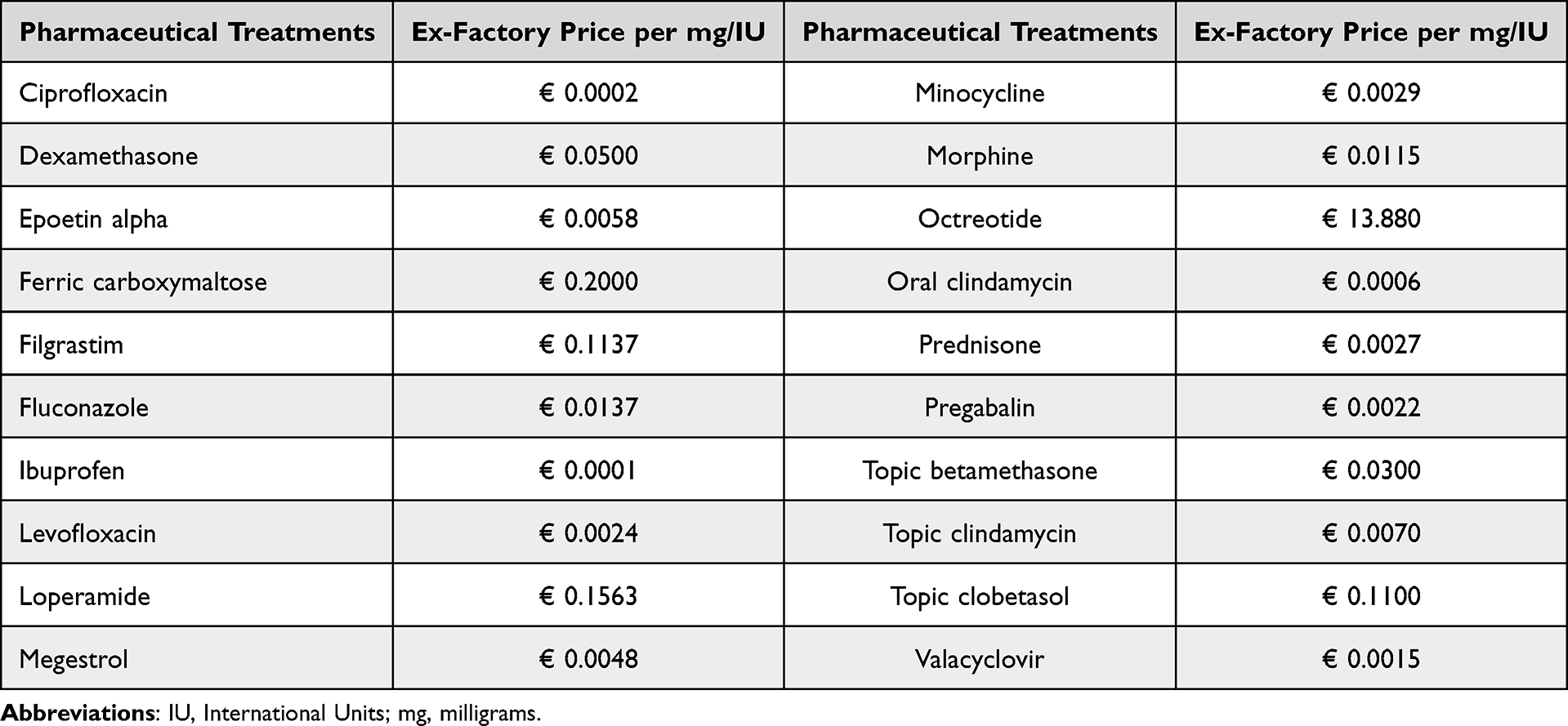 |
Table 2 Price per mg or IU of Pharmaceutical Treatments (€, 2025) |
Results
Considering the resource consumption estimated by the expert panel for each of the AEs included in this analysis, the total cost associated with the management of grade ≥3 AEs occurring in patients with mCRC receiving 3L+ of treatment ranged from € 300.19 per patient for the management of hypertension to € 3335.11 per patient for the management of increased bilirubin. In most cases, AEs were managed by visits to specialists or to the emergency department, except for diarrhea, neutropenia and increased bilirubin, where the highest cost was associated with hospital admissions. Regarding visits, the oncologist was the specialist with the highest number of visits to resolve an AE. Among all AEs, hand-foot syndrome and hypertension had the highest rate of specialist visits, with these visits representing 99.5% and 98.0% of the total cost, respectively (Table 3).
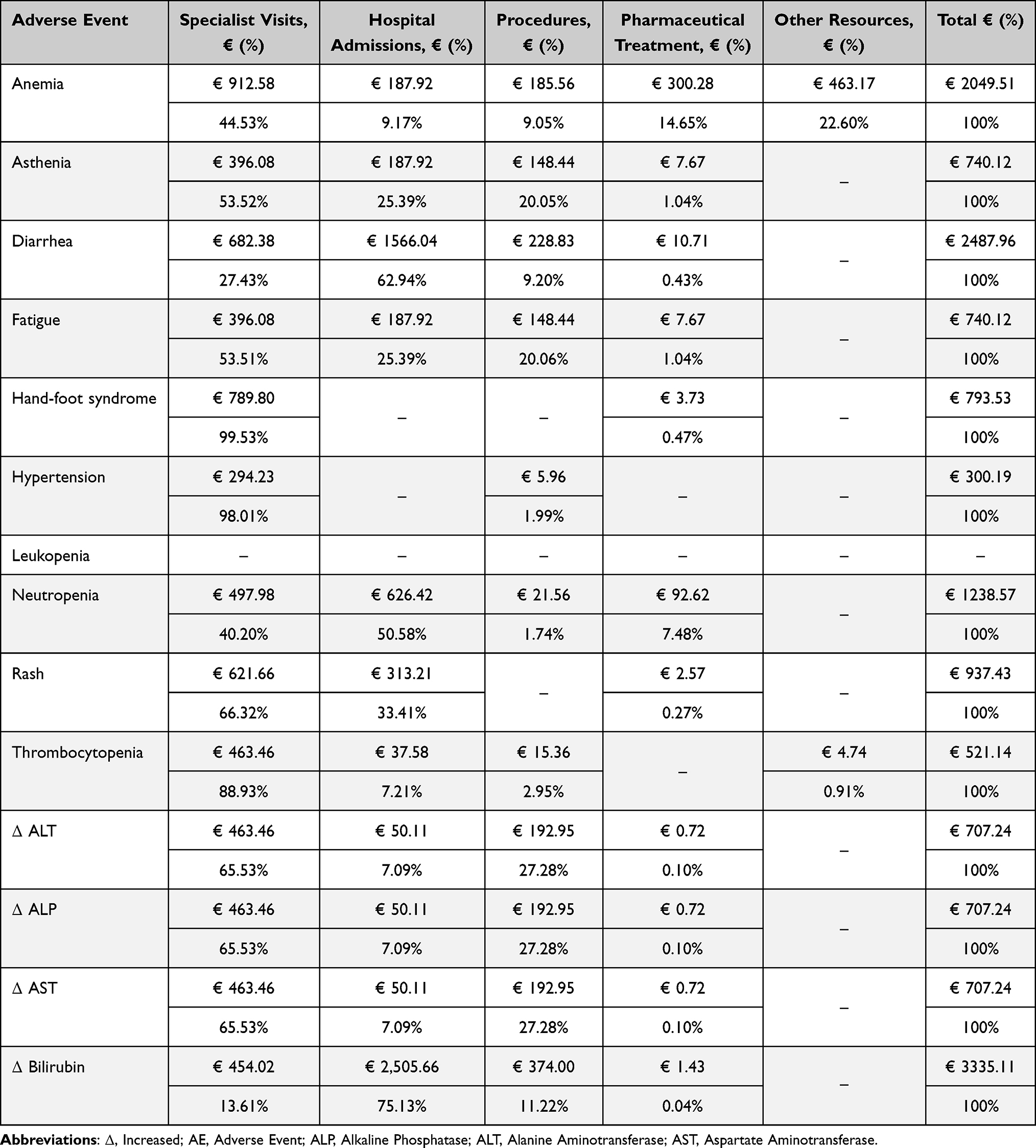 |
Table 3 Management Mean Cost per AE and by Type of Resource |
In relation to leukopenia, the expert panel consulted mentioned that its management does not represent an additional cost as it is usually related to neutropenia; therefore, in the analysis, it was assumed that any potential cost related to leukopenia would be implicitly included in the cost associated with the management of neutropenia.
Figure 2 shows the total cost associated with the management of each of the AEs considered in the model.
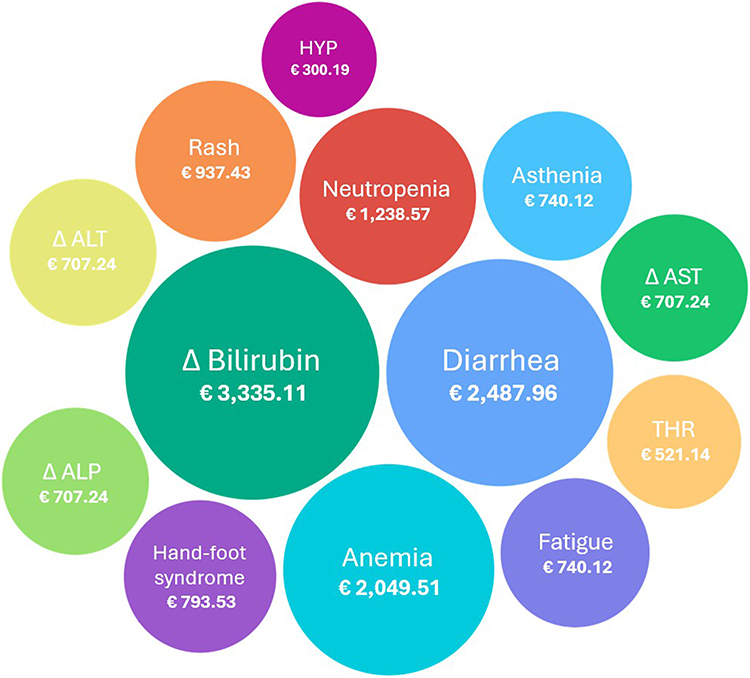 |
Figure 2 Total cost associated with the management of each of the AE assessed. Abbreviations: Δ, Increased; ALP, Alkaline phosphatase; ALT, Alanine aminotransferase; AST, Aspartate aminotransferase; HYP, Hypertension; THR, Thrombocytopenia. |
Adjusting AEs for reported incidence in the main studies, the total cost associated with the management of AEs with fruquintinib in FRESCO and FRESCO-2 was € 284.54 and € 301.82, respectively. For regorafenib (CORRECT), the total cost was € 1158.76. With T/T, the total cost was € 750.56 and € 1383.57 in SUNLIGHT and RECOURSE, respectively. The total cost for T/T + bevacizumab was € 749.91 in SUNLIGHT. Those AEs with the greatest economic impact were hand-foot syndrome (€ 85.63) and diarrhea (€ 71.60) for fruquintinib in FRESCO and FRESCO-2 respectively; increased bilirubin (€ 407.55) for regorafenib in CORRECT; neutropenia (€ 397.75 - € 469.16) for T/T in RECOURSE and SUNLIGHT; and finally, neutropenia (€ 533.69) for T/T plus bevacizumab in SUNLIGHT. Table 4 and Figure 3 shows the total mean cost of grade ≥3 AE between the studies.
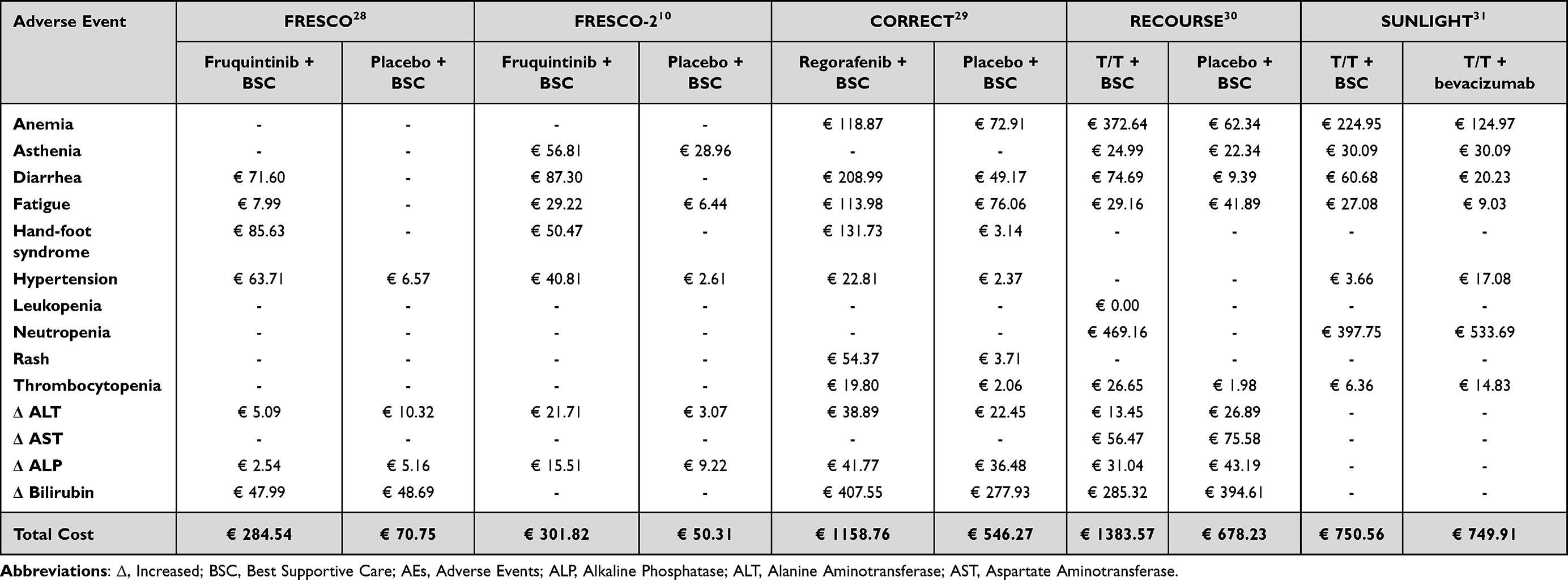 |
Table 4 Total Mean Cost of AEs Between FRESCO, FRESCO-2, CORRECT, RECOURSE and SUNLIGHT Studies |
 |
Figure 3 Total costs of AEs management for each therapeutic alternative. Abbreviations: AEs, Adverse Events; ALP, Alkaline Phosphatase; ALT, Alanine Aminotransferase; AST, Aspartate Aminotransferase; BSC, Best Supportive Care; T/T, Trifluridine/Tipiracil. |
When comparing the results across the different studies, fruquintinib showed the lowest incremental costs among the respective treatment arms. For its part, the DID method associated fruquintinib in FRESCO and FRESCO-2 with a cost reduction of € 360.98 - € 398.70 and € 453.83 - € 491.55 compared to regorafenib in CORRECT and T/T in RECOURSE, respectively. Table 5 shows the anchor-based comparison of AEs cost with placebo + BSC as the common comparator.
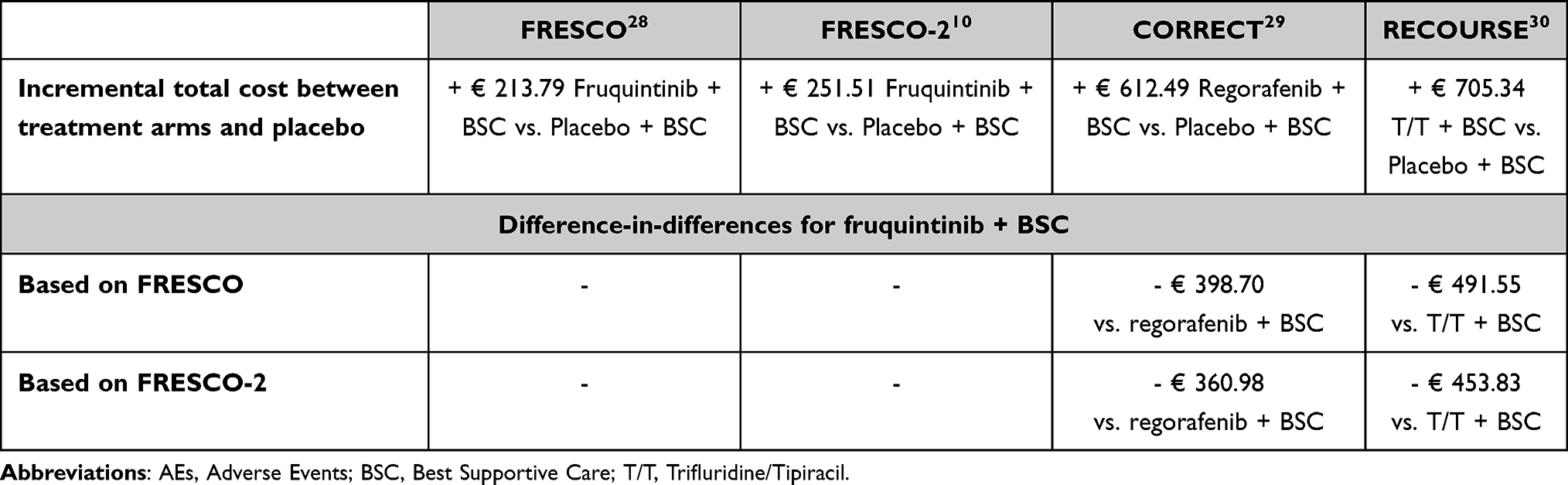 |
Table 5 Difference-in-Differences Analysis of AEs Management Costs by Treatment |
Discussion
CRC is an ongoing public health problem and is the second leading cause of cancer deaths worldwide and the first leading cause of cancer deaths in Spain in the coming years.2,3,36 Advances in therapies have improved both survival and QoL for patients. However, longer survival also increases healthcare resource use due to extended treatment and patient follow-up. Also, because these patients have already received multiple prior lines of therapy, they are often more vulnerable, and managing advanced stages of diseases such as mCRC requires closer monitoring and greater resource utilization.
This analysis provided detailed estimates about the health resource consumption and the total cost, associated with the management of the most frequent grade ≥3 AEs related to late-line treatments (fruquintinib, regorafenib, T/T and T/T + bevacizumab) of patients with mCRC from the Spanish NHS perspective. The type and proportion of those grade ≥3 AEs reported for fruquintinib, when comparing to regorafenib, T/T, and T/T plus bevacizumab in their respective pivotal trials, reflected a decrement in healthcare resource use associated with AEs management cost. Among the assessed clinical trials, the three AEs with the highest economic impact related to their management in the mCRC population due to late-line therapies were increased bilirubin, diarrhea and anemia, in which the economic expenditure was normally driven by inpatient care and secondly by specialist visits. For the rest of the AEs, given that most of cases were managed through specialist visits, these yielded the least impact on costs.
For the present analysis, the most common grade ≥3 AEs were considered, and validated by an expert panel. Other cost analyses conducted within the context of the Spanish healthcare system in the field of oncology have also included the management cost of AEs as part of broader economic evaluations.37–39 However, the large differences observed—such as the type of illness, drug therapy, population treated, AEs considered, year of evaluation, and others—cause substantial cost disparities in the results, making it difficult to compare our findings directly with these studies. In some adverse events, such as hypertension, costs may be underestimated because these conditions can evolve into chronic episodes requiring follow‑up in primary care. However, based on expert opinion, these long‑term management costs were not considered clinically or economically significant within the scope of this study. Therefore, only the acute, treatment‑related costs of severe AEs were included in the analysis.
A cost analysis model conducted with a methodological approach and population similar to those used in the present study has been published in the USA.32 Although the study population consisted of patients with mCRC treated with late-line therapies, likewise, structural differences between healthcare systems and currency exchange rates make direct comparison difficult. Nevertheless, our findings appear to be in line with the referenced publication. The study showed that fruquintinib was less costly relative to managing AEs compared to the other late-line treatments for mCRC. Both studies also highlight that the treatment of grade ≥3 hematologic AEs was a cost driver, with the highest prevalence rates reported in T/T and T/T + bevacizumab.
Beyond the economic impact, severe AEs equally affect QoL, which is also an important input to consider. At the point of latest line treatments, the best treatment has to consist not only in improving overall survival, but also in improving the patient’s QoL, making them feel as comfortable and self-sufficient as possible.40 The AEs associated with mCRC treatments may worsen patient’s QoL, and as a result, different Health Technologies Assessments bodies currently recognize QoL and patient reported outcomes as a key endpoint to assess in the approval process of oncology therapies.27,41
The current study is not exempt from limitations. First, AEs management costs were estimated only for those graded 3 or more. Thus, costs associated with grade 1 or 2 AEs and costs incurred in outpatient settings were not considered in the model. However, this approach is supported by the fact that, typically, only AEs grade ≥3 requires close follow-up of the patient, as well as that grade ≥3 AEs are commonly the only ones that require treatments/procedures in the hospital setting. Also, in this cost analysis, hospital admissions and specialist visits accounted for the major expense in the management of AEs. Despite all, this approach may result in underestimation of the actual costs incurred during AEs management. Another limitation inherent to healthcare economic models is the need for assumptions and therefore the uncertainty of values such as those associated with standard clinical practice. Therefore, in this analysis, due to the lack of published data, the resource consumption had been estimated based on an expert panel opinion.
Conclusions
In conclusion, despite the limitations mentioned above, the results of this analysis show the economic impact for the NHS in the management of each of the selected AEs experienced by patients with mCRC who had received at least two prior lines of treatment in Spain. Furthermore, this analysis proves that the costs associated with AEs are widely different between treatments for patients with mCRC in advanced stages of the disease. Considering the incremental cost between study arms, fruquintinib may lead to a range of cost reductions of € 448 - € 465 compared to T/T + bevacizumab, € 857 - € 874 versus regorafenib and € 466 - € 1099 compared to T/T. Therefore, the use of fruquintinib could reduce the costs associated with the management of AEs for the NHS, as fruquintinib achieves lower AEs incidence rates compared to the other late-line therapeutic alternatives in mCRC considered in the analysis. Finally, this analysis could be useful for clinical decision-making on treatment optimization in mCRC, providing information on AEs and associated management costs that may complement clinical efficacy.
Medical Writing Support
Medical writing support for the development of this manuscript, under the direction of the authors, was provided by IOM of PORIB, funded by Takeda and complied with the Good Publication Practice (GPP) guidelines (De Tora LM et al. Ann Intern Med 2022;175:1298-304).
Data Sharing Statement
The data presented in this study are available upon reasonable request from the corresponding author.
Ethics Approval
Ethical approval is considered not applicable and unnecessary according to national regulations, as this is not a study collecting patient-level data. Therefore, as it is not a study, informed consent does not apply.
Author Contributions
All authors made a significant contribution to the work reported, whether that is in the conception, study design, execution, acquisition of data, analysis and interpretation, or in all these areas; took part in drafting, revising or critically reviewing the article; gave final approval of the version to be published; have agreed on the journal to which the article has been submitted; and agree to be accountable for all aspects of the work.
Funding
This study was supported by Takeda.
Disclosure
Itziar Oyagüez, María Mareque and Paula Castro Albarrán are employees of Pharmacoeconomics & Outcomes Research Iberia (PORIB), a consultant company specializing in health technology assessment, which has received financial support from Takeda to conduct the development of the present work. Ana Fernández has received support from Roche, Merck, and Takeda to attend conferences and courses, and has also received fees as a speaker (conferences and courses) or consultant from Amgen, Bayer, BMS, GSK, Merck, MSD, Pierre Fabre, Servier, Takeda, Astra Zeneca, Takeda, Beone, and Leopharma. Beatriz González Astorga has received support from Roche, Amgen and Takeda to attend conferences and courses, and has also received fees as a speaker (conferences and courses) or consultant from Amgen, Roche, Merck, MSD, Servier and Takeda. María José Safont has received support from Amgen, Merck, Servier and Takeda to attend conferences and courses, and has also received fees as a speaker (conferences and courses) or consultant from Amgen, Bayer, BMS, GSK, Merck, MSD, Pierre Fabre, Servier and Takeda. The authors hereby declare that this economic support has not interfered with development of this project. The authors state that the sponsor did not participate or influence the analysis of the present study or the interpretations of its results. The authors have no other relevant affiliations or financial involvement with any organization or entity with a financial interest in or financial conflict with the subject matter or materials discussed in the manuscript apart from those disclosed.
References
1. Cáncer de colon y recto - SEOM: sociedad Española de Oncología Médica © 2019. Available from: https://seom.org/info-sobre-el-cancer/colon-recto?showall=1&showall=1.
2. Cáncer colorrectal. Available from: https://www.who.int/es/news-room/fact-sheets/detail/colorectal-cancer.
3. Sociedad Española de Oncología Médica (SEOM). Las cifras del cáncer en España, 2025. Available from: https://www.seom.org/images/LAS_CIFRAS_DMC2025.pdf.
4. Red Española de Registros de Cáncer (REDECAN). Estimación de la incidencia de cáncer en España. Available from: https://redecan.org/storage/documentation/442e1d1a-4040-4674-81cf-5e6a67af6458.pdf.
5. Informe dinámico: cáncer de colon | AECC Observatorio. Available from: https://observatorio.contraelcancer.es/informes/informe-dinamico-cancer-de-colon.
6. Los Avances en Cáncer de Colorrectal - SEOM: sociedad Española de Oncología Médica © 2019. Available from: https://www.seom.org/los-avances-en-cancer-de-colorrectal.
7. Recent trends in SEER age-adjusted incidence rates, 2000-2022. Available from: https://seer.cancer.gov/statistics-network/explorer/application.html.
8. Wu C, Li S, Hou X. A real-world study: third-line treatment options for metastatic colorectal cancer. Front Oncol. 2024;14:1480704. doi:10.3389/fonc.2024.1480704
9. Cervantes A, Adam R, Roselló S, et al. Metastatic colorectal cancer: ESMO clinical practice guideline for diagnosis, treatment and follow-up. Ann Oncol. 2023;34(1):10–13. doi:10.1016/j.annonc.2022.10.003
10. Dasari A, Lonardi S, Garcia-Carbonero R, et al. Fruquintinib versus placebo in patients with refractory metastatic colorectal cancer (FRESCO-2): an international, multicentre, randomised, double-blind, Phase 3 study. Lancet. 2023;402(10395):41–53. doi:10.1016/S0140-6736(23)00772-9
11. Bouvier AM, Jooste V, Sanchez-Perez MJ, et al. Differences in the management and survival of metastatic colorectal cancer in Europe. A population-based study. Dig Liver Dis. 2021;53(5):639–645. doi:10.1016/j.dld.2021.01.021
12. Arndt V, Merx H, Stegmaier C, Ziegler H, Brenner H. Quality of life in patients with colorectal cancer 1 year after diagnosis compared with the general population: a population-based study. J Clin Oncol. 2004;22(23):4829–4836. doi:10.1200/JCO.2004.02.018
13. Röhrl K, Guren MG, Astrup GL, Småstuen MC, Rustøen T. High symptom burden is associated with impaired quality of life in colorectal cancer patients during chemotherapy: A prospective longitudinal study. Eur J Oncol Nurs. 2020;44:101679. doi:10.1016/j.ejon.2019.101679
14. Sjövall A, Lagergren P, Johar A, Buchli C. Quality of life and patient reported symptoms after colorectal cancer in a Swedish population. Colorectal Dis. 2023;25(2):191–201. doi:10.1111/codi.16332
15. Montes AF, Alonso V, Aranda E, et al. SEOM-GEMCAD-TTD clinical guidelines for the systemic treatment of metastatic colorectal cancer. Clin Transl Oncol. 2022;9:2718–2731.
16. Bekaii-Saab T. A decade of progress: advances in the third-line treatment of patients with metastatic colorectal cancer. Am J Manag Care. 2024;30(2 Suppl):S23–30.
17. Koopman M, Garcia-Carbonero R, Pinto C, et al. Continuum of care and survival in patients with metastatic colorectal cancer: results of the real-world prospective, longitudinal cohort PROMETCO study. ESMO Gastrointestinal Oncol. 2025;9:100214. doi:10.1016/j.esmogo.2025.100214
18. Tabernero J, Ros J, Élez E. The evolving treatment landscape in BRAF-V600E–mutated metastatic colorectal cancer. Am Soc Clin Oncol Educ Book. 2022;42:254–263. doi:10.1200/EDBK_349561
19. Stintzing S, Tabernero J, Satoh T, et al. Quality-adjusted survival in patients with metastatic colorectal cancer treated with fruquintinib plus best supportive care: results from FRESCO-2. ESMO Open. 2025;10(3):104297. doi:10.1016/j.esmoop.2025.104297
20. European Medicines Agency (EMA). Stivarga EPAR (Product Information). Available from: https://www.ema.europa.eu/en/documents/product-information/stivarga-epar-product-information_en.pdf.
21. European Medicines Agency (EMA). Fruzaqla. EPAR (Product information). Available from: https://www.ema.europa.eu/en/documents/product-information/fruzaqla-epar-product-information_en.pdf.
22. European Medicines Agency (EMA). Lonsurf. EPAR (Product information). Available from: https://www.ema.europa.eu/en/documents/product-information/lonsurf-epar-product-information_en.pdf.
23. European Medicines Agency (EMA). Avastin EPAR (Product information). Available from: https://www.ema.europa.eu/en/documents/product-information/avastin-epar-product-information_en.pdf.
24. Bachet JB, Wyrwicz L, Price T, et al. Safety, efficacy and patient-reported outcomes with trifluridine/tipiracil in pretreated metastatic colorectal cancer: results of the PRECONNECT study. ESMO Open. 2020;5(3):e000698. doi:10.1136/esmoopen-2020-000698
25. Schuurhuizen CSEW, Braamse AMJ, Konings IRHM, et al. Does severe toxicity affect global quality of life in patients with metastatic colorectal cancer during palliative systemic treatment? A systematic review. Ann Oncol. 2017;28(3):478–486. doi:10.1093/annonc/mdw617
26. Durand M, Castelli C, Roux-Marson C, Kinowski JM, Leguelinel-Blache G. Evaluating the costs of adverse drug events in hospitalized patients: a systematic review. Health Econ Rev. 2024;14(1):11. doi:10.1186/s13561-024-00481-y
27. European Medicines Agency (EMA). From laboratory to patient: the journey of a medicine assessed by EMA. Available from: https://www.ema.europa.eu/en/documents/other/laboratory-patient-journey-centrally-authorised-medicine_en.pdf.
28. Li J, Qin S, Xu RH, et al. Effect of Fruquintinib vs Placebo on overall survival in patients with previously treated metastatic colorectal cancer: the FRESCO randomized clinical trial. JAMA. 2018;319(24):2486–2496. doi:10.1001/jama.2018.7855
29. Axel G, Eric VC, Alberto S, et al. Regorafenib monotherapy for previously treated metastatic colorectal cancer (CORRECT): an international, multicentre, randomised, placebo-controlled, phase 3 trial. Lancet. 2013;381(9863):303–312.
30. Mayer RJ, Van Cutsem E, Falcone A, et al. Randomized trial of Tas-102 for refractory metastatic colorectal cancer (RECOURSE). N Engl J Med. 2015;372(20):1909–1919. doi:10.1056/NEJMoa1414325
31. Prager GW, Taieb J, Fakih M, et al. Trifluridine-Tipiracil and Bevacizumab in refractory metastatic colorectal cancer (SUNLIGHT). N Engl J Med. 2023;388(18):1657–1667. doi:10.1056/NEJMoa2214963
32. Paly VF, Dasari A, Hubbard J, Bekaii-Saab T, Padukkavidana T, Hernandez L. Adverse event costs of systemic therapies for metastatic colorectal cancer previously treated with fluoropyrimidine-, oxaliplatin- and irinotecan-based chemotherapy and biologics in the US. J Comp Eff Res. 2024;13(8):e240084. doi:10.57264/cer-2024-0084
33. Oblikue - Base de conocimiento de costes y precios del sector sanitario. Available from: http://esalud.oblikue.com/.
34. Consejo General de Colegios Oficiales de Farmacéuticos. Base de datos del Conocimiento Sanitario - Bot Plus 2.0. Available from: https://botplusweb.portalfarma.com/.
35. BOE-A-2010-8228 Real Decreto-ley 8/2010, de 20 de mayo, por el que se adoptan medidas extraordinarias para la reducción del déficit público. Available from: https://www.boe.es/buscar/act.php?id=BOE-A-2010-8228.
36. Red Española de Registros de Cáncer (REDECAN). Estimaciones de la incidencia del cáncer en España, 2024. Available from: https://redecan.org/storage/documents/031b5800-a7fe-4c2b-8a09-a38d046365df.pdf.
37. Isla D, De Castro J, Juan O, et al. Costs of adverse events associated with erlotinib or Afatinib in first-line treatment of advanced EGFR-positive non-small cell lung cancer. Clinicoecon Outcomes Res. 2016;9:31–38. doi:10.2147/CEOR.S121093
38. Ojeda B, de Sande LM, Casado A, Merino P, Casado MA. Cost-minimisation analysis of pegylated liposomal doxorubicin hydrochloride versus topotecan in the treatment of patients with recurrent epithelial ovarian cancer in Spain. Br J Cancer. 2003;89(6):1002–1007. doi:10.1038/sj.bjc.6601228
39. Pericay C, Frías C, Abad A, et al. Análisis coste-efectividad de aflibercept en combinación con FOLFIRI en el tratamiento de pacientes con cáncer colorrectal metastásico.
40. Fakih M, Prager GW, Tabernero J, Amellal N, Calleja E, Taieb J. Clinically meaningful outcomes in refractory metastatic colorectal cancer: a decade of defining and raising the bar. ESMO Open. 2024;9(11):103931. doi:10.1016/j.esmoop.2024.103931
41. Bonnetain F, Borg C, Adams RR, et al. How health-related quality of life assessment should be used in advanced colorectal cancer clinical trials. Ann Oncol. 2017;28(9):2077–2085. doi:10.1093/annonc/mdx191
 © 2026 The Author(s). This work is published and licensed by Dove Medical Press Limited. The
full terms of this license are available at https://www.dovepress.com/terms
and incorporate the Creative Commons Attribution
- Non Commercial (unported, 4.0) License.
By accessing the work you hereby accept the Terms. Non-commercial uses of the work are permitted
without any further permission from Dove Medical Press Limited, provided the work is properly
attributed. For permission for commercial use of this work, please see paragraphs 4.2 and 5 of our Terms.
© 2026 The Author(s). This work is published and licensed by Dove Medical Press Limited. The
full terms of this license are available at https://www.dovepress.com/terms
and incorporate the Creative Commons Attribution
- Non Commercial (unported, 4.0) License.
By accessing the work you hereby accept the Terms. Non-commercial uses of the work are permitted
without any further permission from Dove Medical Press Limited, provided the work is properly
attributed. For permission for commercial use of this work, please see paragraphs 4.2 and 5 of our Terms.