
Back to Journals » Advances in Medical Education and Practice » Volume 17
Application of the Flipped Classroom Teaching Model Integrated with the Feynman Learning Method in Cardiovascular Ultrasound Postgraduate Teaching: An Action Research
Authors Zhang Y, Ye Q, Zhang Y, Liu Y, Cao Y
Received 23 February 2026
Accepted for publication 30 June 2026
Published 9 July 2026 Volume 2026:17 603133
DOI https://doi.org/10.2147/AMEP.S603133
Checked for plagiarism Yes
Review by Single anonymous peer review
Peer reviewer comments 3
Editor who approved publication: Dr Md Anwarul Azim Majumder
Yuke Zhang,1 Qing Ye,2 Yu Zhang,2 Yan Liu,2 Yuan Cao2
1Department of Medical Intensive Care Unit, the First Affiliated Hospital of Shandong First Medical University, Jinan, Shandong, People’s Republic of China; 2Department of Cardiology, Qilu Hospital of Shandong University, National Key Laboratory for Innovation and Transformation of Luobing Theory, The Key Laboratory of Cardiovascular Remodeling and Function Research, Chinese Ministry of Education, Chinese National Health Commission and Chinese Academy of Medical Sciences, Jinan, Shandong, People’s Republic of China
Correspondence: Yuan Cao, Department of Cardiology, Qilu Hospital of Shandong University, National Key Laboratory for Innovation and Transformation of Luobing Theory, The Key Laboratory of Cardiovascular Remodeling and Function Research, Chinese Ministry of Education, Chinese National Health Commission and Chinese Academy of Medical Sciences, 107 Wenhua West Road, Jinan, Shandong, 250012, People’s Republic of China, Tel +86-18560086561, Email [email protected]
Purpose: Medical postgraduates face a growing volume of knowledge, heavy research workload, and inefficient traditional teaching methods. Cardiovascular ultrasound teaching is particularly challenging due to its high theoretical and clinical requirements. This exploratory study evaluated the effect of a flipped classroom combined with the Feynman Learning Method in cardiovascular ultrasound teaching for postgraduates, aiming to improve teaching quality and teachers’ pedagogical skills.
Methods: Seventy-eight third-year postgraduates majoring in ultrasound medicine under standardized residency training at Qilu Medical College of Shandong University from September 2024 to February 2025 were divided into two groups based on training order: a control group (n=38) receiving conventional teaching plus bedside instruction, and an experimental group (n=40) receiving integrated teaching with pre-method training. Both groups used the same case library and followed the same teaching schedule for a 20-week intervention. Data from theoretical and practical exams, as well as questionnaires, were statistically analyzed using SPSS 20.0 software.
Results: There were no significant differences in gender or age between the two groups at baseline (p > 0.05). The experimental group achieved significantly higher scores in theoretical (85.3± 8.17) and practical (83.4± 8.58) exams, as well as higher overall exam pass rates (all p < 0.001). Eighty-five percent of students and 87.5% of teachers accepted the integrated model and confirmed its role in enhancing learning outcomes and teaching skills. While 70% of students reported considerable out-of-class time investment (only 37.5% were willing to continue using the model), 87.5% of teachers recognized its high value for promoting clinical teaching.
Conclusion: The student-centered integrated teaching model effectively improves postgraduates’ academic performance and teachers’ teaching competence through the “learning-by-teaching” approach, making it a valuable pedagogical reform for cardiovascular ultrasound education. It provides a solid foundation for further validation; however, its large-scale application requires full consideration of postgraduates’ practical challenges, such as heavy research pressure and time limitations.
Keywords: cardiovascular ultrasound, flipped classroom, Feynman Learning Method, medical postgraduates, medical education reform
Introduction
Currently, China’s medical postgraduate education faces growing challenges. Driven by big data, electronic information, and artificial intelligence (AI), the volume of medical knowledge has expanded rapidly.1 Medical postgraduates are required to master an increasingly large body of professional knowledge across multiple disciplines. At the same time, they face mounting employment pressure, as employers set higher academic standards. However, both medical students and employers have gradually reduced their emphasis on theoretical knowledge and clinical skills. In fact, postgraduates bear excessive scientific research burdens, leaving them with insufficient time and energy to acquire theoretical knowledge and practice clinical skills.2–4 In this context, improving the quality of medical education requires students to recognize the importance of active learning from both internal and external perspectives.
Cardiovascular ultrasound medicine is a discipline that requires strong professional theoretical knowledge and proficient practical skills.5 Practitioners must have solid theoretical foundations and rich clinical experience to perform their daily work competently.6,7 Under traditional teaching models, students cannot fully exert their subjective initiative, leading to suboptimal teaching results.8 Therefore, there is an urgent need to reform teaching methods to stimulate students’ enthusiasm and active participation, thereby improving overall teaching effectiveness.
Two widely accepted teaching approaches merit attention: the Feynman Learning Method and the flipped classroom model. Developed by the renowned physicist and educator Richard Feynman, the Feynman Learning Method is based on the core principle of “learning by teaching”.9,10 It consists of four steps: (1) independently learning and internalizing knowledge; (2) hypothetically teaching the mastered content to a novice without prior exposure to the subject; (3) reorganizing, reviewing, and simplifying key knowledge points; (4) explaining the knowledge in the simplest terms.11,12 This method has achieved positive results in the teaching of some medical disciplines.13 The flipped classroom concept emerged at the University of Miami in the United States in 2000, and its practical application began at Woodland Park High School in Colorado, United States, in 2007.14–16 As a student-centered model, it shifts the classroom focus from teachers to students and restructures the learning content. Specifically, traditional lecture materials are provided to students through videos, courseware, and other resources for self-paced learning outside class, while in-class time is used for students to discuss and resolve questions with teachers.15,17 Its core is to position students as the main participants in teaching and learning. Notably, the two approaches share key commonalities: they are student-centered, emphasize “learning by teaching”, and can maximize students’ subjective initiative.
Teaching practices in various disciplines have confirmed that the Feynman Learning Method and the flipped classroom model have similar effects in optimizing teaching outcomes and are complementary to each other11,13,18. Both follow a “learning-teaching-relearning” cycle and adopt an “input-output-further deepening” model, helping students firmly master professional theories and practical skills.11,13,18,19 Existing studies have explored the application of the integrated teaching model combining the Feynman Learning Method and the flipped classroom in specific medical disciplines.20 Due to the inherent dynamic and high-risk nature of cardiovascular ultrasound medicine, it has long been a major challenge in teaching.5,7 In this study, we aim to improve the teaching process of cardiovascular ultrasound medicine by integrating the Feynman Learning Method into the flipped classroom model, and to explore the effectiveness of this integrated approach in improving teaching quality and teachers’ instructional capabilities. This study will be conducted as an action study among postgraduates majoring in ultrasound medicine who are also participating in standardized residency training, in line with current Chinese medical education requirements. The main objectives of this exploratory study are to address practical issues in clinical teaching, initially investigate the teaching effectiveness of this model, and provide timely feedback—all of which are consistent with the actual situation of clinical education in China.
Methods
Study Subjects
We recruited third-year professional master’s students specializing in ultrasound medicine at Qilu Medical College of Shandong University who were also undergoing standardized residency training, from September 2024 to February 2025. Students were assigned to Group A (control group) and Group B (experimental group) based on the order of their enrollment in cardiovascular ultrasound teaching training. Each group corresponded to one class, with students randomly assigned to classes according to their entrance examination scores. This grouping method balances baseline data between groups without disrupting normal teaching order. Group A received conventional teaching, including centralized classroom lectures and bedside teaching, while Group B was taught using the flipped classroom model integrated with the Feynman Learning Method. This study complied with the Declaration of Helsinki, and all participants signed informed consent forms.
Study Design
Action Research
This study used an action research protocol rather than a randomized controlled trial (RCT) design. Action research is an exploratory approach defined by a spiral cyclic framework, following the plan–act–observe–reflect cycle. It allows for iterative refinement of research protocols during implementation and real-time adjustment of intervention strategies based on feedback from teaching practice, thereby addressing on-site challenges and closely aligning with the realities of clinical education.21,22 As an exploratory method, action research focuses on qualitative data analysis, supplemented by quantitative data comparison, and can lay the foundation for identifying research topics for confirmatory designs such as RCTs.21,23 During the study, questionnaires were distributed to students and instructors in the experimental group for qualitative analysis. The primary goals of this study were to solve practical problems in clinical teaching, initially explore the pedagogical effectiveness of this teaching model, and provide timely feedback—all of which are consistent with the current state of clinical education in China.
Pre-Experimental Training
Prior to formal experiment initiation, senior clinical preceptors with relevant expertise provided systematic training on the Feynman Learning Method and flipped classroom model to students in the experimental group, to ensure their understanding and acceptance of the integrated flipped classroom model incorporating the Feynman Learning Method.
Experimental Protocol
Step 1: The teaching content specified in the cardiovascular ultrasound syllabus was systematically refined and summarized to establish a teaching case library, which was collectively developed by the teaching faculty and included both theoretical and practical modules. For the practical component, students first practiced on standardized patients in accordance with standard operating procedures (SOPs) under faculty guidance before delivering teaching content during flipped classroom sessions. Following an incremental difficulty progression, corresponding case entries were provided to experimental group students for pre-class preparation before each flipped classroom session. The control group received traditional didactic teaching using the same case library and teaching sequence.
Step 2: Implementation procedures for the flipped classroom teaching model integrated with the Feynman Learning Method were established (Figure 1 shows the detailed flowchart). The experiment lasted 20 weeks (one academic semester), with two instructional sessions per week.
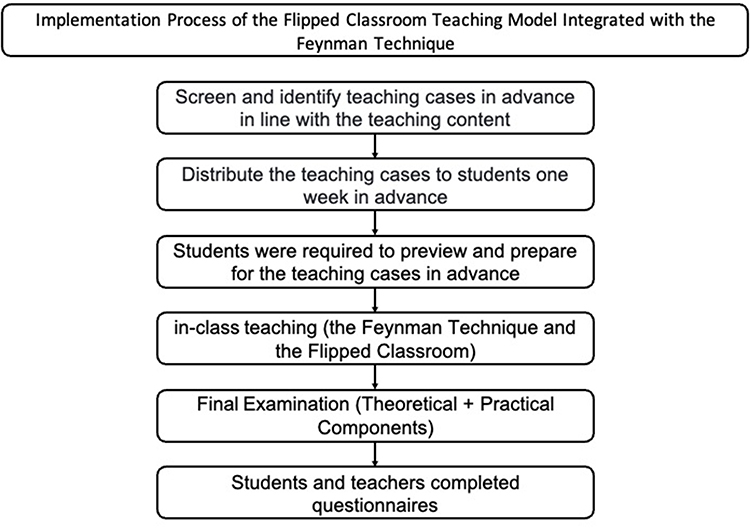 |
Figure 1 Implementation process of the flipped classroom integrated with the Feynman Learning Method. |
Step 3: Final examination questions (paper-based, open-ended, including theoretical and practical sections) and specialized paper-based questionnaires for students and teachers were designed. Both groups used the same examination method. The examination questions covered the breadth and depth of the curriculum, and the questionnaires were assessed for reliability and validity by epidemiological experts. The complete set of examination questions and questionnaires is available in Figure S1.
Step 4: At the end of the semester, after teaching activities were completed, questionnaires were distributed to students and teachers in the experimental group, and students in both groups took the final examination simultaneously.
Statistical Analysis
Quantitative data were presented as mean ± standard deviation (SD) and subjected to statistical analysis using the t-test. Comparisons of categorical variables (rates) were performed via the chi-square (χ2) test. All statistical analyses were conducted using SPSS 20.0 software, with a two-tailed p-value < 0.05 considered statistically significant.
Results
General Characteristics of the Study Participants
The experimental group included 40 students (15 males and 25 females) with a mean age of 25.9 ± 0.54 years, while the control group consisted of 38 students (12 males and 26 females) with a mean age of 26.0 ± 0.56 years. No statistically significant differences were observed in gender distribution or age between the two groups (both p > 0.05).
Analysis of Examination Results
A systematic analysis was conducted on the questionnaires completed by students and teachers in the experimental group, with the key findings summarized as follows:
Among students in the experimental group, the awareness rate of the Feynman Learning Method was 45% (12/40), while the awareness rate of the flipped classroom model was 17.5% (7/40). Regarding the novel flipped classroom model integrated with the Feynman Learning Method: 85% (34/40) of students accepted this teaching model; 80% (32/40) perceived a significant facilitative effect on learning compared with traditional teaching methods; 70% (28/40) reported a more rigorous learning attitude; 67.5% (27/40) observed improvements in their expressive and critical thinking abilities; 27.5% (11/40) expressed a willingness to continue adopting this model; 70% (28/40) indicated that the model increased their extracurricular learning time; 65% (26/40) regarded the model as an additional learning burden; 37.5% (15/40) acknowledged the model’s potential for promotion.
Among the 8 participating teachers: the awareness rate of the novel teaching model was 75% (6/8); The acceptance rate reached 87.5% (7/8); 87.5% (7/8) reported enhancements in their teaching competence through the model; 87.5% (7/8) recognized the model’s value for promotion across broader disciplines.
A comparison of the examination scores of the two groups is presented in Figure 2. Score analysis indicated that the mean theoretical score of the experimental group was 85.3±8.17, while that of the control group was 79.21±9.19, with a statistically significant difference between the two groups (p < 0.001, Figure 2A). The mean practical score of the experimental group was 83.4±8.58, compared with 77.05±8.43 in the control group, and the difference was statistically significant (p < 0.001, Figure 2B).
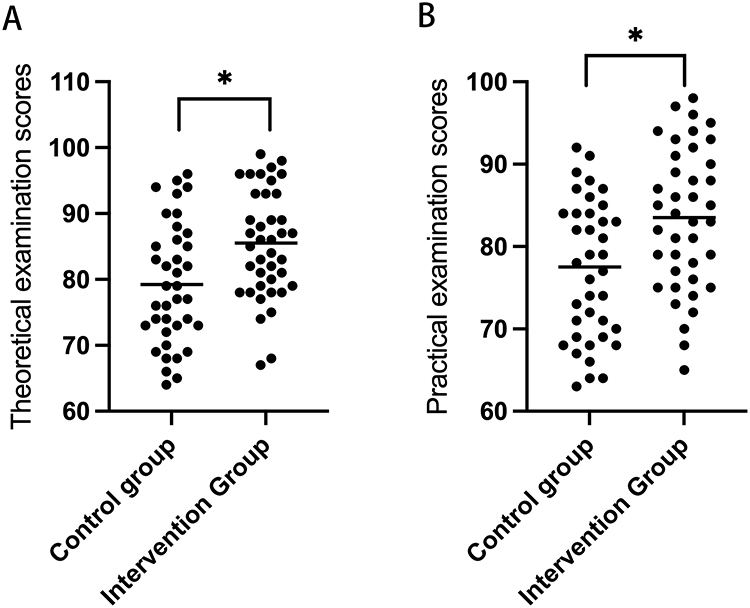 |
Figure 2 Comparison of final examination scores. (A) Comparison of theoretical scores between the experimental group and the control group. (B) Comparison of practical scores between the experimental group and the control group. *p < 0.001. |
Analysis of the examination pass rates revealed that the theoretical examination pass rates of the experimental group and the control group were 95% (38/40) and 81.6% (31/38), respectively, with a statistically significant difference (p < 0.001). The practical examination pass rates of the experimental group and the control group were 100% (40/40) and 92.1% (35/38), respectively, and the difference was also statistically significant (p < 0.001).
Discussion
Our findings show that the flipped classroom model integrated with the Feynman Learning Method significantly improves examination scores and pass rates of postgraduates in cardiovascular ultrasound clinical teaching. Qualitative analysis also revealed high acceptance of this model among both students and teachers, who recognized its effectiveness in enhancing learning and teaching performance. Teachers were more likely to advocate for its promotion, but a considerable proportion of students had reservations about its widespread implementation.
Cardiovascular ultrasound is one of the more challenging clinical disciplines.5,7 It is abstract and dynamic, requiring strong spatial imagination and operational skills. Additionally, cardiovascular diseases are diverse, with often atypical ultrasonic imaging manifestations that demand high diagnostic differentiation capabilities. Furthermore, diagnostic reports frequently serve as key references for cardiovascular surgery, imposing significant professional responsibilities.5,7 With conventional teaching methods, students passively acquire knowledge with superficial understanding and inadequate mastery. This leaves them with insufficient professional knowledge and practical skills when entering clinical practice after graduation—some even need to re-learn relevant content from scratch,15,17 inevitably wasting educational resources and personal effort.13 Our findings indicate that the innovative flipped classroom model embedded with the Feynman Learning Method effectively addresses these issues. While several international studies have preliminarily explored this integrated teaching model,11,13,18 no reports have been published on its application in cardiovascular ultrasound teaching to date.
Our results demonstrate that students taught via the flipped classroom model integrated with the Feynman Learning Method achieved significantly higher examination scores and pass rates than those in the conventional teaching group. This aligns with findings reported by Song et al20 confirming the superiority of this innovative teaching model in cardiovascular ultrasound education. Qualitative analysis showed high acceptance among participating students and clinical instructors implementing the model. Based on these favorable results, the flipped classroom model integrated with the Feynman Learning Method is a valuable pedagogical reform with considerable potential for broader promotion to deliver greater educational benefits.
However, this may not hold true—at least in China’s current educational context, where popularizing this model is likely to face certain obstacles.24,25 In this study, while 80% of participating students recognized the model’s benefits, only 37.5% endorsed continuing with it when queried. This unexpected discrepancy warrants analysis of its underlying causes, which must be viewed against the current challenges of postgraduate education in China. Qualitative analysis showed that 70% of experimental group students perceived this new teaching model as overly time-consuming. This raises a relevant question: how would this time be used if not allocated to academic learning? In reality, Chinese postgraduates currently face an increasingly complex environment and a grim employment outlook. A large portion of their time during postgraduate studies—whether actively or passively—is devoted to research projects, a trend that is intensifying into an unproductive “rat race”.4,26 As a result, time available for coursework is drastically reduced, leaving students insufficient time to engage in the flipped classroom model integrated with the Feynman Learning Method, which requires more time investment. Regrettably, while this issue is not new, the status quo is unlikely to change in the short term4. Adjusting postgraduate education goals at the top-level institutional design may help alter this situation, encouraging students to focus more on coursework.4,24 In today’s information society, students in China and other countries face a growing volume of knowledge to learn, inevitably reducing time available for any single specialized field.27,28 Thus, even if students recognize a learning method’s benefits, they are reluctant to adopt it if it requires excessive time.26 One feasible solution is phased implementation: pilot applications in affiliated teaching hospitals of high-level medical universities to allow gradual adaptation by students and teachers, followed by larger-scale promotion.25 Like the flipped classroom and Feynman Learning Method themselves, their development from initial application to widespread promotion followed this same path.12,19
This study has several limitations. First, it was a single-center study with a relatively small sample size. Our institution is among China’s top-tier medical education providers in terms of teaching capacity; thus, to improve generalizability, future RCTs should adopt a multicenter design with large sample sizes, including a broader range of representative medical schools and teaching hospitals. Second, baseline heterogeneity may exist among participants in academic aptitude, learning habits, and supplementary learning strategies, which may have confounded study outcomes. Third, the intervention duration was relatively short (one academic semester), precluding a robust evaluation of the model’s long-term teaching effectiveness. Fourth, reliance on self-reported questionnaires introduces inherent subjectivity and potential response bias.
Conclusions
In Chinese postgraduate medical education, the flipped classroom model integrated with the Feynman Learning Method can fully stimulate students’ subjective initiative, reflect the philosophy of learning through teaching, and promote mutual improvement of teaching and learning. Compared with conventional teaching models, this innovative approach offers distinct advantages: in cardiovascular ultrasound postgraduate teaching, it not only significantly improves students’ examination scores and pass rates but also enhances teachers’ pedagogical skills. Having gained positive recognition from both students and teachers, this model is a valuable initiative for pedagogical reform in clinical medical education.
Action research is an exploratory approach focused on addressing practical teaching challenges, featuring iterative implementation with dynamic adjustments and a continuous feedback mechanism throughout the research process. This paradigm aligns well with the realities of clinical teaching practice, laying a solid empirical foundation for subsequent studies seeking to validate the effectiveness of the flipped classroom model integrated with the Feynman Learning Method.
Despite its considerable promotional potential in improving teaching efficacy, the flipped classroom model integrated with the Feynman Learning Method has elicited divergent attitudes between teachers and students regarding its large-scale implementation. This inconsistency arises from the multifaceted challenges currently facing Chinese postgraduate medical education and thus requires prudent consideration in its future popularization.
Data Sharing Statement
The original contributions presented in the study are included in the article/Supplementary Material, further inquiries can be directed to the corresponding author.
Ethics Information
Ethical approval (No. XYJG2023111) was obtained from the Ethics Committee of Qilu Hospital of Shandong University, with a waiver granted due to the use of anonymized academic data and minimal risk to participants. Informed consent and confidentiality were maintained throughout the study. As the Ethics Committee of Qilu Hospital of Shandong University and the approving authority of this study (Shandong University) followed a joint review process, the ethical approval number of this study is identical to the project number.
Funding
This work was supported by the Postgraduate Education Quality Improvement Program of Shandong Province and Shandong University (XYJG2023111).
Disclosure
The authors report no conflicts of interest in this work.
References
1. Yang C, Chen Y, Qian C, Shi F, Guo Y. The data-intensive research paradigm: challenges and responses in clinical professional graduate education. Front Med. 2025;12:1461863. doi:10.3389/fmed.2025.1461863
2. Li P, Zhao J, Wang J, Zhu S, Wong GWK, Xiao RP. Advancing physician-scientist training in china - challenges, gaps, and future directions. N Engl J Med. 2025;393(9):836–8. doi:10.1056/NEJMp2503525
3. Bao D, Mydin F, Surat S, Lyu Y, Pan D, Cheng Y. Challenge-hindrance stressors and academic engagement among medical postgraduates in china: a moderated mediation model. Psychol Res Behav Manag. 2024;17:1115–1128. doi:10.2147/PRBM.S448844
4. Tie H, Luo Y, Chen D. Thinkings on the reform of medical education system in China. Med Educ Online. 2024;29(1):2302677. doi:10.1080/10872981.2024.2302677
5. Baldassarre LA, Mendes LA, Blankstein R, et al; Writing Committee Members. 2025 ACC/AHA/ASE/ASNC/SCCT/SCMR advanced training statement on advanced cardiovascular imaging: a report of the ACC competency management committee. Circ Cardiovasc Imaging. 2025;18(12):1120. doi:10.1161/HCI.0000000000000088
6. Gorbaty B, Escuardo EV, Gherciuc A, Gherciuc S, Perry TE. Enhancing transesophageal echocardiography training in cardiac anesthesia fellows using wearable eye-tracking technology. J Cardiothorac Vasc Anesth. 2025;39(8):2198–2201. doi:10.1053/j.jvca.2025.04.039
7. Dieden A, Carlson E, Gudmundsson P. Learning echocardiography- what are the challenges and what may favour learning? A qualitative study. BMC Med Educ. 2019;19(1):212. doi:10.1186/s12909-019-1656-1
8. Lau YH, Acharyya S, Wee CWL, et al. Effectiveness of traditional, artificial intelligence-assisted, and virtual reality training modalities for focused cardiac ultrasound skill acquisition: a randomised controlled study. Ultrasound J. 2025;17(1):61. doi:10.1186/s13089-025-00469-7
9. Feynman RP, Leighton RB, Sands M. The Feynman Lectures on Physics. Addison-Wesley Publishing Company; 1963.
10. Wea KN, Dua YS, Elizabeth A. An exploratory study to investigate the implementation of feynman learning method in a physics classroom setting. JISE. 2023;12(3):331–339. doi:10.15294/jise.v12i3.78672
11. Reyes E, Blanco RMF, Doroon DR, et al; University of San Jose-Recoletos, Cebu City, Philippines. Feynman technique as a heutagogical learning strategy for independent and remote learning. RMRJ. 2021;9(2):1–13. doi:10.32871/rmrj2109.02.06
12. Rajesh A, Khan S. Learn like feynman: developing and testing an ai-driven feynman bot. In:
13. Zhang SL, Ren SJ, Zhu DM, et al. Which novel teaching strategy is most recommended in medical education? A systematic review and network meta-analysis. BMC Med Educ. 2024;24(1):1342. doi:10.1186/s12909-024-06291-4
14. French H, Arias-Shah A, Gisondo C, Gray MM. Perspectives: the flipped classroom in graduate medical education. Neoreviews. 2020;21(3):e150–e156. doi:10.1542/neo.21-3-e150
15. Bhavsar MH, Javia HN, Mehta SJ. Flipped classroom versus traditional didactic classroom in medical teaching: a comparative study. Cureus. 2022. doi:10.7759/cureus.23657
16. Angadi NB, Kavi A, Shetty K, Hashilkar NK. Effectiveness of flipped classroom as a teaching–learning method among undergraduate medical students – an interventional study. J Educ Health Promot. 2019;8(1). doi:10.4103/jehp.jehp_163_19
17. Homsanit M. Comparison of academic outcomes of epidemiology and biostatistics course between traditional lecture and flipped classroom blended approach in 2nd year medical students: a retrospective cohort study. SMJ. 2019;71(2):123–126. doi:10.33192/Smj.2019.19
18. Bishop J, Verleger M. The flipped classroom: a survey of the research. In:
19. Spaic D, Bukumiric Z, Rajovic N, et al. The flipped classroom in medical education: systematic review and meta-analysis. J Med Internet Res. 2025;27:e60757. doi:10.2196/60757
20. Song G, Xi G, Xing Y, Yang J. Application research of flipped classroom + PBL + Feynman technique in biochemistry teaching. J Shanxi Datong Univ. 2025; 40(1):78–82.
21. Casey M, Coghlan D, Carroll Á, Stokes D, Roberts K, Hynes G. Application of action research in the field of healthcare: a scoping review protocol. HRB Open Res. 2021;4:46. doi:10.12688/hrbopenres.13276.2
22. Meyer J. Qualitative research in health care: using qualitative methods in health related action research. BMJ. 2000;320(7228):178–181. doi:10.1136/bmj.320.7228.178
23. Understanding qualitative research in health care. Drug Ther Bull. 2017;55(2):21–24. doi:10.1136/dtb.2017.2.0457
24. Song P, Jin C, Tang W. New medical education reform in China: towards healthy China 2030. Biosci Trends. 2017;11(4):366–369. doi:10.5582/bst.2017.01198
25. You Y, Wang W, Cleland J. Does medical education reform change who is selected? A national cross-sectional survey from China. BMJ Open. 2023;13(8):e070239. doi:10.1136/bmjopen-2022-070239
26. Zhu J, Li W, Chen L. Doctors in China: improving quality through modernisation of residency education. Lancet. 2016;388(10054):1922–1929. doi:10.1016/S0140-6736(16)00582-1
27. Lujan HL, DiCarlo SE. The paradox of knowledge: why medical students know more but understand less. Med Sci Educ. 2025;35(3):1761–1766. doi:10.1007/s40670-025-02379-8
28. Dykes MH. Beating the knowledge and technology explosion. JAMA. 1981;246(17):1924–1925. doi:10.1001/jama.1981.03320170036025
 © 2026 The Author(s). This work is published and licensed by Dove Medical Press Limited. The
full terms of this license are available at https://www.dovepress.com/terms
and incorporate the Creative Commons Attribution
- Non Commercial (unported, 4.0) License.
By accessing the work you hereby accept the Terms. Non-commercial uses of the work are permitted
without any further permission from Dove Medical Press Limited, provided the work is properly
attributed. For permission for commercial use of this work, please see paragraphs 4.2 and 5 of our Terms.
© 2026 The Author(s). This work is published and licensed by Dove Medical Press Limited. The
full terms of this license are available at https://www.dovepress.com/terms
and incorporate the Creative Commons Attribution
- Non Commercial (unported, 4.0) License.
By accessing the work you hereby accept the Terms. Non-commercial uses of the work are permitted
without any further permission from Dove Medical Press Limited, provided the work is properly
attributed. For permission for commercial use of this work, please see paragraphs 4.2 and 5 of our Terms.