
Back to Journals » Advances in Medical Education and Practice » Volume 17

Academic Engagement and Contextual Factors Associated with Academic Performance in First-Year Medical Students: A Cross-Sectional Study
Authors Flores V, Ríos H, González Gentili C, Donato M  , Rapacioli M
Received 13 May 2026
Accepted for publication 3 July 2026
Published 10 July 2026 Volume 2026:17 622464
DOI https://doi.org/10.2147/AMEP.S622464
Checked for plagiarism Yes
Review by Single anonymous peer review
Peer reviewer comments 2
Editor who approved publication: Dr Sateesh Arja
Vladimir Flores,1,2 Hugo Ríos,1,3 Camila González Gentili,1 Martín Donato,4 Melina Rapacioli1,2
1Departamento de Histología, Embriología, Biología Molecular y Genética, Facultad de Medicina, Universidad de Buenos Aires, Ciudad Autónoma de Buenos Aires, Argentina; 2Instituto de Neurociencia Cognitiva y Traslacional (INCyT), Universidad Favaloro - INECO - CONICET, Ciudad Autónoma de Buenos Aires, Argentina; 3Instituto de Biología Celular Y Neurociencias “Prof. E. De Robertis” (IBCN), CONICET - Universidad de Buenos Aires, Ciudad Autónoma de Buenos Aires, Argentina; 4Instituto de Bioquímica y Medicina Molecular (IBIMOL), CONICET - Universidad de Buenos Aires, Ciudad Autónoma de Buenos Aires, Argentina
Correspondence: Melina Rapacioli, Departamento de Histología, Embriología, Biología Molecular y Genética, Facultad de Medicina, Universidad de Buenos Aires, Paraguay 2155, Ciudad Autónoma de Buenos Aires, C1121A6B, Argentina, Email [email protected]
Purpose: Academic performance in medical education reflects interactions among student background, academic engagement, and assessment context, particularly during the transition into medical training. This study examined associations among sociodemographic factors, academic engagement, and academic performance in first-year medical students.
Methods: A cross-sectional study was conducted among first-year medical students at the University of Buenos Aires. Academic engagement was assessed using the Utrecht Work Engagement Scale (UWES-9S), focusing on vigor. Sociodemographic variables included age, gender, nationality, living arrangements, and parental education. Performance was evaluated using partial and final examination scores and pass/fail outcomes across oral, written multiple-choice, and written open-ended examinations. Students contributed repeated subject-level performance observations across partial examinations; therefore, mixed-effects models with random intercepts for students were used, alongside linear and logistic regression models.
Results: Among 257 students, partial examination data were available for 227. Final examination data were available for a selectively progressed subset of 124 students and were analyzed secondarily. Higher vigor was associated with a greater probability of passing partial examinations (OR = 1.15, 95% CI 1.01 to 1.32), although it was not clearly associated with continuous examination scores. In the main mixed-effects model, cross-border/international students obtained modestly lower partial examination scores than Argentine students (β = − 0.74, 95% CI − 1.45 to − 0.04), and students living with a partner and/or own children scored lower than those living alone (β = − 1.06, 95% CI − 1.97 to − 0.15). An exploratory interaction suggested that performance differences between cross-border/international and Argentine students varied across assessment contexts; however, assessment context was structurally confounded with subject content and curricular timing.
Conclusion: Academic vigor and contextual factors, including nationality and living arrangements, were associated with early academic progression. Exploratory assessment-context findings require confirmation in longitudinal studies with controlled assessment designs before informing institutional policy.
Keywords: vigor, sociodemographic factors, living arrangements, assessment context, mixed-effects models, higher education
Introduction
Academic performance in medical education is driven by a complex interplay of individual, contextual, and educational factors. The early identification of variables associated with academic success is critical during the first year of medical training, a transitional period characterized by rigorous academic demands and an elevated risk of attrition.1–3
Among the factors that may help students navigate these demands, student engagement has gained considerable attention. Academic engagement is conceptualized as a multidimensional construct comprising vigor, dedication, and absorption. Vigor denotes the energetic-behavioral dimension of engagement, characterized by energy, mental resilience, persistence, and sustained effort while studying. Within the Study Demands-Resources (SD-R) framework, this dimension is theoretically relevant to how students respond to demanding academic environments. On this basis, vigor was selected a priori as the engagement dimension theoretically most relevant to early academic progression, rather than dedication, which reflects affective identification, or absorption, which reflects cognitive immersion.4–13
Student background characteristics may shape academic outcomes by influencing how students experience and respond to academic demands. Variables such as living arrangements, country of origin, cultural background, and linguistic background may function as contextual demands or resources within the learning process. The internationalization of medical education has increased the heterogeneity of student populations, raising questions about how these background characteristics interact with academic engagement and performance.14–19 This issue is particularly relevant in settings that receive regional or cross-border/international students. In Argentina, regional student mobility to large public universities is shaped by tuition-free education, an open-access admission tradition, the prestige and international visibility of medical training, and geographic and cultural proximity within Latin America.20,21 Recent work on international medical students in Argentina has also emphasized differences between the Argentine university system and those of students’ countries of origin, as well as the role of student advisory agencies that often highlight university quality, including QS rankings, together with tuition-free education and open admission.22
In this context, the University of Buenos Aires is a highly visible public university in the region, ranked 71st worldwide in the 2025 QS World University Rankings and 8th in South America in the QS regional ranking.23,24 At the national level, international students represent approximately 25.7% of enrollment in public medical schools.25 Within the specific first-year basic-science subjects examined in this study, international students accounted for 46.6% of total enrollment in 2025 (Institutional Enrollment Records, Faculty of Medicine, University of Buenos Aires, 2025). In the present sample, cross-border/international students represented 51.8% of participants.
Assessment practices may also function as structural demands that influence observed academic performance. Oral and written examinations impose distinct cognitive and communicative demands, which may be relevant when considering student background characteristics such as country of origin or linguistic background.26–29 Oral examinations, in particular, require students to formulate responses spontaneously, communicate under time pressure, and interact directly with examiners, demands that differ from those of written formats.26,30 In the present study, whether performance differences according to student background varied across assessment contexts was examined only as a secondary exploratory question.
Despite the growing literature on academic engagement, integrative studies combining engagement dimensions, sociodemographic background, institutional academic records, and assessment context remain scarce, particularly in the early years of medical training and in large public Latin American universities with high sociodemographic heterogeneity.31 This gap is particularly relevant from the perspective of the Study Demands-Resources (SD-R) framework, which emphasizes the interplay between academic demands, personal resources, and contextual factors.13
The present study examined the associations among academic engagement, sociodemographic characteristics, and academic performance in first-year medical students. In addition, potential variation in performance differences across assessment contexts was explored as a secondary exploratory analysis.
Methods
Study Design and Participants
This cross-sectional observational study was conducted in accordance with the Strengthening the Reporting of Observational Studies in Epidemiology (STROBE) guidelines.
The study population comprised first-year medical students at the University of Buenos Aires, Argentina. Participation was voluntary. The survey was available between April and August 2025. The survey was administered online using Google Forms and was distributed through the institutional virtual campus to enrolled first-year medical students. Access was restricted to students using their institutional student-domain accounts. The questionnaire comprised three sections: (i) informed consent and identifying information required for linkage with institutional academic records; (ii) sociodemographic and educational background items; and (iii) the 9-item UWES-9S academic engagement scale. The questionnaire was self-administered asynchronously through an institutional Google Forms link and required less than 10 minutes to complete. No teachers, investigators, or proctors were present during completion. Survey timing relative to examinations varied according to the subject and semester in which each student was enrolled. As participation was contingent upon student attendance and availability during the survey period, the resulting self-selected sample may not fully represent the entire first-year cohort.
A total of 257 students were included in the study. Academic performance data from partial examinations were available for 227 students, whereas final examination data were available for a subset of 124 students. This subset represents a selectively progressed group, because final examination records were available only for students who reached and/or sat for this later assessment stage, either after meeting regular course requirements or, less frequently, by taking the examination as free students under institutional rules. Consequently, analyses involving final examination scores were considered secondary and were not interpreted as representative of the full surveyed cohort.
Measures
Detailed operational definitions for all variables are provided in Supplementary Table S1.
Academic Engagement
Academic engagement was assessed using the Spanish version of the 9-item Utrecht Work Engagement Scale for Students (UWES-9S), which measures three dimensions: vigor, dedication, and absorption. The instrument has shown adequate psychometric properties in Latin American university populations.32,33 Internal consistency within the current sample was acceptable across all subscales (Cronbach’s α = 0.82 for vigor, 0.82 for dedication, and 0.78 for absorption).
Vigor was selected a priori as the primary engagement variable for multivariable analyses. This decision was grounded in the Study Demands-Resources (SD-R) framework, in which vigor represents the energetic component of academic engagement and is conceptually linked to persistence and sustained effort in demanding academic contexts. The associations of dedication and absorption with academic outcomes are reported in supplementary descriptive analyses (Supplementary Table S2).
Sociodemographic Variables
Sociodemographic data included age, gender, nationality, living arrangements, and parental education. Nationality was categorized as Argentine or cross-border/international according to self-reported country of origin. The cross-border/international category included students whose country of origin was not Argentina, including students from neighboring Latin American countries and other international backgrounds.
Living arrangements were classified according to cohabitation status: living alone, living with friends, living with a partner and/or own children, or living with family of origin. The category “living with friends” corresponds to the original Spanish questionnaire response “vivo con amigos”.
Parental education was evaluated for both parents and dichotomized into higher education versus no higher education. Maternal and paternal education were moderately correlated. To reduce redundancy and preserve model parsimony, maternal education was retained for multivariable modeling, while paternal education was reported descriptively.
A country-of-origin-based linguistic proxy was also derived from self-reported country of origin and classified students according to whether the country was Spanish-speaking or non-Spanish-speaking. This variable was used only as an exploratory proxy and should not be interpreted as a direct measure of Spanish language proficiency.
Academic Performance
Academic performance was determined using partial examination scores, aggregated final examination scores across subjects (F_mean_total), and definitive pass/fail outcomes. Partial examination performance was summarized using PR_mean, an aggregate score that incorporated regular partial examinations and retake examinations when applicable. Retake examinations were included because they form part of the institutional progression pathway and determine students’ course status; therefore, PR_mean was interpreted as a progression-related performance indicator rather than as a measure of first-attempt performance alone.
Assessment context for partial examinations was coded according to the actual subject-specific examination format. Embryology and Histology partial examinations were administered as oral examinations, whereas the Molecular Biology and Genetics partial examination was administered as a written multiple-choice examination. Final examinations were described separately because they consisted of written open-ended responses and were not included in the nationality-by-assessment-context mixed-effects model. Because assessment format was structurally linked to subject, it was interpreted as part of the broader assessment context rather than as an independently assigned examination modality.
Data Linkage and Anonymization
To enable linkage between survey responses and academic records, participants provided identifying information at the time of survey completion, including name, institutional Email address, national identification number, and university record number. Linkage was performed by an authorized administrative member of the research team with access to the institutional academic database. National identification number and university record number were used as the primary matching variables, with name and institutional Email used to verify uncertain or ambiguous matches. Linked records were checked for duplicate identifiers, unmatched cases, and inconsistencies between identifiers. After linkage, each participant was assigned a unique numerical code, and all direct identifiers were removed before statistical analysis.
Statistical Analysis
Academic performance was recorded across three specific subjects (Embryology, Histology, and Molecular Biology and Genetics), yielding repeated measures for each student. Data were consequently reshaped into a long format to facilitate multi-subject analyses.
Descriptive statistics were computed for all study variables. Associations between sociodemographic characteristics and academic engagement were evaluated using linear regression models. Academic performance outcomes were analyzed via linear regression for continuous variables and logistic regression for pass/fail outcomes.
To account for the repeated measures structure of academic performance, linear mixed-effects models were fitted with a random intercept for each student. The dependent variable was the examination score per subject. The primary model incorporated academic vigor, subject, nationality, and living arrangements as fixed effects. Reference categories were established as Argentine nationality, living alone, and Embryology. Subject was modeled as a fixed effect because the three subjects represented specific curricular units with systematic differences in content, difficulty, timing, and assessment context, rather than a random sample of subjects.
Analyses involving final examination outcomes were considered secondary and hypothesis-generating because final examination data were available only for students who reached and/or sat for this later stage of assessment. These analyses were not interpreted as representative of the full surveyed cohort.
To explore whether the association between nationality and performance varied across evaluation contexts, a secondary mixed-effects model introduced an interaction term between nationality and assessment context (oral vs written multiple-choice partial examinations). Because assessment context was structurally linked to subject, this analysis was considered exploratory. Oral partial examinations corresponded to Embryology and Histology, whereas the written multiple-choice partial examination corresponded to Molecular Biology and Genetics. Therefore, assessment context could not be disentangled from subject content, timing, grading practices, or evaluative conditions. Models including both subject and assessment context were rank deficient, indicating that these factors could not be independently estimated in the present dataset.
Missing data were handled using model-specific complete-case analysis. This approach was used because missingness in the main sociodemographic and engagement variables was minimal. Academic outcome data were not imputed because missing examination records primarily reflected academic progression, eligibility, or whether students reached and/or sat for the corresponding examination stage rather than item non-response. For the mixed-effects analyses, the dataset was reshaped into subject-level observations, with up to three observations per student, one for each subject. Partial examination scores were available for 555 subject-level observations from 227 students; after excluding observations with missing data in modeled covariates, the analytic sample comprised 552 observations nested within 226 students.
Two sensitivity analyses were conducted. First, to address the timing of survey completion relative to examinations, each subject-level observation was classified according to whether the survey response occurred before or during/after the corresponding partial examination period, taking into account the semester in which the student took each subject. The main mixed-effects model was then refitted after restricting the dataset to observations in which the survey preceded the relevant partial examination. Second, to assess the robustness of the findings to retake examinations, the main mixed-effects model was refitted after excluding students who completed at least one retake examination.
All p-values were two-sided and were not adjusted for multiple comparisons. Therefore, the interpretation of results prioritized the magnitude and direction of estimates, the precision of confidence intervals, and the exploratory nature of secondary analyses, rather than relying strictly on dichotomous p-value thresholds.
All statistical procedures were executed in R software version 4.5.2 (R Foundation for Statistical Computing) using RStudio version 2026.01.0. Linear mixed-effects models were constructed using the lme4 package, with p-values approximated via the lmerTest package based on Satterthwaite’s method for degrees of freedom. Additional data manipulation and output formatting were conducted using the dplyr and tidyr packages.
Ethics Approval and Consent to Participate
The study adhered to the principles of the Declaration of Helsinki and received ethical approval from the Human Ethics Committee of the School of Medicine, University of Buenos Aires (Approval No: RESCD-2024-1655-E-UBA-DCT#FMED). Participants accessed a downloadable informed consent document through the first page of the online form and indicated consent electronically before completing the questionnaire. The consent document included contact information for the research team and the institutional ethics committee.
Participants were informed that identifying information would be used only to link survey responses with institutional academic records. Participants were informed of, and provided consent for, the use and dissemination of aggregated and anonymized demographic and academic data in scientific publications. All data were stored on password-protected institutional servers and were accessible only to the research team.
Use of Artificial Intelligence
A large language model (ChatGPT, OpenAI) was used to assist with language editing and manuscript preparation. No artificial intelligence tools were used for data analysis, statistical computation, or interpretation of results. All analytical decisions and conclusions were performed by the authors, who reviewed and approved the final manuscript and assume full responsibility for its content.
Results
Participant Characteristics
A total of 257 first-year medical students were included in the study. Academic performance data from partial examinations were available for 227 students, whereas final examination data were available for a selectively progressed subset of 124 students who reached and/or sat for this later assessment stage. The analytic dataset for mixed-effects modeling comprised 552 observations nested within 226 students, following the exclusion of observations with missing data in the modeled variables. The participant flow, including availability of academic performance data and analytic samples for the main and secondary analyses, is shown in Figure 1. The sociodemographic and academic characteristics of the study population are detailed in Table 1.
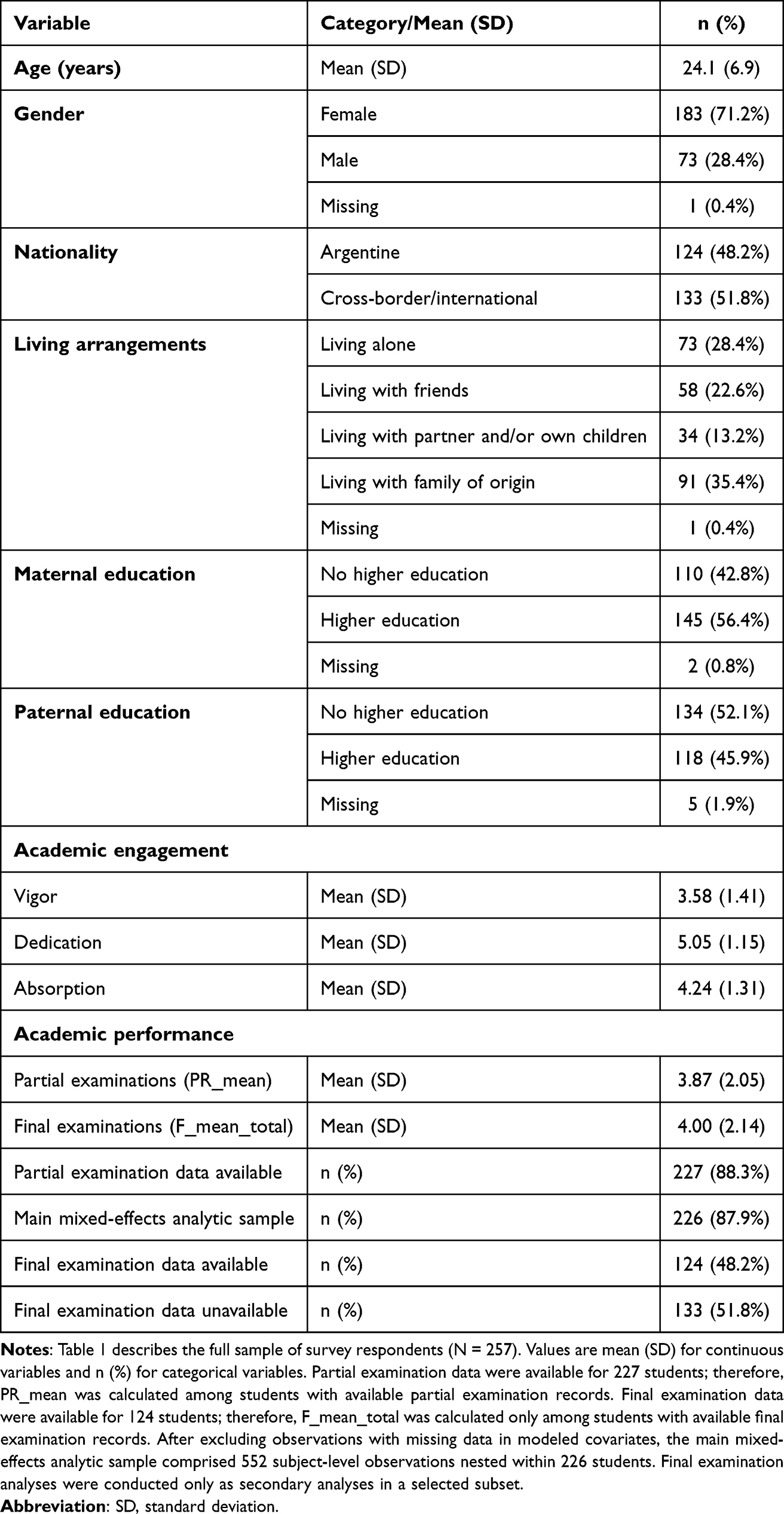 |
Table 1 Sociodemographic Characteristics, Academic Engagement, and Academic Performance of First-Year Medical Students (N = 257) |
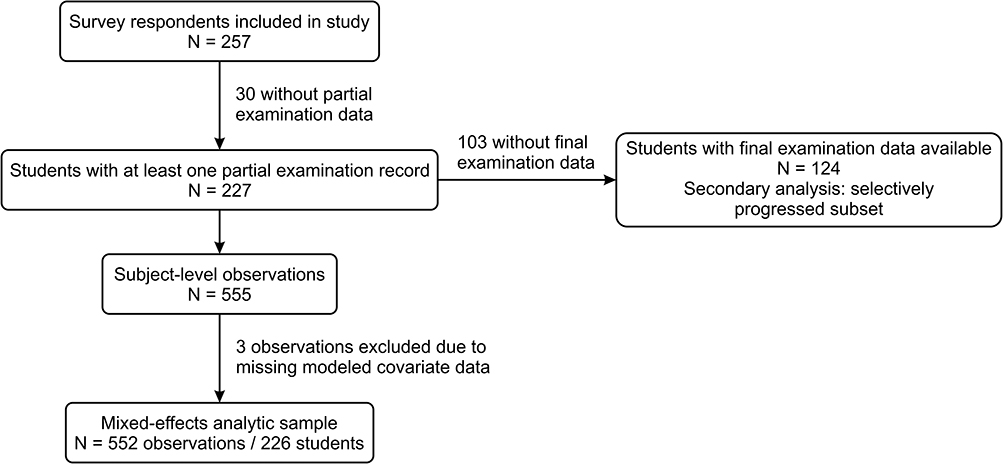 |
Figure 1 STROBE participant flow diagram showing survey respondents, availability of academic performance records, missing outcome data, exclusions due to missing modeled covariates, and analytic samples. Final examination analyses were secondary because final examination data were available only for students who reached and/or sat for this later assessment stage. |
Missing data in sociodemographic and engagement variables were limited. Maternal education was missing for 2 students (0.8%), paternal education for 5 students (1.9%), and age, gender, and living arrangements for 1 student each (0.4%). Nationality and engagement variables had no missing values. In contrast, missing academic performance data reflected availability of examination records and academic progression: partial examination averages were unavailable for 30 students (11.7%), and final examination averages were unavailable for 133 students (51.8%). Missing data patterns are shown in Supplementary Table S3.
Retake examinations were frequent: 150 students (58.4%) completed at least one retake across the three first-year subjects.
Academic Engagement
Mean scores for the three dimensions of academic engagement (vigor, dedication, and absorption) were calculated. In unadjusted analyses, comparable patterns of association with academic outcomes were observed across all three dimensions, characterized by modest associations with continuous grades and more pronounced associations with passing outcomes (Supplementary Table S2).
Sociodemographic Factors Associated with Academic Engagement
In multivariable analyses, academic vigor was associated with living arrangements; specifically, lower vigor scores were observed among students living with friends compared to those living alone. No consistent associations were identified between vigor and age, gender, or parental education.
Partial Examination Outcomes
Continuous Performance Outcomes
Results from the multivariable linear mixed-effects model are presented in Table 2. In this model, lower academic performance was observed among cross-border/international students compared to Argentine students (β = −0.74, 95% CI −1.45, −0.04, p = 0.040). Cohabiting with a partner and/or own children was associated with lower performance (β = −1.06, 95% CI −1.97, −0.15, p = 0.023), whereas other living arrangements yielded no significant associations. Vigor was not significantly associated with continuous partial examination scores in the adjusted mixed-effects model (β = 0.13, 95% CI −0.06, 0.33, p = 0.183).
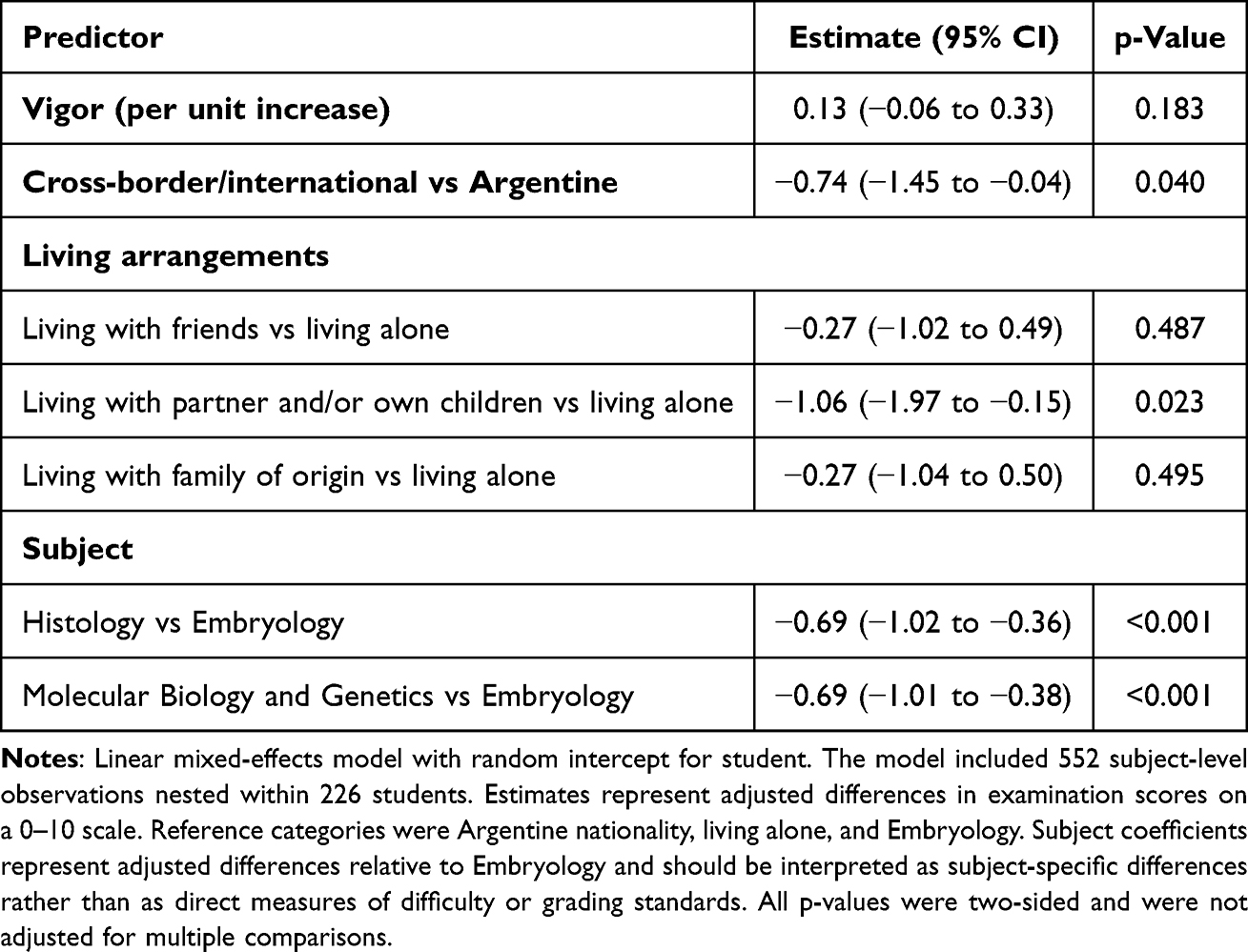 |
Table 2 Multivariable Linear Mixed-Effects Model of Academic Performance in Partial Examinations |
Regarding subject-specific differences, performance in Histology and Molecular Biology and Genetics was lower than in Embryology (Table 2).
Because PR_mean incorporated retake scores when applicable, the contribution of retake examinations was examined descriptively. Students who completed at least one retake had lower initial partial examination averages than those without retakes (P_mean: 2.98 vs 5.15). Incorporating retake scores modestly increased the aggregate partial/retake average among students with retakes (mean increase = 0.28 points). Because of the potential influence of retake examinations on PR_mean, a sensitivity analysis excluding students who completed at least one retake examination was conducted and is reported in the Results subsection titled “Additional Analyses”.
Interaction with Assessment Context
In the exploratory mixed-effects model, the interaction between nationality and assessment context was statistically significant (β = 0.96, 95% CI 0.42, 1.50), indicating that the association between nationality and academic performance varied across the observed assessment contexts. The estimated performance difference between cross-border/international and Argentine students was more apparent in the oral assessment context (β = −1.10, 95% CI −1.67, −0.52) and was attenuated in the written multiple-choice context. Because assessment context was structurally linked to subject content and curricular timing, this pattern should not be interpreted as an independent effect of assessment modality. Predicted marginal means from the exploratory interaction model are shown in Supplementary Figure S1 to aid interpretation of the nationality-by-assessment-context pattern. Full model estimates are reported in the Results subsection titled “Additional Analyses”.
Approval Outcomes
In the long-format logistic regression model for subject-level partial examination passing, academic vigor was associated with an increased probability of passing partial examinations (OR = 1.15, 95% CI 1.01 to 1.32, p = 0.031). Passing odds were lower in Histology (OR = 0.53, 95% CI 0.34 to 0.83, p = 0.006) and Molecular Biology and Genetics (OR = 0.61, 95% CI 0.40 to 0.93, p = 0.023) than in Embryology. Students living with a partner and/or own children had lower odds of passing than those living alone (OR = 0.46, 95% CI 0.24 to 0.86, p = 0.017). Cross-border/international status showed lower estimated odds of passing, although this association did not reach conventional statistical significance (OR = 0.63, 95% CI 0.40 to 1.00, p = 0.052). The remaining living-arrangement categories, living with friends and living with family of origin, were not clearly associated with passing.
Final Examination Outcomes
In the selected subset of students with final examination data, the main associations observed in partial examinations were not clearly replicated for aggregated final examination scores. Vigor was not associated with final examination scores (β = 0.02, 95% CI −0.31 to 0.34), and the estimated difference between cross-border/international and Argentine students was close to zero (β = 0.06, 95% CI −0.96 to 1.08). Students living with a partner and/or own children showed lower estimated final examination scores than those living alone, although the estimate was imprecise and the confidence interval included zero (β = −1.54, 95% CI −3.30 to 0.23).
A descriptive comparison between students with and without final examination data showed that the subset with final examination records differed from the rest of the surveyed cohort. Students with final examination data had lower mean age, higher mean partial examination averages, higher mean engagement scores, a higher proportion of maternal higher education, and lower proportions of cross-border/international students and students living with a partner and/or own children than students without final examination data (Supplementary Table S4). Final-examination analyses were therefore considered secondary and hypothesis-generating, and were not interpreted as representative of the full surveyed cohort.
Additional Analyses
The potential impact of further sociodemographic variables was evaluated. In unadjusted analyses, age, maternal education, and linguistic background demonstrated associations with academic outcomes (Supplementary Table S5). Specifically, older age and a non-Spanish linguistic background were linked to lower performance, whereas higher maternal education was associated with improved outcomes. These associations were attenuated in multivariable models, reflecting structural overlap with other included covariates.
Maternal and paternal education were moderately correlated both as ordinal variables (Spearman’s ρ = 0.505, p < 0.001) and when dichotomized as higher versus no higher education (phi coefficient = 0.395, 95% CI 0.285, 0.494, p < 0.001).
The exploratory nationality-by-assessment-context model included 555 observations nested within 227 students. In this model, the interaction between cross-border/international status and written multiple-choice assessment context was statistically significant; however, because assessment context was structurally linked to subject, this finding should be interpreted as exploratory rather than as evidence of an independent assessment-format effect. Full coefficients for this model are shown in Supplementary Table S6.
In the sensitivity analysis restricted to observations in which the survey preceded the corresponding partial examination, the model included 483 observations nested within 216 students. Estimates were directionally consistent with the main analysis, although the coefficients for cross-border/international status and living with a partner and/or children were attenuated and did not reach conventional statistical significance. Full results are provided in Supplementary Table S7.
In the sensitivity analysis excluding students who completed at least one retake examination, the model included 177 observations nested within 77 students. Estimates for vigor remained positive but non-significant, whereas cross-border/international status and living with a partner and/or children remained negatively associated with partial examination performance. However, confidence intervals were wider because of the substantially reduced sample size. Full results are provided in Supplementary Table S8.
An alternative mixed-effects model additionally adjusted for age, gender, and maternal higher education included 545 observations nested within 223 students. The main findings were broadly consistent with the primary model: cross-border/international status and subject-specific differences remained associated with examination performance, whereas vigor remained positive but non-significant and the living-arrangement coefficients were attenuated. Full results are provided in Supplementary Table S9.
Finally, as an additional model comparison, we tested whether the association between vigor and partial examination scores varied by subject by adding a vigor-by-subject interaction term to the main mixed-effects model. This interaction model did not significantly improve model fit compared with the main model, likelihood ratio test: chi-square = 4.82, df = 2, p = 0.090. Therefore, the more parsimonious main model was retained.
Discussion
Principal Findings
In the present study, associations among academic engagement, sociodemographic characteristics, and academic performance were examined in first-year medical students. The findings showed that the vigor dimension of academic engagement was modestly associated with academic progression, most notably with the probability of passing examinations, but was not clearly associated with continuous examination scores. Previous studies have generally linked academic engagement with better academic outcomes, but the evidence is not uniform: meta-analytic work indicates modest associations that vary across populations and by engagement dimension, with some dimensions more closely tied to achievement than others.34–36 Studies in health sciences students have similarly reported associations that vary across subgroups rather than uniform overall effects,8 a pattern also reported in Latin American health sciences cohorts.37 This mixed evidence is consistent with the present findings, in which vigor was modestly associated with passing outcomes but not clearly associated with continuous examination scores. Furthermore, living arrangements were associated with both engagement and performance, although the direction and robustness of these associations varied across specific outcomes. Other sociodemographic variables showed associations with academic outcomes in unadjusted analyses, but these associations were attenuated in multivariable models. In addition, exploratory analyses suggested that performance differences between cross-border/international and Argentine students varied across assessment contexts; however, this finding should be interpreted cautiously because assessment context was structurally linked to subject.
Interpretation of Findings
The observation that vigor was associated with passing outcomes, but not clearly with continuous grade variation, suggests that the energetic component of academic engagement may be more closely related to academic progression than to fine-grained differences in examination scores. This pattern should be interpreted cautiously and examined in longitudinal studies, rather than as evidence of a defined performance threshold. This interpretation is consistent with theoretical conceptualizations of vigor as a dimension related to persistence and effort regulation, rather than necessarily as a predictor of incremental differences in examination scores.7,10,38,39 The magnitude of these associations should also be interpreted cautiously. The association between vigor and continuous examination scores was small and not statistically significant, indicating limited explanatory value for fine-grained differences in grades. Similarly, associations between engagement dimensions and passing outcomes reflected modest effect sizes. The adjusted coefficient for cross-border/international status in the main mixed-effects model was β = −0.74 on a 0–10 examination scale, corresponding to approximately 7% of the total scale range. Although such a difference may be relevant for students close to a passing threshold, it represents a modest absolute difference and may not necessarily be educationally meaningful in all contexts. These findings should therefore not be interpreted as evidence that engagement or contextual characteristics alone have a large educational impact, but rather as preliminary evidence that they may form part of broader academic progression processes.
Contextually, living arrangements emerged as a relevant factor associated with academic engagement and performance. The lower levels of vigor observed among students living with friends are consistent with literature on peer effects in higher education, which suggests that study habits, time allocation, and effort regulation may be influenced by immediate social environments.40–42 Conversely, the lower academic performance observed among students cohabiting with a partner and/or children may reflect competing demands related to partnership or caregiving responsibilities. Taken together, these patterns are consistent with recent evidence suggesting that the broader social and structural characteristics of student living environments are associated with academic adaptation and well-being.43,44
The attenuation of variables such as age, linguistic background, and maternal education in multivariable models suggests that these distal background factors may partly reflect or overlap with more proximal academic and contextual demands, including current living arrangements, language-related demands, prior educational experiences, and the specific communicative and evaluative demands of different assessment contexts. However, these pathways were not directly measured, and mediation mechanisms cannot be inferred from the present cross-sectional design. Future longitudinal studies should examine how background characteristics, academic language, living arrangements, and assessment demands jointly shape early academic adaptation.
Assessment Context
The exploratory assessment-context analysis suggested that performance differences between cross-border/international and Argentine students varied across the observed evaluation contexts. Specifically, these differences were more apparent in oral partial examination contexts and attenuated in the written multiple-choice partial examination context. Similar context-dependent variations have been documented in studies comparing evaluation modalities.28,29 Potential mechanisms may include the heightened linguistic and communicative demands of oral evaluations,15,19,26 as well as variability in examiner interaction and grading conditions.27 However, this interpretation must be cautious because assessment context was structurally linked to subject content, curricular timing, and assessment stage. Oral partial examinations corresponded to Embryology and Histology, the written multiple-choice partial examination corresponded to Molecular Biology and Genetics. Therefore, the present data do not allow assessment-format effects to be separated from subject effects, subject-specific conceptual difficulty, timing within the academic year, grading practices, assessment conditions, model instability, or residual confounding. Future studies using controlled or within-subject assessment designs are needed to determine whether observed differences are attributable to assessment modality, subject content, grading practices, or other contextual factors.
Methodological Considerations
The interpretation of these findings must be contextualized within several methodological limitations.
First, the cross-sectional design precludes the establishment of causal relationships and reverse causality remains an important consideration. Higher-performing students may report greater engagement because of prior academic success, rather than engagement leading to improved performance. Therefore, the observed associations should be interpreted as non-causal and hypothesis-generating. Although a subject-level sensitivity analysis restricted to observations in which the survey preceded the corresponding partial examination yielded directionally consistent estimates, temporal ordering between engagement and performance could not be fully assured for all observations. In addition, the reliance on a self-selected sample, contingent upon student availability and voluntary participation, restricts the generalizability of the findings to the broader first-year cohort. Students who were more engaged, more available, or performing better academically may have been more likely to complete the survey, whereas students experiencing disengagement, academic difficulties, or early withdrawal may have been underrepresented. This selection process may have led to an overestimation of engagement levels and of the association between engagement and academic outcomes. Although the April-August 2025 data collection window captured the initial adaptation phase and early outcomes in core first-year subjects, it was not sufficient to assess long-term attrition, sustained academic trajectories, or the predictive validity of engagement for later preclinical or clinical years.
Analytical constraints must also be acknowledged. No a priori sample size or power calculation was performed, as the study was based on voluntary participation and linkage with available academic records. The main mixed-effects model included 552 subject-level observations nested within 226 students; however, because repeated observations within students are not statistically independent, precision should be interpreted in relation to both the number of observations and the number of students. As a descriptive post hoc approximation based on the observed standard error of the vigor coefficient, assuming a two-sided α = 0.05 and 80% power, the approximate minimum detectable effect was 0.28 points on the 0–10 examination score scale per one-unit increase in vigor. Therefore, the study may have been underpowered to detect smaller associations, and non-significant findings should not be interpreted as evidence of absence of association.
The subset of students with final examination data represents a selectively progressed cohort, because final examinations were available only for students who reached and/or sat for this later stage of assessment. These analyses are therefore vulnerable to survivorship and selection bias, may show reduced score variability, and should be interpreted as secondary and hypothesis-generating only, rather than as representative of the full surveyed cohort.
Assessment context was structurally linked to subject, timing, content scope, and grading conditions; therefore, observed differences across assessment contexts cannot be attributed to examination modality alone. This structural confounding represents a major limitation for causal interpretation of the nationality-by-assessment-context interaction and was supported analytically by the rank deficiency observed when attempting to include both subject and assessment context in the same mixed-effects model. Given the modest analytic sample and the exploratory nature of the interaction model, model instability or overfitting cannot be excluded. A more rigorous assessment of format effects would require comparing different assessment formats within the same subject or using a controlled within-subject design, which was not possible in the present dataset.
In addition, multiple statistical tests were conducted and formal correction for multiple comparisons was not applied; therefore, secondary analyses, particularly the exploratory nationality-by-assessment-context interaction, should be interpreted cautiously.
Although internal consistency was acceptable for all UWES-9S subscales, the absorption subscale showed a Cronbach’s alpha of 0.78, slightly below 0.80; therefore, findings involving absorption were treated as supplementary and should be interpreted cautiously.
Finally, the country-of-origin-based linguistic proxy is an important measurement limitation. Country of origin does not directly measure Spanish proficiency, communicative fluency, academic language competence, or prior educational experience in Spanish. This proxy may therefore misclassify students, particularly those from multilingual contexts or students whose language proficiency does not correspond closely to country of origin. Findings involving this proxy should be interpreted as exploratory and require confirmation using direct self-rated or test-based measures of Spanish language proficiency and academic language competence. Taken together, these limitations reinforce the exploratory and hypothesis-generating nature of the subgroup, assessment-context, and linguistic-background analyses.
Implications
These findings suggest potential directions for future research and early academic monitoring in medical education. First, academic vigor may represent a psychological dimension associated with academic progression, particularly with passing examinations, but the present study does not establish whether vigor is modifiable or whether interventions targeting it would improve performance. If these associations are confirmed in longitudinal studies, institutions could evaluate structured transition supports, such as peer mentoring, early formative feedback, or workshops addressing study organization and adaptation to medical training. Second, contextual factors such as living arrangements may help institutions recognize that students differ in the adaptation demands they face during the transition to medical training, without treating these characteristics as deterministic indicators of academic risk. Third, the exploratory assessment-context findings suggest that student background and evaluation conditions may interact in ways that require further study. Future longitudinal and controlled or within-subject assessment studies are needed to determine whether observed differences are attributable to assessment modality, subject content, grading practices, or other contextual factors, and whether incorporating more than one early assessment point improves the timing and targeting of academic support.
Conclusion
In first-year medical students at the University of Buenos Aires, higher academic vigor was associated with a greater probability of passing partial examinations, although it was not clearly associated with continuous examination scores. Cross-border/international students obtained modestly lower partial examination scores than Argentine students after adjustment, and specific living-arrangement patterns were associated with academic engagement and academic performance. A secondary exploratory analysis suggested that performance differences between cross-border/international and Argentine students varied across assessment contexts; however, assessment modality could not be disentangled from subject content, curricular timing, and evaluative conditions, and this finding requires confirmation in controlled or within-subject designs. Given the cross-sectional design, these associations should not be interpreted as causal. By linking a validated engagement measure with institutional academic records in a heterogeneous Latin American public medical education context, this study provides evidence on early academic progression and generates hypotheses for future longitudinal studies with prespecified designs and analytical strategies.
Author Contributions
All authors made a significant contribution to the work reported, whether that is in the conception, study design, execution, acquisition of data, analysis and interpretation, or in all these areas; took part in drafting, revising or critically reviewing the article; gave final approval of the version to be published; have agreed on the journal to which the article has been submitted; and agree to be accountable for all aspects of the work.
Disclosure
The authors report no conflicts of interest in this work.
References
1. Maher BM, Hynes H, Sweeney C, et al. Medical school attrition-beyond the statistics a ten year retrospective study. BMC Med Educ. 2013;13(1):13. doi:10.1186/1472-6920-13-13
2. Eames D, Thomas S, Norman K, Simanton E, Weisman A. Sociodemographic disadvantage in the burden of stress and academic performance in medical school: implications for diversity in medicine. BMC Med Educ. 2024;24(1):348. doi:10.1186/s12909-024-05263-y
3. Prendergast M, Cardoso Pinto AM, Harvey CJ, Muir E. Burnout in early year medical students: experiences, drivers and the perceived value of a reflection-based intervention. BMC Med Educ. 2024;24(1):7. doi:10.1186/s12909-023-04948-0
4. Schaufeli WB, Martínez IM, Pinto AM, Salanova M, Bakker AB. Burnout and engagement in university students: a cross-national study. J Cross Cult Psychol. 2002;33(5):464–14. doi:10.1177/0022022102033005003
5. Schaufeli WB, Bakker AB, Salanova M. The measurement of work engagement with a short questionnaire: a cross-national study. Educ Psychol Meas. 2006;66(4):701–716. doi:10.1177/0013164405282471
6. Salanova M, Llorens S, García-Renedo M, Burriel R, BresÓ E, Schaufeli WB. Towards a four-dimensional model of burnout: a multigroup factor-analytic study including depersonalization and cynicism. Educ Psychol Meas. 2005;65(5):807–819. doi:10.1177/0013164405275662
7. Schaufeli WB, Bakker AB. Job demands, job resources, and their relationship with burnout and engagement: a multi‐sample study. J Organ Behavior. 2004;25(3):293–315. doi:10.1002/job.248
8. Casuso-Holgado MJ, Cuesta-Vargas AI, Moreno-Morales N, Labajos-Manzanares MT, Barón-López FJ, Vega-Cuesta M. The association between academic engagement and achievement in health sciences students. BMC Med Educ. 2013;13(1):33. doi:10.1186/1472-6920-13-33
9. Gómez HP, Pérez VC, Parra PP, et al. Relación entre el bienestar y el rendimiento académico en alumnos de primer año de medicina. Rev méd Chile. 2015;143(7):930–937. doi:10.4067/S0034-98872015000700015
10. Wu H, Li S, Zheng J, Guo J. Medical students’ motivation and academic performance: the mediating roles of self-efficacy and learning engagement. Med Educ Online. 2020;25(1):1742964. doi:10.1080/10872981.2020.1742964
11. Xu X, Shi Z, Bos NA, Wu H. Student engagement and learning outcomes: an empirical study applying a four-dimensional framework. Med Educ Online. 2023;28(1):2268347. doi:10.1080/10872981.2023.2268347
12. Calcatin S, Sinval J, Neto LL, Marôco J, Ferreira AG, Oliveira P. Correction: burnout and dropout intention in medical students: the protective role of academic engagement. BMC Med Educ. 2025;25(1):1265. doi:10.1186/s12909-025-07924-y
13. Lesener T, Pleiss LS, Gusy B, Wolter C. The study demands-resources framework: an empirical introduction. Int J Environ Res Public Health. 2020;17(14):5183. doi:10.3390/ijerph17145183
14. Wijnen-Meijer M. Implications of internationalisation of medical education. BMC Med Educ. 2023;23(1):640. doi:10.1186/s12909-023-04630-5
15. Edwards G, Spooner M, Arnett R, Kelly H, Carr JCA, Illing J. Transnational medical education programmes and preparation for different country medical practice: a systematic review. Med Educ. 2025;59(9):924–937. doi:10.1111/medu.15660
16. Albornoz-Palacios E, Ladera-Castañeda M, Briceño-Vergel G, et al. Sociodemographic factors associated with the satisfaction level of Peruvian dental students with virtual classes during the COVID-19 pandemic: a prospective bicentric study. Adv Med Educ Pract. 2024;15:257–268. doi:10.2147/AMEP.S452630
17. Huang R, Yao Y, Jin M, et al. Parental education level and medical student engagement: a multi-center cross-sectional study. BMC Psychol. 2025;14(1):40. doi:10.1186/s40359-025-03744-3
18. Jaber MH, Dafallah IA, Mohammed AY, et al. Socioeconomic disparities and their effect on medical student academic attainment Sudanese Universities. BMC Med Educ. 2024;24(1):929. doi:10.1186/s12909-024-05867-4
19. Hamad AA, Mustaffa DB, Alnajjar AZ, et al. Decolonizing medical education: a systematic review of educational language barriers in countries using foreign languages for instruction. BMC Med Educ. 2025;25(1):701. doi:10.1186/s12909-025-07251-2
20. de Freitas JAX, de Almeida WM. Ser “doctor” en el extranjero: brasileños estudiando Medicina en Argentina. Périplos. 2023;7(2):121–144.
21. Sosa FM, Zubieta E. Migration and socio-cultural adaptation experience: social identity contact and social support in migrant college students. Psicogente. 2015;18(33). doi:10.17081/psico.18.33.54
22. Luchilo L. Estudiantes internacionales en carreras de medicina en universidades argentinas: tendencias recientes. Debate Universitario. 2024;16(25):78–95. doi:10.59471/debate2024308
23. Quacquarelli Symonds. QS World University Rankings 2025. 2024. Available from: https://www.topuniversities.com/world-university-rankings/2025?search=buenos%20aires.
24. Quacquarelli Symonds. QS World University Rankings: Latin America & The Caribbean - South America 2025. 2024. Available from: https://www.topuniversities.com/latin-america-south-america-rankings/2025?search=buenos%20aires.
25. Subsecretaría de Políticas Universitarias. Síntesis de información estadísticas universitarias 2023–2024. 2025. Available from: https://www.argentina.gob.ar/sites/default/files/sintesis_anuario_2023-2024.pdf.
26. Memon MA, Joughin GR, Memon B. Oral assessment and postgraduate medical examinations: establishing conditions for validity, reliability and fairness. Adv Health Sci Educ. 2010;15(2):277–289. doi:10.1007/s10459-008-9111-9
27. Abuzied AIH, Nabag WOM. Structured viva validity, reliability, and acceptability as an assessment tool in health professions education: a systematic review and meta-analysis. BMC Med Educ. 2023;23(1):531. doi:10.1186/s12909-023-04524-6
28. Huhn D, Resch F, Duelli R, et al. Examination performances of German and international medical students in the preclinical studying-term--a descriptive study. GMS Zeitschrift Medizinische Ausbildung. 2014;31(3):29. doi:10.3205/ZMA000921
29. Huhn D, Lauter J, Roesch Ely D, et al. Performance of international medical students in psychosocial medicine. BMC Med Educ. 2017;17(1):111. doi:10.1186/s12909-017-0950-z
30. Stephenson Z, Johnson-Glauch N, Cruchley S. Interventions and facilitators of oral assessment performance in higher education: a systematic review. Assess Eval Higher Educ. 2025;50(7):1140–1153. doi:10.1080/02602938.2025.2504621
31. Kassab SE, El‐Sayed W, Hamdy H. Student engagement in undergraduate medical education: a scoping review. Medical Education. 2022;56(7):703–715. doi:10.1111/medu.14799
32. Carmona-Halty MA, Schaufeli WB, Salanova M. The Utrecht Work Engagement Scale for students (UWES–9S): factorial validity, reliability, and measurement invariance in a Chilean sample of undergraduate university students. Front Psychol. 2019;10:1017. doi:10.3389/fpsyg.2019.01017
33. Dominguez-Lara SA, Sánchez-Villena AR, Fernández-Arata M. Psychometric properties of the UWES-9S in Peruvian college students. Acta Colomb Psicol. 2020;23(2):7–39. doi:10.14718/ACP.2020.23.2.2
34. Lei H, Cui Y, Zhou W. Relationships between student engagement and academic achievement: a meta-analysis. Soc Behav Pers. 2018;46(3):517–528. doi:10.2224/sbp.7054
35. Madigan DJ, Curran T. Does Burnout Affect Academic Achievement? A Meta-Analysis of over 100,000 Students. Educ Psychol Rev. 2021;33(2):387–405. doi:10.1007/s10648-020-09533-1
36. Reeve J, Basarkod G, Jang HR, Gargurevich R, Jang H, Cheon SH. Specialized Purpose of Each Type of Student Engagement: a Meta-Analysis. Educ Psychol Rev. 2025;37(1):13. doi:10.1007/s10648-025-09989-z
37. Carrasco Muñoz MA, Martínez Morales C. Nivel de engagement y su implicancia en el rendimiento académico en estudiantes universitarios de ciencias de la salud de la Unheval-Huánuco, 2015. bol Redipe. 2019;8(2):131–139. doi:10.36260/rbr.v8i2.692
38. Salanova M, Schaufeli W, Martínez I, Bresó E. How obstacles and facilitators predict academic performance: the mediating role of study burnout and engagement. Anxiety Stress Coping. 2010;23(1):53–70. doi:10.1080/10615800802609965
39. Reyes-de-Cózar S, Merino-Cajaraville A, Salguero-Pazos MR. Avoiding academic burnout: academic factors that enhance university student engagement. Behav Sci. 2023;13(12):989. doi:10.3390/bs13120989
40. Stinebrickner R, Stinebrickner TR. What can be learned about peer effects using college roommates? Evidence from new survey data and students from disadvantaged backgrounds. J Public Econ. 2006;90(8–9):1435–1454. doi:10.1016/j.jpubeco.2006.03.002
41. Pu S, Yan Y, Zhang L. Peers, study effort, and academic performance in college education: evidence from randomly assigned roommates in a flipped classroom. Res High Educ. 2020;61(2):248–269. doi:10.1007/s11162-019-09571-x
42. Cao Y, Zhou T, Gao J. Heterogeneous peer effects of college roommates on academic performance. Nat Commun. 2024;15(1):4785. doi:10.1038/s41467-024-49228-7
43. Worsley JD, Harrison P, Corcoran R. Accommodation environments and student mental health in the UK: the role of relational spaces. J Ment Health. 2023;32(1):175–182. doi:10.1080/09638237.2021.1922648
44. Maqbool M, Farooq M, Imran M, Alghafli M, Fatima N. Mental health and academic performance of students at tertiary level: the role of housing. Front Educ. 2025;10:1627192. doi:10.3389/feduc.2025.1627192
 © 2026 The Author(s). This work is published and licensed by Dove Medical Press Limited. The
full terms of this license are available at https://www.dovepress.com/terms
and incorporate the Creative Commons Attribution
- Non Commercial (unported, 4.0) License.
By accessing the work you hereby accept the Terms. Non-commercial uses of the work are permitted
without any further permission from Dove Medical Press Limited, provided the work is properly
attributed. For permission for commercial use of this work, please see paragraphs 4.2 and 5 of our Terms.
© 2026 The Author(s). This work is published and licensed by Dove Medical Press Limited. The
full terms of this license are available at https://www.dovepress.com/terms
and incorporate the Creative Commons Attribution
- Non Commercial (unported, 4.0) License.
By accessing the work you hereby accept the Terms. Non-commercial uses of the work are permitted
without any further permission from Dove Medical Press Limited, provided the work is properly
attributed. For permission for commercial use of this work, please see paragraphs 4.2 and 5 of our Terms.