
Back to Journals » Advances in Medical Education and Practice » Volume 17

Twelve Tips for Implementing Competency-Based Medical Education (CBME) in Resource-Limited Educational Settings
Authors Sohrabi S, Sandars J  , Hajizadeh Bandeghara F , Hayrabedian A, Mansouri M
Received 19 February 2026
Accepted for publication 10 July 2026
Published 21 July 2026 Volume 2026:17 604270
DOI https://doi.org/10.2147/AMEP.S604270
Checked for plagiarism Yes
Review by Single anonymous peer review
Peer reviewer comments 4
Editor who approved publication: Dr Sateesh Arja
Video abstract of “Implementing CBME in Resource-Limited Educational Settings” [604270].
Views: 3
Somaye Sohrabi,1 John Sandars,2 Fahimeh Hajizadeh Bandeghara,3 Aygineh Hayrabedian,3 Mahmoud Mansouri3
1Department of Medical Education, School of Medical Education and Learning Technologies, Shahid Beheshti University of Medical Sciences, Tehran, Iran; 2Health Research Institute, Edge Hill University, Ormskirk, UK; 3School of Medical Education and Learning Technologies, Shahid Beheshti University of Medical Sciences, Tehran, Iran
Correspondence: Somaye Sohrabi, Department of Medical Education, School of Medical Education and Learning Technologies, Shahid Beheshti University of Medical Sciences, Tehran, Iran, Email [email protected]
Abstract: This experience-informed perspective article presents twelve practical tips for implementing Competency-Based Medical Education (CBME) in resource-limited educational settings (RLS). CBME has gained global traction as a framework aligning medical training with patient care outcomes, yet its implementation in RLS remains challenging due to constraints in infrastructure, faculty capacity, and system readiness. The tips emerged from the collective lived implementation experience of the authorship team—medical educators and researchers with direct CBME experience in RLS—triangulated with a targeted narrative review of the literature, and were finalized through iterative consensus. The twelve tips are: (1) Secure formal institutional commitment to drive change; (2) Adapt the CBME framework to reflect local contextual needs; (3) Map competencies to the existing curriculum for strategic integration; (4) Engage learners as co-creators of the CBME experience; (5) Use Entrustable Professional Activities (EPAs) to translate competencies into clinical action; (6) Prioritize low-cost, high-impact assessment methods; (7) Develop local assessment champions to lead sustainable change; (8) Leverage educational technologies and low-fidelity simulation for scalable CBME delivery; (9) Build peer learning networks and communities of practice; (10) Implement a phased rollout to build readiness and sustainability; (11) Invest in faculty development to foster a CBME-aligned mindset; and (12) Assess and build systems readiness for sustainable CBME implementation. This practical guidance aims to support educators, curriculum leaders, and administrators in low- and middle-income countries (LMICs) seeking to adapt and implement CBME in a sustainable, contextually appropriate manner.
Keywords: competency-based medical education, resource-limited settings, implementation science, faculty development, medical education, entrustable professional activities
Introduction
There has been increasing global adoption of Competency-Based Medical Education (CBME), with a shift from time-based progression to demonstrating mastery of clinical competencies.1 Based on outcome-based education principles, CBME ensures graduates achieve essential competencies for safe and effective patient care.2 Widely recognized CBME frameworks include Entrustable Professional Activities (EPAs), which define observable clinical tasks that learners can be entrusted to perform independently; the Accreditation Council for Graduate Medical Education (ACGME) Milestones framework, which maps trainee development across competency domains; and the Canadian Medical Education Directions for Specialists (CanMEDS) framework, which organizes competencies around physician roles.
While high-resource settings benefit from infrastructure, digital tools, and faculty expertise to facilitate CBME adoption,3 resource-limited settings (RLS) face challenges due to limited funding, shortage of trained faculty, insufficient technology, and limited experience in appropriate assessments of competency.4 RLS has been used in the wider educational literature to describe settings—predominantly in low- and middle-income countries (LMICs)—with limited infrastructure, faculty capacity, learning resources, and financial support for the provision of high-quality education.5
Despite these barriers, the adoption of CBME in RLS has followed global trends in an attempt to address local healthcare needs.6 Most literature on CBME comes from well-resourced institutions, creating a gap in practical guidance for educators in RLS. Standard implementation frameworks often assume access to resources like high-fidelity simulation and electronic portfolios, which are scarce in resource-limited settings, and medical schools in RLS have struggled with the implementation of CBME without extensive financial or technological support.4
This article is an experience-informed perspective article, supplemented by a targeted narrative review of the literature. It is intended as practical guidance for educators, curriculum leaders, and administrators in resource-limited settings seeking to adapt and implement CBME. Several published “Twelve Tips” articles on CBME have informed the approach taken in this article.7–9
Approach to Developing the Tips
The 12 tips presented in this article emerged from two primary sources. First, they draw on the collective lived implementation experience of the authorship team, who are medical educators and researchers with direct experience in implementing and evaluating CBME curricula in resource-limited settings in Iran and with awareness of implementation challenges across other LMICs. Second, the tips are informed by a targeted narrative review of the published literature, in which relevant studies were identified through searches of PubMed, Google Scholar, and ERIC using terms such as “competency-based medical education”, “resource-limited settings”, “LMICs”, “CBME implementation”, and related terms. Literature was selected based on relevance to the practical implementation of CBME in resource-limited contexts. The tips were developed through iterative group discussion and consensus among the authorship team and organized under four thematic clusters (Table 1). Where recommendations are primarily experience-based rather than evidence-based, this is indicated. This manuscript advocates for the critical adaptation and contextual implementation of CBME principles rather than the wholesale adoption of Western models, while acknowledging that hybrid approaches tailored to local realities may be most appropriate in many settings. This Twelve Tips article presents a range of practical strategies for implementing CBME in resource-limited settings, with a focus on feasibility, sustainability, and contextual relevance.
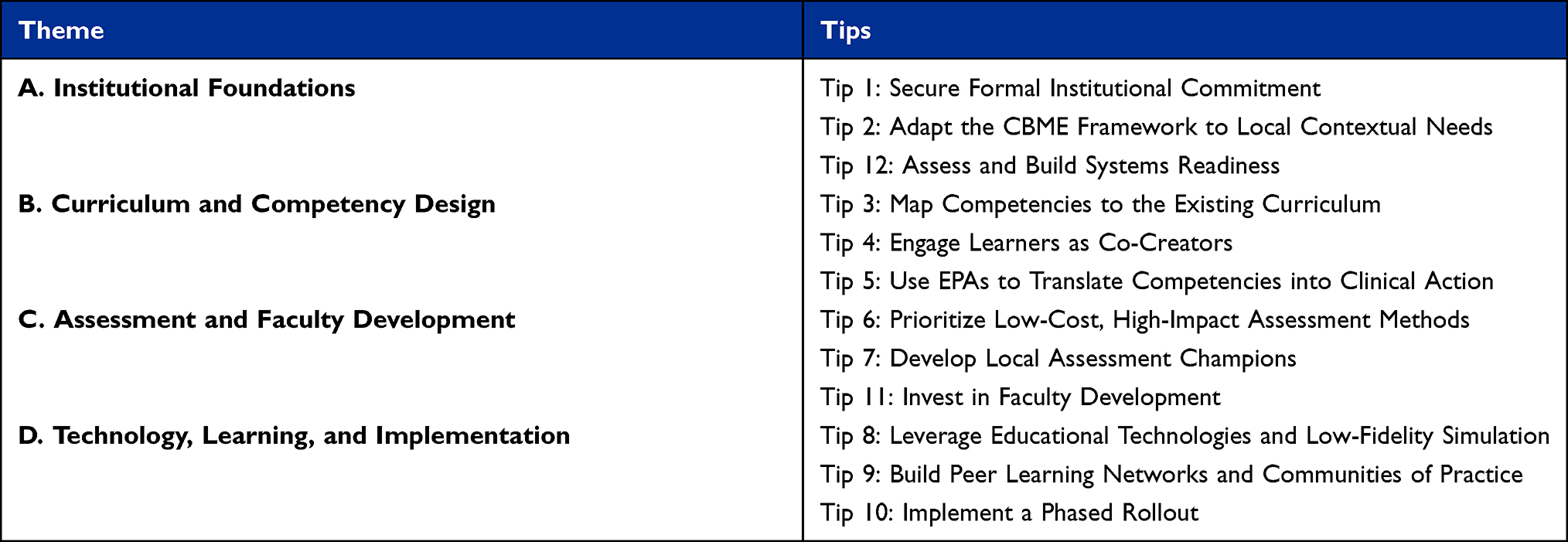 |
Table 1 Thematic Overview of the Twelve Tips |
Tip 1: Secure Formal Institutional Commitment to Drive Change
Rationale
Institutional commitment is crucial for the successful implementation of CBME in resource-limited settings.4 Leadership endorsement helps align change initiatives with strategic goals by supporting the development of operational policies and ensuring appropriate resource allocation, both of which are critical for long-term sustainability.10
Practical Recommendations
We recommend that institutional commitment should move beyond verbal support and take tangible forms, such as integrating CBME into strategic plans, allocating dedicated budgets, and formally recognizing CBME roles. Early engagement with senior leaders, such as through orientation sessions and policy dialogues, can build a shared vision. Creating a CBME committee endorsed by leadership can improve coordination and accountability, and also alignment with national accreditation standards or workforce goals may increase support. Visible leadership backing enhances faculty motivation, reduces resistance, and fosters collaboration across departments.11
Potential Pitfalls
Common pitfalls include verbal commitment without resource allocation, leadership changes that disrupt CBME momentum, and insufficient integration of CBME into institutional performance metrics. Ensuring CBME is embedded in formal governance documents (eg, strategic plans, accreditation submissions) can mitigate these risks.
Resources and Examples
The WHO Global Competency and Outcomes Framework for Universal Health Coverage (2022) provides a freely downloadable, LMIC-relevant tool for aligning institutional CBME commitments with health system governance goals and national workforce policy. A directly applicable, open-access example from a low- to middle-income country context is provided by Riaz et al (2025), who document how program directors in Pakistan secured and formalized institutional commitment to the implementation of postgraduate CBME.11 Institutions may adapt the freely available ACGME Common Program Requirements (acgme.org/programs-and-institutions/programs/common-program-requirements) as a structural template for drafting a CBME steering committee charter with defined roles, timelines, and accountability mechanisms.
Tip 2: Adapt the CBME Framework to Reflect Local Contextual Needs
Rationale
Adapting global CBME frameworks to local contexts is essential for the successful implementation of CBME in resource-limited settings. Imported CBME frameworks, such as the Canadian Medical Education Directions for Specialists (CanMEDS) or the Accreditation Council for Graduate Medical Education (ACGME) Milestones framework, may not align with local health needs, disease profiles, or sociocultural norms. Adapting these frameworks to local contextual needs ensures relevance and prepares graduates for real-world practice within the regional context.12
Practical Recommendations
We recommend beginning the implementation of CBME in a resource-limited setting by conducting a targeted multi-stakeholder needs assessment that incorporates input from faculty, key policymakers, students, and local community members. The findings of this assessment can be used to inform the adaptation of global frameworks and emphasize locally relevant competencies, especially those related to primary care, public health, and cultural communication. McKenzie-White et al (2022) provide a relevant example of a locally developed competency-based curriculum in a Sub-Saharan African medical school, illustrating how local development rather than direct framework adoption can enhance relevance.12
The use of collaborative and consensus-building methods, such as workshops or virtual panels, can ensure both the development of a locally relevant CBME framework and the essential stakeholder buy-in for implementation. In our experience, aligning frameworks with national health priorities—such as rural service delivery or infectious disease management—can enhance the credibility of CBME reforms. Partnering with ministries of health and accreditation bodies may also help institutionalize these adaptations. Pilot-testing the revised framework with students and clinical supervisors can further refine its usability. Adaptation is not a one-time event but a cyclical process requiring periodic review and stakeholder feedback.
Potential Pitfalls
Key pitfalls include conducting needs assessments without acting on findings, over-relying on existing Western frameworks without critical appraisal, and failing to involve community health representatives. Adaptation should be evidence-informed rather than purely theoretical.
Resources and Examples
The CanMEDS 2015 Physician Competency Framework (Royal College of Physicians and Surgeons of Canada) is the most widely adopted CBME framework globally and is freely downloadable as a starting point for local contextualization. McKenzie-White et al (2022) provide a concrete example of locally developed—rather than imported—competency-based curriculum design in a Sub-Saharan African medical school, illustrating how adaptation to local disease burden and sociocultural context can be achieved in practice. Multi-stakeholder needs assessment surveys for framework adaptation can be designed and distributed at no cost using Google Forms, which functions in low-bandwidth settings and automatically compiles responses into a shared spreadsheet for collaborative analysis.
Tip 3: Map Competencies to the Existing Curriculum for Strategic Integration
Rationale
Mapping existing curricula to CBME competencies enables a gradual, cost-effective integration, which is crucial in resource-limited settings, given the limited time, faculty, and resources available. This approach prevents unnecessary content duplication and ensures that key competencies are addressed without significant structural reforms. Studies from resource-limited settings have noted that most CBME elements already exist in existing curricula but require improved alignment.4
Practical Recommendations
Involving faculty through short mapping workshops can foster ownership and help identify gaps or existing overlaps. To enhance feasibility, mapping can begin in a single department as a pilot before broader expansion. Institutions may use free or low-cost curriculum mapping tools to visualize alignment (Table 2). Including early-career faculty in mapping sessions can build local expertise. We also recommend scheduling follow-up meetings to validate results, adjust mismatches, and create shared repositories for mapped content. A sample competency-to-session mapping matrix and the corresponding coverage level key are provided in Supplementary File 1 (Tables S1a and S1b).
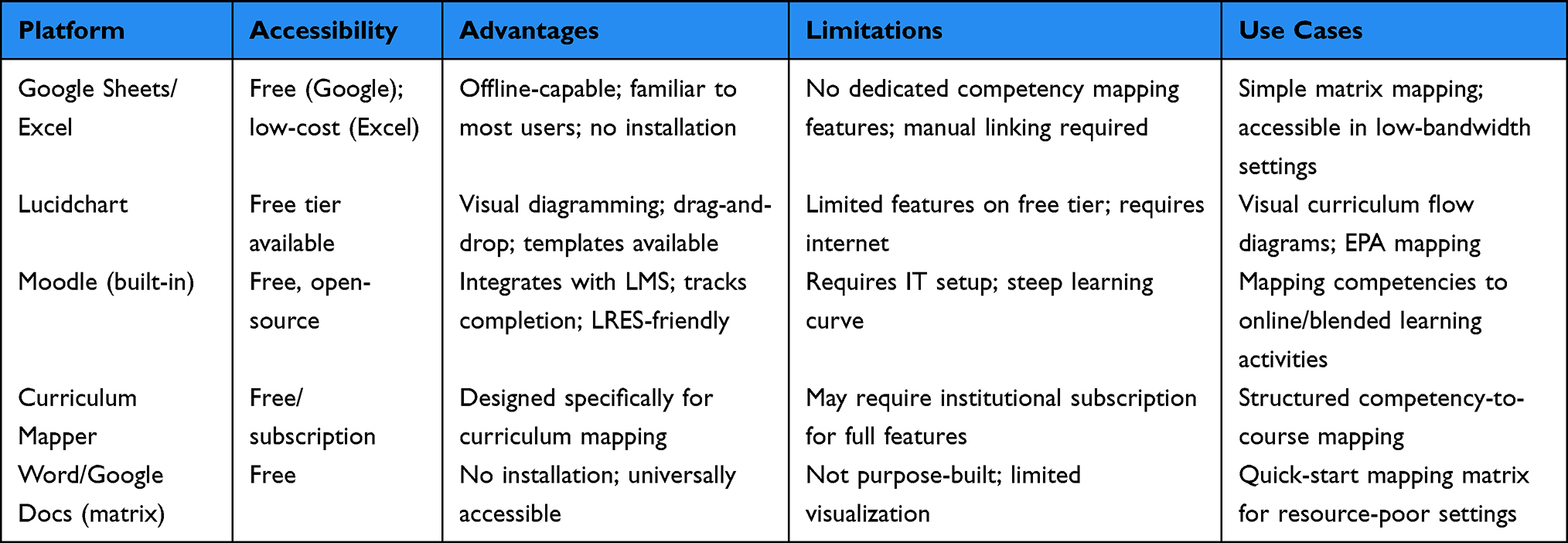 |
Table 2 Free/Low-Cost Curriculum Mapping Tools for Resource-Limited Settings |
Potential Pitfalls
Pitfalls include overwhelming participants with the full competency list, conducting mapping without follow-through on identified gaps, and failing to update the map as the curriculum evolves. Start with high-priority competencies and schedule regular review cycles.
Resources and Examples
Google Sheets is the most accessible free tool for curriculum mapping in resource-limited settings: it works in low-bandwidth environments, supports offline editing via the mobile app, and allows a simple matrix format (rows = competencies/EPAs; columns = courses or clinical rotations; cells = level of coverage) to be created and shared collaboratively without cost. Alsayed et al (2022) describe a practical “Curriculum Barcoding” approach for mapping medical curricula to competency frameworks—directly applicable to LRES contexts—and is freely available in the open-access journal Cureus.13
Tip 4: Engage Learners as Co-Creators of the CBME Experience
Rationale
Actively involving learners throughout the iterative process of CBME implementation can enhance ownership and relevance, especially in resource-limited settings, where top-down reforms often ignore this essential perspective. Learners can be involved through various approaches, such as learner advisory groups and curriculum co-design workshops.14 Programs that engage learners in meaningful roles have been associated with greater satisfaction and deeper learning.15
Practical Recommendations
Mobile platforms, such as WhatsApp or SMS, can also facilitate continuous learner feedback about the implementation process.16 Beyond curriculum co-design, students should be engaged in assessment planning, peer teaching, and faculty development. Involving student representatives in CBME committees has enabled institutions to gather real-time feedback and address implementation challenges. Recognizing learners’ contributions through academic credit, certificates, or leadership roles can foster sustained engagement. Additionally, training students in leadership and communication skills prepares them to serve as effective CBME ambassadors among their peers.
Potential Pitfalls
Token involvement of learners without meaningful influence on decisions can undermine trust. Ensure learner representatives are adequately trained and that their input is visibly acted upon.
Resources and Examples
Telegram and WhatsApp are free, widely used platforms across LMICs that support structured learner feedback through group polls, anonymous surveys, and asynchronous discussions—functioning effectively in low-bandwidth settings on basic smartphones. Zarandi et al (2022) provide a systematic review of student roles and behaviors in higher education co-creation, offering a practical taxonomy of meaningful learner involvement that extends beyond token participation into curriculum design, assessment planning, and program governance.15 Google Forms can be used at no cost to design structured learner advisory questionnaires accessible by mobile phone, with responses automatically compiled into a shared Google Sheet for real-time analysis by curriculum committees.
Tip 5: Use Entrustable Professional Activities (EPAs) to Translate Competencies into Clinical Action
Rationale
Entrustable Professional Activities (EPAs) provide clarity by focusing on what learners must do, not just what they must know. This helps translate abstract competencies into real-world clinical tasks and is especially important in resource-limited settings, where graduates often assume responsibilities early. Evidence specifically from resource-limited settings on the utility of context-adapted EPAs is emerging.17
Practical Recommendations
We recommend identifying a short list of core EPAs that are relevant to local practice, with avoidance of copying EPA descriptors that have been developed in high-resource countries.18 Developing EPAs in collaboration with local clinical supervisors and recent graduates ensures relevance and feasibility. Institutions can begin with a limited number of high-impact EPAs—such as managing common emergencies or conducting antenatal care visits—and gradually expand. Incorporating EPAs into logbooks or paper-based portfolios can support tracking even in settings with limited digital infrastructure. It is also helpful to align EPAs with national licensure expectations where possible, to increase institutional support and legitimacy.
The relationship between EPAs and high-stakes national exit and licensure examinations is also important to consider. In LMIC contexts, national competency examinations serve as a definitive measure of the competencies required for health professionals to practice medicine, and CBME implementation should be designed with alignment to these systems in mind.19,20 A sample EPA card and the corresponding 5-level entrustment scale are provided in Supplementary File 2 (Tables S2a and S2b).
Potential Pitfalls
Over-extending the number of EPAs can overwhelm faculty and learners. Begin with 3–5 core EPAs and expand incrementally. Avoid importing EPA descriptors from high-resource settings without critical contextual adaptation.
Resources and Examples
The book “Entrustable Professional Activities and Entrustment Decision-Making in Health Professions Education” is published under an open-access Creative Commons licence and all chapters—including EPA framework definitions, entrustment scales, and implementation guidance—are freely downloadable without registration.21 The AAMC Core Entrustable Professional Activities for Entering Residency document provides 13 fully elaborated EPA examples with assessment guidance and entrustment level descriptors, freely adaptable to local RLS clinical contexts by substituting US-specific scenarios with locally prevalent presentations. Eteng et al (2024) describe a stepwise process for EPA development in a public health emergency management curriculum in an African LMIC context, providing a replicable methodology for EPA identification and validation in resource-limited settings.17
Tip 6: Prioritize Low-Cost, High-Impact Assessment Methods
Rationale
Traditional CBME assessments, such as OSCEs or e-portfolios, may be impractical in resource-limited settings.22 Instead, we recommend using affordable tools that align with available resources, including structured oral exams, Workplace-Based Assessments (WBAs) (such as mini-CEX and case-based discussions), logbook reviews, and paper-based portfolios.23
Practical Recommendations
The implementation process for CBME can commence with reviewing current practices, and an essential first step is standardizing current assessments using structured rubrics or checklists to increase their reliability. Assessments can also be integrated into routine clinical teaching to minimize additional workload. Collaborating with national or regional networks to share validated rubrics and assessment items can further reduce the burden and ensure quality.
Faculty should be provided with templates for structured feedback. A simplified mini-CEX assessment form and structured feedback prompts are provided in Supplementary File 3 (Tables S3a and S3b).
Potential Pitfalls
Faculty resistance to conducting formative assessments due to time constraints is common. Short, focused assessments (5–10 minutes) embedded in routine clinical encounters help normalize the practice without adding significant burden.
Resources and Examples
The Royal College of Physicians (UK) provides a freely downloadable mini-CEX assessment form suitable for paper-based implementation in resource-limited settings, including structured domains (history-taking, clinical examination, reasoning, professionalism) and built-in feedback prompts. For structured faculty feedback, the Pendleton feedback model (What went well → What could be improved → Agreed action) requires no tools or technology and is described in detail in Ramani and Krackov (2012), freely accessible via PubMed Central.24 Lockyer et al (2017) outline the core principles of CBME assessment that underpin all low-cost assessment methods recommended in this tip and serve as essential reading for faculty developers in resource-limited settings.23
Tip 7: Develop Local Assessment Champions to Lead Sustainable Change
Rationale
Local assessment champions are crucial in leading, adapting, and sustaining assessment reforms for CBME in resource-limited settings. These faculty members play a pivotal role in advocating for necessary resources, mentoring colleagues to ensure reliable assessment practices, and tailoring assessment methods to fit local realities and constraints.25
Practical Recommendations
We recommend that the role of these champions be formalized and supported by the institution. Assessment champions should be strategically selected from various departments to foster cross-disciplinary ownership. Their training can be scaffolded through short workshops, online modules, and mentorship programs, potentially supported by international academic partnerships. Recognizing their contributions through promotions, teaching awards, or protected academic time encourages sustained engagement. Champions can also lead audit and feedback cycles to monitor assessment quality.
Potential Pitfalls
Over-reliance on one or two champions creates a single point of failure. Build a distributed network of champions across departments from the outset.
Resources and Examples
The Foundation for Advancement of International Medical Education and Research (FAIMER) offers a two-year, fully online fellowship program specifically designed for health professions faculty from developing countries, targeting skills in assessment, CBME implementation, and educational leadership—free to apply and directly accessible to educators in Iran and other LMIC settings. Kelly et al (2024) describe how ACGME Clinician Educator Milestones can be used to formally recognize and evaluate the contributions of assessment champions in a CBME-aligned faculty evaluation system, providing a model for institutional formalization of the champion role.25 Free, Creative Commons-licensed workshop materials and resources for medical educators—including modules on assessment design and faculty development—are available through the AMEE Open Medical Education Practice portal, requiring no registration or institutional access.
Tip 8: Leverage Educational Technologies and Low-Fidelity Simulation for Scalable CBME Delivery
Rationale
In resource-limited settings, even low-fidelity simulation and digital tools may be inconsistently available. This tip addresses both low-fidelity simulation and open-source digital technologies under a unified framework of context-sensitive, scalable educational technology use. The goal is to maximize learning impact within realistic resource constraints.
Practical Recommendations: Low-Fidelity Simulation
Low-fidelity simulation (LFS) provides an affordable and effective method for teaching clinical skills in resource-limited settings. Using simple materials—such as sponges for suturing or role-playing for communication—LFS can enable repetitive and structured practice.26,27 We recommend that LFS teaching sessions focus on key competencies relevant to local needs and include structured debriefing to reinforce reasoning and feedback. Institutions can start by identifying core clinical scenarios—such as obstetric emergencies or basic life support—that are feasible for low-fidelity simulation. Even peer-to-peer simulation practice can be valuable when guided by checklists and structured reflection.
Practical Recommendations: Open-Source Digital Tools
Open-source digital tools, such as Moodle, Kolibri, and OpenMRS, enable resource-limited settings to design, deliver, and assess CBME at a significantly reduced cost. These platforms can support competency tracking, feedback, and offline access, which is especially important in bandwidth-limited contexts.28 Learners may prefer mobile phones. Where possible, tools that function offline or on shared devices are recommended. Prioritizing asynchronous content—such as recorded lectures or offline quizzes—can reduce connectivity burdens. Faculty should be supported in developing straightforward multimedia content using available devices, and involving Information Technology (IT) staff from the outset helps ensure long-term sustainability.
Potential Pitfalls
Even low-fidelity simulation requires faculty training in facilitation and debriefing—without this, simulation sessions may not achieve intended learning outcomes. For digital tools, connectivity and device access remain barriers in many RLS; piloting with a single module before wider rollout is strongly recommended.
Resources and Examples
Moodle is a free, open-source Learning Management System used in over 100,000 institutions globally; it can be installed on a local server without ongoing cost, supports offline content delivery via its mobile app, and is fully adaptable to CBME competency tracking—making it the recommended LMS for bandwidth-limited resource-limited settings. For settings with no reliable internet, Kolibri is a free, open-source offline learning platform designed specifically for areas with limited connectivity; it can be installed on a low-cost laptop and serves as a local content server for an entire classroom or clinical unit. Ferrari et al (2024) describe a successful low-cost simulation collaboration between Italy and Ethiopia, demonstrating how locally manufactured low-fidelity simulators can be developed and integrated into CBME clinical skills training in resource-limited settings.27
Tip 9: Build Peer Learning Networks and Communities of Practice
Rationale
Peer learning and Communities of Practice (CoPs) are cost-effective, scalable approaches for sustaining CBME implementation in resource-limited settings. Importantly, these approaches should be understood as complementary to—rather than replacements for—formal educational strategies already integrated into curricula, such as community-based medical education, problem-based learning, and structured collaborative learning. These approaches foster reflective practice, shared learning, mutual support, and professional identity development.29
Practical Recommendations
Our experience is that building peer learning and CoPs can often be most effective when based at the level of small operational units, such as clinical teams that are responsible for a specific topic. Mobile platforms like WhatsApp or SMS can effectively support these approaches, even in decentralized or rural settings.30
Free resource-sharing tools that have proven useful in LMIC settings include Google Drive, Dropbox, WhatsApp groups, and Telegram channels; a comparative summary of the advantages, limitations, and key considerations for each tool is provided in Supplementary File 4 (Table S4).
We recommend that CoPs meet regularly to discuss real teaching challenges and share practical solutions. Assigning rotating facilitators among peers can increase participation and leadership development. Where possible, CoPs can connect with regional or national networks for cross-institutional exchange.
Potential Pitfalls
CoPs can lose momentum without dedicated facilitation and recognized institutional value. Formal recognition of CoP participation in teaching portfolios or continuing education credit systems helps sustain engagement.
Resources and Examples
Free, LMIC-accessible platforms recommended for peer learning networks include: Google Drive for sharing templates and assessment tools; Telegram (telegram.org; free, supports group channels and polls, functions in low-bandwidth settings) for asynchronous community communication; and WhatsApp for informal peer exchange. Giske et al (2022) provide qualitative evidence for the value of Communities of Practice in supporting medical students’ learning in primary health care settings, demonstrating increased reflective practice and professional identity development—outcomes directly aligned with CBME goals.29 For institutions seeking to formalize peer learning within established educational structures, the WHO’s freely available guide on problem-based learning in medical education provides a compatible framework for integrating structured collaborative learning with CBME competency development.
Tip 10: Implement a Phased Rollout to Build Readiness and Sustainability
Rationale
A phased rollout enables institutions in resource-limited settings to adopt CBME gradually, with opportunities for building sustainable capacity and iteratively refining their approach in response to local contexts.17 Suddenly, large-scale implementation often fails due to unprepared faculty, infrastructure gaps, and cultural resistance.31
Practical Recommendations
Phased implementation may begin with select competencies, specific years of training, or pilot departments. Each phase should include clear objectives, timelines, and monitoring indicators. Early successes from pilot phases can build momentum and increase institutional buy-in. Incorporating feedback from students and faculty after each phase enables responsive refinement.
Potential Pitfalls
Rushing to scale up before evaluating the pilot phase is a common error. Build explicit evaluation gates between phases so that evidence guides expansion.
Resources and Examples
Ferguson et al (2017) provide evidence-based guidance on the cultural and organizational conditions required for successful phased CBME implementation, demonstrating that gradual rollout combined with iterative faculty feedback is significantly more sustainable than large-scale simultaneous reform.31 Eteng et al (2024) describe a practical, stepwise phased implementation approach for a competency-based curriculum in an African LMIC context, including specific milestones, evaluation gates, and scale-up criteria that can serve as a template for institutions in comparable resource-limited settings.17
Tip 11: Invest in Faculty Development to Foster a CBME-Aligned Mindset
Rationale
Faculty in resource-limited settings often face heavy workloads, limited training, and can be resistant to change—yet they are central to CBME success. Faculty development should go beyond content delivery and help educators embrace their evolving roles in CBME.23,32 Tailored faculty development can improve the mindset and confidence of adopting CBME in their practices.24
Practical Recommendations
We recommend conducting initial training needs assessments to identify gaps, followed by targeted opportunities integrated into the educator’s regular duties. Faculty programs should prioritize hands-on training in competency-based teaching, formative feedback, and practical assessment methods. Short, modular sessions—offered during faculty meetings or through mobile platforms—can improve accessibility. Peer mentoring and faculty learning circles encourage reflection and collective growth. Institutions may also consider developing a cadre of faculty trainers who can cascade learning within departments. A sample phased CBME implementation timeline is provided in Supplementary File 5 (Table S5).
Potential Pitfalls
Faculty development programs that are generic, one-time, and disconnected from daily practice are unlikely to produce lasting change. Programs should be tailored, iterative, and embedded in authentic teaching contexts.
Resources and Examples
The World Health Organization’s OpenWHO platform offers free, self-paced online courses on health workforce education and competency-based approaches, accessible from Iran and other LMIC settings without registration or institutional subscription, and downloadable for offline use. Richardson et al (2021) demonstrate that cultivating a growth mindset among faculty is a foundational prerequisite for CBME adoption and provide practical faculty development strategies directly applicable to resource-limited settings.33 FAIMER offers a two-year online fellowship specifically targeting LMIC faculty development in CBME, assessment, and educational leadership, providing the most comprehensive and accessible free professional development pathway available to medical educators in resource-limited settings.
Tip 12: Assess and Build Systems Readiness for Sustainable CBME Implementation
Rationale
Systems readiness is one of the most prevalent yet under-addressed barriers to CBME implementation in resource-limited settings. Without adequate institutional governance, aligned accreditation frameworks, and dedicated implementation infrastructure, even well-designed CBME curricula will struggle to be sustained. This tip addresses the systems-level factors that must be assessed and developed alongside curriculum-level work.
Practical Recommendations
Institutions should conduct a formal systems readiness assessment before initiating CBME implementation. Key domains to assess include: (1) Institutional governance—Are policies, committees, and accountability mechanisms in place? Consider establishing a dedicated CBME implementation unit or committee with defined roles and protected time. (2) Accreditation alignment—Does the institution’s CBME approach align with national or regional accreditation standards? An outcome-based accreditation approach may be more compatible with CBME principles than process-based models. (3) National licensing and competency examinations—In LMIC contexts, high-stakes national exit and licensure examinations are a critical measure of graduate competency. CBME implementation should be designed with explicit alignment to these national systems to ensure institutional credibility and learner buy-in. (4) Faculty development infrastructure—Are there sufficient trained educators, mentors, and champions to sustain CBME? (5) External partnerships—Leveraging partnerships with international academic institutions, organizations such as FAIMER (Foundation for Advancement of International Medical Education and Research), WHO, and relevant NGOs can provide technical assistance, training, and resources that are particularly valuable in resource-limited settings.
Potential Pitfalls
Neglecting systems readiness while focusing exclusively on curriculum design is a common cause of CBME implementation failure. Systems assessment should be conducted iteratively throughout implementation, not only at the outset.
Resources and Examples
The WHO Global Competency and Outcomes Framework for Universal Health Coverage provides the most appropriate globally available tool for conducting a systems-level CBME readiness assessment, explicitly linking competency-based education to health system governance, accreditation frameworks, and national licensing requirements. Bhanji et al (2024) examine the critical relationship between CBME implementation and high-stakes national licensing examinations in LMIC contexts, providing evidence-based guidance on how to align CBME progression criteria with national exit examination requirements to maximize institutional credibility and learner engagement.19 The World Federation for Medical Education (WFME) provides freely downloadable global standards for basic and postgraduate medical education that serve as an internationally recognized benchmark for aligning institutional CBME implementation with accreditation requirements across diverse LMIC regulatory environments.
Conclusion
Implementing CBME in resource-limited settings is often challenging but achievable. By adopting context-sensitive strategies—such as localized frameworks, low-cost assessments, digital tools, and phased implementation—institutions can overcome common barriers without compromising quality. Faculty development and stakeholder engagement are key to sustainability. With leadership, innovation, and flexibility, CBME can support better-aligned training for future health needs in LMICs.
Limitations and Future Directions: The recommendations presented in this article are based primarily on the authors’ lived implementation experience in resource-limited settings, supplemented by a targeted narrative literature review. As such, they may reflect context-specific realities and should be critically appraised before application in diverse settings. The tips have not been empirically validated through prospective research. Future studies evaluating the effectiveness and feasibility of these tips across diverse resource-limited settings and healthcare systems would significantly advance the evidence base for CBME implementation in LMICs. We encourage researchers and educators in resource-limited settings to document and disseminate their implementation experiences to build this collective knowledge base.
Data Sharing Statement
Data sharing does not apply to this article, as no datasets were generated or analyzed.
Funding
There is no funding to report.
Disclosure
The authors report no conflicts of interest in this work.
References
1. Van Melle E, Hall AK, Schumacher DJ, et al. Capturing outcomes of competency-based medical education: the call and the challenge. Med Teach. 2021;43(7):794–13. doi:10.1080/0142159X.2021.1925640
2. Bhattacharya S. Competency-based medical education: an overview. Ann Med Sci Res. 2023;2(3):132–138. doi:10.4103/amsr.amsr_27_23
3. Lee GB, Chiu AM. Assessment and feedback methods in competency-based medical education. Ann Allergy Asthma Immunol. 2022;128(3):256–262. doi:10.1016/j.anai.2021.12.010
4. Abdullah Z, Ayub H, Saleem S, Jabeen N, Gul N, Aman K. Competency-based medical education: an analysis of implementation challenges in resource-limited settings. Pak J Health Sci. 2025;53–59. doi:10.54393/pjhs.v6i3.2857
5. UNESCO. Global education monitoring report 2020: inclusion and education: all means all. Paris: UNESCO; 2020.
6. Ramos-Zaga F. Transforming medical education in the 21st century: the role of competency-based medical education. Revista de la Facultad de Medicina Humana. 2024;24(1). doi:10.25176/RFMH.v24i1.5950
7. Oandasan I, Martin L, McGuire M, Zorzi R. Twelve tips for improvement-oriented evaluation of competency-based medical education. Med Teach. 2020;42(3):272–277. doi:10.1080/0142159X.2018.1552783
8. Parson R, Danilovich N, Lochnan H, et al. Twelve tips for bringing competencies into continuing professional development: curriculum mapping. MedEdPublish. 2019;8:145. doi:10.15694/mep.2019.000145.1
9. Hall J, Oswald A, Hauer KE, et al. Twelve tips for learners to succeed in a CBME program. Med Teach. 2021;43(7):745–750. doi:10.1080/0142159X.2021.1925233
10. Alharbi NS. Evaluating competency-based medical education: a systematized review of current practices. BMC Med Educ. 2024;24(1):612. doi:10.1186/s12909-024-05609-6
11. Riaz Q, Khan MR, Ahmed M. Competency-based postgraduate medical education as an institutional initiative in a low-middle-income country: program directors’ perceptions of early implementation. BMC Med Educ. 2025;25(1):912. doi:10.1186/s12909-025-07065-2
12. McKenzie-White J, Mubuuke AG, Westergaard S, et al. Evaluation of a competency based medical curriculum in a Sub-Saharan African medical school. BMC Med Educ. 2022;22(1):724. doi:10.1186/s12909-022-03781-1
13. Alsayed BA, Omer AA, Alsayed B. Curriculum mapping for curriculum development: the notion of ‘curriculum barcoding’ in view of the Saudi medical education directives framework (SaudiMEDs). Cureus. 2022;14(10).
14. van Lankveld T, Thampy H, Cantillon P, Horsburgh J, Kluijtmans M. Supporting a teacher identity in health professions education: AMEE Guide No. 132. Med Teach. 2021;43(2):124–136. doi:10.1080/0142159X.2020.1838463
15. Karunakaran I, Sukhumar GT, Arun GT. Redefining the role of a learner in the competency-based medical curriculum. Korean J Med Educ. 2022;34(4):337. doi:10.3946/kjme.2022.242
16. Zarandi N, Soares AM, Alves H. Student roles and behaviors in higher education co-creation. Int J Educ Manag. 2022;36(7):1297–1320.
17. Eteng W-EO, Collard E, Anebonam U, et al. Designing a competency-based curriculum for an advanced training program in public health emergency management: a stepwise, mixed method approach, 2023. BMC Med Educ. 2024;24(1):1344. doi:10.1186/s12909-024-06341-x
18. Rodgers V, Tripathi J, Lockeman K, Helou M, Lee C, Ryan MS. Implementation of a workplace-based assessment system to measure performance of the core entrustable professional activities in the pediatric clerkship. Acad Pediatr. 2021;21(3):564–568. doi:10.1016/j.acap.2020.09.016
19. Bhanji F, Naik V, Skoll A, et al. Competence by design: the role of high-stakes examinations in a competence-based medical education system. Perspect Med Educ. 2024;13(1):68. doi:10.5334/pme.965
20. Leatemia L, Susani Y, Iryani D, et al. The impact of Indonesian Medical Doctors National Competency Examination (IMDNCE) towards learning and clinical practices: a qualitative study. Jurnal Pendidikan Kedokteran Indonesia. 2022. doi:10.22146/jpki.73080
21. ten Cate O, Burch VC, Chen HC, Chou FC, Hennus MP. Entrustable Professional Activities and Entrustment Decision-Making in Health Professions Education. Ubiquity Press; 2024.
22. Soundariya K, Kalaiselvan G, Rajalakshmi M, Sindhuri R. Implementation and evaluation of competency-based medical education in phase I of undergraduate medical curriculum. J Adv Med Educ Prof. 2022;10(4):228–234. doi:10.30476/JAMP.2022.94999.1616
23. Lockyer J, Carraccio C, Chan M-K, et al. Core principles of assessment in competency-based medical education. Med Teach. 2017;39(6):609–616. doi:10.1080/0142159X.2017.1315082
24. Ramani S, Krackov SK. Twelve tips for giving feedback effectively in the clinical environment. Med Teach. 2012;34(10):787–791. doi:10.3109/0142159X.2012.684916
25. Kelly K, Yu GC, Woolever R. Transforming faculty evaluations in the CBME Era with ACGME clinician educator milestones. Ann Family Med. 2024;22(4):360. doi:10.1370/afm.3158
26. DiMiceli M, Banerjee A, Newton MW, McEvoy MD. Simulation in low-resource settings: a review. In: Comprehensive Healthcare Simulation: Anesthesiology. Cham: Springer International Publishing; 2020:313–321.
27. Ferrari A, Maglio S, Tamirat S, et al. Nursing and midwifery simulation training with a newly developed low-cost high-fidelity placenta simulator. BMC Med Educ. 2024;24(1):1191. doi:10.1186/s12909-024-06152-0
28. Nyamboga FN. Adoption of Open Educational Resources (OER) In Promoting Blended Learning at University Libraries in Nairobi County [Doctoral dissertation]. Kenya: KeMU; 2024.
29. Giske S, Kvangarsnes M, Landstad BJ, Hole T, Dahl BM. Medical students’ learning experience and participation in communities of practice at municipal emergency care units. BMC Med Educ. 2022;22(1):427. doi:10.1186/s12909-022-03492-7
30. Zamiri M, Esmaeili A. Strategies, methods, and supports for developing skills within learning communities: a systematic review. Admin Sci. 2024;14(9):231. doi:10.3390/admsci14090231
31. Ferguson PC, Caverzagie KJ, Nousiainen MT, Snell L. Changing the culture of medical training: an important step toward the implementation of competency-based medical education. Med Teach. 2017;39(6):599–602. doi:10.1080/0142159X.2017.1315079
32. Hathur B, Kulkarni P. Changing roles of medical teachers in the era of competency-based medical education. APIK J Int Med. 2024;12(1):1–3. doi:10.4103/ajim.ajim_100_23
33. Richardson D, Kinnear B, Hauer KE, et al. Growth mindset in competency-based medical education. Med Teach. 2021;43(7):751–757. doi:10.1080/0142159X.2021.1928036
 © 2026 The Author(s). This work is published and licensed by Dove Medical Press Limited. The
full terms of this license are available at https://www.dovepress.com/terms
and incorporate the Creative Commons Attribution
- Non Commercial (unported, 4.0) License.
By accessing the work you hereby accept the Terms. Non-commercial uses of the work are permitted
without any further permission from Dove Medical Press Limited, provided the work is properly
attributed. For permission for commercial use of this work, please see paragraphs 4.2 and 5 of our Terms.
© 2026 The Author(s). This work is published and licensed by Dove Medical Press Limited. The
full terms of this license are available at https://www.dovepress.com/terms
and incorporate the Creative Commons Attribution
- Non Commercial (unported, 4.0) License.
By accessing the work you hereby accept the Terms. Non-commercial uses of the work are permitted
without any further permission from Dove Medical Press Limited, provided the work is properly
attributed. For permission for commercial use of this work, please see paragraphs 4.2 and 5 of our Terms.