
Back to Journals » Infection and Drug Resistance » Volume 19
Treatment Bundle for Bloodstream Infection Caused by Carbapenem-Resistant Klebsiella Pneumoniae After Liver Transplantation: A Retrospective Cohort Study
Authors Guo Z, Wu G, Hou Y, Zhao H, Li A, Hao H, Lin J, Tong X  , Lu Q, Tang R
Received 13 November 2025
Accepted for publication 26 February 2026
Published 9 March 2026 Volume 2026:19 581333
DOI https://doi.org/10.2147/IDR.S581333
Checked for plagiarism Yes
Review by Single anonymous peer review
Peer reviewer comments 2
Editor who approved publication: Dr Hemant Joshi
Zhe Guo,* Guangdong Wu,* Yucheng Hou, Hongqiang Zhao, Ang Li, Huayuan Hao, Jingyi Lin, Xuan Tong, Qian Lu, Rui Tang
Hepatopancreatobiliary Center, Beijing Tsinghua Changgung Hospital, Key Laboratory of Digital Intelligence Hepatology (Chinese Ministry of Education), Beijing Key Laboratory of Liver Transplantation and Bionic Manufacturing, School of Clinical Medicine, Tsinghua University, Beijing, 102218, People’s Republic of China
*These authors contributed equally to this work
Correspondence: Rui Tang, Hepatopancreatobiliary Center, Beijing Tsinghua Changgung Hospital, Key Laboratory of Digital Intelligence Hepatology (Chinese Ministry of Education), Beijing Key Laboratory of Liver Transplantation and Bionic Manufacturing, School of Clinical Medicine, Tsinghua University, No. 168 Litang Road, Beijing, 102218, People’s Republic of China, Email [email protected]
Purpose: Bloodstream infection (BSI) caused by carbapenem-resistant Klebsiella pneumoniae (CRKP) after liver transplantation (LT) is a rising threat during postoperative care. An alternative antibiotic treatment approach comprises ceftazidime-avibactam. This retrospective cohort study evaluated a novel ceftazidime-avibactam-centered bundle therapy (CCBT) for CRKP BSIs in LT recipients.
Patients and methods: Among 728 LT recipients, 25 patients with CRKP BSIs were included. The CCBT comprised: (1) prompt infection source control; (2) early ceftazidime-avibactam initiation (< 3 days post-culture); (3) immunosuppression adjustment (discontinuation of calcineurin/mechanistic target of rapamycin inhibitors/mycophenolate until blood culture clearance); and (4) intravenous immunoglobulin (IVIG, 300 mg/kg/day for 5 days). The controls received empirical anti-infection therapy comprising polymyxin- and tigecycline-based combination regimens, or amikacin and polymyxin used in combination with meropenem according to drug susceptibility results. Outcomes included microbiological clearance, mortality, immune/liver function recovery, recurrence, and complications.
Results: Patients were distributed into CCBT (n=15) and control (n=10) groups. The CCBT group had a higher blood culture clearance rate (100% vs 50%; P=0.005) and longer post-infection median survival time (407 vs 18.5 days; P=0.011) than the control group. Liver enzyme (aspartate aminotransferase, alanine aminotransferase, direct bilirubin) levels improved significantly (P< 0.05) and normalized in the CCBT group. The CCBT group also exhibited significant rebounds in natural killer, CD4+, and CD8+ cell numbers post-recovery (P< 0.01), indicating immune reconstitution. Despite immunosuppression withdrawal, rejection occurred in only 2 CCBT group patients (Banff scores 3 and 5), which were managed successfully with steroid pulses. Perioperative complications (bile leaks, hepatic artery issues) showed no intergroup differences.
Conclusion: A multidisciplinary bundle integrating ceftazidime-avibactam, IVIG and immunosuppression minimization significantly improved survival and microbiological outcomes in patients with CRKP BSI after LT, compared with antibiotic therapy alone. Multicenter studies are merited to confirm whether wider implementation of this multidisciplinary bundle would improve outcomes in patients with CRKP BSI after LT.
Keywords: carbapenem-resistant Klebsiella pneumonia, liver transplantation, ceftazidime-avibactam, bloodstream infection, bundle treatment
Introduction
Bloodstream infections (BSIs) caused by carbapenem-resistant Klebsiella pneumoniae (CRKP) pose a significant threat to liver transplantation (LT) recipients, with mortality rates reaching up to 70% due to limited antibiotic options and the immunosuppressed condition of these patients.1 In China, CRKP infections affect up to 7% of LT recipients within three months post-transplant and are independently associated with early mortality.2 Traditional treatment options – including polymyxins, tigecycline and fosfomycin – are often limited by suboptimal efficacy and high toxicity, particularly in critically ill patients.2 CRKP colonization can originate from either the donor or the recipient and may remain asymptomatic until postoperative immunosuppression enables bacterial invasion and systemic spread.3 The use of high-dose steroids and immunosuppressants to prevent rejection in LT patients further complicates anti-infective therapy.
Ceftazidime-avibactam (CZA) is now widely employed for the treatment of Gram-negative bacterial (GNB) infections. Ceftazidime, a third-generation cephalosporin with broad-spectrum bactericidal activity, acts by binding to penicillin-binding proteins and inhibiting bacterial cell wall synthesis. Avibactam, a synthetic non-β-lactam β-lactamase inhibitor, has no intrinsic antibacterial activity but protects β-lactam antibiotics from degradation by β-lactamase-producing organisms. It is effective against Class A β-lactamases (eg, extended-spectrum beta-lactamase [ESBL], Klebsiella pneumoniae carbapenemase [KPC]), Class C (AmpC cephalosporinases), and Class D (oxacillinase-48) enzymes. A systematic review reported that 89.6% of GNB isolates were susceptible to CZA.4
The Infectious Diseases Society of America currently recommends CZA as a first-line therapy for carbapenem-resistant Enterobacterales (CRE) infections.5 Nevertheless, the mortality rate remains high (12.5%) in LT recipients with CRKP who are treated with CZA,6 highlighting the need for improved management protocols with greater efficacy. This retrospective cohort study evaluated a novel, structured bundle therapy centered on the early administration of CZA, along with timely source control, temporary cessation of immunosuppressants (except corticosteroids and basiliximab), and administration of intravenous immunoglobulin (IVIG). It is well known that immunosuppression (to reduce the risk of graft rejection) not only makes LT recipients susceptible to potentially life-threatening infections such as Klebsiella pneumoniae,1 but also complicates anti-infective therapy. In addition, IVIG has been suggested as an adjuvant treatment for antibiotic-resistant infections,7 and IVIG administration has been reported to reduce the rate of re-infection in solid organ recipients (including LT recipients) with infection and secondary antibody deficiency.8 Therefore, it was hypothesized that temporary minimization of immunosuppression and administration of IVIG during CZA therapy might facilitate therapeutic efficacy. To the best of our knowledge, there are no guidelines or published studies describing the use of this treatment bundle (the combination of early CZA initiation, timely source control, minimization of immunosuppression, and IVIG administration) in the management of CRKP infections.
Methods
Study Design and Patients
This was a retrospective observational cohort study. Inclusion criteria for the study were: (1) adult patients (age ≥ 18 years) who underwent LT including orthotopic LT, living donor LT and split LT in Beijing Tsinghua Changgung Hospital from January 2018 to June 2024; and (2) meeting the CDC diagnostic criteria for BSI.9 The exclusion criteria were: (1) patients who died within 24 hours after LT but unrelated to infection; and (2) patients who refused to provide relevant information or their data was missing. The endpoint for postoperative follow-up was December 2024. The study protocol was reviewed and approved by the Ethics Committee of Beijing Tsinghua Changgung Hospital (Approval No. 24720-6-01), and the study was conducted in accordance with the Declaration of Helsinki. All organs were donated voluntarily, and all procedures were conducted in accordance with the Declaration of Istanbul. Written informed consent was obtained from all enrolled patients.
Data Collection
Information on patient demographics, surgical history, laboratory tests and survival outcomes was continuously collected from inpatient and outpatient medical records. Follow-up data were obtained via telephone interviews. All collected data were carefully reviewed and verified by two independent investigators.
Treatment Bundle for BSI Caused by CRKP
For patients diagnosed with BSIs caused by CRKP, the following treatment bundle was implemented: (1) prompt identification and removal of the infection source; (2) administration of CZA as the primary anti-infective therapy (<3 days post-culture); (3) adjustment of immunosuppressive therapy, comprising temporary discontinuation of calcineurin inhibitors (CNIs), mechanistic target of rapamycin inhibitors and mycophenolate mofetil until two consecutive negative blood cultures were obtained, while corticosteroids and basiliximab were continued without change; and (4) administration of IVIG at a dose of 300 mg/kg daily for 5 consecutive days.
Infection status was continuously monitored through repeat blood cultures and microbiological testing of specimens from other body sites, including sputum, bronchial lavage fluid, urine, bile (via percutaneous transhepatic cholangiography and drainage or endoscopic nasobiliary drainage tubes), chest and abdominal drainage fluid, and surgical incisions, to assess the extent of coexisting colonization. Microorganisms in blood specimens were detected using the BACTECTM FX 200 fully automated blood culture system (BD, USA), followed by microbial identification using the MS 1000 mass spectrometer (Antu Bio, China). Antimicrobial susceptibility testing was performed using the disk diffusion method, and the results for each patient are summarized in Supplementary Tables S1 and S2.
Given the suspension of immunosuppressive therapy, liver function was closely monitored to prevent uncontrolled rejection. If a patient developed unexplained elevations in liver enzymes or bilirubin levels ≥ 2 times the upper limit of normal, a liver biopsy was performed to evaluate for rejection according to the Banff criteria. In cases of biopsy-confirmed acute rejection, high-dose steroid pulse therapy was initiated, and CNIs were promptly reintroduced.
Grouping and Follow-Up
Standard perioperative antimicrobial prophylaxis consisted of meropenem, piperacillin–tazobactam or teicoplanin. Fluconazole and ganciclovir were routinely administered after LT. Documented infections were mainly caused by susceptible organisms, including K. pneumoniae, Escherichia coli, and Enterococcus faecium, as well as ESBL-producing Enterobacterales and vancomycin-resistant Enterococci. These pathogens were generally managed with meropenem, imipenem or piperacillin–tazobactam for GNB, and vancomycin, teicoplanin or linezolid for Gram-positive bacteria. Infections that were difficult to control were uncommon. Immunosuppression consisted of induction therapy with basiliximab and corticosteroids, followed by maintenance with a corticosteroid taper and tacrolimus, with or without mycophenolate mofetil. Tacrolimus could be substituted with sirolimus in patients with malignancy or impaired renal function. Blood cultures were collected prior to surgery, daily for the first three days post-transplant, and then once weekly until discharge. Additional blood cultures were obtained at any time during the follow-up period if the patient developed a fever >38°C or experienced fever with chills. Following LT, all patients received regular follow-ups, initially scheduled weekly during the first month post-discharge, bi-weekly at 2–3 months, monthly at 3–6 months, quarterly at 6–12 months, and semiannually thereafter. Patients were hospitalized for treatment during the period of infection, and test results were continuously monitored. Based on the treatment used for BSI caused by CRKP, the patients were divided into a CZA-centered bundle therapy (CCBT) group and a control group.
In the control group, the attending physician formulated the anti-infection regimen based on bacterial culture and drug sensitivity results. At that time, CZA was not available for use in the control group, and treatment could only be based on clinical experience and drug susceptibility results using other agents, including polymyxin- and tigecycline-based combination regimens, or amikacin and polymyxin used in combination with meropenem.
Definitions
BSI was defined as the presence of more than one positive blood culture for CRKP, regardless of concurrent infection or colonization at other body sites. Effective use of CZA was defined as initiation within 3 days of the first positive blood culture, with a treatment duration of at least 3 days. Cure of BSI was defined as the absence of symptoms, negative blood cultures and no significantly elevated infection markers for at least 14 days after CZA discontinuation, without the need to restart active antimicrobial therapy for CRKP.
Recurrence of BSI was defined as at least two consecutive positive blood cultures accompanied by clinical signs of infection reappearing after documented cure, with the patient surviving for at least two weeks following the initial cure. These criteria applied regardless of whether drainage cultures were negative. Mortality due to CRKP was defined as death occurring in the context of a persistent CRKP infection. Colonization was defined as the isolation of CRE from surveillance or clinical specimens, without any clinical signs of infection.
Statistical Analysis
Data were analyzed using SPSS software (ver. 23.0). The normality of continuous variables was first assessed. For variables following a normal distribution, results are expressed as the mean ± SD, and between-group comparisons were performed using Student’s t-test. For non-normally distributed data, continuous variables are presented as the median with range or interquartile range (IQR) and compared using the Mann–Whitney U-test. Categorical variables were analyzed using the Pearson chi-squared test or Fisher’s exact test, as appropriate. Survival analysis was conducted using the Kaplan-Meier method, and comparisons between groups were made using the Log rank test. All statistical tests were two-tailed, with a P-value < 0.05 considered to be statistically significant.
Results
Baseline Characteristics
A total of 728 adult LT recipients were screened. Of these, 28 patients were diagnosed with BSIs caused by CRKP. Three patients who died within 24 hours post-transplantation were excluded (Figure 1). The final study cohort consisted of 25 patients – 21 males and 4 females – with the following underlying conditions: alcoholic cirrhosis (n = 9); hepatitis B-related cirrhosis (n = 5); primary sclerosing cholangitis (n = 1); hepatocellular carcinoma (n = 6); liver failure (n = 3); and cryptogenic cirrhosis (n = 1). Surgical procedures included: classic orthotopic LT (n = 14); modified piggyback LT (n = 8); split LT (n = 2, one left lobe, one right lobe); and living donor LT (n = 1; right lobe). Patients were categorized into the CCBT and control groups based on the treatment approach (Figure 1).
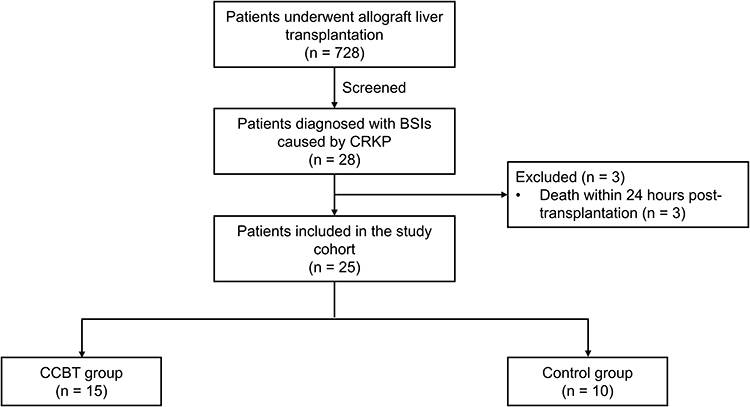 |
Figure 1 Flowchart of the study inclusion process. Abbreviations: BSI, bloodstream infection; CCBT, ceftazidime-avibactam-centered bundle therapy; CRKP, carbapenem-resistant Klebsiella pneumoniae. |
There were no statistically significant differences between the CCBT and control groups with respect to gender, age, liver disease etiology (alcoholic cirrhosis vs other causes), Model for End-Stage Liver Disease (MELD) score, donor-recipient CRKP colonization status, surgical approach (whole LT vs partial LT), intraoperative blood loss, cold ischemia time, Acute Physiology and Chronic Health Evaluation (APACHE) II score at infection onset, or Sequential Organ Failure Assessment (SOFA) score (Table 1). Comparison of laboratory parameters at the time of infection onset (Table 2) showed that the CCBT group had significantly lower total bilirubin levels compared to the control group (P = 0.046), while direct bilirubin (DBIL) levels did not differ significantly between the groups.
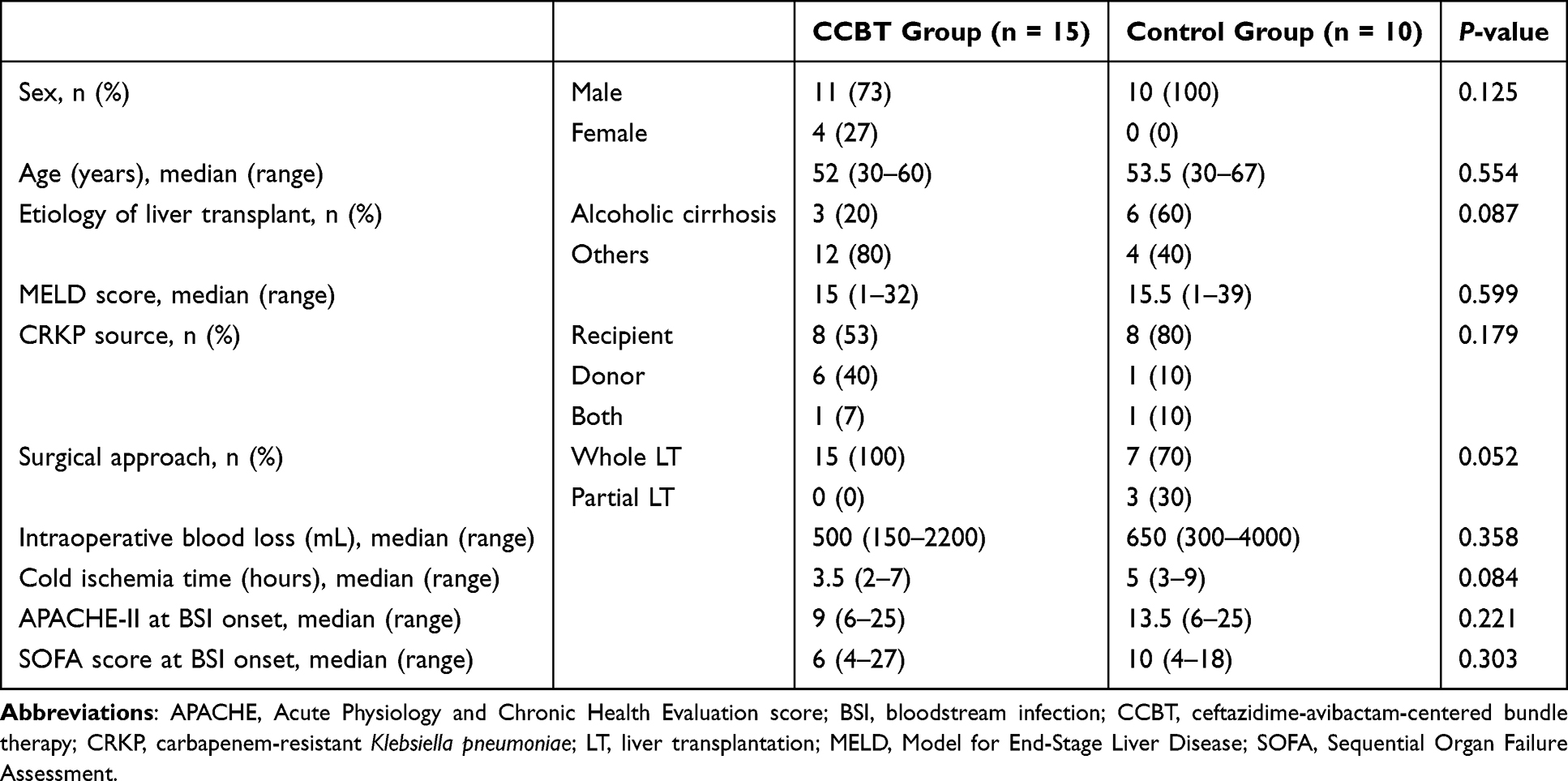 |
Table 1 Characteristics of LT Recipients with a BSI Caused by CRKP |
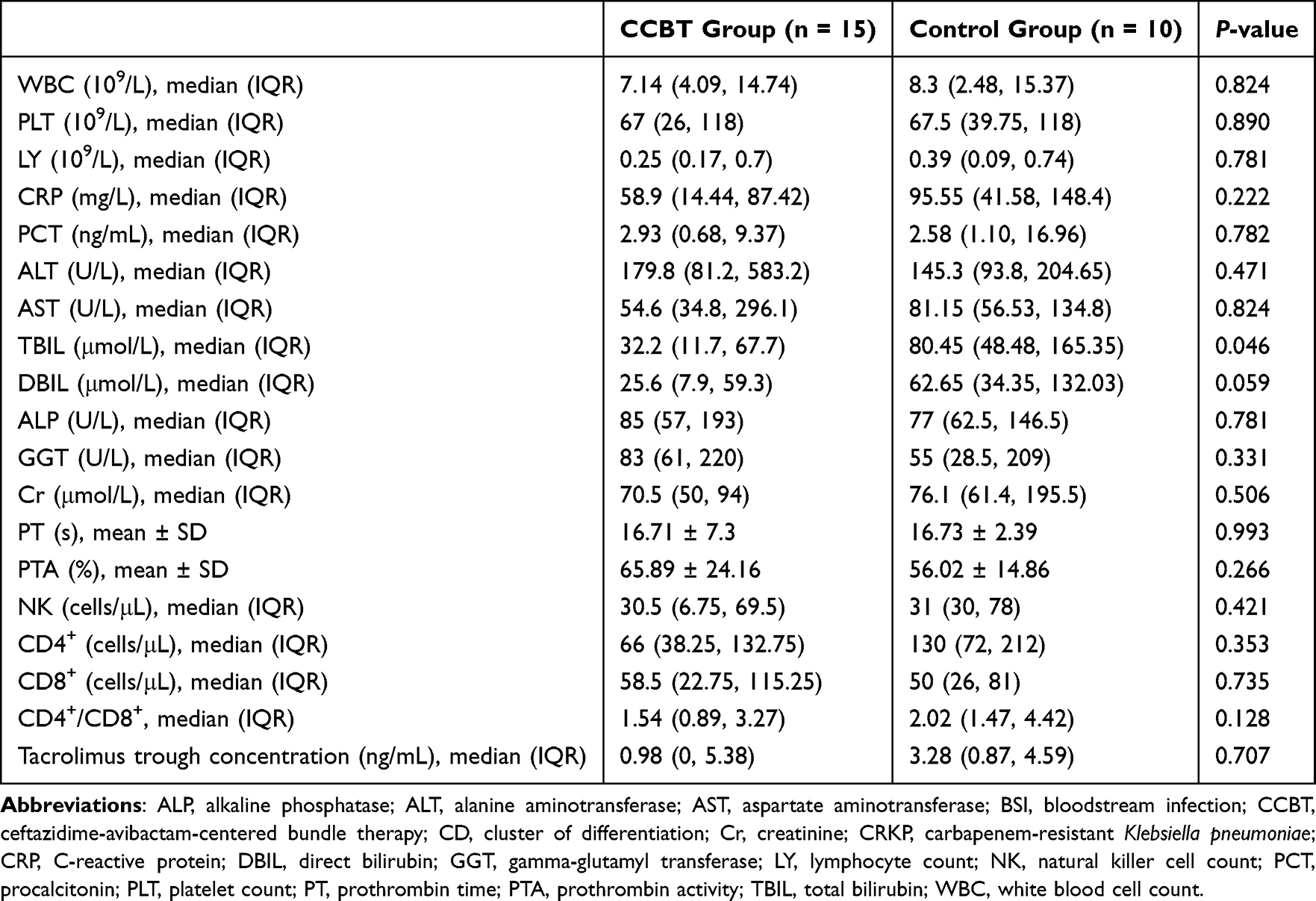 |
Table 2 Laboratory Test Results When BSI Caused by CRKP Occurred |
Outcomes of LT Patients After Different Treatment Methods
Complications
During the perioperative period, a total of 17 patients developed complications, of whom 14 experienced severe complications (Table 3). These included bile leakage (8 cases), biliary stricture (1 case), intra-abdominal hemorrhage (7 cases), liver abscess (3 cases), wound dehiscence (2 cases), portal vein stenosis (3 cases), hepatic artery (HA) complications (5 cases), intra-abdominal infection (6 cases), gastrointestinal perforation (1 case), continuous renal replacement therapy (3 cases), acute respiratory distress syndrome (1 case) and multiple organ dysfunction syndrome (1 case) (Figure 2).
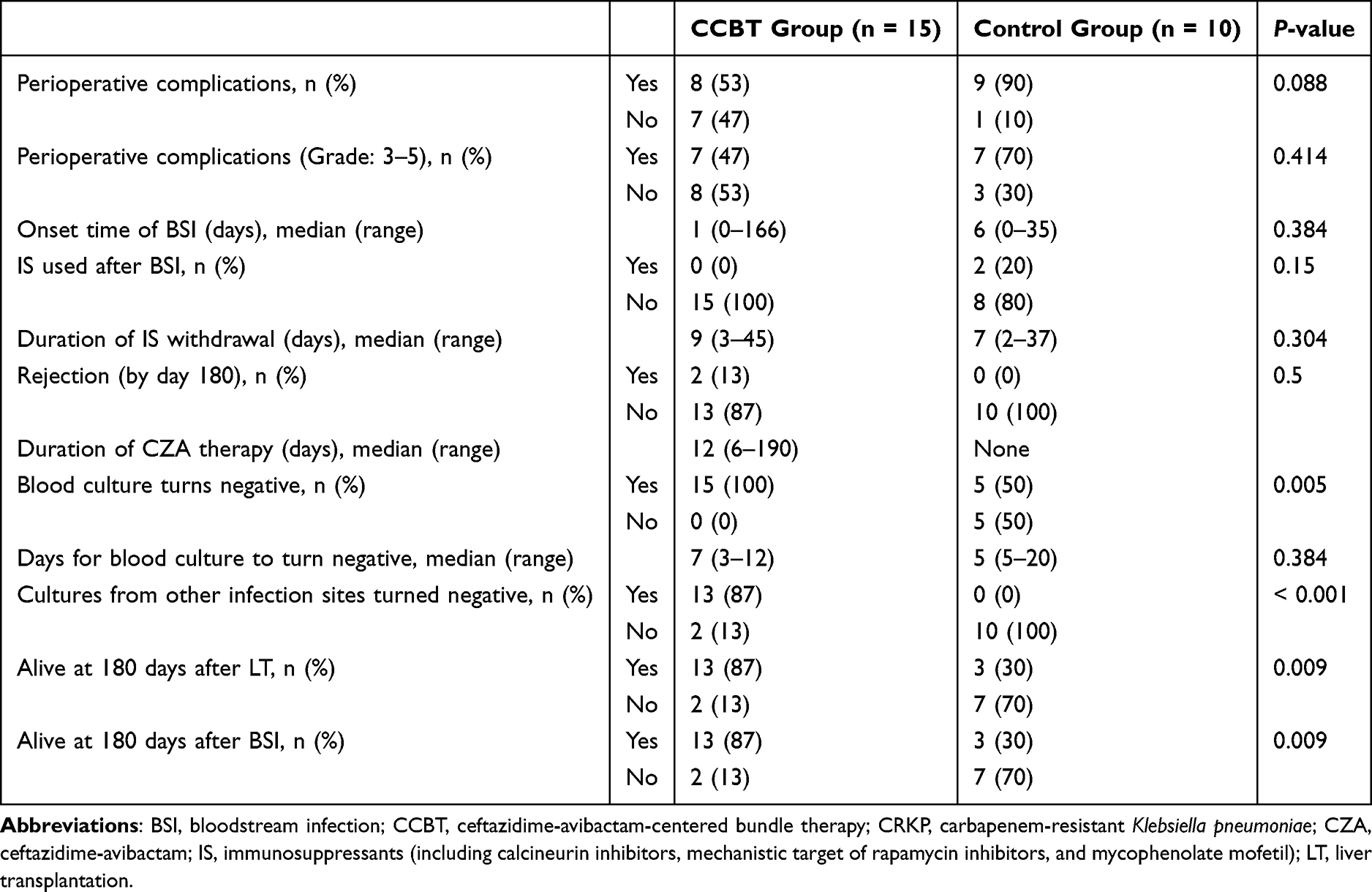 |
Table 3 Clinical and Microbiological Outcomes of Patients with BSI Caused by CRKP |
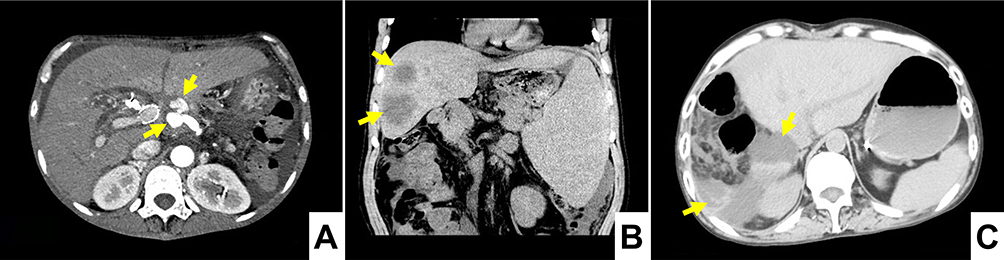 |
Figure 2 CT imaging of liver abscess, abdominal infection, and hepatic artery complications caused by CRKP. (A) Infectious fluid accumulation around the hepatic artery with aneurysm formation (yellow arrows). (B) Liver abscess caused by CRKP infection (yellow arrows). (C) Bile leakage complicated by infected abdominal fluid accumulation (yellow arrows). Abbreviation: CRKP, carbapenem-resistant Klebsiella pneumoniae. |
No statistically significant differences were observed between the two groups in terms of the overall incidence of perioperative complications, grade 3–5 complications, the interval between positive blood culture and surgery, discontinuation of immunosuppressants during anti-infective therapy, duration of immunosuppressant withdrawal, or the incidence of rejection within 180 days post-transplantation. During anti-infective treatment, 23 patients in total discontinued immunosuppressants entirely. Rejection occurred in 2 patients within 180 days post-LT, both being in the CCBT group, with Banff scores of 3 and 5, respectively (Table 3).
In the CCBT group, CZA therapy was initiated at a median time of 2 days (range: 1–3 days) after blood culture positivity. The median duration of CZA treatment was 12 days, and the median time to negative blood culture conversion was 7 days. All patients in the CCBT group achieved negative blood culture conversion, which was a significantly higher blood culture clearance rate than that in the control group (100% vs 50%, P = 0.005) (Table 3). Among those diagnosed with BSI, recurrence occurred in 3 patients in the CCBT group (with 1, 4, and 6 episodes, respectively) and in 1 patient in the control group (with 5 episodes).
Among patients who survived more than 7 days post-infection, new HA complications developed in 6 patients: 2 patients in the CCBT group developed HA aneurysm and occlusion, while all 4 patients in the control group experienced HA aneurysm rupture with hemorrhage.
Survival
During the follow-up period, a total of 7 deaths occurred in the CCBT group, of which only 2 were attributed to CRKP infection. The remaining deaths were due to liver graft failure (1 case), other infections (2 cases) and tumor recurrence (2 cases). In contrast, 8 deaths in the control group were directly caused by CRKP infection. Regarding 180-day post-operative and post-infection survival, patients in the CCBT group showed significantly better outcomes compared to the control group (both P = 0.009) (Table 3). Over the full follow-up period, the median postoperative survival time in the CCBT group was 573 days (range: 16–1119), and the median post-infection survival time was 407 days (range: 13–1116). In the control group, the median postoperative survival time was 37 days (range: 2–1638), and the median post-infection survival time was 18.5 days (range: 1–1637). Both post-transplant (P = 0.015) and post-infection (P = 0.011) survival times were significantly longer in the CCBT group compared to the control group (Figure 3).
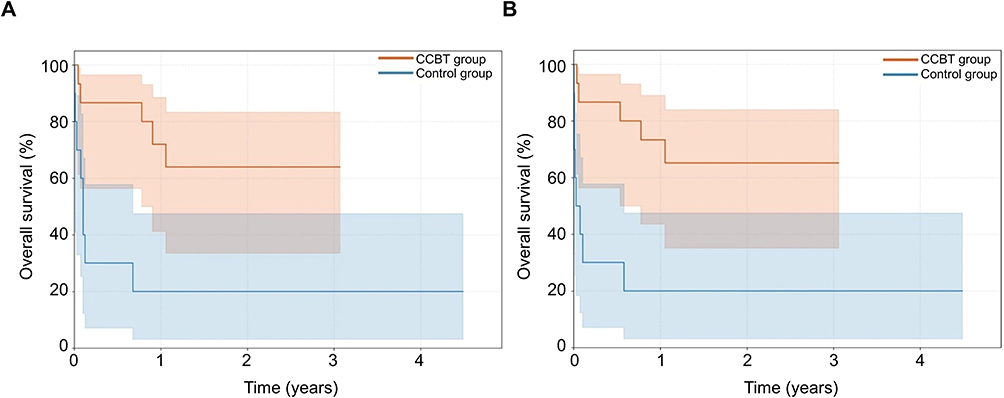 |
Figure 3 Survival curves for patients in the two groups. (A) Survival after LT. (B) Survival after CRKP infection. Abbreviations: CCBT, ceftazidime-avibactam-centered bundle therapy; CRKP, carbapenem-resistant Klebsiella pneumoniae; LT, liver transplantation. |
The CCBT group demonstrated successful recovery of liver function following treatment, with significant improvements observed in aspartate aminotransferase (P < 0.001), alanine aminotransferase (P = 0.015), and DBIL (P = 0.004), all of which gradually returned to normal levels. Concurrently, due to immune suppression during the infection period, a rebound in immune cell populations was noted after the reintroduction of anti-rejection therapy. Specifically, there were significant increases in natural killer cell levels at 3 months post-recovery (P < 0.001), CD4⁺ T cells at 7 days post-recovery (P < 0.001), and CD8⁺ T cells at 4 weeks post-recovery (P = 0.006) (Figure 4).
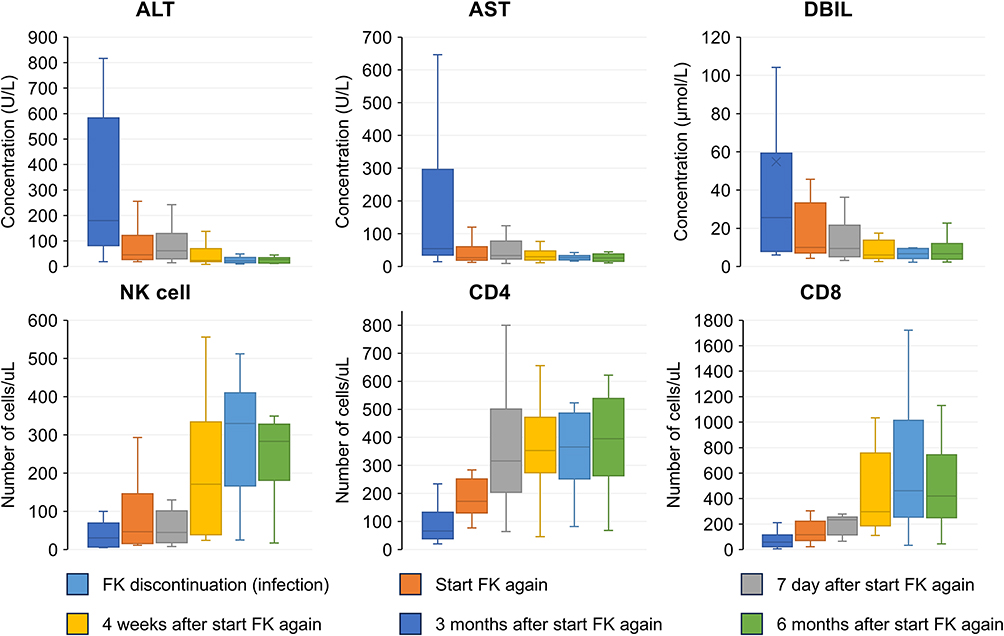 |
Figure 4 Changes in laboratory test results during therapy for the CCBT group. Abbreviations: ALT, alanine aminotransferase; AST, aspartate aminotransferase; CCBT, ceftazidime-avibactam-centered bundle therapy; CD, cluster of differentiation; DBIL, direct bilirubin; FK, tacrolimus; NK, natural killer. |
Discussion
Since the first study in 2012 described the incidence and outcomes of CRKP infections in LT recipients, poor survival and high mortality have remained pressing concerns, making treatment strategies for CRKP BSIs a continuous focus of attention. The incidence of CRKP infection has been reported to range from 2.5% to 35%, with a high fatality rate of 62.5% to 82%, mostly within the first 30 days post-LT.10 Multivariate analysis has identified several risk factors for post-LT CRKP infection, including a high MELD score at transplantation, presence of hepatocellular carcinoma, requirement for Roux-en-Y biliary choledochojejunostomy, and bile leak.11 In our study, only 7 patients had MELD scores above 20, and 9 patients had alcoholic cirrhosis. While alcoholic cirrhosis was not statistically confirmed as a risk factor, alcohol and its metabolite acetaldehyde are known to compromise the intestinal epithelial barrier, cause dysbiosis and promote bacterial overgrowth,12 which may increase CRKP colonization in LT candidates. Colonization itself may also strongly predict CRKP infection. In the cohort, 7 recipients likely acquired CRKP from the donor, yet all survived, suggesting that donor-derived bacteria may not worsen prognosis.
Four patients with uncontrolled biliary leakage ultimately died, highlighting the importance of effective abdominal drainage to prevent bile accumulation and abscess formation. However, due to the effective drainage protocols at our center, the incidence of CRKP BSI remained low. Post-LT dialysis has been identified as a risk factor for CRE acquisition; in our study, 3 patients required postoperative renal replacement therapy.13
Cephalosporins and carbapenems are commonly used to prevent GNB infections post-LT but are ineffective against CRKP. All-cause 30-day mortality in solid organ transplant recipients infected with CRKP ranges from 25% to 71%, with a 1-year survival of only 29% in LT recipients, emphasizing the challenge of infection control in this population.14,15 Traditional treatments for CRKP have included polymyxins, tigecycline and fosfomycin, while newer options involve β-lactamase inhibitor combinations such as CZA.16
CZA therapy has been associated with lower treatment failure rates in cirrhotic patients with CRKP infection.17 Unlike general patients, LT recipients are immunosuppressed, increasing both the risk of severe infection and the complexity of treatment. In one cohort, 30-day and all-cause mortality were 38.1% and 42.9%, respectively.18 While CZA shows promise in this group, rapid identification of CRKP is essential. Traditional culture-based diagnostics cause a 48–72 h delay between sampling and therapy. At our center, CRKP BSIs typically yielded positive blood cultures from both central and peripheral veins within 10 hours. With two consecutive positive cultures, CRKP infection was highly suspected, allowing timely treatment. Prompt source control and antibiotic initiation are essential for improved outcomes.
IVIG is commonly used for viral infections or ABO-incompatible LT. One study reported IVIG reduced 28-day mortality in sepsis-induced coagulopathy.19 Given the immunodeficient state of LT recipients during severe infection, IVIG was used in our CCBT group, and this may have contributed to the excellent infection control and survival rates.
Reports on immunosuppression withdrawal during severe infection post-LT are limited. One case report described recovery from COVID-19 pneumonia after LT with temporary immunosuppression withdrawal,20 but for bacterial BSIs both rejection and complete immunosuppression withdrawal were independent risk factors for 30-day mortality.21 Thus, caution is warranted. In our study, 2 cases of rejection occurred in the CCBT group and none in the control group (2/23 overall). Both were managed with steroid boluses and increased doses of tacrolimus. One rejection resolved quickly; the other required multiple steroid boluses. This patient had prior immune checkpoint inhibitor therapy, which increases the rejection risk.22 He later developed liver abscess, bile leakage and hepatic artery thrombosis (HAT), underscoring the need for careful immunosuppression management in high-risk CRKP patients. The timing and strategy for restarting immunosuppression – especially steroid use – should balance infection control and rejection risk. Nevertheless, we believe immunosuppression withdrawal is safe during severe CRKP infection, provided liver function is closely monitored, possibly using lymphocyte status as the reference.23
CRKP-induced HA rupture is fatal. Qian et al found encapsulated bacilli infiltrating arterial elastic fibers, confirming CRKP’s invasiveness.24 They advised removing infected graft arteries. In our cohort, 5 patients developed HA rupture; only 1 was in the CCBT group. This finding suggests that timely and effective anti-infective therapy may reduce such complications. In addition to rupture, HAT is a serious concern. Patients with HAT, or those undergoing embolization after rupture, often develop liver abscesses, further complicating CRKP control and promoting colonization. Four patients in our study experienced recurrent infections, with 1 to 6 relapses involving abscesses and HAT. Only 1 patient showed arterial compensation and had a single relapse. Recurrent infections may induce CZA resistance. One reported case involved HAT, liver abscess and CZA resistance, requiring meropenem-vaborbactam and retransplantation.25
Although pre-LT CRKP colonization is a risk factor for post-LT infection, no evidence supports adjusting prophylactic antibiotics to prevent it. Few patients received CRE-active prophylaxis. One study reported lower treatment failure rates in cirrhotic CRKP patients treated with CZA,17 but no guidelines recommend CZA for prophylaxis in high-risk patients. Widespread CZA use has led to resistant CRKP, especially with repeated or prolonged exposure.25 In one study, microbiologic failure occurred in 27% of patients, with CZA resistance in 30% of failures.26 Resistance mechanisms include KPC overexpression or variants; alternative treatments include imipenem-relebactam and meropenem-vaborbactam.26,27 Novel agents such as eravacycline and plazomicin may also help in refractory cases. For LT recipients, comprehensive CRKP management from pre-op to long-term follow-up is crucial, and standardized management protocols should be developed.28
Despite the current high susceptibility of CRKP to CZA, there is some evidence that treatment efficacy can be further improved by combining CZA with another antimicrobial agent. For example, CZA in combination with another antibiotic (including carbapenem, tigecycline, amikacin or aztreonam) was associated with better outcomes (14-day clinical and microbiological cure rates and mortality) than CZA monotherapy.29 Furthermore, CZA has been reported to exhibit additive or synergistic actions with various other antimicrobial agents against isolates producing KPC-2 variants or metallo-β-lactamase.30 Since there is concern that the emergence of more KPC variants may lead to increasing CZA resistance over time,31 further research is needed to establish whether combining CZA with another agent might be beneficial in patients with CRKP BSI after LT.
The present study had a number of limitations. First, this was a single-center study, so the generalizability of the results is unknown. Second, the sample size was small, so the analysis may have been underpowered to detect some real differences between groups. Third, this was a retrospective study, so the findings may be subject to selection bias and information bias. Fourth, CRKP resistance gene analysis was not performed, and carbapenem-resistant Acinetobacter baumannii, carbapenem-resistant Pseudomonas aeruginosa and culture-negative CRKP cases were excluded. Fifth, immune status was assessed by lymphocyte counts only, without functional or cytokine analyses. Sixth, our study was unable to establish the independent contributions of immunosuppression minimization and IVIG administration to the therapeutic efficacy of our treatment bundle. Therefore, a large-scale, multicenter prospective study is needed to confirm whether CCBT improves outcomes (versus antibiotic therapy alone) in patients with CRKP BSI after LT and establish the contributions of each bundle component.
Conclusion
The study suggests that the CCBT regimen significantly improves survival and infection control in LT recipients with CRKP BSIs. Early administration of CZA should be considered once CRKP is suspected. The use of IVIG and temporary immunosuppression withdrawal appears safe in these patients. LT recipients with CRKP BSIs require close monitoring of liver function, immune status and microbiological markers during follow-up.
Abbreviations
APACHE, Acute Physiology and Chronic Health Evaluation; BSI, bloodstream infection; CCBT, beftazidime-avibactam-centered bundle therapy; CNI, calcineurin inhibitor; CRKP, carbapenem-resistant Klebsiella pneumoniae; CRE, carbapenem-resistant Enterobacterales; CZA, ceftazidime-avibactam; DBIL, direct bilirubin; ESBL, extended-spectrum beta-lactamase; GNB, Gram-negative bacterial; HA, hepatic artery; HAT, hepatic artery thrombosis; IQR, interquartile range; IVIG, intravenous immunoglobulin; KPC, Klebsiella pneumoniae carbapenemase; LT, liver transplantation; MELD, Model for End-Stage Liver Disease; SOFA, Sequential Organ Failure Assessment.
Data Sharing Statement
The datasets used and/or analyzed during the current study are available from the corresponding author on reasonable request.
Ethics Approval and Informed Consent
The study protocol was reviewed and approved by the Ethics Committee of Beijing Tsinghua Changgung Hospital (Approval No. 24720-6-01), and the study was conducted in accordance with the Declaration of Helsinki. All organs were donated voluntarily, and all procedures were conducted in accordance with the Declaration of Istanbul. Written informed consent was obtained from all enrolled patients.
Author Contributions
All authors made a significant contribution to the work reported, whether that is in the conception, study design, execution, acquisition of data, analysis and interpretation, or in all these areas; took part in drafting, revising or critically reviewing the article; gave final approval of the version to be published; have agreed on the journal to which the article has been submitted; and agree to be accountable for all aspects of the work.
Disclosure
The authors report no conflicts of interest in this work.
References
1. Guo L, Peng P, Peng WT, Zhao J, Wan QQ. Klebsiella pneumoniae infections after liver transplantation: drug resistance and distribution of pathogens, risk factors, and influence on outcomes. World J Hepatol. 2024;16(4):612–11. doi:10.4254/wjh.v16.i4.612
2. Wu D, Chen C, Liu T, Jia Y, Wan Q, Peng J. Epidemiology, susceptibility, and risk factors associated with mortality in carbapenem-resistant Gram-negative bacterial infections among abdominal solid organ transplant recipients: a retrospective cohort study. Infect Dis Ther. 2021;10(1):559–573. doi:10.1007/s40121-021-00411-z
3. Mills JP, Talati NJ, Alby K, Han JH. The epidemiology of carbapenem-resistant Klebsiella pneumoniae colonization and infection among long-term acute care hospital residents. Infect Control Hosp Epidemiol. 2016;37(1):55–60. doi:10.1017/ice.2015.254
4. Wang Y, Sholeh M, Yang L, Shakourzadeh MZ, Beig M, Azizian K. Global trends of ceftazidime-avibactam resistance in Gram-negative bacteria: systematic review and meta-analysis. Antimicrob Resist Infect Control. 2025;14(1):10. doi:10.1186/s13756-025-01518-5
5. Tamma PD, Heil EL, Justo JA, Mathers AJ, Satlin MJ, Bonomo RA. Infectious Diseases Society of America 2024 guidance on the treatment of antimicrobial-resistant gram-negative infections. Clin Infect Dis. 2024. doi:10.1093/cid/ciae403
6. Liu TH, Chen LH, Wan QQ. Carbapenem-resistant Klebsiella pneumoniae infections after liver transplantation: drug resistance, risk factors and impact on prognosis. World J Gastroenterol. 2025;31(8):98415. doi:10.3748/wjg.v31.i8.98415
7. Pedraza-Sánchez S, Cruz-González A, Palmeros-Rojas O, Gálvez-Romero JL, Bellanti JA, Torres M. Polyvalent human immunoglobulin for infectious diseases: potential to circumvent antimicrobial resistance. Front Immunol. 2022;13:987231. doi:10.3389/fimmu.2022.987231
8. Carbone J, Montanchez J, Cifrian J, et al. Intravenous immunoglobulin is associated with lower rates of reinfection in solid organ recipients with infection and secondary antibody deficiency: a multicenter randomized clinical trial. J Heart Lung Transplant. 2022;41(4):S179–S180. doi:10.1016/j.healun.2022.01.1583
9. CDC. Bloodstream infection event (central line-associated bloodstream infection and non-central line associated bloodstream infection); 2025 [updated January, 2025]. Available from: https://www.cdc.gov/nhsn/pdfs/pscmanual/4psc_clabscurrent.pdf.
10. Mouloudi E, Massa E, Papadopoulos S, et al. Bloodstream infections caused by carbapenemase-producing Klebsiella pneumoniae among intensive care unit patients after orthotopic liver transplantation: risk factors for infection and impact of resistance on outcomes. Transplant Proc. 2014;46(9):3216–3218. doi:10.1016/j.transproceed.2014.09.159
11. Pereira MR, Scully BF, Pouch SM, et al. Risk factors and outcomes of carbapenem-resistant Klebsiella pneumoniae infections in liver transplant recipients. Liver Transpl. 2015;21(12):1511–1519. doi:10.1002/lt.24207
12. Das S, Song Z, Han H, et al. Intestinal osteopontin protects from alcohol-induced liver injury by preserving the gut microbiome and the intestinal barrier function. Cell Mol Gastroenterol Hepatol. 2022;14(4):813–839. doi:10.1016/j.jcmgh.2022.06.012
13. Freire MP, Oshiro IC, Pierrotti LC, et al. Carbapenem-resistant Enterobacteriaceae acquired before liver transplantation: impact on recipient outcomes. Transplantation. 2017;101(4):811–820. doi:10.1097/tp.0000000000001620
14. Bartoletti M, Giannella M, Tedeschi S, Viale P. Multidrug-resistant bacterial infections in solid organ transplant candidates and recipients. Infect Dis Clin North Am. 2018;32(3):551–580. doi:10.1016/j.idc.2018.04.004
15. Kalpoe JS, Sonnenberg E, Factor SH, et al. Mortality associated with carbapenem-resistant Klebsiella pneumoniae infections in liver transplant recipients. Liver Transpl. 2012;18(4):468–474. doi:10.1002/lt.23374
16. Tamma PD, Aitken SL, Bonomo RA, Mathers AJ, van Duin D, Clancy CJ. Infectious Diseases Society of America guidance on the treatment of extended-spectrum β-lactamase producing Enterobacterales (ESBL-E), carbapenem-resistant Enterobacterales (CRE), and Pseudomonas aeruginosa with difficult-to-treat resistance (DTR-P. aeruginosa). Clin Infect Dis. 2021;72(7):1109–1116. doi:10.1093/cid/ciab295
17. Feldman S, Russo A, Ceccarelli G, et al. Ceftazidime-Avibactam for the treatment of carbapenem-resistant Klebsiella pneumoniae infections in patients with liver cirrhosis. J Clin Exp Hepatol. 2022;12(5):1293–1300. doi:10.1016/j.jceh.2022.04.016
18. Chen F, Zhong H, Yang T, et al. Ceftazidime-avibactam as salvage treatment for infections due to carbapenem-resistant Klebsiella pneumoniae in liver transplantation recipients. Infect Drug Resist. 2021;14:5603–5612. doi:10.2147/idr.S342163
19. Fang J, Huang P, Cui W, Lin Y, Rong D, Li X. Comprehensive therapeutic efficacy analysis of intravenous immunoglobulin in treating sepsis-induced coagulopathy: a single-center, retrospective observational study. Shock. 2024;62(1):4–12. doi:10.1097/shk.0000000000002336
20. Liu B, Wang Y, Zhao Y, Shi H, Zeng F, Chen Z. Successful treatment of severe COVID-19 pneumonia in a liver transplant recipient. Am J Transplant. 2020;20(7):1891–1895. doi:10.1111/ajt.15901
21. Chen F, Pang XY, Shen C, et al. High mortality associated with gram-negative bacterial bloodstream infection in liver transplant recipients undergoing immunosuppression reduction. World J Gastroenterol. 2020;26(45):7191–7203. doi:10.3748/wjg.v26.i45.7191
22. Xu Y, Yan Y, Liu D, et al. Risk of transplant rejection associated with ICIs prior to liver transplantation in HCC: a multicenter retrospective study. Int Immunopharmacol. 2024;143(Pt 2):113400. doi:10.1016/j.intimp.2024.113400
23. Li WQ, Zhang WY, Li X, Zhang YM, Sun ZH. [Analysis of early changes in lymphocyte subpopulations after liver transplantation and their correlation with clinical manifestations]. Zhonghua Yu Fang Yi Xue Za Zhi. 2024;58(5):679–685. Chinese. doi:10.3760/cma.j.cn112150-20231120-00357
24. Qian Y, Zhang H, Chen X, Zhang J, Xia Q. Graft hepatic artery rupture due to carbapenem-resistant Klebsiella pneumoniae infection after liver transplant. Exp Clin Transplant. 2020;18(4):529–532. doi:10.6002/ect.2018.0384
25. Athans V, Neuner EA, Hassouna H, et al. Meropenem-vaborbactam as salvage therapy for ceftazidime-avibactam-resistant Klebsiella pneumoniae bacteremia and abscess in a liver transplant recipient. Antimicrob Agents Chemother. 2019;63(1):e01551–18. doi:10.1128/aac.01551-18
26. Shields RK, Potoski BA, Haidar G, et al. Clinical outcomes, drug toxicity, and emergence of ceftazidime-avibactam resistance among patients treated for carbapenem-resistant Enterobacteriaceae infections. Clin Infect Dis. 2016;63(12):1615–1618. doi:10.1093/cid/ciw636
27. Li Y, Chen X, Guo Y, et al. Overexpression of KPC contributes to ceftazidime-avibactam heteroresistance in clinical isolates of carbapenem-resistant Klebsiella pneumoniae. Front Cell Infect Microbiol. 2024;14:1450530. doi:10.3389/fcimb.2024.1450530
28. Wong D, van Duin D. Carbapenemase-producing organisms in solid organ transplantation. Curr Opin Organ Transplant. 2019;24(4):490–496. doi:10.1097/mot.0000000000000664
29. Liu CW, Chen Q, Ding N, Hu LF. Ceftazidime-avibactam: combination therapy versus monotherapy in the challenge of pneumonia caused by carbapenem-resistant Klebsiella pneumoniae. Heliyon. 2024;10(16):e35757. doi:10.1016/j.heliyon.2024.e35757
30. Liu C, Wu Y, Zhang Y, et al. Effectiveness of antimicrobial agent combinations against carbapenem-producing Klebsiella pneumoniae with KPC variants in China. Front Microbiol. 2024;15:1519319. doi:10.3389/fmicb.2024.1519319
31. Hobson CA, Pierrat G, Tenaillon O, et al. Klebsiella pneumoniae carbapenemase variants resistant to ceftazidime-avibactam: an evolutionary overview. Antimicrob Agents Chemother. 2022;66(9):e0044722. doi:10.1128/aac.00447-22
 © 2026 The Author(s). This work is published and licensed by Dove Medical Press Limited. The
full terms of this license are available at https://www.dovepress.com/terms
and incorporate the Creative Commons Attribution
- Non Commercial (unported, 4.0) License.
By accessing the work you hereby accept the Terms. Non-commercial uses of the work are permitted
without any further permission from Dove Medical Press Limited, provided the work is properly
attributed. For permission for commercial use of this work, please see paragraphs 4.2 and 5 of our Terms.
© 2026 The Author(s). This work is published and licensed by Dove Medical Press Limited. The
full terms of this license are available at https://www.dovepress.com/terms
and incorporate the Creative Commons Attribution
- Non Commercial (unported, 4.0) License.
By accessing the work you hereby accept the Terms. Non-commercial uses of the work are permitted
without any further permission from Dove Medical Press Limited, provided the work is properly
attributed. For permission for commercial use of this work, please see paragraphs 4.2 and 5 of our Terms.
Recommended articles

Risk Factors for Mortality and Outcomes in Hematological Malignancy Patients with Carbapenem-Resistant Klebsiella pneumoniae Bloodstream Infections
Meng H, Han L, Niu M, Xu L, Xu M, An Q, Lu J
Infection and Drug Resistance 2022, 15:4241-4251
Published Date: 4 August 2022
Molecular Epidemiology, Clinical Characteristics and Risk Factors for Bloodstream Infection of Multidrug-Resistant Klebsiella pneumoniae Infections in Pediatric Patients from Tianjin, China
Hou M, Chen N, Dong L, Fang Y, Pan R, Wang W, Wang L, Ning J, Dong H
Infection and Drug Resistance 2022, 15:7015-7023
Published Date: 2 December 2022