
Back to Journals » Nature and Science of Sleep » Volume 18


Toward a Classification of Chronotype Questionnaires
Authors Putilov AA 
Received 10 February 2026
Accepted for publication 20 May 2026
Published 30 May 2026 Volume 2026:18 602542
DOI https://doi.org/10.2147/NSS.S602542
Checked for plagiarism Yes
Review by Single anonymous peer review
Peer reviewer comments 2
Editor who approved publication: Prof. Dr. Ahmed BaHammam
Arcady A Putilov1,2
1Independent Research Group for Biomedical Systems Math-Modeling, Berlin, 12489, Germany; 2Laboratory of Sleep/Wake Neurobiology, Institute of Higher Nervous Activity and Neurophysiology of the Russian Academy of Sciences, Moscow, 117865, Russia
Correspondence: Arcady A Putilov, Email [email protected]
Purpose: Chronotyping is a key methodology for assessing individual differences in human adaptation to the 24-h periodicity of geophysical and social environments. Throughout the 50-yr period of publications of chronotype questionnaires, there has been steady growth in their number and diversity. Therefore, it is becoming increasingly difficult to determine which questionnaires can be optimally applied to address a given research question. Consequently, this study aimed to develop a structured system for classifying and comparing chronotype questionnaires.
Methods: A search in two bibliographic databases and 8 previously published reviews yielded 75 chronotype questionnaires. The properties of these questionnaires were defined and used for their classification and comparison.
Results: Of 75 identified questionnaires, 60 and 15 were designed for only chronotype and chronotype and something else assessment, respectively. The set of 20 questionnaire and questionnaire scale properties was proposed. These properties were used to classify the questionnaires to allow the distinction of any of the questionnaires from other questionnaires.
Conclusion: The proposed structured system of questionnaire classification can help in navigating between numerous published questionnaires. Using this system, an optimal instrument for a given research purpose can be chosen and properties of yet-unconstructed questionnaires and scales can be predicted.
The Plain Language Summary: Chronotype refers to the behavior manifestations of individual differences in adaptation to the 24-h periodicity of geophysical and social environments. Chronotype questionnaires are permanently growing in number and diversity throughout the 50-yr period of their scientific publications. These questionnaires often have different aims, use different assessment methodologies, and, therefore, are not interchangeable. Given that some researchers would be confused about the different concepts behind these questionnaires, it is essential to determine what instrument to choose for a given research purpose. A system of questionnaire classification can help to navigate between numerous published questionnaires for choosing an optimal instrument for assessment of individual differences in a given study. Moreover, it can help to predict the properties of yet-unconstructed questionnaires. A system based on a set of 20 properties of questionnaires and questionnaire-scales was proposed. It might be used for choosing an optimal instrument for assessment of individual differences in the domain of chronobiology and sleep science and predicting properties of new questionnaires and new scales of published questionnaires.
Keywords: morningness-eveningness, chronotyping, individual variation, self-assessment, classification
Introduction
The façade of the Social Science Research Building of the University of Chicago bears Lord Kelvin’s dictum: “If you cannot measure, your knowledge is meager and unsatisfactory”. This dictum refers to his lecture titled “Electrical Units of Measurement” delivered on May 3, 1883, in which he highlighted the necessity of quantitative, numerical data for scientific understanding, suggesting that knowledge lacking measurement is, at best, a preliminary stage of science,1 Indeed, measurement is considered a hallmark of scientific enterprise. A valid and reliable measurement is critical in any field of science, including research on individual differences in the domains of chronobiology and sleep.2,3 Chronotypes are the behavior manifestations of individual differences in adaptation to the 24-h periodicity of geophysical and social environments. The first scientifically recognized dimension of such differences in human behavior was an individual’s preference for either the early or late phase of the daily rhythmicity of sleep-wakefulness and rest-work. In 1976, Östberg, in co-authorship with Horne, published the first English-language scale, the Morningness-Eveningness Questionnaire (MEQ).4 It was soon translated into a dozen languages and remains the most popular scale for assessment of individual variation in the field of sleep and biological rhythm research (Table S1).
This questionnaire encouraged to use the same methodology to construct several other scales for the self-assessment of morningness-eveningness. The earliest of such scales are the 7-item Diurnal Type Scale (DTS),5 one of the two scales of the 16-item Marburger questionnaire (MQ),6 and the 13-item Composite Scale of Morningness (CSM).7
Soon after the publication of the MEQ in 1979, Folkard, Monk and Lobban8 proposed the first questionnaire instrument for the multi-dimensional (multi-scale) self-assessment of individual differences in daily rhythms. They suggested that morningness-eveningness is not the only chronobiological characteristic of individuals that determines the success or failure of biological adaptation to night and shift work. Factor analysis of responses to the initially proposed list of 20 items of their Circadian-Type Questionnaire (CTQ)8 yielded three factorial dimensions. One dimension was interpreted as a well-established construct named “morningness-eveningness,” while two other dimensions were named “rigidity-flexibility” (of sleeping habits) and “languidness-vigorousness” (or “inability-ability to overcome drowsiness”).8
Later, such a multidimensional approach to chronotyping8 was applied for the development of several other questionnaires including the 16-item Chronotype Questionnaire (ChQ)9 and the 40-item Sleep-Wake Pattern Assessment Questionnaire (SWPAQ-40).10
After five decades of intensive research, chronotype remains the central concept in studies of individual variation in the fields of chronobiology, chronomedicine, chronopsychology, and sleep-wake regulating mechanisms. Therefore, assessment of chronotypes is a key methodology for studying the differences between people in their capacity to adapt to the 24-h cyclicity of their environment. However, a scientific consensus has not yet been reached on the method of ranking and typing people according to the dimensions of individual variation in daily patterns of performance, sleepiness and sleep-wakefulness.3 The concepts behind questionnaires used to assess chronotypes are often profoundly different. Particularly, some researchers follow the MEQ4 approach to chronotyping that suggests that people can be ranked along the only morningness-eveningness (or, in other words, earliness-lateness dimension), while some other follow the CTQ8 strategy suggesting importance of more complex, multidimensional chronotyping.2,3,11,12
It seems that the process of developing questionnaires within the framework of various concepts was intensified in recent years. The examples of questionnaires published in the last decade are the 15-item Morningness–Eveningness-Stability Scale improved (MESSi),11 the 168-item Sleep-Wake Adaptability Test (SWAT-168),12 the Athlete Sleep Screening Questionnaire (ASSQ),13 the 15-item Mood Rhythm Instrument (MRhI),14 the 30-item Morningness-eveningness Exercise Preference Questionnaire (MEEPQ),15 the 10-item Francis Owl-Lark Indices (FOLI),16 the Single-Item Chronotyping (SIC),17 the Sleep, Circadian Rhythms, and Mood (SCRAM) questionnaire,18 and a series of chrononutrition questionnaires, such as the Chrononutrition profile-questionnaire (CPQ-M),19 the Food Timing Questionnaire and Food Timing Screener (FTQ and FTS, respectively),20 the ChronoNutrition Questionnaire (CNQ),21 and the Chrono-Nutrition Behavior Questionnaire (CNBQ).22 Therefore, it is unlikely that the attempts to develop new chronotype questionnaires are coming to the end.
The available chronotype questionnaires often have different aims and use different assessment methodologies.23 Some of them cannot be interchangeably applied in sleep and biological rhythm study. Since researchers can be confused about the different concepts behind these questionnaires, it is essential to know what instrument to choose for a given research purpose.23
To our knowledge, the relationships and conceptual and methodological differences between numerous chronotype questionnaires have not been clarified so far in the framework of a single structured system. Therefore, the following two questions arise: Is it possible to create a system, something like “questionnaire identifier”, to help to 1) choose an optimal instrument for assessing individual differences in a chronobiological and sleep study and 2) determine whether such an instrument is still missing and might be constructed to fill the gap between the already constructed questionnaires? Consequently, the purpose of this paper was to propose such a structured system for facilitating comparisons of basic properties of chronotype questionnaires. The purpose of this system can be to help navigate between numerous questionnaires without much effort for choosing the right instrument and for uncovering empty territories in the questionnaire landscape and predicting the unique properties of yet-unconstructed questionnaires and scales.
Here, a property-based system of questionnaire classification was proposed. Such a system provides the possibility to navigate between numerous questionnaires without much effort, particularly, without inspecting the content of each questionnaire. A list of chronotype questionnaires was created via a literature search, properties of these questionnaires and their scales were defined, criteria for categorization of each of these properties were suggested, and the examples of such categorization of the identified questionnaires as well as the examples of comparison of questionnaires on their properties were presented.
Materials and Methods
Identification of Chronotype Questionnaires
The main aim of the literature search was to identify publications reporting the results of the development and/or application of chronotype questionnaires in human sleep and biological rhythm research. PRISMA (Preferred Reporting Items for Systematic Reviews and Meta-Analyses) guidelines for a search of published questionnaires were used.24
A questionnaire was included in the list of chronotype questionnaires when the whole questionnaire or, at least, one of its separate scales was designed to assess behavior manifestations of diurnal rhythms including timing of the sleep-wake cycle and times of feeling sleepy-alert. Questionnaires developed to assess general sleep quality and problems were not searched. PRISMA-informed identification of chronotype questionnaires included two following steps.
First, the PubMed bibliographic database was searched for publications of chronotype questionnaires from inception to 1/10/2025. The title, abstract and method section were examined to find such questionnaire names and its reference. Previously published reviews on chronotype questionnaires were also manually searched to identify additional questionnaires (Figure 1A). A total of 42 questionnaires were identified by searching in 224 of 516 publications found via a PubMed search using the following search terms: (((Chronotype [Title/Abstract] OR Diurnal [Title/Abstract] OR Morningness-Eveningness [Title/Abstract] OR Morning preference [Title/Abstract] OR Evening preference [Title/Abstract]) AND (Scale [Title/Abstract] OR Questionnaire [Title/Abstract] OR Inventory [Title/Abstract])) AND (Validation [Title/Abstract] OR Validity [Title/Abstract] OR Psychometric [Title/Abstract] OR Reliability [Title/Abstract] OR Construction [Title/Abstract] OR Development [Title/Abstract]). Additionally, 8 reviews (Cavallera and Giudici,25 Di Milia et al,2 Almoosawi et al,26 Tonetti et al,27 Putilov et al,17 Vidueira et al,28 Coelho et al,29 and Buest de Mesquita Silva et al30) were searched for questionnaires missed in the PubMed search. This review search yielded 33 chronotype questionnaires in addition to 42 questionnaires identified in the PubMed search (Figure 1A and Table S1).
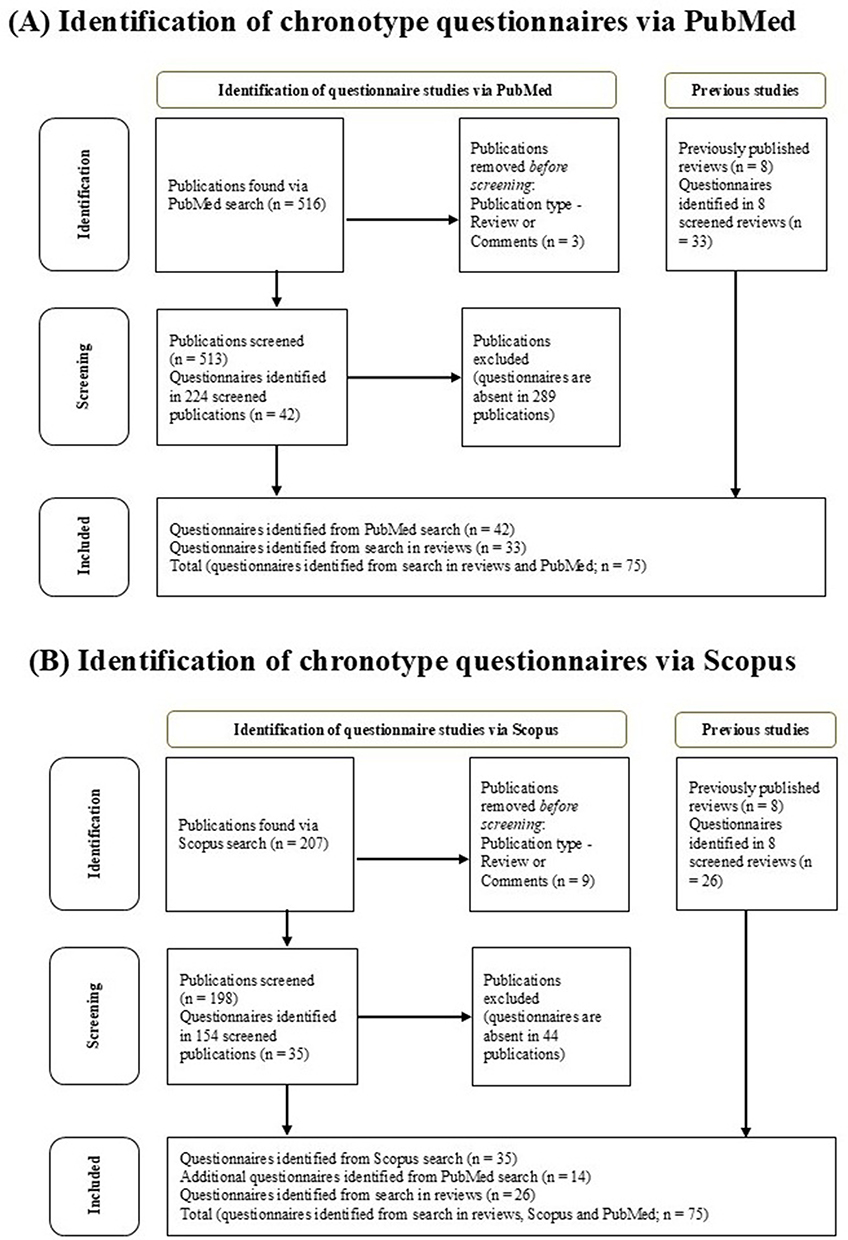 |
Figure 1 PRISMA flow diagram illustrating the steps of PRISMA-informed identification of 75 chronotype questionnaires in PubMed (A) and Scopus databases (B) with additional search in reviews. |
Second, the Scopus bibliographic database was searched for publications of chronotype questionnaires from inception to 31/12/2025 to ensure that none of the published questionnaires was missed in the previous search in PubMed database and 8 reviewers (Figure 1A and Table S1). The search terms were the same as in the PubMed search: ((Chronotype OR Diurnal OR Morningness-Eveningness OR Morning preference OR Evening preference) AND (Scale OR Questionnaire OR Inventory)) AND (Validation OR Validity OR Psychometric OR Reliability OR Construction OR Development). A total of 35 questionnaires were identified by searching in 154 of 207 publications found by screening their titles, abstracts and method section via this Scopus search (Figure 1B and Table S1). Compared to the results of PubMed search, 7 more questionnaires were found, but 14 questionnaires were missed. The remaining 26 questionnaires were previously found in the mentioned above 8 reviewers (Figure 1B and Table S1). Thus, this additional search in Scopus bibliographic database did not yield missed questionnaires.
Classification of Chronotype Questionnaires
After identification of chronotype questionnaires, their content was examined to 1) briefly describe each of the identified questionnaires (Table S2), 2) determine relationships between new and previously published questionnaires (Tables S3 and 1), 3) propose a set of 11 properties of these questionnaires (Tables S4 and 2) and 9 properties of their scales (Tables S5 and 3), 4) categorize these properties and provide examples of these categories (Tables S4 and S5, and 2–4), and 5) illustrate the prospects of comparison of questionnaires on their properties (Tables S6 and S7 and 5 and 6).
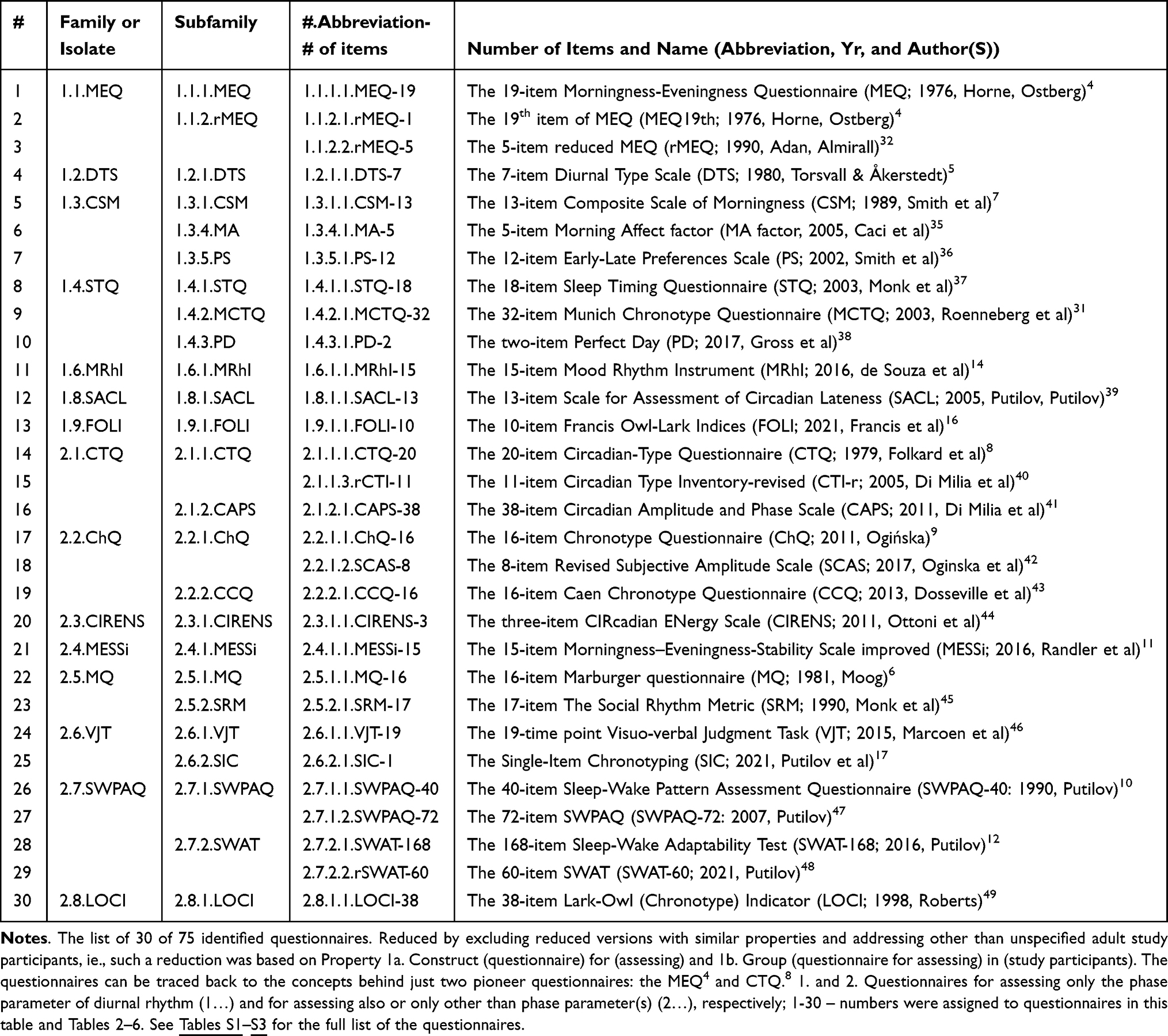 |
Table 1 Grouping Chronotype Questionnaires in Families and Subfamilies |
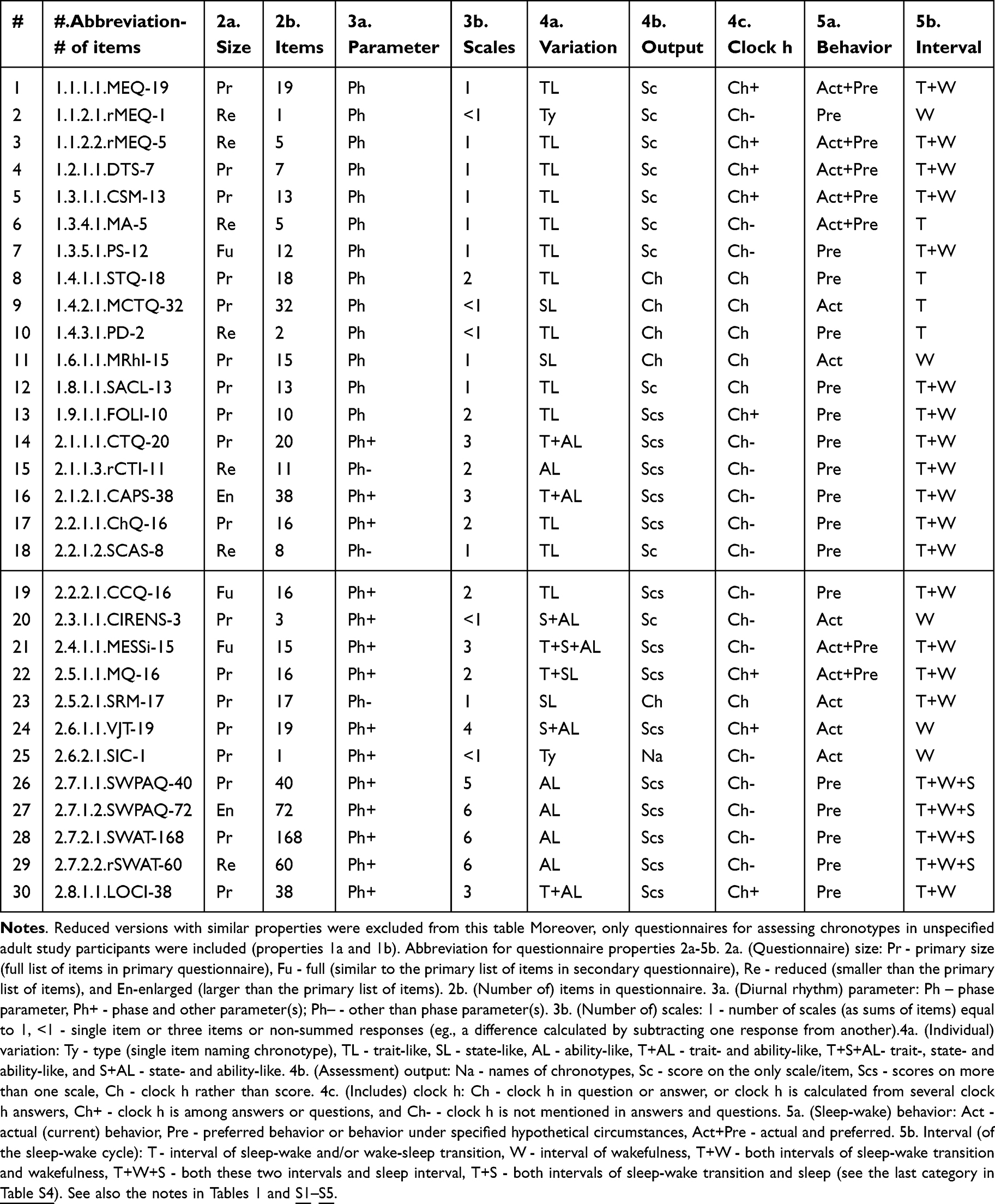 |
Table 2 Properties of Chronotype Questionnaires |
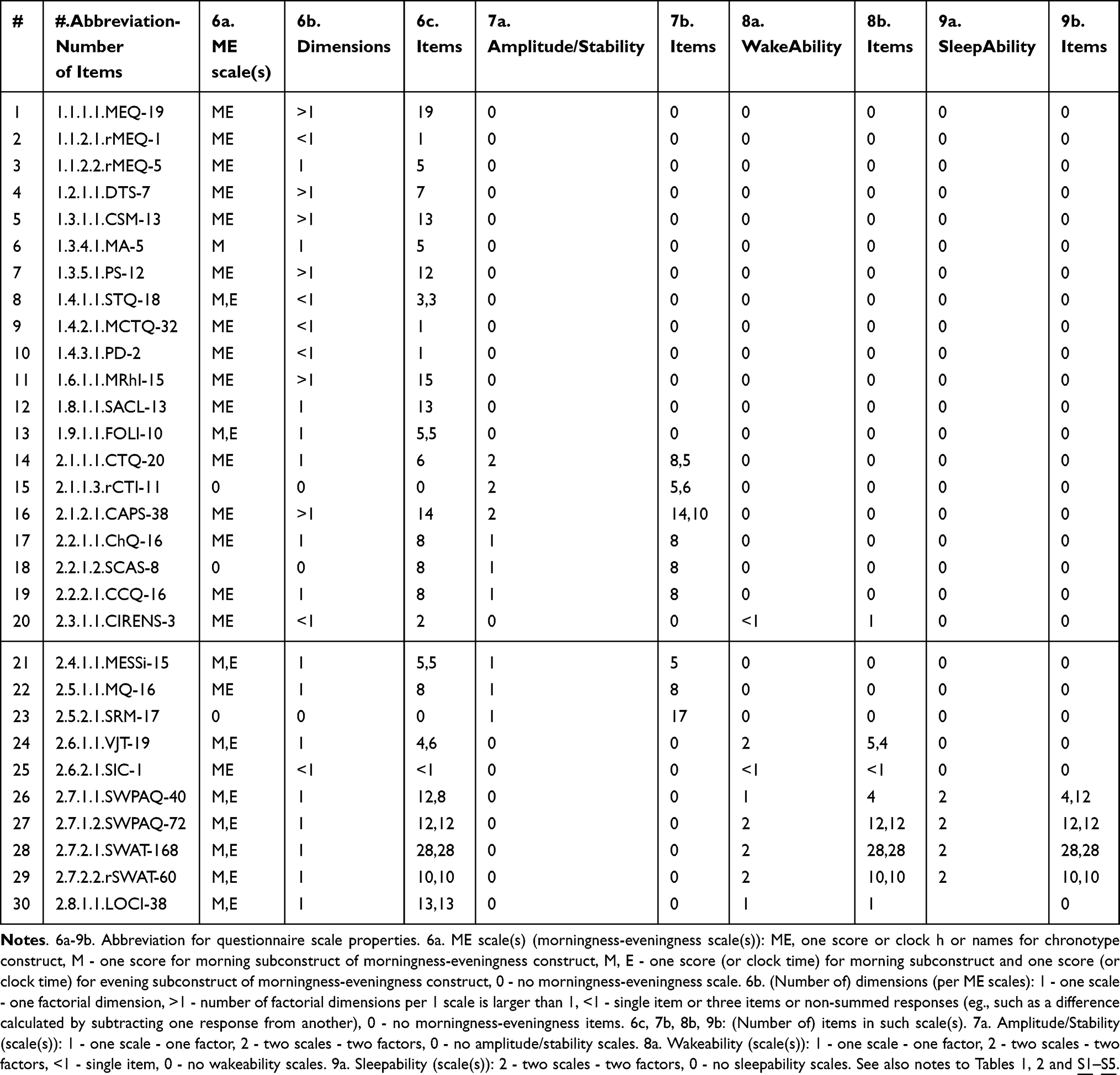 |
Table 3 Properties of Scales of Chronotype Questionnaires |
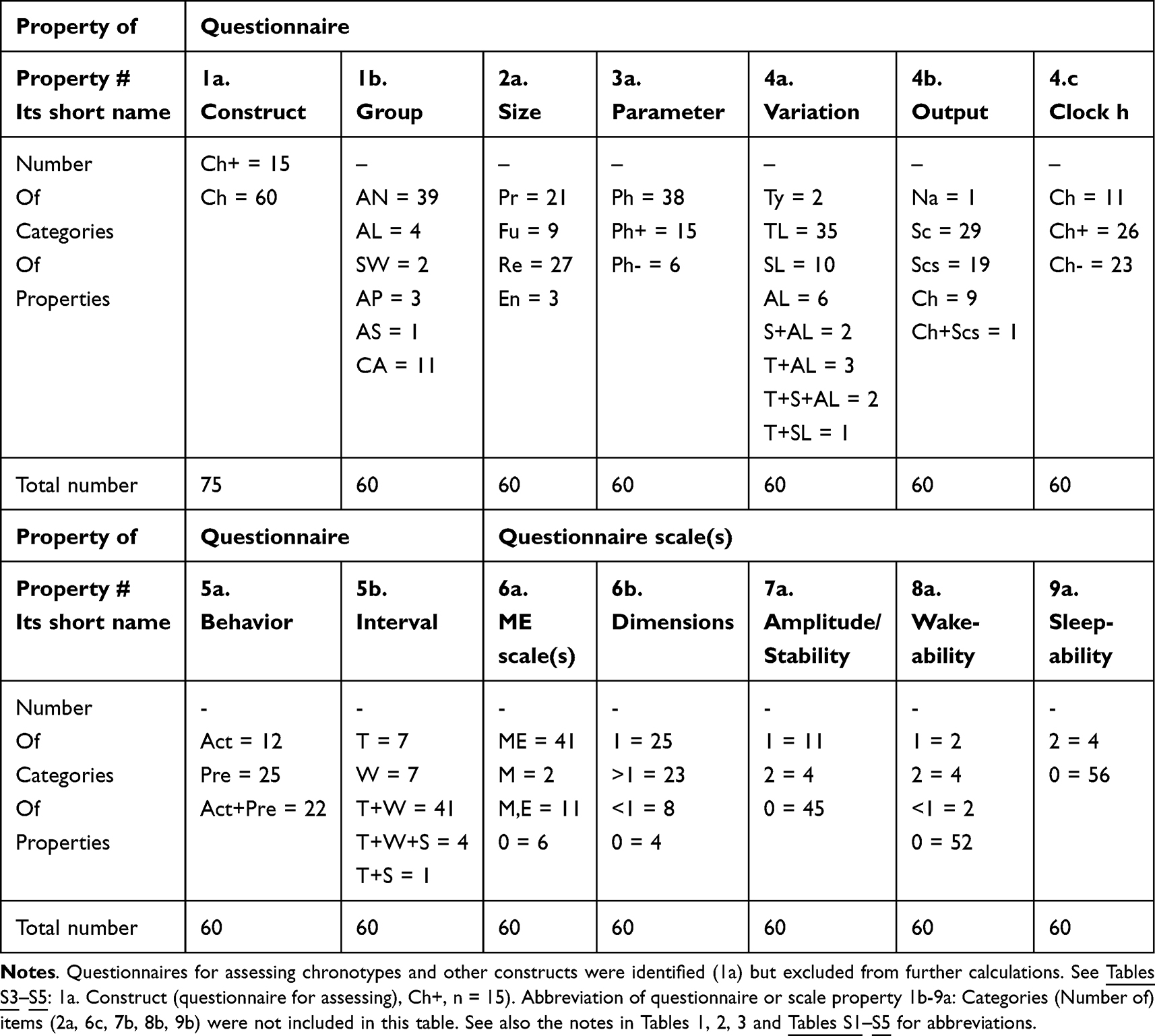 |
Table 4 Number of Chronotype Questionnaires in Each Category of a Property |
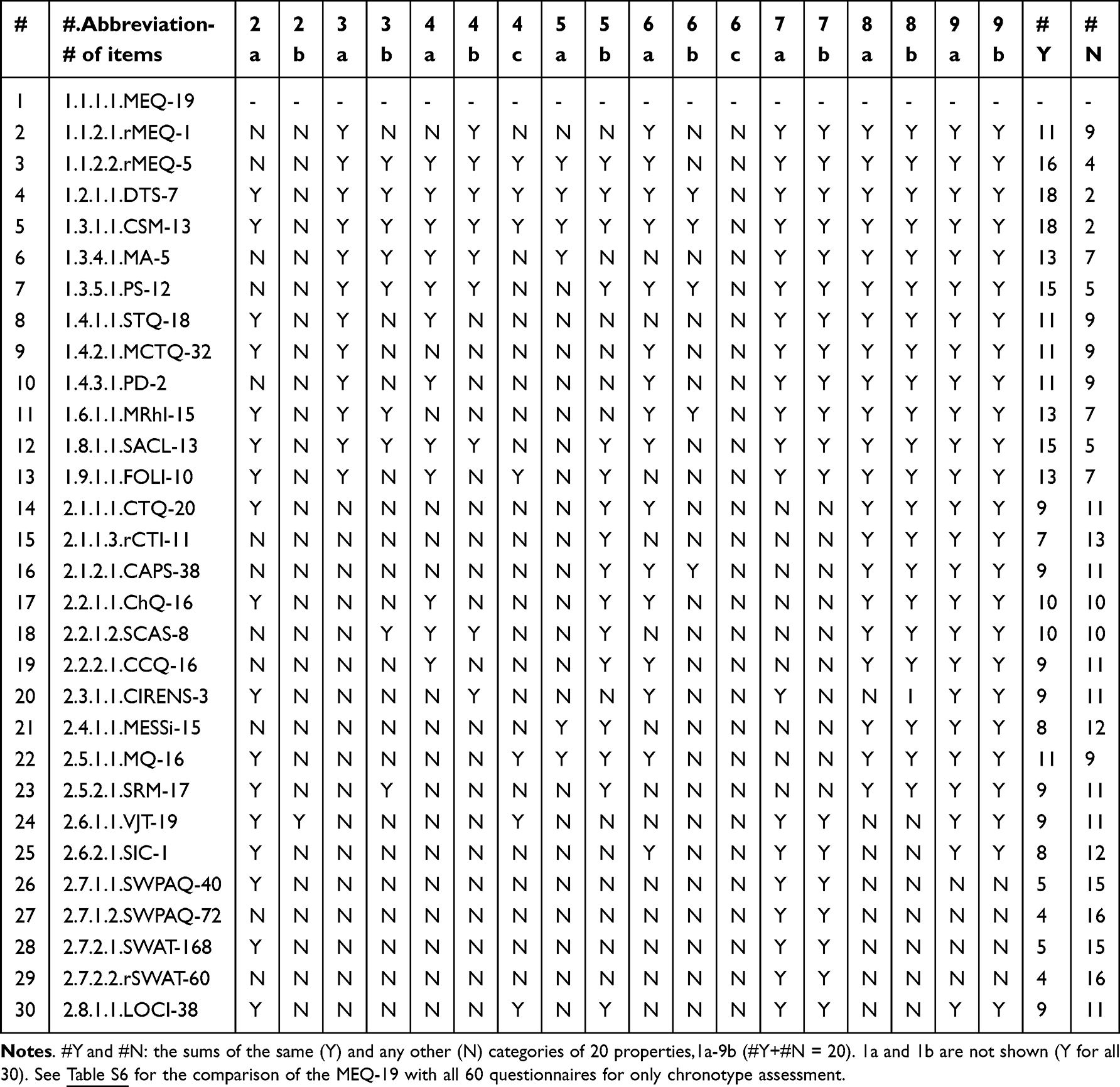 |
Table 5 Example of Comparison of One of the Questionnaires, the MEQ-19, with 29 Other Questionnaires on Similarity (Y) and Difference (N) in Properties |
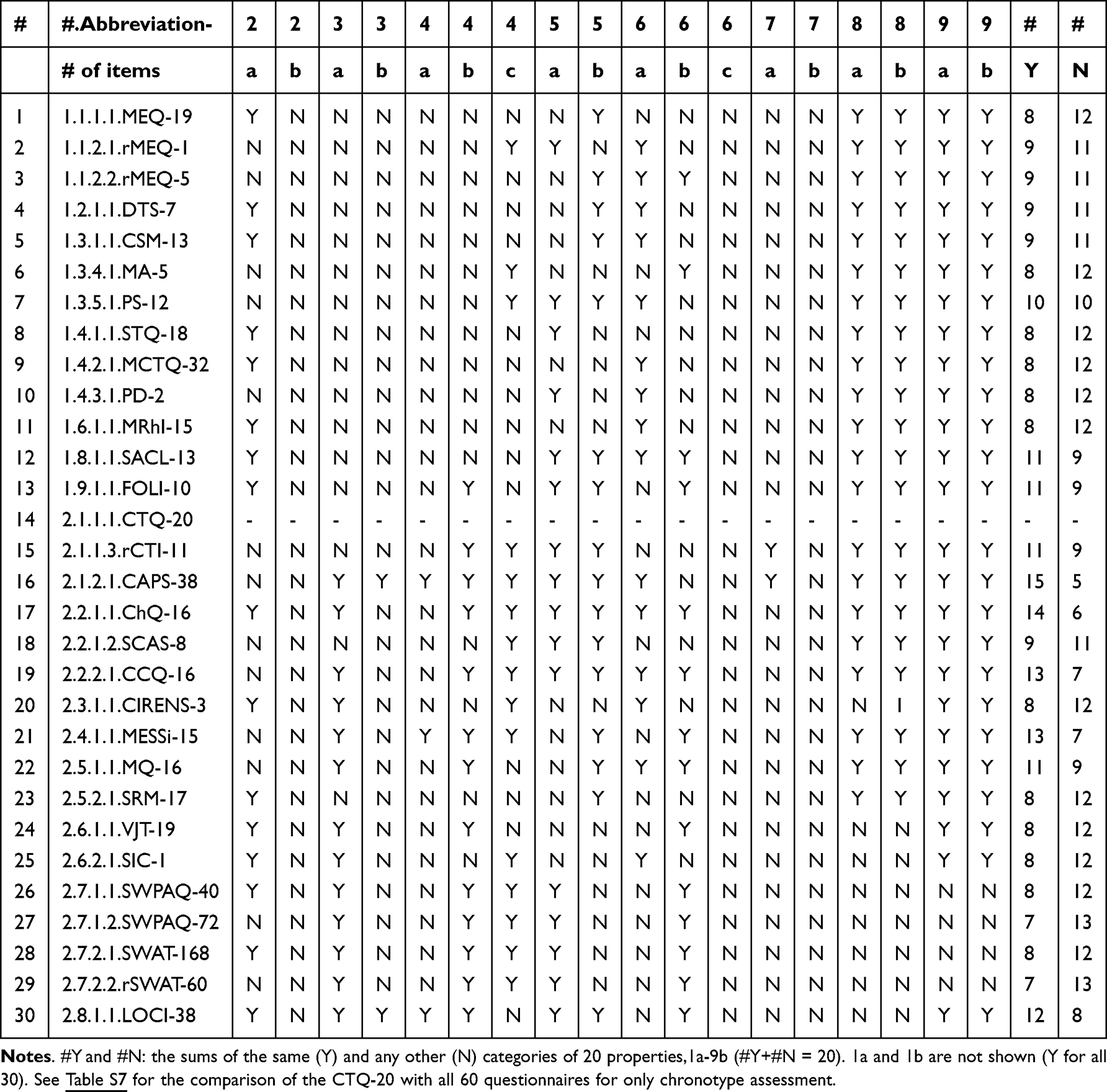 |
Table 6 Example of Comparison of One of the Questionnaires, the CTQ-20, with 29 Other Questionnaires on Similarity (Y) and Difference (N) in Properties |
Results
A List of Identified Questionnaires
In total, 75 chronotype questionnaires were identified through a search of publications in two databases and in previously published papers, including 8 reviews on chronotypes and methods of their self-assessment (Figure 1).
Table S1 lists the 42 questionnaires identified in 224 of the 516 publications in PubMed, 35 questionnaires identified in 154 of 207 publications in Scopus, and the remaining questionnaires identified in 8 reviewers. Most frequently used questionnaires (ie., at least 13 publications, ##1-6) were the MEQ,4 32-item Munich Chronotype Questionnaire (MCTQ),31 5-item reduced Morningness-Eveningness Questionnaire (rMEQ),32 CSM,7 10-item Morningness-Eveningness Scale for Children (MESC),33 and MESSi.11 The 27-tem Children’s Chronotype Questionnaire (CCTQ)34 was the 7th in the PubMed search (12 publications), but only 8th in the Scopus search (6 publications). Most of other questionnaires (##8-42 in the PubMed search and ##9-35 in the Scopus search) were rarely used in the identified publications (Table S1).
Table S2 includes a brief description of each of the 75 identified questionnaires and its primary reference. Tables S3 and 1 (that is the reduced version of Table S3) show the results of grouping these questionnaires in accord with relationships between them. In Table 1, this list was shortened to 30 questionnaires by 1) including only questionnaires for assessing unspecified adult populations and 2) excluding questionnaires for assessments of both chronotype and other than chronotype states/traits/abilities (see the notes in Table 1).
The relationships between questionnaires are mentioned in their brief descriptions (Table S2). Such relationships usually include the reduction, extension, and mixing of previously published scales; their adaptation to a specific population; results of editing or recontextualization of all or some of the primary questionnaire items; modification of response options; and reversal of scoring (Table S2). Related questionnaires were included in the subfamilies and families. As a rule, questionnaires of different subfamilies also differ in the conceptualization of assessed constructs(s) and/or in several questionnaire properties (Tables 1 and S2, and S3).
Although some questionnaires can be viewed as isolates, it seems that the basic concepts behind any of 60 identified questionnaires for assessing chronotype can be traced back to the conceptualizations introduced in two pioneer questionnaires for self-assessment of either a morningness-eveningness construct or several sleep-wake adaptabilities, the MEQ4 and the CTQ,8 respectively (Tables 1 and S2 and S3).
Properties Proposed for Classification of Questionnaires
To create a structural system for the classification of published and future chronotype questionnaires, a set of 20 questionnaires and questionnaire scale properties were defined (Tables S4 and S5 of Supplementary Materials 1; see also for more details “Сode-book: Decision Rules for the 20 Properties” in Supplementary Materials 2). The following 11 properties were included in the subset of the questionnaire properties (1a-5b), and each of these properties was represented by two or more categories (see also Supplementary Materials 2 for more details):
1a. Construct (questionnaire for assessing). Two categories include assessing chronotype and chronotype and something else (they were abbreviated in Tables 2–4 as Ch and Ch+, respectively). Only the questionnaires assigned to the 1st category were further classified (n = 60), while the questionnaires assigned to the 2nd category were not included in the present classification (n = 15; see also Supplementary Materials 2 for “Сode-book: Decision Rules for the 20 Properties”).
1b. Group (questionnaire for assessing in study participants). Six categories include 1) adults, unspecified, 2) adults, language adaptation, 3) adults, patients, 4) adults, exercising or sportsmen, 5) shiftworkers, and 6) children and/or adolescents (abbreviated in Tables 2–4 as AN, AL, AP, AS, SW, and CA, respectively). Given that the tables listing 60 questionnaires are too long for their inclusion in the main text, only the questionnaires of the 1st category (ie., for unspecified adult populations) were included in tables of the main text (n = 30, Tables 1–6), while the questionnaires of other categories (ie., addressing specific populations, AL, AP, AS, SW, and CA) were included only in the supplementary tables (n = 30; Tables S1–S3 and S5–S7 of Supplementary Materials 1).
2a. Size (of questionnaire). Four categories include primary size (ie., full list of items in primary questionnaire), full-sized (ie., similar to the primary list), reduced size (ie., smaller than the primary or full list), and enlarged (ie., larger than the primary list; abbreviated as Pr, Fu, Re, and En, respectively).
2b. Items (number of questionnaire items). Number of items included in primary or full or reduced or enlarged questionnaire. It varies from 1 to 168.
3a. Parameter (diurnal rhythm parameter). Three categories include phase parameter, phase and other parameter(s), and other than phase parameter(s) (abbreviated as Ph, Ph+, and Ph-, respectively).
3b. Scales (number of questionnaire scales). The number of scales (as sums of items) can be equal to 1 or more. Moreover, either <1 or <3 in the tables refers to insufficient to complete a scale number of items, either single item or three items, respectively. Moreover, <1 refers to other calculations than simple summing responses (such as a difference between one response and another response).
4a. Variation (individual variation). The traditional psychological approach to assessment of individual differences includes either typing or ranking along a scale (type vs. trait/state/ability). Therefore, the individuals can be either typed or ranked (with further distinguishing between trait-like, state-like, and ability-like individual variation). Eight categories include type, ie., naming chronotype by responding to single item (typing), trait-like, state-like, and ability-like individual variation, and their combinations, trait- and ability-like, trait-, state- and ability-like, trait- and state-like, state- and ability-like (abbreviated as Ty, TL, SL, AL, T+AL, T+S+AL, T+SL, and S+AL, respectively).
4b. Outcome (outcome of assessment). Five categories include names of chronotypes, score on the only scale/item, scores on more than one scale, clock h rather than score, and clock h and scores (abbreviated as Na, Sc, Scs, Ch, and Ch+Scs, respectively).
4c. Clock h (includes clock h in questions and/or answers). Three categories include clock h in question or answer or clock h is calculated from several clock h answers, clock h is among answers or questions, and no clock h among answers and questions (abbreviated as Ch, Ch+, and Ch-, respectively).
5a. Behavior (sleep-wake behavior). Three categories include actual, or, in another term, current behavior, preferred behavior or behavior under specified hypothetical circumstances, and actual and preferred behavior (abbreviated as Act, Pre, and Act+Pre, respectively).
5b. Interval (interval of the sleep-wake cycle). Five categories include time intervals of sleep-wake transition, time interval of wakefulness, both intervals of sleep-wake transition and wakefulness, both these two intervals and sleep interval, and intervals of sleep-wake transition and sleep (abbreviated as T, W, T+W, T+W+S, and T+S, respectively).
The following nine properties were included in the subset of the properties of the questionnaire scales (6a-9b) in addition to the subset of the questionnaire properties (1a-5b; see also Supplementary Materials for more details):
6a. ME scale(s) (morningness-eveningness scale(s)). Four categories include one score or clock h or names for morningness-evevningness construct, one score for morning subconstruct of morningness-evevningness construct, one score or clock h for morning subconstruct and one score or clock h for evening subconstruct of morningness-eveningness construct, and no morningness-eveningness items (abbreviated as ME, M, M, E, and 0, respectively).
6b. Dimensions (number of dimensions per each of morningness-eveningness scales). Four categories include the following: one scale - one factorial dimension, number of factorial dimensions per 1 scale is larger than 1, single item or three items or non-summed responses, (eg., such as a difference between one response and another response), and no morningness-eveningness scales (1, >1, <1, and 0, respectively).
6c. Items (number of items in morningness-eveningness scale(s)). It varies from 1 to 28.
7a. Amplitude/stability (amplitude/stability scale(s)). Number of scales to assess wakeability or sleepiness varies from <1 to two.
7b. Items (number of items in amplitude/stability scale(s)). It varies from 5 to 17.
8a. Wakeability (wakeability scale(s)). Number of scales to assess wakeability or sleepiness varies from <1 to two.
8b. Items (number of items in wakeability scale(s)). It varies from <1 to 28.
9a. Sleepability (sleepability scale(s)). Two scales were developed to assess sleepability or sleep proneness.
9b. Items (number of items in sleepability scale(s)). It varies from 4 to 28.
Examples of 11 Properties of Questionnaires
The following questionnaire properties (1a-5b) are illustrated below by properties of some of chronotype questionnaires.
1a. Construct (questionnaire for assessing). Most of the identified questionnaires (n = 60) were designed to assess chronotypes. These questionnaires were further categorized in accord with their other 10 properties, 1b-6i (Tables S2–S5). The remaining questionnaires (n = 15) were designed to assess chronotypes in addition to one or more other individual characteristics (Tables S3–S5). They were not further categorized here due to several reasons. The main reasons for exclusion of these 15 questionnaires designed to assess chronotype and something else from the present classification was that the decisions of choosing such a questionnaire for a given study would require the evaluation of theories behind other than chronotype constructs and specific features of these other constructs. The SCRAM18 and chrononutrition questionnaires19–22 can serve as examples of such questionnaires for assessing morning preference and other than chronotype constructs of individual variation.
1b. Group (questionnaire for assessing in study participants). Most questionnaires were developed to assess chronotypes in unspecified adult populations. Tables 1–3 list only such questionnaires, while most of the versions addressing specific populations and the reduced versions of the previously proposed questionnaires are listed only in Tables S3–S5. Overall, a half of 60 identified questionnaires for chronotype assessment were designed to study specific populations and/or were developed by reducing the previously proposed versions. The most recent examples of questionnaires for the assessment of unspecified adults are the MESSi,11 MRhI,14 and SIC.17 The second-largest group of questionnaires include the questionnaires for assessing children and/or adolescents (Tables S3–S5). The most recent examples of such questionnaires are the MESC33 and the CCTQ.34 A minority of the remaining questionnaires targeted other specific populations, such as patients, sportspeople, shiftworkers, and adults speaking languages more or less profoundly distinct from English (Tables 1–4 and S3–S5). Such questionnaires include the 7-item (reduced) Basic Language Morningness (rBALM) scale,50 the ASSQ,13 the 60-item Munich Chronotype Questionnaire for shift workers (MCTQShift),51 and the 7-item (shortened Thai version of) Composite Scale of Morningness (sCSM),52 respectively.
2a. Size (questionnaire size). Some of the initially developed questionnaires were further developed but remained of a similar size in terms of the number of scales and items per each scale (full size ≈ primary size). The examples of primary and secondary questionnaires are the 13-item CSM7 and the 13-item Basic Language Morningness (BALM),53 respectively, the 15-item MESSi11 and the 15-item Morningness-Eveningness-Stability Scale improved for adolescents (aMESSi),54 respectively, the 16-item Chronotype Questionnaire (ChQ)9 and the 16-item Caen Chronotype Questionnaire (CCQ),43 respectively. Some questionnaires were expanded by adding new scales and/or items (Tables 2–4 and S2–S5). The 38-item Circadian Amplitude and Phase Scale (CAPS)41 was developed from the CTQ8 and the 6-scale 72-item Sleep-Wake Pattern Assessment Questionnaire (SWPAQ-72)47 was developed from its primary 5-scale 40-item version.10,55 More often, a questionnaire was reduced to solve problems of its length, which would often prevent study participants from completing the questionnaire in full (Tables S3–S5). The most popular of the remarkably reduced versions of MEQ4 is the rMEQ.32 Another example is the 6-item Ultra-Short Version of the Munich ChronoType Questionnaire (µMCTQ)56 developed by MCTQ.31 It was sufficient to obtain the only chronotype measure recommended by the authors of this questionnaire (it is calculated from the reported clock times for sleep). In fact, many research papers cite the MCTQ,31 but it is unlikely that their authors asked their study participants to answer to each of its 32 questions when they needed for calculation of chronotype to make arithmetic operations on the answers to few questions about sleep times.31 Moreover, many reductions were aimed at solving two other problems of an earlier developed morningness-eveningness scales, their multi-dimensional structure and the low item-scale correlation coefficients of several questions (Table S2). Such reduced versions of the 19-item MEQ4 are known as the 15-item (shortened) Morningness-Eveningness Questionnaire (MEQ-15)57 and the 4-item version of the Morningness-Eveningness Questionnaire (MEQ-4),58,59 respectively.
2b. Items (number of questionnaire items). However, a reduction in the number of items might decrease reliability of the morningness-eveningness scale. The reliability of the maximally reduced scale, a single-item or three-item measure, cannot be assessed using conventional internal consistency methods, such as Cronbach’s alpha. Therefore, they are evaluated using other approaches, such as test-retest reliability, where scale scores, clock times, and type scores are correlated at two different time points. Single-item scales include the SIC17 and the 19th item of the Morningness-Eveningness Questionnaire (rMEQ-1).4,60 Moreover, a single clock time can be calculated from the responses to more than one question, for example, by using answers to several items from either MCTQ31 or µMCTQ.56
3a. Parameter (of diurnal rhythm). Starting from the first questionnaire for assessing morningness-eveningness, the MEQ,4 the majority of published questionnaires were designed to self-assess only one parameter of circadian (diurnal, daily) rhythm, its phase. The list of such questionnaires includes the MEQ,4 DTS,5 CSM,7 MESC,33 12-item Early-Late Preferences Scale (PS),36 and 12-item Student Morningness-Eveningness Questionnaire (SMEQ).61 A small part of the questionnaires has one or more scales for assessing parameters other than the phase of diurnal rhythm (Tables 1–4 and S3–S5). The list of such questionnaires includes the CTQ,8 CAPS,41 SWPAQ,10,47,55 SWAT,12,48 ChQ.9 CCQ,43 MQ 6 and 17-item Social Rhythm Metric (SRM).45
3b. Scales (number of questionnaire scales). Consequently, the authors of the vast majority of chronotype questionnaires developed only scale (Tables S3–S5). The number of scales in the other questionnaires (>1) varied from 2 (for instance, the MQ6) to 6 (for instance, the enlarged SWPAQ47 and SWAT12). Moreover, chronotype can be assessed using one item with several response options for choosing either a score or name of chronotype (eg., either the MEQ-14,60 or SIC,17 respectively). Chronotype can also be assessed using one continuous variable calculated from the responses to several questions or statements. Such calculation of clock h is the outcomes of the MCTQ31 and two-item Perfect Day (PD).38 Moreover, the difference between the scored responses to two questions can be calculated. For instance, the difference between two items is the outcome of the three-item CIRcadian ENergy Scale (CIRENS)44 that recommends the estimation of morningness-eveningness from responses to morning and evening items.
4a. Variation (individual variation). The traditional psychological approach to assessment of individual differences suggests either typing individuals or ranking them using a scale (type vs. trait/state/ability). Consequently, the individuals can be either typed or ranked (with further distinguishing between trait-like, state-like, and ability-like individual variation). In the SIC,17 the study participants are directly asked to choose their chronotypes from several names of chronotype. Question(s) designed to rank individuals by assessing trait- and state-like differences between them can refer either to most typical/usual behavior in such situation/circumcises or to actual (current) situation/circumcises (eg., by asking either about the preference or for today, this week, this month, etc). The PS36 and SRM45 are intentionally designed to assess trait-like and state-like individual variation, respectively. One asks about preference while another asks about times for current behavior. Theoretically, an individual’s trait-like characteristics are stable, long-lasting, and internally caused, whereas state-like characteristics can be temporal, short-lasting, or caused by external circumstances. In fact, the term “chronotype” can be used only for assessment of trait- and type-like variation, while assessment of current state might disagree with trait- and type-assessment (eg., in the case of administering the questionnaire in atypical/unusual situation/circumcises).3 Finally, the study participants can be asked about their ability to do something or to perform well or, instead, not quite well during a certain time of the day after a certain – typical or atypical – period of permanent wakefulness or after normal or insufficient sleep or in the sleep-promoting situations. The assessment of ability-like rather than trait-like individual variation was a purpose of the authors of pioneer multi-dimensional questionnaire, the STQ8 (Tables 1–4 and S3–S5). The term “adaptability” was coined in this publication to stress that these are the factors determining the success or failure of biological adaptation to night and shift work.8 Examples of such questionnaires for assessment of ability-like variation include the SWAT,12 SWPAQ,10,47,55 and 11-item Circadian Type Inventory-revised (CTI-r).40
4b. Outcome (outcome of assessment). Study participants could simply be asked to choose the name of chronotype from several options. The only example is the SIC.17 The responses to the last (19th) question of the MEQ about chronotype (MEQ-1)4,60 are scored. In the vast majority of questionnaires, the responses to several items are used to calculate a score that determines a position on a scale, for example, in the MEQ.4 Scores can be calculated on more than one scale, for example, using the CTQ8 and SWPAQ.10,47,55 Moreover, clock time can be calculated from responses to several items, for example, by using responses to some of the questions included in the MCTQ31 and the 18-item Sleep Timing Questionnaire (STQ)37 (Tables 1–4 and S2–S5).
4c. Clock h (includes clock hours for questions and/or answers). Clock h can be mentioned in the question(s) and/or answer(s). The 13-item Scale for Assessment of Circadian Lateness (SACL)39 can serve as an example of a questionnaire intentionally designed to ask exclusively to choose one of several clock h options (each of which is assigned a score) by answering about behavior expected under specified hypothetical circumstances. This makes this morningness-eveningness scale unidimensional despite its relatively long (13-item) length. However, questions and answers can be, in contrast, intentionally worded to avoid any reference to clock times. For instance, the PS36 asks to compare a study participant with most other people, for example, asking whether you are earlier or later than the other (Tables 1–4 and S2–S5). Referring to clock hours is also avoided in several other questionnaires, such as the SWAT12 and SWPAQ.10,47,55
5a. Behavior (sleep-wake behavior). One or more items can refer to actual (current) behavior. Such are the questions about actual sleep timing on weekdays and free days in the MCTQ.31 Moreover, one or more items can refer to preferred behavior or behavior under specified hypothetical circumstances. All items can refer to preferred and hypothetical sleep timing. The example of such questionnaire is the PD38 (it is asking only about free days). As a rule, items included in a chronotype questionnaire ask either mostly or only about such a preference, eg., either the MEQ4 or STQ,37 respectively (Tables 1–4 and S2–S5).
5b. Interval (interval of sleep-wake cycle). Questions can refer only to the interval of transition from wakefulness to sleep and/or from sleep to wakefulness. Examples of such questionnaires are the PD38 and the MCTQ.31 The 5-item Morning Affect factor (MA)35 asks only about behavior during transition from sleep to wake state. Moreover, scales of a questionnaire can refer to an interval of wakefulness between these transitions, for example, the MRhI.14 This interval can include a subinterval of prolonged wakefulness. The 19-time point Visuo-verbal Judgment Task (VJT)46 is designed to ask about sleepiness on the 1.5-day interval of permanent wakefulness after awakening at 7:30. Finally, several items of a scale or even all items of a scale can refer to the interval of night sleep or to the ability to nap during the wake phase of the sleep-wake cycle. The examples of such scales are the nighttime and daytime (or anytime) sleepability scales of the SWAT12 and SWPAQ10,47,55 (Tables 1–4 and S2–S5).
Examples of 9 Properties of Questionnaire Scales
The following properties of questionnaire scale(s) (6a-9b) are illustrated below by examples of scales of particular chronotype questionnaires.
6a. ME scale(s) (morningness-eveningness scale(s)). Starting with the MEQ,4 most chronotype questionnaires assess morningness-eveningness with one scale (Tables 1–4 and S2–S5). When the conventional psychometric procedures were applied for construction and/or evaluation of such a scale, they yielded not one, but, at least, two factors. Therefore, starting from the SWPAQ,10 morning and evening subconstructs of the morningness-eveningness construct were separated in two scales, such questionnaires with two subconstructs developed in separate scales include the MESSi,11 SWAT,12 MEEPQ,15 FOLI,16 and 38-item Lark-Owl (Chronotype) Indicator (LOCI)49 (Tables 1–4 and S2–S5). Moreover, it was demonstrated that an original ME scale can be reduced with the purpose of development of a short scale for reliable assessment of just one – morning – subconstruct of morningness-eveningness construct called Morning Affect (MA).35 This scale’s name was later coined to one of two morningness-eveningness scales of the MESSi.11
6b. Dimensions (number of dimensions per each of morningness-eveningness scale). Since conventional psychometric procedures were not applied for the construction of initial versions of earlier published ME scales (eg., the MEQ,4 DTS5 and CSM7), their multidimensional nature was revealed later in studies applying factor analysis for testing their dimensional structure (Table S2). Most usually, the remarkable reduction of an ME scale, for example, to either five or four items, yields a one-factor solution. When a somewhat larger number of items was included in a reduced scale, it remained multidimensional, for example, the 6-item (reduced) Morningness-Eveningness Questionnaire (MEQ-6).62
6c. Items (number of items in the morningness-eveningness scale(s)). Although factor analysis of a 4- or 5-item scale, such as the rMEQ,23 usually yields a single factor, such a scale can contain several constructs that are found in different factors when responses to the primary (much larger) scale, such as the MEQ,4 are factor-analyzed. Consequently, the application of factor-analytic approach to reduce the number of items can decrease the reliability of a scale because it still contains several constructs of the primary scale (Table S2). Moreover, a questionnaire, such as STQ,37 can ask to report only three clock times for the calculation of each of the two (morning and evening) components of morningness-eveningness. Such small number of items seems to be insufficient for completing scales.
7a. Amplitude/stability (amplitude/stability scale(s)). The entrained circadian rhythm is characterized by phase and amplitude parameters. It is well established that individual differences in phase parameters are suitable for self-assessment using a morningness-eveningness scale. The development of one or two amplitude/stability scale(s) was encouraged by the idea that psychological and behavioral manifestations of differences in circadian amplitude parameters are also suitable for self-assessments (Table S2). The CTQ,8 CTI-r,40 CAPS,41 ChQ,9 CCQ,43 and MESSi11 contain scale(s) designed to assess the amplitude/stability of diurnal rhythmicity. One of the two scales of the MQ6 was designed to assess stability of diurnal timing, that is, day-to-day replicable rise- and bed-times. Stability is also assessed with the SRM.45 One scale for the assessment of the amplitude/stability parameter was developed in MESSi,11 ChQ,38 CCQ,43 the MQ,6 and SRM,45 whereas, in contrast, the CTQ8 and its several descendants, such as the CAPS,41 the CTI-r,40 and the 18-item Circadian Type Inventory (CTI),63 were developed to assess subjective rhythm amplitude by scoring on two scales, languid-vigor and flexible-rigid. It was hypothesized that low-amplitude (eg., languid) and flexible rhythms would show better adjustment to night work. This hypothesis predicted that these scales would be intercorrelated, but the correlation between the established scales was shown to be non-significant (Table S2).
7b. Items (number of items in amplitude/stability scale(s)). Each of amplitude/stability scales contains, at least, 5 items. The minimal length of two scales for assessment of amplitude is equal to 11 items (CTI-r40).
8a. Wakeability (wakeability scale(s)). Definitely, people differ in their ability to keep waking in sleep-promoting conditions. Therefore, the ability-like individual variation can be assessed as wakeability under certain conditions without any idea about whether it can be traced to the amplitude parameter of the circadian rhythm (Table S2). Moreover, sleepiness assessed with the VJT46 seems to be a correlate of wakeability. Wakeability can be assessed using at least two scales (eg., in the SWAT12,48) because such ability can manifest in various circumstances (eg., during either appropriate or inappropriate for waking time of the day, in nap-provoking conditions during daytime, in the condition of prolongation of wakefulness to night and next day hours, etc.; Tables 1–4 and S2–S5). For instance, only one wakeability scale was constructed in the primary version of the SWPAQ,10 but an additional scale was added to the enlarged version.47 Moreover, both the primary and reduced versions of the SWAT12,48 include two wakeability scales. Finally, the VJT46 assesses sleepiness levels during hours of everyday wakefulness that include typical hours of nap and during the following prolongation of wakefulness on hours of everyday sleep.
8b. Items (number of items in wakeability scale(s)). Alertness-sleepiness or wakeability during usual interval of wakefulness might be assessed not only with a scale, as in the VJT,46 SWAT12,48 and SWPAQ10,47,55 but also with the single question of the SIC17 asking about the pattern of daily variation in alertness-sleepiness level (<1 scale).
9a. Sleepability (sleepability scale or scales). Two opposing terms, “wakeability” and “sleepability”, can describe sleep-wake behavior at different times of the day and after different periods of permanent wakefulness or sleep. Factor analysis of wakeability and sleepability items suggested that they cannot be assigned to opposing poles of a single factorial dimension. For instance, a study participant can report that it is easy for him/her not only to remain awake but also to fall asleep, while another participant can have problems with both waking and falling asleep. Therefore, results of factor analysis were used to identify the items of factorial dimensions of wakeability and sleepability that were included in separate wakeability and sleepability scales of the SWAT12,48 and SWPAQ10,47,55 (Tables S2–S4).
9b. Items (number of items on the sleepability scale or scales). The four-items scales of the primary version of the SWPAQ10 were further developed in 12-item scales.47 The 10-item scales are included in the reduced version of the SWAT.48
Examples of Comparison of Properties of Questionnaires
Properties of questionnaires listed in Tables S3 and S4 can be used for the comparison of each of chronotype questionnaires with other 59 questionnaires on 11 questionnaire properties and 9 properties of their scales (20 in total). Tables S6–S7 and S5 and S6 illustrate such comparison for the pioneer questionnaires proposed for self-assessment of morningness-eveningness and sleep-wake adaptabilities, the MEQ4 (Tables S6 and 5) and the CTQ,8 respectively (Tables S7 and 6). Such tables can be made for comparison of any of remaining 58 questionnaires with other questionnaires.
The publication of the MEQ4 encouraged development of several similar questionnaires that were found to differ from it in only two of 20 properties, the 7-item DTS,5 the 13-item CSM,7 the 19-item caMEQ,64 and the 19-item aMEQ65 (Tables S6 and 5). Most of the MEQ’s properties are also very similar to the properties of other questionnaires for assessment of phase parameter of diurnal rhythm, but they are much more dissimilar to the properties of questionnaires for multidimensional assessment of chronotype (Tables S6 and 5). Most profound differences (in 15 or 16 properties) are shown by the questionnaires with 5 or more scales (Tables S6 and 5).
The properties of the CTQ8 are rather dissimilar to the properties of the majority of other questionnaires (Tables S7 and 6). This questionnaire differs in 9–13 properties from questionnaires for assessment of phase parameter of diurnal rhythm, and it shows rather similar number of differences from properties of the majority of questionnaires designed for multidimensional assessment of chronotype (Tables S7 and 6).
Discussion
The number and variety of chronotype questionnaires have profoundly increased over the last 50 years, after the first publication of such a questionnaire.4 It is sometimes essential to determine which of these questionnaires would be better applicable for answering a given research question. Here, a structured system is proposed to 1) facilitate comparisons of the properties of chronotype questionnaires and 2) predict the features of unconstructed questionnaires and scales. A set of 20 chronotype questionnaire properties was defined, and 60 questionnaires were classified to provide the possibility to distinguish each of them from 59 other questionnaires. Thus, the results suggested that the relationships and conceptual and methodological differences between numerous chronotype questionnaires and scales can be clarified in the framework of a single structured system. This system can help navigate between numerous questionnaires without much effort, for example, without inspecting the content of each questionnaire. It might be used to choose the right instrument for a study of individual differences in the domain of chronobiology and sleep science. Moreover, it can also help to develop new questionnaires and new versions of previously published questionnaires. The prospects of such application of the proposed system are illustrated below.
The prediction of content of scales of an extended version of the VJT can illustrate applicability of the proposed structured system for developing new versions of previously published questionnaires. The 19-time point VJT asks study participants to score the expected level of sleepiness at 19 different clock times within a 1.5-day interval of permanent wakefulness. Originally, the VJT46 was constructed to validate flexibility scores obtained with the CTI,62 and, in a more recent studies, it was applied for the validation of chronotypes self-chosen with the SIC17 and to support the structural model of sleep-wake ability with 6 factorial dimensions.48 Four scales revealed by factor analysis of the VJT17 were compared with 6-scales of SWPAQ47 and SWAT48 and these results can illustrate the possibility to predict the method of extension of the VJT. It was shown48 that these 4 scales are the counterparts of 4 of 6 scales of SWPAQ47 because the SWAT48 is designed to assess wakeability in the morning, daytime, nighttime and next morning hours (ie., Morning Lateness, Daytime Wakeability, Evening Lateness and Anytime Wakeability of the SWPAQ,47 respectively, and Morning Sleepability, Daytime Wakeability, Nighttime Wakeability, and After 24 h Wakeability of the SWAT, respectively48). Because sleepiness is a correlate of wakeability rather than sleepability, the VJT cannot be used for assessing sleepability/sleep proneness at different clock times during this 1.5-day interval of permanent wakefulness. The structural model of sleep-wake ability predicts 6 factorial dimensions developed in 6 scales of the SWPAQ47 and SWAT.48 Therefore, the VJT can be enlarged to additionally assess sleepability/sleep proneness with two scales. For instance, 19 primary questions about how study participants think they would be sleepy at 19 clock times can be modified in 19 new questions asking about how easy study participants think they would fall asleep. The response options can distinguish between more or less longer time intervals required to voluntarily fall asleep (eg., less than one min, 1–5 min, 6–10 min, 11–30 min, >30 min, and failure to sleep).
It is expected that factor analysis of the proposed enlarged (38-item) version of the VJT would yield two additional factors, a factor of sleepability/sleep proneness expected during usual interval of everyday wakefulness (eg., daytime sleepability/sleep proneness) and a factor of sleepability/sleep proneness expected during the following interval of extended wakefulness (eg., nighttime sleepability/sleep proneness). These factors are predicted to become the counterparts of two remaining factors of SWPAQ47 and SWAT48 represented by Anytime Sleepability and Nighttime Sleepability scales in the SWPAQ, respectively, and Daytime Sleepability and Nighttime Sleepability scales in the SWAT, respectively.
Overall, the analysis of the proposed extended version of the VJT would yield 6 factors. Four factors are predicted to be the same as 4 factors of the original 19-item version (sleepiness in the morning, daytime, nighttime and next morning hours), while the additional items would mostly load on two more factors (daytime and nighttime sleepability/sleep proneness). Consequently, similarly to the SWPAQ47 and SWAT,48 the extended 38-item version would include 6 scales for assessing wakeability/sleepiness and sleepability/sleep proneness. Thus, this proposal illustrates the possibility of uncovering empty territories in the questionnaire landscape to predict properties of yet-unconstructed questionnaires and scales.
Studies on age-associated differences in morningness-eveningness can illustrate the importance of choosing an optimal questionnaire tool for research on individual variation in the field of chronobiology and sleep science. It is well established that sleep duration gradually decreases with advancing age,66,67 while circadian sleep timing shows a clear n-shape age trend with the most prominent delay of bedtime in the age of late adolescence and early adulthood. In other words, age-associated shifts occur toward later and earlier sleep timing during the transitions through adolescence and then through adulthood, respectively.31,68,69 Irrespective of age, the difference in sleep timing between the morning and evening types was found to be approximately equal to two hours.70 Since sleep duration and timing dramatically varies with age, morning types identified in a sample of late adolescents usually report weekend wakeups at the same clock time as evening types in samples of people of younger and older ages (that is, early adolescents and middle-age adults, respectively).64,70,71 Moreover, when both morning and evening types are forced to wake up on weekdays at approximately the same clock time to attend the same workplace or class, the difference between them in weekend sleep timing becomes much shorter than two hours due to a more pronounced shift of the 24-h pattern of weekday light exposure in the evening than morning types.65
Such issues of comparison of current (within this week) sleep timing in chronotypes of different ages, even under identical environmental conditions, were recognized by the authors of some questionnaires, such as the PS36 and SWPAQ.10 These questionnaire tools do not mention clock times in any of items and any response options. Consequently, such questionnaires, rather than questionnaires asking about actual or even preferred clock times, can be recommended for the comparison of chronotypes of participants of various ages and for the comparison of people living in northern and equatorial countries.3 Moreover, as discussed in,23 profoundly different results of the comparison of chronotypes might be obtained in studies applying questionnaires asking about either actual (current) or preferred clock time, ie., designed to assess state- and trait-like individual variation, respectively.
There are limitations to the set of classified questionnaires and the proposed approach to their classification. Only the questionnaires designed to assess chronotype were classified here using the proposed 20 properties. The questionnaires for assessment of chronotype and other constructs can be also, at least partially, accommodated within the proposed system in further studies. Further studies are definitely needed to check replicability of the proposed classification system. This is a single-author classification that desires confirmation by independently suggested classification. A property-based classification system does not exclude the necessity for future development of classification based on other approaches (eg., such as a decision algorithm, a scoring tool, an interactive selection guide, etc). Moreover, the proposed system does rely on some important information about each of classified questionnaires, such as its validity and reliability, reproducibility of the questionary-based results, attempts of it translation/localization/cross-cultural adaptations, etc.
Conclusion
The system of questionnaire classification based on a set of 20 questionnaire and questionnaire scale properties was proposed. It can help in navigating between numerous published questionnaires. This system might be used for 1) choosing an optimal instrument for assessment of individual chronobiological differences and 2) predicting properties of new questionnaires and scales. These possibilities were illustrated in Discussion on the examples of 1) choosing right questionnaire for age-associated research and 2) predicting factorial structure of an enlarged version of the published questionnaire. Further studies are needed to check replicability of the proposed classification system and to examine its predictive power for construction of new questionnaires or scales. Further development of this classification can be, in particular, aimed on accounting for several additional features of chronotype questionnaires, such as their validity and replicability, attempts of their translation/localization/cross-cultural adaptations, and results of their direct comparison as the instruments for achieving a particular research purpose.
Supplementary Materials
Supplementary Materials 1 include Tables S1–S7, and Supplementary Materials 2 include Сode-book: Decision Rules for the 20 Properties.
Preprint
This article has been uploaded to Preprints.org as a preprint: https://doi.org/10.20944/preprints202601.0929.v2 (Posted Date: 13 February 2026).
Data Sharing Statement
No new datasets were generated for this study. The data supporting the reported results can be found in Tables S1–S4 of the Supplementary Materials1.
Author Contributions
A.A.P is the only author of this paper: Conceptualization, Data curation, Formal analysis, Investigation, Methodology, Validation, Visualization, Writing – original draft, and Writing – review and editing. The Author gave final approval of the version to be published; have agreed on the journal to which the article has been submitted; and agree to be accountable for all aspects of the work.
Funding
This research received no external funding.
Disclosure
The author reports no conflicts of interest in this work.
References
1. Sir William Thomson (Lord Kelvin). Popular Lectures and Addresses, Vol. 1. London Macmillan; 1889:73
2. Di Milia L, Adan A, Natale V, Randler C. Reviewing the psychometric properties of contemporary circadian typology measures. Chronobiol Int. 2013;30(10):1261–20. doi:10.3109/07420528.2013.817415
3. Putilov AA. Owls, larks, swifts, woodcocks and they are not alone: a historical review of methodology for multidimensional self-assessment of individual differences in sleep-wake pattern. Chronobiol Int. 2017;34(3):426–437. doi:10.1080/07420528.2017.1278704
4. Horne JA, Östberg O.A self-assessment questionnaire to determine morningness-eveningness in human circadian rhythms. Int J Chronobiol. 1976;4(2):97–110.
5. Torsvall L, Åkerstedt T. A diurnal type scale. Construction, consistency and validation in shift work. Scand J Work Environ Health. 1980;6(4):283–290. [PMID: 7195066]. doi:10.5271/sjweh.2608
6. Moog R. Morning-Evening Types and Shift Work: A Questionnaire Study. Reinberg A, Vieux N, Andlauer P, Eds. Night and shift work: biological and social aspects. Oxford: Pergamon Press; 1981:481–488.
7. Smith CS, Reilly C, Midkiff K. Evaluation of three circadian rhythm questionnaires with suggestions for an improved measure of morningness. J Appl Psychol. 1989;74(5):728–738. doi:10.1037/0021-9010.74.5.728
8. Folkard S, Monk TH, Lobban MC. Towards a predictive test of adjustment to shift work. Ergonomics. 1979;22(1):79–91. doi:10.1080/00140137908924591
9. Ogińska H. Can you feel the rhythm? A short questionnaire to describe two dimensions of chronotype. Pers Individ Dif. 2011;50(7):1039–1043. doi:10.1016/j.paid.2011.01.020
10. Putilov AA.A questionnaire for self-assessment of individual traits of sleep-wake cycle. Bulletin of the Siberian Branch of the USSR Academy of Medical Sciences.1990;1;22–25.in Russian.
11. Randler C, Díaz-Morales JF, Rahafar A, Vollmer C. Morningness-eveningness and amplitude - development and validation of an improved composite scale to measure circadian preference and stability (MESSi). Chronobiol Int. 2016;33(7):832–848. doi:10.3109/07420528.2016.1171233
12. Putilov AA. Three-dimensional structural representation of the sleep-wake adaptability. Chronobiol Int. 2016;33(2):169–180. doi:10.3109/07420528.2015.1125362
13. Samuels C, James L, Lawson D, Meeuwisse W. The athlete sleep screening questionnaire: a new tool for assessing and managing sleep in elite athletes. Br J Sports Med. 2016;50(7):418–422. doi:10.1136/bjsports-2014-094332
14. de Souza CM, Carissimi A, Costa D, et al. The Mood Rhythm Instrument: development and preliminary report. Braz J Psychiatry. 2016;38(2):148–153. doi:10.1590/1516-4446-2015-1763
15. Miyazaki R, Ando H, Hamasaki T, et al. Development and initial validation of the Morningness-Eveningness Exercise Preference Questionnaire (MEEPQ) in Japanese university students. PLoS One. 2018;13(7):e0200870. doi:10.1371/journal.pone.0200870
16. Francis LJ, Village A, Payne VJ. Introducing the Francis Owl-Lark Indices (FOLI): assessing the implications of diurnal activity patterns for clergy work-related psychological health. Ment Health Relig Cult.2021. 2021;24(8):780–795. doi:10.1080/13674676.2021.1871595
17. Putilov AA, Sveshnikov DS, Puchkova AN, et al. Single-Item Chronotyping (SIC), a method to self-assess diurnal types by using 6 simple charts. Pers Ind Differ. 2021;168:110353. doi:10.1016/j.paid.2020.110353
18. Byrne JEM, Bullock B, Murray G. Development of a measure of sleep, circadian rhythms, and mood: the scram questionnaire. Front Psychol. 2017;8:2105. doi:10.3389/fpsyg.2017.02105
19. Veronda AC, Allison KC, Crosby RD, Irish LA. Development, validation and reliability of the Chrononutrition Profile - Questionnaire. Chronobiol Int. 2020;37(3):375–394. doi:10.1080/07420528.2019.1692349
20. Chakradeo P, Rasmussen HE, Swanson GR, et al. Psychometric testing of a food timing questionnaire and food timing screener. Curr Dev Nutr. 2021;6(2):nzab148. doi:10.1093/cdn/nzab148
21. Phoi YY, Bonham MP, Rogers M, Dorrian J, Coates AM. Content validation of a chrononutrition questionnaire for the general and shift work populations: a delphi study. Nutrients. 2021;13(11):4087. doi:10.3390/nu13114087
22. Murakami K, Shinozaki N, McCaffrey TA, Livingstone MBE, Masayasu S, Sasaki S. Relative validity of the Chrono-Nutrition Behavior Questionnaire (CNBQ) against 11-day event-based ecological momentary assessment diaries of eating. Int J Behav Nutr Phys Act. 2025;22(1):46. doi:10.1186/s12966-025-01740-9
23. Roenneberg T. Having trouble typing? what on earth is chronotype? J Biol Rhythms. 2015;30(6):487–491. doi:10.1177/0748730415603835
24. Page MJ, McKenzie JE, Bossuyt PM, et al. The PRISMA 2020 statement: an updated guideline for reporting systematic reviews. BMJ. 2021;372:n71. doi:10.1136/bmj.n71
25. Cavallera GM, Giudici S. Morningness and eveningness personality: a survey in literature from 1995 up till 2006. Pers Individ Dif. 2008;44:3–21. doi:10.1016/j.paid.2007.07.009
26. Tonetti L, Adan A, Di Milia L, Randler C, Natale V. Measures of circadian preference in childhood and adolescence: a review. Eur Psychiatry. 2015;30(5):576–582. doi:10.1016/j.eurpsy.2015.01.006
27. Almoosawi S, Vingeliene S, Gachon F, et al. Chronotype: implications for epidemiologic studies on chrono-nutrition and cardiometabolic health. Adv Nutr. 2019;10(1):30–42. doi:10.1093/advances/nmy070
28. Coelho J, Martin VP, Gauld C, et al. Clinical physiology of circadian rhythms: a systematic and hierarchized content analysis of circadian questionnaires. Int J Clin Health Psychol. 2025;25(2):100563. doi:10.1016/j.ijchp.2025.100563
29. Vidueira VF, Booth JN, Saunders DH, Sproule J, Turner AP. Circadian preference and physical and cognitive performance in adolescence: a scoping review. Chronobiol Int. 2023;40(9):1296–1331. doi:10.1080/07420528.2023.2256901
30. Buest de Mesquita Silva R, Schmidt H, Dos Santos G, Leocadio-Miguel M, Mazzilli Louzada F. Chronotype profile in children: a systematic review. Sleep Vigilance. 2025. doi:10.1007/s41782-025-00324-8
31. Roenneberg T, Wirz-Justice A, Merrow M. Life between clocks: daily temporal patterns of human chronotypes. J Biol Rhythms. 2003;18(1):80–90. doi:10.1177/0748730402239679
32. Adan A, Almirall H. Horne and őstberg morningness-eveningness questionnaire: a reduced scale. Pers Individ Dif. 1991;12(3):241–253. doi:10.1016/0191-8869(91)90110-W
33. Carskadon MA, Vieira C, Acebo C. Association between puberty and delayed phase preference. Sleep. 1993;16(3):258–262. doi:10.1093/sleep/16.3.258
34. Werner H, Lebourgeois MK, Geiger A, Jenni OG. Assessment of chronotype in four- to eleven-year-old children: reliability and validity of the Children’s Chronotype Questionnaire (CCTQ). Chronobiol Int. 2009;26(5):992–1014. doi:10.1080/07420520903044505
35. Caci H, Adan A, Bohle P, Natale V, Pornpitakpan C, Tilley A. Transcultural properties of the composite scale of morningness: the relevance of the “morning affect” factor. Chronobiol Int. 2005;22(3):523–540. doi:10.1081/CBI-200062401
36. Smith CS, Folkard S, Schmieder RA, et al. Investigation of morning–evening orientation in six countries using the preferences scale. Pers Individ Dif. 2002;32:949–968. doi:10.1016/S0191-8869(01)00098-8
37. Monk TH, Buysse DJ, Kennedy KS, Pods JM, DeGrazia JM, Miewald JM. Measuring sleep habits without using a diary: the sleep timing questionnaire. Sleep. 2003;26(2):208–212. doi:10.1093/sleep/26.2.208
38. Groß JV, Fritschi L, Erren TC. Hypothesis: a perfect day conveys internal time. Med Hypotheses. 2017;101:85–89. doi:10.1016/j.mehy.2017.02.010
39. Putilov AA, Putilov DA. Sleepless in Siberia and Alaska: cross-validation of factor structure of the individual adaptability of the sleep-wake cycle. Ergonomia. 2005;27(2):207–226.
40. Di Milia L, Smith PA, Folkard S. A validation of the revised circadian type inventory in a working sample. Pers Indiv Differ. 2005;39:1293–1305. doi:10.1016/j.paid.2005.04.012
41. Di Milia L, Folkard S, Hill J, C W Jr. A psychometric assessment of the Circadian Amplitude and Phase Scale. Chronobiol Int. 2011;28(1):81–87. doi:10.3109/07420528.2010.502603
42. Oginska H, Mojsa-Kaja J, Mairesse O. Chronotype description: in search of a solid subjective amplitude scale. Chronobiol Int. 2017;34(10):1388–1400. doi:10.1080/07420528.2017.1372469
43. Dosseville F, Laborde S, Lericollais R. Validation of a chronotype questionnaire including an amplitude dimension. Chronobiol Int. 2013;30(5):639–648. doi:10.3109/07420528.2012.763042
44. Ottoni GL, Antoniolli E, Lara DR. The Circadian Energy Scale (CIRENS): two simple questions for a reliable chronotype measurement based on energy. Chronobiol Int. 2011;28(3):229–237. doi:10.3109/07420528.2011.553696
45. Monk TH, Flaherty JF, Frank E, Hoskinson K, Kupfer DJ. The Social Rhythm Metric. An instrument to quantify the daily rhythms of life. J Nerv Ment Dis. 1990;178(2):120–126. doi:10.1097/00005053-199002000-00007
46. Marcoen N, Vandekerckhove M, Neu D, Pattyn N, Mairesse O. Individual differences in subjective circadian flexibility. Chronobiol Int. 2015;32(9):1246–1253. doi:10.3109/07420528.2015.1085387
47. Putilov AA. Introduction of the tetra-circumplex criterion for comparison of the actual and theoretical structures of the sleep-wake adaptability. Biol Rhythm Res. 2007;38:65–84. doi:10.1080/09291010600832453
48. Putilov AA, Budkevich EV, Tinkova EL, et al. A six-factor structure of individual variation in the tendencies to become sleepy and to sleep at different times of the day. Acta Psychol (Amst). 2021;217:103327. doi:10.1016/j.actpsy.2021.103327
49. Roberts RD. The Lark-Owl (Chronotype) Indicator (LOCI). Sydney: Entelligent Testing Products; 1998:www.radssolution.com/wp–content/uploads/2018/09/1–Tech–Bulletin–Lark–Owl–Chronotype–Indicator.pdf.
50. Rhee MK, Lee HJ, Rex KM, Kripke DF. Evaluation of two circadian rhythm questionnaires for screening for the delayed sleep phase disorder. Psychiatry Investig. 2012;9(3):236–244. doi:10.4306/pi.2012.9.3.236
51. Juda M, Vetter C, Roenneberg T. The Munich ChronoType Questionnaire for Shift-Workers (MCTQShift). J Biol Rhythms. 2013;28(2):130–140. [PMID: 23606612]. doi:10.1177/0748730412475041
52. Pornpitakpan C. Psychometric properties of the composite scale of morningness: a shortened version. Pers Ind Diff. 1998;25:699–709. doi:10.1016/S0191-8869(98)80002-0
53. Brown FM. Psychometric equivalence of an improved Basic Language Morningness (BALM) scale using industrial population within comparisons. Ergonomics. 1993;36(1–3):191–197. doi:10.1080/00140139308967872
54. Weidenauer C, Täuber L, Huber S, Rimkus K, Randler C. Measuring circadian preference in adolescence with the Morningness-Eveningness Stability Scale improved (MESSi). BiolRhythm Res. 2019;52(3):367–379. doi:10.1080/09291016.2019.1600268
55. Putilov AA. Association of the circadian phase with two morningness-eveningness scales of an enlarged version of the sleep-wake pattern assessment questionnaire. Arbeitswissbetriebl Praxis. 2000;17:317–322.
56. Ghotbi N, Pilz LK, Winnebeck EC, et al. The µMCTQ: an ultra-short version of the munich chronotype questionnaire. J Biol Rhythms. 2020;35(1):98–110. doi:10.1177/0748730419886986
57. Manjón-Caballero JL, Díaz-Morales JF. Morningness-Eveningness Questionnaire: reliability and factorial structure of the full and reduced versions in Spanish adolescents. Chronobiol Int. 2025;42(6):808–816. doi:10.1080/07420528.2025.2509634
58. Urbán R, Magyaródi T, Rigó A. Morningness-eveningness, chronotypes and health-impairing behaviors in adolescents. Chronobiol Int. 2011;28(3):238–247. doi:10.3109/07420528.2010.549599
59. Jankowski KS. Polish version of the reduced morningness–eveningness questionnaire. Biol Rhythm Res. 2013;44:427–433. doi:10.1080/09291016.2012.704791
60. Turco M, Corrias M, Chiaromanni F, et al. The self-morningness/eveningness (Self-ME): an extremely concise and totally subjective assessment of diurnal preference. Chronobiol Int. 2015;32(9):1192–1200. doi:10.3109/07420528.2015.1078807
61. Košćec A, Radošević-Vidaček B, Kostović M. Morningness–eveningness across two student generations: would two decades make a difference? Pers. Individ. Dif. 2001;31(4):627–638. doi:10.1016/S0191-8869(00)00167-7
62. Hätönen T, Forsblom S, Kieseppä T, Lönnqvist J, Partonen T. Circadian phenotype in patients with the co-morbid alcohol use and bipolar disorders. Alcohol Alcohol. 2008;564–568. doi:10.1093/alcalc/agn057
63. Barton J, Spelten E, Totterdell P, Smith L, Folkard S, Costa G. The standard shiftwork index—a battery of questionnaires for assessing shiftwork-related problems. Work Stress. 1995;9:4–30. doi:10.1080/02678379508251582
64. Putilov AA, Donskaya OG. What can make the difference between chronotypes in sleep duration? testing the similarity of their homeostatic processes. Front Neurosci. 2022;16:832807. doi:10.3389/fnins.2022.832807
65. Putilov AA, Verevkin EG, Sveshnikov DS, et al. Estimation of the CIRCADIAN PHASE DIFFERENCE IN WEEKEND SLEEP AND FURTHER EVIDENCE FOR OUR FAILURE TO SLEEP MORE ON WEEKENDS TO CATCH UP ON LOST SLEEp. Clocks & Sleep. 2025;7:67. doi:10.3390/clockssleep7040067
66. Ohayon MM, Carskadon MA, Guilleminault C, Vitiello MV. Meta-analysis of quantitative sleep parameters from childhood to old age in healthy individuals: developing normative sleep values across the human lifespan. Sleep. 2004;27(7):1255–1273. doi:10.1093/sleep/27.7.1255
67. Evans MA, Buysse DJ, Marsland AL, et al. Meta-analysis of age and actigraphy-assessed sleep characteristics across the lifespan. Sleep. 2021;44(9):zsab088. doi:10.1093/sleep/zsab088
68. Skeldon AC, Derks G, Dijk DJ. Modelling changes in sleep timing and duration across the lifespan: changes in circadian rhythmicity or sleep homeostasis? Sleep Med Rev. 2016;28:96–107. doi:10.1016/j.smrv.2015.05.011
69. Putilov AA, Verevkin EG. Weekday and weekend sleep times across the human lifespan: a model-based simulation. Sleep Breath. 2024;28(5):2223–2236. doi:10.1007/s11325-024-03124-y
70. Putilov AA, Verevkin EG. Simulation of the ontogeny of social jet lag: a shift in just one of the parameters of a model of sleep-wake regulating process accounts for the delay of sleep phase across adolescence. Front Physiol. 2018;9:1529. doi:10.3389/fphys.2018.01529
71. A.A P, Verevkin EG, Donskaya OG, Tkachenko ON, Dorokhov VB. Model-based simulations of weekday and weekend sleep times self-reported by larks and owls. Biol Rhythm Res. 2020;51(5):709–726. doi:10.1080/09291016.2018.1558735
72. Ishihara K, Honma Y, Miyake S. Investigation of the children’s version of the morningness-eveningness questionnaire with primary and junior high school pupils in Japan. Percept Motor Skill. 1990;71:1353–1354. doi:10.2466/pms.1990.71.3f.1353
 © 2026 The Author(s). This work is published and licensed by Dove Medical Press Limited. The
full terms of this license are available at https://www.dovepress.com/terms
and incorporate the Creative Commons Attribution
- Non Commercial (unported, 4.0) License.
By accessing the work you hereby accept the Terms. Non-commercial uses of the work are permitted
without any further permission from Dove Medical Press Limited, provided the work is properly
attributed. For permission for commercial use of this work, please see paragraphs 4.2 and 5 of our Terms.
© 2026 The Author(s). This work is published and licensed by Dove Medical Press Limited. The
full terms of this license are available at https://www.dovepress.com/terms
and incorporate the Creative Commons Attribution
- Non Commercial (unported, 4.0) License.
By accessing the work you hereby accept the Terms. Non-commercial uses of the work are permitted
without any further permission from Dove Medical Press Limited, provided the work is properly
attributed. For permission for commercial use of this work, please see paragraphs 4.2 and 5 of our Terms.