
Back to Journals » Clinical, Cosmetic and Investigational Dermatology » Volume 19
Tofacitinib for the Management of Refractory Eosinophilic Pustular Folliculitis: A Case Report and Literature Review
Authors Zhu D, Lin Y, Li Y  , Yao L
Received 5 December 2025
Accepted for publication 24 February 2026
Published 11 March 2026 Volume 2026:19 585317
DOI https://doi.org/10.2147/CCID.S585317
Checked for plagiarism Yes
Review by Single anonymous peer review
Peer reviewer comments 3
Editor who approved publication: Dr Monica K. Li
Danfeng Zhu,1 Youshu Lin,2 Yuan Li,2 Liping Yao1
1Department of Dermatology, The Fifth People’s Hospital of Hainan Province, Haikou, Hainan, People’s Republic of China; 2Department of Cosmetic Dermatology, The Fifth People’s Hospital of Hainan Province, Haikou, Hainan, People’s Republic of China
Correspondence: Liping Yao, Department of Dermatology, The Fifth People’s Hospital of Hainan Province, No. 8 Longhua Road, Longhua District, Haikou, Hainan, 570100, People’s Republic of China, Email [email protected] Yuan Li, Department of Cosmetic Dermatology, The Fifth People’s Hospital of Hainan Province, No. 8 Longhua Road, Longhua District, Haikou, Hainan, 570100, People’s Republic of China, Email [email protected]
Abstract: This case study investigates the efficacy of tofacitinib, a Janus kinase (JAK) inhibitor, in treating refractory eosinophilic pustular folliculitis (EPF), a rare dermatological disorder characterized by recurrent pruritic pustules and eosinophilic infiltration. We present a 55-year-old male patient with an 8-month history of progressive facial erythema and pustules. Pre-treatment evaluation revealed extensive erythema, follicular papules, and pustules on both cheeks, accompanied by marked pruritus and an elevated peripheral eosinophil count (0.59× 10⁹/L).The patient had failed multiple conventional therapies, including oral methylprednisolone, indomethacin, minocycline, isotretinoin, and topical corticosteroids/antibiotics. Diagnostic confirmation was achieved through histopathological analysis, which revealed perifollicular eosinophilic infiltrates and elevated peripheral eosinophil counts. The patient was then administered tofacitinib monotherapy at 25 mg twice daily, resulting in rapid clinical improvement by day 3 and complete resolution of lesions within two weeks. Histological follow-up demonstrated marked reduction in dermal inflammation, supporting the role of JAK-STAT pathway inhibition in attenuating eosinophil-driven pathology. The findings suggest that tofacitinib may serve as a potent therapeutic alternative for steroid-resistant EPF, potentially through modulation of interleukin-4/13 signaling. However, the study is limited by its single-case design and lack of long-term safety data, necessitating further validation in larger cohorts. This report highlights the novel application of tofacitinib in EPF management, offering insights into targeted immunomodulation for recalcitrant dermatoses. The rapid and sustained response observed underscores the potential of JAK inhibitors in addressing unmet therapeutic needs for rare inflammatory skin conditions.
Keywords: eosinophilic pustular folliculitis, refractory, tofacitinib, janus kinase inhibitor, JAK-STAT pathway, eosinophil-mediated inflammation
Introduction
Eosinophilic pustular folliculitis (EPF), also known as Ofuji disease, is a chronic, relapsing, non-infectious follicular inflammatory disorder of uncertain etiology. Its defining histopathological feature is a dense eosinophil-predominant infiltrate involving the hair follicles and perifollicular regions. Clinically, EPF manifests as pruritic follicular papules and pustules, which may affect the face, trunk, and extremities.1 Based on clinical characteristics, EPF is generally classified into several subtypes, including the classic form, the infantile form, and the immunosuppression-associated form (such as HIV-related EPF), with the classic type most commonly occurring in adult males and typically involving the face.2 Although EPF does not pose a significant risk of mortality, patients often experience persistent and severe pruritus that can lead to sleep disturbances. In addition, recurrent eruptions on cosmetically sensitive areas, such as the face, frequently result in social anxiety, collectively exerting a profound negative impact on quality of life.3
From a therapeutic perspective, the clinical management of EPF remains challenging. Topical corticosteroids are generally reserved for mild and localized cases, yet relapses commonly occur after short-term symptom relief. Systemic corticosteroids can rapidly suppress acute inflammation; however, prolonged use is associated with significant adverse effects, including hyperglycemia, osteoporosis, and increased susceptibility to infections, in addition to the risk of steroid resistance or rebound upon withdrawal.4 Non-steroidal anti-inflammatory drugs (NSAIDs), such as indomethacin, are considered first-line therapy for classic EPF. Still, their response rate is less than 50%, and long-term administration carries the risk of gastrointestinal mucosal injury.5 Antibiotics, such as minocycline, are primarily used to treat secondary infections but do not address the underlying immune dysregulation.6 Immunosuppressants, including cyclosporine, have shown efficacy in certain refractory cases but require close monitoring of hepatic and renal function as well as blood pressure, thereby limiting their widespread clinical utility. Oral isotretinoin primarily regulates follicular keratinization to improve lesions but lacks direct inhibitory effects on eosinophil-mediated inflammation; therefore, it failed to adequately control disease activity in this patient.7 Consequently, the search for novel therapeutic strategies that are safe, effective, and well-tolerated has become a central focus in EPF research.
Tofacitinib is an oral small-molecule Janus kinase (JAK) inhibitor that primarily exerts its effects by selectively inhibiting the JAK1 and JAK3 signaling pathways, thereby blocking Th2 cytokine-mediated immune responses involving interleukin (IL)-4, IL-5, and IL-13.8 In recent years, tofacitinib has demonstrated promising efficacy in various inflammatory dermatoses, including atopic dermatitis and alopecia areata, owing to its capacity for precise immunomodulation and the convenience of oral administration. Tofacitinib has demonstrated favorable short-term safety in inflammatory dermatoses, with mild adverse events (eg, gastrointestinal discomfort, headache) reported in <5% of patients and rare severe adverse events. However, long-term safety data remain limited.9,10 In 2024, Zheng et al11 reported complete remission in a patient with generalized EPF treated with tofacitinib, while Cai et al12 further confirmed the therapeutic value of JAK inhibitors (abrocitinib) in refractory EPF. Building upon these advances and the underlying pathogenic insights, we herein report a case of refractory EPF unresponsive to conventional therapies that was successfully treated with tofacitinib. This case, in conjunction with the latest evidence, provides a valuable clinical reference for the management of this challenging condition.
Case Presentation
General Information
A 55-year-old Han Chinese male presented to the dermatology outpatient clinic of our hospital on 18 November 2024, with an 8-month history of erythema and papules accompanied by pruritus on both cheeks. Eight months prior, erythematous lesions initially developed on the right cheek without obvious precipitating factors, accompanied by scattered papules and mild pruritus, which subsequently progressed to involve the left cheek (Figures 1A and B). The patient had been otherwise healthy, with no history of chronic diseases, drug allergies, HIV infection, or long-term use of immunosuppressive agents.
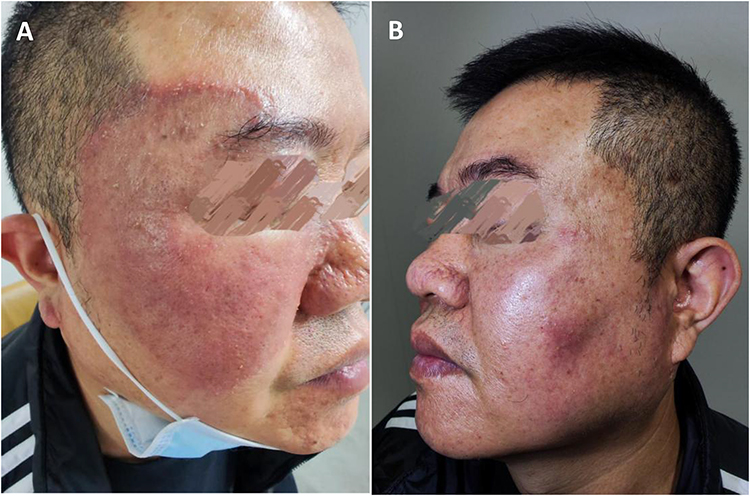 |
Figure 1 (A) Large erythematous plaque on the right frontal–facial region, with perifocal annularly distributed papules and pustules; the erythema was firm on palpation. (B) An ill-defined erythematous patch on the left facial region, firm on palpation, with scattered pinpoint-sized pustules on the surface. |
Previous Diagnosis and Treatment History
Initially, the patient was diagnosed with “facial dermatitis” at an outpatient visit and was treated with topical mometasone furoate cream (0.1%, once daily), recombinant human epidermal growth factor gel (twice daily), and fusidic acid cream (twice daily). The lesions showed slight improvement during treatment but worsened rapidly upon discontinuation. The right cheek developed large, poorly demarcated erythematous patches with perifollicular papules arranged in annular patterns, accompanied by pronounced pruritus. Further investigations were conducted: direct microscopic examination of the local lesions revealed spores, but no hyphae, excluding tinea faciei; serologic testing for HSV-1/2 IgM (acute infection marker) was negative, ruling out viral infection. During subsequent clinical evaluations, the patient received varying diagnoses, including “rosacea” and “allergic dermatitis.” He underwent multiple systemic and topical therapies without sustained improvement: oral methylprednisolone (30 mg/day for seven consecutive days), intramuscular injection of compound betamethasone (1 mL, single dose), oral loratadine (5 mg twice daily), oral minocycline hydrochloride (100 mg twice daily), compound sulfamethoxazole and trimethoprim tablets (1 g twice daily), compound glycyrrhizin tablets (75 mg three times daily), topical boric acid solution (cold compress twice daily), and LED red and yellow light therapy. Despite these interventions, the condition persisted with recurrent exacerbations.
Definitive Diagnosis and Treatment Adjustment
On 17 January 2025, a skin biopsy of the facial lesions was performed to establish a definitive diagnosis. Histopathological examination revealed hyperkeratosis with follicular plugging, mild epidermal thickening, and dense infiltration of lymphocytes and eosinophils within and around the follicular–sebaceous units of the dermis (Figures 2A and B). Direct immunofluorescence testing for IgA, IgG, IgM, and C3 was negative, effectively excluding autoimmune blistering disorders. Based on the combination of clinical presentation, laboratory findings including peripheral blood eosinophilia (0.59 × 10⁹/L; reference range, 0.02–0.52 × 10⁹/L) and histopathological results, a diagnosis of classic-type eosinophilic pustular folliculitis (EPF) was confirmed. Following the definitive diagnosis, the patient was initially treated with oral enteric-coated indomethacin tablets (75 mg/day, divided into three doses) for 1 week, without significant improvement in skin lesions. Oral methylprednisolone (16 mg/day, taken in the morning) was added, resulting in slight symptom relief. The methylprednisolone dose was subsequently tapered to 8 mg/day, and indomethacin was adjusted to 50 mg/day, with the addition of oral isotretinoin soft capsules (10 mg/day). Despite these modifications, the lesions remained poorly controlled, with continued emergence of new papules and pustules.
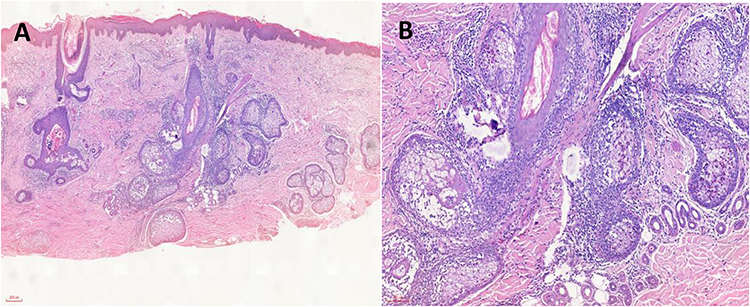 |
Figure 2 (A) Hyperkeratosis with mild epidermal acanthosis, accompanied by dense inflammatory cell infiltration around dermal hair follicles and sebaceous glands (H&E, ×40). (B) Prominent infiltration of lymphocytes and eosinophils within and surrounding folliculosebaceous units (H&E, ×100). |
Tofacitinib Treatment and Follow-Up
Given the patient’s lack of response to conventional therapies, fulfilling the criteria for refractory EPF, and based on current literature evidence,11,12 treatment with tofacitinib was initiated after obtaining informed consent and excluding contraindications, including no history of tuberculosis or exposure to tuberculosis, normal chest X-ray findings, and a negative tuberculin skin test (TST). No hepatic or renal dysfunction, and no history of thromboembolic events. On 14 July 2025, all previous medications were discontinued, and oral tofacitinib tablets were administered at a dose of 25 mg twice daily. The patient reported noticeable improvement by day 3 of therapy, including lightening of facial erythema, reduction in the number of papules, and marked relief of pruritus. At the 2-week follow-up, erythema, papules, and pustules on both cheeks had resolved entirely (Figures 3A and B), and repeat laboratory tests showed normalization of peripheral blood eosinophil count (0.28 x 10⁹/L). The patient has continued regular tofacitinib therapy, and as of the last follow-up in October 2025, no recurrence or treatment-related adverse events, including infections, gastrointestinal discomfort, or hepatic or renal abnormalities, have been observed.
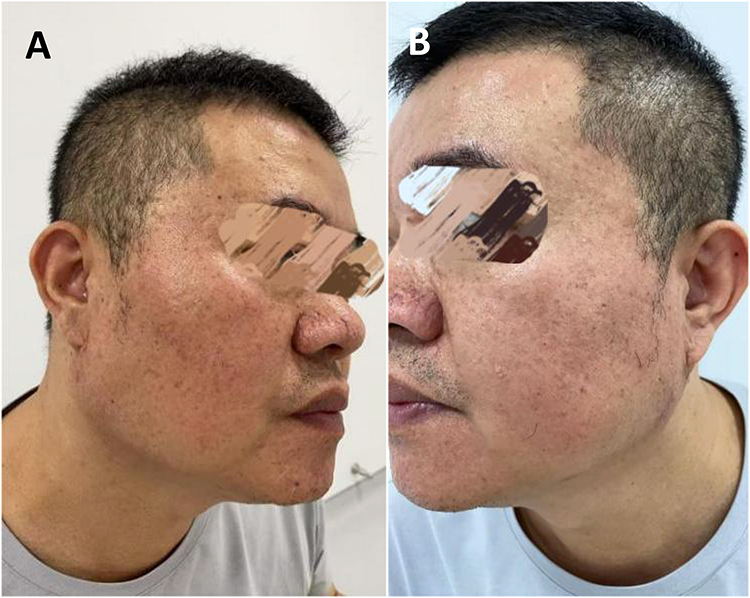 |
Figure 3 (A and B) Complete resolution of skin lesions after two weeks of tofacitinib treatment. |
Discussion
The clinical presentation of EPF is highly variable. It may be easily confused with common facial dermatoses such as facial dermatitis, rosacea, or tinea faciei in the early stages, leading to misdiagnosis and delayed treatment.1 In the present case, the patient initially developed erythema and pruritic papules on the cheeks and was successively diagnosed with facial dermatitis and rosacea. Multiple conventional therapies failed to achieve sustained improvement, which aligns with the characteristic clinical features of EPF, namely, nonspecific lesions and pruritus that overlap with various inflammatory facial dermatoses. The definitive diagnosis was ultimately established by histopathological examination, which revealed dense perifollicular eosinophilic infiltration, along with peripheral blood eosinophilia, meeting the diagnostic gold standard for EPF.1,13 This clinical course underscores the importance of performing skin biopsies in patients with recurrent facial inflammatory lesions unresponsive to conventional treatment, to ensure accurate diagnosis and guide subsequent management, thereby avoiding inappropriate therapy due to misdiagnosis.
Conventional therapeutic strategies for EPF are limited by suboptimal efficacy and potential safety concerns.The therapeutic efficacy of tofacitinib in EPF is attributable to its precise mechanism of action. The central pathogenic process in EPF involves Th2 cytokine-mediated activation of the JAK-STAT pathway, which drives eosinophil activation, chemotaxis to the perifollicular region, and subsequent inflammation.13,14 As a selective JAK1/JAK3 inhibitor, tofacitinib blocks the interaction between JAK1/JAK3 and STAT proteins, thereby inhibiting Th2 cytokine signaling. This results in reduced eosinophil proliferation, chemotaxis, and release of cytotoxic mediators, ameliorating inflammation at the mechanistic level.8,10 Furthermore, tofacitinib has been shown to suppress the expression of eosinophil chemoattractant eotaxin-3, further limiting perifollicular eosinophil accumulation.15 These mechanistic effects are consistent with the rapid resolution of lesions and normalization of peripheral eosinophil counts observed in the present patient following treatment.
Recent literature increasingly supports the therapeutic value of JAK inhibitors in EPF. In 2024, Zheng et al11 reported a 16-year-old male patient with generalized EPF who was unresponsive to systemic corticosteroids and methotrexate; treatment with tofacitinib (10 mg/day) achieved complete remission within six months without relapse. In the same year, Cai et al12 described two cases of refractory EPF treated with abrocitinib (a selective JAK1 inhibitor, 100 mg/day), resulting in lesion resolution within 2–4 weeks and no recurrence over 12–16 weeks of follow-up. In 2025, Wang et al2 presented a case series of three refractory EPF patients receiving tofacitinib (10 mg/day), all of whom achieved complete remission within 2–4 weeks, with a mean follow-up of 4.3 months without relapse. In the present case, the patient treated with tofacitinib (25 mg/day) demonstrated symptom improvement within 3 days and complete lesion resolution within 2 weeks, consistent with previous reports, and further confirming the efficacy of tofacitinib in refractory EPF. To date, 5 cases of EPF treated with tofacitinib have been reported (including this case). Zheng et al11 reported complete remission within 6 months with 10 mg/day; Wang et al2 reported remission within 2–4 weeks with 10 mg/day; and the present case achieved remission within 2 weeks with 50 mg/day, confirming dose-dependent, rapid efficacy. In all published cases (n=5), no severe adverse events were reported. The present patient showed normal liver/kidney function and no infections during the 3-month follow-up. Common adverse events of tofacitinib (eg, anemia, transaminitis) are rare at doses ≤50 mg/day, supporting its short-term safety for EPF.9,11 Additionally, while oral tofacitinib avoids the need for subcutaneous injections of biologics, regular monitoring of blood routine, liver/kidney function, and infection markers is recommended during treatment to ensure safety.
Compared with conventional therapies, tofacitinib demonstrates several notable clinical advantages. First, it has a rapid onset of action: in the present case, symptom improvement was observed within three days, considerably faster than traditional treatments such as systemic corticosteroids (1–2 weeks), NSAIDs (2–4 weeks), and certain biologics, including dupilumab (4–8 weeks).4,16 This rapid efficacy provides prompt relief of pruritus and lesions, thereby improving the patient’s quality of life. Second, oral tofacitinib administration enhances convenience and patient adherence, avoiding the need for frequent clinic visits or injections required by parenteral biologics.11,12 Third, tofacitinib directly targets the underlying pathogenic mechanism of EPF, contributing to durable efficacy; in this case, the patient remained relapse-free over a 3-month follow-up, consistent with the long-term remission reported in the literature.2,11
This study has several limitations. First, as a single-case report, the sample size is limited, and individual variability may influence therapeutic outcomes; multicenter studies with larger cohorts are needed to further validate the efficacy of tofacitinib in EPF. Second, the follow-up duration was relatively short (three months), and the long-term efficacy of tofacitinib, including relapse rates beyond one year, optimal treatment duration, and dose-adjustment strategies, remains to be determined through extended follow-up. Third, no pre- and post-treatment assessments of cytokines (eg, IL-4, IL-5, IL-13) or JAK-STAT pathway-related molecular expression were conducted, precluding mechanistic verification at the molecular level. Future studies incorporating these analyses would strengthen the mechanistic evidence and provide a more comprehensive understanding of treatment effects.
Conclusion
This case report, together with existing literature, provides additional clinical evidence for the efficacy of tofacitinib in refractory EPF, with rapid symptom relief and favorable short-term safety. However, given the single-case design, tofacitinib is not recommended as a first-line therapy for EPF at present. It may be considered as an alternative option for patients unresponsive to conventional treatments. Long-term efficacy, optimal dosing, and treatment duration require further validation through multicenter, large-scale randomized controlled trials.
Data Sharing Statement
All data are available within the manuscript.
Ethics Statement
The patient has granted permission for the images to be published along with the case report, and The Fifth People’s Hospital of Hainan Province has given its approval for the case details to be disclosed after obtaining approval from its own Ethics Committee.
Consent
The patient had given written informed consent for the publication of his clinical details and accompanying images.
Funding
This work is supported by “Hainan Province Clinical Medical Center”. “Project supported by Hainan Provincial Natural Science Foundation of China (824QN401)”. “Project supported by Nanhai Xinxing Medical and Health Talent PlatformProject of Hainan Province (NHXX-WJW-2023020)”.
Disclosure
The authors declare no conflicts of interest in this work.
References
1. Fujiyama T, Tokura Y. Clinical and histopathological differential diagnosis of eosinophilic pustular folliculitis. J Dermatol. 2013;40(6):419–7. doi:10.1111/1346-8138.12125
2. Wang Q-X, He H-Y, Niu Y-L, et al. Refractory eosinophilic pustular folliculitis treated with tofacitinib: a case series and literature review. Clin Exp Dermatol. 2025;50(6):1196–1200. doi:10.1093/ced/llaf053
3. Nervi SJ, Schwartz RA, Dmochowski M. Eosinophilic pustular folliculitis: a 40 year retrospect. J Am Acad Dermatol. 2006;55(2):285–289. doi:10.1016/j.jaad.2006.02.034
4. Simon D, Simon HU. Therapeutic strategies for eosinophilic dermatoses. Curr Opin Pharmacol. 2019;46:29–33. doi:10.1016/j.coph.2019.01.002
5. Solimani F, Meier K, Ghoreschi K. Emerging topical and systemic JAK inhibitors in dermatology. Front Immunol. 2019;10:2847. doi:10.3389/fimmu.2019.02847
6. Parker SRS, Murad E. Follicular mucinosis: clinical, histologic, and molecular remission with minocycline. J Am Acad Dermatol. 2010;62(1):139–141. doi:10.1016/j.jaad.2009.01.031
7. Dodia P, Folliculitis CCEP. Internet. Treasure Island (FL);StatPearls Publishing.2025.Jan.
8. Keohane C, Kordasti S, Seidl T, et al. JAK inhibition induces silencing of T helper cytokine secretion and a profound reduction in T regulatory cells. Br J Haematol. 2015;171(1):60–73. doi:10.1111/bjh.13519
9. Honap S, Cookson H, Sharma E, Samaan MA, Irving PM. Tofacitinib for the treatment of ulcerative colitis, alopecia universalis, and atopic dermatitis: one drug, three diseases. Inflamm Bowel Dis. 27 2 e13–e14 doi: 10.1093/ibd/izaa243.
10. Craiglow BG, King BA. JAK inhibitors in dermatology: the promise of a new drug class. J Am Acad Dermatol. 2018;78(2):241–257.
11. Zheng C, Yu Y, Zhou G, et al. A case of generalized eosinophilic pustular folliculitis: treatment with JAK inhibitor. J DermatolTreat. 2024;35(1):2331785. doi:10.1080/09546634.2024.2331785
12. Cai L, Yan Y, Li Y, et al. Two cases of eosinophilic pustular folliculitis successfully treated with abrocitinib. J Dermatol. 2024;51(12):1694–1697. doi:10.1111/1346-8138.17284
13. Nakashima D, Fukamachi A, Nakamura M, Tokura Y. Verification of the hygienic hypothesis by evaluating the regional incidence of eosinophilic pustular folliculitis. J UOEH. 35 3 201–205 doi: 10.7888/juoeh.35.201.
14. Otsuka A, Doi H, Miyachi Y, et al. Treatment of eosinophilic pustular folliculitis with ciclosporin: suppression of mRNA expression of IL-4 and IL-13. J Eur Acad Dermatol Venereol. 2010;24(12):1489–1491. doi:10.1111/j.1468-3083.2010.03674.x
15. Chikhoune L, Poggi C, Moreau J, et al. JAK inhibitors (JAKi): mechanisms of action and perspectives in systemic and autoimmune diseases. Rev Med Interne. 2025;46(2):89–106. doi:10.1016/j.revmed.2024.10.452
16. Thyssen JP, Rosmarin D, Costanzo A, et al. Efficacy and safety of upadacitinib versus dupilumab treatment for moderate-to-severe atopic dermatitis in four body regions: analysis from the heads up study. Dermatology. 2025;241(1):10–18. doi:10.1159/000542275
 © 2026 The Author(s). This work is published and licensed by Dove Medical Press Limited. The
full terms of this license are available at https://www.dovepress.com/terms
and incorporate the Creative Commons Attribution
- Non Commercial (unported, 4.0) License.
By accessing the work you hereby accept the Terms. Non-commercial uses of the work are permitted
without any further permission from Dove Medical Press Limited, provided the work is properly
attributed. For permission for commercial use of this work, please see paragraphs 4.2 and 5 of our Terms.
© 2026 The Author(s). This work is published and licensed by Dove Medical Press Limited. The
full terms of this license are available at https://www.dovepress.com/terms
and incorporate the Creative Commons Attribution
- Non Commercial (unported, 4.0) License.
By accessing the work you hereby accept the Terms. Non-commercial uses of the work are permitted
without any further permission from Dove Medical Press Limited, provided the work is properly
attributed. For permission for commercial use of this work, please see paragraphs 4.2 and 5 of our Terms.
Recommended articles

Tofacitinib for the Treatment of Psoriasiform Dermatitis Caused by IL-17 Inhibitors: A Case Report
Luo N, Zhong L, Luo N, Wang Q, Li T, Hao P
Journal of Inflammation Research 2023, 16:2167-2172
Published Date: 19 May 2023
Case Series and Literature Review on Tofacitinib for Treating Severe Alopecia Areata
He J, Yao L, Lan N, Zhu L, Lv Y
Clinical, Cosmetic and Investigational Dermatology 2025, 18:3051-3059
Published Date: 15 November 2025