
Back to Journals » Drug Design, Development and Therapy » Volume 19
Therapeutic Challenges of Diabetes Mellitus-Related Erectile Dysfunction and The Potential Therapeutic Role of Medicinal Plants: A Narrative Review
Authors Wang H  , Chang H, Sun D, Wang A , Yan B , Chung E
Received 2 January 2025
Accepted for publication 7 April 2025
Published 24 April 2025 Volume 2025:19 Pages 3209—3223
DOI https://doi.org/10.2147/DDDT.S515403
Checked for plagiarism Yes
Review by Single anonymous peer review
Peer reviewer comments 3
Editor who approved publication: Professor Tamer Ibrahim
Hao Wang,1 Hongyuan Chang,1 Di Sun,1 Anmin Wang,1 Bin Yan,1 Eric Chung2,3
1Department of Andrology, Xiyuan Hospital of China Academy of Chinese Medical Sciences, Beijing, People’s Republic of China; 2Department of Urology, Princess Alexandra Hospital, University of Queensland, Brisbane, QLD, Australia; 3AndroUrology Centre, Brisbane, QLD, Australia
Correspondence: Bin Yan, Department of Andrology, Xiyuan Hospital of China Academy of Chinese Medical Sciences, Beijing, 100091, People’s Republic of China, Email [email protected] Eric Chung, Department of Urology, Princess Alexandra Hospital, University of Queensland, Brisbane, QLD, 4102, Australia, Email [email protected]
Abstract: Erectile dysfunction (ED) is a common male sexual dysfunction and can be induced by diabetes mellitus (DM). Diabetes mellitus-induced erectile dysfunction (DMED) affects various aspects of the patient’s quality of life, mental well-being, and relationship dynamics. Given the increasing incidence of DM worldwide, the incidence of DMED is expected to increase accordingly. There are more challenges to treat DMED compared to non-DMED. The efficacy of oral phosphodiesterase-5 inhibitors is often ineffective in DMED and there is a need to search for effective drugs. Medicinal plants such as Eucommia ulmoides Oliv. Leaf, Cordycep militaris have been used in treating DMED in some experiments. And some ingredients from the medicinal plants such as Icariside II, Panax notoginseng Saponins have also shown to be beneficial in improving erectile function in animal models of DMED. These medicinal plants and ingredients may act by regulating hormone levels, ameliorating oxidative damage, and promoting NO/cGMP. We summarize the challenges in treating DMED due to related complicated pathogenesis and limited therapeutic options, while particularly highlight the role of the medicinal plants and their ingredients in DMED.
Keywords: erectile dysfunction, diabetes mellitus, medicinal plant, mechanism, treatment
Introduction
Erectile dysfunction (ED) is the inability to obtain or maintain sufficient penile erection to complete a satisfactory sexual life,1 which seriously affects patients’ physical and mental health, quality of life and relationship dynamics. Audiovisual Sexual Stimulation, Nocturnal Penile Tumescence and Rigidity, and Intracavern osal Injection combined with Color Doppler Duplex Ultrasonography are the main methods to diagnose ED.1 And many factors can induce ED such as diabetes mellitus (DM), psychosomatic factors, ageing, dietary factors, neurogenic causes, etc. Among them, ED is one of the most common complications in DM patients and is closely affected by the severity and duration of DM and glycaemic control.2,3 Studies have shown that people with DM are 3.5 times more likely to have ED compared to healthy men, with approximately 37.5% in type 1 DM and 66.3% in type 2 DM suffering from ED.4 Additionally, the prevalence of diabetes mellitus-induced erectile dysfunction (DMED) positively correlated with increasing age, with 26.5% among DM patients under 40 years and rising to 91% in those over 70.5 DMED patients have poorer erectile function and sexual satisfaction compared to non- DMED.6 The development of DMED is a complex, multifactorial process involving vascular endothelial dysfunction, neuropathy, abnormal hormone levels, and psychological disorders.7 Oral phosphodiesterase-5 (PDE5) inhibitor is recommended as the first-line therapy to improve penile erections.8,9 However, the therapeutic mechanism of ED depends on the integrity of the nitric oxide (NO)/cyclic guanosine monophosphate (cGMP) pathway, and on-demand PDE5 inhibitors have an overall efficacy of 60–70% for ED; meaning 30–35% of patients fail to respond to the PDE5 inhibitor.10 Of these drug-refractory ED patients, DMED is one of the main reasons.6 As the total number of patients with DMED increases, it is important to explore new and novel treatment strategies.
In recent years, studies have shown that medicinal plants can treat various diseases by modulating relevant signalling pathways, attenuating oxidative stress, inhibiting inflammatory responses, and regulating programmed cell death, with the advantages of multi-pathway, and multi-targeting.11–13 They have demonstrated positive effects on various conditions in urology, reproduction, and sexual medicine.14–16 In this narrative review, we summarize the mechanisms of DMED and its current treatment challenge and focus on the research progress in medicinal plants and their active ingredients, while aiming to provide new treatment strategies and incorporating complementary and alternative therapies for DMED.
Multiple Factors of DMED
After receiving the erection signal from the hypothalamic center, the penile cavernous nerve releases neuronal nitric oxide synthase (nNOS) with the corpus cavernosum (CC) stimulates the synthesis and release of endothelial nitric oxide synthase (eNOS). Both nNOS and eNOS are responsible for the nitric oxide (NO), which acts on the guanylate cyclase in the corpus cavernosum smooth muscle cells (CCSMC) to convert it into cyclic guanosine monophosphate (cGMP),17 resulting in a series of biochemical pathways responsible for penile erection.17 The pathological changes induced by the DM on the CC are complex, such as nerve damage, vascular dysfunction, endothelial cell dysfunction, decreased smooth muscle diastolic capacity, and cavernous fibrosis.4
Vascular dysfunction in DM patients can be related to underlying penile arteriosclerosis stenosis and micro-arterial occlusion, which leads to penile arterial hypertension and cavernous arterial insufficiency.18,19 Microangiopathy induced by DM can also disrupt the ability of the venous plexus in the CC to close.20 In a cross-sectional study of 87 DMED participants, penile vasculopathy was found in 21.8% (17.2% had arterial insufficiency, 2.3% had a venous leak, and 2.3% had arterial insufficiency with a venous leak).21 The mechanism by which DM induces vascular structural lesions may be related to the massive production of advanced glycosylation end products (AGEs) in the penile vasculature. AGEs can bond covalently with vascular collagen, increasing vascular permeability and endothelial adhesion molecule expression, which leads to vascular pathology.22 AGEs can also affect DNA transcription and replication, leading to changes in intracellular proteins that contribute to atherosclerosis and the narrowing of penile artery lumens.23
The hyperglycemic state not only induces abnormal endothelial cell function by reducing the expression of vascular endothelial growth factor (VEGF), a key regulator of endothelial cell proliferation, angiogenesis, and anti-apoptosis,24,25 but also elevates reactive oxygen species (ROS) levels, consequently diminishing NO activity.26,27 Additionally, persistent endothelial dysfunction and significant injury to the cavernosal vascular bed can also lead to endothelial cell apoptosis.28 Hyperglycemia significantly reduces the expression of smooth muscle gap junction proteins and the permeability of their derived gap junctions,29,30 affecting several subtypes of the smooth muscle myosin and decreasing the expression of α-smooth muscle actin and caveolin-1 proteins in CCSMC.31,32 Studies have demonstrated that elevated levels of ROS and fibrogenic factors under high-glucose conditions can induce structural alterations, including smooth muscle atrophy and fibrosis, which ultimately impair smooth muscle diastolic function.33 Also, oxidative stress can lead to an increase in CCSMC apoptosis.34 In the CC of DMED rats, it was found to increase the apoptosis of CCSMC and extracellular matrix fibrosis,35 resulting in the loss of normal contractile and diastolic functions of the CC.
Penile erectile function is complexly regulated by the hormones of the organism’s endocrine glands and is significantly related to various hormonal pathways such as pituitary-testicular axes and thyroid function.36,37 It is well known that androgens not only induce penile erection but also play a regulatory role in the process of CC blood perfusion and reflux to maintain the erectile state.38 And adequate testosterone levels can regulate the expression and activity of PDE5 as well as endothelial function.39,40 The reduction in serum testosterone levels has been identified as an independent determinant of penile vascular endothelial dysfunction. An animal experiment showed that DM condition affects the physiological functions of the hypothalamic-pituitary-gonadal axis in rats,41 leading to a decrease in gonadotropin release and testosterone synthesis.41 Moreover, DM can also increase apoptosis in germ cells by influencing B-cell lymphoma-2 and cysteine-dependent aspartate-directed proteases.42
The autonomic nervous system regulates CC blood flow, whereas activation of the peripheral nervous system induces contractions in the bulbo-cavernous and ischiocavernosus muscles.4 In DM, the adrenergic and cholinergic autonomic nerves innervating the penile vasculature are impaired. This dysfunction leads to an imbalance in arteriovenous contraction during penile erection, reduced expression of nNOS,43 and consequently diminished NO secretion. Also, diabetic peripheral neuropathy can cause sensory impulses from the penis to be transmitted to the erection reflex center, thereby reducing the contraction force of the cavernous muscles.44 The mechanisms by which DM neuropathy affects erectile function are complex, involving multiple factors such as increased oxidative stress and decreased NOS activity.45
Limitations of DMED Treatments
DMED is one of the hard-to-treat ED subgroups. Despite significant progress in this field, it still faces many challenges. Based on the literature, the main treatment strategies for DMED include lifestyle interventions, psychosexual therapy, pharmacotherapy or non-pharmacological therapy, and penile prosthesis therapy.4,8,46 Among them, lifestyle intervention is often supplemented with psychotherapy according to the patient’s psychological condition, which can also alleviate underlying psychological problems. At present, the PDE5 inhibitor has been accepted as the standard of treatment for DMED. For patients exhibiting suboptimal therapeutic response to PDE5 inhibitors, contraindications for their use, or intolerance to adverse effects, alternative therapeutic approaches should be considered. Cayetano-Alcaraz et al reviewed antioxidant supplementation, intracavernosal injection therapy, intraurethral/topical alprostadil, vacuum erection devices, penile prosthesis, stem-cell therapy, low-intensity extracorporeal shock wave in the treatment of those DMED patients who have unsatisfied efficacy in PDE5 inhibitor therapy,47 and each of the mentioned therapeutics have its limitations and adverse effects. These limitations have been briefly listed in Figure 1.
 |
Figure 1 Available treatments for DMED and their limitations (Created in BioRender. Wang, (H) (2025) https://BioRender.com/i62y216). |
Medicinal Plants in DMED
Application of Medicinal Plants in DMED
Previous studies have reviewed the role of medicinal plants in ED. Since ED can be categorized into various subtypes, there are few reviews of medicinal plants in DMED. We summarize current experiments on medicinal plants and some of their active ingredients in DMED in Table 1 and Table 2 to elucidate their targets of action and related mechanisms.
 |
Table 1 Experiments About Medicinal Plants in DMED |
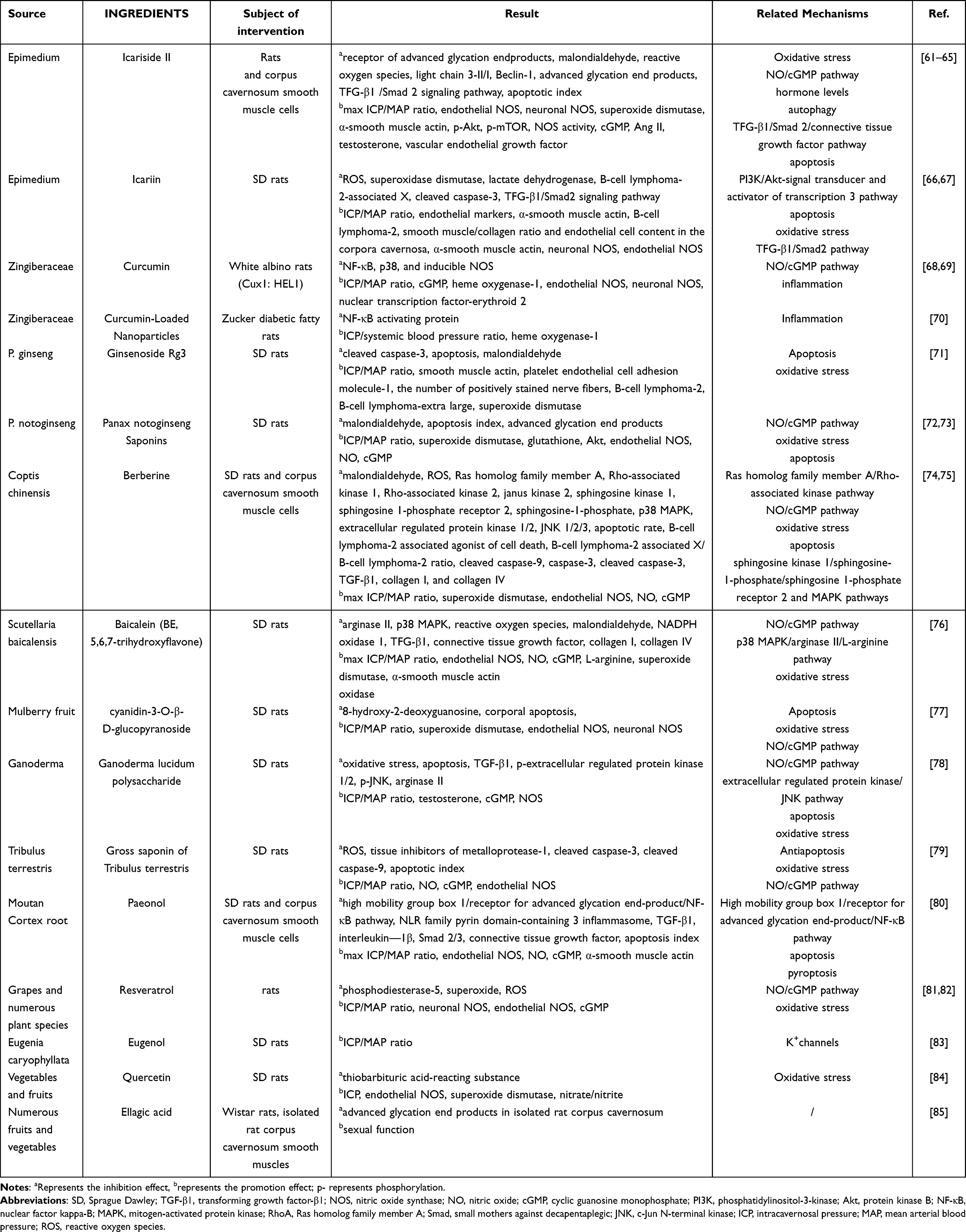 |
Table 2 Experiments About Ingredients of Medicinal Plants in DMED |
Butea superba enhanced penile erection in DM rats by increasing the intracavernous pressure,58 while Dracaena arborea is thought to possess aphrodisiac properties capable of alleviating DMED rats.59 Ferula elaeochytris root extract administration to DMED rats has been shown to reduce glucose levels and recover neurogenic and endothelial dysfunction, but the authors did not confirm the possible mechanisms of action.60 To explore the mechanisms of medicinal plants in DMED, Suresh et al analyzed the mechanisms of mucuna pruriens on DM-induced erectile tissue damage, and the results indicated that ROS, superoxide dismutase, catalase, etc. were significantly improved in the penile tissue of DM rats after mucuna pruriens treatment.48 Other studies showed red ginseng, pomegranate and almond fruits have the potential for antioxidant effects based on restoration of intracavernosal pressure reduced by DM.50,52,56
Salvia miltiorrhiza Bunge has antioxidative, anti-inflammatory, and antifibrotic properties and can regulate programmed cell death.86 Danshen injection is a Chinese medicine injection whose main ingredient is Salvia miltiorrhiza Bunge. Studies showed that it could improve erectile function in DMED rats via increased erection times.53 The therapeutic mechanisms are mediated through attenuation of penile tissue apoptosis via caspase-3 activation inhibition coupled with oxidative stress reduction. These effects occur concomitantly with downregulation of the endoplasmic reticulum stress biomarkers such as 78-kDa glucose-regulated protein and C/EBP homologous protein.53 In addition, Gynochthodes officinalis (F.C.How) Razafim and B.Bremer is a lianoid shrub found in China, and its root is a common herb in traditional Chinese medicine (TCM) and also has effects on improving reproductive and sexual function.87 Vitro experiments confirmed that it protected CCSMC and Schwann cells from apoptosis.49 Their results also showed the protein expressions of the phosphatidylinositol 3-kinase (PI3K)/protein kinase B (AKT)/eNOS pathway were upregulated in DMED rats after fermented or unfermented Gynochthodes officinalis (F.C.How) Razafim and B.Bremer treatment, while the level of oxidative stress was significantly reduced.49
Medicinal plants also have a role in regulating the NO/cGMP pathway. Nwagwe et al revealed that Pentaclethra macrophylla leaves supplemented diets caused a significant reduction in blood glucose levels and augmented erectile function by inhibiting arginase and PDE5 activities as well as enhancing NO level.51 Fu et al investigated the effects of Eucommia ulmoides Oliv. Leaf extract on restoring erectile function in streptozotocin-induced DM rats model, and the results showed it promoted the NO/cGMP pathway, serum superoxide dismutase and glutathione peroxidase levels and reduced serum malondialdehyde levels.55 Furthermore, Eucommia ulmoides Oliv. Leaf extract is likely to benefit the hypothalamic-pituitary-gonadal axis, sexual hormone and hormone receptor expression.55 Similarly, extracts of tribulus terrestris and Cordycep militaris can also reverse the reduction of testosterone in DMED rats.54,57
Active Ingredients of Some Medicinal Plants for DMED
Studies demonstrate that the active ingredients of medicinal plants ameliorate DMED through CC relaxation via K+ channels,83 and potentiation of the NO/cGMP pathway via upregulated NOS, cGMP, and PDE5 inhibition in the CC of DMED rats. And these active ingredients concomitantly reverse DM-induced testosterone reduction, mitigate oxidative stress, and suppress apoptosis—critical processes for attenuating CC fibrosis and restoring endothelial function.76–82,84 The active components of medicinal plants combined with PDE5 inhibitors can improve erectile function in DMED rats and potentially exert a synergistic effect.85 It is worth mentioning that icariside, curcumin, saponin and berberine are relatively common in basic research in the field of DMED.
Epimedium is the whole grass of the Epimedium brevicornum, a plant of the Berberidaceae Epimedium. The main active ingredients of Epimedium are flavonoids, mainly including icariin, icariside I, icariside II, etc. Icariin preserved penile hemodynamics, smooth muscle and endothelial integrity of DM rats by improving the smooth muscle/collagen ratio, endothelial cell content, and the expression of eNOS and nNOS in the CC.67 Wang et al explored the mechanisms through which icariin enhances the efficacy of adipose-derived mesenchymal stem cells in the treatment of DMED and found icariin significantly inhibited the up-regulation of apoptosis-related proteins under oxidative conditions while promoting the expression of the anti-apoptotic factor.66 These positive effects were accompanied by the activation of the signaling molecules PI3K/Akt and signal transducer and activator of transcription 3.66 Icariin II can increase the intracellular cGMP, nNOS expression and NOS activity in rat CC tissues in vitro.64 Also, several studies showed that icariin II could increase smooth muscle cell/collagen fibril proportions and α-smooth muscle actin to prevent atrophy of CC smooth muscle and CC fibrosis.61,63,65 The specific mechanisms of these effects may be related to regulating testosterone and the programmed cell death, anti-oxidative properties, and the PI3K-Akt-mammalian target of rapamycin pathway.61–63,65 Nonetheless, co-administration of icariin II and insulin exhibits enhanced therapeutic efficacy in improving erections compared with icariin II alone in DMED rats.65
Curcumin is a fat-soluble polyphenolic compound extracted from the rhizome of turmeric, which is the main component of turmeric to exert pharmacological effects. Previous studies have shown that curcumin has pharmacological effects such as anti-oxidative stress, anti-inflammatory, anti-fibrotic, and anti-tumor,88 and has been used in male sexual dysfunction.89 Curcumin is involved in erectile signaling through increased eNOS, nNOS and cGMP expression in DMED rats.68 NOS synthesis and release are involved in the NO/cGMP pathway, which directly affects penile erection. It is worth mentioning that heme oxygenase/carbonic oxide systems may complement or substitute the NOS/NO/cGMP system in cavernous tissue.90 Heme oxygenase-1-derived carbonic oxide has a positive effect on cGMP levels in vascular endothelial cells.90 A significant reduction of heme oxygenase-1 has been found in the cavernous tissue of DMED rats, and the heme oxygenase-1 reduction can be reversed by curcumin.69 Also, studies showed that the expression of nuclear factor kappa-B and p38 significantly increased in DMED rats, and the administration of curcumin can lead to a significant reduction in their gene expression.68,69 This further suggests that curcumin treating DMED may be related to its modulation of inflammation-related signaling pathways. In addition to internal administration, the topical application of curcumin-loaded nanoparticles also demonstrated similar anti-inflammatory effects on the corporal tissue of DMED rats.70
Ginsenoside Rg3, a trace tetracyclic triterpenoid saponin present in ginseng, has pharmacological effects that selectively inhibit tumor cell infiltration and metastasis, and is mainly used in oncological diseases.91 In DMED, Liu et al explored the mechanism of ginsenoside Rg3 in terms of antiapoptosis and anti-oxidative properties, and they found that daily gavage of 100 mg/kg ginsenoside Rg3 in DMED rats can repair the damaged cavernous smooth muscle and vascular endothelium with the inhibition of cleaved caspase-3, malondialdehyde, and promotion of b-cell lymphoma-2, b-cell lymphoma-extra-large, and superoxide dismutase.71 Similar to ginseng, Panax notoginseng also belongs to the Araliaceae family and ginseng genus, and is rich in saponins.92 The Panax notoginseng saponins can down-regulate the expression of inflammatory factors, promote the growth of vascular endothelial cells, and regulate the function of endothelial cells.93 Panax notoginseng saponins improved the DMED via the NO/cGMP pathway and restored the function of endothelium in CC of rats while at the same time, limiting the accumulation of AGEs and inhibiting cell apoptosis.72 Panax notoginseng saponins can also suppress oxidative stress in CC of DMED rats, such as increasing the superoxide dismutase and decreasing the malondialdehyde.73 While Akt is involved in cell survival and oxidative stress inhibits Akt activity, the suppression of oxidative stress by Panax notoginseng saponins may restore Akt-mediated protection of CCSMC and vascular endothelial cells in CC of DMED rats.73
Berberine is an isoquinoline alkaloid extracted from Rhizoma Coptidis, which is the most abundant and valuable monomer among the active ingredients of Rhizoma Coptidis. Berberine can improve DM and its complications. Previous experiments confirmed that berberine could improve the erectile function of DM rats by inhibiting Janus kinase 2 and reducing oxidative stress.74 In addition, berberine has many other effects such as regulating the sphingosine 1-phosphate receptor 2/mitogen-activated protein kinase signalling pathway to ameliorate DMED rats. In Liu et al study, DM induced the high expression of sphingosine kinase 1, sphingosine 1-phosphate receptor 2, and sphingosine-1-phosphate in the penile tissue of rats, and these indicators could be partially suppressed by berberine.75 Furthermore, supplementation with berberine inhibited the expression of transforming growth factor-β1, collagen I/IV, and apoptosis indicators caused by DM in the penile tissue of rats.75
Advantages of Medicinal Plants for DMED Treatments
Previous studies on DMED mechanisms involve multiple pathways that may influence CC relaxation and contraction, and the NO/cGMP pathway remains a crucial target for DMED. PDE5 inhibitor is accepted as the first-line treatment for ED.1,94 Recently, many studies have explored the potential of combination therapies for the treatment of DMED.95,96 The main targets of action of the medicinal plants mentioned in Table 1 and Table 2 are also focused on the regulation of the NO/cGMP pathway, and it is noteworthy that they also promote the production of NO, eNOS, and nNOS. Furthermore, the antioxidative properties and apoptosis-regulating capacity inherent to medicinal plants synergistically enhance penile endothelial and smooth muscle function through multi-mechanistic pathways. Despite limited clinical data on the use of medicinal plants in combination with PDE5 inhibitors for the treatment of DMED, animal studies showed that dosing with ellagic acid, sildenafil, and the combination of both increased the sexual function of DM rats. Sildenafil was more effective than ellagic acid, and the combination of both was the most effective in managing DM-induced sexual dysfunction.85 Similarly, the combination of novel water-soluble curcumin derivative with sildenafil had a more obvious effect on improving NOS activity compared to either soluble curcumin derivative or sildenafil alone.69
TCM therapy for DMED is widely used In some East Asian countries, and it is characterized by the prescription of several medicinal plants through TCM perspective to achieve individualized treatment.97 In terms of TCM theory, the causes of ED are related to kidney yang deficiency, qi deficiency, and blood stasis, etc. TCM believes that many medicinal plants such as Eucommia ulmoides Oliv. Leaf, and Epimedium can tonify kidney yang, red ginseng can tonify qi, and Radix S. miltiorrhiza can remove blood stasis. However, there is still a lack of research on whether the prescription of multiple medicinal plants is superior to a single medicinal plant treatment in improving erectile function in patients with DMED. The effects of a nutritional supplement composed of Panax ginseng, Moringa oleifera and rutin have been evaluated as single or combined agents in DMED rats, and the results showed that the mixture of these three medicinal plants was more effective in improving sexual behaviour compared with any single one of these three medicinal plants.98 It is undeniable that prescriptions of multiple medicinal plants improve erectile function in patients with DMED.97 From TCM perspectives, these prescriptions have specific effects, such as tonifying the kidney, regulating the liver, and promoting better blood flow to various organs. Current studies of the compound composition of TCM and animal model also suggest that these prescriptions of medicinal plants contain multiple pharmacodynamic components, such as icariside and curcumin (Table 2), and these prescriptions can serve as multi-targeted treatment of DMED through different pathways.99–101 Therefore, combining the application of medicinal plants with the theoretical perspectives of TCM to form prescriptions seems to be a “holistic” therapeutic approach.
Challenges in the Use of Medicinal Plants in DMED
We briefly review that DM-induced ED is refractory, mainly due to the complexity of the involved mechanisms and the limitations of available treatments. We also discuss the potential of medicinal plants and their active ingredients in DMED. Although current animal experiments have established a certain foundation, They have at least confirmed some targets and pathways of action for medicinal plants and their active ingredients in treating DMED. However, we admit that there are still many challenges in the research on medicinal plants in the field of DMED (Figure 2).
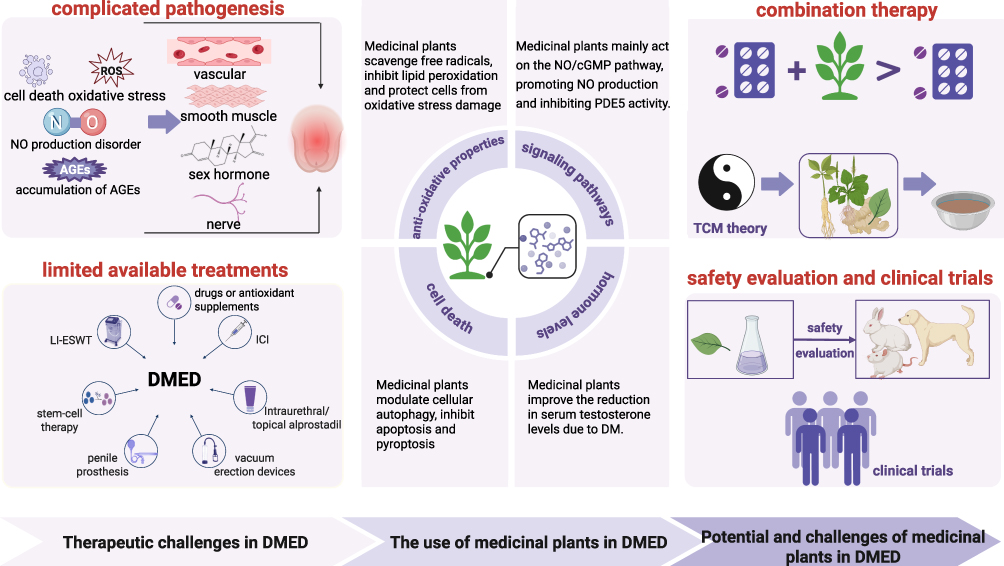 |
Figure 2 Therapeutic challenges in DMED and potential of medicinal plants (Created in BioRender. Wang, (H) (2025) https://BioRender.com/b36d664). Abbreviations: NO, nitric oxide; AGEs, advanced glycation end products; ROS, reactive oxygen species; DMED, diabetes mellitus erectile dysfunction; cGMP, cyclic guanosine monophosphate; TCM, traditional Chinese medicine; PDE5, phosphodiesterase-5; ICI, intracavernous injection; LI-ESWT, low-intensity extracorporeal shock wave therapy. |
There are many clinical studies on the application of medicinal plants in the treatment of ED,102,103 but few studies in DMED. On the one hand, DMED is a type of refractory ED, often accompanied by vascular and neural injuries, etc. It may be difficult to ensure the efficacy of using medicinal plants alone. In a randomized controlled trial, the authors investigated the effects of a topical saffron gel on ED in DM men, the intervention group was treated with topical saffron, and the control group received a similar treatment with a placebo.104 After 1-month treatment, the prepared saffron gel was significantly more effective than placebo on erectile function score.104 Nevertheless, due to the difference between DMED and nonorganic ED, the authors did not describe the underlying treatment management involved in the participants during the study, including glucose-lowering regimens, daily life coaching, and so on.104 Also, there might be some limitations, such as ethical controversies, when applying a placebo only to the control group. Therefore, many researchers often use the guideline-recommended treatment option to treat DMED patients in the control group, and they regard the medicinal plant as a complementary and alternative therapy and used it in combination with the recommended treatment option in the guideline for the treatment group.105 This is also in line with practical clinical applications.
In Table 1 and Table 2, the basic studies evaluating the relevance of medicinal plants to DMED treatment did not report any adverse effects or toxicity. However, this may be because most of them were drug discovery or mechanism studies rather than toxicity studies. Thus, the focus of these studies has been on elucidating active plant constituents or mechanisms of action rather than on safety assessment. Medicinal plants and their active ingredients are generally considered safe because they are “natural”. However, various factors such as the inherent toxicity of plants and natural products, contamination, and exact formulations may affect their safety profile. This also seems to imply that achieving substantial clinical translation and realizing the benefits of medicinal plants still have a long way to go.
Future Recommendation in the Use of Medicinal Plants on DMED
The pathogenesis of DMED involves vascular, neurological, endocrine, and other factors. Based on our review, medicinal plants exert their effects through a wide range of mechanisms, including vascular endothelial protection, sex hormone regulation, and antioxidant activity. Therefore, it is necessary to further isolate the active components (such as flavonoids and saponins) in medicinal plants and reveal their effects on the targets related to DMED through molecular biology techniques in the future. And clarifying the long-term safety of plant active ingredients, drug metabolism pathways, and interaction risks of co-administration with some hypoglycemic agents through animal model interventions will also be beneficial to the medication safety. In addition, with the wide application of multi-omics technology, systematic analysis of the effects of medicinal plants on the metabolic network of DMED patients is also helpful to provide a basis for precise medication.
Due to the complexity of the pathogenesis of DMED, it is difficult for medicinal plants to have the same rapid clinical efficacy as PDE5 inhibitors. However, we have to admit that phytotherapy considers multiple aspects including neurological, vascular, and endocrine in the treatment of DMED.106 This suggests that medicinal plants may serve not only as complementary and alternative therapies but could also be used in combination with PDE5 inhibitors for managing DMED, as well as improving other symptoms induced by DM.107,108 Therefore, further clinical trials are needed to validate the efficacy and safety of medicinal plants for DMED and to explore combination therapies that may offer comprehensive therapeutic solutions.
Topical medications are beneficial in alleviating the adverse effects associated with oral medications and may also increase adherence to treatment.109 Studies have demonstrated the potential of topical application of PDE5 inhibitors in the treatment of ED,110 and localized inflammatory responses in the penile tissue of DMED rats have also been alleviated by curcumin-loaded nanoparticles.70 Despite the lack of relevant studies, the encapsulation of active ingredients from medicinal plants using nanotechnology, along with the enhancement of their bioavailability and targeted delivery to the cavernous body of the penis or neurovascular tissue, remains necessary to reduce systemic adverse effects.
Conclusion
We review the complicated pathogenesis and current treatment limitations in DMED, explores the therapeutic applications, potential, and challenges of medicinal plants and their active ingredients, and proposes future research recommendations for this field. Although our review demonstrated the advantages of medicinal plants and their active ingredients in regulating NO/cGMP pathway, cell death, oxidative stress, and sex hormone levels, relevant studies are still lacking, especially high-level scientific evidence and a better understanding of the dose, toxicity, and metabolic mechanisms. At the same time, clinical trials of using the medicinal plant alone or in combination with other therapeutic options are still necessary to evaluate their efficacy and safety for DMED patients.
Data Sharing Statement
Data supporting this article is readily available upon request and in public domains.
Author Contributions
All authors made a significant contribution to the work reported, whether that was in the conception, study design, execution, acquisition of data, analysis and interpretation, manuscript drafting, revising or critical review. All authors consented to the final approval of the version to be published; have agreed on the journal to which the article has been submitted; and agree to be accountable for all aspects of the work. No Artificial Intelligence tools have been used in the drafting of this manuscript.
Funding
This work was financed by Special Funds for Basic Research Operating Expenses of Central-level Public Welfare Research Institutes (No. ZZ15-YQ-012) and State Administration of Traditional Chinese Medicine High-level Key Discipline Construction Project (No. zyyzdxk-2023238).
Disclosure
The authors report there are no conflicts of interest in this work.
References
1. Salonia A, Bettocchi C, Boeri L. EAU Working Group on Male Sexual and Reproductive Health. European Association of urology guidelines on sexual and reproductive health-2021 update: male sexual dysfunction. Eur Urol. 2021;80(3):333–357. doi:10.1016/j.eururo.2021.06.007
2. Zeleke M, Hailu D, Daka D. Erectile dysfunction and associated factors among diabetic patients at, Hawassa, Southern, Ethiopia. BMC Endocr Disord. 2021;21(1):139. doi:10.1186/s12902-021-00807-5
3. Chen G, Huang L, Lai M, Ran J. Association between erectile dysfunction and the prevalence and prognosis of hyperglycemia in adults in the USA based on NHANES 2001-2004. Sci Rep. 2024;14(1):17663. doi:10.1038/s41598-024-68208-x.
4. Defeudis G, Mazzilli R, Tenuta M, et al. Erectile dysfunction and diabetes: a melting pot of circumstances and treatments. Diabetes Metab Res Rev. 2022;38(2):e3494. doi:10.1002/dmrr.3494
5. Khatib FA, Jarrah NS, Shegem NS, et al. Sexual dysfunction among Jordanian men with diabetes. Saudi Med J. 2006;27(3):351–356.
6. F PD, M LD, P LD, et al. Do impotent men with diabetes have more severe erectile dysfunction and worse quality of life than the general population of impotent patients? Results from the exploratory comprehensive evaluation of erectile dysfunction (ExCEED) database. Diabetes Care. 2003;26(4):1093–1099. doi:10.2337/diacare.26.4.1093
7. Dilixiati D, Waili A, Tuerxunmaimaiti A, Tao L, Zebibula A, Rexiati M. Risk factors for erectile dysfunction in diabetes mellitus: a systematic review and meta-analysis. Front Endocrinol. 2024;15:1368079. doi:10.3389/fendo.2024.1368079
8. Corona G, Rastrelli G, Sparano C, Vignozzi L, Sforza A, Maggi M. Pharmacotherapeutic strategies for the management of erectile dysfunction in patients with diabetes and pre-diabetes. Expert Opin Pharmacother. 2024;5:1–11.
9. Samidurai A, Xi L, Das A, Kukreja RC. Beyond erectile dysfunction: cGMP-specific phosphodiesterase 5 inhibitors for other clinical disorders. Annu Rev Pharmacol Toxicol. 2023;63:585–615. doi:10.1146/annurev-pharmtox-040122-034745
10. Lee M, Sharifi R. Non-invasive management options for erectile dysfunction when a phosphodiesterase type 5 inhibitor fails. Drugs Aging. 2018;35(3):175–187. doi:10.1007/s40266-018-0528-4
11. Adetunji TL, Olisah C, Acho MA, Oyetunde-Joshua F, Amoo SO. Global research trends and recent advances in medicinal plant-synthesized nanoparticles for cancer treatment. Plants. 2024;13(20):2836. doi:10.3390/plants13202836
12. Lim XY, Lau MS, Zolkifli NA, et al. Medicinal plants for allergic rhinitis: a systematic review and meta-analysis. PLoS One. 2024;19(4):e0297839. doi:10.1371/journal.pone.0297839
13. Ansari T, Asif M, Saleem M, Ahmed NZ, Meena R. Rubus moluccanus L.: a valuable medicinal plant of traditional system of medicine. Nat Prod Res. 2023;11:1–11.
14. Wang H, Zhang J, Ma D, Zhao Z, Yan B, Wang F. The role of red ginseng in men’s reproductive health: a literature review. Basic Clin Androl. 2023;33(1):27. doi:10.1186/s12610-023-00203-0
15. Van Damme L, Chatrou L, de la Peña E, et al. Plant use and perceptions in the context of sexual health among people of Congolese descent in Belgium. J Ethnobiol Ethnomed. 2024;20(1):20. doi:10.1186/s13002-024-00662-3
16. Masuku NP, Unuofin JO, Lebelo SL. Promising role of medicinal plants in the regulation and management of male erectile dysfunction. Biomed Pharmacother. 2020;130:110555. doi:10.1016/j.biopha.2020.110555
17. Matsui H, Sopko NA, Hannan JL, Bivalacqua TJ. Pathophysiology of erectile dysfunction. Curr Drug Targets. 2015;16(5):411–419. doi:10.2174/138945011605150504114041
18. Gandaglia G, Salonia A, Passoni N, Montorsi P, Briganti A, Montorsi F. Erectile dysfunction as a cardiovascular risk factor in patients with diabetes. Endocrine. 2013;43(2):285–292. doi:10.1007/s12020-012-9780-2
19. Calenda G, Tong Y, Kanika ND, et al. Reversal of diabetic vasculopathy in a rat model of type 1 diabetes by opiorphin-related peptides. Am J Physiol Heart Circ Physiol. 2011;301(4):H1353–9. doi:10.1152/ajpheart.00383.2011
20. Faselis C, Katsimardou A, Imprialos K, Deligkaris P, Kallistratos M, Dimitriadis K. Microvascular complications of type 2 diabetes mellitus. Curr Vasc Pharmacol. 2020;18(2):117–124.
21. Alam MS, Kalam ST, Akter D, Kamrul-Hasan AB. Penile color Doppler ultrasonography in patients with type 2 diabetes mellitus presenting with erectile dysfunction: a single-center experience from Bangladesh. Mymensingh Med J. 2024;33(1):254–260.
22. Wen Y, Skidmore JC, Porter-Turner MM, Rea CA, Khokher MA, Singh BM. Relationship of glycation, antioxidant status and oxidative stress to vascular endothelial damage in diabetes. Diabetes Obes Metab. 2002;4(5):305–308. doi:10.1046/j.1463-1326.2002.00212.x
23. Benaragama KS, Singh AA, Taj T, Hague J, Boyle JR, Richards T. Erectile dysfunction in peripheral vascular disease: endovascular revascularization as a potential therapeutic target. Vasc Endovascular Surg. 2020;54(8):707–711.
24. Kavoussi PK, Heberlein K, Straub AC. Recombinant PAI-1 therapy restores myoendothelial junctions and erectile function in PAI-1-deficient mice. Andrologia. 2015;47(10):1147–1152. doi:10.1111/and.12395
25. Jesmin S, Sakuma I, Salah-Eldin A, Nonomura K, Hattori Y, Kitabatake A. Diminished penile expression of vascular endothelial growth factor and its receptors at the insulin-resistant stage of a type II diabetic rat model: a possible cause for erectile dysfunction in diabetes. J Mol Endocrinol. 2003;31(3):401–418. doi:10.1677/jme.0.0310401
26. Du X, Edelstein D, Obici S, Higham N, Zou MH, Brownlee M. Insulin resistance reduces arterial prostacyclin synthase and eNOS activities by increasing endothelial fatty acid oxidation. J Clin Invest. 2006;116(4):1071–1080. doi:10.1172/JCI23354
27. T SUN, Xu W, Wang J, et al. Saxagliptin alleviates erectile dysfunction through increasing stromal cell-derived factor-1 in diabetes mellitus. Andrology. 2023;11(2):295–306. doi:10.1111/andr.13296
28. Costa C, Virag R. The endothelial−erectile dysfunction connection: an essential update. J Sex Med. 2009;6:2390–2404. doi:10.1111/j.1743-6109.2009.01356.x
29. Suadicani SO, Urban-Maldonado M, Tar MT, et al. Effects of ageing and streptozotocin-induced diabetes on connexin 43 and P2 purinoceptor expression in the rat corpora cavernosa and urinary bladder. BJU Int. 2009;103(12):1686–1693. doi:10.1111/j.1464-410X.2008.08337.x
30. Filippi S, Amerini S, Maggi M, et al. Studies on the mechanisms involved in the ATP-induced relaxation in human and rabbit corpus cavernosum. J Urol. 1999;161(1):326–331. doi:10.1016/S0022-5347(01)62140-2
31. Zhang X, Kanika ND, Melman A, et al. Smooth muscle myosin expression, isoform composition, and functional activities in rat corpus cavernosum altered by the streptozotocin-induced type 1 diabetes. Am J Physiol Endocrinol Metab. 2012;302(1):E32–E42. doi:10.1152/ajpendo.00231.2011
32. De Young LX, Domes T, Lim K, et al. Endothelial rehabilitation: the impact of chronic PDE5 inhibitors on erectile function and protein alterations in cavernous tissue of diabetic rats. Eur Urol. 2008;54(1):213–220. doi:10.1016/j.eururo.2008.02.034
33. Li H, Xu W, Liu X, et al. JAK2 deficiency improves erectile function in diabetic mice through attenuation of oxidative stress, apoptosis, and fibrosis. Andrology. 2021;9(5):1662–1671. doi:10.1111/andr.13061
34. Li WJ, Zhou J, Li B, Wang H, Peng YB, Wang Z. PARP inhibition restores erectile function by suppressing corporal smooth muscle apoptosis in diabetic rats. J Sex Med. 2011. 8: 1072–1082.
35. Fan M, Xu X, He X, et al. Protective effects of hydrogen-rich saline against erectile dysfunction in a streptozotocin induced diabetic rat model. J Urol. 2012;190:350–356. doi:10.1016/j.juro.2012.12.001
36. Törzsök P, Steiner C, Pallauf M, et al. Long-term follow-up after testicular torsion: prospective evaluation of endocrine and exocrine testicular function, fertility, oxidative stress and erectile function. J Clin Med. 2022;11(21):6507. doi:10.3390/jcm11216507
37. Kjaergaard AD, Marouli E, Papadopoulou A, et al. Thyroid function, sex hormones and sexual function: A Mendelian randomization study. Eur J Epidemiol. 2021;36(3):335–344. doi:10.1007/s10654-021-00721-z
38. Wang Y, Jiang R. Androgens and erectile dysfunction: from androgen deficiency to treatment. Sex Med Rev. 2024;12(3):458–468. doi:10.1093/sxmrev/qeae030
39. Aversa A, Francomano D, Lenzi A. Does testosterone supplementation increase PDE5-inhibitor responses in difficult-to-treat erectile dysfunction patients? Expert Opin Pharmacother. 2015;16:625–628. doi:10.1517/14656566.2015.1011124
40. Aversa A, Isidori AM, De Martino MU, et al. Androgens and penile erection: evidence for a direct relationship between free testosterone and cavernous vasodilation in men with erectile dysfunction. Clin Endocrinol. 2000;53:517–522. doi:10.1046/j.1365-2265.2000.01118.x
41. Ahi S, Ebrahimi F, Abedi HA, Kargar Jahromi H, Zarei S. The effects of hydroalcoholic extract of silk cocoon on hypothalamic-pituitary -gonadal axis in streptozotocin-induced diabetic male rats. Autoimmune Dis. 2022;2022:7916159. doi:10.1155/2022/7916159
42. Koh P. Streptozotocin-induced diabetes increases the interaction of Bad/Bcl-XL and decreases the binding of pBad/14-3-3 in rat testis. Life Sci. 2007;81:1079–1084. doi:10.1016/j.lfs.2007.08.017
43. Shin D, Jeon SH, Tian WJ, et al. Extracorporeal shock wave therapy combined with engineered mesenchymal stem cells expressing stromal cell-derived factor-1 can improve erectile dysfunction in streptozotocin-induced diabetic rats. Transl Androl Urol. 2021;10(6):2362–2372. doi:10.21037/tau-21-79
44. Herman WH, Pop-Busui R, Braffett BH, et al. Use of the Michigan neuropathy screening instrument as a measure of distal symmetrical peripheral neuropathy in type 1 diabetes: results from the diabetes control and complications trial/epidemiology of diabetes interventions and complications. Diabet Med. 2012;29(7):937–944. doi:10.1111/j.1464-5491.2012.03644.x
45. Zhang JL, Hui Y, Zhou F, Hou JQ. Neuroprotective effects of melatonin on erectile dysfunction in streptozotocin-induced diabetic rats. Int Urol Nephrol. 2018;50(11):1981–1988. doi:10.1007/s11255-018-1989-4
46. Kaltsas A, Zikopoulos A, Dimitriadis F, et al. Oxidative stress and erectile dysfunction: pathophysiology, impacts, and potential treatments. Curr Issues Mol Biol. 2024;46(8):8807–8834. doi:10.3390/cimb46080521
47. Cayetano-Alcaraz AA, Tharakan T, Chen R, Sofikitis N, Minhas S. The management of erectile dysfunction in men with diabetes mellitus unresponsive to phosphodiesterase type 5 inhibitors. Andrology. 2023;11(2):257–269. doi:10.1111/andr.13257
48. Suresh S, Prakash S. Effect of Mucuna pruriens (Linn.) on oxidative stress-induced structural alteration of corpus cavernosum in streptozotocin-induced diabetic rat. J Sex Med. 2011;8(7):1943–1956. doi:10.1111/j.1743-6109.2011.02221.x
49. Liu S, Li K, Zhao Y, et al. Fermented Gynochthodes officinalis (F.C.How) Razafim. & B.Bremer alleviates diabetic erectile dysfunction by attenuating oxidative stress and regulating PI3K/Akt/eNOS pathway. J Ethnopharmacol. 2023;307:116249. doi:10.1016/j.jep.2023.116249
50. Ryu JK, Lee T, Kim DJ, et al. Free radical-scavenging activity of Korean red ginseng for erectile dysfunction in non-insulin-dependent diabetes mellitus rats. Urology. 2005;65(3):611–615. doi:10.1016/j.urology.2004.10.038
51. Nwagwe OR, Adefegha SA, Oboh G. Pentaclethra macrophylla leaves reduce blood glucose level, improve sexual behavior and modulate critical enzymes associated with diabetes-erectile dysfunction morbidity in rats. J Complement Integr Med. 2024;21(1):80–87. doi:10.1515/jcim-2023-0101
52. Onal E, Yilmaz D, Kaya E, Bastaskın T, Bayatlı N, Gur S. Pomegranate juice causes a partial improvement through lowering oxidative stress for erectile dysfunction in streptozotocin-diabetic rat. Int J Impot Res. 2016;28(6):234–240. doi:10.1038/ijir.2016.34
53. Zhang Y, Chen J, Ji H, Xiao ZG, Shen P, Xu LH. Protective effects of Danshen injection against erectile dysfunction via suppression of endoplasmic reticulum stress activation in a streptozotocin-induced diabetic rat model. BMC Complement Altern Med. 2018;18(1):343. doi:10.1186/s12906-018-2414-3
54. Ștefănescu R, Farczadi L, Huțanu A, et al. Tribulus terrestris efficacy and safety concerns in diabetes and erectile dysfunction, assessed in an experimental model. Plants. 2021;10(4):744. doi:10.3390/plants10040744
55. Fu H, Bai X, Le L, et al. Eucommia ulmoides Oliv. leaf extract improves erectile dysfunction in streptozotocin-induced diabetic rats by protecting endothelial function and ameliorating hypothalamic-pituitary-gonadal axis function. Evid Based Complement Alternat Med. 2019;2019:1782953. doi:10.1155/2019/1782953
56. Adebayo AA, Oboh G, Ademosun AO. Nutraceutical potential of almond fruits in managing diabetes-related erectile dysfunction: effect on Nrf-2 level and smooth muscle/collagen ratio. Andrologia. 2022;54(11):e14636. doi:10.1111/and.14636
57. Pohsa S, Hanchang W, Singpoonga N, Chaiprasart P, Taepavarapruk P. Effects of cultured cordycep militaris on sexual performance and erectile function in streptozotocin-induced diabetic male rats. Biomed Res Int. 2020;2020:4198397. doi:10.1155/2020/4198397
58. Tocharus C, Sooksaen P, Shimbhu D, Tocharus J. Butea superba (Roxb.) improves penile erection in diabetic rats. Andrologia. 2012;44(Suppl 1):728–733. doi:10.1111/j.1439-0272.2011.01257.x
59. Wankeu-Nya M, Watcho P, Nguelefack TB, Carro-Juarez M, Tapondjou L, Kamanyi A. Effects of Dracaena arborea (Dracaenaceae) on sexual dysfunction in 4 weeks hyperglycemic male rats. Asian Pac J Trop Med. 2014;7(8):609–619. doi:10.1016/S1995-7645(14)60103-6
60. Eser N, Buyuknacar HS, Cimentepe OO, et al. The effect of Ferula elaeochytris root extract on erectile dysfunction in streptozotocin-induced diabetic rat. Int J Impot Res. 2020;32(2):186–194. doi:10.1038/s41443-019-0137-8
61. Zhang J, Li S, Zhang S, et al. Effect of Icariside II and metformin on penile erectile function, histological structure, mitochondrial autophagy, glucose-lipid metabolism, angiotensin ii and sex hormone in type 2 diabetic rats with erectile dysfunction. Sex Med. 2020;8(2):168–177. doi:10.1016/j.esxm.2020.01.006
62. Zhang J, Li S, Li S, et al. Effect of icariside II and metformin on penile erectile function, glucose metabolism, reaction oxygen species, superoxide dismutase, and mitochondrial autophagy in type 2 diabetic rats with erectile dysfunction. Transl Androl Urol. 2020;9(2):355–366. doi:10.21037/tau.2020.02.07
63. Zhou F, Xin H, Liu T, et al. Effects of icariside II on improving erectile function in rats with streptozotocin-induced diabetes. J Androl. 2012;33(5):832–844. doi:10.2164/jandrol.111.015172
64. Zhang J, Wang YB, Ma CG, et al. Icarisid II, a PDE5 inhibitor from Epimedium wanshanense, increases cellular cGMP by enhancing NOS in diabetic ED rats corpus cavernosum tissue. Andrologia. 2012;44(Suppl 1):87–93. doi:10.1111/j.1439-0272.2010.01144.x
65. Wang L, Xu Y, Li H, et al. Antioxidant icariside II combined with insulin restores erectile function in streptozotocin-induced type 1 diabetic rats. J Cell Mol Med. 2015;19(5):960–969. doi:10.1111/jcmm.12480
66. Wang X, Liu C, Xu Y, et al. Combination of mesenchymal stem cell injection with icariin for the treatment of diabetes-associated erectile dysfunction. PLoS One. 2017;12(3):e0174145. doi:10.1371/journal.pone.0174145
67. Liu T, Xin H, Li WR, et al. Effects of icariin on improving erectile function in streptozotocin-induced diabetic rats. J Sex Med. 2011;8(10):2761–2772. doi:10.1111/j.1743-6109.2011.02421.x
68. Abdel Aziz MT, Motawi T, Rezq A, et al. Effects of a water-soluble curcumin protein conjugate vs. pure curcumin in a diabetic model of erectile dysfunction. J Sex Med. 2012;9(7):1815–1833. doi:10.1111/j.1743-6109.2012.02741.x
69. Zaahkouk AM, Abdel Aziz MT, Rezq AM, et al. Efficacy of a novel water-soluble curcumin derivative versus sildenafil citrate in mediating erectile function. Int J Impot Res. 2015;27(1):9–15. doi:10.1038/ijir.2014.24
70. Draganski A, Tar MT, Villegas G, Friedman JM, Davies KP. Topically applied curcumin-loaded nanoparticles treat erectile dysfunction in a rat model of type-2 diabetes. J Sex Med. 2018;15(5):645–653. doi:10.1016/j.jsxm.2018.03.009
71. Liu T, Peng YF, Jia C, et al. Ginsenoside Rg3 improves erectile function in streptozotocin-induced diabetic rats. J Sex Med. 2015;12(3):611–620. doi:10.1111/jsm.12779
72. Lin F, Gou X. Panax notoginseng saponins improve the erectile dysfunction in diabetic rats by protecting the endothelial function of the penile corpus cavernosum. Int J Impot Res. 2013;25(6):206–211. doi:10.1038/ijir.2013.19
73. Li H, He WY, Lin F, Gou X. Panax notoginseng saponins improve erectile function through attenuation of oxidative stress, restoration of Akt activity and protection of endothelial and smooth muscle cells in diabetic rats with erectile dysfunction. Urol Int. 2014;93(1):92–99. doi:10.1159/000354878
74. Song J, Tang Z, Li H, et al. Role of JAK2 in the pathogenesis of diabetic erectile dysfunction and an intervention with berberine. J Sex Med. 2019;16(11):1708–1720. doi:10.1016/j.jsxm.2019.08.014
75. Liu K, Sun T, Luan Y, et al. Berberine ameliorates erectile dysfunction in rats with streptozotocin-induced diabetes mellitus through the attenuation of apoptosis by inhibiting the SPHK1/S1P/S1PR2 and MAPK pathways. Andrology. 2022;10(2):404–418. doi:10.1111/andr.13119
76. Chen Y, Zhou B, Yu Z, et al. Baicalein alleviates erectile dysfunction associated with streptozotocin-induced type I diabetes by ameliorating endothelial nitric oxide synthase dysfunction, inhibiting oxidative stress and fibrosis. J Sex Med. 2020;17(8):1434–1447. doi:10.1016/j.jsxm.2020.04.390
77. Ha US, Koh JS, Kim HS, et al. Cyanidin-3-O-β-D-glucopyranoside concentrated materials from mulberry fruit have a potency to protect erectile function by minimizing oxidative stress in a rat model of diabetic erectile dysfunction. Urol Int. 2012;88(4):470–476. doi:10.1159/000336136
78. Yao X, Yuan Y, Jing T, Ye S, Wang S, Xia D. Ganoderma lucidum polysaccharide ameliorated diabetes mellitus-induced erectile dysfunction in rats by regulating fibrosis and the NOS/ERK/JNK pathway. Transl Androl Urol. 2022;11(7):982–995. doi:10.21037/tau-22-428
79. Zhang H, Tong WT, Zhang CR, et al. Gross saponin of Tribulus terrestris improves erectile dysfunction in type 2 diabetic rats by repairing the endothelial function of the penile corpus cavernosum. Diabetes Metab Syndr Obes. 2019;12:1705–1716. doi:10.2147/DMSO.S205722
80. Sun T, Xu W, Wang J, et al. Paeonol ameliorates diabetic erectile dysfunction by inhibiting HMGB1/RAGE/NF-kB pathway. Andrology. 2023;11(2):344–357. doi:10.1111/andr.13203
81. Dalaklioglu S, Bayram Z, Tasatargil A, Ozdem S. Resveratrol reverses diabetes-related decrement in sildenafil-induced relaxation of corpus cavernosum in aged rats. Aging Clin Exp Res. 2017;29(3):345–351. doi:10.1007/s40520-016-0582-x
82. Bai Y, An R. Resveratrol and sildenafil synergistically improve diabetes-associated erectile dysfunction in streptozotocin-induced diabetic rats. Life Sci. 2015;135:43–48. doi:10.1016/j.lfs.2015.04.020
83. Yilmaz-Oral D, Onder A, Gur S, et al. The beneficial effect of clove essential oil and its major component, eugenol, on erectile function in diabetic rats. Andrologia. 2020;52(6):e13606. doi:10.1111/and.13606
84. Zhang W, Wang Y, Yang Z, et al. Antioxidant treatment with quercetin ameliorates erectile dysfunction in streptozotocin-induced diabetic rats. J Biosci Bioeng. 2011;112(3):215–218. doi:10.1016/j.jbiosc.2011.05.013
85. Goswami SK, Vishwanath M, Gangadarappa SK, Razdan R, Inamdar MN. Efficacy of ellagic acid and sildenafil in diabetes-induced sexual dysfunction. Pharmacogn Mag. 2014;10(Suppl 3):S581–7. doi:10.4103/0973-1296.139790
86. Huang J, Zhang J, Sun C, et al. Adjuvant role of Salvia miltiorrhiza bunge in cancer chemotherapy: a review of its bioactive components, health-promotion effect and mechanisms. J Ethnopharmacol. 2024;318(Pt B):117022. doi:10.1016/j.jep.2023.117022
87. Gu S, Zhou R, Wang X. Comparison of enhanced male mice sexual function among three medicinal materials. Andrologia. 2018;50(9):e13087. doi:10.1111/and.13087
88. Gu Y, Niu Q, Zhang Q, Zhao Y. Ameliorative effects of curcumin on type 2 diabetes mellitus. Molecules. 2024;29(12):2934. doi:10.3390/molecules29122934
89. Saka WA, Oladipo AA, Kolawole OR, Olayioye A, Akhigbe RE. Sexual dysfunction in dichlorvos-exposed male Wistar rat is ameliorated by curcumin and associated with the upregulation of testosterone. Naunyn Schmiedebergs Arch Pharmacol. 2025;398(1):1003–12
90. Jin YC, Gam SC, Jung JH, Hyun JS, Chang KC, Hyun JS. Expression and activity of heme oxygenase-1 in artificially induced low-flow priapism in rat penile tissues. J Sex Med. 2008;5(8):1876–1882. doi:10.1111/j.1743-6109.2008.00886.x
91. Wu L, Bai L, Dai W, et al. Ginsenoside Rg3: a review of its anticancer mechanisms and potential therapeutic applications. Curr Top Med Chem. 2024;24(10):869–884. doi:10.2174/0115680266283661240226052054
92. Mancuso C. Panax notoginseng: pharmacological aspects and toxicological issues. Nutrients. 2024;16(13):2120. doi:10.3390/nu16132120
93. Zhang H, Li J, Diao M, Li J, Xie N. Production and pharmaceutical research of minor saponins in Panax notoginseng (Sanqi): current status and future prospects. Phytochemistry. 2024;223:114099.
94. Burnett AL, Nehra A, Breau RH, et al. Erectile dysfunction: AUA guideline. J Urol. 2018;200:633–641. doi:10.1016/j.juro.2018.05.004
95. Hamidi Madani A, Asadolahzade A, Mokhtari G, Shahrokhi Damavand R, Farzan A, Esmaeili S. Assessment of the efficacy of combination therapy with folic acid and tadalafil for the management of erectile dysfunction in men with type 2 diabetes mellitus. J Sex Med. 2013;10(4):1146–1150. doi:10.1111/jsm.12047
96. Gentile V, Vicini P, Prigiotti G, Koverech A, Di Silverio F. Preliminary observations on the use of propionyl-L-carnitine in combination with sildenafil in patients with erectile dysfunction and diabetes. Curr Med Res Opin. 2004;20(9):1377–1384. doi:10.1185/030079904X2394
97. Feng Y, Shi T, Fu Y, Lv B. Traditional Chinese medicine to prevent and treat diabetic erectile dysfunction. Front Pharmacol. 2022;13:956173. doi:10.3389/fphar.2022.956173
98. Nobili S, Lucarini E, Murzilli S, Vanelli A, Di Cesare Mannelli L, Ghelardini C. Efficacy evaluation of plant products in the treatment of erectile dysfunction related to diabetes. Nutrients. 2021;13(12):4520. doi:10.3390/nu13124520
99. Li X, Feng JL, Chen ZL, et al. Mechanism by which Huoxue Tongluo Qiwei Decoction improves the erectile function of rats with diabetic erectile dysfunction. J Ethnopharmacol. 2022;283:114674. doi:10.1016/j.jep.2021.114674
100. Jiang S, Cai Q, Gao Y, et al. Improve erectile dysfunction in streptozotocin-induced diabetic rats through suppression of oxidative stress. Evid Based Complement Alternat Med. 2022;2022:4187359. doi:10.1155/2022/4187359
101. Li X, Zhang M, Feng J, et al. Mechanisms of Xuefu Zhuyu Tang in the treatment of diabetic erectile dysfunction in rats through the regulation of vascular endothelial function by CaSR/PLC/PKC and MEK/ERK/RSK pathways. Am J Mens Health. 2024;18(5):15579883241277423. doi:10.1177/15579883241277423
102. Ca S Jr, Reis LO, Destro-Saade R, Luiza-Reis A, Fregonesi A. Tribulus terrestris versus placebo in the treatment of erectile dysfunction: a prospective, randomized, double blind study. Actas Urol Esp. 2014;38(4):244–248. doi:10.1016/j.acuro.2013.09.014
103. Kamenov Z, Fileva S, Kalinov K, Jannini EA. Evaluation of the efficacy and safety of Tribulus terrestris in male sexual dysfunction-A prospective, randomized, double-blind, placebo-controlled clinical trial. Maturitas. 2017;99:20–26. doi:10.1016/j.maturitas.2017.01.011
104. Mohammadzadeh-Moghadam H, Nazari SM, Shamsa A, et al. Effects of a Topical Saffron (Crocus sativus L) gel on erectile dysfunction in diabetics: a randomized, parallel-group, double-blind, placebo-controlled trial. J Evid Based Complementary Altern Med. 2015;20(4):283–286. doi:10.1177/2156587215583756
105. Wu QH, Li PC, Zhang FH, Hua Z, Zhang XH, Sun ZX. To evaluate the efficacy of Yishen Tongluo decoction combined with low-dose tadalafil in the treatment of diabetic erectile dysfunction with kidney deficiency and blood stasis syndrome. Zhonghua Nan Ke Xue. 2023;29(6):527–532.
106. Alrumaihi F, Raut R, Yahia EA, Kumar V, Anwar S. A review on risk factors, diagnostic innovations, and plant based therapies for the management of erectile dysfunction. Uro. 2024;4(2):60–88. doi:10.3390/uro4020006
107. Boutaj H. A comprehensive review of Moroccan medicinal plants for diabetes management. Diseases. 2024;12(10):246. doi:10.3390/diseases12100246
108. Benjamin MAZ, Mohd Mokhtar RA, Iqbal M, et al. Medicinal plants of Southeast Asia with anti-α-glucosidase activity as potential source for type-2 diabetes mellitus treatment. J Ethnopharmacol. 2024;330:118239. doi:10.1016/j.jep.2024.118239
109. Tan X, Feldman SR, Chang J, Balkrishnan R. Topical drug delivery systems in dermatology: a review of patient adherence issues. Expert Opin Drug Deliv. 2012;9(10):1263–1271. doi:10.1517/17425247.2012.711756
110. Hamzehnejadi M, Ranjbar Tavakoli M, Abiri A, Ghasempour A, Langarizadeh MA, Forootanfar H. A review on phosphodiesterase-5 inhibitors as a topical therapy for erectile dysfunction. Sex Med Rev. 2022;10(3):376–391. doi:10.1016/j.sxmr.2022.02.002
 © 2025 The Author(s). This work is published and licensed by Dove Medical Press Limited. The
full terms of this license are available at https://www.dovepress.com/terms
and incorporate the Creative Commons Attribution
- Non Commercial (unported, 4.0) License.
By accessing the work you hereby accept the Terms. Non-commercial uses of the work are permitted
without any further permission from Dove Medical Press Limited, provided the work is properly
attributed. For permission for commercial use of this work, please see paragraphs 4.2 and 5 of our Terms.
© 2025 The Author(s). This work is published and licensed by Dove Medical Press Limited. The
full terms of this license are available at https://www.dovepress.com/terms
and incorporate the Creative Commons Attribution
- Non Commercial (unported, 4.0) License.
By accessing the work you hereby accept the Terms. Non-commercial uses of the work are permitted
without any further permission from Dove Medical Press Limited, provided the work is properly
attributed. For permission for commercial use of this work, please see paragraphs 4.2 and 5 of our Terms.