
Back to Journals » Journal of Blood Medicine » Volume 16
The Value of Using Bedside Point of Care Testing for International Normalized Ratio in Patients on Warfarin Undergoing Dental Procedures and Bleeding Assessment; A Single Center Prospective Study
Authors Albarkheel A, Alshareef H, Albar A, Altbaili SY, Alminaqash MA, Alotibie A, Sheikh A, Alahmadi A, Alaifan B, Tamim H, Owaidah T 
Received 30 December 2024
Accepted for publication 7 July 2025
Published 23 July 2025 Volume 2025:16 Pages 337—348
DOI https://doi.org/10.2147/JBM.S514109
Checked for plagiarism Yes
Review by Single anonymous peer review
Peer reviewer comments 2
Editor who approved publication: Dr Martin H Bluth
Abdullah Albarkheel,1 Hawazen Alshareef,1 Amal Albar,1 Sohayla Youssef Altbaili,1 Mohammed Ali Alminaqash,1 Amjad Alotibie,2 Aamir Sheikh,3,4 Abdullah Alahmadi,3 Badar Alaifan,3 Hani Tamim,4 Tarek Owaidah2,4
1Dental Department, King Faisal Specialist Hospital & Research Centre, Riyadh, Saudi Arabia; 2Pathology and Laboratory Medicine Department, King Faisal Specialist Hospital & Research Centre, Riyadh, Saudi Arabia; 3Medicine Department, King Faisal Specialist Hospital & Research Centre, Riyadh, Saudi Arabia; 4Alfaisal University, College of Medicine, Riyadh, Saudi Arabia
Correspondence: Tarek Owaidah, Department of Pathology and Laboratory Medicine, King Faisal Specialist Hospital & Research Centre, Riyadh, Saudi Arabia, Email [email protected]
Introduction: Postoperative bleeding is a significant complication in dental surgeries, especially for patients on anticoagulants. Risk stratification based on patient factors can help reduce these complications, but current tools lack accurate risk prediction.
Aim: To examine point-of-care device accuracy for measuring International Normalized Ratio (INR) compared to laboratory INR and evaluate risk factors for post-dental surgical bleeding in warfarin patients.
Methods: The primary outcome was post-operative bleeding following invasive dental procedures. INR measurements were performed using both point-of-care devices and laboratory methods. One-way ANOVA compared INR values across bleeding severity groups and procedure types. Independent samples t-test compared INR values between low (< 5 mg) versus high (≥ 5 mg) warfarin doses. Levene’s test assessed variance equality.
Results: The study included 88 patients (61.4% female, mean age 49.7 ± 14.1 years). Bleeding outcomes were: no bleeding (33.0%, n = 29), minimal bleeding (34.1%, n = 30), moderate bleeding (20.5%, n = 18), and severe bleeding (11.4%, n = 10). No significant differences existed between < 5 mg versus ≥ 5 mg warfarin groups in point-of-care INR (2.51 vs 2.70, p = 0.235) or laboratory INR (2.54 vs 2.63, p = 0.572). Significant associations were found between physician and procedure type (p < 0.001) and between point-of-care and laboratory INR measurements (r = 0.717, p < 0.001). No correlation existed between INR level and bleeding.
Conclusion: Bleeding risk in warfarin patients undergoing dental procedures depends on procedure complexity and duration rather than INR level alone. Point-of-care INR devices demonstrated accuracy comparable to laboratory measurements, offering valuable risk assessment that may help predict bleeding risk and provide reassurance for low-risk cases.
Keywords: dental surgery, bleeding, INR, warfarin
Introduction
Bleeding is a common complication in dental surgeries, with a notable incidence in patients undergoing procedures like tooth extractions, which account for approximately 88.81% of cases.1,2 Patients on anticoagulants, such as coumarin derivatives and acetylsalicylic acid, represent a significant portion of those experiencing postoperative bleeding.2 A large screening study was conducted in the capital city of Saudi Arabia to assess the prevalence of bleeding among adolescents and young adults. Of the 525 participants, 67 (12.8%) had post-dental extraction bleeding.3
The causes of these bleeding instances are inherited or acquired with different levels of severity. Patients on anticoagulants are at a higher risk of bleeding complications, necessitating careful management strategies.4 Antithrombotic agents can increase bleeding risk during dental procedures, including antiplatelet drugs such as clopidogrel and anticoagulants such as warfarin or Direct Oral Anticoagulants (DOACs).5,6
There has been a notable increase in DOACs use, which are preferred for their ease of use and reduced need for monitoring compared to traditional vitamin K antagonists like warfarin. In many regions, including Europe and Asia, DOACs have become increasingly popular among healthcare providers due to their favorable safety profiles and effectiveness in preventing thromboembolic events.7 Despite the growing preference for DOACs, certain clinical indications remain that warfarin remains the only approved oral anticoagulant. These include patients with mechanical heart valves, specific types of atrial fibrillation, and those with certain antiphospholipid antibody syndrome.8,9 Warfarin’s well-established efficacy in these conditions continues to make it the treatment of choice in these scenarios.
In contrast, Bajkin et al, 2024 showed that safe dentoalveolar surgery in patients taking DOAC and VKA can be performed safely without therapy cessation.10 Dolce et al, 2023 recently conducted a systematic review based on randomized control trials. The systematic review findings concluded that the patients on autologous platelet concentrates experienced reduced post-operative bleeding events without discontinuing their anticoagulant therapy, along with a shorter hemostasis time, reduced pain, and accelerated wound healing.11 However, the results of this systematic review remain inconclusive due to high or unclear biases in the included studies about the superiority of APCs as hemostatic agents relative to similar products. Furthermore, patients usually achieve bleeding control through local hemostatic measures without pharmacological drug management or suspension.12 PERIXa is an ongoing trial investigating the safety and effectiveness of a simplified, standardized protocol for perioperative management of direct factor Xa inhibitors in patients with atrial fibrillation undergoing procedures associated with minor bleeding risk.13
Bleeding during and after dental surgery is a significant concern, particularly for patients with specific medical conditions or those on anticoagulant therapy. Understanding the frequency and causes of bleeding in these patients is essential for effectively managing and preventing complications. Science-based research and clinical investigations have increased the ability to understand and handle dental procedures for patients taking anticoagulant and antiplatelet drugs. Hemostatic agents, together with clinical protocols, risk factor identification, and continuous education, ensure patients obtain optimal therapy outcomes while improving their well-being.11 Systematic reviews have shown that traditional methods, such as routine coagulation tests, often provide poor predictive accuracy for postoperative bleeding in patients with bleeding disorders.14 Specifically, the positive predictive values for coagulation tests range from 0.03 to 0.22, indicating their limited utility in clinical practice.15 Furthermore, despite the potential for bleeding, the risk of thromboembolic events from stopping antithrombotic medications is a significant concern. This is particularly relevant for warfarin users, where the International Normalized Ratio (INR) is used to monitor anticoagulation levels. The acceptable INR range for patients undergoing surgery generally lies between 2.0 and 3.0.16 However, patients with a “labile INR” (ie, fluctuations in INR outside this therapeutic range) may face increased bleeding risk, particularly if their INR exceeds this threshold. Therefore, a balanced approach that considers both bleeding and thromboembolic risks and careful monitoring of INR is essential in managing patients undergoing dental surgery. Point-of-care testing for INR allows medical staff to analyze patient blood clotting directly, where patients receive care from the clinic through doctor’s offices up to home environments rather than sending blood samples to laboratories.
There are several documented cases of serious embolic complications in patients whose warfarin therapy was withdrawn for dental treatment. Ferrari et al studied 1236 patients with acute coronary syndrome, 51 of whom were hospitalized within 1 month of aspirin withdrawal; for 13 cases, dental treatment was the reason for the aspirin withdrawal.17 On the other hand, the risk of bleeding after a minor dental procedure is higher for oral anticoagulant inpatient treatment compared to non-oral anticoagulant treatment.18 Blood count and coagulation parameters have no significant correlation to bleeding risk.19 Furthermore, a 3-fold increase in bleeding risk for oral anticoagulant patients has been reported.20
Risk stratification tools are essential in predicting bleeding risks for patients undergoing anticoagulation therapy. These tools must utilize both local and systemic factors to provide a comprehensive assessment, enabling healthcare providers to make informed decisions regarding patient management. Several validated risk stratification tools are widely used to predict bleeding risk in patients on anticoagulants. HAS-BLED score evaluates the risk of major bleeding based on various factors, including hypertension, abnormal renal/liver function, stroke history, bleeding history, labile INR (for warfarin users), age, and drug/alcohol use. While it is commonly used, its accuracy has been questioned in certain populations, particularly those on DOACs.21 The ORBIT bleeding score is noted for its superior calibration and predictive ability compared to HAS-BLED and ATRIA scores, especially in patients treated with DOACs. It includes factors such as age, renal function, history of bleeding, and concurrent medications.22 Developed specifically for patients with atrial fibrillation on DOACs, the DOAC score incorporates parameters like age, renal function, weight, and comorbidities such as diabetes and liver disease.23
Post-dental extraction bleeding is difficult to measure. As a result, most of the definitions used in the literature include clinically significant bleeding and are based on the intervention done and/or the timing of bleeding rather than the signs and symptoms induced by bleeding.24,25 Acquiring a simple tool that can accurately predict bleeding is more urgent than ever due to the increasing number of patients taking anticoagulants. The study aims to examine local factors that help predict post-dental surgical bleeding in patients on warfarin therapy.
Methodology
The single-center observational prospective cohort study was conducted after approval from the Research Advisory Board of King Faisal Specialist Hospital and Research Center Riyadh, with #2191266. Written informed consent was obtained from all study participants, and the hospital IRPB reviewed the signed consent forms. For minors, a legal guardian had signed. The study was conducted according to the declaration of Helsinki. All patients were managed according to a standardized institutional protocol. The study population included patients over 12 years of both genders requiring invasive dental procedures, including simple and surgical extractions. The simple procedure was mainly hygiene, such as gross, sub/supra gingival scaling or OHI (Oral Hygiene Instruction). Two types of extractions were done: simple and surgical. A simple dental extraction is a procedure to remove teeth that can be seen and are easily accessible, whereas surgical, dental extraction typically requires an incision into the gum to gain access to the tooth that needs to be removed. The primary outcome of interest was post-operative dental bleeding, defined as bleeding after an invasive dental procedure that cannot be controlled by biting on gauze and requires medical intervention within 30 minutes.
All patients were tested on the day of the procedure by two methods: point of care INR by Hemochron signature device. A sample was collected in 3.2 citrated blood and tested in the main laboratory by Stago for INR. Data collection was carried out through predesigned case report forms that recorded various personal and clinical variables, such as age, gender, warfarin indication, medical history, and type of procedure.
For hemostasis, pressure was applied by biting on a gauze swab for 10 minutes, followed by an additional 10-minute observation period for post-procedure bleeding. For definitions of bleeding, we used the following standard levels of bleeding score:
- No bleeding: no bleeding along the gingival margin
- Mild bleeding: bleeding without flow along the gingival margin
- Moderate bleeding: bleeding with flow along the gingival margin
- Severe bleeding: inflamed tissue that tends to bleed spontaneously
Sample Size
A single proportion-based sample size formula with a specified margin of error was used to estimate the incidence of postoperative bleeding after invasive dental procedures, which assumes a normal approximation to the binomial distribution for larger samples.


where n = number or required sample size
Z = Z-score corresponding to the desired confidence level (for a 95% confidence level, Z = 1.96)
p = population anticipated to have post-operative bleeding incidence based on literature is approximately 10% (p = 0.1)
d = the desired margin of error (precision) is set to 5% to detect the incidence (d = 0.05)
Plugging these values into the formula:


Thus, a minimum of 139 patients was required to detect the incidence of postoperative bleeding with a 5% margin of error at a 95% confidence level.
Statistical Analysis
Statistical analyses were performed using IBM SPSS Statistics (IBM Corp., Armonk, NY, USA). Descriptive statistics were presented as frequencies with percentages for categorical variables and means ± standard deviations for continuous variables. The normality of continuous variables was assessed, and appropriate parametric tests were applied. The agreement between Hemochron and laboratory INR measurements was evaluated using paired samples t-test and Pearson’s correlation coefficient. The mean difference between the two methods was calculated with 95% confidence intervals. One-way analysis of variance (ANOVA) was used to compare INR values across different bleeding severity groups and procedure types. Independent samples t-test was employed to compare INR values between patients receiving low (<5 mg) versus high (≥5 mg) doses of warfarin. Levene’s test was used to assess the equality of variances. The associations between physician and procedure type and physician and bleeding complications were analyzed using Pearson’s chi-square test. Statistical significance was set at p < 0.05 for all analyses.
Results
The study initially included 130 patients; however, 42 were excluded due to different clinical/other reasons, including medical fitness, lack of return to the clinic, and missing data. Finally, 88 patients were included for analysis. The sample showed female predominance (61.4%, n = 54) compared to males (38.6%, n = 34). The mean age of participants was 49.7 ± 14.1 years (range: 13–84 years).
Mechanical valve replacement (MechMVR) was the most common indication for anticoagulation in 39.8% (n = 35) of patients, followed by mechanical aortic valve replacement (MechAVR) in 36.4% (n = 32). Other relatively less common indications included atrial fibrillation (14.8%, n = 13) and antiphospholipid syndrome (23.9%, n = 21)). Less common indications included biological valve replacements, left ventricular thrombus, and Budd-Chiari syndrome (each 1.1%, n = 1). The categorical data is summarized in Table 1.
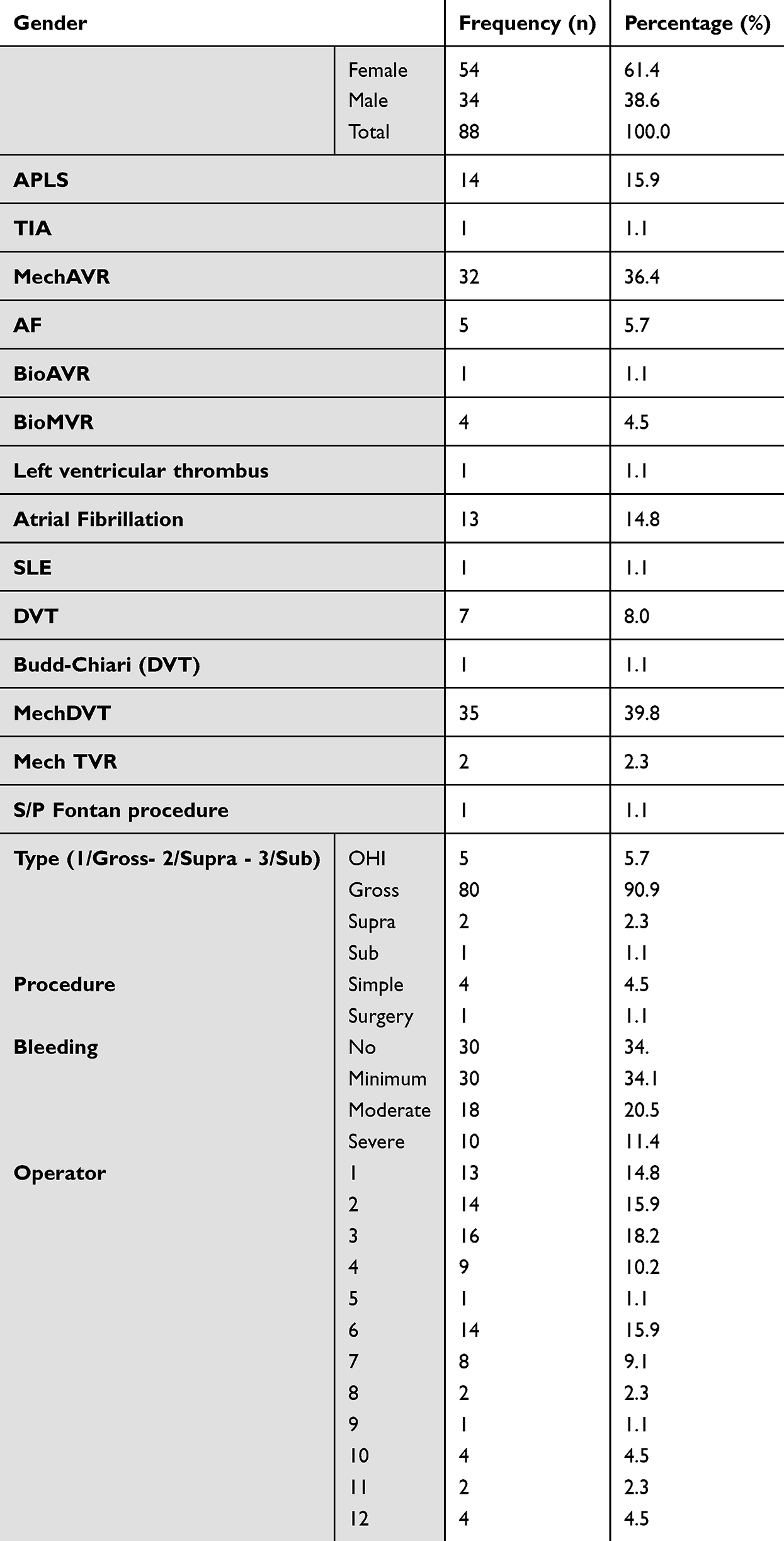 |
Table 1 Basic Descriptive Analysis of All the Categorical Variables |
The mean warfarin dose was 5.2 ± 2.0 mg (range: 1.5–12.0 mg). INR measurements were performed using both point-of-care technique (Hemochron) and laboratory methods. The mean Hemochron INR was 2.61 ± 0.74, while the mean laboratory INR was 2.59 ± 0.73. Paired sample analysis showed no significant difference between the two methods (mean difference: 0.024, 95% CI: −0.093 to 0.141, p = 0.687), Figure 1. A strong positive correlation was observed between Hemochron and laboratory INR measurements (r = 0.717, p < 0.001), as shown in Table 2.
 |
Table 2 Correlation Between Hemochron INR and Lab INR |
 |
Figure 1 Correlation between Hemochron INR and Lab INR shows a high correlation 0.717. |
The majority of cases (90.9%, n = 80) had hygiene and were classified as gross with smaller proportions of supra-gingival (2.3%, n = 2) and sub-gingival (1.1%, n = 1) scaling. For the extraction procedures, 4 (80%) were simple and 1(20%) surgical, as shown in Table 1. Figures 2–4 show pre, intra and post extraction instances.
 |
Figure 2 Clinical figure showing pre-extraction. |
 |
Figure 3 Clinical figure showing snapshot during extraction. |
 |
Figure 4 Clinical figure showing after extraction. |
Regarding bleeding complications, 34.0% (n = 30) of patients had no bleeding, 34.1% (n = 30) experienced minimal bleeding, 20.5% (n = 18) had moderate bleeding, and 11.4% (n = 10) suffered severe bleeding, as shown in Table 1. Analysis of variance showed no significant difference in INR values across bleeding severity groups for both Hemochron (F = 0.608, p = 0.658) and laboratory measurements (F = 0.641, p = 0.634).
When comparing patients receiving <5 mg versus ≥5 mg of warfarin daily, no significant differences were found in either Hemochron INR (2.51 vs 2.70, p = 0.235) or laboratory INR (2.54 vs 2.63, p = 0.572), as shown in Table 3.
 |
Table 3 Independent Sample Test with Dose of Warfarin Less Than or Greater Than 5mg |
We looked at the effect of the operator on the bleeding tendency and severity. Chi-square analysis revealed a significant association between operator and type of procedure (χ² = 170.738, p < 0.001), as shown in Table 4. There was no significant association between the operator and bleeding complications (χ² = 36.326, p = 0.788), as shown in Table 5.
 |
Table 4 Cross Tabulation and Chi-Square Test Between Operator and Type |
 |
Table 5 Cross Tabulation and Chi-Square Test Between Physician and Bleeding Severity |
Discussion
Bleeding is a significant risk associated with dental surgery, particularly in patients with underlying conditions or those on anticoagulant therapy. Effective management strategies are essential to mitigate this risk and ensure patient safety. Patients on anticoagulants, particularly vitamin K inhibitors, showed a higher incidence of postoperative bleeding (8.6% vs 4.8% in discontinued patients).26
While the risk of bleeding in dental surgery is notable, advancements in management techniques and a thorough understanding of patient-specific factors can significantly mitigate these risks. However, the potential for serious complications remains, necessitating careful preoperative planning and monitoring. Furthermore, the physician can also play an important role in managing bleeding risk associated with dental surgeries that is attributable to the attitude towards pre-operative management.27
Mechanical valve replacements were the most common indication for anticoagulation with warfarin, with two key types: mechanical mitral valve replacement (MechMVR) and mechanical aortic valve replacement (MechAVR). The management of patients with mechanical valve replacements undergoing dental surgery poses significant challenges due to the risk of bleeding associated with anticoagulation therapy. Other indications include atrial fibrillation, antiphospholipid syndrome, and deep vein thrombosis. Less common indications include biological valve replacements, left ventricular thrombus, and Budd-Chiari syndrome. Patients on anticoagulants may experience prolonged bleeding during and after dental procedures. This can complicate surgical interventions and lead to significant morbidity if not managed properly.28,29 In our study, most patients had no bleeding; however, 20.5% of patients had moderate bleeding, and 11.4% suffered severe bleeding. The postoperative bleeding rate after dental procedures is approximately 0.2−3.3%.30 For those with conditions such as hemophilia, bleeding complications can occur in 8.6% to 32.1% of cases.30,31 A study involving 537 patients reported a 6.5% overall rate of postoperative bleeding, with variations based on the type of anticoagulant therapy maintained during low-risk dental procedures.26
The validation of point-of-care devices and laboratory INR measurements is important in managing patients on anticoagulation therapy, particularly those receiving warfarin. We validated the point-of-care device with standard laboratory INR and found that they were comparable to what had been shown previously.32 A study found that differences in INR between point-of-care devices and laboratory methods were negatively correlated with patients’ hematocrit levels. Specifically, as hematocrit increased, the discrepancies in INR readings also increased, although these differences were clinically acceptable within a certain range (approximately 10%).33,34 A comparative evaluation showed that while POC devices provided INR results significantly correlated with laboratory methods, they tended to overestimate INR values. This can lead to inappropriate adjustments in warfarin dosing, increasing the risk of thromboembolic events if clinicians do not account for this bias.35
The relationship between warfarin dosage and the risk of bleeding during dental procedures is a critical concern for dental practitioners. Research indicates that maintaining anticoagulation with warfarin during dental surgery generally results in a low incidence of significant bleeding complications. A literature review found that over 99% of anticoagulated patients experienced no significant postoperative bleeding requiring more than local hemostatic measures.36 Our results show 11.4% suffered severe bleeding, while a retrospective study that had reported a 4.8% incidence of persistent bleeding after invasive procedures, primarily extractions.37 In a systematic review, continuing warfarin therapy was not associated with an increased risk of clinically significant bleeding compared to interrupting the medicine.38 These are in agreement with our findings.
For patients with lower INR, simple dental extractions can generally be performed safely, with moderate bleeding occurring in only a small percentage of cases.39 However, as the INR rises above this threshold, the risk of bleeding increases substantially. It is critical to monitor the INR closely before any dental procedure. An INR below 3.5 is generally acceptable for performing simple extractions without significantly modifying warfarin therapy.40
The bleeding risk associated with major dental procedures in patients taking warfarin can vary significantly based on the type of procedure performed. High-risk procedures that include invasive surgeries are more likely to result in significant bleeding.41
The current study provides important insights into the key factors that play an important role in determining the risk of bleeding in patients undergoing dental procedures. However, the study stands from relatively small samples. Further studies with larger sample sizes need to be designed to validate the findings of this study.
Conclusion
The bleeding risk associated with warfarin during various simple and surgical dental procedures depends on the complexity and duration of the procedure, as well as the patient’s INR level. We have confirmed the accuracy and value of INR results from a point-of-care device that may help predict cases at risk of bleeding and reassured operators of low risk if the levels of INR are low. Nevertheless, this study is an important analysis of the relatively under-represented Saudi population and highlights that physician and procedure type are major risk factors in determining the outcome of the patients undergoing dental surgery.
Human Ethics and Consent to Participate
The study was approved by the Research Advisory Board of King Faisal Specialist Hospital and Research Center Riyadh, with approval # 2191266. Written informed consent was obtained from all the study participants, and signed consent was reviewed by the hospital IRB. For minors, a legal guardian had signed. The study was conducted according to the declaration of Helsinki.
Author Contributions
All authors made a significant contribution to the work reported, whether that is in the conception, study design, execution, acquisition of data, analysis, and interpretation, or all these areas; took part in drafting, revising, or critically reviewing the article; gave final approval of the version to be published; have agreed on the journal to which the article has been submitted; and agree to be accountable for all aspects of the work.
Funding
There is no funding to report.
Disclosure
The authors report no conflicts of interest in this work.
References
1. Prokopidi M-E. Postoperative bleeding after oral surgeries: causes, risk profile of patients and therapy approaches. 2012.
2. Igelbrink S, Burghardt S, Michel B, Kübler NR, Holtmann H. Secondary bleedings in oral surgery emergency service: a cross‐sectional study. Int J Dent. 2018;2018(1):6595406. doi:10.1155/2018/6595406
3. Owaidah T, Saleh M, Alzahrani H, et al. Prevalence of bleeding symptoms among adolescents and young adults in the capital city of Saudi Arabia. Adv Hematol. 2018;2018(1):1858241. doi:10.1155/2018/1858241
4. de Campos N, Furlaneto F, Buischi YDP. Bleeding in dental surgery. 2019.
5. Chan MH, Sun F, Malakan J. Controversies in stoppage of antiplatelet and anticoagulant medications prior to oral surgery. Dental Clin North America. 2024;68(1):21–45. doi:10.1016/j.cden.2023.07.001
6. Deglovič J, Remková A. Dental interventions in oral antithrombotic therapy. Vnitrni Lekarstvi. 2023;69(1):31–36. doi:10.36290/vnl.2023.004
7. Ueno H, Tokugawa J, Saito R, et al. Trends in prior antithrombotic medication and risk of in-hospital mortality after spontaneous intracerebral hemorrhage: the J-ICH registry. Sci Rep. 2024;14(1):12009. doi:10.1038/s41598-024-62717-5
8. Hori M, Matsumoto M, Tanahashi N, et al. Predictive factors for bleeding during treatment with rivaroxaban and warfarin in Japanese patients with atrial fibrillation–subgroup analysis of J-ROCKET AF. J Cardiol. 2016;68(6):523–528. doi:10.1016/j.jjcc.2015.12.003
9. Pengo V, Denas G, Zoppellaro G, et al. Rivaroxaban vs warfarin in high-risk patients with antiphospholipid syndrome. Blood J Am Soc Hematol. 2018;132(13):1365–1371.
10. Bajkin BV, Tadic AJ, Komsic JJ, Vuckovic BA. Risk of dentoalveolar surgery postoperative bleeding in patients taking direct oral anticoagulants and vitamin K antagonists: a prospective observational study. J Craniomaxillofac Surg. 2024;52(6):772–777. doi:10.1016/j.jcms.2024.03.035
11. Inchingolo F, Inchingolo AM, Piras F, et al. Management of patients receiving anticoagulation therapy in dental practice: a systematic review. Healthcare. 2024;12(15):1537. doi:10.3390/healthcare12151537
12. Boccatonda A, Frisone A, Lorusso F, et al. Perioperative management of antithrombotic therapy in patients who undergo dental procedures: a systematic review of the literature and network meta-analysis. Int J Environ Res Public Health. 2023;20(7):5293. doi:10.3390/ijerph20075293
13. Kwon S, Lee SR, Choi EK, et al. Perioperative management in patients with atrial fibrillation treated with non-vitamin K antagonist oral anticoagulants undergoing minor bleeding risk procedure: rationale and protocol for the PERIXa study. Vasc Health Risk Manag. 2024;20:231–244. doi:10.2147/VHRM.S455530
14. Dahri K, Loewen P. The risk of bleeding with warfarin: a systematic review and performance analysis of clinical prediction rules. Thrombosis Haemostasis. 2007;98(11):980–987. doi:10.1160/TH07-04-0297
15. Chee YL, Crawford JC, Watson HG, Greaves M. Guidelines on the assessment of bleeding risk prior to surgery or invasive procedures. Br J Haematol. 2008;140(5):496–504. doi:10.1111/j.1365-2141.2007.06968.x
16. Douketis JD, Spyropoulos AC, Spencer FA, et al. Perioperative management of antithrombotic therapy: antithrombotic therapy and prevention of thrombosis: American college of chest physicians evidence-based clinical practice guidelines. Chest. 2012;141(2):e326S–e50S. doi:10.1378/chest.11-2298
17. Ferrari E, Benhamou M, Cerboni P, Marcel B. Coronary syndromes following aspirin withdrawal: a special risk for late stent thrombosis. J Am College Cardiol. 2005;45(3):456–459. doi:10.1016/j.jacc.2004.11.041
18. Shi Q, Xu J, Zhang T, Zhang B, Liu H. Post-operative bleeding risk in dental surgery for patients on oral anticoagulant therapy: a meta-analysis of observational studies. Front Pharmacol. 2017;8:58. doi:10.3389/fphar.2017.00058
19. Cañigral A, Silvestre F-J, Cañigral G, Alós M, Garcia-Herraiz A, Plaza A. Evaluation of bleeding risk and measurement methods in dental patients. Med Oral Patol Oral Cir Bucal. 2010;15(6):e863–8. doi:10.4317/medoral.15.e863
20. Bensi C, Belli S, Paradiso D, Lomurno G. Postoperative bleeding risk of direct oral anticoagulants after oral surgery procedures: a systematic review and meta-analysis. Int J Oral Maxillofacial Surg. 2018;47(7):923–932. doi:10.1016/j.ijom.2018.03.016
21. Gao X, Cai X, Yang Y, Zhou Y, Zhu W. Diagnostic accuracy of the HAS-BLED bleeding score in VKA-or DOAC-treated patients with atrial fibrillation: a systematic review and meta-analysis. Front Cardiovasc Med. 2021;8:757087. doi:10.3389/fcvm.2021.757087
22. Esteve-Pastor MA, Rivera-Caravaca JM, Roldán V, et al. Predicting performance of the HAS-BLED and ORBIT bleeding risk scores in patients with atrial fibrillation treated with Rivaroxaban: observations from the prospective EMIR Registry. European Heart J-Cardiovasc Pharmacother. 2023;9(1):38–46. doi:10.1093/ehjcvp/pvac060
23. Aggarwal R, Ruff CT, Virdone S, et al. Development and validation of the DOAC score: a novel bleeding risk prediction tool for patients with atrial fibrillation on direct-acting oral anticoagulants. Circulation. 2023;148(12):936–946. doi:10.1161/CIRCULATIONAHA.123.064556
24. Ockerman A, Bornstein MM, Leung YY, Li SKY, Politis C, Jacobs R. Incidence of bleeding after minor oral surgery in patients on dual antiplatelet therapy: a systematic review and meta-analysis. Int J Oral Maxillofacial Surg. 2020;49(1):90–98. doi:10.1016/j.ijom.2019.06.002
25. Bajkin BV, Wahl MJ, Miller CS. Dental implant surgery and risk of bleeding in patients on antithrombotic medications: a review of the literature. Oral Surg Oral Med Oral Pathol Oral Radiol. 2020;130(5):522–532. doi:10.1016/j.oooo.2020.07.012
26. Lee J-Y, Park S-H, Kim D-M, et al. Risk of post-operative bleeding after dentoalveolar surgery in patients taking anticoagulants: a cohort study using the common data model. Sci Rep. 2024;14(1):7787. doi:10.1038/s41598-024-57881-7
27. Nagarale R, Todkar M, Khan S, Khan Y, Rehan M, Rizvi Q. Assessment of knowledge, importance and management of uncontrolled bleeding in dental surgical procedures among dental professionals. Int J Appl Dent Sci. 2021;7(4):312–316. doi:10.22271/oral.2021.v7.i4e.1388
28. Dézsi CA, Dézsi BB, Dézsi AD. Management of dental patients receiving antiplatelet therapy or chronic oral anticoagulation: a review of the latest evidence. Eur J Gen Pract. 2017;23(1):196–201. doi:10.1080/13814788.2017.1350645
29. Wahl MJ. Dental Surgery in Anticoagulated Patients. Arch Intern Med. 1998;158(15):1610–1616. doi:10.1001/archinte.158.15.1610
30. Römer P, Heimes D, Pabst A, Becker P, Thiem DGE, Kämmerer PW. Bleeding disorders in implant dentistry: a narrative review and a treatment guide. Int J Implant Dentistr. 2022;8(1):20. doi:10.1186/s40729-022-00418-2
31. Fan G, Shen Y, Cai Y, Zhao J-H, Wu Y. Uncontrollable bleeding after tooth extraction from asymptomatic mild hemophilia patients: two case reports. BMC Oral Health. 2022;22(1):69. doi:10.1186/s12903-022-02074-9
32. Bhat M, Abuzied Y, Fagih Z, et al. Efficacy of point-of-care for INR testing compared to standard laboratory methods at a tertiary care hospital in Saudi Arabia. Global J Quality Safety Healthcare. 2020;3(3):98–104. doi:10.36401/JQSH-19-36
33. van den Besselaar AM, Witteveen E, van der Meer FJ. Influence of haematocrit on international normalised ratio (INR) differences between a whole blood point-of-care coagulation monitor and reference prothrombin time in plasma. Thromb Haemost. 2008;100(6):1181–1184. doi:10.1160/TH08-04-0257
34. Barcellona D, Fenu L, Marongiu F. Point-of-care testing INR: an overview. Clin Chemistr Laboratory Med (CCLM). 2017;55(6):800–805. doi:10.1515/cclm-2016-0381
35. Gedikbasi A, Cicek YG, Neijmann ST, et al. New generation oral anticoagulants may cause unreliable results in routine coagulation testing. Int J Med Biochem. 2019;2(2):35–40.
36. Wahl MJ, Pinto A, Kilham J, Lalla RV. Dental surgery in anticoagulated patients—stop the interruption. Oral Surg Oral Med Oral Pathol Oral Radiol. 2015;119(2):136–157. doi:10.1016/j.oooo.2014.10.011
37. Hong C, Napenas JJ, Brennan M, Furney S, Lockhart P. Risk of postoperative bleeding after dental procedures in patients on warfarin: a retrospective study. Oral Surg Oral Med Oral Pathol Oral Radiol. 2012;114(4):464–468. doi:10.1016/j.oooo.2012.04.017
38. Nematullah A, Alabousi A, Blanas N, Douketis JD, Sutherland SE. Dental surgery for patients on anticoagulant therapy with warfarin: a systematic review and meta-analysis. Database Abstracts Rev Effects (DARE). 2009.
39. Chahine J, Khoudary MN, Nasr S. Anticoagulation use prior to common dental procedures: a systematic review. Cardiol Res Pract. 2019;2019(1):9308631. doi:10.1155/2019/9308631
40. Wahl MJ. The mythology of anticoagulation therapy interruption for dental surgery. J Am Dent Assoc. 2018;149(1):e1–e10. doi:10.1016/j.adaj.2017.09.054
41. Members WC, Virani SS, Newby LK, et al. 2023 AHA/ACC/ACCP/ASPC/NLA/PCNA guideline for the management of patients with chronic coronary disease: a report of the American Heart Association/American College of Cardiology Joint Committee on Clinical Practice Guidelines. J Am College Cardiol. 2023;82(9):833–955. doi:10.1016/j.jacc.2023.04.003
 © 2025 The Author(s). This work is published and licensed by Dove Medical Press Limited. The
full terms of this license are available at https://www.dovepress.com/terms
and incorporate the Creative Commons Attribution
- Non Commercial (unported, 4.0) License.
By accessing the work you hereby accept the Terms. Non-commercial uses of the work are permitted
without any further permission from Dove Medical Press Limited, provided the work is properly
attributed. For permission for commercial use of this work, please see paragraphs 4.2 and 5 of our Terms.
© 2025 The Author(s). This work is published and licensed by Dove Medical Press Limited. The
full terms of this license are available at https://www.dovepress.com/terms
and incorporate the Creative Commons Attribution
- Non Commercial (unported, 4.0) License.
By accessing the work you hereby accept the Terms. Non-commercial uses of the work are permitted
without any further permission from Dove Medical Press Limited, provided the work is properly
attributed. For permission for commercial use of this work, please see paragraphs 4.2 and 5 of our Terms.
Recommended articles

Effect of Some Risk Factors on Over-Anticoagulation Disorders and Bleeding in Patients Receiving Anticoagulant Therapy with Overdosage of Vitamin K Antagonist
Dung Chu S, Thi Tran M
Vascular Health and Risk Management 2023, 19:663-672
Published Date: 18 October 2023