
Back to Journals » Diabetes, Metabolic Syndrome and Obesity » Volume 18
The Role of Growth Mindset and Self-Control Strategies Between Outcome Experiences and Physical Activity: Insights from Structural Equation Model and System Dynamics
Authors Zhao B  , Zhang S, Zhang W, Zheng S, Fu Y , Wu Q , Huang X , Shao J
Received 8 June 2025
Accepted for publication 14 October 2025
Published 31 October 2025 Volume 2025:18 Pages 4035—4047
DOI https://doi.org/10.2147/DMSO.S545478
Checked for plagiarism Yes
Review by Single anonymous peer review
Peer reviewer comments 2
Editor who approved publication: Dr Rebecca Baqiyyah Conway
Binyu Zhao,1,2 Shunmin Zhang,3 Wei Zhang,4 Sufen Zheng,5 Yujia Fu,1,2 Qiwei Wu,1,2 Xianhong Huang,6 Jing Shao1,2
1Department of Nursing, The Fourth Affiliated Hospital of School of Medicine, and International School of Medicine, International Institutes of Medicine, Zhejiang University, Yiwu, Zhejiang, People’s Republic of China; 2Institute of Nursing Research, School of Medicine, Zhejiang University, Hangzhou, Zhejiang, People’s Republic of China; 3Department of Psychology and Behavioral Sciences, Zhejiang University, Hangzhou, Zhejiang, People’s Republic of China; 4Clinical Trial Unit, Affiliated Hospital of Hangzhou Normal University, Hangzhou, Zhejiang, People’s Republic of China; 5Department of Nursing, Sir Run Run Shaw Hospital, Zhejiang University School of Medicine, Hangzhou, Zhejiang, People’s Republic of China; 6Department of Health Policy and Management, Hangzhou Normal University School of Public Administration, Hangzhou, Zhejiang, People’s Republic of China
Correspondence: Jing Shao, Department of Nursing, The Fourth Affiliated Hospital of School of Medicine, International School of Medicine, International Institutes of Medicine, Zhejiang University, Yiwu, 322000, People’s Republic of China, Tel +86 15858236985, Email [email protected]
Background: Outcome experiences have been recognized as a prominent predictor of physical activity engagement and maintenance in adults with obesity, while the underlying mechanisms remain unclear. This study aims to investigate and elucidate whether and how growth mindset and self-control strategies serve as modifiable mediators in this relationship.
Methods: A cross-sectional study was conducted using stratified sampling, enrolling 209 adults with obesity. Logistic regression, structural equation modeling, system dynamics modeling, and simulation interventions were employed to test the hypothesized mediation model.
Results: Outcome experiences were directly and significantly associated with physical activity (β = 0.247, P < 0.01). This association was significantly mediated by growth mindset (indirect effect =0.055, 95% CI [0.034, 0.122]), whereas the mediation role of self-control strategies was not statistically significant (indirect effect = 0.011, 95% CI [− 0.027, 0.059]). Notably, a chained mediating effect was observed, with growth mindset and self-control strategies jointly mediating the relationship between outcome experiences and physical activity (indirect effect = 0.011, 95% CI [0.004, 0.038]). Together, these mediators explained 23.77% of the total variance in physical activity. Simulation intervention further evidenced that reinforcing growth mindset and self-control strategies, particularly in combination, can generate sustained improvement in the trajectory of PA engagement.
Conclusion: Although outcome experiences are resistant to change, their impact on physical activity can be modulated through adaptive psychological mechanisms, including growth mindset and self-control strategies. Interventions targeting these modifiable factors offer a promising pathway to promote physical activity among adults with obesity, especially those affected by negative past experiences. However, given the cross-sectional design of this study, causal inferences are limited, and the intervention recommendations remain preliminary, necessitating further validation through longitudinal and experimental research.
Keywords: obesity, physical activity, weight loss, growth mindset, self-control, system dynamics
Introduction
Obesity is a major global health crisis, with over 2.2 billion adults currently classified as overweight or obese—a figure projected to exceed 54% of the global adult population by 2035, costing over 4.32 trillion dollars.1 Although physical activity (PA) is a cornerstone of obesity management, participation and adherence remain elusive. In 2018, only 15% of US adults with obesity met PA guidelines.2 Similarly, Hansen et al reported that merely 33% of adults adhered to PA recommendations, with obese individuals being 63% less likely to meet these guidelines than their normal-weight counterparts.3 Even among successful weight loss maintainers, only 22.3% consistently achieved PA targets.4 Participating and maintaining PA poses substantial challenges for adults with obesity.
Outcome experiences, which reflect personal experiences and appraisals regarding specific behaviors, are recognized as a pivotal determinant of PA maintenance among obese adults.5,6 Driven by health and appearance concerns, approximately 66.7% of obese adults have attempted weight loss.7 However, weight loss commonly reaches a plateau, and alarmingly, high rates of weight regain are frequently documented, sometimes even surpassing the initial body weight.8 These discouraging experiences, compounded by pain, embarrassment, and psychological stress, can significantly deter sustained participation in PA.9 Therefore, we proposed Hypothesis 1: Outcome experiences are associated with PA. However, as outcome experiences are relatively stable and difficult to modify, identifying underlying mechanisms and modifiable mediators is crucial for effective intervention.10
Mindset, a central construct of personal agency, represents the fundamental assumptions that guide individuals’ interpretation of external information and orient their specific expectations, attributions, goals, and behaviors.11 Recently, an increasing focus on the growth mindset as a key facilitator of health-promoting behaviors, such as healthy eating, reducing health information avoidance, weight management, and PA.12–15 The growth mindset of weight, a dynamic and malleable belief system, pertains to the belief that body weight is either a fixed characteristic or a modifiable attribute.16 Accumulating evidence underscores the positive impact of growth mindsets on PA engagement despite fears and physical pain and predicts greater weight loss achievement.17,18 Meanwhile, a mindset can be developed from outcome experiences. According to the process model of mindsets, a growth mindset emerges from the accumulation of daily experiences. These experiences shape responses and outcome attributions, reinforcing a recursive feedback loop that gradually stabilizes the mindset.19 Therefore, we proposed Hypothesis 2: A growth mindset mediates the relationship between outcome experience and PA.
Self-control strategies, such as planning and resisting distractions, enable individuals to prioritize long-term goals over immediate temptations, also playing a crucial role in PA.20 Empirical evidence indicates that the regular application of self-control strategies can significantly increase self-reported PA and daily step counts.21 On the other hand, outcome experience is associated with self-control strategies. It is reported that outcome experiences, specifically emotions arising from self-control successes and failures, can modify the perceived value of goals, subsequently affecting the exertion of future self-control and the strategies employed.22,23 Consequently, we proposed Hypothesis 3: Self-control strategies mediate the relationship between outcome experiences and PA.
Self-control strategies are also closely related to mindset. Within the integrated growth systems framework, a growth mindset directly enables proactive and reflective practices, such as self-control strategies, and indirectly enhances ultimate behavioral outcomes.24 Longitudinal research also indicates that mindset has a direct effect on self-control.25 Thus, we proposed Hypothesis 4: Weight mindset and self-control strategies serve as a mediating chain in the relationship between outcome experiences and PA.
Taken together, we propose that outcome experiences not only directly impact PA but also do so through the mediators of growth mindset and self-control strategies. This study aims to (i) quantify these multiple mediating effects between outcome experiences and PA, and (ii) simulate the dynamic impact of enhancing growth mindset and self-control strategies on PA trajectories. This hybrid approach not only advances theoretical understanding but also offers a practical tool for designing adaptive, simulation-based interventions to support long-term PA engagement in populations with obesity.
Materials and Methods
Study Sample and Data Collection
This cross-sectional study was conducted from September 2024 to January 2025 in Hangzhou, the capital city of Zhejiang Province, located on the southeastern coast of China. In 2024, Hangzhou had an estimated resident population of approximately 12.62 million.26 The prevalence of overweight and obesity among Hangzhou residents has surpassed one-third, closely mirroring the national overweight and obesity rate of 34.3% in China,27,28 suggesting a certain level of representativeness. We used a stratified sampling strategy to select two hospitals and four districts for the study. The hospital sites included one municipal and one provincial facility, while the selected districts were Shangcheng (central), Xihu (western), Xiaoshan (eastern and southern), and Gongshu (northern). Eligibility criteria for participants included: i) a diagnosis of obesity, defined as a body mass index (BMI) of ≥28 kg/m2; ii) age of 18 years or older; iii) a history of weight loss through PA (evaluated by the question “Have you ever deliberately engaged in physical activity for a purpose?”; participants who selected “lose weight”); and iv) provision of written informed consent. Exclusion criteria encompassed: i) current pregnancy or plans to become pregnant; and ii) a diagnosis of severe cognitive, psychiatric, or neurological disorders.
Data were gathered through face-to-face interviews conducted by trained nursing graduate students with substantial field experience in site surveys. All investigators underwent uniform training in questionnaire administration and interview techniques before data collection. Furthermore, each investigator thoroughly reviewed every questionnaire item to ensure a comprehensive understanding. This was followed by a collaborative pilot administration with adults with obesity to standardize procedures from the outset. During the data collection process, all investigators administered the questionnaires using standardized and uniform instructions. The participants were thoroughly informed about the study’s objectives and procedures, and written informed consent was obtained. The questionnaires were primarily self-completed, with assistance provided when necessary. Due to the limited number of participants present during each survey session, a maximum of two investigators were present at any given time. The author (BZ) was responsible for addressing nearly all participant inquiries and exclusively administered questionnaires to older adults. We collected and reviewed these questionnaires immediately on-site, ensuring data accuracy through manual double-entry of the data. Overall, 223 individuals were surveyed, with 209 providing valid responses, resulting in an effective response rate of 93.7%. Ethical approval for the study was obtained from the Ethics Committee of Zhejiang University (2024-005).
Measures
PA
PA was assessed using the International Physical Activity Questionnaire Short Form (IPAQ-SF), a condensed version of the original IPAQ. Both instruments were developed by an international consortium of physical activity researchers to enable population-level surveillance among adults.29 The IPAQ is extensively utilized as a self-reported measure for evaluating PA and exhibits strong psychometric properties, including high reliability and evidence of construct validity.30 The IPAQ-SF captures participants’ duration and frequency of vigorous-intensity activity, moderate-intensity activity, walking, and sitting over the past seven days. A metabolic equivalent of task (MET) score is calculated for each activity domain, with values of 3.3 METs for walking, 4 METs for moderate-intensity activity, and 8 METs for vigorous-intensity activity. Based on criteria established in previous studies, participants were subsequently categorized as having low, moderate, or high activity levels.31–33
Growth Mindset
The growth mindset of weight was assessed using a well-established six-item instrument, adapted from Dweck’s implicit theory measure of intelligence (eg, “You have a certain body weight, and you can’t really do much to change it”).34 This instrument comprised six items, with responses scored on a scale from 1 (strongly agree) to 6 (strongly disagree). Higher scores reflected a stronger growth mindset of weight.17 In this study, the Cronbach’s alpha for this questionnaire was 0.844, indicating good reliability.
Self-Control Strategies
The self-control strategies were evaluated using the self-control strategies dimension of the multidimensional self-control scale.35 This dimension originally consisted of six items, but two items were excluded due to weak correlations with PA: “I try to conquer the fear if I do something scary” and “When it is hard to for me to concentrate on what I read, I try different ways of increasing my concentration”. Responses to each item were recorded on a 5-point Likert scale, ranging from 1 (completely noncompliant) to 5 (completely compliant). A higher total score indicated a greater level of self-control strategy. In the extreme group analysis, t-tests were performed comparing the upper and lower 27% of respondents, revealing statistically significant differences across all items (p < 0.001). As detailed in Supplementary Table 1, item-total correlation coefficients ranged from 0.460 to 0.812 (p < 0.01), with factor loadings ranging from 0.802 to 0.872, except for Item 4 (“I often look for new solutions by redefining the situation”), which exhibited a lower loading of 0.296. This item also demonstrated the lowest loading (0.40) in the study by Nilsen et al35 and was consequently excluded based on the threshold of 0.50.36 The revised three-item scale demonstrated good internal consistency, with a Cronbach’s alpha of 0.786.
Outcome Experience
The assessment of outcome experience was conducted using five items specifically designed to evaluate the PA experience among adults with obesity. The questionnaire for this study was developed through a process involving the screening of items via a literature review and our prior qualitative research,8,37 consultation with experts, and subsequent modification and preliminary validation of the instrument through a pre-survey. Initially, participants responded, “ Have you ever deliberately engaged in physical activity for a purpose?” Those who selected “lose weight” proceeded to complete the following five items: “My weight decreased after physical activity”, “I achieved my physical activity goal”, “My weight loss plateaued after physical activity”, “My weight rebounded after physical activity”, and “I am satisfied with the outcome of physical activity”. Each item was rated on a five-point Likert scale (1 = strongly disagree, 5 = strongly agree), with two items reverse-scored. Higher scores indicated more favorable outcome experiences. In the present study, the extreme group analysis confirmed statistically significant differences for all items (p < 0.001). As shown in Supplementary Table 1, item-total correlation coefficients ranged from 0.552 to 0.747 (p < 0.01), and factor loadings ranged from 0.786 to 0.872, with a Cronbach’s alpha of 0.605, indicating acceptable reliability and validity.38
Covariates
Sociodemographic and clinical variables included age, sex, religious belief, education level, marital status, place of residence, occupation, household monthly income, medical insurance, metabolic comorbidities, and obesity grade. Obesity grade was determined by BMI, calculated as weight (kg) divided by height squared (m²), and categorized into four classes: class I (28.00–32.49 kg/m²), class II (32.50–37.49 kg/m²), class III (37.50–49.99 kg/m²), and class IV (≥50.00 kg/m²).
Statistical Analysis
We conducted the data analysis using SPSS version 26.0, Mplus version 8.3, and Vensim PLE version 8.2.1. The relationship between PA and sociodemographic variables was examined using t-tests and one-way ANOVA. Logistic regression analysis was employed to explore the association between outcome experience, growth mindset, self-control strategies, and PA, with categorical covariates converted into dummy variables. Then, the structural equation model (SEM) was applied to quantitatively analyze the mediation pathways involving growth mindset and self-control strategies between outcome experience and PA.39 The hypothesized model was deemed to fit the data well if the value of χ²/df (degrees of freedom) was less than 5, the Comparative Fit Index (CFI) and Tucker–Lewis Index (TLI) were greater than 0.90, and the Root Mean Square Error of Approximation (RMSEA) was less than 0.08.
Furthermore, the study utilizes a system dynamics (SD) model to simulate the interactions between these factors and PA. SD is a mathematical and methodological modeling approach introduced by Forrester to address complex issues and simulate the anticipated outcomes of interventions in intricate health dilemmas.40,41 Through the simulation of intervention outcomes in complex health dilemmas, SD offers a distinctive lens for analyzing obesity and tackling the issue effectively.40,42 For instance, a comprehensive review has highlighted its established value in the field of obesity, demonstrating its notable effectiveness in guiding intervention development and optimizing resource allocation.40 This methodological integration helps to identify the optimal conditions for achieving desired levels of growth mindset and self-control strategies to enhance PA effectively. SD models can be developed from multiple sources, including theoretical frameworks, group model building sessions, stakeholder workshops, and interviews.40 In this study, SEM was initially utilized to test and quantify the structural relationships among outcome experience, growth mindset, self-control strategies, and PA. The path coefficients derived from SEM were subsequently employed to initialize the SD model. Specifically, the SEM coefficients informed the dependency equations within the SD model, while standardized values of the constructs served as initial stocks. The model’s structure was visualized using a stock-and-flow diagram, with detailed descriptions provided in the Supplementary Methods, and Supplementary Tables 1–3. This combination of SEM and SD has also been reported for its capacity to incorporate dynamism into models.43,44 Then, a series of simulation scenarios were systematically manipulated growth mindset and self-control strategies to assess their impact on PA trajectories. The simulated scenarios encompassed single-factor enhancements, with 20% and 50% increases in either growth mindset or self-control strategies, and combined enhancements at varying intensities. This methodological approach facilitated the evaluation of prospective system behavior under diverse configurations, the identification of leverage points, and the prioritization of intervention targets to optimize behavioral outcomes.
Result
Sociodemographic Characteristics of Participants
Table 1 presented the sociodemographic characteristics of participants with obesity. The mean age (±SD) was 34.90 ± 9.91 years, with a roughly equal distribution of male and female participants. A majority of the participants were either married or cohabiting (89.8%), resided in urban areas (80.9%), and were classified as having obesity grade I (45.0%). Compared to individuals with negative symptoms or comorbidities, healthy adults with obesity were less likely to engage in PA (P<0.05).
 |
Table 1 Characteristics of the Study Participants (n = 209) |
Logistic Regression Analysis
Supplementary Table 3 displayed the results of the logistic regression analysis. In the unadjusted model, outcome experiences, growth mindset, and self-control strategies were significantly associated with PA (P <0.05). After adjusting for covariates, positive outcome experiences (OR = 0.093; 95% CI [0.012,0.175]), growth mindset (OR= 0.062; 95% CI [0.023,0.101]), and self-control strategies (OR = 0.141; 95% CI [0.041,0.238]) remained significantly associated with increased PA.
Chain Mediating Analysis
To further substantiate the chain mediating effect of growth mindset and self-control strategies between outcome experience and PA, SEM was employed, with the results illustrated in Figure 1 and Table 2. The fit indices indicated an good model fit (χ²/df = 2.564, CFI = 0.961, TLI = 0.950, SRMR = 0.096, RMSEA = 0.078).45 As presented in Table 2, both the total effect (β = 0.324, P < 0.001) and the direct effect (β = 0.247, P < 0.01) of outcome experience on PA were statistically significant, with the total indirect effect (β = 0.077, P < 0.05) accounting for 23.77% (medium effect) of the total variance. To assess the chain mediating effects, 95% CIs were calculated. The indirect effect was derived from two pathways: (1) the association between outcome experience and PA was mediated via growth mindset (indirect effect = 0.055, 95% CI [0.034, 0.122]), and (2) the association between outcome experience and PA through the chain mediating effect of growth mindset and self-control strategies (indirect effect = 0.011, 95% CI [0.004, 0.038]). However, the mediating effect of coping strategy between outcome experience and PA was not significant (indirect effect = 0.011, 95% CI [−0.027, 0.059]).
 |
Table 2 Direct Effect, Indirect Effect and Total Effect |
 |
Figure 1 Structural equation model of outcome experience, growth mindset, self-control strategy, and PA. The covariate metabolic comorbidity was included in modeling but omitted in the figure for visual simplicity. *p < 0.05 and **p < 0.01. Abbreviation: PA, Physical activity. |
To determine the weights of feedback loops in the SD model, SEM also examined reciprocal relationships by reversing the directions of the arrows. The results revealed that PA was significantly associated with outcome experience (β = 0.209, 95% CI [0.072,0.345], P < 0.05), growth mindset (β = 0.387, 95% CI [0.278,0.496], P < 0.001), and self-control strategies (β = 0.259, 95% CI [0.139,0.378], P < 0.001). However, other pathways did not reach statistical significance.
SD Models
Figure 2 presented the stock-and-flow diagrams formulated based on SEM. The simulation results for each scenario were illustrated in Figure 3. Among individuals with low PA levels, PA remained persistently low without simulating intervention. The yellow and blue curves indicated that enhancing growth mindset and self-control strategies slowed the decline in PA, with a 50% increase in growth mindset notably elevating PA levels. The red curves underscored the cumulative effects of combining interventions, suggesting additive benefits when strategies are implemented concurrently.
 |
Figure 2 Stock and flow diagram of the SD mode. *Rectangles denote stocks (accumulated quantities), valves indicate flows (rates of change), and arrows represent causal links. Abbreviations: OE, Outcome experience; GM, Growth mindset; SS, Self-control strategies; PA, Physical activity. |
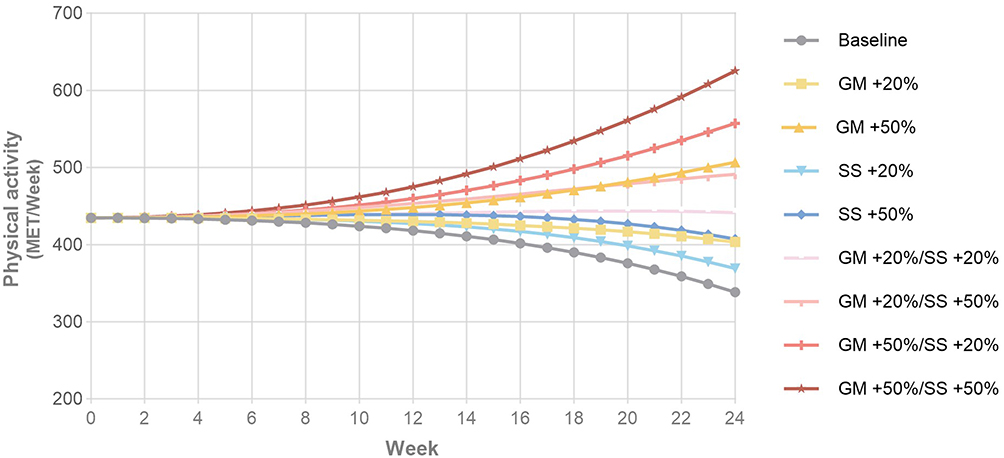 |
Figure 3 PA level over time with varying simulated interventions. Abbreviations: GM, Growth mindset; SS, Self-control strategies. |
Discussion
By integrating SEM-SD, this study is the first to reveal the direct and indirect associations between outcome experiences and PA both via modifiable factors such as growth mindset of weight and self-control strategies. The quantitative simulations suggested that strengthening growth mindset of weight and self-control strategies, particularly in combination, could produce cumulative improvements in PA engagement over time. These findings advance theoretical understanding of the psychological mechanisms underlying individual agency in PA and highlight actionable targets for sustained engagement.
From the SEM
SEM revealed a positive association between outcome experiences and PA, which is consistent with previous research. For instance, Parschau et al found that positive exercise outcomes are significantly associated with exercise intention and behavior, playing a more prominent role in the motivational phase than in the volitional phase of physical exercise change.46 Positive outcome experiences, such as weight loss, can act as natural reinforcers by engaging the brain’s reward circuitry, which is central to decision-making. This neural engagement reinforces the association between PA and desirable outcomes, thereby promoting sustained behavioral adjustments toward increased PA.47 According to expectancy-value re-evaluation theory, outcome experience might influence PA’s anticipated or intrinsic value, thereby triggering the motivation for PA engagement.48
In alignment with Hypothesis 2, a growth mindset of weight could partially explain the impact of outcome experiences on PA. Primarily, evidence indicated that individuals who experienced greater success in outcome tended to possess a stronger growth mindset, predicting PA engagement.49,50 Positive outcome experiences, such as successful weight loss, may recalibrate perceptions of weight malleability, fostering a growth mindset. This mindset influenced PA behavior through formative meaning systems encompassing beliefs and attributions.51 A growth mindset could cultivate positive effort beliefs, such as the conviction that weight loss depended on sustained personal effort, thereby enhancing perceived agency and motivating behavioral investment in PA.51 Importantly, it also facilitated adaptive attributions, where weight change was seen as effort-dependent and setbacks were viewed as opportunities for growth, ultimately promoting sustained engagement in PA.19,52
Contrary to Hypothesis 3, the mediating effect of self-control strategies between outcome experiences and PA was not statistically significant. While self-control strategies demonstrated a direct and significant association with PA in both logistic regression and SEM, outcome experiences did not exhibit a significant association with self-control strategies. A potential mechanism may be that outcome experiences influence self-control strategies through mediating psychological constructs rather than exerting a direct effect. From the perspective of ego depletion, the outcomes of physical activity experiences shape cost-benefit expectations and future effort investment, subsequently affecting self-control strategies.53 Furthermore, the MoVo process model proposed that outcome experiences shape outcome expectations and intentions, which subsequently facilitate self-control strategies.23,54 When outcome experiences fail to effectively reinforce outcome expectations and intentions, the downstream activation of self-control strategies may be impeded. However, once activated, self-control strategies facilitate individuals in initiating and maintaining regulatory actions—such as planning, monitoring, and suppressing competing impulses—to achieve their PA objectives.55 A sequential indirect effect involving a growth mindset and self-control strategies supported Hypothesis 4, suggesting that outcome experiences influence self-control strategies indirectly through the growth mindset. This finding was consistent with the integrated growth systems framework, where a growth mindset enables the practices, including self-control strategies, to mediate the association between context and outcomes.24 Adults with obesity who possess a growth mindset demonstrate adaptive self-control strategies, characterized by the adoption of mastery-oriented strategies rather than succumbing to helplessness when faced with setbacks.56 These adaptive self-control strategies may facilitate greater resilience in the face of challenges,57 which, in turn, could support the initiation and maintenance of PA. Consequently, higher outcome experiences are associated with elevated levels of growth mindset, which contribute to enhanced self-control strategies and ultimately lead to increased levels of PA. This underscores the potential for fostering s growth mindset and self-control strategies to improve PA.
From the SD Model
Based on the SEM results, which identified growth mindset and self-control as mediators between outcome experiences and PA, the SD simulations offer a dynamic extension by illustrating how strengthening these mechanisms could alter PA trajectories over time. Simulations utilizing the SD model demonstrated that interventions targeting a growth mindset of weight or self-control strategies could lead to slight improvement in PA trajectories. A stronger effect was observed when the growth mindset of weight was enhanced by 50% or when combined with self-control strategies. It should also be noted that these simulation results are exploratory and have not been empirically validated in longitudinal or interventional studies, although they underscored the potential effective targets for future research. To date, growth mindset intervention has predominantly concentrated on academic and psychological outcomes.58 The application of such interventions within health-related domains, such as PA, is still in its nascent stage. However, a digital mindset intervention for individuals with knee osteoarthritis has preliminarily evidenced that substantial improvements in mindset were accompanied by medium effect sizes for PA.59 Additionally, a randomized controlled trial has shown that mindset interventions enhance self-reported PA compared to participants who only received accurate step counts,60 indicating a promising translational pathway. The underlying mechanism might involve growth mindsets enhancing resilience and fostering adaptive behaviors, such as persistence and effort, which are key components of sustained PA. These effects appear particularly pronounced among vulnerable populations “at risk”, where individuals encounter stress, threats, or adverse environmental constraints.51 The pronounced effect observed when combining growth mindset and self-control strategies may stem from a synergistic mechanism: growth mindsets enhance motivation by fostering positive beliefs about ability and effort, while self-control strategies serve as the operational tools to realize the motivation driven by a growth mindset. This interaction is rooted in the reciprocal reinforcement of motivational and strategic processes, forming a cohesive system for fostering growth and resilience, thereby promoting sustained PA engagement.
Theoretical and Practical Implications
The key contributions of this research are twofold. Theoretically, this study advances understanding by elucidating the mechanism through which outcome experiences influence PA via the sequential mediation of a growth mindset and self-control strategies. Grounded in positive psychology, this agency-centered framework clarifies how beliefs and volitional processes interact to promote PA, offering a foundation for theory development in behavior change. Within the Chinese cultural context, adults with obesity may attribute their weight status to external factors, such as genetic predispositions and socio-environmental conditions (eg, “overwork obesity”), rather than primarily to personal effort. This attributional pattern contrasts with cultural settings where internal attributions are more prevalent and may attenuate the relationship between a growth mindset of weight and participation in PA. Practically, the findings offer potential actionable intervention targets for promoting PA, particularly in individuals who have experienced adverse weight loss outcomes. These targets include fostering a growth mindset of weight and enhancing self-control strategies. Growth mindset interventions are well-established, with their efficacy extensively validated and reported in reputable journals such as Nature.11,58,61 Building on this empirical foundation, future research should focus on developing tailored, obesity-specific online growth mindset interventions, offering a scalable and cost-effective path to foster a growth mindset and sustained PA engagement. Furthermore, self-control strategies, including situation modification, precommitment techniques, and willpower training,62 should be incorporated into enhancing PA engagement.
Limitations
Although this study is the first to identify the chain mediating roles of a growth mindset of weight and self-control strategies between outcome experience and PA, several limitations should be acknowledged. Firstly, the cross-sectional design of this study limits the ability to infer causality from the conclusions. To address this, further prospective longitudinal and experimental designs, such as just-in-time adaptive interventions and system identification approaches, are necessary to confirm and expand upon these findings. Secondly, our sampling was limited to Hangzhou due to resource constraints, future research should test the robustness of our findings in larger and more culturally diverse samples, both within and beyond China. Furthermore, this study innovatively integrates SD with SEM results to simulate the effects of changes in mediators on PA. However, since the SD model is parameterized based on cross-sectional SEM outputs, it is limited in its ability to fully capture temporal causal relationships that intervention data might reveal. Future research employing longitudinal designs or experimental validation is necessary to further substantiate and refine the dynamic processes modeled in this study. The fourth limitation involves using self-reported questionnaires, which may be influenced by social desirability bias and recall bias in outcome experience. Consequently, a multimodal measurement approach is required, incorporating experience sampling diaries, objective wearables (eg, accelerometers), implicit tasks, and inhibitory control paradigms (eg, Go/No-Go tasks) to achieve precise measurement. Finally, potential unmeasured confounding variables may have influenced the findings, which should be addressed in future research.
Conclusion
Weight loss is a commonly pursued goal among adults with obesity; however, PA participation and maintenance remain challenging. This study demonstrates that outcome experiences have a direct effect on PA and exert indirect effects through the growth mindset of weight and self-control strategies. Targeted interventions focused on growth mindset and self-control strategies offer a promising, scalable, and impactful avenue for sustaining PA, addressing one of the most persistent challenges in obesity care.
Institutional Review Board Statement
The study was conducted according to the guidelines of the Declaration of Helsinki, and approved by the Ethics Committee of Zhejiang University (2024-005).
Data Sharing Statement
The datasets used and/or analyzed during the current study are available from the corresponding author on reasonable request.
Informed Consent Statement
Informed consent was obtained from all subjects involved in the study.
Acknowledgments
The authors acknowledge the cooperation of all participating adults with obesity and the contribution of all research assistants.
Funding
This work was supported by the Fundamental Research Funds for the Central Universities [grant numbers S20230009]; National Natural Science Foundation of China [grant numbers 72004193]; and Natural Science Foundation of Zhejiang Province [grant numbers LY23G030008].
Disclosure
The authors declare no competing interests.
References
1. World Obesity Federation. World obesity atlas 2024. World Obesity Federation; 2024. Available from: https://www.knowledge-action-portal.com/en/content/world-obesity-atlas-2024.
2. López‐Gil JF, Calatayud J, López‐Bueno R. Trends in adherence to physical activity guidelines from 1997 to 2018 among adults with obesity: an analysis from the US National Health Interview Survey. Obes Rev. 2025;26(3):e13866. doi:10.1111/obr.13866
3. Hansen BH, Kolle E, Steene-Johannessen J, Dalene KE, Ekelund U, Anderssen SA. Monitoring population levels of physical activity and sedentary time in Norway across the lifespan. Scand J Med Sci Sports. 2019;29(1):105–112. doi:10.1111/sms.13314
4. Unick JL, Gaussoin SA, Hill JO, et al. Objectively-assessed physical activity and weight loss maintenance among individuals enrolled in a lifestyle intervention. Obesity. 2017;25(11):1903–1909. doi:10.1002/oby.21971
5. Tsafou KE, De Ridder DT, Van Ee R, Lacroix JP. Mindfulness and satisfaction in physical activity: a cross-sectional study in the Dutch population. J Health Psychol. 2016;21(9):1817–1827. doi:10.1177/1359105314567207
6. Fuchs R, Goehner W, Seelig H. Long-term effects of a psychological group intervention on physical exercise and health: the MoVo Concept. J Phys Act Health. 2011;8(6):794–803. doi:10.1123/jpah.8.6.794
7. Gaesser GA, Angadi SS. Obesity treatment: weight loss versus increasing fitness and physical activity for reducing health risks. iScience. 2021;24(10):102995. doi:10.1016/j.isci.2021.102995
8. Oppert JM, Ciangura C, Bellicha A. Physical activity and exercise for weight loss and maintenance in people living with obesity. Rev Endocr Metab Disord. 2023;24(5):937–949. doi:10.1007/s11154-023-09805-5
9. Bombak AE. Obese persons’ physical activity experiences and motivations across weight changes: a qualitative exploratory study. BMC Public Health. 2015;15(1):1129. doi:10.1186/s12889-015-2456-0
10. Pelletier H, Diemert L, Soule E, et al. Smokers’ experiences with vaping to quit: a concept mapping study. Tob Regul Sci. 2021;7(2):103–117. doi:10.18001/TRS.7.2.2
11. Yeager DS, Bryan CJ, Gross JJ, et al. A synergistic mindsets intervention protects adolescents from stress. Nature. 2022;607(7919):512–520. doi:10.1038/s41586-022-04907-7
12. Thomas FN, Burnette JL, Hoyt CL. Mindsets of health and healthy eating intentions. J Appl Soc Psychol. 2019;49(6):372–380. doi:10.1111/jasp.12589
13. O’Brien AG, Foust JL, Taber JM. Physical health mindsets and information avoidance. J Behav Med. 2024;47(6):1052–1066. doi:10.1007/s10865-024-00514-1
14. Orvidas K, Burnette JL, Schleider JL, Skelton JA, Moses M, Dunsmore JC. Healthy body, healthy mind: a mindset intervention for obese youth. J Genet Psychol. 2020;181(6):443–457. doi:10.1080/00221325.2020.1796573
15. Yu T, Zeng C, He L, et al. Relationship between growth mindset and self-rated health in Chinese college teachers: sequential mediating effect of health self-efficacy and physical exercise. Front Public Health. 2025;13:1421319. doi:10.3389/fpubh.2025.1421319
16. Burnette JL, Hoyt CL, Orvidas K. Mindsets of body weight. In: Zedelius CM, Müller BCN, Schooler JW, editors. The Science of Lay Theories: How Beliefs Shape Our Cognition, Behavior, and Health. Springer International Publishing; 2017:319–339. doi:10.1007/978-3-319-57306-9_13
17. Earl S, Burnette JL, Ho AS. Exploring the benefits and costs of a growth mindset in a digital app weight management program. J Health Psychol. 2024;29(11):1181–1194. doi:10.1177/13591053241226610
18. Boswell MA, Evans KM, Zion SR, et al. Mindset is associated with future physical activity and management strategies in individuals with knee osteoarthritis. Ann Phys Rehabil Med. 2022;65(6):101634. doi:10.1016/j.rehab.2022.101634
19. De Ruiter NMP, Thomaes S. A process model of mindsets: conceptualizing mindsets of ability as dynamic and socially situated. Psychol Rev. 2023;130(5):1326–1338. doi:10.1037/rev0000425
20. Hofmann W. Going beyond the individual level in self-control research. Nat Rev Psychol. 2024;3(1):56–66. doi:10.1038/s44159-023-00256-y
21. Stieger M, Allemand M, Lachman ME. Effects of a digital self-control intervention to increase physical activity in middle-aged adults. J Health Psychol. 2023;28(10):984–996. doi:10.1177/13591053231166756
22. Hofmann W, Fisher RR. How guilt and pride shape subsequent self-control. Soc Psychol Pers Sci. 2012;3(6):682–690. doi:10.1177/1948550611435136
23. Duckworth AL, Gendler TS, Gross JJ. Situational strategies for self-control. Perspect Psychol Sci. 2016;11(1):35–55. doi:10.1177/1745691615623247
24. Mendoza NB, Yan Z. From beliefs to behaviors: conceptualizing and assessing students’ practices that reflect a growth mindset. Soc Psychol Educ. 2025;28(1):73. doi:10.1007/s11218-025-10032-w
25. Yuan RM, Peng WY, Jiang J. Relationship between growth mindset and self-control amongst chinese primary school students: a longitudinal study. PRBM. 2024;17:3101–3109. doi:10.2147/PRBM.S468490
26. Statistical bulletin on the national economic and social development of Hangzhou in 2024. Available from: https://tjj.hangzhou.gov.cn/art/2025/3/20/art_1229279682_4338665.html.
27. National Health Commission of the People’s Republic of China G. Report on the Status of Nutrition and Chronic Diseases of Chinese Residents (2020). People’s Medical Publishing House; 2021.
28. Hangzhou Municipal Health Commission. Body shape characteristics and health awareness in Hangzhou population. 2025. Available from: https://wsjkw.hangzhou.gov.cn/art/2025/5/21/art_1229113704_58940833.html.
29. Craig CL, Marshall AL, Sjöström M, et al. International physical activity questionnaire: 12-country reliability and validity. Med Sci Sports Exerc. 2003;35(8):1381–1395. doi:10.1249/01.MSS.0000078924.61453.FB
30. Van Poppel MNM, Chinapaw MJM, Mokkink LB, Van Mechelen W, Terwee CB. Physical activity questionnaires for adults: a systematic review of measurement properties. Sports Med. 2010;40(7):565–600. doi:10.2165/11531930-000000000-00000
31. Bhimla A, Gadegbeku CA, Tan Y, Zhu L, Aczon F, Ma GX. A study of physical activity determinants among high-risk hypertensive Filipino and Korean Americans. Int J Environ Res Public Health. 2019;16(7):1156. doi:10.3390/ijerph16071156
32. Fan M, Lyu J, He P. Chinese guidelines for data processing and analysis concerning the international physical activity questionnaire. Chin J Epidemio. 2014;35(8):961–964. doi:10.3760/cma.j.issn.0254-6450.2014.08.019
33. Sjostrom M, Ainsworth B, Bauman A, Bull F, Craig C, Sallis J. Guidelines for data processing and analysis of the International Physical Activity Questionnaire (IPAQ) short form. Available from: http://www.institutferran.org/documentos/scoring_short_ipaq_april04.pdf.
34. Burnette JL. Implicit theories of body weight: entity beliefs can weigh you down. Pers Soc Psychol Bull. 2010;36(3):410–422. doi:10.1177/0146167209359768
35. Nilsen FA, Bang H, Boe O, Martinsen ØL, Lang-Ree OC, Røysamb E. The Multidimensional Self-Control Scale (MSCS): development and validation. Psychol Assess. 2020;32(11):1057–1074. doi:10.1037/pas0000950
36. Lampic C, Skoog Svanberg A, Sorjonen K, Sydsjö G. Understanding parents’ intention to disclose the donor conception to their child by application of the theory of planned behaviour. Hum Reprod. 2020;36(2):395–404. doi:10.1093/humrep/deaa299
37. Wang L. Research on the Influencing Factors and Promotingstrategies of College Students’ Exercise Persistence Behavior. Shandong University; 2021.
38. Wu M. Questionnaire Statistical Analysis in Practice: SPSS Operation and Application. Chongqing University Press; 2010.
39. Schuler MS, Coffman DL, Stuart EA, Nguyen TQ, Vegetabile B, McCaffrey DF. Practical challenges in mediation analysis: a guide for applied researchers. Health Serv Outcomes Res Method. 2025;25(1):57–84. doi:10.1007/s10742-024-00327-4
40. Zheng L, Xue Y, Chen X, Ung COL, Hu H. Application of system dynamics approach in developing health interventions to strengthen health systems to combat obesity: a systematic literature review and critical analysis. BMC Public Health. 2025;25(1):1580. doi:10.1186/s12889-025-22821-1
41. Forrester JW. Industrial dynamics: a major breakthrough for decision makers. In: Klaus P, Müller S, editors. The Roots of Logistics: A Reader of Classical Contributions to the History and Conceptual Foundations of the Science of Logistics. Springer; 2012:141–172. doi:10.1007/978-3-642-27922-5_13
42. Homer JB, Hirsch GB. System dynamics modeling for public health: background and opportunities. Am J Public Health. 2006;96(3):452–458. doi:10.2105/AJPH.2005.062059
43. Ma L, Ma X, Zhang J, Yang Q, Wei K. A methodology for dynamic assessment of laboratory safety by SEM-SD. Int J Environ Res Public Health. 2021;18(12):6545. doi:10.3390/ijerph18126545
44. Mohandes SR, Kineber AF, Abdelkhalek S, et al. Evaluation of the critical factors causing sewer overflows through modeling of structural equations and system dynamics. J Cleaner Prod. 2022;375:134035. doi:10.1016/j.jclepro.2022.134035
45. Anggriani R, Anggrawan A, Cahyadi I. Structural analysis of the equation model on store atmosphere towards hedonic value and consumer impulsive buying (Study at Majapahit Food Center). Varian. 2020;4(1):61–70. doi:10.30812/varian.v4i1.851
46. Parschau L, Fleig L, Warner LM, et al. Positive exercise experience facilitates behavior change via self-efficacy. Health Educ Behav. 2014;41(4):414–422. doi:10.1177/1090198114529132
47. Lewis RG, Florio E, Punzo D, Borrelli E. The Brain’s reward system in health and disease. Adv Exp Med Biol. 2021;1344:57–69. doi:10.1007/978-3-030-81147-1_4
48. Shang C, Moss AC, Chen A. The expectancy-value theory: a meta-analysis of its application in physical education. J Sport Health Sci. 2023;12(1):52–64. doi:10.1016/j.jshs.2022.01.003
49. Boles DZ, DeSousa M, Turnwald BP, et al. Can exercising and eating healthy be fun and indulgent instead of boring and depriving? Targeting mindsets about the process of engaging in healthy behaviors. Front Psychol. 2021;12:745950. doi:10.3389/fpsyg.2021.745950
50. Limeri LB, Carter NT, Choe J, et al. Growing a growth mindset: characterizing how and why undergraduate students’ mindsets change. Int J STEM Educ. 2020;7(1):35. doi:10.1186/s40594-020-00227-2
51. Yeager DS, Dweck CS. What can be learned from growth mindset controversies? Am Psychologist. 2020;75(9):1269. doi:10.1037/amp0000794
52. Song J, Kim SI, Bong M. Controllability attribution as a mediator in the effect of mindset on achievement goal adoption following failure. Front Psychol. 2020;10:2943. doi:10.3389/fpsyg.2019.02943
53. Boureau YL, Sokol-Hessner P, Daw ND. Deciding how to decide: self-control and meta-decision making. Trends Cogn Sci. 2015;19(11):700–710. doi:10.1016/j.tics.2015.08.013
54. Fuchs R, Seelig H, Göhner W, Burton NW, Brown WJ. Cognitive mediation of intervention effects on physical exercise: causal models for the adoption and maintenance stage. Psychol Health. 2012;27(12):1480–1499. doi:10.1080/08870446.2012.695020
55. Bourque JR, Delli Paoli AG, Selby EA, et al. Effortful self-control as a potential target for physical activity maintenance. Psychol Sport Exerc. 2025;80:102926. doi:10.1016/j.psychsport.2025.102926
56. Burnette JL, O’Boyle EH, VanEpps EM, Pollack JM, Finkel EJ. Mind-sets matter: a meta-analytic review of implicit theories and self-regulation. Psychol Bull. 2013;139(3):655–701. doi:10.1037/a0029531
57. Janssen TWP, van Atteveldt N. Coping styles mediate the relation between mindset and academic resilience in adolescents during the COVID-19 pandemic: a randomized controlled trial. Sci Rep. 2023;13(1):6060. doi:10.1038/s41598-023-33392-9
58. Burnette JL, Billingsley J, Banks GC, et al. A systematic review and meta-analysis of growth mindset interventions: for whom, how, and why might such interventions work? Psychol Bull. 2023;149(3–4):174–205. doi:10.1037/bul0000368
59. Boswell MA, Evans KM, Ghandwani D, et al. A randomized clinical trial testing digital mindset intervention for knee osteoarthritis pain and activity improvement. Npj Digit Med. 2024;7(1):1–11. doi:10.1038/s41746-024-01281-8
60. Zahrt OH, Evans K, Murnane E, et al. Effects of wearable fitness trackers and activity adequacy mindsets on affect, behavior, and health: longitudinal randomized controlled trial. J Med Internet Res. 2023;25(1):e40529. doi:10.2196/40529
61. Yeager DS, Hanselman P, Walton GM, et al. A national experiment reveals where a growth mindset improves achievement. Nature. 2019;573(7774):364–369. doi:10.1038/s41586-019-1466-y
62. Milyavskaya M, Saunders B, Inzlicht M. Self‐control in daily life: prevalence and effectiveness of diverse self‐control strategies. J Pers. 2021;89(4):634–651. doi:10.1111/jopy.12604
 © 2025 The Author(s). This work is published and licensed by Dove Medical Press Limited. The
full terms of this license are available at https://www.dovepress.com/terms
and incorporate the Creative Commons Attribution
- Non Commercial (unported, 4.0) License.
By accessing the work you hereby accept the Terms. Non-commercial uses of the work are permitted
without any further permission from Dove Medical Press Limited, provided the work is properly
attributed. For permission for commercial use of this work, please see paragraphs 4.2 and 5 of our Terms.
© 2025 The Author(s). This work is published and licensed by Dove Medical Press Limited. The
full terms of this license are available at https://www.dovepress.com/terms
and incorporate the Creative Commons Attribution
- Non Commercial (unported, 4.0) License.
By accessing the work you hereby accept the Terms. Non-commercial uses of the work are permitted
without any further permission from Dove Medical Press Limited, provided the work is properly
attributed. For permission for commercial use of this work, please see paragraphs 4.2 and 5 of our Terms.