
Back to Journals » Advances in Medical Education and Practice » Volume 16
The Relationship Between Learning and Thinking Styles and the Performance of Female Pharmacy Students in an Anatomy Course
Authors Batarfi M, Alraddadi A 
Received 20 June 2025
Accepted for publication 9 October 2025
Published 11 October 2025 Volume 2025:16 Pages 1869—1877
DOI https://doi.org/10.2147/AMEP.S545204
Checked for plagiarism Yes
Review by Single anonymous peer review
Peer reviewer comments 4
Editor who approved publication: Dr Sateesh Arja
Munirah Batarfi,1 Abdulrahman Alraddadi2– 4
1Department of Anatomy, College of Medicine, King Saud University, Riyadh, Saudi Arabia; 2Department of Basic Medical Sciences, College of Medicine, King Saud bin Abdulaziz University for Health Sciences, Riyadh, Saudi Arabia; 3King Abdullah International Medical Research Center (KAIMRC), Ministry of National Guard – Health Affairs, Riyadh, Saudi Arabia; 4Department of Pharmaceutical Sciences, College of Pharmacy, Princess Nourah bint Abdulrahman University, Riyadh, Saudi Arabia
Correspondence: Abdulrahman Alraddadi, Department of Basic Medical Sciences, College of Medicine, King Saud bin Abdulaziz University for Health Sciences, Mail Code 3127; P.O.Box.3660, Riyadh, 11481, Saudi Arabia, Email [email protected]
Background: In professional health education, it is common to align teaching strategies with students’ preferred learning and thinking styles. However, the evidence supporting this “meshing” approach is weak. To address this gap, this study aimed to investigate the learning and thinking styles of first-year female pharmacy students and compare them to their performance in an anatomy course.
Material and Methods: This cross-sectional study evaluated first-year female Doctor of Pharmacy students enrolled in an anatomy course over two consecutive academic years. Two validated inventory tools were used to assess students’ learning and thinking styles: the Visual, Aural, Read/Write, and Kinesthetic Learning Styles Inventory (VARK) and the Thinking Style Indicator (TSI). The students’ final course grades were compared with their thinking and learning styles.
Results: 259 students (98% of both cohorts) provided complete data on both instruments. The kinesthetic (58%) and concrete-sequential learners (32%) had the highest grades among the studied population. Neither learning style (P = 0.959) nor thinking style (P = 0.918) predicted the performance of students in the anatomy course. On the other hand, students with multimodal learning and thinking styles tended to have better scores than those who were unimodal.
Conclusion: The results of the study demonstrate that learning and thinking styles do not have a significant role in the performance of pharmacy students in an anatomy course, which led us to reject the null hypothesis. Thus, anatomy educators should make full use of multiple active blended learning modalities available to accommodate the full range of individualized learning preferences.
Keywords: thinking styles, learning styles, anatomy education, pharmacy program, student performance
Introduction
Significant scientific attention has been paid to the human brain and its complex processes, including thought, learning, behavior, and emotions. In particular, individual cognitive differences remain a topic of interest to educators, psychologists, and researchers. In medical education, students’ diverse learning and thinking styles have generated considerable interest. Learning styles describe the way people acquire, process, and retain new information, affecting both how they learn and what outcome will be produced.1 Similarly, thinking styles encompass the means by which students approach problem-solving and succeed in school.2 Increasing interest in thinking styles has underscored their importance in classroom teaching and learning. Visual, auditory, read/write, and kinesthetic learning styles all have some role in how learners interact with their course content.3 Visual learners benefit from diagrams and images, auditory learners from discussions, read/write learners from text, and kinesthetic learners from hands-on experiences. By adapting their methods to these learning preferences, teachers can boost engagement and comprehension.4,5
According to DePorter and Hernacki, thinking styles specifically help show how students think through their experiences.6 Concrete-sequential thinkers prefer structured learning environments, while concrete-random thinkers are adaptable learners who thrive on exploration. Furthermore, abstract-sequential thinkers communicate with ideas via analysis and theory, while their counterparts, abstract-random thinkers, use emotional intelligence to understand the big picture.7 Understanding these learning styles and their intricacies can aid teachers in selecting instructional methods that are likely to result in better performance in academic work. Put simply, understanding and adapting to these styles is essential in creating successful learning environments that address learners’ varying needs.
Anatomy is one of the most challenging subjects in medical education, as it involves various complex topics, including three-dimensional spatial relationships, connective structures and their functions, and applying clinical knowledge. Because of its complexity, employing a variety of methods to teach can boost student motivation and enhance academic skills and retention while reducing classroom stress.8 Peer teaching, simulation-based learning, and reflective practice, for example, address different cognitive styles and thus increase students’ clinical skills and memory.9 Meanwhile, kinesthetic learning techniques, including dissections, significantly increase long-term memory retention and spatial reasoning in anatomy instruction.10 Conversely, according to pedagogical critiques, kinesthetic learning techniques may draw resources away from evidence-based strategies for instruction, such as multimodal active learning, spaced retrieval, and elaborative interrogation.
Nonetheless, the impact of aligning teaching strategies with students’ learning and processing styles on anatomy education has received little attention in the literature, specifically in pharmacy programs. Chaudhary et al studied 600 Pakistani medical students using Visual, Auditory, Read/Write, and Kinesthetic (VARK) surveys and noted minor improvements, but their study lacked controls for covariates.9 After considering previous GPA, Hernández et al, who surveyed 148 first-year medical students, found no impact of learning styles on academic performance.4 Lastly, in their survey of 421 Indian medical students, Kathiah et al reported higher scores for multimodal learners, but the reliability of self-reported grades was limited.5
Notably, pharmacy students have not been included in previous studies assessing learning styles, nor did those studies explore cognitive thinking styles. Furthermore, previous results have been inconsistent in rejecting their null hypotheses and in reporting relationships between learning styles and students’ performance. Therefore, due to the lack of pharmacy-specific evidence in anatomy education, this research aimed to examine the relationship between the preferred learning and thinking styles of first-year female pharmacy students and their performance in an anatomy course. In pursuing this area of interest, this study’s results may increase our understanding of how anatomy educators frame their pedagogy to interact with style preferences, specifically to enhance learning through an improved match between their instructional strategy and students’ preferences. Additionally, the study’s findings may help students develop skills that contribute to their academic success and professional lives.
Material and Methods
Study Design and Setting
This was a cross-sectional study conducted at a female-only institution in Saudi Arabia. The two studied cohorts were comprised of first-year pharmacy students enrolled in a dedicated anatomy and histology course. This course primarily consisted of lectures and seminars, creating a cohesive group used to test the meshing hypothesis and to analyze the relationships between learning and thinking styles and academic achievement. Additionally, these students had not received prior exposure to anatomy studies and therefore represented a suitable cohort for this research. The course was entirely conducted by the study investigator A.A., providing greater control over the teaching and assessment methods utilized in the course.
The study complied with the Declaration of Helsinki and was approved by the Institutional Review Board (IRB) at Princess Nourah bint Abdulrahman University (HAP-01-R-059). Participation was voluntary, with all students providing informed consent, which contained clear details of the purpose of the study, voluntary participation, and its confidentiality. Participation was anonymous, and all results were aggregated.
Study Population, Sample Size, and Sampling Technique
A census of first-year female pharmacy students from two academic years (2023/2024 and 2024/2025) was conducted. Over this period, 265 students enrolled in the anatomy and histology course. The sample size was calculated using the Open-Epi website (www.openepi.com) based on the total number of enrolled students. At least 158 students were required to be enrolled in this study, with a 95% confidence level and a margin of error of ± 5%. To maximize participation and ensure an adequate sample size, the study implemented a non-probability consecutive sampling technique which includes all students who meet the inclusion criteria. Therefore, all eligible pharmacy students were invited to participate in this study. All responses were screened for quality by ensuring that there was no missing information and no inaccuracy, a normal response time, and not a fixed-choice answer.
Instruments for Measuring Learning and Thinking Styles
Two validated tools were used to assess students’ learning and cognitive preferences: the VARK Learning Styles Inventory (Version 8.02) and the Thinking Style Indicator (TSI). The VARK tool classifies learners based on their preferred sensory modality for processing information, separating students into four learning styles—visual, auditory, reading/writing, or kinesthetic—as described by Fleming and Mills.11 The VARK inventory was validated by Leite et al and has been used in previous studies to measure learning preferences.12–14
To analyze learning styles for this study, each student’s response was evaluated individually, and the final style or styles were combined and plotted on an Excel spreadsheet for comparison. The VARK questionnaire consisted of 16 multiple-choice questions, allowing respondents to select more than one option per item, with each option representing a learning style. The respondents’ answers were then compared to the scoring chart, with all selected options replaced by their corresponding style letters: V, A, R, or K. The totals across the 16 items were calculated to produce four sub-scores (V-score, A-score, R-score, and K-score) according to the guidelines published on the VARK website (https://vark-learn.com/). A participant’s learning style was assigned to the modality with the highest score. When two or more modalities tied for the highest value, the learner was classified as multimodal (having two or multiple preferences) rather than as having a single preference.
The TSI instrument measures cognitive processing preferences, offering insights into how students approach problem-solving and decision-making based on four thinking styles: concrete-sequential, concrete-random, abstract-sequential, and abstract-random. Developed by John Le Tellier in 2007, this indicator is based on Gregorc’s Mind Styles model.15 DePorter and Hernacki validated the TSI, which researchers now use to assess thinking styles.6,16,17
For this analysis, each student’s response was evaluated individually, and the final style or styles were recorded on an Excel sheet for comparison with other variables. The TSI consisted of 15 items, each with four options (A, B, C, D). Respondents selected the two descriptors that best described themselves. Each selected letter was scored from 1 to 4, not necessarily in order. The scoring process involved using the key and multiplying the sum of the selections in each column by 4 to generate scaled scores for the four styles. A participant’s dominant thinking style was identified as the category with the highest scaled score; if two or more categories had equally high scores, the participant was classified as having double or multiple thinking styles.
The study objectives and instruments were clearly explained to the students. Then, at the beginning of their course, all eligible students received an invitation Email via their university Email addresses, which included a link to complete the surveys for the learning and thinking instruments, along with a consent form. The instruments were designed in a self-administered format on Google Forms. Both surveys were filled in on students’ personal devices during their free time and were submitted before the end of the course. The average time to complete the survey was 15–20 minutes. Mandatory responses were requested on all survey items to ensure that the learning and thinking styles of participants were accurately assessed. Instructions were provided to prevent confusion or biased responses, along with the study investigators’ contact details for any further clarifications. Additionally, to encourage participation, students were offered individualized feedback on their learning and thinking preferences, tailored to their requests. No students’ names or personal information were collected to maintain the study’s anonymity, except for the students’ university numbers, which were used to link their preferred learning and thinking styles to their scores in the anatomy course.
Data Collection and Statistical Analysis
Data were collected in two formats: quantitative and qualitative. The quantitative data included students’ performance metrics from the anatomy and histology course, obtained from the academic affairs department after securing participants’ consent. The qualitative data comprised students’ preferences for thinking and learning styles, which were collected via the VARK and TSI instruments. A unique code number was assigned for each participant to protect their anonymity. Following data collection, the two datasets were combined, which consisted of the final course grade (between 0 and 100) and answers to style preferences exported from Google Forms. Analysis was conducted on only those participants who completed both surveys.
The responses were coded using Microsoft Excel and then imported into SPSS (Version 25, IBM) for statistical analysis. The data were also screened to ensure that no information was missing or incomplete and that the responses selected were not fixed choices throughout the survey’s questions. Then normality and outliers were tested for the quantitative data (student performance in the anatomy course). The data were found to be normally distributed (Kolmogorov–Smirnov P-value = 0.200) and did not contain outliers. Descriptive statistics were then used to summarize the distribution of learning and thinking styles among the study sample. A one-way ANOVA was performed to explore differences in anatomy performance across style categories. Statistical significance was defined as a P-value ≤ 0.05.
Results
A total of 259 out of 265 students completed the survey, equating to a response rate of 98%. After obtaining the data, the descriptive analysis was conducted to identify the distribution of learning and thinking styles among participants. The statistical analysis revealed that the studied students exhibited different patterns of learning and thinking styles. The VARK results showed that most female pharmacy students preferred a unimodal learning style (n=228, 88%), while a smaller percentage preferred multimodal styles (n=31, 12%). Within the unimodal preference group, kinesthetic was the most prevalent type (n=134, 58%), followed by aural (n=55, 24%), visual (n=27, 12%), and read/write preferences (n=12, 5%), as shown in Figure 1. Additionally, the results showed that a combination of aural and kinesthetic styles (n = 13, 42%) was the most common multimodal preference. In comparison, a small percentage of students preferred three-style combinations of aural-kinesthetic-read/write (n=1, 3%) and aural-kinesthetic-visual (n=3, 10%). Interestingly, only two students (n=2, 6%) preferred all four VARK learning styles. These findings suggest that most female pharmacy students preferred the kinesthetic and aural learning methods, including hands-on activities and auditory explanations.
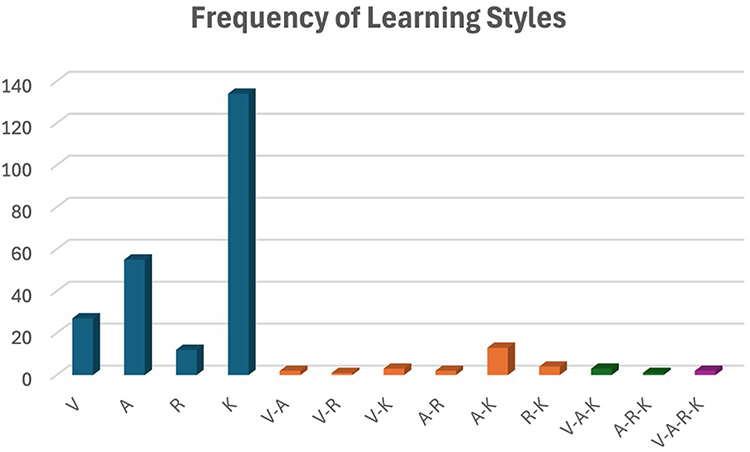 |
Figure 1 Distribution of Learning Styles Among Students: Visual (V), Aural (A), Read/Write (R), and Kinesthetic (K). |
Similarly, the TSI results showed that most female pharmacy students preferred a unimodal thinking style (n=213, 82%), with only 18% (n=46) preferring multimodal styles. Within the unimodal preferences, the concrete-sequential (n=69, 32%) was the most prevalent style, followed by abstract-random (n=62, 29%), abstract-sequential (n=46, 22%), and concrete-random (n=36, 17%), as shown in Figure 2. Additionally, the multimodal preferences were commonly presented as a combination of abstract-sequential and concrete-sequential (n=12, 26%), followed by abstract-random and abstract-sequential (n=11, 24%), and then concrete-random and concrete-sequential (n=9, 20%). In contrast, the other combinations were relatively rare, accounting for 11% or less of the total. Furthermore, a few students exhibited multimodal preferences of three thinking styles: abstract-random, abstract-sequential, and concrete-random (n=3, 7%) and abstract-random, abstract-sequential, and concrete-sequential (n=2, 4%). Notably, the study results did not reveal any students who adopted all four thinking styles, suggesting a preference for selectivity rather than diversity in their approaches. In sum, most female pharmacy students employed both structured and creative thinking, while a smaller subset of students showed flexibility in their thinking styles.
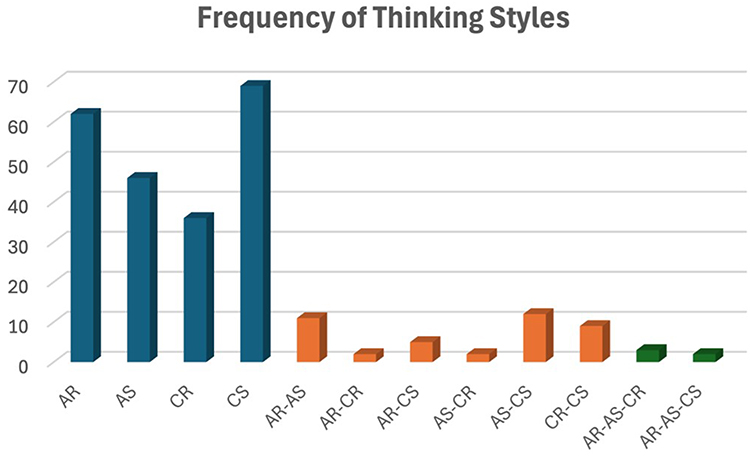 |
Figure 2 Distribution of Thinking Styles Among Students: Abstract-random (AR), Abstract-sequential (AS), Concrete-random (CR), and Concrete-sequential (CS). |
Next, we conducted the one-way ANOVA test to assess the impact of preferred learning and thinking styles on students’ performance in the anatomy and histology course. The analysis revealed varied results in the students’ performance based on their learning and thinking preferences. Students with multimodal learning preferences achieved a higher average score (81.23 ± 9.56) than those with two learning styles (80.63 ± 8.36) or one learning style (Table 1). Within the unimodal learners, the kinesthetic learners earned the highest average score (80.38 ± 8.05). However, there were no statistically significant differences between the learning style groups (P = 0.959). Similarly, the analysis showed that students’ performance in the course varied by their thinking preferences, with students with multimodal preferences scoring the highest (82.78 ± 6.35), followed by those with abstract-sequential (80.78 ± 8.31) and two thinking styles (80.37 ± 7.07) (Table 2). Nevertheless, the analysis showed no statistically significant differences in students’ performance based on their thinking preferences (P = 0.918).
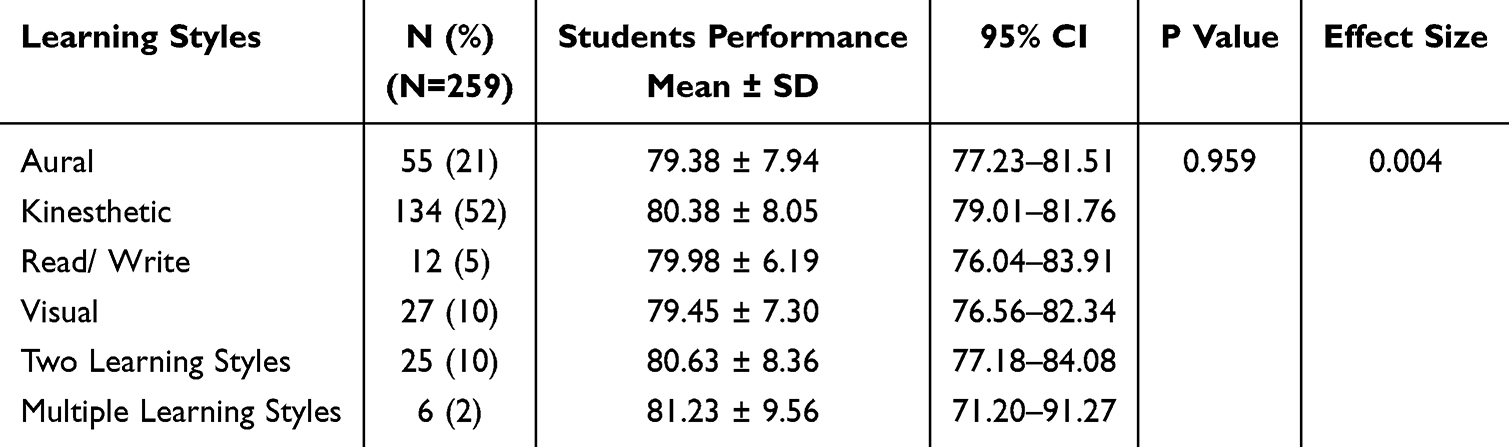 |
Table 1 One-Way ANOVA Results for Comparison of Student Performance in the Course of Anatomy and Histology Based on Learning Styles |
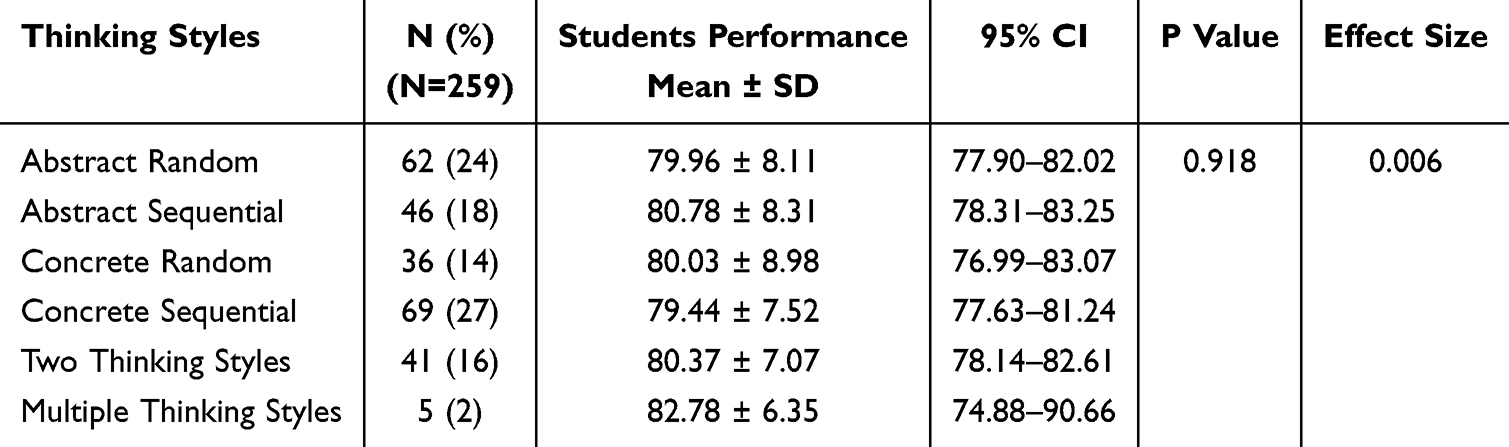 |
Table 2 One-Way ANOVA Results for Comparison of Student Performance in the Course of Anatomy and Histology Based on Thinking Styles |
In sum, contrary to expectations, the study results showed that pharmacy students’ preferences for learning and thinking styles did not significantly predict their performance in the anatomy course, supporting the rejection of the null hypothesis. However, a close inspection of the trending of mean scores suggests that students with multimodal preferences in learning and thinking styles tended to achieve better scores than those with unimodal preferences. The findings therefore suggest that using blended teaching approaches in anatomy education, which address different learner preferences, could improve overall performance.
Discussion
This study investigated how preferred thinking and learning styles impacted the performance of first-year pharmacy doctoral students in an anatomy and histology course. The results demonstrated that, regardless of students’ preference in cognitive learning behaviors, their performance in the anatomy course was not significantly different based on variations in learning and thinking preferences. These findings add to the mounting evidence challenging the benefits of educational interventions tailored to individuals’ cognitive preferences.
The study found that the majority of students (88%) preferred a unimodal learning style. This finding supports earlier studies that also indicated a strong preference for unimodal learning among students.18,19 This finding has not been universal, however, as other studies have suggested that many students favor multimodal learning styles.20–25 Furthermore, the results revealed that kinesthetic and aural learning styles were the most preferred among students, which aligns with previous studies.18–24 However, Mozaffari et al reported that reading/writing was the most favored style among dental students, with kinesthetic being the least preferred.25
The current study similarly found that the majority of students (82%) preferred a unimodal thinking style, with the concrete-sequential style being the most favored, followed by the abstract-random style. These results are consistent with those of some previous research, which highlighted the predominance of the concrete-sequential thinking type among students.16,26 Notably, though, neither of the studies that had similar results included any multimodal style preferences.
The differences in students’ reported preferences found in this study versus others could be attributed to cued population disparity, gender differences, and subjects’ academic level. Notably, though, previous studies have indicated that female learners preferred multimodal styles, whereas male students preferred unimodal styles.18,20,23,24 In addition, in these other studies, male students tended to prefer aural and kinesthetic styles, while female students preferred visual and aural styles.18–20,22–24 Parashar et al, however, found no difference between the sexes in regarding preferred learning style.21 Moreover, further studies have shown that learning style preference evolves over time; as students progress academically, they tend to shift from a unimodal style in their early years to a multimodal one in later years.18,20,23 Such results validate our findings that unimodal learning styles, specifically kinesthetic and aural, are the most prevalent in female pharmacy students during the early years of their undergraduate lives.
In addition to identifying preferred learning styles and thinking modes, the study also examined these preferences’ influence on students’ academic achievement in an anatomy course. The results indicated that students with multimodal styles of learning and thinking tended to perform slightly better than those with unimodal styles. The results of the study align with recent publications that challenge “the meshing hypothesis”, the assumption that teaching in a way similar to student preferences leads to better learning outcomes.1,27 Such a finding represents a valuable contribution, as research on this topic has found varying results: While several studies have shown that modifying teaching methods to suit multiple learning styles can have a potential impact on academic achievement,28,29 others have shown that learning style preferences are not significantly related to academic achievement.18,19,21,25 This divergence in the findings can perhaps be explained by the studied learners themselves, as some investigators have reported that multimodal learners are more likely to perform better on instructional material because they can adjust to new methods of instruction.20,23,24 Therefore, these observations suggest an upward trend that deserves further investigation in future studies, particularly regarding the potential importance of cognitive flexibility, the ability to adapt and engage across different modalities, in mastering complex subjects like anatomy.
Several studies covering other student populations produced similar results. Munahefi et al did not find a significant difference in the mathematics creative thinking process test among high school students based on different longitudes of thinking styles.17 Huincahue et al also found that thinking style was not significantly correlated with performance in computer engineering instruction, indicating other factors such as major, curriculum, and instructional approach may outweigh individual cognitive preference.30 Zhang thinking also found that thinking styles had a minimal impact on academic performance over and beyond self-assessed abilities.31
As intimated earlier, however, not all studies share such findings. Güngör et al and Mohsin et al argued that thinking styles positively influence problem-solving skills and classroom participation.32,33 Putri & Halim, meanwhile, found that learning and thinking styles significantly influenced the learning outcomes of high school students in physics, as students with auditory and concrete-sequential preferences performed better than their peers.26
These conflicting results highlight the likely influence of contextual factors, such as subject matter and cultural influences, emphasizing the need for a more nuanced understanding of how cognitive styles interact with educational environments.31,34 Therefore, the results of this study and others suggest that factors such as prior knowledge, teaching quality, curriculum structure, and student engagement may significantly impact educational success more than individual cognitive preferences.
Beyond the students’ performance, identifying students’ preferences for learning and thinking styles may help in understanding the students’ learning process. Devy et al carried out an investigation of high school students’ perceptions of physics concepts depending on their learning styles and thinking modes.16 The study described certain features in relation to each style. Considering the different learning and thinking styles resulted in different preferences in academic settings. Drawing on these insights, the current study’s findings reinforce the pressing need for pedagogical innovations that promote active learning approaches in anatomy education, such as simulation-based exercises, cooperative peer learning activities, and reflective practice that enhance retention of content and clinical competence.9
Limitations
This is one of the few studies to examine thinking and learning styles concurrently, an approach that contributes significantly to understanding the influence of cognitive diversity on academic success in health professional education. However, the study has several limitations. Firstly, the studied population drew on students from one course at one institution and only included female participants. Additionally, the present study was based predominantly on theoretically examined measures and self-report scales. These limitations may influence the results of this study and limit its generalizability and application to other academic settings. A further limitation is that students’ overall GPAs were not considered in the analysis, which could be a covariate for preference of learning and thinking style and performance. Future work should include samples of both males and females, different measures of outcomes, and different learning and testing conditions to improve our understanding of these relationships in medical settings.
Conclusion
This study has investigated the impact of the learning and thinking styles of first-year female pharmacy students on their academic performance in an anatomy and histology course. The results showed that most students favored unimodal styles, such as kinesthetic and concrete-sequential learning and thinking. Nevertheless, students’ learning and thinking styles did not successfully predict their scores achieved in the course. It is worth noting, though, that students with a multimodal preference had average scores slightly higher than those with unimodal styles. These findings support a rejection of the style-fitting learning strategy and instead suggest that all students would benefit from active, blended teaching mediated by a range of learning modalities. Furthermore, course outcomes can be improved by increasing faculty knowledge of learning strategies like retrieval practice, spaced repetition, and active learning in general. Future studies should be validated in mixed-gender, multiple-institution cohorts with a longitudinal or experimental design to evaluate the impact of active-learning strategies on the students’ outcomes.
Declaration of Generative AI and AI-Assisted Technologies in the Writing Process
The authors used Grammarly to check grammar and consistency without changing the context. They then reviewed and revised the content as necessary, taking full responsibility.
Data Sharing Statement
All data generated or analyzed during the current study are included in this article and available upon request.
Acknowledgment
The study authors sincerely thank Dr. Bshra Ali A Alsfouk for her support and assistance in obtaining IRB approval for this study.
Author Contributions
All authors made a significant contribution to the work reported, whether that is in the conception, study design, execution, acquisition of data, analysis and interpretation, or in all these areas; took part in drafting, revising or critically reviewing the article; gave final approval of the version to be published; have agreed on the journal to which the article has been submitted; and agree to be accountable for all aspects of the work.
Funding
This study received no external funding.
Disclosure
The authors declare no conflicts of interest relevant to this study.
References
1. Pashler H, McDaniel MA, Rohrer D, Bjork RA. Learning styles. Psychol Sci Public Interes. 2008;9(3):105–119. doi:10.1111/j.1539-6053.2009.01038.x
2. Bhat M. Learning styles in the context of reasoning and problem solving ability: an approach based on multivariate analysis of variance. Int J Psychol Educ Stud. 2019;6(1):10–20. doi:10.17220/ijpes.2019.01.002
3. Fleming N, Baume D. Learning styles again: vARKing up the right tree! Educ Develop. 2006;7:4–7.:.
4. Hernández D, Ali S, Chan C. First year medical students’ learning style preferences and their correlation with performance in different subjects within the medical course. BMC Med Educ. 2017;17(1). doi:10.1186/s12909-017-0965-5
5. Kathiah RAPD, Selvakumar S, Kunnumbrath A, Meenakshisundaram K, K M. Deciphering the nexus: exploring learning styles and academic success among medical students through a comprehensive study. Cureus. 2024. doi:10.7759/cureus.59079
6. DePorter B, Hernacki M. Quantum Learning. Jakarta: Kaifa; 2013.
7. Khalil MM, Ahmed MGAD, Gawish SM. Towards better understanding of medical students: learning styles of preclinical and clinical medical students. South-East Asian J Medl Educ. 2014;8(2):20. doi:10.4038/seajme.v8i2.107
8. Awla H. Learning Styles and Their Relation to Teaching Styles. Int J Language Linguistics. 2014;2(3):241. doi:10.11648/j.ijll.20140203.23
9. Chaudhary M, Aftab A, Ayub S, et al. Association of academic performance with learning style preference of medical students: multi-center study from Pakistan. J Contemporary Med Educ. 2015;3(3):110. doi:10.5455/jcme.20151011041452
10. Barry A, Haji S, Shahabi M, et al. Assessment of the relationship between thinking styles and learning styles with academic performance in medical and nursing students of Kermanshah university of medical sciences. J Educ Health Promotion. 2024;13(1):442. doi:10.4103/jehp.jehp_1301_23
11. Fleming ND, Mills C. Not another inventory, rather a catalyst for reflection. To Improve Acad. 1992;11(1):137–155. doi:10.1002/j.2334-4822.1992.tb00213.x
12. Leite WL, Svinicki M, Shi Y. Attempted validation of the scores of the VARK: learning styles inventory with multitrait-multimethod confirmatory factor analysis models. Educ Psychol Meas. 2010;70(2):323–339. doi:10.1177/0013164409344507
13. Fahim A, Rehman S, Fayyaz F, et al. Identification of preferred learning style of medical and dental students using VARK questionnaire. Biomed Res Int. 2021;2021(1):1–7. doi:10.1155/2021/4355158
14. Tonkaboni A, Pareshkooh MK, Manafi S, Mendes RA, Kharazifard MJ. Different scoring methods of the VARK questionnaire to evaluate dentistry Students’ learning styles. Eur J Dent Educ. 2023;27(3):515–519. doi:10.1111/eje.12835
15. Le Tellier JP. Quantum learning implementation & study guide. Quantum Learning Network. 2007. Available from: https://www.qln.com/downloads/qli_study_guide.pdfqln.com.
16. Devy NK, Halim A, Syukri M, et al. Analysis of understanding physics concepts in terms of students’ learning styles and thinking styles. Jurnal Penelitian Pendidikan IPA. 2022;8(4):1937–1943. doi:10.29303/jppipa.v8i4.1926
17. Munahefi D. Mathematical creative thinking process for each Gregorc mind style using the open-ended project-based e-learning model. J Scientific Res Pub. 2023;58(4):271–281.
18. Hashem D. Preferred learning styles of dental students in Madinah, Saudi Arabia: bridging the gender gap. Adv Med Educ Pract. 2022;2022:275–282. doi:10.2147/amep.s358671
19. Rezigalla AA, Ahmed OY. Learning style preferences among medical students in the college of medicine, university of bisha, Saudi Arabia (2018). Adv Med Educ Pract. 2019;Volume 10:795–801. doi:10.2147/amep.s219176
20. Aldosari MA, Aljabaa AH, Al-Sehaibany FS, Albarakati SF. Learning style preferences of dental students at a single institution in Riyadh, Saudi Arabia, evaluated using the VARK questionnaire. Adv Med Educ Pract. 2018;Volume 9:179–186. doi:10.2147/amep.s157686
21. Parashar R, Hulke S, Pakhare A. Learning styles among first professional northern and central India medical students during digitization. Adv Med Educ Pract. 2019;10:1–5. doi:10.2147/amep.s182790
22. Khanal L, Giri J, Shah S, Koirala S, Rimal J. Influence of learning-style preferences in academic performance in the subject of human anatomy: an institution-based study among preclinical medical students. Adv Med Educ Pract. 2019;Volume 10:343–355. doi:10.2147/amep.s198878
23. Bin Eid A, Almutairi M, Alzahrani A, et al. Examining learning styles with gender comparison among medical students of a Saudi University. Adv Med Educ Pract. 2021;Volume 12:309–318. doi:10.2147/amep.s295058
24. Abouzeid E, Fouad S, Wasfy NF, Alkhadragy R, Hefny M, Kamal D. Influence of personality traits and learning styles on undergraduate medical students’ academic achievement. Adv Med Educ Pract. 2021;Volume 12:769–777. doi:10.2147/amep.s314644
25. Mozaffari HR, Janatolmakan M, Sharifi R, Ghandinejad F, Andayeshgar B, Khatony A. The relationship between the VARK learning styles and academic achievement in dental students. Adv Med Educ Pract. 2020;Volume 11:15–19. doi:10.2147/amep.s235002
26. Putri A, Halim A. The impact of learning and thinking styles on the learning outcomes of high school students. In
27. Newton PM. The learning styles myth is thriving in higher education. Front Psychol. 2015;6. doi:10.3389/fpsyg.2015.01908
28. Alfonso T, Sophia S. Does learning style predict academic performance of engineering and technology students in India? Int J Recent Technol Engineering. 2019;8(4):167–175. doi:10.35940/ijrte.c6596.118419
29. Shirazi F, Heidari S. The relationship between critical thinking skills and learning styles and academic achievement of nursing students. J Nurs Res. 2019;27(4):e38. doi:10.1097/jnr.0000000000000307
30. Huincahue J, Gaete-Peralta C, Garrido VV. Thinking styles and computer engineering training: an empirical study. Int J Cognitive Res Sci Engineering Educ. 2019;7(1):21–33. doi:10.5937/ijcrsee1901021h
31. Zhang L. Revisiting the predictive power of thinking styles for academic performance. J Psychol. 2004;138(4):351–370. doi:10.3200/jrlp.138.4.351-370
32. Güngör C, Baysal EA. The impact of undergraduate students’ thinking styles on problem-solving skills. Insan Ve Toplum Bilimleri Arastirmalari Dergisi. 2024;13(2):697–716. doi:10.15869/itobiad.1299119
33. Mohsin MN, Naureen B, Rana KN. Effects of students thinking styles on classroom participation and academic achievements: a case study of pakistani students. Sustainable Business Soc Emerg Economies. 2021;3(3):195–207. doi:10.26710/sbsee.v3i3.1894
34. Bernardo ABI, Zhang L, Callueng C. Thinking styles and academic achievement among Filipino students. J Genetic Psychol. 2002;163(2):149–163. doi:10.1080/00221320209598674
 © 2025 The Author(s). This work is published and licensed by Dove Medical Press Limited. The
full terms of this license are available at https://www.dovepress.com/terms
and incorporate the Creative Commons Attribution
- Non Commercial (unported, 4.0) License.
By accessing the work you hereby accept the Terms. Non-commercial uses of the work are permitted
without any further permission from Dove Medical Press Limited, provided the work is properly
attributed. For permission for commercial use of this work, please see paragraphs 4.2 and 5 of our Terms.
© 2025 The Author(s). This work is published and licensed by Dove Medical Press Limited. The
full terms of this license are available at https://www.dovepress.com/terms
and incorporate the Creative Commons Attribution
- Non Commercial (unported, 4.0) License.
By accessing the work you hereby accept the Terms. Non-commercial uses of the work are permitted
without any further permission from Dove Medical Press Limited, provided the work is properly
attributed. For permission for commercial use of this work, please see paragraphs 4.2 and 5 of our Terms.