
Back to Journals » Patient Preference and Adherence » Volume 20
The Mediating Role of Care Preparedness Between Social Support and Relocation Stress Among Parents of Children Transferred from the PICU: A Cross-Sectional Mediation Analysis
Authors Lin J  , Liu J, Zhang Y, Zhang L, Liang W
Received 4 April 2026
Accepted for publication 21 May 2026
Published 27 May 2026 Volume 2026:20 614530
DOI https://doi.org/10.2147/PPA.S614530
Checked for plagiarism Yes
Review by Single anonymous peer review
Peer reviewer comments 4
Editor who approved publication: Dr Johnny Chen
Jiejie Lin,1,2 Jingjing Liu,1 Yunzi Zhang,1 Linyu Zhang,1,2 Wenli Liang1
1Department of Nursing, Guangdong Pharmaceutical University, Guangzhou, People’s Republic of China; 2Guangzhou Women and Children’s Medical Center, Guangzhou, People’s Republic of China
Correspondence: Wenli Liang, Email [email protected]
Purpose: After children are transferred from the PICU to the general ward, parents experience significant relocation stress due to drastic changes in the care environment and their roles, yet the internal mechanisms for alleviating this stress remain understudied. The purpose of this study is to examine the mediating role of care preparedness in the relationship between social support and relocation stress in parents of children transferred from the PICU and to provide empirical data for developing precise nursing interventions aimed at enhancing parental preparedness.
Methods: A cross-sectional study design was adopted, 212 parents of children transferred out of the PICU from a tertiary Grade A specialized hospital in Guangzhou were selected as study participants. Assessments were conducted using the Family Relocation Stress Syndrome Scale (FRSS, total score range 17– 85, with lower scores indicating higher relocation stress), the Care Preparedness Scale (CPS, total score range 0– 32, with higher scores indicating better preparedness), and the Social Support Rating Scale (SSRS, total score range 12– 66, with higher scores indicating higher levels of social support). Pearson correlation analysis was used to explore relationships among the variables. Structural equation modeling and the bootstrap method (5000 resamples, 95% confidence interval) were employed to test the mediating effect of care preparedness. The total effect refers to the overall impact of social support on relocation stress, including both the direct effect and the indirect effect mediated through care preparedness.
Results: The relocation stress score among parents was 60.25 ± 8.10, the social support score was 42.36 ± 7.31, and the care preparedness score was 24.19 ± 6.44. Relocation stress showed a moderate positive correlation with both care preparedness, and showed a weak positive correlation with social support (higher support and preparedness are associated with lower stress), while a weak positive correlation was found between social support and care preparedness. Care preparedness played a mediating role between social support and relocation stress, accounting for 29.3% of the total effect.
Conclusion: Care preparedness is an important mediating link through which social support of parents of children transferred out of the PICU influences relocation stress. In clinical practice, healthcare professionals should systematically assess parents’ levels of social support, provide targeted structured transitional care education, focus on enhancing parents’ care preparedness, and thereby effectively alleviate their relocation stress.
Keywords: relocation stress, social support, care preparedness, mediating effect, parents of children transferred from the PICU
Introduction
According to Meleis’s Transitions Theory, relocation stress is considered a situational transition. During the transition phase, factors such as expectations, knowledge and skill levels, environment, and emotional state can influence the individual, making them susceptible to transition risk.1 For children in the Pediatric Intensive Care Unit (PICU), transfer to the general ward is a critical turning point in the disease recovery process. With the continuous advancement of modern medical technology, the majority of PICU children can be transferred to the ward for continued treatment once their condition stabilizes.2 During the transfer from the PICU, parents experience significant changes in the care environment, the primary caregiver role, and the intensity of care.3 In this process, parents often encounter issues such as inadequate caregiving capacity and insufficient psychological preparedness, which can trigger relocation stress; when an individual transitions from a familiar environment to a new one, it may lead to a state of physiological or psychological disruption, and this state is referred to as relocation stress.4 Relocation stress can induce anxiety and depression in family members,5 leading them to doubt their caregiving and decision-making abilities, which may consequently affect disease prognosis.6,7 Social support, as an important external resource, plays a positive role in reducing stress levels among parents of children transferred from the PICU.8
Social support, a vital bond between individuals, refers to the material and psychological assistance obtained from others or social groups during interpersonal interactions. It has been shown to effectively alleviate stress levels among various caregiver populations.9,10 For parents of children transferred from the PICU, professional guidance from healthcare providers can help them master caregiving skills, assistance with care from family members can reduce physical and psychological burden, and emotional support from relatives and friends can alleviate negative emotions—all of which can enhance their ability to cope with challenges and mitigate stress responses.11 Existing studies have shown that adequate social support can reduce levels of anxiety and depression among family members of critically ill children and decrease stress-related psychological issues.12 However, social support does not directly alleviate relocation stress; its effectiveness often depends on the caregiver’s capacity to receive and transform external resources.13 According to Meleis’s Transition Theory,1 during the transition process, the level of knowledge and skills influences adaptation outcomes. Care preparedness, as a form of knowledge and skill reserve,14 may serve as an intermediate variable mediating the relationship between social support and relocation stress.
Care preparedness refers to the extent to which a caregiver is ready in terms of knowledge, skills, psychological state, and resource availability before transitioning into a caregiving role.15 This readiness is reflected across multiple dimensions, including understanding the child’s medical condition and recovery needs, proficiency in home-based care procedures, and confidence in managing emergencies.16 In essence, it denotes a caregiver’s preparatory state for assuming the caregiving role, encompassing both physical and psychological needs. Social support serves as a key prerequisite for enhancing care preparedness.17 Simultaneously, improved preparedness can directly alleviate relocation stress.18 When parents are adequately prepared for caregiving, they experience a greater sense of control when facing challenges associated with environmental transitions, thereby reducing stress reactions triggered by uncertainty and helplessness.19 The mediating mechanism of care preparedness in this process, however, requires further empirical validation.
Current research predominantly focuses on the direct relationship between social support and relocation stress or separately examines the impact of caregiver preparedness on child care outcomes. However, no study has yet systematically analyzed the underlying mechanisms linking these three factors. The unique caregiving context for parents of children transferred from the PICU suggests that social support alleviates relocation stress indirectly by enhancing preparedness. Based on Pearlin’s stress process model,20 external resources must be processed through an individual’s cognitive and capacity-related transformation to exert a stress-buffering effect. Care preparedness, which reflects an individual’s self-assessment of their knowledge, skills, and psychological readiness, aligns well with this intermediate transformation step,15 providing a critical theoretical foundation for constructing a model that integrates these three elements.
Based on the above analysis, social support not only directly affects the relocation stress among parents of children transferred from the PICU but also indirectly reduces relocation stress by enhancing care preparedness. Therefore, the research question that this study aims to address is: Does care preparedness mediate the relationship between social support and relocation stress among parents of children transferred from the PICU?
Research Aim
This study aimed to explore the mediating role of care preparedness between social support and relocation stress among parents of children transferred from the PICU, clarify the intrinsic mechanisms linking these three factors, and provide a theoretical basis for developing targeted interventions.
Method
Participants and Procedure
This cross-sectional study employed a convenience sampling method. The study used the Strengthening the Reporting of Observational Studies in Epidemiology (STROBE) criteria. Inclusion criteria for the children: (1) PICU stay > 24 hours; (2) A physician’s order for transfer had been issued; (3) The children had not yet been transferred from the PICU. Exclusion criteria for the children: (1) Underwent central venous catheterization only; (2) Underwent hemodialysis only; (3) Received palliative care only. Inclusion criteria for the parents: (1) age ≥ 18 years; (2) having received notification of the children transfer from the PICU; (3) being the primary caregiver during the child’s hospitalization; (4) possessing normal communication and comprehension abilities; and (5) providing informed consent and voluntarily participating in the study. Exclusion criteria for the parents: (1) a history of mental illness; and (2) suffering from severe psychological or cognitive dysfunction.
The data were collected from 212 parents of children discharged from the PICU of a tertiary specialized hospital in Guangzhou between December 2021 and April 2023. Due to the constraints of the COVID-19 pandemic and research resources, it was only feasible to conduct the study at a single center. The sample size was calculated using the formula for cross-sectional studies with quantitative variables:21  . Based on clinical experience, the survey error d was set to 1. With α=0.05, the value of U1-α/2=1.96. According to previous research,22 the standard deviation of relocation stress scores among caregivers of patients transferred from the ICU was 6.30. Substituting these values into the formula yielded a minimum sample size of approximately 153 participants. Considering a potential 20% invalid questionnaire rate, the required sample size was increased to 184. The final sample size in this study was 212.
Data Collection
Data collection commenced after parents had been notified that their child would be transferred from the PICU, but before the actual transfer occurred. Uniformly trained researchers approached the parents either in the PICU or in the general ward. The researchers first explained the study purpose, content, and the principles of voluntary participation, anonymity, and the right to withdraw at any time without consequence. After obtaining written informed consent, the questionnaire was provided to the participants. The time required to complete the questionnaire was estimated to be 10–15 minutes. Participants could choose to complete the questionnaire on the spot. Those who did not finish were allowed to take it to the general ward and complete it as soon as the child was settled (usually within a few hours). The researcher collected the completed questionnaires on the same day. All returned questionnaires had no missing items. A total of 220 questionnaires were distributed, and 212 valid questionnaires were returned (8 participants withdrew during the study), resulting in a valid response rate of 96.36%.
Instrument
General Information Questionnaire
Developed by the researchers after consulting the relevant literature, this form consisted of two parts: (1) Child’s Information: age, gender, payment method for medical expenses, length of PICU stay, and any previous ICU experience. (2) Parent’s Information: age, educational level, per capita monthly household income, and relationship to the child.
Family Relocation Stress Syndrome Scale (FRSS)
This scale was developed by Korean scholars Oh et al23 in 2015 and was subsequently translated and culturally adapted into Chinese by Jing Zhao,24 with Cronbach alpha coefficient of 0.845. It consists of 17 items grouped into three dimensions: “Awareness of the patient’s condition” (7 items, eg, “I agree with transferring the patient to a general ward”), “Anxiety about ICU transfer” (6 items, eg, “I would worry if the patient was transferred out of the ICU unexpectedly”), and “Awareness of treatment conditions and environmental changes” (4 items, eg, “I am familiar with the general ward and its surroundings”). Responses are recorded on a 5-point Likert scale ranging from “Completely Agree” (5 points) to “Completely Disagree” (1 point). Seven items (including one from the “Anxiety about ICU transfer” dimension and one from the “Awareness of the patient’s condition” dimension) are reverse-scored. The total score ranges from 17 to 85, with lower scores indicating higher levels of relocation stress. Domestic scholars Song Zhou et al22 categorized relocation stress into three levels based on the total score: high (17–50 points), moderate (51–67 points), and low (68–85 points). In our study, its Cronbach’s α coefficient was 0.780.
Care Preparedness Scale (CPS)
This scale was developed by American scholars Archbold et al15 and was subsequently translated and culturally adapted into Chinese by domestic scholar Yanmian Liu et al25 with Cronbach alpha coefficient of 0.925. The scale comprises 8 items (for example, “You feel prepared to take care of the patient’s physical needs”). Responses are recorded using a 5-point Likert scale ranging from “Strongly Disagree” (0 points) to “Strongly Agree” (4 points), yielding a total score between 0 and 32. Higher scores indicate better care preparedness. Although this scale was originally developed for family caregivers in palliative care settings, its core items—assessing preparedness in terms of knowledge, skills, emotions, and resources—are generic across different caregiving contexts.26 In our study Cronbach alpha coefficient was found to be 0.947.
Social Support Rating Scale (SSRS)
This scale was developed by Chinese scholar Shuiyuan Xiao,27 with Cronbach alpha coefficient of 0.810. The scale consists of 10 items divided into three dimensions: Subjective Support includes four items (eg, “How many close friends do you have who can provide support and help?”), Objective Support includes three items (eg, “In the past, when you encountered difficult situations, what sources provided you with comfort and care?”), and Utilization of Social Support includes three items (eg, “How do you usually confide when you encounter worries?”). Scoring method: Items 1–4, 8, and 10 are single-choice questions, and the selected option number corresponds to the score. Item 5 includes four sub-items (A, B, C, D), each scored sequentially from 1 to 4 points. Items 6 and 7 are multiple-choice questions, with each selected option awarded 1 point; if no option is selected, the score is 0. The sum of all item scores yields the total score, ranging from 12 to 66. A higher total score indicates a higher level of social support. Scores≤22 represent a low level, 23–44 a moderate level, and 45–66 a high level. In our study Cronbach alpha coefficient was found to be 0.783.
Statistical Analysis
The data obtained in the study were evaluated using the SPSS 25.0 statistical program. Continuous variables conforming to a normal distribution are presented as mean ± standard deviation. Differences in the three core variables between groups with and without a prior ICU history were compared using independent samples t-tests. Pearson correlation analysis was performed for relevant variables. The interpretation of correlation strength with Cohen’s (1988) classic standards:28 0.10–0.29=weak correlation, 0.30–0.49=moderate correlation, and 0.50–1.0=strong correlation. Amos 24.0 was used to construct a structural equation model with social support as the independent variable, relocation stress as the dependent variable, and care preparedness as the mediating variable. Parameter estimation was performed using the maximum likelihood method. The model fit evaluation indices and criteria were as follows: χ2/df < 3, RMSEA < 0.08, and GFI, TLI, and CFI all > 0.90. The bootstrap method (5000 resamples, 95% confidence interval) was used to test the mediating effect. The indirect effect was considered significant if its confidence interval did not include zero. The effect sizes and their respective proportions were reported.
Results
General Characteristics of Participants
A total of 220 questionnaires were distributed, with 212 valid questionnaires collected (8 participants withdrew from the study), resulting in an effective response rate of 96.36%. Findings on the General Characteristics of Children Transferred from the PICU are shown in Table 1. In this study, the children’s ages ranged from 1 month to 16 years, with a mean age of 3.26 ± 3.66. The majority (61.8%) were infants or toddlers. There were 126 boys (59.4%) and 86 girls (40.6%). 63 children (29.7%) had a history of previous ICU experience. Days in the PICU ranged from 2 to 48 days, with a mean stay of 10.42 ± 8.23. Medical insurance or public funding covered 181 cases (85.4%).
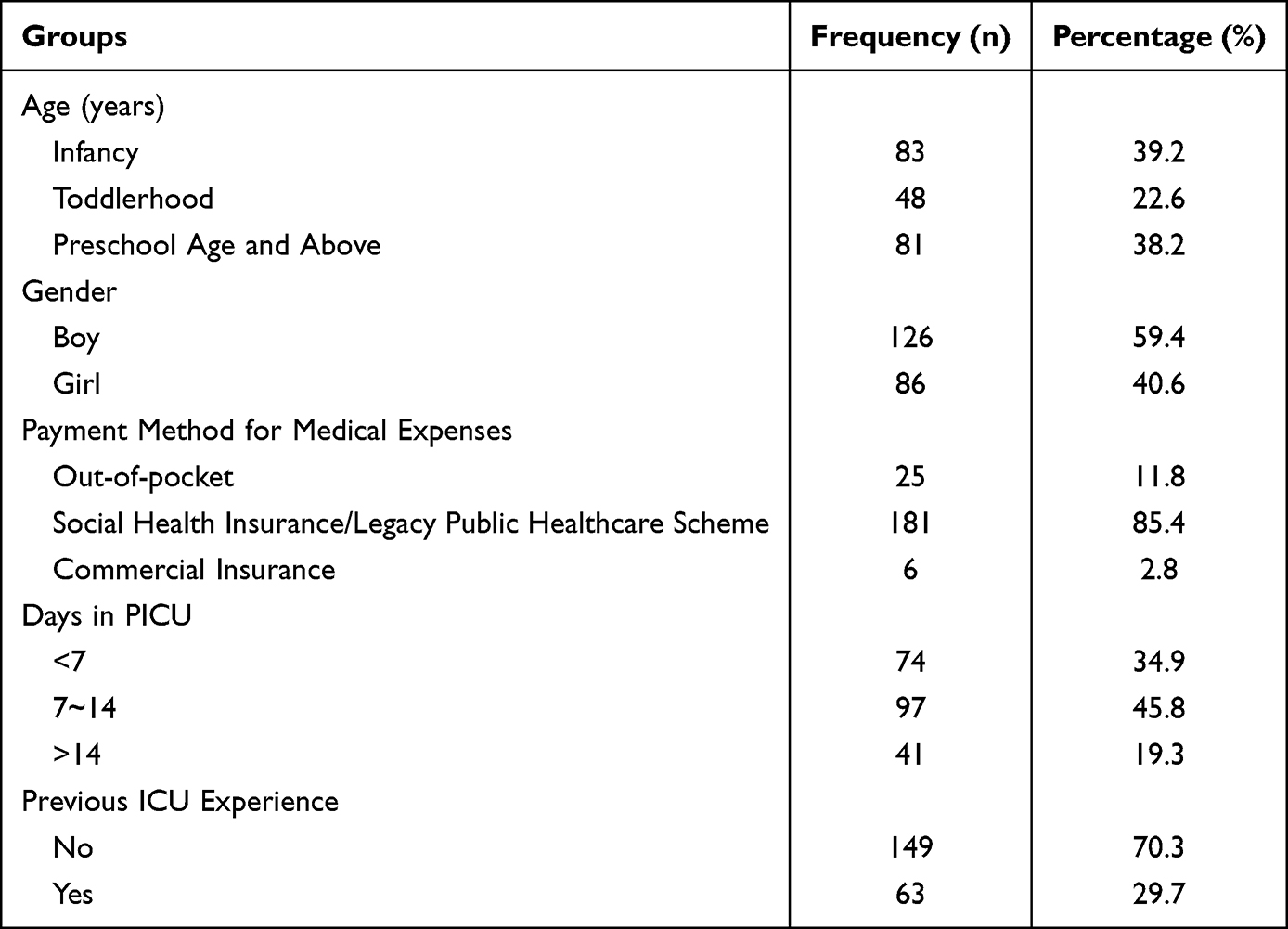 |
Table 1 General Characteristics of Children Transferred from the PICU (n=212) |
Findings on the General Characteristics of Parents of Children Transferred from the PICU are shown in Table 2. The parents’ ages ranged from 19 to 50 years, with a mean age of 32.88 ± 5.35. Mothers constituted 186 cases (87.7%), while fathers accounted for 26 cases (12.3%).
 |
Table 2 General Characteristics of Parents of Children Transferred from the PICU (n=212) |
Among the general characteristics, the differences in relocation stress scores of PICU parents with different education levels and Per capita monthly household income reached statistical significance (F = 3.727/3.080, p<0.05).
Additionally, comparisons were conducted between groups based on whether the children had a prior ICU history and the study variables. The results showed no statistically significant differences in social support scores (t=0.367, p>0.05), care preparedness scores (t=0.260, p>0.05), or relocation stress scores (t=1.433, p>0.05) between parents of children with and without prior ICU experience (Table 3).
 |
Table 3 Comparison of Scores Based on Prior ICU Experience |
Descriptive Statistics of Variables (Social Support, Care Preparedness, Relocation Stress)
Scale scores of parents’ social support, care preparedness, relocation stress, are presented in Table 4. The total relocation stress score among parents of children transferred from the PICU ranged from 29 to 85, with a mean score of 60.25 ± 8.10. The social support score ranged from 15 to 58, with a mean score of 42.36 ± 7.31. The care preparedness score ranged from 0 to 32, with a mean score of 24.19 ± 6.44.
 |
Table 4 Mean (SD) for Scores for The Main Study Variables (N=212) |
Correlation and Regression Statistics of Variables (Social Support, Care Preparedness, Relocation Stress)
A moderate correlation was found between relocation stress and care preparedness among parents of children transferred from the PICU (r=0.460, P<0.001). Relocation stress also showed a weak positive correlation with social support (r=0.297, P<0.001). Additionally, a weak positive correlation was observed between social support and care preparedness (r=0.214, P<0.001). Note: Higher scores on the FRSS indicate lower levels of relocation stress; therefore, a positive correlation means that a variable is associated with lower relocation stress (Table 5).
 |
Table 5 Correlation Analysis Between Social Support, Care Preparedness, Relocation Stress Scores |
To identify factors associated with relocation stress, a stepwise regression analysis was conducted, incorporating social support, care preparedness, and other variables that showed significance in univariate analysis. Prior to the analysis, categorical independent variables were converted into dummy variables. The regression results indicated a significant association between care preparedness, social support, and relocation stress (F=35.375, P<0.001). These two variables explained 25.3% of the variance in relocation stress (R2=0.253). Specifically, adequate care preparedness (β=0.416) and higher levels of social support (β=0.208) were associated with higher relocation stress scores, which indicate lower levels of relocation stress (Table 6).
 |
Table 6 Regression Analysis of Relocation Stress Among Parents of Children Transferred from the PICU (n=212) |
The Mediating Effect of Care Preparedness
Using Amos 24.0, a structural equation model was constructed with Relocation Stress as the dependent variable, Social Support as the independent variable, and Care Preparedness as the mediating variable. The results indicated a good model fit: χ2/df = 2.138, RMSEA = 0.073, GFI = 0.969, TLI = 0.920, CFI = 0.954. The mediation model is illustrated in Figure 1. Although the RMSEA value (0.073) is above the strict “good fit” threshold (0.06), it remains within the acceptable range, supporting the adequacy of the hypothesized mediation model.
 |
Figure 1 Mediation Model of Care Preparedness between Social Support and Relocation Stress in Parents of Children Transferred from the PICU. |
The bootstrap method with 5000 resamples and a 95% confidence interval was employed to test the mediating effect of Care Preparedness between Social Support and Relocation Stress among parents of children transferred from the PICU. The results showed that Social Support positively predicted Care Preparedness (β = 0.254, p = 0.003). Social Support positively predicted Relocation Stress (β = 0.273, p < 0.003). Care Preparedness positively predicted Relocation Stress (β = 0.444, p < 0.001). Note that higher scores on the relocation stress scale indicate lower levels of relocation stress. The 95% confidence interval for the mediation effect (0.075, 0.737) did not include zero, indicating that the mediating effect of Care Preparedness was significant, with a mediation effect value of 0.113. The direct effect and mediation effect accounted for 70.7% and 29.3% of the total effect, respectively, as shown in Table 7.
 |
Table 7 The Mediating Role of Care Preparedness in the Relationship Between Social Support and Relocation Stress |
Discussion
Status of Relocation Stress in Parents of Children Discharged from the PICU
In this study, the relocation stress score among parents of children transferred from the PICU was at a moderate level, which is higher than that reported by Yixian Zhou.11 This difference may be attributed to the fact that more than half of the participants in that study had tertiary education or above Further analysis revealed that the score for ICU transfer-related anxiety was the lowest, indicating that parents experience significant anxiety when their child is transferred out of the PICU. This finding is consistent with the findings on emotional experiences of parents in the PICU in the international literature. A longitudinal qualitative study conducted by Poh et al29 among Chinese, Malay, and Indian parents of children discharged from the PICU in Singapore found that parents from all ethnic groups reported significant emotional distress after their child’s discharge, with Chinese parents tending to report higher psychological burden. In the PICU, all care is provided by healthcare professionals, but after transfer to the general ward, the shift in care model and environment requires parents to take on some aspects of daily care. Due to a lack of knowledge and the need to cooperate with medical staff in assisting with care, parents are prone to relocation stress.3 The lower scores regarding changes in environment and treatment suggest that such changes imply a shift in caregiving roles and patterns, which is precisely what triggers relocation stress in parents. If parents lack sufficient understanding and preparation before the transfer, they may experience anxiety and helplessness due to poor role adaptation and the gap between expectations and reality, thereby leading to relocation stress.
The Correlation Between Relocation Stress, Social Support, and Care Preparedness in Parents of Children Transferred from the PICU
The results of this study indicate that the level of social support among parents of children transferred from the PICU is moderate, and a weak positive correlation exists between relocation stress and social support (P<0.05), suggesting that adequate social support can reduce the level of relocation stress. After transfer from the PICU, the child is in the early stage of recovery, with ongoing risks of clinical fluctuation. Moreover, due to the young age of most children, normal communication with parents is often challenging. Parents must independently shoulder multiple burdens—physical, psychological, and economic.6,8 Insufficient social support can easily lead to a significant increase in their relocation stress. By providing practical assistance and emotional exchange, social support effectively alleviates the degree of stress experienced by parents. This is primarily because individuals can utilize healthcare resources more efficiently, thereby reducing negative emotions such as anxiety, restlessness, and depression.30 A prospective longitudinal study in Singapore31 involving 128 parents of children discharged from the PICU showed that approximately 53% of parents experienced moderate to severe health problems after discharge, with insufficient social support being a key factor contributing to long-term psychological distress. This further confirms that adequate social support has cross‑cultural universal significance in reducing relocation stress among parents of children transferred from the PICU.
The study revealed a moderate positive correlation between care preparedness and relocation stress among parents of children transferred from the PICU (P<0.05), indicating that better care preparedness is associated with lower levels of relocation stress. When parents are inadequately prepared for their child’s care needs, the uncertainty and responsibility pressures during the transition period significantly increase, thereby exacerbating their stress response. Research has found that parents with low preparedness are more prone to anxiety and self-doubt due to difficulties in role adaptation.19 This finding can be reasonably explained by Lazarus’s cognitive appraisal theory of stress;13 poorly prepared parents are more likely to perceive the transfer as an uncontrollable threat, amplifying their stress response. Clinically, this often manifests as helplessness and repeated requests for assistance when facing the child’s emergent situations, forming a vicious cycle of stress.32 Therefore, this finding not only validates the influence of knowledge and preparedness levels on transition outcomes as posited by Meleis’s Transition Theory,1 but also suggests that clinical practice should focus on strengthening parents’ caregiving capabilities during the initial phase of their child’s transfer.
A weak positive correlation was found between the total score of social support and care preparedness among parents of children transferred from the PICU (P<0.05), indicating that better social support can enhance care preparedness. This finding can be reasonably explained by Meleis’s Transition Theory: social support, as a key external condition, directly fulfills the internal prerequisites for a successful transition by improving parents’ knowledge and skill levels as well as their emotional state, thereby translating into higher care preparedness. Research shows that the level of social support depends not only on material assistance and social networks but also on the utilization of such support.33 In terms of subjective support, emotional care primarily comes from healthcare providers, spouses, relatives, friends, and peer support groups, manifested through listening, empathy, encouragement, and validation. Nurses can enhance parents’ perception of emotional support through proactive communication, psychological counseling, and creating a supportive environment, thereby boosting their caregiving confidence and alleviating anxiety.34 The correlation between objective support (eg, material assistance, direct care assistance from others) and care preparedness did not reach statistical significance, suggesting that in the PICU transfer context, parents’ internal transformation toward care preparedness depends more on emotional support (subjective support) and utilization of support than on purely practical material help. Nursing professionals can help parents access and effectively utilize these resources by coordinating discharge planning, referring to social resources, and providing family caregiving skills training. This not only reduces their physical burden but also creates opportunities for them to learn and adapt caregiving skills through practical experience.35 Improved utilization of social support further helps parents effectively transform external resources into their own caregiving capabilities. This suggests that a comprehensive social support system requires multidimensional collaboration to collectively promote the enhancement of care preparedness.
The Partial Mediating Role of Care Preparedness Between Social Support and Relocation Stress in Parents of Children Transferred from the PICU
The results of this study demonstrated that care preparedness played a partial mediating role between social support and relocation stress, accounting for 29.3% of the total effect. This indicates that social support not only directly reduces the level of relocation stress in parents of children transferred from the PICU but also indirectly lowers it by enhancing care preparedness. Care preparedness refers to the state of readiness exhibited when caring for a patient and also serves as an evaluative basis for assessing the caregiver’s own adaptability and coping capacity.36 Chinese parents often regard “perfect care” as the core of their responsibility ethics.37 When parents hear messages such as “someone else’s child recovered faster,” it may intensify their self-doubt and weaken the efficiency of translating support into preparedness. According to Meleis’s Transition Theory,1 external resources must be transformed into an individual’s “knowledge and skill levels” and a positive “emotional state” to facilitate a successful transition. When parents access resources through the social support system, they can internalize this external support into the knowledge and skills they need, thereby enabling them to cope more confidently with the challenges of environmental transition and role change from the PICU to the general ward. This enhancement in internal preparedness allows parents to adopt more proactive coping strategies when facing uncertainties in caregiving, rather than being dominated by feelings of helplessness and fear, ultimately leading to a significant reduction in the level of relocation stress. Regarding the uncertainty of the indirect effect confidence interval width (0.075–0.737): The issue you raised is very important. In this study, the 95% confidence interval for the indirect effect was wide (0.075–0.737), indicating uncertainty in the point estimate of the mediating effect (0.113). Possible reasons include: although the sample size met the calculation requirement, its precision for detecting a relatively weak mediating effect was insufficient; the cross-sectional design could not control for temporal variability; and the correlation between social support and care preparedness was weak (r = 0.214). Future studies could adopt larger samples, longitudinal designs, or latent variable modeling to obtain more precise estimates of the mediating effect.
Limitation
First, all data were collected via self-report questionnaires, making the measurement of variables inherently subjective. When completing the questionnaires, parents may have been influenced by their emotional state at the time, recall bias, or social desirability effects, potentially leading to common method bias. Moreover, no PICU-specific estimate was available during study planning, and this value was the best approximation. Future studies should use pilot data or PICU-specific estimates to refine sample size calculations. Second, this study adopted a cross-sectional design. Although a mediation model was constructed based on theory, it was not possible to control for all potential confounding factors (eg, parental personality traits, prior caregiving experience, severity of the child’s illness, etc) nor to establish causal ordering among the variables. Future research should employ longitudinal designs or interventional studies and include more covariates in the statistical analyses to control for confounding effects. Third, this study used convenience sampling. All participants were recruited from a single tertiary Grade A specialized hospital, and the proportion of mothers was excessively high (87.7%), which limits the generalizability of the findings. Fourth, social support was analyzed as a global variable, without in-depth exploration of whether its different dimensions (eg, subjective support, objective support) influence care preparedness and relocation stress through distinct mechanisms. Future studies should adopt multi-center, large-sample designs, balance the gender ratio of parents, and conduct refined analyses of the various dimensions of social support.
Conclusion
This study validates the applicability of Meleis’s Transition Theory and Pearlin’s Stress Process Model in the context of this research: external social support resources need to be transformed through individuals’ internal knowledge, skills, and psychological readiness (ie, care preparedness) to effectively alleviate relocation stress. The findings reveal the key mediating role of care preparedness, as a modifiable internal variable, between social support and relocation stress. Future research could further explore how social support resources can be systematically transformed into parents’ care preparedness and, based on this, design targeted transitional care intervention programs. In clinical practice, healthcare professionals should assess parents’ level of care preparedness, particularly providing personalized support to families at high risk for relocation stress.
Implications for Practice
By assessing relocation stress in parents, nurses can better position themselves to deliver quality nursing, support, and enhanced caregiver preparedness for both children transferred from the PICU and their parents.
Ethical Approval
Prior to the study, approval was obtained from the hospital and relevant department, and ethical review was secured from the tertiary specialized hospital in Guangzhou, specifically the Guangzhou Women and Children’s Medical Center. (Ethical Approval No.: [2021] No. 252A01). The ethical approval date was January 4, 2022, with the approval period covering December 15, 2021 to December 31, 2023. This study was conducted in accordance with the ethical standards of the Declaration of Helsinki. All participants provided written informed consent.
Acknowledgments
We would like to thank all parents of children transferred from the PICU who participated in this study.
Funding
This study did not receive any funding.
Disclosure
The authors declare they have no conflict of interest with respect to the research, authorship, and/or publication of this article.
References
1. Schumacher KL, Meleis AL. Transitions: a central concept in nursing. Image J Nurs Sch. 1994;26(2):119–12. doi:10.1111/j.1547-5069.1994.tb00929.x
2. De Sonnaville ESV, Kӧnigs M, Van Leijden O, Knoester H, Van Woensel JBM, Oosterlaan J. Intelligence outcome of pediatric intensive care unit survivors: a systematic meta-analysis and meta-regression. BMC Med. 2022;20(1):198. doi:10.1186/s12916-022-02390-5
3. Rennick JE, St-Sauveur I, Knox AM, Ruddy M. Exploring the experiences of parent caregivers of children with chronic medical complexity during pediatric intensive care unit hospitalization: an interpretive descriptive study. BMC Pediatr. 2019;19(1):272. doi:10.1186/s12887-019-1634-0
4. Boisvert C. [Congress of the North American Nursing Diagnosis Association (San Diego, 1992)]. Soins Rev Ref Infirm. 1992;(563–564):64–65. French
5. Li YM, Huang RZ, Lu YM, Lin XM, Shi Q, Liang CY. Investigation and influencing factors analysis of the relocation stress of the main caregivers of children transferred from the pediatric intensive care units. Intern Med China. 2024;19(5):527–532. doi:10.16121/j.cnki.cn45-1347/r.2024.05.12
6. Ko MSM, Lee WK, Sultana R, et al. Psychological outcomes in families of PICU survivors: a meta-analysis. Pediatrics. 2024;154(1):e2023064210. doi:10.1542/peds.2023-064210
7. Yang HL, Ji JL, Zeng CQ, Chen OY, Lu QF. A study of the effectiveness of an ICU transitional care program in improving relocation stress and caregiving skills of parents of critically ill children. Chin J Nurs. 2025;60(16):1966–1973. doi:10.3761/j.issn.0254-1769.2025.16.007
8. Yip SASE, Lim QZX, Kong G, Amin Z, Ng YPM. Quality of life of parents of premature infants: a systematic review and meta-analysis. JAMA Network Open. 2026;9(1):e2553712. doi:10.1001/jamanetworkopen.2025.53712
9. Chang Q, Xiao Y, Duan ZY, Tian YX. The relationship between family migration stress level, social support, coping style and self-efficacy of patients in orthopaedic ICU and its clinical value. Heilongjiang Med Pharm. 2025;48(4):129–132. doi:10.3969/j.issn.1008-0104.2025.04.041
10. Zhu DP, Shao P, Qiao YH, Wang HX, Zhang WY. Application and effect evaluation of relocation stress nursing program for family members of patients with severe traumatic brain injury transferred from ICU. Chin J Emerg Crit Care Nurs. 2025;6(3):261–267. doi:10.3761/j.issn.2096-7446.2025.03.001
11. Yixian Z, Yanhong Z, Ailing W, Jiaomei M, Weijuan Y, Yaoyao S. Correlation study of relocation stress, social support and social comparison orientation of the main caregivers of children transferred from PICU. J Nurses Train. 2021;36(14):1287–1292. doi:10.16821/j.cnki.hsjx.2021.14.008
12. Bichard E, Herring D. The psychological burden of restricted parental visiting in paediatric intensive care. Nurs Crit Care. 2020;25(6):379–381. doi:10.1111/nicc.12544
13. Lazarus RS, Folkman S. Stress, Appraisal, and Coping. Springer; 1984. 11. [print.].
14. Mikovits JC. A concept analysis of preparedness: application to LGBTQ considerations for nursing. J Nurs Manag. 2021;29(1):16–23. doi:10.1111/jonm.13208
15. Archbold PG, Stewart BJ, Greenlick MR, Harvath T. Mutuality and preparedness as predictors of caregiver role strain. Res Nurs Health. 1990;13(6):375–384. doi:10.1002/nur.4770130605
16. Cameron JI, Chu LM, Matte A, et al. One-year outcomes in caregivers of critically ill patients. N Engl J Med. 2016;374(19):1831–1841. doi:10.1056/NEJMoa1511160
17. Cohen S, Wills TA. Stress, social support, and the buffering hypothesis. Psychol Bull. 1985;98(2):310–357. doi:10.1037/0033-2909.98.2.310
18. Lu L, Jiang Y, Li CY. Research status on relocation stress among caregivers of children transferred from the PICU. Mod Nurse. 2025;32(24):5–9. doi:10.19793/j.cnk.1006-6411.2025.24.002
19. Jiao J, Liu H. Discharge preparation for parents of preterm infants in the neonatal intensive care unit: a qualitative study revealing experiences and needs. Medicine. 2025;104(46):e45690. doi:10.1097/MD.0000000000045690
20. Pearlin LI. The sociological study of stress. J Health Soc Behav. 1989;30(3):241–256. doi:10.2307/2136956
21. Wang X, Liu JP. Sample size estimation in Clinical Research: (II) observational studies. J Tradit Chin Med. 2007;48(7):599–601. doi:10.3321/j.issn:1001-1668.2007.07.009
22. Zhou S, Wang JN, Wang J, Zha LL. Relocation stress and its influencing factors of the families of patients transferred from ICU. Chin J Nurs. 2017;52(8):911–915. doi:10.3761/j.issn.0254-1769.2017.08.003
23. Oh H, Lee S, Kim J, et al. Clinical validity of a relocation stress scale for the families of patients transferred from intensive care units. J Clin Nurs. 2015;24(13–14):1805–1814. doi:10.1111/jocn.12778
24. Zhao J, Yan XY. Reliability and validity test for Chineseization version of the migration stress scale of family members among ICU patients. J Nurses Train. 2018;33(17):1552–1555. doi:10.16821/j.cnki.hsjx.2018.17.005
25. Liu YM, Wang M, Dong XF. Reliability and validity of Chinese version of the caregiver preparedness scale in caregivers of stroke survivors. Chin J Pract Nurs. 2016;32(14):1045–1048. doi:10.3760/cma.j.issn.1672-7088.2016.14.002
26. Wang Z, Wang Y, Bao H, Zhang S, Wang Z, Pang X. Care readiness and positive feelings of family caregivers of children with liver transplantation in China: a cross-sectional study. J Pediatr Nurs. 2022;67:e123–e128. doi:10.1016/j.pedn.2022.08.018
27. Xiao SY, Yang DS. The impact of social support on physical and mental health. Chin Ment Health J. 1987;(4):5.
28. Cohen J. Statistical Power Analysis for the Behavioral Sciences.
29. Poh PF, Carey MC, Manning JC, Lee JH, Latour JM. Ethnic differences in parental experiences during the first six months after PICU discharge in Singapore: a qualitative study. Front Pediatr. 2023;11:1288507. doi:10.3389/fped.2023.1288507
30. Gise J, Cohen LL. Social support in parents of children with cancer: a systematic review. J Pediatr Psychol. 2022;47(3):292–305. doi:10.1093/jpepsy/jsab100
31. Poh PF, Lee JH, Sultana R, Manning JC, Carey MC, Latour JM. Physical, cognitive, emotional, and social health outcomes of parents in the first six months after childhood critical illness: a prospective single centre study. Children. 2024;11(8):948. doi:10.3390/children11080948
32. Rees G, Gledhill J, Garralda ME, Nadel S. Psychiatric outcome following paediatric intensive care unit (PICU) admission: a cohort study. Intensive Care Med. 2004;30(8):1607–1614. doi:10.1007/s00134-004-2310-9
33. Kawachi I, Berkman LF. Social ties and mental health. J Urban Health Bull N Y Acad Med. 2001;78(3):458–467. doi:10.1093/jurban/78.3.458
34. Chaboyer W, Thalib L, Alcorn K, Foster M. The effect of an ICU liaison nurse on patients and family’s anxiety prior to transfer to the ward: an intervention study. Intensive Crit Care Nurs. 2007;23(6):362–369. doi:10.1016/j.iccn.2007.04.005
35. Suleman Z, Evans C, Manning JC. Parents’ and carers’ experiences of transition and aftercare following a child’s discharge from a paediatric intensive care unit to an in-patient ward setting: a qualitative systematic review. Intensive Crit Care Nurs. 2019;51:35–44. doi:10.1016/j.iccn.2018.10.003
36. Henriksson A, Årestedt K. Exploring factors and caregiver outcomes associated with feelings of preparedness for caregiving in family caregivers in palliative care: a correlational, cross-sectional study. Palliat Med. 2013;27(7):639–646. doi:10.1177/0269216313486954
37. Pan JY. The impact of parental perfectionism on parenting burnout. Adv Psychol. 2024;14(4):323–331. doi:10.12677/ap.2024.144224
 © 2026 The Author(s). This work is published and licensed by Dove Medical Press Limited. The
full terms of this license are available at https://www.dovepress.com/terms
and incorporate the Creative Commons Attribution
- Non Commercial (unported, 4.0) License.
By accessing the work you hereby accept the Terms. Non-commercial uses of the work are permitted
without any further permission from Dove Medical Press Limited, provided the work is properly
attributed. For permission for commercial use of this work, please see paragraphs 4.2 and 5 of our Terms.
© 2026 The Author(s). This work is published and licensed by Dove Medical Press Limited. The
full terms of this license are available at https://www.dovepress.com/terms
and incorporate the Creative Commons Attribution
- Non Commercial (unported, 4.0) License.
By accessing the work you hereby accept the Terms. Non-commercial uses of the work are permitted
without any further permission from Dove Medical Press Limited, provided the work is properly
attributed. For permission for commercial use of this work, please see paragraphs 4.2 and 5 of our Terms.
Recommended articles

Academic Motivation and Social Support: Mediating and Moderating the Life Satisfaction and Learning Burnout Link
Chen C, Zhu Y, Xiao F, Que M
Psychology Research and Behavior Management 2023, 16:4583-4598
Published Date: 4 November 2023
The Impact of Social Support for Patients with COVID-19 in Post-Traumatic Growth: A Mediating Analysis Study
Liang J, Jiao X, Xiang P, Dong L, He Y, Hu Y, Zhang Z, Chen W, Lei J
Journal of Multidisciplinary Healthcare 2025, 18:3593-3603
Published Date: 21 June 2025
Mediating Role of Dyadic Coping Between Social Support and Oral Frailty Cross-Sectional Study of Elderly Ovarian Cancer Patients in China
Jin J, Zhao D, Chen Y
International Journal of Women's Health 2026, 18:594341
Published Date: 23 April 2026
Social Support and Hospital Discharge Readiness in CHD Patients: Mediating Roles of Self-Efficacy and Adherence
Wang D, Yang N, Wei C, Wang J, Yuan L, Sun R
Patient Preference and Adherence 2026, 20:601646
Published Date: 4 June 2026