
Back to Journals » Psychology Research and Behavior Management » Volume 18
The Longitudinal Relationship Between Cyberbullying Perpetration and Suicidal Ideation Among Vocational School Adolescents: A Moderated Mediation Model
Authors Li X, Gui D, Cai X, Yin Y, Wang P, Ouyang M 
Received 15 February 2025
Accepted for publication 29 July 2025
Published 10 October 2025 Volume 2025:18 Pages 2139—2151
DOI https://doi.org/10.2147/PRBM.S497797
Checked for plagiarism Yes
Review by Single anonymous peer review
Peer reviewer comments 5
Editor who approved publication: Professor Mei-Chun Cheung
Xiaoxuan Li,1,* Danni Gui,2,* Xiao Cai,3,* Yulong Yin,4 Pengcheng Wang,5 Mingkun Ouyang1
1College of Education Science, Guangxi Minzu University, Nanning, People’s Republic of China; 2School of Economics and Management, Fuzhou University, Fuzhou, People’s Republic of China; 3School of Foreign Languages, Renmin University of China, Beijing, People’s Republic of China; 4School of Psychology, Northwest Normal University, Lanzhou, People’s Republic of China; 5School of Media and Communication, Shanghai Jiao Tong University, Shanghai, People’s Republic of China
*These authors contributed equally to this work
Correspondence: Mingkun Ouyang, College of Education Science, Guangxi Minzu University, Nanning, 530000, People’s Republic of China, Correspondence: Email [email protected]
Background: Although there is extensive evidence linking cyberbullying perpetration to adolescents’ suicidal ideation, studies have not yet explored the longitudinal relationship between cyberbullying perpetration and adolescents’ suicidal ideation, nor have they elucidated the mechanisms underlying this relationship. To address these gaps, this study employed a three-wave longitudinal design to examine the relationship between cyberbullying perpetration and suicidal ideation among Chinese vocational school adolescents, and the mediating effect of depression and the moderating effect of need to belong (NTB) in this relationship.
Methods: Using a cluster sampling method, 802 adolescents (Mage = 17.5, SD=4.3, 51.6% female) from two vocational schools completed the questionnaires measuring cyberbullying perpetration, suicidal ideation, depression, and NTB across three waves at six-month intervals. T1 depression was treated as a control variable in the statistical model. This study used SPSS 27.0 and PROCESS macro to test the research hypotheses.
Results: The results demonstrated that (1) T1 cyberbullying perpetration positively predicted T3 suicidal ideation; (2) T2 depression fully mediated the relationship between T1 cyberbullying perpetration and T3 suicidal ideation; (3) T2 NTB moderated the indirect relationship between T2 depression and T3 suicidal ideation. Specifically, the relationship between T2 depression and T3 suicidal ideation was stronger for vocational school adolescents with high NTB than for those with low NTB.
Conclusion: These findings indicate that cyberbullying perpetration impacts adolescents’ suicidal ideation via depression, and that adolescents with high NTB are more vulnerable to suicidal ideation when experiencing depression. This research highlights the importance of adopting a depression-focused intervention, thus preventing cyberbullying perpetration from escalating to suicidal ideation among vocational school adolescents, particularly those with high NTB.
Keywords: suicidal ideation, cyberbullying perpetration, depression, need to belong, vocational school adolescents
Introduction
Suicide is a leading cause of death among adolescents globally.1 The risk of death by suicide generally increases progressively along a continuum that moves from suicidal ideation to suicide attempts and ultimately to suicide completion.2 Suicidal ideation, which refers to self-reported thoughts of engaging in suicidal behaviors,3 is a significant risk factor for future suicidal behaviors.2,4 Evidence suggests that 74.9% of individuals with suicidal ideation develop suicidal behaviors within one year.5 Adolescents are at high risk for suicidal ideation.6 A meta-analysis demonstrated that the prevalences of suicidal ideation among adolescents was 16.3%, significantly higher than the global average in youth populations.7 Notably, research on vocational school adolescents found that they reported having an even higher susceptibility, with prevalence rates of 37.7%.8 Given the seriousness of suicidal ideation among vocational school adolescents, it is crucial to identify the potential risk factors for adolescents’ suicidal ideation to better inform prevention and intervention efforts.
Among the risk factors, cyberbullying perpetration has been identified as a significant contributor.9 However, previous studies on the relationship between cyberbullying perpetration and suicidal ideation have revealed conflicting findings. Some studies have identified a positive association between cyberbullying perpetration and adolescents’ suicidal ideation,9,10 while others have reported no statistically significant correlation.11,12 This discrepancy may stem from methodological limitations in accounting for potential mediators or moderators that could elucidate the complex mechanisms underlying this relationship. Specifically, the current literature lacks examination of intervening variables that might explain how and when cyberbullying perpetration influences suicidal ideation. To address these gaps, the present study employed a three-wave longitudinal design to investigate the relationship between cyberbullying perpetration and adolescents’ suicidal ideation. We further extended the existing literature by covering the mediating role of depression and the moderating role of the need to belong in this association.
Cyberbullying Perpetration and Suicidal Ideation
Cyberbullying perpetration refers to an aggressive, intentional act carried out by a group or individual, using electronic forms of contact, repeatedly and over time against a victim who cannot easily defend themselves.13 Compared to research on cyberbullying victimization,14,15 fewer studies have investigated the relationship between cyberbullying perpetration and suicidal ideation. Perpetrators of cyberbullying have been found to exhibit high levels of aggressive behavior16 and other problematic behaviors such as antisocial tendencies.17 Suicidal behavior could be considered an aggression turned inwards.18 Thus, it is a reason to propose that cyberbullying perpetration can be a risk factor for adolescents’ suicidal ideation. According to the general strain theory,19,20 suicidal ideation may function as a maladaptive coping strategy for cyberbullying perpetrators to escape the emotional distress they experience. Empirical studies have revealed that cyberbullying perpetration is associated with adverse mental health outcomes, such as loneliness,21 anxiety,22,23 and depression,24 as well as social difficulties,17 which may further lead to more severe consequences such as suicidal ideation.10,25
Empirical research has supported the view that adolescents who experienced cyberbullying perpetration are at an increased risk of suicidal ideation.10,25 For example, a meta-analysis of cross-sectional studies revealed that adolescents who engage in cyberbullying perpetration are 1.23 times more likely to develop suicidal ideation compared to non-perpetrators.26 Surprisingly, only one prior study has examined the longitudinal relationship between cyberbullying perpetration and suicidal ideation among adolescents, demonstrating that cyberbullying perpetration contributes to suicidal ideation over the course of a year.9 Notably, no previous studies have directly explored the longitudinal relationship between cyberbullying perpetration and suicidal ideation among vocational school adolescents. Adolescents in vocational schools have been reported to engage in higher levels of cyberbullying perpetration than their peers in regular schools,27 thereby potentially increasing the risk of suicidal ideation.
The Mediating Effect of Depression
One mediating mechanism through which cyberbullying perpetration is linked to suicidal ideation may be depression. Depression is a public mental health problem that has long-term adverse effects on individuals’ well-being and quality of life.28,29 According to the general strain theory, suicide is recognized as a maladaptive response to stress.19 Cyberbullying perpetration, as a stressful event, can lead to serious mental health problems and unhealthy behaviors, including low self-esteem,17 anxiety,23,25 self-harm,30 and antisocial behavior.10 These outcomes can increase the risk of depression,31–33 which in turn may drive adolescents to seek ways to escape their emotional distress. Suicidal ideation may serve as a maladaptive coping mechanism to alleviate such distressing emotion.34 Therefore, depression would mediate the relationship between cyberbullying perpetration and adolescents’ suicidal ideation.
Previous studies support the mediating process from cyberbullying perpetration to suicidal ideation through depression. Empirical evidence indicates that individuals who engage in cyberbullying perpetration exhibit higher levels of depression across different age groups.35,36 Longitudinal studies suggest that cyberbullying perpetration predicts depression,37,38 and a meta-analysis study reveals that cyberbullying perpetrators are 1.73 times more likely to develop depression than non-perpetrators.39 Furthermore, depression increases the risk of adolescents’ suicidal ideation.40 Cross-sectional studies show that depressed adolescents are more likely to report severe suicidal ideation.41–43 Longitudinal studies also indicate that depression in childhood predicts suicidal ideation in adulthood,44 and depression at age 17 years significantly predicts suicidal ideation in adolescents one year later.45
To the best of our knowledge, while previous studies have demonstrated that the mediating role of depression in the relationship between psychosocial factors and suicidal ideation,42,43,46 they have not examined whether depression would mediate the relationship between cyberbullying perpetration and adolescents’ suicidal ideation.
The Moderating Effect of Need to Belong
Although cyberbullying perpetration may influence adolescents’ suicidal ideation via the mediating role of depression, not all adolescents are equally susceptible to this influence. Therefore, it is crucial to identify potential moderators that may shape the indirect pathway between cyberbullying perpetration and suicidal ideation. The present study proposed that the need to belong (NTB) would moderate the indirect relationship between depression and adolescents’ suicidal ideation.
According to the belongingness hypothesis, the NTB is a fundamental human need for social connections, and this need becomes especially important during the transitional phase of adolescence.47 Individuals with a high NTB are highly motivated to engage in interactions with others to enhance their social connections and are thus more sensitive to others’ thoughts and feelings.48 The interpersonal theory of suicide suggests that suicide ideation is associated with interpersonal risks such as thwarted belongingness and perceived burdensomeness.49 Given that depression greatly significantly impairs interpersonal relationships and reduces relational satisfaction,50 depressed individuals with high NTB are more likely to experience interpersonal risks, including thwarted belongingness, and greater negative emotional distress compared to those with low NTB.51,52 They may try to compensate for lacking real social interaction by connecting with nonhuman things like photos and gadgets,53 or by talking to themselves more often.54 But these ways can actually make them feel lonelier and even lead to serious mental health problems55 such as suicidal ideation.56 With this in mind, high NTB may strengthen the relationship between depression and suicidal ideation.
Few studies pay attention to the moderating effect of NTB on the relationship between depression and adolescents’ suicidal ideation. However, indirect evidence supports this view. For example, NTB is reported to moderate the relationship between narcissistic vulnerability and depression.57 Moreover, NTB is found to moderate the association between thwarted belongingness and suicidal ideation, with individuals who have higher NTB being more likely to develop suicidal ideation when experiencing thwarted belongingness.56 Nevertheless, no research has examined whether NTB moderates the indirect relationship between depression and suicidal ideation among vocational school adolescents.
The Present Study
The purpose of this study is to examine the longitudinal relationship between cyberbullying perpetration and suicidal ideation, using a sample of adolescents from vocational schools. We will further explore the mechanisms underlying this relationship by examining depression as a mediator and NTB as a moderator, using a three-wave longitudinal design (see Figure 1). To achieve these purpose, we first examined the relationships among cyberbullying perpetration, depression, suicidal ideation, and NTB. Next, we examined a moderated mediation model with a twofold aim: (1) to explore the whether depression mediates the relationship between cyberbullying perpetration and adolescents’ suicidal ideation, and (2) to determine whether NTB moderates the indirect relationship between cyberbullying perpetration and adolescents’ suicidal ideation via depression. Based on the literature review and the aims of the present study, we proposed the following hypotheses:
H1: Cyberbullying perpetration will positively predict adolescents’ suicidal ideation. H2: Depression will mediate the relationship between cyberbullying perpetration and adolescents’ suicidal ideation. H3: NTB will moderate the indirect effect of cyberbullying perpetration on adolescents’ suicidal ideation via depression, such that this effect will be stronger for adolescents with high NTB than those with low NTB.
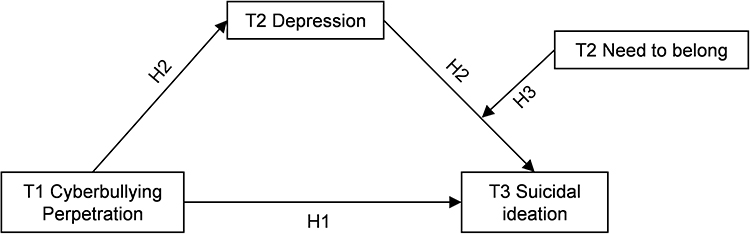 |
Figure 1 The proposed moderated mediation model. Abbreviation: H, hypothesis. |
Method
Participants and Procedure
Participants were recruited from two vocational schools in Guilin, Guangxi Province, China. A cluster sampling method was used to ensure a representative sample from diverse geographical regions.
Specifically, the study was structured around two defined clusters, with one vocational school was selected from each cluster to represent its respective geographical area. Participants completed the questionnaires regarding cyberbullying perpetration, suicidal ideation, depression, and NTB across three waves at six-month intervals. All parents or legal caregivers provided written informed consent and participants were informed of their right to withdraw from the survey at any time.
A total of 1250 participants took part in the first survey in March 2023 (Time 1, T1). Among them, 1120 participants completed the second wave of data collection in September 2023 (Time 2, T2). Of these, 909 participants who had taken part in the first two surveys completed the final survey in March 2024 (Time 3, T3). The final valid sample consisted of 802 participants, including 414 girls (51.6%) and 388 boys (48.4%), with an average age of 17.5 years ranging from 15 to 19. Of the total sample, 134 (16.7%) were left-behind youth, and 102 (12.7%) were only children, while 705 (87.3%) had at least one sibling. A post hoc power analysis was conducted using G*Power 3.1 to evaluate the current effective sample size for correlation analysis.58,59 With a total sample size set of 802 participants, a significance level of α = 0.01, and an effect size of r = 0.142 (the correlation between T1 cyberbullying perpetration and T3 suicidal ideation), the statistical power reached 0.93. T-tests showed that there were no statistically significant differences in cyberbullying perpetration, suicidal ideation, depression, or NTB between participants who were lost to follow-up and those who remained in the study (ts < 1, ps > 0.05, Cohen’s d < 0.15). This study was approved by the Ethics Committee of the First Author’s University.
Measures
Cyberbullying Perpetration
The Cyberbullying Scale developed by Wright was used to measure cyberbullying perpetration.60 The scale contains 9 items, and each item (eg, “I insulted other classmates online or through text messages.”) was scored on a 5-point Likert scale ranging from 1 (never) to 5 (all the time), with higher summed scores indicating higher levels of cyberbullying. The scale has demonstrated good validity and reliability in Chinese adolescent samples.61 In the present study, the Cronbach’s α coefficients of the scale at the three waves were 0.91 (T1), 0.90 (T2), and 0.89 (T3), respectively.
Suicidal Ideation
The Positive and Negative Suicide Ideation scale (PANSI),62 as revised by Wang,63 was used to assess suicidal ideation among Chinese adolescents. The revised PANSI includes 14 items measuring two factors: 6 items assess positive suicidal ideation (eg, “Studying is going well and I feel very happy.”), while 8 items assess negative suicidal ideation (eg, “Feeling hopeless about the future and thinking of suicide.”). Each item was rated on a 5-point Likert scale ranging from 1 (never) to 5 (always). All items in the positive ideation factor were reverse-scored and then combined with the total negative ideation scores to yield a total score for suicidal ideation, with higher total scores signifying higher levels of suicidal ideation. The revised PANSI has been demonstrated to be a reliable and valid measure.63 In the present study, the Cronbach’s α coefficients of the scale at the three waves were 0.85 (T1), 0.89 (T2), and 0.87 (T3), respectively.
Depression
The Patient Health Questionnaire (PHQ-9) was used to measure depression.64 The questionnaire consists of 9 items (eg, “Little interest or pleasure in doing things.”), and each item was scored on a 4-point scale ranging from 0 (not at all) to 3 (almost every day), with higher scores indicating higher levels of depression. This questionnaire has demonstrated good reliability and validity in Chinese population.65 In the present study, the Cronbach’s α coefficients of the scale at the three waves were 0.90 (T1), 0.87 (T2), and 0.91 (T3), respectively.
Need to Belong
The Single-item Need to Belong Scale was used to assess adolescents’ need to belong.66 The scale includes one item (ie, “I have a strong need to belong.”), which was rated on a 7-point scale ranging from 1 (Not at all) to 7 (Extremely), with a higher score indicating a greater level of need to belong. This scale has been widely used in Chinese samples.67 The intraclass correlation coefficient68 indicating test-retest reliability between T1 and T2 was 0.72 (95% CIs = [0.67, 0.76], p <0.001).
Control Variable
T1 depression was treated as a control variable in the hypothesized model.69 The depression subscale of the Symptom Checklist-90-Revision64 was employed to assess adolescents’ T1 depression. The subscale contains 13 items (eg, “I feel sad”), with each item rated on a 4-point scale ranging from 1 (never) to 4 (serious), where higher total scores indicate higher levels of depression. This scale has good reliability and validity in Chinese population.70 The Cronbach’s α of the scale for this study was 0.91.
Statistical Analyses
First, we calculated the descriptive statistics for all study variables and computed Pearson correlation coefficients between these variables. Second, we used the PROCESS macro (Model 4)71 to examine the mediating role of depression in the relationship between cyberbullying perpetration and suicidal ideation. Third, we used the PROCESS macro (Model 14)71 to test whether NTB moderates the indirect relationship between depression and suicidal ideation. A bias-corrected percentile bootstrap based on 5000 samples was used to determine the significance of the indirect effects. A 95% confidence intervals (95% CIs) without zero indicates statistical significance at the 0.05 level. Prior to analysis, all variables were standardized, and T1 depression was included as a control variable.
Results
Correlation Analysis
Means, standard deviations, and correlations for all variables were presented in Table 1. The results showed that T1 cyberbullying perpetration was positively associated with T3 suicidal ideation (β = 0.142, p < 0.001), T2 depression (β = 0.183, p < 0.001), and T2 NTB (β = 0.072, p < 0.05). T2 depression was positively associated with T3 suicidal ideation (β = 0.452, p < 0.001) and T2 NTB (β = 0.311, p < 0.001). T2 NTB was positively correlated with T3 suicidal ideation (β = 0.118, p < 0.001).
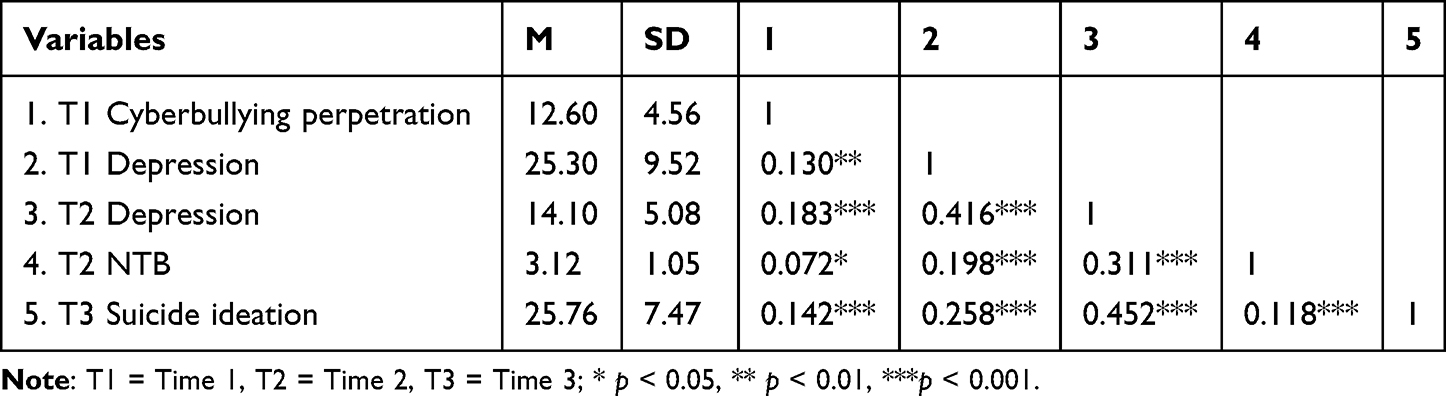 |
Table 1 Descriptive Statistics and Correlation Analysis |
Testing for the Mediating Effect of Depression
We used Model 4 in the PROCESS macro to test the mediating effect of depression. In this model, T3 suicidal ideation served as the dependent variable, T1 cyberbullying perpetration as the independent variable, T2 depression as the mediating variable, and T1 depression as the control variable. The results showed that T1 cyberbullying perpetration significantly predicted T2 depression, (β = 0.132, t = 4.097, p < 0.001), which in turn significantly predicted T3 suicidal ideation (β = 0.408, t = 11.702, p < 0.001) (see Table 2). However, the direct effect of T1 cyberbullying perpetration on T3 suicidal ideation was not statistically significant (β = 0.057, t = 1.773, p > 0.05). Furthermore, the bias-corrected percentile bootstrap method indicated that the effect of T1 cyberbullying perpetration on T3 suicidal ideation via T2 depression was significant (indirect effect = 0.054, SE = 0.16, 95% CIs = [0.025,0.085]). These findings indicate that depression fully mediates the relationship between cyberbullying perpetration and suicidal ideation.
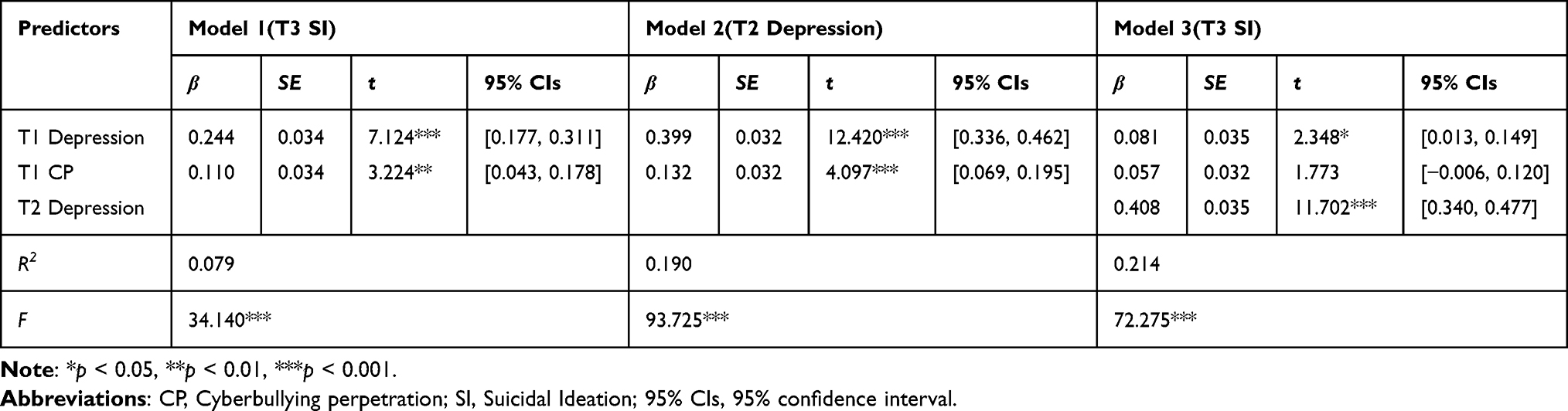 |
Table 2 Testing the Mediating Effect of Cyberbullying Perpetration on Suicidal Ideation |
Testing for the Moderating Effect of NTB
We used Model 14 in the PROCESS macro to examine the moderating effect of NTB on the indirect relationship between T2 depression and T3 suicidal ideation. The results showed that the interaction between T2 depression and T2 NTB was significant (β =0.133, t = 3.156, p < 0.01), suggesting that NTB moderates the relationship between depression and adolescents’ suicidal ideation (see Table 3). To illustrate this effect, we plotted the predicted values of suicidal ideation against depression for low and high levels of NTB (ie, 1 SD above or below the mean) (see Figure 2). Simple slope tests revealed that the association between depression and suicidal ideation was stronger for adolescents with high NTB (βsimple = 0.719, SE = 0.062, 95% CIs = [0.596, 0.841]) than those with low NTB (βsimple = 0.439, SE = 0.076, 95% CIs = [0.289, 0.589]).
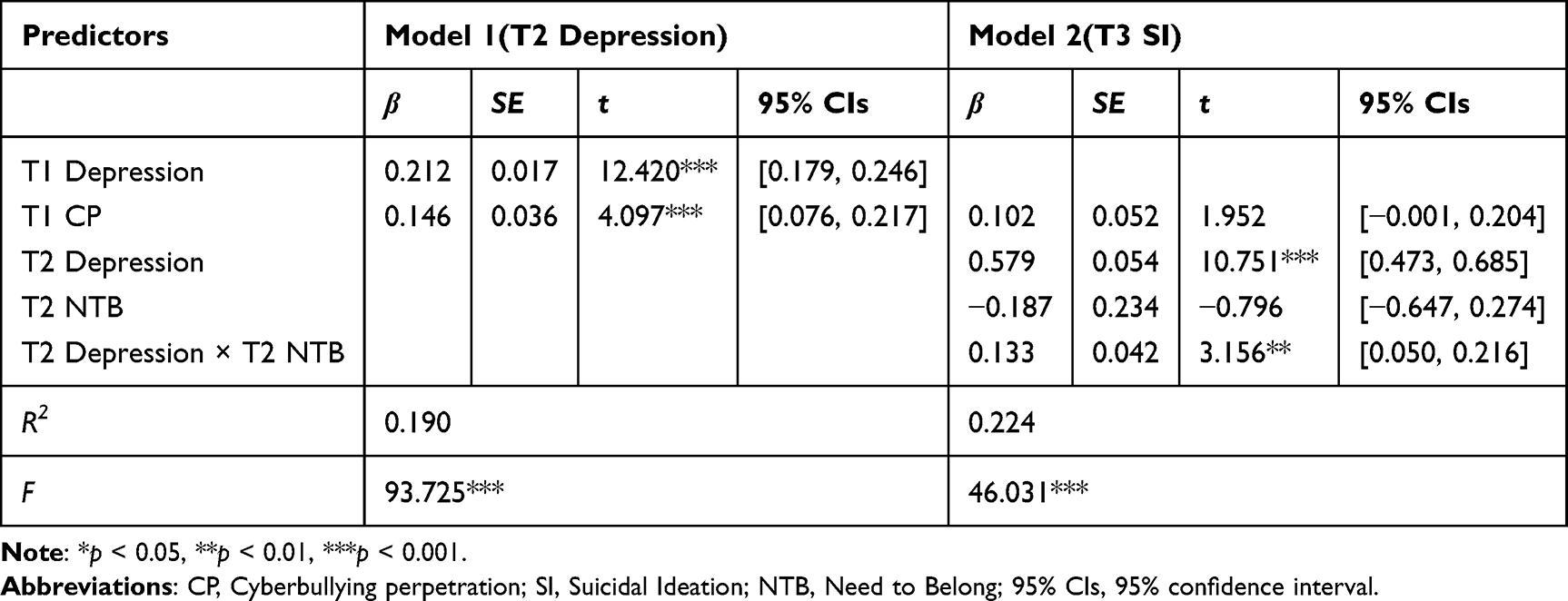 |
Table 3 Testing the Moderated Mediation Effect of Cyberbullying Perpetration on Suicidal Ideation |
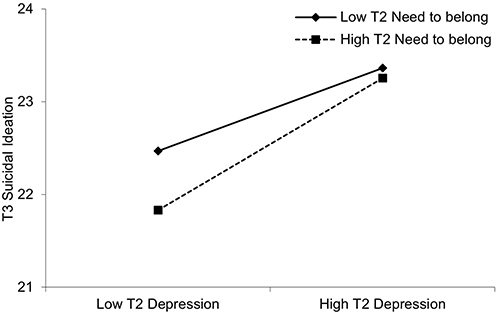 |
Figure 2 T2 NTB moderates the relationship between T2 depression and T3 suicidal ideation. |
Furthermore, the bias-corrected percentile bootstrap method confirmed that the indirect pathway between T2 depression and T3 suicidal ideation was moderated by T2 NTB. The relationship between T2 depression and T3 suicidal ideation was stronger for adolescents with high T2 NTB (β = 0.105, SE = 0.031, 95% CIs = [0.049, 0.169]) than for those with low T2 NTB (β = 0.063, SE = 0.024, 95% CIs = [0.026, 0.117]).
Overall, the present study confirmed the mediating role of depression and the moderating role of NTB in the relationship between cyberbullying perpetration and suicidal ideation among Chinese vocational school adolescents (see Figure 3).
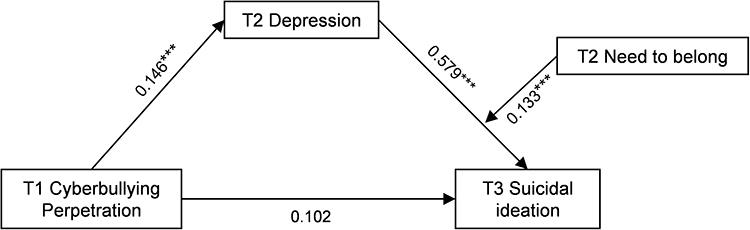 |
Figure 3 The moderated mediation model. Note: **p <0.01, ***p <0.001. |
Discussion
The present study adopted a three-wave longitudinal design and constructed a moderated mediation model to examine the mediating role of depression and the moderating role of NTB in the longitudinal relationship between cyberbullying perpetration and suicidal ideation among vocational school adolescents. Consistent with our hypotheses and theoretical theories (ie, the general strain theory19 and the interpersonal theory of suicide49), the results showed that T1 cyberbullying perpetration positively predicted adolescents’ T3 suicidal ideation, and T2 depression fully mediated this relationship. Moreover, T2 NTB moderated the indirect relationship between T2 depression and T3 suicidal ideation, such that this indirect effect was stronger for adolescents with high T2 NTB than for those with low T2 NTB. In other words, NTB significantly amplified the negative impact of depression on adolescents’ suicidal ideation.
Cyberbullying Perpetration and Suicidal Ideation Among Vocational School Adolescents
As expected, cyberbullying perpetration positively predicts vocational school adolescents’ suicidal ideation. This finding suggests that cyberbullying perpetration is a risk factor for heightened suicidal ideation among vocational school adolescents, aligning with the general strain theory.19,20 A possible explanation is that vocational school adolescents who engage in cyberbullying often experience a range of maladaptive emotional and behavioral problems, such as guilt, anxiety, depression, and social isolation.14,72,73 These psychological difficulties may intensify their emotional distress, fostering feelings of hopelessness and entrapment. Consequently, they may perceive suicide as a means of escape, ultimately leading to suicidal ideation.74
The results of the present study are consistent with most previous studies,9,10,25 but differ from other studies that found no significant association between cyberbullying perpetration and suicidal ideation.11,12 One reason for these discrepant findings lies in differences in the study samples. Arnon et al examined a sample of early adolescents with a mean age of 12 years,11 whereas the present study focused on late adolescents with a mean age of 17.5 years. Compared to early adolescents, late adolescents are more likely to engage in cyberbullying perpetration and more susceptible to its severe psychological consequences of cyberbullying, including suicidal ideation.22,72 Another factor contributing to these inconsistencies is the sample size. Kim et al included only 93 adolescents,12 which may have limited the generalizability of their findings and increased the risk of Type II errors. In contrast, the larger sample size in the present study provided for more reliable estimates and greater statistical power, enhancing the likelihood of detecting a significant relationship between cyberbullying perpetration and suicidal ideation.
The Mediating Role of Depression
In line with our expectations, the present study found that depression mediated the relationship between cyberbullying perpetration and suicidal ideation among vocational school adolescents. Specifically, vocational school adolescents who experience high levels of cyberbullying perpetration are more likely to develop depression, which, in turn, increases their risk of suicidal ideation. These findings provide an insight into how cyberbullying perpetration contributes to adolescents’ suicidal ideation. While a study has identified depression as a critical mediator, it employed a cross-sectional design, raising concerns about shared method variance.43 In contrast, this study employed a three-wave longitudinal design, providing a more robust test of the mediating role of depression in the relationship between cyberbullying perpetration and adolescents’ suicidal ideation. To our knowledge, this is the first longitudinal study using a longitudinal design to examine the mediating role of depression in this association. The present findings are consistent with general strain theory,19 which posits that adolescents who engage in cyberbullying are at high risk for developing emotional problems like depression. Consequently, these emotional problems may drive them to engage in maladaptive behaviors, including suicidal ideation, as a way to seek relief. Therefore, our results emphasize the importance of addressing depression as a key factor in preventing the negative psychological outcomes associated with cyberbullying, particularly suicidal ideation among vocational school adolescents.
In the first stage (ie, T1 cyberbullying perpetration→ T2 depression), we found that cyberbullying perpetration positively predicts adolescent depression. This finding is consistent with general strain theory,19 and previous studies,35–37,39 suggesting that adolescents engaging in cyberbullying perpetration are at high risk for developing depression. There are two possible explanations for this finding. First, cyberbullying perpetration may lead vocational school adolescents to become unpopular among their peers or experience social ostracism, thereby increasing their risk of depression.22 Second, engaging in cyberbullying perpetration may elicit negative emotions such as guilt, loneliness, hopelessness, and anxiety, placing adolescents at high risk of depression.21,31 Thus, cyberbullying perpetration may trigger maladaptive emotional responses such as depression among vocational school adolescents.
For the second stage (ie, T2 depression → T3 suicidal ideation), we found that depression positively predicted suicidal ideation among vocational school adolescents. This finding is consistent with existing research,41–43 suggesting that vocational school adolescents suffering from depression are more likely to develop suicidal ideation. The interpersonal theory of suicide provides an explanation for this finding,49 which posits that depression could lead to increased social withdrawal, social isolation, or negative social interactions. These interpersonal difficulties may then contribute to feelings of being a burden to others, ultimately leading to suicidal ideation. In fact, previous studies have demonstrated that depression contributes to suicidal ideation via perceived burdensomeness.44,45
The Moderating Role of NTB
The third aim of the study was to examine the moderating role of NTB in the relationship between depression and suicidal ideation. The results showed that NTB significantly moderated the relationship between depression and suicidal ideation among vocational school adolescents, with the relationship being stronger for adolescents with high NTB than for those with low NTB. That is, NTB exacerbated the association between depression and adolescents’ suicidal ideation. This finding aligns with the interpersonal theory of suicide,49 indicating that while NTB is generally adaptive, an excessively high NTB may not always be beneficial. Previous research has shown that elevated NTB are associated with lower well-being,75,76 higher levels of depression,55,57 and increased suicidal ideation.56 These findings suggest that high NTB may exacerbate emotional distress in adolescents, especially to those who are depressed. Individuals with high NTB typically exhibit stronger motivation for interpersonal connectedness.48 However, considering that depression is associated with more interpersonal difficulties and low relationship satisfaction,50,77 depressed individuals with high NTB may experience greater challenges in fulfilling their belongingness needs. This phenomenon may be particularly pronounced among vocational school adolescents, as they often experience less social support and greater societal discrimination or stigmatization compared to other peer groups.78,79 Research has suggested that this discrepancy between high NTB and impaired relationship satisfaction constitutes a significant risk factor for suicidal ideation.56 Thus, it is not surprising that NTB can strengthen the impact of depression on suicidal ideation among vocational school adolescents.
To our knowledge, this study is the first to confirm that NTB moderates the relationship between depression and suicidal ideation among vocational school adolescents. By identifying NTB as a crucial moderating factor, our study advances the understanding of mental health risks, particularly suicidal ideation, in depressed adolescents.
Limitations and Future Directions
This study has several limitations that should be considered. First, the sample’s exclusive focus on adolescents from vocational schools may introduce potential cultural or contextual biases, thereby reducing the generalizability of the findings to populations with differing sociocultural backgrounds or educational contexts. Future research should include participants from different educational backgrounds, such as regular high schools, colleges, or vocational schools in various regions, to enhance the generalizability of the findings. Second, this study relied on self-reported measures, which may introduce biases such as social desirability effects and recall inaccuracies. While self-reports provide valuable insights, they may not fully capture the complexity of psychological processes. Future research should incorporate multiple data sources, such as behavioral observations, experimental measures, or peer reports, to provide a more comprehensive understanding of the results found in this study. Third, the relatively short time intervals between the three data collection waves may fail to reveal the dynamic interaction among the variables of interest in this study. Future research should consider longer study periods to better track the long-term psychological effects and to provide a more comprehensive understanding of how these processes evolve over time.
Conclusion
In summary, this study developed a moderated mediation model to explore the longitudinal relationship between cyberbullying perpetration and suicidal ideation among vocational school adolescents, using a three-wave longitudinal design. The results showed that depression fully mediated the relationship between cyberbullying perpetration and adolescents’ suicidal ideation. Importantly, the indirect relationship between depression and suicidal ideation was moderated by NTB, with this relationship was stronger for adolescents with high NTB than those with low NTB. The findings enhance our understanding of how cyberbullying perpetration links to adolescents’ suicidal ideation and when this relationship is particularly strong. This study underscores the necessity for adopting a depression-focused intervention (eg, mindfulness and group psychological counseling), which could prevent cyberbullying behaviors from progressing to suicidal ideation among vocational school adolescents, especially those with high NTB.
Data Sharing Statement
The data that support the findings of this study are available from the corresponding author upon reasonable request.
Ethical Statement
This study was approved by the Ethics Committee of Guangxi Minzu University, review number: 202010608004.
Acknowledgments
We would like to express our sincere appreciation to all the study participants and extend our heartfelt thanks to the students, teachers, and school principals who contributed to this research.
Consent to Participate
Informed consent was obtained from all the subjects involved in the study.
Funding
This research was supported by grants from the Annual Major Project in 2025 for the 14th Five-Year Plan of Guangxi Educational Science (grant number: 2025A001), the 2023 Research Project of Philosophy and Social Science of Guangxi (grant number: 23BYY003), the 2024 Guangxi Higher Education Undergraduate Teaching Reform Engineering Project (grant number: 2024JGA161), the 2023‑2024 Education and Teaching Reform Project of Steering Committee for Psychology Education in Higher Education Institutions of Ministry of Education of China (titled: Research and Practice of Group Cooperative Learning Model in the Course of Experimental Psychology), the Humanities and Social Science Fund of Guangxi Minzu University (grant number: 2021MDSKYB03), and the Guangxi Minzu University Talent Introduction Research Start-up Project (grant number: 2021SKQD31).
Disclosure
The authors declare that they have no competing financial interests or personal relationships that could have appeared to influence the work reported in this paper.
References
1. World Health Organization. Suicide; 2024 Available from https://www.who.int/news-room/fact-sheets/detail/suicide/.
2. Klonsky ED, May AM. The three-step theory (3ST): a new theory of suicide rooted in the “ideation-to-action” framework. Int J Cogn Ther. 2015;8(2):114–129. doi:10.1521/ijct.2015.8.2.114
3. Bridge JA, Goldstein TR, Brent DA. Adolescent suicide and suicidal behavior. J Child Psychol Psychiatr. 2006;47(3–4):372–394. doi:10.1111/j.1469-7610.2006.01615.x
4. Franklin JC, Ribeiro JD, Fox KR, et al. Risk factors for suicidal thoughts and behaviors: a meta-analysis of 50 years of research. Psychol Bull. 2017;143(2):187–232. doi:10.1037/bul0000084
5. Voss C, Ollmann TM, Miché M, et al. Prevalence, onset, and course of suicidal behavior among adolescents and young adults in Germany. JAMA Netw Open. 2019;2(10):e1914386–e1914386. doi:10.1001/jamanetworkopen.2019.14386
6. Xiao Y, Cerel J, Mann JJ. Temporal trends in suicidal ideation and attempts among US adolescents by sex and race/ethnicity, 1991–2019. JAMA Netw Open. 2021;4(6):e2113513. doi:10.1001/jamanetworkopen.2021.13513
7. Zou GS, Lyu JC, Qiao XW. A meta-analysis of detection rate of suicidal ideation in middle school students in China. Chin Mental Health J. 2021;35(08):643–650. doi:10.3969/jissn1000-6729202108006
8. Teng Z, Zhang Y, Wei Z, et al. Internet addiction and suicidal behavior among vocational high school students in Hunan Province, China: a moderated mediation model. Front Public Health. 2023;10:063605. doi:10.3389/fpubh.2022.1063605
9. Benatov J, Brunstein Klomek A, Chen-Gal S. Bullying perpetration and victimization associations to suicide behavior: a longitudinal study. Eur Child Adolesc Psychiatry. 2022;31(9):1353–1360. doi:10.1007/s00787-021-01776-9
10. Skilbred-Fjeld S, Reme SE, Mossige S. Cyberbullying involvement and mental health problems among late adolescents. Cyberpsychology. 2020;14(1):5. doi:10.5817/CP2020-1-5
11. Arnon S, Brunstein Klomek A, Visoki E, et al. Association of cyberbullying experiences and perpetration with suicidality in early adolescence. JAMA Netw Open. 2022;5(6):e2218746. doi:10.1001/jamanetworkopen.2022.18746
12. Kim J, Walsh E, Pike K, Thompson EA. Cyberbullying and victimization and youth suicide risk: the buffering effects of school connectedness. J Sch Nurs. 2020;36(4):251–257. doi:10.1177/1059840518824395
13. Smith PK, Mahdavi J, Carvalho M, et al. Cyberbullying: its nature and impact in secondary school pupils. J Child Psychol Psychiatr. 2008;49(4):376–385. doi:10.1111/j.1469-7610.2007.01846.x
14. Hinduja S, Patchin JW. Connecting adolescent suicide to the severity of bullying and cyberbullying. J Sch Violence. 2019;18(3):333–346. doi:10.1080/15388220.2018.1492417
15. Wang X, Wang S. The bridge between cybervictimization and suicidal ideation among adolescents: a vicious cycle of hopelessness. J Youth Adolesc. 2023;52(5):996–1009. doi:10.1007/s10964-022-01726-x
16. Matos MG, Branquinho CS, Carvalho M. Cyberbullies, cybervictims and cyberbullies-victims: discriminant factors in Portuguese adolescents. Psicologia, Saúde Doenças. 2017;18(3):657–668. doi:10.15309/17psd180303
17. Campbell MA, Slee PT, Spears B, Butler D, Kift S. Do cyberbullies suffer too? Cyberbullies’ perceptions of the harm they cause to others and to their own mental health. Sch Psychol Int. 2013;34(6):613–629. doi:10.1177/0143034313479698
18. Plutchik R. Outward and inward directed aggressiveness: the interaction between violence and suicidaliy. Pharmacopsychiatry. 1995;28(S2):47–57. doi:10.1055/s-2007-979620
19. Agnew R. Foundation for a general strain theory of crime and delinquency. Criminology. 1992;30(1):47–88. doi:10.1111/j.1745-9125.1992.tb01093.x
20. Bishopp SA, Boots DP. General strain theory, exposure to violence, and suicide ideation among police officers: a gendered approach. J Crim Justice. 2014;42(6):538–548. doi:10.1016/j.jcrimjus.2014.09.007
21. Cañas E, Estévez E, Martínez-Monteagudo MC, Delgado B. Emotional adjustment in victims and perpetrators of cyberbullying and traditional bullying. Soc Psychol Educ. 2020;23(4):917–942. doi:10.1007/s11218-020-09565-z
22. Kowalski RM, Giumetti GW, Schroeder AN, Lattanner MR. Bullying in the digital age: a critical review and meta-analysis of cyberbullying research among youth. Psychol Bull. 2014;140(4):1073–1137. doi:10.1037/a0035618
23. Alghamdi W, Almadani S, Banjer H, Alsulami D, Alghamdi Y. Relationship between cyberbullying, anxiety, and depression among university students in Jeddah, Saudi Arabia: a cross-sectional study. Int J Psychiatry Med. 2025;60(2):170–186. doi:10.1177/00912174241265560
24. Martínez-Monteagudo MC, Martínez-Monteagudo Á, Estévez E, Delgado B. Cyberbullying profiles: differences in anxiety, depression, and stress in a sample of Spanish students. Sage Open. 2024;14(2):21582440241251608. doi:10.1177/21582440241251608
25. Bitar Z, Elias MB, Malaeb D, Hallit S, Obeid S. Is cyberbullying perpetration associated with anxiety, depression and suicidal ideation among Lebanese adolescents? Results from a cross-sectional study. BMC Psychol. 2023;11(1):53. doi:10.1186/s40359-023-01091-9
26. John A, Glendenning AC, Marchant A, et al. Self-harm, suicidal behaviours, and cyberbullying in children and young people: systematic review. J Med Internet Res. 2018;20(4):e129–e129. doi:10.2196/jmir.9044
27. Chen Q, Tang J, Zhu Y, Chan KL. The role of school climate on student disclosure of private information and cyberbullying: a comparison of regular and vocational school students in China. Front Public Health. 2024;12:1336617. doi:10.3389/fpubh.2024.1336617
28. Ouyang M, Gui D, Cai X, et al. Stressful life events and subjective well-being in vocational school female adolescents: the mediating role of depression and the moderating role of perceived social support. Front Psychol. 2020;11:603511. doi:10.3389/fpsyg.2020.603511
29. Liu X, Wang J. Depression, anxiety, and student satisfaction with university life among college students: a cross-lagged study. Humanit Soc Sci Commun. 2024;11(1):1172. doi:10.1057/s41599-024-03686-y
30. Kircaburun K, Demetrovics Z, Király O, Griffiths MD. Childhood emotional trauma and cyberbullying perpetration among emerging adults: a multiple mediation model of the role of problematic social media use and psychopathology. Int J Ment Health Addict. 2020;18(3):548–566. doi:10.1007/s11469-018-9941-5
31. Wang W, Xie X, Wang X, et al. Cyberbullying and depression among Chinese college students: a moderated mediation model of social anxiety and neuroticism. J Affect Disord. 2019;256:54–61. doi:10.1016/j.jad.2019.05.061
32. Liu X, Yuan Y, Gao W, Luo Y. Longitudinal trajectories of self-esteem, related predictors, and impact on depression among students over a four-year period at college in China. Humanit Soc Sci Commun. 2024;11(1):1–8. doi:10.1057/s41599-024-03136-9
33. Kiing JSH, Ragen ES, Sulaiman MS, et al. Bullying and depression among adolescents in East Asia: a scoping review on prevalence rates, risk and protective factors. Front Psychiatry. 2025;16:1497866. doi:10.3389/fpsyt.2025.1497866
34. Elamoshy R, Bird Y, Thorpe L, Moraros J, Moraros J. Risk of depression and suicidality among diabetic patients: a systematic review and meta-analysis. J Clin Med. 2018;7(11):445. doi:10.3390/jcm7110445
35. Alrajeh SM, Hassan HM, Al-Ahmed AS, Alsayed HD. An investigation of the relationship between cyberbullying, cybervictimization and depression symptoms: a cross sectional study among university students in Qatar. PLoS One. 2021;16(12):e0260263. doi:10.1371/journal.pone.0260263
36. Wright MF, Wachs S. Cyberbullying involvement and depression among elementary school, middle school, high school, and university students: the role of social support and gender. Int J Environ Res Public Health. 2023;20(4):2835. doi:10.3390/ijerph20042835
37. Turliuc MN, Măirean C, Boca-Zamfir M. The relation between cyberbullying and depressive symptoms in adolescence. The moderating role of emotion regulation strategies. Comput Human Behav. 2020;109:106341. doi:10.1016/j.chb.2020.106341
38. Marciano L, Schulz PJ, a C. Cyberbullying perpetration and victimization in youth: a meta-analysis of longitudinal studies. J Comput Mediat Commun. 2020;25(2):163–181. doi:10.1093/jcmc/zmz031
39. Ye Z, Wu D, He X, et al. Meta-analysis of the relationship between bullying and depressive symptoms in children and adolescents. BMC Psychiatry. 2023;23(1):215. doi:10.1186/s12888-023-04681-4
40. Yu J, Goldstein RB, Haynie DL, et al. Resilience factors in the association between depressive symptoms and suicidality. J Adolesc Health. 2021;69(2):280–287. doi:10.1016/j.jadohealth.2020.12.004
41. Gijzen MWM, Rasing SPA, Creemers DHM, et al. Suicide ideation as a symptom of adolescent depression. a network analysis. J Affect Disord. 2021;278:68–77. doi:10.1016/j.jad.2020.09.029
42. Poindexter EK, Mitchell SM, Brown SL, Cukrowicz KC. Interpersonal trauma and suicide ideation: the indirect effects of depressive symptoms, thwarted belongingness, and perceived burden. J Interpers Violence. 2022;37(1–2):NP551–NP570. doi:10.1177/0886260520917513
43. Tabares ASG, Restrepo JE, Zapata-Lesmes G. The effect of bullying and cyberbullying on predicting suicide risk in adolescent females: the mediating role of depression. Psychiatry Res. 2024;337:115968. doi:10.1016/j.psychres.2024.115968
44. Kerr DCR, Reinke WM, Eddy JM. Trajectories of depressive symptoms and externalizing behaviors across adolescence: associations with histories of suicide attempt and ideation in early adulthood. Suicide Life-Threat. 2013;43(1):50–66. doi:10.1111/j.1943-278X.2012.00127.x
45. El-Hourani M, Zadra A, Castellanos-Ryan N, et al. Longitudinal associations throughout adolescence: suicidal ideation, disturbing dreams, and internalizing symptoms. Sleep Med. 2022;98:89–97. doi:10.1016/j.sleep.2022.06.012
46. Cheng G, Liu J, Yang Y, et al. Stressful events and adolescents’ suicidal ideation during the COVID-19 epidemic: a moderated mediation model of depression and parental educational involvement. Child Youth Serv Rev. 2021;127:106047. doi:10.1016/j.childyouth.2021.106047
47. Baumeister RF, Leary MR. The need to belong: desire for interpersonal attachments as a fundamental human motivation. Psychol Bull. 1995;117(3):497–529. doi:10.1037/0033-2909.117.3.497
48. Pickett CL, Gardner WL, Knowles M. Getting a cue: the need to belong and enhanced sensitivity to social cues. Pers Soc Psychol Bull. 2004;30(9):1095–1107. doi:10.1177/0146167203262085
49. Van Orden KA, Witte TK, Cukrowicz KC, et al. The interpersonal theory of suicide. Psychol Rev. 2010;117(2):575–600. doi:10.1037/a0018697
50. Lawrence KC. Traumatising factors influencing interpersonal relationships of university students. Cogent Psychol. 2020;7(1):1835383. doi:10.1080/23311908.2020.1835383
51. Dutcher JM, Lederman J, Jain M, et al. Lack of belonging predicts depressive symptomatology in college students. Psychol Sci. 2022;33(7):1048–1067. doi:10.1177/09567976211073135
52. Samadieh H, Rezaei M. A serial mediation model of sense of belonging to university and life satisfaction: the role of social loneliness and depression. Acta Psychol. 2024;250:104562. doi:10.1016/j.actpsy.2024.104562
53. Epley N, Akalis S, Waytz A, Cacioppo JT. Creating social connection through inferential reproduction: loneliness and perceived agency in gadgets, gods, and greyhounds. Psychol Sci. 2008;19(2):114–120. doi:10.1111/j.1467-9280.2008.02056.x
54. Reichl C, Schneider JF, Spinath FM. Relation of self-talk frequency to loneliness, need tobelong, and health in German adults. Pers Individ Dif. 2013;54(2):241–245. doi:10.1016/j.paid.2012.09.003
55. Barbour EK, Smallwood SW, Hurt Y. Examining social activity, need to belong, and depression among college students. J Am Coll Health. 2023;71(7):2263–2271. doi:10.1080/07448481.2021.1967357
56. Dienst F, Forkmann T, Schreiber D, Holler I. Attachment and need to belong as moderators of the relationship between thwarted belongingness and suicidal ideation. BMC Psychol. 2023;11(1):50. doi:10.1186/s40359-023-01080-y
57. Kealy D, Hewitt PL, Cox DW, Laverdière O. Narcissistic vulnerability and the need for belonging: moderated mediation from perceived parental responsiveness to depressive symptoms. Curr psychol. 2023;42(4):2820–2826. doi:10.1007/s12144-021-01644-4
58. Faul F, Erdfelder E, Buchner A, Lang A. Statistical power analyses using G* Power 3.1: tests for correlation and regression analyses. Behav Res Methods. 2009;41(4):1149–1160. doi:10.3758/BRM.41.4.1149
59. Zhang Y, Zhou J, Wang F, et al. The impact of cyberbullying victimization on internet gaming addiction among college students: the mediating roles of basic psychological need satisfaction and frustration, and the moderating role of parental autonomy support. Psychol Res Behav Manag. 2024;Volume 17:4105–4118. doi:10.2147/PRBM.S486250
60. Wright MF. Longitudinal investigation of the associations between adolescents’ popularity and cyber social behaviors. J Sch Violence. 2014;13(3):291–314. doi:10.1080/15388220.2013.849201
61. Wang X, Lei L, Liu D, Hu H. Moderating effects of moral reasoning and gender on the relation between moral disengagement and cyberbullying in adolescents. Pers Individ Dif. 2016;98:244–249. doi:10.1016/j.paid.2016.04.056
62. Osman A, Gutierrez PM, Kopper BA, Barrios FX, Chiros CE. The positive and negative suicide ideation inventory: development and validation. Psychol Rep. 1998;82(3):783–793. doi:10.2466/pr0.1998.82.3.783
63. Wang XZ, Gong HL, Kang XR, et al. Reliability and validity of Chinese revision of positive and negative suicide ideation in high school students. China J Health Psychol. 2011;19(8):964–966. doi:10.1016/j.sleep.2022.06.012
64. Kroenke K, Spitzer RL, Williams JB. The PHQ-9: validity of a brief depression severity measure. J Gen Intern Med. 2001;16(9):606–613. doi:10.1046/j.1525-1497.2001.016009606.x
65. Yin L, Teklu S, Pham H, et al. Validity of the Chinese language patient health questionnaire 2 and 9: a systematic review. Health Equity. 2022;6(1):574–594. doi:10.1089/heq.2022.0030
66. Nichols AL, Webster GD. The single-item need to belong scale. Pers Individ Dif. 2013;55(2):189–192. doi:10.1016/j.paid.2013.02.018
67. Wang P, Zhao M, Wang X, et al. Peer relationship and adolescent smartphone addiction: the mediating role of self-esteem and the moderating role of the need to belong. J Behav Addict. 2017;6(4):708–717. doi:10.1556/2006.6.2017.079
68. Koo TK, Li MY. A guideline of selecting and reporting intraclass correlation coefficients for reliability research. J Chiropr Med. 2016;15(2):155–163. doi:10.1016/j.jcm.2016.02.012
69. Cole DA, Maxwell SE. Testing mediational models with longitudinal data: questions and tips in the use of structural equation modeling. J Abnormal Psychol. 2003;112(4):558–577. doi:10.1037/0021-843x.112.4.558
70. Zhou J, Yu JE, Zhou Y, Qiu J. Study of item text in the Chinese symptom checklist-90. Medicine. 2021;100(11):e24841. doi:10.1097/MD.0000000000024841
71. Hayes L, Pössel P, Roane SJ. Perceived everyday discrimination and depressive symptoms: does cognitive style mediate? J Couns Dev. 2019;97(4):427–436. doi:10.1002/jcad.12291
72. Bauman S, Toomey RB, Walker JL. Associations among bullying, cyberbullying, and suicide in high school students. J Adolesc. 2013;36(2):341–350. doi:10.1016/j.adolescence.2012.12.001
73. Gámez-Guadix M, Orue I, Smith PK, Calvete E. Longitudinal and reciprocal relations of cyberbullying with depression, substance use, and problematic internet use among adolescents. J Adolesc Health. 2013;53(4):446–452. doi:10.1016/j.jadohealth.2013.03.030
74. O’Connor RC, Kirtley OJ. The integrated motivational-volitional model of suicidal behaviour. Philos T R Soc B. 2018;373(1754):20170268. doi:10.1098/rstb.2017.0268
75. Leary MR, Kelly KM, Cottrell CA, Schreindorfer LS. Construct validity of the need to belong scale: mapping the nomological network. J Pers Assess. 2013;95(6):610–624. doi:10.1080/00223891.2013.819511
76. Verhagen M, Lodder GMA, Baumeister RF. Unmet belongingness needs but not high belongingness needs alone predict adverse well-being: a response surface modeling approach. J Pers. 2018;86(3):498–507. doi:10.1111/jopy.12331
77. Rum R, Birg JA, Silva G, et al. Social motivation differentiates social anxiety and depression: a daily diary study. Behav Ther. 2024;55(4):698–711. doi:10.1016/j.beth.2023.11.004
78. Sun P, Sun Y, Fang D, Jiang H, Pan M. Cumulative ecological risk and problem behaviors among adolescents in secondary vocational schools: the mediating roles of core self-evaluation and basic psychological need satisfaction. Front Public Health. 2021;9:591614. doi:10.3389/fpubh.2021.591614
79. Wang X, Leng J, Cong X, Fan Z. Development of junior high school students to secondary vocational students stigma scale. Psychol Res Behav Manag. 2022;15:2957–2970. doi:10.2147/PRBM.S381069
 © 2025 The Author(s). This work is published and licensed by Dove Medical Press Limited. The
full terms of this license are available at https://www.dovepress.com/terms
and incorporate the Creative Commons Attribution
- Non Commercial (unported, 4.0) License.
By accessing the work you hereby accept the Terms. Non-commercial uses of the work are permitted
without any further permission from Dove Medical Press Limited, provided the work is properly
attributed. For permission for commercial use of this work, please see paragraphs 4.2 and 5 of our Terms.
© 2025 The Author(s). This work is published and licensed by Dove Medical Press Limited. The
full terms of this license are available at https://www.dovepress.com/terms
and incorporate the Creative Commons Attribution
- Non Commercial (unported, 4.0) License.
By accessing the work you hereby accept the Terms. Non-commercial uses of the work are permitted
without any further permission from Dove Medical Press Limited, provided the work is properly
attributed. For permission for commercial use of this work, please see paragraphs 4.2 and 5 of our Terms.