
Back to Journals » Journal of Pain Research » Volume 18
The Genetic Association Between Prescription Pain Medication Use and the Risk for Fibromyalgia: A Bidirectional and Multivariable Mendelian Randomization Analysis
Authors Zhou G, Cao W, Liang S, Ye Z, Liu Z, Zou W 
Received 26 May 2025
Accepted for publication 14 October 2025
Published 16 October 2025 Volume 2025:18 Pages 5455—5465
DOI https://doi.org/10.2147/JPR.S526655
Checked for plagiarism Yes
Review by Single anonymous peer review
Peer reviewer comments 3
Editor who approved publication: Dr Timothy Atkinson
Gaojie Zhou,1,* Wei Cao,1,* Shuang Liang,1 Ziyu Ye,1 Zhuoyi Liu,1 Wangyuan Zou1,2
1Department of Anesthesiology, Xiangya Hospital, Central South University, Hunan Province Clinical Research Center for Anesthesia and Perioperative Medicine, Changsha, People’s Republic of China; 2National Clinical Research Center for Geriatric Disorders, Xiangya Hospital, Changsha, People’s Republic of China
*These authors contributed equally to this work
Correspondence: Wangyuan Zou, Department of Anesthesiology, Xiangya Hospital, Central South University, 87 Xiangya Road, Changsha, 410008, People’s Republic of China, Tel/Fax +86-731-84327413, Email [email protected]
Introduction: Increasing evidence has indicated that prescription opioid use is associated with poor prognosis in patients with fibromyalgia. However, it remains unknown whether there are causal associations between prescription opioid and fibromyalgia.
Methods: We performed a bidirectional two-sample MR analysis using genetic variants associated with prescription pain medication use and fibromyalgia from genome-wide association studies (GWAS). Multivariable Mendelian randomization (MVMR) was further employed to ascertain the causal relationship, incorporating confounders such as major depressive disorder (MDD), anxiety disorders (ADs) and insomnia. A mediation MR analysis was conducted to assess their potential mediating roles.
Results: The forward two-sample Mendelian analysis revealed a positive causal role in the contribution of prescription opioid use to fibromyalgia, as indicated by the Inverse Variance Weighted (IVW) method (OR = 1.42, 95% CI: 1.17, 1.72, p = 3.55E-04) and the Weighted Median method (OR = 1.40, 95% CI: 1.07, 1.83; p = 0.01). In MVMR, the association remained after accounting for MDD, ADs and insomnia, none of which exhibited mediating effects. In the reverse MR analysis, which assessed whether fibromyalgia causally affected prescription opioid use, no significant associations were found. No substantial associations were observed between non-opioid pain medications and fibromyalgia.
Conclusion: Our findings provide genetic evidence supporting causal relationship for prescription opioid use on a high risk of fibromyalgia. This association remains robust after adjustment for MDD, ADs and insomnia. Given the potential for opioid prescriptions to increase the risk of developing fibromyalgia, clinicians should prioritize alternative, evidence-based pain management strategies.
Keywords: fibromyalgia, opioids, Mendelian randomization, genome-wide association studies
Introduction
Chronic pain can be categorized into nociceptive, neuropathic, and nociplastic pain.1 Fibromyalgia, also referred to as widespread musculoskeletal pain, is a typical type of nociplastic pain. People with fibromyalgia tend to have worse health states than those with other chronic pain conditions. It is often accompanied by other symptoms, such as fatigue, intestinal disorders, sleep disturbance, and mood problems. It is usually seen as a comorbidity of other chronic pain conditions, such as osteoarthritis, rheumatoid arthritis, and lupus. In addition, the management of fibromyalgia typically involves a combination of non-pharmacological and pharmacological approaches, with a particular emphasis on patient education, psychotherapy, medication, and physical therapy.2
The long-term use of opioids is associated with many side effects, such as addiction, tolerance, allodynia, hyperalgesia, and dependence.3–5 A retrospective cohort study, which was conducted to examine the trend in pain medication prescriptions from 2012 to 2022, revealed an increase in the use of nonsteroidal anti-inflammatory drugs (NSAIDs), acetaminophen, opioids, neuropathic agents, and muscle relaxants.6 Studies have also shown that prescription opioids are often the first to be misused,7 with almost 30% of patients prescribed these medications for chronic pain engaging in misuse, and approximately 12% developing opioid use disorder (OUD).8
Unfortunately, opioid analgesics are not recommended for the treatment of fibromyalgia. Fibromyalgia does not fall within the category of neuropathic pain. But its clinical management still follows the therapeutic approaches used for neuropathic pain.9 Duloxetine, milnacipran, and pregabalin are approved by the US Food and Drug Administration (FDA) for the treatment of fibromyalgia.10 A cross-sectional study indicated that the presence of fibromyalgia may be associated with increased odds of pain-precipitated OUD.11 Additionally, almost all individuals ultimately diagnosed with fibromyalgia have experienced multiple bouts of chronic pain in various parts of their bodies throughout their early life, making them more prone to using opioids and other analgesics for relief before receiving a formal diagnosis.12 Collectively, these findings suggest a significant association between prescription opioid use (POU) and fibromyalgia. Although opioid use can exacerbate fibromyalgia-related hyperalgesia and central sensitization, there is currently no evidence from prospective studies or randomized clinical trials to determine a causal relationship between POU and fibromyalgia.13,14
The Mendelian randomization (MR) method, an effective approach to examining whether the exposure plays a causal role in the etiology of an outcome, can mitigate confounder bias in observational studies by using the random distribution characteristics of genetic variation in the population to simulate the randomization process in randomized controlled trials.15 Early identification of individuals at risk for fibromyalgia and strategies to reduce opioid use are critical for improving patient prognosis and preventing symptom exacerbation. Establishing a causal relationship between pain medication use and the risk of fibromyalgia could provide valuable insights for guiding clinical decision-making and tailoring interventions to protect vulnerable populations from worsening health states. In this study, we conducted bidirectional Mendelian randomization, multivariable MR (MVMR) and Mediation Mendelian randomization to further assess this association. Previous studies have indicated that depressive disorder, anxiety, and insomnia are linked to the risk of increased opioid consumption,16,17 and that patients with fibromyalgia tend to have cognitive and emotional problems, which may lead to prejudice against the independence assumption.18,19 MVMR can account for the potential confounding factors mentioned above that may affect the assessment of the relationship between prescription opioid use and the risk for fibromyalgia. Here, we found a genetic causal association between increased prescription opioid use and the risk for fibromyalgia.
Materials and Methods
Study Design
Two-sample MR analysis was implemented to assess the causal effect of prescription opioid and non-opioid medication use on the risk of fibromyalgia, and vice versa. We validated our results of univariate two sample MR analysis by testing for sensitivity analysis, heterogeneity, and horizontal pleiotropy. In the MVMR analysis, major depressive disorder (MDD), anxiety disorders (ADs), and insomnia were incorporated as confounders to ascertain the direct impact of opioid medication use on fibromyalgia. (Figure 1) Because these factors may also be mediating variables in fibromyalgia, then we explicitly tested the causal effects between prescription opioid use and the four mediators by MR analysis. This investigation utilized publicly available summary statistics whose original study had been reviewed and approved by the local ethics committee.
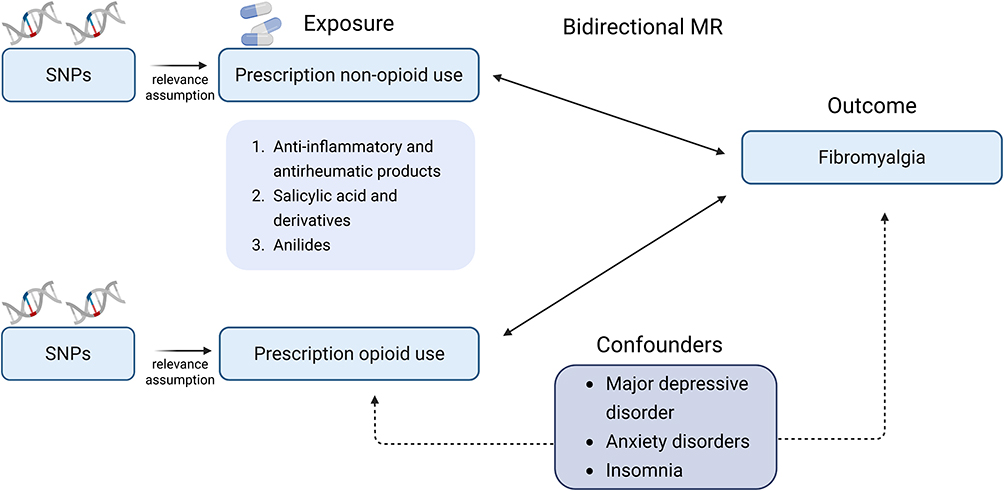 |
Figure 1 The overview of the study design of mendelian analysis. |
Data Source
A brief introduction of the GWAS data sources is presented in the table (Supplementary Table 1).
Data Sources for Patients with Fibromyalgia
The summary statistics of patients with fibromyalgia were obtained from the FinnGen R11 database. The FinnGen study is a large-scale genomics initiative that has analyzed over 500,000 Finnish biobank samples and correlated genetic variation with health data to understand disease mechanisms and predispositions.20 The dataset comprises 3,166 cases and 326,530 controls, among which 2,956 are female patients. The diagnosis of fibromyalgia met the corresponding criteria in the ICD-10.20 The current diagnostic criteria for fibromyalgia in adults require the following four conditions to be simultaneously satisfied: (1) Generalized pain, defined as pain in at least 4 of 5 regions, is present. (2) Symptoms must have persisted at a similar severity for at least 3 months. (3) Widespread pain index (WPI) ≥ 7 and symptom severity scale (SSS) score ≥ 5 OR WPI of 4–6 and SSS score ≥ 9. (4) The diagnosis is considered independently valid and is not precluded by the coexistence of other distinct clinical disorders.21 All participants were of European ancestry, and none of them overlapped with the UK Biobank.
Data Sources for Prescription Opioid and Nonopioid Medication Use
The summary statistics of prescription opioid and non-opioid medication use were sourced from the United Kingdom Biobank (UKB). UKB has classified medications into 6,745 categories, of which 1,809 were reported by 10 or more people. Among these, 1,752 were classified via the Anatomical Therapeutic Chemical (ATC) Classification System and then allocated to 23 categories according to their active ingredients, partially incorporating opioids (such as morphine, oxycodone, codeine, fentanyl, pethidine, and tramadol), NSAIDs, anilides, and salicylic acid products. Although 502,616 individuals with an average age of 56.5 years (with a standard deviation of 8.1 years) had medication histories documented during their initial UKB evaluation, only 318,177 of them had complete medication records and took any of the 1,752 medications.22
Data Sources for Primary Anxiety Disorders and Major Depressive Disorder
The genetic instruments for anxiety disorders were obtained from a large-scale genome-wide association meta-analysis conducted by the Anxiety NeuroGenetics STudy (ANGST) Consortium. This analysis included data from nine samples of European ancestry, totaling 31,060 individuals. Standardized diagnostic assessments were used to identify 7,016 cases with any lifetime anxiety disorder diagnosis (generalized anxiety disorder, panic disorder, social phobia, agoraphobia, or specific phobias) and 14,745 “super-normal” controls without significant anxiety symptoms. The estimated SNP-based heritability of the anxiety phenotypes was approximately 10% on the liability scale.23 The summary statistics for MDD were sourced from a large-scale GWAS meta-analysis conducted by the Psychiatric Genomics Consortium (PGC). This MDD GWAS dataset included 135,458 cases and 344,901 controls, primarily of European descent, recruited from seven cohorts across various countries. MDD diagnoses were made according to international consensus criteria (DSM-IV, ICD-9, or ICD-10) for lifetime MDD.24 To reduce sample overlap, we used statistics of MDD excluding both the UKB (14,260 cases and 15,480 controls) and 23andMe cohorts (59,851 cases and 113,154 controls).
Data Sources for Insomnia
The GWAS summary statistics of insomnia were sourced from the Complex Trait Genetics lab (CTGlab) of Center for Neurogenomics and Cognitive Research (CNCR). Original summary statistics included data collected in the UK Biobank version 29 (n = 386,533) and 23andMe (n = 944,477).25 Due to restrictions on sharing the data, the summary statistics we used in this study do not include 23andMe participants. Insomnia complaints were measured via questionnaire data. An independent sample of the Netherlands Sleep Register was used to verify the validity of the questionnaire.
Statistical Analysis
Selection of Genetic Instruments
We first selected relevant SNPs in the GWAS dataset of exposure that had reached the significance threshold of p < 5×10⁻⁶ and then eliminated linkage disequilibrium (LD) by removing SNPs that had r2 > 0.001 with other SNPs in a 10,000 SNP window.26 The instrumental variables (IVs) selected to meet the three fundamental assumptions are as follows: (1) IVs are highly related to the exposure (relevance assumption); (2) IVs are not relevant to confounding factors (independence assumption); and (3) IVs influence the outcome only through their impact on the exposure (exclusive assumption).27 Next, the F parameter for each SNP was calculated using the formula F = β2/se2, and SNPs with F-statistic < 10 were removed to reduce weak instrument bias.28,29 Then, we used the SNPs selected above to harmonize with GWAS summary statistics of outcomes, excluding palindromic SNPs with intermediate allele frequencies. In addition, we checked whether there were SNPs strongly related to the outcome, which were defined as p < 5×10⁻⁶ in the harmonization dataset. Finally, before MR analysis, the MR PRESSO method was used to remove outlier SNPs that affected horizontal pleiotropy.
Univariate MR Analysis (UVMR)
A series of analyses for Mendelian Randomization were conducted with R software (version 4.3.2) and certain packages, including TwoSampleMR, Mendelian randomization, and the MR-PRESSO package.
We mainly incorporated Inverse Variance Weighted (IVW), MR Egger, and Weighted Median for MR analyses, of which IVW was the most significant method. The IVW method can be performed via a fixed-effects or a random-effects meta-analysis model.30 It requires that SNPs fully comply with the three principles of selection for instruments to obtain accurate causal estimates. If heterogeneity and pleiotropy are not found in the sensitivity analyses, IVW method may be the preferred choice. Unlike IVW method, MR-Egger method can detect and adjust for directional pleiotropy. It merely needs to fulfill the instrument strength independent of direct effect (InSIDE) and NO Measurement Error (NOME) assumption,31 in which case weakens the exclusive assumption and requires no measurement error in the association between instrumental variables and the exposure factors.32 If the intercept term is exactly equal to zero which means that there is no pleiotropic effect, then the MR-Egger estimate will equal the IVW estimate.33 The Weighted Median approach can provide a consistent estimate of the causal effect even when more than 50% of genetic instrumental variants are invalid. When there is heterogeneity but no pleiotropy, we prioritize the estimate of Weighted Median.34 The method of calculating mediating effect is in the Supplementary Method 1.
To evaluate the robustness and validity of the Mendelian randomization (MR) results, we assessed heterogeneity via Cochran’s Q test and visualized the data with a scatter plot. Horizontal pleiotropy was examined via the MR-Egger intercept test and the MR PRESSO global test. If the p-value for Cochran’s Q statistic was less than 0.05, we concluded that heterogeneity was present. Additionally, if the p-value for the MR-Egger intercept test was less than 0.05, pleiotropy was indicated. Furthermore, leave-one-out analysis was performed to assess the impact of each SNP on the overall causal estimate by removing one SNP at a time. Sensitivity analyses, including forest plots and funnel plots, were also carried out.
Multivariable MR Analysis
To investigate the independent effects of prescription opioid use on the risk of fibromyalgia, we conducted additional MVMR analyses.35 First, for each exposure dataset, SNPs strongly associated with the trait were selected, with a stringent threshold of p < 5×10⁻⁶. To minimize potential confounding due to genetic correlation, SNPs in linkage disequilibrium (LD) (defined as r² > 0.1 within a 1000 kb window) were excluded. Second, SNPs from multiple exposures were integrated into a dataset, and overlapping variants were removed. We further reassessed LD across the selected SNPs to ensure independence, eliminating any remaining SNPs showing high LD. Third, we extracted the corresponding information for each SNP from both the exposure and outcome datasets. Allele alignment was subsequently performed to ensure consistency in the direction of effects across all genetic variants. Finally, we used the MR-LASSO method to estimate the causal effect of each exposure on the outcome and removed exposures with high collinearity. The primary causal estimates for the exposures selected by MR-LASSO were derived using the multivariate Inverse Variance Weighted (MV-IVW) method.
Results
Univariate MR Analysis
In the context of prescription opioid use and its impact on fibromyalgia, a total of 35 SNPs were selected as instrumental variants after linkage disequilibrium (LD) clumping and harmonization. Palindromic SNPs with intermediate allele frequencies were also removed after harmonization. No SNPs strongly correlated with fibromyalgia were found. The remaining SNPs displayed F statistics exceeding 10, indicating that there was no bias from weak instruments (Supplementary Table 2). The relationship between prescription opioid use and fibromyalgia showed a positive causal association with the application of the Inverse Variance-Weighted (IVW) method (OR = 1.42, 95% CI: 1.17, 1.72, p = 3.55E-04) and Weighted Median method (OR = 1.40, 95% CI: 1.07, 1.83; p = 0.01). However, the results of the MR Egger method were not significantly different (OR = 1.28, 95% CI: 0.72, 2.27; p = 0.40) (Figures 2A and 3).
 |
Figure 2 Scatter plots of the causal effect of prescription pain medication use on fibromyalgia. (A) Scatter plot of the causal effect of Opioids on fibromyalgia; (B) Scatter plot of the causal effect of Anti-inflammatory and antirheumatic products (non-steroids) on fibromyalgia; (C) Scatter plot of the causal effect of Anilides on fibromyalgia; (D) Scatter plot of the causal effect of Salicylic acid on fibromyalgia. |
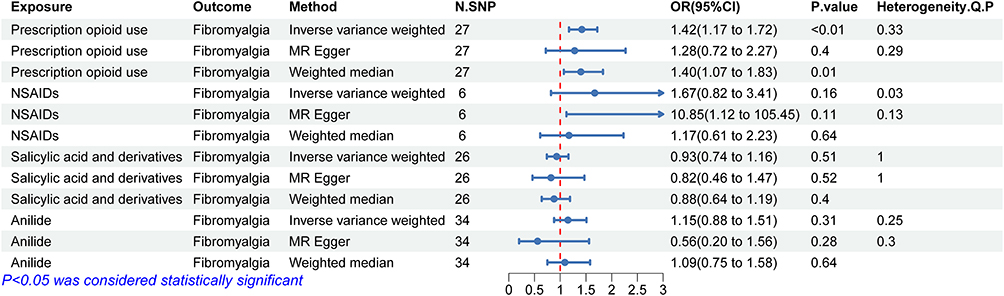 |
Figure 3 Forest plot of the MR estimates of prescription pain medication use on fibromyalgia. The blue horizontal lines indicate the 95% confidence intervals, and the blue dots represent the point estimates of the odds ratios. The vertical dashed red line positioned at an odds ratio of 1 corresponds to the null hypothesis, indicating no causal effect. The blue text at the bottom (P < 0.05 was considered statistically significant) specifies the threshold for determining statistical significance of P - values in these analyses. NSAIDs, anti-inflammatory and antirheumatic products (non-steroids). |
With respect to the use of non-opioid prescriptions for fibromyalgia Mendelian Randomization (MR) estimates, we analyzed the causal effect of other non-opioid medications, including anti-inflammatory and antirheumatic products (nonsteroids), salicylic acid and its derivatives and anilides on fibromyalgia (Figures 2B–D and 3). A total of 35, 367 and 38 SNPs were selected as instrumental variants for anilides, NSAIDs, and salicylic acid and derivatives, respectively, after LD clumping and harmonization (Supplementary Tables 3–5). The IVW method did not show any substantial correlations between these pain medications and fibromyalgia (all p values > 0.05). This conclusion of non-significance was reinforced by the MR-Egger and Weighted Median methods (Figure 3). In the backward MR analysis investigating whether fibromyalgia has a causal effect on pain medication use, we also did not find connections because the estimates lacked statistical significance (Figure 4, Supplementary Figure 1 and Supplementary Tables 6–10).
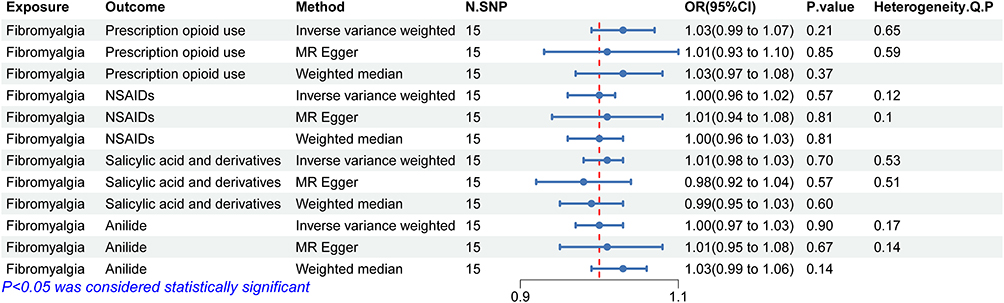 |
Figure 4 Forest plot of the MR estimates of fibromyalgia on prescription pain medication use. The blue horizontal lines indicate the 95% confidence intervals, and the blue dots represent the point estimates of the odds ratios. The vertical dashed red line positioned at an odds ratio of 1 corresponds to the null hypothesis, indicating no causal effect. The blue text at the bottom (P < 0.05 was considered statistically significant) specifies the threshold for determining statistical significance of P - values in these analyses. NSAIDs, anti-inflammatory and antirheumatic products (non-steroids). |
For the sensitivity analysis of forward and backward MR analysis, both p value of the MR-Egger Intercept and MR-PRESSO global test were above 0.05, indicating that no horizontal pleiotropy existed and that no outliers were detected. The Cochrane’s Q test for both the MR-Egger and IVW methods indicated no significant heterogeneity, with p values above 0.05 (Supplementary Table 10). The only exception was in the estimation of the relationship between NSAIDs and fibromyalgia, where the p value was 0.03, suggesting the presence of heterogeneity (Figure 3). In addition, we did not find that SNPs strongly affected the outcome and needed to be discarded. Leave-one-out analysis of the IVW estimates illustrated in the plot (Supplementary Figure 2A) revealed that no single-nucleotide polymorphism (SNP) drove the association between the genetic risk of prescription opioid use and fibromyalgia. However, in our leave-one-out MR analysis examining the relationship between non-opioid prescriptions and fibromyalgia, as well as the reverse MR analysis linking fibromyalgia to the use of prescription pain medications, we identified SNPs that affect the overall causal estimate (Supplementary Figure 2B–H).
Multivariable MR Analysis
For MVMR, to assess the direct influence of opioid use on fibromyalgia, we incorporated major depressive disorder (MDD), anxiety disorders (ADs) and insomnia jointly into the analysis. The results demonstrated that opioid use had a robust causal connection with fibromyalgia (OR = 1.45, 95% CI: 1.20, 1.77, p = 2.01E-04), which is nearly consistent with the UVMR results. None of the other confounding factors were significantly associated with fibromyalgia in the presence of prescription opioid use (Figure 5).
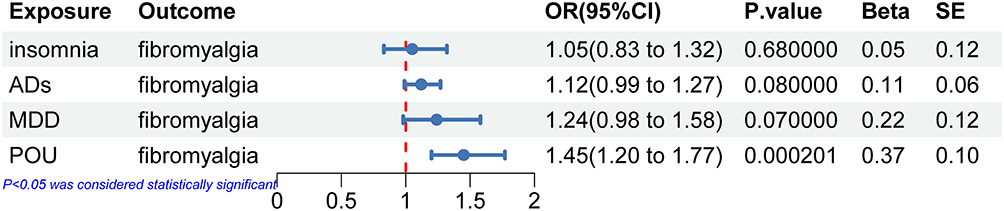 |
Figure 5 Forest plot of the MVMR estimates of prescription opioid use on fibromyalgia after adjusting confounders. The blue horizontal lines indicate the 95% confidence intervals, and the blue dots represent the point estimates of the odds ratios. The vertical dashed red line positioned at an odds ratio of 1 corresponds to the null hypothesis, indicating no causal effect. The blue text at the bottom (P < 0.05 was considered statistically significant) specifies the threshold for determining statistical significance of P - values in these analyses. Abbreviations: ADs, anxiety disorders; MDD, major depressive disorder; POU, prescription opioid use. |
Mediating Effect
The results indicated that 12.97% (β = 0.045, p = 0.190) and 12.06% (β = 0.042, p = 0.35) of the total effect of prescription opioid use (POU) on fibromyalgia was mediated by MDD and insomnia, respectively (Supplementary Tables 11 and 12). However, the Sobel test based on the product of coefficients method showed that the estimated effects for these two mediating pathways did not reach the conventional level of statistical significance (p > 0.05) (Supplementary Table 13). Furthermore, to assess the possibility of anxiety disorder acting as a mediator, we first examined the causal effect of POU on anxiety. Multiple MR methods, including the inverse variance weighted (IVW) method, found no significant evidence of a causal effect of POU on anxiety disorders (OR = 1.009, 95% CI: 0.80, 1.27, p = 0.94) (Supplementary Table 14). Consequently, anxiety disorders were not included in the subsequent mediation model.
Discussion
In the present study, we utilized bidirectional and multivariable Mendelian randomization analysis to evaluate the causal relationship between prescription pain medication use and fibromyalgia. We found that genetic liability for prescription opioid use was associated with increased fibromyalgia risk. This result was further confirmed after adjusting for confounding factors such as major depressive disorder (MDD), anxiety disorders (ADs), and insomnia. Because these confounders may also act as mediators, we performed additional mediating MR analysis, which indicated no significant mediating effects. However, the reverse MR analysis indicated a non-significant causal association between fibromyalgia and prescription opioid use. No substantial associations were observed between non-opioid pain medications and fibromyalgia.
Previous studies suggests that patients with fibromyalgia have worse pain outcomes with long-term opioid use than patients without fibromyalgia.36 In our study, we verified that prescription opioid use is a contributing factor to the increased risk of fibromyalgia. The possible mechanisms underlying the genetically predicted association between prescription opioid use and increased risk of fibromyalgia are as follows. In the short term, opioids produce feelings of pleasure and pain relief by activating “opioid receptors” in the brain. However, prolonged use may result in receptor endocytosis and increase the level of endogenous opioids in the brain, which is a complementary reaction to endocytosis.37 Although the level of these opioid substances is elevated, the insufficient number of receptors means patients effectively remain in a state of low endogenous opioid tone.12 More importantly, fibromyalgia shares certain pathophysiological features with neuropathic pain, such as central sensitization and altered pain signal processing.38 Using opioids for a long time usually leads to central sensitization, an enhanced pain processing by the CNS, is particularly pronounced in fibromyalgia patients and can lead to the generalization of pain throughout the body. Furthermore, the clinical presentations of fibromyalgia and opioid withdrawal are very similar and include restless legs, depression, intolerable anxiety, non-restorative sleep, and generalized pain.39 The mechanism behind this is related to the cyclic AMP (cAMP) pathway activated by the long-term opioid use, in which an opioid attached to the μ-opioid receptor triggers a decrease in cAMP and cAMP-dependent protein phosphorylation, ultimately resulting in reduced secretion of norepinephrine from the locus coeruleus.4,40 The locus coeruleus-noradrenaline system (LC-NA) constitutes the foundation of the structure and function of central sensitization,41 which may also mediate the causal association between prescription opioid use and increased risk of fibromyalgia.
Although MR analysis indicated a significant causal relationship of prescription opioid use on fibromyalgia, the relationship between the two events is likely bidirectional and complex. We cannot confirm that opioid use directly participates in the immunological pathogenesis of FMS. On one hand, long-term opioid use can lead to symptoms remarkably similar to fibromyalgia, such as widespread pain, anxiety and sleep disturbance. On the other hand, the pain of fibromyalgia may predispose patients to opioid dependence. A study including patients with a diagnosis of fibromyalgia revealed that a portion of individuals with rheumatic and musculoskeletal disorders (RMDs) who are newly prescribed opioids may shift to long-term use.42 In light of this, alternative pain management strategies, such as non-opioid pharmacological treatments (duloxetine, milnacipran, and pregabalin) and non-pharmacological interventions, should be prioritized to avoid the risks associated with prolonged opioid use.
Mood disorders and sleep disturbances are common comorbidities bothering fibromyalgia individuals. These patients are more likely to develop an anxiety disorder.43 Additionally, insomnia constitutes one of the diagnostic criteria for fibromyalgia and may be associated with the severity of the condition.44,45 An observational study revealed a clear relationship where increased sleep difficulties corresponded to a greater chance of fibromyalgia.46 Notably, long-term opioid use (≥90 days) may exacerbate depressive symptoms and sleep disturbances in fibromyalgia, elevating the risk of depression (HR: 1.58, 95% CI: 1.29–1.95) and sleep disorders (HR: 1.3, 95% CI: 1.09–1.55).47 Genetic evidence from MR revealed that prescription opioid use was associated with increased risk of major depressive disorder, anxiety and stress-related disorders.26 So, given that opioid use and fibromyalgia share similar clinical risks, which may act as confounders or mediate causal inference, we incorporated major depressive disorders, anxiety disorder, and insomnia into the multivariable Mendelian analysis and calculated the mediating effect of these factors.
Our analysis has several strengths. First, Mendelian randomization, which is analogous to randomized clinical trials, mitigates the ethical concerns associated with traditional randomized trials by leveraging naturally occurring genetic variation rather than random assignment. Besides, we also utilized bidirectional and multivariable MR to explore the causal relationship between prescription pain medication use and fibromyalgia, which, to our knowledge, is a novel approach and reduces bias caused by mood disorders. Furthermore, by leveraging large-scale genome-wide association study (GWAS) data and applying multiple statistical methods, such as IVW, MR Egger, and Weighted Median, we were able to validate our findings, thereby enhancing the robustness and credibility of the results.
Despite the strengths we mentioned above, this study still has several limitations. Owing to the lack of efficacious large-scale GWAS data, we cannot extend our analysis to the relationship between prescription pain medication use and common pathologies and pathologic conditions with the potential for chronic pain, such as complex regional pain syndrome, endometriosis, and persistent spinal pain syndrome (PSPS). Moreover, in our study, we found some correlations between prescription opioid use and fibromyalgia, but further research is still needed to investigate which opioids can increase the risk of fibromyalgia and the duration of opioid use that increases fibromyalgia risk. The estimates of the relationship are based on mostly European populations. The GWAS databases may have a selection bias and are not representative of the sampling population.48 Therefore, the caution of extrapolating to other races is warranted. Additionally, it should be noted that our analysis did not account for certain potential confounders, such as obesity and chronic inflammatory markers. These factors may influence both prescription opioid use49,50 and the risk of chronic pain conditions.51,52 Furthermore, we set a wider range (p < 5×10⁻⁶) for the selection of strongly related SNPs because we obtained only a few instrumental variants when classical genome-wide significance (p < 5×10⁻⁸) was used.
Conclusions
In summary, our bidirectional Mendelian analysis revealed that prescription opioid use, but not non-opioid use, has a causal relationship with an increased risk of fibromyalgia. After adjusting the confounding factors including depression, anxiety and insomnia, the relationship is still robust. Given the potential for opioid prescriptions to increase the risk of developing fibromyalgia, clinicians should prioritize alternative, evidence-based pain management strategies.
Data Sharing Statement
All data generated or analyzed during this study are included in this published article and its supplementary information files.
Ethics Approval and Consent to Participate
As per the regulations outlined in the national legislation guidelines of China, specifically Item 1 and Item 2 of Article 32 of the Measures for Ethical Review of Life Science and Medical Research Involving Human Subjects (issued February 18, 2023), our study qualifies for exemption from ethical approval. Our study meets these conditions for the following reasons:
- We utilized exclusively pre-existing, publicly available summary statistics from large-scale Genome-Wide Association Studies (GWAS) consortia (including UK Biobank, Psychiatric Genomics Consortium (PGC), FinnGen, and ANGST). These datasets were accessed legally from public repositories.
- The data we employed are completely anonymized. The GWAS summary statistics do not contain any individual-level personal identifiers, sensitive personal information, or biological samples that could be linked back to any individual participant. Therefore, our analysis poses no risk of harm to participants and no risk to personal privacy or interests.
Acknowledgments
We would like to express our gratitude to the participants and investigators of the FinnGen study. Our thanks also go to the Anxiety Working Group and MDD Working Group of the Psychiatric Genomics Consortium for providing data on MDD and ADs. We appreciate the Psychiatric & Statistical Genomics research team of CNCR for sharing GWAS summary statistics on insomnia. Additionally, we acknowledge the contributions of the CARDIoGRAMplusC4D Consortium, MEGASTROKE Consortium, and Wu et al for their work on prescription pain medication using the GWAS meta-analysis.
Author Contributions
All authors made a significant contribution to the work reported, whether that is in the conception, study design, execution, acquisition of data, analysis and interpretation, or in all these areas; took part in drafting, revising or critically reviewing the article; gave final approval of the version to be published; have agreed on the journal to which the article has been submitted; and agree to be accountable for all aspects of the work.
Funding
This work was supported by grants from the National Natural Science Foundation of China (Nos. 82171236 and 82372180) and the Key Project of the Natural Science Foundation of Hunan Province (No. 2025JJ30037).
Disclosure
The authors report no conflicts of interest in this work.
References
1. Fitzcharles MA, Cohen SP, Clauw DJ, Littlejohn G, Usui C, Häuser W. Nociplastic pain: towards an understanding of prevalent pain conditions. Lancet. 2021;397(10289):2098–2110. doi:10.1016/s0140-6736(21)00392-5
2. Clauw DJ. From fibrositis to fibromyalgia to nociplastic pain: how rheumatology helped get us here and where do we go from here? Ann Rheum Dis. 2024;83(11):1421–1427. doi:10.1136/ard-2023-225327
3. Williams JT, Ingram SL, Henderson G, et al. Regulation of μ-opioid receptors: desensitization, phosphorylation, internalization, and tolerance. Pharmacol Rev. 2013;65(1):223–254. doi:10.1124/pr.112.005942
4. Deng M, Zou W. Noncoding RNAs: novel targets for opioid tolerance. Curr Neuropharmacol. 2023;21(5):1202–1213. doi:10.2174/1570159x21666221129122932
5. Wu J, Shi Y, Xing M, et al. CircRalgapa1 facilitates morphine tolerance via miR-873a-5p/A20 axis in mice. Neuropharmacology. 2023;224:109353. doi:10.1016/j.neuropharm.2022.109353
6. Goudman L, Moens M, Pilitsis JG. Incidence and prevalence of pain medication prescriptions in pathologies with a potential for chronic pain. Anesthesiology. 2024;140(3):524–537. doi:10.1097/aln.0000000000004863
7. Cicero TJ, Ellis MS, Surratt HL, Kurtz SP. The changing face of heroin use in the United States: a retrospective analysis of the past 50 years. JAMA Psychiatry. 2014;71(7):821–826. doi:10.1001/jamapsychiatry.2014.366
8. Vowles KE, McEntee ML, Julnes PS, Frohe T, Ney JP, van der Goes DN. Rates of opioid misuse, abuse, and addiction in chronic pain: a systematic review and data synthesis. Pain. 2015;156(4):569–576. doi:10.1097/01.j.pain.0000460357.01998.f1
9. Bair MJ, Krebs EE. Fibromyalgia. Ann Intern Med. 2020;172(5):Itc33–itc48. doi:10.7326/aitc202003030
10. Goldenberg DL, Clauw DJ, Palmer RE, Clair AG. Opioid use in fibromyalgia: a cautionary tale. Mayo Clin Proc. 2016;91(5):640–648. doi:10.1016/j.mayocp.2016.02.002
11. Hall OT, Lagisetty P, Rausch J, et al. Fibromyalgia is associated with increased odds of prior pain-precipitated relapse among non-treatment-seeking individuals with opioid use disorder. Ann Med. 2024;56(1):2422050. doi:10.1080/07853890.2024.2422050
12. Clauw DJ. Fibromyalgia and related conditions. Mayo Clin Proc. 2015;90(5):680–692. doi:10.1016/j.mayocp.2015.03.014
13. Baraniuk JN, Whalen G, Cunningham J, Clauw DJ. Cerebrospinal fluid levels of opioid peptides in fibromyalgia and chronic low back pain. BMC Musculoskelet Disord. 2004;5:48. doi:10.1186/1471-2474-5-48
14. Schrepf A, Harper DE, Harte SE, et al. Endogenous opioidergic dysregulation of pain in fibromyalgia: a PET and fMRI study. Pain. 2016;157(10):2217–2225. doi:10.1097/j.pain.0000000000000633
15. Burgess S, Butterworth A, Thompson SG. Mendelian randomization analysis with multiple genetic variants using summarized data. Genet Epidemiol. 2013;37(7):658–665. doi:10.1002/gepi.21758
16. Zhao S, Chen F, Feng A, Han W, Zhang Y. Risk factors and prevention strategies for postoperative opioid abuse. Pain Res Manag. 2019;2019:7490801. doi:10.1155/2019/7490801
17. Short NA, Austin AE, Naumann RB. Associations between insomnia symptoms and prescription opioid and benzodiazepine misuse in a nationally representative sample. Addict Behav. 2023;137:107507. doi:10.1016/j.addbeh.2022.107507
18. Sanderson E. Multivariable mendelian randomization and mediation. Cold Spring Harb Perspect Med. 2021;11(2). doi:10.1101/cshperspect.a038984
19. Glass JM. Fibromyalgia and cognition. J Clin Psychiatry. 2008;69(Suppl 2):20–24.
20. Kurki MI, Karjalainen J, Palta P, et al. FinnGen provides genetic insights from a well-phenotyped isolated population. Nature. 2023;613(7944):508–518. doi:10.1038/s41586-022-05473-8
21. Wolfe F, Clauw DJ, Fitzcharles MA, et al. 2016 revisions to the 2010/2011 fibromyalgia diagnostic criteria. Semin Arthritis Rheum. 2016;46(3):319–329. doi:10.1016/j.semarthrit.2016.08.012
22. Wu Y, Byrne EM, Zheng Z, et al. Genome-wide association study of medication-use and associated disease in the UK biobank. Nat Commun. 2019;10(1). doi:10.1038/s41467-019-09572-5
23. Otowa T, Hek K, Lee M, et al. Meta-analysis of genome-wide association studies of anxiety disorders. Mol Psychiatry. 2016;21(10):1391–1399. doi:10.1038/mp.2015.197
24. Wray NR, Ripke S, Mattheisen M, et al. Genome-wide association analyses identify 44 risk variants and refine the genetic architecture of major depression. Nat Genet. 2018;50(5):668–681. doi:10.1038/s41588-018-0090-3
25. Jansen PR, Watanabe K, Stringer S, et al. Genome-wide analysis of insomnia in 1,331,010 individuals identifies new risk loci and functional pathways. Nature Genet. 2019;51(3):394–403. doi:10.1038/s41588-018-0333-3
26. Rosoff DB, Smith GD, Lohoff FW. Prescription opioid use and risk for major depressive disorder and anxiety and stress-related disorders: a multivariable mendelian randomization analysis. JAMA Psychiatry. 2021;78(2):151–160. doi:10.1001/jamapsychiatry.2020.3554
27. Skrivankova VW, Richmond RC, Woolf BAR, et al. Strengthening the reporting of observational studies in epidemiology using mendelian randomization: the STROBE-MR statement. JAMA. 2021;326(16):1614–1621. doi:10.1001/jama.2021.18236
28. Burgess S, Thompson SG, Collaboration CCG. Avoiding bias from weak instruments in mendelian randomization studies. Int J Epidemiol. 2011;40(3):755–764. doi:10.1093/ije/dyr036
29. Feng R, Lu M, Xu J, et al. Pulmonary embolism and 529 human blood metabolites: genetic correlation and two-sample mendelian randomization study. BMC Genom Data. 2022;23(1):69. doi:10.1186/s12863-022-01082-6
30. Burgess S, Davey Smith G, Davies NM, et al. Guidelines for performing mendelian randomization investigations: update for summer 2023. Wellcome Open Res. 2019;4:186. doi:10.12688/wellcomeopenres.15555.3
31. Bowden J, Del Greco MF, Minelli C, Davey Smith G, Sheehan NA, Thompson JR. Assessing the suitability of summary data for two-sample mendelian randomization analyses using MR-Egger regression: the role of the I2 statistic. Int J Epidemiol. 2016;45(6):1961–1974. doi:10.1093/ije/dyw220
32. Bowden J, Davey Smith G, Burgess S. Mendelian randomization with invalid instruments: effect estimation and bias detection through Egger regression. Int J Epidemiol. 2015;44(2):512–525. doi:10.1093/ije/dyv080
33. Burgess S, Thompson SG. Interpreting findings from Mendelian randomization using the MR-Egger method. Eur J Epidemiol. 2017;32(5):377–389. doi:10.1007/s10654-017-0255-x
34. Bowden J, Davey Smith G, Haycock PC, Burgess S. Consistent estimation in mendelian randomization with some invalid instruments using a weighted median estimator. Genet Epidemiol. 2016;40(4):304–314. doi:10.1002/gepi.21965
35. Burgess S, Thompson SG. Multivariable mendelian randomization: the use of pleiotropic genetic variants to estimate causal effects. Am J Epidemiol. 2015;181(4):251–260. doi:10.1093/aje/kwu283
36. Turner JA, Shortreed SM, Saunders KW, LeResche L, Thielke S, Von Korff M. Does association of opioid use with pain and function differ by fibromyalgia or widespread pain status? Pain. 2016;157(10):2208–2216. doi:10.1097/j.pain.0000000000000631
37. Weng Y, Wu J, Li L, et al. Circular RNA expression profile in the spinal cord of morphine tolerated rats and screen of putative key circRNAs. Mol Brain. 2019;12(1):79. doi:10.1186/s13041-019-0498-4
38. Siracusa R, Paola RD, Cuzzocrea S, Impellizzeri D. Fibromyalgia: pathogenesis, mechanisms, diagnosis and treatment options update. Int J Mol Sci. 2021;22(8). doi:10.3390/ijms22083891
39. Johnson B, Ulberg S, Shivale S, Donaldson J, Milczarski B, Faraone SV. Fibromyalgia, autism, and opioid addiction as natural and induced disorders of the endogenous opioid hormonal system. Discov Med. 2014;18(99):209–220.
40. Srivastava AB, Mariani JJ, Levin FR. New directions in the treatment of opioid withdrawal. Lancet. 2020;395(10241):1938–1948. doi:10.1016/s0140-6736(20)30852-7
41. Halili A. Temporal model for central sensitization: a hypothesis for mechanism and treatment using systemic manual therapy, a focused review. MethodsX. 2023;10:101942. doi:10.1016/j.mex.2022.101942
42. Huang YT, Jenkins DA, Peek N, Dixon WG, Jani M. High frequency of long-term opioid use among patients with rheumatic and musculoskeletal diseases initiating opioids for the first time. Ann Rheum Dis. 2023;82(8):1116–1117. doi:10.1136/ard-2023-224118
43. Arnold LM. Biology and therapy of fibromyalgia. New therapies in fibromyalgia. Arthritis Res Ther. 2006;8(4):212. doi:10.1186/ar1971
44. Leon-Llamas JL, Villafaina S, Murillo-Garcia A, Rohlfs Domínguez P, Gusi N. Relationship between pineal gland, sleep and melatonin in fibromyalgia women: a magnetic resonance imaging study. Acta Neuropsychiatr. 2021;1–9. doi:10.1017/neu.2021.35
45. Choy EH. The role of sleep in pain and fibromyalgia. Nat Rev Rheumatol. 2015;11(9):513–520. doi:10.1038/nrrheum.2015.56
46. Mork PJ, Nilsen TI. Sleep problems and risk of fibromyalgia: longitudinal data on an adult female population in Norway. Arthritis Rheum. 2012;64(1):281–284. doi:10.1002/art.33346
47. Hurtado I, Robles C, Peiró S, et al. Long versus short-term opioid therapy for fibromyalgia syndrome and risk of depression, sleep disorders and suicidal ideation: a population-based, propensity-weighted cohort study. RMD Open. 2024;10(3):e004466. doi:10.1136/rmdopen-2024-004466
48. Fry A, Littlejohns TJ, Sudlow C, et al. Comparison of sociodemographic and health-related characteristics of UK biobank participants with those of the general population. Am J Epidemiol. 2017;186(9):1026–1034. doi:10.1093/aje/kwx246
49. Quraishi R, Kathiresan P, Verma K, Rao R, Jain R. Effect of chronic opioid use on the hematological and inflammatory markers: a retrospective study from North India. Indian J Psychiatry. 2022;64(3):252–256. doi:10.4103/indianjpsychiatry.indianjpsychiatry_751_21
50. Stokes A, Lundberg DJ, Hempstead K, Berry KM, Baker JF, Preston SH. Obesity and Incident Prescription Opioid Use in the U.S. 2000-2015. Am J Prev Med. 2020;58(6):766–775. doi:10.1016/j.amepre.2019.12.018
51. Groven N, Fors EA, Reitan SK. Patients with fibromyalgia and chronic fatigue syndrome show increased hsCRP compared to healthy controls. Brain Behav Immun. 2019;81:172–177. doi:10.1016/j.bbi.2019.06.010
52. D’Onghia M, Ciaffi J, Lisi L, et al. Fibromyalgia and obesity: a comprehensive systematic review and meta-analysis. Semin Arthritis Rheum. 2021;51(2):409–424. doi:10.1016/j.semarthrit.2021.02.007
 © 2025 The Author(s). This work is published and licensed by Dove Medical Press Limited. The
full terms of this license are available at https://www.dovepress.com/terms
and incorporate the Creative Commons Attribution
- Non Commercial (unported, 4.0) License.
By accessing the work you hereby accept the Terms. Non-commercial uses of the work are permitted
without any further permission from Dove Medical Press Limited, provided the work is properly
attributed. For permission for commercial use of this work, please see paragraphs 4.2 and 5 of our Terms.
© 2025 The Author(s). This work is published and licensed by Dove Medical Press Limited. The
full terms of this license are available at https://www.dovepress.com/terms
and incorporate the Creative Commons Attribution
- Non Commercial (unported, 4.0) License.
By accessing the work you hereby accept the Terms. Non-commercial uses of the work are permitted
without any further permission from Dove Medical Press Limited, provided the work is properly
attributed. For permission for commercial use of this work, please see paragraphs 4.2 and 5 of our Terms.
Recommended articles
The Causal Correlation Between Gastroesophageal Reflux Disease and Chronic Widespread Pain: A Bidirectional Mendelian Randomization Study
Chen M, Tu H, Zhou J, Zhang Y, Wen S, Xiao Y, He L
Journal of Pain Research 2025, 18:3107-3115
Published Date: 24 June 2025
Carnitine and Other Metabolites in Fibromyalgia a Clinical Perspective on a Mendelian Randomization Study
Hong M, Wang J, Huang X, Xu Q, Xiao Y, Ling K
Journal of Pain Research 2025, 18:7097-7107
Published Date: 25 December 2025