
Back to Journals » International Journal of General Medicine » Volume 18
The Association Between Radiation-Induced miR-208a, Cancer Recurrence and Death Risk in Patients with Non-Small Cell Lung Cancer
Authors Ji W, Bi Y, Zheng Q, Sun R, Dai K
Received 3 June 2025
Accepted for publication 19 September 2025
Published 11 October 2025 Volume 2025:18 Pages 6203—6209
DOI https://doi.org/10.2147/IJGM.S538351
Checked for plagiarism Yes
Review by Single anonymous peer review
Peer reviewer comments 2
Editor who approved publication: Dr Dana Kristjansson
Wenjing Ji, Yanzhi Bi, Qian Zheng, Ruirui Sun, Kejun Dai
Oncology Department, Changzhou Cancer Hospital, Changzhou City, Jiangsu Province, 213000, People’s Republic of China
Correspondence: Kejun Dai, Oncology Department, Changzhou Cancer Hospital, No. 68 Honghe Road, Xinbei District, Changzhou City, Jiangsu Province, 213000, People’s Republic of China, Email [email protected]
Background: Existing experimental evidence suggested that the miR-208a expression in tumor tissue from non-small cell lung cancer (NSCLC) was significantly high after radiotherapy in vitro and in vivo, indicating a potential role for predicting NSCLC progression or recurrence. However, its prognostic value has not been fully confirmed among patients with NSCLC.
Aim: We explored the association of serum miR-208a level with adverse events including cancer recurrence and/or metastasis and cancer death during a follow-up for 36 months after radiotherapy.
Methods: We identified the serum level of miR-208a from 46 patients before and after surgical treatment combined with radiotherapy in NSCLC patients. The association between serum miR-208a and risk for the cancer recurrence and/or metastasis and cancer death among these patients were examined by Kaplan-Meier and multivariable Cox analysis.
Results: The comprehensive outcomes during the follow-up period for 3 years including cancer recurrence and/or cancer metastasis and cancer death were 13 (28.3%) and 8 (17.4%), respectively. Kaplan-Meier analysis suggested that a high serum miR-208a level after radiotherapy tended to have a higher rate of cancer recurrence and/or cancer metastasis and a higher risk of cancer death than those with a low level of serum miR-208a. Furthermore, our multivariable Cox analysis suggested that elevated serum miR-208a levels were associated with an increased risk for cancer recurrence and/or cancer metastasis (HR=7.5, 95% CI: 2.5– 24.9, P< 0.01) and cancer death risk (HR=5.3, 95% CI: 1.7– 18.5, P< 0.05) after age, gender, smoking, drinking and tumor node metastasis (TNM) stage were controlled for.
Conclusion: This study further provided evidence that elevated serum miR-208a levels after radiotherapy were associated with a high risk for cancer recurrence and/or metastasis and death among NSCLC patients.
Keywords: radiotherapy, non-small cell lung cancer, microRNAs, recurrence, death
Introduction
Existing data shows that the incidence of lung cancer has been significantly increased for few decades globally.1,2 Especially in developed countries, authoritative statistical data from China reported that lung cancer has become the leading cause of common malignant tumors, which has surpassed breast cancer as the main cancer death.3,4 Lung cancer was mainly divided into non-small cell lung cancer (NSCLC) and small cell lung cancer according to its biological characteristics, and the NSCLC accounts for more than 80% of all lung cancer cases.5 Although early detection methods for lung cancer have significantly improved in recent years, only about 20% of cancer patients can actively undergo surgical resection due to the high concealment of lung cancer.6 When patients experienced symptoms such as coughing and coughing up blood, the cancer has already progressed to the late stage with distant metastasis.7 As an important supplementary treatment, radiotherapy has been considered as an important role in the clinical management for a post-surgical treatment or inoperable NSCLC,8 even significantly improving the quality of life for those cancer patients. However, radio-resistance is still an important disadvantage that might limit the positive effect of radiotherapy for NSCLC due to some confirmed mechanisms including tumor hypoxia, DNA-repair ability, P53 mutation, autophagy and others.9 The specific molecular mechanisms concerning radiation-induced radio-resistance are still poorly understood. Therefore, exploring mechanisms involving in radio-resistance during cancer therapy still has an important theoretical significance.
MicroRNAs (miRNAs) have been considered to be involved in proliferation and migration of various tumors including lung cancer by directly regulating gene expression.10,11 The existing evidence has also demonstrated that miRNAs play a tumor-suppressing or tumor-promoting role in various human cancers according to their different target genes.12 As a result, mir-208a has been reported to have abnormal expression in lung cancer.13–15 For instance, a previous basic study was used by miRNA microarray technology to identify miRNAs that were differentially expressed before and after radiotherapy in lung cancer patients, and they provided evidence that miR-208a can affect the proliferation and radio-sensitivity of human lung cancer cells by targeting p21.13 Another study showed that long intergenic non-protein-coding RNA p53-induced transcript mediated inhibitory effect on cell proliferation, cell migration and invasion by miR-208a-3p/programmed cell death 4 in NSCLC.14 Importantly, a recent experimental study also suggested that miR-208a could facilitate cell proliferation and invasion by directly targeting Src kinase signaling inhibitor 1 in NSCLC.15 Although these previous studies have hinted that miR-208a might be a potential biomarker or therapeutic target for NSCLC, experimental data of which were mostly based on animals and cells in vitro, it has not been fully validated in clinical patients with NSCLC.
Therefore, the present study was aimed to measure the expression level of miR-208a in serum, and evaluated its association with tumor recurrence and cancer death among NSCLC patients after radiotherapy.
Methods
Study Samples
We obtained samples from circulating blood and tumor tissue of 46 patients with NSCLC in total. These included 26 cases with squamous cell carcinoma, 14 cases with adenocarcinoma and 6 cases with large cell carcinoma at Changzhou Cancer Hospital between January 2015 and December 2020, who have already experienced surgery combined with radiotherapy during hospitalization. Tumor node metastasis (TNM) stage for these NSCLC patients was 7 subjects in stage I, 16 subjects in stages II, 20 subjects in stages III and 3 subjects in stages IV 5. All patients included underwent routine blood collection within 24 hours after admission and re-examination before discharge; we collected these stored blood samples from each individual for measuring the expression level of serum miR-208a. The NSCLC tissue from some patients was extracted during the operation for evaluating expression level of miR-208a. Postoperative radiotherapy was then conducted for each patient during hospitalization. After these patients completed treatment and were discharged, we started a 3 year follow-up by phone or the clinic requiring outpatient re-examination. The exclusion criteria has been detailed in our previous study:16 (1) patients without receiving radiotherapy; (2) patients who have been lost during the follow-up period; (3) patients who had other severe comorbidities that seriously affected quality of life; (4) patients receiving targeted therapy before and after surgery.16 Because the present study was a retrospective design, major patients have lost contact. Thus the study has been applied for exemption from informed consent. The ethics committee of Changzhou Cancer Hospital approved the implementation of the study design based on the Declaration of Helsinki guidelines. All patient information was completely confidential in this study.
Measurement for miR-208a Expression in Serum and NSCLC Tissue
The fasting venous blood from each patient on first morning after admission was extracted into centrifuge tube and supernatants were immediately stored at −80 °C refrigerator for further use.16 The stored samples from serum and NSCLC tissue for real-time fluorescence quantitative polymerase chain reaction (RT-PCR) analysis was performed to measure the miR-208a expression, respectively. RNA extraction from these samples was used by a Trizol method, and the specific RT-PCR primers of miR-208a were designed from GenePharma Co. Ltd (Shanghai).
Follow-up for Adverse Events
The adverse events in our study were mainly contained cancer recurrence and/or metastasis and cancer death among these NSCLC patients during a follow-up period for 3 years, which was considered the primary endpoint.16 Each NSCLC patient was followed up two times each year by telephone or subsequent visit with a doctor after discharge. Cancer recurrence and/or metastasis was confirmed as the new tumor appeared in lung tissue or enlarged masses reappeared in the primary site or distant metastases occured in other organs of the patient’s body, detected by examinations including positron emission tomography/computed tomography (PET/CT), CT, magnetic resonance imaging (MRI), ultrasound or others.17 The cancer death was confirmed by the deaths being were caused by NSCLC cancer during the follow-up. All included outcomes were confirmed by attending physician in combination with radiologist.
Statistical Analysis
All statistical data for this study were analyzed by using SPSS 26.0 software (SPSS, Chicago, USA). A Student’s t-test was performed to compare difference of miR-208a expression level from serum and cancer tissue among NSCLC patients after and before surgery combined with radiotherapy, respectively. Continuously, Kaplan-Meier analysis was conducted to evaluate the association of serum miR-208a level with risk for adverse outcomes including cancer recurrence and/or cancer metastasis and cancer death during the follow-up period for 3 years. Furthermore, multivariable Cox analysis was performed to confirm the associations of serum miR-208a with these adverse outcomes. In multivariable models, covariates including age and gender were enrolled into adjusted Model I. Covariates including age, gender, smoking, drinking and TNM stage were enrolled into adjusted Model II. In addition, we also added pathology subtype of NSCLC into adjusted model I and II to further analyze the association between serum miR-208a level and adverse outcomes, respectively. P value less than 0.05 was defined as being significant.
Results
Baseline Characteristics
As shown in Figure 1A, we identified a significantly elevated serum level of miR-208a among patients after surgery combined with radiotherapy, compared with the serum level from these patients before the treatment by using RT-PCR analysis. Similar expression difference did occur in the tumor tissue in these NSCLC patients (Figure 1B). The miR-208a from NSCLC tissue before surgery combined with radiotherapy was significantly lower than the same patients after the treatment. This preliminarily indicated that radiotherapy for NSCLC patients increased the miR-208a expression. Additionally, the clinical features of NSCLC patients were described in Table 1, the mean age was 59.4 years and male rate was 32 (69.6%). Outcome events during the follow-up period for 3 years including cancer recurrence and/or cancer metastasis and cancer death were 13 (28.3%) and 8 (17.4%), respectively.
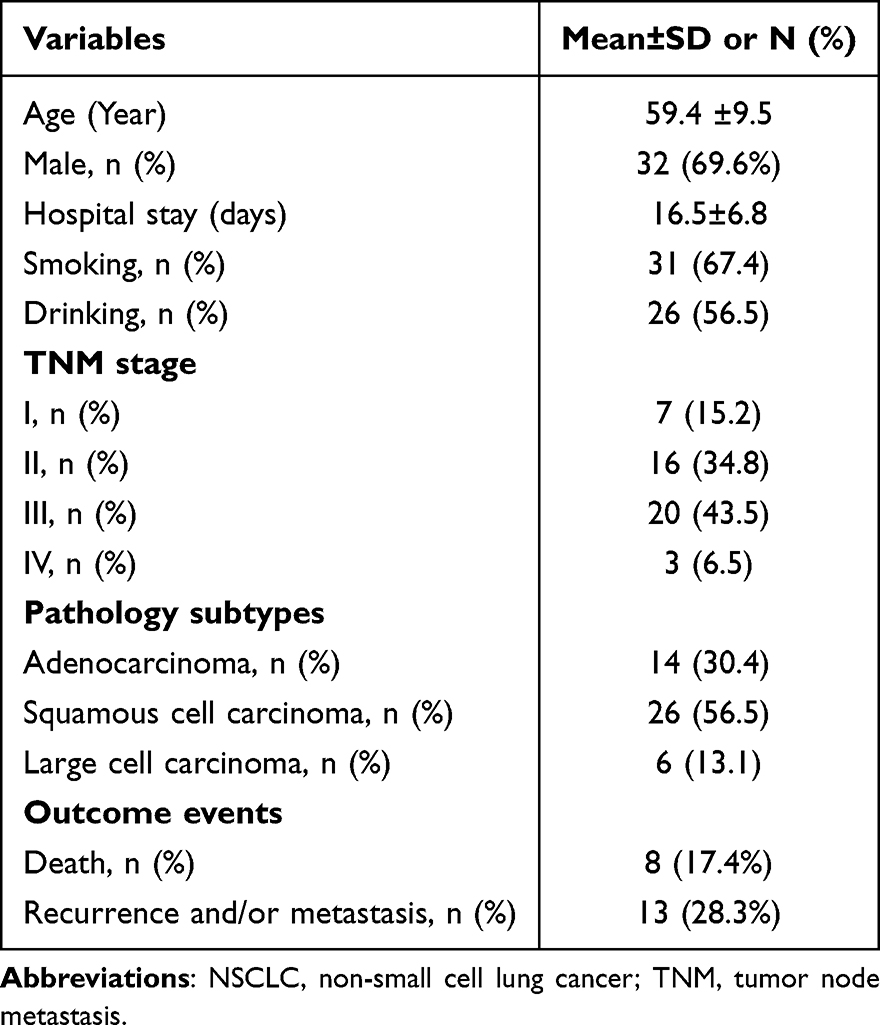 |
Table 1 Baseline Characteristics Among 46 NSCLC Patients |
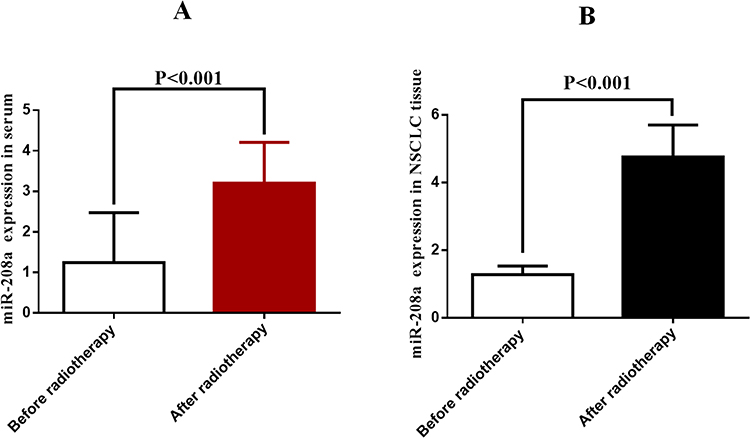 |
Figure 1 (A) and (B) GRHL2 expression (mRNA and protein) from fasting blood on the first morning in NSCLC patients. |
Association of Serum miR-208a with Risk for Outcome Events
Kaplan-Meier curve displayed that a high expression of serum miR-208a among patients with NSCLC after radiotherapy had a relatively higher rate for cancer recurrence and/or cancer metastasis (Figure 2A) and cancer death (Figure 2B), compared with those with lower expression of serum miR-208a.
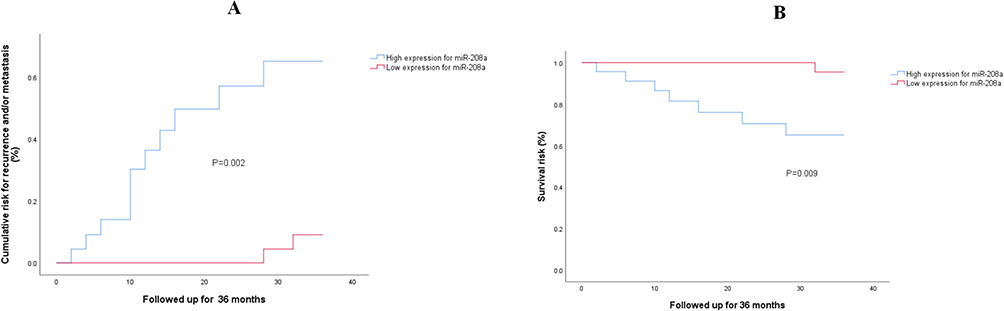 |
Figure 2 (A) and (B) Kaplan-Meier analysis for composite endpoint risk on NSCLC patients. |
Consistently, compared with patients with a relatively low expression of serum miR-208a (Table 2), our multivariable Cox analysis suggested that up-expressed miR-208a in serum was positively associated with cancer recurrence and/or cancer metastasis (HR=7.9, 95% CI: 2.8–26.6, P<0.01) and risk for cancer death (HR=5.7, 95% CI: 1.8–18.8, P<0.05) in adjusted Model I after age and gender were controlled for. The associations of serum miR-208a level with cancer recurrence and/or cancer metastasis (HR=7.5, 95% CI: 2.5–24.9, P<0.01) and cancer death risk (HR=5.3, 95% CI: 1.7–18.5, P<0.05) has hardly changed in adjusted Model II after smoking, drinking and TNM stage were further controlled for. In addition, sensitivity analysis was also performed to support a similar relation of serum miR-208a with these outcome events by using ‘pathology subtype’ as additional covariate into these adjusted multivariable Cox models (Table 3).
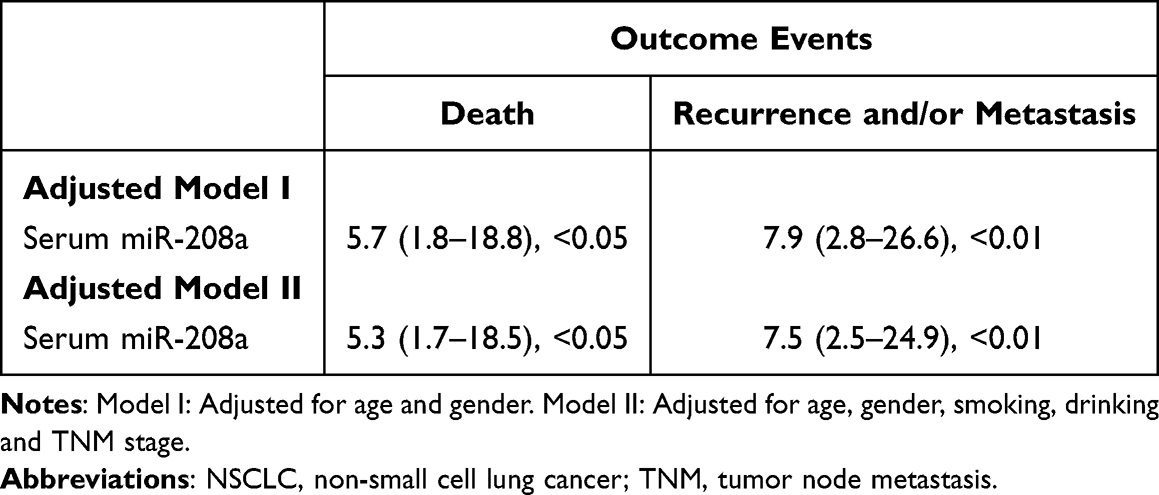 |
Table 2 The Association of Serum miR-208a Level with Risk for Outcome Events Among Patients with NSCLC |
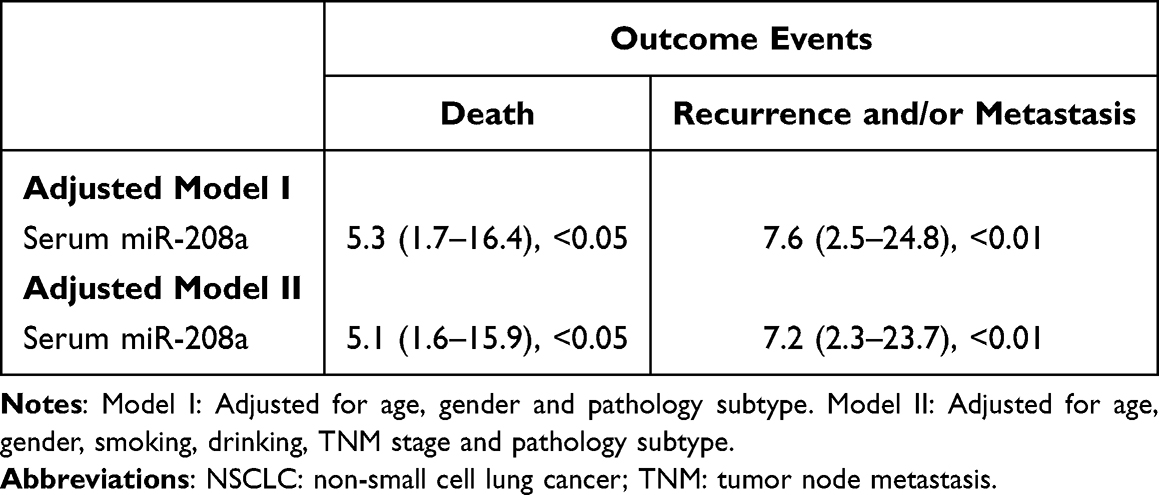 |
Table 3 Sensitivity Analysis |
Discussion
The existing clinical and basic evidence have been confirmed that abnormal expression of miRNAs displays important functions on the occurrence and development of NSCLC.18,19 Exploring the association of miRNAs expression with NSCLC progression has significant clinical implications for the identification of potential predictive or therapeutic biomarkers to monitor tumor progression or treatment efficacy among NSCLC patients.20 In fact, there was also a lot of evidence that has confirmed the abnormal expression of mir-208a in lung cancer. A previous basic study reported that mir-208a was up-regulated in the serum of NSCLC patients after radiation treatment, and the overexpression of miR-208a could promote cell proliferation and induced radio-resistance via targeting p21 with activation of the AKT/mTOR pathway in lung cancer cells, whereas knock-down of miR-208a caused the opposite effects.13 Another basic experiment also showed that activated miR-208a-3p/programmed cell death 4 mediated inhibitory effect on cell proliferation, cell cycle, cell migration and invasion in NSCLC cells.14 A recent study further suggested that mir-208a was significantly upregulated in cancer tissues of NSCLC and cell lines than non-cancerous controls, and elevated miR-208a expression was significantly associated with adverse TNM stage and lymph node metastasis, promoting the cell proliferation and invasion of NSCLC cancer by directly activating Src kinase signaling inhibitor 1.15 This relatively small evidence exerted a potential value of miR-208a as a novel biomarker or target on predicting the progression or recurrence of NSCLC. However, these previous conclusions have not been fully validated in NSCLC patients. In the present study, we collected clinical data and tumor samples from 46 NSCLC patients after surgery combined with radiotherapy to further analyze the relationship between serum level of miR-208a expression and risk for cancer recurrence and/or metastasis and cancer death. We observed that a higher miR-208a expression in serum and NSCLC tissue occurred after radiotherapy compared to before the treatment, and elevated serum miR-208a level contributed to a higher risk for cancer recurrence and/or cancer metastasis and cancer death. This further supported previous results that overexpression of miR-208a could induce radio-resistance and promote tumor growth, ultimately leading to a poor prognosis after radiotherapy.13
Interestingly, mir-208a has also been confirmed to be involved in various human cancers.17,21–23 For example, mir-208a has been reported with a high expression in hepatocellular carcinoma, and the knock-down of mir-208a could inhibit proliferation and metastasis of hepatoma cell in vitro.21 A study also showed that mir-208a was highly expressed in esophageal cancer tissue and cell lines, and overexpression of mir-208a promoted cell proliferation and tumorigenicity of the cancer cell.22 Furthermore, mir-208a was found to be highly expressed in gastric cancer, and overexpressed mir-208a could promote tumor cell proliferation and attenuate cell apoptosis in vivo.23 Liu et al even found that mir-208a might be involved in the cell migration and invasion in pancreatic cancer.17 Accordingly, the previous evidence suggested the overexpression of mir-208a could promote progression of various tumors, which further supported the advantageous predictive role of mir-208a in cancer recurrence and death of NSCLC patients.
There is a key advantage that needs to be emphasized in our study. This was one of few studies to further validate the predictable value of mir-208a from collecting serum and tumor sample on adverse clinical events among NSCLC patients. We observed for the first time that mir-208a has a significantly predictive role for monitoring cancer recurrence and death risk in NSCLC patients after surgery combined with radiotherapy, which might provide strong support for further promoting serum mir-208a as a clinical biomarker for the prognosis of NSCLC. On the contrary, this study also had several limitations. This was a single-center retrospective study, and a small sample of patients might lead to bias for patient selection. The cohort only included 46 patients with 13 experiencing recurrence/metastasis and 8 cancer deaths. While our hazard ratios are significant, the wide confidence intervals suggested limited precision, restraining the generalizability of the results. Then, we compared the serum mir-208a levels of NSCLC patients before and after radiotherapy, but did not compare the difference of mir-208a with general populations without NSCLC. Furthermore, the follow-up period of three years was relatively short, and some endpoints including cancer recurrence, metastasis and cancer death might occur after 3 years, which may result in bias for our results in this study. Finally, NSCLC is characterized by a heterogeneous mutational landscape, including key driver mutations such as EGFR, ALK, KRAS, and others, which have well-established prognostic and predictive implications. The absence of patient genetic profile data in the multivariable analysis may introduce bias or confounding for our results.
Conclusion
Briefly, we evaluated serum mir-208a levels from NSCLC patients after radiotherapy. Our findings provided evidence to support that serum miR-208a may be considered as a novel predictive biomarker for monitoring prognosis among NSCLC patients after radiotherapy. Of course, more multi-enter and large-sample cohort studies are needed to further support our results.
Ethics Approval
The ethics committee of Changzhou Cancer Hospital approved the implementation of the study design based on the Declaration of Helsinki guidelines.
Consent to Publication
All authors reviewed and agreed to publish the manuscript.
Funding
The work was supported by Changzhou Municipal Health Commission Major Project (ZD202325).
Disclosure
The authors report no conflicts of interest in this work.
References
1. Li C, Lei S, Ding L. et al. Global burden and trends of lung cancer incidence and mortality. Chin Med J. 2023;136(13):1583–1590. doi:10.1097/CM9.0000000000002529
2. Howlader N, Forjaz G, Mooradian MJ, et al. The Effect of Advances in Lung-Cancer Treatment on Population Mortality. N Engl J Med. 2020;383(7):640–649. doi:10.1056/NEJMoa1916623
3. Luo YH, Chiu CH, Scott Kuo CH, et al. Lung Cancer in Republic of China. J Thorac Oncol. 2021;16(4):519–527. doi:10.1016/j.jtho.2020.10.155
4. Gao S, Li N, Wang S, et al. Lung Cancer in People’s Republic of China. J Thorac Oncol. 2020;15(10):1567–1576. doi:10.1016/j.jtho.2020.04.028
5. Herbst RS, Morgensztern D, Boshoff C. The biology and management of non-small cell lung cancer. Nature. 2018;553(7689):446–454. doi:10.1038/nature25183
6. Remon J, Soria JC, Peters S. ESMO Guidelines Committee. Electronic address: [email protected]. Early and locally advanced non-small-cell lung cancer: an update of the ESMO Clinical Practice Guidelines focusing on diagnosis, staging, systemic and local therapy. Ann Oncol. 2021;32(12):1637–1642. doi:10.1016/j.annonc.2021.08.1994
7. Gargalionis AN, Papavassiliou KA, Basdra EK, Papavassiliou AG. Advances in non-small cell lung cancer mechanomedicine: deciphering the signaling networks that govern tumor-TME interactions. J Exp Clin Cancer Res. 2024;43(1):316. doi:10.1186/s13046-024-03242-1
8. Vinod SK, Hau E. Radiotherapy treatment for lung cancer: current status and future directions. Respirology. 2020;25 Suppl 2(S2):61–71. doi:10.1111/resp.13870
9. Kim TW, Hong DW, Hong SH. PB01 suppresses radio-resistance by regulating ATR signaling in human non-small-cell lung cancer cells. Sci Rep. 2021;11(1):12093. doi:10.1038/s41598-021-91716-z
10. Lee YS, Dutta A. MicroRNAs in cancer. Annu Rev Pathol. 2009;4(1):199–227. doi:10.1146/annurev.pathol.4.110807.092222
11. Hussen BM, Hidayat HJ, Salihi A, Sabir DK, Taheri M, Ghafouri-Fard S. MicroRNA: a signature for cancer progression. Biomed Pharmacother. 2021;138:111528. doi:10.1016/j.biopha.2021.111528
12. Volinia S, Calin GA, Liu CG, et al. A microRNA expression signature of human solid tumors defines cancer gene targets. Proc Natl Acad Sci U S A. 2006;103(7):2257–2261. doi:10.1073/pnas.0510565103
13. Tang Y, Cui Y, Li Z, et al. Radiation-induced miR-208a increases the proliferation and radioresistance by targeting p21 in human lung cancer cells. J Exp Clin Cancer Res. 2016;35(1):7. doi:10.1186/s13046-016-0285-3. Erratum in: J Exp Clin Cancer Res. 2016 Jan 28;35:20. doi: 10.1186/s13046-016-0299-x.
14. Zhang L, Hu J, Li J, Yang Q, Hao M, Bu L. Long noncoding RNA LINC-PINT inhibits non-small cell lung cancer progression through sponging miR-218-5p/PDCD4. Artif Cells Nanomed Biotechnol. 2019;47(1):1595–1602. doi:10.1080/21691401.2019.1605371
15. Liu L, Wang W, Gao S, Wang X. MicroRNA‑208a directly targets Src kinase signaling inhibitor 1 to facilitate cell proliferation and invasion in non‑small cell lung cancer. Mol Med Rep. 2019;20(4):3140–3148. doi:10.3892/mmr.2019.10542
16. Zheng Q, Ji W, Sun R, Dai K. Prognostic value of blood GRHL2 in patients with non-small-cell lung cancer after radiotherapy and chemotherapy. Biomarker Med. 2024;18(13–14):611–617. doi:10.1080/17520363.2024.2366161
17. Liu A, Shao C, Jin G, et al. miR-208-induced epithelial to mesenchymal transition of pancreatic cancer cells promotes cell metastasis and invasion. Cell Biochem Biophys. 2014;69(2):341–346. doi:10.1007/s12013-013-9805-3
18. Charkiewicz R, Sulewska A, Charkiewicz A, et al. miRNA-Seq Tissue Diagnostic Signature: a Novel Model for NSCLC Subtyping. Int J Mol Sci. 2023;24(17):13318. doi:10.3390/ijms241713318
19. Petracci E, Pasini L, Urbini M, et al. Circulating cell-free and extracellular vesicles-derived microRNA as prognostic biomarkers in patients with early-stage NSCLC: results from RESTING study. J Exp Clin Cancer Res. 2024;43(1):241. doi:10.1186/s13046-024-03156-y
20. Zhang ZY, Gao XH, Ma MY, Zhao CL, Zhang YL, Guo SS. CircRNA_101237 promotes NSCLC progression via the miRNA-490-3p/MAPK1 axis. Sci Rep. 2020;10(1):9024. doi:10.1038/s41598-020-65920-2
21. Yu P, Wu D, You Y, et al. miR-208-3p promotes hepatocellular carcinoma cell proliferation and invasion through regulating ARID2 expression. Exp Cell Res. 2015;336(2):232–241. doi:10.1016/j.yexcr.2015.07.008
22. Li H, Zheng D, Zhang B, et al. Mir-208 promotes cell proliferation by repressing SOX6 expression in human esophageal squamous cell carcinoma. J Transl Med. 2014;12(1):196. doi:10.1186/1479-5876-12-196
23. Yin K, Liu M, Zhang M, et al. miR-208a-3p suppresses cell apoptosis by targeting PDCD4 in gastric cancer. Oncotarget. 2016;7(41):67321–67332. doi:10.18632/oncotarget.12006
 © 2025 The Author(s). This work is published and licensed by Dove Medical Press Limited. The
full terms of this license are available at https://www.dovepress.com/terms
and incorporate the Creative Commons Attribution
- Non Commercial (unported, 4.0) License.
By accessing the work you hereby accept the Terms. Non-commercial uses of the work are permitted
without any further permission from Dove Medical Press Limited, provided the work is properly
attributed. For permission for commercial use of this work, please see paragraphs 4.2 and 5 of our Terms.
© 2025 The Author(s). This work is published and licensed by Dove Medical Press Limited. The
full terms of this license are available at https://www.dovepress.com/terms
and incorporate the Creative Commons Attribution
- Non Commercial (unported, 4.0) License.
By accessing the work you hereby accept the Terms. Non-commercial uses of the work are permitted
without any further permission from Dove Medical Press Limited, provided the work is properly
attributed. For permission for commercial use of this work, please see paragraphs 4.2 and 5 of our Terms.