
Back to Journals » Diabetes, Metabolic Syndrome and Obesity » Volume 18
The Association Between Adiponectin Gene Polymorphism (rs1501299) and Metabolic Syndrome
Authors Yin L  , Tang Y , Yuan Y
Received 10 July 2024
Accepted for publication 18 January 2025
Published 25 January 2025 Volume 2025:18 Pages 209—215
DOI https://doi.org/10.2147/DMSO.S475193
Checked for plagiarism Yes
Review by Single anonymous peer review
Peer reviewer comments 4
Editor who approved publication: Dr Rebecca Baqiyyah Conway
Lianli Yin,1 Yinghua Tang,2 Yulin Yuan1
1Department of Clinical Laboratory, Guangxi Academy of Medical Sciences, The People’s Hospital of Guangxi Zhuang Autonomous Region, Nanning, Guangxi, 530021, People’s Republic of China; 2Department of Clinical Laboratory, Guangxi Hospital of Traditional Chinese Medicine, The First Affiliated Hospital of Guangxi University of Chinese Medicine, Nanning, Guangxi, 530023, People’s Republic of China
Correspondence: Yulin Yuan, Department of Clinical Laboratory, The People’s Hospital of Guangxi Zhuang Autonomous Region, Nanning, Guangxi, 530021, People’s Republic of China, Email [email protected]
Objective: To investigate the allelic genotypes of the adiponectin (APN) gene polymorphisms (rs1501299) and its association with APN level among Mets patients.
Methods: A total of 410 patients with Mets and 203 healthy subjects were included in the study. The serum APN levels of the subjects were detected using enzyme-linked immunosorbent assay. The polymorphisms of the G/T gene at the rs1501299 locus of the APN gene were detected using restriction fragment length polymorphism polymerase chain reaction technology.
Results: The serum APN levels were significantly lower in Mets patients than in the control group (15.0 ± 4.9 mg/L vs 27.2 ± 6.5 mg/L, p < 0.05). The distribution of the three genotypes at the rs1501299 locus was statistically different between the Mets patients and the control group (GG, GT, and TT, p < 0.05), and the frequencies of the T alleles were higher in the Mets patients than in control group (GT and TT, p < 0.05). Logistic regression analysis showed that the study subjects with the T allele had a higher risk of Mets than those with the G allele (OR = 1.85, p < 0.05). The risk of Mets was higher in GT and TT genotypes compared to in GG genotypes (OR = 1.43; OR = 2.14 vs OR = 1.00 ref). Similarly, it increased after combining GT and GG genotypes (OR = 1.73, p < 0.05). The APN levels in the GT (14.3 ± 5.3 mg/L) and TT (13.4 ± 5.4 mg/L) genotypes of the study subjects were lower than those of the GG genotype (15.5 ± 4.8 mg/L, p < 0.05).
Conclusion: The occurrence of Mets may be associated with genetic variants at the rs1501299 locus, especially for individuals with G to T variants that reduce APN levels and lead to a higher risk of developing Mets.
Keywords: adiponectin, gene polymorphism, metabolic syndrome
Introduction
Metabolic syndrome (Mets) is an important influencing factor in cardiovascular disease and diabetes, and it can increase the risk of heart disease by 2–3 times.1,2 With improvements in living standards, the prevalence of Mets has increased over the years.3,4 Mets has thus become a serious public health issue that has attracted widespread attention. Adiponectin (APN) is a hormonal protein secreted by adipose tissue that can affect insulin resistance, glucose conversion, lipid metabolism, vascular endothelial function, and inflammatory response through autocrine, paracrine, and endocrine forms.5,6 Some researchers have proposed that the occurrence of Mets is closely related to APN levels and that the serum APN levels of Mets patients are significantly lower than those of healthy individuals.7 APN is thus considered to serve as a biological marker for Mets, and it plays an important role in its occurrence and development.8 The APN gene is located in the chromosome 3q27 region, which is a susceptibility gene region for type II diabetes mellitus, Mets, and coronary heart disease. This region also has rich gene polymorphisms.9 The rs1501299 is a commonly found polymorphic site in APN and has been reported to be associated with the risk of Mets through the CTT, CGG, and GTG haplotypes.10 It is evident that the genetic polymorphism of rs1501299 is likely involved in the development of Mets. The aim of this study is to investigate their relationship with the occurrence of Mets by detecting APN levels in Mets patients and the frequency of distribution of the polymorphisms and alleles of the G/T gene at their rs1501299 locus.
Materials and Methods
Study Object
A retrospective analysis was conducted on patients with MetS and individuals who underwent healthy physical examinations at the First Affiliated Hospital of Guangxi University of Chinese Medicine from February to October 2023. A total of 410 Mets patients (234 males and 176 females) aged 35–66 (average age of 50.5) along with 203 healthy individuals (109 males and 94 females) aged 32–60 (average age of 45.6) were selected as the study subjects. All the Mets patients were diagnosed with Mets according to the 2016 Chinese guidelines for the management of dyslipidemia in adults. The definition of Mets is based on abdominal obesity (waist circumference ≥ 85 cm for women and ≥ 90 cm for men) as a prerequisite, along with any two additional abnormal indicators: triglyceride levels ≥ 1.7 mmol/L, high-density lipoprotein (HDL) < 1.0 mmol/L, fasting plasma glucose ≥ 6.10 mmol/L, systolic blood pressure (SBP) ≥ 130 mmHg or diastolic blood pressure (DBP) ≥ 85 mmHg. The healthy control group did not meet any of the criteria for Mets. All the study subjects completed the measurements of their height, weight, waist circumference, hip circumference, and blood pressure at the time of inclusion. All the procedures performed in studies involving human participants were in accordance with the ethical standards of the institutional and/or national research committee and with the 1964 helsinki Declaration and its later amendments or comparable ethical standards. This research was reviewed and approved by the Medical Ethics Committee of the First Affiliated Hospital of Guangxi University of Chinese Medicine. Informed consent was acquired from the patient and that the patient consented to the publishing of all images, clinical data, and other data included in the manuscript.
Sample Collection
After an overnight fast by the subjects, 5 mL of venous blood was extracted from each subject and placed into a dry tube and an ethylenediaminetetraacetic acid (EDTA) anticoagulant tube. The blood samples were centrifuged at 3000 r/min for 10 min, and the supernatant was collected and stored frozen at −20°C for testing. Serum was used for triglyceride (TG), total cholesterol (TC), low-density lipoprotein cholesterol (LDL-C), low plasma high-density lipoprotein cholesterol (HDL-C), fasting plasma glucose (FPG), and APN assays. EDTA-anticoagulated blood was used for polymorphisms in the APN gene locus.
Biochemical Parameters and APN Detection
Serum TG, TC, LDL, HDL-C, and FPG were measured according to the instructions of the Hitachi 7600 Automatic Biochemistry Analyzer (Hitachi, Japan) and related reagent kits. The serum TG, TC, LDL, HDL-C, and FPG kits were provided by Roche Diagnostic Products (Shanghai) Co., Ltd. The APN levels were detected by enzyme-linked immunosorbent assay (ELISA) according to the reagent instructions. The APN reagents were provided by MULTI SCIENCES (Hangzhou).
APN Gene Testing
Gene Testing
The whole blood DNA was prepared in strict accordance with the reagent instructions (Tiangen Biotech, Beijing, China). The APN gene was detected by polymerase chain reaction–restriction fragment length polymorphism (PCR-RFLP) technology. The upstream primer for APN gene locus rs1501299 polymorphism detection is 5′- CTTGGTGAGGAGAGAGAGAC-3′, and the downstream primer is 5′- GGAGAATCAGATGATG-3′.
Reaction System
This was performed in a 50 μL total volume of reaction system containing 2 μL of DNA template, 8 μL of PCR mixing reaction solution containing deoxynucleoside triphosphate buffer, 1 μL each of upstream and downstream primers, 0.5 μL of Taq DNA polymerase, and 37.5 μL of water.
Amplification Conditions
The amplification conditions were 94°C for 5 min pre-denaturation, 94°C for 1 min, 55°C for 45s, 72°C for 1 min for 35 cycles, and a 72°C extension for 5 min.
Restriction Fragment Length Polymorphism Analysis
For this analysis, 20 μL of PCR amplification product, 1 μL of restriction enzyme, 3 μL of buffer, and 6 μL of water were taken and digested at 37°C for 1 h. The digested DNA products were then analyzed by 2% agarose gel electrophoresis, and the genotypes were determined. Each study participant was categorized into one of three possible genotypes.
Statistical Analysis
The APN alleles were subjected to the Hardy–Weinberg (H–W) balanced test, and p > 0.05 indicated that the samples were representative of the group. Differences in the genotype and allele frequency distribution of the APN between the two groups were tested by the chi-square test, and p < 0.05 indicated that the differences were statistically significant. The count data were analyzed by the Mann–Whitney U-test, the measurement data were expressed as ( ), and p < 0.05 indicated that the differences were statistically significant. The relative risk of Mets occurrence for each genotype and allele of rs1501299 was compared using multiple logistic regression analysis. The results were expressed through the ratio (OR) and the 95% confidence interval (CI), with OR > 1 indicating an increased relative risk. All data processing was performed using SPSS 20.0.
Results
Biochemical Indicators and APN Levels in the Serum of the Study Subjects
As shown in Table 1. The Mets patients were higher than the control group in their weight, waist circumference, hip circumference, and blood pressure. The difference was statistically significant (p < 0.05). Although the age of the Mets patients was slightly higher than that of the control group, there was no difference in age, gender, or height between the two study groups (p > 0.05). The serum APN and HDL-C levels of the Mets patients were lower than those of the control group. However, the levels of FPG, TG, TC, and LDL-C in the Mets patients were elevated, with statistically significant differences (p < 0.05).
 |
Table 1 Clinical Characteristics of the Study Participants |
Genotype and Allele Frequency of the rs1501299 Locus
The G/T gene polymorphisms and allele frequencies of rs1501299 in the Mets patients and the controls are shown in Table 2. The genotype and allele frequency distributions of rs1501299 were balanced by the H–W balance test (X2 = 2.976, p = 0.085; X2 = 3.268, p = 0.071). The overall distribution of the GG, GT, and TT genotypes at the rs1501299 locus was statistically different between the Mets patients and the controls (p < 0.001). The Mets patients had higher GT and TT genotypes than the controls and also had significantly higher frequencies of the T alleles than the controls (p < 0.001). After adjusting for age, sex, and waist circumference, logistic regression analysis showed that study subjects with GT and TT genotypes at the rs1501299 locus had a higher risk of Mets than those with the GG genotype, as seen in Table 3 (OR = 1.43, OR = 2.14). By combining the GT and TT genotypes, it was found that the risk of Mets was similarly higher in the GT + TT genotype than in the GG genotype (OR = 1.73, 95% CI: 1.17–4.75 vs OR = 1.00 ref, p < 0.05). When analyzing the correlation between the allele and the occurrence of Mets, it was found that the study subjects with the T allele had a higher risk of Mets than those with the G allele (OR = 1.85, 95% CI: 1.23–3.95 vs OR = 1.00 ref, p < 0.05).
 |
Table 2 rs1501299 G/T Polymorphisms and Allelic Frequencies in MetS Patients and Controls |
 |
Table 3 Genotype and Allele Frequencies of the SNP in the ADIPOQ in MetS Patients and Controls |
The Relationship Between Adiponectin Gene Polymorphism and Serum APN, FPG, TG, TC, and LDL-C Levels in Mets Patients
Further analysis of APN levels among various genotypes revealed that the APN levels were significantly lower in subjects with the TT genotype (13.4 ± 5.4 mg/L) or the GT genotype (14.3 ± 5.3 mg/L) than in those with the GG genotype (15.5 ± 4.8 mg/L, Table 4). The combination of the GT and TT genotypes revealed that APN levels were similarly lower in the GT + TT genotype (14.2 ± 5.2 mg/L) than in the GG genotype (p < 0.05). There was also no difference in APN levels between the GT, TT and GT+TT groups. Similarly, the TG, TC, and LDL-C levels in MetS patients with the TT genotype are higher than those in the GG genotype (p < 0.05), while the FPG and HDL-C levels show little variation among the different genotypes.
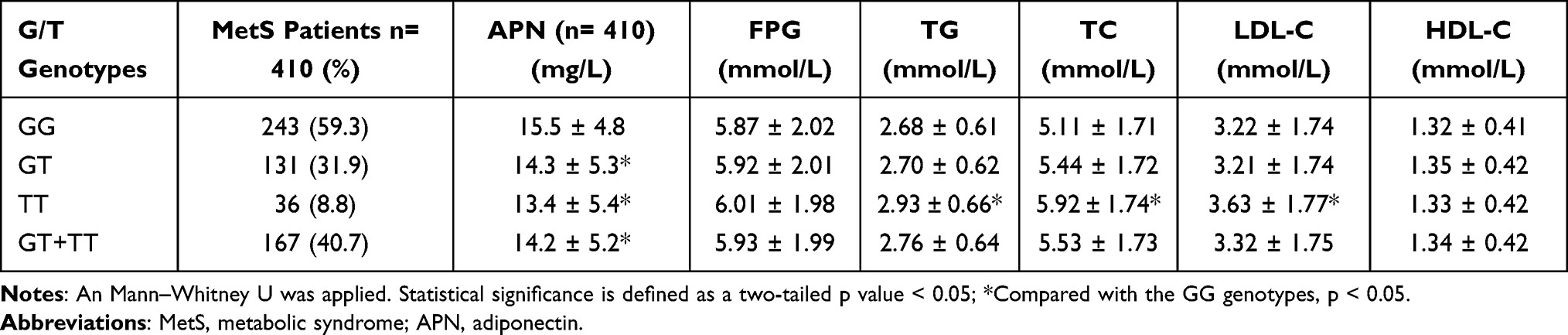 |
Table 4 The Comparison Between Adiponectin Gene Polymorphisms and Serum APN Concentrations in MetS Patients |
Discussion
Mets is a group of complex metabolic disorder syndromes that are thought to result from polygenic and multiple environmental effects. The prevalence of this disease has increased from 25.5% to 32.4% in recent years in people aged over 60.11 Mets is an important risk factor for diabetes and cardiovascular disease (CVD). It can also contribute to an increased risk of developing a variety of diseases, such as hypertension, coronary heart disease, and stroke. Many patients with Mets eventually develop CVD and kidney disease, resulting in high rates of cardiovascular disease, cerebrovascular disease, and death.12,13 This creates huge psychological and economic burdens on the patients and on society.14 It is thus important to find potential risk factors for the development of Mets in order to facilitate early detection and prevention in patients who may develop Mets. APN is the classic example of a pro-inflammatory adipokine. APN is a hormonal protein specifically secreted by adipose tissue, which promotes metabolic function and provides cardiovascular protection.15 Currently considered a biological marker for Mets.16,17
The aim of this study was to identify APN polymorphisms associated with metabolic syndrome and to determine whether APN polymorphisms are associated with the development of metabolic syndrome in this population. The results showed that the serum APN levels in the Mets patients were significantly lower than those in the healthy population (P < 0.001), indicating that reduced APN levels are closely associated with the development of Mets. This suggests that APN plays an important role in the development and progression of Mets, which is consistent with related reports.18–20 In the analysis of the G/T genotype and the allele frequency of polymorphisms at the rs1501299 locus of the lipocalin gene, it was found that the frequency of distribution of GG, GT, and TT genotypes was significantly higher in Mets patients than in the control group (P < 0.001). The G allele was also more common in the Mets group than in the control group. Logistic regression analysis adjusted for age, sex, and waist circumference showed that the subjects with the GT and TT genotypes had a 1.43-fold and 2.14-fold increased risk of Mets, respectively. Compared to the G allele subjects, the T allele subjects had a 1.85-fold increased risk of Mets. Further comparisons of the APN levels between the TT, GT, and GG genotype groups showed that the APN levels were significantly lower in the TT genotype and TG genotype subjects than in the GG genotype subjects. This suggests that the TT and GT genotype subjects may have lower APN levels and may be more prone to Mets. This also implies that this genotype is a risk factor for Mets, and even though the G allele is more common in Mets subjects, the T allele has a higher risk of developing Mets. This is consistent with previous studies reported by.21–23 In addition, many researchers have proposed that obese patients are more likely to have abnormal metabolic function.24–26 Saltiel27 also pointed out that obesity is a low-grade inflammatory metabolic disorder.
The results of this study showed that the differences in blood glucose, blood lipids, blood pressure, and body weight between the Mets patients and the control group were statistically significant. FPG, TG, TC, LDL-C, body weight, and blood pressure were significantly higher in the Mets group. This indirectly reflected the finding that the storage and metabolic capacity of TG and TC in the adipose tissue of obese individuals was related to their degree of insulin resistance, resulting in reduced APN levels. Low levels of APN are more likely to develop into Mets. Furthermore, patients with the TT genotype of MetS have higher levels of TG, TC, and LDL-C compared to those with the GG genotype. Since TG, TC, and LDL-C are all risk factors for MetS, this also indirectly suggests that the T allele is more likely to predispose individuals to developing MetS. The variation of the rs1501299 gene locus may thus lead to low serum APN levels, which are closely related to the occurrence of Mets. Using the APN and rs1501299 gene locus as screening indicators for Mets can therefore help identify susceptible populations in the early stages. The variation of the rs1501299 gene locus may thus lead to low serum APN levels, which are closely related to the occurrence of Mets. Using the APN and rs1501299 gene locus as screening indicators for Mets can therefore help identify susceptible populations in the early stages. By revealing that individuals with the G to T variation may experience reduced levels of adiponectin (APN), making them more susceptible to developing MetS, this finding aids in assessing an individual’s disease risk, particularly within the Chinese population. The study on the association between the adiponectin gene rs1501299 variant and the risk of MetS not only provides new scientific evidence for the early diagnosis and prevention of MetS but may also contribute to the design of more effective prevention and treatment plans targeted at patients with specific genotypes.
This study has several limitations. All samples for this study were sourced from patients at a single tertiary care facility, and all participants were from the same province in China, necessitating further research to determine if there are regional differences. The cases of metabolic syndrome included in this study were individuals with diabetes, and additional research is required to confirm the utility of the ADIPOQ gene polymorphism as a risk marker for metabolic syndrome in patients with diabetes.
Conclusion
The variation at the rs1501299 locus of the adiponectin gene is significantly associated with an increased risk of Mets. In particular, individuals with G-T mutations are more prone to decreases in their APN levels and to having Mets, indicating that this genotype is a risk factor for Mets.
Data Sharing Statement
The data used to support the findings of this study are available from the corresponding author upon request. Data will be made available on request.
Author Contributions
All authors made a significant contribution to the work reported, whether that is in the conception, study design, execution, acquisition of data, analysis and interpretation, or in all these areas; took part in drafting, revising or critically reviewing the article; gave final approval of the version to be published; have agreed on the journal to which the article has been submitted; and agree to be accountable for all aspects of the work.
Funding
This study was supported by Guangxi Natural Science Foundation Project (2023GXNSFAA026124), the Health Commission of the Guangxi Zhuang Autonomous Region (Z-A20220039), and Central Government Guidance Fund for Local Science and Technology Development of Guangxi Province (Guike ZY24212050).
Disclosure
The authors have no competing interests to declare for this work.
References
1. Gouveia ÉR, Gouveia BR, Marques A, et al. Predictors of metabolic syndrome in adults and older adults from Amazonas, Brazil. Int J Environ Res Public Health. 2021;18(3):1303. doi:10.3390/ijerph18031303
2. Lee H, Rhee TM, Park HE, Han K, Choi SY. Association between cumulative metabolic risk exposure and cardiovascular disease: a nationwide cohort of over 3.6 million young adults. Eur J Prev Cardiol. 2024;31:1288–1300. doi:10.1093/eurjpc/zwae088
3. Mehrabani S, Shoaei N, Shateri Z, et al. Consumption of ultra-processed foods could influence the metabolic syndrome odds: a cross-sectional study. Food Sci Nutr. 2024;12:2567–2577. doi:10.1002/fsn3.3938
4. Wang Q, Ren DC, Bi Y, et al. Association and functional study between and metabolic syndrome in elderly Chinese Han population. Aging-Us. 2020;12(24):25819–25827. doi:10.18632/aging.104203
5. Narita S, Ito R, Huang M, Numakura K, Tsuruta H, Maeno A. Impact of obesity and adiponectin signaling in patients with renal cell carcinoma: a potential mechanism for the obesity paradox. J Clin Oncol. 2017;35(6):449. doi:10.1200/JCO.2017.35.6_suppl.449
6. Ito R, Narita S, Huang M, et al. The impact of obesity and adiponectin signaling in patients with renal cell carcinoma: a potential mechanism for the “obesity paradox”. PLoS One. 2017;12(2):e0171615. doi:10.1371/journal.pone.0171615
7. Ghadge AA, Khaire AA, Kuvalekar AA. Adiponectin: a potential therapeutic target for metabolic syndrome. Cytokine Growth Factor Rev. 2018;39:151–158. doi:10.1016/j.cytogfr.2018.01.004
8. Chen VCH, Chen CH, Chiu YH, Lin TY, Li FC, Lu ML. Leptin/Adiponectin ratio as a potential biomarker for metabolic syndrome in patients with schizophrenia. Psychoneuroendocrinology. 2018;92:34–40. doi:10.1016/j.psyneuen.2018.03.021
9. Zhang X, Cao YJ, Zhang HY, Cong HL, Zhang J. Associations between polymorphisms and coronary artery disease: a meta-analysis. Bmc Cardiovasc Disor. 2019;19. doi:10.1186/s12872-019-1041-3
10. Mosad AS, Elfadil GA, Gassoum A, Elamin KM, Husain NEOSA. Adiponectin gene polymorphisms and possible susceptibility to metabolic syndrome among the Sudanese population: a case-control study. Int J Endocrinol. 2023;2023:5527963. doi:10.1155/2023/5527963
11. Li R, Li WC, Lun ZJ, et al. Prevalence of metabolic syndrome in mainland China: a meta-analysis of published studies. Bmc Public Health. 2016;16. doi:10.1186/s12889-016-2870-y
12. Wang ZW, Ma LY, Liu MB, Fan J, Hu SS, Cardiovascular WCR. Summary of the 2022 report on cardiovascular health and diseases in China. Chinese Med J. 2023;136(24):2899–2908. doi:10.1097/CM9.0000000000002927
13. Sharebiani H, Mokaram M, Mirghani M, Fazeli B, Stanek A. The effects of antioxidant supplementation on the pathologic mechanisms of metabolic syndrome and cardiovascular disease development. Nutrients. 2024;16(11):1641. doi:10.3390/nu16111641
14. Saklayen MG. The global epidemic of the metabolic syndrome. Curr Hypertens Rep. 2018;20(2):12. doi:10.1007/s11906-018-0812-z
15. Peng J, Chen Q, Wu CC. The role of adiponectin in cardiovascular disease ? Cardiovasc Pathol. 2023;64.
16. Nesic J, Ljujic B, Rosic V, et al. Adiponectin and Interleukin-33: possible early markers of metabolic syndrome. J Clin Med. 2023;12(1).
17. Wattanapol P, Vichinsartvichai P, Sakoonwatanyoo P. Serum adiponectin is a potential biomarker for metabolic syndrome in peri-and postmenopausal women. Gynecological Endocrinol. 2020;36(7):620–625. doi:10.1080/09513590.2020.1742688
18. Cho SA, Joo HJ, Cho JY, et al. Visceral fat area and serum adiponectin level predict the development of metabolic syndrome in a community-based asymptomatic population. PLoS One. 2017;12(1). doi:10.1371/journal.pone.0169289
19. Kang DR, Yadav D, Koh SB, Kim JY, Ahn SV. Impact of serum leptin to adiponectin ratio on regression of metabolic syndrome in high-risk individuals: the ARIRANG study. Yonsei Med J. 2017;58(2):339–346. doi:10.3349/ymj.2017.58.2.339
20. Kim JY, Ahn SV, Guallar E. Response to comment on: kim et al. Prospective study of serum adiponectin and incident metabolic syndrome: the ARIRANG study. Diabetes care 2013;36:1547–1553. Diabetes Care. 2013;36(9):E168–E168. doi:10.2337/dc13-1179
21. Yuan HP, Sun L, Li XH, et al. Association of adiponectin polymorphism with metabolic syndrome risk and adiponectin level with stroke risk: a meta-analysis. Sci Rep. 2016;6:6. doi:10.1038/s41598-016-0015-2
22. Zhao N, Li NX, Zhang SJ, et al. Associations between two common single nucleotide polymorphisms (rs2241766 and rs1501299) of ADIPOQ gene and coronary artery disease in type 2 diabetic patients: a systematic review and meta-analysis. Oncotarget. 2017;8(31):51994–52005. doi:10.18632/oncotarget.18317
23. Peters KE, Beilby J, Cadby G, et al. A comprehensive investigation of variants in genes encoding adiponectin (ADIPOQ) and its receptors (ADIPOR1/R2), and their association with serum adiponectin, type 2 diabetes, insulin resistance and the metabolic syndrome. Bmc Med Genet. 2013;14:14. doi:10.1186/1471-2350-14-14
24. Winn M, Karra P, Haaland B, et al. Metabolic dysfunction and obesity-related cancer: results from the cross-sectional national health and nutrition examination survey. Cancer Med-Us. 2023;12(1):606–618. doi:10.1002/cam4.4912
25. Gallardo-Alfaro L, Bibiloni MDM, Mascaró CM, et al. Leisure-time physical activity, sedentary behaviour and diet quality are associated with metabolic syndrome severity: the PREDIMED-plus study. Nutrients. 2020;12(4):1013. doi:10.3390/nu12041013
26. Stanek A, Grygiel-Górniak B, Brożyna-Tkaczyk K, Myśliński W, Cholewka A, Zolghadri S. The influence of dietary interventions on arterial stiffness in overweight and obese subjects. Nutrients. 2023;15(6):1440. doi:10.3390/nu15061440
27. Saltiel AR, Olefsky JM. Inflammatory mechanisms linking obesity and metabolic disease. J Clin Investig. 2017;127(1):1–4. doi:10.1172/JCI92035
 © 2025 The Author(s). This work is published and licensed by Dove Medical Press Limited. The
full terms of this license are available at https://www.dovepress.com/terms
and incorporate the Creative Commons Attribution
- Non Commercial (unported, 3.0) License.
By accessing the work you hereby accept the Terms. Non-commercial uses of the work are permitted
without any further permission from Dove Medical Press Limited, provided the work is properly
attributed. For permission for commercial use of this work, please see paragraphs 4.2 and 5 of our Terms.
© 2025 The Author(s). This work is published and licensed by Dove Medical Press Limited. The
full terms of this license are available at https://www.dovepress.com/terms
and incorporate the Creative Commons Attribution
- Non Commercial (unported, 3.0) License.
By accessing the work you hereby accept the Terms. Non-commercial uses of the work are permitted
without any further permission from Dove Medical Press Limited, provided the work is properly
attributed. For permission for commercial use of this work, please see paragraphs 4.2 and 5 of our Terms.