
Back to Journals » Journal of Pain Research » Volume 19
The Analgesic Efficacy of Ultrasound-Guided Transversus Abdominis Plane Block for Laparoscopic Living Donor Hepatectomy: A Randomized Controlled Study
Authors Liu S  , Yang Y , Wei L, Zhang L, Li X, Hao X, Cui L
Received 9 October 2025
Accepted for publication 6 March 2026
Published 13 March 2026 Volume 2026:19 567829
DOI https://doi.org/10.2147/JPR.S567829
Checked for plagiarism Yes
Review by Single anonymous peer review
Peer reviewer comments 2
Editor who approved publication: Dr Karina Gritsenko
Shen Liu,1 Yuxuan Yang,1 Lin Wei,2,3 Liang Zhang,1 Xiuliang Li,1 Xiaofang Hao,1 Lingli Cui1
1Department of Anesthesiology, Beijing Friendship Hospital, Capital Medical University, Beijing, 100050, People’s Republic of China; 2Liver Transplantation Center, National Clinical Research Center for Digestive Diseases, Beijing Friendship Hospital, Capital Medical University, Beijing, 100050, People’s Republic of China; 3Clinical Center for Pediatric Liver Transplantation, Capital Medical University, Beijing, 100069, People’s Republic of China
Correspondence: Lingli Cui, Email [email protected]
Purpose: The transversus abdominis plane (TAP) block provides effective postoperative analgesia for abdominal surgeries. However, its efficacy in laparoscopic living donor hepatectomy (LLDH) remains uncertain. This study aimed to assess the impact of ultrasound-guided TAP block on postoperative analgesia and recovery quality in living liver donors undergoing LLDH.
Patients and Methods: In this prospective, randomized, double-blind controlled trial, eighty patients scheduled for LLDH were randomly allocated 1:1 to receive ultrasound-guided bilateral single-injection TAP block (Group T) or local incisional infiltration (Group C). The primary outcome was total opioid consumption within 24 hours postoperatively. Secondary outcomes were visual analogue scale (VAS) pain scores, opioid consumption within 48h postoperatively, Quality of Recovery-15 (QoR-15) scores, time to first flatus and ambulation, length of hospital stay (LOS), postoperative liver function, opioid related adverse reactions, and puncture-related complications.
Results: The total opioid consumption within 24 hours postoperatively as the primary outcome was significantly lower in group T compared to group C (42 [38.5, 54] mg vs. 62 [52, 68] mg, P < 0.001), and this significant difference was also present at 48 hours postoperatively (98 [84.5, 104.5] mg vs. 112 [102, 133] mg, P < 0.001). The VAS scores at rest and movement were also lower in Group T at 2h after surgery (P < 0.01). Moreover, patients in Group T had earlier first postoperative flatus (P = 0.012). No significant differences between groups were observed in other secondary outcomes.
Conclusion: Ultrasound-guided TAP block can reduce postoperative opioid consumption, alleviate early postoperative pain without increasing adverse events in living donors undergoing the LLDH.
Keywords: TAP block, living donor, laparoscopic living donor hepatectomy, postoperative analgesia
Introduction
Liver transplantation is the most effective treatment for end-stage liver diseases, which is limited by the global shortage of donor organs. In this context, living donor liver transplantation (LDLT) has substantially expanded the donor pool.1 However, traditional open donor hepatectomy requires a J-shaped incision (25–30 cm) in the right upper abdomen, which is highly invasive and often leads to severe pain and complications. Postoperative pain may negatively affect recovery, prolong the length of hospital stay (LOS), and impact the donor’s mental health.2 With the improvement of surgical techniques, laparoscopic living donor hepatectomy (LLDH) has been recognized as the standard procedure for LDLT and is gradually replacing open surgery due to its reduced trauma and faster recovery.3 Nevertheless, living liver donors still experience moderate anxiety and acute pain levels in the postoperative period.4 For healthy individuals voluntarily donating to save their family member, ensuring perioperative safety and minimizing postoperative pain are crucial to the success of LLDH, and may also enhance the willingness of potential donors in LDLT. Currently, a standardized analgesic protocol for LLDH is still lacking and warrants further research and improvement.
In current clinical practice, patient-controlled intravenous analgesia (PCIA) remains the most commonly used postoperative analgesic approach. However, living liver donors often experience abnormal liver function in the early postoperative period, which may affect opioid metabolism and increase the risk of excessive sedation, respiratory depression, and postoperative nausea and vomiting (PONV).5–7 In recent years, with the continuous advancement of ultrasound technology, regional block techniques have become an indispensable part of multimodal postoperative analgesia.8 Currently, the most commonly used regional blocks for pain management following hepatectomy include epidural analgesia, paravertebral nerve block (PVB), erector spinae plane block (ESPB), and transversus abdominis plane (TAP) block, etc. Thoracic epidural analgesia (TEA) can provide effective pain relief for liver resection, yet its use is limited due to concerns over potential neurological injury and coagulopathy.9–11 Although PVB and ESPB also provide effective analgesia after hepatectomy, these methods are technically demanding and carry risks of complications such as hematoma, pneumothorax, and hemothorax.12 In contrast, ultrasound-guided TAP block offers distinct advantages, including technical simplicity, clear anatomical landmarks, and a high safety profile. Previous studies have demonstrated TAP block efficacy in reducing opioid consumption after abdominal surgery.13,14 Existing studies indicate that TAP block can effectively decrease opioid requirements and enhance recovery following living donor hepatectomy.15–17 It should be noted, however, that current research primarily focuses on open donor hepatectomy, with limited exploration of the analgesic efficacy in LLDH. This study aims to assess the efficacy and safety of ultrasound-guided TAP block in living liver donors undergoing LLDH, optimizing postoperative analgesia strategies, and promoting the rapid recovery of donors.
Patients and Methods
Study Population
The study protocol was approved by the Ethics Committee of Beijing Friendship Hospital, Capital Medical University at May 8, 2023 (Reference Number: 2023-P2-123-01), and registered in the Chinese Clinical Trial Registry (Registration Number: ChiCTR2300071694) at May 22, 2023. This study was performed in accordance with the Consolidated Standards of Reporting Trials (CONSORT 2010) Guidelines18 and the principles of the Declaration of Helsinki. Additionally, all donor procedures were approved by the Beijing Municipal Health Commission.
This study enrolled patients undergoing LLDH at Beijing Friendship Hospital between July 1, 2023 and October 31, 2024. Each patient voluntarily signed an informed consent to donate a portion of her or his liver in accordance with the Declaration of Istanbul. Inclusion Criteria: ①Aged 18–65 years; ②American Society of Anesthesiologists (ASA) grades I–II. Exclusion Criteria: ①History of significant cardiovascular disease; ②Infection at the proposed block site; ③Documented allergy to local anesthetics; ④Chronic pain syndrome or regular analgesic use (>3 months); ⑤History of substance abuse or alcohol dependence;⑥Patient refused to participate. Patients were excluded after randomization if any of the following occurred intraoperatively: ①Conversion to open surgery; ②Major intraoperative blood loss; ③Serious adverse events (eg, local anesthetic systemic toxicity); ④Unplanned postoperative intensive care unit (ICU) admission; ⑤Requirement for reoperation within 48 hours.
Randomization and Blinding
Randomization was performed using a computer-generated random-sequence allocation list. The randomisation process was performed by an investigator who was not involved in the patient eligibility assessment or recruitment processes and data collection. The allocation sequence was concealed from the researchers at all sites by serially numbered, opaque, sealed envelopes. Following fascial closure by the surgical team, the anesthesiologist opened the designated envelope. Eligible participants were randomly allocated in a 1:1 ratio to either the TAP block group (Group T) or the local incisional infiltration group (Group C). All TAP block were performed by a single experienced anesthesiologist (CLL), and local infiltration procedures were administered by the same senior hepatobiliary surgeon (WL). To ensure blinding, both interventions were done before emergence from anesthesia. The patients and postoperative follow-up team were unaware of the group allocation throughout the study, and the follow-up staff did not intervene in the postoperative analgesic regimen.
Standard Anesthesia Management
All patients received a standardized anesthetic management per our institutional protocol for LLDH. Upon arrival in the operating room, each patient was fitted with ASA standard monitors, including electrocardiogram (ECG), heart rate (HR), non-invasive blood pressure (NIBP), pulse oximetry (SpO2), and bispectral index (BIS). A peripheral intravenous catheter was placed in the right upper extremity, followed by radial artery cannulation for continuous arterial pressure monitoring. Rapid sequence induction was achieved with sufentanil 0.3–0.4 μg/kg, propofol 2 mg/kg, and cisatracurium 0.2 mg/kg. After intubation, mechanical ventilation was set as: respiratory rate of 12–15 breaths/min, tidal volume of 6–8 mL/kg, positive end-expiratory pressure (PEEP) of 5 cmH2O, and end-tidal carbon dioxide (EtCO2) at 35–45 mmHg. Anesthesia was maintained with continuous infusions of propofol (3–5 mg/kg/h), remifentanil (0.1–0.3 μg/kg/min), and cisatracurium (0.1 mg/kg/h) to maintain the BIS value of 40–60. After the closure of peritoneum, all patients received tramadol hydrochloride 100 mg and tropisetron 5 mg intravenous injection for postoperative analgesia and nausea prophylaxis.
Intervention
Patients in Group T received a bilateral ultrasound-guided TAP block at the end of surgery before extubation. After disinfecting the skin, a linear high-frequency ultrasound probe (8–14 MHz, Mindray China) was placed at the level of the midaxillary line between the subcostal margin and iliac crest. Ultrasound clearly showed the three layers of the abdominal wall muscles: from superficial to deep, ie, the external oblique, internal oblique, and transversus abdominis. Using an in-plane technique from the anterior axillary line, a 22-gauge needle was advanced into the fascial plane between the internal oblique and transversus abdominis muscles. 2 mL of 0.9% normal saline was injected to confirm proper needle placement. As the correct needle placement was confirmed with 2mL of 0.9% normal saline, 25–30 mL of 0.333% ropivacaine was injected bilaterally. The spread of the drug was seen between the internal oblique muscle and the transverse abdominis muscle. The same procedure was repeated on the contralateral side.
Patients in Group C received local infiltration with anesthetics in the wounds after closure of the peritoneum. 25 mL of 0.333% ropivacaine was infiltrated around the transverse incision site 3 cm above the symphysis pubis. 5 mL of the local anesthetic was infiltrated at each trocar incisions.
Postoperative Management
Patients were extubated upon meeting standard extubation criteria, and subsequently transferred to the post-anesthesia care unit (PACU) for close observation. All patients received standardized postoperative patient-controlled intravenous analgesia (PCIA) pumps. The PCIA pump contained sufentanil 200 μg and ondansetron 20 mg in 0.9%sodium chloride of 200 mL, programmed with a background infusion rate of 2 mL/h, bolus dose of 2 mL, 10-minute lockout interval. In the PACU, anesthesia nurses assessed patients’ pain scores every 5 minutes using the visual analogue scale (VAS) scores at rest and movement. If a patient’s VAS score at rest exceeded 4, rescue analgesia was provided via PICA. In cases of severe pain, an additional sufentanil 5 μg was administered. All patients received scheduled intravenous flurbiprofen axetil 50 mg every 12 hours. Morphine hydrochloride 10 mg was used as needed in the ward.
Outcome Measures
The primary outcome was the total opioid consumption within 24 hours postoperatively (including sufentanil via PCIA, opioid administrated in the PACU and ward as rescue analgesia after surgery), converted to intravenous morphine milligram equivalents (MME). Secondary outcomes included the following: VAS scores at rest and movement (when coughing, getting out of bed, or walking) at 2, 4, 6, 24, and 48 hours postoperatively; cumulative opioid consumption (in MME) within 48 hours postoperatively; rescue analgesic consumption; the Quality of Recovery-15 (QoR-15) scores19 at 24 and 48 hours after surgery. Additional outcomes were the time to first flatus, time to first ambulation, length of hospital stay, and liver function during the first 48 hours postoperatively. Postoperative adverse events (eg, nausea and vomiting, pruritus, and respiratory depression) and puncture-related complications (eg, local anesthetic intoxication, hepatic dysfunction, and puncture site hematoma) were recorded in both groups.
Sample Size Calculation and Statistical Analysis
The sample size was calculated based on the primary outcome: the total opioid consumption within 24 hours postoperatively. According to the results of pilot study, the opioid consumption over the first 24 hours postoperative was 44.8 ± 14.7 mg in Group T and 68.3 ± 23.9 mg in Group C. According to the mean superiority test of the two independent samples, the clinically significant difference between the two groups was 10 mg of morphine. Using the PASS 15.0 software, assuming a power of 80% with an alpha of 0.05, 35 participants were required in each group. Accounting for a potential dropout rate of 10%, a final sample size of 80, ie, 40 patients in each group, was determined.
The analysis adhered to the intention-to-treat (ITT) and per-protocol principle. Quantitative data (baseline characteristics, perioperative parameters, opioid consumption, VAS scores, and QoR-15 scores) were presented as the mean (standard deviation, SD) or median (interquartile range, IQR). According to the normality of the data, between-group comparisons were performed using Student’s t-test or the Mann‒Whitney U-test. Qualitative data (gender, surgical types, adverse events) were expressed as frequencies (percentages), and their between-group comparisons were done using the Chi-square test or Fisher’s exact test. For the primary outcome, intergroup differences were compared using the Mann‒Whitney U-test. For all analyses, a two-sided P < 0.05 was considered to indicate statistical significance. In this study, the data analysis was performed using SPSS 23.0 statistical software.
Results
Study Population
The participant flow is displayed in Figure 1 (following the CONSORT flowchart for clinical trial reporting). A total of 98 patients were assessed for eligibility; 16 patients were excluded due to a change in the surgical approach (n=14), declined to participate (n=1), or substance abuse (n=1). 82 patients were randomly assigned either to Group T (n = 42) or Group C (n = 40). 2 patients in Group T were excluded after randomisation because 1 patient due to conversion to laparotomy, and 1 due to reoperation within 48 hours. No dropouts occurred in Group C. Finally, 80 patients (40 per group) were included in the final analysis. The demographic and baseline characteristics of the patients were comparable between the two groups (Table 1). There were no significant differences between groups in anesthesia time, surgery time, graft types, dosages of propofol and remifentanil, and extubation time (Table 1).
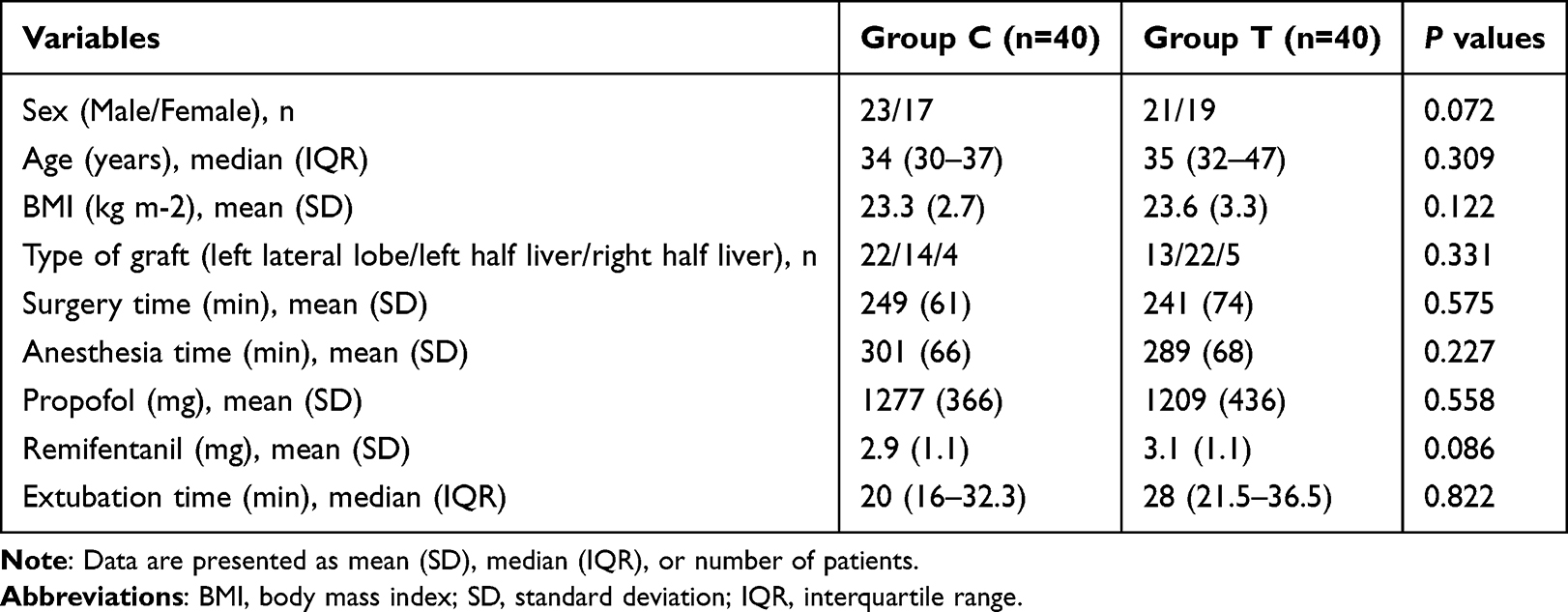 |
Table 1 Patient Demographic and Peri-Operative Data |
 |
Figure 1 Consolidated Standards of Reporting Trials (CONSORT) flowchart. |
Primary and Important Secondary Outcomes
The cumulative morphine consumption was significantly lower in Group T compared to Group C at 24 hours (Group T vs. Group C: 42 [38.5, 54] mg vs. 62 [52, 68] mg, P < 0.001) postoperatively. Notably, this significant difference persisted at 48 hours postoperatively (Group T vs. Group C: 98 [84.5, 104.5] mg vs. 112 [102, 133] mg, P < 0.001) (Table 2).
 |
Table 2 The Postoperative Data |
Secondary Outcomes
The VAS scores at 2 hours after surgery were significantly lower in Group T compared to Group C at rest (0.7 ± 0.2 vs. 1.8 ± 0.3, P < 0.001) and with movement (1.6 ± 0.3 vs. 3.4 ± 0.5, P < 0.001). However, there was no significant difference in VAS scores at 4, 6, 24, and 48 hours between groups (P > 0.05) (Table 2). The changes of pain scores at the different time points are shown in Figure 2.
 |
Figure 2 Postoperative VAS scores at different time-points. (A) VAS scores at rest; and (B) VAS scores at movement. Bars represent the mean; error bars indicate the SD. Abbreviations: VAS, visual analogue scale; SD, standard deviation; Group C, the control group; Group T, the TAP block group. |
6 patients in Group T received rescue analgesia, while 13 patients in Group C received rescue analgesia after surgery. No significant difference was observed between the two groups (P = 0.065) (Table 2).
Postoperative recovery outcomes and adverse events for patients in both groups are shown in Table 2. The time to first flatus after surgery was significantly shorter in Group T (48 [26.5, 65.5] hours) than in Group C (55.5 [43, 72] hours, P = 0.012). The QoR-15 scores (at 24, 48 hours postoperatively), opioid-related adverse events (nausea and vomiting, respiratory depression), puncture-related complications (local anesthetic systemic toxicity, puncture site hematoma), the time to first ambulation, and the length of hospital stays were not significantly different between groups. There was also no significant difference in the peak serum AST and ALT levels after surgery between groups (Table 2).
Discussion
This randomized controlled clinical trial demonstrated that, compared with traditional local infiltration anesthesia, ultrasound-guided TAP block significantly reduced postoperative opioid consumption, lowered early pain scores, and shortened the time to first flatus in living liver donors undergoing LLDH. This strategy proved safe, with no observed adverse events, supporting its efficacy as a component of multimodal analgesia within an enhanced recovery after surgery (ERAS) framework for living liver donors.
As healthy individuals undergoing major surgery to save a loved one, providing safe and effective postoperative analgesia for living liver donors is of paramount importance. Within ERAS protocols, the primary goal of analgesia is to achieve effective pain control while minimizing adverse effects and accelerating recovery.20 Opioids carry specific risks in liver donors. Postoperative changes in hepatic blood flow and function may impair the metabolism of opioids, leading to drug accumulation and side effects, such as nausea, vomiting, and ileus, which may directly hinder recovery and delay discharge.6,7 In our study, TAP block significantly reduced morphine consumption within 24 and 48 hours postoperatively, aligning with the core principles of ERAS protocols. Several studies have demonstrated that TAP block can produce effective analgesia and reduce opioid requirements in abdominal surgery.15,21–23 Kitlik et al17 reported that ultrasound-guided bilateral TAP block (single-injection bupivacaine) in donors with right subcostal J-shaped incisions significantly reduced postoperative morphine consumption at 2, 6, and 24 hours, along with improved resting and movement VAS scores at 0, 2, 4, 6, and 24 hours. Maeda et al15 also applied continuous subcostal TAP block (levobupivacaine) with inverted-T incisions, demonstrating significant reductions in 48-hour opioid consumption and improved VAS scores at 3 and 6 hours. In our study, the VAS pain scores showed no significant difference between groups at any postoperative time points, except for the 2-hour time point. However, the duration and efficacy of TAP block vary across studies, likely due to differences in incision type, local anesthetic selection, block technique (single-shot vs. continuous infusion), and timing of block application (pre-incisional vs. post-incisional), as well as surgical approaches (open vs. laparoscopic) and patient populations. This transient superiority in analgesia may be attributed to the peak efficacy of single-injection ropivacaine; after its effects waned, patients relied solely on PCA. The pharmacokinetic profile of ropivacaine, with a finite duration of action, explains the waning of its specific effect in the later postoperative period.24,25 Therefore, using a longer-acting local anesthetic such as liposomal bupivacaine may provide more effective and longer pain control in the postoperative period.
Additionally, this study found that the TAP block group experienced a shorter time to first flatus compared to the control group, indicating a positive effect on the recovery of gastrointestinal function after surgery. This improvement is likely an indirect benefit of reduced opioid consumption, as it is well known that opioids can inhibit intestinal motility. The prokinetic medications to promote gastrointestinal recovery were not routinely administered at our center, thereby avoiding potential bias introduced by these interventions. Earlier gastrointestinal function recovery marks a critical node in the postoperative recovery process. Despite earlier gastrointestinal recovery in the TAP block group, no corresponding reduction in hospital stay was observed. The finding of this study is inconsistent with previous reports.16 This discrepancy may be influenced by institutional protocols and surgeon-specific discharge practices, which can outweigh subtle differences in patient recovery.
Interestingly, despite the reduction in 24-hour opioid consumption, we did not find a statistically significant difference in the incidence of opioid-related adverse effects such as nausea, vomiting, or pruritus. This finding aligns with some studies but contrasts with others.15,25–27 Several factors may explain this discrepancy. First, the relatively small sample size limits the statistical power to detect differences between groups, particularly for secondary outcomes. Second, although total opioid consumption is significantly reduced, the magnitude of reduction may not reach the threshold required to alter the incidence of common adverse effects in this healthy population. Third, the influencing factors for postoperative nausea and vomiting are multifactorial, including gender, age, history of motion sickness, smoking, and anxiety, of which opioid dosage is only one contributing factor and may not independently determine the outcome.
Additionally, in our study, all TAP blocks were performed under ultrasound guidance without any puncture-related complications, such as local anesthetic systemic toxicity, organ injury, or hematoma, further supporting the safety of the TAP block procedure. Whether the risk of local anesthetic systemic toxicity is elevated in living liver donors undergoing major hepatectomy is also a concern for clinicians. A previous study indicated that TAP block with 3 mg/kg ropivacaine during laparoscopic hepatectomy almost never resulted in the plasma ropivacaine concentrations associated with neurotoxicity.25 Although plasma ropivacaine concentrations were not monitored in our study, no clinical signs of local anesthetic toxicity were observed. Future large-scale trials are still needed to further evaluate the pharmacokinetic parameters in living liver donors undergoing LLDH. This study also assessed the effect of local anesthetics on postoperative liver function. No significant difference was observed in peak liver enzyme levels between groups. However, due to the absence of a control group without regional blockade, the current evidence was insufficient to support a potential association between local anesthetic absorption and postoperative liver function.
TAP block is highly effective for somatic pain from abdominal wall incisions, but has limited efficacy against visceral pain.28–31 Several studies suggested that TAP block alone may not provide significant analgesic benefits or opioid savings following laparoscopic abdominal surgery.32,33 This underscores that TAP block should not be used as a standalone solution but rather as part of a multimodal analgesic regimen.14,21,34,35 Combining TAP block with other non-opioid analgesics (eg, acetaminophen, NSAIDs) and agents targeting visceral pain pathways may provide more comprehensive and sustained pain relief. Moreover, compared with other regional techniques, TAP block does not require turning over, is intuitive and easy to learn, and may reduce overall healthcare costs by decreasing opioid use and side effects. It is easier to promote in clinical practice.
Limitations
This study has several limitations. First, the single-center design and relatively small sample size may limit the generalizability of our findings and reduce the statistical power to detect differences in less frequent outcomes, particularly opioid-related adverse events and puncture-related complications. Second, the transient superior analgesia observed in the TAP block group may be attributed to the inherent pharmacological constraints of single-injection techniques. Future studies should investigate the efficacy of continuous subcostal TAP block or the use of adjuvants, or its combination with other regional approaches, such as rectus sheath block, to achieve prolonged analgesic effects.15,36,37 Finally, as our study population comprised young, healthy liver donors without underlying hepatic impairment, the results may not be directly applicable to patients undergoing hepatectomy for malignancies or other hepatic diseases. Such patients often exhibit varying degrees of liver dysfunction, which could increase their susceptibility to complications such as drug accumulation and local anesthetic toxicity. Therefore, further studies with well design and large sample sizes are needed to address above issues and to optimize the incorporation of TAP block into ERAS protocols for LLDH.
Conclusion
In conclusion, ultrasound-guided bilateral TAP block is an effective component of a multimodal analgesic strategy for patients undergoing LLDH. It provides significant opioid-sparing effects, superior early postoperative analgesia, and promotes gastrointestinal recovery, offering important clinical benefits for enhanced recovery in healthy donors. Future studies are needed to explore the combination of TAP block with other regional analgesia techniques or long-acting agents, aiming to achieve superior prolonged analgesia, and further improve the quality of recovery and safety in living liver donors.
Data Sharing Statement
All data generated and/or analyzed during the present study are available from the corresponding author upon reasonable request.
Ethical Approval
All procedures performed in studies involving human participants were in accordance with the ethical standards of the institutional and/or national research committee and with the Helsinki declaration.
Informed Consent
Informed consent was obtained from all individual participants included in the study.
Acknowledgments
The authors extend their sincere gratitude to all the participants who took part in this study.
Author Contributions
All authors made a significant contribution to the work reported, whether that is in the conception, study design, execution, data acquisition, analysis and interpretation, or in all these areas. All authors took part in drafting, revising or critically reviewing the article and gave final approval of the version to be published. All authors have agreed on the journal to which the article has been submitted and agree to be accountable for all aspects of the work.
Funding
There is no funding to report.
Disclosure
The authors report no conflicts of interest for this work.
References
1. Nadalin S, Capobianco I, Panaro F, et al. Living donor liver transplantation in Europe. Hepatobiliary Surg Nutr. 2016;5(2):159–10. doi:10.3978/j.issn.2304-3881.2015.10.04
2. Holtzman S, Clarke HA, McCluskey SA, Turcotte K, Grant D, Katz J. Acute and chronic postsurgical pain after living liver donation: incidence and predictors. Liver Transpl. 2014;20(11):1336–1346. doi:10.1002/lt.23949
3. Soubrane O, Eguchi S, Uemoto S, et al. Minimally invasive donor hepatectomy for adult living donor liver transplantation: an international, multi-institutional evaluation of safety, efficacy and early outcomes. Ann Surg. 2022;275(1):166–174. doi:10.1097/SLA.0000000000003852
4. Tseng SC, Lee WC, Chen KH, Tsai HH, Kuo MC, Weng LC. Anxiety, pain intensity, and decision regret of living liver donors during postoperative period. Appl Nurs Res. 2023;69:151662. doi:10.1016/j.apnr.2022.151662
5. Neuman MD, Bateman BT, Wunsch H. Inappropriate opioid prescription after surgery. Lancet. 2019;393(10180):1547–1557. doi:10.1016/S0140-6736(19)30428-3
6. Yong BH, Tsui SL, Leung CC, et al. Management of postoperative analgesia in living liver donors. Transplant Proc. 2000;32(7):2110. doi:10.1016/s0041-1345(00)01592-x
7. Simpson JC, Bao X, Agarwala A. Pain management in enhanced recovery after surgery (ERAS) protocols. Clin Colon Rectal Surg. 2019;32(2):121–128. doi:10.1055/s-0038-1676477
8. Kianian S, Bansal J, Lee C, Zhang K, Bergese SD. Perioperative multimodal analgesia: a review of efficacy and safety of the treatment options. Anesthesiol Perioperat Sci. 2024;2(1). doi:10.1007/s44254-023-00043-1
9. Koul A, Pant D, Rudravaram S, Sood J. Thoracic epidural analgesia in donor hepatectomy: an analysis. Liver Transpl. 2018;24(2):214–221. doi:10.1002/lt.24989
10. Tzimas P, Prout J, Papadopoulos G, Mallett SV. Epidural anaesthesia and analgesia for liver resection. Anaesthesia. 2013;68(6):628–635. doi:10.1111/anae.12191
11. Rosero EB, Cheng GS, Khatri KP, Joshi GP. Evaluation of epidural analgesia for open major liver resection surgery from a US inpatient sample. Bayl Univ Med Cent Proc. 2014;27(4):305–312. doi:10.1080/08998280.2014.11929141
12. Dieu A, Huynen P, Lavand’homme P, et al. Pain management after open liver resection: procedure-Specific Postoperative Pain Management (PROSPECT) recommendations. Reg Anesth Pain Med. 2021;46(5):433–445. doi:10.1136/rapm-2020-101933
13. Tsai HC, Yoshida T, Chuang TY, et al. Transversus abdominis plane block: an updated review of anatomy and techniques. Biomed Res Int. 2017;2017:8284363. doi:10.1155/2017/8284363
14. Grape S, Kirkham KR, Akiki L, Albrecht E. Transversus abdominis plane block versus local anesthetic wound infiltration for optimal analgesia after laparoscopic cholecystectomy: a systematic review and meta-analysis with trial sequential analysis. J Clin Anesth. 2021;75:110450. doi:10.1016/j.jclinane.2021.110450
15. Maeda A, Shibata SC, Wada H, et al. The efficacy of continuous subcostal transversus abdominis plane block for analgesia after living liver donation: a retrospective study. J Anesth. 2016;30(1):39–46. doi:10.1007/s00540-015-2085-x
16. Erdogan MA, Ozgul U, Uçar M, et al. Effect of transversus abdominis plane block in combination with general anesthesia on perioperative opioid consumption, hemodynamics, and recovery in living liver donors: the prospective, double-blinded, randomized study. Clin Transplant. 2017;31(4). doi:10.1111/ctr.12931
17. Kıtlık A, Erdogan MA, Ozgul U, et al. Ultrasound-guided transversus abdominis plane block for postoperative analgesia in living liver donors: a prospective, randomized, double-blinded clinical trial. J Clin Anesth. 2017;37:103–107. doi:10.1016/j.jclinane.2016.12.018
18. Schulz KF, Altman DG, Moher D; CONSORT Group. CONSORT statement: updated guidelines for reporting parallel group randomised trials. Trials. 2010;11(1):32. doi:10.1186/1745-6215-11-32
19. Stark PA, Myles PS, Burke JA. Development and psychometric evaluation of a postoperative quality of recovery score: the QoR-15. Anesthesiology. 2013;118(6):1332–1340. doi:10.1097/ALN.0b013e318289b84b
20. Joshi GP, Beloeil H, Lobo DN, et al. A critical approach to research on perioperative pain management. Br J Anaesth. 2025;134(3):621–626. doi:10.1016/j.bja.2024.11.004
21. El-Dawlatly AA, Turkistani A, Kettner SC, et al. Ultrasound-guided transversus abdominis plane block: description of a new technique and comparison with conventional systemic analgesia during laparoscopic cholecystectomy. Br J Anaesth. 2009;102(6):763–767. doi:10.1093/bja/aep067
22. Ripollés J, Mezquita SM, Abad A, Calvo J. Analgesic efficacy of the ultrasound-guided blockade of the transversus abdominis plane - a systematic review. Braz J Anesthesiol. 2015;65(4):255–280. doi:10.1016/j.bjane.2013.10.016
23. Ganapathy S, Sondekoppam RV, Terlecki M, Brookes J, Das Adhikary S, Subramanian L. Comparison of efficacy and safety of lateral-to-medial continuous transversus abdominis plane block with thoracic epidural analgesia in patients undergoing abdominal surgery: a randomised, open-label feasibility study. Eur J Anaesthesiol. 2015;32(11):797–804. doi:10.1097/EJA.0000000000000345
24. Amundson AW, Olsen DA, Smith HM, et al. Acute benefits after liposomal bupivacaine abdominal wall blockade for living liver donation: a retrospective review. Mayo Clin Proc Innov Qual Outcomes. 2018;2(2):186–193. doi:10.1016/j.mayocpiqo.2018.03.003
25. Zhang J, Liu T, Zhou H, Fei Y, Yu X. The safety and efficacy of ultrasound-guided bilateral dual transversus abdominis plane (BD-TAP) block in ERAS program of laparoscopic hepatectomy: a prospective, randomized, controlled, blinded, clinical study. Drug Des Devel Ther. 2020;14:2889–2898. doi:10.2147/DDDT.S255385
26. Wu Y, Liu F, Tang H, et al. The analgesic efficacy of subcostal transversus abdominis plane block compared with thoracic epidural analgesia and intravenous opioid analgesia after radical gastrectomy. Anesth Analg. 2013;117(2):507–513. doi:10.1213/ANE.0b013e318297fcee
27. Bhatia N, Arora S, Jyotsna W, Kaur G. Comparison of posterior and subcostal approaches to ultrasound-guided transverse abdominis plane block for postoperative analgesia in laparoscopic cholecystectomy. J Clin Anesth. 2014;26(4):294–309. doi:10.1016/j.jclinane.2013.11.023
28. Belavy D, Cowlishaw PJ, Howes M, Phillips F. Ultrasound-guided transversus abdominis plane block for analgesia after Caesarean delivery. Br J Anaesth. 2009;103(5):726–730. doi:10.1093/bja/aep235
29. Finnerty O, Sharkey A, Mc Donnell JG. Transversus abdominis plane block for abdominal surgery. Minerva Anestesiol. 2013;79(12):1415–1422.
30. Petersen PL, Mathiesen O, Torup H, Dahl JB. The transversus abdominis plane block: a valuable option for postoperative analgesia? A topical review. Acta Anaesthesiol Scand. 2010;54(5):529–535. doi:10.1111/j.1399-6576.2010.02215.x
31. Abdallah FW, Chan VW, Brull R. Transversus abdominis plane block: a systematic review. Reg Anesth Pain Med. 2012;37(2):193–209. doi:10.1097/AAP.0b013e3182429531
32. Hotujec BT, Spencer RJ, Donnelly MJ, et al. Transversus abdominis plane block in robotic gynecologic oncology: a randomized, placebo-controlled trial. Gynecol Oncol. 2015;136(3):460–465. doi:10.1016/j.ygyno.2014.11.013
33. Cataldo R, Bruni V, Migliorelli S, et al. Laparoscopic-guided transversus abdominis plane (TAP) block combined with port-site infiltration (PSI) for laparoscopic sleeve gastrectomy in an ERABS pathway: a randomized, prospective, double-blind, placebo-controlled trial. Obes Surg. 2024;34(7):2475–2482. doi:10.1007/s11695-024-07292-4
34. McDonnell JG, O’Donnell B, Curley G, Heffernan A, Power C, Laffey JG. The analgesic efficacy of transversus abdominis plane block after abdominal surgery: a prospective randomized controlled trial. Anesth Analg. 2007;104(1):193–197. doi:10.1213/01.ane.0000250223.49963.0f
35. De Oliveira GS Jr, Castro-Alves LJ, Nader A, Kendall MC, McCarthy RJ. Transversus abdominis plane block to ameliorate postoperative pain outcomes after laparoscopic surgery: a meta-analysis of randomized controlled trials. Anesth Analg. 2014;118(2):454–463. doi:10.1213/ANE.0000000000000066
36. Yang X, Su B, Chen Y, et al. Adjuvants and rebound pain following peripheral nerve block in adult surgical patients: a systematic review and network meta-analysis of randomized controlled trials. Anesthesiol Perioperat Sci. 2025;3(6). doi:10.1007/s44254-025-00111-8
37. Lu X, Yu P, Ou C, Wang J, Zhou Z, Lai R. The postoperative analgesic effect of ultrasound-guided bilateral transversus abdominis plane combined with rectus sheath blocks in laparoscopic hepatectomy: a randomized controlled study. Ther Clin Risk Manag. 2020;16:881–888. doi:10.2147/TCRM.S267735
 © 2026 The Author(s). This work is published and licensed by Dove Medical Press Limited. The
full terms of this license are available at https://www.dovepress.com/terms
and incorporate the Creative Commons Attribution
- Non Commercial (unported, 4.0) License.
By accessing the work you hereby accept the Terms. Non-commercial uses of the work are permitted
without any further permission from Dove Medical Press Limited, provided the work is properly
attributed. For permission for commercial use of this work, please see paragraphs 4.2 and 5 of our Terms.
© 2026 The Author(s). This work is published and licensed by Dove Medical Press Limited. The
full terms of this license are available at https://www.dovepress.com/terms
and incorporate the Creative Commons Attribution
- Non Commercial (unported, 4.0) License.
By accessing the work you hereby accept the Terms. Non-commercial uses of the work are permitted
without any further permission from Dove Medical Press Limited, provided the work is properly
attributed. For permission for commercial use of this work, please see paragraphs 4.2 and 5 of our Terms.
Recommended articles
Clinical Trial Study Protocol: A Prospective Blinded, Randomized, Controlled Clinical Trial Protocol to Assess the Efficacy of Ultrasound-Guided Transversus Abdominis Plane Block on Postoperative Analgesia and Recovery Quality in Laparoscopic Donor Hepatectomy
Liu S, Song B, Zhang L, Li X, Cui L
Journal of Pain Research 2024, 17:3401-3408
Published Date: 22 October 2024
Hydromorphone is Noninferior to Dexamethasone as an Adjuvant to Ropivacaine for Transversus Abdominis Plane Block After Laparoscopic Colorectal Cancer Surgery: A Randomized, Double-Blind Trial
Zhao L, Wang Y, Guo Q, An Q, Wu M, Fan C, Guo Z
Journal of Pain Research 2026, 19:581520
Published Date: 5 March 2026