
Back to Journals » Drug Design, Development and Therapy » Volume 20
Tegileridine versus Sufentanil Patient-Controlled Intravenous Analgesia for Gastrointestinal Recovery in Elderly Patients Undergoing Laparoscopic Colorectal Cancer Surgery: A Randomized Controlled Trial
Authors He H, Xiong W, Song M, Yao J, Wang Y, Feng J 
Received 26 April 2026
Accepted for publication 14 July 2026
Published 22 July 2026 Volume 2026:20 620139
DOI https://doi.org/10.2147/DDDT.S620139
Checked for plagiarism Yes
Review by Single anonymous peer review
Peer reviewer comments 2
Editor who approved publication: Prof. Dr. Tin Wui Wong
Hongyan He,1,* Wenxuan Xiong,1,* Mengqin Song,2,* Jinliang Yao,1 Ying Wang,3 Jiying Feng1
1Department of Anesthesiology, The Affiliated Lianyungang Hospital of Xuzhou Medical University, Lianyungang, Jiangsu, People’s Republic of China; 2Department of Anesthesiology, Lianyungang Clinical College of Nanjing Medical University, Lianyungang, Jiangsu, People’s Republic of China; 3Department of Gynecology, The Affiliated Lianyungang Hospital of Xuzhou Medical University, Lianyungang, Jiangsu, People’s Republic of China
*These authors contributed equally to this work
Correspondence: Ying Wang, Department of Gynecology, The Affiliated Lianyungang Hospital of Xuzhou Medical University, Lianyungang, Jiangsu, People’s Republic of China, Tel +86 18961326623, Email [email protected] Jiying Feng, Department of Anesthesiology, The Affiliated Lianyungang Hospital of Xuzhou Medical University, Lianyungang, Jiangsu, People’s Republic of China, Tel +86 18961322506, Email [email protected]
Purpose: To compare tegileridine-based and sufentanil-based patient-controlled intravenous analgesia (PCIA) for postoperative gastrointestinal recovery in elderly patients undergoing laparoscopic colorectal cancer surgery.
Methods: In this single-center, double-blind, randomized controlled trial, patients scheduled for elective laparoscopic colorectal cancer surgery were randomized 1:1 to tegileridine-based PCIA (Group T) or sufentanil-based PCIA (Group S). The primary outcome was the Intake, Feeling nauseated, Emesis, physical Exam, and Duration of symptoms (I-FEED) score on postoperative day 3 (POD3). Secondary outcomes included I-FEED scores on POD1– 5 (excluding POD3), incidence of postoperative gastrointestinal dysfunction (POGD), time to first flatus and defecation, analgesic outcomes, quality of recovery, and adverse events.
Results: One hundred patients were included in the primary analysis (Group T, n = 51; Group S, n = 49). Compared with Group S, Group T had significantly lower I-FEED scores on POD1 (estimated marginal mean [EMM] difference, − 0.60; 95% CI, − 1.03 to − 0.17; P = 0.006), POD2 (EMM difference, − 0.66; 95% CI, − 1.14 to − 0.18; P = 0.008), and POD3 (EMM difference, − 0.72; 95% CI, − 1.17 to − 0.27; P = 0.002), a lower incidence of POGD (11.8% vs 28.6%; P = 0.036), and a shorter time to first flatus (36 h vs 40 h; P = 0.025). Pain scores, PCIA use, and rescue analgesia were comparable between groups. Quality of Recovery-15 (QoR-15) scores were higher in Group T on POD2 and POD3. Group T also had a lower overall incidence of adverse events (27.5% vs 49.0%; P = 0.027) and a lower incidence of nausea and vomiting (23.5% vs 44.9%; P = 0.024).
Conclusion: In elderly patients undergoing laparoscopic colorectal cancer surgery, tegileridine-based PCIA provided analgesia comparable to sufentanil under the prespecified dosing regimens. It was associated with better gastrointestinal recovery during the first three postoperative days and fewer adverse events. This regimen may be a safe and effective analgesic option in this population.
Keywords: tegileridine, patient-controlled intravenous analgesia, laparoscopic colorectal cancer surgery, postoperative gastrointestinal function, elderly patients, I-FEED
Introduction
Postoperative gastrointestinal dysfunction (POGD) is one of the most common complications after abdominal surgery, with an incidence ranging from 10% to 30%.1 This is associated with adverse outcomes, including prolonged hospital stay, increased medical costs, delayed recovery, and patient discomfort.2–4 Among patients undergoing gastrointestinal surgery, older adults are at particularly high risk of impaired postoperative gastrointestinal recovery. A meta-analysis including 43,878 patients with gastrointestinal tumors showed that age of 60 years or older was a risk factor for POGD.5 Although laparoscopic surgery has been shown to reduce the incidence of POGD by attenuating tissue injury and inflammatory stress compared with open surgery,6 postoperative gastrointestinal recovery in older patients remains challenging because of reduced physiologic reserve, greater frailty, and multiple comorbidities.7–9
Patient-controlled intravenous analgesia (PCIA) is commonly used for pain management after major abdominal surgery. Conventional opioids, such as morphine and sufentanil, remain widely used for postoperative analgesia because of their reliable analgesic efficacy.10–12 However, higher cumulative perioperative opioid exposure is an independent risk factor for delayed postoperative gastrointestinal recovery and postoperative ileus.13,14 Mechanistically, conventional opioids bind to μ-opioid receptors and produce analgesia through activation of G protein signaling, but they also activate the β-arrestin pathway.15 Preclinical studies have shown that β-arrestin pathway is associated with opioid-related adverse events, including respiratory depression, nausea and vomiting, and constipation.16–18
Tegileridine is a novel G protein-biased μ-opioid receptor agonist. Unlike conventional opioids, it mainly activates G protein signaling, with minimal β-arrestin recruitment (approximately 10% of morphine).19 Theoretically, this biased signaling profile may preserve analgesic efficacy while reducing opioid-related adverse events. A study in healthy Chinese male subjects showed that tegileridine has favorable pharmacokinetic and safety profiles, with rapid peak plasma concentrations after intravenous administration, an elimination half-life of approximately 6–7 h, extensive metabolism, and predominant urinary elimination.20 Its major metabolites are pharmacologically inactive, and dose adjustment is generally not required in patients with renal impairment or mild-to-moderate hepatic impairment.19 Moreover, early clinical studies using morphine as the active comparator showed that tegileridine provided effective analgesia in patients with moderate to severe acute postoperative pain.21,22 However, in routine clinical practice in China, sufentanil is one of the most commonly used opioids for postoperative PCIA because of its high analgesic potency and rapid onset of action.11,12 Prospective evidence regarding the effects of tegileridine on postoperative gastrointestinal recovery remains limited, and direct comparisons between tegileridine-based and sufentanil-based PCIA regimens are lacking. In elderly patients undergoing colorectal surgery, bowel recovery is an important part of overall postoperative recovery. Therefore, using gastrointestinal recovery as the primary endpoint is clinically meaningful.
This randomized clinical trial was designed to compare the effects of tegileridine-based and sufentanil-based PCIA on postoperative gastrointestinal recovery in elderly patients undergoing laparoscopic colorectal cancer surgery. We hypothesized that tegileridine-based PCIA would provide better postoperative gastrointestinal recovery than sufentanil-based PCIA.
Methods
Ethics
This study was approved by the Ethics Committee of the Affiliated Lianyungang Hospital of Xuzhou Medical University on July 1, 2025 (study ID: KY-20250306001.A02) and was registered with the Chinese Clinical Trial Registry (registration number: ChiCTR2500105664). The study was conducted in accordance with the Declaration of Helsinki and adhered to the CONSORT guidelines. Written informed consent was obtained from all patients.
Study Participants
Patients who met the following criteria were included: age 65 years or older, American Society of Anesthesiologists (ASA) physical status I to III, body mass index (BMI) 18.5–30 kg/m2, and scheduled for elective laparoscopic colorectal cancer surgery with an expected operative duration of 1–4 h. Patients who met any of the following criteria were excluded: inability to understand the study assessment scales, contraindications to the study drugs, intellectual disability, communication impairment, or psychiatric disorders, chronic opioid use (oral morphine > 60 mg/day or equivalent)23 or substance abuse, a history of gastrointestinal motility disorders or previous gastrointestinal surgery, preoperative hypoxemia (PaO2 < 60 mmHg or SpO2 < 90%), and severe cardiac, hepatic, or renal dysfunction.
Randomization and Blinding
Patients were randomly assigned in a 1:1 ratio to the tegileridine group (Group T) or the sufentanil group (Group S) according to a computer-generated random number sequence. Group assignments were sealed in sequentially numbered opaque envelopes. An anesthesia nurse opened the envelope in the preparation room before surgery and prepared the study drugs according to the assigned group, including the loading dose and the PCIA solution. The loading dose consisted of tegileridine 1 mg or sufentanil 5 μg diluted to 10 mL with 0.9% saline. The PCIA solution consisted of tegileridine 5 mg or sufentanil 100 μg diluted to 100 mL with 0.9% saline. The study drugs were identical in appearance. Thirty minutes before the end of surgery, the prepared drugs were provided to the anesthesiologist, who administered the loading dose intravenously. The PCIA pump was connected at the end of surgery. The anesthesiologists, surgeons, follow-up investigators, and patients were blinded to group allocation.
Anesthesia and Intervention
On the day before surgery, an independent researcher provided standardized education on the use of PCIA, collected baseline data, and obtained written informed consent. After arrival in the operating room, standard monitoring was established, including electrocardiography, noninvasive and invasive arterial blood pressure, and pulse oximetry. Bispectral index (BIS) was used to monitor anesthetic depth. After adequate preoxygenation, general anesthesia was induced with intravenous sufentanil 0.3–0.5 μg/kg, propofol 1.0–1.5 mg/kg, and rocuronium 0.6 mg/kg. Tracheal intubation was performed after loss of the eyelash reflex and complete muscle relaxation. Ventilation was adjusted to maintain PETCO2 at 35–45 mmHg. An experienced anesthesiologist then performed ultrasound-guided bilateral transversus abdominis plane (TAP) block using 20 mL of 0.25% ropivacaine on each side.
Anesthesia was maintained with inhaled sevoflurane and intravenous propofol (4–12 mg/kg/h) to keep BIS at 40–60. Remifentanil was titrated to 8–15 μg/kg/h to maintain hemodynamic stability (mean arterial pressure within 20% of baseline). Additional rocuronium was given as needed. Thirty minutes before the end of surgery, the loading dose of the study drug was administered intravenously: tegileridine 1 mg in Group T and sufentanil 5 μg in Group S. Before skin closure, the surgeon infiltrated the skin incision with 0.75% ropivacaine. The PCIA pump was connected and activated at the end of surgery. For PCIA, Group T received tegileridine 5 mg diluted to 100 mL with 0.9% saline (0.05 mg/mL), whereas Group S received sufentanil 100 μg diluted to 100 mL with 0.9% saline (1 μg/mL). The pump settings were the same in both groups: a background infusion of 2 mL/h, a bolus dose of 1 mL, and a lockout interval of 20 min.
Patients were transferred to the post-anesthesia care unit (PACU) for extubation and discharged to the ward when the modified Aldrete score was ≥ 9. Both in the PACU and in the ward, patients were instructed to press the PCIA button when the resting numerical rating scale (NRS) pain score was ≥ 4. If pain was not relieved after an effective PCIA bolus, intravenous parecoxib sodium 40 mg was given as rescue analgesia. PCIA was routinely continued until postoperative day 2 (POD2), but was discontinued earlier if nausea or vomiting was not relieved by rescue antiemetic treatment, or if respiratory depression occurred and SpO2 remained ≤ 90% despite supplemental oxygen via nasal cannula. After PCIA discontinuation, whether on POD2 or earlier, no systemic opioids were routinely administered, and intravenous parecoxib sodium 40 mg continued to serve as rescue analgesia for a resting NRS pain score ≥ 4.
It should be noted that, because no established equianalgesic conversion ratio between tegileridine and sufentanil is currently available, this study was not designed as a strict equianalgesic trial. The tegileridine regimen was determined according to the drug instructions, with a loading dose of 1 mg and a PCIA dose of 5 mg diluted to 100 mL (0.05 mg/mL). The sufentanil regimen was based on our institutional clinical practice and was further confirmed in a pilot study. In the pilot study, elderly patients undergoing laparoscopic colorectal cancer surgery received a loading dose of sufentanil 5 μg and a PCIA dose of 100 μg diluted to 100 mL (1 μg/mL), using the same pump settings as in the tegileridine group. This regimen provided acceptable postoperative analgesia without an obvious increase in safety risk and was therefore selected as the control regimen in the study.
Standardized Perioperative Care
Except for the randomized PCIA regimens, both groups received the same standardized perioperative care based on Enhanced Recovery After Surgery (ERAS) principles for colorectal surgery24,25 and our institutional clinical practice. Patients started a liquid diet on POD1 and gradually progressed to a soft and then regular diet as tolerated. Patients began sitting up and performing bedside activities on POD1 and were assisted by nursing staff to ambulate as tolerated.
Anesthesiologists adjusted the administration of intravenous fluids and vasoactive drugs (ephedrine, norepinephrine, or urapidil) according to hemodynamic status, blood loss, and urine output. Fluid volumes and drug doses were recorded. Postoperative intravenous fluids were adjusted according to circulatory status, urine output, serum electrolyte levels, and oral intake.
All patients received the same prophylaxis for postoperative nausea and vomiting (PONV). Dolasetron 12.5 mg and dexamethasone 5 mg were routinely administered intravenously during surgery. If nausea or vomiting occurred in the PACU or ward, intravenous dolasetron 12.5 mg was administered as rescue treatment.
Prophylactic nasogastric tubes were not routinely used. If a nasogastric tube was inserted intraoperatively for clinical reasons, it was removed at the end of surgery. Urinary catheters were generally removed within 24–48 h after surgery.
In addition to their assigned PCIA regimens, both groups received the same opioid-sparing multimodal analgesic measures, including bilateral TAP block, incision infiltration with ropivacaine, and parecoxib sodium rescue analgesia.
Outcomes
The primary outcome was the Intake, Feeling nauseated, Emesis, physical Exam, and Duration of symptoms (I-FEED) score on postoperative day 3 (POD3). The I-FEED score was used to assess postoperative gastrointestinal function. Each of the five components was scored from 0 to 3 according to the patient’s clinical presentation. Based on the total score, patients were classified into three categories: normal (0–2), postoperative gastrointestinal intolerance (POGI, 3–5), or postoperative gastrointestinal dysfunction (POGD, ≥ 6).
Secondary outcomes included I-FEED scores on POD1, POD2, POD4 and POD5, the incidence of POGD, time to first flatus and time to first defecation. POGD was defined as an I-FEED score ≥ 6 using the highest I-FEED score recorded during the first 5 postoperative days as the final score. Other secondary outcomes included NRS pain scores at rest and on movement (defined as three deep breaths followed by one cough)26 at 30 min, 6 h, 24 h, and 48 h after surgery, the numbers of effective and total PCIA presses within 48 h, the proportion of patients requiring rescue analgesia, Quality of Recovery-15 (QoR-15) scores on POD2, POD3, and POD5, and patient satisfaction on POD5. Adverse events recorded within 48 h after surgery included respiratory depression, PONV, dizziness, and pruritus. Respiratory depression was defined as SpO2 < 90% while breathing room air or a respiratory rate < 8 breaths/min.27
Pain intensity was assessed using an 11-point numerical rating scale (NRS), where 0 indicated no pain and 10 indicated the worst imaginable pain. Patient satisfaction was also assessed using the NRS (0 = extreme dissatisfaction, 10 = extreme satisfaction). Postoperative recovery quality was evaluated using the QoR-15 questionnaire, which covers five dimensions: pain, physical comfort, physical independence, psychological support, and emotional state. The total score ranges from 0 to 150, with higher scores indicating better recovery.
Sample Size
In the pilot study, 10 patients were assigned to the tegileridine group (Group T) and 10 to the sufentanil group (Group S). The mean ± standard deviation of the I-FEED score on POD3 was 1.9 ± 1.4 in Group T and 2.8 ± 1.6 in Group S. With a two-sided α of 0.05 and a power of 0.80, the required sample size was estimated to be 90 patients using G*Power 3.1 software. Allowing for a 20% dropout rate, 114 patients were enrolled.
Statistical Analysis
The primary analysis was based on the per-protocol set (PPS). The PPS included randomized patients who underwent laparoscopic colorectal cancer surgery according to the study protocol, received the allocated PCIA intervention, and completed the prespecified outcome assessments. To assess the robustness of the primary findings, a sensitivity analysis was performed for all gastrointestinal outcomes. This analysis additionally included randomized patients who were not included in the PPS analysis but had received the allocated PCIA intervention.
Continuous variables were tested for normality using the Shapiro–Wilk test. Normally distributed data were expressed as mean ± standard deviation and compared using the independent-samples t test. Non-normally distributed data were expressed as median (interquartile range) and compared using the Mann–Whitney U-test. Categorical variables were expressed as number (percentage) and compared using the chi-square test or Fisher’s exact test. Effect sizes for dichotomous outcomes were reported as relative risk (RR) with 95% confidence intervals (CI). For continuous outcomes, effect sizes were reported as mean differences or median differences with 95% CI. Median differences and their 95% CI were calculated using the Hodges-Lehmann estimator.
Repeated measures of I-FEED scores and NRS pain scores were analyzed using generalized estimating equations (GEE). Group, time, and the group-by-time interaction were included in the models as fixed effects. The GEE models were adjusted for age, sex, BMI, and ASA classification, with the I-FEED model additionally adjusted for surgical category and stoma formation. Wald χ2 statistics were used to test the significance of fixed effects. If the group-by-time interaction was statistically significant, post hoc between-group comparisons based on the estimated marginal means (EMMs) were performed at each prespecified time point, with Bonferroni correction for multiple comparisons. For all other analyses, a two-sided P value < 0.05 was considered statistically significant. All analyses were performed using SPSS version 26.0.
Results
Study Population
Between July 2025 and February 2026, 130 patients were assessed for eligibility. After excluding 16 patients, 114 were randomized to the tegileridine group (Group T) or the sufentanil group (Group S). After randomization, 14 patients were excluded from the PPS analysis, including 6 in Group T and 8 in Group S. The reasons were conversion to open surgery (n = 5), operative time exceeding 4 h (n = 4), postoperative transfer to the ICU (n = 4), and early discontinuation of the analgesia pump due to refractory nausea and vomiting (n = 1). Finally, 100 patients were included in the PPS analysis, with 51 patients in Group T and 49 patients in Group S (Figure 1). The patient with early PCIA discontinuation had received the allocated intervention and had evaluable gastrointestinal outcome data; therefore, this patient was included in the sensitivity analysis of gastrointestinal outcomes. All patients included in the analysis completed follow-up through POD5, with no patients lost to follow-up.
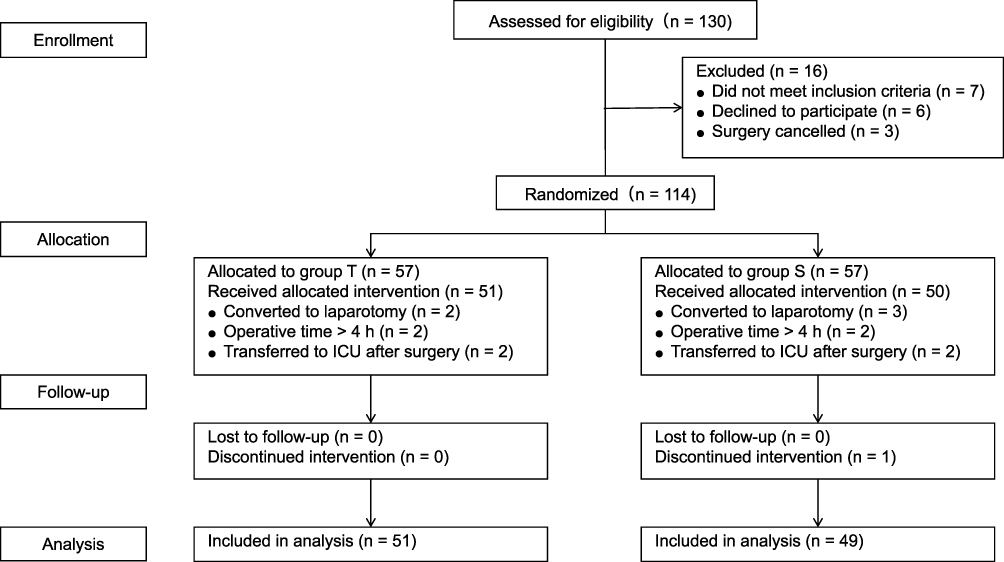 |
Figure 1 CONSORT diagram for the study. |
Baseline demographic, surgical, and anesthesia-related characteristics are shown in Table 1. Baseline characteristics were balanced between the two groups. Intraoperative opioid consumption, converted to morphine equivalent dose (excluding the loading dose of the study drug), was comparable between the two groups (P = 0.578). In addition, extubation time and PACU stay did not differ significantly (P = 0.199 and P = 0.155, respectively).
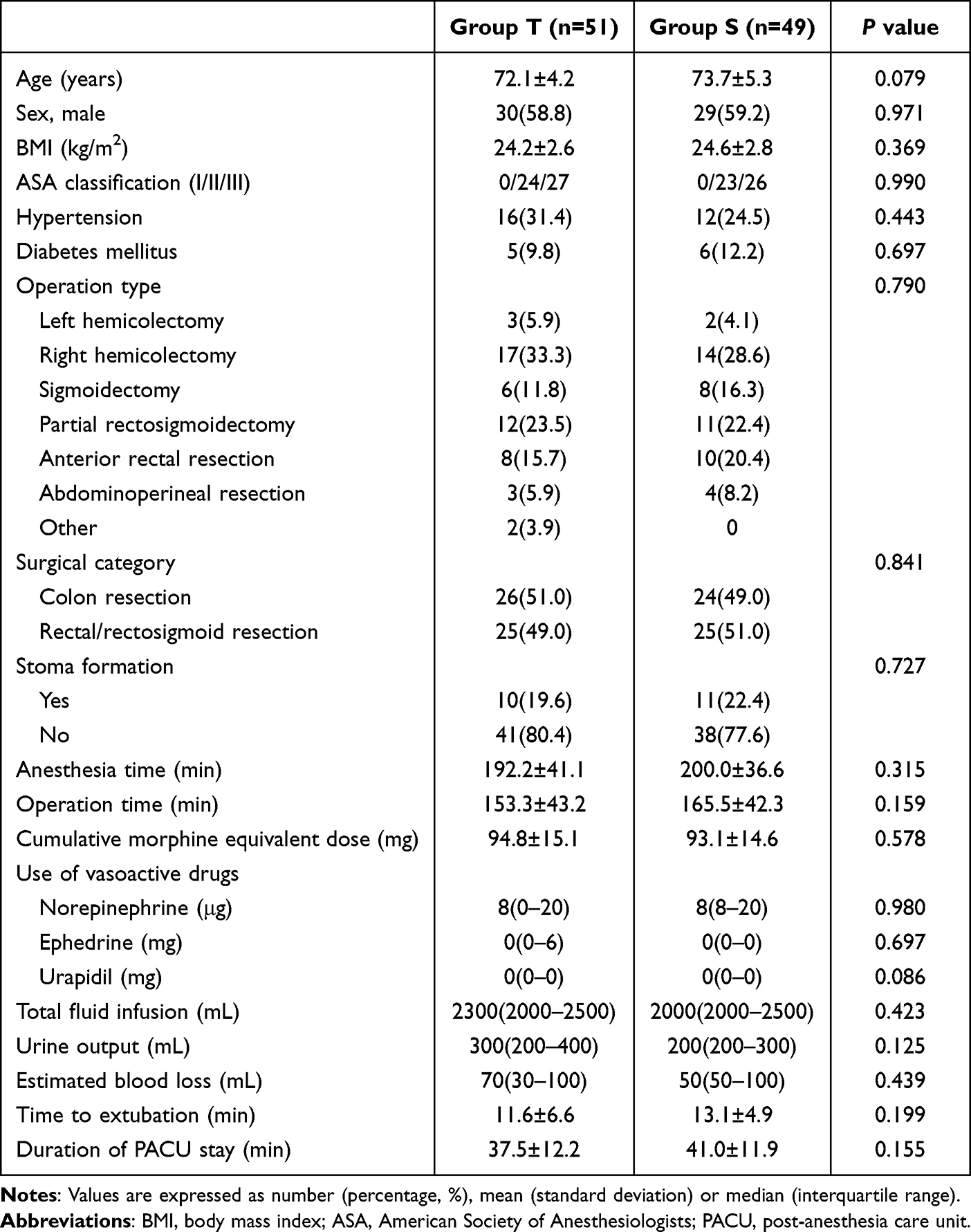 |
Table 1 Baseline, Surgical, and Anesthesia Characteristics of Participants |
Postoperative Gastrointestinal Function
GEE analysis of I-FEED scores from POD1 to POD5 showed significant effects of group (Wald χ2 = 6.871, P = 0.009), time (Wald χ2 = 1800.039, P < 0.001), and the group-by-time interaction (Wald χ2 = 14.812, P = 0.005). Therefore, post hoc pairwise comparisons with Bonferroni correction were performed at each time point (Table 2). Group T had significantly lower I-FEED scores than Group S on POD1 (median, 3 vs 4; EMM difference, −0.60; 95% CI, −1.03 to −0.17; P = 0.006), POD2 (median, 3 vs 3; EMM difference, −0.66; 95% CI, −1.14 to −0.18; P = 0.008) and POD3 (median, 1 vs 2; EMM difference, −0.72; 95% CI, −1.17 to −0.27; P = 0.002). No significant differences were found at the other time points. The sensitivity analysis was consistent with the PPS analysis, showing significantly lower I-FEED scores in Group T on POD1, POD2, and POD3 (P = 0.005, P = 0.005, and P = 0.001, respectively; Supplemental Table 1).
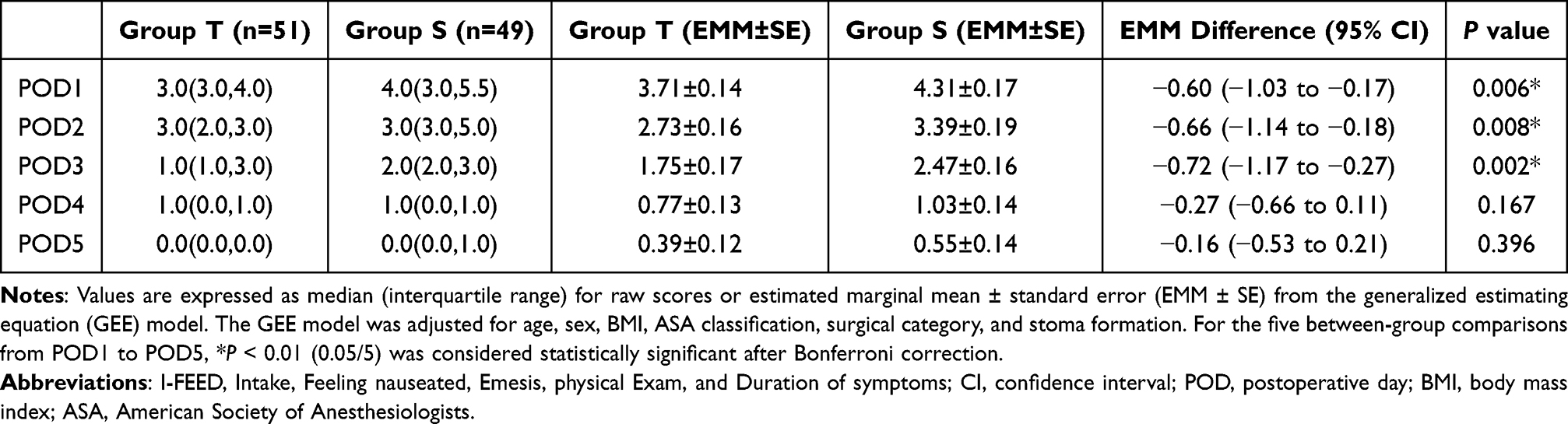 |
Table 2 Comparison of I-FEED Scores Between the Two Groups |
Other gastrointestinal outcomes are shown in Table 3. The incidence of POGD was lower in Group T than in Group S (11.8% vs 28.6%; RR, 0.41; 95% CI, 0.17 to 0.98; P = 0.036). Time to first flatus was shorter in Group T (36 h vs 40 h; median difference, −4 h; 95% CI, −7 to −1; P = 0.025). Time to first defecation did not differ significantly between groups (P = 0.127). The sensitivity analysis showed a similar pattern: POGD incidence remained lower and time to first flatus remained shorter in Group T (P = 0.024 and P = 0.018, respectively), whereas time to first defecation did not differ significantly between groups (P = 0.101; Supplemental Table 2).
 |
Table 3 Other Gastrointestinal Function Outcomes |
Postoperative Analgesia
NRS pain scores were analyzed using GEE (Table 4). At rest, the time effect was significant (Wald χ2 = 444.268, P < 0.001), indicating that pain decreased progressively in both groups. The group effect (Wald χ2 = 0.005, P = 0.941) and group-by-time interaction (Wald χ2 = 4.364, P = 0.225) were not significant, indicating similar pain levels and a similar trend of pain relief over time between the two groups. Results on movement were consistent. The time effect was significant (Wald χ2 = 576.636, P < 0.001), while the group effect (Wald χ2 = 0.722, P = 0.395) and group-by-time interaction (Wald χ2 = 1.350, P = 0.717) were not significant.
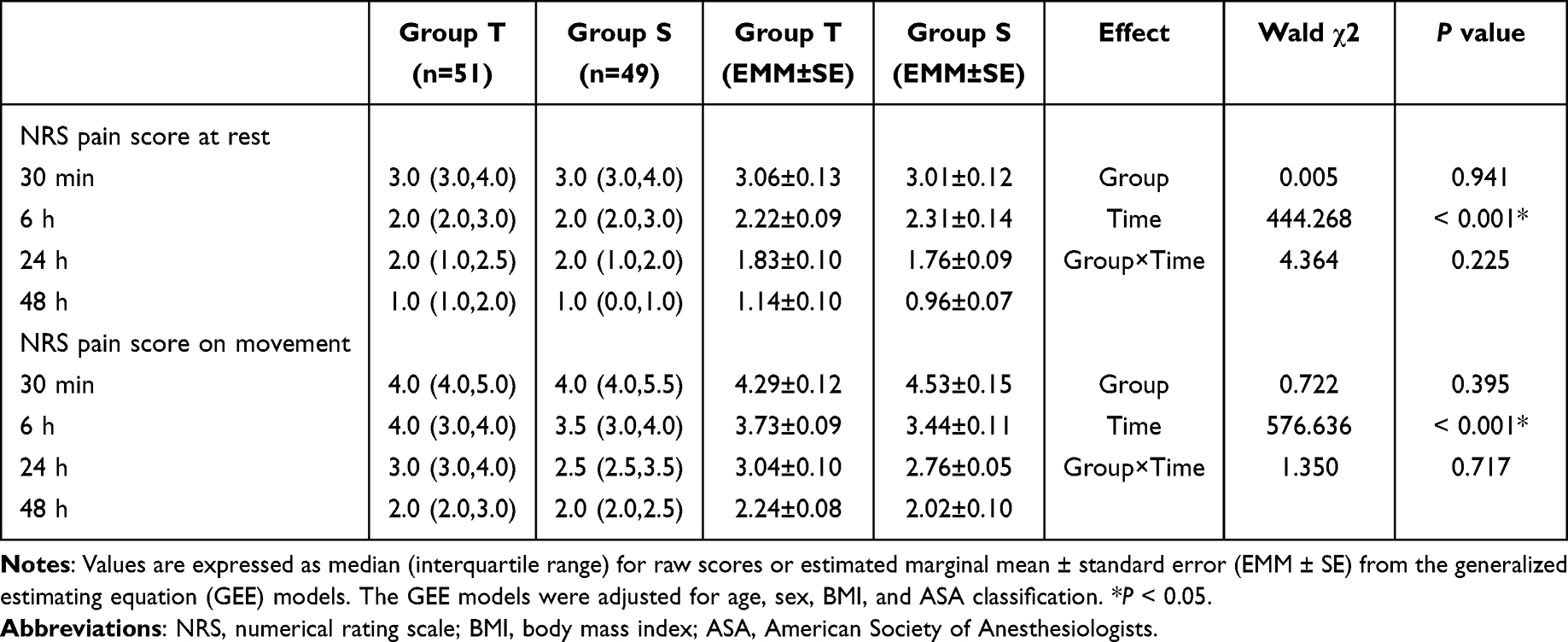 |
Table 4 Comparison of NRS Pain Scores Between the Two Groups |
The number of effective PCIA presses, total presses, and proportion requiring rescue analgesia did not differ significantly between the two groups (Table 5).
 |
Table 5 Comparison of PCIA Use and Rescue Analgesia Between the Two Groups |
Quality of Recovery and Patient Satisfaction
QoR-15 scores and patient satisfaction are summarized in Table 6. QoR-15 scores were significantly higher in Group T on POD2 (124 vs 118; median difference, 4; 95% CI, 1 to 7; P = 0.013) and POD3 (133 vs 129; median difference, 3; 95% CI, 1 to 5; P = 0.032). No significant difference was found on POD5. In addition, patient satisfaction was higher in Group T than in Group S (9 vs 8; median difference, 0; 95% CI, 0 to 1; P = 0.030).
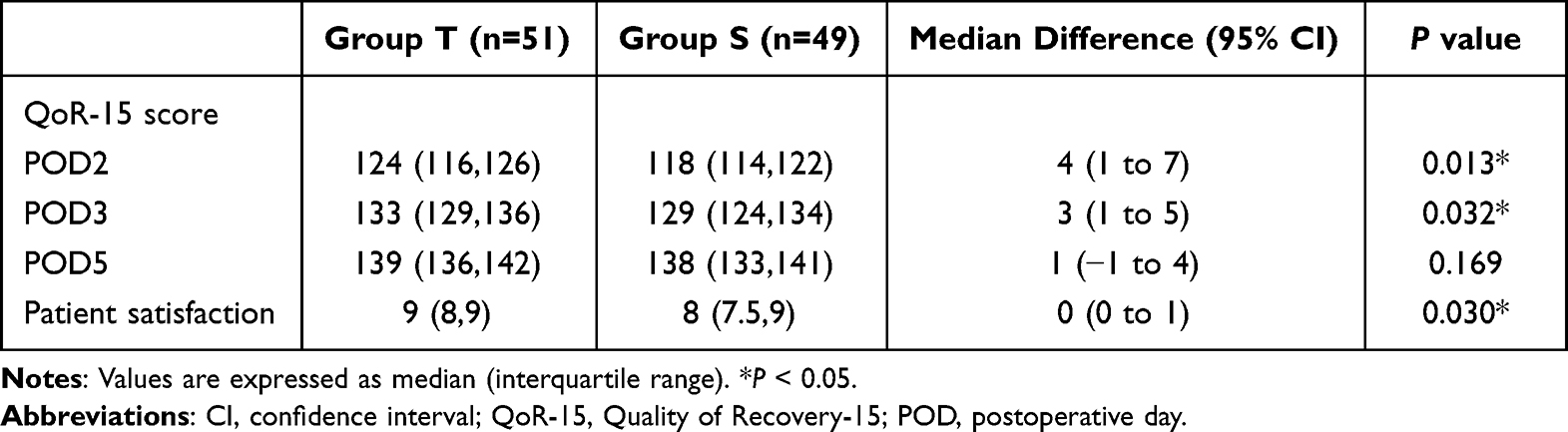 |
Table 6 Comparison of Quality of Recovery and Patient Satisfaction Between the Two Groups |
Safety Outcomes
Postoperative adverse events within 48 h are summarized in Table 7. The overall incidence of adverse events was significantly lower in Group T than in Group S (27.5% vs 49.0%; RR, 0.56; 95% CI, 0.33 to 0.95; P = 0.027). Specifically, Group T had significantly lower rates of nausea and vomiting (23.5% vs 44.9%; RR, 0.52; 95% CI, 0.29 to 0.94; P = 0.024). Dizziness was numerically lower in Group T (13.7% vs 20.4%), but the difference was not significant (P = 0.374). Respiratory depression did not differ significantly between the two groups. No pruritus occurred in either group.
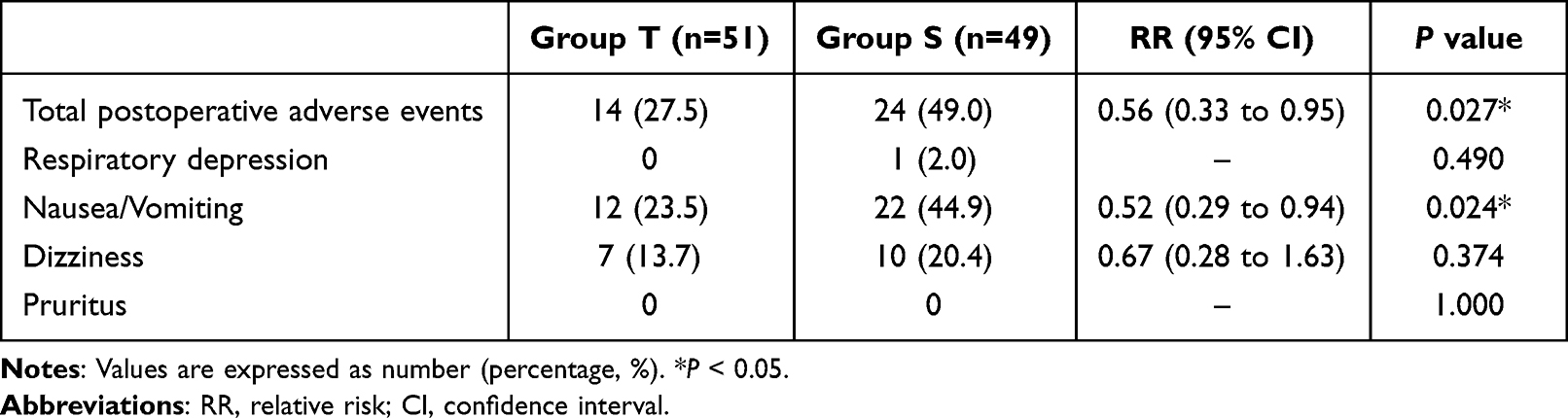 |
Table 7 Safety Outcomes |
Discussion
In this randomized controlled trial, tegileridine-based PCIA was associated with better early postoperative gastrointestinal recovery than sufentanil-based PCIA in elderly patients undergoing laparoscopic colorectal cancer surgery. This was reflected by lower I-FEED scores during the first 3 postoperative days, a lower incidence of POGD, and a shorter time to first flatus. The two groups showed comparable analgesic efficacy. In addition, the tegileridine group had better early postoperative quality of recovery and a lower incidence of postoperative adverse events.
The I-FEED score is a measure recommended by the joint consensus statement from the American Society for Enhanced Recovery and the Perioperative Quality Initiative for the assessment of postoperative gastrointestinal function, and it has also been shown to be useful in patients undergoing colorectal surgery.25,28 In this study, I-FEED scores were assessed daily over the first 5 postoperative days and analyzed longitudinally using GEE. Significant group and group-by-time interaction effects were found, indicating that the overall I-FEED score differed between the two groups, but that this difference changed over time. Post hoc comparisons showed that I-FEED scores were significantly lower in Group T during the first 3 postoperative days. By POD4 and POD5, the between-group differences had narrowed and were no longer statistically significant. These findings suggest that the benefit of tegileridine was most evident during the early phase of gastrointestinal recovery. A possible explanation is that PCIA was continued until POD2, when opioid-related inhibition of gastrointestinal motility and nausea and vomiting are most pronounced. As postoperative time progressed and the analgesia pump was discontinued, gastrointestinal function gradually recovered in both groups. By POD4 and POD5, I-FEED scores had decreased in both groups, and the between-group difference had narrowed. Importantly, after PCIA discontinuation on POD2, no systemic opioids were routinely administered in either group, and both groups followed the same rescue analgesic protocol, with intravenous parecoxib sodium administered when required. This standardized regimen reduced the likelihood that analgesic treatment after PCIA discontinuation materially confounded the gastrointestinal recovery outcomes observed from POD3 to POD5. For the primary outcome, the adjusted between-group difference in I-FEED scores on POD3 was −0.72 points. Although this difference was statistically significant, its magnitude was relatively small. A generally accepted minimal clinically important difference for the I-FEED score has not yet been established. Therefore, the clinical importance of this finding cannot be determined solely from the I-FEED score difference. However, the lower incidence of POGD and shorter time to first flatus were consistent with the primary outcome and provided additional support for a possible benefit in early gastrointestinal recovery. Nevertheless, the clinical relevance of this modest score difference should be interpreted with caution.
One previous study showed that the incidence of POGD after colorectal cancer surgery ranges from 10% to 30%, higher than in other types of surgery.29 Consistent with that report, the incidence of POGD in Group S was 28.6%, at the higher end of this range. Several patient and surgical characteristics in our study may help explain this relatively high incidence. All patients were aged 65 years or older, and in Group S, 53.1% had an ASA classification of III and 22.4% underwent stoma formation. Advanced age, higher ASA classification, and stoma formation may have partly contributed to the relatively high incidence of POGD in Group S.7,8,30 However, these factors were generally balanced between the two groups and therefore are unlikely to explain the observed between-group difference, which was more likely related to the randomized PCIA regimens. Compared with Group S, Group T had a significantly lower incidence of POGD (11.8% vs 28.6%) and a shorter time to first flatus. These findings are consistent with the significantly lower I-FEED score on POD3 (the primary outcome) and further support the possibility that tegileridine has a weaker inhibitory effect on postoperative gastrointestinal function. This is consistent with the pharmacological profile of tegileridine, which preferentially activates G protein signaling with reduced β-arrestin recruitment, a property that may contribute to reduced opioid-related gastrointestinal inhibition.19,20 Preclinical studies provide some support for this explanation, showing that β-arrestin-2 knockout mice exhibited enhanced and prolonged morphine analgesia, whereas morphine-induced respiratory depression and gastrointestinal dysfunction were attenuated.16,17
A Phase II/III study of tegileridine in orthopedic surgery suggested a possible dose-related pattern in its analgesic efficacy. Under a PCA regimen without background infusion, 0.1 mg and 0.2 mg bolus doses provided analgesia comparable to morphine, whereas the 0.05 mg bolus dose was less effective.21 In the present study, although the on-demand bolus dose of tegileridine was 0.05 mg, the PCIA regimen also included a background infusion of 2 mL/h, equivalent to 0.1 mg/h. This may have helped maintain sufficient drug exposure for postoperative analgesia. Consistently, GEE analysis showed no significant group effect or group-by-time interaction for NRS pain scores at rest or on movement. The numbers of effective and total PCIA presses and the proportion of patients requiring rescue analgesia were also comparable between groups. These findings suggest that tegileridine-based PCIA provided analgesia comparable to sufentanil-based PCIA under the regimen used in this study.
Notably, because no validated equianalgesic conversion ratio exists between tegileridine and sufentanil, this study compared two prespecified, clinically feasible PCIA regimens rather than a strict equianalgesic trial. Nevertheless, as noted above, analgesic efficacy was comparable between the two regimens, suggesting that the observed differences in gastrointestinal outcomes and adverse events are unlikely to be explained primarily by inadequate analgesia or a substantial difference in analgesic efficacy between groups. Moreover, the direction of these findings was also consistent with the G protein-biased agonist profile of tegileridine, supporting the possibility that its distinct receptor signaling profile contributed to the observed clinical differences. However, because the two regimens were not matched according to a validated equianalgesic ratio and drug exposure was not directly assessed in this study, the potential influence of differences in relative dose intensity or drug exposure cannot be entirely excluded.
Within ERAS protocols, the main goal of analgesia is to provide adequate pain control while minimizing adverse effects.31 In our study, the overall incidence of adverse events was lower in Group T, with a significant reduction in nausea and vomiting. This was broadly consistent with previous studies, which reported numerically lower rates of nausea and vomiting and lower use of antiemetics with tegileridine.21,22 Opioid-induced respiratory depression (OIRD) is one of the most important perioperative safety concerns, especially in elderly patients. Previous studies have shown that the risk of OIRD increases with age, and age ≥65 years has been recognized as an important risk factor.32,33 Given its biased agonism, tegileridine may theoretically have a lower risk of respiratory depression than conventional opioids. However, in our study, respiratory depression was rare, with only one case in Group S, and no significant difference was observed between the two groups. This was broadly consistent with the findings of the Phase III trial of tegileridine in patients undergoing abdominal surgery.22 In that study, 526 patients were randomized to placebo, tegileridine 0.75 mg, tegileridine 1.0 mg, or morphine. Only one case of tegileridine-related respiratory depression was reported. The authors therefore considered the event rate too low to allow a reliable between-group comparison. The lack of a between-group difference may be explained by several factors. First, the incidence of OIRD was low, and the sample size was relatively small, limiting the statistical power for this safety outcome. Second, OIRD is dose dependent. A previous observational study suggested that the risk of OIRD increases more markedly when the daily morphine milligram equivalent reaches or exceeds 100 mg.34 In this study, the sufentanil PCIA regimen was relatively conservative, which may have contributed to the low event rate. However, because the study had limited statistical power to detect a between-group difference in the incidence of OIRD, the absence of a statistically significant difference should not be interpreted as evidence of equivalent respiratory safety between the two regimens. Therefore, the potential respiratory safety advantage of tegileridine in elderly patients requires further confirmation in larger studies.
The QoR-15 score is a widely used tool for assessing postoperative quality of recovery in clinical practice. In this study, QoR-15 scores were higher in Group T on POD2 and POD3, indicating better early postoperative recovery in this group. This was more likely related to earlier gastrointestinal recovery, a lower incidence of nausea and vomiting, and better patient comfort, rather than to differences in analgesic efficacy. This may also explain the higher patient satisfaction in Group T. However, the estimated median difference in patient satisfaction was 0 points (95% CI, 0 to 1), suggesting that the clinical relevance of this finding may be limited. Therefore, this result should be interpreted with caution. No significant between-group difference in QoR-15 was observed on POD5. This may be related to the gradual recovery of gastrointestinal function and the alleviation of opioid-related adverse effects after discontinuation of PCIA.
Several limitations of this study should be acknowledged. First, the tegileridine and sufentanil PCIA regimens were fixed, clinically based doses rather than individually adjusted or matched using a validated equianalgesic ratio, so the potential influence of relative dose intensity or drug exposure cannot be entirely excluded. Second, a complete intention-to-treat analysis was not feasible because 13 randomized patients had no available outcome data. Although the sensitivity analysis showed consistent results, residual selection bias cannot be excluded. Third, the relatively small sample size may have limited the power to detect differences in safety outcomes with low event rates, such as respiratory depression and dizziness. Fourth, the single-center design and relatively strict eligibility criteria may limit the generalizability of the findings to broader elderly populations. Fifth, the sample size calculation was based on a small pilot study of 10 patients per group, which may have limited the precision of the sample size estimate.
Conclusion
In elderly patients undergoing laparoscopic colorectal cancer surgery, tegileridine-based PCIA provided analgesia comparable to sufentanil under the prespecified dosing regimens. It was associated with better gastrointestinal recovery during the first three postoperative days and fewer adverse events. This regimen may be a safe and effective analgesic option in this population. Dose-ranging studies and larger multicenter trials are warranted to confirm these preliminary findings.
Abbreviations
PCIA, patient-controlled intravenous analgesia; I-FEED, Intake, Feeling nauseated, Emesis, physical Exam, and Duration of symptoms; POD, postoperative day; POGD, postoperative gastrointestinal dysfunction; NRS, numerical rating scale; QoR-15, Quality of Recovery-15; EMM, estimated marginal mean; SE, standard error; CI, confidence interval; RR, relative risk; CONSORT, Consolidated Standards of Reporting Trials; ASA, American Society of Anesthesiologists; BMI, body mass index; PaO2, partial pressure of arterial oxygen; SpO2, peripheral oxygen saturation; BIS, bispectral index; PETCO2, end-tidal carbon dioxide partial pressure; TAP, transversus abdominis plane; PONV, postoperative nausea and vomiting; PACU, post-anesthesia care unit; PCA, patient-controlled analgesia; POGI, postoperative gastrointestinal intolerance; PPS, per-protocol set; GEE, generalized estimating equations; ICU, intensive care unit; ERAS, Enhanced Recovery After Surgery; OIRD, opioid-induced respiratory depression.
Data Sharing Statement
The datasets used and/or analyzed during the current study are available upon reasonable request from the corresponding author Jiying Feng.
Ethics Approval and Informed Consent
This study was conducted in accordance with the ethical principles of the Declaration of Helsinki. The trial was approved by the Ethics Committee of the Affiliated Lianyungang Hospital of Xuzhou Medical University (Ethical Application Reference: KY-20250306001.A02). All participants were informed about the study, and written informed consent was obtained from them. All methods were carried out in accordance with relevant guidelines and regulations.
Author Contributions
All authors made a significant contribution to the work reported, whether that is in the conception, study design, execution, acquisition of data, analysis and interpretation, or in all these areas; took part in drafting, revising or critically reviewing the article; gave final approval of the version to be published; have agreed on the journal to which the article has been submitted; and agree to be accountable for all aspects of the work.
Funding
This research did not receive any specific grant from funding agencies in the public, commercial, or not-for-profit sectors.
Disclosure
The authors declare no competing interests in this work.
References
1. Venara A, Neunlist M, Slim K, et al. Postoperative ileus: pathophysiology, incidence, and prevention. J Visc Surg. 2016;153(6):439–13. doi:10.1016/j.jviscsurg.2016.08.010
2. Tevis SE, Carchman EH, Foley EF, et al. Postoperative ileus—more than just prolonged length of stay? J Gastrointest Surg. 2015;19(9):1684–1690. doi:10.1007/s11605-015-2877-1
3. Asgeirsson T, El-Badawi KI, Mahmood A, et al. Postoperative ileus: it costs more than you expect. J Am Coll Surg. 2010;210(2):228–231. doi:10.1016/j.jamcollsurg.2009.09.028
4. Wolthuis AM, Bislenghi G, Fieuws S, et al. Incidence of prolonged postoperative ileus after colorectal surgery: a systematic review and meta-analysis. Colorectal Dis. 2016;18(1):1–9. doi:10.1111/codi.13210
5. Song J, Zhou C, Zhang T. Prognostic factors associated with gastrointestinal dysfunction after gastrointestinal tumor surgery: a meta-analysis. World J Gastrointest Surg. 2024;16(5):1420–1429. doi:10.4240/wjgs.v16.i5.1420
6. Wang H, Wang Y, Xing H, et al. Laparoscopic surgery within an enhanced recovery after surgery (ERAS) protocol reduced postoperative ileus by increasing postoperative Treg levels in patients with right-side colon carcinoma. Med Sci Monit. 2018;24:7231–7237. doi:10.12659/MSM.910817
7. Grosso G, Biondi A, Marventano S, et al. Major postoperative complications and survival for colon cancer elderly patients. BMC Surg. 2012;12(Suppl 1):S20. doi:10.1186/1471-2482-12-S1-S20
8. Horowitz JA, Jain A, Puvanesarajah V, et al. Risk factors, additional length of stay, and cost associated with postoperative ileus following anterior lumbar interbody fusion in elderly patients. World Neurosurg. 2018;115:e185–e189. doi:10.1016/j.wneu.2018.04.006
9. Xiong X, Zhang T, Chen H, et al. Comparison of three frailty scales for prediction of prolonged postoperative ileus following major abdominal surgery in elderly patients: a prospective cohort study. BMC Surg. 2024;24(1):115. doi:10.1186/s12893-024-02391-6
10. Momeni M, Crucitti M, De Kock M. Patient-controlled analgesia in the management of postoperative pain. Drugs. 2006;66(18):2321–2337. doi:10.2165/00003495-200666180-00005
11. Han L, Su Y, Xiong H, et al. Oxycodone versus sufentanil in adult patient-controlled intravenous analgesia after abdominal surgery: a prospective, randomized, double-blinded, multiple-center clinical trial. Medicine. 2018;97(31):e11552. doi:10.1097/MD.0000000000011552
12. Nie Z, Cui X, Zhang R, et al. Effectiveness of patient-controlled intravenous analgesia (PCIA) with sufentanil background infusion for post-cesarean analgesia: a randomized controlled trial. J Pain Res. 2022;15:1355–1364. doi:10.2147/JPR.S363743
13. Kronberg U, Kiran RP, Soliman MS, et al. A characterization of factors determining postoperative ileus after laparoscopic colectomy enables the generation of a novel predictive score. Ann Surg. 2011;253(1):78–81. doi:10.1097/SLA.0b013e3181fcb83e
14. Ju H, Shen K, Li J, et al. Total postoperative opioid dose is an independent risk factor for prolonged postoperative ileus after laparoscopic colorectal surgery: a case-control study. Korean J Anesthesiol. 2024;77(1):133–138. doi:10.4097/kja.22792
15. Ju J, Li Z, Liu J, et al. Biased opioid receptor agonists: balancing analgesic efficacy and side-effect profiles. Int J Mol Sci. 2025;26(5):1862. doi:10.3390/ijms26051862
16. Bohn LM, Lefkowitz RJ, Gainetdinov RR, et al. Enhanced morphine analgesia in mice lacking beta-arrestin 2. Science. 1999;286(5449):2495–2498. doi:10.1126/science.286.5449.2495
17. Raehal KM, Walker JK, Bohn LM. Morphine side effects in beta-arrestin 2 knockout mice. J Pharmacol Exp Ther. 2005;314(3):1195–1201. doi:10.1124/jpet.105.087254
18. Raehal KM, Schmid CL, Groer CE, et al. Functional selectivity at the μ-opioid receptor: implications for understanding opioid analgesia and tolerance. Pharmacol Rev. 2011;63(4):1001–1019. doi:10.1124/pr.111.004598
19. Dhillon S. Tegileridine: first approval. Drugs. 2024;84(6):717–720. doi:10.1007/s40265-024-02033-4
20. Shi R, Chai Y, Feng H, et al. Study of the mass balance, biotransformation and safety of [14C]SHR8554, a novel μ-opioid receptor injection, in healthy Chinese subjects. Front Pharmacol. 2023;14:1231102. doi:10.3389/fphar.2023.1231102
21. Zhao Y, Lu Z, Song X, et al. Efficacy and safety of SHR8554 on postoperative pain in subjects with moderate to severe acute pain following orthopedic surgery: a multicenter, randomized, double-blind, dose-explored, active-controlled, phase II/III clinical trial. Pharmacol Res. 2025;212:107576. doi:10.1016/j.phrs.2025.107576
22. Wang T, Wang Y, Xie H, et al. Tegileridine for moderate-to-severe acute pain following abdominal surgery: a randomized, double-blind, Phase 3 clinical trial. Cell Rep Med. 2025;6(12):102477. doi:10.1016/j.xcrm.2025.102477
23. Dowell D, Haegerich TM, Chou R. CDC guideline for prescribing opioids for chronic pain—United States, 2016. Jama. 2016;315(15):1624–1645. doi:10.1001/jama.2016.1464
24. Irani JL, Hedrick TL, Miller TE, et al. Clinical practice guidelines for enhanced recovery after colon and rectal surgery from the American Society of Colon and Rectal Surgeons and the Society of American Gastrointestinal and Endoscopic Surgeons. Dis Colon Rectum. 2023;66(1):15–40. doi:10.1097/DCR.0000000000002650
25. Hedrick TL, McEvoy MD, Mythen MMG, et al. American Society for Enhanced Recovery and Perioperative Quality Initiative Joint Consensus Statement on postoperative gastrointestinal dysfunction within an enhanced recovery pathway for elective colorectal surgery. Anesth Analg. 2018;126(6):1896–1907. doi:10.1213/ANE.0000000000002742
26. Srikandarajah S, Gilron I. Systematic review of movement-evoked pain versus pain at rest in postsurgical clinical trials and meta-analyses: a fundamental distinction requiring standardized measurement. Pain. 2011;152(8):1734–1739. doi:10.1016/j.pain.2011.02.008
27. Jarzyna D, Jungquist CR, Pasero C, et al. American Society for Pain Management Nursing guidelines on monitoring for opioid-induced sedation and respiratory depression. Pain Manag Nurs. 2011;12(3):118–145.e10. doi:10.1016/j.pmn.2011.06.008
28. Alsharqawi N, Alhashemi M, Kaneva P, et al. Validity of the I-FEED score for postoperative gastrointestinal function in patients undergoing colorectal surgery. Surg Endosc. 2020;34(5):2219–2226. doi:10.1007/s00464-019-07011-6
29. Harnsberger CR, Maykel JA, Alavi K. Postoperative ileus. Clin Colon Rectal Surg. 2019;32(3):166–170. doi:10.1055/s-0038-1677003
30. Guo D, Peng S, An W, et al. Prevalence and risk factors for postoperative ileus in colorectal cancer patients: a systematic review and meta-analysis. Front Oncol. 2026;15:1742152. doi:10.3389/fonc.2025.1742152
31. Joshi GP, Beloeil H, Lobo DN, et al. A critical approach to research on perioperative pain management. Br J Anaesth. 2025;134(3):621–626. doi:10.1016/j.bja.2024.11.004
32. Cepeda MS, Farrar JT, Baumgarten M, et al. Side effects of opioids during short-term administration: effect of age, gender, and race. Clin Pharmacol Ther. 2003;74(2):102–112. doi:10.1016/S0009-9236(03)00152-8
33. Kessler ER, Shah M, Gruschkus SK, et al. Cost and quality implications of opioid-based postsurgical pain control using administrative claims data from a large health system: opioid-related adverse events and their impact on clinical and economic outcomes. Pharmacotherapy. 2013;33(4):383–391. doi:10.1002/phar.1223
34. Nadpara PA, Joyce AR, Murrelle EL, et al. Risk factors for serious prescription opioid-induced respiratory depression or overdose: comparison of commercially insured and Veterans Health Affairs populations. Pain Med. 2018;19(1):79–96. doi:10.1093/pm/pnx038
 © 2026 The Author(s). This work is published and licensed by Dove Medical Press Limited. The
full terms of this license are available at https://www.dovepress.com/terms
and incorporate the Creative Commons Attribution
- Non Commercial (unported, 4.0) License.
By accessing the work you hereby accept the Terms. Non-commercial uses of the work are permitted
without any further permission from Dove Medical Press Limited, provided the work is properly
attributed. For permission for commercial use of this work, please see paragraphs 4.2 and 5 of our Terms.
© 2026 The Author(s). This work is published and licensed by Dove Medical Press Limited. The
full terms of this license are available at https://www.dovepress.com/terms
and incorporate the Creative Commons Attribution
- Non Commercial (unported, 4.0) License.
By accessing the work you hereby accept the Terms. Non-commercial uses of the work are permitted
without any further permission from Dove Medical Press Limited, provided the work is properly
attributed. For permission for commercial use of this work, please see paragraphs 4.2 and 5 of our Terms.