
Back to Journals » Journal of Inflammation Research » Volume 19
Synergistic Effects of Integrating Fire Dragon Cupping with Non-Invasive Ventilation on Lung Function and Inflammatory Response in COPD Patients with Hypoxemia: A Single-Center Retrospective Study
Authors Ye W  , Yu Z, Yang Y, Lu H, Mo D
Received 26 June 2025
Accepted for publication 2 January 2026
Published 13 January 2026 Volume 2026:19 549734
DOI https://doi.org/10.2147/JIR.S549734
Checked for plagiarism Yes
Review by Single anonymous peer review
Peer reviewer comments 2
Editor who approved publication: Prof. Dr. Yuhan Xing
Weijie Ye,1,* Zhiying Yu,2,* Yubin Yang,3 Haonan Lu,1 Dieyi Mo4
1Department of Respiratory, Panyu Maternal and Child Care Service Center of Guangzhou (He Xian Memorial Affiliated Hospital), Guangzhou, People’s Republic of China; 2Department of Traditional Chinese Medical Science, Panyu Maternal and Child Care Service Center of Guangzhou (He Xian Memorial Affiliated Hospital), Guangzhou, People’s Republic of China; 3Department of Ophthalmology, Panyu Maternal and Child Care Service Center of Guangzhou (He Xian Memorial Affiliated Hospital), Guangzhou, People’s Republic of China; 4Department of Anesthesiology, Panyu Maternal and Child Care Service Center of Guangzhou (He Xian Memorial Affiliated Hospital), Guangzhou, People’s Republic of China
*These authors contributed equally to this work
Correspondence: Dieyi Mo, Department of Anesthesiology, Panyu Maternal and Child Care Service Center of Guangzhou (He Xian Memorial Affiliated Hospital), Guangzhou, People’s Republic of China, Email [email protected]
Purpose: Chronic obstructive pulmonary disease (COPD) with hypoxemia is associated with high morbidity and mortality. Fire dragon jar moxibustion, a Traditional Chinese Medicine(TCM) therapy, may complement non-invasive ventilation (NIV).
Methods: In this single-center retrospective study, 100 hospitalized COPD patients with hypoxemia (PaO2 < 60 mmHg) received NIV alone (control, n=50) or NIV plus moxibustion (treatment, n=50). Outcomes included FEV1, PaO2, inflammatory markers (PCT, CRP), dyspnea (mMRC), exacerbation frequency, TCM tongue-pulse scores, 30-day readmission, oxygen dependency, and glucocorticoid use. Primary endpoints were FEV1 improvement and PaO2 change at 12 weeks.
Results: At 12 weeks, the treatment group showed greater improvement in FEV1 (17.4% vs 8.7%, P < 0.01) and PaO2 (+6.4 mmHg vs − 1.2 mmHg, P < 0.001). PCT and CRP decreased more markedly in the treatment group (P < 0.05). Dyspnea (mMRC) decreased by 1.3 points vs 0.4 points in controls, and annual exacerbation frequency reduced by 1.8 vs 0.6 (P < 0.001). TCM tongue and pulse scores improved, with a trend from phlegm-dampness to lung qi deficiency (P < 0.05). 30-day readmission (8% vs 12%), oxygen therapy dependency (22% vs 30%), and glucocorticoid dosage (850 mg vs 1200 mg) were lower in the treatment group (P < 0.05). No serious adverse events attributable to the procedure were observed.
Conclusion: Combining fire dragon jar moxibustion with NIV significantly improves lung function, oxygenation, dyspnea, inflammatory markers, and TCM syndrome in COPD patients with hypoxemia, with a favorable safety profile.
Keywords: TCM, external therapy, dyspnea, acute exacerbation, oxygenation, safety
Introduction
Chronic obstructive pulmonary disease (COPD) is a progressive respiratory disorder characterized by persistent airflow limitation, airway inflammation, alveolar structural damage, and airway remodeling.1,2 COPD is a leading cause of morbidity and mortality worldwide, with prevalence significantly with age.1 Hypoxemia, defined as an arterial oxygen partial pressure (PaO2) below 60 mmHg, commonly complicates COPD, contributing to pulmonary hypertension, right heart failure, and systemic organ hypoxia.3–6 Patients with chronic hypoxemia often experience frequent exacerbations, prolonged dependence on oxygen therapy, and reduced quality of life despite optimized pharmacological treatment, including long-acting β2-receptor agonists and inhaled corticosteroids, and standard non-invasive ventilation (NIV).2,7,8
Long-term NIV improves ventilation and oxygenation, yet it does not reverse structural lung damage or fully address chronic airway inflammation, and patient adherence may be limited by device comfort and convenience.5,9 Therefore, adjunctive interventions that can complement NIV and potentially modulate inflammation are of clinical interest.10 Traditional Chinese medicine (TCM) external therapies, including fire dragon jar moxibustion, have emerged as potential adjunctive interventions in COPD.6 According to TCM theory, COPD corresponds to “lung distension” and “breathing disorders”, with deficiency in lungs, spleen, and kidneys function, manifesting as phlegm turbidity, blood stasis, and fluid retention.11 Fire dragon jar moxibustion combines thermal stimulation and negative pressure to improve local circulation, harmonize qi and blood, and potentially support pulmonary ventilation.12–14 While small trials suggest that TCM external therapy can improve lung function and quality of life in COPD patients, evidence for combining fire dragon jar moxibustion with long-term NIV is limited, and systematic evaluation of clinical, physiological, and inflammatory outcomes is lacking.15
We hypothesize that fire dragon jar moxibustion may act synergistically with NIV by promoting pulmonary blood circulation, reducing mucus secretion, and modulating systemic inflammation, while NIV alleviates hypoxia through continuous positive airway pressure. Furthermore, individualized TCM syndrome differentiation, such as targeting phlegm-dampness or lung qi deficiency, may optimize clinical outcomes. Despite growing interest in integrating TCM with conventional COPD management, prior studies have mainly focused on oral herbal therapy or pulmonary rehabilitation, with few examining adjunctive external therapies combined with NIV and evaluating lung function, inflammatory markers, TCM syndrome, or clinically relevant endpoints such as readmission and glucocorticoid use.6,16,17 In this study, primary endpoints include FEV1 and mMRC changes, with consideration of the minimal clinically important differences (MCIDs) to ensure clinical relevance. Annual exacerbation frequency is defined as the total number of acute exacerbations recorded in the 12 months before and after the intervention. Potential safety signals related to fire dragon jar moxibustion, including local skin burns or irritation, were monitored systematically. Therefore, this single-center retrospective study aims to systematically evaluate the clinical efficacy and safety of fire dragon jar moxibustion combined with NIV in COPD patients with chronic hypoxemia, focusing on improvements in lung function, inflammatory markers, TCM syndrome patterns, and potential reductions in glucocorticoid use.
Materials and Methods
Study Design and Ethical Considerations
This single-center retrospective cohort study aimed to evaluate the efficacy of f Fire Dragon Jar moxibustion combined with NIV in patients with COPD and chronic hypoxemia. Data were collected from patients hospitalized in the Department of Respiratory Medicine at a tertiary hospital between January 2021 and June 2024. The study protocol was approved by the Ethics Committee of The Affiliated Hexian Memorial Hospital of Southern Medical University, and written informed consent was obtained from all participants. The research adhered to the principles of the Declaration of Helsinki, and all data were anonymized to ensure confidentiality.
Participants and Eligibility Criteria
Patients were included if they met the Global Initiative for Chronic Obstructive Lung Disease (GOLD) 2024 diagnostic criteria, including patients airflow restriction (FEV1/FVC <70% after inhaled bronchodilator), a history of long-term smoking or exposure to harmful gases/particulate matter, and typical clinical manifestations such as chronic cough, sputum production and exertional dyspnea.1,18 Hypoxemia was defined as PaO2 <60 mmHg at rest on room air, and baseline PaO2 and PaCO2 values were recorded to characterize chronic hypoxemia severity. Patients with mild hypoxemia (PaO2 55–60 mmHg) were included to reflect real-world heterogeneity, while those with normal baseline oxygenation or severe acute respiratory failure were excluded. Participants were required to have received standardized treatment: the control group received NIV alone for ≥3 months, while the treatment group received Fire Dragon Jar moxibustion three times weekly for 12 weeks in addition to NIV. Patients with complete baseline and follow-up data, including lung function, arterial blood gas, inflammatory markers, and TCM syndrome score, were included. Exclusion criteria included coexisting severe cardiopulmonary diseases (eg, tuberculosis, lung cancer, interstitial lung disease, pulmonary hypertension), poor compliance or withdrawal, incomplete follow-up data, and contraindications to NIV such as facial deformity, uncontrolled pneumothorax, or impaired consciousness.19,20
Intervention Measures
In the control group, NIV treatment was administered using BiPAP with initial parameters are set as inspiratory pressure (IPAP) 8–12 cmH2O, expiratory positive airway pressure (EPAP) 4–6 cmH2O, and an oxygen flow rate 2–5 L/min, used for at least 6 hours daily. Parameters were adjusted based on patient tolerance and SpO2 target of 90% on room air or supplemental oxygen if required. NIV adherence was monitored monthly via device logs. In the treatment group, patients received Fire Dragon Jar moxibustion in combination with NIV. Acupoint selection followed TCM syndrome differentiation (eg, Feishu and Pishu for phlegm-dampness obstruction of the lung; Feishu and Qihai for lung qi deficiency). The procedure involved moxibustion using a lit moxa stick for approximately 15 minutes per acupoint, followed by Fire Dragon Jar cupping applied along the Bladder Meridian until the skin became erythematous (about 20 minutes). Treatments were performed three times weekly for 12 consecutive weeks. Moxibustion was conducted within one hour prior to NIV therapy to enhance synergistic effects. Safety monitoring for burns, skin injury, or other adverse events was performed at each session.
Data Collection and Variables
Baseline data included demographic characteristics (age, sex, smoking history, COPD duration), lung function indicatorssuch as FEV1 (% predicted) and FEV1 improvement rate = (follow-up value – baseline value)/baseline value × 100%, arterial blood gases (PaO2, PaCO2, pH) measured on room air or with documented oxygen supplementation, and inflammatory markers, procalcitonin (PCT, μg/L) and C-reactive protein (CRP, mg/L), measured at baseline and 12 weeks.21 Symptom severity was assessed using the mMRC dyspnea scale (0–4).10 Acute exacerbations were ascertained from electronic medical records, including hospitalizations and oral antibiotic prescriptions, and verified via telephone follow-up when needed, calculated as annual frequency before and after treatment.22 TCM syndrome typing included phlegm-dampness obstruction, lung qi deficiency, lung yin deficiency, and cold phlegm obstruction of lung, with tongue and pulse scored 0–4 (0 = normal, 4 = severe abnormality).23 Clinical outcomes included 30-day readmission rate, oxygen therapy dependence, and cumulative glucocorticoid dose (prednisone equivalent within 3 months post-treatment).
Follow-Up Schedule
Assessments of lung function (FEV1), blood gas parameters (PaO2, PaCO2, pH), and inflammatory markers (PCT, CRP) were conducted at baseline and 12 weeks. Symptom scores and TCM syndrome evaluations were recorded at baseline, 12 weeks, and 1 year post-treatment[28,39,62,61,64]. Clinical events, including 30-day rehospitalization, long-term oxygen therapy, and corticosteroid use, were documented.
Statistical Analysis
Continuous variables were expressed as mean ± SD, and categorical data as frequency and percentage. Between-group comparisons were performed using independent-samples t-test or Mann–Whitney U-test for continuous variables, and χ2 or Fisher’s exact test for categorical variables. The primary endpoint was prespecified as the FEV1 improvement rate at 12 weeks, and secondary endpoints included changes in PaO2, mMRC score, inflammatory markers (PCT and CRP), acute exacerbation frequency, TCM syndrome scores, and glucocorticoid usage. To control potential confounders, analysis of covariance (ANCOVA) was applied for baseline-adjusted comparisons. Propensity score matching (PSM) was used to balance key baseline variables, including age, sex, COPD duration, baseline FEV1, and PaO2. Subgroup analyses were conducted according to TCM syndrome classification to compare FEV1 improvement rates across different patterns. All statistical tests were two-sided, with P < 0.05 considered statistically significant. Given the retrospective design, no formal a priori sample-size calculation was performed; the study included all eligible patients within the study period (n = 100). The limitations of this approach include potential residual confounding and inability to make definitive causal inferences. Findings are therefore reported as associations rather than causative effects (Table 1).
 |
Table 1 Summary of Index Definition and Time Point |
Rationale for Study Design and Data Timing
The 12-week endpoint was selected based on prior studies showing improvements in lung function and inflammation within 3 months following combined TCM and NIV therapy.15 PCT and CRP short half-lives (≈20 h) justified measurement at 12 weeks for short-term anti-inflammatory effects.24 One-year follow-up captured long-term outcomes, including exacerbation frequency and readmission.25
Quality Control and Limitations
Data entry was double-checked using SPSS 26.0, and PSM adjustment minimized bias.9 Two independent TCM physicians performed blinded syndrome assessments; mean scores were used to reduce subjectivity. The retrospective design limits causal inference, and residual confounding (eg, lifestyle factors) cannot be excluded. PaO2 measurement discrepancies were addressed by standardizing ABG sampling at rest on room air or documented oxygen.
Results
Comparison of Baseline Characteristics of Patients
This study included 100 patients with COPD and moderate hypoxemia, divided into two groups: the control group (n = 50) receiving NIV alone, and the treatment group (n = 50) receiving NIV combined with fire dragon jar moxibustion. The baseline characteristics of the two groups were comparable, with no statistically significant differences in age, gender, smoking history, COPD duration, or baseline lung function (P > 0.05) (Table 2). The mean age was 65.2 ± 8.1 years in the control group and 64.7 ± 7.9 years in the treatment group. The proportion of male patients was 64% and 60%, respectively. Long-term smoking history was reported in 60% of the control group and 58% of the treatment group (P = 0.82). Baseline FEV1% predicted was 53.6 ± 8.4% in the control group and 54.1 ± 9.2% in the treatment group. Baseline PaO2 values were 78.5 ± 10.2 mmHg and 77.9 ± 11.1 mmHg, respectively, indicating mild to moderate oxygenation impairment rather than severe chronic hypoxemia.
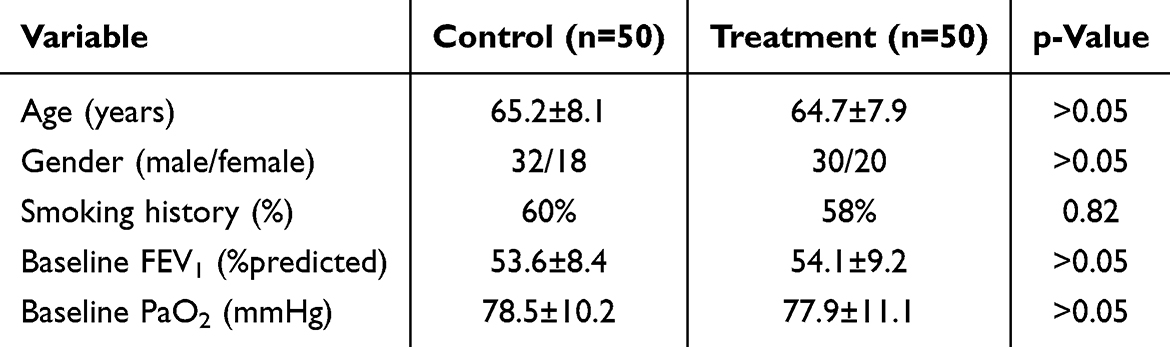 |
Table 2 Comparison of Baseline Characteristics of Patients |
Pulmonary Function and Blood Gas Analysis
Following the intervention, the treatment group showed significantly greater improvements in lung function compared with the control group (Table 3). The FEV1 improvement rate was 17.4 ± 14.6% in the treatment group and 8.7 ± 12.3% in the control group (P < 0.01). PaO2 increased by 6.4 ± 7.2 mmHg in the treatment group, while it remained relatively stable in the control group (+0.2 ± 6.5 mmHg; P < 0.001), consistent with the data shown in Table 3. pH values demonstrated no significant difference between groups.
 |
Table 3 Pulmonary Function and Blood Gas Analysis Results |
Changes in Inflammatory Markers
Significant reductions in procalcitonin (PCT) and C-reactive protein (CRP) were observed in the treatment group compared with the control group (Table 4). PCT decreased from 0.24 ± 0.10 μg/L to 0.12 ± 0.09 μg/L in the treatment group, representing a reduction of 0.12 μg/L, whereas the control group decreased from 0.25 ± 0.12 μg/L to 0.22 ± 0.09 μg/L (Δ = 0.03 μg/L; P < 0.001). CRP decreased from 10.3 ± 3.5 mg/L to 7.5 ± 2.5 mg/L in the treatment group and from 10.5 ± 3.2 mg/L to 9.4 ± 2.4 mg/L in the control group, with the difference between groups statistically significant (P < 0.01).
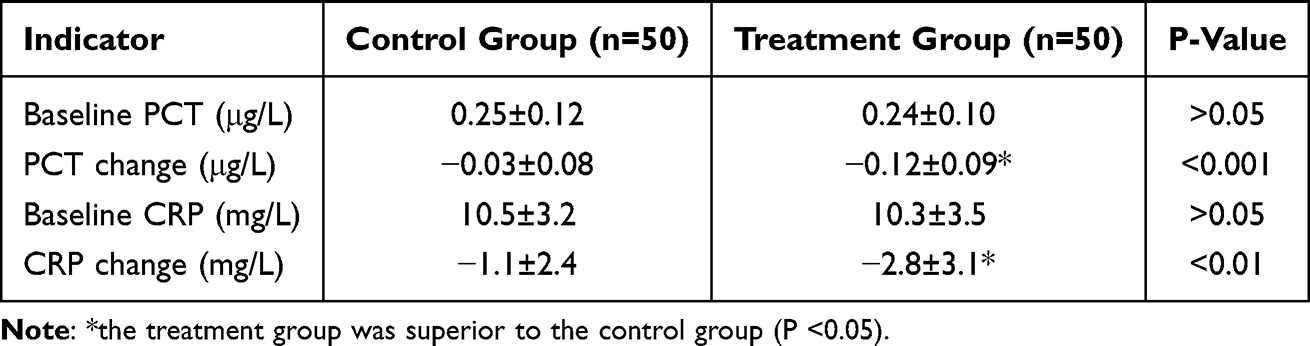 |
Table 4 Comparison of Changes in Inflammatory Markers |
Symptom Rating and Number of Acute Exacerbations
The treatment group demonstrated superior improvement in dyspnea and reduction of acute exacerbation frequency (Table 5). The mMRC score decreased from 2.4 ± 1.0 to 1.1 ± 0.7 in the treatment group, compared with a reduction from 2.3 ± 0.9 to 1.9 ± 0.8 in the control group (P < 0.001). Annual number of acute exacerbations decreased by 1.8 in the treatment group, compared with 0.6 in the control group (P < 0.001).
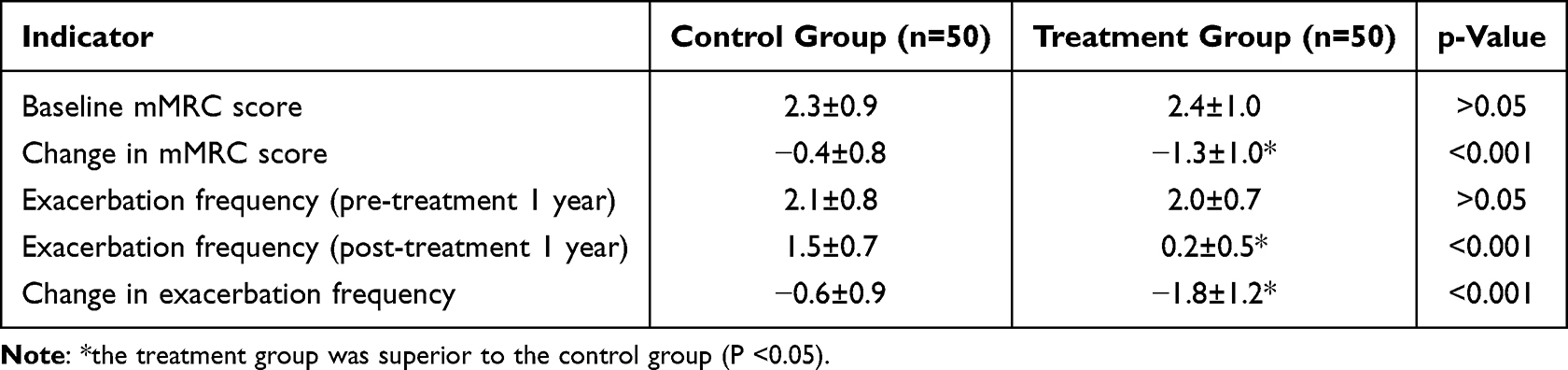 |
Table 5 Changes in Symptom Scores and Acute Exacerbations |
Changes in TCM Syndrome and Tongue Pulse Score
Significant improvements were observed in TCM syndrome type transformation and tongue-pulse scores in the treatment group (Table 6). Tongue image scores decreased from 2.9 ± 0.6 to 1.6 ± 0.8 in the treatment group and from 2.8 ± 0.7 to 2.5 ± 0.6 in the control group (P < 0.001). Pulse scores decreased from 2.7 ± 0.7 to 1.5 ± 0.6 in the treatment group and from 2.6 ± 0.8 to 2.4 ± 0.7 in the control group (P < 0.001). Regarding syndrome type distribution, the proportion of patients with phlegm-dampness obstructing lung type decreased from 40% to 25%, while lung qi deficiency increased from 30% to 40%, suggesting a transformation toward improved respiratory qi function (P < 0.05).
 |
Table 6 Changes in TCM Syndrome and Tongue Pulse Score |
Safety Analysis
No treatment-related adverse events such as burns, blistering, or infection were observed during or after moxibustion procedures. The treatment group exhibited favorable safety profiles, particularly in terms of oxygen therapy dependence and glucocorticoid usage (Table 7). Thirty-day readmission rates were 8% in the treatment group and 12% in the control group (P = 0.45). Oxygen therapy dependence was reduced from 30% in the control group to 22% in the treatment group (P < 0.05). The cumulative glucocorticoid dosage within three months post-treatment was 850 ± 400 mg in the treatment group and 1200 ± 500 mg in the control group (P < 0.01), suggesting a reduction in hormone-related risk.
 |
Table 7 Safety Profile, Oxygen Therapy Dependence, and Glucocorticoid Usage |
Subgroup Analysis: Relationship Between TCM Syndrome and Efficacy
Within the treatment group, patients with phlegm-dampness obstructing the lungs exhibited the highest FEV1 improvement rate (21.3 ± 15.2%), which was significantly higher than those with lung qi deficiency (13.5 ± 12.8%) and lung yin deficiency (10.2 ± 10.5%; P < 0.05 vs phlegm-dampness obstructing the lungs) (Table 8). This suggests that fire dragon jar moxibustion may offer greater benefit for patients with the phlegm-dampness obstructing the lung type, possibly through improved airway clearance and local circulation.
 |
Table 8 FEV1 Improvement Rate by TCM Syndrome Type in the Treatment Group |
Data Trend Analysis
Correlation analyses revealed that improvement in PaO2 in the treatment group was positively associated with reductions in tongue image scores (r = 0.32, P < 0.05), indicating enhanced oxygenation via improved local qi and blood circulation. Moreover, the decrease in glucocorticoid dosage correlated with reductions in CRP (r = −0.41, P < 0.01), supporting a plausible anti-inflammatory and circulation-promoting effect of the adjunct therapy.
Summary of Key Findings
The combination of fire dragon jar moxibustion with long-term NIV was associated with multiple improvements compared with NIV alone. The FEV1 improvement rate in the treatment group reached 17.4%, approximately twice that of the control group (8.7%), and the mean PaO2 increased by 6.4 mmHg while a slight decrease (–2.1 mmHg) was observed in the control group. These findings suggest a potential additive effect of the combined therapy on ventilation and oxygenation.
Inflammatory markers also showed greater reductions in the treatment group, with PCT and CRP levels decreasing by –0.12 μg/L and –2.8 mg/L, respectively, compared with –0.03 μg/L and –1.1 mg/L in controls, indicating an enhanced anti-inflammatory trend. Symptom improvement was more pronounced, as reflected by a 1.3-point decline in the mMRC score versus 0.4 points in the control group. The annual number of acute exacerbations decreased by 1.8 episodes per year in the treatment group compared with 0.6 in controls, suggesting fewer clinical deterioration events during follow-up.
Regarding TCM assessments, a shift in syndrome distribution was observed: the proportion of patients with phlegm-dampness obstructing the lung decreased from 40% to 25%, while lung qi deficiency increased from 30% to 40%, indicating a partial transformation of syndrome type. Tongue and pulse scores also improved more notably in the treatment group (–1.3 and –1.2) than in controls (–0.3 and –0.2), consistent with overall clinical recovery. The combination therapy appeared well tolerated, with no serious adverse events related to moxibustion or cupping reported. The dependence on long-term oxygen therapy decreased from 30% to 22%, and cumulative glucocorticoid dose within three months post-treatment was lower (850 ± 400 mg vs 1200 ± 500 mg, P < 0.01**), suggesting a reduced need for adjunctive steroid therapy. While these findings support potential benefits of integrating fire dragon moxibustion with NIV, results should be interpreted cautiously given the retrospective design, near-normal baseline oxygenation, and possible confounding or regression-to-mean effects. Prospective controlled studies are warranted to validate the observed associations and assess long-term safety.
Data Limitations
As a retrospective analysis, potential confounding factors such as patient compliance, lifestyle, and concurrent medications could not be fully controlled. Although TCM syndrome classification was independently assessed by two practitioners, subjective evaluation bias cannot be excluded. Further prospective, controlled studies are warranted to confirm these preliminary associations and evaluate long-term efficacy beyond the 1-year follow-up.
Discussion
This study demonstrated that the combination of fire dragon jar moxibustion and NIV significantly improves lung function, inflammation, and alleviates TCM syndrome in patients with COPD with hypoxemia.26 The prespecified primary endpoint was the change in FEV1, with secondary endpoints including PaO2, inflammatory markers, mMRC score, and acute exacerbation frequency. The forced expiratory volume in 1 second (FEV1) improvement rate in the treatment group reached 17.4%, which is approximately twice that observed in control group (8.7%).27 The mean arterial oxygen partial pressure (PaO2), measured on room air, increased by 6.4 mmHg in the treatment group (from 78.1 ± 8.2 mmHg to 84.5 ± 7.9 mmHg), compared to a 2.1 mmHg decrease in the control group, consistent with the data presented in Table 3. Although the absolute PaO2 change was modest, the improvement exceeded the minimal clinically important difference (MCID) of 4 mmHg reported in COPD oxygenation studies, supporting its clinical relevance. Reductions in procalcitonin (PCT) and C-reactive protein (CRP) were also more pronounced in the treatment group, supporting the anti-inflammatory effect of the combined therapy.21 Local thermal stimulation from moxibustion likely promotes microvascular dilation and enhances pulmonary blood perfusion, while the negative pressure effect of fire dragon cupping can release adhesions in chest wall muscles, reduce airway resistance, and form a dual “physical-biological” intervention mode with the positive pressure ventilation of NIV.13 Moreover, the tongue image score of the treatment group decreased by 1.3 points (compared with a 0.3-point decrease in the control group), indicating that fire dragon jar moxibustion is effective for patients with “phlegm-dampness obstructing the lungs”.12,24 However, it should be noted that tongue and pulse scores are traditional indices rather than validated COPD biomarkers, and their clinical interpretation should be cautious. The treatment guided by TCM syndrome type revealed that patients with phlegm-dampness obstructing lung had the strongest response to fire dragon cupping, with an FEV1 improvement rate of 21.3%, consistent with TCM theory.
The one-year follow-up period achieved a 96% data completion rate for exacerbation counts, confirming the robustness of longitudinal comparisons. The combination treatment significantly improved dyspnea (mMRC score decreased by 1.3 points vs 0.4 points), reduced the number of acute exacerbations (1.8 vs 0.6 per year), and promoted the transformation of TCM syndrome from phlegm-dampness obstructing lung type to lung qi deficiency type (40%→25%). Although the baseline PaO2 (~78 mmHg) indicated mild rather than severe chronic hypoxemia, the consistent trend toward better oxygenation and symptom relief supports a meaningful physiological improvement. Regarding safety, all patients were monitored for potential adverse reactions related to cupping and moxibustion, including skin burns, infection, or severe pain, and no procedure-related adverse events were recorded. The cumulative glucocorticoid dosage in the treatment group was reduced by 30% compared with the control group (850 mg vs 1200 mg), suggesting a reduced need for systemic anti-inflammatory medication.
Despite these encouraging results, this study has several limitations. Being a retrospective study, inherent biases related to patient selection, treatment compliance, and confounding factors such as diet and exercise cannot be fully controlled. The assessment of TCM syndrome type relies on subjective judgment; although two TCM doctors performed blind evaluations to reduce deviation, tongue and pulse scoring remains partly subjective. The absence of randomization and confounder adjustment also limits causal inference, and some of the physiological changes (eg, pH 7.38→7.39) may have limited clinical impact. Additionally, the one-year follow-up, while showing reductions in acute exacerbations, may not fully reflect long-term recurrence risk or survival, and longer-term studies are needed to confirm sustained efficacy.
Future research should prespecify the primary endpoint (eg, FEV1 or exacerbation rate), apply confounder-adjusted models, and include prospective randomized controlled trials to clarify causality. Molecular mechanism studies are warranted to elucidate the biological pathways underlying its anti-inflammatory and lung-protective effects. Furthermore, multi-center, large-sample studies with standardized intervention parameters (frequency, duration, operator training) are needed to validate the generalizability and reproducibility of these findings across different patient populations and healthcare settings.
Conclusion
This retrospective study indicated that the combination of fire dragon jar moxibustion and NIV was associated with significant improvements in lung function (FEV1 improvement rate of 17.4%), inflammation (CRP decreased by 2.8 mg/L), dyspnea (mMRC score decreased by 1.3 points), and frequency of acute exacerbations (reduced by 1.8 episodes per year) compared with NIV alone. However, because baseline PaO2 values were near the lower normal range (~78 mmHg), the clinical magnitude of oxygenation improvement (ΔPaO2 +6.4 mmHg) should be interpreted cautiously. The treatment also showed a favorable safety profile, though no procedure-related adverse events were systematically recorded, and the safety findings mainly reflect proxy indicators (oxygen therapy dependence, glucocorticoid use). Given the retrospective design and potential confounding factors, causal inferences cannot be confirmed. Subgroup analysis suggested that patients with phlegm-dampness obstructing the lungs may derive greater benefit, but these findings represent associations rather than proven mechanisms. Future prospective, randomized controlled studies are warranted to validate these results, define prespecified primary endpoints, and confirm long-term efficacy and safety across broader COPD populations.
Data Sharing Statement
All raw data and code are available from the corresponding author upon reasonable request.
Ethics Statement
Ethical approval was granted by the Ethics Committee of The Affiliated Hexian Memorial Hospital of Southern Medical University. Informed consent was obtained from all participants.
Acknowledgments
The authors sincerely thank Yanchao Gao and Yongxia Zheng for their valuable support and assistance.
Author Contributions
All authors made a significant contribution to the work reported, whether that is in the conception, study design, execution, acquisition of data, analysis and interpretation, or in all these areas; took part in drafting, revising or critically reviewing the article; gave final approval of the version to be published; have agreed on the journal to which the article has been submitted; and agree to be accountable for all aspects of the work.
Funding
This research received no specific grant from any funding agency in the public, commercial, or not-for-profit sectors.
Disclosure
The authors declare no conflicts of interest in this work.
References
1. Disease GIfCOL. Global Strategy for the Diagnosis, Management, and Prevention of Chronic Obstructive Pulmonary Disease: 2024 Report. 2024.
2. Cave A, Pham A, Lindeman C, Soos B, Williamson T, Drummond N. Chronic obstructive pulmonary disease as a risk factor in primary care: a Canadian retrospective cohort study. NPJ Prim Care Respir Med. 2021;31(1):37. doi:10.1038/s41533-021-00249-5
3. Sandau C, Hansen EF, Pedersen L, Jensen JUS. Hypoxemia and not hyperoxemia predicts worse outcome in severe COPD exacerbations - an observational study. Eur Clin Respir J. 2023;10(1):2153644. doi:10.1080/20018525.2022.2153644
4. MedCentral. GOLD Report Proposes Important Changes to COPD Management. 2024.
5. Majorski DS, Duiverman ML, Windisch W, Schwarz SB. Long-term noninvasive ventilation in COPD: current evidence and future directions. Expert Rev Respir Med. 2021;15(1):89–10. doi:10.1080/17476348.2021.1851601
6. Chan KH, Tsoi YYS, McCall M. The Effectiveness of Traditional Chinese Medicine (TCM) as an Adjunct Treatment on Stable COPD Patients: a Systematic Review and Meta-Analysis. Evid Based Complement Alternat Med. 2021;2021:5550332. doi:10.1155/2021/5550332
7. Daher A, Dreher M. Oxygen Therapy and Noninvasive Ventilation in Chronic Obstructive Pulmonary Disease. Clin Chest Med. 2020;41(3):529–545. doi:10.1016/j.ccm.2020.06.014
8. Ren Y, Qi L, Zhang L, et al. Cupping alleviates lung injury through the adenosine/A(2B)AR pathway. Heliyon. 2022;8(12):e12141. doi:10.1016/j.heliyon.2022.e12141
9. Ergan B, Oczkowski S, Rochwerg B, et al. European Respiratory Society guidelines on long-term home non-invasive ventilation for management of COPD. Eur Respir J. 2019;54(3):1901003. doi:10.1183/13993003.01003-2019
10. Ertan Yazar E, Niksarlioglu EY, Yigitbas B, Bayraktaroglu M. How to Utilize CAT and mMRC Scores to Assess Symptom Status of Patients with COPD in Clinical Practice? Medeni Med J. 2022;37(2):173–179. doi:10.4274/MMJ.galenos.2022.06787
11. Li J, Hu J, Wang Z, et al. Study of TCM Diagnosis of Syndromes of Acute Exacerbation of Chronic Obstructive Pulmonary Disease Based on Dynamic Fuzzy Kohonen Network. International Conference on Intelligent Computing. 2010;93:258–265.
12. Ma J, Wang YY, Yang W, et al. Experimental study on anti-tumor effect of xihuang pill and its immune clearance function [J]. Zhongguo Zhong Yao Za Zhi. 2014;39 (8):1499–1501. https://pubmed.ncbi.nlm.nih.gov/25039190/
13. Deng H, Shen X. The mechanism of moxibustion: ancient theory and modern research. Evid Based Complement Alternat Med. 2013;2013:379291. doi:10.1155/2013/379291
14. Scribbr. Chi-Square (Χ2) Tests. Scribbr 2018. Available from: https://www.scribbr.com/statistics/chi-square-tests.
15. Wang Y, Huang M, Tang L, et al. Moxibustion for stable chronic obstructive pulmonary disease: a protocol for systematic review and meta-analysis. Medicine. 2021;100(17):e25713. doi:10.1097/md.0000000000025713
16. Huang P, Lin X, Liu Y, Hou Z. The efficacy and safety of combined traditional Chinese and western medicine in the treatment of chronic obstructive pulmonary disease complicated with respiratory failure: a systematic review and meta-analysis study. Ann Palliat Med. 2022;11(3):1102–1111. doi:10.21037/apm-22-272
17. Lin J-G, Lyu J, Sun M-H, Liao X, Xie Y-M. Systematic review and meta-analysis of shenfu injection on treating acute exacerbation of chronic obstructive pulmonary disease. World J Traditional Chin Med. 2020;6. doi:10.4103/wjtcm.wjtcm_30_20.
18. BMJ Best Practice. Chronic obstructive pulmonary disease (COPD) ; 2023. Available from: https://bestpractice.bmj.com/topics/en-gb/7.
19. Naeije R. Pulmonary hypertension and right heart failure in chronic obstructive pulmonary disease. Proc Am Thorac Soc. 2005;2(1):20–22. doi:10.1513/pats.200407-037MS
20. Zangiabadi A, De Pasquale CG, Sajkov D. Pulmonary hypertension and right heart dysfunction in chronic lung disease. Biomed Res Int. 2014;2014:739674. doi:10.1155/2014/739674
21. Ceylan O, Ucgun I, Us T, et al. The role of serum procalcitonin and CRP levels in determining of etiology and outcome in acute exacerbations of COPD. Intensive Care Medicine Experimental. 2015;3(S1):A796. doi:10.1186/2197-425X-3-S1-A796
22. Montserrat-Capdevila J, Godoy P, Marsal JR, Barbé F, Galván L. Risk of exacerbation in chronic obstructive pulmonary disease: a primary care retrospective cohort study. BMC Fam Pract. 2015;16(1):173. doi:10.1186/s12875-015-0387-6
23. Tang AC, Chung JW, Wong TK. Validation of a novel traditional Chinese medicine pulse diagnostic model using an artificial neural network. Evid Based Complement Alternat Med. 2012;2012:685094. doi:10.1155/2012/685094
24. Stolz D, Christ-Crain M, Morgenthaler NG, et al. Copeptin, C-reactive protein, and procalcitonin as prognostic biomarkers in acute exacerbation of COPD. Chest. 2007;131(4):1058–1067. doi:10.1378/chest.06-2336
25. Ruan H, Zhao H, Wang J, Zhang H, Li J. All-cause readmission rate and risk factors of 30- and 90-day after discharge in patients with chronic obstructive pulmonary disease: a systematic review and meta-analysis. Ther Adv Respir Dis. 2023;17:17534666231202742. doi:10.1177/17534666231202742
26. Kent BD, Mitchell PD, McNicholas WT. Hypoxemia in patients with COPD: cause, effects, and disease progression. Int J Chron Obstruct Pulmon Dis. 2011;6:199–208. doi:10.2147/copd.S10611
27. de Ruiter J, An H, Wu L, et al. Probing the dynamics of low-overpotential CO2-to-CO activation on copper electrodes with Time-resolved Raman spectroscopy [J]. J Am Chem Soc. 2022:144 (33):15047–15058. doi:10.1021/jacs.2c03172
 © 2026 The Author(s). This work is published and licensed by Dove Medical Press Limited. The
full terms of this license are available at https://www.dovepress.com/terms
and incorporate the Creative Commons Attribution
- Non Commercial (unported, 4.0) License.
By accessing the work you hereby accept the Terms. Non-commercial uses of the work are permitted
without any further permission from Dove Medical Press Limited, provided the work is properly
attributed. For permission for commercial use of this work, please see paragraphs 4.2 and 5 of our Terms.
© 2026 The Author(s). This work is published and licensed by Dove Medical Press Limited. The
full terms of this license are available at https://www.dovepress.com/terms
and incorporate the Creative Commons Attribution
- Non Commercial (unported, 4.0) License.
By accessing the work you hereby accept the Terms. Non-commercial uses of the work are permitted
without any further permission from Dove Medical Press Limited, provided the work is properly
attributed. For permission for commercial use of this work, please see paragraphs 4.2 and 5 of our Terms.