
Back to Journals » Pediatric Health, Medicine and Therapeutics » Volume 17
Summary and Critical Appraisal of Evidence for Intrahospital Neonatal Transport
Authors Li X  , Suo T, Zhang F, Wang L
Received 23 December 2025
Accepted for publication 22 May 2026
Published 16 June 2026 Volume 2026:17 587666
DOI https://doi.org/10.2147/PHMT.S587666
Checked for plagiarism Yes
Review by Single anonymous peer review
Peer reviewer comments 3
Editor who approved publication: Professor Roosy Aulakh
Xingchen Li,1 Tonghui Suo,2 Fengqin Zhang,2 Liping Wang2
1Department of Nursing, The First Affiliated Hospital of USTC, Division of Life Sciences and Medicine, University of Science and Technology of China, Hefei, Anhui, People’s Republic of China; 2Department of Neonatology, The First Affiliated Hospital of USTC, Division of Life Sciences and Medicine, University of Science and Technology of China, Hefei, Anhui, People’s Republic of China
Correspondence: Liping Wang, Department of Neonatology, The First Affiliated Hospital of USTC, Division of Life Sciences and Medicine, University of Science and Technology of China, No. 1 Tian’e Lake Road, Government Affairs and Cultural District, Hefei, Anhui, People’s Republic of China, Email [email protected]
Objective: To systematically review and analyze the literature on intrahospital neonatal transport and synthesize the available evidence to inform the development of standardized transport procedures.
Methods: Following the “ 6S” evidence model, a systematic search was conducted across multiple databases from inception to August 31, 2025. Eligible documents were appraised for methodological quality, and relevant recommendations and evidence statements were extracted and synthesized narratively. The level of evidence and strength of recommendations were graded according to the 2014 JBI evidence pre-grading system.
Results: A total of 10 documents were included, comprising 7 guidelines, 2 evidence summaries, and 1 systematic review. A total of 35 evidence statements were synthesized and grouped into 7 themes: transport team; pre-transport assessment and decision-making; preparation of healthcare providers and neonates; preparation of supplies and medications; transport equipment; monitoring and care during transport; and handover and quality management. The evidence base was primarily derived from guideline recommendations, evidence summaries, and expert consensus.
Conclusion: This review provides a structured synthesis and critical appraisal of the available evidence and recommendations for intrahospital neonatal transport. The synthesized recommendations may help inform standardized transport procedures; however, they should be interpreted with caution because a substantial proportion of the evidence base is derived from guidelines or expert consensus. Further high-quality prospective, multicenter studies are warranted to evaluate the effectiveness, feasibility, and generalizability of these recommendations across diverse clinical settings.
Keywords: neonate, intrahospital transport, evidence summary, evidence-based nursing
Introduction
According to the World Health Organization (WHO), approximately 2.3 million newborns died in 2022 (equivalent to nearly 6500 deaths per day), with almost half of all deaths of children under five occurring within the first 28 days of life.1 A systematic review estimated that neonatal admissions averaged 134.6 per 1,000 live births across various settings.2 In the United States, for example, the proportion of infants admitted to a neonatal intensive care unit (NICU) increased from 8.7% in 2016 to 9.8% in 2023.3 These findings indicate that the neonatal period is the most vulnerable stage of early life in terms of both mortality and hospital-level morbidity.
Given the high global burden of neonatal mortality and morbidity, ensuring the safety and quality of neonatal care has become a central focus of perinatal health systems. Advances in neonatal medicine and technology have improved the survival of preterm and critically ill infants; however, these advances have also increased the need for complex diagnostic and therapeutic procedures performed outside the neonatal unit. Consequently, intrahospital transport, which refers to the movement of a neonate from the neonatal intensive care unit or nursery to another department within the same hospital for diagnostic or therapeutic purposes, has become a frequent and indispensable component of neonatal care.4,5
In the early stages of neonatal transport, infants were primarily transferred by manual carrying with simple warming measures, with limited continuous physiological monitoring and inadequate resuscitation support.6 The first use of a transport incubator in 1900 marked the transition of neonatal transport from simple transfer toward medically supported transport with thermal regulation and life-support capabilities.7 After the mid-20th century, neonatal transport further developed toward specialization and standardization. Specialized transport teams gradually emerged, comprising neonatologists, nurses, and respiratory therapists or emergency personnel, and were equipped with transport incubators, portable ventilators, oxygen sources, monitoring devices, and emergency medications, thereby substantially improving safety and physiological stability during transport.8 However, intrahospital transport itself is a high-risk medical activity, and this risk may be further increased by the immaturity of neonatal physiological systems, unstable respiratory and circulatory status,9,10 and high sensitivity to external stimuli such as temperature changes or handling.11 Therefore, neonates undergoing intrahospital transport face multiple sources of risk, including the inherent uncertainty of their underlying conditions, complex nursing interventions, and dynamic environmental changes that may challenge physiological stability.
Although intrahospital neonatal transport usually lasts only a few to several minutes, even short delays during the process can significantly affect patient outcomes. Previous studies have shown that adverse events occur in 22%–27.3% of neonatal transports, most commonly involving respiratory or circulatory instability, abnormal temperature, or agitation.11–13 These incidents can compromise the effectiveness of treatment, prolong hospitalization, and even increase the risk of mortality. Therefore, evidence-based support is needed to enhance the safety of intrahospital neonatal transport and to guide clinical decision-making, standardized procedures, and nursing practice. Although several national and international organizations have issued guidelines on neonatal transport, these guidelines generally focus on interhospital transport. Evidence related to intrahospital neonatal transport remains fragmented and has not yet been systematically synthesized or classified.14 This lack of integrated evidence may limit the development of standardized, evidence-based, and clinically applicable protocols for intrahospital neonatal transport.
Therefore, this review aimed to evaluate and synthesize the existing evidence on intrahospital neonatal transport using an evidence-based approach to identify recommended safety elements, procedural requirements, and effective interventions related to the preparation, implementation, and management of intrahospital neonatal transport, thereby providing a reference for the development of standardized, evidence-informed, and clinically applicable transport protocols. Notably, because relatively few primary studies have specifically examined intrahospital neonatal transport, the available evidence in this field is largely derived from clinical guidelines, expert consensus, evidence summaries, and systematic reviews. Therefore, the findings and recommendations of this review should be interpreted as a synthesis of the best currently available evidence, rather than as conclusions based primarily on direct evidence from interventional studies. The study was registered at the Fudan University Centre for Evidence-Based Nursing (registration number: ES20258986).
Materials and Search Methods
Problem Establishment
According to the PIPOST model developed by the JBI Centre for Evidence-Based Healthcare, the clinical question has been framed as an evidence-based inquiry.15 The population (P) refers to neonates who require intrahospital transport for diagnostic, therapeutic, or nursing purposes. The interventions (I) represent safety strategies and management measures applied during the transport process. The professionals/implementers (P) denote healthcare professionals responsible for transport implementation, including NICU nurses, transport nurses, and pediatricians. The outcomes (O) include outcomes such as the incidence of adverse events, transport effectiveness and efficiency, and parental satisfaction. The settings (S) in which the evidence applies were specifically neonatal intensive care units and other departments involved in intrahospital transport. The types of evidence (T) include clinical practice guidelines, expert consensus statements, best practice recommendations, evidence summaries, systematic reviews, meta-analyses, and relevant primary research.
Literature Search Strategy
Adhering to the “6S” evidence-based model, a comprehensive and hierarchical literature search was conducted to obtain the best available evidence related to intrahospital neonatal transport.16 The retrieval process proceeded from high-level evidence sources to primary studies. The following databases and platforms were systematically searched: UpToDate, BMJ Best Practice, Guidelines International Network (GIN), National Guideline Clearinghouse (NGC), Scottish Intercollegiate Guidelines Network (SIGN), National Institute for Health and Care Excellence (NICE), Registered Nurses’ Association of Ontario (RNAO), Medlive, Joanna Briggs Institute (JBI) Evidence-Based Practice Database, Cochrane Library, PubMed, Embase, CINAHL, Web of Science, China Biomedical Literature Database (CBM), China National Knowledge Infrastructure (CNKI), and Wanfang Data. To further supplement guideline-related evidence, additional searches were performed on websites of professional organizations, including the World Health Organization (WHO), the American Academy of Pediatrics (AAP), the Australian and New Zealand College of Anaesthetists (ANZCA), and the Child and Adolescent Health Service (CAHS) of Western Australia, focusing on recommendations regarding the safety and quality management of intrahospital neonatal transport. Search terms included both MeSH terms and free-text terms. Core concepts involved: “neonate”, “newborn”, “premature infant”, “NICU patient”, “in-hospital transport”, “intrahospital transport”, “intra-facility transport”, “neonatal transport”, “guideline”, “best practice”, “evidence summary”, “recommendation”, “consensus”, “systematic review”, and “meta-analysis”. The search strategy was adapted to the indexing rules and syntax requirements of each database, combining MeSH terms and free-text terms with Boolean operators to enhance sensitivity and specificity. The literature search covered all publications from the inception of each database to August 31, 2025. An example of the PubMed search strategy is shown in Table 1.
 |
Table 1 PubMed Search Strategy |
Inclusion and Exclusion Criteria for Evidence
Inclusion criteria: (1) Studies of neonates requiring intrahospital transport for diagnostic examinations, therapeutic procedures, or surgical interventions, including preterm and term infants; (2) Studies related to intrahospital neonatal transport, including pre-transport assessment, preparation, monitoring, equipment management, risk prevention, quality control, and post-transport evaluation; (3) Literature types of clinical decision-making resources, guidelines, best practice documents, evidence summaries, expert consensus statements, systematic reviews, meta-analyses, and relevant primary research.
Exclusion criteria: (1) Studies involving only interhospital transport or adult intrahospital transport; (2) Low-quality literature; (3) Duplicate publications, articles with incomplete information, or studies for which full text was unavailable.
Literature Screening
All retrieved records were imported into NoteExpress, and duplicate publications were removed using both automated and manual methods. Two researchers trained in evidence-based methodology independently screened the literature. Disagreements between the two reviewers were resolved through consultation with a third expert in evidence-based nursing.
Quality Assessment of the Literature
The methodological quality of the guidelines was evaluated using the Appraisal of Guidelines for Research and Evaluation Instrument II (AGREE II).17 The overall quality of each guideline was determined based on standardized percentage scores across the six domains as well as item-level ratings. Guidelines with domain scores ≥60% across all domains were classified as Grade A and considered directly recommendable for use. Guidelines with three or more domain scores <60% but ≥30% were classified as Grade B and were considered recommendable following appropriate revision. Guidelines with three or more domain scores <30% were classified as Grade C and were not recommended due to suboptimal methodological rigor or low-quality evidence. Systematic reviews were appraised using the JBI critical appraisal criteria (2016 version) developed by the Joanna Briggs Institute Centre for Evidence-Based Healthcare in Australia.18 Clinical decision-making documents and best-evidence summaries were assessed using the Critical Appraisal for Summaries of Evidence (CASE) tool,19 which comprises 10 items rated as “yes,” “partially yes,” or “no.”
The methodological quality of the guidelines was independently assessed by four trained researchers, whereas the remaining types of evidence were independently evaluated by two designated researchers. When discrepancies occurred in the appraisal results, an evidence-based methodology expert was consulted to make the final determination regarding the quality rating.
Evidence Extraction and Synthesis
Evidence extraction and synthesis were independently conducted by two researchers. When evidence from multiple sources was consistent, the clearest and most comprehensive evidence was adopted. In cases of inconsistency, priority was given to high-quality evidence, evidence-based sources, and the most recent authoritative publications. The JBI evidence levels and recommendation system (2014) were used to classify the evidence into five levels (Levels 1–5) according to study design.20 Based on evidence level and the FAME principles (feasibility, appropriateness, meaningfulness, and effectiveness), the research team determined the recommendation grades as Grade A (strong recommendation) or Grade B (weak recommendation) through group discussion. This review adopted a narrative synthesis approach. No statistical analysis or quantitative synthesis was performed.
Results
Literature Search Results
A total of 2,804 records were identified through the database and manual searches. After removing duplicates and screening the titles and abstracts, 10 documents met the inclusion criteria. These included 7 guidelines,5,21–26 2 evidence summaries,27,28 and 1 systematic review.29 The literature screening process is shown in Figure 1. The general characteristics of the included documents are summarized in Table 2.
 |
Table 2 Characteristics of Included Literature (n=10) |
 |
Figure 1 Flowchart of Literature Screening. Abbreviations: NGC, National Guideline Clearinghouse; GIN, Guidelines International Network; SIGN, Scottish Intercollegiate Guidelines Network; NICE, National Institute for Health and Care Excellence; RNAO, Registered Nurses’ Association of Ontario; JBI, Joanna Briggs Institute; CBM, Chinese Biomedical Literature Database; CNKI, China National Knowledge Infrastructure; WHO, World Health Organization; AAP, American Academy of Pediatrics; ANZCA, Australian and New Zealand College of Anaesthetists; CAHS, Child and Adolescent Health Service (Western Australia). |
Results of Literature Quality Appraisal
Quality Appraisal of Guidelines
A total of 7 guidelines5,21–26 were included and appraised using the AGREE II instrument. Of these, 3 guidelines5,23,26 were rated as Grade A, and the remaining 4 guidelines21,22,24,25 were rated as Grade B. Overall, the methodological quality of the included guidelines was high, and all were retained for evidence synthesis. The domain-level standardized scores and recommendation grades for each guideline are presented in Table 3.
 |
Table 3 Quality Evaluation of Included Guidelines (n=7) |
Quality Appraisal of Evidence Summaries
A total of 2 evidence summaries were included in this review.27,28 Both summaries were rated as “partially met” for the item assessing the clarity and transparency of evidence appraisal and were rated as “no” for the item evaluating the timeliness of recommendations (ie, updated within the past two years) In addition, the evidence summary by Le Qiong et al was rated as “partially met” for the item concerning the comprehensiveness and transparency of the search strategy27 All remaining appraisal items were rated as “yes” for both summaries Overall, the included evidence summaries demonstrated high methodological quality, and both were retained for evidence synthesis.
Quality Appraisal of the Systematic Review
One systematic review was included in this study.29 The item assessing whether the likelihood of publication bias was evaluated was rated as “no,” while all other appraisal items were rated as “yes.” Overall, the methodological quality of the systematic review was high, and it was retained for evidence synthesis.
Evidence Synthesis
The research team extracted 35 evidence items related to intrahospital neonatal transport, which focused on seven key aspects: transport team, pre-transport assessment and decision-making, preparation of healthcare providers and neonates, preparation of supplies and medications, transport equipment, monitoring and care during transport, handover and quality management. These evidence items encompass the key operational elements before, during, and after intrahospital neonatal transport, providing a scientific basis and practical guidance for neonatal transport (Table 4).
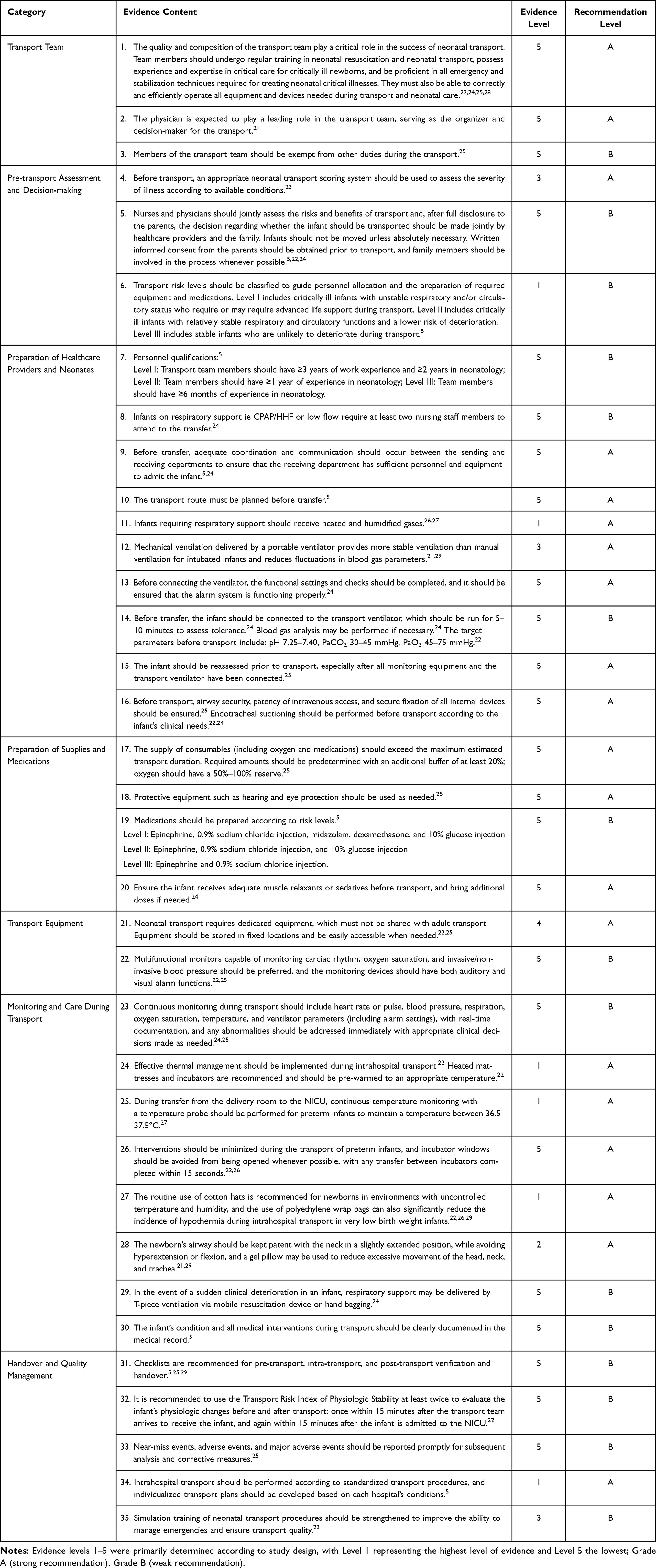 |
Table 4 Best Evidence Summary of Intrahospital Neonatal Transport |
Discussion
Establishment of the Transport Team
Available evidence indicates that the quality and composition of the transport team play a critical role in successful neonatal transport.22 Evidence statements 1 through 3 highlight the core requirements for intrahospital neonatal transport teams. Neonates, especially preterm and critically ill infants, are prone to sudden complications, such as respiratory distress, circulatory instability, and hypothermia, during transport; these complications require immediate intervention by trained professionals.30 A prospective study conducted in Japan showed a significantly lower incidence of adverse events during transport performed by skilled personnel than during transport performed by less experienced staff.31 Therefore, team members should regularly receive training in neonatal resuscitation and critical care, have hands-on experience in treatment and nursing care, and be proficient in emergency techniques and equipment operation22,24,25,28 to facilitate prompt and accurate management of unexpected events during transport.32 However, recommendations for establishing dedicated neonatal transport teams are largely based on low-level evidence and have not been supported by sufficient high-quality comparative studies. Current evidence shows only an association between transport by skilled professionals and a reduced risk of adverse events. It does not clearly identify the unique outcome advantages of dedicated specialized teams compared with well-trained ad hoc teams.33 Therefore, it is unclear whether improved transport safety is attributable to the structure of specialized teams or to standardized professional training. Available evidence also suggests that transport team members should be relieved of other clinical duties during intrahospital transport and focus fully on transport-related responsibilities. However, this requirement may be difficult to implement in resource-constrained healthcare settings, particularly in primary-level hospitals where staffing shortages are common.25
In some developing countries, the establishment of intrahospital neonatal transport teams remains at an exploratory stage, and ad hoc team models are still the predominant approach. Transport responsibilities are often temporarily assumed by on-duty nurses and attending physicians without dedicated transport positions. This model is characterized by an unstable team structure, inconsistent competency standards, fragmented workflows, and insufficient emergency response capacity, which may indirectly increase the risk of adverse events during the transport of critically ill neonates. However, these risks cannot be attributed solely to the absence of dedicated transport teams. Their underlying causes are also related to insufficient investment in professional training, a lack of standardized transport protocols, and limited healthcare resource allocation.
Given the currently limited evidence and variability in healthcare resources, implementation strategies should be tailored to regional healthcare resources, hospital capacity, staffing levels, and transport demand. In high-level NICUs with sufficient staffing and high transport demand, dedicated transport teams with fixed personnel may be established. Clear eligibility criteria, regular specialized training in neonatal resuscitation and critical care, and rigorous competency assessment systems should be implemented to ensure proficiency in emergency management and equipment operation, as well as rapid responses to transport-related complications. In resource-limited secondary or primary hospitals in developing countries, a semi-specialized team model may be more feasible. This approach involves selecting key healthcare professionals as core transport personnel, supplemented by regular refresher training and standardized protocols to compensate for the structural limitations of ad hoc teams.
Improving Pre-Transport Assessment and Preparation
The included guidelines and evidence summaries consistently emphasized that comprehensive and detailed pre-transport assessment and preparation are essential for ensuring transport safety. Evidence suggests that more than 70% of transport-related adverse events can be prevented during the preparation phase through systematic assessment and standardized procedures.34 Therefore, for high-risk neonates, a detailed risk–benefit assessment should be conducted before transport, and the decision to proceed should be made jointly by healthcare professionals and the infant’s family after adequate and informed communication.5 Assessment tools, such as the Early Warning Score for Neonates and the Transport Risk Index of Physiologic Stability (TRIPS), can be used to quantitatively evaluate disease severity.35–38 Based on these scores, a stratified risk classification system may be established to guide appropriate staff allocation and medication preparedness.
A study by Kumar et al showed that, even during large-scale intrahospital neonatal transport that had been carefully planned, equipment failure and inadequate preparation remained major contributors to physiological instability in neonates.39 Therefore, before transport is initiated, the infant’s airway should be kept patent and securely maintained, respiratory function should be stable, and effective temperature management should be implemented. In addition, personnel, equipment, and essential supplies should be adequately prepared. In addition to a transport incubator, multiparameter monitoring equipment, thermal protection supplies, and essential emergency medications, other equipment should be selected according to clinical needs, such as oxygen supply devices, portable ventilators, self-inflating bags or T-piece resuscitators, portable suction devices and suction catheters, syringe pumps, and stethoscopes. Transport should be performed jointly by qualified physicians and nurses. The transport route should be determined in advance, with priority given to the shortest and safest route. Relevant departments should also be coordinated in advance to avoid unnecessary delays.
For neonates requiring respiratory support, airway fixation and ventilator alarm functions should be carefully checked to prevent accidental airway displacement or apnea during transport. It is recommended that, before departure, the ventilator be connected to the infant and operated for 5–10 minutes, during which the neonate’s tolerance to mechanical ventilation should be closely monitored. If necessary, blood gas analysis may be performed to evaluate whether the infant’s oxygenation and ventilation parameters have reached the expected targets.24 Critical medications, such as sedatives and vasoactive agents, should be prepared in advance, and the required doses should be accurately calculated according to the infant’s body weight and the anticipated duration of transport. Supplies should be sufficient to meet needs beyond the expected maximum duration of transport. Oxygen reserves should include an additional buffer of 50%–100% to address unexpected transport delays or a sudden increase in oxygen demand.25
Intrahospital neonatal transport should not be regarded simply as spatial transfer. This is particularly true for critically ill neonates or those requiring escalation to a higher level of monitoring and treatment. In such cases, the need for transport often indicates greater disease severity and is accompanied by more complex nursing procedures, more intensive monitoring, and higher resource requirements. Although standardized operating procedures can regulate transport practices and reduce predictable deviations in equipment preparation, staff role allocation, en-route monitoring, and handover, they cannot completely eliminate the dynamic risks arising from clinical instability and increased nursing needs. Increased nursing complexity not only indicates a higher nursing workload but also reflects more potential risk points and greater care dependency. During transport, these neonates often require the simultaneous maintenance of vital sign monitoring, medication therapy, line and tube management, safety protection, and team communication. Any interruption in monitoring, poor transition between devices, omission of information, or delay in intervention may disrupt the infant’s existing clinical stability and thereby increase the risk of transport-related adverse events. Future studies may further explore the feasibility of integrating nursing complexity into routine transport assessment tools to improve the early identification of high-risk neonates and to provide a basis for clinical decision-making, resource allocation, and transport safety management. Meanwhile, digital solutions, such as electronic checklists and intelligent early warning systems, may be further explored to support standardized workflows and traceable management during the transport preparation phase.
Enhancing Continuous Monitoring and Nursing Care During Transport
Studies have shown that neonates are at increased risk of critical events during transport, such as sudden heart rate abnormalities, hypoxemia, hypothermia, and apnea, because of their limited thermoregulatory capacity and unstable circulatory function.40,41 Therefore, continuous real-time monitoring and documentation of vital signs throughout intrahospital neonatal transport are clinically justified.5,24,25 Continuous monitoring facilitates the early detection of changes in clinical status, helps reduce delays in responding to unexpected events, and represents a key strategy for preventing adverse events during intrahospital transport.42 During transport, the use of multiparameter monitors equipped with audible and visual alarms is recommended.25 When monitored values exceed preset thresholds, such devices can promptly alert the transport team, thereby minimizing delays caused by reliance on manual observation. They may also support timely identification of clinical deterioration and enable rapid intervention.29 Notably, the effectiveness of monitoring depends not only on the equipment itself but also on the team’s ability to respond appropriately to alarm signals. At present, however, there is no unified standard for alarm threshold settings or documentation frequency during intrahospital neonatal transport, and the available evidence remains limited.
Among the various monitoring parameters, temperature management is considered one of the most critical areas in neonatal transport and is supported by relatively stronger evidence. Measures such as using a prewarmed incubator or heated mattress, implementing continuous temperature monitoring, and maintaining the body temperature of preterm infants within the range of 36.5–37.5°C are supported by high-level evidence (Level 1, Grade A).22,27
Accordingly, strengthening temperature control and thermal protection is essential for preventing neonatal hypothermia. Evidence indicates that each 1°C decrease in neonatal body temperature is associated with a significantly increased risk of respiratory distress and death.43 In this context, warming measures should be initiated before transport begins. The transport incubator or heated mattress should be prewarmed to the target temperature in advance.22 During transport, the time during which the neonate is exposed outside the incubator should be minimized. In addition, auxiliary measures such as plastic wrap and thermal caps may be used to further support temperature and humidity regulation.22,26,29 Continuous temperature monitoring should be maintained throughout transport, and warming strategies should be adjusted dynamically according to the neonate’s condition to ensure that body temperature remains within the normal range.27 In addition to preventing hypothermia, maintaining airway patency during transport is also critical. If acute clinical deterioration occurs, respiratory support may be provided using a T-piece ventilation device via a mobile resuscitation device or a manual resuscitator (Level 5, Grade B).
Overall, the relatively high level of evidence supporting temperature management indicates that thermal stability is not merely a routine nursing concern, but a central and evidence-supported safety target during intrahospital neonatal transport. In contrast to several other monitoring and care practices that are still mainly supported by expert opinion or low-level evidence, thermal management has a clearer evidence base and more actionable recommendations. For clinical practice, temperature management should therefore be prioritized in transport protocols and implemented as a structured process that includes prewarming of transport equipment, continuous temperature monitoring, minimization of heat loss during transfer, appropriate use of thermal protection measures, and documentation during handover. For future research, the focus should move beyond confirming the general importance of thermal management toward evaluating the implementation, feasibility, and effectiveness of standardized thermal management bundles across different healthcare settings.
Establishing Standardized Handover Documentation and a Continuous Quality Management System
Evidence statements 31–35 collectively demonstrate that neonatal transport is not merely a technical task but a complex medical process that relies heavily on system coordination, standardized execution, and ongoing quality improvement. Research has shown that structured and standardized handover procedures can significantly reduce information omissions and medical errors, while enhancing team efficiency and patient safety.44 In pediatric and neonatal transport, the implementation of standardized handover tools such as ISBAR (Identify, Situation, Background, Assessment, Recommendation) or checklist-based templates has been associated with a reduction in handover-related problems from 9.9% to 1.0%.43 These tools improve the completeness and traceability of handover information, ensuring critical details are effectively communicated. Moreover, the Transport Risk Index of Physiologic Stability (TRIPS) can be used to quantitatively assess the physiological condition of neonates before and after transport.22 This approach shifts the evaluation of transport quality from subjective clinical judgment to measurable physiological outcomes. It enables the early detection of subtle deterioration and provides a data-driven foundation for quality monitoring and continuous improvement efforts. One study reported that multidisciplinary scenario-based simulations significantly improve staff responsiveness to emergencies and proficiency in equipment use.45 These simulations also reduce the occurrence of medication omissions and equipment failures during transport. Therefore, strengthening simulation training for neonatal transport procedures plays an important role in ensuring transport quality.
Establishing an intrahospital transport management system that emphasizes standardized handover documentation and continuous quality improvement should be considered a key priority. Developing individualized neonatal transport plans tailored to institutional resources, along with conducting regular scenario-based simulation training, may help to strengthen team coordination and enhance patient safety.
Conclusion
This review synthesized the currently available recommendations on intrahospital neonatal transport and categorized them into seven domains. Overall, transport safety depends on coordinated team preparation, structured risk assessment, adequate equipment and medication preparedness, continuous monitoring and care, and standardized handover and quality management. Although the inclusion criteria allowed for eligible primary studies, no primary studies were identified during the screening process. Therefore, the evidence synthesized in this review was mainly derived from guidelines, expert consensus documents, and evidence summaries, and the overall quality of evidence was limited. Accordingly, these recommendations should be regarded as a provisional practice framework rather than definitive practice standards. In clinical practice, healthcare institutions should adapt these recommendations according to their available resources, staffing capacity, workflow characteristics, and neonatal risk profiles. Future high-quality primary studies are needed to evaluate the effectiveness, feasibility, and safety of different transport interventions, team configuration models, and standardized handover procedures, as well as their effects on transport safety and neonatal outcomes.
Disclosure
The authors report no conflicts of interest in this work.
References
1. WHO. Newborn mortality. Available from: https://www.who.int/news-room/fact-sheets/detail/newborn-mortality.
2. JOGH. Estimating the number of hospital beds for the care of sick and small newborns: an evidence-based systematic approach. 2025. Available from: https://jogh.org/2025/jogh-15-04312/.
3. Martin JA, Osterman MJK. Increases in neonatal intensive care admissions in the United States, 2016–2023. In NCHS Data Briefs [Internet]. National Center for Health Statistics (US); 2025. doi10.15620/cdc/174581
4. Haydar B. Error Traps in the Intrahospital Transport of Critically Ill and Anesthetized Children. Paediatr Anaesth. 2025;35(7):497–14. doi:10.1111/pan.15112
5. Editorial Board of Chinese Journal of Evidence-Based Pediatrics. Clinical practice guidelines for in-hospital transport of hospitalized children (2023 edition). Chin J Evid Based Pediatr. 2023;18(3):165–175.
6. Roy RND. Neonatal Transport. Med J Aust. 1977;2(26):862–864. doi:10.5694/j.1326-5377.1977.tb107718.x
7. Doronjski A. Neonatal land transport. Acad J Pediatr Neonatol. 2017;2(4):1. doi:10.19080/AJPN.2017.02.555594
8. Storrs CN, Taylor MRH. Transport of sick newborn babies. Br Med J. 1970;3(5718):328–332. doi:10.1136/bmj.3.5718.328
9. Baştuğ O, Gunes T, Korkmaz L, et al. An evaluation of intra-hospital transport outcomes from tertiary neonatal intensive care unit. J Matern Fetal Neonatal Med. 2016;29(12):1993–1998. doi:10.3109/14767058.2015.1072158
10. Delacrétaz R, Fumeaux CF, Stadelmann C, Trejo AR, Destaillats A, Giannoni E. Intra-hospital transport of newborn infants dataset. Data Brief. 2021;39:107510. doi:10.1016/j.dib.2021.107510
11. Delacrétaz R, Fischer Fumeaux CJ, Stadelmann C, Rodriguez Trejo A, Destaillats A, Giannoni E. Adverse events and associated factors during intrahospital transport of newborn infants. J Pediatr. 2022;240:44–50. doi:10.1016/j.jpeds.2021.08.074
12. Vieira ALP, Dos Santos AMN, Okuyama MK, Miyoshi MH, de Almeida MFB, Guinsburg R. Factors associated with clinical complications during intra-hospital transports in a neonatal unit in Brazil. J Trop Pediatr. 2011;57(5):368–374. doi:10.1093/tropej/fmq111
13. Chaichotjinda K, Chantra M, Pandee U. Assessment of interhospital transport care for pediatric patients. Clin Exp Pediatr. 2020;63(5):184–188. doi:10.3345/kjp.2019.00024
14. Committee on Hospital Care. American academy of pediatrics committee on hospital care: guidelines for air and ground transportation of pediatric patients. Pediatrics. 1986;78(5):943–950. doi:10.1542/peds.78.5.943
15. Zhu Z, Hu Y, Xing W, Zhou Y, Gu Y. Composition of the different types of evidence-based problems. J Nurse Training. 2017;32(21):1991–1994. doi:10.16821/j.cnki.hsjx.2017.21.025
16. Dicenso A, Bayley L, Haynes RB. Accessing pre-appraised evidence: fine-tuning the 5S model into a 6S model. Evid Based Nurs. 2009;12(4):99–101. doi:10.1136/ebn.12.4.99-b
17. Brouwers MC, Kho ME, Browman GP, et al. AGREE II: advancing guideline development, reporting and evaluation in health care. CMAJ. 2010;182(18):E839–E842. doi:10.1503/cmaj.090449
18. JBI. JBI critical appraisal tools. Available from: https://jbi.global/critical-appraisal-tools.
19. Foster MJ, Shurtz S. Making the critical appraisal for summaries of evidence (CASE) for evidence-based medicine (EBM): critical appraisal of summaries of evidence. J Med Libr Assoc. 2013;101(3):192–198. doi:10.3163/1536-5050.101.3.008
20. Wang CQ, Hu Y. JBI evidence pre-grading and evidence recommendation level system (2014 edition). J Nurses Train. 2015;30(11):964–967. doi:10.16821/j.cnki.hsjx.2015.11.002
21. Kong XY, Feng ZC, Li QP, et al. Guidelines for neonatal transport (2017 edition). Chin J Dev Med. 2017;5(4):193–197.
22. Narli N, Kırımi E, Uslu S. Turkish neonatal society guideline on the safe transport of newborn. Turk Pediatri Arsivi. 2018;53(Suppl 1):S18–S31. doi:10.5152/TurkPediatriArs.2018.01804
23. Yan CB, Qiu G, Yuan L, et al. Guidelines for diagnosis and treatment of common neonatal diseases in primary medical institutions: neonatal transport (2025 edition). Chin J Contemp Pediatr. 2025;27(7):759–769.
24. Child and adolescent health service. CAHS - neonatology guidelines. Available from: https://cahs.health.wa.gov.au/For-health-professionals/Resources/Neonatology-guidelines.
25. ANZCA. Australian and New Zealand college of anaesthetists. 2025. Available from: https://www.anzca.edu.au/.
26. Tourneux P, Thiriez G, Renesme L, et al. Optimising homeothermy in neonates: a systematic review and clinical guidelines from the French Neonatal Society. Acta Paediatr Oslo Nor. 2022;111(8):1490–1499. doi:10.1111/apa.16407
27. Le Q, Luo L, Wu LF, Zhang L, Kang M. Best evidence summary for prevention and management of hypothermia in preterm infants. J Nurs Sci. 2022;37(1):87–90.
28. Liang JL, Xue S, Liu L, et al. Best evidence summary of prevention strategies for unplanned extubation in mechanically ventilated children. Chin J Nurs. 2022;57(24):3046–3054.
29. Haydar B, Baetzel A, Elliott A, MacEachern M, Kamal A, Christensen R. Adverse Events During Intrahospital Transport of Critically Ill Children: a Systematic Review. Anesth Analg. 2020;131(4):1135. doi:10.1213/ANE.0000000000004585
30. Messner H, Staffler A. Transport of the high-risk neonate. Ital J Pediatr. 2015;41(S1):A22. doi:10.1186/1824-7288-41-S1-A22
31. Nozawa M, Kaku N, Shimizu N, et al. Safety of transporting ventilated children by skilled personnel: a multicenter prospective study. Pediatr Int off J Jpn Pediatr Soc. 2025;67(1):e70187. doi:10.1111/ped.70187
32. Rosen O, Nayak B, Olivera J, Bondal E, Payne M, Connors J. Neonatal transport ventilation: simulation to improve knowledge and skills. MedEdPORTAL J Teach Learn Resour. 2022;18:11272. doi:10.15766/mep_2374-8265.11272
33. Chang AS, Berry A, Jones LJ, Sivasangari S. Specialist teams for neonatal transport to neonatal intensive care units for prevention of morbidity and mortality. Cochrane Database Syst Rev. 2015;2015(10). doi:10.1002/14651858.CD007485.pub2
34. Bergman LM, Pettersson ME, Chaboyer WP, Carlström ED, Ringdal ML. Safety hazards during intrahospital transport: a prospective observational study. Crit Care Med. 2017;45(10):e1043–e1049. doi:10.1097/CCM.0000000000002653
35. Qu W, Shen Y, Qi Y, et al. Comparison of four neonatal transport scoring methods in the prediction of mortality risk in full-term, out-born infants: a single-center retrospective cohort study. Eur J Pediatr. 2022;181(8):3005–3011. doi:10.1007/s00431-022-04506-8
36. Kulkarni A, Chavan A, Kaul S, Balan S. Transport risk index of physiologic stability score in neonatal transport. Arch Dis Child. 2019;104(Suppl 2):A89. doi:10.1136/archdischild-2019-rcpch.214
37. Shao FP, Qi YE, Chai R, Chen L, Guo Y, Qiu SZ. Effect of early warning grading management on in-hospital transport time and adverse events in critically ill preterm infants. Chin Gen Pract. 2020;18(6):972–975. doi:10.16766/j.cnki.issn.1674-4152.001406
38. Ma C, Sun M, Wang ZX, Sun J, Jin Y, Xie HW. Application of modified early warning score in in-hospital transport of critically ill neonates. Chin Nurs Manag. 2019;19(4):589–593.
39. Kumar R, Wasim S, Gupta G, Mathur S, Kahlon D. Experience of mass intrahospital neonatal transport: impact on vitals. Cureus. 2022;14:22785. doi:10.7759/cureus.22785
40. Warren L, Kaser D, Nocera E, Cholette JM. Pediatric critical care transport: prevention of unintended hypothermia in neonates when an isolette is not available. Air Med J. 2023;42(4):308. doi:10.1016/j.amj.2023.05.015
41. Zhu YJ, Chen XY, Cheng YB. Clinical analysis of 4274 cases of neonatal transport. Int Med Health Guid News. 2019;25(8):1232–1235. doi:10.3760/cma.j.issn.1007-1245.2019.08.015
42. Tourelle KM, Fricke J, Feißt M, et al. A comparison of two transport monitor systems with regard to efficiency and staff satisfaction in the perioperative setting. Cureus. 2024. doi:10.7759/cureus.60481
43. Nakayama DK, Lester SS, Rich DR, Weidner BC, Glenn JB, Shaker IJ. Quality improvement and patient care checklists in intrahospital transfers involving pediatric surgery patients. J Pediatr Surg. 2012;47(1):112–118. doi:10.1016/j.jpedsurg.2011.10.030
44. Reime MH, Tangvik LS, Kinn-Mikalsen MA, Johnsgaard T. Intrahospital handovers before and after the implementation of ISBAR communication: a quality improvement study on ICU nurses’ handovers to general medical ward nurses. Nurs Rep. 2024;14(3):2072–2083. doi:10.3390/nursrep14030154
45. Thampi S, Long HM, Aye WMM, Fu KX. Improving transfer and handover process of intubated paediatric cardiac patients between the operating theatre and paediatric intensive care unit patients - a quality improvement project. J Cardiothorac Vasc Anesth. 2023;37:7–8. doi:10.1053/j.jvca.2023.08.021
 © 2026 The Author(s). This work is published and licensed by Dove Medical Press Limited. The
full terms of this license are available at https://www.dovepress.com/terms
and incorporate the Creative Commons Attribution
- Non Commercial (unported, 4.0) License.
By accessing the work you hereby accept the Terms. Non-commercial uses of the work are permitted
without any further permission from Dove Medical Press Limited, provided the work is properly
attributed. For permission for commercial use of this work, please see paragraphs 4.2 and 5 of our Terms.
© 2026 The Author(s). This work is published and licensed by Dove Medical Press Limited. The
full terms of this license are available at https://www.dovepress.com/terms
and incorporate the Creative Commons Attribution
- Non Commercial (unported, 4.0) License.
By accessing the work you hereby accept the Terms. Non-commercial uses of the work are permitted
without any further permission from Dove Medical Press Limited, provided the work is properly
attributed. For permission for commercial use of this work, please see paragraphs 4.2 and 5 of our Terms.