
Back to Journals » Infection and Drug Resistance » Volume 19
Successful Treatment with Sulbactam-Durlobactam for Severe Acute Pancreatitis Complicated by Extensively Drug-Resistant Acinetobacter baumannii Infection at Multiple Sites: A Case Report
Authors Ge Z  , Li L, Wang L, Liu D, Liu Y
Received 23 October 2025
Accepted for publication 6 January 2026
Published 10 January 2026 Volume 2026:19 575394
DOI https://doi.org/10.2147/IDR.S575394
Checked for plagiarism Yes
Review by Single anonymous peer review
Peer reviewer comments 2
Editor who approved publication: Prof. Dr. Héctor Mora-Montes
Zhengmao Ge, Li Li, Longxin Wang, Dengke Liu, Yupeng Liu
Department of Critical Care Medicine, The 967 Hospital, Joint Logistics Support Force of PLA, Dalian, 116021, People’s Republic of China
Correspondence: Yupeng Liu, Department of Critical Care Medicine, The 967 Hospital, Joint Logistics Support Force of PLA, No. 80 Shengli Road, Dalian, Liaoning, 116021, People’s Republic of China, Email [email protected]
Background: The management of severe acute pancreatitis (SAP) complicated by multi-site infections with extensively drug-resistant Acinetobacter baumannii (XDR-AB) represents a critical therapeutic challenge. This report describes, to our knowledge, an early successful application of sulbactam-durlobactam in an SAP patient with concurrent XDR-AB infections in the abdomen, biliary tract and lungs.
Case Presentation: A 36-year-old female with hypertriglyceridemic SAP developed infections at multiple sites, with cultures consistently yielding XDR-AB. After the failure of multiple last-line antimicrobial regimens, therapy was switched to sulbactam-durlobactam combined with meropenem. This change was followed by a substantial clinical improvement: body temperature normalized, infection biomarkers decreased significantly and microbiological clearance of XDR-AB from all sites was achieved, leading to successful liberation from mechanical ventilation and discharge from the ICU.
Conclusion: This case demonstrates that sulbactam-durlobactam can be a highly effective therapeutic option for achieving both clinical and microbiological cure in complex SAP cases with multi-site XDR-AB infections that are refractory to conventional treatment regimens. It contributes early real-world evidence supporting a new therapeutic strategy for managing such life-threatening, complex infections.
Keywords: severe acute pancreatitis, Acinetobacter baumannii, drug resistance, sulbactam-durlobactam, case report
Introduction
Severe acute pancreatitis (SAP) is a critical illness with high mortality, often driven by secondary infections.1,2 The pathophysiology of SAP—involving a systemic inflammatory storm, subsequent immunoparalysis, gut barrier dysfunction with bacterial translocation and pancreatic necrosis—creates a high risk for multi-site infections.3 This vulnerability is compounded by the global rise of carbapenem-resistant Gram-negative bacteria, which poses a severe therapeutic challenge in SAP.4 Traditional regimens like polymyxin and tigecycline, while possessing some activity, are often suboptimal due to limitations such as uneven tissue distribution and nephrotoxicity.5
Sulbactam-durlobactam is a novel β-lactamase inhibitor combination. Durlobactam, a novel diazabicyclooctane β-lactamase inhibitor, potently inhibits Ambler class A, C and D β-lactamases. This action protects sulbactam from hydrolysis and can synergize with other β-lactams, collectively restoring activity against resistant Acinetobacter baumannii. This agent was approved by the US Food and Drug Administration in 2023 for treating hospital-acquired bacterial pneumonia and ventilator-associated bacterial pneumonia caused by carbapenem-resistant Acinetobacter baumannii (CR-AB).6 However, robust real-world data on its clinical effectiveness and optimal application in the specific and complex scenario of SAP complicated by multi-site extensively drug-resistant Acinetobacter baumannii (XDR-AB) infections are currently lacking.
This report describes the successful use of sulbactam-durlobactam in a patient with hypertriglyceridemic SAP (HTG-SAP) (Figure 1) and concurrent multi-site XDR-AB infection who had refractory to conventional regimens. This case provides early evidence supporting the use of sulbactam-durlobactam as a potent salvage therapy for complex, multi-site XDR-AB infections refractory to conventional regimens.
 |
Figure 1 Timeline of Key Clinical Events and Therapeutic Interventions During ICU Stay. Abbreviations: ICU, Intensive Care Unit; LD, Loading Dose; SCF, Cefoperazone-Sulbactam; MEM, Meropenem; CZA, Ceftazidime-Avibactam; CS, Colistin Sulfate; SUL-DUR, Sulbactam-Durlobactam; TGC, Tigecycline; VAN, Vancomycin; CAS, Caspofungin; FLC, Fluconazole. Notes: The upper section of the figure chronologically depicts major clinical milestones, including admission to ICU, therapeutic procedures (eg, plasma exchange, drainage procedures), and respiratory support events (eg, endotracheal intubation, tracheostomy). The lower section illustrates the sequential administration of antimicrobial and antifungal agents, using standard abbreviations. Vertical dashed lines in the lower panel mark the time points of major antimicrobial regimen changes. The Y-axis plots serum C-reactive protein (CRP, mg/L) levels, reflecting the trajectory of the systemic inflammatory response, while the X-axis represents time and is correlated with the patient’s body temperature (°C). |
Case Presentation
This case report was prepared in accordance with the CARE guidelines (Supplementary File 1).7 A 36-year-old female with a body mass index of 33.7 kg/m2 was admitted for persistent mid-upper abdominal pain. Her history included hyperlipidemia and fatty liver. Initial labs showed leukocytosis (11.17×10⁹/L), elevated amylase (368 U/L), lipase (1794 U/L), and hypertriglyceridemia (7.93 mmol/L). Abdominal CT confirmed acute pancreatitis (Figure 2). The diagnosis was acute pancreatitis, hyperlipidemia, and fatty liver. Her condition rapidly deteriorated with soaring triglycerides (53.55 mmol/L), rising lipase (2958 U/L), hypocalcemia and hypoxemia, prompting immediate ICU transfer.
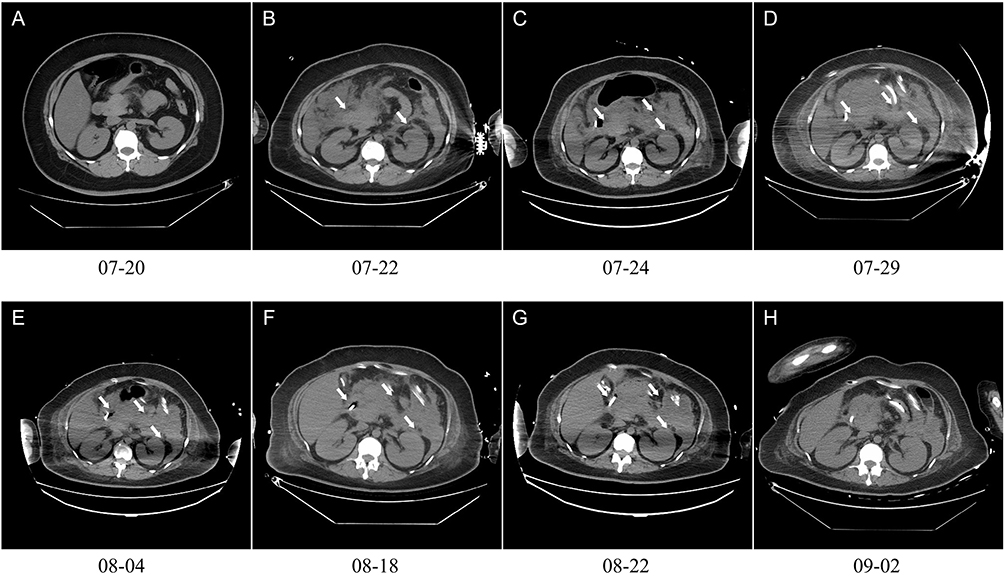 |
Figure 2 Comparative Serial Axial CT Images at the Level of the Renal Hilum. Notes: (A–H) Serial axial non-contrast CT images at the level of the renal hilum obtained on July 20, 22, 24, 29, August 4, 18, 22 and September 2, 2025 respectively. White arrows in (B–G) highlight key pathological features, including progressive peri-pancreatic infiltration and fluid collections. This series illustrates the dynamic clinical course: (A) obtained at initial admission, shows early signs of pancreatitis. By day 3 (B), a rapid and significant progression of peri-pancreatic infiltration and fluid collections is evident. Following intensive medical and surgical intervention, subsequent images demonstrate gradual resolution. By day 44, on the eve of ICU discharge (H), although edema of the pancreatic head remains notable, the extensive peri-pancreatic exudation has been largely controlled. |
Initial Management and Emergence of Multi-Site Infection
In the ICU, she received continuous renal replacement therapy (CRRT) and empiric cefoperazone-sulbactam. Three plasma exchange sessions lowered triglycerides to 4.98 mmol/L. However, evidence of multi-site infections emerged. Repeat CT showed increased peripancreatic exudation, suggesting peritonitis (Figure 2). Percutaneous drainage yielded bloody and dark brown ascitic fluid. On day 3, severe acute respiratory distress syndrome (ARDS) developed, requiring mechanical ventilation. Microbiological cultures were sent from sputum, bronchoalveolar lavage fluid, ascites and bile.
Escalating Antimicrobial Challenges and Microbiological Findings
Due to persistent fever and elevated infection biomarkers (procalcitonin (PCT) 4.38 ng/mL, C-reactive protein (CRP) 177.6 mg/L), antimicrobial therapy was escalated to meropenem. Laparoscopic necrosectomy and drainage were performed for worsening abdominal condition. As detailed in Table 1, microbiological data revealed a succession of carbapenem-resistant Klebsiella pneumoniae (CR-KP) and CR-AB, which later exhibited an XDR-AB, from abdominal and respiratory sites between early and late August. Anti-infective regimens were repeatedly adjusted based on culture and susceptibility results (Table 1), sequentially employing tigecycline, ceftazidime-avibactam, and colistin. Despite these targeted efforts, clinical and biomarker evidence of persistent sepsis indicated uncontrolled abdominal infection.
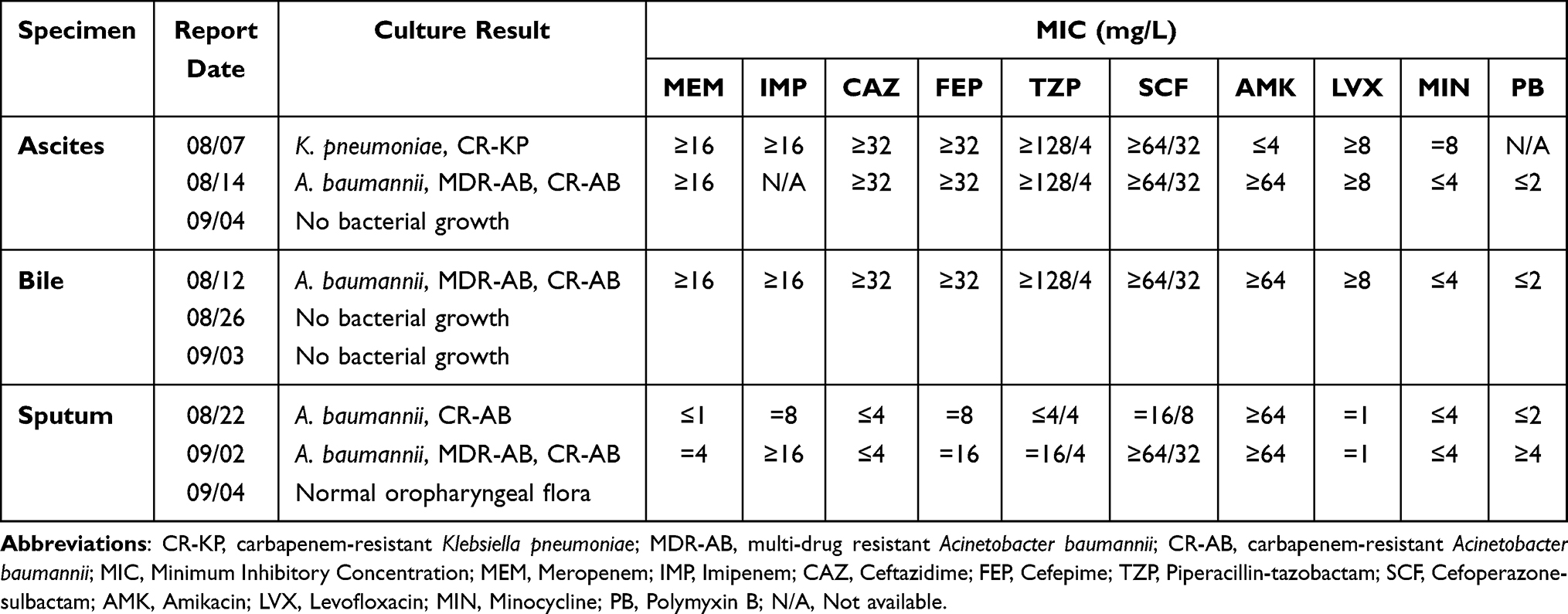 |
Table 1 Selected Microbiological Culture Identification and Drug Susceptibility Testing Results |
Initiation of Novel Agent and Clinical Turnaround
On August 27, with recurrent fever (38.3°C), leukocytosis (21.87×10⁹/L), and ongoing culture positivity for XDR-AB, therapy was switched to sulbactam-durlobactam combined with meropenem. This intervention marked a clinical turning point. Body temperature and infection biomarkers normalized promptly (CRP decreased from 70.4 mg/L to 8.9 mg/L; PCT fell to <0.10 ng/mL). Microbiological clearance of XDR-AB from all sites was confirmed by September 4. Consequently, oxygenation improved, allowing liberation from mechanical ventilation, and abdominal drainage decreased. After one week of combination therapy, the infection was controlled, and the patient was transferred from the ICU on September 3.
Discussion
The diagnostic and therapeutic course of this patient exemplifies the extreme challenges and potential breakthroughs in managing HTG-SAP complicated by XDR Gram-negative bacterial infections.
Underlying Host Factors and the Pathogenesis of Infection
This young female patient had a background of hyperlipidemia and fatty liver and SAP was triggered by hypertriglyceridemia. HTG-SAP often follows a more severe course. Its pathophysiology involves massive pancreatic enzyme activation, a systemic inflammatory storm and immune dysfunction, creating conditions predisposing to secondary infections.8 This case demonstrated typical features of SAP-associated infections, namely sequential colonization or infection of multiple sites—abdomen (peripancreatic, ascites), biliary tract and respiratory tract—forming a complex “network of infection foci.” The early appearance of pancreatic necrosis and peritonitis, rapidly progressing to severe ARDS requiring mechanical ventilation, highlights the severity and complexity. Although comprehensive management, including CRRT, plasma exchange and surgical debridement/drainage, was implemented early, infection remained uncontrolled, reflecting the collapse of host defense mechanisms in such patients, providing an opportunity for colonization and invasion by resistant bacteria.
The Therapeutic Impasse of Multi-Drug Resistant Infections
The anti-infective course in this case was particularly challenging. Typically, carbapenems, β-lactam/β-lactamase inhibitor combinations, fifth-generation cephalosporins, oxazolidinones and some aminoglycosides show good activity against infections complicating acute pancreatitis.3 Therefore, during empirical treatment, we continuously evaluated and escalated the regimen, sequentially using broad-spectrum, potent agents like cefoperazone-sulbactam, meropenem, tigecycline and ceftazidime-avibactam, yet with poor efficacy. This could be partly attributed to poor antibiotic penetration into deep-seated abdominal infections, particularly those enclosed within necrotic tissue. Furthermore, microbiological evidence obtained later revealed a more intractable problem: mixed infection with CR-KP and XDR-AB. This aligns with previous reports identifying Klebsiella pneumoniae and Acinetobacter baumannii as predominant carbapenem-resistant pathogens in SAP.9 Studies, including one by Chen et al on AP-related infections, have also noted that the emergence of resistant pathogens limits treatment options and can severely impact prognosis.10 Thus, we considered the presence of these resistant organisms as the primary reason for the prolonged failure to control the infection.
In interpreting these microbiological findings, a critical distinction was made between infection and colonization based on specimen source and clinical context. In this patient, A. baumannii isolated from all sites was considered indicative of active infection. This judgment was based on composite criteria: isolation from sterile abdominal/biliary fluids, and for the respiratory tract, concurrent purulent secretions on bronchoscopy, systemic signs of infection (fever, elevated CRP) and the absence of an alternative septic focus. This confirmed a state of disseminated, multi-site infection, underscoring the clinical challenge and validating the goal of microbiological clearance from all compartments.
After obtaining etiological evidence, we escalated therapy based on drug susceptibility and tNGS results, using ceftazidime-avibactam (targeting CR-KP) and later the potent combination of tigecycline plus polymyxin (targeting XDR-AB).11,12 However, even with these currently considered most powerful antimicrobial weapons, the patient’s clinical and microbiological response remained poor after a minimum treatment period of 4 to 11 days, with persistence of sepsis signs and ongoing culture positivity. The suboptimal performance of polymyxin, in particular, may be attributed to pharmacokinetic variability and unpredictable drug exposure in a patient undergoing continuous renal replacement therapy, compounding the inherent challenge of achieving effective concentrations in deep-seated, necrotic infections.
The Rationale and Efficacy of Sulbactam-Durlobactam in Complex Infections
The therapeutic strategy was guided by the Infectious Diseases Society of America (IDSA) 2024 guidance, which recommends sulbactam-durlobactam in combination with imipenem-cilastatin or meropenem as a preferred regimen for CR-AB infections, a recommendation supported by in vitro synergy data aiming to optimize treatment efficacy.13,14 Meropenem was selected for this combination based on its favorable safety profile—particularly a lower risk of neurotoxicity compared to imipenem—and its reliable activity against potential co-pathogens such as Pseudomonas aeruginosa.15 Durlobactam, a novel diazabicyclooctane β-lactamase inhibitor in the combination, exerts potent inhibition against class A, C and D carbapenemases. Its synergy with sulbactam and β-lactam antibiotics (eg, meropenem) creates a triple synergistic effect.16,17 Crucially, the β-lactamase inhibitors restore the efficacy of β-lactam drugs against β-lactamase-producing pathogens. This mechanism not only effectively targets CR-AB, as in this case, but could also theoretically retain activity against some enzyme-producing CR-KP strains. However, clinical evidence for this indication remains limited, and the drug is not currently approved for CR-KP infections. In our patient, the observed microbiological clearance may have been primarily attributable to its potent activity against CR-AB. In contrast, traditional drugs like polymyxin and tigecycline often struggle to achieve effective therapeutic concentrations simultaneously at all critical infection sites due to issues like poor tissue penetration or low serum levels.18 The observed rapid clinical and microbiological response following its initiation suggests a key advantage: the ability to achieve effective bactericidal concentrations at multiple, disparate infection sites—a feat often unattainable with older agents like polymyxin or tigecycline due to unfavorable pharmacokinetics.
Regarding drug safety, liver and kidney impairment are common during SAP. Traditional antimicrobials often carry risks of hepatorenal toxicity. During prolonged anti-infective courses, these side effects can limit drug use and exacerbate organ dysfunction.19 Sulbactam-durlobactam, as a β-lactam derivative, generally has a favorable safety profile. In this patient, who already had liver injury and required ongoing CRRT, its good safety and tolerability were crucial for completing a full course of potent anti-infective therapy. A Phase III clinical trial has confirmed that for patients with CR-AB causing pneumonia, sulbactam-durlobactam demonstrated comparable efficacy to polymyxin-based regimens but with a significantly lower incidence of nephrotoxicity (P < 0.001).20
Implications and Limitations
This case is among the first reports successfully using sulbactam-durlobactam to rescue a patient with SAP and multi-site XDR-AB infection. It provides crucial, early real-world evidence for infectious disease and critical care specialists facing the challenge of XDR-AB in SAP. It suggests that for complex resistant Gram-negative infections failing conventional combination therapy, especially when the pathogen is carbapenemase-producing Acinetobacter baumannii, sulbactam-durlobactam can be a powerful salvage option. It is crucial to emphasize that the success of sulbactam-durlobactam was built upon adequate surgical drainage and organ function support.21 The drug’s mechanism involves killing actively growing bacteria, while surgical drainage removes the massive bacterial reservoir within biofilms and necrotic tissue, reducing the inoculum. Together, they form a successful model combining “chemical eradication” and “physical clearance”. This case underscores that in SAP infection control, any potent antimicrobial must be integrated with active surgical intervention and meticulous organ support to achieve maximum efficacy.
This case has limitations. It is a single-center, retrospective report and the successful outcome was achieved on the foundation of comprehensive treatments like surgical drainage and organ support. Furthermore, detailed strain homology analysis and deeper resistance mechanism studies were not performed. Potential confounders such as heteroresistance or site-specific pharmacokinetic variability in SAP patients were not assessed and may represent unmeasured confounders that could influence outcomes. Future larger-sample clinical studies are needed to further confirm its efficacy, optimize dosing regimens and explore resistance evolution.
Conclusion
For the clinical challenge of SAP complicated by multi-site, extensively drug-resistant Acinetobacter baumannii infection, the novel β-lactamase inhibitor combination sulbactam-durlobactam demonstrates breakthrough therapeutic potential when conventional regimens fail. This case confirms that this agent can effectively clear resistant bacteria from multiple sites, including the respiratory tract, abdomen and biliary system, achieving both clinical and microbiological cure, thereby providing a new key weapon for managing such critically ill patients.
Data Sharing Statement
All data generated or analyzed during this study are included in this published article.
Ethics Approval and Consent to Participate
This study was approved by the Institutional Ethics Committee of the 967 Hospital, Joint Logistics Support Force of PLA (Approval No: PLA967-GC2025-32). This approval included consent for publication of anonymized case details. Written informed consent was obtained from the patient’s legal guardian (father) for publication of this case report, as the patient was bedbound and had limited communication capacity during the consent process.
Acknowledgments
The authors gratefully acknowledge the dedicated care provided by the medical team and the unwavering support and consent of the patient’s family.
Author Contributions
All authors made a significant contribution to the work reported, whether that is in the conception, study design, execution, acquisition of data, analysis and interpretation, or in all these areas; took part in drafting, revising or critically reviewing the article; gave final approval of the version to be published; have agreed on the journal to which the article has been submitted; and agree to be accountable for all aspects of the work.
Funding
This work did not receive any grant.
Disclosure
The authors report no conflicts of interest in this work.
References
1. Tenner S, Vege SS, Sheth SG, et al. American College of Gastroenterology Guidelines: management of acute pancreatitis. Am J Gastroenterol. 2024;119(3):419–7. doi:10.14309/ajg.0000000000002645
2. Hong W, Pan J, Goyal H, Zippi M. Editorial: acute pancreatitis infection: epidemiology, prevention, clinical characteristics, treatment, and prediction. Front Cell Infect Microbiol. 2023;13:1175195. doi:10.3389/fcimb.2023.1175195
3. Li F, Zhang F, Wan X, et al. Infections in acute pancreatitis: organisms, resistance-patterns and effect on mortality. Dig Dis Sci. 2023;68(2):630–643. doi:10.1007/s10620-022-07793-1
4. Jia Y, Liu Y, Huang Y, et al. Clinical characteristics, drug resistance, and risk factors for death of Klebsiella pneumoniae infection in patients with acute pancreatitis: a single-center retrospective study from China. Infect Drug Resist. 2023;16:5039–5053. doi:10.2147/IDR.S410397
5. González-López J, Macías-García F, Lariño-Noia J, Domínguez-Muñoz JE. Theoretical approach to local infusion of antibiotics for infected pancreatic necrosis. Pancreatology. 2016;16(5):719–725. doi:10.1016/j.pan.2016.05.396
6. Pogue JM, Harrington J, Wangchinda W, Kaye KS. New perspectives on antimicrobial agents: sulbactam-durlobactam. Antimicrob Agents Chemother. 2025;69(10):e01086–24. doi:10.1128/aac.01086-24
7. Gagnier JJ, Kienle G, Altman DG, et al. The CARE guidelines: consensus-based clinical case reporting guideline development. BMJ Case Rep. 2013;2013:bcr2013201554. doi:10.1136/bcr-2013-201554
8. Wang J, Xia Y, Cao Y, et al. Evaluating the efficacy and timing of blood purification modalities in early-stage hyperlipidemic acute pancreatitis treatment. Lipids Health Dis. 2023;22(1):208. doi:10.1186/s12944-023-01968-z
9. Wu D, Huang Y, Xiao J, Qin G, Liu H, Peng J. Risk factors for mortality among critical acute pancreatitis patients with carbapenem-resistant organism infections and drug resistance of causative pathogens. Infect Dis Ther. 2022;11(3):1089–1101. doi:10.1007/s40121-022-00624-w
10. Chen J, Xiang Q, Wu JY, Zheng XJ, Jiang XY. Characteristics and risk factors for infection and mortality caused by Klebsiella pneumoniae in patients with acute pancreatitis. Front Public Health. 2025;12:1533765. doi:10.3389/fpubh.2024.1533765
11. Karampatakis T, Tsergouli K, Behzadi P. Carbapenem-resistant Klebsiella pneumoniae: virulence factors, molecular epidemiology and latest updates in treatment options. Antibiotics. 2023;12(2):234. doi:10.3390/antibiotics12020234
12. Ibrahim S, Al-Saryi N, Al-Kadmy IMS, Aziz SN. Multidrug-resistant Acinetobacter baumannii as an emerging concern in hospitals. Mol Biol Rep. 2021;48(10):6987–6998. doi:10.1007/s11033-021-06690-6
13. Tamma PD, Heil EL, Justo JA, Mathers AJ, Satlin MJ, Bonomo RA. Infectious Diseases Society of America 2024 Guidance on the treatment of antimicrobial-resistant gram-negative infections. Clin Infect Dis. 2024;ciae403. doi:10.1093/cid/ciae403
14. Halim J, Bouzo J, Carabetta VJ. Evaluation of sulbactam/durlobactam activity and synergy against highly drug-resistant Acinetobacter baumannii strains. JAC Antimicrob Resist. 2025;7(6):dlaf220. doi:10.1093/jacamr/dlaf220
15. Katip W, Oberdorfer P, Kasatpibal N. Effectiveness and nephrotoxicity of loading dose colistin-meropenem versus loading dose colistin-imipenem in the treatment of carbapenem-resistant Acinetobacter baumannii infection. Pharmaceutics. 2022;14(6):1266. doi:10.3390/pharmaceutics14061266
16. Karlowsky JA, Hackel MA, McLeod SM, Miller AA. In vitro activity of sulbactam-durlobactam against global isolates of Acinetobacter baumannii-calcoaceticus complex collected from 2016 to 2021. Antimicrob Agents Chemother. 2022;66(9):e00781–22. doi:10.1128/aac.00781-22
17. Keam SJ. Sulbactam/durlobactam: first approval. Drugs. 2023;83(13):1245–1252. doi:10.1007/s40265-023-01920-6
18. Jean SS, Harnod D, Hsueh PR. Global threat of carbapenem-resistant gram-negative bacteria. Front Cell Infect Microbiol. 2022;12:823684. doi:10.3389/fcimb.2022.823684
19. Yahav D, Giske CG, Grāmatniece A, Abodakpi H, Tam VH, Leibovici L. New β-Lactam–β-Lactamase inhibitor combinations. Clin Microbiol Rev. 2020;34(1):e00115. doi:10.1128/CMR.00115-20
20. Kaye KS, Shorr AF, Wunderink RG, et al. Efficacy and safety of sulbactam–durlobactam versus colistin for the treatment of patients with serious infections caused by Acinetobacter baumannii–calcoaceticus complex: a multicentre, randomised, active-controlled, Phase 3, non-inferiority clinical trial (ATTACK). Lancet Infect Dis. 2023;23(9):1072–1084. doi:10.1016/S1473-3099(23)00184-6
21. Zerem E, Kurtcehajic A, Kunosić S, Zerem Malkočević D, Zerem O. Current trends in acute pancreatitis: diagnostic and therapeutic challenges. World J Gastroenterol. 2023;29(18):2747–2763. doi:10.3748/wjg.v29.i18.2747
 © 2026 The Author(s). This work is published and licensed by Dove Medical Press Limited. The
full terms of this license are available at https://www.dovepress.com/terms
and incorporate the Creative Commons Attribution
- Non Commercial (unported, 4.0) License.
By accessing the work you hereby accept the Terms. Non-commercial uses of the work are permitted
without any further permission from Dove Medical Press Limited, provided the work is properly
attributed. For permission for commercial use of this work, please see paragraphs 4.2 and 5 of our Terms.
© 2026 The Author(s). This work is published and licensed by Dove Medical Press Limited. The
full terms of this license are available at https://www.dovepress.com/terms
and incorporate the Creative Commons Attribution
- Non Commercial (unported, 4.0) License.
By accessing the work you hereby accept the Terms. Non-commercial uses of the work are permitted
without any further permission from Dove Medical Press Limited, provided the work is properly
attributed. For permission for commercial use of this work, please see paragraphs 4.2 and 5 of our Terms.