
Back to Journals » Clinical Ophthalmology » Volume 19
Subjective Grading and Objective Assessment After Switching to a Daily Disposable Silicone Hydrogel Contact Lens
Authors Chen YY  , Yang RY, Sun HY
Received 29 May 2025
Accepted for publication 13 August 2025
Published 6 September 2025 Volume 2025:19 Pages 3273—3281
DOI https://doi.org/10.2147/OPTH.S538886
Checked for plagiarism Yes
Review by Single anonymous peer review
Peer reviewer comments 2
Editor who approved publication: Dr Scott Fraser
Ya-Yu Chen,1 Ren-Yu Yang,2 Han-Yin Sun2,3
1Department of Optometry, MacKay Medical College, New Taipei City, Taiwan; 2Department of Optometry, Chung Shan Medical University, Taichung City, Taiwan; 3Department of Ophthalmology, Chung Shan Medical University Hospital, Taichung City, Taiwan
Correspondence: Han-Yin Sun, Department of Optometry, Chung Shan Medical University, No. 110, Sec. 1, Jianguo N. Road, South Dist, Taichung, 402, Taiwan, Tel +8864-24730022 ext, 12364, Fax +8864-24759950, Email [email protected]
Purpose: To evaluate both subjective grading and objective assessments associated with switching from habitual silicone hydrogel daily disposable contact lenses to verofilcon A lenses (study lenses) among young Asian individuals, and to investigate the relationship between these subjective and objective measures.
Patients and Methods: 58 participants wore study lenses for 8– 10 hours daily for a week. Subjective assessments, including comfort, visual quality, and eye dryness, were conducted using a numerical rating scale (0– 100) on the first and seventh day. Noninvasive tear breakup time (NITBUT), bulbar conjunctival redness (BR), tear meniscus height (TMH), and meibography were measured with the Keratograph M5 at baseline, the first and the seventh day.
Results: After the seventh day, subjective ratings showed increased comfort and decreased visual quality and dryness. Comfort and visual quality scores on the first and seventh days were above 85 points, with no significant differences. The average NITBUT significantly improved 15 minutes and 8 hours post-lens application compared to baseline measures (P = 0.019). Tear meniscus height was highest at baseline, with a marginal decrease observed following both 15 minutes and 8 hours of study lenses wear (P < 0.001). The most pronounced bulbar conjunctival redness was noted at baseline, decreasing significantly after switching to study lenses (P = 0.002). Notably, NITBUT was found to be significantly positively correlated with comfort (P < 0.05).
Conclusion: The switch to daily disposable study lenses resulted in maintained comfort and improved tear film stability in the young Asian population. A significant positive correlation was observed between NITBUT and subjective measures of comfort.
Keywords: comfort, dryness, NITBUT, verofilcon A, vision quality
Introduction
Daily disposable soft contact lenses (CLs) offer a convenient and safe approach to correcting refractive errors. First introduced in the mid-1990s, these lenses have been widely prescribed across the globe.1 Of these, dryness-related discomfort is the most prevalent, accounting for up to 30% of discontinuations,2,3 making it the primary reason for stopping contact lens use.4 CL comfort is influenced by factors such as lens material,5 individual characteristics, wearing modality,6 and lens care solutions.7 A key determinant of comfort is the interaction between the ocular surface condition and the contact lens.8 Dryness, the most frequently reported symptom, results from contact lens-induced tear film instability.9 Contact lens-induced discomfort is a multifactorial condition influenced by the compatibility between the CL and the ocular surface.8 Additionally, oxygen transmissibility through the lens material can affect corneal physiology, leading to hypoxia-related complications, including neovascularization, epithelial keratitis, and microcysts.10,11
A recent study reported a higher prevalence of dry eye disease in Asia than in Western countries, with rates ranging from 7% in the United States to over 30% in Taiwan, Japan, and Korea.12 Environmental factors, such as strong sunlight and windy weather, may contribute to this disparity.13,14 Despite these challenges, demand for CLs continues to rise in Asia due to high myopia rates.15 CL wearers who frequently use computers16 or work in air-conditioned environments often experience ocular complaints due to accelerated tear evaporation.17
The tear film, a 2–5 micrometers thick fluid layer, maintains hydration, smooths the corneal surface, and improving vision quality.18 Contact lenses disrupt tear film homeostasis, leading to reduced comfort.19 Advance in lens materials and design have improved oxygen permeability and wettability.20 Silicone hydrogel daily disposable lenses, introduced in 2008, are now widely used due to their balance of oxygen transmissibility and on-eye comfort, helping stabilize the pre-lens tear film.21
Objective assessments like Schirmer’s test, tear breakup time (TBUT), and tear osmolarity are commonly used to evaluate tear film stability, though they can be invasive and time-consuming. Recently, noninvasive methods such as measuring tear meniscus height (TMH) and bulbar redness have gained popularity.22,23 Meibomian gland health is also a crucial factor in CL success. Clinical assessment and dry eye tests help address comfort issues, with tools like the CLDEQ-8 and SPEED, and OSDI questionnaires offering validated symptom tracking,24,25 although the OSDI is not specifically validated for CL wearers.26 Visual analog scales (VAS) are commonly used to assess overall comfort and satisfaction.27,28 Therefore, this study aimed to evaluate both subjective grading and objective assessments associated with switching from habitual silicone hydrogel daily disposable contact lenses to verofilcon A lenses among young Asian individuals, and to investigate the relationship between these subjective and objective measures.
Materials and Methods
Study Subjects
This study was designed as a prospective, open-label experiment, with participants receiving their habitual contact lenses, made of SF daily disposable silicone hydrogel contact lenses, at the first visit. A total of 58 subjects were recruited from two sites, Chung Shan Medical University and Da-Yeh University. All procedures were approved by the relevant Human Research Ethics Committee, and written informed consent was obtained from all subjects. The study was conducted in accordance with the tenets of the Declaration of Helsinki and was approved by the Institutional Review Board Chung Shan Medical University Hospital (CSMUH No: CS1-22177). Eligible participants were 20- to 30-year-old Asians with myopic eyes (≥ −6.00 DS) who could achieve a monocular habitual visual acuity of at least 20/25 (6/7.5) in both eyes with spherical soft contact lens correction. The participants had no ocular or systemic health conditions and were not taking any medications. Their eyes are of either normal dryness or mildly dry (OSDI scores < 22) and spent more than four hours per day using visual display terminals.29 The subjects initially wore their habitual lenses before switching to daily verofilcon A contact lenses (study lenses) for 7 ± 2 days. The participants inserted a fresh pair of CLs each day and discarding them at the end of the day. They were provided with one lens type at a time, receiving the second lens type at the second visit. All subjects were current soft contact lens wearers who typically wore their lenses for at least eight hours per day, five days per week.
Study Protocol
The trial consisted of three scheduled visits (see the Figure 1). During the first visit, biomicroscopy was used to evaluate the ocular surface. The non-invasive tear break-up time (NITBUT), bulbar conjunctival redness (BR), tear meniscus height (TMH), and meibography were measured without contact lenses (baseline). Additionally, habitual visual acuity was measured while the participants were wearing their eyeglasses. Subsequently, subjects wore habitual lenses (somofilcon A) for 15 minutes, and data on visual acuity, over-autorefraction, lens fit assessment, NITBUT, BR, TMH, meibography and initial visual analogue scale (VAS) scores were collected. After wearing the habitual lenses for 8 hours, the subjects provided their satisfaction via a VAS. Following this, the subjects wore the habitual lenses for 7 ± 2 days.
 |
Figure 1 A diagram of the study protocol. |
At the second visit, on the seventh day of wearing habitual lenses, data were collected after the subjects had worn the lenses for 4 hours. This data included visual acuity, over-autorefraction, lens fit assessment, NITBUT, BR, TMH, meibography, and VAS scores. Subsequently, the subjects discarded the habitual lenses and switched to wearing study contact lenses. The same data were collected after the subjects wore the study lenses for 15 minutes. After wearing the study lenses for 8 hours on the same day, the subjects provided a VAS score. Following this, the subjects wore the study lenses for 7 ± 2 days.
During the third visit, on the seventh day of wearing study lenses, data were collected on visual acuity, over-autorefraction, lens fit assessment, NITBUT, BR, TMH, meibography, and VAS scores after wearing study lenses for 8 hours. Participants accessed the VAS on an online platform during the research. All participants reported a comfort score ranging from 0 to 100, where 0 indicated “extremely uncomfortable” and 100 represented “extremely comfortable”. A score of 0 represented “not at all dry”, while 100 represented “extremely dry”. Tear film parameters were assessed using a Keratograph 5M (Oculus Optikgerate, Wetzlar, Germany Keratograph® 5M - Topography and Dry Eye Analysis - OCULUS, Inc.) in a specific sequence to minimize the influence of prior measurements. The parameters were evaluated in the following order: noninvasive keratograph breakup time (both first and average; NITBUT-first, NITBUT-average), TMH, BR, and meibography.
Statistical Analysis
This study employed a non-comparative design, utilizing descriptive statistics to assess survey responses. Survey data were analyzed using SPSS software version 26 (IBM Corp, Armonk, NY). Only one eye (OD assessment) from each subject was included in the data analysis. The paired t-test was conducted to compare the overall and end-of-day VAS scores obtained on Day 1 and Day 7. A clinically significant difference was defined as a change in VAS score of seven points or more.30 The NITBUT measurements were collected at three time points (baseline, 15 minutes, and 8 hours after wearing study lenses). Repeated measures analysis of variance (ANOVA) was utilized to determine the statistical significance of differences among these measurements. Additionally, 95% confidence intervals (CI) of the differences were calculated. When repeated measures ANOVA indicated statistical significance, post hoc pairwise comparisons were conducted using the Bonferroni correction. Pearson’s correlation coefficients were employed to examine the relationship between NITBUT and VAS variables. Mixed model analysis was also performed to evaluate the association between NITBUT and the overall VAS with data measured at two time points. Data are presented as mean ± standard deviation (SD), and a p-value of < 0.05 was considered statistically significant.
Results
Participant Demographics and the Lens Fitting
This study recruited 61 soft contact lens users (mean age: 20.73 ± 1.34 years, male/female ratio: 8/50). In the end, 58 subjects completed the follow-up and were included in all analyses. The mean OSDI score was 6.91 ± 5.44, and the average duration of wearing habitual lenses was 17.57 ± 9.20 weeks. The average spherical equivalent and keratometry of the right eye were −4.14 ± 1.59 D and 43.57 ± 1.55 D, respectively. The visual acuity (VA) of the right eye with habitual lenses and study lenses were logMAR −0.05 ± 0.07, and −0.07 ± 0.15, respectively. VA did not differ between habitual lenses and study lenses.
The fitting evaluation for habitual lenses revealed the following distribution: 43.1% were optimal, 36.2% were acceptably loose, and 8.6% were acceptably tight. Only 8.6% were unacceptably loose, and 3.4% were unacceptably tight. For study lenses, 58.6% were optimal, 17.2% were acceptably loose, and 22.4% were acceptably tight. Only 1.7% were unacceptably loose, and none were unacceptably tight in the study. There were no clinically significant differences. The symptoms associated with wearing either habitual lenses or study lenses, including dryness, lens awareness, blurred vision, the need for lens cleaning, redness, blurring, and itching, were all below the level of “trace”.
Subjective Comfort Rating of Verofilcon A Contact Lenses
Subjective evaluations of end-of-day comfort, end-of-day visual quality, and end-of-day dryness on the first day (Day 1) and the seventh day (Day 7) of wearing study lenses are presented in Table 1. No significant differences were found in end-of-day comfort, visual quality, and dryness between Day 1 and Day 7 of wearing study lenses for 8 hours. Consequently, the subjective grading of comfort, visual quality, and dryness remained consistent throughout the study. The average scores for comfort and visual quality on the first and seventh days of wearing study lenses for 8 hours were both higher than 85 points, with no statistically significant differences between Day 1 and Day 7. Regarding dryness, the mean scores for wearing study lenses on Day 1 and Day 7 were both approximately 20 points, with no significant differences observed. Although overall satisfaction on Day 7 decreased significantly compared to Day 1 (P = 0.038), the difference was not clinically significant (<7 points).
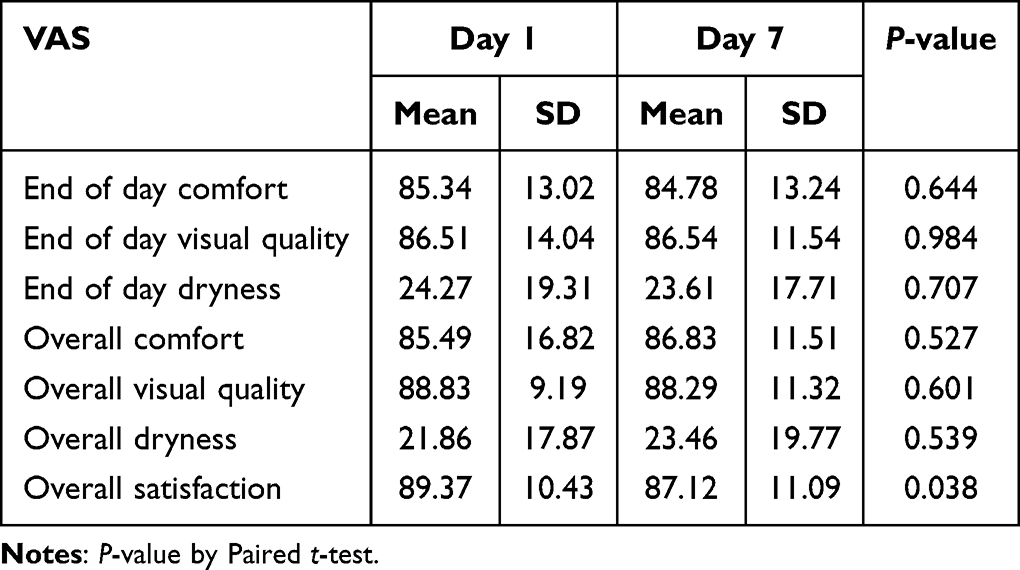 |
Table 1 The End of Day and Overall Score of VAS Questionnaire After Wearing Verofilcon A Lenses for Day 1 and Day 7 |
Objective Assessment Switching Verofilcon A Contact Lenses
In this study, the average NITBUT was analyzed under three time points: without wearing contact lenses (baseline), wearing study lenses for 15 minutes on Day 1, and wearing study lenses for 8 hours on Day 7. As shown in Table 2, a significant increase in the average NITBUT was observed after wearing study lenses for 15 minutes and 8 hours compared to baseline measurements (P = 0.019). However, no significant differences were found in the first NITBUT measurements among the three time points (P = 0.774). Bulbar conjunctival redness was mild at baseline and only varied from 0.26 to 0.23 before and after wearing the study lenses (P = 0.002). With study lenses, the tear meniscus height was highest at baseline, with a slight decrease at 15 minutes and 8 hours (P < 0.001). Meibography revealed no significant differences after wearing study lenses for 15 minutes and 8 hours (P = 0.320).
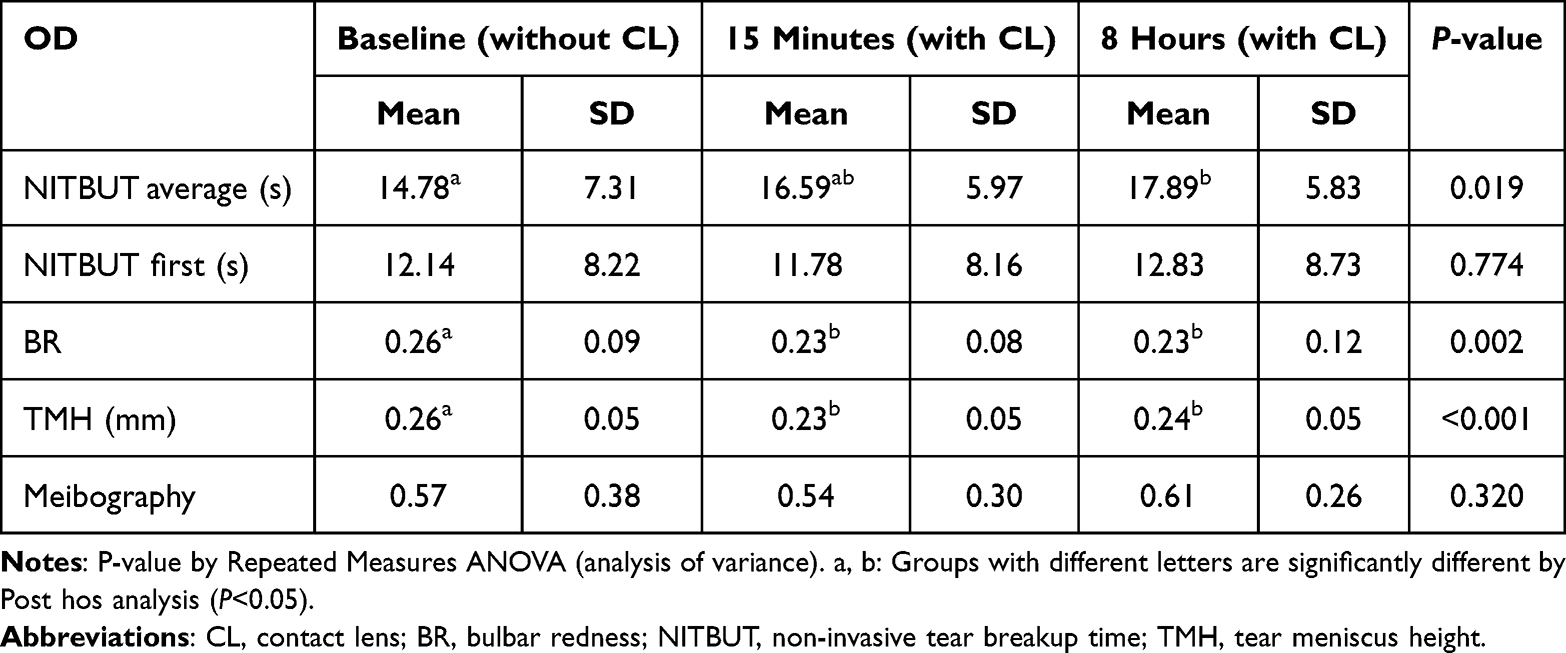 |
Table 2 The Objective Assessment in the Subjects Before and After Wearing Verofilcon A Contact Lenses |
Relationship Between Comfort Rating and NITBUT
Figure 2 illustrates the results of the Pearson correlation coefficient between comfort, visual quality, and NITBUT. In Figure 2A and B, the average NITBUT on the seventh day of wearing study lenses (Day 7) demonstrated a significantly positive correlation with comfort during the day (r = 0.268; P = 0.038) and end-of-day visual quality (r = 0.305; P = 0.018). Similarly, the first NITBUT on Day 7 also showed a significant positive correlation with comfort during the day (r = 0.268; P = 0.040).
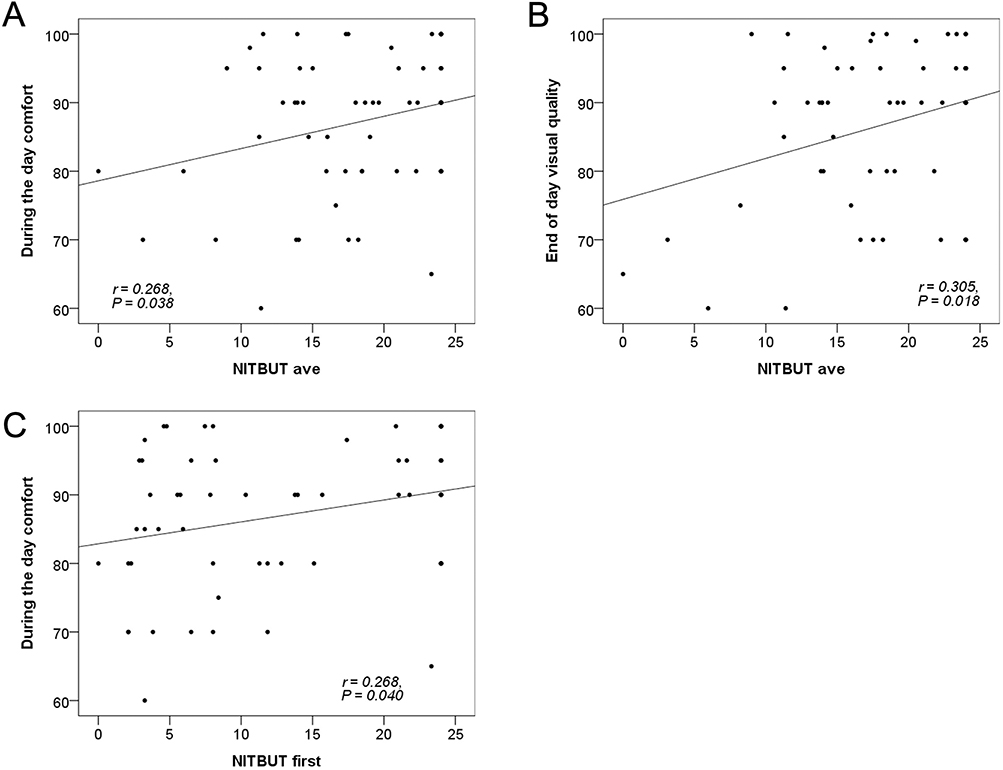 |
Figure 2 Pearson correlation coefficient between VAS and NITBUT after one week of lens wear. (A) NITBUT average vs During the day comfort on verofilcon A 7 days. (B) NITBUT average vs End of day visual quality on verofilcon A 7 days. (C) NITBUT first vs During the day comfort on verofilcon A 7 days. |
The objective assessments and subjective grading were analyzed using a mixed model analysis. Table 3 presents the results, indicating that both the first, average NITBUT and BR were significantly positively correlated with the comfort measurement (P < 0.05). However, no significant correlation was observed between TMH and meibography, and a significant negative correlation was found between visual quality and bulbar conjunctival redness. Additionally, the dryness point did not correlate with the objective assessments significantly.
 |
Table 3 Mixed Model Analysis to Assess the Correlation Between NITBUT and Overall VAS |
Discussion
This study of Asian young adults represents the first exploration of subjective evaluations and objective assessments following the use of silicone hydrogel daily disposable contact lenses. A significant proportion of soft contact lens users report progressive discomfort with increasing wear duration, including dryness, irritation, fatigue, or a foreign body sensation.31 These symptoms are particularly common toward the end of the day32 and may be due to changes in the tear film and interaction with the ocular surface.33 Prior research has indicated that comfort ratings decline throughout the day, even in non-lens wearers, but more so in contact lens users.34,35
In the present study, no significant differences were observed in end-of-day comfort, visual quality, or dryness between the first and seventh day of wearing the study lens. Participants reported high satisfaction, with subjective ratings for vision, comfort, and overall satisfaction exceeding 85 out of 100. These findings align with previous studies reporting long-lasting comfort and reduced dryness.36 Although a statistically significant drop in satisfaction was noted after seven days (P = 0.038), the difference was less than seven points and not clinically meaningful.28
The average NITBUT significantly increased after switching to study lenses at both 15 minutes and 8 hours of wear (P = 0.019). This suggests improved tear film stability. Eye discomfort is associated with decreased NITBUT, staining, and reduced tear meniscus. Interestingly, the most intense bulbar conjunctival redness was noted at baseline, with a significant reduction observed after lens wear (P = 0.002). Although not clinically significant, the reduction suggests improved oxygen transmissibility of the study lenses. High-water gradient and surface treatments further support pre-lens tear film stability and wearer comfort. The lens core has 51% water content, while the surface maintains moisture levels exceeding 80%, which may potentially contribute to tear film stability.23
A key finding was the significant correlation between subjective ratings and NITBUT. Both average and first NITBUT showed positive correlation with comfort (P < 0.05), indicating that longer tear break-up times are associated with higher comfort. Tear break-up time can thus serve as a useful tool in assessing pre-corneal and pre-lens tear film quality in young Asian adults. Wolffsohn et al also demonstrated that tear breakup time of the daily contact lens surface effectively detected changes in the ocular surface.37 It is also important to note that light transmission is primarily facilitated by the tear film. The consistency and stability of the tear film significantly influence the optical quality of the retinal image. A shorter tear breakup time may compromise optical quality, potentially leading to suboptimal visual performance.38 Environmental conditions like humidity, wind, and temperature can also impact hydration, gas permeability, and comfort. Lenses, such as study lenses, that facilitate greater oxygen transmission to the eye are associated with fewer hypoxia-related complications, contributing to enhanced comfort and satisfaction overall.
The present study has several limitations. First, the subjective evaluation of both eyes presents a potential limitation, as the overall rating of comfort, visual quality, dryness, and satisfaction may be influenced by the condition of the less comfortable eye, which could lead to an underestimation. Second, given that this was an unblinded, quantitative study, the potential for human error or subjective bias in the findings cannot be entirely excluded.39 However, the objectivity of assessments such as NITBUT, BR, and meibography, which were automatically determined by the Keratograph 5M, mitigates this limitation. Lastly, the final assessment of the objective parameters and VAS score were conducted on the seventh day of wearing study lenses, a duration that may not be sufficient to fully understand the long-term effects of study lenses use. Future research will extend this evaluation period to better investigate the long-term effects on study lens wearers.
Conclusion
Our findings demonstrated that the daily disposable study lenses maintained comfort and improved tear film stability in a population of young Asian. The data revealed a significant positive correlation between NITBUT and subjective measures of comfort. Objective and subjective evaluation of the ocular surface, such as questionnaires and/or clinical assessments of tear break time, may prove beneficial for assessing ocular discomfort.
Acknowledgments
The authors thank all the participants for their cooperation. This paper has been uploaded to ResearchSquare as a preprint: https://www.researchsquare.com/article/rs-4279711/v1.
Funding
The study was supported by a grant from the Alcon Services AG, Taiwan Branch (Investigator-Initiated Trial IIT # 75058859).
Disclosure
The authors report no conflicts of interest in this work.
References
1. Efron N, Morgan PB, Woods CA. An international survey of daily disposable contact lens prescribing. Clin Exp Optom. 2013;96(1):58–64. doi:10.1111/j.1444-0938.2012.00773.x
2. Young G, Veys J, Pritchard N, Coleman S. A multi-centre study of lapsed contact lens wearers. Ophthalmic Physiol Opt. 2002;22(6):516–527. doi:10.1046/j.1475-1313.2002.00066.x
3. Richdale K, Sinnott LT, Skadahl E, Nichols JJ. Frequency of and factors associated with contact lens dissatisfaction and discontinuation. Cornea. 2007;26(2):168–174. doi:10.1097/01.ico.0000248382.32143.86
4. Nichols JJ, Sinnott LT. Tear film, contact lens, and patient-related factors associated with contact lens-related dry eye. Invest Ophthalmol Vis Sci. 2006;47(4):1319–1328. doi:10.1167/iovs.05-1392
5. Dumbleton K, Keir N, Moezzi A, Feng Y, Jones L, Fonn D. Objective and subjective responses in patients refitted to daily-wear silicone hydrogel contact lenses. Optom Vis Sci. 2006;83(10):758–768. doi:10.1097/01.opx.0000237547.35542.b8
6. Fahmy M, Long B, Giles T, Wang CH. Comfort-enhanced daily disposable contact lens reduces symptoms among weekly/monthly wear patients. Eye Contact Lens. 2010;36(4):215–219. doi:10.1097/ICL.0b013e3181e5859f
7. Campbell R, Kame G, Leach N, Paul M, White E, Zigler L. Clinical benefits of a new multipurpose disinfecting solution in silicone hydrogel and soft contact lens users. Eye Contact Lens. 2012;38(2):93–101. doi:10.1097/ICL.0b013e318243c1a3
8. Nichols JJ, Willcox MD, Bron AJ, et al. The TFOS international workshop on contact lens discomfort: executive summary. Invest Ophthalmol Vis Sci. 2013;54(11):Tfos7–tfos13. doi:10.1167/iovs.13-13212
9. Bishop MJ, Sun CK, Coles-Brennan C, Gallois-Bernos A. Evaluation of daily disposable senofilcon A contact lenses in a symptomatic population. Cont Lens Anterior Eye. 2022;45(5):101574. doi:10.1016/j.clae.2022.101574
10. Giasson C, Bonanno JA. Acidification of rabbit corneal endothelium during contact lens wear in vitro. Curr Eye Res. 1995;14(4):311–318. doi:10.3109/02713689509033531
11. Sweeney DF. Clinical signs of hypoxia with high-Dk soft lens extended wear: is the cornea convinced? Eye Contact Lens. 2003;29(1 Suppl):S22–25. [discussion S26-29, S192-194]. doi:10.1097/00140068-200301001-00007
12. Kuo YK, Lin IC, Chien LN, et al. Dry eye disease: a review of epidemiology in taiwan, and its clinical treatment and merits. J Clin Med. 2019;8(8):1227. doi:10.3390/jcm8081227
13. Berg EJ, Ying GS, Maguire MG, et al. Climatic and environmental correlates of dry eye disease severity: a report from the dry eye assessment and management (DREAM) study. Transl Vis Sci Technol. 2020;9(5):25. doi:10.1167/tvst.9.5.25
14. Mandell JT, Idarraga M, Kumar N, Galor A. Impact of air pollution and weather on dry eye. J Clin Med. 2020;9(11):3740. doi:10.3390/jcm9113740
15. Tsai TH, Liu YL, Ma IH, et al. Evolution of the prevalence of myopia among taiwanese schoolchildren: a review of survey data from 1983 through 2017. Ophthalmology. 2021;128(2):290–301. doi:10.1016/j.ophtha.2020.07.017
16. Uchino M, Schaumberg DA, Dogru M, et al. Prevalence of dry eye disease among Japanese visual display terminal users. Ophthalmology. 2008;115(11):1982–1988. doi:10.1016/j.ophtha.2008.06.022
17. Ousler GW 3rd, Abelson MB, Nally LA, Welch D, Casavant JS. Evaluation of the time to “natural compensation” in normal and dry eye subject populations during exposure to a controlled adverse environment. Adv Exp Med Biol. 2002;506(Pt B):1057–1063.
18. Bai Y, Ngo W, Gu B, Zhang Y, Nichols JJ. An imaging system integrating optical coherence tomography and interferometry for in vivo measurement of the thickness and dynamics of the tear film. Biomed Eng Online. 2018;17(1):164. doi:10.1186/s12938-018-0597-y
19. Nichols JJ, King-Smith PE. Thickness of the pre- and post-contact lens tear film measured in vivo by interferometry. Invest Ophthalmol Vis Sci. 2003;44(1):68–77. doi:10.1167/iovs.02-0377
20. Cho P, Boost MV. Daily disposable lenses: the better alternative. Cont Lens Anterior Eye. 2013;36(1):4–12. doi:10.1016/j.clae.2012.10.073
21. Downie LE, Craig JP. Tear film evaluation and management in soft contact lens wear: a systematic approach. Clin Exp Optom. 2017;100(5):438–458. doi:10.1111/cxo.12597
22. Cox SM, Nichols KK, Nichols JJ. Agreement between automated and traditional measures of tear film breakup. Optom Vis Sci. 2015;92(9):e257–263. doi:10.1097/OPX.0000000000000648
23. Vidal-Rohr M, Wolffsohn JS, Davies LN, Cerviño A. Effect of contact lens surface properties on comfort, tear stability and ocular physiology. Cont Lens Anterior Eye. 2018;41(1):117–121. doi:10.1016/j.clae.2017.09.009
24. Pucker AD, Jones-Jordan LA, Marx S, et al. Clinical factors associated with contact lens dropout. Cont Lens Anterior Eye. 2019;42(3):318–324. doi:10.1016/j.clae.2018.12.002
25. Pucker AD, Dougherty BE, Jones-Jordan LA, Kwan JT, Kunnen CME, Srinivasan S. Psychometric analysis of the SPEED questionnaire and CLDEQ-8. Invest Ophthalmol Vis Sci. 2018;59(8):3307–3313. doi:10.1167/iovs.18-24016
26. Schiffman RM, Christianson MD, Jacobsen G, Hirsch JD, Reis BL. Reliability and validity of the ocular surface disease index. Arch Ophthalmol. 2000;118(5):615–621. doi:10.1001/archopht.118.5.615
27. Papas E, Tilia D, McNally J, de la Jara PL. Ocular discomfort responses after short periods of contact lens wear. Optom Vis Sci. 2015;92(6):665–670. doi:10.1097/OPX.0000000000000607
28. Papas EB, Keay L, Golebiowski B. Estimating a just-noticeable difference for ocular comfort in contact lens wearers. Invest Ophthalmol Vis Sci. 2011;52(7):4390–4394. doi:10.1167/iovs.10-7051
29. Bogdănici CM, Săndulache DE, Nechita CA. Eyesight quality and computer vision syndrome. Rom J Ophthalmol. 2017;61(2):112–116. doi:10.22336/rjo.2017.21
30. Diec J, Naduvilath T, Tilia D. Subjective ratings and satisfaction in contact lens wear. Optom Vis Sci. 2018;95(3):256–263. doi:10.1097/OPX.0000000000001187
31. Fernández-Jimenez E, Diz-Arias E, Peral A. Improving ocular surface comfort in contact lens wearers. Cont Lens Anterior Eye. 2022;45(3):101544. doi:10.1016/j.clae.2021.101544
32. Fonn D, Situ P, Simpson T. Hydrogel lens dehydration and subjective comfort and dryness ratings in symptomatic and asymptomatic contact lens wearers. Optom Vis Sci. 1999;76(10):700–704. doi:10.1097/00006324-199910000-00021
33. Wolffsohn J, Hall L, Mroczkowska S, et al. The influence of end of day silicone hydrogel daily disposable contact lens fit on ocular comfort, physiology and lens wettability. Cont Lens Anterior Eye. 2015;38(5):339–344. doi:10.1016/j.clae.2015.03.010
34. Masoudi S, Stapleton FJ, Willcox MD. Contact lens-induced discomfort and protein changes in tears. Optom Vis Sci. 2016;93(8):955–962. doi:10.1097/OPX.0000000000000888
35. Begley CG, Caffery B, Nichols KK, Chalmers R. Responses of contact lens wearers to a dry eye survey. Optom Vis Sci. 2000;77(1):40–46. doi:10.1097/00006324-200001000-00012
36. Grant T, Tang A. A survey of contact lens wearers and eye care professionals on satisfaction with a new smart-surface silicone hydrogel daily disposable contact lens. Clin Optom. 2020;12:9–15. doi:10.2147/OPTO.S233328
37. Wolffsohn JS, Mroczkowska S, Hunt OA, Bilkhu P, Drew T, Sheppard A. Crossover evaluation of silicone hydrogel daily disposable contact lenses. Optom Vis Sci. 2015;92(11):1063–1068. doi:10.1097/OPX.0000000000000706
38. Liu H, Thibos L, Begley CG, Bradley A. Measurement of the time course of optical quality and visual deterioration during tear break-up. Invest Ophthalmol Vis Sci. 2010;51(6):3318–3326. doi:10.1167/iovs.09-4831
39. Sorbara L, Simpson T, Duench S, Schulze M, Fonn D. Comparison of an objective method of measuring bulbar redness to the use of traditional grading scales. Cont Lens Anterior Eye. 2007;30(1):53–59. doi:10.1016/j.clae.2006.12.003
 © 2025 The Author(s). This work is published and licensed by Dove Medical Press Limited. The
full terms of this license are available at https://www.dovepress.com/terms
and incorporate the Creative Commons Attribution
- Non Commercial (unported, 4.0) License.
By accessing the work you hereby accept the Terms. Non-commercial uses of the work are permitted
without any further permission from Dove Medical Press Limited, provided the work is properly
attributed. For permission for commercial use of this work, please see paragraphs 4.2 and 5 of our Terms.
© 2025 The Author(s). This work is published and licensed by Dove Medical Press Limited. The
full terms of this license are available at https://www.dovepress.com/terms
and incorporate the Creative Commons Attribution
- Non Commercial (unported, 4.0) License.
By accessing the work you hereby accept the Terms. Non-commercial uses of the work are permitted
without any further permission from Dove Medical Press Limited, provided the work is properly
attributed. For permission for commercial use of this work, please see paragraphs 4.2 and 5 of our Terms.
Recommended articles

Evaluating the Performance of Verofilcon A Daily Disposable Contact Lenses in a Group of Heavy Digital Device Users
Schulze MM, Fadel D, Luensmann D, Ng A, Guthrie S, Woods J, Jones L
Clinical Ophthalmology 2023, 17:3165-3175
Published Date: 24 October 2023