
Back to Journals » International Journal of General Medicine » Volume 17
Sobrerol in Managing Acute Respiratory Infections in Clinical Practice During the “Cold” Season: An Italian Primary Care Experience
Authors Varricchio A  , Ciprandi G
Received 23 September 2024
Accepted for publication 13 November 2024
Published 23 November 2024 Volume 2024:17 Pages 5471—5477
DOI https://doi.org/10.2147/IJGM.S497547
Checked for plagiarism Yes
Review by Single anonymous peer review
Peer reviewer comments 3
Editor who approved publication: Prof. Dr. Héctor Mora-Montes
Attilio Varricchio,1 Giorgio Ciprandi,2 Study Group on respiratory infection management in clinical practice included:Francesco Paolo Brunese, Luigi Costanzo, Lorenzo Cresta, Maurizio Daccò, Donatella Del Gaizo, Carla Dominici, Cosimo Lanza, Michele Lisco, Anastasia Matteucig, Carlotta Moretti On behalf of the Study Group on respiratory infection management in clinical practice
1Department of Otolaryngology, University of Molise, Campobasso, Italy; 2Allergy Clinic, Casa di Cura Villa Montallegro, Genoa, Italy
Correspondence: Giorgio Ciprandi, Casa di Cura Villa Montallegro, Genoa, Italy, Email [email protected]
Purpose: Acute upper respiratory infections (AURI) represent a daily challenge in primary care practice. Mucus production may impair during AURI. Sobrerol is a muco-active agent that improves rheological characteristics and exerts other ancillary activities. The aim of this retrospective case–series study was to compare the efficacy and safety of different uses of sobrerol (only oral, only nebulized, and combined or standard treatment for infections alone) in patients with AURIs.
Patients and Methods: The present clinical experience retrospectively collected clinical data of patients with AURIs visited by ten primary care doctors (pediatricians and general practitioners) over a long period. Patients could take standard therapy for infections, or as add-on: oral sobrerol, nebulized sobrerol, or combined oral and nebulized aerosol during the infection for 3 days.
Results: Patients treated with combined oral and nebulized sobrerol experienced less intense symptoms, mainly concerning cough (p < 0.001) and nasal complaints (p = 0.043). In addition, the patients taking the combined therapy reported a more rapid disappearance of cough and nasal symptoms at day 7 than patients treated with the other options (OR 4.47 and 3.16, respectively).
Conclusion: The current retrospective and observational study showed that a three-day combined (oral and nebulized) sobrerol course may represent a valuable add-on option in patients with AURIs.
Keywords: acute upper respiratory infections, combined therapy, nebulization, oral formulation, primary care, sobrerol
Introduction
Acute respiratory infections usually involve the upper airways and are generally viral. In this regard, the prototype of acute upper respiratory infections (AURI) is the common cold. A common cold is a trivial condition that tends to self-limit and resolve within a few days.1 However, the cough may last longer, even for a few weeks.2 In addition, viral infections may give rise to a more relevant clinical picture called ‘flu like syndrome’, in which the symptoms are similar to influenza.3
In the absence of diagnostic tests, which are rarely investigated in clinical practice, the clinical features of AURI are substantially superimposable among acute upper respiratory infections, mainly including nasal complaints, sore throat, and cough.
In these individuals, abundant mucus production may be a factor favoring the worsening of infection and promoting further infections.4 Thus, modulating mucus production could be valuable in managing AURI patients.5 In this context, muco-active drugs have been used for a long time. Sobrerol is a muco-active agent available for over 50 years.6 Sobrerol is a monocyclic monoterpene compound that belongs to the pharmacological class of mucolytics (ATC code: R05CB07). Sobrerol has a multifaceted mechanism of action: it can reduce the viscosity of mucus in the airways via a hydration mechanism, increase ciliary motility and thus promote mucociliary clearance, increase the phospholipid portion of the surfactant, promote secretory IgA secretion, and finally, exert antioxidant activity, acting as a free radical scavenger.6 As a result, sobrerol can be defined as a mucolytic-mucoregulator. A recent review pointed out the sobrerol pharmacological characteristics and compared it with other muco-active agents.6 Briefly, sobrerol belongs to the class of drugs able to modify the mucus secretion, also including S-carboxymethylcysteine, domiodol, and hydropropylidenglycerol.6 However, sobrerol differs from other drugs in the same class in its ability to stimulate the immune system.6
Sobrerol has been available in various formulations (syrup, granules, ampoules, and suppositories) since the early 1970s. Its main indication is its use in the treatment of respiratory diseases characterized by thick, viscous hypersecretion. Introduced over 50 years ago, several studies have investigated its efficacy in the treatment of respiratory, infectious, and inflammatory diseases, both in pediatric and adult age, including the elderly, as recently pointed out.6
The present recommended oral dose in adults is 600 mg (equivalent to the contents of two sachets) per day for up to 3 days; in children, this dosage is halved. The recommended dose of nebulization is a vial containing 40 mg of sobrerol, one to two times daily.
The only contraindication is using in children under 30 months of age or with a history of epilepsy or febrile convulsions, as well as, of course, hypersensitivity to the active ingredient or any of the excipients used in the various formulations. However, particular precautions must be observed in individuals with severe respiratory insufficiency, asthmatics, and debilitated patients, as the increased fluidity of secretions necessitates effective expectoration.
The revised indication of sobrerol limited the duration of treatment to 3 days alone. As this time could be short in some patients, a new combined treatment was hypothesized, such as the simultaneous administration of the oral route with the nebulized route. In this way, it was assumed that a duration of only 3 days would still be appropriate.
Since sobrerol boasts mucoregulatory, antioxidant, and immunomodulating (on humoral immunity) activity, a primary care experience retrospectively evaluated its capability of affecting symptom and infection progress over time. In addition, this experience aimed to compare three different administration methods: oral, nebulization, and combined (oral plus nebulization). This practical experience was also conducted in the context of self-management and telemedicine.
Materials and Methods
Study Design
This observational case–series study was retrospectively performed in different geographical areas of Italy. The study conformed to the Helsinki Declaration and was approved by the independent Review Board of the Associazione Italiana Vie Superiori (AIVAS). The Review Board stated that a patient consent to review medical records was not necessary as the anonymity of data was guaranteed and the collection was confidential. In addition, it has to be underlined that the Italian primary care health service guarantees a doctor for each subject. So, the primary care doctor well knows their patients as there is a relationship of trust between doctor and patient.
The present experience involved five family pediatricians and five general practitioners in the primary care setting. These doctors retrospectively collected clinical data of their patients managed in autumn-spring 2023/24 (beginning in early September and ending at the end of April) to intercept most respiratory infections. Namely, the experience started at the beginning of the autumn season and continued throughout the ‘cold’ season so that it could be assessed as to what therapeutical option can reduce the severity of infectious episodes during that ‘cold’ season.
Recruited subjects were observed throughout the study, either through medical visits or telemedicine (using Whatsapp, SMS, or e-mail).
The inclusion criteria were subjects over 3 years of age of both sexes with a clinical history of frequent respiratory infections. Each doctor selected the patients who he/she managed prescribing sobrerol. In addition, each doctor included a group of patients with AURIs who were treated only with standard treatment for infections. The standard treatment was decided by each doctor for each single patients considering the clinical characteristics, usually including antibiotics, antipyretics, and anti-inflammatory drugs.
Exclusion criteria included age under 30 months, epilepsy, severe respiratory failure, uncontrolled asthma, or severe physical debilitation.
Subjects could be treated using four different therapeutical options. A group that took only standard therapy for acute viral infections was named the Standard Therapy (ST) group. A second group took only sobrerol (sachets or syrup, depending on the age and patient’s preference) twice a day for three days and was called the Oral Sobrerol (OS) group. A third group nebulized sobrerol through a micronizing douche twice a day for 3 days and was referred to as the Nebulized Sobrerol (NS) group. A fourth group took a combination of oral and nebulized sobrerol once a day for 3 days and was called the combined sobrerol (CS) group. Doctors instructed the patients to autonomously start the sobrerol therapy at the onset of infectious symptoms (self-management). This schedule had to be repeated for every infectious episode.
Telemedicine was initiated autonomously by the patient at the same time as the start of therapy. The patient, via whatsapp, sms, or e-mail, monitored his/her clinical condition by sending simple self-assessment parameters, such as the visual analog scale (VAS) for symptom intensity (0 = no symptoms, 10 = the most intense symptom), presence of cough, and any school/work absence. Clinical data were sent at the onset of infection (D0), after four (D4) and seven (D7) days.
This procedure was repeated for each respiratory infection.
Doctors decided to visit patients and prescribe pharmacological therapy on a clinical basis.
Doctors retrospectively collected the data of their patients and put them into an Excel file, specially set up, that constituted the database to be further analyzed. Usually, clinical data were collected after each AURI.
Statistical Analysis
Descriptive data are expressed as mean with standard deviation for continuous variables, median with interquartile range (25th–75th percentile) for non-normally distributed variables, and absolute and relative frequencies for categorical variables. The chi-square test was applied to verify the association between categorical variables (such as sex, signs, number of follow-up visits, and symptoms with the treatment group). The Independent-Samples Kruskal–Wallis Test, followed by post-hoc pairwise comparisons of groups corrected by Bonferroni, was used to identify differences among groups of continuous variables (age, delta VAS, delta number of absence days). The effect of treatment on the disappearance of signs and symptoms during follow-up visits was investigated using binary logistic regression, adjusted for age and sex. Results are expressed with odds ratios and confidence intervals. A p-value of less than 0.05 was considered statistically significant.
Results
The present experience included retrospective data on 177 patients. The demographic data are reported in detail in Table 1, also after stratification per group. The four groups were homogeneous, considering gender and age.
 |
Table 1 Demographic Data of Patients, Considered Globally and After Stratification per Group |
Table 2 reports the different numbers of respiratory infections among groups during the experience. There was no significant difference among groups considering the total and mean number of respiratory infection events. Also, considering the number of two or three RI events, there was no significant difference among the groups (Table 3).
 |
Table 2 Number of Respiratory Infections (RI) During the Observation Period in the Four Groups |
 |
Table 3 Number of RI Events During the Experience |
Table 4 reports the presence and intensity of clinical data at the onset of all RI events. There was a significant difference among groups for the presence of cough (p < 0.001) and nasal symptoms (p = 0.043) at the RI onset.
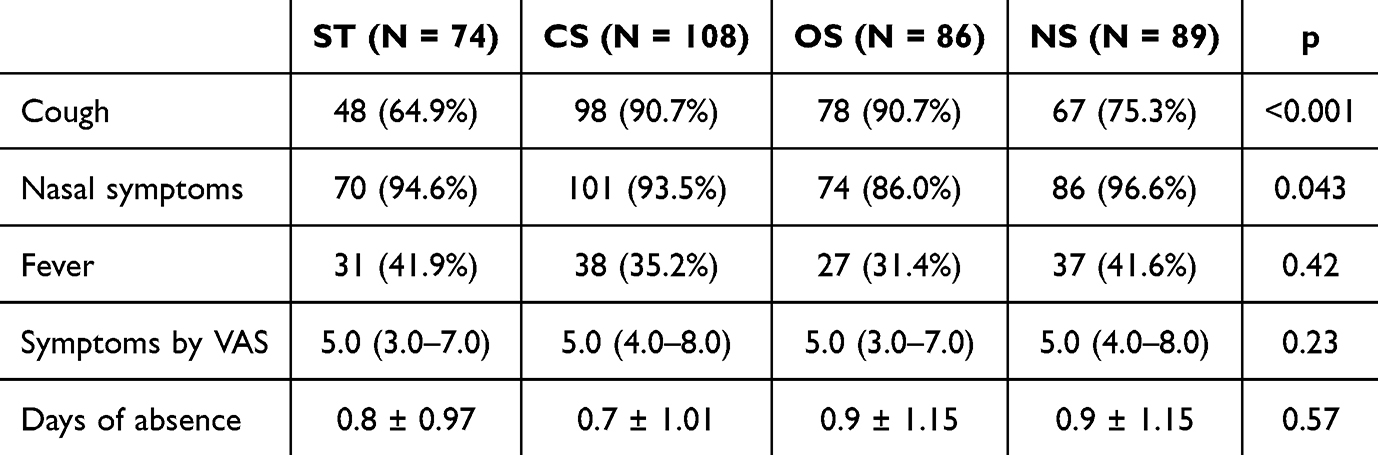 |
Table 4 Presence and Intensity of the Different Recorded Clinical Data at the Onset of All RI Events |
Table 5 reports the Odds Ratio (with Confidence Interval) for the probability that one therapeutical option could affect the disappearance of a clinical parameter at Day 4 in comparison with standard treatment. Combined sobrerol was associated with higher odds of disappearing cough (OR 15.2) at D4. Nebulized sobrerol had higher odds of disappearing nasal symptoms (OR 6.7) at D4. These outcomes were corrected for age and gender.
 |
Table 5 Therapeutic Options Associated with the Disappearance of Clinical Feature at Day 4 in Comparison with Standard Therapy |
Table 6 reports the Odds Ratio (with Confidence Interval) for the probability that one therapeutical option could affect the disappearance of a clinical parameter at Day 7 in comparison with standard treatment. Combined sobrerol was associated with higher odds of disappearing cough (OR 4.47) and nasal symptoms (OR 3.2) at D7. These outcomes were corrected for age and gender.
 |
Table 6 Therapeutic Options Associated with the Disappearance of Clinical Feature at Day 7 in Comparison with Standard Therapy |
Figure 1 panel A shows the ∆VAS between D4 and D0 comparing the different groups: combined sobrerol was associated with the highest ∆ (p = 0.001). Figure 1 panel B shows the ∆ VAS between D7 and D0 comparing the different groups: combined sobrerol was associated with the highest ∆ (p < 0.001).
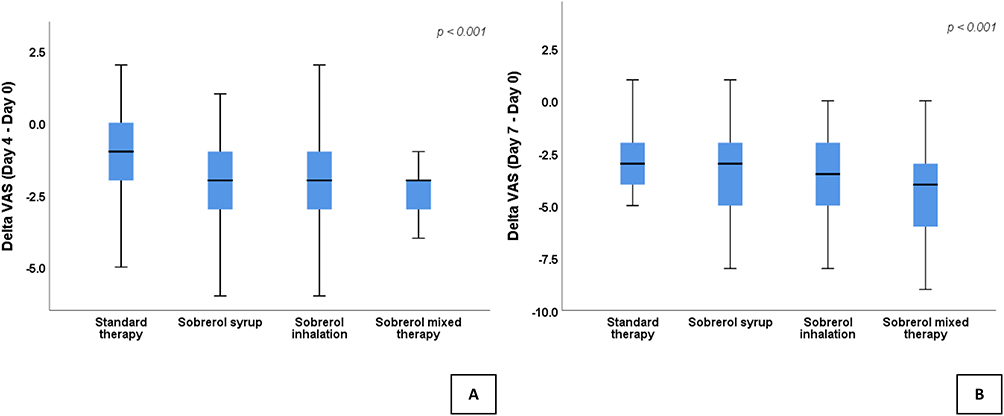 |
Figure 1 Subpart (A) Delta VAS of symptom perception at Day 4 respect to Day 0 in the four subgroups. Subpart B:Delta VAS of symptom perception at Day 7 respect to Day 0 in the four subgroups. |
Discussion
Respiratory infections represent a relevant burden for patients, their families, and society. Acute upper respiratory infections are particularly frequent and may be associated with more severe conditions, eg, the common cold complicated with rhinosinusitis.
Symptoms of AURI usually last a few days, but cough persists longer and may be associated with impaired quality of life.7 In this regard, cough may be associated with two opposite situations: mucus hyperproduction or reduced mucus secretion. These two conditions practically translate into a wet cough and a dry cough. Both cough types require appropriate treatment. Mucus actually has protective and beneficial effects, but if hyperproduced, it has detrimental effects.8 As a result, an objective in managing patients with cough is to ensure adequate mucus production, ie, that it is neither too much nor too little.9 In this regard, sobrerol is a muco-active agent with additional activities that may benefit patients with AURI.
The present clinical experience in the primary care setting showed some interesting findings. The combined administration of oral and nebulized sobrerol was associated with the highest probability of disappearing cough and nasal symptoms after 4 and 7 days.
The findings were consistent with a previous study that compared sobrerol with nelyenexine (an amide derivative of ambroxol and thiophenecarboxylic acid).10 That study demonstrated that the two muco-active agents were substantially equivalent in treating patients with obstructive airway diseases.
The results of the present study, therefore, could be expected but require demonstration. As a result, the combined option could be optimal overall considering the temporal limitation of administration to only 3 days. This limitation is derived from some cases of adverse neurological reactions in very selected patients. On the other hand, sobrerol has been prescribed for long periods for decades without the emergence of potentially severe adverse reactions.
In any case, the present indication recommended by regulatory agencies allows only a short three-day period. Combining administration routes could ensure the best efficacy potential, as reported in the present experience. In addition, patients treated with the combined administration experienced the lowest intensity of symptoms after 4 and 7 days. This finding is consistent with the high probability of disappearing cough and nasal symptoms.
Thus, the present experience provided an interesting opportunity, as represented by the combined administration of oral and nebulized sobrerol.
However, this experience had some limitations, including the open and retrospective design, the lack of biomarkers, and the diagnosis of the type of infections. In addition, the selection of patients was arbitrary, respecting only a certain number of patients per arm. For this reason, patients and practitioners were not aware of specific hypotheses to be tested. This issue could represent a further bias of the study. Another limitation was the lack of a sample size calculation: this absence caused a relatively small size of each subgroup limiting the statistical power, particularly for smaller effects or subgroup analyses. Also, there was no specific procedure to manage patients, as each doctor treated the patients according to their own experience. Finally, each doctor was free to decide which type of treatment (and route of administration) was most suitable for each individual patient. Obviously, this choice liberty could have led the physician to prefer the combined approach (oral plus nebulized route) in patients with more intense symptoms. Accordingly, there was a significant difference among sub-groups regarding the presence of cough (but there was no difference between combined strategy and oral route). This point was a further limitation of the study.
Taken together with these issues, we are aware that they represent relevant concerns about the interpretation of the results. However, this experience was conducted in a real-world model. The real-world model per se does not ensure a robust methodology, but it may reflect what happens in daily practice. In addition, the participation of pediatricians and general practitioners ensured a wide range of ages for patients so that the results could be transferred to both children and older people. Finally, the study was spontaneous without any sponsor.
As a result, the combined approach of sobrerol might offer a promising alternative that warrants further comparison studies with standard therapies for acute respiratory infections (eg, other mucolytics, antihistamines, or antitussives). This future evidence would enhance its potential place within the broader therapeutic landscape as previously envisaged.11
Conclusion
This retrospective experience reported that a three-day combined oral and nebulized sobrerol course may be valuable option in managing patients with cough associated with acute upper respiratory infections.
Acknowledgments
We would like to thank Lingomed (Naples, Italy) that provided the platform to collect clinical data and the statistical analysis.
Disclosure
The authors report no conflicts of interest in this work.
References
1. Eccles R. Common cold. Front Allergy. 2023;4(1224988). doi:10.3389/falgy.2023.1224988
2. Capristo C, Rossi GA. Post-infectious persistent cough: pathogenesis and therapeutic options. Minerva Pediatr. 2017;69(5):444–452. doi:10.23736/S0026-4946.17.04958-1
3. Moriyama M, Hugentobler WJ, Iwasaki A. Seasonality of respiratory viral infections. Annu Rev Virol. 2020;7(1):83–101. doi:10.1146/annurev-virology-012420-022445
4. Voynow JA, Rubin BK. Mucins, mucus, and sputum. Chest. 2009;135(2):505–512. doi:10.1378/chest.08-0412
5. Dicpinigaitis PV. Effect of viral upper respiratory tract infection on cough reflex sensitivity. J Thorac Dis. 2014;6(Suppl 7):S708–11. doi:10.3978/j.issn.2072-1439.2013.12.02
6. Ciprandi G, Varriccchio A. Sobrerol: New perspectives to manage patients with frequent respiratory infections. Children. 2023;10(7):1210. doi:10.3978/j.issn.2072-1439.2013.12.02
7. Lovie-Toon YG, Chang AB, Newcombe PA, et al. Longitudinal study of quality of life among children with acute respiratory infection and cough. Qual Life Res. 2018;27(4):891–903. doi:10.1007/s11136-017-1779-y
8. Hill DB, Button B, Rubinstein M, Boucher RC. Physiology and pathophysiology of human airway mucus. Physiol Rev. 2022;102(4):1757–1836. doi:10.1007/s11136-017-1779-y
9. Volsko TA. Airway clearance therapy: finding the evidence. Respir Care. 2013;58(10):1669–1678. doi:10.4187/respcare.02590
10. Fadda G. Oral neltenexine in patients with obstructive airways diseases: an open, randomised, controlled comparison versus sobrerol. Minerva Med. 2001;92(4):269–275.
11. Scaglione F, Petrini O. Mucoactive agents in the therapy of upper respiratory airways infections: fair to describe them just as mucoactive? Clin Med Insights Ear Nose Throat. 2019;12:1179550618821930. doi:10.1177/1179550618821930
 © 2024 The Author(s). This work is published and licensed by Dove Medical Press Limited. The
full terms of this license are available at https://www.dovepress.com/terms
and incorporate the Creative Commons Attribution
- Non Commercial (unported, 3.0) License.
By accessing the work you hereby accept the Terms. Non-commercial uses of the work are permitted
without any further permission from Dove Medical Press Limited, provided the work is properly
attributed. For permission for commercial use of this work, please see paragraphs 4.2 and 5 of our Terms.
© 2024 The Author(s). This work is published and licensed by Dove Medical Press Limited. The
full terms of this license are available at https://www.dovepress.com/terms
and incorporate the Creative Commons Attribution
- Non Commercial (unported, 3.0) License.
By accessing the work you hereby accept the Terms. Non-commercial uses of the work are permitted
without any further permission from Dove Medical Press Limited, provided the work is properly
attributed. For permission for commercial use of this work, please see paragraphs 4.2 and 5 of our Terms.