
Back to Journals » International Journal of Nanomedicine » Volume 21
SmartLipids in Drug Delivery: Redefining the Third Generation of Lipid Nanocarriers for Clinical and Industrial Translation
Authors Hashmi AR, Zahra F, Sekar M  , Al Hamod M, Al Hamood N, Begum MY , Molugulu N, Wong LS , Kumarasamy V
Received 31 October 2025
Accepted for publication 27 January 2026
Published 19 March 2026 Volume 2026:21 578218
DOI https://doi.org/10.2147/IJN.S578218
Checked for plagiarism Yes
Review by Single anonymous peer review
Peer reviewer comments 2
Editor who approved publication: Dr Sachin Mali
Ahmed Raza Hashmi,1 Farwa Zahra,2 Mahendran Sekar,1,3 Mona Al Hamod,4 Noura Al Hamood,5 M Yasmin Begum,5 Nagashekhara Molugulu,1 Ling Shing Wong,6 Vinoth Kumarasamy7
1School of Pharmacy, Monash University Malaysia, Subang Jaya, Selangor, Malaysia; 2Department of Pharmacy, Superior University Sargodha Campus, Sargodha, Punjab, Pakistan; 3Faculty of Pharmacy and Health Sciences, Royal College of Medicine Perak, Universiti Kuala Lumpur, Ipoh, Perak, Malaysia; 4Department of Pharmaceutics, Faculty of Pharmacy, Northern Border University, Rafhaa, Saudi Arabia; 5Department of Pharmaceutics, Faculty of Pharmacy, King Khalid University, Abha, Saudi Arabia; 6Faculty of Health and Life Sciences, INTI International University, Nilai, Malaysia; 7Department of Parasitology & Medical Entomology, Faculty of Medicine, Universiti Kebangsaan Malaysia, Kuala Lumpur, Malaysia
Correspondence: Mahendran Sekar; Vinoth Kumarasamy, Email [email protected]; [email protected]
Abstract: SmartLipids represent the third generation of lipid-based nanocarriers, emerging as a transformative innovation in modern drug delivery and formulation science. Evolving from solid lipid nanoparticles (SLNs) and nanostructured lipid carriers (NLCs), SmartLipids overcome key limitations such as low drug loading, polymorphic instability, and limited scalability. Characterized by a “chaotic” matrix of 5– 10 structurally diverse lipids, SmartLipids enable high encapsulation efficiency, enhanced physical and chemical stability, tunable drug release, and improved penetration and bioavailability for both lipophilic and amphiphilic molecules. This comprehensive review elucidates their rational design principles, formulation strategies, and key physicochemical and biological characterization parameters, supported by recent preclinical findings demonstrating superior cytocompatibility, permeability, and controlled release performance. Furthermore, we discuss the industrial translation of SmartLipids under Quality by Design (QbD) frameworks, their regulatory prospects, and their expanding applications beyond cosmetics, spanning oral, mucosal, and gene delivery systems. Collectively, SmartLipids bridge the gap between bench-scale innovation and clinical translation, offering a versatile, stable, and scalable platform for next-generation nanomedicines.
Keywords: SmartLipids, lipid nanocarriers, drug loading, bioavailability, scalability, clinical translation, nanomedicine
Introduction
Lipid nanocarriers with a submicron particle size of less than 1000 nm have now long been utilized for having the potential of efficient and controlled drug delivery to the target sites or organs, circumvent the challenges associated with conventional drug delivery strategies.1,2 Lipid-based drug delivery systems like lipid nanoparticles (LNPs) have been investigated, and its advanced drug delivery techniques such as Solid Lipid Nanoparticles (SLNs) and Nanostructured Lipid Carriers (NLCs), have rapidly gained recognition in the scientific community.3,4 SLNs are the first-generation LNPs;5 they were designed to overcome the drawbacks of conventional colloidal carriers, with the advantages of protecting the drug from the gut’s harsh environment and improving the bioavailability and controlled drug delivery at targeted sites.6,7 Even with these benefits, it still has certain shortcomings, like polymorphic transitions, reduced drug load, and leakage of drugs during storage.7 These disadvantages became the reason for developing a second generation of LNPs, which are NLCs with the beneficial effects of stability and enhanced loading capacity due to their structural composition.8,9
The latest third generation of LNPs, ie., SmartLipids, was introduced in 2014 to cover the limitations of NLCs, such as poor adhesion, which ultimately affects the drug’s absorption and its bioavailability.10–13 SmartLipids are the specialized version of NLCs that primarily differ in composition, as they attain a 5–10 lipids blend, either solid lipids only or with limited incorporation of oil, while NLCs only hold one liquid lipid and one solid lipid.14 Consequently, this chaotic blend of SmartLipids not only supports the loading capacity of actives but also protects them from degradation and increases chemical stability. Overall, the combination of firm drug inclusion, high drug loading aspects and reduced or absence of polymorphic transition makes SmartLipids a highly potential and attractive nanocarrier for pharmaceutical and cosmetic active ingredients.15 They also improve drugs’ penetration and bioavailability, serve as a natural skin barrier for restoration, hinder chemically labile actives’ degradation, control the drug release profile, and increase cellular uptake. All these benefits render SmartLipids a promising nanocarriers for efficient drug delivery of lipophilic/amphiphilic molecules.14,16 Due to the combination of versatile lipids, these nanocarriers chaotically arrange themselves, which renders them for high drug loading and reduced tendency to form ordered structures, thereby providing better stabilization for sensitive active substances.17
The present review provides a detailed overview of SmartLipids, ie., an emerging class of lipid-based nanocarriers. It highlights their historical advancement from SLNs and NLCs, designing principles, formulation strategies, characterization and evaluation parameters, examples of commercially available SmartLipids, and future trends. It helps to provide the existing trends that were employed for improving the bioavailability of different active ingredients by adopting this advanced lipid-based drug delivery system.
Advancements From SLNs and NLCs to SmartLipids
In the field of advanced drug delivery, the lipid nanocarriers have promptly emanated as an indispensable podium. These nanocarriers are colloidal drug carriers having a submicron particle size less than 1000 nm,1 earning fame because of their efficient and controlled drug delivery to the targeted sites or organs.2 Additionally, lipid nanocarriers circumvent the obstacles associated with conventional drug delivery strategies.1 The physiological barriers like the blood–brain barrier and intestinal epithelium can be easily permeated by these nanocarriers,18 along with potential perks including low toxicity, enhanced biodegradability and biocompatibility, scale-up capacity and controlled/targeted delivery of both lipophilic and hydrophilic drugs.7 Numerous lipid-based drug delivery systems like LNPs have been investigated. Nowadays, some advanced delivery techniques have become the center of attention for scientists.4 Among these, SLNs and NLCs have been the most frequently employed LNPs over the last decade.3 SLNs originated in 1991 and are termed the first generation of lipid nanocarriers, having a submicron particle size of 40–1000 nm.5,19 They have been designed to conquer the drawbacks, such as polymer degradation, cytotoxicity, high production and drug leakage, of conventional colloidal carriers, ie., emulsions, liposomes, niosomes and polymeric nanoparticles.6 SLNs are comprised of solid lipids, customarily a combination of glyceride, purified triglycerides, or even waxes,20 delivering privileges including securing chemically labile drugs from destruction in the gut’s harsh environment, improving the bioavailability of drugs and controlled drug delivery at targeted sites. Despite these benefits, SLNs have certain drawbacks, like polymorphic transitions, reduced drug load, and leakage of drugs while in storage.7 Consequently, to circumvent the limitation of SLNs, NLCs, a second generation of LNPs with an average size of 10–500 nm,8 were introduced in 1999. They are composed of a blend of both solid and liquid lipids, rather than one solid lipid, which leads to inducing imperfection in the crystal lattice for enhancing drug uptake capacity and stability.9 Additionally, NLCs share similar advantages like SLNs, ie., drug prevention from harsh gastric environments, sustained drug release, low toxicity and biodegradability.21 Besides all the benefits of NLCs, they show less bioadhesion that directly leads to affecting the drug’s absorption and bioavailability.12,13 Nevertheless, in NLCs, the presence of liquid lipids along with solids gives rise to fast structural rearrangements during storage.22
Therefore, these generations of LNPs were perfected with the latest or third generation, called SmartLipids, developed in 2014.10,11 In detail, it was recognized that the stability and loading capacity of particles become higher in the presence of polydisperse lipids, ie., a combination of mono-, di-, and triglycerides along with various fatty acids. Consequently, this strategy is acknowledged as a “smart” solution for better “lipid” particle design; that’s why it’s termed as SmartLipids.10,23 Furthermore, in Table 1, key advantages and limitations/drawbacks of SmartLipids are summarized and compared with SLNs and NLCs. Figure 1 illustrates the historical development of these aforementioned LNPs.
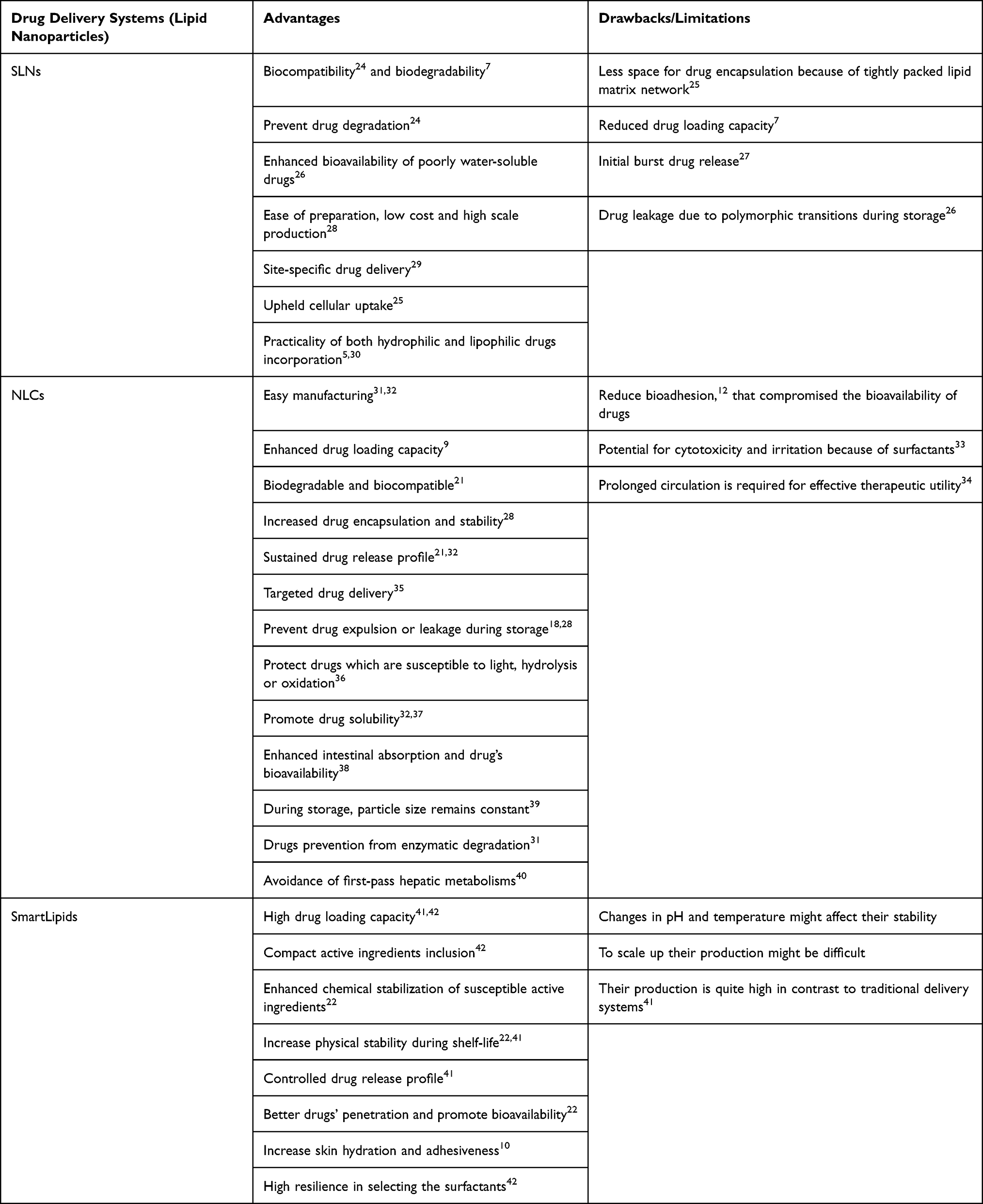 |
Table 1 Comparative Key Advantages and Drawbacks/Limitations of SLNs, NLCs, and SmartLipids |
 |
Figure 1 Chronological progression of lipid nanoparticles demonstrating their development timeline, presenting the transition from first-generation solid lipid nanoparticles (SLNs) to second-generation nanostructured lipid carriers (NLCs), and subsequently to third-generation SmartLipids. Highly ordered solid lipid core is depicted by SLNs. NLCs illustrated the disordered lipid matrix due to the incorporation of liquid lipid. However, the presence of multiple lipid components in SmartLipids gives the highly heterogeneous internal structure. |
SmartLipids: A Comprehensive Introduction
The SmartLipids are contemplated as the groundbreaking advancement in the realm of drug delivery systems, demonstrating the third or latest generation of LNPs.41 Fundamentally, SmartLipids are constituted of lipid combinations, usually a blend of 5–10 distinct solid lipids, ie., mono-, di-, and triglycerides (with discrete carbon chain lengths), fatty acids, and fatty alcohols, or a blend of both solid and liquid lipids.10 Consequently, the complex, chaotic and imperfect particle matrix structure will evolve, where the presence of lipids differing in chain length, saturation degree and molecular geometry coinciding within the same matrix arises lipid heterogeneity. Such heterogeneity hinders the ordered crystalline lattice formation because of disrupted lipid-chain alignment. Therefore, reduced crystallinity and imperfect packing rendered by the lipid matrix directly contribute to improved stability, better drug retention and delayed polymorphic transitions.43 Nevertheless, the incorporation of liquid lipid further facilitates the enhanced drug loading, but the amount of liquid lipid should be limited in order to prevent the hastened polymorphic transition of the lipid matrix as in NLCs.10
Unlike NLCs, SmartLipids are primarily composed of diverse solid lipids rather than high liquid lipids, which bring spatial discontinuities to generate imperfections within the matrix. As a result, irregular lipid-chain alignment retards the polymorphic transitions from metastable α or β′ forms to the thermodynamically stable β polymorph during storage. The structural differences of distinct lipid molecules result in a lipid matrix structure with considerable α-modifications along with few β′-modifications that lead to hinder or occlude the reordering or polymorphic transitions of the lipid matrix to highly ordered β-modifications during storage and directly expedite the enhanced loading and impede drug leakage.22 This low-order crystallinity with increased imperfections due to wild lipid combinations assists the firm inclusion of drugs with enhanced drug loading capacity.44
At the molecular stage, the disorganized architecture of the chaotic lipid matrix brings structural imperfections and interstitial spaces, which favor drug incorporation and enable improved drug accommodation, relative to highly organized lipid matrix systems such as SLNs.45 Primarily, the drug accommodation is governed by their miscibility into the lipid phase and non-covalent interaction between the drug and lipid matrix. Moreover, for successful drug loading, it is essential to partition the drug into molten lipid during formulation. Afterwards, the drug molecules reside at imperfect sites and non-covalent forces facilitate drug accommodation inside the lipid matrix.45,46 Thermal and structural characterization via differential scanning calorimetry (DSC) and X-ray diffraction (XRD) support the experimental evidence to support this mechanistic framework, which exhibited broadened melting transitions and reduced crystallinity.43,47
These 3rd generation LNPs deliver nanosized particles with narrow range distribution, controlled drug release kinetics, reduced unwanted effects of incorporated drugs, and practicality of industrial translation. Moreover, these LNPs entertain topical and mucosal adhesion to some extent.48,49 These remarkable attributes of SmartLipids segregate them from conventional delivery systems.41 Moreover, the SmartLipids also retain the key advantages of both SLNs and NLCs.22 The structural illustration of SmartLipids is presented in Figure 2.
 |
Figure 2 Schematic demonstration of a SmartLipids particle, showing the highly imperfect lipid matrix because of deliberate blending of various structurally different lipids. |
Design Principles of SmartLipids
Over the past few years, the engagement of LNPs as a delivery system has been increased meticulously. In spite of that, the exhausting process for suitable lipid selection is unavoidable for each particular active ingredient. The fabrication of such delivery systems, particularly SLNs and NLCs, encompasses the screening of drugs regarding their solubility, partition coefficient, and miscibility in different lipids to ensure the peculiar lipid that is optimal for drug loading without generating any stability-related issues, which is an extensive process. However, as the SmartLipids are comprised of a blend of various compatible solid and lipid lipids, they serve as a more universal approach that potentially engages the range of drugs and can lessen the requirements for the tedious lipid screening procedure, and accordingly simplifies the development process.48
The rational design for the production of SmartLipids should be considered thoroughly. The attributes that influence the formulation’s stability should be analyzed profoundly and majorly include lipid composition, the nature of surfactant/stabilizers, and production dimensions. Due to the presence of a multi-lipid blend in the SmartLipids composition, acquiring stable SmartLipids is somehow arduous in contrast to the 1st and 2nd LNP generations.48
Rational for Lipids Selection
As it is mandatory to employ both solid and liquid lipids for a stable SmartLipids formulation with a highly imperfect lipid matrix, the blend of solid lipids should be different and usually between 5–10 lipids must be employed with divergent carbon-chain lengths. Additionally, it should keep in mind that the lipids incorporated for formulation should be a mixture of mono-, di-, and triglycerides of corresponding fatty acids. For instance, the commercially available lipid excipients, ie., Compritol 888 ATO and Precirol, are not chemically pure because they accommodate a combination of mono-, di-, and triglycerides.43 Furthermore, the low melting range lipids should be incorporated for lipid composition, as they deliver an exceptionally homogenous lipid matrix that leads to a more stable formulation, along with a low melting range. The narrowness of the melting range is also crucial for lipid blend composition.50
The solubility of pharmaceutical and cosmetic active ingredients is usually low in solid lipids as compared to liquid ones, so liquid lipids must be employed for promoting the drug loading but should be in limited amounts. Because excessive liquid lipid concentration might not always lead to stability, sometimes excessive concentration generates polymorphic transitions that reduce the imperfections in lipid matrices. Accordingly, the liquid lipid should be selected, which has good solubility features for the active to be utilized. For instance, Miglyol 812 has an optimal solubility for retinol, a cosmetic active for dermal preparations.43
Numerous solid lipids have already been engaged by different researchers for SmartLipids fabrication; they are enlisted in Table 2 43,47,48,51,52 along with their carbon chain length, melting point (sorted by descending melting ranges), and chemical nature.
 |
Table 2 List of Solid Lipids Communicated for SmartLipids Production |
Selection of Stabilizers: Surfactants/Polymers
The surfactants play a key role regarding the particle size, size distribution and long-term physical stability of the formulation and accordingly, the type and concentration of surfactants are crucial aspects for designing the stable SmartLipids formulation.53
The type of surfactant contributes it vital role for highly stable formulation development, as some may provoke the aggregation or congealing of particles just after formation. Due to safety concerns nonionic surfactants are primarily preferred, specifically for dermal formulations.43 For instance, polysorbate 20/Tween 20 is a non-ionic surfactant and acts as a stabilizer for LNPs formulation, ie., SmartLipids. In terms of stabilization, polysorbate 20 brings steric stabilization, meaning in this case the surfactant generates a thick layer around particles to hinder aggregation.54 The zeta potential (ζ potential) becomes lower, acting as proof for the presence of a surfactant layer as the layer thickness increased. Generally, in electrostatic stabilization, the susceptibility of aggregation increased with a decrease of ζ potential,55 but in the case of steric stabilization of LNPs, even with a low ζ potential, they exhibit a high physical stability value.56 Moreover, Plantacare 2000 UP, another nonionic surfactant composed of decyl glucoside and lauryl glucoside, aids in designing the stable SmartLipids formulation as compared to a single surfactant, which showed that the engagement of co-surfactants is likely to be more efficient.48
The value of hydrophilic-lipophilic balance (HLB) potentially influences the physical stability of SmartLipids formulations. Furthermore, the HLB theory guides that the surfactant’s HLB value should match with the lipids’ HLB value for adequate stability. Typically, a high HLB value is preferable, such as Tween 80, which has an HLB value of 15 and delivers a more stable product as compared to a low-value HLB surfactant.48 Moreover, the concentration of stabilizer should be adequate to efficiently cover the particles for aggregation suppression. A high concentration of surfactants helps to create a rigid shell around particles that slows down the particles’ movement and inhibits the aggregation to promote stability; as a result, a higher concentration is usually preferable.43
Production Parameters
Hot high-pressure homogenization is the primary method that has been used for the fabrication of SmartLipids because this method ensures a narrow range particle size distribution and is easily upscalable for industrial use. Homogenization facilitates reducing the particle size, but the number of cycles should be finalized carefully in conjunction with surfactants.51 Excessive cycles of homogenization enhance the particle kinetic energy that can potentially disturb the physical stability due to the surfactant film destruction that leads to particles’ aggregation. Similarly, in order to achieve desired particle size, optimal drug loading and physical stability, several production parameters need attention.57
Generally, 85 °C is the temperature at which both phases (lipid and aqueous phases) admix together before homogenization; therefore, the same temperature should be used during the homogenizing cycle to maintain the molten state of lipid mixtures. For lab-scale preparation of SmartLipids, homogenization is normally performed at a pressure of 500 bars for adequate particle size reduction and distribution for 3 cycles. After performing this procedure, the hot nanosuspensions should be cooled at room temperature, ie. 20 °C, while protecting them from light. The controlled cooling assists the lipid particles to solidify appropriately and evade the chances of drug expulsion.51
Formulation Strategies: Methods for the Production of SmartLipids
The formulation of SmartLipids leans on the progressive formulation strategies adapted from conventional lipid nanoparticle formulation approaches. Like in SLNs and NLCs, the frequently employed methods for their production include high-pressure homogenization (hot and cold), ultrasonic homogenization, solvent diffusion method, microemulsification, spray drying, and microfluidics.58,59 But for SmartLipids production, the method should be optimized to acquire enhanced drug loading, higher stability and a controlled drug release pattern. Additionally, the selection of method relies on the lipid composition, physicochemical aspects of drugs, desired route of administration and scalability. The most frequently adopted methods for the production of SmartLipids are hot high-pressure homogenization and cold high-pressure homogenization, as evident by reported literature.47,51
High-Pressure Homogenization (HPH) – Hot Process
HPH is the most frequently employed method for the production of SmartLipids. In detail, the lipid blend is heated at a slightly higher melting point, relatively 5–10 °C higher than its highest melting lipid. Then incorporate and dissolve the active pharmaceutical ingredient into the lipid melt. Consequently, this mixture is dispersed into a hot aqueous phase with high-speed stirring, having the same temperature as the lipid mixture and also containing stabilizers, ie. surfactants/polymers, thereby acquiring the coarse suspension. Afterwards, coarse suspension is allowed to process through a high-pressure homogenizer, like a piston-gap homogenizer, and usually one or two cycles are imposed at 500 bar at 85 °C. After this step, hot nanosuspension is attained, which after cooling solidifies and accordingly yields a fine solid particle of SmartLipids. A preservative may be incorporated, or a preservative-free version can also be designed.22,48 The schematic presentation of this formulation method is demonstrated in Figure 3.
 |
Figure 3 Stepwise schematic demonstration of SmartLipids production via hot high-pressure homogenization process: [1] melting of lipid blend above its highest melting point, [2] incorporation of active pharmaceutical ingredient (API), [3] dispersion of lipid phase into aqueous phase, [4] homogenization typically involves one or two cycles, and [5] solidification of hot nanosuspension yielding SmartLipids. |
Commonly employed homogenizers in laboratory-scale production are APV Micron LAB 40 and Panda Niro Soavi, with the volume ranges of 20–40 and 100–200 mL, respectively. Furthermore, for industrial-scale production, APV Gaulin 5.5 and GEA Niro Soavi homogenizers are usually utilized.10
High-Pressure Homogenization (HPH) – Cold Process
The cold process of HPH is slightly different than the hot ones. In this method, initially, the lipid blend gets melted and the API dissolved into it. After that, the mixture is set to recrystallize by cooling. In the next step, the solid mixture is processed for milling, thereby attaining the micron-sized particles, which are then dispersed into the aqueous solution holding stabilizers, ie., surfactants/polymers. Subsequently, this macrosuspension is then processed via homogenizer by engaging 5–10 homogenizing cycles to acquire a desirable size, and forces are sufficiently high to break the macrosuspension into nanodimensions. This process is preferable for thermolabile APIs because high heat, like in hot HPH, leads to their degradation. Additionally, this method also facilitates the fabrication of specific lipid matrix structures. However, the hot HPH is more recommendable because this technique is much costlier.10 Figure 4 illustrates the graphical presentation of the cold HPH process.
 |
Figure 4 Graphical demonstration of the cold high-pressure homogenization process in different steps: [1] heating of lipid mixture, [2] dissolving the active pharmaceutical ingredient (API), [3] cooling and recrystallization, [4] milling of the solid mixture, [5] suspension formation, and [6] homogenization lead to SmartLipids formation. |
High-Shear Homogenization – Hot Process
The initial stages for the fabrication of LNPs in this procedure are more or less similar to the aforementioned techniques. While the high-shear homogenizers, ie., DIAX 90047 and Ultra-Turrax T-25,60 are used in this technique for nanocarrier production. In detail, the solid lipid blend is mixed and melted at 70–80 °C; subsequently the model drug is incorporated into the molten lipids to attain a drug-lipids mixture. Afterwards, aqueous surfactant solution is heated to the same temperature and incorporated into the drug-lipid mixture with stirring. Then this mixture is homogenized via a high-shear homogenizer for a specific time at a predetermined rpm to get a coarse suspension. Additionally, ultrasonication can also be performed via ultrasonication (SK 3210 HP) in order to get nanocarriers with more reduced particle size, narrow PDI and improved stability; otherwise, homogenization is also sufficient to attain desired nanocarriers. After homogenization, hot nanosuspension is often cooled in an ice bath to prevent particle aggregation and ensure stability. In Figure 5, a schematic illustration for this procedure is mentioned.
 |
Figure 5 Schematic presentation of the high shear homogenization process, including different steps: [1] melting of the lipid blend above its highest melting point, [2] incorporation of active pharmaceutical ingredient (API), [3] dispersion of the lipid phase into the aqueous phase at the same temperature, [4] high shear homogenization, and [5] cooling and solidification of the hot nanosuspension in an ice bath yielding SmartLipids. |
Characterization and Evaluation Parameters for SmartLipids
In order to ensure the physical stability, performance and efficiency of SmartLipids, it is mandatory to execute comprehensive characterization and evaluation studies. For analyzing these advanced LNPs, a multimodal toolkit is required that encompasses the multiple parameters for their extensive characterization and evaluation.
Physicochemical Characterization
A comprehensive array of physicochemical characterization primarily includes the analysis of particle size, polydispersity index (PDI), zeta (ζ) potential, encapsulation efficiency (%EE), assessment of storage stability, differential scanning calorimetry (DSC), and analysis of morphological features. Table 3 compiles the key physicochemical parameters to provide a direct quantitative comparison between SLNs, NLCs and SmartLipids.
 |
Table 3 Summarized Key Physicochemical Parameters for Quantitative Comparison Among SLNs, NLCs and SmartLipids |
Evaluation of Particle Size, PDI, ζ Potential, and %EE
The resveratrol-loaded SmartLipids were fabricated in order to conquer the solubility and bioavailability hurdles of resveratrol in order to enhance its potential against cancer.47 By incorporating a 21×32 factorial design, 19 different SmartLipids formulations were designed and evaluated on the basis of the particle size, PDI, ζ potential, and %EE.
For determining the particle size, PDI, and ζ potential, dynamic light scattering is a frequently employed particle size analyzer. The monitored values for all 19 formulations fluctuated between 254.58 ± 23.52 to 995.44 ± 167.58 nm for particle size, 0.425 ± 0.02 to 0.783 ± 0.03 for PDI, and −7.88 ± 0.17 to −20.43 ± 0.72 mV for ζ potential. After sufficient evaluation, it was observed that the particle size of 288.63 ± 5.55 nm was optimal according to the optimized formula (formulation having 1% lipid and 1% Tween 80) and helps to deliver sustained release, and the value of PDI should be in the range of 0.01 to 0.5, as these present the monodisperse sample,64 while the ζ potential at −16.44 ± 0.99 mV indicated adequate electrostatic repulsion that showed good stability of the formulation because the higher the ζ potential, the higher will be the stability.65 Additionally, during evaluation it was confirmed that the lipid concentration and type of surfactant potentially influence the particle size. Major reasons include (1) that the high concentration of lipid enhances the viscosity of the dispersed phase, which may reduce the homogenization effect,66 (2) high lipid concentration increases the interfacial tension, and accordingly, the chances for aggregation will also increase,67 (3) the particle size of formulations with Tween 80 is smaller in contrast to Tween 20.
In a broader perspective, for lipid-based nanoparticles like SLNs, NLCs, polymeric nanoparticles and hybrid systems, the average particle size range lies between 100–400 nm, and for systemic delivery, the sizes at the lower end of this range are more desirable. Moreover, a PDI value less than 0.3 is often regarded as optimal for physical stability.68 In ζ potential, for electrostatic colloid stabilization, the ζ potential value greater than +30 mV or lower than −30 mV render strong enough to maintain colloidal stability. However, for lipid-based nanoparticles containing non-ionic surfactants, the absolute ζ potential value around ±20 mV is sufficient for the system’s electro-steric stabilization.61 Accordingly, the aforementioned optimized SmartLipids formulation lies within the acceptable physicochemical ranges suitable for stable lipid nanoparticles, such as 288.63 ± 5.55 nm and −16.44 ± 0.99 mV for particle size and ζ potential, respectively.
Furthermore, for %EE an indirect method was adopted in which ultracentrifugation was performed at 60,000 rpm for 1 hour at 4 °C to acquire the supernatant. After that, supernatant was collected, and after dilution with methanol, the non-entrapped resveratrol (RES) concentration was measured spectrophotometrically at 303 nm. The following equation was employed for measuring the %EE:60,62

Here, Winitial RES and Wfree RES demonstrated the initial/total weight of RES used and free RES weight, respectively. In results, it was monitored that the %EE for all formulations lies in the range of 65 ± 5.22 and 93.86 ± 5.92, while as per the optimized formula, 86.346 ± 3.61% is an encapsulation efficiency that demonstrated the sufficient drug entrapment within the LNPs.47 However, it was observed that by increasing the concentration of surfactant, the %EE is also increased till 2%, but further increase in surfactant concentration causes the %EE to decrease. It might be occurring because when the surfactant concentration exceeds its critical micelle concentration (CMC), it causes drug leakage.69,70
Generally, in lipid nanoparticles like SLNs and NLCs, the %EE value higher than 60%, highlighting the efficacy of the preparation method for loading a drug in an appropriate amount. However, the %EE value higher than 80% is usually the desired one.71,72 In SmartLipids, the %EE value around 94% was also monitored, which indicated their better encapsulation behavior in comparison to other nanocarriers.51 Although this parameter also depends on the nature of the active ingredients and formulation composition, and accordingly the %EE also varies.
Drug Loading Capacity
SmartLipids are the advanced LNPs that have a high drug loading capacity as compared to previous generations, ie., SLNs and NLCs. SmartLipids fabrication for dermal application was performed with the aim of determining its loading capacity for retinol.43 A formulation with increased percentages of retinol, 5%, 15% and 20% (w/w) was designed, and in the results, it was concluded that the increased concentration of retinol increased the drug loading. As was evidenced by the physical and chemical stability studies. Moreover, the particle size, PDI and ζ potential of the 20% retinol-containing formulation stay stable even after storage of 60 days. After storage, it was summarized that the 5%, 15% and 20% retinol loading formulations retained 37%, 59% and 75% of retinol, respectively.
In SLNs, the highly crystalline lipid matrix makes the drug loading of retinol limited to 1% (w/w); however, in NLCs, slight imperfections in the crystal lattice due to the presence of liquid lipid increased the loading capacity to 5% (w/w). Relative to SLNs and NLCs, SmartLipids exhibited 15% (w/w) retinol loading due to a highly imperfect lipid matrix.10 The retinol retention of up to 20% (w/w) also reflects the enhanced loading potential of SmartLipids; however, such loading behavior may not be achievable for all drug molecules.
An indirect method, ultracentrifugation is commonly employed for calculating the drug loading capacity. After centrifugation, free drug concentration is monitored via HPLC and drug loading capacity is calculated by using the given equation:12

Whereas Winitialdrug is the total weight of added drug, Wfreedrug is the weight of unentrapped drug, and Wlipids is the total weight of LNPs.
Light Microscopy and Photon Correlation Spectroscopy (PCS)
Light microscopy is an approach that assists the direct visualization of particles and potential aggregates, particularly in the micrometer (µm) range. It facilitates the detection of gelation or larger particles that might not be thoroughly examined via other methods like laser diffraction. In this regard, the light microscope BA 210 (Motic, Germany) is currently employed for assessment purposes.52 The light microscope is equipped with a digital camera and images are captured at 100-, 400-, and 1000-fold magnification for detailed examination of particle aggregation.43 Additionally, PCS is another technique that aids in monitoring the particle size, usually the preferable particle size for SmartLipids is >100 nm and <1000 nm. Because of these nanodimensions, they possess special beneficial nano-properties, particularly for skin. With this technique the average particle size of 112 nm–400 nm was observed for retinol-loaded SmartLipids, making this size ideal for these nanocarrier fabrications.15
Determination of Melting Behavior and Crystallization Index via DSC
To determine the melting behavior and crystallization index of drug-loaded SmartLipids, DSC is a useful technique. Ding et al prepared a dermal product containing retinol-loaded SmartLipids, 3 different retinol concentrations, 5%, 15% and 20% were utilized and incorporated into SmartLipids, and its crystalline features were observed over short-term storage via DSC to check if the thermal behavior and internal structure of the nanoparticles changed over time.43
For evaluation, researchers used a bulk lipid mixture containing retinol concentrations of 5%, 10%, and 20% as a reference and compared its DSC curves with retinol-loaded SmartLipids. DSC curves were recorded between 20–80 °C for 60 days at a heating rate of 5 K/min. After performing the procedure for formulations and bulk lipid mixture, it was monitored that the melting peaks appeared at 48.52, 49.82, and 50.58 °C for bulk lipid mixture holding 5%, 15%, and 20% retinol concentrations, respectively. Bulk lipid mixture showed sharp and narrowed peaks, while retinol-loaded SmartLipids showed lower and broadened peaks between ∼ 38.9–46.2 °C. Primarily, this behavior was mainly attributed to crystal lattice imperfection, interaction with stabilizers, and high surface area of the LNPs. Each retinol-loaded SmartLipids reflected lipid polymorphism by two melting peaks, the lower and higher temperature peaks for α- and β-forms, respectively. It was concluded that the DSC curves and recrystallization index for the designed formulations were stable over 60 days, which indicated the structural stability of the SmartLipids.
Investigation of Morphological Features
The assessment of morphological features generally includes the analysis of size, shape and structure of LNPs at very high resolution. For this purpose, high-resolution transmission electron microscopy (TEM JEOL JEM-2100, 200 kV) is utilized frequently. Hence, the lipid particles are not much visible under TEM, so a negative stain (1% phosphotungstic acid) is applied to enhance the visibility of LNPs via staining, and accordingly, the TEM facilitates confirming whether the LNPs, ie., SmartLipids are spherical and uniformly dispersed or not.73
Fourier Transform-Infrared Spectroscopy (FT-IR)
The SmartLipids are composed of a blend of solid lipid, liquid lipid, surfactant, and API, so FT-IR is typically engaged to monitor the chemical structure of compounds individually and to detect any alterations at the molecular level after their combination. The FT-IR is usually performed in the range of 4000–400 cm−1 wavelength via Shimadzu FT-IR spectrometer. Consequently, any interactions between the lipid mixture and the model drug can be analyzed potentially, which facilitates the analysis of the compatibility of ingredients with each other.74
X-Ray Crystallography (XRD)
This tool is quite helpful in determining the crystalline structure of the drug and lipid matrix in the SmartLipids. The X-Ray-diffractometer, like the X’Pert Pro diffractometer, is commonly employed equipment for this objective.51 By performing XRD for SmartLipids, it’s easy to examine whether the crystallinity of the system remains the same (stable) or increases (unstable). Furthermore, polymorphic transitions are frequent in LNPs, in which system changes to a highly ordered matrix in the long run cause drug leakage, so XRD aids in tracking these alterations and determining the structural stability of LNPs. The absence of drug-characteristic sharp peaks and time-stable lipid diffraction patterns indicated that the drug was molecularly dispersed in the lipid matrix and the system was physically stable on storage.
The SmartLipids mixture composed of eight solid lipids was analyzed via X-ray diffractometer for evaluating its crystalline state. A characteristic peak at 21.4° was monitored, which remained unchanged even after the one year of storage at room temperature, illustrating the existence of the same crystalline state (chaotic and disordered). In contrast, SLNs made of tristearin demonstrated the rapid transition to highly aligned β modifications within only one month of storage, and the appearance of peaks at 19.4°, 23.0° and 24.0° gave evidence of this change. This study supports the concept that the less ordered lipid matrix state is responsible for better drug loading and prevention of drug expulsion during storage, as matrix imperfections and defects facilitate drug accommodation.23
Evaluation Parameters: Stability and Drug Release Kinetics Chemical and Physical Stability Evaluation During Storage
Some ingredients, ie., phenylethyl resorcinol (PER), are sensitive to environmental conditions like light, temperature, moisture and air. Although this agent is chemically sensitive to light, which leads to degradation of the dermal product, it still has potential due to its skin-brightening features. D. Köpke et al designed PER-loaded SmartLipids, thereby aiming to enhance their drug loading and storage stability both physically and chemically.52 For this purpose, PER-loaded SmartLipids without stabilizing additives and with 14 different stabilizing additives were fabricated. Afterwards, the designed formulations were divided into two equal portions (20 mL each) and stored in the glass vials. One vial of each preparation was sheathed with aluminum foil and placed at room temperature in a closed and dark cabinet. Meanwhile, another vial of each preparation was exposed to light emitted from two natural daylight-imitating fluorescent tubes (Osram L58 W/25) at room temperature, with the vial at a distance of 5 cm placed directly under the lamps.
During the investigation, both the chemical (discoloration) and physical stability of PER SmartLipids with or without additives were assessed. The data indicate that the stability of PER-loaded SmartLipids largely depends on the choice of stabilizer. The satisfactory performance of Tinosorb S and Oxynex ST is a consequence of their high UV radiation absorption (340–400 nm), confirming the postulate of light-induced degradation of PER at longer wavelengths. Chelating agents such as EDTA and phytic acid inhibited discoloration very effectively by decatalyzing metal-catalyzed breakdown, but their vigorous acidification (pH ~2) renders them less suitable for skin products. Antioxidants, on the other hand, were less consistent: propyl gallate and BHT stabilized to some extent, whereas others (Tinogard TT, TBHQ) facilitated breakdown, suggesting pro-oxidant activity in certain situations. The dual action of alpha-tocopherol helps to highlight even more the complexity of antioxidant mechanisms, being protective under light but destabilizing in dark storage. In terms of physical stability, most additives had no effect on particle size, with sodium metabisulfite causing rampant aggregation and phytic acid inducing long-term instability. Collectively, these results indicate Tinosorb S as being the most promising stabilizer for marketable PER formulations that have photostability and physical stability without affecting dermal applicability.52 These findings concluded that the SmartLipids have sufficient potential for enhancing the stability of sensitive dermal products while ensuring both photo- and physical stability.
The physical stability of PER SmartLipids dispersion was assessed by monitoring the particle size, PDI, and ζ potential over time. After one day of preparation, all the formulations possessed mean particle sizes ranging from 102–120 nm with PDI ranging from 0.14–0.20, indicating monodisperse distributions. The introduction of most of the additives has minimal impact on initial size properties. After 3 months, the majority of dispersions were found stable, whereas sodium metabisulfite (NMBS) led to prominent particle growth and showed destabilization. On the contrary, physical stability was maintained in formulations involving Tinosorb S, Oxynex ST, or EDTA throughout storage for 9 months. These findings confirm that the choice of additives is a determining factor regarding SmartLipids formulations’ long-term stability.52
In vitro Drug Release Analysis
The dialysis membrane method is a frequently employed procedure for analyzing the in vitro drug release profile and then spectrophotometric analysis is performed for assessing the drug release pattern.75 In detail, the cutoff size of the dialysis membrane is selected according to the solute molecular weight, allowing drug molecules to move out freely through pores while holding the LNPs, like SmartLipids, inside the dialysis bag. This facilitates the determination of the released drug molecules only, not the SmartLipids themselves. The slow and sustained drug release behavior is demonstrated by RES-loaded SmartLipids. In comparison to RES-aqueous suspension, the optimized formulation demonstrated ∼40% cumulative drug release after 24 hours, which was markedly lower than that observed for RES-aqueous suspension under identical experimental conditions.47 The available literature is deficient in terms of SmartLipids drug release behavior and also formulation specific; therefore, making a unified statement regarding its release behavior should be drawn cautiously.
Biological Evaluation: Ex vivo Permeation Analysis, In vitro Assessment of Cytotoxicity and Biological Activity
Along with physicochemical characterization and evaluation parameters, biological evaluation is also mandatory to assess the safety and performance of SmartLipids on a cellular level. Cell diffusion/permeation studies and cellular uptake help to figure out the effectiveness of these advanced LNPs, and thereby therapeutic utility can be analyzed.
Ex vivo Skin Permeation Analysis
This particular study was performed to determine the diffusion of drugs from LNPs through human or excised mouse skin, so the permeability of the formulation can be analyzed precisely. A Franz glass diffusion cell is a very well-known technique for diffusion/permeation studies that assists in correlating the in vitro or ex vivo permeation with in vivo results. In detail, the excised skin is placed between the donor and receptor chambers, and the formulation is placed in the donor compartment to maintain a concentration gradient that provides direct contact of drug molecules with the epidermal skin surface. Afterwards, the drug diffuses via skin by passive diffusion towards the receptor chamber. The receptor chamber contains receptor medium like phosphate buffer and alcohol, usually thermostated to mimic physiological temperature (∼32 °C), that is stirred continuously to maintain sink conditions. Consequently, as the drug diffused, it was rapidly carried away to hinder back diffusion. Furthermore, the aliquot is taken from the receptor chamber at predetermined time intervals, and an equal volume of fresh medium is added to maintain experimental conditions. The drug concentration is quantified via UV or HPLC spectrophotometric analysis.76 It is evident from previous studies that SmartLipids favor the drug permeation that directly showcases their potential for effective drug delivery.51
The 0.2% curcumin suspension in SmartLipids was compared with a 2.0% curcumin crystal suspension and a commercially available curcumin-containing gel product to analyze whether SmartLipids improve skin permeation. Pig ear skin was used, and formulations were applied on it in a covered Franz diffusion cell. Fluorescence microscopy was employed for further analysis because curcumin is a natural fluorescent and visualized easily. Relative to curcumin crystal suspension and gel products, the curcumin-containing SmartLipids exhibited clear fluorescence in the skin epidermis, which shows its penetration. This study highlights the improved penetration behavior of SmartLipids for poorly soluble drugs; consequently, it would also facilitate bioavailability.22 Apart from in vitro and ex vivo evaluations, quantitative in vivo bioavailability data remain limited for SmartLipids. Generally, the reported improvements are claimed on the basis of release kinetics and permeation, but to get clear insights for systemic bioavailability enhancement, further in vivo validations are required for better pharmacokinetic measurements. Moreover, existing literature is focused on topical/dermal delivery of SmartLipids and in vivo data is currently limited.
In vitro Assessment of Cytotoxicity and Biological Evaluation
In general, the MTT assay (3-(4,5-dimethylthiazol-2-yl)-2,5-diphenyl tetrazolium bromide) is considered a standard colorimetric technique used for cell viability, cytotoxicity, and biocompatibility estimation and facilitates the evaluation of safety associated with drug use and carrier systems like LNPs for living cells.77 Similarly, to unlock the full potential of SmartLipids, it is essential to fabricate them in a practical and feasible way. Primarily, in the case of healthy cells, after performing a biocompatibility assay, high cell viability indicates the high biocompatibility and safety of the formulation.
Resveratrol (RES) has anticancer activity, but solubility and bioavailability challenges compromised its therapeutic potential; therefore, RES-loaded SmartLipids were designed, and their cytotoxic and anticancer activity was monitored.47 The anticancer activity of the optimized RES-loaded SmartLipids formulation was assessed against breast (MCF7), liver (HepG2), and colon (HT29) cancer cell lines and against free RES suspension. Cytotoxicity was assessed using the MTT assay, wherein SmartLipids were found to enhance the activity of RES significantly by reducing IC50 values by about seven-fold in MCF7, three-fold in HepG2, and more than ten-fold in HT29 cells. Cell-cycle analysis also revealed that SmartLipids caused substantial arrest in the G0/G1 phase with reduction in the number of the G2/M phase, with more inhibition of cancer cell growth. Apoptosis studies revealed that both free RES and SmartLipids caused programmed cell death, but the SmartLipids preparation produced much higher numbers of apoptotic cells. In the results, it was summarized that the SmartLipids significantly promote the delivery and anticancer activity of RES by enhancing its cytotoxicity, cell-cycle arrest, and apoptosis induction.
Long-Term Safety, Toxicity, and Immunogenicity Studies
In terms of safety profile, the LNPs have been studied extensively, particularly across SLNs and NLCs, which serve as the developmental foundation for SmartLipids. Preclinical studies consistently report good cutaneous biocompatibility, reduced irritation, and enhanced local tolerance compared to traditional topically applied vehicles, particularly when encapsulating reactive species such as retinoid or curcumin.33,78 These findings complement the comparative safety of SmartLipids when topically applied. However, long-term systemic exposure and toxicity data remain limited. Although most SmartLipids are limited to dermal applications, minor fractions of nanoparticles might penetrate deeper layers of tissue or enter systemic circulation and therefore require thorough toxicokinetic evaluations. Consequently, biodistribution minimizes the systemic toxicity risks but still requires validation under compromised skin and in long-term utilization. Furthermore, many SmartLipids formulations depend on non-PEG stabilizers, so the risks for immunogenicity are reduced in contrast to PEGylated lipid carriers;79 however, predictive immunogenicity screening remains advisable, particularly for systemic or mucosal applications.
The nanoscale quantitative structure–activity relationship (QSAR) models can predict the intrinsic features like cytotoxicity and oxidative stress, based on physicochemical descriptors such as particle size, crystallinity, and surface charge.80,81 Moreover, organ-on-chip systems provide advanced microphysiological models to assess dermal penetration, immune activation, and hepatic lipid metabolism under repeated dosing scenarios.82 Consequently, these approaches can be utilized to assess the safety profile of SmartLipids.
Comparative Assessment of SmartLipids with SLNs, NLCs, and Other Nanocarriers
To establish the comparative therapeutic performance of LNPs, encapsulation efficiency (%EE) and drug loading (DL%) are two vital formulation parameters. The relative assessment between SLNs, NLCs and SmartLipids exhibits remarkable differences in their capacity for drug loading and encapsulation. Pharmaceutical activities, i.e., lidocaine, retinol and coenzyme Q10, have been compared among LNPs in terms of their drug-loading behavior. Each lipid-based system demonstrated drug loading to some extent, while in comparison it was summarized that the SmartLipids exhibited maximum drug loading as compared to the 1st and 2nd generations of LNPs for the same drugs. For instance, in the case of retinol, SmartLipids showed 15% drug loading, while SLNs and NLCs showed 1% and 5%, respectively.42 Moreover, examples of drugs10,51 for comparative assessment are mentioned in Figure 6. Furthermore, SmartLipids exert a significant impact on the drug’s encapsulation as well. In different experiments, resveratrol was integrated into different LNPs. The resveratrol demonstrated the encapsulation of 79.7% in SLNs,62 82.76% in NLCs63 and 86.35% in SmartLipids.47 The gradual increase of drug encapsulation presents the superior functional performance of SmartLipids, where the enhanced encapsulation directly reflects the significance of their chaotic lipid matrix. Figure 7 presents the comparison of SmartLipids encapsulation efficiency with other LNPs. Although the higher drug loading and encapsulation are achieved in SmartLipids, their higher composition complexity might affect the physical stability, resulting in compromising the therapeutic performance. In contrast, SLNs usually provide limited drug loading capacity but exhibit predictable stability with simple crystalline organization.28
 |
Figure 6 Comparative assessment of drug loading capacity in SLNs, NLCs and SmartLipids for lidocaine, retinol and coenzyme Q10. |
 |
Figure 7 Comparative evaluation of resveratrol encapsulation efficiency in SLNs, NLCs and SmartLipids. |
The SLNs are comprised of only solid lipids, which causes drug expulsion and reduced drug accumulation.83 While in NLCs incorporation of liquid lipid partially helps to address this hurdle, as structural imperfections facilitate the improved drug accumulation.84 In contrast, the lipids blend in SmartLipids generate a highly disorganized matrix to conquer the encapsulation issues, which is a formulation-specific gain, not a universal performance advantage. Table 3 illustrating the quantitative comparison among these three nanocarriers. However, relative to SLNs and NLCs, a notable limitation in SmartLipids is reproducibility. Different ratios of lipids and formulation variables may influence the batch-to-batch variability, which may also affect the scalability as well.41
Compared to liposomes, SmartLipids offer a reduced susceptibility to drug leakage. However, the phospholipid bilayer behavior of liposomes renders them suitable for the encapsulation of both lipophilic and hydrophilic drugs in comparison to SmartLipids, which are primarily suitable for lipophilic drugs only because of their inherent lack of aqueous core architecture.85 In the case of polymeric nanoparticles, these nanoparticles have precise control over drug release kinetics due to their mechanical rigidity and degradation behavior.86 However, the relative disadvantage of SmartLipids is their softened lipid matrix, which may lead to rapid drug diffusion and compromised release kinetics for certain applications. Regardless of this, polymeric nanoparticles raise concerns regarding biocompatibility and polymeric accumulation, but the physiological lipid composition of SmartLipids mitigates these concerns partially. Collectively, SmartLipids should be attended to as a complementary platform because their performance is highly context-dependent and cannot be generalized across different therapeutic platforms.
In addition to lipid-based nanocarriers, metallic (gold) and inorganic (mesoporous silica nanoparticles), have also been reported for better drug loading, high surface area and tunable pore size, as well as surface functionalization for active controlled and targeted delivery.87,88 However, the long-term biodegradability, in vivo fate and regulatory acceptance remain a challenge for inorganic carriers. In contrast, SmartLipids are composed of biocompatible lipids while maintaining better drug encapsulation and controlled release, which provide a balanced alternative for translational feasibility.
Trends Today and Opportunities Tomorrow
Since 2014, SmartLipids have been prominently explored for dermal and topical pharmaceutical applications. Formulations incorporating retinol,43 phenylethyl resorcinol,52 and resveratrol47 have already been developed. Moreover, “second skin SmartLipids” (or “SmartLipids 2nd skin”) enriched with coenzyme Q10 have been designed to mimic and reinforce the natural skin lipid matrix, thereby protecting and supporting barrier recovery in cases of skin damage.51 These formulations consistently demonstrate high drug loading, excellent encapsulation efficiency, and notable physical as well as chemical stability. Such advancements highlight the strong potential of SmartLipids for future applications. Importantly, their industrial translation is already under consideration, with some formulations progressing toward commercialization.
COSSMA is a cosmetic and personal care industry that designed glabridin-incorporated SmartLipids. Glabridin, which is a potent skin-lightener isolated from the roots of licorice, has limited solubility, low bioavailability, and high cost. SmartLipids provide an effective solution to all these limitations. Tape-stripping studies confirm higher and deeper penetration of glabridin from SmartLipids compared to a dispersion of pure glabridin powder (95% purity) in water. Moreover, in vivo studies show significant reduction in dark spots after 12-week usage.17
BergaCare SmartLipids are commercially available SmartLipids products that present a strong panorama for industrial translation. These SmartLipids were designed under strict cosmetic/pharmaceutical GMP standards. Moreover, they are commercially available and can be bought as concentrates (10/20–30%) for admixture to different cosmetic products. This shows the potential translation of academic research into a marketable product. Furthermore, this product can be customized to fit unique needs, like BergaCare SmartLipids concentrate, which is simply admixed with active ingredients (cosmetic/pharmaceutical) under gentle stirring for formulation development and avoidance of complicated production steps.14 Presently, the company Berg+Schmidt Care Ingredients is marketing various BergaCare SmartLipids products, as mentioned in Table 4.89 In addition, these SmartLipids remarkably improve the stability of the product and hamper drug leakage during storage.90
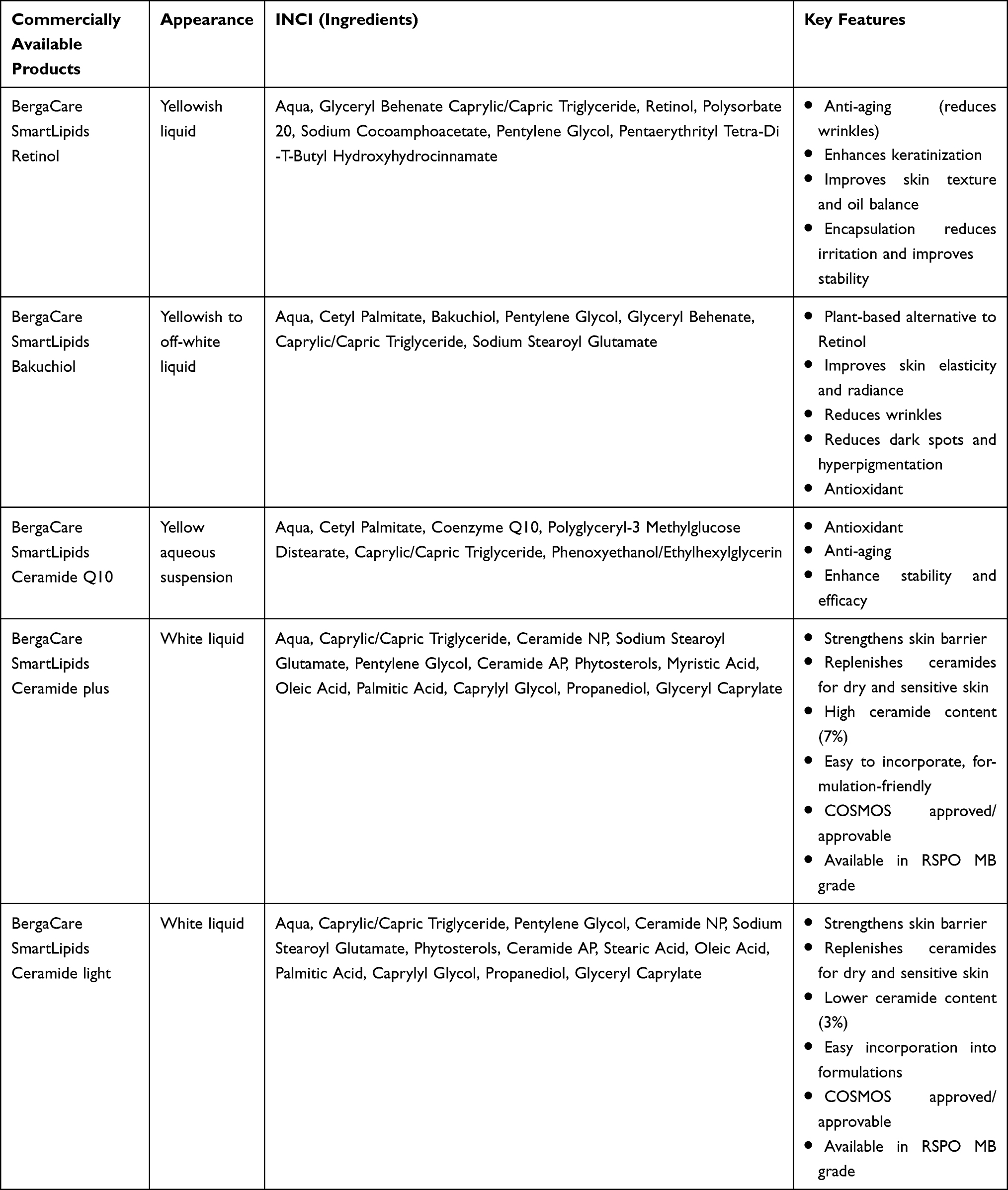 |
Table 4 Commercially Available BergaCare SmartLipids Products for Skincare Applications |
Despite all these advantageous aspects, there is still a need to extend the role of SmartLipids in the pharmaceutical sector. As many drugs from BCS class-II and IV suffer from oral bioavailability issues that affect the therapeutic utility of these active ingredients.91 The potential of SmartLipids for therapeutic oral drug delivery is not yet explored; therefore, for future researchers, we should consider this gap for further scientific pursuits. Furthermore, the nanoscale size of SmartLipids facilitates the advantageous features for mucosal delivery. Morphologically, mucosa is quite similar to skin,92 moreover, transmucosal routes, ie., oral, buccal, vaginal, and intranasal, for drug delivery are frequently employed, convenient and the safest routes.93 In addition to cosmetics, SmartLipids can also be employed in pharma for oral delivery, but selection of the lipid mixture is a considerable factor because all lipids cannot make a desired chaotic structure for SmartLipids fabrication.94
Moreover, the protective mucosal layer covers epithelium that affects and restrains the optimal adhesion of LNPs with mucosal surfaces.95 Although strategies like surface modification might help to conquer this limitation. Subsequently, the surface modification of SmartLipids might be helpful to prolong the gastric residence time that directly expedites the conquering of bioavailability concerns for poorly aqueous soluble drugs. However, different surface modification approaches can be employed, but nowadays, thiolation is a well-recognized strategy for surface modification.96
Plant-based actives make up >50% of the approved therapeutic drugs. Since ancient times, people have been utilizing bioactives or bioagents for gaining health benefits.92 According to WHO, till today ∼75% of the population is consuming these products because of their safety, efficacy and low toxicity.93 However, many phytochemicals bear the solubility and oral bioavailability problems that reduce their therapeutic potential in clinical settings.94 These SmartLipids might conquer these limitations, as it was evidenced by previously established lipid-based nanocarriers that they have a significant potential for oral administration of phytochemicals to unlock their full potential.
In addition, hydrogels are broadly employed in cosmetics, drug delivery, and tissue engineering.97 The concept of nanohydrogels is innovative, the incorporation of SmartLipids into hydrogels not only refines their functioning performance but also enhances the drug-related health benefits. As SmartLipids are effective nanocarriers for drug delivery, their integration into hydrogels is expected to significantly promote the therapeutic utility of drugs. Overall, the SmartLipids hold great promise for contributing to health setups in an efficient manner; however, further development is recommended to optimize their performance and promote patient compliance.
Pharmaceutical Applications
The chaotic lipid matrix of SmartLipids is expanding its pharmaceutical applications. SmartLipids are highly advantageous for the topical delivery of chemically labile pharmaceutical actives like retinol and establishing and invisible and occlusive film on skin, thereby offering skin hydration and improved penetration of incorporated ingredients along with better physical and chemical stability attributes.98 Ding et al constructed retinol-loaded SmartLipids with various concentrations; among them, 20% retinol-containing nanoparticles were selected and incorporated into the hydroxypropyl cellulose hydrogel. The designed formulation renders controlled drug release, which assists in minimizing skin irritation, better drug penetration, and improved aesthetics to maximize patient compliance and cosmetic appeal.43 Apart from dermal application, the interest for parenteral, oral, and ocular delivery has seen an increase due to the biocompatibility and reduced systemic toxicity of lipid nanoparticles.
Diab et al performed a study to potentiate the anticancer potential of resveratrol (RES) via their integration into SmartLipids. The MTT assay was performed for cytotoxicity evaluation of the optimized drug-loaded formulation by incorporating different cell lines, ie., human breast adenocarcinoma (MCF7), human hepatocellular carcinoma (HepG2), and human colon cancer cells (HT29). In comparison to free RES, the RES-loaded SmartLipids exhibited significantly higher cytotoxicity. Specifically, the IC50 was reduced about 3-, 7-, and 10-fold in HepG2, MCF-7 and HT29, respectively. Findings highlight the induction of apoptosis and cell cycle arrest during the G0/G1 phase in cancer cells, thereby underscoring the potential of SmartLipids in cancer treatment.47
The performance of lidocaine, a local anesthetic, can be improved, as its high loading capacity was reported in SmartLipids in contrast to SLNs and NLCs. This facilitates better percutaneous absorption in pre-laser treatment; moreover, controlled and prolonged release expedites the sustained biological effect. Even under mechanical stress, improved adhesion ensures the longer availability of actives at the application site.22 Collectively, all these applications underline the pharmaceutical potential of SmartLipids across multitudinous routes and therapeutic areas.
Expanding the Application of SmartLipids: A Multifaceted Spectrum
Although SmartLipids have chiefly gained commercial success in cosmetic and dermal applications, their essential formulation benefits, like the highly imperfect crystal lattice empowering the high drug loading and encapsulation, improved stability, and controlled release profile,99 open paths to immense therapeutic domains.94 The former lipid nanoparticles, ie., SLNs and NLCs, already demonstrated their potential across multiple administration routes along with promising therapeutic utility.100,101 Similarly, SmartLipids can also be utilized across multiple routes for gaining multiple therapeutic purposes. Moreover, the LNPs facilitate the improvement of pharmacokinetic attributes like solubility, bioavailability, stability and transportation of nutraceuticals.102 They have been exhibited to preserve the potency of encapsulated phytochemicals, facilitating sustained and targeted release kinetics, reducing dosage requirements and improving patient compliance.103,104 Correspondingly, SmartLipids might enhance the therapeutic potential of phytochemicals, improve their utilization in clinical settings, and through improved drug encapsulation with high stability, help in reducing the resource consumption.
In the realm of genome editing, LNPs are the dominant nonviral platforms for delivering genetic therapy. LNPs have emerged as a potent vehicle for bringing CRISPR/Cas components, offering remarkable benefits such as high in vivo efficacy.105 Clinical and preclinical advances involve encapsulation and systemic delivery of siRNA for transthyretin amyloidosis targeting, mRNA for protein replacement or immunization, and plasmid DNA for gene editing or expression. LNPs exhibit highly efficient delivery with composition control, high payload volume, and efficient cellular uptake, making them leading gene therapy platforms.106 Apart from conventional LNPs, SmartLipids may also be designed as second-generation vectors for nucleic acid medicine. Their heterogeneous “chaotic” lipid matrix allows for the incorporation of ionizable lipids or hybrid lipid–polymer systems needed for stabilizing siRNA, mRNA, or CRISPR/Cas9 payloads. By leveraging their improved stability and large payload, SmartLipids are able to conquer some of the limitations of conventional ionizable LNPs, such as storage instability and limiting formulation options, to enable opportunities in RNA vaccines, gene silencing therapies, and precision genome editing.
Hybrid lipid polymer-based nanoparticles have emerged as a unique platform that merges lipids’ biocompatibility behavior with the tunable mechanical attributes of polymers. This emerging strategy provides multiple benefits, including improved drug loading, stability, biocompatibility, and controlled-release kinetics. Furthermore, outer shell functionalization via ligands and stimuli-responsive agents offers targeted drug delivery, which facilitates improved therapeutic responses.107 While the SmartLipids-polymer hybrid formulation still needs researchers’ attention. Reported benefits of SmartLipids could bring something more valuable when combined with polymers.
In addition to small-molecule therapeutics, attempts have been made to conquer the delivery challenges of proteins and peptides due to their susceptibility to enzymatic degradation and large molecular size. Although different hybrid lipid nanoparticles have been reported for efficient delivery of proteins/peptides, direct reports on their encapsulation into SmartLipids remain limited.108 However, lipid polymer hybrid nanoparticles exhibit better macromolecule accommodation and therapeutic response;109 therefore, these outcomes suggest that the inherent structural disorder of SmartLipids may offer a promising framework for future protein/peptide delivery with better stability and bioavailability.
Industrial Translation and Scalability of SmartLipids
Lipid-based nanocarriers, including SmartLipids, bear physical challenges during laboratory-scale formulation to industrial translation. Generally, the pivotal features of formulation, ie., particle size and size distribution, morphology, encapsulation efficiency, and stability, get disrupted while scaling up and these factors are crucial in terms of regulatory acceptance and clinical performance.110
To conquer the scalability problems and enhance the reproducibility and quality, the pharmaceutical sector is adopting the Quality by Design (QbD) approach nowadays. QbD is concerned with the understanding of the target product profile, identification of critical quality attributes, and control of critical attributes such as active ingredients, excipients, and manufacturing processes. QbD employment in lipid nanocarrier development enhances process understanding, product quality, and regulatory flexibility. QbD is essential for the translation of laboratory success into scalable, high-quality, and commercializable products.111 Moreover, identification of Critical Quality Attributes (CQAs), ie., particle size, PDI, ζ potential, encapsulation efficiency, drug release and stability during storage, is mandatory to establish the rational performance and regulatory compliance for any lipid-based nano-platform, including SmartLipids. These CQAs are basically the physiochemical and biological attributes that should be maintained in order to acquire quality products. In the case of lipid nanocarriers, for both the product and the manufacturing process, the CQAs should be monitored carefully for optimum performance. Different aspects of pharmaceutical products, such as drugs, excipients and intermediates, may influence the CQAs during processing or packaging. Therefore, it is essential to analyze the potential impact of drugs or excipients on CQAs to ensure desired product quality and also critical for regulatory acceptance criteria.111,112
Industrial production of lipid nanocarriers is obstructed via multiple factors. From a good manufacturing practice (GMP) perspective, the batch-to-batch reproducibility for SmartLipids is influenced by the multi-compositional lipid matrix. A slight variation in lipid ratios and production parameters can potentially disturb the CsAs, such as physicochemical attributes. Relative to simple lipid nanocarriers like SLNs, the complex lipid blend increases system sensitivity; therefore, it is required to ensure robust quality monitoring strategies and stringent in-process controls, ensuring rational reproducibility under GMP specifications.111 Bulk production requires high-quality lipids and persistent process control. Thoughtful technology selection (eg., HPH and continuous systems), in combination with implementation of QbD, can reduce per-unit cost through increased yield, reduced process deviation, and fewer validation paths.113
Scalability of SmartLipids from laboratory to industrial scale develops further bottlenecks. In lab conditions, it is easy to closely monitor the process and adjust production parameters accordingly. If production parameters are optimized on a small scale, then they do not always translate linearly to a large scale, which can in turn potentially lead to variations in CQAs. Furthermore, raw material supply chains can pose a hurdle to large-scale production. If lipids and other components are not produced on the same scale as the need for large production, progress gets affected. So, securing a reliable supply of high-quality raw materials is crucial.114 Radiation exposure and high temperature can also affect the lipids’ polymorphisms.115 Consequently, the formulations that require sterilization might be affected. For ensuring stability and safety, the selection of a suitable sterilization process without affecting integrity is crucial during industrial production.34 Addressing these scale-up constraints is significant for ensuring successful industrial translation.
Clinical Translation and Regulatory Landscape of SmartLipids
The clinical maturity of SmartLipids in contrast to former generations of nanocarriers, ie., liposomes, polymeric nanoparticles, and micelles, is still emerging. For instance, the liposomal formulations remain the most progressive because of having multiple EMA- and FDA-approved medicines, like doxorubicin,116 amphotericin B,117 and irinotecan liposome injection,118 backed by the well-established FDA’s and EMA’s regulatory frameworks. Further, the polymeric micelles have only acquired selective regionally approved oncology products, such as paclitaxel-based micellar products, including Apealea (paclitaxel micellar) by EMA,119 and Genexol-PM (paclitaxel injection) by South Korea.120 However, while extensively researched, they still bear additional hurdles due to complex composition, like extensive regulatory assessments and quality/clinical evaluations that are required frequently on a case-by-case basis that restrain their global harmonization.121
For SmartLipids, except for BergaCare SmartLipids (commercially available cosmetic formulations), no other peer-reviewed evidence of interventional clinical trials or drug approvals using SmartLipids has been documented to date. This highlights their translational potential, although the employment of systematic regulation is required. Moreover, beyond cosmetic products, no clinical trials and marketed products are available regarding SmartLipids, as verified by the PubMed and ClinicalTrials.gov databases. Further, one patent has been filed with the patent number CN111616969A, also associated with dermal application of SmartLipids.122 Additionally, in one more patent study, not directly relevant to SmartLipids, it was stated that fabrication of SmartFilms for oral and peroral administration can also be done by incorporating the SmartLipids similarly to other lipid-based nanocarriers.123
From a regulatory standpoint, for drug products containing nanomaterials, the FDA (2022) guidance emphasizes the identification of critical quality attributes (CQAs), ie., particle size, particle size distribution, drug loading, crystallinity and drug release kinetics, which are also essential for SmartLipids.124 Furthermore, EMA reflection notes125 highlight the need for robust in vitro–in vivo correlation and comparability studies in scale-up. By adopting these guidelines, SmartLipids are not yet cleared as drugs clinically, but their dermal safety record, improved stability profile, and cost-effectively scalable lipid excipient platform suggest a strong translational foundation. Normalized CQA mapping, in vitro permeation test data packages, and incorporation of regulatory-preferred analytics can help SmartLipids break clinical development channels and fill the translational gap observed between cosmetics and therapeutic uses.
Limitations and Challenges Associated with SmartLipids Development
Multiple limitations and unresolved challenges block the clinical and industrial translation of SmartLipids on a broad level, despite growing interest in this latest generation of lipid nanocarriers. These challenges target reproducibility, manufacturing scalability, and regulatory acknowledgement.
The compositional complexity of SmartLipids enables improved drug accommodation due to the integration of multiple solid and liquid lipids;10 it also inflates the sensitivity of several formulation variables, such as lipid ratios and design protocols. Any minute deviation in such variables might have a major impact on particle size, encapsulation efficiency and crystallinity, which highlights concerns regarding batch-to-batch variability.126 In order to acquire consistent quality attributes, it is essential to tighten the process controls.
The in vivo fate of lipid-based delivery systems is usually followed by lipolysis, micellar solubilization and chylomicron formation, which not only facilitate the lymphatic drug absorption but also improve systemic bioavailability.127 This fate is highly dependent on the properties of lipid composition, particle size, protein corona formation and surface decoration, and is emerging as a new field of research.128 However, in the case of SmartLipids, the biological performance of actives has been analyzed dermally and on various cancer cell lines, but their in vivo fate remains limited and yet unresolved. Consequently, the declaration of superior in vivo performance is usually hypothesized from in vitro data, which may not reliably predict real-time therapeutic performance.
The physical and chemical stability of SmartLipids has already been tested but only in controlled laboratory conditions. In terms of firm drug inclusion, particle size and polymorphic transitions, which are pivotal for the shelf-life of cosmeceuticals and pharmaceuticals, the formulations behaved very well in contrast to SLNs/NLCs.43,51 Nevertheless, the long-term stability with respect to industrial perspective across various administrative routes still requires researchers’ attention. Their compositional nature might act differently under real-world conditions and transportation, which exert a huge impact on product stability and therapeutic performance. Furthermore, the manufacturing of SmartLipids is an energy-intensive process that generally depends on high-pressure homogenization,10 so manufacturing scalability and cost-effectiveness remain the most demanding concerns. Because it might be difficult to get large production volumes consistently. Additionally, the complex composition of lipid blends also increases the excipients’ cost and regulatory challenges.
Conclusion
SmartLipids represent a promising advancement in lipid-based drug delivery, with high drug loading, improved physical stability, improved penetration and bioavailability, a controlled drug release profile, and increased cellular uptake. All these advantages render SmartLipids promising nanocarriers for efficient drug delivery of lipophilic/amphiphilic molecules and sensitive active ingredients, broadening their applications in pharmaceuticals. SmartLipids offer a versatile and robust drug delivery platform with the potential to redefine modern nanomedicines. Cosmetics and nutraceuticals can enhance patient adherence by improving their efficacy. Despite these advantages, there are still challenges in their regulatory approval, large-scale manufacturing and long-term stability, which must be resolved to gain their benefits in clinical settings. Future research should focus on regulatory acceptance, industrial scalability, and personalized medicine applications to accelerate their transition from experimental systems to clinically approved products.
Acknowledgment
The authors would like to acknowledge the School of Pharmacy, Monash University Malaysia for providing the institutional support and necessary research infrastructure that facilitated the preparation of this article. The authors also extend their gratitude for the access to scientific resources and research facilities that greatly contributed to the quality and comprehensiveness of this work. The authors extend their appreciation to the Deanship of Scientific Research at Northern Border University, Arar, KSA. The authors also extend their appreciation to the Deanship of Research and Graduate Studies at King Khalid University for funding this work through Large Group Research Project under the grant number RGP2/59/46.
Disclosure
The authors report no conflicts of interest in this work.
References
1. Din FU, Aman W, Ullah I. et al. Effective use of nanocarriers as drug delivery systems for the treatment of selected tumors. Int J Nanomed. 2017;Volume 12:7291–29. doi:10.2147/IJN.S146315
2. Patra JK, Das G, Fraceto LF, et al. Nano based drug delivery systems: recent developments and future prospects. J Nanobiotechnol. 2018;16(1):71. doi:10.1186/s12951-018-0392-8
3. Battaglia L, Gallarate M. Lipid nanoparticles: state of the art, new preparation methods and challenges in drug delivery. Expert Opin Drug Delivery. 2012;9(5):497–508. doi:10.1517/17425247.2012.673278
4. Viegas C, Patrício AB, Prata JM. Solid Lipid Nanoparticles vs. Nanostructured Lipid Carriers: a Comparative Review. Pharmaceutics. 2023;15(6):1593.
5. Mishra V, Bansal KK, Verma A, et al. Solid Lipid Nanoparticles: emerging Colloidal Nano Drug Delivery Systems. Pharmaceutics. 2018;10(4). doi:10.3390/pharmaceutics10040191.
6. Adib ZM, Ghanbarzadeh S, Kouhsoltani M, et al. The effect of particle size on the deposition of solid lipid nanoparticles in different skin layers: a histological study. Adv Pharm Bull. 2016;6(1):31. doi:10.15171/apb.2016.06
7. Ghasemiyeh P, Mohammadi-Samani S. Solid lipid nanoparticles and nanostructured lipid carriers as novel drug delivery systems: applications, advantages and disadvantages. Res Pharm Sci. 2018;13(4):288–303. doi:10.4103/1735-5362.235156
8. Sharma A, Baldi A. Nanostructured lipid carriers: a review. J Dev Drugs. 2018;7(1):191.
9. Müller RH, Shegokar R, Keck CM. 20 years of lipid nanoparticles (SLN and NLC): present state of development and industrial applications. Curr Drug Discov Technol. 2011;8(3):207–227. doi:10.2174/157016311796799062
10. Müller RH, Olechowski F, Köpke D, et al. SmartLipids—The Third Generation of Solid Submicron Lipid Particles for Dermal Delivery of Actives. In: Nanocosmetics: From Ideas to Products. Springer; 2019:141–159.
11. Müller R, Ruick R, Keck C. smartLipids®—the new generation of lipid nanoparticles after SLN and NLC. in
12. Hashmi AR, Eltayib EM, Qaisar MN, et al. Mucoadhesive aprepitant-loaded nanostructured lipid carriers containing sulfhydryl surfactant for enhanced oral drug bioavailability. J Drug Delivery Sci Technol. 2024;98:105904. doi:10.1016/j.jddst.2024.105904
13. Yasir M, Zafar A, Noorulla KM, et al. Nose to brain delivery of donepezil through surface modified NLCs: formulation development, optimization, and brain targeting study. J Drug Delivery Sci Technol. 2022;75:103631. doi:10.1016/j.jddst.2022.103631
14. Olechowski F, et al. BergaCare smartLipids®-commercial lipid submicron particle concentrates for cosmetics, consumer care & pharma. Wissenschaftliche Posterausstellung 2016: Poster 6. 2016.
15. Robert Ruick SMP, Müller RH, Keck CM. 3rd generation technology – bergaCare smartLipids® submicron carrier for improved retinol formulation. In: Wissenschaftliche Posterausstellung 2016: Poster 9. 2016.
16. Keck C. SmartLipids® for Improved Delivery of Lipophilic Anti-Aging Actives. 2016.
17. Sabilla Digel FO, Mueller RH. Better bioavailability with SmartLipids. 2020. Available from: https://www.cossma.com/ingredients/article/better-bioavailability-with-smartlipids-36089.html.
18. Khosa A, Reddi S, Saha RN. Nanostructured lipid carriers for site-specific drug delivery. Biomed Pharmacother. 2018;103:598–613. doi:10.1016/j.biopha.2018.04.055
19. Pardeike J, Hommoss A, Müller RH. Lipid nanoparticles (SLN, NLC) in cosmetic and pharmaceutical dermal products. Int J Pharm. 2009;366(1):170–184. doi:10.1016/j.ijpharm.2008.10.003
20. Akbari J, Saeedi M, Ahmadi F, et al. Solid lipid nanoparticles and nanostructured lipid carriers: a review of the methods of manufacture and routes of administration. Pharmaceutl Develop Technol. 2022;27(5):525–544. doi:10.1080/10837450.2022.2084554
21. Rahman HS, Othman HH. Novel Drug Delivery Systems for Loading of Natural Plant Extracts and Their Biomedical Applications. Int J Nanomed. 2020;15:2439–2483.
22. Olechowski F, Müller RH, Pyo SM. BergaCare SmartLipids: commercial lipophilic active concentrates for improved performance of dermal products. Beilstein J Nanotechnol. 2019;10:2152–2162. doi:10.3762/bjnano.10.208
23. Müller R, Ruick R, Keck C. Smartlipids®—the next generation of lipid nanoparticles by optimized design of particle matrix. in
24. Geszke-Moritz M, Moritz M. Solid lipid nanoparticles as attractive drug vehicles: composition, properties and therapeutic strategies. Mater Sci Eng C. 2016;68:982–994. doi:10.1016/j.msec.2016.05.119
25. Sun J, Bi C, Chan HM, et al. Curcumin-loaded solid lipid nanoparticles have prolonged in vitro antitumour activity, cellular uptake and improved in vivo bioavailability. Colloids Surf B. 2013;111:367–375. doi:10.1016/j.colsurfb.2013.06.032
26. Sivadasan D, Ramakrishnan K, Mahendran J, et al. Solid Lipid Nanoparticles: applications and Prospects in Cancer Treatment. Int J Mol Sci. 2023;24(7):6199. doi:10.3390/ijms24076199
27. Makwana V, Jain R, Patel K, et al. Solid lipid nanoparticles (SLN) of Efavirenz as lymph targeting drug delivery system: elucidation of mechanism of uptake using chylomicron flow blocking approach. Int J Pharm. 2015;495(1):439–446. doi:10.1016/j.ijpharm.2015.09.014
28. Naseri N, Valizadeh H, Zakeri-Milani P. Solid Lipid Nanoparticles and Nanostructured Lipid Carriers: structure, Preparation and Application. Adv Pharm Bull. 2015;5(3):305–313.
29. Mehrdadi S. Drug delivery of solid lipid nanoparticles (SLNs) and nanostructured lipid carriers (NLCs) to target brain tumors. Adv Pharm Bull. 2022;13(3):512. doi:10.34172/apb.2023.062
30. Das S, Chaudhury A. Recent advances in lipid nanoparticle formulations with solid matrix for oral drug delivery. AAPS Pharm Sci Tech. 2011;12(1):62–76. doi:10.1208/s12249-010-9563-0
31. Mahor AK, Singh PP, Gupta R, et al. Nanostructured lipid carriers for improved delivery of therapeutics via the oral route. J Nanotechnol. 2023;2023(1):4687959. doi:10.1155/2023/4687959
32. Garcês A, Amaral MH, Sousa Lobo JM, et al. Formulations based on solid lipid nanoparticles (SLN) and nanostructured lipid carriers (NLC) for cutaneous use: a review. Eur J Pharm Sci. 2018;112:159–167. doi:10.1016/j.ejps.2017.11.023
33. Khan S, Sharma A, Jain V. An Overview of Nanostructured Lipid Carriers and its Application in Drug Delivery through Different Routes. Advanced Pharmaceutical Bulletin. 2023;13(3):446–460. doi:10.34172/apb.2023.056
34. Queiroz MDCV, Muehlmann LA. Characteristics and Preparation of Solid Lipid Nanoparticles and Nanostructured Lipid Carriers. J Nanotheranost. 2024;5(4):188–211. doi:10.3390/jnt5040012
35. Mall J, Naseem N, Haider MF, et al. Nanostructured lipid carriers as a drug delivery system: a comprehensive review with therapeutic applications. Intelligent Pharmacy. 2024;2024:1.
36. Srivastava S, Haider MF, Ahmad A, et al. Exploring nanoemulsions for prostate cancer therapy. Drug Res. 2021;71(08):417–428. doi:10.1055/a-1518-6606
37. Shirodkar RK, Kumar L, Mutalik S, et al. Solid lipid nanoparticles and nanostructured lipid carriers: emerging lipid based drug delivery systems. Pharm Chem J. 2019;53(5):440–453. doi:10.1007/s11094-019-02017-9
38. Dhiman N, Awasthi R, Sharma B, et al. Lipid nanoparticles as carriers for bioactive delivery. Front Chem. 2021;9:580118. doi:10.3389/fchem.2021.580118
39. Gordillo-Galeano A, Mora-Huertas CE. Solid lipid nanoparticles and nanostructured lipid carriers: a review emphasizing on particle structure and drug release. Eur J Pharm Biopharm. 2018;133:285–308. doi:10.1016/j.ejpb.2018.10.017
40. Tiwari R, Pathak K. Nanostructured lipid carrier versus solid lipid nanoparticles of simvastatin: comparative analysis of characteristics, pharmacokinetics and tissue uptake. Int J Pharm. 2011;415(1–2):232–243. doi:10.1016/j.ijpharm.2011.05.044
41. Sharma B, Chauhan I, Kumar G, et al. SmartLipids: ushering in a New Era of Lipid Nanoparticles for Drug Delivery. Micro Nanosyst. 2024;16(2):88–96. doi:10.2174/0118764029294004240318094405
42. Müller RH, Keck CM. Next generation after SLN® and NLC®–the “chaotic” smartLipids®. In: Wissenschaftliche Posterausstellung 2015: Poster 9. Germany: Freie Universität Berlin; PharmaSol GmbH; 2015.
43. Ding Y, Pyo S, Müller R. smartLipids® as third solid lipid nanoparticle generation–stabilization of retinol for dermal application. Die Pharmazie. 2017;72(12):728–735.
44. Gad S, Fekri R, Mohamed A. Lipid-Based Nanosystems as Advanced Approach for Drug Delivery. Records Pharmaceut Biomed Sci. 2023;7(3):190–202. doi:10.21608/rpbs.2023.255014.1257
45. Puri A, Loomis K, Smith B, et al. Lipid-based nanoparticles as pharmaceutical drug carriers: from concepts to clinic. Crit Rev Ther Drug Carrier Syst. 2009;26(6):523–580. doi:10.1615/CritRevTherDrugCarrierSyst.v26.i6.10
46. Doane T, Burda C. Nanoparticle mediated non-covalent drug delivery. Adv Drug Deliv Rev. 2013;65(5):607–621. doi:10.1016/j.addr.2012.05.012
47. Diab RF, Abdelghany TM, Gad S, et al. Novel resveratrol smart lipids; design, formulation, and biological evaluation of anticancer activity. J Pharm Pharmacol. 2024;76(6):631–645. doi:10.1093/jpp/rgae009
48. Ding Y. Lipid nanoparticles for topical delivery: solid lipid nanoparticles (SLN) & smartLipids. In: Department of Biology, Chemistry and Pharmacy. Berlin: Freie Universität; 2018.
49. Pyo SM, Meinke M, Klein AF, et al. A novel concept for the treatment of couperosis based on nanocrystals in combination with solid lipid nanoparticles (SLN). Int J Pharm. 2016;510(1):9–16. doi:10.1016/j.ijpharm.2016.05.017
50. Greenhalgh DJ, Williams AC, Timmins P, et al. Solubility parameters as predictors of miscibility in solid dispersions. J Pharmaceut Sci. 1999;88(11):1182–1190. doi:10.1021/js9900856
51. Köpke D. smartLipids and smartCrystals for improved dermal delivery of anti-pollution actives. In: Department of Biology, Chemistry and Pharmacy. Berlin: Freie Universität; 2020.
52. Köpke D, Müller RH, Pyo SM. Phenylethyl resorcinol smartLipids for skin brightening–Increased loading & chemical stability. Eur J Pharm Sci. 2019;137:104992. doi:10.1016/j.ejps.2019.104992
53. McClements DJ. Food Emulsions: Principles, Practices, and Techniques.
54. Xin X, Zhang H, Xu G, et al. Influence of CTAB and SDS on the properties of oil-in-water nano-emulsion with paraffin and span 20/Tween 20. Colloids Surf A. 2013;418:60–67. doi:10.1016/j.colsurfa.2012.10.065
55. Choi K-O, Aditya N, Ko S. Effect of aqueous pH and electrolyte concentration on structure, stability and flow behavior of non-ionic surfactant based solid lipid nanoparticles. Food Chem. 2014;147:239–244. doi:10.1016/j.foodchem.2013.09.095
56. Shaal LA, Mishra PR, Müller RH, et al. Nanosuspensions of hesperetin: preparation and characterization. Die Pharmazie. 2014;69(3):173–182.
57. Freitas C, Müller R. Correlation between long-term stability of solid lipid nanoparticles (SLN™) and crystallinity of the lipid phase. Eur J Pharm Biopharm. 1999;47(2):125–132. doi:10.1016/S0939-6411(98)00074-5
58. Lüdtke FL, Silva TJ, da Silva MG, et al. Lipid Nanoparticles: formulation, Production Methods and Characterization Protocols. Foods. 2025;14(6):973. doi:10.3390/foods14060973
59. Fathi F, Machado TOX, De A. C. kodel H, et al. Solid lipid nanoparticles (SLN) and nanostructured lipid carriers (NLC) for the delivery of bioactives sourced from plants: part I – composition and production methods. Expert Opin Drug Delivery. 2024;21(10):1479–1490. doi:10.1080/17425247.2024.2410951
60. Al-Maghrabi PM, Khafagy E-S, Ghorab MM, et al. Influence of formulation variables on miconazole nitrate–loaded lipid based nanocarrier for topical delivery. Colloids Surf B. 2020;193:111046. doi:10.1016/j.colsurfb.2020.111046
61. Ilić T, Đoković JB, Nikolić I, et al. Parenteral Lipid-Based Nanoparticles for CNS Disorders: integrating Various Facets of Preclinical Evaluation towards More Effective Clinical Translation. Pharmaceutics. 2023;15(2):443. doi:10.3390/pharmaceutics15020443
62. Mohseni R, ArabSadeghabadi Z, Ziamajidi N, et al. Oral administration of resveratrol-loaded solid lipid nanoparticle improves insulin resistance through targeting expression of SNARE proteins in adipose and muscle tissue in rats with type 2 diabetes. Nanoscale Res Lett. 2019;14(1):227. doi:10.1186/s11671-019-3042-7
63. Lahan M. Formulation and Characterization of Resveratrol-Loaded Nanostructured Lipid Carriers (NLC) with Mesua ferrea Seed Oil as Liquid Lipid. Sci Pharm. 2024;3(4):203–211. doi:10.58920/sciphar0304271
64. Shah P, Chavda K, Vyas B, et al. Formulation development of linagliptin solid lipid nanoparticles for oral bioavailability enhancement: role of P-gp inhibition. Drug Delivery Transl Res. 2021;11(3):1166–1185. doi:10.1007/s13346-020-00839-9
65. Müller RH, Jacobs C, Kayser O. Nanosuspensions as particulate drug formulations in therapy: rationale for development and what we can expect for the future. Adv. Drug Delivery Rev. 2001;47(1):3–19. doi:10.1016/S0169-409X(00)00118-6
66. Vitorino C, Carvalho FA, Almeida AJ, et al. The size of solid lipid nanoparticles: an interpretation from experimental design. Colloids Surf B. 2011;84(1):117–130. doi:10.1016/j.colsurfb.2010.12.024
67. Khames A, Khaleel MA, El-Badawy MF, et al. Natamycin solid lipid nanoparticles – sustained ocular delivery system of higher corneal penetration against deep fungal keratitis: preparation and optimization. Int J Nanomed. 2019;Volume 14:2515–2531. doi:10.2147/IJN.S190502
68. Xu L, Wang X, Liu Y, et al. Lipid nanoparticles for drug delivery. Adv NanoBiomed Res. 2022;2(2):2100109. doi:10.1002/anbr.202100109
69. Singh S, Vardhan H, Kotla NG, et al. The role of surfactants in the formulation of elastic liposomal gels containing a synthetic opioid analgesic. Int J Nanomed. 2016;11:1475–1482. doi:10.2147/IJN.S100253
70. Bnyan R, Khan I, Ehtezazi T, et al. Surfactant effects on lipid-based vesicles properties. J Pharmaceut Sci. 2018;107(5):1237–1246. doi:10.1016/j.xphs.2018.01.005
71. Haider M, Abdin SM, Kamal L, et al. Nanostructured Lipid Carriers for Delivery of Chemotherapeutics: a Review. Pharmaceutics. 2020;12(3):288. doi:10.3390/pharmaceutics12030288
72. Chettupalli AK, Bukke SPN, Rahaman SA, et al. Ritonavir loaded solid lipid nanoparticles for oral drug delivery and bioavailability enhancement. Discover Applied Sciences. 2025;7(1):58. doi:10.1007/s42452-024-06322-1
73. Espinosa-Sandoval L, Ochoa-Martínez C, Ayala-Aponte A, et al. Polysaccharide-based multilayer nano-emulsions loaded with oregano oil: production, characterization, and in vitro digestion assessment. Nanomaterials. 2021;11(4):878. doi:10.3390/nano11040878
74. Salama AH, Elmotasem H, Salama AA. Nanotechnology based blended chitosan-pectin hybrid for safe and efficient consolidative antiemetic and neuro-protective effect of meclizine hydrochloride in chemotherapy induced emesis. Int J Pharm. 2020;584:119411. doi:10.1016/j.ijpharm.2020.119411
75. Poonia N, Kaur Narang J, Lather V, et al. Resveratrol loaded functionalized nanostructured lipid carriers for breast cancer targeting: systematic development, characterization and pharmacokinetic evaluation. Colloids Surf B. 2019;181:756–766. doi:10.1016/j.colsurfb.2019.06.004
76. Lane ME. In vitro permeation testing for the evaluation of drug delivery to the skin. Eur J Pharm Sci. 2024;201:106873. doi:10.1016/j.ejps.2024.106873
77. Nassimi M, Schleh C, Lauenstein H-D, et al. Low cytotoxicity of solid lipid nanoparticles in in vitro and ex vivo lung models. Inhal Toxicol. 2009;21:104–109. doi:10.1080/08958370903005769
78. Zheng L, Du Y, Zhang L, et al. Enhanced therapeutic effects of all-trans retinoic acid nanostructured lipid carrier composite gel drug delivery system for alopecia areata. J Nanobiotechnol. 2025;23(1):351. doi:10.1186/s12951-025-03407-w
79. Estapé Senti M, de Jongh CA, Dijkxhoorn K, et al. Anti-PEG antibodies compromise the integrity of PEGylated lipid-based nanoparticles via complement. J Control Release. 2022;341:475–486. doi:10.1016/j.jconrel.2021.11.042
80. Moncho S, Serrano-Candelas E, de Julián-Ortiz JV, et al. A review on the structural characterization of nanomaterials for nano-QSAR models. Beilstein J Nanotechnol. 2024;15:854–866. doi:10.3762/bjnano.15.71
81. Qi Q, Wang Z. Integrating machine learning and nano-QSAR models to predict the oxidative stress potential caused by single and mixed carbon nanomaterials in algal cells. Environ Toxicol Chem. 2025;44(9):2535–2544. doi:10.1093/etojnl/vgae049
82. Sampaio AR, Maia RF, Ciardulli MC, et al. Organ-on-chip platforms for nanoparticle toxicity and efficacy assessment: advancing beyond traditional in vitro and in vivo models. Mater Today Bio. 2025;33:102053. doi:10.1016/j.mtbio.2025.102053
83. Musielak E, Feliczak-Guzik A, Nowak I. Optimization of the conditions of solid lipid nanoparticles (SLN) synthesis. Molecules. 2022;27(7):2202. doi:10.3390/molecules27072202
84. Gomaa E, Fathi HA, Eissa NG, et al. Methods for preparation of nanostructured lipid carriers. Methods. 2022;199:3–8. doi:10.1016/j.ymeth.2021.05.003
85. Allen TM, Cullis PR. Liposomal drug delivery systems: from concept to clinical applications. Adv Drug Delivery Rev. 2013;65(1):36–48. doi:10.1016/j.addr.2012.09.037
86. Beach MA, Nayanathara U, Gao Y, et al. Polymeric Nanoparticles for Drug Delivery. Chem Rev. 2024;124(9):5505–5616. doi:10.1021/acs.chemrev.3c00705
87. Abu-Dief AM, Alsehli M, Al-Enizi A, et al. Recent Advances in Mesoporous Silica Nanoparticles for Targeted Drug Delivery Applications. Current Drug Delivery. 2022;19(4):436–450. doi:10.2174/1567201818666210708123007
88. El-Dabea T, Abu-Dief AM, Salaheldeen M. Recent advances in development of gold nanoparticles for drug delivery systems. J Mod Nanotechnol. 2021;2021:1.
89. Ingredients BSC. BergaCare SmartLipids The Future of Active Ingredient Delivery. 2025. Available from: https://solutions.berg-schmidt.com/careingredients/smartlipids.
90. Florence Olechowski SMP, Keck C, Müller RH. “BergaCare SmartLipids Retinol” – product features for improved dermal retinol delivery. In: Wissenschaftliche Posterausstellung 2017: Poster 8. 2017.
91. Espinar FJO. Formulation strategies to improve the bioavailability of poorly absorbed drugs, in Dosage Forms, Formulation Developments and Regulations. Elsevier; 2024:223–255.
92. Turabelidze A. Differences Between Oral and Skin Keratinocytes During Wound Healing. In: Orthodontics. University of Illinois Chicago; 2013.
93. Lam JKW, Cheung CCK, Chow MYT, et al. Transmucosal drug administration as an alternative route in palliative and end-of-life care during the COVID-19 pandemic. Adv Drug Deliv Rev. 2020;160:234–243. doi:10.1016/j.addr.2020.10.018
94. Keck RHMACM. Next Generation After SLN® and NLC® – The “Chaotic” smartLipids®. Wissenschaftliche Posterausstellung; 2015.
95. Wu L, Liu M, Zhu X, et al. Modification strategies of lipid-based nanocarriers for mucosal drug delivery. Curr Pharm Des. 2015;21(36):5198–5211. doi:10.2174/1381612821666150923103000
96. Knoll P, Francesco Racaniello G, Laquintana V, et al. Lipid-based nanoparticles: enhanced cellular uptake via surface thiolation. Int J Pharm. 2023;635:122753. doi:10.1016/j.ijpharm.2023.122753
97. Clegg JR, Adebowale K, Zhao Z, et al. Hydrogels in the clinic: an update. Bioeng Transl Med. 2024;9(6):e10680. doi:10.1002/btm2.10680
98. Jun S-H, Kim H, Lee H, et al. Synthesis of Retinol-Loaded Lipid Nanocarrier via Vacuum Emulsification to Improve Topical Skin Delivery. Polymers. 2021;13(5):826. doi:10.3390/polym13050826
99. Juszkiewicz K, Sikorski AF, Czogalla A. Building Blocks to Design Liposomal Delivery Systems. Int J Mol Sci. 2020;21(24):9559. doi:10.3390/ijms21249559
100. Talegaonkar S, Bhattacharyya A. Potential of Lipid Nanoparticles (SLNs and NLCs) in Enhancing Oral Bioavailability of Drugs with Poor Intestinal Permeability. AAPS Pharm Sci Tech. 2019;20(3):121. doi:10.1208/s12249-019-1337-8
101. Fonseca-Santos B, Silva PB, Rigon RB, et al. Formulating SLN and NLC as innovative drug delivery systems for non-invasive routes of drug administration. Curr Med Chem. 2020;27(22):3623–3656. doi:10.2174/0929867326666190624155938
102. Ashfaq R, Rasul A, Asghar S, Kovács A, Berkó S, Budai-Szűcs M. Lipid Nanoparticles: an Effective Tool to Improve the Bioavailability of Nutraceuticals. International Journal of Molecular Sciences. 2023;24(21). doi:10.3390/ijms242115764
103. Blanco-Llamero C, Fonseca J, Durazzo A. Nutraceuticals and Food-Grade Lipid Nanoparticles: from Natural Sources to a Circular Bioeconomy Approach. Foods. 2022;11(15):2318.
104. Uti DE, Alum EU, Atangwho IJ, et al. Lipid-based nano-carriers for the delivery of anti-obesity natural compounds: advances in targeted delivery and precision therapeutics. J Nanobiotechnol. 2025;23(1):336. doi:10.1186/s12951-025-03412-z
105. Yuan Y, Li Y, Li G, et al. Intelligent Design of Lipid Nanoparticles for Enhanced Gene Therapeutics. Mol Pharmaceut. 2025;22(3):1142–1159. doi:10.1021/acs.molpharmaceut.4c00925
106. Cullis PR, Hope MJ. Lipid Nanoparticle Systems for Enabling Gene Therapies. Mol Ther. 2017;25(7):1467–1475. doi:10.1016/j.ymthe.2017.03.013
107. Gajbhiye KR, Salve R, Narwade M, et al. Lipid polymer hybrid nanoparticles: a custom-tailored next-generation approach for cancer therapeutics. Mol Cancer. 2023;22(1):160. doi:10.1186/s12943-023-01849-0
108. Hassan AAA, Ramadan E, Kristó K, et al. Lipid-Polymer Hybrid Nanoparticles as a Smart Drug Delivery System for Peptide/Protein Delivery. Pharmaceutics. 2025;17(6):797. doi:10.3390/pharmaceutics17060797
109. Imam SS, Gilani SJ, Bin Jumah MN, et al. Harnessing lipid polymer hybrid nanoparticles for enhanced oral bioavailability of thymoquinone: in vitro and in vivo assessments. Polymers. 2022;14(18):3705. doi:10.3390/polym14183705
110. Souto EB, Maia RCAP, Rannier L, et al. Nanopharmaceutics: part II-Production Scales and Clinically Compliant Production Methods. Nanomaterials (Basel, Switzerland). 2020;10(3). doi:10.3390/nano10020390.
111. Buya AB, Mahlangu P, Witika BA. From lab to industrial development of lipid nanocarriers using quality by design approach. Int J Pharm. 2024;X(8):100266.
112. Mehta M, Bui TA, Yang X, Aksoy Y, Goldys EM, Deng W. Lipid-Based Nanoparticles for Drug/Gene Delivery: an Overview of the Production Techniques and Difficulties Encountered in Their Industrial Development. ACS Materials Au. 2023;3(6):600–619. doi:10.1021/acsmaterialsau.3c00032
113. MicrofluidicsTM. Pharmaceutical Challenges for Lipid Nanoparticle Production. 2022.
114. Biotech H. What Challenges Exist in Scaling Up Lipid Nanoparticle Production? 2024. Available from: https://www.helixbiotech.com/post/what-challenges-exist-in-scaling-up-lipid-nanoparticle-production.
115. Youshia J, Kamel AO, El Shamy A, et al. Gamma sterilization and in vivo evaluation of cationic nanostructured lipid carriers as potential ocular delivery systems for antiglaucoma drugs. Eur J Pharm Sci. 2021;163:105887. doi:10.1016/j.ejps.2021.105887
116. Agency EM. Caelyx pegylated liposomal-doxorubicin_EMEA/H/C/000089. 2025; Available from: https://www.ema.europa.eu/en/medicines/human/EPAR/caelyx-pegylated-liposomal.
117. Administration, USAFD. 2021 First Generic Drug Approvals. 2022. Available from: https://www.fda.gov/drugs/drug-and-biologic-approval-and-ind-activity-reports/2021-first-generic-drug-approvals.
118. Agency EM. Onivyde pegylated liposomal_EMEA/H/C/004125. 2016. Available from: https://www.ema.europa.eu/en/medicines/human/EPAR/onivyde-pegylated-liposomal#authorisation-details.
119. Agency EM. Apealea® EMEA/H/C/004154. 2018. Available from: https://www.ema.europa.eu/en/medicines/human/EPAR/apealea#overview.
120. Werner ME, Cummings ND, Sethi M, et al. Preclinical evaluation of Genexol-PM, a nanoparticle formulation of paclitaxel, as a novel radiosensitizer for the treatment of non-small cell lung cancer. Int J Radiat Oncol Biol Phys. 2013;86(3):463–468. doi:10.1016/j.ijrobp.2013.02.009
121. Austria E, Bilek M, Varamini P, et al. Breaking biological barriers: engineering polymeric nanoparticles for cancer therapy. Nano Today. 2025;60:102552.
122. Wen Zimin XM, Lei S, Shunping C, Xiaorong Y, Shengzhao G. A kind of intelligent lipid carrier with whitening and sunscreen functions and preparation method thereof [CN111616969A], Google Patents. 2020, Guangdong Industry Technical College.
123. Stefan Lemke E-JS, Welzel H-P, Keck CM. Support matrices based on cellulose fibers for layered products for oral and peroral administration as well as their production [ES2969071T3], in Google Patents. 2016, Glatt GmbH.
124. Administration USFD. Drug Products, Including Biological Products, that Contain Nanomaterials - Guidance for Industry. Center for Drug Evaluation and Research_FDA-2017-D-0759. 2022. Available from: https://www.fda.gov/regulatory-information/search-fda-guidance-documents/drug-products-including-biological-products-contain-nanomaterials-guidance-industry.
125. Agency EM. Nanotechnology-based medicinal products for human use: EU-IN Horizon Scan. 2025. Available from: https://www.pharmaexcipients.com/wp-content/uploads/2025/02/Nanotechnology-based-medicinal-products-for-human-use.pdf.
126. Lombardi Borgia S, Regehly M, Sivaramakrishnan R, et al. Lipid nanoparticles for skin penetration enhancement-correlation to drug localization within the particle matrix as determined by fluorescence and parelectric spectroscopy. J Control Release. 2005;110(1):151–163. doi:10.1016/j.jconrel.2005.09.045
127. Ghadi R, Dand N. BCS class IV drugs: highly notorious candidates for formulation development. J Control Release. 2017;248:71–95. doi:10.1016/j.jconrel.2017.01.014
128. Qi J, Zhuang J, Lu Y, et al. In vivo fate of lipid-based nanoparticles. Drug Discov Today. 2017;22(1):166–172. doi:10.1016/j.drudis.2016.09.024
 © 2026 The Author(s). This work is published and licensed by Dove Medical Press Limited. The
full terms of this license are available at https://www.dovepress.com/terms
and incorporate the Creative Commons Attribution
- Non Commercial (unported, 4.0) License.
By accessing the work you hereby accept the Terms. Non-commercial uses of the work are permitted
without any further permission from Dove Medical Press Limited, provided the work is properly
attributed. For permission for commercial use of this work, please see paragraphs 4.2 and 5 of our Terms.
© 2026 The Author(s). This work is published and licensed by Dove Medical Press Limited. The
full terms of this license are available at https://www.dovepress.com/terms
and incorporate the Creative Commons Attribution
- Non Commercial (unported, 4.0) License.
By accessing the work you hereby accept the Terms. Non-commercial uses of the work are permitted
without any further permission from Dove Medical Press Limited, provided the work is properly
attributed. For permission for commercial use of this work, please see paragraphs 4.2 and 5 of our Terms.
Recommended articles
Extracellular Vesicle-Based Therapeutic Cargo Delivery for Cancer Therapy
Huang Z, Cheng J, Deng Z, Liu C, Huang T, Lin W
International Journal of Nanomedicine 2025, 20:13007-13037
Published Date: 27 October 2025
Nanomedicine-Integrated Phototherapy for Cancer Theranostics: A Systematic Review of Photoresponsive Materials, Mechanisms, and Clinical Translation
Alsaikhan F, Al-Saikhan TF, Alsaikhan YF
International Journal of Nanomedicine 2026, 21:596646
Published Date: 16 April 2026
Nanomedicine in 2026: Illustrative Quantitative Analyses of EPR Heterogeneity, Clinical Trial Attrition, and Emerging Horizons for Active Nanotherapeutics
Fayez SM
International Journal of Nanomedicine 2026, 21:618407
Published Date: 11 June 2026