
Back to Journals » Diabetes, Metabolic Syndrome and Obesity » Volume 18
Risk Prediction Model for Arteriovenous Fistula Maturation Failure in Elderly Diabetic Patients: Limitations and Future Directions [Response to Letter]

Shuangyan Liu,1,* Xiaojie He,1,* Yaqing Wang,2,* Yuqing Wang,1,* Xiaodong Li3
1Graduate School of Hebei Medical University, Shijiazhuang, Hebei, 050017, People’s Republic of China; 2Graduate School of Chengde Medical University, Chengde, Hebei, 067000, People’s Republic of China; 3Department of Nephrology, Baoding No 1 Central Hospital of Hebei Medical University, Baoding, Hebei, People’s Republic of China
*These authors contributed equally to this work
Correspondence: Xiaodong Li, Department of Nephrology, Baoding No.1 Central Hospital of Hebei Medical University, Baoding Great Wall North Street No 320, Baoding, Hebei, 071000, People’s Republic of China, Email [email protected]
View the original paper by Dr Liu and colleagues
This is in response to the Letter to the Editor
Dear editor
We have received the correspondence from Shi-Cheng Liu et al regarding our recently published study, and we appreciate their insightful comments.1,2 Our article investigates the risk factors for arteriovenous fistula (AVF) maturation failure in elderly diabetic patients and develops an early prediction model.
First, we concur with the authors’ point regarding the limitations in data collection and potential biases in sample selection. Although we included 548 patients, the sample size remains limited compared to the global population of elderly diabetic and end-stage renal disease (ESRD) patients. The single-center nature of our study may restrict the generalizability of our findings. We fully acknowledge this issue and agree that multicenter studies would enhance the robustness and applicability of our conclusions. Additionally, our exclusion criteria may have omitted complex cases, which is a valid concern. To control variables and improve internal validity, we implemented specific exclusion criteria, which inevitably limits the model’s applicability in more complex clinical scenarios. Regarding the handling of missing data, we employed multiple imputation methods during data preprocessing to ensure data completeness and accuracy. However, due to space constraints, these details were not elaborated in the main text. We will include this information in subsequent versions or supplementary materials to improve transparency.
Second, we acknowledge the authors’ emphasis on the necessity of external validation. External validation is crucial for assessing a model’s performance in real-world clinical applications, as it confirms the model’s stability and accuracy across different datasets. Unfortunately, due to resource and time constraints, we were unable to conduct external validation in this study.
Furthermore, we agree with the authors’ perspective on the clinical applicability of predictive models.3,4 Although the five predictive variables in our study are easily accessible, their combined use for prediction remains somewhat complex. We developed a dynamic nomogram that allows for direct calculation of the probability of AVF maturation failure by inputting specific values for the five independent variables (Figure 1A). However, due to the limitations mentioned, we have not yet published the website on shinyapps.io.
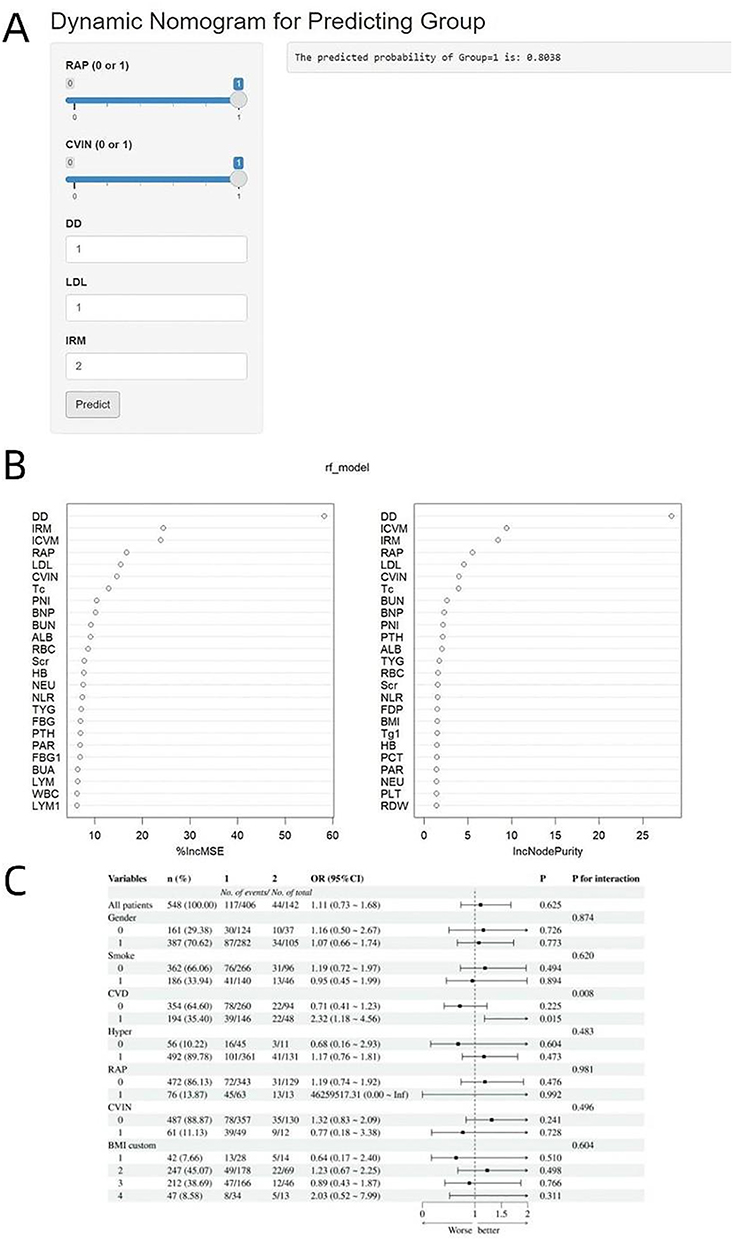 |
Figure 1 (A) Dynamic nomogram for poor maturation of AVF in elderly diabetic patients with ESRD (web version); (B) Random forest plot for variable selection; (C) Forest plot for subgroup analysis. |
Lastly, the authors suggested exploring advanced statistical methods such as Bayesian networks or Random Forests for variable selection and model construction. Our study already utilized Random Forests for variable screening, and the results were largely consistent with LASSO regression (Figure 1B). However, due to the limited sample size, LASSO regression was preferred for its advantage in reducing overfitting.5 Model ignores subgroup diffs, shows no AVF failure diffs at age 70 across subgroups (Figure 1C).
In future research, we aim to expand our sample size, observational indicators, and geographical coverage through increased collaboration. We will collect diverse datasets for external validation to enhance the model’s broad applicability. We sincerely thank the authors for their valuable suggestions, which we will consider in our future studies.
Disclosure
The authors report no conflicts of interest in this communication.
References
1. Liu S-C, Tian K, Zhang Y-T. Nomogram for predicting early avf failure in elderly diabetic patients: methodological and clinical considerations. Diabetes Metab Syndr Obes. 2025;18:677–678. doi:10.2147/DMSO.S521525
2. Liu S, Wang Y, He X, Li X. Construction and evaluation of a predictive nomogram for identifying premature failure of arteriovenous fistulas in elderly diabetic patients. Diabetes Metab Syndr Obes. 2024;17:4825–4841. doi:10.2147/DMSO.S484041
3. Wang C, Song X, Liu J, Song Y, Gao J. Analysis of risk factors and development and validation of dynamic nomogram for postherpetic neuralgia: a retrospective study. J Pain Res. 2024;17:3935–3948. doi:10.2147/JPR.S483531
4. Guo W, Tian J, Wang Y, et al. Web-based dynamic nomogram for predicting risk of mortality in heart failure with mildly reduced ejection fraction. Risk Manag Healthc Policy. 2024;17:1959–1972. doi:10.2147/RMHP.S474862
5. Lijin ZHANG, Xiayan WEI, Jiaqi LU, Junhao PAN. Lasso regression: from explanation to prediction. Adv Psychol Sci. 2020;28(10):1777–1788. doi:10.3724/SP.J.1042.2020.01777
 © 2025 The Author(s). This work is published and licensed by Dove Medical Press Limited. The
full terms of this license are available at https://www.dovepress.com/terms
and incorporate the Creative Commons Attribution
- Non Commercial (unported, 3.0) License.
By accessing the work you hereby accept the Terms. Non-commercial uses of the work are permitted
without any further permission from Dove Medical Press Limited, provided the work is properly
attributed. For permission for commercial use of this work, please see paragraphs 4.2 and 5 of our Terms.
© 2025 The Author(s). This work is published and licensed by Dove Medical Press Limited. The
full terms of this license are available at https://www.dovepress.com/terms
and incorporate the Creative Commons Attribution
- Non Commercial (unported, 3.0) License.
By accessing the work you hereby accept the Terms. Non-commercial uses of the work are permitted
without any further permission from Dove Medical Press Limited, provided the work is properly
attributed. For permission for commercial use of this work, please see paragraphs 4.2 and 5 of our Terms.