
Back to Journals » Advances in Medical Education and Practice » Volume 17
Residents’ Communication Skills and Patient-Centered Care: An Eight- year Observational Study from Lebanon
Authors Saab B, El Khatib K, Rahme D, Khater B, Fathallah El-Mofti M, Lakissian Z 
Received 2 April 2026
Accepted for publication 1 July 2026
Published 13 July 2026 Volume 2026:17 611654
DOI https://doi.org/10.2147/AMEP.S611654
Checked for plagiarism Yes
Review by Single anonymous peer review
Peer reviewer comments 2
Editor who approved publication: Dr Sateesh Arja
Basem Saab, Khaled El Khatib, Diana Rahme, Beatrice Khater, Maha Fathallah El-Mofti, Zavi Lakissian
Department of Family Medicine, American University of Beirut Medical Center, Beirut, Lebanon
Correspondence: Basem Saab, Department of Family Medicine, American University of Beirut Medical Center, P. O. Box: 11-0236, Beirut, Lebanon, Tel +961 1 350000/ ext: 3041, Email [email protected]
Purpose: Communication skills (CS) are essential in residency training. Several accreditation bodies consider CS a core competency. Direct observational studies evaluating patient centered communication is lacking in the Middle East. This study aims to explore the performance of residents in the Family Medicine Department (FMD) at the American University of Beirut Medical Center (AUBMC) in communication skills, with a focus on adopting a patient-centered approach.
Patients and Methods: We reviewed a total of 390 evaluations of FM residents based on real time observation via closed-circuit television (CCTV). Monitoring via CCTV occurred from a room adjacent to the consultation rooms used by residents. The evaluations were conducted using a validated CS assessment form. Descriptive and comparative analyses were performed.
Results: Fifty-nine Family Medicine (FM) residents were evaluated by 20 faculty members. The checklist demonstrated good internal reliability, with a Cronbach’s alpha of 0.784. Residents performed best in opening interviews with a mean score of 97.4% and a standard deviation (SD) of 11.8. A high score was also noted in explaining diagnoses and management plans with a mean score of 90.5 and SD of 16.5. Scores below 50% were observed in areas related to patient-centered approaches and addressing patients’ emotions. No decline in empathy-related communication behaviors was observed across residency levels. A gender difference was identified among third-year female residents interviewing female patients.
Conclusion: There is a need to enhance teaching activities that focus on patient-centered approaches and addressing emotions, while also considering gender-related cultural dynamics.
Keywords: patient-centered care, communication skills, residents, empathy, graduate medical education
Introduction
Traditional medical education emphasizes theoretical knowledge and clinical skills but often overlooks CS, which are critical for effective patient care.1 Globally, medical schools recognize the importance of CS in clinical practice.2 Effective communication and counseling techniques can be taught, practiced, and retained.3,4 The General Medical Council and the Accreditation Council for Graduate Medical Education (ACGME) includes CS among its core competencies.5,6
Doctor-patient communication is a fundamental component of medical practice. Physicians’ interpersonal and CS significantly affect patient care and are associated with improved health outcomes.7 Empathy is defined as the ability to understand patients’ emotions and act upon this understanding. Empathy enhances diagnostic accuracy, patient satisfaction, and treatment adherence while reducing psychological distress and complications.8,9 The ability to understand a patient’s personal experience without over-identifying with them is an essential communication skill that encompasses emotional, cognitive, and behavioral dimensions.10 A patient-centered approach improves patient satisfaction and increases adherence to medical advice.7,11
Several tools assess CS from various perspectives, including self-evaluations and evaluations by faculty and patients.6 The literature highlights discrepancies between self-evaluations and those conducted by faculty and patients, underscoring differences in the perception of “good” communication. A patient-centered approach, particularly addressing patient emotions, is crucial.12,13 Studies have shown that physicians often fail to express empathy and explore patients’ understanding of their conditions, beliefs, and expectations.14,15 Such behaviors are influenced by multiple factors, including physicians’ sociocultural backgrounds, gender, and year of residency.3,14,16
The AUBMC is a private nonprofit institution. The Family Medicine (FM) program is an ACGME-International accredited 3–4-year program. New residents begin their academic year with a six-week rotation in Introduction to Family Medicine, during which they attend three communication skills (CS) workshops covering basic communication skills, breaking bad news, and communication with terminally ill patients. These workshops emphasize the importance of responding to emotions and adopting a patient-centered approach. Following this course, postgraduate year (PGY)-1 residents rotate through other departments while maintaining one continuity clinic session in the FMD. In this setting, PGY-1, PGY-2, PGY-3, and PGY-4 residents see approximately three, four, five, and six new patients over three and a half hours, respectively, with two follow-up cases substituting for one new case. Additionally, PGY-2 to PGY-4 residents participate in biweekly Balint groups and bimonthly professionalism sessions that use film-based discussions to address ethical and communication issues. However, the impact of these activities on residents’ performance has not been formally assessed.
To the best of our knowledge, no study has used direct observation to evaluate FM residents’ CS using a patient-centered approach in the Middle East. The primary objective of this study was to assess FM residents’ CS at the AUBMC, with a focus on addressing emotions and employing a patient-centered approach. Secondary objectives included evaluating whether empathy diminishes over the years of residency and whether gender differences exist in empathetic communication. Based on these findings, areas for improvement can be identified to enhance doctor-patient interactions.
Materials and Methods
Study Setting and Design
This study was conducted at the FMD continuity clinics at the AUBMC, a private university hospital in an urban setting, from 2014 to 2022. Residents’ CS was assessed in real-time patient encounters.
Participants
All FM residents enrolled in the department during the study period were included in the study. Faculty members documented their observations using a validated checklist.
Intervention and Evaluation Tool
Faculty members observed residents’ clinical encounters in real time via a CCTV system from an adjacent office in the continuity clinics. The cameras are fixed and installed in the clinics, positioned to focus on the office rather than the examination table The preceptor can observe the encounter from an adjacent office and listen through headphones, which are used to protect confidentiality.
The investigators adopted the checklist developed by Lehmann et al.17 Our checklist consisted of 26 items across five categories.
- Introduction (two items): Initial interactions between residents and patients.
- Body of the Interaction (thirteen items): Assessment of attentiveness to patient concerns, emotional responsiveness, recognition of patient beliefs, and adherence to appropriate protocols.
- Explanations (five items): Evaluation of the resident’s ability to explain procedures, conditions, treatment plans, and respond to patient questions.
- Overall Impressions (three items): Assessment of language clarity, body language, and rapport building.
- Conclusion (three items): Verification of patient understanding regarding follow-up and management plans, as well as the residents’ closing interactions.
Items added by us to our checklist include use of open-ended questions, exploring patient’s beliefs, and exploring patient’s expectations. A Cochrane alpha of 0.784 was noted for the checklist used by us.
Our checklist omitted several items from that suggested by Lehmann et al. Omitted items included: mentions own name, mentions title as doctor, mentions that s/he is a doctor, directs patient to be seated, follow up visit: inquiries about any new problems, asked patient whether he or she agrees with this understanding, suggests to patient which problems might be addressed during this visit, tells patient where to undress, tells patient where to put clothes, warns patient beforehand that the examination could be painful, directs patient to be dressed again, lets patient dress privately, tells patient how long he or she expects to be away to discuss case with supervising physician.
Patient-centered communication encompasses both verbal and nonverbal elements. The verbal components included exploring patients’ beliefs and expectations, reflecting on emotions, checking for patient understanding, and using comprehensible language.
Empathy was assessed using four indicators: questioning patients about their emotions, reflecting emotions by naming them, and maintaining appropriate body language and visual contact.
Data Management and Analysis
Data were electronically entered in real-time using the checklist required by the evaluators. Each item was rated as done, not done, or not applicable. The application used does not allow faculty members to omit/not grade any item. The total percentage score is then calculated. Not applicable items were excluded from the score.
The department’s program coordinator subsequently consolidated the data and organized them in Microsoft Excel, grouped by year. Data was extracted, cleaned, and analyzed using the Statistical Package for the Social Sciences (SPSS).18
Descriptive analyses were performed using frequencies and percentages for categorical variables and means with standard deviations for continuous variables. An independent t-test was conducted for comparative analyses, with a p-value of ≤0.05 considered statistically significant.
Ethics Approval and Informed Consent
Supervision of residents’ consultations is part of routine daily practice in continuity clinics. Evaluation of residents using the Mini-CEX, as well as assessment of communication skills, are required responsibilities of preceptors.
Patients are informed that preceptors may monitor consultations either directly or via CCTV. The interviews were not recorded. Patient data were anonymized; no names, ages, medical record numbers, or room numbers were recorded.
The Quality Advisory Council at AUBMC reviewed and approved this work as a quality improvement initiative; therefore, it was exempt from IRB approval.
Results
A total of 59 FM residents were evaluated during 390 clinic encounters between 2014 and 2022. The number of evaluations per year ranged from 65 (2014–2015) to 26 (2019–2020), with the lowest number recorded during the COVID-19 pandemic when in-person interactions were restricted. Twenty FM physicians completed the evaluations.
Of the evaluated encounters, 78 (20%) involved first-year residents, 120 (31%) second-year residents, 111 (28%) third-year residents, and 81 (21%) fourth-year residents. The mean evaluation scores were as follows: PGY-1: 82.6 (SD = 10.0); PGY-2: 80.6 (SD = 14.0); PGY-3: 81.0 (SD = 13.0); and PGY-4: 84.0 (SD = 12.5). The overall mean score across all the residents was 82.0 (SD = 12.7).
When comparing the overall performance across residency years, female residents performed significantly better than their male counterparts during PGY-3 (p = 0.023) (Table 1). Female residents encountered approximately twice as many female patients as their male counterparts (143 vs. 76), while male residents encountered more male than female patients (93 vs. 78). When evaluating mean scores based on resident-patient gender concordance, female residents performed significantly better during same-gender encounters (mean score: 84.5% [SD = 12.6], p = 0.004) (Table 2).
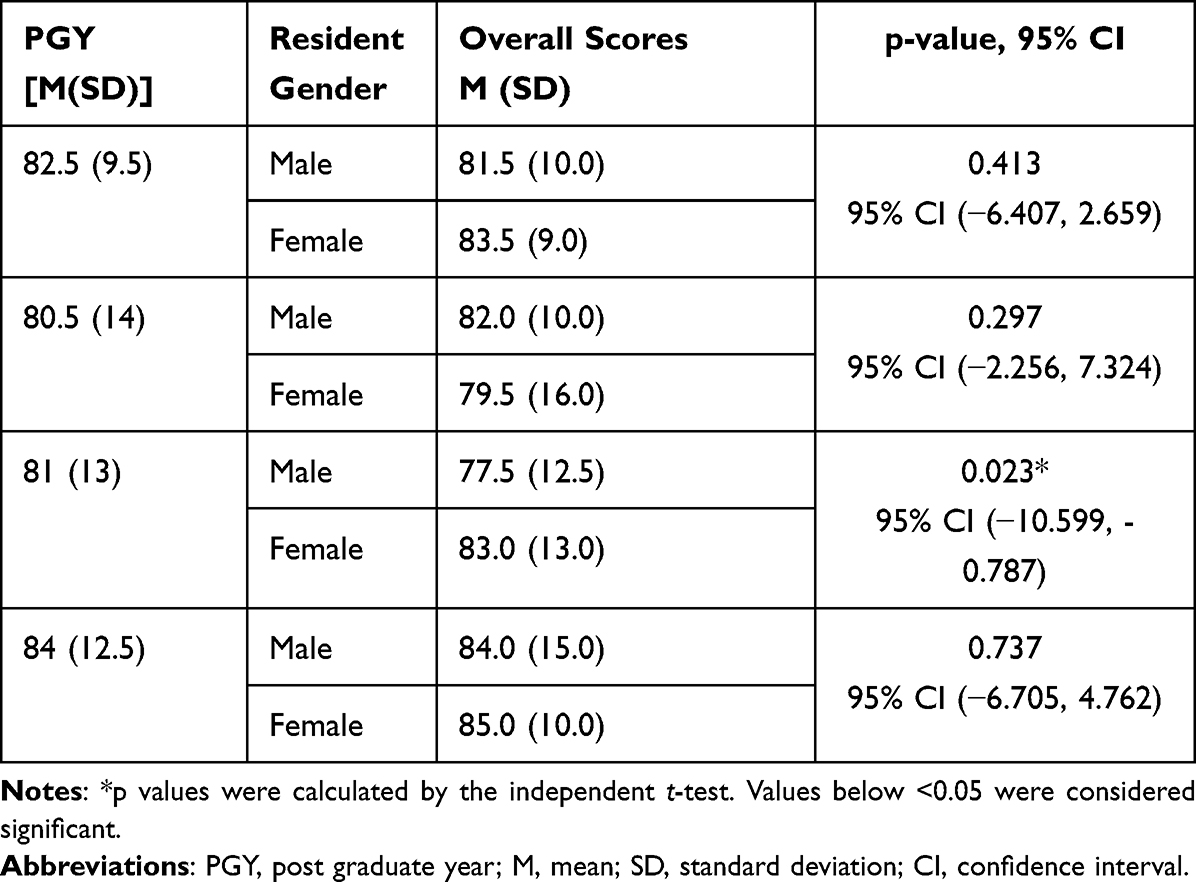 |
Table 1 Overall Evaluation Scores in Each year of Residency Based on Resident Gender |
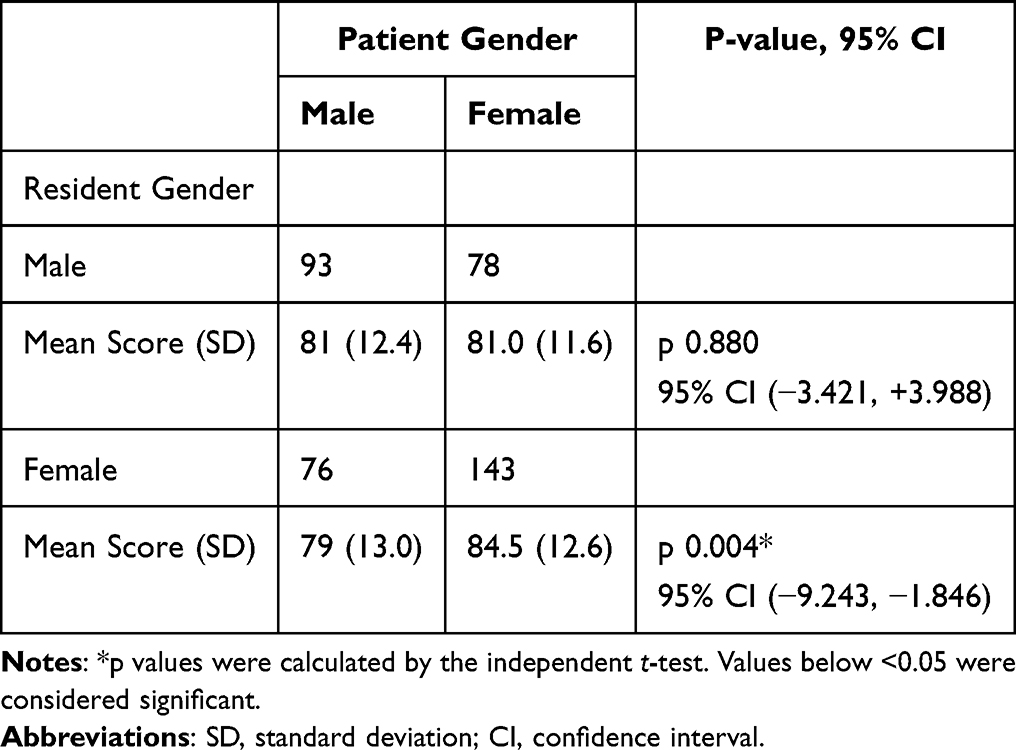 |
Table 2 Overall Performance in Communication Skills According to Patient and Resident Gender |
Stratified analysis of patient-centered communication skills scores by resident and patient gender showed that residents generally scored higher when interacting with patients of the same gender. Male residents performed significantly better when inquiring about emotions with male patients (p = 0.016), whereas female residents exhibited significantly higher scores when interviewing female patients (p = 0.034) and reflecting on patient emotions (p = 0.003). Additionally, in PGY-3, female residents scored significantly higher (68.0% [SD = 26.0]) than male residents (56.0% [SD = 27.0], p = 0.031) when interacting with patients of the same gender.
As shown in Table 3, the residents performed well across all assessed categories. However, scores were comparatively lower in the “Body of the Interaction” category. The lowest scores were recorded in patient-centered communication skills (mean score: 65.5% ± 25.0), particularly in emotional competency.
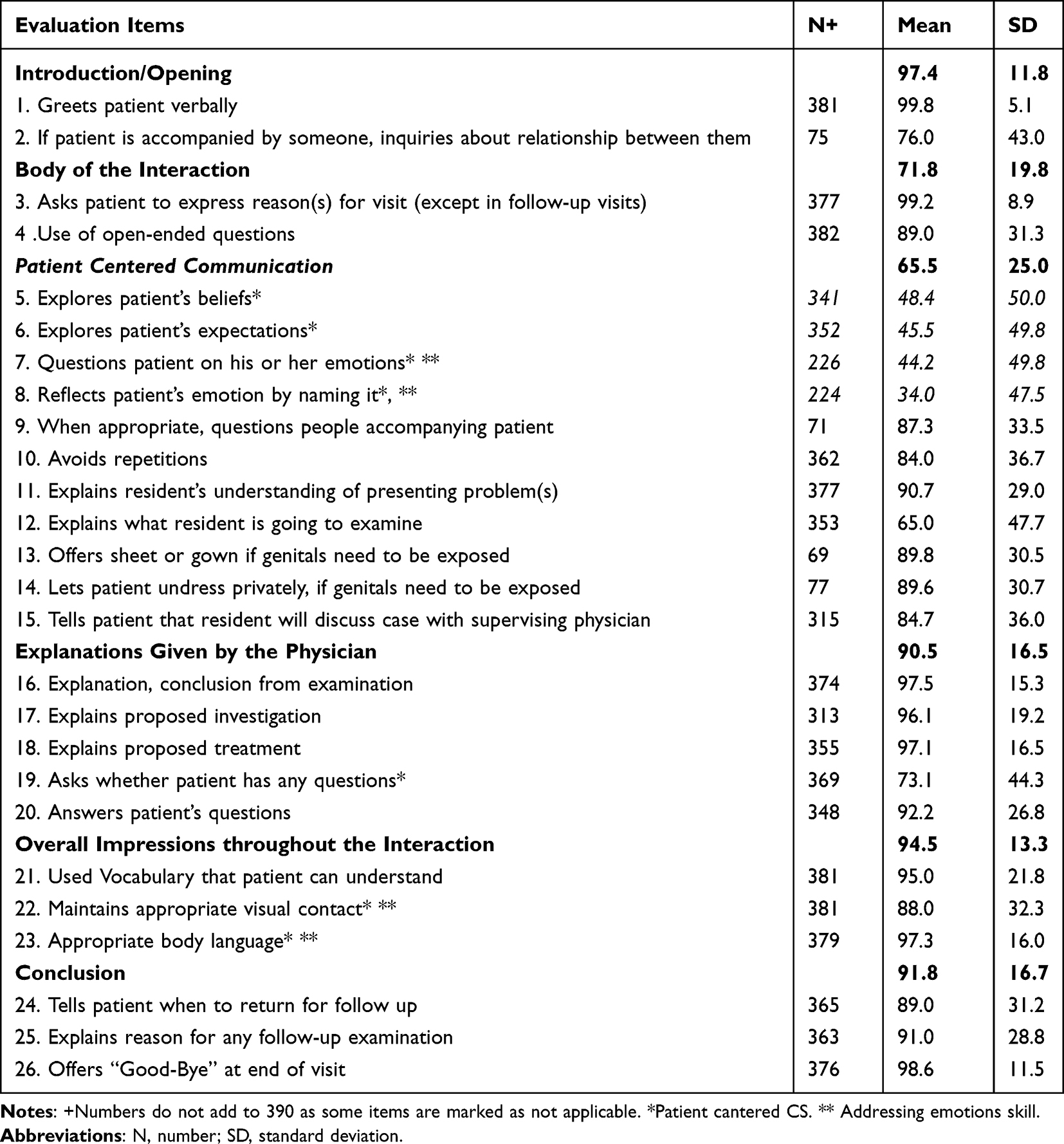 |
Table 3 Scores for Each of the Five Categories and Individual Items |
Discussion
Family medicine residents at the AUBMC demonstrated strong CS, with an overall performance score of 82%. This is better than those reported in other studies. A study from Iran found that patient satisfaction with residents’ CS was 48.8%.19 However, given that patients often provide more favorable evaluations than residents’ self-assessments, this score may be somewhat inflated.20 Family medicine residents at AUBMC performed particularly well in using open-ended questions and explaining diseases and management plans to patients. Han et al (2017) analyzed audiotaped interviews with internal medicine residents in a program in the United States and found that they performed poorly when employing appropriate questioning strategies and educating patients about their diagnoses and treatment plans.21
Family medicine residents at the AUBMC scored low on the items that address patients’ beliefs, expectations and emotions which contributed the most to lowering the overall CS score. Our findings were not different from those reported by a study from Tennessee, USA, which reported a score of 2/4 among first-year residents on incorporating the patient’s or family’s perspective, an essential element of patient-centered communication.22 Considering the family perspective is relevant in collectivist cultures, such as Lebanon, where patients and their families are often integral to medical decision-making. A study on obstetrics and gynecology residents in the Kingdom of Saudi Arabia showed that residents had the lowest score on the item “Involved me in decisions as much as I wanted” which is included in the Communication Assessment Tool (CAT). This was also reported earlier from a FM program in the United States.23,24 Research based on analyzing audio recording of residents at the Southern Illinois University School of Medicine revealed poor performance in understanding the patient’s perspective.21
Empathy comprises multiple components that can be challenging to define and assess.25–27 While we anticipated cultural differences in emotional expression between residents in our program and those in Western settings (Western Europe and North America), our findings did not align with Lim’s observation of such differences.3 Although residents excelled in maintaining appropriate posture and eye contact, they scored lower in reflecting on and exploring patients’ emotions when applicable. This may be attributable to the belief that explicitly naming negative emotions can heighten patient distress. In our study at AUBMC, which is an American institution, residents face the challenge of balancing Western medical training with collectivist and traditional expectations of Eastern patients.
No decline in empathy-related communication behaviors was observed across residency levels, a finding that aligns with some reports but contradicts others.2,25,26,28 One possible explanation is the continuous emphasis on the patient-physician relationship throughout the various teaching activities implemented by the FMD at the AUBMC.
In our program female residents performed better than their male counterparts in overall CS and patient-centered communication when interacting with female patients. This finding is consistent with the study by Bertakis et al who reported that physician-patient gender concordance was associated with better scores in understanding the whole person.29 Female residents in our program excelled in overall performance during PGY-3. At the level of PGY-4, scores between male and female residents were comparable, likely reflecting increased experience and greater confidence in handling sensitive psychosocial issues across genders. A study conducted in the United Kingdom found no significant gender differences in the external measures of empathy among general practitioners.27
Although PGY-4 residents had higher CS scores than those of other residency levels, the total mean scores did not differ significantly. The relatively strong performance of first-year residents can be attributed to several factors. Upon joining the FMD, PGY-1 residents participated in three dedicated CS workshops. Additionally, first-year residents often spend more time with patients than their senior counterparts do. While PGY-2, PGY-3, and PGY-4 residents continued to engage in patient-physician relationship training throughout their residency, their performance did not show significant improvement. Whether this stagnation is due to reduced patient interaction time remains unclear. Previous research has identified heavy workloads as a barrier to effective patient-centered communication.14,24 Notably, the perception of having sufficient time with patients is a key element of the CAT.24
A major strength of this study is that the data were collected through direct observation rather than resident self-reports, which are susceptible to bias. Direct observation is also more reliable than studies that rely solely on audio-recorded interviews, which may miss critical nonverbal communication cues. Unlike other studies, all residents in our program were evaluated, reducing potential selection bias. While some may argue that patient evaluations are the most relevant, Johnson et al (2020) reported that patients tended to rate residents more favorably than faculty members, introducing another potential source of bias.30
This study had several limitations. Comparisons with other studies are challenging owing to differences in assessment methodologies. While some studies relied on resident self-assessments, others used patient evaluations, audio-recorded consultations, and less used direct observation. Additionally, despite using direct observation, we could not ascertain whether all faculty members consistently captured every detail of each resident’s communication skills, potentially leading to missing certain items. Furthermore, we did not assess the complexity of clinical cases or their potential impact on residents’ comfort levels and stress, which could have influenced their communication performance.
Knowing that they may be monitored may alter the behavior of residents and improve the skills addressed in our study. Furthermore, no advanced statistical analyses accounting for clustering were performed. Each consultation, involving a different patient and medical condition, was analyzed as an independent observation. Because each resident participated in an average of six consultations, observations may have been correlated within residents. Failure to account for this potential clustering could have affected the precision of the estimates and is an important limitation of the study.
Conclusions
In general, FM residents at the AUBMC at all levels did well in CS. No empathy decline was noted over the training years. The lowest scores were noted in items pertaining to patient centered approach and addressing emotions. There is a need to develop activities that address this deficiency.
Acknowledgments
We would like to thank all faculty members and residents who made this study possible.
Funding
This research received no grant from any funding agency.
Disclosure
The authors report no conflicts of interest in this work.
References
1. Eno C, Correa R, Stewart NH, et al. Milestones Guidebook for Residents and Fellows. Accreditation Council for Graduate Medical Education; 2020.
2. Noordman J, Post B, van Dartel AAM, Slits JMA, Olde Hartman TC. Training residents in patient-centred communication and empathy: evaluation from patients, observers and residents. BMC Med Educ. 2019;19:128. doi:10.1186/s12909-019-1555-5
3. Lim N. Cultural differences in emotion: differences in emotional arousal level between the East and the West. Integr Med Res. 2016;5(2):105–8. doi:10.1016/j.imr.2016.03.004
4. Perera HJM. Effective communication skills for medical practice. J Postgrad Inst Med. 2015;2:20. doi:10.4038/jpgim.8082
5. Tazzyman A, Ferguson J, Hillier C, Boyd A, Archer J, Tarrant C. The evolving purposes of medical revalidation in the United Kingdom: a qualitative study of professional and regulatory narratives. Acad Med. 2018;93(4):642–647. doi:10.1097/ACM.0000000000001904
6. Gilligan C, Powell M, Lynagh MC, et al. Interventions for improving medical students’ interpersonal communication in medical consultations. Cochrane Database Syst Rev. 2021;2:CD012418. doi:10.1002/14651858.CD012418.pub2
7. Core Committee, Institute for International Medical Education. Global minimum essential requirements in medical education. Med Teach. 2002;24(2):130–135. doi:10.1080/01421590220120731
8. Yu CC, Tan L, Le MK, et al. The development of empathy in the healthcare setting: a qualitative approach. BMC Med Educ. 2022;22(1):3. doi:10.1186/s12909-022-03312-y
9. Moudatsou M, Stavropoulou A, Philalithis A, Koukouli S. The role of empathy in health and social care professionals. Healthcare. 2020;8(1):26. doi:10.3390/healthcare8010026
10. Boissy A, Windover AK, Bokar D, et al. Communication skills training for physicians improves patient satisfaction. J Gen Intern Med. 2016;31(7):755–761. doi:10.1007/s11606-016-3597-2
11. Sorenson C, Bolick B, Wright K, Hamilton R. Understanding compassion fatigue in healthcare providers: a review of current literature. J Nurs Scholarsh. 2016;48(5):456–465. doi:10.1111/jnu.12229
12. Lewis JJ, Balaji L, Grossestreuer AV, Ullman E, Rosen C, Dubosh NM. Correlation of attending and patient assessment of resident communication skills in the emergency department. AEM Educ Train. 2021;5(4):e10629. doi:10.1002/aet2.10629
13. King A, Hoppe RB. Best practice for patient-centered communication: a narrative review. J Grad Med Educ. 2013;5(3):385–393. doi:10.4300/JGME-D-13-00072.1
14. Nosseir M. Arabs and Westerners: the widening gap. The Globalist; 2015. Available from: https://www.theglobalist.com/arabs-westerners-middle-east-us/.
15. Kwame A, Petrucka PM. A literature-based study of patient-centered care and communication in nurse-patient interactions: barriers, facilitators, and the way forward. BMC Nurs. 2021;20(1):158. doi:10.1186/s12912-021-00684-2
16. Aziz AB, Ali SK. Relationship between level of empathy during residency training and perception of professionalism climate. BMC Med Educ. 2020;20:262. doi:10.1186/s12909-020-02231-0
17. Lehmann F, Côté L, Bourque A, Fontaine D. Physician-patient interaction: a reliable and valid checklist of quality. Can Fam Physician. 1990;36:1711–1714.
18. IBM Corp. IBM SPSS Statistics for Windows. Version 28.0. IBM Corp; 2021.
19. Nouri M, Ghaffarifar S, Bazargani HS, Ghaffari R. Patients’ satisfaction with medical residents’ communication skills at the largest teaching and treatment center in Northwest Iran in 2016. Shiraz E Med J. 2017;18(4):e44968. doi:10.5812/semj.44968
20. Burt J, Abel G, Elmore N, et al. Rating communication in GP consultations: the association between ratings made by patients and trained clinical raters. Med Care Res Rev. 2018;75(2):201–218. doi:10.1177/1077558716671217
21. Han H, Papireddy MR, Hingle ST, Ferguson JA, Koschmann T, Sandstrom S. The most common feedback themes in communication skills training in an internal medicine residency program: lessons from the resident audio-recording project. Health Commun. 2018;33(7):809–815. PMID: 28467180. doi:10.1080/10410236.2017.1314872
22. Budesa Z, Klar M, Datta S, Moore E, Lamsen L. Evaluating first year residents’ communication skills: a health literacy curriculum needs assessment. J Commun Healthc. 2023;16(1):30–37. doi:10.1080/17538068.2022.2026054
23. Qari AA, Alswat MM, Alharbi BS, Khalil A. Patients’ perception and residents’ self-evaluation of the communication skills of obstetrics and gynecology residents. Dr Sulaiman Al Habib Med J. 2020;2(4):174–180. doi:10.2991/dsahmj.k.200903.003
24. Myerholtz L, Simons L, Felix S, et al. Using the communication assessment tool in family medicine residency programs. Fam Med. 2010;42(8):567–573.
25. Schrooten I, de Jong MD. If you could read my mind: the role of healthcare providers’ empathic and communicative competencies in clients’ satisfaction with consultations. Health Commun. 2017;32(1):111–118. doi:10.1080/10410236.2015.1110002
26. Foreback J, Kusz H, Lepisto BL, Pawlaczyk B. Empathy in internal medicine residents at community-based hospitals: a cross-sectional study. J Med Educ Curric Dev. 2018;5:2382120518771352. doi:10.1177/2382120518771352
27. Surchat C, Carrard V, Gaume J, Berney A, Clair C. Impact of physician empathy on patient outcomes: a gender analysis. Br J Gen Pract. 2022;72(715):e119–e126. doi:10.3399/BJGP.2021.0193
28. Kusz H, Foreback J, Dohrenwend A. Empathy among internal medicine residents in a community-based training program: a pilot study. MedEdPublish. 2017;6:53. doi:10.15694/mep.2017.000077
29. Bertakis KD, Franks P, Epstein RM. Patient-centered communication in primary care: physician and patient gender and gender concordance. J Womens Health. 2009;18(4):539–545. doi:10.1089/jwh.2008.0969
30. Johnson W, Ngo NA, Elrod M. Communication skills of Grandview/Southview Medical Center general surgery residents. J Osteopath Med. 2020;120(12):865–870. doi:10.7556/jaoa.2020.122
 © 2026 The Author(s). This work is published and licensed by Dove Medical Press Limited. The
full terms of this license are available at https://www.dovepress.com/terms
and incorporate the Creative Commons Attribution
- Non Commercial (unported, 4.0) License.
By accessing the work you hereby accept the Terms. Non-commercial uses of the work are permitted
without any further permission from Dove Medical Press Limited, provided the work is properly
attributed. For permission for commercial use of this work, please see paragraphs 4.2 and 5 of our Terms.
© 2026 The Author(s). This work is published and licensed by Dove Medical Press Limited. The
full terms of this license are available at https://www.dovepress.com/terms
and incorporate the Creative Commons Attribution
- Non Commercial (unported, 4.0) License.
By accessing the work you hereby accept the Terms. Non-commercial uses of the work are permitted
without any further permission from Dove Medical Press Limited, provided the work is properly
attributed. For permission for commercial use of this work, please see paragraphs 4.2 and 5 of our Terms.