
Back to Journals » Clinical, Cosmetic and Investigational Dermatology » Volume 19
Real-World Outcomes of Microwave Treatment for Axillary Hyperhidrosis and Bromhidrosis: A 12-Month Study in a Southeast Asian Setting
Authors Le TTM  , Dang NT , Van TT
Received 17 April 2026
Accepted for publication 2 July 2026
Published 25 July 2026 Volume 2026:19 617844
DOI https://doi.org/10.2147/CCID.S617844
Checked for plagiarism Yes
Review by Single anonymous peer review
Peer reviewer comments 4
Editor who approved publication: Dr Michela Starace
Thu Tran Minh Le,1,* Ngocbich T Dang,2,* Trung The Van1
1Department of Dermatology, University of Medicine and Pharmacy at Ho Chi Minh City, Ho Chi Minh City, Vietnam; 2Department of Dermatology and Aesthetic Dermatology, Tam Anh General Hospital, Ho Chi Minh City, Vietnam
*These authors contributed equally to this work
Correspondence: Trung The Van, Department of Dermatology, University of Medicine and Pharmacy at Ho Chi Minh City, Ho Chi Minh City, Vietnam, Email [email protected]
Background: Microwave therapy has emerged as a minimally invasive treatment option, but long-term real-world data, particularly from Southeast Asian populations, remain limited.
Purpose: To evaluate the effectiveness of microwave therapy and its impact on quality of life (QoL) in patients with axillary hyperhidrosis and bromhidrosis.
Patients and Methods: A longitudinal ambispective case series study was conducted on 52 adult patients with axillary hyperhidrosis and bromhidrosis treated with microwave therapy. Treatment efficacy and QoL improvement were assessed at 1 week and at 3, 6, 9, and 12 months post-intervention using the Minor test, Hyperhidrosis Disease Severity Scale (HDSS), Visual Analog Scale (VAS), and Dermatology Life Quality Index (DLQI). Repeated measures were analyzed using mixed-effects models.
Results: At 1 week, the mean area of discoloration decreased markedly from 49.1 cm2 to 0.3 cm2 in the left axilla, with similar improvement observed in the right axilla. At 12 months, compared with baseline, the model-predicted probability of HDSS grade 4 decreased from 68.2% to 5.7%, while the mean odor score and DLQI score decreased from 6.8 to 3.0 and from 19.5 to 6.5, respectively. Overall satisfaction at 12 months was 66.6%. Statistically significant improvements were observed across the majority of efficacy outcomes (p < 0.05). The most common adverse events were pain and swelling, which were mild and self-limiting, with no serious complications reported.
Conclusion: Microwave therapy demonstrated a favorable safety profile and sustained clinical benefits in patients with axillary hyperhidrosis and bromhidrosis over 12 months of follow-up. Although patient satisfaction declined modestly at 12 months, overall treatment outcomes remained favorable.
Keywords: microwave therapy, hyperhidrosis, bromhidrosis, quality of life, patient satisfaction
Introduction
Hyperhidrosis is a condition characterized by excessive sweating in response to thermoregulatory stimuli, primarily due to overactivity of eccrine sweat glands.1 It affects an estimated 15.3 million individuals in the United States of America (USA), yet only 51.0% of affected individuals discuss their condition with healthcare professionals, partly because 60.0% do not perceive it as a medical disorder and 47.0% do not believe that effective treatment is available.2 Hyperhidrosis is classified into primary and secondary forms, with the axilla being the most commonly involved site, often impairing daily functioning and social interactions.3
Axillary odor typically develops after puberty and is primarily caused by bacterial decomposition of apocrine gland secretions.1,4 Although neither excessive sweating nor odor is life-threatening, both conditions cause persistent discomfort and substantially affect daily activities, psychological well-being, and overall quality of life (QoL).5 In Southeast Asia, where high temperature and humidity are prevalent throughout much of the year, the burden of these conditions is likely to be particularly pronounced.
Current treatment options for axillary hyperhidrosis and bromhidrosis include topical and systemic therapies, botulinum toxin injections, energy-based devices and surgical procedures, each with distinct advantages and limitations. Within this therapeutic landscape, microwave therapy represents a device-based treatment option that aims to provide durable symptom control while avoiding repeated injections and the invasiveness of surgical approaches.6 Microwave technology is a non-invasive modality approved by the Food and Drug Administration (FDA) for the treatment of axillary hyperhidrosis with bromhidrosis.7 The miraDry® System (Miramar Labs, Sunnyvale, California, USA) employs microwave technology to deliver controlled electromagnetic energy at 5.8 GHz to the targeted tissue. With an effective penetration depth of 2–5 mm, this produces selective heating at the interface between the deep dermis and subcutaneous tissue, where sweat glands are densely concentrated, resulting in the destruction of both eccrine and apocrine glands through thermal ablation.8 Western studies have demonstrated significant efficacy and high patient satisfaction with this technique. Favorable outcomes have also been reported across several Asian populations, including studies from China, South Korea, and Japan.9–11 However, despite the hot and humid climate of Southeast Asia, which may influence symptom severity and treatment outcomes, real-world evidence on microwave therapy in this region remains limited.
Therefore, this study was conducted to evaluate the long-term efficacy, safety, and QoL improvement associated with microwave therapy in patients with axillary hyperhidrosis and bromhidrosis in a Southeast Asian setting.
Materials and Methods
Eligibility Criteria
Participants were eligible for inclusion if they were ≥18 years of age, had a confirmed diagnosis of primary axillary hyperhidrosis accompanied by axillary bromhidrosis, and were indicated for treatment with microwave therapy. Primary axillary hyperhidrosis was diagnosed when patients had a history of excessive axillary sweating for at least 6 months without any identifiable secondary cause, accompanied by at least two of the following six criteria: onset before 25 years of age, frequent episodes throughout the week, bilateral symmetry, positive family history, resolution during sleep and interference with daily activities.12 Axillary bromhidrosis was diagnosed based on patient complaints, reports from family or others, or physician observation of odor from the axillae during clinical evaluation. Only patients who provided written informed consent were enrolled.
Patients were excluded if they had secondary hyperhidrosis; active axillary swelling or infection; implanted pacemakers or other electronic devices; a known allergy to local anesthetics, including lidocaine or adrenaline; were pregnant or breastfeeding; had psychiatric disorders that impaired cooperation during the treatment process; or had received botulinum toxin injections or other treatments for axillary hyperhidrosis within the preceding 6 months.
Study Design
This was an ambispective longitudinal study using consecutive sampling. This study included both retrospective and prospective components to evaluate real-world treatment outcomes over an extended follow-up period. Patients who initiated treatment between October 2023 and June 2024 were retrospectively identified and subsequently followed prospectively from July 2024 onward. From July 2024 to November 2024, additional patients were consecutively enrolled and followed prospectively. All data collection and analysis were conducted after ethical approval. The study was conducted at the Department of Dermatology and Aesthetic Dermatology, Tam Anh General Hospital, Ho Chi Minh City.
Assessment Tools
Basic patient characteristics were recorded, including sex, age, weight, height, age of onset, family history, previous treatment modalities and axillary dimensions (length and width).
The Minor test was performed by applying an iodine–alcohol solution followed by cornstarch to the axillae; sweat-producing areas turned dark blue–black.13 This assessment was conducted at baseline to document axillary sweating and repeated at the 1-week follow-up to evaluate post-treatment sweat reduction.
The Hyperhidrosis Disease Severity Scale (HDSS) is a four-point patient-reported scale (1: not noticeable; 2: tolerable; 3: barely tolerable; 4: intolerable sweating interfering with daily activities). It was used to evaluate the severity of axillary hyperhidrosis.14
The Visual Analog Scale (VAS), ranging from 0 to 10, was used to evaluate the severity of axillary odor perceived by the patients. A score of 0 indicates no odor, whereas a score of 10 represents the worst possible odor.
The Dermatology Life Quality Index (DLQI) is a patient-reported outcome measure (0–30 points) and was used to assess the QoL impact of axillary hyperhidrosis and bromhidrosis. Scores are categorized as: no effect (0–1), small effect (2–5), moderate effect (6–10), very large effect (11–20), and extremely large effect (21–30).15
Disease severity and patient-reported outcomes including HDSS, VAS, DLQI, and satisfaction were evaluated at all time points.
Study Procedures
After disinfecting and marking the axillary treatment area, a solution containing lidocaine 2%, epinephrine 1 mg/mL and 0.9% saline was prepared and infiltrated evenly throughout the marked grid using a multi-needle injector. Adequate anesthesia was confirmed before treatment. The miraDry system was then initialized, treatment parameters such as treatment area and energy level 5 (5.8 GHz, 3.0 s) were entered into the console. After disinfecting the axillae and marking treatment points using the sizing template, a sterile bioTip was attached and a thin layer of KY gel was applied to the skin. Microwave treatment was then delivered to the right and subsequently to the left axilla following the standardized protocol.
Post-intervention assessments were performed at 1 week through direct clinical evaluation, with subsequent follow-up at 3, 6, 9, and 12 months conducted using telephone interviews and electronic medical record review. Outcome data were collected and reviewed by two trained investigators according to standardized study procedures.
Statistical Analysis
Statistical analyses were performed using Stata version 14.0. Descriptive statistics were presented as frequencies and percentages for categorical variables, and as means with standard deviations (SD) for normally distributed continuous variables or medians with interquartile ranges (IQR) for non-normally distributed data. Mixed-effects models were applied to account for within-subject correlation arising from repeated measurements. Mixed-effects ordered logistic regression models were used for ordinal outcomes, mixed-effects logistic regression models for binary outcomes, and linear mixed-effects models for continuous outcomes. Time was included as a fixed effect and subject-level random effects were incorporated in all models. Loss to follow-up was assumed to be missing at random, and all available observations from each participant were included in the analyses. Statistical significance was assessed using the Wald test, with a p value < 0.05 considered statistically significant. When an overall time effect was significant, p values for individual time points represented comparisons between each follow-up visit and the reference category.
Results
A total of 52 patients with axillary hyperhidrosis and bromhidrosis were enrolled in the study. Follow-up data were available for 47 patients at 1 week, 45 patients at 3 months, 44 patients at both 6 and 9 months, and 41 patients at 12 months (Figure 1).
 |
Figure 1 Study flow diagram of patient enrollment and follow-up. |
Patient Characteristics
Baseline demographic and clinical characteristics of the study population are summarized in Table 1. Most participants were female (80.8%), and the majority had severe disease at baseline, with 65.4% classified as HDSS grade 4.
 |
Table 1 Baseline Demographic and Clinical Characteristics of the Study Population |
Treatment Effectiveness
As shown in Table 2, the mean stained area decreased markedly at 1 week compared with baseline in both axillae, approaching near-complete reduction. The linear mixed-effects model confirmed a significant reduction over time, with estimated decreases of approximately 49–50 cm2 (p < 0.001).
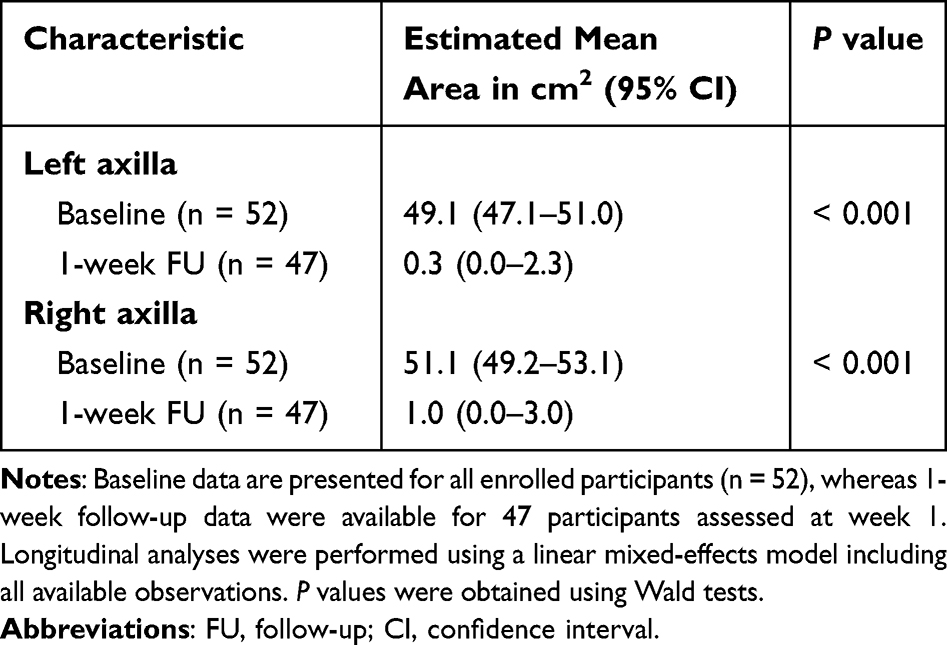 |
Table 2 Comparison of Starch–Iodine–Positive Areas in the Left and Right Axillae at Baseline and 1-Week Follow-Up |
In the mixed-effects ordered logistic regression model, HDSS grades changed significantly over time (overall Wald test for time, p < 0.001) (Figure 2). Relative to baseline, all follow-up visits showed negative fixed-effects coefficients ranging from −4.7 to −8.0, indicating a shift toward lower disease severity. The probability of severe disease (HDSS grade 4) declined markedly from 68.2% at baseline to 5.7% at 12 months (p < 0.001), whereas the combined probability of mild disease (HDSS grades 1–2) increased from 9.2% to 76.8% (p < 0.05). Changes in HDSS grade 3 were modest and not statistically significant (p = 0.355).
 |
Figure 2 Predicted probabilities of each Hyperhidrosis Disease Severity Scale (HDSS) grade across time points based on the mixed-effects ordered logistic regression model. Values shown represent model-predicted probabilities rather than observed proportions. Error bars represent 95% confidence intervals. The overall time effect was statistically significant (p < 0.001). |
In the linear mixed-effects model, odor score decreased significantly over time (Wald test, p < 0.001), with negative fixed-effects coefficients for follow-up visits ranging from −3.8 to −5.0 relative to baseline (Figure 3). The model-derived predicted mean odor score decreased from 6.8 (95% CI: 6.4–7.2) at baseline to 3.1 (95% CI: 2.7–3.5) at week 1, and further to 2.3 (95% CI: 1.9–2.6) at 3 months. The score remained low at 1.8 (95% CI: 1.4–2.2), 1.9 (95% CI: 1.5–2.3) and 3.0 (95% CI: 2.6–3.4) at 6, 9, and 12 months, respectively.
 |
Figure 3 Predicted mean odor scores across time points based on the linear mixed-effects model. Values shown represent model-predicted means rather than observed values. Error bars represent 95% confidence intervals. The overall time effect was statistically significant (p < 0.001). |
Treatment-Related Events
As shown in Table 3, the most common treatment-related events during the first week were pain and swelling (85.1%), reduced hair growth (57.4%) and bruising (51.1%). All reported adverse events were mild in severity. Most adverse events decreased substantially by 3 months and had almost completely resolved by 6 months, with only a low rate of reduced hair growth remaining (9.1%), which resolved completely by month 9. No treatment-related events were observed thereafter. No cases of compensatory hyperhidrosis or infection were reported throughout the study period. Cold compresses were applied routinely as part of standard post-procedural care, and oral analgesics were administered as needed for pain relief in a subset of patients. Conservative management was sufficient in all cases, and no patient required additional pharmacological or procedural intervention.
 |
Table 3 Treatment-Related Events at Each Follow-Up Time Point |
QoL Improvement and Patient Satisfaction
In the linear mixed-effects model, DLQI scores decreased significantly over time relative to baseline (Wald test, p < 0.001), with negative fixed-effects coefficients for all follow-up visits ranging from −9.8 to −17.0 (Figure 4). The predicted mean DLQI score at baseline was 19.5 (95% CI: 18.6–20.3). Following treatment, the DLQI decreased to 9.7 (95% CI: 8.8–10.5) at week 1 and further to 4.8 (95% CI: 3.9–5.7) at 3 months. The score continued to decline to 2.6 (95% CI: 1.7–3.5) at 6 months, and remained low at 2.5 (95% CI: 1.7–3.4) at 9 months, before increasing to 6.5 (95% CI: 5.6–7.5) at 12 months.
 |
Figure 4 Predicted mean Dermatology Life Quality Index (DLQI) scores across time points based on the linear mixed-effects model. Values shown represent model-predicted means rather than observed values. Error bars represent 95% confidence intervals. The overall time effect was statistically significant (p < 0.001). |
In the mixed-effects logistic regression model, patient satisfaction varied significantly over time (overall Wald test for time, p = 0.004) (Figure 5). Compared with week 1, satisfaction was significantly higher at 3, 6, and 9 months, with positive fixed-effects coefficients ranging from 1.5 to 2.3 (all p < 0.05), whereas the difference at 12 months was not statistically significant, as indicated by a small fixed-effects coefficient of −0.2 (p = 0.711). The predicted probability of being satisfied increased from 69.2% at week 1 to a peak of 89.1% at 3 months and remained high at 6 months (85.6%) and 9 months (83.3%), followed by a slight decline at 12 months (66.6%). Conversely, the probability of being not satisfied remained low across follow-up visits.
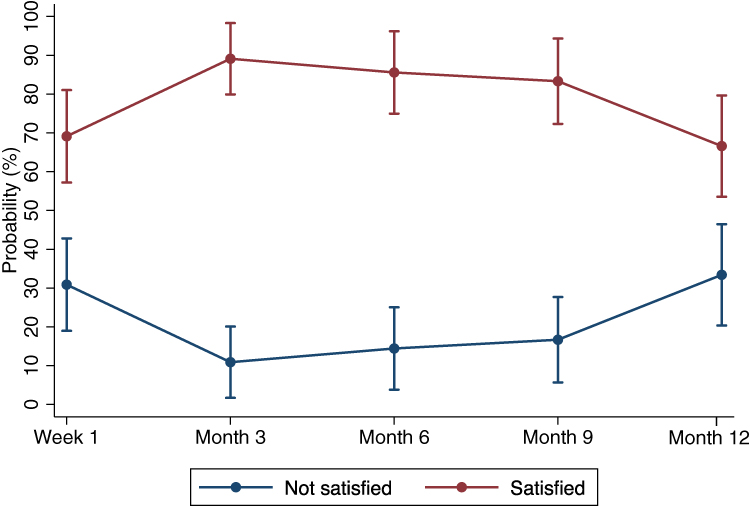 |
Figure 5 Predicted probabilities of patient satisfaction across time points based on the mixed-effects logistic regression model. Values shown represent model-predicted means rather than observed values. Error bars represent 95% confidence intervals. The overall time effect was statistically significant (p = 0.004). |
Discussion
Patient Characteristics
A median BMI of 22.0 kg/m2 was observed in this study, which was lower than the 24.8 kg/m2 reported by Hong et al.16 This difference may reflect variations in study populations and recruitment settings between the two cohorts.
Baseline disease severity was high, with HDSS grades 3 and 4 accounting for 28.8% and 65.4%, respectively. Wimmer et al17 similarly reported a cohort with predominantly severe disease, with 35.0% of patients classified as HDSS grade 3 and 65.0% as grade 4. The median DLQI in the present study was 21.0, which was markedly higher than that reported by Grove et al18 (10.0, IQR 7.0–14.0). These differences suggest a greater baseline quality-of-life burden in our cohort and may reflect variations in disease severity and patient characteristics across study populations.
Treatment Effectiveness and Treatment-Related Events
In this cohort of patients from a tropical Southeast Asian setting, clinically meaningful reductions in axillary sweating and axillary odor were observed early after treatment and were largely maintained throughout 12 months of follow-up. Similar long-term benefits have been reported by Tan et al9 and Glaser et al,19 supporting the durability of microwave therapy across different patient populations. The sustained treatment effect is biologically plausible because microwave energy selectively induces thermolysis of eccrine and apocrine glands located at the dermal–subcutaneous interface, resulting in prolonged reduction of sweat production.8 Likewise, improvement in axillary odor may be attributed to destruction of apocrine glands,10 thereby reducing the secretion of odor precursors available for bacterial metabolism.20
Common treatment-related events during the first week included pain, swelling, hair reduction, and bruising, all of which improved over time. Similar short-term adverse events have been reported by Scuderi et al.21 Pain is likely related to tissue injury induced by microwave energy and the gradual resolution of local anesthetic effects. Tumescent anesthesia creates a fluid cushion that protects deeper structures and facilitates targeted energy delivery to the dermal–subcutaneous interface where sweat glands reside.22 Compared with conventional local anesthesia, tumescent anesthesia provides improved safety, better pain control, and reduced bleeding, thereby enhancing treatment precision.23 However, fluid infiltration may also contribute to transient swelling. Bruising may result from the negative pressure generated during skin elevation, whereas temporary hair reduction is consistent with partial thermal injury to hair follicles. Continuous surface cooling in the miraDry system protects the epidermis and superficial dermis, minimizing serious or persistent adverse effects.24 Overall, the observed treatment-related events were transient, self-limiting, and consistent with the established safety profile of microwave therapy.
QoL Improvement and Patient Satisfaction
Microwave therapy was associated with early and sustained improvements in QoL throughout follow-up. Comparable improvements in DLQI were reported by Hong et al,16 who observed reductions of approximately 10 points that were maintained for up to 12 months. Early improvement in QoL may be explained by reductions in axillary sweating and odor, which alleviate embarrassment and lessen the need for frequent hygiene measures and clothing adjustments that interfere with daily activities.3 The persistence of these benefits likely reflects durable symptom control following microwave-induced destruction of eccrine and apocrine glands.8
Despite sustained improvements in symptom severity and QoL, patient satisfaction followed a somewhat different pattern. Satisfaction remained high during the first 9 months after treatment but declined modestly at 12 months. While Hong et al16 and Tan et al9 reported persistently high patient satisfaction during long-term follow-up, our cohort demonstrated a slight attenuation of treatment response at the final follow-up visit, reflected by modest increases in HDSS, odor scores, and DLQI. Although these changes were small and outcomes remained markedly improved compared with baseline, residual or recurrent symptoms may partly explain the decline in patient satisfaction.
The discrepancy between maintained clinical improvement and declining satisfaction suggests that patient satisfaction may not always parallel symptom severity or QoL measures. Satisfaction represents a broader patient-reported outcome that may be influenced by factors beyond symptom control alone. In addition, environmental conditions characteristic of tropical Southeast Asia, including high temperature and humidity, could potentially increase awareness of residual sweating symptoms and thereby affect treatment perceptions. However, these factors were not directly evaluated in the present study and should therefore be interpreted cautiously. Further studies are warranted to better understand determinants of long-term patient satisfaction following microwave therapy.
Taken together, these findings support microwave therapy as an effective and generally well-tolerated treatment for axillary hyperhidrosis and bromhidrosis in a tropical Southeast Asian setting. Although a modest decline in patient satisfaction was observed during late follow-up, clinical outcomes and QoL improvements were largely maintained throughout 12 months.
Limitations
This study has several limitations. First, it was conducted at a single center with a relatively small sample size, which may limit the generalizability of the findings. Second, the absence of a control group restricts the ability to establish causal relationships and compare treatment efficacy with other modalities, and placebo effects cannot be excluded. Third, outcomes including HDSS, VAS, DLQI, and patient satisfaction were based on patient-reported measures and may therefore be subject to expectation and reporting bias; additionally, the lack of blinding may have influenced these assessments. Finally, the Minor (starch–iodine) test was not repeated beyond the early follow-up period, limiting objective evaluation of long-term sweat reduction, and loss to follow-up may have introduced bias despite the use of mixed-effects models to account for missing data.
Conclusion
Microwave therapy demonstrated a favorable safety profile and durable clinical benefits in this Southeast Asian cohort, with sustained improvements in axillary sweating, axillary odor, and quality of life throughout 12 months of follow-up. Although patient satisfaction declined modestly during late follow-up, overall treatment outcomes remained favorable.
Ethics Approval
The study was approved by the Institutional Ethics Committee of Tam Anh General Hospital, Ho Chi Minh City (IRB.GCN.TA2.24.14) on June 27, 2024. The approved protocol included both retrospective and prospective study phases. Patients treated between October 2023 and June 2024 were retrospectively included through review of existing clinical records after ethics approval had been obtained, whereas prospective enrollment commenced thereafter. All procedures were conducted in accordance with the ethical principles of the Declaration of Helsinki and written informed consent was obtained from all participants.
Acknowledgments
We sincerely thank all patients who participated in this study for their valuable contribution.
Funding
No funding was received for this study.
Disclosure
The authors report no conflicts of interest in this work.
References
1. Wohlrab J, Bechara FG, Schick C, Naumann M. Hyperhidrosis: a central nervous dysfunction of sweat secretion. Dermatol Ther. 2023;13(2):453–11. doi:10.1007/s13555-022-00885-w
2. Doolittle J, Walker P, Mills T, Thurston J. Hyperhidrosis: an update on prevalence and severity in the United States. Arch Dermatol Res. 2016;308(10):743–749. doi:10.1007/s00403-016-1697-9
3. Parashar K, Adlam T, Potts G. The impact of hyperhidrosis on quality of life: a review of the literature. Am J Clin Dermatol. 2023;24(2):187–198. doi:10.1007/s40257-022-00743-7
4. Troccaz M, Gaia N, Beccucci S, et al. Mapping axillary microbiota responsible for body odours using a culture-independent approach. Microbiome. 2015;3(1):3. doi:10.1186/s40168-014-0064-3
5. Li P, Chen S, Li P, et al. Treatment of axillary osmidrosis by rebalancing skin microecology with Lactobacillus bulgaricus. Front Microbiol. 2022;13:821696. doi:10.3389/fmicb.2022.821696
6. Arora G, Kassir M, Patil A, et al. Treatment of Axillary hyperhidrosis. J Cosmet Dermatol. 2022;21(1):62–70. doi:10.1111/jocd.14378
7. US Food and Drug Administration. miraDry System–K103014 510(k) summary. Available from: https://www.accessdata.fda.gov/scripts/cdrh/devicesatfda/index.cfm?db=pmn&id=K103014.
8. Sanchez-Carpintero I, Martin-Gorgojo A, Ruiz-Rodriguez R. Microwave treatment for axillary hyperhidrosis and bromhidrosis. Actas Dermosifiliogr. 2017;108(5):418–422. doi:10.1016/j.ad.2016.12.011
9. Tan Y, Huang W, Liu J, et al. The application of microwaves in axillary hyperhidrosis: curative effect observation of a pathological examination over 1 year. J Cosmet Dermatol. 2024;23(1):134–140. doi:10.1111/jocd.15909
10. Lee SJ, Chang KY, Suh DH, Song KY, Ryu HJ. The efficacy of a microwave device for treating axillary hyperhidrosis and osmidrosis in Asians: a preliminary study. J Cosmet Laser Ther. 2013;15(5):255–259. doi:10.3109/14764172.2013.807114
11. Kaminaka C, Mikita N, Inaba Y, et al. Clinical and histological evaluation of a single high energy microwave treatment for primary axillary hyperhidrosis in Asians: a prospective, randomized, controlled, split-area comparative trial. Lasers Surg Med. 2019;51(7):592–599. doi:10.1002/lsm.23073
12. Hornberger J, Grimes K, Naumann M, et al. Recognition, diagnosis, and treatment of primary focal hyperhidrosis. J Am Acad Dermatol. 2004;51(2):274–286. doi:10.1016/j.jaad.2003.12.029
13. Hexsel D, Rodrigues TC, Soirefmann M, Zechmeister-Prado D. Recommendations for performing and evaluating the results of the minor test according to a sweating intensity visual scale. Dermatol Surg. 2010;36(1):120–122. doi:10.1111/j.1524-4725.2009.01364.x
14. Stashak AB, Brewer JD. Management of hyperhidrosis. Clin Cosmet Invest Dermatol. 2014;7:285–299. doi:10.2147/CCID.S53119
15. Finlay AY, Khan GK. Dermatology life quality index (DLQI)–a simple practical measure for routine clinical use. Clin Exp Dermatol. 1994;19(3):210–216. doi:10.1111/j.1365-2230.1994.tb01167.x
16. Hong HC, Lupin M, O’Shaughnessy KF. Clinical evaluation of a microwave device for treating axillary hyperhidrosis. Dermatol Surg. 2012;38(5):728–735. doi:10.1111/j.1524-4725.2012.02375.x
17. Wimmer F, Ramic A, Nolte JP, Djedovic G, Dietl M. Evaluation of efficacy and safety of miraDry procedure in the treatment of primary axillary hyperhidrosis. Aesthetic Plast Surg. 2025;49(9):2545–2551. doi:10.1007/s00266-024-04558-1
18. Grove GL, Togsverd-Bo K, Zachariae C, Haedersdal M. Botulinum toxin A versus microwave thermolysis for primary axillary hyperhidrosis: a randomized controlled trial. JAAD Int. 2024;15:91–99. doi:10.1016/j.jdin.2023.12.011
19. Glaser DA, Coleman WP, Fan LK, et al. A randomized, blinded clinical evaluation of a novel microwave device for treating axillary hyperhidrosis: the dermatologic reduction in underarm perspiration study. Dermatol Surg. 2012;38(2):185–191. doi:10.1111/j.1524-4725.2011.02250.x
20. Mogilnicka I, Bogucki P, Ufnal M. Microbiota and malodor-etiology and management. Int J Mol Sci. 2020;21(8):2886. doi:10.3390/ijms21082886
21. Scuderi S, Manoharan P, Lim D, Manoharan S. A survey of patient satisfaction with use of microwave device for axillary hyperhidrosis. Australas J Dermatol. 2017;58(2):126–129. doi:10.1111/ajd.12448
22. Jacob CI. Examining hyperhidrosis: an update on new treatments. Am J Manag Care. 2018;24(23 Suppl):S496–S501.
23. Uttamani RR, Venkataram A, Venkataram J, Mysore V. Tumescent anesthesia for dermatosurgical procedures other than liposuction. J Cutan Aesthet Surg. 2020;13(4):275–282. doi:10.4103/jcas.Jcas_192_19
24. Jacob CI. Treatment of hyperhidrosis with microwave technology. Semin Cutan Med Surg. 2013;32(1):2–8.
 © 2026 The Author(s). This work is published and licensed by Dove Medical Press Limited. The
full terms of this license are available at https://www.dovepress.com/terms
and incorporate the Creative Commons Attribution
- Non Commercial (unported, 4.0) License.
By accessing the work you hereby accept the Terms. Non-commercial uses of the work are permitted
without any further permission from Dove Medical Press Limited, provided the work is properly
attributed. For permission for commercial use of this work, please see paragraphs 4.2 and 5 of our Terms.
© 2026 The Author(s). This work is published and licensed by Dove Medical Press Limited. The
full terms of this license are available at https://www.dovepress.com/terms
and incorporate the Creative Commons Attribution
- Non Commercial (unported, 4.0) License.
By accessing the work you hereby accept the Terms. Non-commercial uses of the work are permitted
without any further permission from Dove Medical Press Limited, provided the work is properly
attributed. For permission for commercial use of this work, please see paragraphs 4.2 and 5 of our Terms.
Recommended articles


Real-World Experience of People with Hemophilia A Receiving Turoctocog Alfa Pegol (N8-GP): Results from a Patient Experience Survey
Eichler H, Nagao A, Waller J, Stuber A
Patient Preference and Adherence 2023, 17:3001-3014
Published Date: 17 November 2023
Factors Associated with Treatment Satisfaction in Korean Patients with Psoriasis
Jung S, Suh D, Lee SM
Patient Preference and Adherence 2024, 18:2093-2105
Published Date: 4 October 2024