
Back to Journals » Diabetes, Metabolic Syndrome and Obesity » Volume 19
Profiles of Health Behavior Motivation in a Chinese Population with Prediabetes and Its Association with Self-Management Ability: Based on Self-Determination Theory
Authors Wu F, Zhang J, Fu A, Wang L, Yi L, Yang J, Jiang B, Chen L, Xiong C
Received 19 September 2025
Accepted for publication 12 January 2026
Published 10 February 2026 Volume 2026:19 567404
DOI https://doi.org/10.2147/DMSO.S567404
Checked for plagiarism Yes
Review by Single anonymous peer review
Peer reviewer comments 2
Editor who approved publication: Professor Melissa Olfert
Fang Wu,1,* Juan Zhang,2,* Adan Fu,2 Li Wang,1 Lan Yi,1 Jing Yang,1 Bowen Jiang,1 Lingxue Chen,1 Chengyue Xiong3
1Department of Endocrinology; The Central Hospital of Wuhan, Tongji Medical College, Huazhong University of Science and Technology, Wuhan, Hubei, People’s Republic of China; 2Department of Nursing, The Central Hospital of Wuhan, Tongji Medical College, Huazhong University of Science and Technology, Wuhan, Hubei, People’s Republic of China; 3Yangtze University School of Nursing, Yangtze University, Jingzhou, Hubei, People’s Republic of China
*These authors contributed equally to this work
Correspondence: Adan Fu, The Central Hospital of Wuhan, Tongji Medical College, Huazhong University of Science and Technology, No. 26 Shengli Street, Jiangan District, Wuhan, Hubei, People’s Republic of China, Email [email protected] Li Wang, The Central Hospital of Wuhan, Tongji Medical College, Huazhong University of Science and Technology, No. 26 Shengli Street, Jiangan District, Wuhan, Hubei, People’s Republic of China, Email [email protected]
Purpose: Using latent profile analysis (LPA) based on Self-Determination Theory (SDT), this study aimed to explore the profiles of health behavior motivation among Chinese patients with prediabetes and examine the relationship between these profiles and self-management ability.
Patients and Methods: A cross-sectional study was conducted involving 335 patients with prediabetes. The questionnaires were used to assess health behavior motivation, self-management ability, satisfaction of basic psychological needs and disease knowledge level. Latent profile analysis was performed based on five subscale scores of the health behavior motivation measure.
Results: Three distinct latent profiles were identified: a “Self-Determined” profile (C1,29.55%, n=99), a “Non Self-Determined” profile (C2, 55.82%, n=187), and a “Conflicted” profile (C3, 14.63%, n=49). Patients in the C1 profile demonstrated higher levels of autonomy and competence. Patients in the C2 profile were characterized by better disease knowledge and lower relatedness. Compared to patients in the C3 profile, patients in both the C1 and C2 profiles exhibited significantly lower self-management ability.
Conclusion: The heterogeneity in health behavior motivation profiles must be considered in the design and clinical practice of personalized interventions for prediabetes. Profile-specific strategies serve as the foundation for enhancing patients’ self-management ability and sustaining healthy behaviors.
Keywords: prediabetes health behavior, motivation, latent profile analysis, self-management
Introduction
Prediabetes is an intermediate state characterized by blood glucose levels higher than normal but not yet meeting the diagnostic criteria for type 2 diabetes. It represents a critical risk stage for progression to type 2 diabetes.The latest IDF Diabetes Atlas (2025) reports that in 2024, 635 million people were estimated to have impaired glucose tolerance(IGT) while 488 million were estimated to have impaired fasting glucose (IFG).1 The reversibility of prediabetes means that through maintaining healthy behaviors, such as adopting a balanced diet and engaging in regular physical activity, this population has the potential to delay or prevent the onset of type 2 diabetes.2 However, in China, individuals with prediabetes have not yet been incorporated into the National Essential Public Health Services Program for standardized management.3 Consequently, their health management primarily relies on individual self-management. Therefore, effectively motivating and sustaining healthy behaviors within this group, as well as enhancing their self-management capabilities, has become a critical issue urgently needing resolution in the field of public health.
The effective implementation and maintenance of healthy behaviors fundamentally hinges on an individual’s behavioral motivation. Self-Determination Theory (SDT) provides a robust theoretical framework for understanding this process. The theory posits that humans possess an innate developmental propensity to fulfill basic psychological needs (autonomy, competence, and relatedness): from infancy onward, individuals exhibit an intrinsic drive to actively explore and comprehend both their internal and external worlds while integrating into the social environment.4 This developmental propensity manifests in two primary expressions: first, as spontaneous behaviors intrinsically linked to internal motivation (eg, curious exploration and immersive learning); and second, through the internalization and integration of social norms to achieve adaptive social functioning.5
SDT classifies human behavioral motivations into two main categories based on the degree of autonomy: autonomous motivation and controlled motivation, along with a state of amotivation. Autonomous motivation arises from intrinsic willingness or highly internalized value identification, encompassing intrinsic regulation (acting purely for inherent interest/enjoyment/efficacy) and internalized extrinsic forms: identified regulation (personally endorsing the behavior’s value) and integrated regulation (aligning behavior with core self-values).It is characterized by spontaneity, persistence, and integration. Conversely, controlled motivation stems from external pressures or internal compulsions, comprising external regulation (behavior controlled by rewards/punishments) and introjected regulation (driven by guilt/approval-seeking), typically accompanied by pressure and conflict. Amotivation describes a non-initiative state in which an individual lacks the intention to act, mainly due to: an inadequate sense of ability (helplessness/low self-efficacy), a deficit of value (no interest or meaning), or a rebellious opposition to external pressure.6 It is precisely this qualitative distinction in autonomy that leads to profoundly different outcomes: autonomous motivation correlates with positive effects (enhanced persistence, creative engagement, subjective well-being), while controlled motivation associates with negative consequences (external feedback dependence, internal anxiety, diminished behavioral quality, emotional exhaustion).7 Given that the motivation types revealed by Self-Determination Theory exhibit qualitative differences, and considering that individuals may demonstrate unique motivational configurations, identifying distinct health behavior motivation subgroups (ie, latent profiles) among prediabetic patients becomes particularly crucial.
In recent years, academic research on the health behavior motivation of patients with prediabetes has been conducted from multiple perspectives, yielding relatively rich findings. First, regarding intervention studies guided by behavioral theories, scholars have designed and implemented various behavior-promoting programs based on frameworks such as protection motivation theory, the information-motivation-behavioral skills model, the transtheoretical model, and self-determination theory, targeting health behavior motivation as a core intervention focus.8–11 Although these interventions can improve patients’ daily health behaviors, self-management abilities, and glycemic metabolism indicators by enhancing their health behavior motivation, the sustainability of these benefits has not been sufficiently validated. Second, in exploring the factors influencing motivation, researchers have employed qualitative methods such as semi-structured interviews to delve into the driving factors and hindrance mechanisms of motivation during the behavior change process in this population, providing detailed contextual information for understanding their behavioral decision-making.12 Furthermore, guided by self-determination theory, researchers have used statistical methods such as structural equation modeling to analyze the pathways through which health behavior motivation affects specific behaviors such as physical activity, further elucidating the mechanisms underlying the relationship between motivation and behavior.13
However, overall, the aforementioned studies predominantly follow a variable-centered analytical approach, treating motivation as a holistic, unidimensional concept, and focus on examining its general association with behavioral outcomes or validating the effectiveness of intervention programs targeting motivation. Although some studies have begun to differentiate types of motivation such as autonomous motivation and controlled motivation, most still analyze them as independent variables and fail to thoroughly investigate the potential combinatorial patterns, intensity ratios, and structural differences of these different motivation types within the population.
Therefore, current research remains insufficient in identifying and describing the systematic heterogeneity of the internal composition of motivation. Revealing such heterogeneity is crucial for understanding and promoting the long-term sustainability of health behaviors. Against this backdrop, introducing analytical methods capable of effectively capturing within-population heterogeneity becomes particularly necessary. Latent Profile Analysis (LPA), as an individual-centered statistical method, offers the advantage of identifying subgroups with distinct latent profile characteristics based on multiple continuous variables.14 This method does not rely on prior classification criteria but reveals the categorical structures present in the data through model fitting. Compared to traditional variable-centered analytical approaches, it can more intuitively present the diverse combinatorial patterns of psychological or behavioral characteristics within a population.15
Therefore, the objectives of this study are, firstly, to identify latent classes of health behavior motivation among the Chinese prediabetic population using Latent Profile Analysis. Secondly, to compare the differences in self-management behaviors across these motivation classes. The findings will contribute to understanding the internal structural differences in behavioral motivation within this population, thereby providing a scientific basis for developing personalized intervention plans/personally tailored digital intervention strategies in clinical practice. Ultimately, by targeted enhancement of patients’ health behavior motivation, this study aims to promote their health behavior changes and achieve the goal of effectively preventing type 2 diabetes and improving long-term health outcomes. Based on Self-Determination Theory and existing evidence, the following hypotheses are proposed:
1. At least one subgroup characterized by high levels of autonomous motivation and conducive to health promotion can be identified in the Chinese prediabetic population.
2. Simultaneously, at least one or more subgroups characterized by a predominance of controlled motivation and associated with higher health risks can be identified.
3. Compared to other types, the subgroup characterized by high levels of autonomous motivation will demonstrate better health management behaviors.
Materials and Methods
Study Design
This study conducted a cross-sectional observational investigation at a tertiary general hospital. A total of 515 patients diagnosed with prediabetes in the hospital’s outpatient clinic in 2024 were initially included and were sent a text-message-based questionnaire assessing their health behavior motivation. Two weeks after the text messages were sent, researchers contacted the participants via telephone to invite them to join the study, ultimately resulting in 335 valid cases being successfully enrolled. While no strict minimum sample size exists for LPA, a widely recommended guideline is to include at least 300 participants.16 This ensures stable and reliable estimation of latent classes, particularly when analyzing multiple indicators. The sample size included in this study meets this recommended guideline.
Measures
The general demographic variables include age, gender, economic status, occupational status, education level, and marital status. Blood glucose monitoring frequency was included as a health-related variable in the survey.
Self-management ability was assessed using the Prediabetes Self-Management Scale (PSMS), developed by Ge et al in 2016.17 The scale consists of 9 dimensions and 29 items, comprehensively evaluating the self-management ability of prediabetes patients from three aspects: cognition (health beliefs and self-efficacy), behavior (diet, exercise, rest and sleep, stress coping, compliance management), and environment (family and social environment management). In this study, the Cronbach’s α coefficient for this questionnaire was 0.914.
The health behavior motivation of prediabetes patients was measured using the Health Behavior Motivation Scale (HBMS). The scale was originally developed by Magdalena et al in 2021 and subsequently translated into Chinese by Jiang et al in 2024.18,19 The Chinese version consists of 30 items, which are divided into five dimensions: intrinsic regulation, identified and integrated regulation, introjected regulation, external regulation, and amotivation. The scale demonstrated a scale-level content validity index (S-CVI) of 0.957, a Cronbach’s α coefficient of 0.965, and a test-retest reliability of 0.882. In this study, the Cronbach’s α coefficient for this questionnaire was 0.954.
In addition, the satisfaction of basic psychological needs was assessed using the Basic Psychological Needs Scales (BPNS), developed by Deci et al in 2000 and translated into Chinese by Li et al in 2022.20–22 The Chinese version of the scale consists of 21 items, categorized into three subscales: autonomy, competence and relatedness needs. The scale demonstrated a scale-level content validity index (S-CVI) of 0.904, a Cronbach’s α coefficient of 0.920, and a test-retest reliability of 0.842. In this study, the Cronbach’s α coefficient for this questionnaire was 0.718.
Lastly, Knowledge of type 2 diabetes was evaluated with the Prediabetes Population Diabetes Knowledge Questionnaire (PPDKQ), which was developed by Zhang et al in 2015.23 The questionnaire consists of 21 items, categorized into five domains: 5 items on type 2 diabetes-related knowledge, 2 items on type 2 diabetes risk factor knowledge, 7 items on type 2 diabetes dietary knowledge, 3 items on type 2 diabetes treatment knowledge, and 4 items on type 2 diabetes exercise knowledge. In this study, the Cronbach’s α coefficient for this questionnaire was 0.688, which is lower than the original reported value of 0.901 in Zhang’s study. This discrepancy may be attributed to the demographic characteristics of the study sample and the evolving structure of public health knowledge over the past decade. Nevertheless, the obtained value remains within the acceptable range.24
Data Analysis
Latent profile analysis was conducted using Mplus software (Version 7.4), with subscale scores from the Health Behavior Motivation Scale (HBMS) serving as manifest variables. Models ranging from one to five latent classes were sequentially estimated using maximum likelihood estimation.
Model fit was evaluated based on three criteria: (1) information criteria, including the Akaike Information Criterion (AIC), Bayesian Information Criterion (BIC), and adjusted BIC (aBIC), where lower values indicate better model fit; (2) entropy, ranging from 0 to 1, with values closer to 1 reflecting greater classification accuracy; and (3) comparative likelihood ratio tests, specifically the Lo-Mendell-Rubin adjusted likelihood ratio test (LMRT) and the bootstrap likelihood ratio test (BLRT), where a statistically significant result (P<0.05) suggested that the k-class model provided a better fit than the (k−1)-class model.25
After selecting the optimal latent profile solution, subsequent analyses were performed using IBM SPSS Statistics (Version 27.0). Continuous variables were summarized as means±standard deviations or medians with interquartile ranges(IQR), while categorical variables were reported as frequencies and percentages. Group differences were assessed using chi-square tests for categorical variables and Kruskal–Wallis tests for continuous variables.
Finally, multinomial logistic regression was conducted to identify factors associated with latent profile classification, and multiple linear regression was used to test the association between latent classes and self-management ability, where a threshold of P<0.05 was used to determine statistical significance.
Results
A total of 335 valid questionnaires were collected, yielding an effective response rate of 65%. The 335 prediabetic patients had an age range of 18–76 years (52.30±12.25 years), with 60.9% being female. Notably, 27.5% of participants self-reported that they almost never monitored their blood glucose levels (see Table 1).
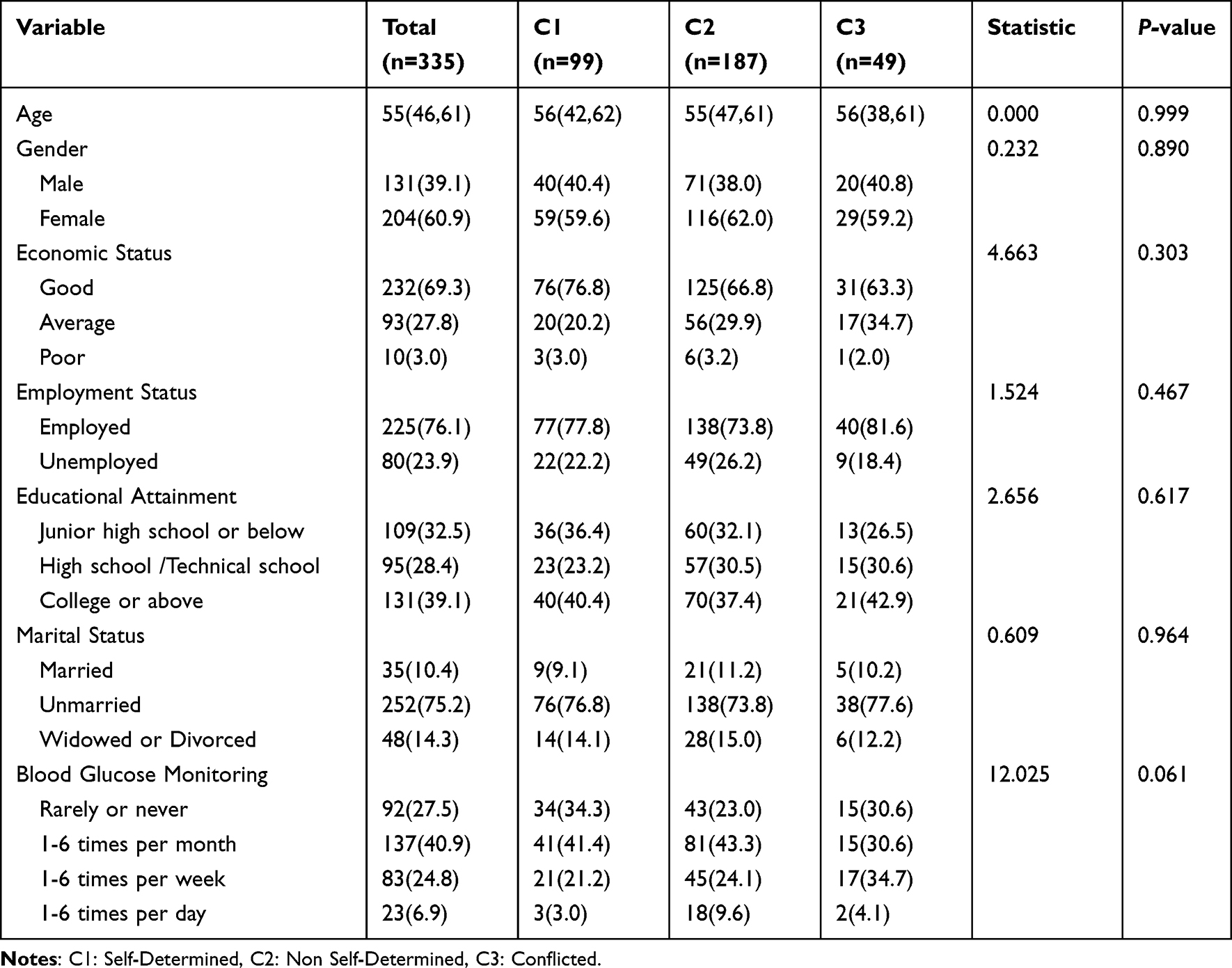 |
Table 1 Classification of Latent Profiles of General Demographic Data [Cases (Percentages,%)] |
Latent Profile Analysis of Health Behavior Motivation in Prediabetic Patients
Among 335 prediabetic patients, the median HBMS score was 93 (IQR 86–105), with dimension-specific medians as follows: intrinsic regulation 20 (IQR 18–23), identified and integrated regulation 20 (IQR 18–22), introjected regulation 18 (IQR 15–21), external regulation 20 (IQR 17–22), and amotivation 18 (IQR 15–21).
Four latent profile models were sequentially fitted starting from the baseline solution (see Table 2). As class numbers increased, entropy progressively rose while AIC, BIC, and aBIC consistently decreased, with all BLRT yielding significant improvements (P<0.001). Comparative fit evaluation revealed that the rate of decrease in AIC, BIC and aBIC substantially slowed at the 3-class solution, coinciding with a non-significant LMRT (P>0.001), indicating diminishing returns in model improvement. The 4-class solution’s LMRT P-value of 0.1687 failed to demonstrate superiority over the 3-class model, confirming the optimal 3-profile structure. Based on a comprehensive evaluation of model fit indices and practical significance, this study identified the 3-class latent profile model as the optimal representation of health behavior motivation among prediabetic patients. The final three-profile solutions as show in Figure 1.
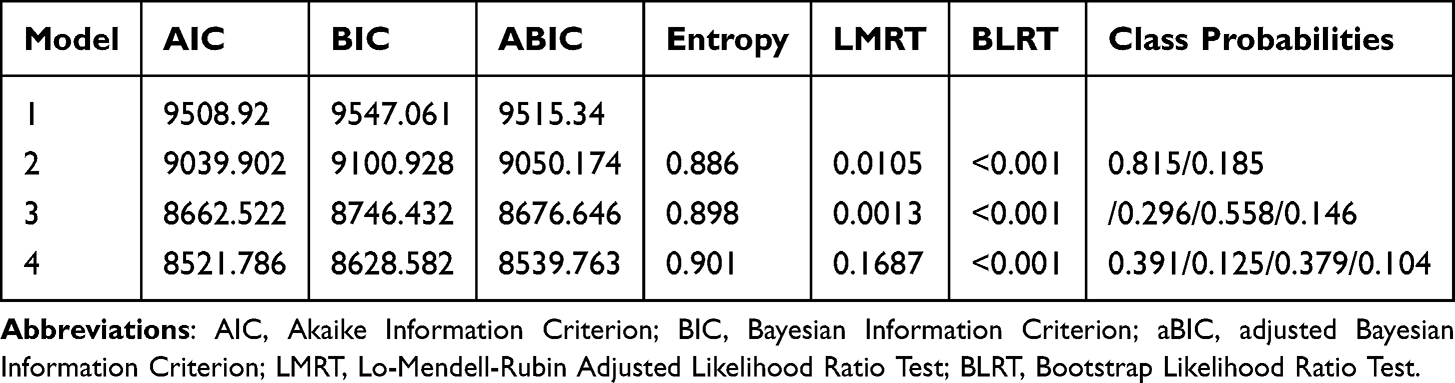 |
Table 2 Model Fit Indices for Latent Profile Analysis of Health Behavior Motivation in Prediabetic Patients |
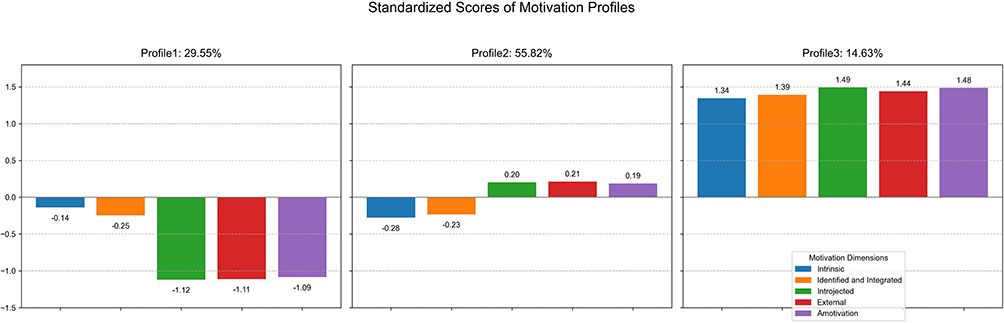 |
Figure 1 Three distinct health behavior motivation patterns among prediabetic patients identified by Latent Profile Analysis. Each motivation profile is defined by its standardized z-scores (Mean = 0, SD = 1) across the five health behavior motivation dimensions of Self-Determination Theory, with each dimension shown in a distinct color. |
1.C1 (Self-Determined,29.55%): Overall below-average motivation; slightly low intrinsic, identified and integrated regulation; very low external, introjected, and amotivation.
2.C2 (Non Self-Determined,55.82%): Near-average overall motivation; slightly low intrinsic, identified and integrated regulation; slightly high external, introjected, and amotivation.
3. C3 (Conflicted,14.63%): High overall motivation with coexisting high autonomous, high controlled, and high amotivation.
Univariate Analysis of Latent Profiles for Health Behavior Motivation in Prediabetic Patients
The results of this study showed no statistically significant differences in demographic characteristics among the three latent profiles of health behavior motivation in prediabetes patients (see Table 1).
Kruskal–Wallis test results (see Table 3) showed that the HBMS score and scores across all dimensions significantly differed among the three latent profiles. Analyzing the characteristics of each class: HBMS scores increased progressively from class C1 to C3 (P<0.05);Scores for the intrinsic regulation and identified and integrated regulation dimensions in profile C3 were significantly higher than those in classes C1 and C2 (P<0.05);Scores for the introjected regulation, external regulation and amotivation dimensions increased progressively from class C1 to C3 (P<0.05);Meanwhile, PPDKQ score, PSMS score, BPNS score and scores for all dimensions were statistically significant (all P<0.05).
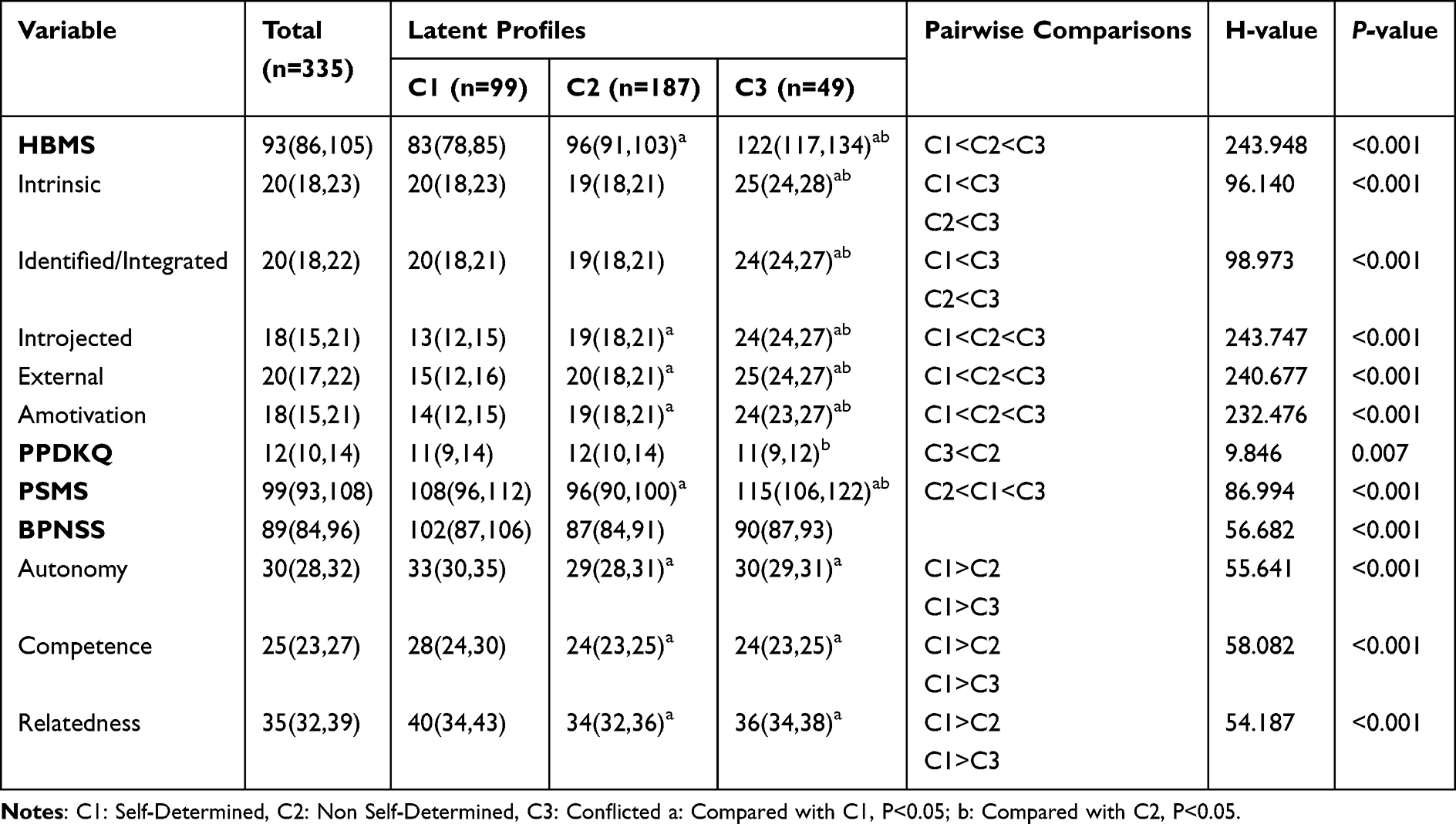 |
Table 3 Comparison of Health Behavior Motivation, Disease Knowledge, Self-Management Ability, and Basic Psychological Need Satisfaction Across Different Latent Profiles [n=335, Score, M (P25, P75)] |
Multivariate Logistic Regression Analysis of Latent Profiles for Health Behavior Motivation in Prediabetic Patients
A multivariate logistic regression analysis was conducted with the three latent profiles of health behavior motivation (“Self-determined” [coded as 1], “Non Self-determined” [2], and “Conflicted” [3]) as the dependent variable. Independent variables included all factors showing statistical significance in the univariate analysis, with variable selection based on default criteria (entry α=0.05, removal α=0.10). The model demonstrated excellent fit (P<0.001), supported by pseudo-R2 values (Cox & Snell=0.284, Nagelkerke=0.333, McFadden=0.173). Results indicated that competence perception significantly influenced both “Non Self-determined” (C2) and “Conflicted” (C3) types (P<0.05), while high autonomy specifically protected against “Self-determined” (C1) motivation (P<0.05). Additionally, greater disease knowledge combined with lower relatedness emerged as protective factors against “Non Self-determined” (C2) motivation (see Table 4).
 |
Table 4 Multivariate Analysis of Latent Profiles of Health Behavior Motivation in Individuals with Prediabetes (n=335) |
Association Between Latent Profiles of Health Behavior Motivation and Self-Management Ability in Prediabetic Patients
The self-management scores of the three latent profiles of health behavior motivation in prediabetic patients— “Self-determined” (C1), “Non Self-determined” (C2) and “Conflicted” (C3) profiles—were 103±15, 96±8, and 113±12, respectively. Multiple linear regression was performed to explore the association between patients self-management ability and latent profiles (Table 5).After controlling for confounding variables, the results revealed that the self-management capacity of both C1 and C2 profiles was significantly lower than that of the C3 profile (P<0.05).Furthermore, to investigate whether differences exist between C1 and C2 patients, we conducted additional multiple linear regression using the C1 profile as the reference category. The results indicated no significant difference in self-management ability between the C1 and C2 profiles.
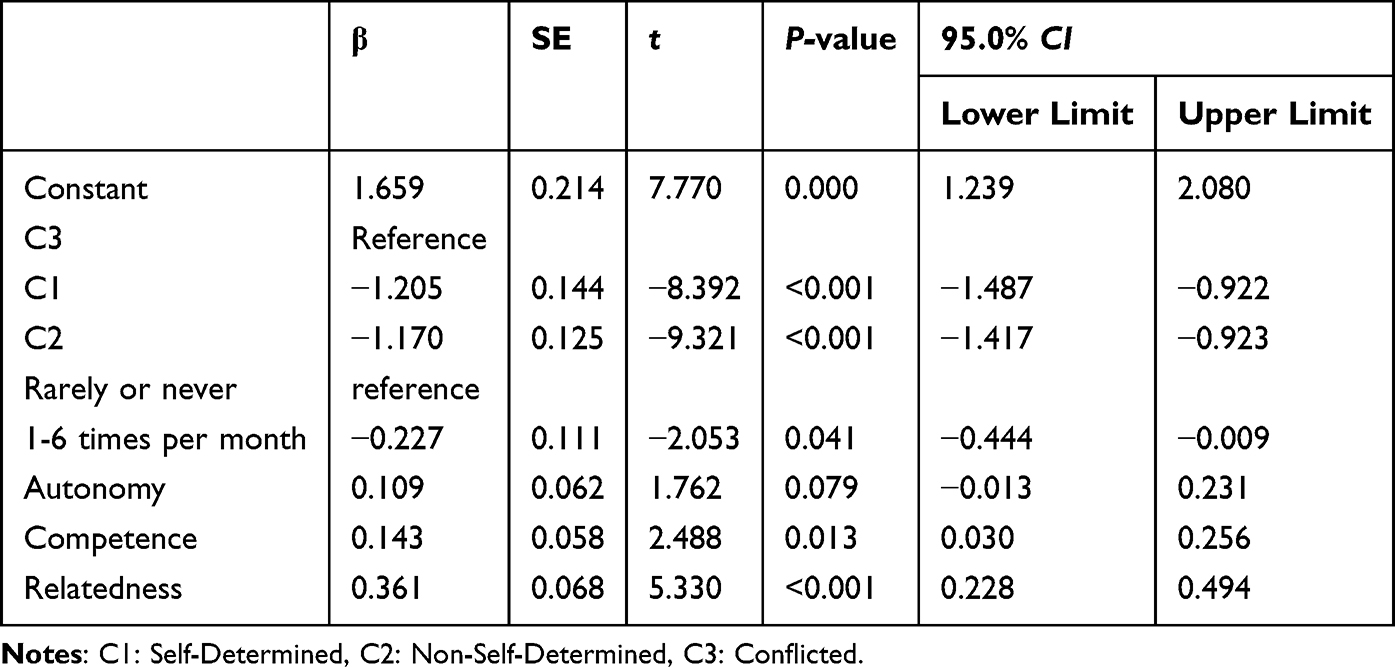 |
Table 5 Association Between Latent Profiles and Self-Management Ability in Multiple Linear Regression (n=335) |
Discussion
With the aid of latent profile analysis, this study categorized 335 patients with prediabetes into three homogeneous subgroups based on shared patterns of health behavior motivation across five domains: intrinsic regulation, identified and integrated regulation, introjected regulation, external regulation, and amotivation. Research combining LPA with SDT has been successfully conducted in other populations—such as motivational analyses of college students engaging in responsible drinking or participants in behavioral weight-loss interventions.26,27 To our knowledge, this is the first empirical study linking LPA and SDT within a Chinese prediabetes population.
Latent Profiles of Health Behavior Motivation in Patients with Prediabetes
Patients with prediabetes can be classified into three latent classes of health behavior motivation, demonstrating significant interindividual heterogeneity. This study revealed that 29.55% of patients with prediabetes belong to the “Self-determined” profile (C1). Although this subgroup exhibited below-mean scores across all motivational dimensions, autonomous motivation predominated in these individuals.
Multiple studies have thoroughly investigated the pivotal role of autonomous motivation in maintaining physical activity behaviors and its relative stability.28,29 An 18-month weight loss intervention study targeting overweight/obese adults—comprising 6 months of supervised and 6 months of non-supervised phases—revealed that individuals possessing a Highly Autonomous exercise motivation (“High Autonomous”) profile exhibited minimal moderate-to-vigorous physical activity (MVPA) attenuation. Their activity maintenance capacity was significantly superior to that of the “Moderate Combined” profile (P=0.043).30 Thus, individuals who exercise for autonomous reasons—such as valuing physical activity and deriving enjoyment from the process—can more effectively sustain MVPA levels even after external supports (eg, supervision) are withdrawn. This highlights the core advantage of autonomous motivation in promoting behavioral persistence. The concurrent lower attrition rate in this group objectively validates this mechanism, as their motivation stems from internal drives rather than reliance on external supervision, making them more inclined toward sustained participation. A cohort study tracking UK primary school pupils’ parents assessed motivation at three timepoints, revealing that the autonomous motivation profile consistently correlated with higher MVPA levels and lower BMI. Notably, while exercise motivation at the individual level was not fixed—demonstrating transitions between different profiles—the proportion of participants classified under the autonomous profile exhibited relative stability at the group level.31 Therefore, we reasonably postulate that the self-determined motivational structure in the “Self-Determined” (C1) patients of our study provides the fundamental psychological foundation for sustaining their long-term health behaviors. Within the Self-Determination Theory framework, this patient subgroup can be characterized as: engaging in exercise autonomously due to enjoyment derived from the activity (intrinsic motivation); perceiving blood glucose control as integral to personal health (identified and integrated regulation); maintaining consistent execution of plans without external supervision; and employing adaptive coping strategies rather than abandonment when confronting setbacks. However, it is noteworthy that although autonomous motivation predominated, the C1 subgroup scored below the study’s overall mean across all dimensions of health behavior motivation. This pattern may be attributable to the covert nature of prediabetic symptoms, this population’s relatively limited awareness of health behavior benefits, compounded by the sociocultural environment’s hindering effects on health behavior modification.32–34
This study revealed that more than half (55.82%) of individuals with prediabetes belong to the “Non Self-Determined” profile (C2). While their overall health behavior motivation was at the average level, it was predominantly characterized by controlled motivation (introjected regulation or external regulation).
This means their health behaviors are primarily driven by external pressures (eg, supervision) or internal pressures (eg, guilt), rather than by genuine personal willingness or value identification. A systematic review analyzing predictors of adherence to exercise interventions during and after cancer treatment found that fewer exercise restrictions were a prominent predictor of cancer patients’ adherence to exercise interventions.35 Another study investigating 712 (pre)diabetic patients in rural eastern Uganda found that controlled motivation showed no significant association with physical activity participation, and that approaches involving blame or guilt induction were ineffective in promoting long-term physical activity adherence.36 Furthermore, previous studies have demonstrated that students’ controlled motivation not only predicts poorer academic performance but also forecasts more severe behavioral problems and an elevated risk of disengagement or dropout.6 These findings suggest that such controlled motivation patterns may be inadequate to sustain long-term behavioral changes, and reducing controlled environments could facilitate patients’ long-term adherence to health-promoting behaviors.
A study published in JAMA found that individuals with prediabetes are required to maintain long-term, potentially lifelong behavioral modifications such as dietary changes and increased physical activity to prevent metabolic deterioration.37 Yet in reality, over half of the patients exhibit this controlled motivational state, which is insufficient to sustain long-term behavioral modifications. When patients measure blood glucose reluctantly due to fear of physician criticism, or engage in exercise compulsively out of disease-related anxiety, yet fail to genuinely appreciate the value of health management or derive satisfaction from lifestyle modifications, the inevitable outcome is that the majority cannot maintain adherence. Simultaneously, it explains precisely why systematic reviews find that intervention effects (eg, motivational interviewing for type 2 diabetes prevention) frequently diminish after program cessation.11 Therefore, future research should be centered on developing methods to help these patients cultivate and sustain health behaviors driven by genuine intrinsic drives. This paradigm shift is essential to achieve lasting remission and maintain normative glycemic regulation.
This study identified that the fulfillment of autonomy (OR=1.827, P=0.014) and competence (OR=2.146, P<0.001) served as significant protective factors for developing a self-determined motivational pattern compared to C2 patients. This indicates that individuals capable of autonomous decision-making in health management and perceiving personal efficacy are more likely to internalize the benefits of health behaviors as personal health goals, thereby maintaining behavioral consistency. Multiple studies involving type 2 diabetes patients substantiate the value of autonomy in enhancing their willingness for sustained self-management.38 However, research by Liu et al39 cautions that autonomy support alone is insufficient for optimal self-management. Self-efficacy, knowledge, skills, family support, and peer involvement are equally essential components. Consequently, future interventions should integrate multidimensional components. Such programs must deliver autonomy support and competence enhance while simultaneously strengthening patients’ knowledge base, skill acquisition, and social support networks through systematic implementation. Notably, a Self-Determination Theory-based study of dietary behaviors in rural South Africa,40 indicates that controlling environments may impede autonomous motivation formation. This finding calls attention to a critical prerequisite: before cultivating patients’ autonomous motivation, interventions must first identify and reduce exposure to controlling social contexts. Such contexts include healthcare communications emphasizing punitive consequences, undue pressure, or choice restriction, as well as family monitoring models that deprive agency. Therefore, establishing environments characterized by low controllability and strong autonomy support constitutes the fundamental prerequisite for activating intrinsic drives.41
Within the Self-Determination Theory framework, the health behavior profile of this prediabetic cohort manifests as follows: While patients may engage in regular exercise through partially internalized awareness of its importance (identified regulation), their adherence predominantly depends on family supervision (external regulation). Without reminders, they frequently lapse into inactivity or maintain effort solely through complication fears and self-reproach (introjected regulation).Concurrently, pervasive deficiencies in “I can self-manage independently” confidence render them vulnerable to goal abandonment after minor setbacks. This behavioral pattern, which is characterized by dependence on external monitoring, motivation driven by guilt, and a lack of self-efficacy, profoundly explains the population’s exhibited fragility when confronting long-term autonomous management requirements and the intrinsic drivers of their behavioral non-sustainability.
This study identified that 14.63% of prediabetic individuals fell into the “Conflicted” profile (C3), characterized by comparatively elevated overall motivation levels, yet manifesting in its simultaneous presentation of high autonomous motivation, high controlled motivation, and significant amotivation. Previously, Cece et al42 first observed this complex motivational pattern, which is characterized by simultaneous presentation of high autonomous motivation, high controlled motivation, and significant amotivation, among young athletes in high-intensity training environments. They attributed athletes’ coexistence of elevated autonomy and control to distinctive environmental pressures: a “win-at-all-costs” competitive climate, coaches’ demanding standards, and compulsory training regimens. These factors frequently frustrate athletes’ autonomy needs. Nevertheless, adolescent athletes partially internalize these external pressures, thereby developing the unique psychological state exhibiting concurrent high autonomous and controlled motivation. Notably, Cece et al did not explicate the co-occurring high amotivation inherent in this typology.
From the integrated perspective of Self-Determination Theory (SDT) and Psychological Reactance Theory (PRT), such amotivation may be reinterpreted in a novel light. An empirical study based on these two theories suggeststhat when parents adopt a controlling parenting style, children experience frustration of their need for autonomy, leading to reactance.43 This reactance not only triggers internalizing or externalizing problems but also manifests as deliberate non-compliance with demands. Ryan et al6 argue that this behavior, which superficially appears as demotivation toward specific tasks, is actually a form of intentional non-compliance or resistance. By refusing to carry out external demands that threaten their basic needs for autonomy or relatedness, children resist the source of imposed control. Following this reasoning, it can be inferred that the high level of amotivation exhibited by patients in the C3 profile in this study may partly represent such “reactance-based amotivation” — a strategic form of resistance triggered by controlled motivation itself. This occurs when individuals perceive external control (such as compulsory demands from doctors/family members) or introjected pressures (internalized regulation driven by excessive worry) as threats to their autonomy.
It is noteworthy that in the complex social context of chronic disease management, an individual’s motivation is often shaped by multiple factors.The empirical data from this study reveal that although C3 profile patients exhibit a higher sense of belonging (C2 vs.C3: Relatedness dimension OR=0.558, P=0.031)—which may stem from the concern of family and friends for their health—this social support has a dual nature in practice. While providing value affirmation and thereby stimulating autonomous motivation, it often unconsciously reinforces patients’ controlled motivation due to its implicit worries, reminders, or expectations, trapping them in a state of contradiction. Beyond the social context, personal internal dilemmas similarly shape their motivational state. Data analysis indicates that this group has a lower level of disease knowledge (C2 vs.C3: Scores on the PPDKQ Scale OR=1.625, P=0.003) and a significantly insufficient sense of self-competence (C1 vs.C3: competence dimension OR=3.112, P<0.001). Insufficient knowledge weakens the cognitive foundation for behavior change, while low competence directly undermines execution confidence. The combination of the two generates a strong sense of helplessness and frustration, jointly forming the internal basis for triggering “competence-deficiency amotivation”. Therefore, the high level of amotivation in C3 profile patients is essentially a mixture shaped by both external circumstances and internal dilemmas: it includes both “reactance-based amotivation” for resisting threats to autonomy and “competence-deficiency amotivation” stemming from cognitive and psychological helplessness. Certainly, the specific interactive mechanisms between these two types of amotivation still require further in-depth examination through more dynamic and contextualized future research.
This study is the first to identify and analyze this complex type (C3) in the field of chronic disease health management, suggesting that within the framework of Self-Determination Theory, the contradictory behaviors of this group can be systematically interpreted as driven by multiple forces: their willingness for health management stems from internalized health values (integrated regulation), while perceived high control pressure and a lack of internal cognitive resources may respectively trigger “reactance-based amotivation” and “competence-deficiency amotivation”, ultimately leading to fluctuations and intermittent abandonment of health behaviors.
Association Between Latent Profiles of Health Behavior Motivation and Self-Management Abilities in Prediabetic Patients
Significant differences in self-management abilities were observed among the three latent groups. Compared to the “Conflicted” profile (C3), patients in both the “Self-Determined” profile (C1) and the “Non-Self-Determined” profile (C2) exhibited markedly lower levels of self-management. A potential explanation for this finding is that the overall motivational level within the “Conflicted” profile (C3) was well above average. Despite the presence of motivational conflicts and potential “reactive amotivation”, this high-intensity motivation in the “Conflicted” profile (C3) – whether stemming from highly internalized health values, external pressures, or a combination of both – appears sufficient to drive their actual management behaviors to a higher level.
A finding worthy of deeper exploration is the lack of significant difference in self-management abilities between the “Self-Determined” profile (C1) and “Non Self-Determined” profile (C2) patients. Although the C1 group exhibited predominantly autonomous motivation, which is widely regarded as the most optimal driver for sustaining long-term behavior,44,45 its absolute motivation levels across all dimensions fell below the study sample’s average. This indicates an overall deficiency in motivational intensity, potentially reflecting either inadequate internalization of health behaviors’ value or significant barriers to behavioral change, both of which impede effective self-management capability deployment. Consequently, despite possessing a more optimal motivational type, the C1 group’s lower overall motivational intensity failed to translate into superior self-management performance. This finding indicates that for at-risk populations with chronic diseases, health behavior interventions should not only cultivate autonomous motivation types but also strengthen overall motivational intensity.
Characterized by predominantly controlled motivation, the C2 group demonstrated near-average overall motivational levels. Although controlled motivation typically correlates with lower-quality behavioral outcomes,46 short-term drivers, such as external surveillance (eg, family reminders) and internal pressures (eg, complication fears, guilt), can effectively initiate specific behaviors. This capacity enables C2 to achieve management levels comparable to C1, consistent with short-term behavioral intervention outcomes.47 Consequently, the current parity between C2 and C1 may obscure an underlying vulnerability to future disengagement or diminished management quality.
Multiple regression analysis confirmed the critical role of satisfying basic psychological needs in self-management capabilities. Significant positive associations emerged between self-management ability and both Relatedness (β=0.361, P<0.001) and Competence dimension scores (β=0.143, P=0.013).These findings align with existing evidence,48,49 indicating that perceived social support (feeling cared for and connected to others) and self-efficacy beliefs (perceived capability to execute health behaviors) constitute fundamental facilitators of self-management. Contrasting with Mathiesen et al’s observations,50 the Autonomy dimension failed to reach statistical significance (β=0.109, P=0.079), which effect in this sample may have been partially confounded by other variables or might require a larger sample size for confirmation. These findings further support the necessity of focusing on satisfying patients’ basic psychological needs in interventions, particularly strengthening social support networks and enhancing patients’ skills and confidence.
Study Implications
There is significant heterogeneity in the health behavior motivation of patients with prediabetes, necessitating personalized interventions based on their core characteristics. The “Self-Determined” profile (C1) patients possess a foundation of autonomous motivation conducive to long-term adherence, yet the overall intensity of their motivation needs enhancement. Therefore, the core of intervention lies in continuously strengthening the intensity of their autonomous motivation by meeting their psychological needs for autonomy, competence, and relatedness through concrete actions. Physicians can collaborate with patients to develop feasible dietary or exercise plans and ask, “Which approach do you find more feasible for yourself?” to reinforce their sense of autonomy. Helping patients specify and stage their goals (eg, “Complete three 30-minute brisk walks per week.”) and using charts, records, or immediate feedback allows them to visually see progress and build a sense of competence. Furthermore, forming support groups or encouraging patients to partner with family or friends as “health buddies” can provide continuous emotional connection and social support in daily interactions, thereby consolidating their sense of relatedness and motivation to persist.
The “Non-Self-Determined” profile (C2) patients rely on external pressure for motivation, making their behavior difficult to sustain. Therefore, the key to intervention is to facilitate the gradual internalization of controlled motivation—driven by external supervision or internal pressure—into intrinsic motivation based on self-identity. This can be achieved by guiding patients to focus on their internal experiences, asking during communication: “Among the health changes you’ve tried, is there any that made you feel better yourself?” to help patients become aware of the positive feelings brought by their behaviors. Further assistance can involve helping patients connect these feelings with self-worth, forming the cognition that “doing this is not just for others but also to make myself feel better.” In daily life, supporters should use questions focused on internal experiences, such as “How do you feel?” instead of purely external evaluations, and encourage patients to regularly reflect on the personal meaning of their health behaviors, prompting external “demands” to gradually transform into autonomous “choices.”
The “Conflicted” profile (C3) patients, despite having high initial motivation levels, are prone to frustration due to insufficient knowledge and a low sense of competence and are susceptible to triggering psychological reactance due to perceived environmental control, resulting in difficulty sustaining behavior. Therefore, intervention requires a two-pronged approach: enhancing their disease-related knowledge and health management competence while reducing the sense of control in their environment. While affirming their efforts, physicians should provide clear, easy-to-understand knowledge and simple options for autonomous choice, helping them accumulate “small successes” to rebuild confidence. Family members, in particular, need to maintain appropriate boundaries when expressing concern, avoiding excessive attention and frequent reminders to alleviate psychological burden, thereby creating mental space for autonomous management and reducing the likelihood of triggering “reactance-based amotivation”.
Study Limitations
This study employed a cross-sectional design, which limits the ability to establish causal relationships between variables. Future research should implement longitudinal cohort studies to systematically track the dynamic evolution of health behavior motivation in individuals with prediabetes and its long-term impact on self-management behaviors. Furthermore, cross-lagged panel models could be employed to further explore the bidirectional predictive relationships between health behavior motivation and self-management behaviors, thereby revealing their potential causal directions. Secondly, the interpretation of the profiles and the determination of labels involved a degree of subjectivity, which may affect the generalizability of the findings. Future studies could validate the stability of the profile structure in independent samples and employ structured methods such as the Delphi technique to establish a more consensual classification framework. Simultaneously, in-depth qualitative interviews could be conducted to better understand the behavioral characteristics and internal experiences of participants belonging to different profile types. Finally, all measures used in this study were based on self-reported data. This approach raises the possibility of biases such as recall bias and social desirability bias, contributing to potential issues of common method bias. Future research should incorporate multi-source objective indicators, such as biochemical markers like HbA1c and physical activity data recorded by wearable devices, to build a multidimensional data system and reduce potential bias from single-source data.
Conclusion
This study is the first to identify three distinct subgroup of health behavior motivation within the Chinese prediabetic population using Latent Profile Analysis: the “Self-Determined” profile (C1), the “Non Self-Determined” profile (C2), and the “Conflicted” profile (C3). This finding suggests that health management for individuals with prediabetes should simultaneously consider the type and intensity of their health behavior motivation, as well as how environmental factors shape these motivational patterns, in order to develop personalized intervention plans. Future research should focus on two specific directions: first, conducting longitudinal studies to track the long-term stability of these motivational subtypes and their impact on health outcomes; second, designing and testing the effectiveness of personalized intervention programs tailored to different subtypes, thereby promoting the establishment of a precision behavior management model.
Data Sharing Statement
The data that support the findings of this study are available from the corresponding author, A. Fu, upon reasonable request.
Ethics Approval and Consent to Participate
This study was conducted with approval from the Ethics Committee of Wuhan Central Hospital, affiliated with Huazhong University of Science and Technology (Approval No: WHZXKYL2025-087). The research was carried out in accordance with the Declaration of Helsinki. Written informed consent was obtained from all participants prior to their involvement in the study.
Acknowledgments
We acknowledge the general and infrastructural support provided by our research institution. Finally, we extend our appreciation to the editors and reviewers for their time and valuable feedback.
Author Contributions
Fang Wu: Writing–original draft, Formal analysis, Methodology, Visualization.
Juan Zhang: Writing – review & editing, Conceptualization, Data curation.
Adan Fu: Writing – review & editing, Conceptualization, Project administration, Supervision, Resources.
Li Wang: Writing – review & editing, Conceptualization, Project administration, Supervision, Resources.
Lan Yi: Writing – review & editing, Data curation, Formal Analysis.
Jing Yang: Writing – review & editing, Data curation, Validation.
Bowen Jiang: Writing – review & editing, Investigation, Methodology.
Lingxue Chen: Writing – review & editing, Investigation, Formal Analysis.
Chengyue Xiong: Writing – review & editing, Investigation, Validation.
Adan Fu and Li Wang contributed equally to this work and should be considered co-corresponding authors. Fang Wu and Juan Zhang contributed equally to this work.
All authors gave final approval of the version to be published; have agreed on the journal to which the article has been submitted; and agree to be accountable for all aspects of the work.
Funding
This work was supported by the Chinese Nursing Association Project (ZHKY202504), the Wuhan Preventive Medicine Association Project (2025GWYYFRH26), and the Wuhan Central Hospital Project (26YJ14).
Disclosure
The authors declare no competing interests, whether financial or non-financial, relevant to this work.
References
1. IDF Diabetes Atlas. 2025. Available from: https://diabetesatlas.org/resources/idf-diabetes-atlas-2025/.
2. Herman WH. Prediabetes diagnosis and management. JAMA. 2023;329:1157–15. doi:10.1001/jama.2023.4406
3. Yang J, Hong T. Establishment of integrated prediabetes management system: current status and futuristic scope. Chin J Diabetes Mellitus. 2022;14(03):213–217. doi:10.3760/cma.j.cn115791-20220114-00035
4. Ryan RM, Deci EL. Intrinsic and extrinsic motivation from a self-determination theory perspective: definitions, theory, practices, and future directions. Contemp Educ Psychol. 2020;61:101860. doi:10.1016/j.cedpsych.2020.101860
5. Ryan RM, Vansteenkiste M. Self-determination theory: metatheory, methods, and meaning. In: Ryan RM, editor. The Oxford Handbook of Self-Determination Theory. New York: Oxford University Press; 2023:3–30. doi:10.1093/oxfordhb/9780197600047.013.2
6. Ryan RM, Deci EL. Self-Determination Theory: Basic Psychological Needs in Motivation, Development, and Wellness. New York: Guilford; 2017.
7. Pelletier LG, Rocchi M. Organismic integration theory: a theory of regulatory styles, internalization, integration, and human functioning in society. In: Ryan RM, editor. The Oxford Handbook of Self-Determination Theory. New York: Oxford University Press; 2023:53–83. doi:10.1093/oxfordhb/9780197600047.013.4
8. Jang J, Xu H, Wang C, Hu A, Wu S. The application effect of self-management interventions based on protection motivation theory in prediabetic populations. Chin J Prev Contr Chron Dis. 2023;31(7):554–558. doi:10.16386/j.cjpccd.issn.1004-6194.2023.07.017
9. Lin M, Chen T, Fan G. Current status and influential factors associated with adherence to self-monitoring of blood glucose with type 2 diabetes mellitus patients in grassroots communities: a cross-sectional survey based on information-motivation-behavior skills model in China. Front Endocrinol. 2023;14:1111565. doi:10.3389/fendo.2023.1111565
10. Miezah D, Amoadu M, Opoku PN, et al. Transtheoretical-Based Model of Intervention for Diabetes and Prediabetes: A Scoping Review. J Diabetes Res. 2024;2024:2935795. doi:10.1155/2024/2935795
11. Phillips AS, Guarnaccia CA. Self-determination theory and motivational interviewing interventions for type 2 diabetes prevention and treatment: a systematic review. J Health Psychol. 2020;25(1):44–66. doi:10.1177/1359105317737606
12. Jiang J, Feng Q, Yan L, Guo Y, Yang Q. Perceptions and experiences of self-management in patients with prediabetes: a qualitative study in China. Patient Prefer Adherence. 2025;19:1283–1293. doi:10.2147/PPA.S513389
13. De Man J, Kasujja FX, Delobelle P, et al. Motivational determinants of physical activity in disadvantaged populations with (pre)diabetes: a cross-cultural comparison. BMC Public Health. 2022;22(1):164. doi:10.1186/s12889-022-12539-9
14. Aflaki K, Vigod S, Ray JG. Part I: a friendly introduction to latent class analysis. J Clin Epidemiol. 2022;147:168–170. doi:10.1016/j.jclinepi.2022.05.008
15. Dai Y, Zheng Y, Hu K, et al. Heterogeneity in the co-occurrence of depression and anxiety among adolescents: results of latent profile analysis. J Affect Disord. 2024;357:77–84. doi:10.1016/j.jad.2024.04.065
16. Ma F, Wang W, Liu M, Chen H, Zhu Y, Liu Y. The relationship between work engagement and safety behaviour of oncology nurses: a latent profile analysis. J Adv Nurs. 2025;10–1111. doi:10.1111/jan.16863
17. Ge G, Chen W, Yu J, Zhou P, Xu W, Li F. Preparation and testing of reliability and validity of self-management scale for pre-diabetes. Journal of Nurses Training. 2016;31:484–487. doi:10.16821/j.cnki.hsjx.2016.06.003
18. Poraj-Weder M, Pasternak A, Szulawski M. The development and validation of the health behavior motivation scale. Front Psychol. 2021;2:706495. doi:10.3389/fpsyg.2021.706495
19. Jiang M, Kong L, Wang Y, Zhang H, Wang J. The Chinese Version of the Health Behavior Motivation Scale (HBMS) and Its Reliability and Validity in the Elderly in the Community. J Jinzhou Medical University. 2024;5(2):98–103. doi:10.13847/j.cnki.lnmu.2024.02.018
20. Deci EL, Ryan RM. The “what” and “why” of goal pursuits: human needs and the self-determination of behavior. Psychol Inq. 2000;11:227–268. doi:10.1207/S15327965PLI1104_01
21. Gagné M. The role of autonomy support and autonomy orientation in prosocial behavior engagement. Motiv Emot. 2003;27:199–223. doi:10.1023/A:1025007614869
22. Li X, Liu L, He Q, et al. Adjustment and psychometric properties examination of the basic needs satisfaction in general scale among the inpatients with type 2 diabetes. Journal of Ningxia Medical University. 2022;44(11):1143–1147. doi:10.16050/j.cnki.issn1674-6309.2022.11.013
23. Zhang L, Zhao J, Zheng W, Sun M, Yu F. Preparation and testing of reliability and validity of a knowledge, attitude, and practice questionnaire for prediabetic populations. Journal of Nurses Training. 2015;30:1401–1404. doi:10.16821/j.cnki.hsjx.2015.15.022
24. Wu M. Questionnaire Statistical Analysis Practice: SPSS Operation and Application. Chongqing, China: Chongqing University Press; 2010.
25. Nylund-Gibson K, Garber AC, Carter DB, et al. Ten frequently asked questions about latent transition analysis. Psychol Methods. 2023;28:284. doi:10.1037/met0000486
26. Richards DK, Pearson MR, Field CA. Profiles of motivations for responsible drinking among college students: a self-determination theory perspective. Addict Behav. 2020;111:106550. doi:10.1016/j.addbeh.2020.106550
27. Hagerman CJ, Miller NA, Butryn ML. Latent profile analysis of physical activity motivation during behavioral weight loss treatment. Psychol Sport Exerc. 2023;66:102376. doi:10.1016/j.psychsport.2022.102376
28. Ryan RM, Patrick H, Deci EL, Williams GC. Facilitating health behaviour change and its maintenance: interventions based on self-determination theory. European Health Psychologist. 2008;10:2–5.
29. Kwasnicka D, Dombrowski SU, White M, Sniehotta F. Theoretical explanations for maintenance of behaviour change: a systematic review of behaviour theories. Health Psychol Rev. 2016;10:277–296. doi:10.1080/17437199.2016.1151372
30. Ostendorf DM, Schmiege SJ, Conroy DE, Phelan S, Bryan AD, Catenacci VA. Motivational profiles and change in physical activity during a weight loss intervention: a secondary data analysis. Int J Behav Nutr Phys Act. 2021;18:158. doi:10.1186/s12966-021-01225-5
31. Emm-Collison LG, Sebire SJ, Salway R, Thompson JL, Jago R. Multidimensional motivation for exercise: a latent profile and transition analysis. Psychol Sport Exerc. 2020;47:101619. doi:10.1016/j.psychsport.2019.101619
32. Howells K, Bower P, Burch P, Cotterill S, Sanders C. On the borderline of diabetes: understanding how individuals resist and reframe diabetes risk. Health, Risk & Society. 2021;23:34–51. doi:10.1080/13698575.2021.1897532
33. Wallace DD, Barrington C, Albrecht S, Gottfredson N, Carter-Edwards L, Lytle LA. The role of stress responses on engagement in dietary and physical activity behaviors among Latino adults living with prediabetes. Ethn Health. 2022;27:1395–1409. doi:10.1080/13557858.2021.1880549
34. Skoglund G, Nilsson BB, Olsen CF, Bergland A, Hilde G. Facilitators and barriers for lifestyle change in people with prediabetes: a meta-synthesis of qualitative studies. BMC Public Health. 2022;22:553. doi:10.1186/s12889-022-12885-8
35. Ormel HL, van der Schoot GGF, Sluiter WJ, Jalving M, Gietema JA, Walenkamp AME. Predictors of adherence to exercise interventions during and after cancer treatment: a systematic review. Psychooncology. 2018;27:713–724. doi:10.1002/pon.4612
36. De Man J, Wouters E, Absetz P, et al. What motivates people with (pre)diabetes to move? testing self-determination theory in rural Uganda. Front Psychol. 2020;11:404. doi:10.3389/fpsyg.2020.00404
37. Echouffo-Tcheugui JB, Perreault L, Ji L, Dagogo-Jack S. Diagnosis and management of prediabetes: a review. JAMA. 2023;329:1206–1216. doi:10.1001/jama.2023.4063
38. Sarfo JO, Obeng P, Kyereh HK, Ansah EW, Attafuah PYA. Self-determination theory and quality of life of adults with diabetes: a scoping review. J Diabetes Res. 2023;2023:5341656. doi:10.1155/2023/5341656
39. Liu SL, Na HY, Li WH, et al. Effectiveness of self-management behavior intervention on type 2 diabetes based on self-determination theory. Journal of Peking University. 2018;50:474–481. doi:10.3969/j.issn.1671-167X.2018.03.014
40. De Man J, Wouters E, Delobelle P, et al. Testing a self-determination theory model of healthy eating in a South African township. Front Psychol. 2020;11:2181. doi:10.3389/fpsyg.2020.02181
41. Biddle S, Mutrie N, Gorely T. Psychology of Physical Activity: Determinants, Well-Being and Interventions.
42. Cece V, Lienhart N, Nicaise V, Guillet-Descas E, Martinent G. Longitudinal sport motivation among young athletes in intensive training settings: the role of basic psychological needs satisfaction and thwarting in the profiles of motivation. J Sport Exerc Psychol. 2018;40:186–195. doi:10.1123/jsep.2017-0195
43. Van Petegem S, Soenens B, Vansteenkiste M, Beyers W. Rebels with a cause? Adolescent defiance from the perspective of reactance theory and self-determination theory. Child Dev. 2015;86:903–918. doi:10.1111/cdev.12355
44. Howard JL, Bureau J, Guay F, Chong JXY, Ryan RM. Student motivation and associated outcomes: a meta-analysis from self-determination theory. Perspect Psychol Sci. 2021;16:1300–1323. doi:10.1177/1745691620966789
45. ME SD, Pelletier LG, Reid RD, Huta V. The roles of self-efficacy and motivation in the prediction of short- and long-term adherence to exercise among patients with coronary heart disease. Health Psychol. 2014;33:1344–1353. doi:10.1037/hea0000094
46. Gurland ST, Grolnick WS. Relations among perceived threat, controlling parenting, and middle school children’s control beliefs. J Child Fam Stud. 2024;33:1–15. doi:10.1007/s10826-023-02690-1
47. Srisodsaluk P, Pothiban L, Wonghongkul T, Chintanawat R. An application of Organismic Integration Theory to enhance basic psychological needs satisfaction and motivation for rehabilitation in older stroke survivors: a randomized controlled trial study. Geriatr Nurs. 2023;54:1–7. doi:10.1016/j.gerinurse.2023.08.008
48. Knox L, Norris G, Lewis K, Rahman R. Using self-determination theory to predict self-management and HRQoL in moderate-to-severe COPD. Health Psychol Behav Med. 2021;9:527–546. doi:10.1080/21642850.2021.1938073
49. Wu R, Feng S, Quan H, Zhang Y, Fu R, Li H. Effect of self-determination theory on knowledge, treatment adherence, and self-management of patients with maintenance hemodialysis. Contrast Media Mol Imaging. 2022;2022:1416404. doi:10.1155/2022/1416404
50. Mathiesen AS, Zoffmann V, Lindschou J, et al. Self-determination theory interventions versus usual care in people with diabetes: a systematic review with meta-analysis and trial sequential analysis. Syst Rev. 2023;12:158. doi:10.1186/s13643-023-02308-z
 © 2026 The Author(s). This work is published and licensed by Dove Medical Press Limited. The
full terms of this license are available at https://www.dovepress.com/terms
and incorporate the Creative Commons Attribution
- Non Commercial (unported, 4.0) License.
By accessing the work you hereby accept the Terms. Non-commercial uses of the work are permitted
without any further permission from Dove Medical Press Limited, provided the work is properly
attributed. For permission for commercial use of this work, please see paragraphs 4.2 and 5 of our Terms.
© 2026 The Author(s). This work is published and licensed by Dove Medical Press Limited. The
full terms of this license are available at https://www.dovepress.com/terms
and incorporate the Creative Commons Attribution
- Non Commercial (unported, 4.0) License.
By accessing the work you hereby accept the Terms. Non-commercial uses of the work are permitted
without any further permission from Dove Medical Press Limited, provided the work is properly
attributed. For permission for commercial use of this work, please see paragraphs 4.2 and 5 of our Terms.