
Back to Journals » International Journal of Women's Health » Volume 17
Predictive Value of Second Trimester HbA1c for Adverse Perinatal Outcomes: A Comparative Study in Diabetic and Non-Diabetic Pregnancies
Authors Yılmaz EBS, Eris Yalcin S 
Received 16 June 2025
Accepted for publication 9 December 2025
Published 16 December 2025 Volume 2025:17 Pages 5469—5478
DOI https://doi.org/10.2147/IJWH.S547431
Checked for plagiarism Yes
Review by Single anonymous peer review
Peer reviewer comments 2
Editor who approved publication: Dr Vinay Kumar
Ebu Bekir Sıddık Yılmaz,1 Serenat Eris Yalcin2
1Department of Maternal Fetal Medicine, University of Health Sciences, Bursa Faculty of Medicine, Bursa City Hospital, Bursa, Turkey; 2Department of Maternal Fetal Medicine, Uludağ University, Faculty of Medicine, Bursa, Turkey
Correspondence: Serenat Eris Yalcin, Department of Maternal Fetal Medicine, Uludağ University, Faculty of Medicine, Uludağ University Medical Faculty Hospital, Görükle Campus, Nilüfer, Bursa, 16059, Turkey, Email [email protected]
Objective: Second-trimester glycated hemoglobin (HbA1c) has been proposed as a marker of adverse pregnancy outcomes, yet its predictive value across gestational diabetes mellitus (GDM), pregestational diabetes mellitus (PGDM), and non-diabetic pregnancies remains unclear. This study assessed whether mid-pregnancy HbA1c predicts adverse perinatal outcomes and identified a clinically meaningful threshold.
Materials and Methods: This retrospective cohort included 460 singleton pregnancies delivered between January 2021 and January 2025 at Bursa City Hospital. Participants were categorized as GDM (n = 203), PGDM (n = 58), or healthy controls (n = 199). HbA1c was measured at 24– 28 gestational weeks. An ROC-derived cut-off of 5.3% for predicting macrosomia (> 4000 g) was used for subgroup analyses. Perinatal outcomes included gestational age at delivery, delivery mode, birth weight, Apgar scores, and neonatal intensive care unit (NICU) admission. Correlation, ROC, and multivariate logistic regression analyses were performed.
Results: Median HbA1c levels were highest in the PGDM group (6.50%), followed by GDM (5.36%) and controls (4.93%) (p = 0.038). Women with HbA1c > 5.3% had higher rates of preterm birth (p = 0.005), cesarean delivery (p = 0.012), and macrosomia (p = 0.004). ROC analysis showed moderate predictive ability for macrosomia (AUC = 0.642), preterm birth (AUC = 0.602), and cesarean delivery (AUC = 0.562). In multivariate analysis, maternal BMI independently predicted macrosomia (OR = 1.07; 95% CI: 1.01– 1.14; p = 0.02), whereas HbA1c showed a positive but nonsignificant association (OR = 1.35; p = 0.13).
Conclusion: Second-trimester HbA1c values above 5.3% were associated with increased risks of preterm birth, cesarean delivery, and macrosomia. Although HbA1c did not independently predict adverse outcomes after adjustment, it may serve as a useful adjunct biomarker for perinatal risk stratification and could contribute to multivariable prediction models.
Keywords: HbA1c, gestational diabetes, pregestational diabetes, perinatal outcomes, macrosomia, preterm birth, cesarean section
Introduction
Gestational diabetes mellitus (GDM), defined as glucose intolerance first recognized during pregnancy, typically arises in the second or third trimester due to increased insulin resistance. Its global prevalence continues to rise, largely driven by maternal obesity and advanced maternal age.1,2 GDM is commonly diagnosed between 24–28 gestational weeks using a 75-gram oral glucose tolerance test (OGTT).3
Maintaining optimal glycemic control during pregnancy is essential for reducing maternal and neonatal morbidity.4,5 Both GDM and pregestational diabetes mellitus (PGDM) are associated with increased risks of preeclampsia, cesarean delivery, and future type 2 diabetes in the mother, as well as macrosomia, neonatal hypoglycemia, prematurity, and long-term metabolic disorders in the offspring.4,5
Glycated hemoglobin (HbA1c), which reflects average blood glucose over the previous 8–12 weeks, offers several advantages during pregnancy: it does not require fasting, is easily obtained, and is less affected by daily glucose fluctuations.6 Elevated HbA1c levels have been linked to high birth weight, cesarean delivery, neonatal hypoglycemia, and preterm birth.7 Nonetheless, physiological changes in pregnancy, such as increased erythrocyte turnover and hemodilution, may influence its interpretation, particularly in mid- to late gestation.8,9
Recent research has examined HbA1c not only as a marker of glycemic control but also as a potential prognostic tool for adverse perinatal outcomes, although the reported cut-off values vary widely.10–12 For instance, thresholds ≥5.0% have been associated with neonatal complications, while values ≥6.2% have been used to predict postpartum diabetes.10–12
Measuring HbA1c in the second trimester aligns with the standard 24–28-week screening period for GDM and reflects glycemic status during the phase of maximal insulin resistance.7–10 Previous studies suggest that HbA1c values between 5.2% and 5.5% may indicate elevated risk for macrosomia or preterm birth, supporting the clinical importance of this interval. The present study aimed to determine the optimal threshold within this range, empirically identified as 5.3% through receiver operating characteristic (ROC) analysis.7–10
Therefore, this study investigated the association between second-trimester HbA1c levels and key perinatal outcomes—including gestational age at delivery, birth weight, delivery mode, and neonatal intensive care unit (NICU) admission—across GDM, PGDM, and non-diabetic pregnancies, to assess whether HbA1c can serve as a predictor of adverse obstetric and neonatal outcomes.
Materials and Methods
This retrospective observational study was conducted in the perinatology unit of a tertiary care center, based on medical records of pregnant women who delivered between January 2021 and January 2025. Ethical approval was obtained from the Ethics Committee of the hospital where the study was conducted. Inclusion criteria were maternal age ≥18 years, singleton pregnancy ≥24 weeks, availability of second-trimester HbA1c data (24–28 weeks), and complete perinatal records. Exclusion criteria included multiple gestation, major fetal anomalies, preeclampsia, HELLP syndrome, intrauterine growth restriction (IUGR), systemic diseases (eg, lupus, renal failure), and missing data.
Participants were categorized into three groups:
- GDM, diagnosed via 75g OGTT (fasting ≥92 mg/dL, 1h ≥180 mg/dL, 2h ≥153 mg/dL) or 100g OGTT following an abnormal 50g screening.
- PGDM, defined as pre-existing type 1 or type 2 diabetes.
- Healthy controls were defined as women with normal fasting glucose and normal 75-g OGTT results, without chronic medical or obstetric conditions or medication use.
Controls who later delivered preterm were analyzed as outcomes, not excluded at baseline.
HbA1c was measured using high-performance liquid chromatography during the second trimester (24–28 weeks), concurrently with OGTT in the GDM group and during routine visits in the PGDM and control groups. Concurrent hemogram and CRP results from the same blood sample were also recorded.
Collected data included maternal age, BMI, HbA1c, gestational age at delivery, delivery mode (vaginal/cesarean), birth weight, 1- and 5-minute Apgar scores, and NICU admission.
Statistical analysis was performed using SPSS v25.0 (IBM Corp., Armonk, NY, USA). Normality of variables was assessed with the Kolmogorov–Smirnov test. ANOVA or Kruskal–Wallis tests were used for continuous variables; chi-square tests were applied for categorical comparisons. Pearson or Spearman correlation was used depending on distribution. Associations between HbA1c levels and adverse perinatal outcomes were assessed using correlation analyses for continuous variables and multivariate logistic regression for categorical outcomes (macrosomia, preterm birth, cesarean delivery). ROC curve analysis was performed to evaluate HbA1c’s predictive ability for adverse outcomes (preterm birth, macrosomia, cesarean delivery), with AUC values calculated. A p-value <0.05 was considered statistically significant. A post hoc power analysis demonstrated that the total sample size (n = 460; three groups: GDM, PGDM, and controls) provided > 80% statistical power to detect a moderate effect size (Cohen’s d = 0.35) with a significance level of α = 0.05 for intergroup comparisons of HbA1c and perinatal outcomes.
Determination of HbA1c Cut-off Value
To identify the optimal HbA1c threshold for predicting adverse perinatal outcomes, receiver operating characteristic (ROC) curve analysis was performed, using fetal macrosomia (birth weight >4000 g) as the primary outcome. The optimal cut-off was determined by the Youden index (sensitivity + specificity – 1). The analysis revealed that an HbA1c value of 5.3% provided the best discrimination for macrosomia, with an area under the curve (AUC) of 0.642, sensitivity of 69.6%, and specificity of 60.3%. This data-driven threshold was subsequently used for subgroup comparisons and risk stratification throughout the study.
The ROC analysis included all participants (GDM, PGDM, and control groups) to ensure a population-wide assessment of HbA1c performance in predicting macrosomia. When analysis was limited to diabetic subgroups only, the discriminative ability slightly decreased and the optimal threshold shifted marginally upward (≈5.4–5.5%), confirming that the 5.3% cut-off represents a balanced, population-level reference value.
Results
A total of 460 pregnant women were included: 203 with GDM, 58 with PGDM, and 199 healthy controls. Significant differences were found among groups regarding maternal age, BMI, gestational age at delivery, mode of delivery, 1-minute Apgar scores, and treatment modality (p < 0.05). Women with PGDM had the highest median age (31 years) and BMI (33.0 kg/m2), both significantly higher than controls (p = 0.006 and p < 0.001, respectively). The GDM group also had significantly higher age and BMI than controls (p < 0.01). Gestational age at delivery was significantly lower in both the GDM and PGDM groups compared to controls (p < 0.001). While 1-minute Apgar scores were lower in the PGDM group (p = 0.0156), 5-minute scores showed no significant difference (p = 0.473). Cesarean delivery rates were significantly higher in PGDM (74.1%) and GDM (65.0%) groups than in controls (50.3%) (p < 0.001). NICU admission rates did not differ significantly between groups (p = 0.3105) (Table 1).
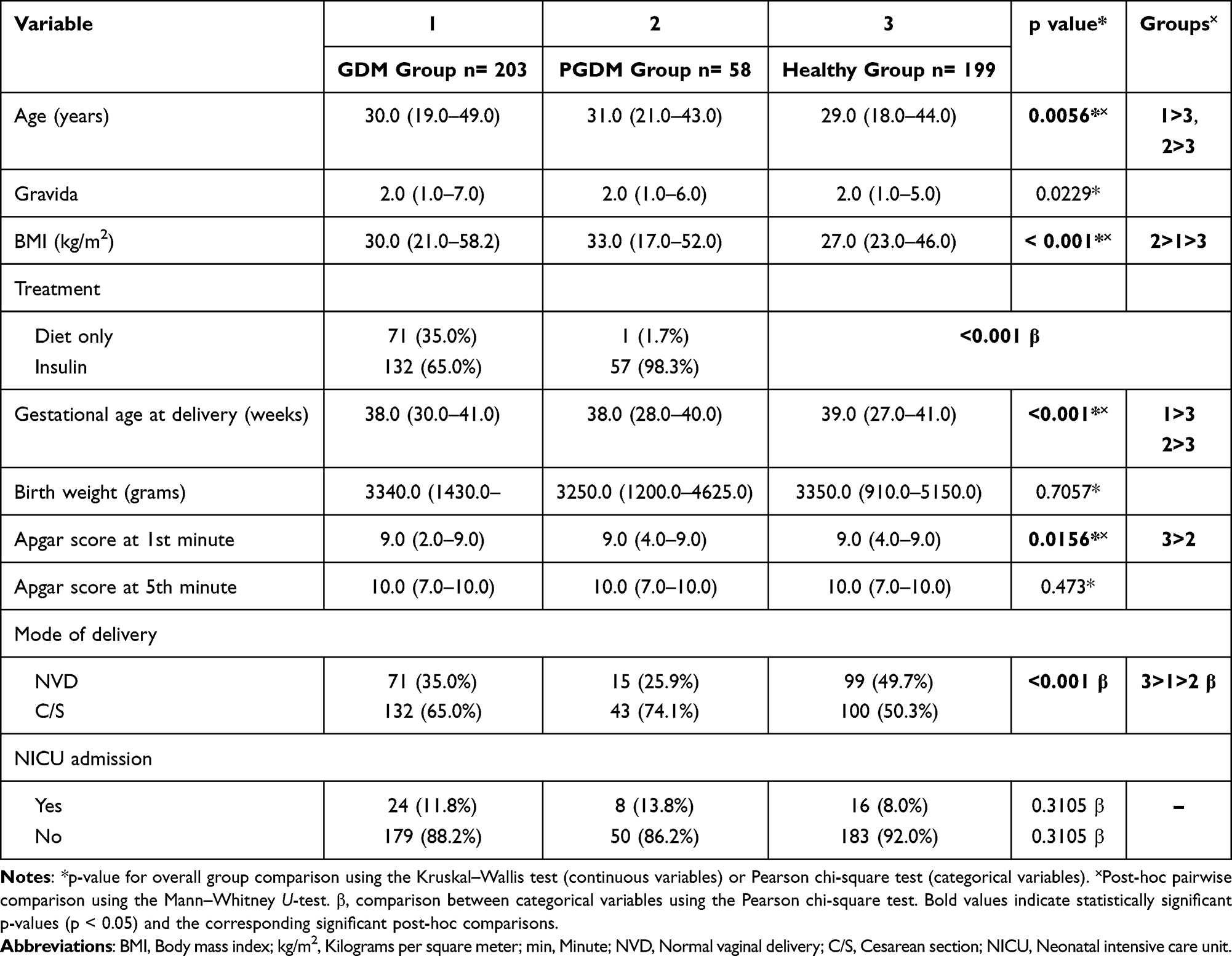 |
Table 1 Comparison of Demographic Characteristics and Birth Outcomes Among Pregnant Women with Gestational Diabetes (GDM), Pregestational Diabetes (PreGDM), and Healthy Controls |
Regarding laboratory findings, HbA1c was highest in the PGDM group (6.50%), followed by GDM (5.36%) and controls (4.93%) (p = 0.038). Fasting glucose and CRP levels were significantly elevated in the diabetic groups (p < 0.001). Hemoglobin was slightly higher in the GDM group (p = 0.045), while white blood cell (WBC) counts showed no group differences (p = 0.415) (Table 2).
 |
Table 2 Comparison of Laboratory Parameters Among Pregnant Women with Gestational Diabetes (GDM), Pregestational Diabetes (PreGDM), and Healthy Controls |
Correlation analysis revealed moderate positive correlations between HbA1c and both fasting glucose (r = 0.448) and CRP (r = 0.417; p < 0.001). A weak negative correlation was observed between HbA1c and gestational age at delivery (r = –0.220; p < 0.001). No significant correlations were found between HbA1c and hemoglobin, birth weight, Apgar scores, or NICU admission (Table 3).
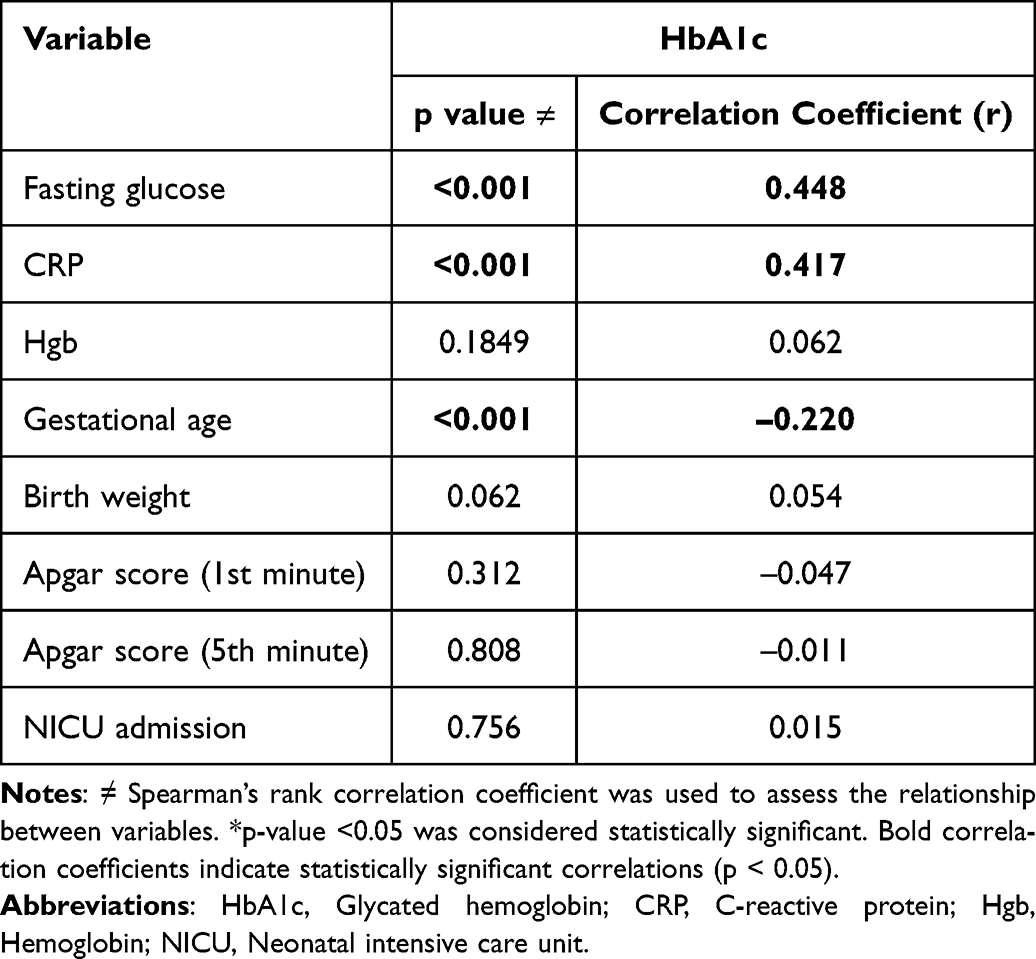 |
Table 3 Correlation Between HbA1c and Fasting Glucose, Gestational Age, Birth Weight, and Perinatal Outcomes |
ROC analysis indicated moderate predictive power for macrosomia (AUC = 0.642; cut-off: 5.3%), preterm birth (AUC = 0.602; cut-off: 5.14%), and cesarean delivery (AUC = 0.562; cut-off: 5.27%). HbA1c had no predictive value for NICU admission or Apgar scores (AUC ~0.5; p > 0.05) (Table 4). The ROC curves for HbA1c in predicting macrosomia, preterm birth, and cesarean delivery are shown in Figure 1. These secondary cut-off values (5.14% and 5.27%) were used only for exploratory purposes and not for subsequent subgroup analyses.
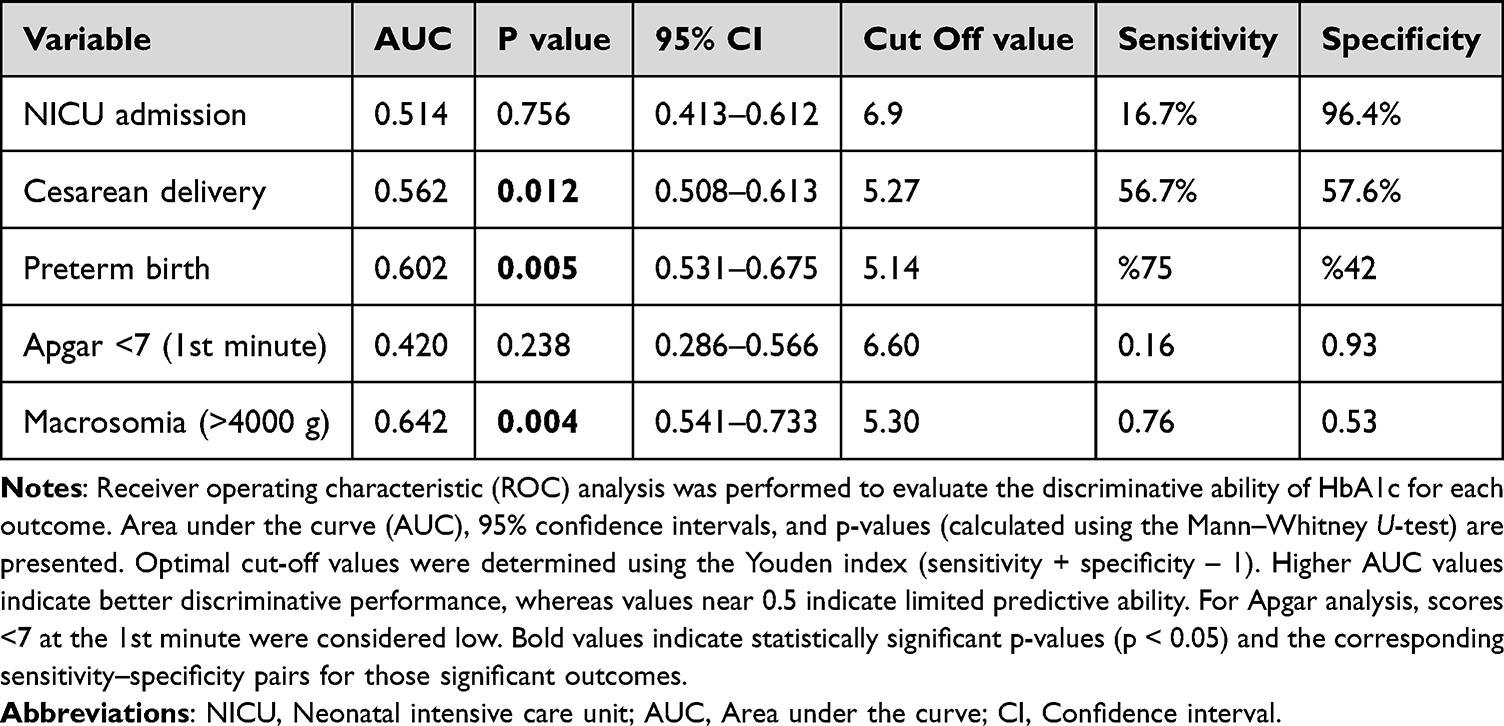 |
Table 4 ROC Analysis of the Predictive Ability of HbA1c Levels for Cesarean Delivery, NICU Admission, and Other Perinatal Outcomes |
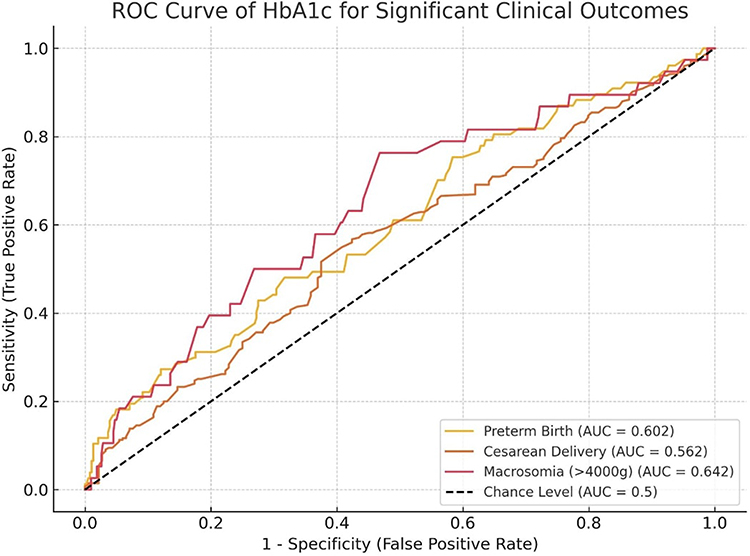 |
Figure 1 Receiver operating characteristic (ROC) curves of HbA1c levels in predicting significant perinatal outcomes. Notes: The figure displays the diagnostic performance of HbA1c in identifying preterm birth, cesarean delivery, and macrosomia (>4000 g). The area under the curve (AUC) values indicate moderate discriminative ability for all three outcomes. |
In multivariate logistic regression analysis including maternal age, BMI, diabetes type, and insulin treatment, HbA1c showed a positive but statistically nonsignificant association with macrosomia (OR=1.35, 95% CI: 0.91–1.99, p=0.13), while maternal BMI was identified as an independent predictor of macrosomia (OR=1.07, 95% CI: 1.01–1.14, p=0.02) (Table 5).
 |
Table 5 Multivariate Logistic Regression for Macrosomia (>4000 g) |
Subgroup analysis by HbA1c threshold (≤ 5.3% vs > 5.3%) revealed that women with higher HbA1c levels had significantly increased rates of preterm birth, cesarean delivery, and macrosomia. Comparisons of adverse perinatal outcomes according to this HbA1c threshold are illustrated in Figure 2.
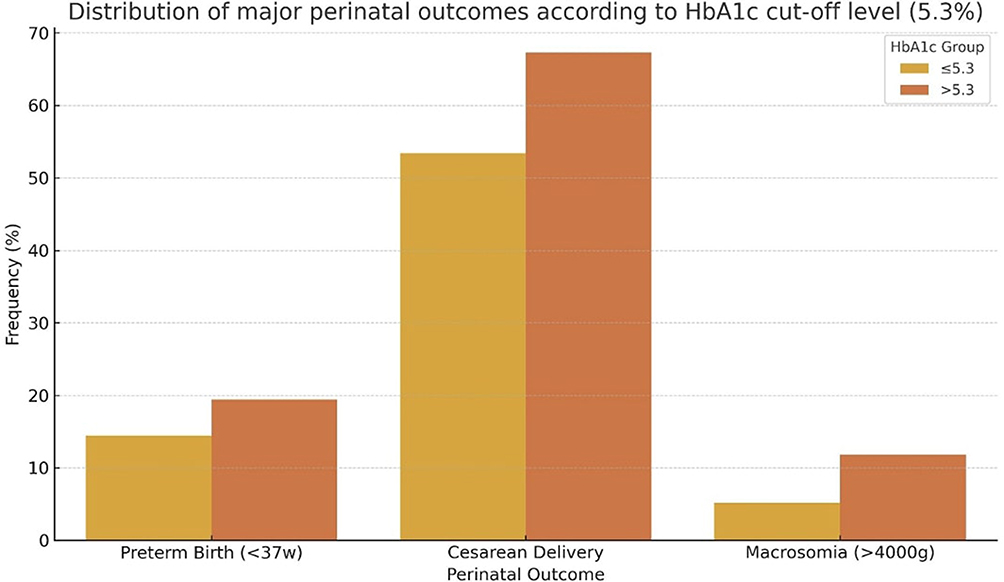 |
Figure 2 Distribution of Major Perinatal Outcomes According to HbA1c Threshold (5.3%). Notes: The figure illustrates the rates (%) of preterm birth (<37 weeks), cesarean delivery, and macrosomia (>4000 g) among pregnant women grouped by HbA1c levels (≤5.3% vs >5.3%). Higher HbA1c levels were associated with increased frequencies of these adverse perinatal outcomes, suggesting that HbA1c may serve as a potential biomarker for predicting perinatal risk. |
Discussion
This study evaluated the association between second-trimester HbA1c levels and perinatal outcomes. Our findings revealed a significant inverse correlation between HbA1c levels and gestational age at delivery, indicating that higher HbA1c values were associated with earlier deliveries. Notably, the incidence of preterm birth was substantially higher in women with HbA1c values exceeding 5.3%, particularly among those with PGDM and GDM, which is consistent with current literature. This inverse relationship suggests that suboptimal glycemic control during mid-pregnancy may contribute to spontaneous or indicated preterm births, independent of preeclampsia or fetal growth restriction. Thus, HbA1c may serve not only as a marker of glycemic control but also as a potential prognostic indicator for preterm delivery.
Supporting our findings, a large Norwegian cohort study by Carlsen et al demonstrated that HbA1c levels above 5.4% at 18 weeks of gestation were associated with reduced gestational age and a 14% increase in preterm birth risk for every 1% increase in HbA1c.13 Although our results parallel those reported by a Norwegian cohort, the present study provides additional scientific contribution by performing a comparative, multi-group analysis across GDM, PGDM, and non-diabetic pregnancies within a single cohort. Unlike prior works, we derived an empirically determined mid-pregnancy HbA1c threshold of 5.3% based on ROC analysis for adverse perinatal outcomes. HbA1c was chosen instead of fasting glucose because it reflects average glycemic exposure over the previous 8–12 weeks and is less affected by short-term dietary or stress-related variations. The commonly cited 5.7% diagnostic cut-off applies to non-pregnant populations; physiological hemodilution and altered erythrocyte turnover during pregnancy lower HbA1c values, making the 5.3% threshold more appropriate for this context.
In our cohort, elevated second-trimester HbA1c levels were also significantly associated with increased rates of cesarean delivery and macrosomia. These associations support the utility of HbA1c not only as a metabolic marker but also as a predictor of delivery-related complications.
After adjustment for maternal confounders, HbA1c retained a positive but nonsignificant association with macrosomia, suggesting that mid-pregnancy glycemic status contributes to fetal overgrowth primarily through maternal adiposity and metabolic milieu rather than HbA1c alone. These findings are consistent with prior studies showing that BMI exerts a stronger independent effect than HbA1c on fetal growth parameters.
Comparable findings were reported by Kiefer et al, who observed that GDM patients with a first-trimester HbA1c ≥5.9% were more likely to require insulin therapy and experienced higher rates of cesarean delivery and macrosomia.14 Although our measurements were obtained during the second trimester, similar patterns emerged, indicating that the prognostic relevance of HbA1c may persist across different stages of pregnancy. In the present study, the HbA1c cut-off of 5.3% was not selected arbitrarily but was derived empirically from ROC curve analysis based on the prediction of macrosomia. This value yielded the highest Youden index, reflecting the best balance between sensitivity and specificity (AUC=0.642, sensitivity=69.6%, specificity=60.3%).While slightly lower than the 5.7% diagnostic threshold used for nonpregnant populations, this lower value is biologically plausible, as pregnancy is characterized by physiological hemodilution and altered red blood cell turnover, leading to lower HbA1c levels for a given glycemic state. Therefore, the 5.3% threshold identified in our cohort likely represents a more pregnancy-specific marker of hyperglycemia-related fetal overgrowth.
It is also important to note that the 5.3% threshold was derived from a pooled analysis including both diabetic and non-diabetic pregnancies, reflecting the overall predictive behavior of HbA1c in a mixed obstetric population. When the ROC analysis was confined to diabetic pregnancies only, the optimal cut-off slightly increased (approximately 5.4–5.5%), suggesting that HbA1c behaves as a continuum rather than a dichotomous marker and that the 5.3% threshold provides the most clinically practical balance for population-level screening.
The literature on the prognostic utility of HbA1c remains mixed. For instance, a retrospective study by Yong et al found that HbA1c >5.6% at 29–30 weeks was associated with preterm birth, preeclampsia, large-for-gestational-age (LGA) neonates, and neonatal hypoglycemia.15 Similarly, Barbry et al reported increased risks of cesarean delivery, preterm birth, and macrosomia in women with elevated HbA1c levels and GDM or PGDM.16 Even within normal reference ranges, incremental increases in HbA1c have been linked to higher risks of LGA, hypertensive disorders, and cesarean birth.17 In a study of over 5600 normoglycemic women, Bi et al also found that rising HbA1c levels were associated with higher incidences of macrosomia, preterm delivery, and LGA.18 Muhuza et al and Xodo et al likewise demonstrated that elevated HbA1c in GDM and PGDM patients was associated with an increased risk of macrosomia, neonatal hypoglycemia, and preterm birth.19,20 Additionally, Sweeting et al noted associations between early pregnancy HbA1c levels and adverse outcomes such as preeclampsia, cesarean delivery, and macrosomia.21
In contrast, Finnegan et al, in a decade-long retrospective study of PGDM patients, found no significant association between HbA1c levels and birth weight or cesarean delivery, concluding that HbA1c may not be a reliable predictor of these outcomes.22 In our analysis, however, an HbA1c threshold >5.3% was significantly predictive of macrosomia and cesarean delivery, as supported by ROC curve analysis. These inconsistencies across studies may be attributable to differences in the timing of HbA1c measurement, population characteristics (eg, inclusion of PGDM vs GDM), cut-off definitions, or methodological heterogeneity.
Interestingly, our study found no significant correlation between HbA1c levels and NICU admission or 5-minute Apgar scores. This may reflect the mitigating effect of timely and effective neonatal care on short-term outcomes. However, the lower 1-minute Apgar scores observed in the PGDM group could indicate transient neonatal compromise, which may not be evident in later time points.
Despite only moderate predictive performance (AUC: 0.562–0.642), our results suggest that second-trimester HbA1c has potential clinical value within a broader diagnostic framework. Given its accessibility, affordability, and non-requirement for fasting, HbA1c could be a feasible adjunct to current obstetric risk assessment practices. However, the absence of a significant relationship with neonatal morbidity underscores its limitations as a standalone prognostic marker. These findings highlight the need for large-scale, prospective studies conducted at multiple gestational stages to further validate the role of HbA1c in perinatal risk prediction and to determine its place in clinical algorithms.
Strengths and Limitations
The strengths of our study include the inclusion of both GDM and PGDM patients and their comparison to a healthy control group within a relatively large sample size. In addition to group comparisons, we performed correlation and ROC analyses, which enhanced the interpretability and clinical applicability of our findings. Demonstrating that HbA1c levels above 5.3% are significantly associated with preterm birth, cesarean delivery, and macrosomia contributes novel evidence toward the utility of HbA1c in obstetric prognosis.
Nonetheless, several limitations must be acknowledged. First, the retrospective nature of the study limits causal inference. HbA1c was measured at a single point in the second trimester, and longitudinal trends were not evaluated. Potential confounders such as iron deficiency anemia, which may influence HbA1c independently of glycemic control, were not systematically excluded. Furthermore, although preeclampsia, HELLP syndrome, and IUGR were excluded to reduce confounding, this may reduce generalizability since these conditions often coexist with hyperglycemia and contribute to adverse outcomes.in real-world settings.
To enhance clinical integration, standardization of HbA1c measurement timing and clarification of optimal cut-off values are required. Future risk models may benefit from incorporating HbA1c alongside maternal characteristics (eg, age, BMI, parity, ethnicity, insulin requirement) and additional markers such as placental growth factors, adipokines, or uterine artery Doppler indices. Integrating HbA1c into first-trimester screening protocols or multivariate risk prediction models may further improve early detection of high-risk pregnancies.
From a public health perspective, the non-fasting nature, affordability, and broad availability of HbA1c testing make it a practical tool in resource-limited settings. Its established role in diabetes care also supports its potential transition into routine obstetric use.
Conclusion
Second-trimester HbA1c levels above 5.3% were associated with increased risks of preterm birth, cesarean delivery, and macrosomia, particularly among diabetic pregnancies. However, HbA1c did not remain an independent predictor after adjustment for confounders and should not be used as a standalone screening tool. Its integration into multiparametric risk models and validation through prospective studies are warranted.
Institutional Review Board Statement
The study was conducted in accordance with the Declaration of Helsinki, and approved by the Institutional Review Board of Bursa City Hospital (2025-12/5 and 11.06.2025).
Data Sharing Statement
Requests to access the datasets should be directed to corresponding author.
Informed Consent Statement
As the study involved only anonymized data collected from medical records and did not include any personally identifiable information, the requirement for informed consent was waived by the Ethics Committee.
Acknowledgments
The authors wish to acknowledge all participants of the study and the whole research team for their collaboration in data collection.
Author Contributions
All authors made a significant contribution to the work reported, whether that is in the conception, study design, execution, acquisition of data, analysis and interpretation, or in all these areas; took part in drafting, revising or critically reviewing the article; gave final approval of the version to be published; have agreed on the journal to which the article has been submitted; and agree to be accountable for all aspects of the work.
Funding
This research received no external funding.
Disclosure
The authors declare no conflicts of interest.
References
1. Committee on Practice Bulletins Obstetrics. ACOG practice bulletin No. 190: gestational diabetes mellitus. Obstet Gynecol. 2018;131(2):e49–64. doi:10.1097/AOG.0000000000002501
2. Saeedi M, Cao Y, Fadl H, Gustafson H, Simmons D. Increasing prevalence of gestational diabetes mellitus when implementing the IADPSG criteria: a systematic review and meta-analysis. Diabet Res Clin Pract. 2021;172:108642. doi:10.1016/j.diabres.2020.108642
3. Gupta Y, Goyal A, Kalra S, Tandon N. Variation in the classification of hyperglycaemia in pregnancy and its implication. Lancet Diabetes Endocrinol. 2020;8(4):264–266. doi:10.1016/S2213-8587(20)30018-8
4. Gajera D, Trivedi V, Thaker P, Rathod M, Dharamsi A. Detailed review on gestational diabetes mellitus with emphasis on pathophysiology, epidemiology, related risk factors, and its subsequent conversion to type 2 diabetes mellitus. Horm Metab Res. 2023;55(5):295–303. doi:10.1055/a-2061-9441
5. Vounzoulaki E, Khunti K, Abner SC, Tan BK, Davies MJ, Gillies CL. Progression to type 2 diabetes in women with a known history of gestational diabetes: systematic review and meta-analysis. BMJ. 2020;
6. American Diabetes Association. Standards of medical care in diabetes—2014. Diabetes Care. 2014;37(Suppl 1):S14–80. doi:10.2337/dc14-S014
7. Lowe LP, Metzger BE, Dyer AR, et al. Hyperglycemia and adverse pregnancy outcome (HAPO) study: associations of maternal A1C and glucose with pregnancy outcomes. Diabetes Care. 2012;35(3):574–580. doi:10.2337/dc11-1687
8. Iwama N, Sugiyama T, Metoki H, et al. Associations between glycosylated hemoglobin level at less than 24 weeks of gestation and adverse pregnancy outcomes in Japan: the Japan Environment and Children’s Study (JECS). Diabet Res Clin Pract. 2020;169:108377. doi:10.1016/j.diabres.2020.108377
9. Kumar N, Kumar P, Harris N, Monga R, Sampath V. Impact of maternal HbA1c levels ≤6% and race in nondiabetic pregnancies on birthweight and early neonatal hypoglycemia. J Pediatr. 2020;227:121–127.e3. doi:10.1016/j.jpeds.2020.08.026
10. Zhang Q, Lee CS, Zhang L, et al. The influence of HbA1c and gestational weight gain on pregnancy outcomes in pregnant women with gestational diabetes mellitus. Front Med. 2022;9:842428. doi:10.3389/fmed.2022.842428
11. Ye M, Liu Y, Cao X, et al. The utility of HbA1c for screening gestational diabetes mellitus and its relationship with adverse pregnancy outcomes. Diabet Res Clin Pract. 2016;114:43–49. doi:10.1016/j.diabres.2016.02.007
12. Coetzee A, Mason D, Hall DR, Hoffmann M, Conradie M. Evidence for the utility of antenatal HbA1c to predict early postpartum diabetes after gestational diabetes in South Africa. Diabet Res Clin Pract. 2018;143:50–55. doi:10.1016/j.diabres.2018.06.021
13. Carlsen EØ, Harmon Q, Magnus MC, et al. Glycated haemoglobin (HbA1c) in mid-pregnancy and perinatal outcomes. Int J Epidemiol. 2022;51(3):759–768. doi:10.1093/ije/dyab270
14. Kiefer MK, Finneran MM, Ware CA, et al. Association of change in haemoglobin A1c with adverse perinatal outcomes in women with pregestational diabetes. Diabet Med. 2022;39(7):e14822. doi:10.1111/dme.14822
15. Yong SL, Ng BK, Mohd Yassin MAJ, Syed Zakaria SZ, Mohamed Ismail NA. Impact of late pregnancy haemoglobin A1c at 29–30 weeks’ gestation on adverse pregnancy outcomes among women with pre-existing diabetes: a retrospective analysis. J Obstet Gynaecol. 2018;38(4):461–465. doi:10.1080/01443615.2017.1372397
16. Barbry F, Lemaitre M, Ternynck C, et al. HbA1c at the time of testing for gestational diabetes identifies women at risk for pregnancy complications. Diabetes Metab. 2022;48(3):101313. doi:10.1016/j.diabet.2021.101313
17. Yin B, Hu L, Meng X, et al. Association of higher HbA1c within the normal range with adverse pregnancy outcomes: a cross-sectional study. Acta Diabetol. 2021;58(8):1081–1089. doi:10.1007/s00592-021-01691-0
18. Bi J, Ji C, Wu Y, et al. Association between maternal normal range HbA1c values and adverse birth outcomes. J Clin Endocrinol Metab. 2020;105(6):dgaa127. doi:10.1210/clinem/dgaa127
19. Muhuza MPU, Zhang L, Wu Q, Qi L, Chen D, Liang Z. The association between maternal HbA1c and adverse outcomes in gestational diabetes. Front Endocrinol. 2023;14:1105899. doi:10.3389/fendo.2023.1105899
20. Xodo S, Londero AP, D’Agostin M, et al. Is glycated hemoglobin A1c level associated with adverse pregnancy outcomes of women affected by pre-gestational diabetes? Medicina. 2021;57(5):461. doi:10.3390/medicina57050461
21. Sweeting AN, Ross GP, Hyett J, et al. Baseline HbA1c to identify high-risk gestational diabetes: utility in early vs standard gestational diabetes. J Clin Endocrinol Metab. 2017;102(1):150–156. doi:10.1210/jc.2016-295
22. Finnegan C, Smyth S, Smith O, Dicker P, Breathnach FM. Glycosylated haemoglobin as an indicator of diabetes control in pregnancy: a 10-year review of the relationship between HbA1c trends and delivery outcome in type I and type II diabetes. Eur J Obstet Gynecol Reprod Biol. 2023;281:36–40. doi:10.1016/j.ejogrb.2022.12.007
 © 2025 The Author(s). This work is published and licensed by Dove Medical Press Limited. The
full terms of this license are available at https://www.dovepress.com/terms
and incorporate the Creative Commons Attribution
- Non Commercial (unported, 4.0) License.
By accessing the work you hereby accept the Terms. Non-commercial uses of the work are permitted
without any further permission from Dove Medical Press Limited, provided the work is properly
attributed. For permission for commercial use of this work, please see paragraphs 4.2 and 5 of our Terms.
© 2025 The Author(s). This work is published and licensed by Dove Medical Press Limited. The
full terms of this license are available at https://www.dovepress.com/terms
and incorporate the Creative Commons Attribution
- Non Commercial (unported, 4.0) License.
By accessing the work you hereby accept the Terms. Non-commercial uses of the work are permitted
without any further permission from Dove Medical Press Limited, provided the work is properly
attributed. For permission for commercial use of this work, please see paragraphs 4.2 and 5 of our Terms.
Recommended articles

Serum Proteomic Signatures in Umbilical Cord Blood of Preterm Neonates Delivered by Women with Gestational Diabetes
Li X, Zhang B, Ding W, Jia X, Han Z, Zhang L, Hu Y, Shen B, Wang H
Diabetes, Metabolic Syndrome and Obesity 2023, 16:1525-1539
Published Date: 26 May 2023
Exploring the Impact of Iron Deficiency Anaemia on Glycated Haemoglobin A1c Levels in Pregnant and Non-Pregnant Women: A Systematic Review
AlQarni AM, Alghamdi AA, Aljubran HJ, Bamalan OA, Abuzaid AH, AlYahya MA, AlAwami AM, Al Shubbar MD, Al Yousif GF
International Journal of Women's Health 2024, 16:797-809
Published Date: 13 May 2024
Serum D-Dimer, Glycated Serum Protein, and HbA1c Levels in Predicting Macrosomia in Gestational Diabetes Mellitus
Quan Y, Wang Y
Diabetes, Metabolic Syndrome and Obesity 2025, 18:2913-2921
Published Date: 15 August 2025