
Back to Journals » Journal of Asthma and Allergy » Volume 19
Polysensitization Patterns and Age-Dependent Allergen Profiles in Children from Suzhou, China: A Component-Resolved Cross-Sectional Study
Authors Xu Q  , Zhao H, Dong Y, Lu M, Zhai Q, Cheng Z
Received 15 August 2025
Accepted for publication 9 January 2026
Published 27 January 2026 Volume 2026:19 556612
DOI https://doi.org/10.2147/JAA.S556612
Checked for plagiarism Yes
Review by Single anonymous peer review
Peer reviewer comments 4
Editor who approved publication: Dr Luis Garcia-Marcos
Qiuyan Xu,1,2,* Haowei Zhao,2,* Yongchao Dong,1,* Min Lu,1 Qin Zhai,1 Zhi Cheng1
1Department of Pediatrics, Suzhou Hospital, Affiliated Hospital of Medical School, Nanjing University, Suzhou, People’s Republic of China; 2Department of Pediatrics, Children’s Hospital of Soochow University, Suzhou, People’s Republic of China
*These authors contributed equally to this work
Correspondence: Zhi Cheng, Department of Pediatrics, Suzhou Hospital, Affiliated Hospital of Medical School, Nanjing University, 1 Lijiang Road, Suzhou, 215153, People’s Republic of China, Email [email protected] Qin Zhai, Department of Pediatrics, Suzhou Hospital, Affiliated Hospital of Medical School, Nanjing University, 1 Lijiang Road, Suzhou, 215153, People’s Republic of China, Email [email protected]
Purpose: Allergic diseases are a major global public health issue with a rising pediatric prevalence. This study explored the allergen sensitization profiles, cross-reactivity, and polysensitization patterns among pediatric patients with allergic diseases in Suzhou, China, to inform precision prevention and treatment.
Methods: This cross-sectional study included 510 children aged 1– 15 years suspected of having allergic diseases such as atopic dermatitis (AD), allergic rhinitis (AR), and allergic asthma (AS). Serum-specific IgE (sIgE) was measured for 12 aeroallergens and 14 food allergens. Component-resolved diagnosis (CRD) was performed for house dust mite (HDM)/Dust mite allergens in 120 patients.
Results: Of the 510 children, 378 (74.12%) tested sIgE-positive. The mean age of the sIgE-positive patients was 7.03 ± 2.79 years, with a male-to-female ratio of 1.35:1. Among the sIgE-positive patients, 56.08% had AD, 87.83% had AR, and 29.37% had AS. Aeroallergen sensitization (90.48%) was significantly higher than food allergen sensitization (48.15%), with HDM being the most common aeroallergen (71.96%). CRD showed high positivity rates for Der p 1 and Der f 1 (both 95.83%) in 120 HDM/Dust mite-sensitized patients. Age significantly affected sensitization patterns: younger children had higher Egg and Cow’s milk sensitization rates, while aeroallergen (including HDM, Dust mite, and Cat dander) sensitization increased significantly with age. Most allergens showed no gender-related differences. Polysensitization was common, with 65.34% (247/378) of patients being sensitized to three or more allergens. Significant cross-reactivity was observed between certain aeroallergens and food allergens, such as a strong correlation between Der p 10 and Shellfish (ρ = 0.88) and moderate correlations between Ragweed and Sesame/Peanut (ρ = 0.53, 0.48, respectively).
Conclusion: In Suzhou, allergic children show high sIgE positivity and polysensitization rates. Allergen sensitization varies with age, highlighting the need for age-specific diagnostics and CRD for precision medicine. Extensive cross-reactivity exists between aeroallergens and food allergens.
Keywords: allergic diseases, children, cross-reactivity, component-resolved diagnosis, precision medicine, age-dependent
Introduction
Allergic diseases have become a significant global public health issue. In recent years, the prevalence of allergic conditions, including those affecting children, has been increasing globally due to environmental changes and lifestyle modifications.1,2 This trend has significantly impacted patients’ quality of life. Atopic dermatitis (AD), allergic rhinitis (AR), and allergic asthma (AS) are the most common allergic disorders. Worldwide, AR affects over 500 million individuals, and AS affects 300 million cases.1 AD, a chronic inflammatory skin disease, affects approximately 20% of children and 7–14% of adults.1 In China, the prevalence of allergic diseases has risen particularly rapidly, now approaching or even exceeding that in Western developed countries.1,3
The progression of allergic diseases from early childhood food allergies to later respiratory allergies, known as the “allergic march,” is influenced by allergen exposure and factors such as age and gender.1,4 Studies have shown that allergen sensitization patterns vary regionally and are closely linked to immune maturation and environmental exposure dynamics.5,6 In Suzhou’s pediatric population, the manifestation of the allergic march, shaped by local factors, is not well understood. Suzhou, located in eastern China, is a region known for its economic development, humid subtropical climate, and rapid urbanization. These factors may contribute to unique patterns of allergen distribution in the area. Urbanization can increase exposure to indoor allergens like House dust mite (HDM) due to higher indoor humidity and changes in the indoor microflora, leading to a high prevalence of allergic diseases. Polysensitization, which is sensitization to three or more allergens,7 is common in pediatric allergic diseases and presents challenges in diagnosis and management. Understanding polysensitization patterns and cross-reactivity is important for developing effective prevention and treatment strategies. Current research indicates that common aeroallergens in Eastern China include HDM.8,9 However, comprehensive investigations into the distribution characteristics of allergen-specific IgE (sIgE) and their correlation with diseases remain insufficient.1,9 Notably, systematic studies on pediatric allergen distribution, cross-reactivity, and polysensitization patterns are lacking,9 which impedes the advancement of precision medicine strategies.
Our previous study focused on the sensitization patterns of HDM components and their associations with specific allergic diseases such as AD, AR, and AS in children, providing a comprehensive insight into HDM-induced allergic responses at the molecular level.10 However, the study was limited to HDM components and did not explore a wider range of allergen sensitization, including other aeroallergens, food allergens, or their complex interactions between them. This study aims to investigate the major types of allergens, distribution patterns, sensitization characteristics, cross-reactivity profiles, and polysensitization epidemiological features among allergic children in Suzhou through population-based analysis. The findings will elucidate regional pediatric allergen sensitization patterns and provide scientific evidence for precision prevention, diagnosis, and treatment of childhood allergic diseases in this area.1,9,11 Since effective allergy management requires locally relevant epidemiological data,1,8 this research holds significant implications for optimizing strategies for preventing and controlling allergic diseases in the region.1–4,8,9,11
Materials and Methods
Study Population and Design
This study recruited 510 pediatric patients with suspected allergic diseases who visited the pediatric department of Suzhou Hospital, Affiliated Hospital of Medical School, Nanjing University, between January 2023 and December 2023. Suspicion was based on clinical symptoms and physician assessment. All participants underwent serum allergen testing, and a total of 378 patients with confirmed allergic diseases were ultimately included in the study. The inclusion criteria were as follows: (1) diagnosed with allergic diseases, such as AD, AR, and AS, by pediatric specialists based on established clinical guidelines;12–14 (2) children with AD exhibited positive reactions to at least one aeroallergen or food allergen, whereas those with AR or AS demonstrated positive reactions to at least one aeroallergen. Patients who had underlying diseases such as immune disorders or potential malignant tumors, or who were currently undergoing biological therapies (eg, omalizumab, dupilumab), and/or allergen-specific immunotherapy, were excluded from the study. Sensitization to three or more allergens is known as polysensitization.7
The study protocol was approved by the Ethics Committee of Suzhou Hospital, Affiliated Hospital of Medical School, Nanjing University (IRB2024058), and informed consent was obtained from the guardians of all subjects. The study was conducted in accordance with the guidelines of the Declaration of Helsinki.
Detection of Serum sIgE and the HDM Component sIgE
Blood samples were collected from all patients and left to clot at room temperature for 30 minutes. Afterwards, the blood was centrifuged at 3000×g for 10 minutes to isolate the serum. The BioCLIA® magnetic particle chemiluminescent allergen detection platform from HOB Biotech Group Corp., Ltd. (Suzhou, China) was used to measure the concentrations of sIgE against 12 aeroallergens and 14 food allergens in serum samples. This detection platform has an intra-assay coefficient of variation (CV) below 10% and a limit of detection (LOD) of less than 0.1 kU/L.10 The 12 aeroallergens tested included: HDM, Dust mite, House dust, Alternaria, Cat dander, Dog dander, Willow, Ragweed, Cockroach, Artemisia, Cypress and Aspergillus fumigatus. The 14 food allergens tested included: Egg, Cow’s milk, Wheat, Sesame, Shrimp, Crab, Peanut, Strawberry, Soybean, Codfish, Pistachio, Almond, Lamb and Beef.
For children positive for HDM and/or Dust mite, the sIgE concentrations of Der p 1, Der f 1, Der p 2, Der f 2, Der p 5, Der p 7, Der p 10, Der p 21, and Der p 23 in serum samples were determined. The protein chip method, using the DX-Autoblot 50 automatic immunoassay analyzer, was employed in 120 cases, with reagents and instruments provided by Hangzhou Zheda Dixun Biological Gene Engineering Co., Ltd. The detailed methodology for the detection assay has been previously reported in the literature.15
The concentration of sIgE is expressed in standardized units of kU/L and categorized into levels 0 to 6 based on its concentration. A positive result is determined when the sIgE concentration is ≥ 0.35 kU/L. The levels are defined as follows: Level 0: sIgE < 0.35 kU/L; Level 1: 0.35 kU/L ≤ sIgE < 0.70 kU/L; Level 2: 0.70 kU/L ≤ sIgE < 3.50 kU/L; Level 3: 3.50 kU/L ≤ sIgE < 17.50 kU/L; Level 4: 17.50 kU/L ≤ sIgE < 50.00 kU/L; Level 5: 50.00 kU/L ≤ sIgE < 100.00 kU/L; Level 6: sIgE ≥ 100.00 kU/L.
Statistical Analysis
Statistical analysis was conducted using SPSS 26.0 (IBM SPSS, Chicago, IL, USA). Categorical data were presented as frequencies and percentages, and intergroup comparisons of positive rates were performed using either the chi-square (χ2) test or Fisher’s exact test. A p-value of <0.05 was considered statistically significant. The Spearman rank correlation coefficient was used to measure the correlation between two allergens, which helped to infer potential cross-reactivity (eg, strong or moderate positive correlations suggest possible cross-reactivity). The strength of the Spearman correlation was interpreted as follows: 0.80–1.00 (very strong), 0.60–0.80 (strong), 0.40–0.60 (moderate), 0.20–0.40 (weak), and 0.00–0.20 (negligible). The correlation matrix diagram was created using the “corrplot” package in R (http://www.r-project.org/, R Foundation for Statistical Computing, Vienna, Austria).
Results
Characteristics of the Study Population
From January 2023 to December 2023, 510 patients suspected of allergic diseases were tested for specific allergens. These patients were aged between 1 and 15 years. Among them, 378 patients (74.12%) tested positive for sIgE, with 217 males (57.41%) and 161 females (42.59%). This yielded a male-to-female ratio of 1.35:1. The average age of the patients was 7.03 ± 2.79 years (Table 1).
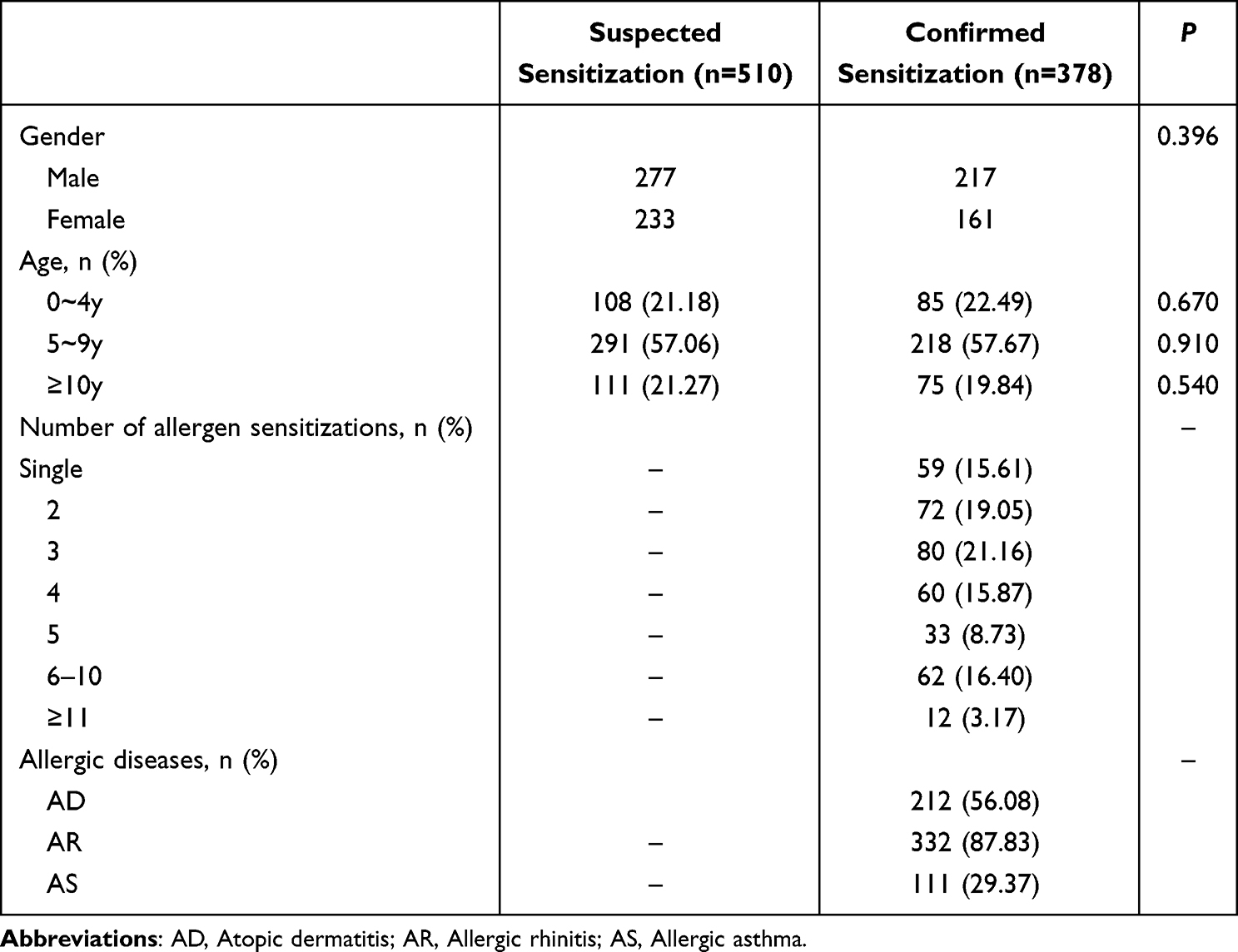 |
Table 1 General Characteristics of the Patient |
The patients were categorized into three age groups: 0–4 years, 5–9 years, and ≥10 years, with sIgE positivity rates of 78.70%, 74.91%, and 67.57%, respectively. The 0–4-year age group had the highest sIgE positivity rate. 84.39% of patients showed sensitization to two or more allergens, with the most common being sensitization to three allergens (21.16%) and two allergens (19.05%). Polysensitization represented 65.34%. Monosensitization was seen in only 15.61% of patients (Table 1).
Among the 378 patients with positive sIgE, 56.08% were diagnosed with AD, 87.83% with AR, and 29.37% with AS, as illustrated in Figure 1.
 |
Figure 1 Venn Diagram of Allergic Disease Comorbidities in Pediatric Patients. |
Epidemiology of Allergens
The distribution of allergen sensitization is shown in Figure 2. Overall, the sensitization rate of aeroallergens (90.48%, 342/378) was significantly higher than that of food allergens (48.15%, 182/378). The top five aeroallergens were HDM (71.96%), Dust mite (67.99%), House dust (51.06%), Alternaria (38.36%), and Cat dander (13.23%). The most common food allergens were Egg (32.28%), Cow’s milk (25.66%), Wheat (11.90%), Sesame (9.52%), and Shrimp (6.61%) (Figure 2A). The sIgE levels were primarily grades 1, 2, and 3 for allergens with a sensitization rate exceeding 5%, as shown in Figure 2B.
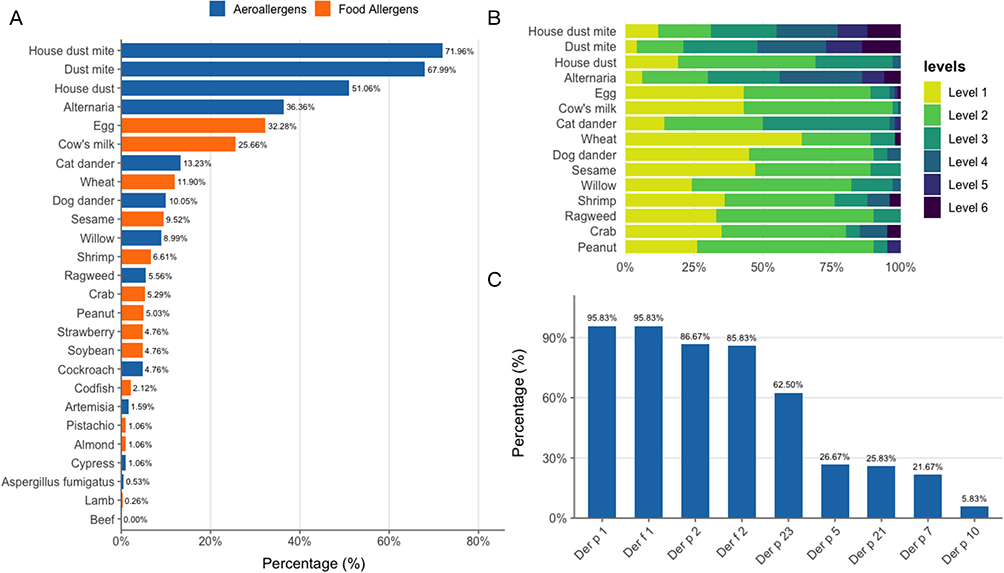 |
Figure 2 Allergen Sensitization Profiles in Pediatric Patients. (A) Prevalence of aeroallergens and food allergens among 378 children with allergic diseases. X-axis label: Sensitization Prevalence (%); Y-axis label: Allergen Category (Aeroallergens/Food Allergens); (B) Distribution of sensitization levels to common allergens with a prevalence rate exceeding 5%; (C) Percentage of patients sensitized to specific components of HDM among 120 HDM-positive children. X-axis label: Specific Components of HDM; Y-axis label: Sensitization Rate (%). |
Among the 282 patients sensitized to HDM and/or Dust mite, 120 patients received component-resolved diagnosis (CRD). The highest positive rates were for Der p 1 and Der f 1 (both 95.83%), followed by Der p 2 (86.67%), Der f 2 (85.83%), and Der p 23 (62.50%), as indicated in Figure 2C.
Age- and Gender-Related Sensitization Characteristics
The sensitizing allergens were divided into three age groups. Children aged 5–9 showed the highest overall sIgE positivity rate (57.67%), while those aged ≥10 showed the lowest (19.84%). In children, the detection rate of HDM increased with age, similar to Dust mite (P < 0.05). Additionally, the detection rate of Cat dander followed a similar pattern to that of HDM for pet-related allergens (P < 0.05), with a generally lower positivity rate than mite allergens. Moreover, age was also found to have correlations with various other aeroallergens, although no statistically significant differences were observed. Food allergens showed a different sensitization pattern compared to aeroallergens. Younger children had higher sensitization rates for Egg and Cow’s milk (P < 0.05). In the gender-stratified analysis, significant differences in sensitization rates were only seen for Alternaria and Ragweed (P < 0.05), with no significant gender-related differences noted for other allergens. There were also no significant differences in disease distribution across the various allergens (Table 2).
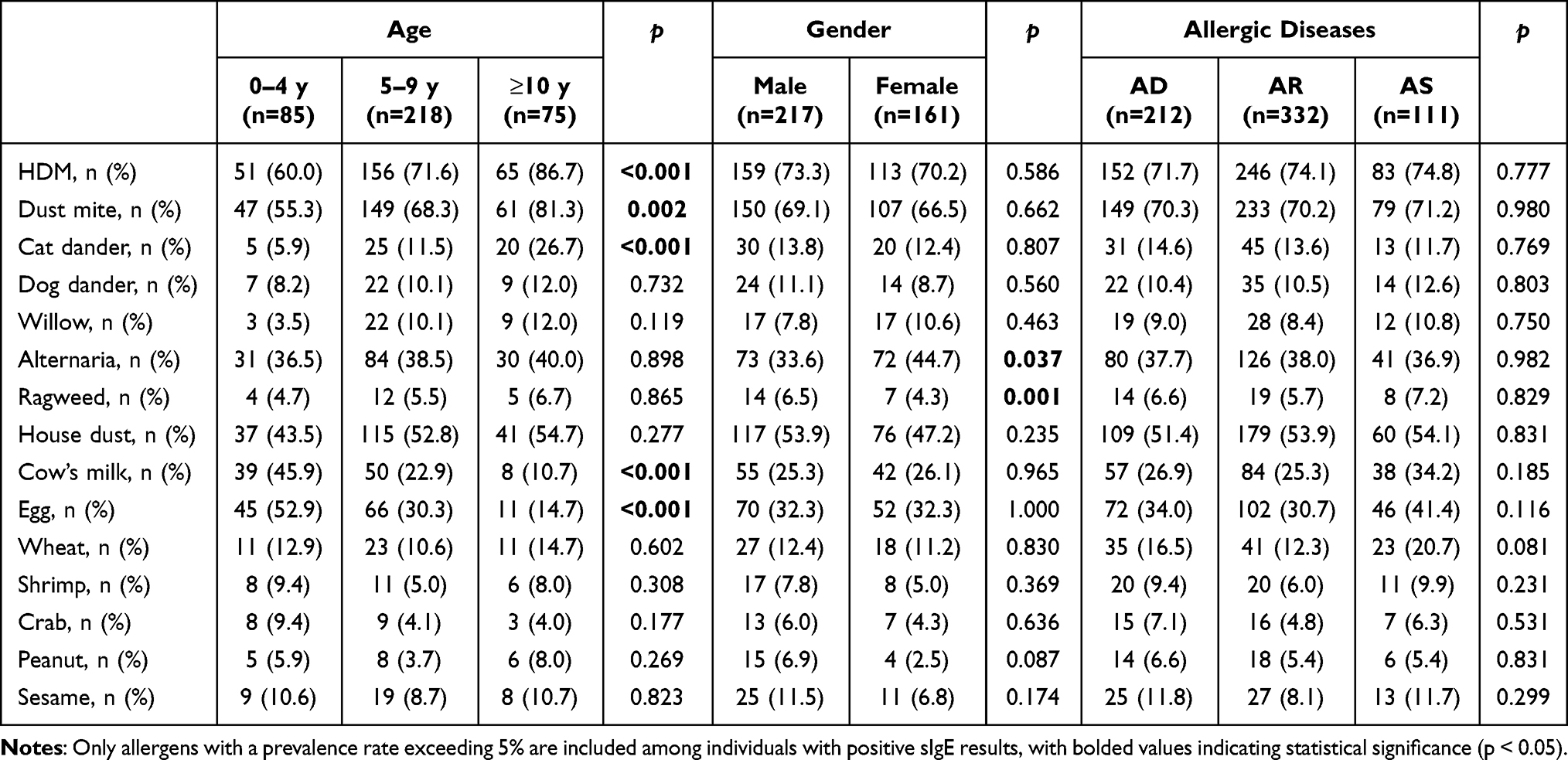 |
Table 2 Characteristics of Allergen Sensitization Distribution in Suzhou, China [n (%)] |
Correlation Analysis of Allergens
A Spearman rank correlation analysis was conducted for allergens. Among the 378 sIgE-positive patients, cross-reactivity was observed between aeroallergens. Specifically, HDM and Dust mite showed a high positive correlation (ρ = 0.90), and both also had strong correlations with House dust (ρ = 0.80 and ρ = 0.81, respectively). Ragweed (a grass pollen) and Willow (a tree pollen) exhibited a moderate correlation (ρ = 0.55), while other tree pollens and grass pollens showed interrelated associations. Additionally, correlations were found between aeroallergens and food allergens. Der p 10 had a very strong correlation with Shrimp and Crab (ρ = 0.88 for both). Ragweed had moderate correlations with Sesame (ρ = 0.53) and Peanut (ρ = 0.48), and Willow showed moderate correlations with Sesame (ρ = 0.60), Peanut (ρ = 0.44), and Strawberry (ρ = 0.42). Within food allergens, Shrimp and Crab displayed a very strong positive correlation (ρ = 0.89).
Among the HDM components, Der p 1 had moderate correlations with Der p 2 (ρ = 0.51), Der f 1 (ρ = 0.47), and Der f 2 (ρ = 0.44), while Der p 2 and Der f 2 showed a very strong correlation (ρ = 0.90). Der p 5 showed a moderate correlation with Der p 21 (ρ = 0.48). However, Der p 7 and Der p 23 did not show significant correlations with other allergens (Figure 3).
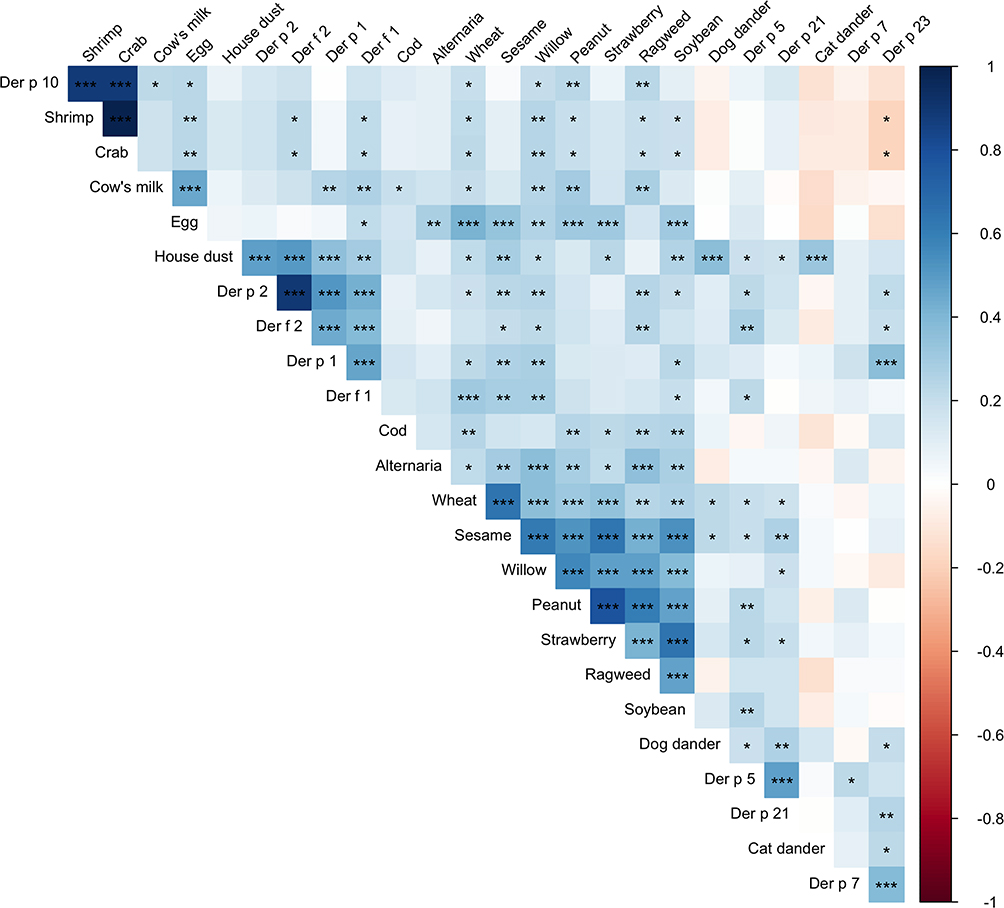 |
Figure 3 Correlation Matrix diagram of Allergen sIgE Levels among 120 Pediatric Patients who underwent CRD. The matrix visually represents the Spearman rank correlation coefficients between various allergens. Blue indicates a positive correlation in the sIgE Levels of two allergens, while red indicates a negative correlation. The intensity of the color reflects the strength of the correlation. *p < 0.05; **p < 0.01; ***p < 0.001. |
Polysensitization Patterns
Among the 378 patients with positive sIgE results, 319 (84.39%) were sensitized to two or more allergens, with polysensitization present in 65.34% of cases. To investigate the polysensitization patterns of the most common allergens, this study analyzed the top five allergens with the highest positivity rates (excluding House dust), as shown in Figure 4. Among the five allergens (HDM, Dust mite, Alternaria, Cow’s milk, and Egg), 97.35% of individuals were sensitized to one or more allergens, with a polysensitization rate of 59.24%. Moreover, 43.21% of patients were sensitized to three allergens, 11.41% to four allergens, and 4.62% to all five allergens.
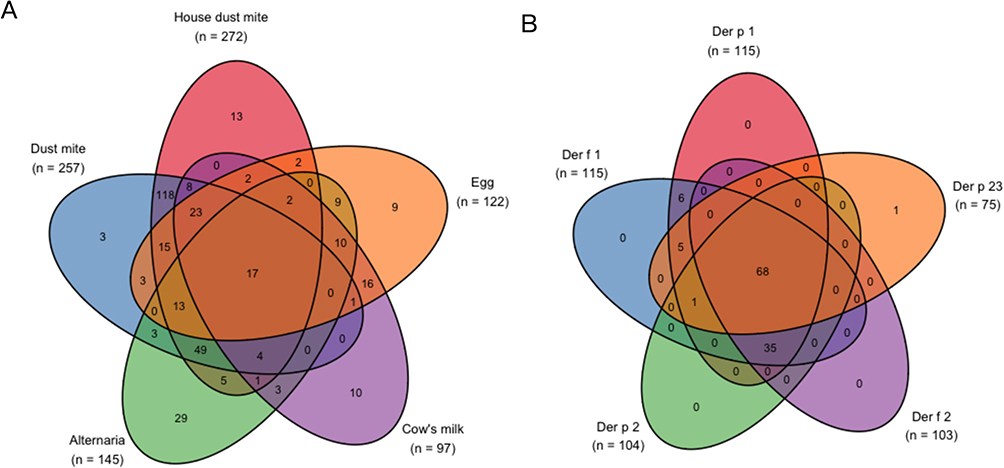 |
Figure 4 Venn Diagrams of Sensitization Patterns to Major Allergens in Pediatric Patients. (A) This Venn diagram shows the polysensitization patterns among five common allergens: HDM, Dust mite, Egg, Cow’s milk, and Alternaria. (B) This Venn diagram displays the intersection of sensitization to five major HDM components: Der p 1, Der f 1, Der p 2, Der f 2 and Der p 23. |
Out of the 120 patients who received CRD, 95.83% were found to have sIgE positivity to at least one of the five most common HDM components (Der p 1, Der f 1, Der p 2, Der f 2, and Der p 23). Among these 115 patients, 94.78% were identified as having polysensitization, with 4.35% sensitized to any three, 31.30% sensitized to any four, and 59.13% being sensitized to all five.
Discussion
This study investigates the allergen sensitization profiles of pediatric patients with allergic diseases in the Suzhou area, revealing epidemiological trends, distribution characteristics, and patterns of polysensitization. The results provide a comprehensive understanding of the allergen sensitization patterns in children in Suzhou, highlighting the high prevalence of sIgE positivity and common polysensitization. These findings are crucial for developing precision prevention and treatment strategies, emphasizing the importance of age-specific diagnostics and CRD to address unique sensitization profiles. By identifying key allergens and their sensitization patterns, the study provides valuable insights to guide the development of targeted interventions and improve the management of pediatric allergic conditions in Suzhou.
Our study found that aeroallergen sensitization was significantly higher compared to food allergen sensitization. Specifically, HDM and Dust mite had high sensitization rates of 71.96% and 67.99% respectively. This finding is consistent with studies from other regions, highlighting the important role of HDM in pediatric allergic diseases in economically developed eastern regions.16 The high sensitization rates for mite allergens may be attributed to their widespread presence in indoor environments and enzyme activity.17,18 The high humidity of Suzhou’s humid subtropical climate may impact the indoor dust microflora composition, resulting in a greater presence of HDM and related allergens. Notably, a high percentage of polysensitization was observed, indicating the widespread prevalence of multiple allergen sensitization among pediatric patients with allergic diseases in the Suzhou area. These findings are crucial for understanding the natural course of allergic diseases and developing targeted intervention strategies, especially in the context of polysensitization and allergen cross-reactivity. Polysensitization may potentially increase the complexity and severity of allergic reactions, making diagnosis and management more challenging.19,20 Polysensitized children are at a higher risk of experiencing persistent symptoms and disease progression. It is important to prioritize polysensitized patients for interventions like allergen immunotherapy and provide personalized counseling to improve quality of life. Moreover, strong correlations (ρ > 0.6) were observed between aeroallergens, such as HDM and Dust mite or House dust, indicating potential cross-reactivity or co-exposure.21 The strong correlation between HDM and House dust could be due to the mixture of mite debris and other particles in House dust.22 Moderate correlations (ρ = 0.48–0.53) between Ragweed and Sesame/Peanut may be linked to the presence of “pollen-food allergy syndrome” (PFAS).23 Additionally, strong positive correlations were seen between certain food allergens, such as Shrimp and Crab, possibly attributable to structural similarities or shared immunological mechanisms among allergens.24 The correlation between Der p 10 and Shellfish (ρ = 0.88) is a potentially novel local sensitization pattern that has direct clinical screening implications for this population. Therefore, it is essential in clinical practice to conduct a detailed medical history, comprehensive allergen testing, and provide counseling on cross-reactivity for patients with allergic conditions, especially children. This approach helps identify all potential sensitizing factors and prevents the oversight of important allergens. Ultimately, it facilitates the development of more precise and individualized treatment plans.
Age was found to be a crucial factor in determining patterns of allergen sensitization in this study. We observed an “allergic march” phenomenon, with higher rates of sensitization to food allergens (especially Egg and Cow’s milk) in the 0–4-year-old group compared to other age groups. As children reached 5 years old, sensitization rates to aeroallergens (particularly HDM and Dust mite) significantly increased with age. The group aged 10 and above showed the widest range of aeroallergen sensitizations. The age-related increase in sensitivity to aeroallergens such as mites may be related to long-term exposure to the environment or immune system maturation,25 while natural tolerance development may explain decreasing food allergen sensitization in older groups.26 Therefore, in the management of pediatric allergic diseases, an age-stratified approach should be adopted: for younger children (0–4 years), prioritize screening for common food allergens such as Egg and Cow’s milk; for school-aged children (≥5 years), emphasize detection of aeroallergens like mites and pollen; and for polysensitized patients, CRD should be considered to identify cross-reactivity risks and guide immunotherapy selection.27,28 This age-specific, personalized approach to diagnosis and treatment aligns with the natural course of allergic diseases and enables more precise diagnosis and intervention. Future studies should further investigate mechanisms linking environmental exposures, gut microbiota, and age-related changes in sensitization patterns.
In contrast to age, gender had a relatively minor impact on allergen sensitization patterns. In gender-stratified analyses, only sensitization rates to Ragweed and Alternaria exhibited significant differences (P<0.05). This finding is consistent with some reports of gender-based variations in pollen allergies.29 However, regarding the overall allergen profile, gender did not demonstrate a significant influence, suggesting that gender factors may play a minor role in the sensitization mechanisms of childhood allergic diseases.30–32
In 120 mite-sensitized patients who underwent CRD, Der p 1 and Der f 1 had a positivity rate of 95.83%, while Der p 2 and Der f 2 had rates of 86.67% and 85.83%, respectively. These rates are significantly higher than those of other components, which is consistent with global epidemiological studies and our previously published research on HDM component sensitization in children.10,11 Notably, the high positivity rate of Der p 23 in Suzhou is significantly higher than the 16.6% reported in northern China,15 which may be attributed to Suzhou’s humid subtropical climate, rapid urbanization, high indoor humidity, and local lifestyle. These factors are thought to influence the composition of indoor dust microflora and modulate HDM gut protein expression, enhancing the immunogenicity of Der p 23.33 In our prior study, we investigated the association between HDM components and specific allergic diseases, confirming that Der p 1, Der f 1, Der p 2, Der f 2, and Der p 23 are major contributors to HDM-induced allergies in this population.10 The high sensitization rates of Der p 1 and Der p 2 may be attributed to their biological functions as proteases or lipid-binding proteins, which are easily recognized by the immune system due to their major mite allergen status.34,35 Furthermore, Der p 23, a newly identified protein found in the gut with a positivity rate of 62.50%, may trigger sensitization through a separate mechanism.36 Our prior research has demonstrated a consistently high positive rate of Der p 23 in patients with AS, emphasizing that Der p 23 is a key component associated with the development of asthma and supporting its role as a potential biomarker for severe respiratory allergic reactions.10 Notably, the strong correlation between Der p 10 (tropomyosin) and Shrimp/Crab (ρ = 0.88) not only highlights its predictive value in predicting cross-reactivity withShellfish hypersensitivity,16 but also suggests a potentially novel local sensitization pattern with direct clinical screening implications for children with mite allergies, helping to identify potential seafood allergy risks. However, Der p 7 and Der p 21 showed lower sensitization rates and weaker correlations, possibly due to their lower exposure levels or immunogenicity, and further validation is needed to determine their clinical significance.11,16
The present study has several limitations. First, the study population was recruited from a hospital setting and allergen testing was only conducted in patients suspected of having allergic diseases; moreover, skin prick tests were not performed. These factors introduce selection bias and limit the generalizability of our findings to the broader population. Future studies should consider recruiting participants from diverse settings and incorporating multiple diagnostic methods, including skin prick tests, to address these limitations. Second, the single-center study design may further compromise the generalizability of the findings. Multicenter studies are needed to address this limitation. Third, the lack of environmental exposure data precludes evaluation of associations between environmental factors and sensitization patterns. Future research should incorporate environmental monitoring to provide a more comprehensive understanding of the factors influencing allergen sensitization. Fourth, the cross-sectional design does not enable the determination of causal relationships between sensitization and disease progression, and the absence of clinical severity assessments restricts the analysis of correlations between sensitization levels and disease activity. Future research should consider a longitudinal design to assess disease severity, symptom progression, and treatment responses over time. It would also be beneficial to incorporate epitope mapping for key aeroallergens (such as HDM components and pollens) and food allergens (such as Shellfish and Egg) to identify common cross-reactive epitopes. This information can help in developing targeted therapies, including peptide immunotherapy and hypoallergenic allergen variants, customized to the region-specific cross-reactivity patterns observed in the pediatric population of Suzhou. This approach has the potential to advance precision medicine for pediatric allergic conditions.
Conclusion
This study found that HDM, Dust mite, and HDM components, such as Der p 1, Der f 1, Der p 2, and Der f 2, have a positivity rate of over 85%, and Der p 23 has a rate of up to 62.50%, making them the main allergens in children. It also showed a typical age-related pattern of sensitization, with infants and younger children being mainly sensitized to Egg and Cow’s milk, while school-aged children are more sensitized to aeroallergens. Polysensitization and cross-sensitization are common, highlighting the need for age-specific diagnostic methods that incorporate CRD to identify cross-reactivity risks and guide immunotherapy. Additionally, individuals with multiple sensitivities should have long-term management strategies in place to achieve precision medicine for pediatric allergic conditions.
Abbreviations
AD, atopic dermatitis; AR, allergic rhinitis; AS, allergic asthma; sIgE, specific IgE; CRD, Component-resolved diagnosis; HDM, House dust mite.
Data Sharing Statement
The data supporting the findings of this study are available from the corresponding authors Qin Zhai and Zhi Cheng upon reasonable request.
Ethics Approval and Consent
The study protocol received approval from the Ethics Committee of Suzhou Hospital, Affiliated Hospital of Medical School, Nanjing University (IRB2024058), ensuring its compliance with the principles set forth in the Declaration of Helsinki.
Acknowledgments
The authors would like to express their sincere gratitude to their colleagues in the Department of Pediatrics at Suzhou Hospital, Affiliated Hospital of Medical School, Nanjing University, as well as to all the patients and guardians who took part in this study.
Author Contributions
All authors made a significant contribution to the work reported, whether that is in the conception, study design, execution, acquisition of data, analysis and interpretation, or in all these areas; took part in drafting, revising or critically reviewing the article; gave final approval of the version to be published; have agreed on the journal to which the article has been submitted; and agree to be accountable for all aspects of the work.
Funding
This work was supported by the Science and Technology Innovation Project of Applied Basic Research in Medical and Health Care in Suzhou (SYWD2024234), and Suzhou Clinical Key Disease Diagnosis and Treatment Technology Special Fund (LCZX202352).
Disclosure
The authors report no conflicts of interest in this work.
References
1. Yang L, Gao K, Gong W, et al. Sources of allergens detected through allergen-specific serum IgE antibody test in children with suspected allergic diseases in Central China. J Asthma Allergy. 2024;17:769–12. doi:10.2147/JAA.S469503
2. Hou YB, Sun JL. Common pollen and related allergen components in patients with allergic diseases in the Beijing area. Front Allergy. 2024;5:1478392. doi:10.3389/falgy.2024.1478392
3. Li YT, Hou MH, Lu YX, et al. Multimorbidity of allergic conditions in urban citizens of Southern China: a real-world cross-sectional study. J Clin Med. 2023;12(6):2226. doi:10.3390/jcm12062226
4. Liu T, Huang Z, Zhu H, et al. Association between urban garbage exposure and allergic diseases among sanitation practitioners: a cross-sectional study. World Allergy Organ J. 2023;16(3):100754. doi:10.1016/j.waojou.2023.100754
5. Havstad SL, Sitarik A, Kim H, et al. Increased risk of asthma at age 10 years for children sensitized to multiple allergens. Ann Allergy Asthma Immunol. 2021;127(4):441–445e441. doi:10.1016/j.anai.2021.04.028
6. Jin Y, Boss AP, Bursley JK, et al. The transcription factor Nrf2 links Th2-mediated experimental allergy to food preservatives. Front Immunol. 2024;15:1476480. doi:10.3389/fimmu.2024.1476480
7. Ozuygur Ermis SS, Borres MP, Basna R, et al. Sensitization to molecular dog allergens in an adult population: results from the West Sweden Asthma Study. Clin Exp Allergy. 2023;53(1):88–104. doi:10.1111/cea.14216
8. Yun JE, Ko EB, Jung HI, et al. Allergen sensitization and its association with allergic diseases in the Korean Population: results from the 2019 Korea National Health and Nutrition Examination Survey. Allergy Asthma Immunol Res. 2024;16(5):534–545. doi:10.4168/aair.2024.16.5.534
9. Zheng C, Dong J, Li P, et al. Allergen sensitization in allergic skin diseases in Suzhou, East China: a retrospective study from 2021 to 2023. Int Arch Allergy Immunol. 2025;186(7):642–651. doi:10.1159/000543021
10. Xu Q, Shang Y, Li X, et al. Exploring the role of allergenic components in children with house dust mite-induced allergic diseases. J Asthma Allergy. 2025;18:183–193. doi:10.2147/JAA.S505471
11. Trinh TH, Nguyen PT, Tran TT, et al. Profile of aeroallergen sensitizations in allergic patients living in southern Vietnam. Front Allergy. 2022;3:1058865. doi:10.3389/falgy.2022.1058865
12. Bateman ED, Hurd SS, Barnes PJ, et al. Global strategy for asthma management and prevention: GINA executive summary. Eur Respir J. 2008;31(1):143–178. doi:10.1183/09031936.00138707
13. Cheng L, Chen J, Fu Q, et al. Chinese society of allergy guidelines for diagnosis and treatment of allergic rhinitis. Allergy Asthma Immunol Res. 2018;10(4):300–353. doi:10.4168/aair.2018.10.4.300
14. Eichenfield LF, Tom WL, Chamlin SL, et al. Guidelines of care for the management of atopic dermatitis: section 1. Diagnosis and assessment of atopic dermatitis. J Am Acad Dermatol. 2014;70(2):338–351. doi:10.1016/j.jaad.2013.10.010
15. Liu Y, Zhao L, Wang J, et al. Serological analysis of allergic components of house dust mite provides more insight in epidemiological characteristics and clinical symptom development in North China. Front Immunol. 2023;14:1083755. doi:10.3389/fimmu.2023.1083755
16. Riggioni C, Leung AS, Wai CY, et al. Exploring geographical variances in component-resolved diagnosis within the Asia-Pacific region. Pediatr Allergy Immunol. 2025;36(3):e70054. doi:10.1111/pai.70054
17. Wei H, Yang F. Residual profiles and health risk of indoor allergens in China. Environ Pollut. 2024;342:123151. doi:10.1016/j.envpol.2023.123151
18. Shi L, Xiong Q, Ao FK, et al. Comparative analysis of cysteine proteases reveals gene family evolution of the group 1 allergens in astigmatic mites. Clin Transl Allergy. 2023;13(12):e12324. doi:10.1002/clt2.12324
19. Dimou MV, Xepapadaki P, Lakoumentas J, et al. Levels of IgE sensitization drive symptom thresholds in allergic rhinitis. Ann Allergy Asthma Immunol. 2024;133(2):177–185e110. doi:10.1016/j.anai.2024.04.026
20. Bakir DB, Yagmur H, Kabadayi G, et al. Demographics and clinical features of pediatric patients with allergic rhinitis: a single-center study from Western Turkey. BMC Pediatr. 2025;25(1):170. doi:10.1186/s12887-025-05541-8
21. Olivry T, Mas-Fontao A, Jacquenet S, et al. Identification of cross-reactive allergens between the Dermatophagoides farinae house dust mite and the Toxocara canis nematode in dogs with suspected allergies. Vet Dermatol. 2024;35(6):662–671. doi:10.1111/vde.13295
22. Ye F, He G, Gan H. Relationship between indoor inhalant allergen concentrations, serum IgE, and allergic diseases: a cross-sectional study from the NHANES 2005–2006 program. World Allergy Organ J. 2024;17(2):100866. doi:10.1016/j.waojou.2023.100866
23. Lisiecka MF. Allergic reactions to spices: a review of sensitivities to pepper, cumin, oregano, anise, mustard and other spices. Eur Ann Allergy Clin Immunol. 2025. doi:10.23822/EurAnnACI.1764-1489.400
24. Yamamoto R, Izawa K, Ando T, et al. Murine model identifies tropomyosin as IgE cross-reactive protein between house dust mite and coho salmon that possibly contributes to the development of salmon allergy. Front Immunol. 2023;14:1238297. doi:10.3389/fimmu.2023.1238297
25. Landzaat LJ, Emons JAM, Sonneveld LJH, et al. Early inhalant allergen sensitization at component level: an analysis in atopic Dutch children. Front Allergy. 2023;4:1173540. doi:10.3389/falgy.2023.1173540
26. He J, Gao J, Zhao Y, et al. Distributional characteristics analysis of allergens in patients with allergic rhinitis in Southern Fujian Province, China. J Asthma Allergy. 2024;17:477–489. doi:10.2147/JAA.S453914
27. Matricardi PM, van Hage M, Custovic A, et al. Molecular allergy diagnosis enabling personalized medicine. J Allergy Clin Immunol. 2025. doi:10.1016/j.jaci.2025.01.014
28. Biliute G, Miskinyte M, Miskiniene A, et al. Sensitization profiles to house dust mite Dermatophagoides pteronyssinus molecular allergens in the Lithuanian population: understanding allergic sensitization patterns. Clin Transl Allergy. 2024;14(1):e12332. doi:10.1002/clt2.12332
29. Alotiby A. Quality of life in the management of anaphylaxis in food-allergic adults. Int J Gen Med. 2024;17:3047–3055. doi:10.2147/IJGM.S467915
30. Zheng C, Zou Y. Allergen sensitization in patients with skin diseases in Shanghai, China. J Asthma Allergy. 2023;16:305–313. doi:10.2147/JAA.S402165
31. Wang B, Zhang D, Jiang Z, et al. Analysis of allergen positivity rates in relation to gender, age, and cross-reactivity patterns. Sci Rep. 2024;14(1):27840. doi:10.1038/s41598-024-78909-y
32. Ndlovu V, Chimbari M, Ndarukwa P, et al. Environmental exposures associated with atopy in a rural community in Gwanda district, Zimbabwe: a cross-sectional study. Front Public Health. 2024;12:1477486. doi:10.3389/fpubh.2024.1477486
33. Platts-Mills TA, Keshavarz B, Wilson JM, et al. High risk of asthma among early teens is associated with quantitative differences in mite and cat allergen specific IgE and IgG4: a modified Th2 related antibody response revisited. EBioMedicine. 2025;112:105556. doi:10.1016/j.ebiom.2024.105556
34. Jacquet A. The HDM allergen orchestra and its cysteine protease maestro: stimulators of kaleidoscopic innate immune responses. Mol Immunol. 2023;156:48–60. doi:10.1016/j.molimm.2023.03.002
35. Giangrieco I, Ciardiello MA, Tamburrini M, et al. Plant and arthropod IgE-Binding Papain-like cysteine proteases: multiple contributions to allergenicity. Foods. 2024;13(5):790. doi:10.3390/foods13050790
36. Kim J, Choi S, Choi S, et al. Contact hypersensitivity and Demodex mite infestation in patients with rosacea: a retrospective cohort analysis. Eur J Dermatol. 2022;32(6):716–723. doi:10.1684/ejd.2022.4358
 © 2026 The Author(s). This work is published and licensed by Dove Medical Press Limited. The
full terms of this license are available at https://www.dovepress.com/terms
and incorporate the Creative Commons Attribution
- Non Commercial (unported, 4.0) License.
By accessing the work you hereby accept the Terms. Non-commercial uses of the work are permitted
without any further permission from Dove Medical Press Limited, provided the work is properly
attributed. For permission for commercial use of this work, please see paragraphs 4.2 and 5 of our Terms.
© 2026 The Author(s). This work is published and licensed by Dove Medical Press Limited. The
full terms of this license are available at https://www.dovepress.com/terms
and incorporate the Creative Commons Attribution
- Non Commercial (unported, 4.0) License.
By accessing the work you hereby accept the Terms. Non-commercial uses of the work are permitted
without any further permission from Dove Medical Press Limited, provided the work is properly
attributed. For permission for commercial use of this work, please see paragraphs 4.2 and 5 of our Terms.
Recommended articles

Awareness and Predictors of the Use of Bioinformatics in Genome Research in Saudi Arabia
Alomair L, Abolfotouh MA
International Journal of General Medicine 2023, 16:3413-3425
Published Date: 11 August 2023
Exploring the Role of Allergenic Components in Children with House Dust Mite-Induced Allergic Diseases
Xu Q, Shang Y, Li X, Ran S, Lu M, Cheng L
Journal of Asthma and Allergy 2025, 18:183-193
Published Date: 13 February 2025