
Back to Journals » Advances in Medical Education and Practice » Volume 16
Perceived Preparedness for the Clinical Practice Among Medical Interns: A Cross-Sectional Study
Authors Sharief WM, Mahdy NH, Al-Eraky M
Received 17 July 2024
Accepted for publication 19 December 2024
Published 24 January 2025 Volume 2025:16 Pages 69—78
DOI https://doi.org/10.2147/AMEP.S466627
Checked for plagiarism Yes
Review by Single anonymous peer review
Peer reviewer comments 2
Editor who approved publication: Dr Md Anwarul Azim Majumder
Wadeia Mohammad Sharief,1 Nehad Hassan Mahdy,1 Mohamed Al-Eraky2
1Medical Education & Research Department, Dubai Health Authority, Dubai, United Arab Emirates; 2Health Professions Education Department, Gulf Medical University (GMU), Ajman, United Arab Emirates
Correspondence: Wadeia Mohammad Sharief, Medical Education & Research Department, Dubai Health Authority, Oud Maitha Road, Po box-4545, Dubai, United Arab Emirates, Tel +971558876136, Email [email protected]
Background: Measurement of medical graduates’ perception of their internship program can help to improve the program to guarantee the general satisfaction of medical interns and enhance their clinical training.
Objective: To evaluate the medical interns’ perceived preparedness for clinical practice and investigate the contributing elements.
Method: The study was carried out to include 109 medical interns. Assessment preparedness for hospital practice questionnaire in Hospitals was used.
Results: For clinical practice, the vast majority of participants (81.7%) were either fully or very well prepared. However, no statistically significant relationship was observed between the intern characteristics and preparedness level. It was found that the interns were not well prepared regarding handling emergencies, dealing with dying patients (44%), inserting an intravenous line (35.8%), conducting a digital-rectal examination (31.2%), as well as speaking with the social worker about the patient (29%). Males scored significantly higher than females regarding the interpersonal domain.
Conclusion & recommendations: The results revealed that most interns were adequately trained for their clinical experiences. More emphasis on training in emergencies, catheterization, insertion of intravenous lines, and dealing with dying patients is required, in addition to continuous assessment of the interns after each clinical rotation to discover the areas of weakness.
Keywords: perceived readiness, clinical practice, medical interns
Introduction
An entire year of practical training is spent in the medical internship. The transition from the academic training students receive in medical school to the actual use of that body of knowledge and skills in the practice of medicine occurs during this training period in clinics and hospitals under the direction of professionals from various hospital departments. 1
The duration of the internship is thought to be the most demanding, stressful, and significant time in a doctor’s career. The internship experience determines the future course of a health professional’s career. Additionally, it’s a crucial time for choosing a career and building confidence in one’s abilities and communication. 2
The term “preparedness” refers to the experience that interns have of being ready for some practice areas. It suggests that they are self-aware of their abilities and have faith in their capacity to begin operating safely. Self-efficacy, skill learning, problem-solving, and communication are all linked to preparedness for practice.3
The readiness of medical students for hospital practice has been assessed in several research studies carried out in different countries. Research conducted in Kenya and Ireland showed that the vast majority of medical graduates were unprepared, specifically for recognizing clinical capabilities, for hospital practice.4,5
A failure of the medical curriculum has been shown by the discovery that medical graduates, even in developed nations, lack basic clinical skills in history-taking, physical examination, and clinical reasoning.6 One significant source of diagnostic error that persists is incorrect clinical reasoning.7
Moreover, studies carried out in the United Kingdom showed that junior doctors found the period between graduation and entry into practice to be particularly anxiety-inducing because they lacked support and had to participate in a variety of professional groups. The majority of interns felt unprepared for practice and encountered issues with time management, protection incidents, and a lack of adequate drug knowledge.8–10
Concerning the domain of interpersonal communications, a Kenya study in 2015 reported that there is a lack of this skill when communications with the nursing staff are carried out.5
In addition, an Indonesian study from 2021 found that 10% of the students strongly agree that they cannot gain experience while participating in the internship program and that they will not receive any benefits.11
However, research conducted in South Africa and Oman found that most of the interns were clinically prepared.12,13 A total of 52% and 47% of the interns assessed the residents as “well-prepared” or “pretty well-prepared”, respectively.13 According to a different American study, it was found that 53.8% of the residents are extremely prepared in terms of their clinical and medical knowledge.14 According to the Saudi Arabian research from 2020, holistic care was highest in terms of preparation, followed by self-directed learning, while the interpersonal skills domain was the lowest.15
A study from Oman (2017) found that a graduate’s age did not affect their perception of readiness.13 However, a previous study found that supervisors gave younger graduates higher ratings than they did for their older counterparts, particularly in the area of interpersonal skills.5
Two studies in Saudi Arabia revealed that females were more satisfied and reported higher preparedness than males. Females performed better because they had better communication skills and were more self-motivated for learning and improvement.16,17 Another study has found no link between gender and a resident’s perception of clinical practice.18
Assessing perceived preparedness can help policymakers improve the internship program, make curriculum changes, and improve the educational environment to ensure overall medical intern satisfaction and success, potentially improve outcomes and improve clinical training.
Objective
To evaluate medical interns’ perceptions of their preparedness for clinical practice and investigate the contributing variables.
Materials and Methods
Study Design & Setting
The study was carried out through the cross-sectional approach at the Department of Medical Education and Research, of the Dubai Health Authority.
Target Population
All medical graduates who completed their internship training program in the academic year 2021–2022.
Sample Size and Sampling Procedure
All medical graduates who finished their internship programs during the academic year 2021–2022 were invited to participate in the research. The sample size reached 109 out of 133.
Data Collection Plan
The survey was created using the Microsoft Forms website. Through the list of internship programs from the Medical Education Section, the Email addresses of the graduates were obtained. The Email including the survey’s QR code was issued to all of the medical interns in the batch of 2021–2022. Pilot testing of the questionnaire was carried out and considered by subjects to be accurate and pertinent.
The questionnaire included the following:
Demographic profile (3 questions): It contained information about the intern’s age, gender, and nationality.
Degree of preparedness (41 questions): The readiness for clinical practice was assessed using the Valid and Reliable Preparedness Hospital Practice Questionnaire (PHPQ).19 The reliability alpha coefficients for the PHPQ subscales ranged from 0.78 to 0.88. It contains eight subscales designed to assess key areas of medical hospital practice: interpersonal skills, confidence/coping skills, collaboration, practical skills and patient management, understanding science, prevention, holistic care, and self-directed learning.
On a 5-point Likert scale, with 1 representing not at all prepared and 5 representing fully prepared, participants were asked to rate their level of preparedness in response to statements such as ”My medical training prepared me to.12,20 Domain scores were calculated for each respondent by taking the mean response (scale 1–5) for the set of items within each domain. - Participants were asked to respond to phrases like, ”My medical training prepared me to” by rating their preparedness on a 5-point Likert scale (1 = not at all prepared, to 5 = fully prepared).12,20
The mean response (scale 1–5) for the set of items within each domain was taken to determine domain scores for each respondent. The mean response across all items was taken to get an overall score as well.12 The overall preparedness level was classified as fully prepared“ (scoring 4.5–5), “well prepared” (scoring 3.5–4.4), “fairly well prepared” (scoring 2.5–3.4), “a little prepared” (1.5–2.4) and not prepared (scoring 1–1.4).12,13
Statistical Analysis
The Statistical Package for the Social Sciences, SPSS version“24.0” was used for the analysis. The Monte Carlo Exact test was used to establish associations between participant characteristics and perceived preparedness. The Kolmogorov–Smirnov test was used to determine if the data were normal. Mann–Whitney U for comparing PHPQ scores based on the attributes of interns. A p-value of less than 0.05 indicated statistical significance.
Ethical Consideration
- Ethical approval was obtained from the Dubai Scientific Research Committee.
- Participants’ anonymity was emphasized.
- Before the study began, participants signed a written informed consent form.
- Confidentiality of the data was maintained throughout the study.
- Participants were informed that they had the freedom to participate in the study or to withdraw from it at any time.
- All data were managed with the strictest confidentiality, and participants’ information was not provided to unrelated parties.
Results
Eighty-two percent of respondents responded (109 out of 133 graduates). Table 1 shows that the interns’ mean age is 24.55 years, with a median age of 24 years (range 23–28 years). The majority were female and non-Emirati (78% and 72.5%, respectively).
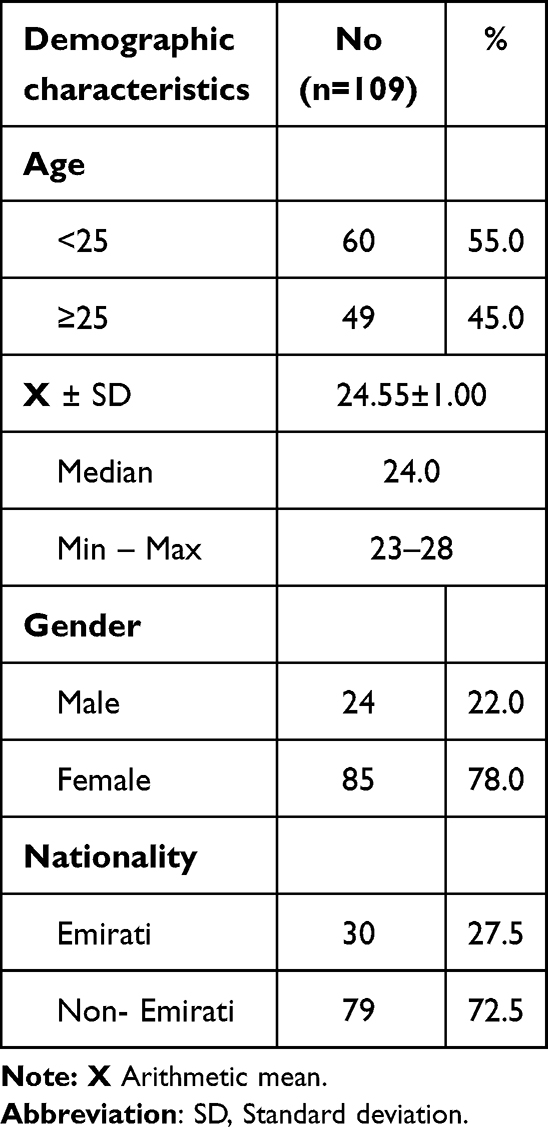 |
Table 1 Distribution of Participants According to Demographic Characteristics |
Table 2 displayed that the greatest number of interns felt fully or well prepared to take responsibility for their learning (91.8%), conducting an efficient physical examination (89.9%), and 89% for measuring blood pressure, recording the clinical data, and appreciate the importance of patient culture, poverty, and unemployment.
 |
Table 2 Distribution of Participants According to the Tasks for Which the Respondents Felt Fully / Well Prepared or Felt Not Well Prepared |
The table also demonstrated that 44% were not well prepared in the following tasks; handling emergencies or terminally ill patients, 42% lacked skills in the balance between work and personal lives, 35.8% in the insertion of intravenous lines, 33% in justification of drug use, and 31.2% in the conduction of rectal examination.
Figure 1 displayed that, 67% of the participants were well prepared, 14.7% were fully prepared and only 2.8% were little prepared, no intern felt unprepared for any of the total questions. Table 3 showed that there was no meaningful relationship between the intern’s characteristics and degree of readiness. Those aged less than 25 years, males and Emirati, were better prepared (85%, 91.7%, 86.7%, respectively) than those aged 25 years or more, females and non-Emirati (77.6%, 78.8%, 79.7%, respectively).
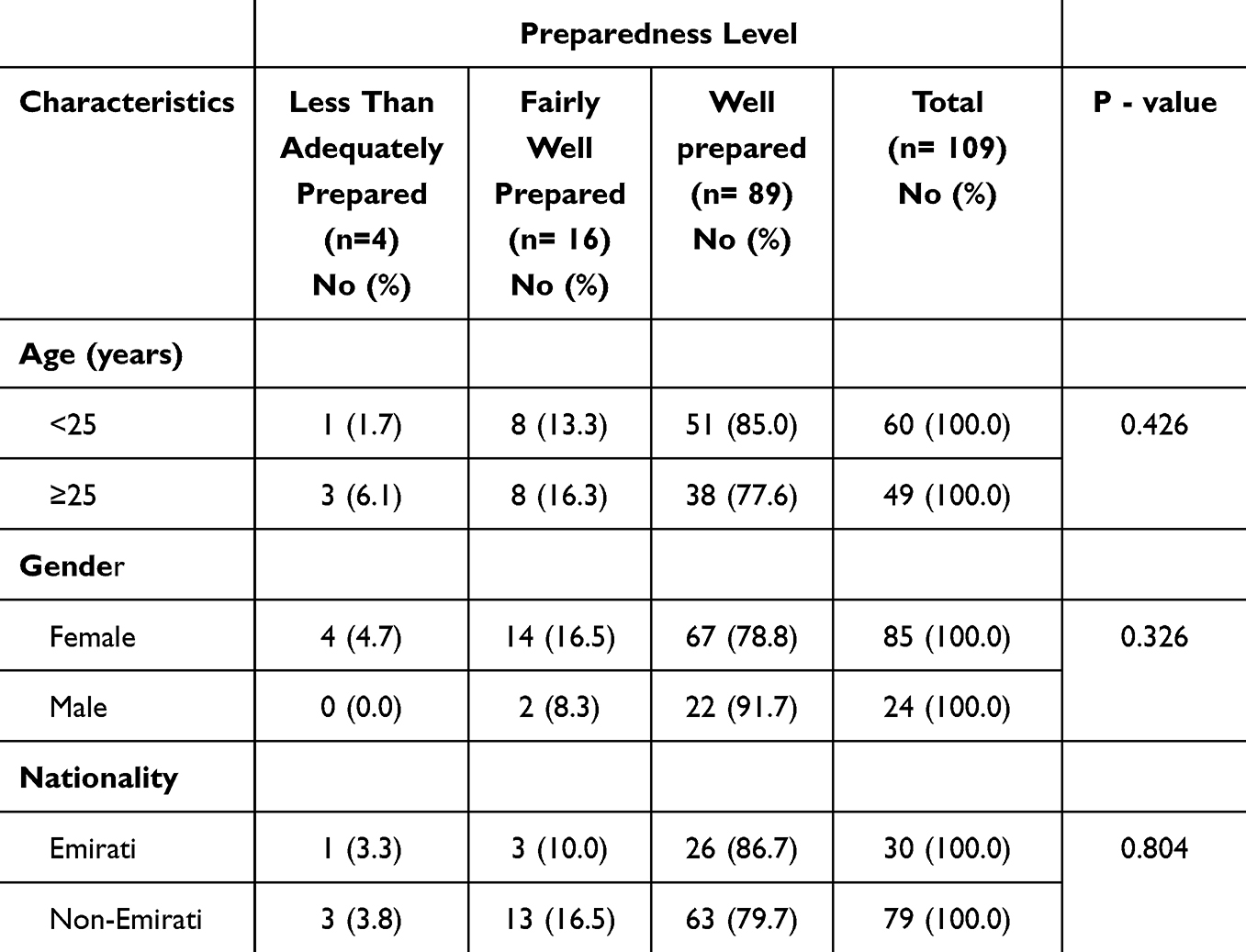 |
Table 3 Hospital Practice Preparedness Level and Medical Interns’ Characteristics |
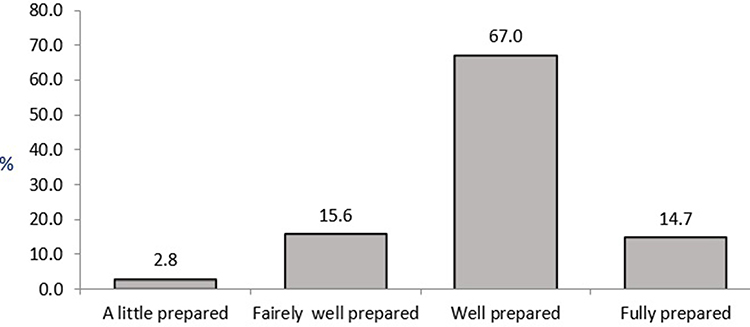 |
Figure 1 Distribution of the participants according to overall preparedness level for hospital practice. |
The preparedness of the hospital practice questionnaire’s median score across all domains was 4. The median overall score was 3.98. Table 4 illustrated that those under the age of 25 had slightly higher median scores of interpersonal skills, confidence, and collaboration than those over that age. However, these differences were not statistically significant. It was found that there were gender differences in the PHPQ scores, with males scoring significantly higher on interpersonal skills than females with a median (IQR) of 4 (4–4.19) versus 3.75 (2.75–4), p = 0.013. The other subscales and the overall score both shared a similar median score, with no significant difference.
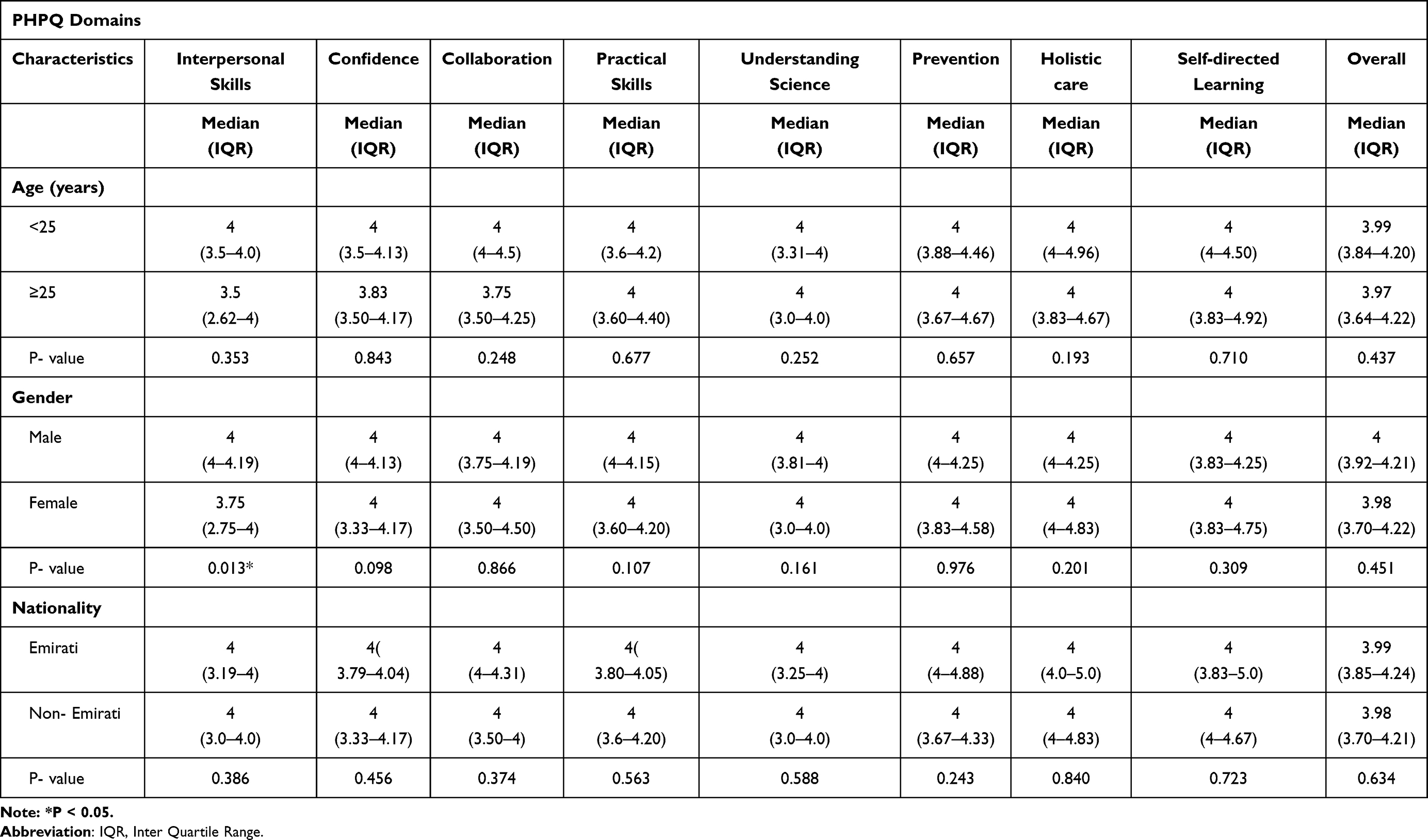 |
Table 4 Comparison of Subscales and Overall Scores of Preparedness for Hospital Practice Questionnaire (PHPQ) According to Characteristics of the Medical Interns |
Discussion
The medical graduate’s learning process can be evident in their assessment of the training they received and their aptitude for doing simple procedures. As a result, it is feasible to acquire crucial data from researching students’ perspectives that could help organize the teaching curriculum.21
The current study sought to evaluate medical graduates’ perceived preparedness for clinical practice and investigate related variables.
The majority of residents (99%) were either “fairly well equipped” or “well prepared” (52% and 47%, respectively) for hospital practice, according to the Oman study.13 This study was supported by a Malaysian study,22 and the current study, which found that nearly 97% of the interns were either fairly well prepared, well prepared, or fully prepared. This was higher than the results of other studies, including one from the United Kingdom (80%),23 the United States, where 53.8% of residents thought they were either mostly or extremely well prepared in terms of their clinical knowledge and clinical skills,14 and the study conducted in South Africa (58%).12
The Saudi Arabian survey (2017) stated that there was no statistically significant difference in readiness between the sexes in terms of preparedness, with 57.5% of males and 41.9% of females reporting that they were well-prepared.24 Higher percentages of well-prepared were the findings in the present study (91.7% and 78.8%) for males and females, respectively, with no significant differences.
According to a Saudi Arabian survey from 2020, graduates were only adequately prepared for holistic care, which obtained a median (IQR) score of 3 (2.6–3.5), followed by self-directed learning, which received a score of 3 (2.5–3.3), and unprepared for the other components regarding the management of procedural skills and practical experiences. The curriculum, which emphasizes the importance of self-directed learning in the learning process and prepares students for the holistic approach that considers the interaction of all factors affecting an individual’s health, including societal, cultural, and family aspects is credited to the authors for the students’ adequate preparation. The reason for the lack of readiness was deemed to be insufficient clinical instruction.15 It was reported by a Croatia study that the median domain score was 3 or more, for seven out of eight domains of PHPQ, while the median score was low for the interpersonal skills domain.25 Similar findings were reported by a Taiwan study in 2021 where the interns reported the highest perceived preparedness for prevention followed by self-directed learning and the lowest one was for interpersonal skills and patient management.26 In contrast to previous findings, the present study showed higher median scores across all domains, which was likely due to a well-organized curriculum and adequate clinical rotations.
Regarding the factors that might affect how medical graduates perceive their preparedness. The PHPQ domain or overall scores did not show a significant relationship with the age of the participants in the Oman study (2017).13 This was in line with current findings and Twain’s study (2021).26 This could also be due to the similarity of the ages of the participants.
Male participants fared noticeably better in the management and practical categories than female individuals,13 and this result is congruent with the current findings. This could be because male students tend to engage in more practical activities than female students. In a different study, it was found that females were more prepared than males in the areas of self-directed learning, holistic care, prevention, and confidence.27,28 Female students performed better on these elements, maybe because they have improved communication skills, are more motivated to improve themselves, and have a better attitude toward doctor-patient contact.27
Limitation
The self-reporting aspect of the questionnaire may have led to reporting bias, which may have caused an overestimation of the students ‘preparedness for hospital practice. It is a cross-sectional study with limited generalizability. The sample size was small and represented only one location in one academic year so it cannot be generalized. The interns were not evaluated while they were actively performing any procedures that might have provided a more accurate picture of their abilities. We may also get a better idea of their capacity for performing certain tasks from the viewpoint of their supervisors.
Conclusion
According to the study’s findings, 81.7% of the participants were either fully or extremely well prepared for clinical practice. Most interns thought they were either fully or very well prepared for all tasks about providing holistic care, managing challenging patients, and accepting accountability for their education. Additionally, they thought they were adequately or well-prepared to take blood pressure, record clinical data, and conduct efficient physical examinations. The tasks that were identified as requiring inadequate preparation included managing critical situations, tending to terminal patients, establishing an intravenous line, and conducting a digital rectal examination. Along with talking about the patients with the social worker.
Recommendations
Perpetual assessment of medical graduates’ readiness for clinical practice must be a crucial element of the clinical training program to ensure interns’ satisfaction and remove barriers to successful clinical training. Each department must implement skill evaluation for the interns, and comments regarding the areas in which they are weak, as these might come up in the post-graduation exam. Training should place more emphasis on dealing with emergencies, clinical pharmacology, and some abilities like setting up an intravenous line and conducting a digital rectal exam as well as coping with dying patients. The internship is a crucial field that requires further research with a larger sample size in more than one location and more than one academic year. Further study is required to assess how trainers and supervisors regard interns’ preparedness.
Data Sharing Statement
The data set are not publicly available due to security and privacy reasons. However, it is available from the Correspondence Author upon reasonable request.
Ethics Approval and Consent to Participate
The research complied with the guidelines for human studies and was conducted ethically in accordance with the World Medical Association Declaration of Helsinki.
This study received an exemption from further review and approval by the Dubai Scientific Research Committee, Decision Number DSREC -GL23-2022 Dated 13/12/2022.
Consent for Publication
An electronic informed consent to participate in the study was sent and collected to all participants by Email prior to questionnaire distribution. Participants’ anonymity was emphasized. Confidentiality of the data was maintained throughout the study.
Acknowledgments
We appreciate the contribution of Prof. HH from GMU for his unlimited cooperation & and support. We are extending our gratitude to the staff in the Medical Education section, for their great support during data collection.
Author Contributions
All authors took part in drafting, revising or critically reviewing the article; gave final approval of the version to be published; have agreed on the journal to which the article has been submitted; and agree to be accountable for all aspects of the work.
Disclosure
The authors report no conflicts of interest in this work.
References
1. DHA. Internship training programs. [Cited November 5, 2022]. Available from: https://www.dha.gov.ae/en/Medical%20Education%20and%20Research/Internship%20Training%20Programs.
2. Cleveland Clinic Abu Dhabi. Physician internship program/transitional year: medical knowledge & clinical skills. [Cited December 10, 2022]. Available from: https://www.clevelandclinicabudhabi.ae/en/institutes-and-specialties/education-dept/pages/internship-program.aspx.
3. Murdoch-Eaton D, Whittle S. Generic skills in medical education: developing the tools for successful lifelong learning. Medical Education. 2012;46(1):120–128. doi:10.1111/j.1365-2923.2011.04065.x
4. Abuhusain H, Chotirmall SH, Hamid N, O’Neill SJ. Prepared for an internship? Ir Med J. 2009;102:82–84.
5. Muthaura PN, Khamis T, Ahmed M, Hussain SR. Perceptions of the preparedness of medical graduates for internship responsibilities in district hospitals in Kenya: a qualitative study. BMC Med Edu. 2015;15:178. doi:10.1186/s12909-015-0463-6
6. Rhamani S, Ring BN, Lowe R, Hunter D. A pilot study assessing knowledge of clinical signs and physical examination skills in incoming medicine residents. J Grad Med Educ. 2010;2(2):232–235. doi:10.4300/JGME-D-09-00107.1
7. Croskerry P. From mindless to mindful practice- cognitive bias and clinical decision making. NEJM. 2013;368:2445–2448. doi:10.1056/NEJMp1303712
8. Brennan N, Corrigan O, Allard J, et al. The transition from medical student to junior doctor: today’s experiences of tomorrow’s doctors. Med Educ. 2010;44:449–458. doi:10.1111/j.1365-2923.2009.03604.x
9. Morrow G, Johnson N, Burford B, et al. Preparedness for practice: the perceptions of medical graduates and clinical teams. Med Teach. 2012;34:123–135. doi:10.3109/0142159X.2012.643260
10. Monrouxe LV, Grundy L, Mann M, et al. How prepared are UK medical graduates for practice? A rapid review of the literature 2009-2014. BMJ. 2017;7(1):e013656.
11. Gay E, Umasugi F, Rasid M. Students’ perceptions on internship program: effectiveness and problems. BIS-HSS. 2020[Cited February 4, 2023]. Available from: https://www.researchgate.net/publication/356419887.
12. Blitz J, Kok N, Van Heerden B, Van Schalkwyk S. PIQUE-ing an interest in curriculum renewal. Afr J Health Prof Educ. 2014;6(1):23–27.
13. Al Sinawi H, Al Alawi M, Al Qubtan A, Al Lawati J, Al Habsi A, Jose S. Perception of preparedness for clinical work among new residents: a cross-sectional study from Oman. Oman Med J. 2017;32(3):201–206. doi:10.5001/omj.2017.38
14. Chen CA, Kotliar D, Drolet BC. Medical education in the United States: do residents feel prepared? Perspect Med Educ. 2015;4:181–185. doi:10.1007/S40037-015-0194-8
15. Masud N, Moukaddem A, Alosaimi AH, et al. Are graduate entrant medical students better prepared for hospital practice than school entrant medical students? J Pak Med Assoc. 2020;70(7):1193–1198. doi:10.5455/JPMA.42229
16. Al Kuwaiti A, Subbarayalu AV. Factors influencing interns’ satisfaction with the internship training program offered at Saudi medical schools. Sultan Qaboos University Med J. 2020;20(2):209–215. doi:10.18295/squmj.2020.20.02.012
17. Serwah AHA, Al Sulimani A, Mohamed WS, et al. Assessment of the level of satisfaction of final year’s medical students with the clinical training at taif teaching hospitals, KSA. J Contemp Med Educ. 2015;3(2):64–71. doi:10.5455/jcme.20150611063851
18. Illing J, Peile E, Morrison J, et al. How prepared are medical graduates to begin practice? A comparison of three diverse UK medical schools. Final Report for the GMC Education Committee. London: 2008 [Cited December 4, 2022]. Available from: https://www.gmc-uk.org/-/media/gmc-site-images/about/how-prepared-are-medical-graduates.
19. Hill J, Rolfe IE, Pearson SA, Heathcote A. Do junior doctors feel they are prepared for hospital practice? A study of graduates from traditional and non-traditional medical schools. Med Educ. 1998;32(1):19–24. doi:10.1046/j.1365-2923.1998.00152.x
20. Prozesky DR, Molwantwa MC, Nkomazana O, Kebaetse MB. Intern preparedness for the CanMEDS roles and the Dunning-Kruger effect: a survey. BMC Med Edu. 2019;19(422). doi:10.1186/s12909-019-1836-z
21. Gismalla MDA, Perumal AK, Habour AB, Mohammed MEI. Does perception of clinical competency correlate with perception of training efficiency? J Med Educ. 2017;16(4):221–226.
22. Yadav H, Tan KL, Yadav R. Perception and preparedness of final year medical students of the internship program. Asian Acad Res J Multidiscip. 2015;2(3):380–391.
23. Barr J, Ogden KJ, Rooney K, Robertson L. Preparedness for practice: the perceptions of graduates of a regional clinical school. Med J Aust. 2017;206(10):447–452. doi:10.5694/mja16.00845
24. Swaid AI, Elhilu AH, Mahfouz MS. Medical internship training in Saudi Arabia: interns ‘views and perceptions. Adv Medical Educ Pract. 2017;8:121–127. doi:10.2147/AMEP.S123119
25. Bojanić K, Schears GJ, Schroeder DR, Jenkins SM, Warner DO, Sprung J. Survey of self-assessed preparedness for clinical practice in one Croatian medical school. BMC Res Notes. 2009;2(1):152. doi:10.1186/1756-0500-2-152
26. Yu SR, Cheng YC, Tseng HM, et al. Undergraduates’ preparedness for practice is associated with professional identity and perception of educational environment: a validation study. Biomedical Journal. 2021;44(4):495–503. doi:10.1016/j.bj.2020.04.009
27. Stastka LH, Seitz T, Billeth S, Pastner B, Preusche I, Seidman C. Significance of gender in the attitude towards doctor-patient communication in medical students and physicians. Wien Klin Wochenschr. 2016;128:663–668. doi:10.1007/s00508-016-1054-1
28. Graf J, Smolka R, Simoes E, et al. Communication skills of medical students during the OSCE: gender-specific differences in a longitudinal trend study. BMC Med Educ. 2017;17(e75). doi:10.1186/s12909-017-0913-4
 © 2025 The Author(s). This work is published and licensed by Dove Medical Press Limited. The
full terms of this license are available at https://www.dovepress.com/terms
and incorporate the Creative Commons Attribution
- Non Commercial (unported, 3.0) License.
By accessing the work you hereby accept the Terms. Non-commercial uses of the work are permitted
without any further permission from Dove Medical Press Limited, provided the work is properly
attributed. For permission for commercial use of this work, please see paragraphs 4.2 and 5 of our Terms.
© 2025 The Author(s). This work is published and licensed by Dove Medical Press Limited. The
full terms of this license are available at https://www.dovepress.com/terms
and incorporate the Creative Commons Attribution
- Non Commercial (unported, 3.0) License.
By accessing the work you hereby accept the Terms. Non-commercial uses of the work are permitted
without any further permission from Dove Medical Press Limited, provided the work is properly
attributed. For permission for commercial use of this work, please see paragraphs 4.2 and 5 of our Terms.