
Back to Journals » Patient Preference and Adherence » Volume 20
Patient Expectations, Safety Concerns, and Adherence to Topical Acne Medications: Findings from a Web-Based Survey
Authors Yang Y, Fan Q, Zhang L, Liu X, Wang P, Pan Z, Ju Q, Wang X
Received 27 March 2026
Accepted for publication 9 July 2026
Published 22 July 2026 Volume 2026:20 612342
DOI https://doi.org/10.2147/PPA.S612342
Checked for plagiarism Yes
Review by Single anonymous peer review
Peer reviewer comments 2
Editor who approved publication: Dr Johnny Chen
Yutong Yang,1,* Qing Fan,2,* Linglin Zhang,1 Xiaojing Liu,1 Peiru Wang,1 Zhanyan Pan,3 Qiang Ju,3 Xiuli Wang1
1The Institute of Photomedicine, Shanghai Skin Disease Hospital, School of Medicine, Tongji University, Shanghai, People’s Republic of China; 2Department of Dermatology, Shanghai Fengxian District Central Hospital, Shanghai, People’s Republic of China; 3Department of Dermatology, Renji Hospital, Shanghai Jiao Tong University School of Medicine, Shanghai, People’s Republic of China
*These authors contributed equally to this work
Correspondence: Xiuli Wang, The Institute of Photomedicine, Shanghai Skin Disease Hospital, School of Medicine, Tongji University, No. 1278 Baode Road, Jingan District, Shanghai, People’s Republic of China, Email [email protected] Qiang Ju, Department of Dermatology, Renji Hospital, Shanghai Jiao Tong University School of Medicine, No. 145 Shandong Middle Road, Huangpu District, Shanghai, People’s Republic of China, Email [email protected]
Background: Suboptimal adherence to first-line topical medications (eg, topical retinoids, benzoyl peroxide, and topical antibiotics) is a major barrier to effective acne vulgaris (AV) management. The influence of patients’ pre-treatment expectations and concerns about adverse effects on adherence behavior remains inadequately quantified.
Objective: To evaluate young patients’ perceptions of acne and their expectations, concerns, and adherence regarding topical medications.
Methods: A web-based cross-sectional survey was conducted from December 2023 to January 2024. Patients aged 16– 29 with a history of AV and topical medication use were recruited. Data on demographics, disease perception, medication knowledge, usage patterns, and adherence were collected via a structured questionnaire and analyzed using descriptive and comparative statistics.
Results: A total of 501 valid questionnaires were collected. Patients acquired their knowledge about acne through various channels, with dermatologists being the most reliable source of information. Although 82.83% of patients recognized AV as a chronic disease, substantial misconceptions regarding its etiology and treatment persisted. Topical medications were commonly used, most frequently adapalene (40.92%), tretinoin (32.93%), benzoyl peroxide (24.75%), and clindamycin (20.96%). However, patients demonstrated limited knowledge regarding the proper application. Expectations for the onset of topical medications were overly optimistic, whereas the actual duration of use was often inadequate. The information that respondents had the strongest desire to access included the side effects, method of use, onset time, and duration of use. Medication discontinuation was primarily attributed to perceived slow efficacy or concerns about adverse effects, which contributed to a relatively high recurrence rate following treatment cessation.
Conclusion: Young patients demonstrated limited comprehension of AV and lacked knowledge of topical medications and their appropriate application, as well as unrealistic expectations regarding onset time. Enhanced education on the nature of AV, along with detailed instructions on topical medication use, is crucial for improving patients’ disease awareness and treatment adherence.
Keywords: acne vulgaris, web-based survey, topical medication, patient adherence, patient education
Introduction
Acne vulgaris (AV) is a highly prevalent skin disease that predominantly affects adolescents and young adults.1,2 In China, the prevalence of acne among adolescents has been reported to range from 39.2% to 53.5%,2–4 and the burden has continued to rise over the past three decades.5 Although not life-threatening, AV has significant psychological and social impacts on patients.6,7 AV requires long-term management due to its chronic and relapsing nature, with topical medications serving as the mainstay of the treatment.8–10 However, patients frequently report suboptimal treatment outcomes,11–13 highlighting a critical disconnect between clinical guidelines and real-world practice.14,15 An accurate understanding of AV and the appropriate use of topical medications are therefore crucial to therapeutic success.12,16,17 Investigating how patients actually use these topical agents is essential to address this gap.
Insufficient knowledge about acne and its treatment remains widespread among patients.17,18 Previous studies across various countries have consistently shown that patients hold misconceptions regarding the etiology and management of AV and often exhibit suboptimal treatment behaviors.19–21
In the current era of rapid information exchange and fast-paced lifestyles, patients increasingly rely on online channels for purchasing products and accessing health information.22–24 Dietary habits (eg, high‑glycemic‑index foods and dairy products), together with lifestyle factors such as stress and sleep deprivation, have been implicated in AV exacerbation.25 These factors are increasingly prevalent in modern Chinese society and may contribute to the growing burden of AV among young adults.3 This trend underscores the urgent need to accurately assess the current landscape of patient knowledge and practices related to AV and its topical treatments, particularly given the disease’s wide prevalence and substantial impact. To date, a comprehensive nationwide investigation into patients’ understanding of AV and their use of topical medications has been lacking in China.
This study aims to bridge this gap by using a web-based survey to investigate the perceptions of AV and the detailed usage patterns of topical medications among young AV patients in China. The findings are expected to offer evidence-based insights to inform clinical practice and patient education initiatives.
The results will be vital for improving support for this substantial patient population and will provide crucial insights to guide both clinical management and educational strategies. Notably, the findings underscore the necessity for dermatologists, even in the midst of demanding schedules, to engage in patient education actively. This study offers the specific, practical guidance needed for clinicians to provide more precise and effective patient support.
Methods
This cross-sectional study was conducted utilizing a specifically designed web-based questionnaire between December 2023 and January 2024. The survey targeted young individuals diagnosed with AV, aged 16 to 29 years, in China. All patients completed the questionnaire anonymously and voluntarily. None of them, nor their families, work in advertising agencies, public relations firms, media outlets, market sectors, pharmaceutical sales, healthcare venues, or medical research institutions.
Data collection covered demographics, skin characteristics, disease perception, psychosocial impact, information sources, and detailed topical medication usage, knowledge, and adherence patterns. No other personally identifiable information (such as name, ID number, telephone number, or residential address) was sought or recorded. All participants were required to provide informed consent electronically before starting the survey. The survey consisted primarily of closed-ended questions, incorporating both single-choice and multiple-choice formats to capture participant responses systematically. Descriptive statistics were presented as means ± standard deviations (SD) for continuous variables and as numbers and percentages (n, %) for categorical variables. Categorical variables were compared between genders using the Chi-square test. A two-sided p-value of less than 0.05 was considered statistically significant. All analyses were performed using SPSS Statistics (version 27; IBM Corp., Armonk, NY, USA).
Results
A total of 501 valid questionnaires were collected from 238 male (47.50%) and 263 female (52.50%) patients. Most patients were categorized as having oily or mixed skin with sensitive symptoms (Table 1).
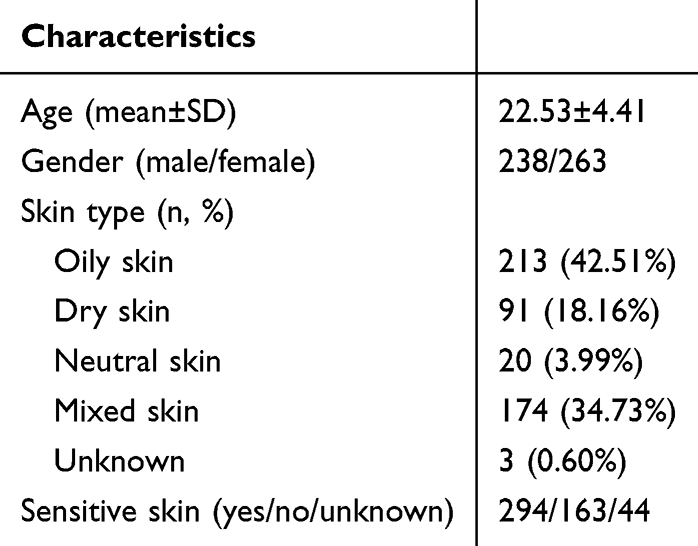 |
Table 1 Demographic and Skin Characteristics of Patients |
Patients obtained information about AV from various sources (Figure 1A), among which they trusted dermatologists in hospitals or clinics the most. There is no difference in the choice of information sources between different genders. It is worth noting that the majority of patients choose online platforms, including Internet hospitals, online pharmacies, and social media. Although a large majority (82.83%) of respondents correctly identified AV as a chronic relapsing disease necessitating long-term therapy, a substantial minority misperceived it as a temporary condition. The correct rate of females’ awareness of AV was significantly higher than that of males (86.69% vs 78.57%, p < 0.01). Most patients believed that the primary etiology of AV is an endocrine disorder (29.54%), personal lifestyle and habits (21.56%), and skin oiliness and pore clogging (21.16%) (Figure 1B). In this regard, there is no difference in the understanding between females and males. The distress caused by AV for patients includes restricted behavior, impacts on social interactions, and negative emotions such as feelings of inferiority (Table 2). Compared with males, females were significantly more restricted in terms of makeup (39.54% vs 2.94%, P < 0.001).
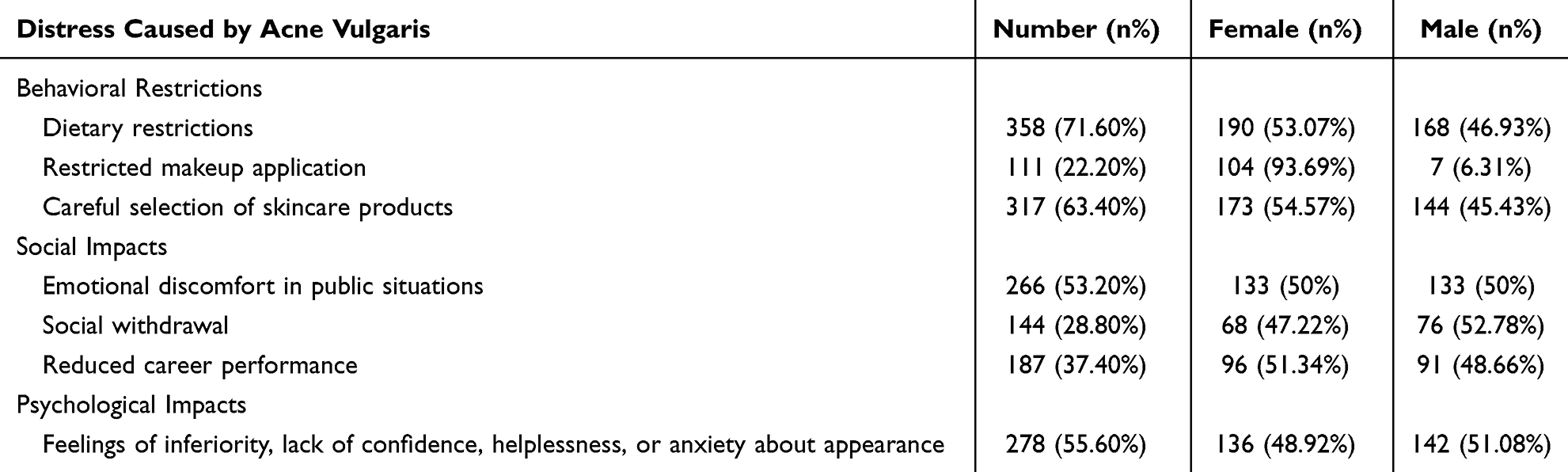 |
Table 2 Distress Caused by Acne Vulgaris |
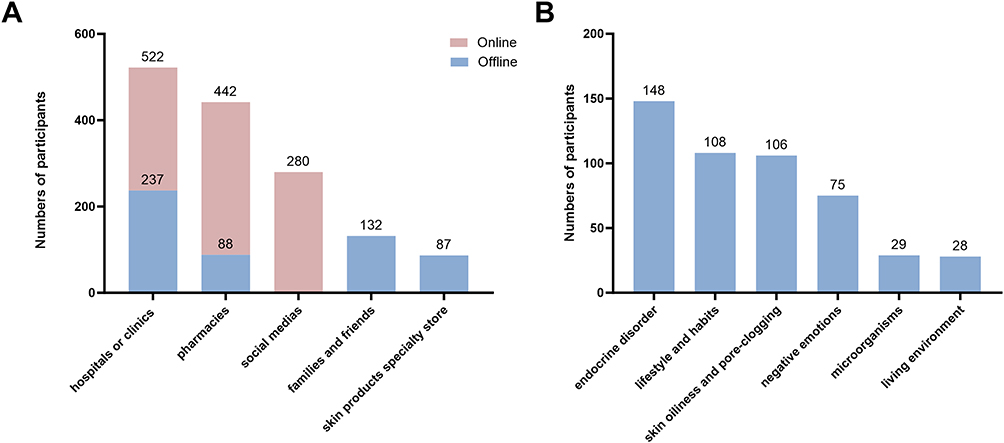 |
Figure 1 Information sources of acne vulgaris among patients (A). Patients’ perceived causes of acne vulgaris (B). |
The topical medications used by patients mainly included retinoids, benzoyl peroxide, topical antibiotics, azelaic acid, and traditional Chinese medicine (Figure 2A). The most frequently used topical medications were adapalene (40.92%), tretinoin (32.93%), benzoyl peroxide (24.75%), and clindamycin (20.96%). As this was a multiple-choice question, the percentages sum to more than 100%. Only 3.39% of young individuals reported use of hydroquinone, dexamethasone, or betamethasone. No significant gender‑related differences were observed in the use of topical anti‑acne agents. Before applying topical drugs, most young patients consulted dermatologists or obtained prescriptions, while some received recommendations from the internet or non-specialists (Figure 2B). A majority of young patients were not well-informed about the ingredients, mechanisms of action, applicable situations, onset time, and age indications. A sizable portion had limited knowledge about how to use the medications, their specific effects, and side effects. Only around 30.00% of patients fully or relatively understood this information (Figure 2C). There was no difference in knowledge levels between different genders. Additionally, the information most desired by patients includes side effects and precautions, onset time, and usage instructions (Figure 2D).
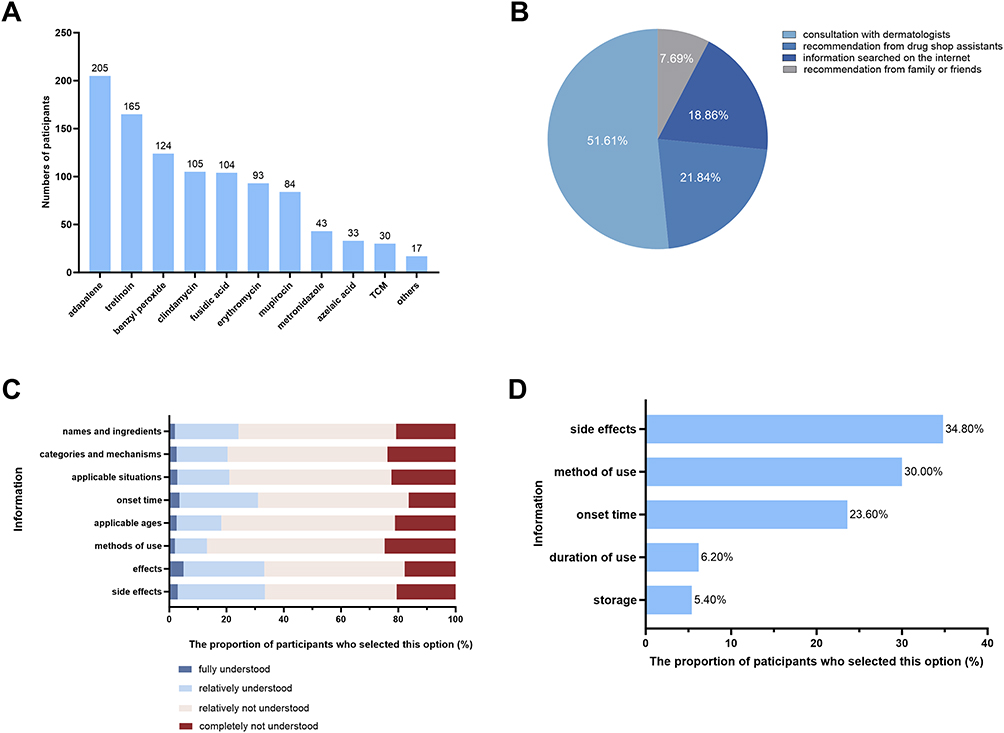 |
Figure 2 Topical medications that patients used (A). The way of confirmation before the administration of topical medicine (B). Patients’ knowledge level regarding information on topical medications (C). The information that patients were most interested in (D). Abbreviation: TCM, Traditional Chinese Medicine. |
The method of applying topical drugs did not differ by type of medicine. 78.11% of the patients applied topical medications in a spot-on manner, while the rest spread them over a larger area. 20.00% of patients were unaware that retinoids require a gradual build-up of tolerance, and 63.00% did not know how to build tolerance correctly.
A significant majority of patients (83.17%) expected topical medications to take effect within 1 week, with 10.89% even anticipating improvement within one day (Figure 3A). However, actual usage patterns revealed notably short treatment durations. The majority of patients used topical medications for less than four weeks. Specifically, over half of retinoid users (50.00% in total, comprising the “less than 1 week” and “1–2 weeks” groups) discontinued treatment within two weeks. In contrast, a notable proportion of patients (23.53%) used topical antibiotics for over eight weeks (Figure 3B). The main reasons patients gave for discontinuing topical medications were slow onset or poor efficacy (44.00%), and concerns about or inability to tolerate side effects (40.00%). Furthermore, 44.59% of patients experienced relapse in three months after withdrawal.
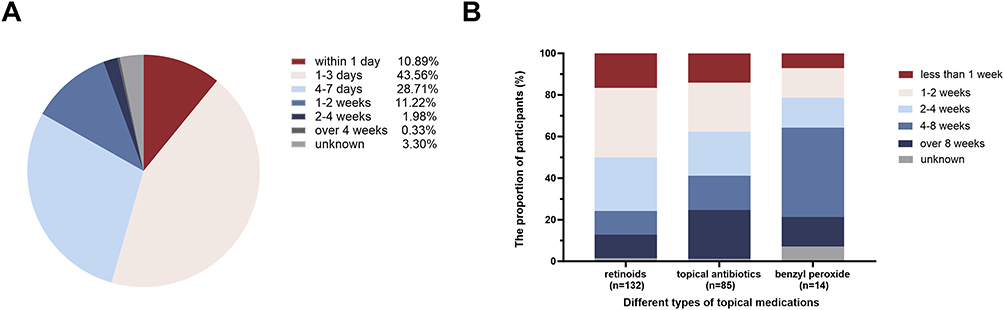 |
Figure 3 The expected onset time of topical medicines (A). The actual duration of topical medication usage (B). |
Discussion
This web-based survey of 501 young patients with AV confirms the substantial psychosocial burden associated with the condition and underscores the central role of topical therapies in its management.6,10 However, our findings reveal a critical disconnect between clinical importance and patient practice: a widespread lack of knowledge about AV and its treatment,12,17 coupled with suboptimal and underutilized application of topical medications.14,16
Advancing patient knowledge about AV remains a critical need. A notable proportion of patients in this study still perceived AV as a temporary condition or believed it did not require formal treatment—misconceptions that are likely to influence their medication adherence and usage patterns negatively.12,25,26 Furthermore, comparative analyses revealed a significant gender disparity in disease awareness, with female patients demonstrating a higher level of understanding than their male counterparts (86.69% vs 78.57%, p<0.01).22 This finding highlights the importance of implementing targeted educational interventions, particularly for male patients, to improve their knowledge.27 Conversely, the data also indicated that female patients bear a disproportionate psychosocial burden from AV, experiencing greater psychological distress and more pronounced impacts on quality of life.27,28 These observations underscore the need to integrate gender-specific support into clinical practice.29 Providing structured psychological support and emotional reassurance for female patients, in addition to knowledge-focused education for males, should be considered within comprehensive dermatological care.
The intervention of non-professional opinions may affect the correctness of topical medicine use. Most patients received prescriptions or recommendations from dermatologists before treatment, indicating that specialists still play a leading role in patients’ initial decisions regarding medication use.30 The predominant rational selection of topical medications among patients reflects standardized prescribing practices among Chinese dermatologists and the measurable impact of public health education initiatives, particularly through nationwide guideline dissemination campaigns and the Healthy China policy framework. However, a small number of patients obtained advice by searching the Internet or by following recommendations from friends or family members, similar to previous studies.20,31 This exposure to information of varying quality and accuracy poses a substantial risk of improper medication use.23 For instance, the reported use of glucocorticoids or hydroquinone cream, which are not mainstream acne treatments, may reflect attempts to alleviate inflammatory symptoms or post-acne hyperpigmentation based on such informal guidance. As patients increasingly turn to digital and social media for health information,30,32 these channels also represent a critical opportunity for dermatologists to deliver accurate, accessible education and counteract the spread of misinformation.33
In practice, patients showed poor adherence to both the duration of medication use and the proper application methods. They used topical medication for a shorter period than recommended, possibly because they expected quick results.12 Most patients believed that topical medicine would work within a very short time, even within 24 hours, showing their urgent desire for improvement.12,34 However, the actual onset time of different drugs can vary depending on factors like drug type and individual differences.16 The gap between these unrealistic expectations and reality may further reduce patients’ adherence to treatment.12 Additionally, patients mainly worried about the side effects of topical medications. These concerns may lead to non-adherence to prescribed topical regimens.35 Therefore, it is essential to provide detailed patient education about how medications work and realistic timelines for improvements to set proper expectations. At the same time, addressing therapeutic hesitancy requires fully informing patients about possible side effects and using evidence-based preventative strategies.
Suboptimal adherence, characterized by an irregular method of use and insufficient treatment duration, is likely associated with the relatively high recurrence rate observed after drug withdrawal. International guidelines recommend retinoids as a fundamental treatment for most acne cases. However, their efficacy depends on proper and sustained use, which includes an initial period of several weeks to achieve effectiveness and a subsequent maintenance phase typically lasting 3 to 12 months.8,9 While most patients in this study used guideline-recommended agents, indicating a general awareness of appropriate drug selection, notable deficiencies were observed in the practical application details. Common issues included a predominant use of spot application rather than larger-area application, a lack of knowledge of tolerance-building techniques for retinoids, and prolonged use of topical antibiotics beyond recommended durations, which may promote bacterial resistance.3 These specific gaps in the “how” and “how long” of treatment, rather than the “which”, represent a critical target for future patient education efforts by dermatologists.
This study has several limitations. The sample size, although informative, remains relatively small. Furthermore, the questionnaire specifically focused on topical medications and used closed-ended questions, which may not have fully captured the variety of patient experiences and behaviors. Additionally, the self-reported nature of the data is vulnerable to recall bias and social desirability bias. Future studies would benefit from a larger sample, the use of mixed-method approaches, and more open-ended questions to better understand real-world clinical practices. Despite these limitations, this investigation provides valuable foundational insights and serves as an important reference for designing future large-scale cohort studies on acne vulgaris.
Conclusion
Despite the wide availability of health information, young AV patients in this study demonstrated limited understanding of the disease and its underlying causes. Dermatologists were identified as the most trusted and primary source of reliable information on topical treatments. Nevertheless, patients demonstrated limited knowledge of topical medication use, particularly regarding application techniques, treatment duration, and onset of action, and often held unrealistic expectations for rapid results. Enhanced education regarding AV perception and detailed instructions on topical medication use are crucial for improving patient awareness and treatment compliance.
Data Sharing Statement
The de-identified individual participant data that support the findings of this study are not publicly available due to privacy and ethical restrictions imposed by the approving ethics committee. The survey questionnaire is available as a supplementary file with this submission. Reasonable requests for data access for academic purposes can be directed to the corresponding author and will be considered subject to a data sharing agreement and approval from the ethics committee.
Ethics Approval
This study was conducted in accordance with the principles of the Declaration of Helsinki. The study protocol was reviewed and approved by the Ethics Committee of Shanghai Skin Disease Hospital (Approval No. 2023-29). Informed consent was obtained electronically from all participants prior to their completion of the web-based questionnaire.
Acknowledgments
We would like to express our sincere gratitude to Dr. Xiaoxiang Liu for her assistance with data statistics.
Funding
This work was supported by the Shanghai Skin Disease Hospital “Rising Star” Young Physician Training Program under Grant No.2025xwzx05.
Disclosure
The authors report no conflicts of interest in this work.
References
1. Bhate K, Williams HC. Epidemiology of acne vulgaris. Br J Dermatol. 2013;168(3):474–8. doi:10.1111/bjd.12149
2. Shen Y, Wang T, Zhou C, et al. Prevalence of acne vulgaris in Chinese adolescents and adults: a community-based study of 17,345 subjects in six cities. Acta dermato-venereologica. 2012;92(1):40–44. doi:10.2340/00015555-1164
3. Wu TQ, Mei SQ, Zhang JX, et al. Prevalence and risk factors of facial acne vulgaris among Chinese adolescents. Int J Adolescent Med Health. 2007;19(4):407–412. doi:10.1515/ijamh.2007.19.4.407
4. Li D, Chen Q, Liu Y, Liu T, Tang W, Li S. The prevalence of acne in Mainland China: a systematic review and meta-analysis. BMJ open. 2017;7(4):e015354. doi:10.1136/bmjopen-2016-015354
5. Yuan R, Long H, Li T, Chen A. Comparison of the burden of acne vulgaris in China vs globally: insights from the global burden of disease study (2021) and projections to 2050. Acta dermato-venereologica. 2026;106. doi:10.2340/actadv.v106.adv-2025-0131
6. Layton AM, Bettoli V, Delore V, Puentes E, Tan JKL. The burden of acne vulgaris on health-related quality of life and psychosocial well-being domains: a systematic review. Am J Clin Dermatol. 2025;27:17–47. doi:10.1007/s40257-025-00983-3
7. Tosun N, Tosun M, Dığış M, Younis M. Internalized stigma in acne vulgaris patients and relationship with quality of life, disease severity. Healthcare. 2025;13(12):1359. doi:10.3390/healthcare13121359
8. Reynolds RV, Yeung H, Cheng CE, et al. Guidelines of care for the management of acne vulgaris. J Am Acad Dermatol. 2024. doi:10.1016/j.jaad.2023.12.017
9. Descamps V. Clinical guidelines for management of acne vulgaris. JAMA. 2017;317(2):213. doi:10.1001/jama.2016.19262
10. Working group for hair diseases CSoD. Guideline for diagnosis and treatment of acne (the 2019 revised edition). J Clin Dermatol. 2019;48(9):583–588. doi:10.16761/j.cnki.1000-4963.2019.09.020
11. Tobiasz A, Nowicka D, Szepietowski JC. Acne vulgaris-novel treatment options and factors affecting therapy adherence: a narrative review. J Clin Med. 2022;11(24):7535. doi:10.3390/jcm11247535
12. Ip A, Muller I, Geraghty AWA, McNiven A, Little P, Santer M. Young people’s perceptions of acne and acne treatments: secondary analysis of qualitative interview data. Br J Dermatol. 2020;183(2):349–356. doi:10.1111/bjd.18684
13. Barbieri JS, Fulton R, Neergaard R, Nelson MN, Barg FK, Margolis DJ. Patient perspectives on the lived experience of acne and its treatment among adult women with acne: a qualitative study. JAMA Dermatol. 2021;157(9):1040–1046. doi:10.1001/jamadermatol.2021.2185
14. Dréno B, Thiboutot D, Gollnick H, et al. Large-scale worldwide observational study of adherence with acne therapy. Int J Dermatol. 2010;49(4):448–456. doi:10.1111/j.1365-4632.2010.04416.x
15. Ferhatosmanoğlu A, Arıca İE, Polat M, et al. Sociodemographic, clinical, and behavioral determinants of treatment adherence in acne vulgaris: a multicenter study. J Dermatol Treatment. 2026;37(1):2620230. doi:10.1080/09546634.2026.2620230
16. Tan JK, Balagurusamy M, Fung K, et al. Effect of quality of life impact and clinical severity on adherence to topical acne treatment. J Cutaneous Med Surg. 2009;13(4):204–208. doi:10.2310/7750.2009.08055
17. Wang J, Bai D, Yao X, Song X, Yang X, Yuan Y. Knowledge, attitudes, and practices of patients with moderate to severe acne regarding oral medication therapy: a structural equation modeling analysis. Clin Cosmet Invest Dermatol. 2026;19:554435. doi:10.2147/ccid.S554435
18. Kaushik M, Gupta S, Mahendra A. Living with acne: belief and perception in a sample of Indian youths. Indian J Dermatol. 2017;62(5):491–497. doi:10.4103/ijd.IJD_100_16
19. Israel CE, Ralph-Nwachukwu CI, Attah CA. Knowledge and treatment behaviour of acne vulgaris among female students of University of Nigeria, Enugu Campus, Enugu State, Nigeria. Indian J Dermatol. 2022;67(6):682–687. doi:10.4103/ijd.ijd_766_21
20. Wisuthsarewong W, Nitiyarom R, Kanchanapenkul D, Arunkajohnask S, Limphoka P, Boonchai W. Acne beliefs, treatment-seeking behaviors, information media usage, and impact on daily living activities of Thai acne patients. J Cosmet Dermatol. 2020;19(5):1191–1195. doi:10.1111/jocd.13132
21. Savo I, Jorgaqi E, Vasili E, Mishtaku S, Demaj D, Jafferany M. Treatment-seeking behavior, knowledge and beliefs about acne vulgaris among adolescents: a cross-sectional study in high school students in Tirana, Albania. Dermatol Ther. 2020;33(4):e13500. doi:10.1111/dth.13500
22. Aldosari MA, Aldosari DA, Almutairi RH, Aldosari TA, Shadid AM, Alzamil FM. Acne vulgaris in Saudi Arabia – myths and common misconceptions: a cross-sectional study. J Dermatol Dermatologic Surg. 2024;28(1):11–18. doi:10.4103/jdds.jdds_2_23
23. Ünal B, Demirbaş A, Erdoğan BG. Social media use as a source of information by acne vulgaris patients. J Cosmet Dermatol. 2024;23:3312–3318. doi:10.1111/jocd.16477
24. Ertekin SS, Salici NS, Manav Bas V, et al. Influence of social media and internet on treatment decisions in adult female acne patients: a cross-sectional survey study. Dermatol Pract Conceptual. 2024;14(3):e2024156. doi:10.5826/dpc.1403a156
25. Magin P, Pond D, Smith W, Watson A. A systematic review of the evidence for ‘myths and misconceptions’ in acne management: diet, face-washing and sunlight. Family Practice. 2005;22(1):62–70. doi:10.1093/fampra/cmh715
26. Thiboutot D, Dréno B, Layton A. Acne counseling to improve adherence. Cutis. 2008;81(1):81–86.
27. Tian J, Shu H, Qian Q, et al. Current status of cognition and skin care behavior in adolescent patients with acne: a survey in China. Chin Med J. 2024;137(4):476–477. doi:10.1097/cm9.0000000000002858
28. Szepietowska M, Stefaniak AA, Krajewski PK, Matusiak L. Females may have less severe acne, but they suffer more: a prospective cross-sectional study on psychosocial consequences in 104 consecutive polish acne patients. J Clin Med. 2023;13(1):4. doi:10.3390/jcm13010004
29. Preis S, Ziehfreund S, Biedermann T, Horster S, Zink A. A systematic review of sex and gender differences in treatment outcome of inflammatory skin diseases: is it time for new guidelines? J Eur Acad Dermatol Venereol. 2025;39(3):512–528. doi:10.1111/jdv.20256
30. Cui RR, Li W, Shen Z, Zhang ZX, Chen AJ. Assessment of skin care behavior and cognition of patients with acne vulgaris in China. Chin Med J. 2021;134(5):614–615. doi:10.1097/cm9.0000000000001397
31. Toy J, Wan V, Lee DG, Liu C, Fleming P, Lynde C. Perspectives and knowledge of acne vulgaris among young adolescents. Pediatr Dermatol. 2023;40(2):308–311. doi:10.1111/pde.15230
32. Aslan Kayıran M, Karadağ AS, Alyamaç G, et al. Social media use in patients with acne vulgaris: what do patients expect from social media? J Cosmet Dermatol. 2021;20(8):2556–2564. doi:10.1111/jocd.14272
33. Tuong W, Wang AS, Armstrong AW. Effect of automated online counseling on clinical outcomes and quality of life among adolescents with acne vulgaris: a randomized clinical trial. JAMA Dermatol. 2015;151(9):970–975. doi:10.1001/jamadermatol.2015.0859
34. Del Rosso JQ. When do efficacy outcomes in clinical trials correlate with clinical relevance? Analysis of clindamycin phosphate 1.2%-benzoyl peroxide 3.75% gel in moderate to severe acne vulgaris. Cutis. 2016;98(1):21–25.
35. Sevimli Dikicier B. Topical treatment of acne vulgaris: efficiency, side effects, and adherence rate. J Int Med Res. 2019;47(7):2987–2992. doi:10.1177/0300060519847367
 © 2026 The Author(s). This work is published and licensed by Dove Medical Press Limited. The
full terms of this license are available at https://www.dovepress.com/terms
and incorporate the Creative Commons Attribution
- Non Commercial (unported, 4.0) License.
By accessing the work you hereby accept the Terms. Non-commercial uses of the work are permitted
without any further permission from Dove Medical Press Limited, provided the work is properly
attributed. For permission for commercial use of this work, please see paragraphs 4.2 and 5 of our Terms.
© 2026 The Author(s). This work is published and licensed by Dove Medical Press Limited. The
full terms of this license are available at https://www.dovepress.com/terms
and incorporate the Creative Commons Attribution
- Non Commercial (unported, 4.0) License.
By accessing the work you hereby accept the Terms. Non-commercial uses of the work are permitted
without any further permission from Dove Medical Press Limited, provided the work is properly
attributed. For permission for commercial use of this work, please see paragraphs 4.2 and 5 of our Terms.
Recommended articles
Plasma Treatment – Results of Skin Microbiome Analysis
Watanabe C
Clinical, Cosmetic and Investigational Dermatology 2025, 18:1269-1279
Published Date: 26 May 2025

Real-World Acne Treatment Patterns, Preferences, and Adherence in Thailand: A Cross-Sectional Analysis
Paichitrojjana A, Paichitrojjana A
Patient Preference and Adherence 2025, 19:3197-3210
Published Date: 16 October 2025