
Back to Journals » Clinical Ophthalmology » Volume 20
NICE-Informed Quality Improvement for Neovascular Age-Related Macular Degeneration: A Single-Centre Two-Cycle Audit of the Two-week Referral-to-Injection Standard
Authors Tandon D  , Patel R, Chhabra Y, Subash M, Sandhu R
Received 12 April 2026
Accepted for publication 1 July 2026
Published 21 July 2026 Volume 2026:20 614936
DOI https://doi.org/10.2147/OPTH.S614936
Checked for plagiarism Yes
Review by Single anonymous peer review
Peer reviewer comments 4
Editor who approved publication: Dr Yousef Fouad
Devansh Tandon,1,2 Rhianna Patel,1,3 Yuvy Chhabra,4 Mala Subash,1 Ranjit Sandhu1
1Ophthalmology, Luton and Dunstable University Hospital, Luton, UK; 2Acute Medicine, University Hospital Coventry and Warwickshire, Coventry, UK; 3Acute Medicine, East Surrey Hospital, Redhill, UK; 4Medical School, University College London, London, UK
Correspondence: Yuvy Chhabra, Medical School, University College London, 74 Huntley Street, London, WC1E 6DE, UK, Email [email protected]
Purpose: Neovascular age-related macular degeneration (nAMD) is a time-critical cause of irreversible central vision loss. National audit standards operationalise timely treatment as intravitreal anti-VEGF therapy within two weeks of community referral. This retrospective, single-centre, two-cycle quality improvement audit evaluated compliance with the referral-to-first-injection (RTFI) standard and the impact of targeted service optimisation on pathway performance and early outcomes.
Methods: Cycle 1 included 81 consecutive community referrals receiving first intravitreal injection for nAMD at Luton and Dunstable University Hospital (March–December 2024); Cycle 2 included 50 patients (May–November 2025). The primary outcome was the proportion meeting the two-week RTFI target. Referral-to-first-appointment (RTFA) and first-appointment-to-first-injection (FATFI) intervals were analysed as pathway components. Secondary outcomes were change in ETDRS visual acuity and OCT-derived central macular thickness (CMT) between baseline and first post-injection follow-up. Following Cycle 1, interventions included a one-week internal assessment deadline, increased injection capacity, and enhanced clinician awareness of referral timelines.
Results: Demographics were similar across cycles (Cycle 1: 60% female, median age 84; Cycle 2: 54% female, median age 81). Two-week RTFI compliance increased from 41% (33/81) to 76% (38/50) after service optimisation (χ2=14.10, p=0.00017). Median RTFA reduced from 2 weeks (IQR 2) to 1 week (IQR 1) (U=2645.5, p=0.0016). Median FATFI remained 1 week in both cycles, with reduced variability (IQR 1 to 0) (U=2537.0, p=0.007). No statistically significant difference was detected in early secondary outcomes: median ETDRS change was +3 letters (IQR 13.8) versus +8 letters (IQR 16.0) (p=0.08), and median CMT change was − 80 μm (IQR 105) versus − 82 μm (IQR 105) (p=0.71).
Conclusion: Pragmatic service redesign was associated with significantly improved compliance with the two-week RTFI standard for nAMD, driven by faster first assessment and more reliable injection delivery. Residual delays were predominantly patient-related, supporting patient-facing interventions and further audit cycles to assess sustainability.
Keywords: quality improvement, patient safety, national guidelines, neovascular age-related macular degeneration
Introduction
Age-related macular degeneration (AMD) is the leading cause of severe visual impairment among adults aged over 50 years in the United Kingdom, accounting for approximately half of all registrations for visual impairment and blindness.1,2 Neovascular age-related macular degeneration (nAMD) is a sight-threatening subtype characterised by pathological choroidal neovascularisation, resulting in macular damage through exudation, haemorrhage, and subsequent fibrotic scarring. Despite accounting for a minority of AMD cases, nAMD is the principal driver of severe visual acuity loss in affected individuals.1
In 2020, an estimated 339,000 people in the UK were living with nAMD, with prevalence projected to rise to nearly 700,000 by 2050, largely driven by population ageing – a trend mirrored across other developed nations.1,3 Beyond its substantial impact on patients’ independence and quality of life, nAMD imposes a significant economic burden on healthcare systems. The Time to Focus report estimated the lifetime cost of a new case of AMD resulting in at least moderate visual impairment to be £73,350, with ongoing intravitreal anti–vascular endothelial growth factor (anti-VEGF) therapy rendering nAMD among the most costly causes of sight loss to treat in the UK.4 These clinical and economic considerations underscore the importance of timely diagnosis and treatment, as well as continuous optimisation of service delivery.
Timely initiation of anti-VEGF therapy is critical in nAMD. Delays in treatment are associated with irreversible photoreceptor loss, subretinal fibrosis, and reduced visual potential, even after subsequent therapy is commenced. Clinical trial and real-world evidence demonstrate that timely treatment initiation and adequate treatment exposure are associated with better visual outcomes.5–7 NICE recommends urgent referral for suspected late AMD with wet active disease, while The Royal College of Ophthalmologists (RCOphth) guidance and the National Ophthalmology Database (NOD) audit / Getting It Right First Time (GIRFT) standard operationalise timely treatment as receipt of first intravitreal injection within two weeks of community referral for suspected nAMD.2,8,9
This audit therefore defined the RTFI standard as the interval from the date of community referral to the date of first intravitreal anti-VEGF injection.
Despite clear national guidance, real-world delivery remains inconsistent. The third NOD Audit for AMD, published in March 2025 and reporting outcomes from 23,390 patients across 73 UK centres, demonstrated that only 40.3% of patients met the two-week referral-to-first-injection target.10 This highlights a persistent gap between evidence-based recommendations and routine clinical practice, reflecting system-level challenges in capacity, pathway design, and service coordination.
Luton and Dunstable University Hospital operates a dedicated AMD service designed to rapidly assess and treat patients with suspected nAMD following community referral. This retrospective, single-centre, two-cycle quality improvement audit aimed to evaluate baseline compliance with national referral-to-treatment standards, identify key contributors to treatment delay, and assess whether targeted service redesign was associated with improved treatment timeliness, while describing early functional and anatomical outcomes.
Materials and Methods
Quality Improvement Approval
This audit received local audit approval from Luton and Dunstable University Hospital.
Audit Design
This retrospective, single-centre, two-cycle quality improvement audit was conducted with reference to the 3rd National Ophthalmology Database (NOD) Audit for AMD. The audit was designed as a before-and-after service evaluation rather than an interventional clinical study; therefore, causal inference was interpreted cautiously.
Outcome Measures
The primary outcome measure was the referral-to-first-injection (RTFI) interval, expressed as the proportion of patients receiving their first intravitreal injection within the two-week target. RTFI was defined as the time from community referral date to first intravitreal anti-VEGF injection date. As components of this pathway metric, referral-to-first-appointment (RTFA; community referral date to first AMD clinic assessment) and first-appointment-to-first-injection (FATFI; first AMD clinic assessment to first intravitreal injection) intervals were also measured. Secondary outcomes included change in Early Treatment Diabetic Retinopathy Study (ETDRS) visual acuity letters and change in optical coherence tomography (OCT)-derived central macular thickness (CMT) between the baseline clinic visit and first follow-up after injection.
Inclusion and Exclusion Criteria
Cycle 1 retrospectively audited performance between March and December 2024, and Cycle 2 audited performance between May and November 2025. These periods reflected complete available pre-optimisation and post-optimisation data collection windows within the local audit programme; the shorter Cycle 2 period produced a smaller cohort and was considered when interpreting comparability. An anonymised list of all patients receiving intravitreal injections within the department during these periods was obtained. Patients were included if they received their first intravitreal injection for neovascular AMD (nAMD) following referral from the community (general practice or optometry). Patients were excluded if they received intravitreal injections for other conditions; were referred from another hospital eye service rather than the community; received injections as part of ongoing treatment or surveillance; or were referred with suspected nAMD but were deemed unsuitable for injection following clinical assessment in line with NICE guidance. The same pathway criteria and inclusion/exclusion criteria were applied in both cycles. The retrospective audit denominator was constructed from treated first-injection records; it did not capture a complete denominator of all community referrals with suspected nAMD who did not proceed to injection; this was recognised as a limitation when interpreting pathway flow.
Data Collation and Extraction
For eligible patients, anonymised patient demographics; dates of referral, first clinic visit, first injection, and first follow-up; visual acuity at the first clinic appointment and first follow-up; and CMT at the first clinic appointment and first follow-up were obtained. These variables were used to populate a spreadsheet, and care was taken to ensure the absence of patient-identifiable data. All data collated were pre-existing at the point of access. RTFI, RTFA, and FATFI intervals were calculated from exact calendar dates and subsequently summarised in weeks for consistency with the two-week audit standard and existing local reporting. The proportion of patients meeting the two-week RTFI target was determined for each cycle. Median change in ETDRS visual acuity and median change in OCT-derived CMT between first clinic appointment and first follow-up were also calculated.
Statistical Analysis
All statistical analyses were performed using RStudio. Normality was assessed using the Shapiro–Wilk test. As outcome distributions were non-parametric, Mann–Whitney U-tests were used for continuous variables and Chi-square tests for categorical proportions. Chi-square testing was selected as opposed to Fisher exact testing for the primary comparison of RTFI target attainment because patient numbers were deemed adequate. As secondary analyses were exploratory and intended to describe pathway components rather than test independent primary hypotheses, formal adjustment for multiple comparisons was not applied. For categorical outcomes, absolute percentage-point differences and 95% confidence intervals (CIs) for risk differences were reported. A two-sided alpha of 0.05 was used.
Service Optimisation Between Cycles
For patients who did not meet the two-week target, documented reasons for delay were reviewed and categorised by the audit team from referral, clinic, and injection booking records. Categories were assigned according to the main documented reason for missing the target and treated as mutually exclusive. Clinic appointment delay referred to delayed first AMD assessment after community referral. Delay to injection following clinic assessment referred to a delay between confirmed treatment decision and first injection. Insufficient injection capacity referred to lack of available injection clinic capacity within the required timeframe. Patient-dependent delay included non-attendance, patient-requested postponement, intercurrent illness, transport difficulty, or delayed consent/acceptance of treatment where documented. Between cycles, the service implemented targeted improvements including: an internal one-week deadline for clinic assessment following community referral; creation of additional protected/short-notice injection capacity within existing injection clinics; earlier escalation of newly referred suspected nAMD cases to the AMD coordinator and macular clinical team; and increased clinician awareness of referral dates through presentation of Cycle 1 findings and routine emphasis on referral-to-treatment timelines. No change was made to the clinical threshold for treatment, and the same pathway criteria were applied across both cycles.
Results
Demographics
Cycle 1 included 81 community referrals between March and December 2024, and Cycle 2 included 50 community referrals between May and November 2025. Most patients in both cohorts were female (60% (49/81) in Cycle 1 and 54% (27/50) in Cycle 2). A slight left-eye predominance was observed, with left eyes accounting for 52% (42/81) of treated eyes in Cycle 1 and 52% (26/50) in Cycle 2. Median age was 84 years in Cycle 1 and 81 years in Cycle 2. Most patients in both cycles received intravitreal faricimab (Vabysmo), comprising 85% (69/81) of injections in Cycle 1 and 80% (40/50) in Cycle 2 (Figure 1). Baseline ETDRS visual acuity was similar between cycles, with a median of 58 letters (IQR 28) in Cycle 1 and 58.5 letters (IQR 22) in Cycle 2. Baseline CMT was 410 μm (IQR 173; n=78/81) in Cycle 1 and 356 μm (IQR 127; n=50/50) in Cycle 2. However, lesion phenotype, disease duration, and symptom-onset-to-referral intervals were not consistently recorded in the audit dataset and were therefore not compared between cohorts.
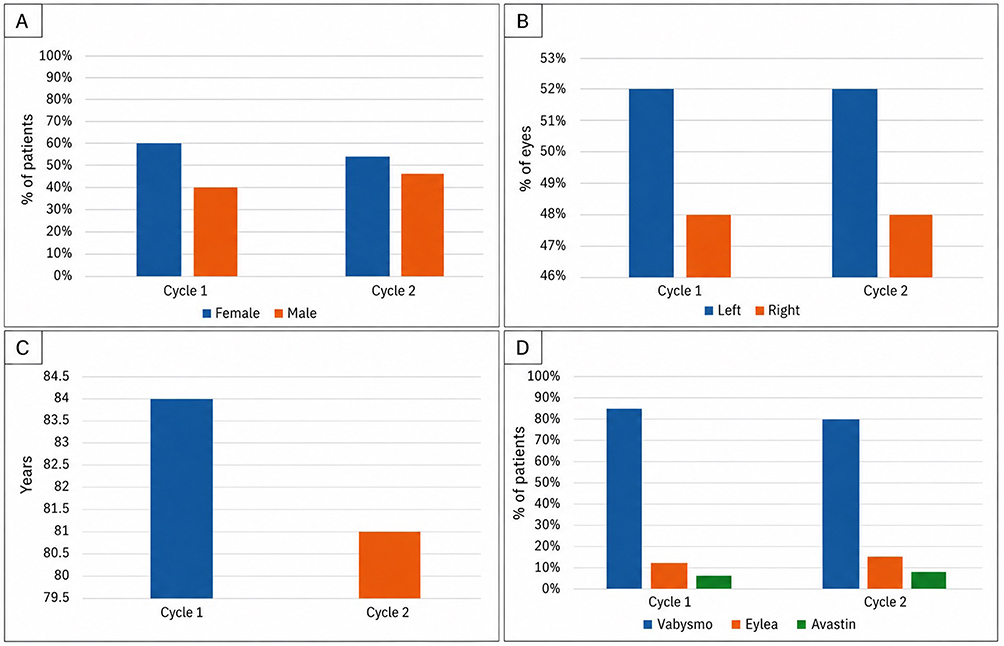 |
Figure 1 Demographic characteristics of patients in Cycle 1 (n = 81) and Cycle 2 (n = 50). (A) Sex distribution: Cycle 1 comprised 60% female and 40% male patients, compared with 54% female and 46% male in Cycle 2. (B) Eye laterality of treated eyes: 52% left and 48% right in both cycles. (C) Median age was 84 years in Cycle 1 and 81 years in Cycle 2. (D) Type of first intravitreal injection received: in Cycle 1, 85% received faricimab (Vabysmo), 11% received aflibercept (Eylea), and 4% received bevacizumab (Avastin); in Cycle 2, the corresponding proportions were 80%, 14%, and 6%, respectively. |
RTFI Interval – The Two-week National Audit Standard
The proportion of patients meeting the two-week RTFI target improved from 41% (33/81) in Cycle 1 to 76% (38/50) in Cycle 2 (Table 1; Figure 2). This was statistically significant (χ2 = 14.10, p = 0.00017) and represented an absolute improvement of 35.3 percentage points (95% CI 18.0 to 49.2). Patients in Cycle 2 also had higher odds of meeting the target (odds ratio 4.61, 95% CI 2.10–10.11). In Cycle 1, among the 48 patients who missed the target, delays were attributed to clinic appointment delay (40%), delay to injection following clinic assessment (31%), insufficient injection capacity (17%), and patient-dependent delay (12%). Within patient-dependent delay, the reasons were as follows: patient-requested postponement (n=2), intercurrent illness (n=2), non-attendance (n=1) and transport difficulty (n=1). Following service optimisation, 12 patients missed the target in Cycle 2. Patient-dependent delay accounted for the majority of the missed targets (67%). Reasons included non-attendance (n=4), patient-requested postponement (n=3) and delayed consent/acceptance of treatment (n=1). The remainder of delayed cases were due to delayed injection following clinic assessment (33%).
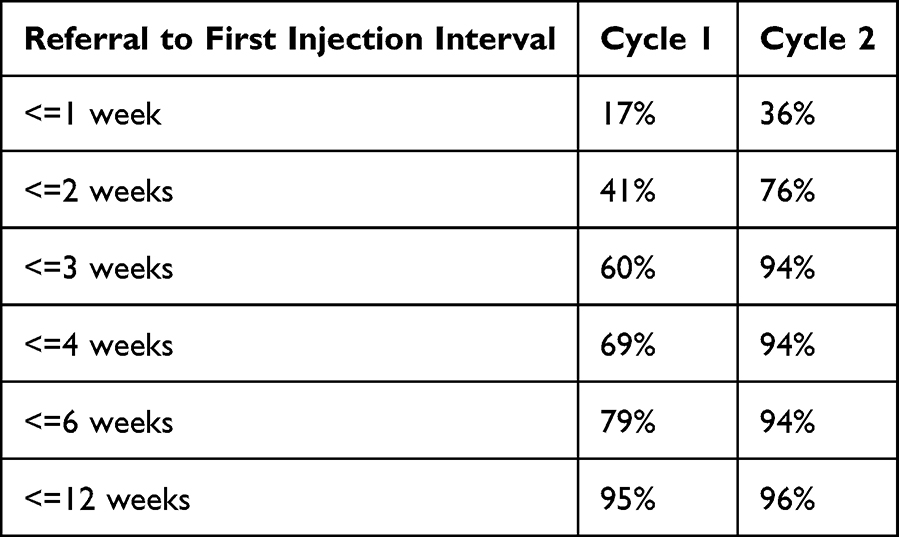 |
Table 1 Referral to First Injection (RTFI) Intervals in Cycle 1 and Cycle 2 |
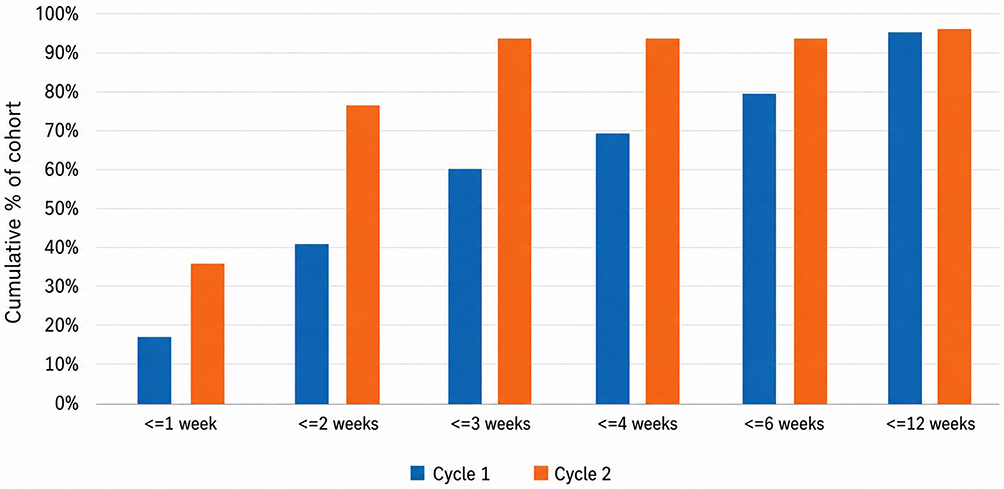 |
Figure 2 Cumulative referral-to-first-injection (RTFI) intervals for Cycle 1 (n = 81) and Cycle 2 (n = 50). The figure shows the proportion of patients receiving their first intravitreal injection within prespecified time thresholds following community referral for suspected neovascular age-related macular degeneration. Two-week RTFI compliance improved from 41% in Cycle 1 to 76% in Cycle 2. Corresponding cumulative proportions were 17% vs 36% within 1 week, 60% vs 94% within 3 weeks, 69% vs 94% within 4 weeks, 79% vs 94% within 6 weeks, and 95% vs 96% within 12 weeks, respectively. |
RTFA and FATFI Intervals
RTFA and FATFI intervals contributed to overall RTFI performance. In Cycle 1, 41% (33/81) of patients were seen in clinic within one week of community referral (RTFA), increasing to 66% (33/50) in Cycle 2, an absolute improvement of 25.3 percentage points (95% CI 7.6 to 40.6) (Table 2; Figure 3). In Cycle 1, 67% (54/81) received their first injection within one week of clinic assessment (FATFI), rising to 90% (45/50) in Cycle 2, an absolute improvement of 23.3 percentage points (95% CI 8.6 to 35.5) (Table 3; Figure 4). Median RTFA reduced from 2 weeks (IQR 2) in Cycle 1 to 1 week (IQR 1) in Cycle 2, representing a statistically significant improvement (Mann–Whitney U = 2645.5, p = 0.0016). Median FATFI was 1 week in both cycles; however, variability decreased from an IQR of 1 week in Cycle 1 to 0 weeks in Cycle 2, and this difference was statistically significant (Mann–Whitney U = 2537.0, p = 0.007).
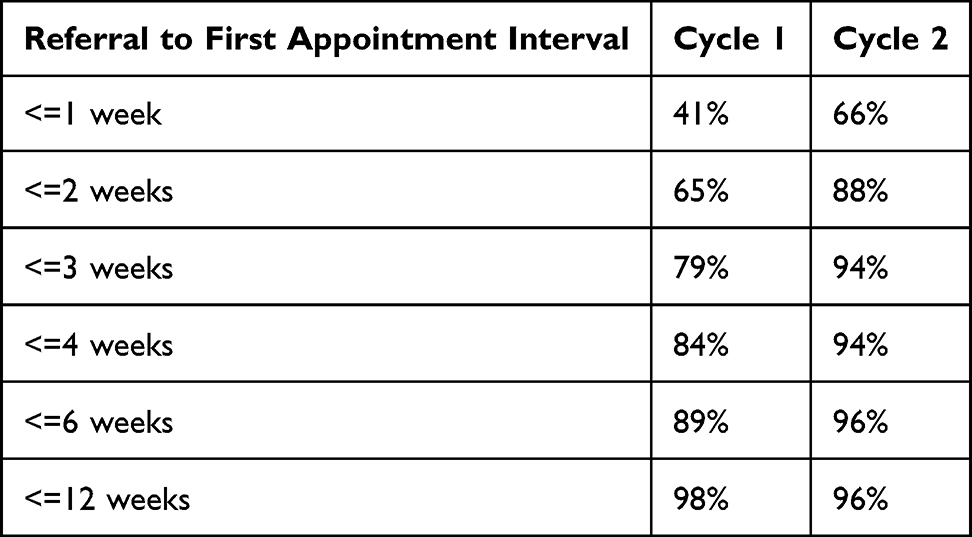 |
Table 2 Referral to First Appointment (RTFA) Intervals in Cycle 1 and Cycle 2 |
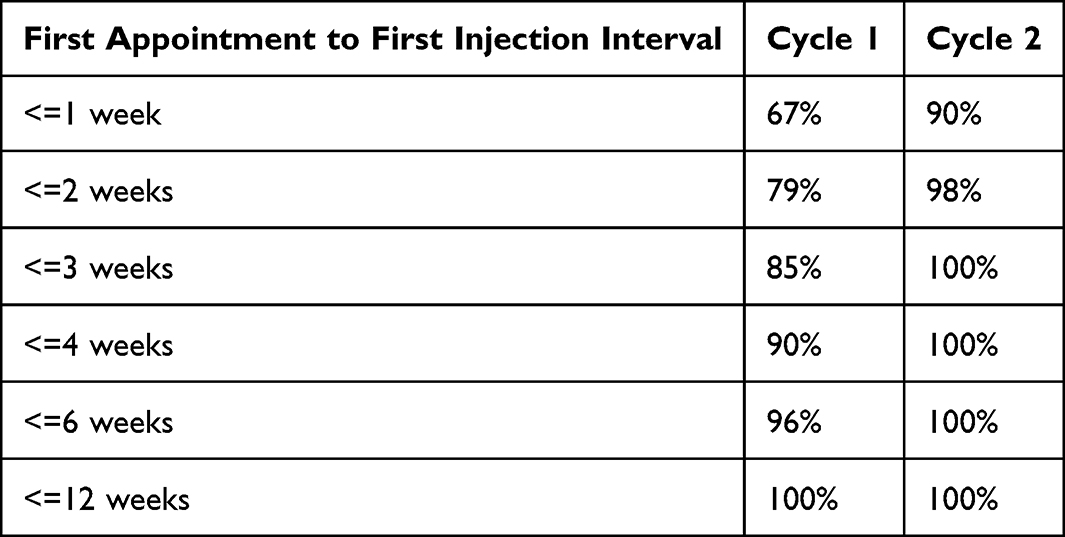 |
Table 3 First Appointment to First Injection (FATFI) Intervals in Cycle 1 and Cycle 2 |
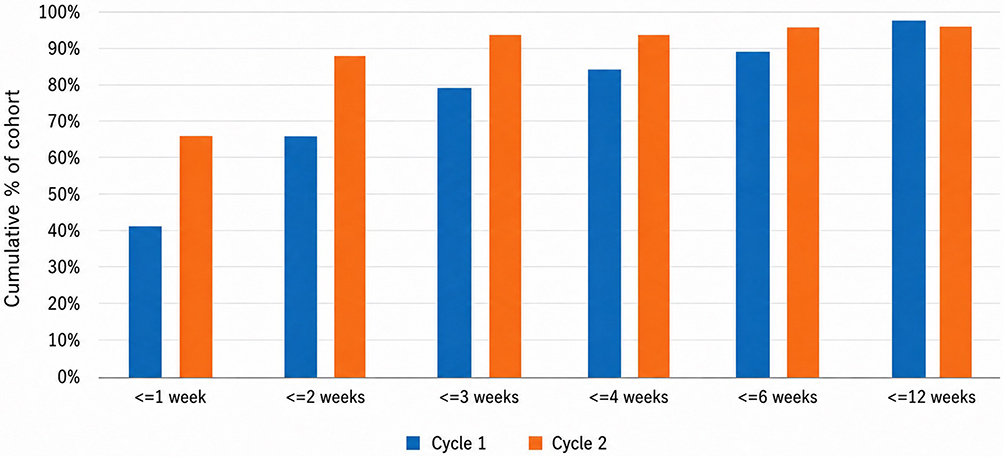 |
Figure 3 Cumulative referral-to-first-appointment (RTFA) intervals for Cycle 1 (n = 81) and Cycle 2 (n = 50). The figure shows the proportion of patients receiving their first AMD clinic assessment within prespecified time thresholds following community referral for suspected neovascular age-related macular degeneration. The proportion assessed within 1 week improved from 41% in Cycle 1 to 66% in Cycle 2. Corresponding cumulative proportions were 65% vs 88% within 2 weeks, 79% vs 94% within 3 weeks, 84% vs 94% within 4 weeks, 89% vs 96% within 6 weeks, and 98% vs 96% within 12 weeks, respectively. |
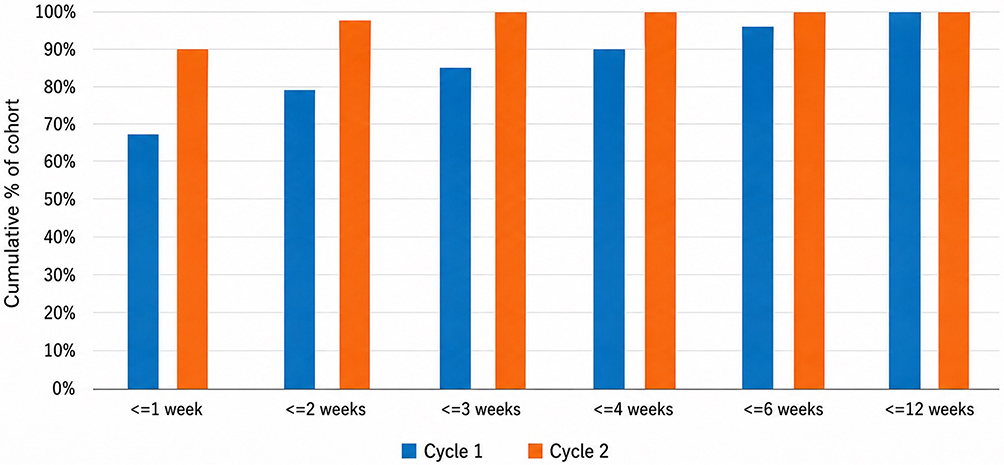 |
Figure 4 Cumulative first-appointment-to-first-injection (FATFI) intervals for Cycle 1 (n = 81) and Cycle 2 (n = 50). The figure shows the proportion of patients receiving their first intravitreal injection within prespecified time thresholds after initial AMD clinic assessment. The proportion injected within 1 week improved from 67% in Cycle 1 to 90% in Cycle 2. Corresponding cumulative proportions were 79% vs 98% within 2 weeks, 85% vs 100% within 3 weeks, 90% vs 100% within 4 weeks, 96% vs 100% within 6 weeks, and 100% vs 100% within 12 weeks, respectively. |
Secondary Outcomes
Secondary outcome follow-up data were available for 74/81 patients in Cycle 1 (91.4%) and 37/50 patients in Cycle 2 (74.0%). Median follow-up duration was 18 weeks in Cycle 1 and 17 weeks in Cycle 2. Reasons for missing follow-up data were not consistently captured in the retrospective audit dataset. Median improvement in visual acuity from first clinic appointment to first follow-up was 3 letters (IQR 13.8) in Cycle 1 and 8 letters (IQR 16.0) in Cycle 2 (Mann–Whitney U = 1150.5, p = 0.08) (Figure 5). Median reduction in CMT over the same interval was −80 μm (IQR 105) in Cycle 1 and −82 μm (IQR 105) in Cycle 2 (Mann–Whitney U = 1429, p = 0.71) (Figure 6). No statistically significant difference was detected between cycles for either early secondary outcome.
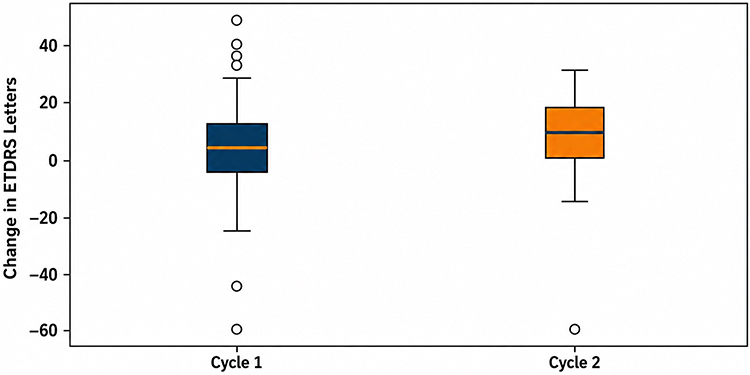 |
Figure 5 Change in visual acuity between baseline clinic assessment and first post-injection follow-up, measured using Early Treatment Diabetic Retinopathy Study (ETDRS) letters. Box-and-whisker plots are shown for Cycle 1 (n = 74) and Cycle 2 (n = 37), with boxes representing the interquartile range and horizontal lines indicating the median. Median visual acuity change was +3 ETDRS letters (IQR 13.8) in Cycle 1 and +8 ETDRS letters (IQR 16.0) in Cycle 2. Outlying values are shown as individual points. The difference between cycles did not reach statistical significance (Mann–Whitney U = 1150.5, p = 0.08). |
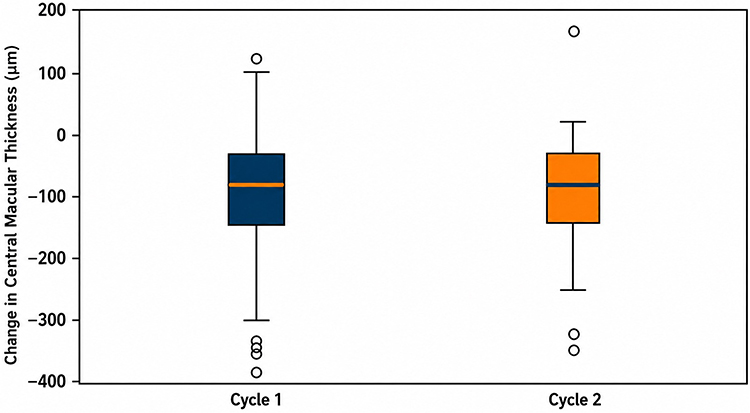 |
Figure 6 Change in central macular thickness (CMT) between baseline clinic assessment and first post-injection follow-up, measured in micrometres using optical coherence tomography. Box-and-whisker plots are shown for Cycle 1 (n = 74) and Cycle 2 (n = 37), with boxes representing the interquartile range and horizontal lines indicating the median. Negative values indicate a reduction in CMT following treatment. Median CMT change was −80 micrometres (μm) (IQR 105) in Cycle 1 and −82 μm (IQR 105) in Cycle 2. Outlying values are shown as individual points. The difference between cycles was not statistically significant (Mann–Whitney U = 1429, p = 0.71). |
Discussion
Anti-VEGF therapy remains the mainstay of neovascular age-related macular degeneration (nAMD) management, improving outcomes and slowing disease progression. The MARINA trial was pivotal in demonstrating that monthly ranibizumab produced meaningful visual preservation and improvement compared with sham, reflecting superiority over the natural course of disease.11 Similarly, the ANCHOR trial demonstrated the superiority of ranibizumab over verteporfin photodynamic therapy.12 Since these landmark studies, multiple anti-VEGF agents have become established for nAMD, including Faricimab (Vabysmo) and aflibercept (Eylea).13 The HARBOR trial further highlighted the role of individualised ranibizumab dosing approaches in nAMD management.14 Contemporary treatment pathways therefore typically include an initial loading phase of monthly injections, followed by a “treat-and-extend” strategy in which injection intervals are gradually increased in the absence of disease activity.15
Timely initiation of anti-VEGF therapy is critical, as delays permit ongoing neovascular activity and exudation that can lead to irreversible photoreceptor damage and subretinal fibrosis.5 Evidence suggests that patients experiencing longer delays between first symptoms and initiation of anti-VEGF treatment have a significantly reduced likelihood of visual improvement at 6 months.6 In addition, COVID-era interruption studies support the time-critical nature of nAMD care, demonstrating that injection delays of greater than two weeks are associated with deterioration in visual acuity and increased subretinal fluid, with outcomes remaining significantly worse at 6 months despite treatment resumption.16 Real-world data further emphasises that outcomes in nAMD depend on timely access to care and baseline vision at treatment initiation. UK electronic medical record data from the Moorfields AMD database, drawn from a cohort of 8174 treatment-naive eyes (with 2177 eyes completing two-year follow-up), showed that younger age, lower baseline visual acuity, and greater treatment exposure were associated with higher visual acuity gain at two years, reinforcing the need to minimise delays so therapy begins while vision is still salvageable.7
Comparisons with the 3rd NOD Audit
Overall, Luton and Dunstable performed in line with national benchmarks in Cycle 1, and subsequent service optimisation was associated with a marked and statistically significant improvement in guideline compliance in Cycle 2.
The 3rd NOD audit (2025) reported demographic information for 23,390 patients, with 59.9% female and a median age of 80.4 years, broadly comparable to both cohorts in this audit.10 RTFI interval data were available for 5,614 eyes nationally, with 40.3% meeting the two-week standard – similar to Cycle 1 performance at Luton and Dunstable.10 Following optimisation, Cycle 2 performance improved significantly and exceeded national compliance. Furthermore, 65.3% of eyes nationally received treatment within 4 weeks of referral;10 Luton and Dunstable exceeded this threshold in both cycles (69% in Cycle 1 and 94% in Cycle 2), suggesting substantial pathway acceleration following service redesign.
Functional outcomes in the NOD audit were reported as median ETDRS change at 12 months, with a national median improvement of 4 letters,10 compared with a median improvement of 3 letters in Cycle 1 and 8 letters in Cycle 2 in the present audit. Direct comparison is limited by follow-up duration, as the NOD audit reported outcomes at 12 months whereas follow-up in this audit was considerably shorter (median 18 weeks and 17 weeks in Cycles 1 and 2 respectively). CMT was not reported in the NOD audit and could not be compared; however, OCT-derived CMT is a recognised surrogate marker in nAMD, reflecting disease activity and treatment response. Increases in CMT in nAMD are typically associated with fluid accumulation secondary to neovascular activity, whereas reductions following anti-VEGF therapy generally reflect anatomical improvement.17,18 The clinical significance of CMT change varies between individuals and depends on baseline CMT and follow-up duration.19 In both cycles, median CMT reductions exceeded 80 micrometres, consistent with anatomical improvements reported across multiple anti-VEGF studies in nAMD.19–22
Quality Improvement Strategies and Impact
Following Cycle 1, the department analysed reasons for failing to meet the two-week target. Delays were primarily attributed to clinic appointment delay after referral, delay to injection following clinic assessment, and insufficient injection capacity, with a minority of delays related to patient factors. These findings were consistent with wider NHS capacity concerns in intravitreal injection services and prompted implementation of rapid, feasible, and low-cost interventions tailored to the local macular service.23
To meet the two-week RTFI target, patients ideally require clinic assessment within one week of referral (RTFA) followed by injection within one week of assessment (FATFI). Cycle 1 demonstrated that although a majority of patients were injected within one week of clinic assessment (67% FATFI ≤1 week), overall compliance with the two-week RTFI standard remained low (41%). This appeared largely driven by delayed clinic assessment, with only 41% achieving RTFA ≤1 week. In response, an internal one-week deadline for clinic assessment following community referral was introduced. Operationally, this involved earlier review of referral dates by the AMD coordinator and macular team, prioritisation of suspected nAMD referrals approaching the one-week assessment threshold, and escalation of cases at risk of breaching the pathway. This increased RTFA performance (66% seen within one week) and contributed to the improved proportion meeting the two-week RTFI standard in Cycle 2 (76%).
Although RTFA was the predominant bottleneck in Cycle 1, FATFI also demonstrated scope for improvement, particularly due to injection capacity constraints. Additional protected/short-notice injection capacity was created within existing injection clinics for newly confirmed nAMD cases requiring first treatment, without changing the clinical threshold for treatment. This improved flow and reduced delay after clinic assessment, increasing FATFI ≤1 week from 67% in Cycle 1 to 90% in Cycle 2, thereby supporting overall pathway efficiency and guideline compliance.
To support these structural pathway changes, department-wide awareness was strengthened through internal presentation of Cycle 1 findings and active engagement of the clinical and administrative team in service optimisation. While the independent impact of this intervention is difficult to quantify, such feedback mechanisms may reinforce urgency and adherence to pathway targets. Notably, the reasons for target shortfall shifted in Cycle 2, with a greater proportion attributable to patient-related delays. Patient-dependent delays included non-attendance and patient-requested postponement of treatment, with other possible contributors including intercurrent illness, transport barriers, and delayed consent or acceptance of treatment when documented. Ongoing work will therefore focus on patient-facing education initiatives to reduce non-attendance and improve understanding of the risks associated with delayed treatment.
Strengths and Limitations
This study demonstrates several strengths. It reflects consecutive real-world patients and routine clinical practice, and the magnitude of improvement in the primary outcome was substantial. Reporting the absolute improvement in two-week RTFI compliance with confidence intervals provides a clinically interpretable estimate of pathway change.
However, limitations remain. This was a single-centre, retrospective, non-randomised audit, which may limit generalisability and precludes definitive causal attribution. The two cycles were temporally separated and differed in duration and sample size. Seasonal variation, referral volumes, staffing levels, clinic capacity, clinician availability, drug selection, and external service pressures may have contributed to the observed change. Follow-up duration was shorter than that reported in the NOD audit, limiting direct comparison of longer-term functional outcomes. Follow-up data were incomplete, particularly in Cycle 2, and missingness may have introduced attrition bias. Lesion phenotype, disease duration, and symptom-onset-to-referral interval were not consistently available, limiting assessment of baseline clinical comparability. In addition, because the audit denominator was based on patients receiving first injection, the analysis did not capture a complete flow of all community referrals with suspected nAMD who were assessed but did not proceed to injection. Finally, secondary outcomes were exploratory, short-term, and not designed or powered to demonstrate equivalence or non-inferiority.
Future Directions
Despite substantial improvement in compliance with the two-week RTFI standard, further gains are still achievable. In Cycle 2, the predominant reasons for missing the target appeared to be patient-centred factors, including non-attendance and postponement of treatment. To address this, a patient education initiative has been launched in primary care - targeting optometry and general practice - to reinforce the urgency of hospital assessment and, where indicated, prompt initiation of intravitreal therapy to reduce the risk of irreversible sight loss. A third audit cycle is planned to evaluate the impact of this intervention, confirm sustainability of the improvements achieved, and identify any remaining modifiable barriers within the pathway.
Conclusion
In this single-centre, retrospective two-cycle audit of neovascular AMD pathway performance, compliance with the NICE-informed national two-week referral-to-first-injection audit standard improved significantly after implementation of pragmatic, low-cost service changes. The increase in target attainment was underpinned by a faster and more reliable pathway, with significant reductions in referral-to-first-appointment and first-appointment-to-first-injection intervals. No statistically significant difference was detected in short-term visual acuity or OCT-derived anatomical outcomes, although these secondary analyses were exploratory and limited by incomplete follow-up. As remaining delays in Cycle 2 were largely patient-related, future work will focus on patient-facing education in primary care to reinforce urgency and improve attendance. A third audit cycle is planned to evaluate the impact of these measures and ensure sustained high-quality delivery of time-critical nAMD care.
Abbreviations
nAMD, neovascular age-related macular degeneration; AMD, age-related macular degeneration; RTFI, referral-to-first-injection; RTFA, referral-to-first-appointment; FATFI, first-appointment-to-first-injection; CMT, central macular thickness; NICE, National Institute for Health and Care Excellence; GIRFT, Getting It Right First Time; RCOphth, Royal College of Ophthalmologists; NOD, National Ophthalmology Database; IQR, interquartile range; ETDRS, Early Treatment Diabetic Retinopathy Study; OCT, optical coherence tomography; Anti-VEGF, anti-vascular endothelial growth factor.
Data Sharing Statement
Full datasets are available from corresponding author Y.C on reasonable request.
Ethics Statements
Prior to commencement, this audit received local approval from Luton and Dunstable University Hospitals. As per UCL Research Ethics guidance, since this is an audit/quality improvement, it is considered “minimal risk”, utilizing anonymized pre-existing data, and therefore ethical approval was not required. Furthermore, as no identifiable patient list exists and data was anonymous at the point of access, informed consent was not applicable.
Acknowledgments
Tahera Khanom is the AMD coordinator at Luton and Dunstable University Hospital and contributed to acquisition of datasets.
Author Contributions
All authors made a significant contribution to the work reported, whether that is in the conception, study design, execution, acquisition of data, analysis and interpretation, or in all these areas; took part in drafting, revising or critically reviewing the article; gave final approval of the version to be published; have agreed on the journal to which the article has been submitted; and agree to be accountable for all aspects of the work.
Disclosure
The authors report no conflicts of interest in this work.
References
1. National Institute for Health and Care Excellence. Macular degeneration (age-related): prevalence. Clinical Knowledge Summaries [Internet]. London: NICE; 2025. Available from: https://cks.nice.org.uk/topics/macular-degeneration-age-related/background-information/prevalence/.
2. Royal College of Ophthalmologists. AMD services commissioning guidance recommendations [Internet]. London: RCOphth; 2021. Available from: https://www.rcophth.ac.uk/wp-content/uploads/2021/08/AMD-Services-Commissioning-Guidance-Recommendtions.pdf.
3. Royal College of Ophthalmologists. AMD commissioning guidance evidence base 2024 [Internet]. London: RCOphth; 2024. Available from: https://www.rcophth.ac.uk/wp-content/uploads/2021/08/AMD-Commissioning-Guidance-Evidence-Base-2024.pdf.
4. Fight for Sight. Time to focus: the UK sight loss crisis and case for investment in research [Internet]. London: Fight for Sight; 2020. Available from: https://www.fightforsight.org.uk/media/voaj1bxm/time-to-focus-report.pdf.
5. Holz FG, Figueroa MS, Czajka M, et al. A model to quantify the influence of treatment patterns and optimize outcomes in nAMD. Sci Rep. 2022;12(1):2884. doi:10.1038/s41598-022-06951-9
6. Lim JH, Wickremasinghe SS, Xie J, et al. Delay to treatment and visual outcomes in patients treated with anti-vascular endothelial growth factor for age-related macular degeneration. Am J Ophthalmol. 2012;153(4):678–686.e2. doi:10.1016/j.ajo.2011.09.013
7. Fasler K, Moraes G, Wagner S, et al. One- and two-year visual outcomes from the Moorfields age-related macular degeneration database: a retrospective cohort study and an open science resource. BMJ Open. 2019;9(6):e027441. doi:10.1136/bmjopen-2018-027441
8. National Institute for Health and Care Excellence. Age-related macular degeneration: diagnosis and referral. NICE guideline [NG82] [Internet]. London: NICE; 2018. Available from: https://www.nice.org.uk/guidance/ng82/chapter/recommendations#diagnosis-and-referral.
9. MacEwen C, Davis A, Chang L. Ophthalmology GIRFT programme national specialty report [Internet]. London: Getting It Right First Time; 2019. Available from: https://gettingitrightfirsttime.co.uk/wp-content/uploads/2019/12/OphthalmologyReportGIRFT19S.pdf.
10. National Ophthalmology Database Audit. NOD audit full annual report 2025 [Internet]. 2025. Available from: https://live-nod-audit.pantheonsite.io/sites/default/files/2025-03/NOD%20Audit%20Full%20Annual%20Report%202025_Final%20%281%29.pdf.
11. MARINA Study Group, Rosenfeld PJ, Brown DM, Heier JS, et al. Ranibizumab for neovascular age-related macular degeneration. N Engl J Med. 2006;355(14):1419–12. doi:10.1056/NEJMoa054481
12. Brown DM, Michels M, Kaiser PK, et al. Ranibizumab versus verteporfin photodynamic therapy for neovascular age-related macular degeneration: two-year results of the ANCHOR study. Ophthalmology. 2009;116(1):57–65.e5. doi:10.1016/j.ophtha.2008.10.018
13. Chen KY, Chan HC, Chan CM. Comparative effectiveness and safety landscape of anti-VEGF therapies for neovascular age-related macular degeneration: insights from a systematic review and network meta-analysis. Biomed Pharmacother. 2026;196:118881. doi:10.1016/j.biopha.2025.118881
14. HARBOR Study Group, Busbee BG, Ho AC, Brown DM, et al. Twelve-month efficacy and safety of 0.5 mg or 2.0 mg ranibizumab in patients with subfoveal neovascular age-related macular degeneration. Ophthalmology. 2013;120(5):1046–1056. doi:10.1016/j.ophtha.2012.10.014
15. Chaikitmongkol V, Sagong M, Lai TYY, et al. Treat-and-extend regimens for the management of neovascular age-related macular degeneration and polypoidal choroidal vasculopathy: consensus and recommendations from the Asia-Pacific Vitreo-retina society. Asia Pac J Ophthalmol. 2021;10(6):507–518. doi:10.1097/APO.0000000000000445
16. Park JY, Chung H, Lim DH, Chung TY. Impact of delayed intravitreal anti-vascular endothelial growth factor therapy due to the coronavirus disease pandemic on the prognosis of patients with neovascular age-related macular degeneration. J Clin Med. 2022;11(9):2321. doi:10.3390/jcm11092321
17. Ahn SJ. Retinal thickness analysis using optical coherence tomography: diagnostic and monitoring applications in retinal diseases. Diagnostics. 2025;15(7):833. doi:10.3390/diagnostics15070833
18. Kaiser PK, Wykoff CC, Singh RP, et al. Retinal fluid and thickness as measures of disease activity in neovascular age-related macular degeneration. Retina. 2021;41(8):1579–1586. doi:10.1097/IAE.0000000000003194
19. Tsai CY, Wu CL, Cheng CK, et al. Baseline characteristics and treatment response predictive of nAMD outcomes with ranibizumab therapy in treatment-naive patients: the RACER subgroup analysis. BMC Ophthalmol. 2023;23:39. doi:10.1186/s12886-023-02780-0
20. Lüke JN, Alquoqa H, Alsamman A, Aljabary B, Schaub F, Heindl LM. Retrospective analysis of OCT parameters after intravitreal anti-VEGF inhibitors in neovascular AMD patients in a real-world setting. Int Ophthalmol. 2023;43(1):13–25. doi:10.1007/s10792-022-02383-6
21. Comparison of Age-related Macular Degeneration Treatments Trials Research Group, Maguire MG, Martin DF, Ying GS, et al. Five-year outcomes with anti-VEGF treatment of neovascular age-related macular degeneration: the comparison of AMD treatments trials. Ophthalmology. 2016;123(8):1751–1761. doi:10.1016/j.ophtha.2016.03.045
22. Wykoff CC, Garmo V, Tabano D, et al. Impact of anti-VEGF treatment and patient characteristics on vision outcomes in neovascular age-related macular degeneration: up to 6-year analysis of the AAO IRIS registry. Ophthalmol Sci. 2024;4(2):100434. doi:10.1016/j.xops.2023.100421
23. Amoaku W, Bailey C, Downey L, et al. Providing a safe and effective intravitreal treatment service: strategies for service delivery. Clin Ophthalmol. 2020;14:1315–1328. doi:10.2147/OPTH.S233061
 © 2026 The Author(s). This work is published and licensed by Dove Medical Press Limited. The
full terms of this license are available at https://www.dovepress.com/terms
and incorporate the Creative Commons Attribution
- Non Commercial (unported, 4.0) License.
By accessing the work you hereby accept the Terms. Non-commercial uses of the work are permitted
without any further permission from Dove Medical Press Limited, provided the work is properly
attributed. For permission for commercial use of this work, please see paragraphs 4.2 and 5 of our Terms.
© 2026 The Author(s). This work is published and licensed by Dove Medical Press Limited. The
full terms of this license are available at https://www.dovepress.com/terms
and incorporate the Creative Commons Attribution
- Non Commercial (unported, 4.0) License.
By accessing the work you hereby accept the Terms. Non-commercial uses of the work are permitted
without any further permission from Dove Medical Press Limited, provided the work is properly
attributed. For permission for commercial use of this work, please see paragraphs 4.2 and 5 of our Terms.
Recommended articles

A Systematic Literature Review of Safety Culture in Hemodialysis Settings
Albreiki S, Alqaryuti A, Alameri T, Aljneibi A, Simsekler MCE, Anwar S, Lentine KL
Journal of Multidisciplinary Healthcare 2023, 16:1011-1022
Published Date: 11 April 2023
Tracing Missing Surgical Specimens: A Quality Improvement Strategy for Adverse Events Based on Root Cause Analysis
Huang LL, Yang JH, Hong WW, Wang BL, Chen HF
Risk Management and Healthcare Policy 2025, 18:2139-2150
Published Date: 27 June 2025
A Once-in-a-Generation Transformation at an Academic Public Hospital During Federal Funding Uncertainty
Spellberg B, Coffey CE Jr, Bickley L, Ross W, Kaiser LR, Yee HF Jr
Journal of Healthcare Leadership 2026, 18:595146
Published Date: 26 March 2026