
Back to Journals » Psychology Research and Behavior Management » Volume 19
Nationwide Patterns and Predictors of In-Hospital Suicide and Self-Harm in Korea: A Registry-Based Study Using the Korea Patient Safety Reporting and Learning System
Authors Choi SM, Lee AR, Yoon S  , Jeon HJ, Lee SM, Paik JW
Received 25 August 2025
Accepted for publication 5 January 2026
Published 15 January 2026 Volume 2026:19 561104
DOI https://doi.org/10.2147/PRBM.S561104
Checked for plagiarism Yes
Review by Single anonymous peer review
Peer reviewer comments 3
Editor who approved publication: Dr Igor Elman
Sung Moon Choi,1,* Ah Rah Lee,1,* Siyeun Yoon,1 Hong Jin Jeon,2 Sang Min Lee,1 Jong-Woo Paik1
1Department of Psychiatry, Kyung Hee University College of Medicine, Kyung Hee University Hospital, Seoul, Republic of Korea; 2Department of Psychiatry, Depression Center, Samsung Medical Center, Sungkyunkwan University School of Medicine, Seoul, Republic of Korea
*These authors contributed equally to this work
Correspondence: Sang Min Lee, Department of Psychiatry, Kyung Hee University College of Medicine, Kyung Hee University Hospital, Seoul, Republic of Korea, Tel +82-2-958-8543, Fax +82-2-957-1997, Email [email protected] Jong-Woo Paik, Department of Psychiatry, Kyung Hee University College of Medicine, Kyung Hee University Hospital, Seoul, Republic of Korea, Tel +82-2-958-8419, Fax +82-2-957-1997, Email [email protected]
Background: Suicide and self-harm in hospitals are critical yet under-recognized threats to patient safety. Previous studies have focused on psychiatric inpatients, leaving a knowledge gap regarding suicide risk in the general medical population. The present study compared in-hospital suicide and self-harm incidents reported on the Korea Patient Safety Reporting and Learning System (KOPS), focusing on differences within the category of intentional self-injury, to identify distinct clinical and environmental predictors.
Methods: We analyzed 447 in-hospital suicide and self-harm cases reported to the KOPS between 2016 and 2020. Demographic, clinical, temporal, and environmental characteristics were compared using chi-squared tests. Multivariate logistic regression analysis identified the predictors that distinguished suicide from self-harm.
Results: Among the 447 cases, 147 were suicides and 300 were self-harm incidents. Absence of a psychiatric diagnosis (odds ratio [OR] 5.12, 95% confidence interval [CI]: 3.01– 8.71), time of incident (evening: OR 2.22, 95% CI: 1.17– 4.19; nighttime: OR 2.27, 95% CI: 1.12– 4.63), and location (inpatient room: OR 4.06, 95% CI: 1.61– 10.30) distinguished suicide from self-harm. Patients without a psychiatric diagnosis were at a higher risk of suicide, and suicides were significantly more likely to occur during the evening and nighttime hours and in private spaces, such as hospital rooms. These patterns persist across diverse hospital types, including general and long-term care facilities.
Conclusion: There is a substantial risk of in-hospital suicide among patients without formal psychiatric diagnoses during off-hours in private spaces. Universal suicide risk screening, enhanced monitoring during high-risk periods, and environmental safety interventions are necessary in all hospitals.
Keywords: suicide, self-harm, inpatients, hospital, risk factors, patient safety, KOPS
Introduction
Suicide among hospitalized patients is a critical safety concern. Meta-analyses have shown that the suicide rate among inpatients with psychiatric disorders is approximately 147 per 100,000 inpatient years, which is more than 12 times higher than that in the general population.1,2 Traditionally, this elevated risk has focused on psychiatric hospitals and patients with mental disorders as the primary high-risk groups.
However, increasing evidence indicates that suicide and self-harm are not confined to psychiatric settings, but can occur across all types of medical institutions, including general, tertiary, and specialty hospitals.3–6
A growing body of evidence suggests that all hospitalized patients, regardless of facility type or underlying diagnosis, may be at risk of suicide or self-harm during admission, reflecting the combined influence of patient-related and institutional factors.
Recent reviews have highlighted that all hospitalized patients, regardless of the type of facility or underlying diagnosis, may be at risk of suicide or self-harm during admission.5,7–9
Although mental illness remains a significant risk factor, a substantial proportion of inpatient suicide and self-harm events involve individuals without a formal psychiatric diagnosis.10,11 Risk factors identified in hospitalized populations include a history of suicide attempts, depressive symptoms, lack of social support, recent loss or interpersonal conflict, substance use, and periods of transition, such as admission or discharge.7,12,13 Notably, the risk of suicide is particularly high in the first week and month following discharge from psychiatric hospitalization, with rates reaching 2,950 per 100,000 person-years in the first week.14,15
Environmental and institutional factors also play significant roles. Studies have found that self-harm and suicide attempts are more likely to occur in private or less-supervised hospital areas, often during the evening or night.5,7 The method of suicide frequently reflects the means available within the hospital environment, with jumping from heights and hanging being the most common methods used by inpatients.11,12,16
Despite this high risk, research on suicide and self-harm in non-psychiatric hospital settings remains limited. Most studies have focused on psychiatric units or have used case-control designs to identify risk factors, with relatively few leveraging national-level data to examine patterns across diverse hospital types and patient populations.1,5,11 This gap highlights the need for comprehensive registry-based studies that can inform preventive strategies tailored to the full spectrum of inpatient care.
In South Korea, the Korea Patient Safety Reporting and Learning System (KOPS), established in 2016, serves as a national platform for reporting and analyzing patient safety incidents, including suicide and self-harm, in medical institutions.17 By encouraging voluntary reporting, KOPS promotes a culture of safety and continuous learning. These data are increasingly used to identify risk factors and inform clinical- and policy-level suicide prevention efforts.18
However, no prior study in Korea has conducted an incident-level comparison of in-hospital suicide and self-harm using nationwide data from mandatory patient safety reporting systems, such as KOPS. Existing research has primarily focused on inpatient suicide, limiting our understanding of how suicide events differ from other severe self-harm incidents that occur in hospital settings. To address this gap, this study compared all suicide and self-harm incidents reported to the KOPS between 2016 and 2020.
This study aimed to analyze the characteristics of inpatient suicide and self-harm cases reported to the KOPS, focusing on differences across in-hospital settings and clinical diagnoses. By identifying patterns and high-risk profiles, this study sought to inform targeted prevention strategies applicable across diverse healthcare settings.
We hypothesized that in-hospital suicide incidents would demonstrate distinct clinical and environmental predictors compared with self-harm incidents reported to the KOPS.
Methods
Data Resources
This study is a secondary data analysis that uses patient safety incident data from KOPS reported to the Patient Safety Reporting and Learning System of the Korea Institute for Healthcare Accreditation for 5 years from 2016 to 2020. The Patient Safety Reporting and Learning System is a national patient safety reporting and learning system in South Korea, enacted on January 28, 2015, based on the Patient Safety Act, and implemented on July 29, 2016. The primary purpose of the KOPS patient safety incident data is to create a safer medical environment through national-level information collection and learning and to support medical institutions in voluntarily establishing patient safety systems. The database includes basic information on the incident (date and time, location, and patient condition), details of the incident (type, sequence of events, and cause), outcomes (impact on the patient, such as death and follow-up measures), and reporting characteristics (voluntary reporting, similar events, and possibility of recurrence).
KOPS collects voluntary incident reports from various healthcare institutions across South Korea, including tertiary general, general, long-term care, and psychiatric hospitals. Hospital size was categorized based on the number of beds: < 200, 200–499, and ≥ 500 beds, consistent with previous Korean patient safety research using KOPS data (Shin and Won, 2021). This classification reflects the structural characteristics of the Korean healthcare system, in which 200 beds represent a key regulatory threshold for hospital accreditation under the Medical Service Act. The 500-bed threshold further distinguishes large tertiary hospitals with greater resource capacity, specialized services, and organizational complexity.
Because KOPS is an incident-based registry without patient-level identifiers, each record represents a single reported event rather than a unique patient, meaning that multiple incidents may originate from the same individual. We extracted data reported as “patient suicide/self-harm” from the 51,611 safety incidents recorded in KOPS and included 447 cases, after excluding missing values, for analysis. Cases with missing values for key predictor variables (psychiatric diagnosis, time of incident, and location of incident) were excluded from the multivariable logistic regression analysis, but were retained in descriptive analyses where applicable. In KOPS, all intentional self-injurious behaviors are reported under a single category of “suicide/self-harm.” The system does not distinguish suicide attempts from non-suicidal self-injury or provide subcategories related to intent or lethality. Therefore, events resulting in death were classified as suicide, whereas all non-fatal intentional self-injury events were categorized as self-harm. We defined cases in which a patient committed suicide in a hospital as suicide and cases in which a patient harmed themselves as self-harm.
This study was approved by the Clinical Research Review Committee of Kyung Hee University Hospital (Clinical Research Review Committee Review No. 2022–04-078) and complied with the ethical principles of the Declaration of Helsinki. The data accessed complied with relevant data protection and privacy regulations; the KOPS dataset is fully de-identified in accordance with Korean privacy regulations, and no personal identifiers were available to the research team.
Statistical Analysis
First, we classified patients into groups based on their reported suicide and self-harm in hospitals. Subsequently, we classified the groups according to sex, age, type of medical institution (tertiary general, general, nursing, psychiatric), number of beds in the hospital (< 200, 200–499, ≥ 500), time of incident (0:00–05:59, 06:00–11:59, 12:00–17:59, 18:00–23:59), place of incident (hospital room, bathroom, other hospital rooms, hospital interior, and hospital exterior), and suicide method (poisoning, hanging, jumping, cutting/stabbing). Incidents occur in various places including treatment rooms, operating rooms, emergency rooms, outpatient clinics, hospital stairs, corridors, rest areas, outdoor parks, parking lots, rooftops, and outdoor spaces. Therefore, other places, excluding hospital rooms and bathrooms, which had the highest frequency, were categorized as hospital interiors (staircases, rest areas, and corridors), exteriors (parks, outdoor gardens, parking lots, rooftops, and exterior spaces), or other hospital rooms (treatment rooms, operating rooms, outpatient clinics, and emergency rooms).
For categorical variables, group differences were examined using the chi-squared test. For the chi-squared analyses, expected cell frequencies were examined and the majority met the recommended threshold of ≥ 5. To identify the factors associated with incident type (suicide vs self-harm), multivariate logistic regression models were constructed, including psychiatric diagnosis, time of incident, and location of incident as primary predictors, with sex and age added as adjustment covariates. This model specification followed a conceptual framework determined a priori, enabling adjusted odds ratios (ORs) to reflect the independent associations of each contextual factor with the likelihood of suicide compared with self-harm.
Cases with missing values for key predictor variables were excluded from multivariate logistic regression analysis using a complete-case approach, whereas descriptive analyses included all available data for each variable. The exclusion of incomplete cases in regression modeling ensures the integrity of the effect estimates by maintaining a consistent analytic sample across all model predictors.
Multicollinearity was assessed using variance inflation factors (VIFs), which ranged from 1.03 to 2.29, remaining below the commonly cited thresholds for problematic collinearity (eg, < 8). The goodness of fit of the multivariable logistic regression model was evaluated using the Hosmer–Lemeshow test, and the discriminatory ability of the model was assessed using the area under the receiver operating characteristic curve (AUC).
No formal adjustments for multiple comparisons (eg, Bonferroni correction) were applied, as variables were selected a priori based on clinical and theoretical relevance. P-values were interpreted in an exploratory manner, with an emphasis on effect sizes and confidence intervals rather than isolated significance testing.
All statistical analyses were performed using SPSS version 26.0 (IBM, Armonk, NY), and a two-sided p-value of < 0.05 was considered statistically significant.
Results
Characteristics of Patients Who Died of Suicide and Those with Self-Harm
Demographic and Statistical Information
In total, 447 incidents were reported during the study period, including 147 completed suicides and 300 self-harm incidents. Table 1 shows the demographic information of the 147 in-hospital suicides and 300 in-hospital self-harm incidents.
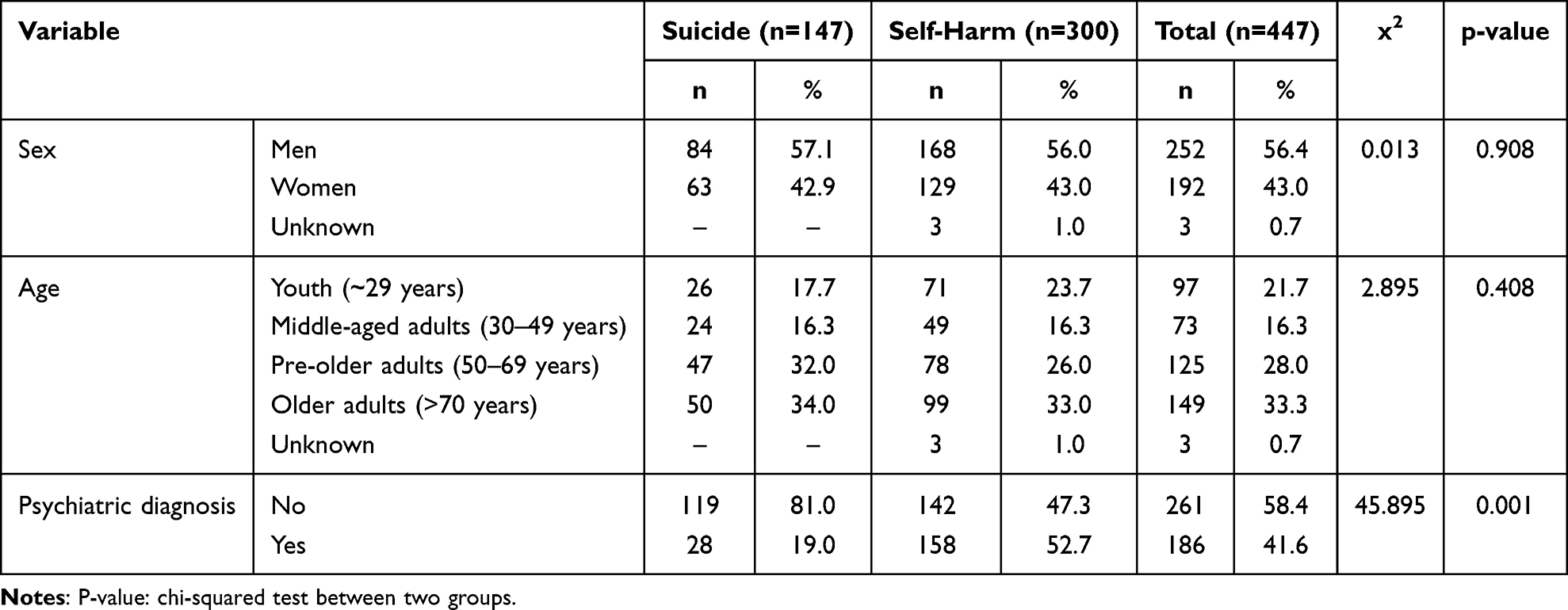 |
Table 1 Comparison of Demographics Between Cases of Suicide and Self-Harm |
Among the 147 in-hospital suicides (N = 147), 84 were men (57.1%), 50 were aged 70 years or older (34.0%), and 119 were not diagnosed with psychiatric disorders (81.0%). Among the 300 self-harm incidents (N = 300), 168 were men (56.0%), 149 were aged 70 years or older (33.3%), and 261 were not diagnosed with a psychiatric disorder (58.4%).
Incident-Related Statistical Information
Statistical information on the incidents is presented in Table 2. Regarding in-hospital suicides (N = 147), 122 (40.7%) were in general hospitals and 139 (45.3%) were in hospitals with 200–499 beds; 50 people (34.0%) died between 18:00 and 23:59, 117 people (76.9%) died in an inpatient room, and 37 people died by hanging (25.2%). Regarding self-harm incidents in hospitals (N = 300), 64 (43.5%) were in general hospitals and hospitals, 70 (47.6%) were in hospitals with 200–499 beds, 84 (28.0%) died between 06:00 and 11:00, 175 (58.3%) died in inpatient rooms, and 87 (29.0%) died by hanging.
 |
Table 2 Comparison of in-Hospital Incident Statistics Related to Suicide and Self-Harm |
Analysis of Group Differences Between in-Hospital Suicide and Self-Harm Groups
As shown in Tables 1 and 2, the results of the intergroup difference test for each variable revealed that the presence of a mental illness diagnosis (x2 = 45.895, p = 0.001), time of the incident (x2 = 14.583, p = 0.006), and location of the incident (x2 = 26.231, p = 0.001) were significantly related to both in-hospital suicide and self-harm. Sex, age, medical institution type, number of beds, and means of suicide or self-harm were not significantly associated with in-hospital suicide or self-harm. Most patients in the in-hospital suicide and self-harm groups (81.0% and 58.4%, respectively) were diagnosed with a mental illness. In addition, the time of discovery was primarily in the evening (34.0%; 18:00–23:59) for the suicide group and in the morning (28.0%; 06:00–11:59) for the self-harm group. Ultimately, most incidents occurred in the hospital in the suicide (76.9%) and self-harm (58.3%) groups.
Multivariate Logistic Regression Analysis of Major Psychiatric Diagnosis
The results of the sex- and age-corrected multivariate logistic regression analyses, focusing on the variables that yielded significant results in the chi-squared analysis, are shown in Table 3. Missing values were excluded from the analysis.
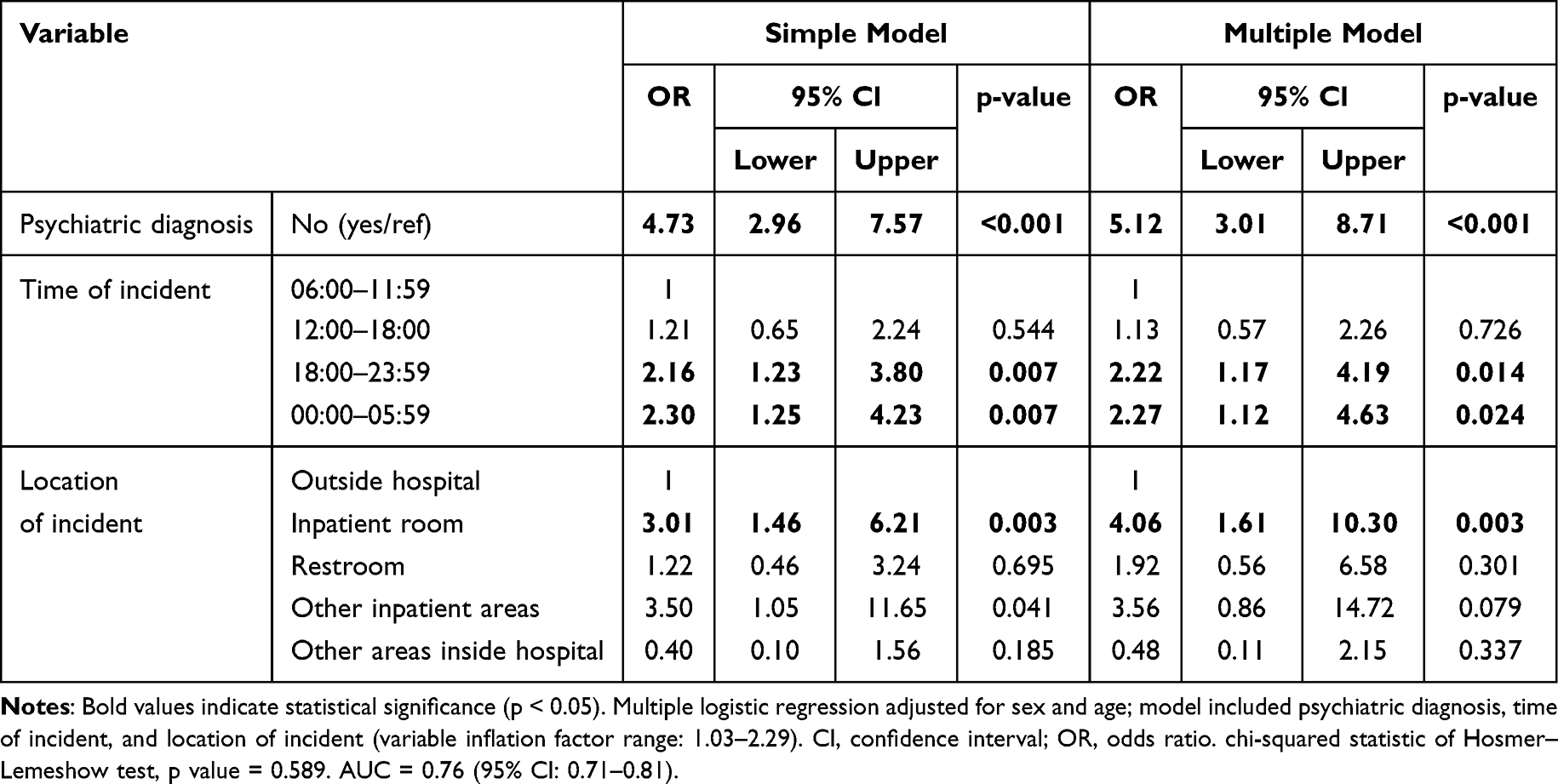 |
Table 3 Logistic Regression Analysis of Predictors of Main Variables (in-Hospital Suicide and Self-Harm) |
Multivariable logistic regression analysis identified three independent predictors of suicide compared to self-harm (Table 3). The Hosmer–Lemeshow test indicated adequate model fit (χ2 = 6.37, p = 0.589), and the model demonstrated acceptable discriminatory ability (AUC = 0.76, 95% CI: 0.71–0.81).
In the univariate analysis, absence of a psychiatric diagnosis was significantly associated with suicide compared to self-harm (OR 4.73, 95% CI: 2.96–7.57, p < 0.001). Using the 06:00–11:59 time period as the reference category, incidents occurring during 18:00–23:59 (OR 2.16, 95% CI: 1.23–3.80, p = 0.007) and 00:00–05:59 (OR 2.30, 95% CI: 1.25–4.23, p = 0.007) were significantly more likely to be suicides. The 12:00–18:00 time period showed no significant difference compared to the reference (OR 1.21, 95% CI: 0.65–2.24, p = 0.544). Regarding location, using outside hospital as the reference category, incidents in inpatient rooms (OR 3.01, 95% CI: 1.46–6.21, p = 0.003) and other inpatient areas (OR 3.50, 95% CI: 1.05–11.65, p = 0.041) were significantly more likely to be suicides. Restroom (OR 1.22, 95% CI: 0.46–3.24, p = 0.695) and other areas inside hospital (OR 0.40, 95% CI: 0.10–1.56, p = 0.185) showed no significant associations. Type of hospital, number of beds, and method of suicide/self-harm were not significantly associated with incident type.
As shown in Table 3 and Figure 1, the multivariate analysis adjusted for sex and age identified psychiatric diagnosis, time of incident, and location of incident as significant predictors. Patients without a psychiatric diagnosis had a 5.12 times higher risk of suicide compared to self-harm (95% CI: 3.01–8.71, p < 0.001). Using the 06:00–11:59 time period as the reference, incidents occurring during evening hours (18:00–23:59) were 2.22 times more likely to be suicides (95% CI: 1.17–4.19, p = 0.014), and those occurring during nighttime hours (00:00–05:59) were 2.27 times more likely to be suicides (95% CI: 1.12–4.63, p = 0.024). Regarding location, using outside hospital as the reference, incidents occurring in inpatient rooms were 4.06 times more likely to be suicides (95% CI: 1.61–10.30, p = 0.003). Incidents in other inpatient areas were significant in the univariate analysis (p = 0.041) but not in the multivariate analysis after adjusting for sex and age (p = 0.079).
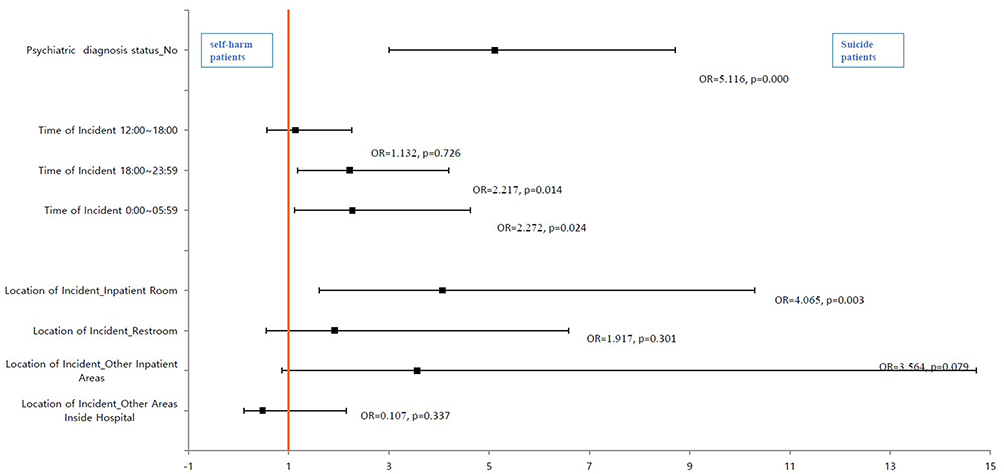 |
Figure 1 Forest plot of adjusted odds ratios for predictors distinguishing in-hospital suicide from self-harm. Multivariable logistic regression adjusted for sex and age. Error bars represent 95% confidence intervals. |
Sensitivity analysis was conducted by comparing the full dataset with a restricted subset, excluding non-response and refusal cases. The findings remain consistent across both analyses, supporting the robustness of the primary results (results not shown).
Discussion
This national study, utilizing patient safety data from KOPS, provides important insights into the characteristics of and risk factors for suicide and self-harm across in-hospital settings. Through multivariate analysis, we identified three key variables that significantly distinguished in-hospital suicide from self-harm: the presence of a psychiatric diagnosis, the time of the incident, and the location of the incident.
Notably, patients without a psychiatric diagnosis had a 5.12-fold higher risk of suicide than those who engaged in self-harm. This counterintuitive result may reflect the limitations in psychiatric recognition and documentation, particularly in non-psychiatric hospital units. The absence of a formal diagnosis does not equate to the absence of risk. Rather, it may reflect limitations in routine mental health assessments, particularly outside psychiatric settings.19,20 As KOPS is a voluntary reporting system, diagnostic completeness may vary widely across institutions.17. This finding suggests that individuals without formal psychiatric diagnoses may constitute a hidden high-risk group and highlights the importance of implementing universal suicide risk screening and proactive mental health evaluation across all inpatient populations, not just those under psychiatric care.20 Another possible explanation is the institutional composition of the data. A significant number of incidents occurred in non-psychiatric facilities, such as long-term care hospitals, where patients are less likely to have a formal psychiatric diagnosis but may suffer from conditions such as dementia or chronic medical illness.21 Conversely, psychiatric hospitals, particularly those with protective wards and established suicide-prevention protocols, may have more robust systems for identifying and managing suicide risk, which could contribute to the lower number of suicide incidents reported in these institutions.2
The time of incident was also a significant distinguishing factor between suicide and self-harm cases. Suicides were significantly more likely to occur during the evening and at night, supporting previous research that identified off-hours as periods of heightened vulnerability due to reduced staffing and increased patient isolation.22,23 Previous studies have consistently reported that both suicide and self-harm incidents across in-hospital settings tend to occur more frequently during nighttime hours.5,24 Our comparative analysis further suggests that while both behaviors require vigilance after hours, the risk of suicide is particularly elevated during the evening and nighttime, underscoring the need for heightened preventive measures and monitoring for suicide, specifically during these periods.
In our study, inpatient rooms were the most common locations for both suicide and self-harm; however, suicide cases occurred disproportionately more often in patient rooms, with a 4.06-fold higher risk than that in other locations. This finding aligns with previous research identifying hospital rooms as high-risk environments for suicide, owing to their relative privacy, accessibility to means, and limited direct supervision. More than half of inpatient suicides have been reported to occur in patient rooms, particularly during periods of reduced staff presence and often without identifiable warning signs. Hospital bedrooms have consistently been identified as the most frequent location of inpatient suicide, likely because of their privacy, accessibility, and limited surveillance. These environments have also been characterized as common sites for sentinel events, particularly when safety-oriented architectural designs and monitoring protocols are inadequate.20,22,25 An important finding of this study was the disproportionately high number of suicides and self-harm incidents reported in long-term care hospitals. Several contextual factors may help explain this pattern, including the high prevalence of chronic medical illnesses, cognitive impairment, functional decline, and increased social isolation among older adults receiving institutional care. These institutions, which primarily serve older patients with chronic illnesses, cognitive impairment, and reduced functional capacity, often have limited access to psychiatric consultations, inadequate mental health training among staff, and insufficient suicide prevention protocols.26 Such environments may heighten psychological vulnerability, while lacking the necessary infrastructure to effectively detect and manage suicide risk.27 Together, these factors contextualize the elevated incidence observed in long-term care hospitals and underscore the need for improved assessment and monitoring strategies tailored to geriatric populations.
However, this study has some limitations that must be acknowledged. First, the KOPS system is based on voluntary reporting, which introduces potential bias in data collection. Institutions with a robust patient safety infrastructure, such as general tertiary hospitals, may be more likely to detect, document, and report suicide and self-harm incidents, whereas under-resourced facilities, particularly those lacking standardized reporting protocols, may underreport such events. This reporting bias could lead to the over-representation of cases from better-equipped institutions and underestimation of the true incidence in other settings. Second, the accuracy and completeness of the reported data, particularly for psychiatric diagnoses, may vary substantially across institutions. In non-psychiatric settings, mental health conditions may go unrecognized or undocumented, resulting in the misclassification of psychiatric morbidity. Third, the dataset spans both the pre- and post-policy periods related to mandatory reporting implementation, which introduces heterogeneity in documentation practices and institutional compliance.
Furthermore, because KOPS is an incident-based and fully de-identified registry, individual-level duplication could not be verified, and the independence assumption for chi-square analyses may not be fully guaranteed. Each report represents a single event rather than a unique patient; thus, multiple incidents may originate from the same individual, and the 300 self-harm incidents do not necessarily correspond to 300 unique patients. We were also unable to determine whether individuals in the self-harm group later appeared in the suicide group. The KOPS framework does not distinguish between suicide attempts and non-suicidal self-injury, thus limiting the granularity with which self-harm behaviors can be interpreted. Additionally, although multicollinearity was assessed and all VIF values were within the acceptable range (1.03–2.29, below < 8), subtle collinearity among the contextual variables cannot be entirely ruled out. The use of complete-case analysis may introduce potential bias if missingness is not completely random; however, missing data patterns did not appear systematically related to the outcome, and there were relatively few excluded cases. Sensitivity analysis excluding the non-response or refusal categories yielded findings that were consistent with the primary results (Table 3), supporting the robustness of the main conclusions. These limitations may have influenced the observed associations and should be considered when interpreting our findings.
Despite these limitations, this study provides valuable national-level evidence on the characteristics of and risk factors for suicide and self-harm across in-hospital settings. Nationwide analyses comparing these two phenomena across diverse hospital types and patient populations remain limited, particularly in nonpsychiatric contexts. By leveraging a centralized patient safety reporting system, this study contributes uniquely to the field of inpatient suicide prevention by offering insights that extend beyond psychiatric wards.
These findings underscore the importance of early detection, continuous monitoring, and environmental safety interventions throughout hospitals and not only in psychiatric units. Hospital-wide suicide prevention protocols should include universal risk screening, staff training, physical safety modifications in high-risk areas such as inpatient rooms, and coordinated discharge planning. Efforts to enhance the accuracy and consistency of patient safety reporting are essential for strengthening national surveillance systems.
Future research should explore ways to enhance the granularity of the KOPS data, including integration with electronic medical records, to improve diagnostic accuracy and event classification. Studies examining institutional characteristics—such as staffing levels, monitoring practices, and environmental design—may further clarify contextual risk factors. In addition, prospective or interventional research evaluating measures such as enhanced nighttime monitoring, telepsychiatry support, and structured staff training programs could help develop evidence-based strategies to reduce in-hospital suicide and self-harm.
Enhancing the accuracy, completeness, and consistency of patient safety data is essential. Strengthening the KOPS system through incentives, training, and integration with clinical records can improve national surveillance and support evidence-based policymaking aimed at reducing inpatient suicide and self-harm across healthcare systems.
Conclusions
This national study using the KOPS registry found that in-hospital suicide risk in Korea is not limited to patients with psychiatric diagnoses or psychiatric wards but extends across all hospital types and patient populations. The absence of a psychiatric diagnosis, incidents occurring during evening and nighttime hours, and events in private spaces, such as inpatient rooms, were all independently associated with a higher suicide risk than self-harm. These findings highlight the need for universal suicide risk screening, enhanced monitoring during high-risk periods, and environmental safety interventions for all inpatients, regardless of their psychiatric history, to improve patient safety and prevent suicide in diverse hospital settings.
Although the analysis was based on national data from South Korea, the observed patterns, particularly the influence of institutional environments and the importance of hospital-wide screening and monitoring, may be relevant to healthcare systems internationally, where similar patient safety challenges are increasingly recognized.
Data Sharing Statement
The data used in this study were obtained from the Korean Psychiatric Central Registry (KOPS). Although the KOPS dataset is publicly available, researchers must obtain approval from the Central Patient Safety Center before accessing the data. Data requests can be made through the official application process of the Korea Patient Safety Center in accordance with their policies and procedures.
Acknowledgments
We express our gratitude to the Central Patient Safety Center and its director, Dr. Hong Mo Koo, for their generous support and assistance during this study.
Author Contributions
Sung Moon Choi and Ah Rah Lee should be considered co-first authors.
All authors made a significant contribution to the work reported, whether that is in the conception, study design, execution, acquisition of data, analysis and interpretation, or in all these areas; took part in drafting, revising or critically reviewing the article; gave final approval of the version to be published; have agreed on the journal to which the article has been submitted; and agree to be accountable for all aspects of the work.
Funding
This work was supported by a grant from the Central Patient Safety Center funded by the Ministry of Health & Welfare, Republic of Korea. Additional funding was provided by the Korea Health Technology R&D Project, administered by the Korea Health Industry Development Institute (KHIDI) and funded by the Ministry of Health and Welfare, Republic of Korea (grant number: HI22C0505).
Disclosure
All authors declare no competing interests.
References
1. Walsh G, Sara G, Ryan C, Large M. Meta-analysis of suicide rates among psychiatric in-patients. Acta Psychiatr Scand. 2015;131(3):174–10. doi:10.1111/acps.12383
2. Chammas F, Januel D, Bouaziz N. Inpatient suicide in psychiatric settings: evaluation of current prevention measures. Front Psychiatry. 2022;13:997974. doi:10.3389/fpsyt.2022.997974
3. Large MM, Chung DT, Davidson M, Weiser M, Ryan CJ. In-patient suicide: selection of people at risk, failure of protection and the possibility of causation. BJPsych Open. 2017;3:102–105. doi:10.1192/bjpo.bp.116.004309
4. Kapur N. Self-harm in the general hospital. Psychiatry. 2009;8:189–193. doi:10.1016/j.mppsy.2009.03.005
5. James K, Stewart D, Bowers L. Self-harm and attempted suicide within inpatient psychiatric services: a review of the literature. Int J Ment Health Nurs. 2012;21:301–309. doi:10.1111/j.1447-0349.2011.00794.x
6. Bachmann S. Epidemiology of suicide and the psychiatric perspective. Int J Environ Res Public Health. 2018;15:1425. doi:10.3390/ijerph15071425
7. Huang D, Hu DY, Han YH, Lu CH, Liu YL. Five high-risk factors for inpatient suicide. Chin Nurs Res. 2014;1:14–16. doi:10.1016/j.cnre.2014.11.005
8. Hong M, Lee SM, Han KM, Kim KH, Paik JW. Suicide death and other-cause mortality in psychiatric patients: a South Korean study using nationwide claims data. J Affect Disord. 2024;352:288–295. doi:10.1016/j.jad.2024.02.075
9. Harris EC, Barraclough B. Suicide as an outcome for mental disorders: a meta-analysis. Br J Psychiatry. 1997;170:205–228. doi:10.1192/bjp.170.3.205
10. Sher L. Suicide in individuals with no psychiatric disorders: what makes you vulnerable? QJM. 2024;117:313–316. doi:10.1093/qjmed/hcad279
11. Lee AR, Choi SM, Baik M, Sun JY, Lee SM, Paik JW. Inpatient suicide trends and prevention: insights from a South Korean nationwide study. Asian J Psychiatr. 2025;107:104479. doi:10.1016/j.ajp.2025.104479
12. Deisenhammer EA, Behrndt-Bauer EM, Kemmler G, Haring C, Miller C. Suicide in psychiatric inpatients—a case–control study. Front Psychiatry. 2020;11:591460. doi:10.3389/fpsyt.2020.591460
13. Aaltonen K, Sund R, Hakulinen C, Pirkola S, Isometsä E. Variations in suicide risk and risk factors after hospitalization for depression in Finland, 1996–2017. JAMA Psychiatry. 2024;81:506. doi:10.1001/jamapsychiatry.2023.5512
14. Che SE, Geun GY, Lee JY, et al. Trends in patient suicide rate after psychiatric discharge in Korea from 2010 to 2018: a nationwide population-based study. J Affect Disord. 2023;323:860–865. doi:10.1016/j.jad.2022.12.009
15. Paik JW, Kim KH, Lee SM, Na KS, Hong M. Postdischarge suicide and death in South Korean children and adolescents hospitalized for a psychiatric illness. J Am Acad Child Adolesc Psychiatry. 2018;57:508–514.e1. doi:10.1016/j.jaac.2018.04.011
16. Inoue K, Kawanishi C, Otsuka K, et al. A large-scale survey of inpatient suicides: comparison between medical and psychiatric settings. Psychiatry Res. 2017;250:155–158. doi:10.1016/j.psychres.2017.01.076
17. Cho DB, Lee YR, Lee W, Lee ES, Lee JH. Analyzing health information technology and electronic medical record system–related patient safety incidents using data from the Korea patient safety reporting and learning system. Qual Improv Health Care. 2021;27:57–72. doi:10.14371/QIH.2021.27.2.57
18. Shin S, Won M. Trend analysis of patient safety incidents and associated factors in Korea using national patient safety report data (2017–2019). Int J Environ Res Public Health. 2021;18(16):8482. doi:10.3390/ijerph18168482
19. Deisenhammer EA, DeCol C, Honeder M, Hinterhuber H, Fleischhacker WW. In-patient suicide in psychiatric hospitals. Acta Psychiatr Scand. 2000;102:290–294. doi:10.1034/j.1600-0447.2000.102004290.x
20. Meehan J, Kapur N, Hunt IM, et al. Suicide in mental health in-patients and within 3 months of discharge: national clinical survey. Br J Psychiatry. 2006;188:129–134. doi:10.1192/bjp.188.2.129
21. Cheng IC, Hu FC, Tseng MCM. Inpatient suicide in a general hospital. Gen Hosp Psychiatry. 2009;31:110–115. doi:10.1016/j.genhosppsych.2008.12.008
22. Hunt IM, Windfuhr K, Swinson N, et al. Suicide amongst psychiatric in-patients who abscond from the ward: a national clinical survey. BMC Psychiatry. 2010;10:14. doi:10.1186/1471-244X-10-14
23. Tubbs AS, Perlis ML, Basner M, et al. Relationship of nocturnal wakefulness to suicide risk across months and methods of suicide. J Clin Psychiatry. 2020;81:19m12964. doi:10.4088/JCP.19m12964
24. McEvoy D, Joyce M, Mongan D, Clarke M, Codd M. Comparing times of self-harm presentations to hospital emergency departments in children, adolescents, young adults, and adults: a national registry study 2007–2019. BMC Psychiatry. 2024;24:474. doi:10.1186/s12888-024-05921-x
25. Chen YL, Tzeng DS, Cheng TS, Lin CH. Sentinel events and predictors of suicide among inpatients at psychiatric hospitals. Ann Gen Psychiatry. 2012;11:4. doi:10.1186/1744-859X-11-4
26. Mezuk B, Rock A, Lohman MC, Choi M. Suicide risk in long-term care facilities: a systematic review. Int J Geriatr Psychiatry. 2014;29:1198–1211. doi:10.1002/gps.4142
27. O’Riley A, Nadorff MR, Conwell Y, Edelstein B. Challenges associated with managing suicide risk in long-term care facilities. Ann Longterm Care. 2013;21:28–34.
 © 2026 The Author(s). This work is published and licensed by Dove Medical Press Limited. The
full terms of this license are available at https://www.dovepress.com/terms
and incorporate the Creative Commons Attribution
- Non Commercial (unported, 4.0) License.
By accessing the work you hereby accept the Terms. Non-commercial uses of the work are permitted
without any further permission from Dove Medical Press Limited, provided the work is properly
attributed. For permission for commercial use of this work, please see paragraphs 4.2 and 5 of our Terms.
© 2026 The Author(s). This work is published and licensed by Dove Medical Press Limited. The
full terms of this license are available at https://www.dovepress.com/terms
and incorporate the Creative Commons Attribution
- Non Commercial (unported, 4.0) License.
By accessing the work you hereby accept the Terms. Non-commercial uses of the work are permitted
without any further permission from Dove Medical Press Limited, provided the work is properly
attributed. For permission for commercial use of this work, please see paragraphs 4.2 and 5 of our Terms.