
Back to Journals » International Journal of Nanomedicine » Volume 21
Nanostructured Lipid Carriers Co-Loaded with Doxycycline, Gentamicin, and Thymol for Enhanced Intracellular Antibacterial Activity Against Brucella melitensis
Authors Morovati Moez N, Arabestani MR, Taheri M  , Karami P, Alikhani MY , Kazemi S, Hosseini SM
Received 13 April 2026
Accepted for publication 18 June 2026
Published 20 June 2026 Volume 2026:21 616475
DOI https://doi.org/10.2147/IJN.S616475
Checked for plagiarism Yes
Review by Single anonymous peer review
Peer reviewer comments 4
Editor who approved publication: Professor Dong Wang
Narjes Morovati Moez,1 Mohammad Reza Arabestani,1 Mohammad Taheri,1 Pezhman Karami,1 Mohammad Yousef Alikhani,1 Sima Kazemi,2 Seyed Mostafa Hosseini1,2
1Department of Microbiology, School of Medicine, Hamadan University of Medical Sciences, Hamadan, Iran; 2Infectious Disease Research Center, Avicenna Institute of Clinical Sciences, Hamadan University of Medical Sciences, Hamadan, Iran
Correspondence: Seyed Mostafa Hosseini, Infectious Disease Research Center, Avicenna Institute of Clinical Sciences, Hamadan University of Medical Sciences, Hamadan, Iran, Email [email protected]
Background: Brucellosis is a zoonotic infection caused by Brucella spp. which persist within macrophages and complicate treatment. This study developed nanostructured lipid carriers (NLCs) co-loaded with doxycycline, gentamicin, and thymol to enhance intracellular delivery and antibacterial activity against Brucella melitensis.
Methods: Drug-loaded NLCs were prepared using high-shear homogenization followed by sonication. The formulations were characterized in terms of particle size, polydispersity index (PDI), zeta potential, morphology by FE-SEM, encapsulation efficiency, and in vitro drug release profile. Cytotoxicity was assessed using the MTT assay on J774A.1 macrophage. Antibacterial activity and intracellular efficacy against Brucella melitensis were evaluated using microbiological and cell-based assays.
Results: The optimized formulation showed a size of 398 ± 30 nm, PDI 0.35, and zeta potential − 17.5 mV, with 97% encapsulation efficiency and stable morphology over nine months. The system exhibited sustained release up to 95% at 80 h, in contrast to rapid diffusion from free drugs. Intracellular studies showed that Gen–Dox–Thy@NLC achieved a 3.4-log reduction in bacterial load, demonstrating significantly higher efficacy (~1.6-log greater reduction) compared with free drugs (p < 0.05), while maintaining macrophage viability above 85%.
Conclusion: The co-loaded NLC formulation provided controlled drug release, improved intracellular delivery, and enhanced antibacterial activity against Brucella melitensis. These findings suggest that Gen–Dox–Thy@NLC may serve as a promising candidate for brucellosis treatment and warrants further in vivo studies.
Keywords: Brucella melitensis, nanostructured lipid carriers, doxycycline, gentamicin, thymol
Introduction
Brucella species are small, Gram-negative coccobacilli that are non-spore-forming, non-capsulated, and non-motile. Among the known Brucella species, at least four Brucella melitensis, B. abortus, B. suis, and B. canis are recognized as causes of human brucellosis.1 Brucellosis is a zoonotic infection, primarily transmitted via direct contact with infected animals or through the ingestion of contaminated animal products, particularly unpasteurized dairy.2,3 Clinically, the disease exhibits a wide range of manifestations, from asymptomatic carriage to acute, subacute, and chronic forms. The systemic nature of the infection allows it to involve multiple organs and tissues, producing nonspecific symptoms such as fever, fatigue, musculoskeletal pain, headache, night sweats, and weight loss. Among the complications, arthritis is one of the most frequently reported.4,5
A central challenge in managing brucellosis is the intracellular survival of Brucella. Upon entering the host, most bacteria are rapidly eliminated by neutrophils, monocytes, and macrophages. However, some bacteria persist within macrophages, where they form a replicative niche in specialized vacuoles derived from the endoplasmic reticulum (ER). These Brucella-containing vacuoles (BCVs) evade lysosomal degradation and provide a protected environment for bacterial replication. Continuous interactions with the ER enable the bacteria to proliferate while remaining shielded from host immune defenses, including antibodies, complement, and cytotoxic responses.6,7 This intracellular localization also limits the efficacy of many antibiotics, which, although effective in vitro, often fail to reach therapeutic concentrations inside host cells. Consequently, intracellular persistence contributes to chronic infection, relapse, and treatment failure, which may occur in 5–30% of patients depending on treatment regimen, duration, and adherence. Immune responses against Brucella are highly variable, influenced by both host factors and bacterial strain, adding further complexity to disease management.7,8
Conventional treatment strategies typically employ combinations of doxycycline, aminoglycosides, rifampin, quinolones, or sulfonamides.9 Combination regimens, such as doxycycline with aminoglycosides or rifampin, generally improve clinical outcomes but are associated with several limitations. The intracellular concentrations of these agents are often suboptimal due to limited cellular uptake, enzymatic degradation, pH sensitivity, and compartmental sequestration. Doxycycline readily penetrates host cells but mainly exhibits bacteriostatic activity; therefore, effective control of intracellular Brucella typically requires combination therapy with bactericidal agents such as aminoglycosides. Nevertheless, aminoglycosides carry risks of nephrotoxicity, while doxycycline and rifampin may produce hepatotoxicity and other systemic adverse effects. Treatments are prolonged, often lasting six weeks or more, which can reduce patient adherence and increase relapse risk.9,10 Despite decades of clinical experience, no existing antibiotic regimen consistently achieves complete elimination of intracellular Brucella, highlighting the urgent need for innovative approaches.
To overcome these challenges, targeted drug delivery systems may provide an effective solution. Therefore, novel strategies have been developed to address the chronic and recurrent nature of brucellosis treatment.9 Among the most promising and innovative approaches are antibiotic-loaded nanocarriers. The development of nanoscale drug delivery systems has enabled the achievement of unique physicochemical properties, leading to improved therapeutic performance and enhanced formulation versatility. Precise formulation of these nanoparticles increases their stability, accelerates dissolution, and improves bioavailability, ultimately resulting in faster therapeutic onset and enhanced biological efficacy.11,12
Studies have shown that discovering new drugs alone does not guarantee effective pharmacotherapy. Many novel drug candidates still face major challenges due to poor water solubility and limited bioavailability. Therefore, designing advanced drug delivery systems that can address these issues has become increasingly important. These delivery platforms should be biocompatible, exhibit adequate drug-loading efficiency, and enable targeted as well as controlled release of therapeutic agents.13–16 Lipid-based nanoparticles have been extensively investigated as efficient carrier systems for various pharmaceutical applications. Numerous drugs with diverse therapeutic indications have been successfully incorporated into nanostructured lipid carriers (NLCs). These delivery systems not only enable controlled drug release but also enhance the chemical stability of the encapsulated antibiotics.17
NLCs offer several remarkable advantages, including protection of drugs from chemical and enzymatic degradation, excellent physical stability, the ability to encapsulate both hydrophilic and hydrophobic compounds, and facile production at both laboratory and industrial scales without the use of organic solvents. Furthermore, they are capable of simultaneously delivering multiple active agents, increasing drug-loading efficiency, and exhibiting small particle size with the ability to be administered through multiple routes. Their biodegradability and biocompatibility, improved bioavailability, effective penetration through biological barriers, and reduced dosing frequency make them highly advantageous.18,19
Beyond traditional antibiotics, plant-derived compounds have emerged as promising complementary antimicrobial agents. Thymol, a key component of several essential oils, possesses lipophilic characteristics that enable its integration into bacterial membranes, where it interferes with electron transport, proton motive force, protein synthesis, and cell wall stability. These disruptions can potentiate the effects of conventional antibiotics especially hydrophobic ones by enhancing their cellular uptake and helping to bypass bacterial defense mechanisms. Consequently, encapsulating thymol within nanocarriers may provide synergistic advantages in eliminating intracellular bacterial infections.20 In addition to its intrinsic antimicrobial activity, thymol has been reported to disrupt bacterial cell membranes, increase membrane permeability, and enhance the activity of several conventional antibiotics against both Gram-positive and Gram-negative bacteria (Marchese et al, 2016; Sharifi-Rad et al, 2018). Such effects may be particularly valuable in intracellular infections, where limited antibiotic penetration and bacterial persistence contribute to therapeutic failure. Therefore, combining thymol with doxycycline and gentamicin within a single nanocarrier may provide complementary mechanisms of action that improve intracellular antibacterial efficacy against Brucella melitensis.21
Although several nanoparticle-based delivery systems have previously been explored for improving the therapeutic efficacy of anti-Brucella agents, most studies have focused on single-drug formulations or conventional antibiotic combinations. Furthermore, the incorporation of natural antimicrobial compounds with potential synergistic activity has received limited attention in the context of intracellular brucellosis. To the best of our knowledge, no previous study has evaluated the co-encapsulation of doxycycline, gentamicin, and thymol within a single nanostructured lipid carrier platform for enhanced intracellular delivery against Brucella melitensis. Therefore, the present study was designed to investigate whether this triple-drug NLC formulation could improve intracellular antibacterial activity while maintaining acceptable physicochemical characteristics and cellular compatibility.22,23
Doxycycline was selected as a core component of the formulation because it is one of the most widely used first-line agents in brucellosis therapy and exhibits good intracellular penetration. Gentamicin was included due to its potent bactericidal activity and its established use in combination regimens for severe or complicated brucellosis. Thymol was incorporated as a natural bioactive compound with documented antimicrobial activity, with the aim of enhancing antibacterial efficacy and potentially supporting the action of conventional antibiotics within the NLC platform. Considering the limitations of current treatments such as low intracellular antibiotic levels, bacterial persistence in macrophages, and frequent relapses there is a pressing need for improved therapeutic strategies. In this study, nanostructured lipid carriers co-loaded with doxycycline, gentamicin, and thymol were evaluated for their antibacterial effects against Brucella melitensis in vitro, aiming to enhance intracellular delivery and therapeutic efficacy while reducing treatment duration and relapse risk.
Materials and Methods
Materials
Oleic acid (Sigma-Aldrich, USA) and palm oil (Softisan 154; kindly provided by Condea, Witten, Germany) were used as lipid components. The water-soluble surfactants included polyoxyethylene20 sorbitan monooleate (Tween 80; Sigma-Aldrich, USA) and Poloxamer 407 (Pluronic F127; Sigma-Aldrich, USA). Lipid-soluble surfactants comprised sorbitan monooleate (Span 80; Sigma-Aldrich, USA) and soy lecithin (Sigma-Aldrich, USA). Doxycycline, gentamicin, and thymol (all from Sigma-Aldrich, USA) were purchased from certified suppliers. All reagents were of analytical grade, and double-distilled water was used for all experimental procedures.
Preparation of Nanostructured Lipid Carriers (NLCs)
Nanostructured lipid carriers (NLCs) were synthesized using a high-shear homogenization technique. Solid lipids (65%) and liquid lipids (22%) were combined with surfactants (8%) and antibacterial agents (doxycycline, gentamicin, and thymol at 5%, individually or in combination). The mixture was heated in a water bath at 70°C until the solid lipids fully melted. Preheated double-distilled water (4 mL, 70°C) was added gradually while stirring. The resulting mixture was homogenized using a magnetic stirrer at 350 rpm for 10 minutes. To achieve nanoscale particle formation, the pre-emulsion was subjected to probe sonication at 25 W using 10s on/5s off pulse cycles for a total sonication time of 2 min. Sonication was performed under temperature-controlled conditions (ice bath) to minimize heat-induced instability during nanoparticle formation. The final NLCs were cooled to room temperature and stored for further characterization.24,25
Formulation composition was expressed according to the actual amount of each component used during preparation; lipid and drug contents were reported on a w/w basis, while aqueous phase components were prepared according to volume-based (w/v or v/v) concentrations where applicable.
Physicochemical Characterization
Particle Size, Polydispersity Index, and Zeta Potential
Dynamic light scattering (DLS) analysis was carried out using a Nanosizer (Malvern Instruments, Worcestershire, UK) to measure particle size, polydispersity index (PDI), and zeta potential. Formulations with particle sizes ranging from 200 to 400 nm, low PDI values, and high surface charge were considered optimal.
Morphology
The surface morphology of nanoparticles was examined using field emission scanning electron microscopy (FESEM). A diluted suspension of NLCs was deposited on aluminum foil, air-dried, and imaged to evaluate particle shape and surface morphology.
Determination of λMax
The maximum absorbance wavelength (λMax) for each antibacterial agent was determined using a UV–Vis spectrophotometer. Stock solutions (1 mg/mL) were prepared by dissolving each agent in sterile double distilled water or appropriate solvent. One milliliter of stock solution was diluted to 10 mL, and absorbance was measured from 200 to 700 nm at 5 nm intervals.
Drug Loading and Encapsulation Efficiency
Drug encapsulation efficiency (EE%) and drug loading (DL%) were determined individually for each of the three agents (Doxycycline, Gentamicin, and Thymol) using an indirect method. Ten milligrams of NLCs were dispersed in 10 mL water, vortexed, and centrifuged at 15,000 rpm for 20 minutes at 4°C. Supernatants were analyzed spectrophotometrically at the λ Max for each drug. EE% and DL% were calculated using the following equations:


Stability Assessment
Lyophilized NLCs were reconstituted in double-distilled water and filtered through 450 nm filters. Particle size, PDI, and zeta potential were measured at 1, 24, and 48 hours, as well as at 1, 3, 6 and 9 months, to evaluate long-term physical and chemical stability.
In vitro Drug Release
Drug release studies were conducted using dialysis bags (cut-off 12,000 Da, Sigma). Lyophilized NLCs were weighed accurately and placed in dialysis bags containing 40 mL phosphate-buffered saline (PBS, pH 7.4) at 37°C with gentle magnetic stirring (100 rpm). At predetermined time points, 1 mL samples were withdrawn and replaced with fresh buffer. Drug concentrations were determined spectrophotometrically. Free drug solutions were used as controls.
FTIR Analysis
FTIR spectroscopy was performed to examine possible interactions between the components of the NLC formulation. Spectra were obtained for the synthesized NLC and for each individual ingredient, and the profiles were compared to identify any shifts or changes in characteristic peaks.
Biological Evaluations
Cytotoxicity
Cytotoxicity of drug-loaded NLCs was evaluated in J774A.1 macrophages using the MTT assay. The J774A.1 murine macrophage cell line was obtained from the Cell Bank of Pasteur Institute of Iran (Tehran, Iran). Cells were seeded in 96-well plates, exposed to the formulations, and incubated under standard culture conditions. Cell viability was then determined by the MTT assay according to standard protocols. The resulting formazan crystals were dissolved in DMSO, and absorbance was measured at 570 nm using a microplate reader.
Antibacterial Activity
All experiments involving Brucella melitensis 16M were performed under Biosafety Level 3 (BSL-3) laboratory conditions in accordance with institutional biosafety regulations and approved safety protocols. Antibacterial activity against Brucella melitensis 16M was evaluated using agar well diffusion and microdilution methods. Mueller-Hinton agar supplemented with sheep blood was inoculated with bacterial suspensions equivalent to 0.5 McFarland. Wells were loaded with NLC formulations, free drugs, or controls. Plates were incubated at 37°C for 24, 48, and 72 hours, and zones of inhibition were measured.
Minimum Inhibitory Concentration (MIC) and Minimum Bactericidal Concentration (MBC)
MIC and MBC determinations were performed according to CLSI guidelines with appropriate modifications for the tested formulation. MIC was determined in 96-well flat-bottom microplates using serial dilutions of NLCs or free drugs in Mueller-Hinton broth. After 24 hours’ incubation at 37°C, the lowest concentration preventing visible growth was recorded as MIC. For MBC determination, 10 µL from wells showing no growth was plated onto TSA, and the lowest concentration eliminating ≥99.9% of bacteria was defined as MBC.
Intracellular Antibacterial Activity
Macrophage infection conditions were selected based on previously reported Brucella intracellular infection protocols.5 Macrophages were infected with B. melitensis at a multiplicity of infection (MOI) of 100 for 5 hours. Cells were washed with PBS to remove extracellular bacteria and incubated with drug-loaded NLCs, free drugs, or free NLCs for 24, 48 and 72 hours. Cells were lysed using Triton X-100 (1%), and intracellular bacteria were quantified by plating serial dilutions on TSA. Colony-forming units (CFUs) were counted, and results were statistically analyzed.
Statistical Analysis
All experiments were performed in triplicate, and data were expressed as mean ± standard deviation. Normality of the datasets was assessed prior to analysis. Comparisons between more than two groups (including different NLC formulations, free drugs, and controls) were carried out using one-way ANOVA followed by an appropriate post-hoc test to identify pairwise differences. Time-dependent changes in antibacterial and intracellular activity were analyzed using repeated-measures ANOVA. For non-parametric data, the Kruskal–Wallis test was applied. A p-value less than 0.05 was considered statistically significant. All statistical analyses were performed using a standard statistical software package.
Results
NLC Characterization (Size, PDI, and Zeta Potential)
The physicochemical characteristics of the nanoparticles varied depending on the proportions of lipid and surfactant used, as well as the homogenization duration and ultrasound probe intensity. In the optimized formulation (F3), the mean particle size, polydispersity index (PDI), and zeta potential were found to be 398 ± 30 nm, 0.35 ± 0.02, and −17.5 ± 1.4 mV, respectively. Drug loading (DL%) and encapsulation efficiency (EE%) were determined individually for each compound. The optimized formulation (F3) showed DL and EE values of 22.5% and 99.1% for doxycycline, 21.3% and 98.3% for gentamicin, and 18.5% and 93.5% for thymol. The overall loading and encapsulation efficiencies reported in Table 1 represent the mean values calculated from these individual measurements.
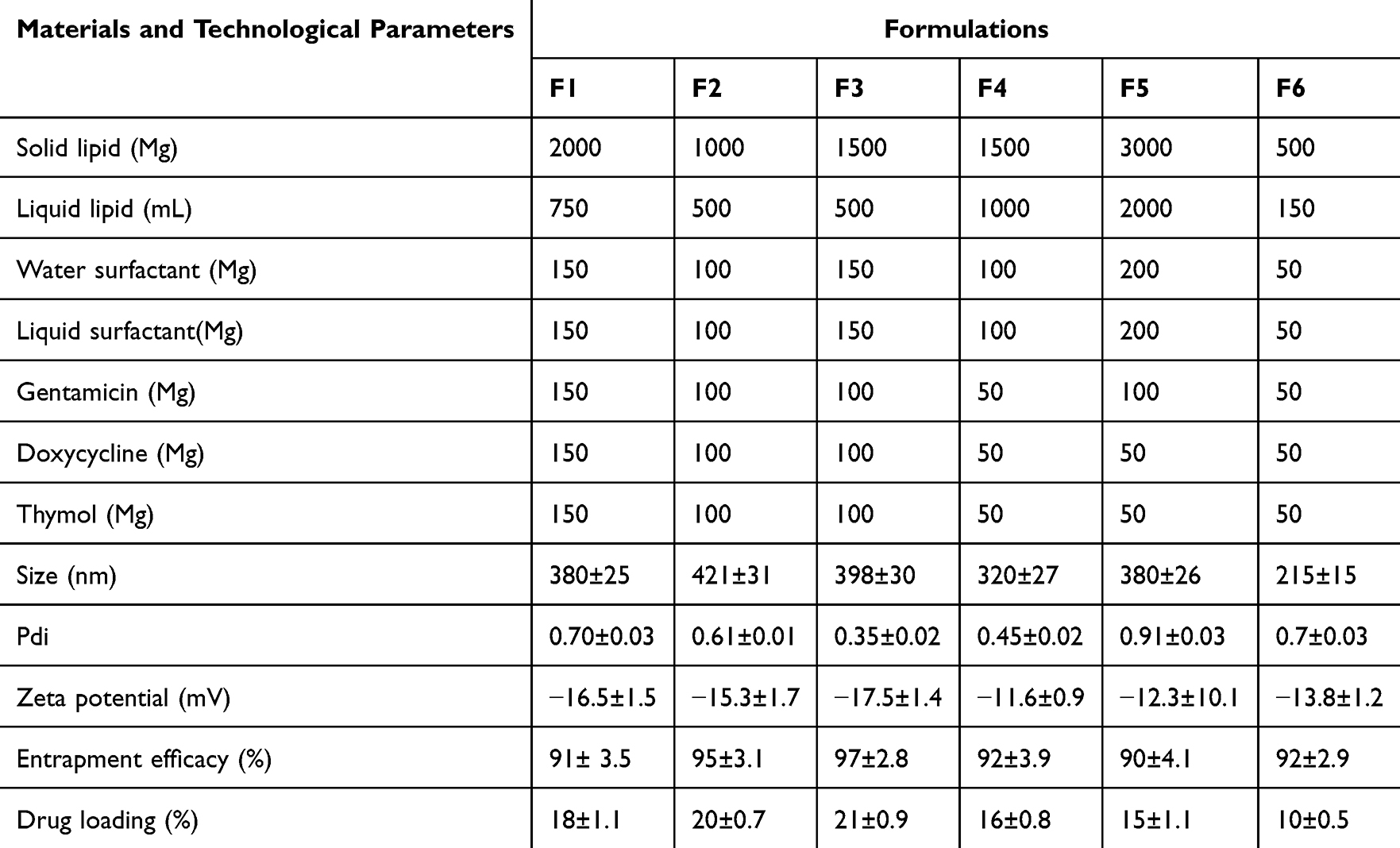 |
Table 1 Composition, Preparation Parameters, and Physicochemical Characteristics of NLC Formulations |
Nanoparticle Stability
The average particle size, PDI, zeta potential, and turbidity of the nanoparticles were assessed at 0, 1, 3, 6, and 9 months (Table 2). The particle size remained relatively constant up to the third month, showing no statistically significant change. After nine months, a slight increase of about 12.5% in particle diameter (from 398 to 455 nm) was observed, suggesting good colloidal stability of the nanoparticles during storage.
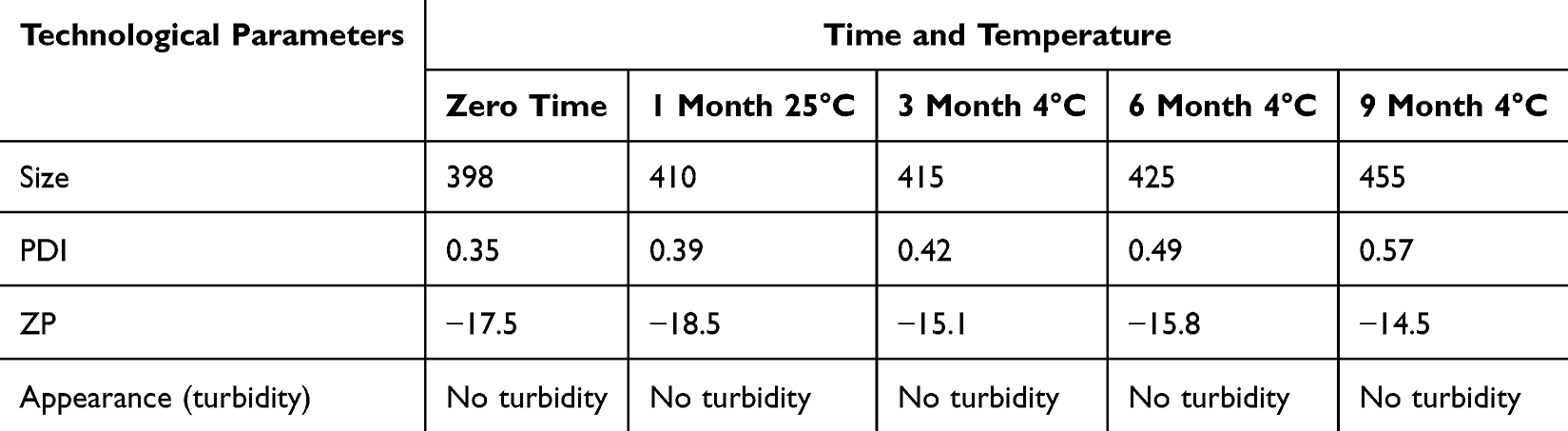 |
Table 2 Evaluation of NLC Stability Parameters During 9 months of Storage |
Morphological Analysis (FESEM)
FESEM imaging showed that the prepared NLCs exhibited a relatively uniform appearance. The particles appeared well distributed across the field without noticeable aggregation, indicating acceptable physical stability of the formulation. The overall morphology tended toward an oval to slightly irregular shape, which is consistent with typical NLC characteristics (Figure 1).
 |
Figure 1 FESEM micrograph of the prepared nanostructured lipid carriers (NLCs) showing nanoscale particles with relatively smooth surfaces and uniform distribution (magnification: 135 kx; scale bar: 200 nm). |
FTIR Analysis
The FTIR spectra of free doxycycline, blank NLCs, and DOX-loaded NLCs (DOX-NLC) were evaluated to investigate the chemical compatibility and successful integration of the drug within the lipid framework (Figure 2). The spectrum of free doxycycline (purple line) displayed its characteristic fingerprint, including broad bands at 3300−3500 cm−1 attributed to O-H and N-H stretching vibrations, and sharp peaks between 1615−1670 cm−1 representing the carbonyl (C=O) stretching of the amide and aromatic rings. In both the blank NLC (blue line) and DOX-NLC (black line) spectra, the dominant peaks at 2918 cm−1 and 2850 cm−1 correspond to the symmetric and asymmetric C-H stretching vibrations of the long aliphatic chains in stearic acid and oleic acid. Additionally, a distinct peak at 1708 cm−1 was observed, identifying the carbonyl group of the fatty acids. In the DOX-NLC spectrum, the characteristic peaks of doxycycline were significantly attenuated or completely masked by the intense signals of the lipid matrix. This observation confirms that the drug was successfully encapsulated within the NLC core, transitioning from a crystalline state to an amorphous or molecularly dispersed state within the lipid carrier. Furthermore, the lack of new peak formation or significant shifts in the lipid signals suggests that no adverse chemical interactions occurred between doxycycline and the NLC component.
 |
Figure 2 FTIR spectra of free- doxycycline, DOX-loaded NLCs (DOX-NLC), and free- NLCs. The masking of doxycycline-specific peaks in the DOX-NLC formulation confirms successful drug entrapment within the stearic acid and oleic acid-based lipid matrix. |
The FTIR analysis was further extended to confirm the encapsulation of gentamicin within the NLC system (Figure 3). The spectrum of free gentamicin (purple line) exhibited a broad and intense absorption band in the 3200−3500 cm−1 region, corresponding to the stretching vibrations of hydroxyl (-OH) and amino (-NH2) groups. Additionally, characteristic peaks observed between 1000−1100 cm−1 represent the glycosidic C-O-C and C-N stretching vibrations inherent to the aminoglycoside structure. In the Gen-NLC spectrum (black line), the predominant signals were those of the lipid matrix, specifically the sharp aliphatic C-H stretching peaks at 2918 cm−1 and 2850 cm−1, and the carbonyl (C=O) peak at 1708 cm−1 from stearic and oleic acids. The absence of the prominent, broad peaks of free gentamicin in the Gen-NLC formulation suggests that the drug is successfully entrapped and molecularly dispersed within the lipid core. Similar to the observations for DOX-NLC, the lack of shift in the primary lipid peaks and the absence of new functional group signals indicate excellent chemical compatibility between gentamicin and the selected lipid components.
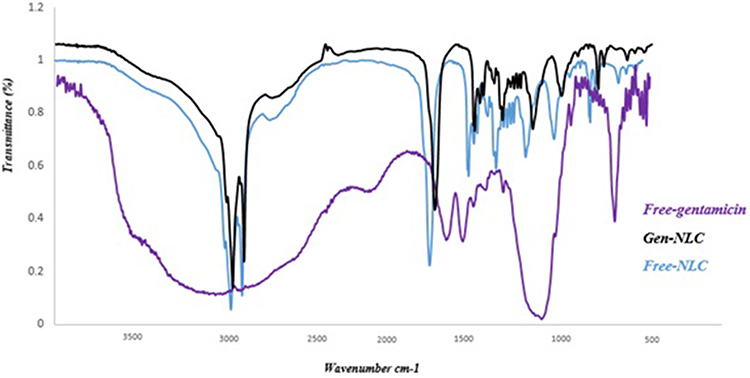 |
Figure 3 FTIR spectra of free gentamicin, gentamicin-loaded NLCs (Gen-NLC), and free NLCs. The successful entrapment of gentamicin is evidenced by the masking of its characteristic amine and hydroxyl signals within the dominant spectra of the lipid matrix. |
The FTIR spectrum of thymol and its integration into the NLC system were evaluated to ensure structural integrity and successful loading (Figure 4). The spectrum of pure thymol (purple line) exhibited a characteristic broad absorption band at approximately 3230 cm−1, assigned to the stretching vibration of the phenolic hydroxyl (-OH) group. Intense peaks in the 2860−2960 cm−1 range correspond to the C-H stretching of its isopropyl and methyl substituents. Furthermore, several sharp bands between 1420−1620 cm−1 reflect the aromatic ring carbon-carbon double bond (C=C) vibrations, while the peak at 808 cm−1 is indicative of the aromatic C-H out-of-plane bending. In the Thy-NLC spectrum (black line), the fingerprint of the lipid matrix (stearic acid and oleic acid) dominated, with the characteristic C-H stretching at 2918 cm−1 and 2850 cm−1, and the lipid carbonyl peak at 1708 cm−1. The significant reduction and overlapping of thymol’s phenolic signals within the NLC spectrum confirm that thymol was effectively partitioned into the hydrophobic core of the lipid carriers. The absence of unexpected new peaks confirms that thymol maintained its chemical structure during the high-shear homogenization process and remained compatible with the lipid components.
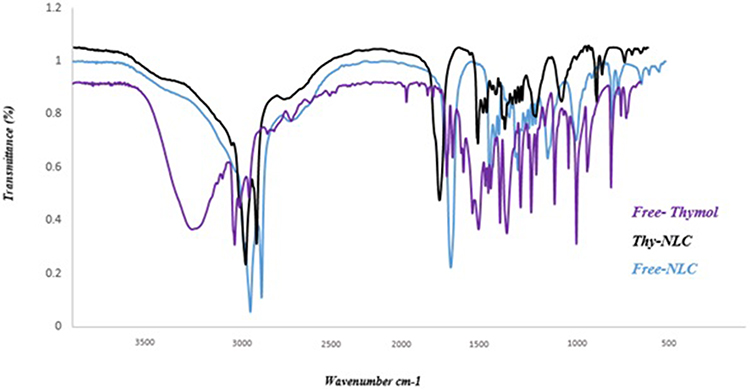 |
Figure 4 FTIR spectra of free thymol, thymol-loaded NLCs (Thy-NLC), and free NLCs. The incorporation of thymol into the lipid matrix is confirmed by the attenuation of the phenolic O-H band and aromatic skeletal vibrations in the Thy-NLC formulation. |
In vitro Drug Release Study
The in vitro release profiles of doxycycline, gentamicin, and thymol from the NLC system were evaluated individually at pH 7.4 (Figure 5). As observed, the release rate of the free drug was markedly higher than that of the drug encapsulated within the lipid nanocarrier, confirming the ability of the NLC system to modulate and sustain drug release (P = 0.01). During the first 20 hours, approximately 20% of the drug was released from the NLC matrix, whereas the free drug exhibited a much faster release, with nearly 60% released within the same period. The sustained release from the nanocarrier continued gradually, reaching about 95% cumulative release after nearly 80 hours. This prolonged release pattern demonstrates the controlled-release behavior of the lipid matrix, which can potentially enhance the therapeutic efficacy and reduce dosing frequency compared with the free drug formulation.
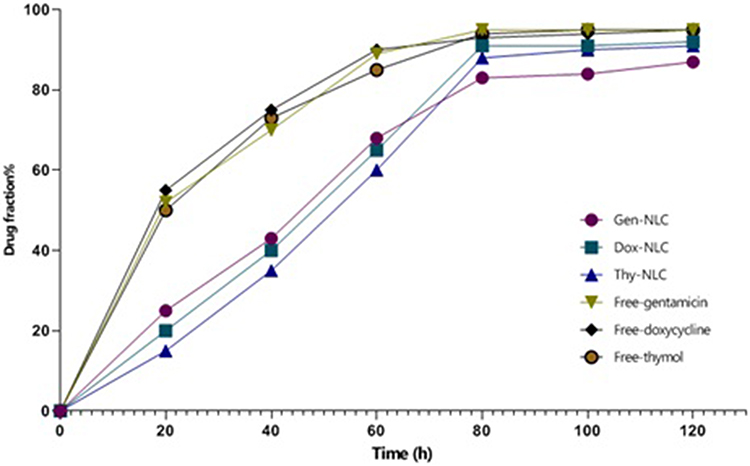 |
Figure 5 In vitro release profile of the free drug and NLC-encapsulated formulation in PBS buffer (pH 7.4, 37 °C) (n = 3). The free drug exhibited a rapid release (~60% within 20 h), while only ~20% of the drug was released from the NLC in the same period. Nearly 95% of the encapsulated drug was released over ~80 h, indicating a sustained and controlled-release pattern provided by the lipid nanocarrier system. |
Antibacterial Studies
The antimicrobial activity of free drugs (gentamicin, doxycycline, and thymol) and their corresponding NLC formulations was assessed by agar well diffusion and minimum inhibitory concentration (MIC) assays (Table 3 and Figure 6). In both assays, unencapsulated drugs produced larger zones of inhibition and lower MIC values than the individual nanoformulations during the initial incubation period. This observation is consistent with the immediate availability of free active agents. In contrast, drugs entrapped within the lipid matrix exhibited a controlled release pattern, requiring time to diffuse from the NLCs to exert their effects.
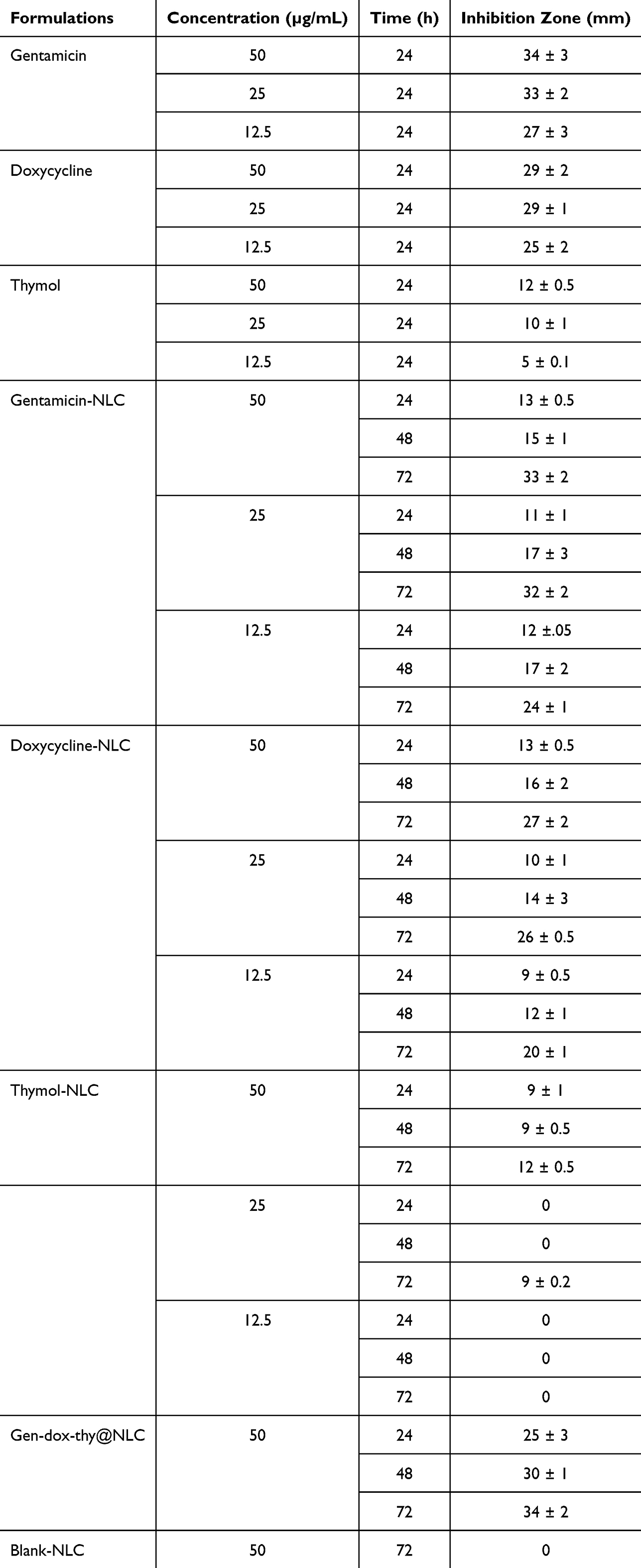 |
Table 3 Antibacterial Activity of Free Drugs and Corresponding NLC Formulations as Determined by Agar Well Diffusion (Zone of Inhibition) Assay. Values Represent Mean ± SD (n = 3) |
 |
Figure 6 Minimum inhibitory concentration (MIC) values of different formulations including free antibiotics and NLC-based systems. Data represent the mean ± SD of three independent experiments (n=3). The Dox-Gen-Thy@NLC formulation showed a markedly lower MIC compared to free drugs and single-loaded NLCs, indicating a synergistic antibacterial effect and enhanced delivery efficiency (p value < 0.05). |
Notably, while individual NLCs showed higher MICs, the triple-drug loaded NLC (Gen-Dox-Thy@NLC) demonstrated a significant enhancement in antibacterial efficacy compared to single-drug NLCs, suggesting a synergistic or additive effect within the nanocarrier. Furthermore, the diameter of the inhibition zones around NLC samples increased progressively over the 72-hour period, surpassing the sustained efficacy of free drugs which often plateaued earlier. These observations suggest that while NLC-encapsulation initially reduces apparent potency in short-term assays, it provides a superior long-term therapeutic profile by maintaining effective drug concentrations over an extended period, which is a critical advantage for treating intracellular pathogens like Brucella melitensis.
Toxicity Studies
The cytotoxicity of free drugs (doxycycline, gentamicin, and thymol) and their corresponding nanostructured lipid carrier formulations (Dox-NLC, Gen-NLC, Thy-NLC) was evaluated using J774A.1 macrophage cells (Figure 7). The results demonstrated that all formulations exhibited dose-dependent cytotoxicity, with a marked reduction in cell viability observed at higher concentrations (800 µg/mL). Among the free drugs, thymol showed the highest cytotoxicity, with cell viability decreasing to approximately 72% at the highest tested concentration. In contrast, the NLC-based formulations showed significantly improved biocompatibility, maintaining cell viability above 85% even at 800 µg/mL. Dox-NLC and Gen-NLC displayed the lowest toxicity profiles, comparable to the standard media control.
 |
Figure 7 Cell viability of J774A.1 macrophage cells after 24 hours of exposure to free drugs and NLC formulations at different concentrations (25–800 µg/mL). Data are presented as mean ± SD from three independent experiments (n = 3). |
Intracellular Infection Study
The intracellular antibacterial activity of the free drugs and their corresponding NLC formulations was evaluated against Brucella melitensis using the J774A.1 macrophage infection model (Figure 8). As shown in the results, all tested concentrations (12.5, 25, and 50 µg/mL) exhibited a concentration-dependent reduction in bacterial colony-forming units (CFUs). However, the NLC-based formulations demonstrated a significantly higher antibacterial efficacy compared to their respective free drugs (P < 0.05). Among the tested formulations, the combined nanodrug (Gen–Dox–Thy@NLC) produced the greatest reduction in intracellular CFUs, indicating enhanced drug delivery and sustained intracellular release. In contrast, the free drug forms and blank NLC showed markedly lower inhibitory effects, with CFU counts remaining relatively high and comparable to the negative control.
 |
Figure 8 Intracellular antibacterial activity of free drugs and NLC formulations against Brucella melitensis in infected J774A.1 macrophage at different concentrations (12.5, 25, and 50 µg/mL). Data are expressed as mean ± SEM from three independent experiments (n = 3). NLC-based formulations, particularly Gen–Dox–Thy@NLC, significantly reduced intracellular bacterial CFUs compared to free drugs and control groups (P < 0.05), demonstrating improved intracellular efficacy of the nanocarrier system. |
Discussion
The present study demonstrates that the nanostructured lipid carrier co-loaded with doxycycline, gentamicin, and thymol exhibits desirable physicochemical properties, controlled release behavior, and enhanced intracellular antibacterial activity against Brucella melitensis. The optimized formulation showed a particle size of approximately 398 nm with moderate polydispersity, characteristics that fall within the range generally associated with efficient macrophage uptake and improved delivery to intracellular pathogens, which is consistent with previous reports on lipid-based antibiotic nanocarriers targeting Brucella and other intracellular bacteria.26,27 Minor differences in size distribution compared with earlier formulations likely arise from variations in lipid composition, surfactant concentration, and production parameters, all of which are known to influence the colloidal behavior of NLCs.28
The high encapsulation efficiency obtained in our formulation aligns with findings from recent studies reporting successful incorporation of both hydrophilic and lipophilic antimicrobial agents into lipid matrices.28,29 Such agreement suggests that the lipid surfactant composition used here provided a stable environment for simultaneous loading of doxycycline, gentamicin, and thymol. Slight discrepancies in loading percentages between studies are expected, considering the differences in drug solubility, lipid miscibility, and preparation technique.
Morphological assessment using FE-SEM confirmed the formation of uniform and non-aggregated nanoparticles, while FTIR analysis indicated physical interactions between the drugs and the lipid core without chemical modification observations that closely mirror those reported for other thymol or antibiotic loaded NLC systems.29,30 These structural features help explain the controlled, biphasic release pattern observed in our study. The initial release phase was followed by a sustained extended release, a behavior commonly described for NLCs containing heterogeneous drug combinations and considered advantageous for chronic intracellular infections requiring prolonged exposure to antibiotics.28,31
The antibacterial findings further support the benefits of the NLC platform. Although free drugs produced larger inhibition zones in extracellular assays due to rapid diffusion through agar, the NLC formulation demonstrated superior intracellular antibacterial activity in infected macrophages. This superior performance is attributed to a dual-action mechanism: first, the NLCs leverage the natural phagocytic activity of macrophages, which facilitates the active uptake of the lipid nanoparticles, a process known as “passive targeting” to the primary reservoir of Brucella. Once internalized, the NLCs likely localize within the phagolysosomal compartments where the bacteria reside. Second, the lipid matrix provides a sustained release profile, ensuring that therapeutic concentrations are maintained locally over an extended period rather than being rapidly cleared or degraded. This concentrated, localized release within the intracellular environment overcomes the penetration limitations of free antibiotics, leading to a more profound reduction in CFU counts. By protecting the encapsulated drugs from the harsh intracellular environment and ensuring their direct delivery to the site of infection, the NLC system significantly enhances the eradication of intracellular Brucella compared to free drug combinations.26,27
The presence of thymol may have contributed to membrane perturbation and improved antibiotic penetration, which could partially explain the enhanced antibacterial activity observed in the triple-drug NLC formulation. Similar supportive effects of natural phenolic compounds co-delivered with antibiotics in lipid-based carriers have been reported in previous studies.29,30
The cytotoxicity of free drugs and their corresponding NLC formulations was evaluated using J774A.1 macrophage cells to assess their biocompatibility. As shown in Figure 7, all formulations exhibited dose-dependent cytotoxicity; however, the NLC-based systems showed significantly improved safety profiles compared to their free counterparts. Specifically, while free thymol reduced cell viability to approximately 72% at 800 µg/mL, the NLC formulations maintained viability above 85% at the same concentration. This enhanced biocompatibility is particularly significant when compared to the antimicrobial efficacy of the system. The safety profile of a nanocarrier is defined by its therapeutic index (the ratio of the toxic dose to the therapeutic dose). In this study, the triple-loaded NLC system (Dox-Gen-Thy@NLC) demonstrated an exceptionally high safety margin; while its MIC was as low as ~0.25 µg/mL, the cytotoxic threshold remained well above 800 µg/mL. This vast gap (a therapeutic index of over 3200) suggests that the effective antimicrobial concentration is far below the level required to induce cellular damage. These findings indicate that the lipid matrix not only facilitates the co-delivery of multiple agents but also acts as a protective shield, masking the inherent toxicity of the drugs especially thymol and ensuring a high degree of safety for potential clinical applications.6,29
Despite the promising outcomes, this study has certain limitations that should be addressed in future research. First, the experiments were conducted under in vitro conditions; therefore, in vivo evaluations are essential to determine the pharmacokinetics, biodistribution, and potential immune interactions, such as protein corona formation. Second, while the reduction in CFUs indicates effective delivery, direct assessment of macrophage viability using standardized assays (eg., MTT or LDH release) and the implementation of a formal gentamicin protection assay would further refine the intracellular quantification and safety profile. Furthermore, the specific intracellular trafficking mechanisms of the NLCs were not explored and should be investigated using fluorescence-based tracing. Finally, further optimization of the drug ratios and lipid matrix composition may enhance the synergistic effects and therapeutic index, as suggested in recent co-delivery studies [2].
Conclusion
This study demonstrates that nanostructured lipid carriers co-loaded with doxycycline, gentamicin, and thymol may help overcome key barriers associated with conventional brucellosis therapy. The optimized formulation produced stable nanoparticles with sustained drug release, high encapsulation efficiency, and good compatibility with macrophage cells. Importantly, the triple-drug NLC showed enhanced intracellular antibacterial activity compared with the free drug combination, indicating its potential to improve intracellular control of Brucella melitensis. These findings suggest that integrating conventional antibiotics with plant-derived compounds in a lipid nanocarrier platform may represent a promising strategy to enhance therapeutic efficacy. Regarding industrial feasibility, the high-shear homogenization method used in this study is a robust and scalable technique already established in pharmaceutical manufacturing. Although co-loading three distinct therapeutic agents presents a manufacturing challenge, the inherent stability and high loading capacity of the NLC’s imperfect crystalline structure facilitate the consistent incorporation of multiple drugs. By optimizing critical process parameters, this triple delivery platform can be adapted for large scale production, potentially bridging the gap between laboratory research and clinical application. Nevertheless, further in vivo studies are required to evaluate pharmacokinetics, biodistribution, and therapeutic performance before clinical translation.
Data Sharing Statement
The data can be accessible to the interested researchers by the corresponding authors on reasonable request.
Ethics Approval and Consent to Participate
The study was conducted according to the guidelines of the Declaration of Helsinki and approved by the Ethics Committee of Hamadan University of Medical Sciences (IR.UMSHA.REC.1403.742). As the research was conducted solely on bacterial isolates without human participants, the requirement for informed consent was waived.
Acknowledgments
The authors wish to express their sincere gratitude to the “Vice Chancellor of Hamadan University of Medical Sciences” for providing financial support and assistance with this research. We also gratefully acknowledge the valuable support of the “Infectious Disease Research Center, Avicenna Institute of Clinical Sciences, Hamadan University of Medical Sciences, and Hamadan, Iran”.
Author Contributions
All authors made a significant contribution to the work reported, whether that is in the conception, study design, execution, acquisition of data, analysis and interpretation, or in all these areas; took part in drafting, revising or critically reviewing the article; gave final approval of the version to be published; have agreed on the journal to which the article has been submitted; and agree to be accountable for all aspects of the work.
Funding
This study was supported by Hamadan University of Medical Sciences (Project No. 140310189181).
Disclosure
The authors declare no competing interests.
References
1. Idrees H, Abbas J, Raza A, et al. A systematic overview of bovine brucellosis and its implications for public health: bovine brucellosis: a zoonotic threat. Lett Animal Biol. 2024;4(1):01–16. doi:10.62310/liab.v4i1.128
2. Qureshi KA, Parvez A, Fahmy NA, et al. Brucellosis: epidemiology, pathogenesis, diagnosis and treatment–a comprehensive review. Ann Med. 2023;55(2):2295398. doi:10.1080/07853890.2023.2295398
3. Karimitabar Z, Chegini Z, Shokoohizadeh L, Moez NM, Arabestani MR, Hosseini SM. Use of the quantum dot-labeled solid lipid nanoparticles for delivery of streptomycin and hydroxychloroquine: a new therapeutic approach for treatment of intracellular Brucella abortus infection. Biomed Pharmacother. 2023;158:114116. doi:10.1016/j.biopha.2022.114116
4. Liu C-M, Suo B, Zhang Y. Analysis of clinical manifestations of acute and chronic brucellosis in patients admitted to a public general hospital in Northern China. Int J Gene Med. 2021;14:8311–8316. doi:10.2147/IJGM.S336850
5. Seleem MN, Jain N, Pothayee N, Ranjan A, Riffle J, Sriranganathan N. Targeting Brucella melitensis with polymeric nanoparticles containing streptomycin and doxycycline. FEMS Microbiol Lett. 2009;294(1):24–31. doi:10.1111/j.1574-6968.2009.01530.x
6. Elrashedy A, Gaafar M, Mousa W, et al. Immune response and recent advances in diagnosis and control of brucellosis. Ger J Vet Res. 2022;2(1):10–24. doi:10.51585/gjvr.2022.1.0033
7. Imbuluzqueta E, Gamazo C, Lana H, et al. Hydrophobic gentamicin-loaded nanoparticles are effective against Brucella melitensis infection in mice. Antimicrob Agents Chemother. 2013;57(7):3326–3333. doi:10.1128/AAC.00378-13
8. Roushan MRH, Moulana Z, Afshar ZM, Ebrahimpour S. Risk factors for relapse of human brucellosis. Global J Health Sci. 2015;8(7):77. doi:10.5539/gjhs.v8n7p77
9. Li C, Wang Y, Peng Q. Research progress in the therapy of brucellosis. Animal Res One Health. 2023;1(1):127–136. doi:10.1002/aro2.5
10. Bosilkovski M, Keramat F, Arapović J. The current therapeutical strategies in human brucellosis. Infection. 2021;49(5):823–832. doi:10.1007/s15010-021-01586-w
11. Alidriss OM, AlSudais H, Alhumaidan OS, et al. Targeted drug delivery strategies in overcoming antimicrobial resistance: advances and future directions. Pharmaceutics. 2025;17(11):1426. doi:10.3390/pharmaceutics17111426
12. Osman N, Devnarain N, Omolo CA, Fasiku V, Jaglal Y, Govender T. Surface modification of nano‐drug delivery systems for enhancing antibiotic delivery and activity. Wiley Interdiscip Rev Nanomed Nanobiotechnol. 2022;14(1):e1758. doi:10.1002/wnan.1758
13. Boyd BJ, Bergström CA, Vinarov Z, et al. Successful oral delivery of poorly water-soluble drugs both depends on the intraluminal behavior of drugs and of appropriate advanced drug delivery systems. Eur J Pharm Sci. 2019;137:104967. doi:10.1016/j.ejps.2019.104967
14. Göke K, Lorenz T, Repanas A, et al. Novel strategies for the formulation and processing of poorly water-soluble drugs. Eur J Pharm Biopharm. 2018;126:40–56. doi:10.1016/j.ejpb.2017.05.008
15. Kalepu S, Nekkanti V. Insoluble drug delivery strategies: review of recent advances and business prospects. Acta Pharmaceutica Sinica B. 2015;5(5):442–453. doi:10.1016/j.apsb.2015.07.003
16. Nouruzi E, Hosseini SM, Asghari B, et al. Effect of poly (lactic-co-glycolic acid) polymer nanoparticles loaded with vancomycin against Staphylococcus aureus biofilm. BMC Biotech. 2023;23(1):39. doi:10.1186/s12896-023-00811-8
17. Zhao Y-Q, Li L-J, Zhou E-F, et al. Lipid-based nanocarrier systems for drug delivery: advances and applications. Pharmaceut Fronts. 2022;4(02):e43–e60. doi:10.1055/s-0042-1751036
18. Nguyen BA, Purnamasari DA, Khan N, Park J-S. A review of state-of-the-art strategies for encapsulating hydrophilic drugs into lipid nanocarriers. J Pharm Invest. 2025;1–17.
19. Singh AK, Kumar M, Upadhyay PK. Methods for the encapsulation of hydrophilic drugs in lipid-based nanocarriers, solid lipid nanoparticles, and nanostructured lipid carriers: a short review and perspective. Curr Nanomed. 2025;15(4):448–458. doi:10.2174/0124681873316337240515080103
20. Gago C, Serralheiro A, Miguel M. Anti-inflammatory activity of thymol and thymol-rich essential oils: mechanisms, applications, and recent findings. Molecules. 2025;30(11):2450. doi:10.3390/molecules30112450
21. Marchese A, Orhan IE, Daglia M, et al. Antibacterial and antifungal activities of thymol: a brief review of the literature. Food Chem. 2016;210:402–414. doi:10.1016/j.foodchem.2016.04.111
22. Almutairy B, Alharthi S, Ebrahimi Shahmabadi H, Alavi SE. Optimized solid lipid nanoparticles for co-delivery of gentamicin and doxycycline: a novel approach to combat intracellular brucella abortus infections. World J Microbiol Biotechnol. 2025;41(7):232. doi:10.1007/s11274-025-04427-2
23. Hosseini SM, Farmany A, Alikhani MY, et al. Co-delivery of doxycycline and hydroxychloroquine using CdTe-labeled solid lipid nanoparticles for treatment of acute and chronic brucellosis. Front Chem. 2022;10:890252. doi:10.3389/fchem.2022.890252
24. Luedtke FL, Stahl MA, Grimaldi R, Forte MBS, Gigante ML, Ribeiro APB. Optimization of high pressure homogenization conditions to produce nanostructured lipid carriers using natural and synthetic emulsifiers. Food Res Int. 2022;160:111746. doi:10.1016/j.foodres.2022.111746
25. Gomaa E, Fathi HA, Eissa NG, Elsabahy M. Methods for preparation of nanostructured lipid carriers. Methods. 2022;199:3–8. doi:10.1016/j.ymeth.2021.05.003
26. Hosseini SM, Abbasalipourkabir R, Jalilian FA, et al. Doxycycline-encapsulated solid lipid nanoparticles as promising tool against Brucella melitensis enclosed in macrophage: a pharmacodynamics study on J774A. 1 cell line. Antimicrob Resist Infect Control. 2019;8(1):62. doi:10.1186/s13756-019-0504-8
27. Almutairy B, Alharthi S, Ebrahimi Shahmabadi H, Alavi SE. Optimized solid lipid nanoparticles for co-delivery of gentamicin and doxycycline: a novel approach to combat intracellular brucella abortus infections. World J Microbiol Biotechnol. 2025;41(7):1–15.
28. Arana L, Gallego L, Alkorta I. Incorporation of antibiotics into solid lipid nanoparticles: a promising approach to reduce antibiotic resistance emergence. Nanomaterials. 2021;11(5):1251. doi:10.3390/nano11051251
29. Sepahvand S, Amiri S, Radi M, Amiri MJ. Effect of thymol and nanostructured lipid carriers (NLCs) incorporated with thymol as antimicrobial agents in sausage. Sustainability. 2022;14(4):1973. doi:10.3390/su14041973
30. Folle C, Marqués AM, Díaz-Garrido N, et al. Gel-dispersed nanostructured lipid carriers loading thymol designed for dermal pathologies. Int J Nanomed. 2024;19:1225–1248. doi:10.2147/IJN.S433686
31. Loretz B, Oh Y-K, Hudson S, Gu Z, Lehr C-M. Drug delivery for fighting infectious diseases: a global perspective. Drug Delivery Transl Res. 2021;11(4):1316–1322. doi:10.1007/s13346-021-01009-1
 © 2026 The Author(s). This work is published and licensed by Dove Medical Press Limited. The
full terms of this license are available at https://www.dovepress.com/terms
and incorporate the Creative Commons Attribution
- Non Commercial (unported, 4.0) License.
By accessing the work you hereby accept the Terms. Non-commercial uses of the work are permitted
without any further permission from Dove Medical Press Limited, provided the work is properly
attributed. For permission for commercial use of this work, please see paragraphs 4.2 and 5 of our Terms.
© 2026 The Author(s). This work is published and licensed by Dove Medical Press Limited. The
full terms of this license are available at https://www.dovepress.com/terms
and incorporate the Creative Commons Attribution
- Non Commercial (unported, 4.0) License.
By accessing the work you hereby accept the Terms. Non-commercial uses of the work are permitted
without any further permission from Dove Medical Press Limited, provided the work is properly
attributed. For permission for commercial use of this work, please see paragraphs 4.2 and 5 of our Terms.