
Back to Journals » Journal of Multidisciplinary Healthcare » Volume 19
Mobile App-Based Interventions to Support Maternal Roles in Child Nutrition and Development: A Scoping Review
Authors Sari RS  , Dhamayanti M , Solehati T , Mediani HS
Received 17 August 2025
Accepted for publication 6 March 2026
Published 15 April 2026 Volume 2026:19 561368
DOI https://doi.org/10.2147/JMDH.S561368
Checked for plagiarism Yes
Review by Single anonymous peer review
Peer reviewer comments 2
Editor who approved publication: Prof. Dr. Krzysztof Laudanski
Ria Setia Sari,1,2,* Meita Dhamayanti,3,* Tetti Solehati,4 Henny Suzana Mediani5
1Doctoral Study Program in Nursing, Faculty of Nursing, Universitas Padjadjaran, Sumedang, West Java, Indonesia; 2Department of Pediatrics, Faculty of Health, Universitas Yatsi Madani, Tangerang, West Java, Indonesia; 3Department of Child Health, Faculty of Medicine, Hasan Sadikin Hospital, Universitas Padjadjaran, Bandung, West Java, Indonesia; 4Department of Maternity Nursing, Faculty of Nursing, Universitas Padjadjaran, Sumedang, West Java, Indonesia; 5Department of Pediatric Nursing, Faculty of Nursing, Universitas Padjadjaran, Sumedang, West Java, Indonesia
*These authors contributed equally to this work
Correspondence: Henny Suzana Mediani, Department of Pediatric Nursing, Faculty of Nursing, Universitas Padjadjaran, Bandung, West Java, 45353, Indonesia, Tel +62 822 1739 1965, Email [email protected]
Background: Early childhood is crucial for long-term health, growth, and development, with mothers playing a central role in nutrition and stimulation. Mobile health (mHealth) technologies have potential to support maternal practices through real-time, context-specific guidance. However, evidence on how mobile applications specifically enhance maternal roles in child nutrition and development is limited and fragmented.
Objective: This scoping review aimed to map and synthesize evidence on mobile app–based interventions that support maternal roles in child nutrition and development.
Methods: Following Arksey and O’Malley’s framework and the PRISMA-ScR checklist, we systematically searched PubMed, Scopus, Web of Science, CINAHL, PsycINFO, and grey literature for studies published between 2013 and 2025. Eligible studies evaluated mHealth interventions targeting maternal behaviors for children under five. Data were extracted and analyzed thematically.
Results: Twenty-five studies met the inclusion criteria. Most interventions addressed breastfeeding, complementary feeding, and developmental stimulation. Common app features included educational modules, growth monitoring, real-time guidance, and peer support. Positive outcomes were observed in breastfeeding practices, child growth, and developmental milestones. Key barriers included low digital literacy and limited access to technology, particularly in marginalized populations.
Conclusion: mHealth applications show promise in supporting maternal roles and improving child nutrition and development outcomes. Future research should focus on digital equity, broader accessibility, and the cost-effectiveness and scalability of these interventions, especially in underserved settings.
Keywords: child nutrition, digital health interventions, early childhood development, mobile health, nutrition
Introduction
Early childhood is a critical period for growth, brain development, and the establishment of health-related behaviors that influence lifelong outcomes. The first five years of life, particularly the first 1000 days from conception to age two, are foundational for long-term cognitive, emotional, and physical health.1,2 During this sensitive window, mothers and primary female caregivers are central agents in shaping a child’s nutrition, development, and overall well-being.3,4 Maternal knowledge, attitudes, and confidence directly affect child outcomes such as exclusive breastfeeding, dietary adequacy, and responsive caregiving.5,6 Empowering mothers with timely, accurate, and actionable information is therefore essential to prevent developmental delays and malnutrition, especially in resource-constrained settings.
Digital health technologies have emerged as a promising strategy to address gaps in maternal and child health service delivery. Tools such as SMS, teleconsultation, decision-support algorithms, and mobile applications offer new avenues to support maternal practices.7 Among these, mobile applications are particularly well-suited for promoting maternal roles due to their capacity to provide interactive, multimedia-rich, and personalized content. Mobile apps can deliver real-time feedback, track behaviors, provide peer and expert support, and offer structured educational modules, all of which have been linked to improved caregiving and feeding practices.6,8 Their scalability, offline functionality, and increasing global smartphone penetration make app-based interventions relevant across urban and rural contexts.
Although several reviews have examined digital health strategies in maternal and child health, most focus broadly on mHealth, combining diverse modalities such as SMS, interactive voice response, telehealth, and apps, which can obscure the specific mechanisms and benefits of mobile applications.9,10 Few studies have explicitly addressed how mobile apps enhance maternal roles in child nutrition and development, particularly in terms of behavior change, decision-making, and psychosocial empowerment.
To address this gap, this scoping review aims to identify, map, and thematically analyze mobile app–based interventions targeting maternal engagement in child nutrition and early development. This review also examines the scope, functionality, and outcomes of these interventions while considering implementation processes, user engagement, and contextual relevance across diverse populations. By consolidating current evidence, this study seeks to inform the design of future digital tools, guide research priorities, and support policies that advance maternal and child health equity.
Methods
Study Design and Framework
This scoping review systematically identified, categorized, and synthesized evidence on mobile application–based digital health interventions supporting maternal roles in early childhood nutrition and development. The review focused on how mobile apps enhance maternal practices, including child feeding, nutritional decision-making, and stimulation activities for children aged 0–5 years. The methodological framework followed Arksey and O’Malley’s five-stage process (2005): (1) identifying the research question, (2) identifying relevant studies, (3) study selection, (4) data charting, and (5) collating, summarizing, and reporting the results. Enhancements recommended by Levac et al,11 including iterative team discussions, were incorporated to improve rigor. The review adhered to the PRISMA-ScR checklist to ensure transparency and reproducibility.12
Eligibility Criteria
Eligibility was defined using the Population–Concept–Context (PCC) framework from the Joanna Briggs Institute.
- Population: mothers or female caregivers of children aged 0–5 years.
- Concept: mobile application–based interventions aimed at improving maternal behaviors related to child nutrition and development.
- Context: both high- and low-resource settings.
Inclusion Criteria
Primary research (qualitative, quantitative, mixed methods), focus on mobile app interventions for maternal roles in child feeding, nutrition, or early development, full text in English, published between January 2013 and May 2025. Grey literature with methodological detail was included. Exclusion criteria: editorials, reviews, conference abstracts, opinion papers, and non-app mHealth interventions (eg, SMS-only, teleconsultation).
Information Sources and Search Strategy
Five databases were searched: PubMed, Scopus, Web of Science, CINAHL, and PsycINFO. Grey literature was sourced from Google Scholar, WHO Digital Health Atlas, UNICEF innovation databases, and relevant NGO repositories. Reference lists of included studies were also screened. Search strategies combined MeSH and free-text terms for maternal behavior, child nutrition, early development, and mobile applications, tailored to each database. Filters included English language and publication years 2013–2025. Final search: May 12, 2025. Detailed search strategies are in Supplementary Table S1.
Study Selection Process
Two-stage screening was performed. Duplicates were removed, then titles and abstracts screened. Full texts were assessed independently by two reviewers using Rayyan. Discrepancies were resolved by discussion, with a third reviewer consulted if needed. Screening is documented in a PRISMA-ScR flowchart.
Data Charting Process
A standardized charting form captured study characteristics, participant demographics, study design, intervention features, and maternal/child outcomes. Additional data included user engagement, technological components, cultural adaptation, and implementation factors. Data extraction was conducted independently by two reviewers, with discrepancies resolved through consensus. Descriptive patterns were analyzed; no meta-analysis was performed due to heterogeneity.
Methodological Quality Assessment
Interpretive assessment of methodological rigor was conducted using design-appropriate tools: Joanna Briggs Institute (JBI) checklists and the Mixed Methods Appraisal Tool (MMAT). Domains assessed included selection, performance, detection, attrition, and reporting bias, rated as low, moderate, or high. Two reviewers conducted assessments independently, with a third reviewer consulted if needed.
Synthesis of Results
Quantitative and qualitative data were synthesized descriptively. Thematic analysis identified patterns in intervention components, maternal behavior change strategies, and child health outcomes. Findings are presented narratively.
Ethical Considerations
No human participants or primary data were involved; all sources were publicly available. Ethical approval was not required.
Results
Search Results
The initial search across five databases and grey literature sources yielded 1756 records. After removing 523 duplicates, 1233 records were screened at the title and abstract level, of which 1102 were excluded for not meeting inclusion criteria. A total of 131 full-text articles were retrieved; 15 could not be obtained, leaving 116 for full-text assessment. During eligibility screening, 91 studies were excluded due to irrelevant population (n = 28), non-aligned intervention scope (n = 24), inappropriate context (n = 16), or unsuitable study design (n = 23). Ultimately, 25 studies met all inclusion criteria. Inter-rater agreement was high (Cohen’s kappa = 0.82). The selection process is illustrated in the PRISMA-ScR flow diagram (Figure 1).
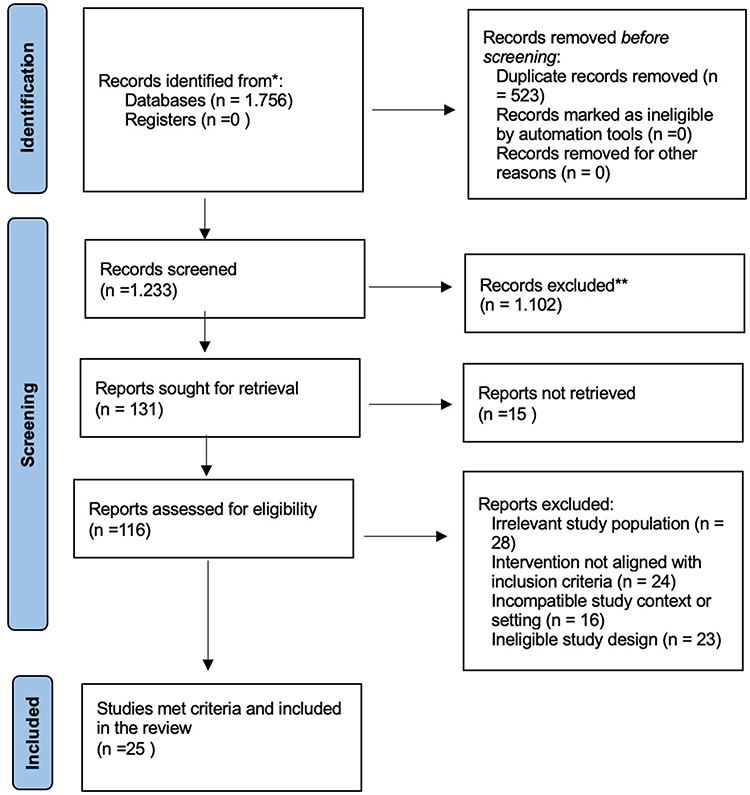 |
Figure 1 PRISMA 2020 flow diagram of the study selection process. The diagram illustrates the process of study identification, screening, eligibility assessment, and inclusion in accordance with the PRISMA 2020 guidelines. Records were identified through database searching and other sources, duplicates were removed, titles and abstracts were screened, full-text articles were assessed for eligibility, and the final studies were included in the review. |
Characteristics of Included Studies
The 25 studies were conducted in high-income and low- to middle-income countries, with most published between 2015 and 2024. Study designs included 11 quantitative studies (randomized controlled trials, quasi-experimental), 7 qualitative studies, and 7 mixed-methods studies. Sample sizes ranged from fewer than 30 participants to over 500. Most interventions targeted mothers of children under 2 years, with some including caregivers of children up to 5 years. Key study characteristics are summarized in Table 1.
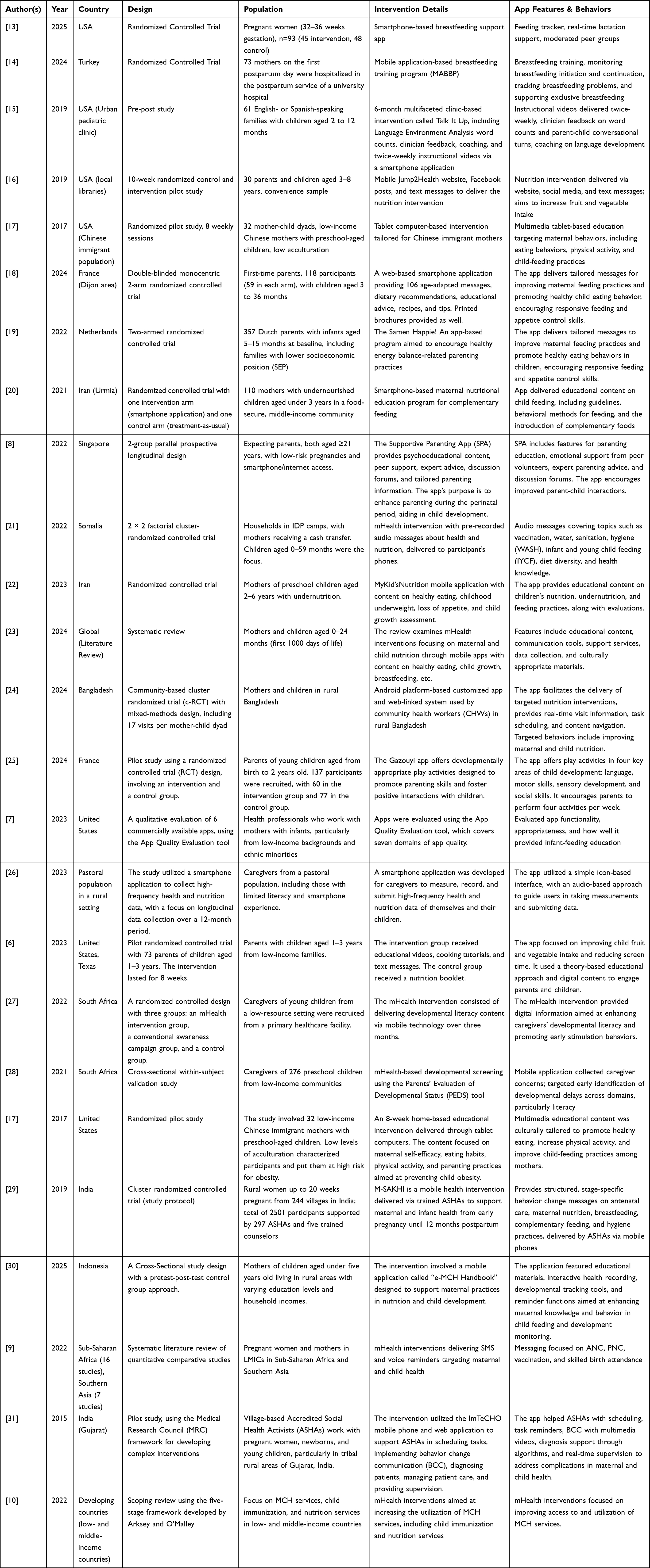 |
Table 1 Characteristics of Included Studies |
Intervention Characteristics
All interventions were delivered via mobile applications, with some integrating SMS reminders or multimedia components. Common app features included:
- Educational modules on breastfeeding, complementary feeding, responsive parenting, and child stimulation
- Real-time feedback based on input from users (eg, feeding logs, child growth data)
- Tracking tools, including growth charts, feeding diaries, and immunization reminders
- Social or peer support functions, such as community chat groups or forums moderated by healthcare professionals.
- Gamification elements to promote engagement and adherence
Several interventions were co-designed with end users to improve cultural relevance and usability, particularly for underserved populations. Objectives varied, including extending breastfeeding duration, promoting responsive feeding, supporting growth monitoring, enhancing maternal self-efficacy, and promoting early stimulation.
Outcomes
Outcomes were consistently positive across four main domains (Table 1):
- Maternal Knowledge and Behavior:Increased knowledge of infant feeding, higher confidence in caregiving, and improved responsive feeding practices.
- Child Health and Developmental Outcomes:
- Developmental Gains:Modest improvements in cognitive, motor, and socioemotional development; integration of milestone tracking with targeted educational messages.
- Service Utilization:Increased attendance at growth monitoring and immunization sessions; better adherence to national nutrition programs.
Implementation and Engagement
Successful interventions incorporated culturally tailored content, co-design with users, interactive features (eg, gamification, personalized feedback), and human support components such as healthcare professionals or trained peer counselors. These elements promoted sustained app use and user satisfaction. Key barriers included limited digital literacy, inconsistent internet access, language or cultural mismatches, and concerns over long-term sustainability (Table 2).
 |
Table 2 Summary of Findings |
Risk of Bias
Methodological quality was generally acceptable Most studies demonstrated low to moderate overall risk of bias, with one study rated high risk.7 Low-risk studies exhibited robust participant selection, intervention delivery, outcome measurement, and reporting.33–35 Moderate-risk studies were affected by performance or attrition bias,15,19,28 and one study had high overall risk due to evaluation of commercial apps without controlled conditions. Reporting bias was minimal across studies, supporting confidence in outcome validity (Figure 2).
 |
Figure 2 Risk of bias distribution for each indicator across the 25 included studies. The figure presents the proportion of studies rated as low risk, high risk, or unclear risk of bias for each methodological domain assessed. The distribution reflects the overall methodological quality across the included studies. |
Summary
Overall, mobile app-based interventions improved maternal behaviors, child nutrition, and developmental outcomes, while highlighting the importance of implementation quality, user engagement, and context-specific adaptations to maximize effectiveness.
Discussion
This scoping review mapped the current evidence on mobile applications designed to support maternal behaviors in promoting child nutrition and development, directly addressing the study’s objective of identifying app-based strategies, their functionalities, and their outcomes across diverse populations. Across the 25 included studies, mobile applications consistently improved maternal knowledge, confidence, and responsive feeding practices, as well as child nutrition and developmental outcomes. These findings confirm the potential of digital interventions to enhance maternal roles in early childhood health, aligning with the review’s aim of evaluating both behavioral and developmental impacts.
Unlike earlier reviews focusing narrowly on breastfeeding,6 or digital parenting interventions.36 This study integrates maternal behavior change strategies, app functionalities, implementation processes, and child-level outcomes. Prior reviews largely emphasized usability or effectiveness without examining contextual factors, co-design processes, or equity considerations. By including studies from both high-income countries (HICs) and low- to middle-income countries (LMICs), this review extends the evidence base, providing a more nuanced understanding of how mobile applications operate in different contexts.16,17
Interventions in HICs often leveraged high smartphone penetration, stable internet access, and advanced app features such as interactive gamification, sophisticated feedback algorithms, and integration with electronic health records.37,38 These studies reported strong improvements in maternal behaviors and developmental outcomes, particularly in well-resourced urban populations. In contrast, interventions in LMICs faced challenges such as limited digital literacy, intermittent internet connectivity, and cultural or language mismatches. Despite these barriers, apps that incorporated co-design, culturally tailored content, peer support, and offline capabilities still achieved meaningful improvements in maternal behaviors and child nutrition.39 This comparison underscores the importance of contextual adaptation, showing that even resource-constrained settings can benefit from mobile applications when interventions are carefully designed to meet local needs.
Across contexts, successful interventions combined interactive content, real-time feedback, milestone tracking, and human support components (eg, healthcare professionals or peer counselors). These features promoted sustained engagement, particularly among populations with limited access to conventional maternal and child health services. Barriers to implementation included low digital literacy, connectivity issues, and sustainability concerns in donor-funded programs. These findings highlight that app design alone is insufficient; human support and health system integration are essential to maximize adoption and impact.
By including quantitative, qualitative, and mixed-methods studies, this review provides a holistic understanding of mobile application interventions and their contextual use. Limitations include small sample sizes, short follow-up periods, inconsistent engagement measures, and lack of standardized outcomes, which constrain comparability across studies. Few studies addressed potential unintended consequences, such as misinformation, privacy concerns, or screen time overexposure.
This review emphasizes the potential of mobile applications to enhance maternal behaviors and child health outcomes across diverse contexts. Future research should focus on long-term effectiveness, scalability, cost-effectiveness, and digital equity, particularly in LMICs. Contextual adaptation, co-design with end users, and integration into existing health systems remain critical for achieving sustainable impact.
Mobile applications represent a versatile and promising approach to supporting maternal roles in child nutrition and development. When contextually adapted and coupled with implementation support, these interventions can promote positive behavioral and developmental outcomes, addressing both immediate needs and long-term health equity goals in both high- and low-/middle-income countries.
Strength and Limitation
This review also has several strengths. It included a wide range of study designs including qualitative, quantitative, and mixed-methods that enabling a rich understSilwanah ng of both outcomes and implementation processes. The diversity of target populations across contexts enhances the generalizability of findings. However, limitations were noted. Small sample sizes and inconsistent definitions of user engagement reduced comparability between studies. Moreover, few studies employed standardized outcome measures or evaluated long-term health impacts.
Implications for Practice, Research, and Policy
mHealth applications can serve as complementary tools to in-person care, especially in settings where healthcare resources are limited. Integration into existing maternal and child health services, supported by community health workers, can help extend the reach of evidence-based care. However, interventions must be tailored to users’ cultural, linguistic, and technological contexts, particularly among populations with limited digital literacy. There is a critical need for long-term studies to evaluate the sustained effects of mHealth tools on maternal practices and child outcomes. Additionally, cost-effectiveness analyses are crucial for informing decisions about scaling up these interventions in resource-limited settings. Future studies should explore personalization strategies that adapt interventions to demographic, behavioral, and cultural factors. Governments and public health agencies have a window of opportunity to invest in digital health infrastructure, including affordable mobile access and regulatory frameworks for quality assurance. National digital health strategies should explicitly incorporate maternal and child health priorities and set standards to ensure that mHealth tools are evidence-based, user-centered, and free from misleading or harmful content.
Conclusion
This scoping review identified and mapped 25 studies involving mobile health interventions aimed at supporting maternal roles in early childhood nutrition and development. The findings suggest that mHealth applications can effectively enhance maternal practices, including breastfeeding, dietary decision-making, and developmental stimulation, thereby contributing to improved child health outcomes. The diversity of interventions and target populations suggests that mobile tools are adaptable across various settings, including underserved communities. However, successful implementation depends on addressing challenges such as digital access, user engagement, and sustainability. Further high-quality studies are needed to examine the long-term effectiveness, integration with existing health services, and cost-effectiveness of digital interventions in real-world conditions. As digital health technologies continue to evolve, they hold significant potential to advance maternal and child health equity, particularly in low-resource contexts.
Data Sharing Statement
All data generated or analyzed during this study are included in this article. Further enquiries can be directed to the corresponding author.
Acknowledgments
The author appreciates Universitas Padjadjaran, Bandung, West Java, Indonesia, for facilitating research and publication.
Funding
This research was funded through Padjadjaran University.
Disclosure
All authors declare no conflicts of interest in this work.
References
1. Black MM, Walker SP, Fernald LCH, et al. Advancing early childhood development: from science to scale 1: Early childhood development coming of age: science through the life course. Lancet. 2016;389(10064):77. doi:10.1016/S0140-6736(16)31389-7
2. Organization WH. Compendium of WHO and Other UN Guidance on Health and Environment: Version with International Classification of Health Intervention (ICHI) Codes. World Health Organization; 2024.
3. Lu C, Cuartas J, Fink G, et al. Inequalities in early childhood care and development in low/middle-income countries: 2010–2018. BMJ Glob Health. 2020;5(2):e002314. doi:10.1136/bmjgh-2020-002314
4. Yousafzai AK, Rasheed MA, Rizvi A, Armstrong R, Bhutta ZA. Effect of integrated responsive stimulation and nutrition interventions in the Lady Health Worker programme in Pakistan on child development, growth, and health outcomes: a cluster-randomised factorial effectiveness trial. Lancet. 2014;384(9950):1282–17. doi:10.1016/S0140-6736(14)60455-4
5. Unicef. Promoting and protecting mental health in schools and learning environments. 2022.
6. Haynes E, Brown CR, Halliday C, et al. Interventions designed to promote the consumption of locally produced foods: a scoping review. Front Sustain Food Syst. 2025;9:1544092. doi:10.3389/fsufs.2025.1544092
7. Uribe ALM, DiFilippo KN, Jarnell K, Patterson JA. Evaluation of commercially available infant-feeding mobile applications using app quality evaluation tool. J Nutr Educ Behav. 2023;55(8):604–611. doi:10.1016/j.jneb.2023.05.249
8. Chua JYX, Shorey S. Effectiveness of mobile application-based perinatal interventions in improving parenting outcomes: a systematic review. Midwifery. 2022;114:103457. doi:10.1016/j.midw.2022.103457
9. Bossman E, Johansen MA, Zanaboni P. mHealth interventions to reduce maternal and child mortality in Sub-Saharan Africa and Southern Asia: a systematic literature review. Front Glob Womens Health. 2022;3:942146. doi:10.3389/fgwh.2022.942146
10. Venkataramanan R, V SS, Alajlani M, Arvanitis TN. Effect of mobile health interventions in increasing utilization of maternal and child health care services in developing countries: a scoping review. Digit Health. 2022;8:20552076221143236. doi:10.1177/20552076221143236
11. Levac D, Colquhoun H, O’Brien KK. Scoping studies: advancing the methodology. Implement Sci. 2010;5:69. doi:10.1186/1748-5908-5-69
12. Tricco AC, Lillie E, Zarin W, et al. PRISMA extension for scoping reviews (PRISMA-ScR): checklist and explanation. Ann Intern Med. 2018;169(7):467–473. doi:10.7326/M18-0850
13. de Mello Sa SR, Wang Z, Sapkalova V, et al. A smartphone-based application to improve breastfeeding duration and self-efficacy: a randomized controlled clinical trial. In: Women Health. 2025:1–13.
14. Acar Z, Şahin N. Development of a mobile application-based breastfeeding program and evaluation of its effectiveness. J Pediatr Nurs. 2024;74:51–60. doi:10.1016/j.pedn.2023.11.011
15. Christakis DA, Lowry SJ, Goldberg G, Violette H, Garrison MM. Assessment of a parent-child interaction intervention for language development in children. JAMA Network Open. 2019;2(6):e195738. doi:10.1001/jamanetworkopen.2019.5738
16. Bakırcı-Taylor AL, Reed DB, McCool B, Dawson JA. mHealth improved fruit and vegetable accessibility and intake in young children. J Nutr Educ Behav. 2019;51(5):556–566. doi:10.1016/j.jneb.2018.11.008
17. Sun A, Cheng J, Bui Q, Liang Y, Ng T, Chen JL. Home-based and technology-centered childhood obesity prevention for Chinese mothers with preschool-aged children. J Transcult Nurs. 2017;28(6):616–624. doi:10.1177/1043659617719139
18. Riera-Navarro C, Schwartz C, Ducrot P, et al. A web-based and mobile randomised controlled trial providing complementary feeding guidelines to first-time parents in France to promote responsive parental feeding practices, healthy children’s eating behaviour and optimal body mass index: the NutrienT t. BMC Public Health. 2024;24(1):2649. doi:10.1186/s12889-024-20057-z
19. Karssen LT, Larsen JK, Burk WJ, et al. Process and effect evaluation of the app-based parenting program Samen Happie! on infant zBMI: a randomized controlled trial. Front Public Health. 2022;10:1012431. doi:10.3389/fpubh.2022.1012431
20. Seyyedi N, Rahmatnezhad L, Mesgarzadeh M, Khalkhali H, Seyyedi N, Rahimi B. Effectiveness of a smartphone-based educational intervention to improve breastfeeding. Int Breastfeed J. 2021;16:1–8. doi:10.1186/s13006-021-00417-w
21. Philbrick W, Milnor J, Deshmukh M, Mechael P. Information and communications technology use to prevent and respond to sexual and gender-based violence in low-and middle-income countries: an evidence and gap map. Campbell Syst Rev. 2022;18(4):e1277. doi:10.1002/cl2.1277
22. Hojati A, Alesaeidi S, Izadi S, Nikniaz A, Farhangi MA. MyKid’sNutrition mobile application trial: a randomized controlled trial to promote mothers’ nutritional knowledge and nutritional status of preschool children with undernutrition—a study protocol. Trials. 2023;24(1):544. doi:10.1186/s13063-023-07503-w
23. Silwanah AS, Suriah S, Jafar N, Areni IS, Yusuf RA. Content and features of Mobile health (mHealth) for mother and child nutrition in the first 1000 days of life (family based intervention): a systematic review. Nutr Health. 2024;30(4):655–670. doi:10.1177/02601060241265550
24. Ferdous TE, Jaman MJ, Siddique AB, et al. Feasibility of employing mhealth in delivering preventive nutrition interventions targeting the first 1000 days of life: experiences from a community-based cluster randomised trial in Rural Bangladesh. Nutrients. 2024;16(20):3429. doi:10.3390/nu16203429
25. Achouche V, Piollet M, Temame M, et al. The impact of a mobile application on parental attitudes, their knowledge of child development, and sense of parenting self-competence: a pilot study. In: Annales Médico-Psychologiques, Revue Psychiatrique. 182. Elsevier; 2024:233–241.
26. Jensen N, Lepariyo W, Alulu V, Sibanda S, Kiage BN. Assessing Mbiotisho: a smartphone application used to collect high-frequency health and nutrition data from difficult-to-reach populations. Matern Child Nutr. 2023;19(3):e13496. doi:10.1111/mcn.13496
27. Brown C, Eccles R, Graham M, van der Linde J. The effect of mHealth and conventional awareness campaigns on caregivers’ developmental literacy. Early Child Dev Care. 2022;192(1):1–13. doi:10.1080/03004430.2020.1728530
28. du Toit MN, van der Linde J, Swanepoel DW. mHealth developmental screening for preschool children in low-income communities. J Child Health Care. 2021;25(4):573–586. doi:10.1177/1367493520970012
29. Patel AB, Kuhite PN, Alam A, et al. M-SAKHI—Mobile health solutions to help community providers promote maternal and infant nutrition and health using a community-based cluster randomized controlled trial in rural India: a study protocol. Matern Child Nutr. 2019;15(4):e12850. doi:10.1111/mcn.12850
30. Sarhan MBA, Fujiya R, Kiriya J, Shibanuma A, Giacaman R, Jimba M. Health literacy mediating the association between health information sources and oral health knowledge among Palestinian adolescent refugees: a cross-sectional study. BMC Oral Health. 2025;25(1):636. doi:10.1186/s12903-025-05836-3
31. Modi D, Gopalan R, Shah S, et al. Development and formative evaluation of an innovative mHealth intervention for improving coverage of community-based maternal, newborn and child health services in rural areas of India. Glob Health Action. 2015;8(1):26769. doi:10.3402/gha.v8.26769
32. Mantzorou M, Papandreou D, Vasios GK, et al. Exclusive breastfeeding for at least four months is associated with a lower prevalence of overweight and obesity in mothers and their children after 2–5 years from delivery. Nutrients. 2022;14(17):3599. doi:10.3390/nu14173599
33. Escobar MF, Nassar AH, Theron G, et al. FIGO recommendations on the management of postpartum hemorrhage 2022. Int J Gynecol Obstet. 2022;157:3–50. doi:10.1002/ijgo.14116
34. Camilleri LJ, Maras K, Brosnan M. Supporting autistic communities through parent-led and child/young person-led digital social story interventions: an exploratory study. Front Digit Health. 2024;6:1355795. doi:10.3389/fdgth.2024.1355795
35. Shorey S, Law E, Mathews, et al. Evaluating the effectiveness of the supportive parenting app on parental outcomes: randomized controlled trial. J Med Internet Res. 2023;25:e41859. doi:10.2196/41859
36. Zhangazha A, Kaura DKM, Robertson AE. Informational continuity by skilled birth attendants during antenatal care in Lesotho. Health SA. 2024;29:1–10. doi:10.4102/hsag.v29i0.2403
37. Patel B, Thind A. Usability of mobile health apps for postoperative care: systematic review. JMIR Perioper Med. 2020;3(2):e19099. doi:10.2196/19099
38. DeWitt A, Kientz J, Coker TR, Liljenquist K. mHealth technology design and evaluation for early childhood health promotion: systematic literature review. JMIR Pediatr Parent. 2022;5(4):e37718. doi:10.2196/37718
39. Jeong J, Franchett EE, de Oliveira C V R, Rehmani K, Yousafzai AK. Parenting interventions to promote early child development in the first three years of life: a global systematic review and meta-analysis. PLoS Med. 2021;18(5):e1003602. doi:10.1371/journal.pmed.1003602
 © 2026 The Author(s). This work is published and licensed by Dove Medical Press Limited. The
full terms of this license are available at https://www.dovepress.com/terms
and incorporate the Creative Commons Attribution
- Non Commercial (unported, 4.0) License.
By accessing the work you hereby accept the Terms. Non-commercial uses of the work are permitted
without any further permission from Dove Medical Press Limited, provided the work is properly
attributed. For permission for commercial use of this work, please see paragraphs 4.2 and 5 of our Terms.
© 2026 The Author(s). This work is published and licensed by Dove Medical Press Limited. The
full terms of this license are available at https://www.dovepress.com/terms
and incorporate the Creative Commons Attribution
- Non Commercial (unported, 4.0) License.
By accessing the work you hereby accept the Terms. Non-commercial uses of the work are permitted
without any further permission from Dove Medical Press Limited, provided the work is properly
attributed. For permission for commercial use of this work, please see paragraphs 4.2 and 5 of our Terms.