
Back to Journals » Psychology Research and Behavior Management » Volume 18
Mediation and Interaction of Cognitive Reappraisal in the Relationship Between Depression and Social Pain Among College Students
Authors Li W, Zu H, Wang Z, Zhang X, Wu Z, Cao J
Received 2 September 2025
Accepted for publication 11 December 2025
Published 17 December 2025 Volume 2025:18 Pages 2387—2399
DOI https://doi.org/10.2147/PRBM.S564779
Checked for plagiarism Yes
Review by Single anonymous peer review
Peer reviewer comments 2
Editor who approved publication: Professor Mei-Chun Cheung
Wei Li,1,* Haizhen Zu,2,* Zhengjun Wang,1 Xueqi Zhang,1 Zhengyu Wu,1 Jianqin Cao1
1Key Laboratory of Basic Research and Health Management on Chronic Diseases in Heilongjiang Province, Harbin Medical University Daqing Campus, Daqing, Heilongjiang, People’s Republic of China; 2Psychological Health Care Consultation Unit, Daqing Third Hospital, Daqing, Heilongjiang, People’s Republic of China
*These authors contributed equally to this work
Correspondence: Jianqin Cao, Harbin Medical University, 39 Xinyang Road, Daqing, Heilongjiang, 163000, People’s Republic of China, Email [email protected]
Purpose: Previous studies have identified depression as a risk factor for social pain. However, few studies have explored the underlying mechanisms. Therefore, this study employed the four-way decomposition method integrating mediation and interaction effects to investigate the potential role of cognitive reappraisal between depression and social pain.
Methods: This study utilized convenience sampling to survey university students from three higher education institutions in Daqing City. Correlation analysis and Linear regression analysis was conducted using SPSS 29.0 to examine the relationships among depression, cognitive reappraisal, and social pain. Four-way decomposition analysis was performed using SAS to investigate the mediation and interaction effects of cognitive reappraisal between depression and social pain.
Results: A total of 773 college students participated in the survey, with females accounting for 74.26% (n=574) and males 25.74% (n=199). Linear regression analyses revealed significant positive associations between depression and social pain (β = 0.30, p < 0.001). Cognitive reappraisal demonstrated negative correlations with both depression (β = − 0.20, p < 0.001) and social pain (β = − 0.63, p < 0.001). Four-way decomposition analysis revealed that cognitive reappraisal plays a dual role in the relationship between depression and social pain. The total mediation effect accounted for 54.20% of the total effect, while the total interaction effect reached − 263.92%, with the eliminable proportion of cognitive reappraisal calculated as − 221.43%.
Conclusion: This study elucidates the underlying mechanisms through which depression and cognitive reappraisal influence social pain among college students, providing a novel perspective for improving their mental health.
Keywords: depression, cognitive reappraisal, social pain, college students, four-way decomposition analysis
Introduction
Human beings are the integration of social relations. Establishing connections with others is both a fundamental aspiration and a basic need of humanity. And the failure to meet such demands will trigger social pain. Social pain is a type of emotional pain,1 referring to the negative emotional experience that occurs when an individual’s potential or actual social relationships break down or social values are devalued. This experience often stems from some negative social events such as the breakdown of friendships, the breakup of couples, social exclusion, rejection and neglect, etc.2,3 College students are at a crucial stage of transition from adolescence to adulthood and also in the “Identity vs Role Confusion” stage of Erikson’s psychosocial development stage. This period not only involves the examination and reconstruction of self-identity, but also the exploration of multiple aspects such as personal value and academic achievements, which is prone to cause confusion about self-identity. Meanwhile, due to factors such as the new living and interpersonal environment, academic expectations, and employment difficulties, college students have become a vulnerable group. During the transitional period from late adolescence to adulthood, this vulnerability is further magnified, which weakens social adaptability and the ability to solve social problems, thereby increasing the risk of college students encountering exclusion, rejection and negation. Research shows that over 60% of college students have experienced exclusion behavior,4 27.5% have experienced domestic bullying, 9% have experienced campus bullying, and the incidence rate among girls is higher than that among boys.5 Meanwhile, during this period, an individual’s emotional empathy shows higher stability compared to adolescence,6 and the ability to perceive and be aware of others’ social pain is also significantly enhanced, thereby demonstrating a deeper emotional resonance. These developmental characteristics make college students not only more prone to social pain but also more likely to empathize with the social pain of others. Long-term social pain can lead to a series of adverse outcomes such as mobile phone addiction,7 suicide,8 reduction of prosocial behavior,9 increase in aggressive behavior and sleep disorders.10
Social pain is influenced by various psychological and social factors. Among these influencing factors, depression plays an important role in social pain. According to the dual-process model of cognitive vulnerability in depression, depression, as a maladaptive mood state, consumes substantial cognitive resources of individuals and promotes the formation of an automatic processing bias. Consequently, when individuals encounter negative events, they struggle to disengage from such experiences, thereby exacerbating their negative emotional responses.11 Empirical research has also demonstrated that one of the core manifestations of depression is impaired social functioning. Compared to healthy individuals, patients with depression exhibit more severe social anhedonia and reduced social motivation.12 Notably, decreased social motivation is also recognized as an adverse effect of antidepressant medications. Christensen et al’s research found that during drug treatment, 40% of patients reported a decrease in motivation and 23% reported a reduction in energy.13 This decline in social motivation is manifested not only as a decrease in the active desire for connection with the outside world, but also as a continuous enhancement of the passive alienation tendency towards social situations.14 This mechanistic pathway drives adaptive withdrawal behaviors—manifesting as both a substantial reduction in social engagement frequency and a progressive atrophy of social support networks15 —thereby impairing the capacity to form meaningful interpersonal connections. Concurrently, it exacerbates the perception of social threats, which subsequently amplifies social pain in social contexts. However, some studies have also found that social pain can exacerbate the severity of depression,7 suggesting a potential bidirectional relationship between the two. Collectively, the aforementioned theoretical and empirical studies indicate that depression can increase individuals susceptibility to social pain, yet the underlying mechanisms remain unclear. Consequently, elucidating the intricate relationship between depression and social pain is paramount for developing targeted interventions to mitigate the deleterious impacts of depression.
As one of the numerous emotion regulation strategies, cognitive reappraisal has been widely applied in daily life and scientific research due to its adaptability.16 It refers to a process that involves the reinterpretation and reconstruction of the meaning of emotion-eliciting events, thereby reducing individuals’ negative emotional experiences.17 The Extended Process Model of Emotion Regulation posits that emotion regulation involves three sequential stages: emotion recognition, emotion regulation strategy selection, and emotion regulation strategy implementation. For individuals with depression, the presence of depressive symptoms reduces their available cognitive resources, thereby impairing the selection and implementation of cognitive reappraisal strategies.18 This aligns with a core characteristic of depression, namely emotional dysregulation, which is primarily manifested as a decreased reliance on adaptive emotion regulation strategies (eg, cognitive reappraisal) and an increased tendency to adopt maladaptive ones (eg, expressive suppression).19 Bylsma et al induced individual negative emotions through negative images and asked the participants to use cognitive reappraisal to regulate the resulting negative emotions. It was found that the depressed population did not show the phenomenon of reduced LPP (an event-related potential positive component is associated with emotion regulation and emotional arousal, and a larger amplitude indicates a more pronounced emotional response) amplitude in the healthy control group, which indicates that patients with depression have impairments in the use of cognitive reappraisal.20 According to the ego depletion theory,21 this impairment may arise because the presence of negative emotions in depressed individuals consumes substantial psychological resources, leaving cognitive resource deficits that impair subsequent cognitive processing. Meanwhile, the Extended Process Model of Emotion Regulation also indicates that cognitive reappraisal effectively downregulates social pain by modifying individuals’ negative interpretations of emotion-eliciting events.18 Similar findings have been corroborated by empirical research. Zhang et al used socially exclusionary images to induce social pain in individuals and found that compared to the control group, cognitive reappraisal could effectively reduce the amplitude of the late positive potent.22 Meanwhile, Mo et al used the social interaction game paradigm to explore the impact of the use of emotion regulation strategies on the social pain of the subjects. They found that cognitive reappraisal could effectively alleviate the level of social pain, and this study further confirmed that cognitive reappraisal and social pain activate the same brain region—the ventrolateral prefrontal cortex.23 This provides support for the relationship between cognitive reappraisal and social pain. Additionally, previous studies have found that cognitive reappraisal exerts a predictive effect on depression, suggesting a potential bidirectional relationship between cognitive reappraisal and depression.24–26 Collectively, the aforementioned theories and studies indicate that cognitive reappraisal plays a mediating role in the association between depression and social pain.
Furthermore, previous research has revealed that the prominent emotion-regulating effects of cognitive reappraisal are not universally applicable, as its efficacy is moderated by depression severity. Yuan et al instructed participants to use cognitive reappraisal for emotion regulation and found that both healthy participants and those with subthreshold depression could effectively employ explicit cognitive reappraisal (a subtype of cognitive reappraisal), whereas patients with major depressive disorder exhibited impairments in the use of this strategy.27 Similarly, Peng et al demonstrated that the regulatory effect of cognitive reappraisal on negative social feedback was more pronounced in individuals with low depression levels compared to those with high depression levels.28 These findings indicate that depression and cognitive reappraisal exert an interaction effect, jointly influencing emotional experiences.
The Present Study
Based on the Extended process model of emotion regulation and empirical evidence, a theoretical framework was constructed as illustrated in Figure 1. The present study posits that cognitive reappraisal exerts both a mediation effect and an interaction effect in the relationship between depression and social pain. However, this underlying mechanism has not been sufficiently explored. Therefore, the current research aims to investigate the mediation and interaction effects of cognitive reappraisal between depression and social pain among college students using four-way decomposition analysis. Four-way decomposition analysis was proposed by Vander weele in 2014 to analyze the relationship between exposure factors and outcome variables.29 This analysis divides the total effect of exposure factors on outcome variables into four parts.(1) Controlled Direct Effect (CDE): This effect represents the direct impact of the exposure variable on the outcome variable, independent of mediating pathways. (2) Reference Interaction Effect (INTref): This refers to the influence of the interaction between the exposure variable and the mediator (or interaction variable) on the outcome variable.(3) Mediated Interaction Effect (INTmed): This denotes the joint effect where the exposure variable influences the outcome variable through the mediator, while simultaneously interacting with the mediator to produce a synergistic or antagonistic effect on the outcome.(4) Pure Indirect Effect (PIE): This refers to the pathway through which the exposure variable influences the outcome variable exclusively via the mediator. The conceptual framework of the four-way decomposition analysis is shown in Figure 2.
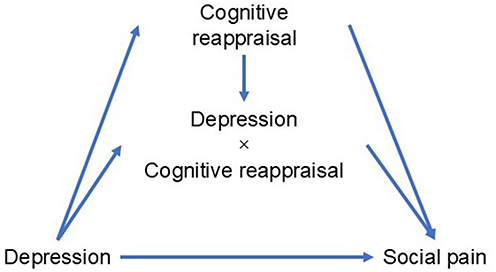 |
Figure 1 Hypothesis-based theoretical framework diagram. Note: solid lines represent the paths that actually exist in this model. |
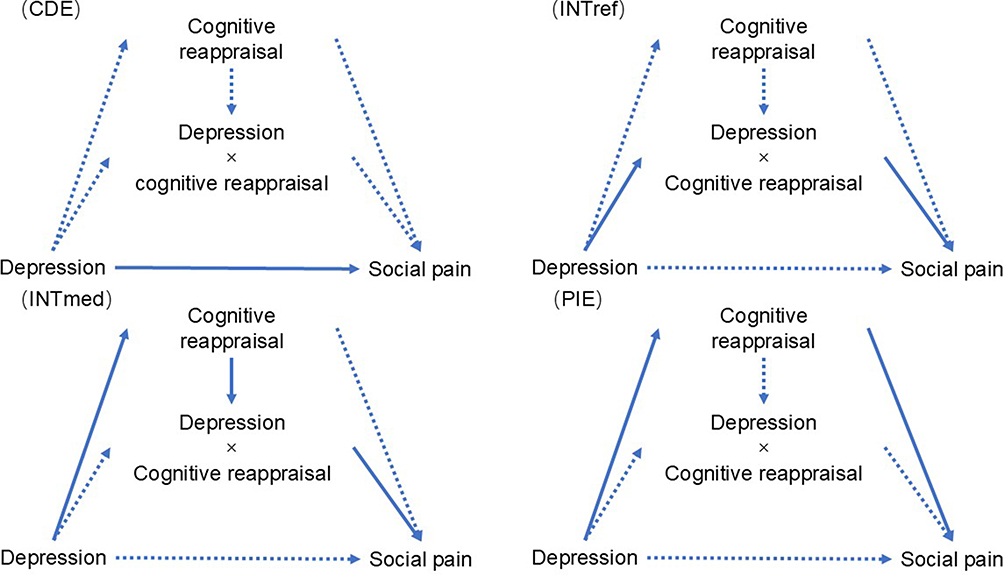 |
Figure 2 The conceptual framework of the four decomposition effects. Note: Dotted lines represent potential paths, while solid lines represent the paths that actually exist in this effect. |
Method
Participants
This study conducted a survey among college students from three universities in Daqing City using the convenient sampling method from March to April 2025. A total of 824 participants were recruited through an online format.
Inclusion criteria: College students currently enrolled in school; aged 16–26 years;30 voluntary participation in this study. Exclusion criteria: Individuals with severe mental disorders or organic diseases; those with an average response time of less than 2 seconds per item.30 A total of 773 valid datasets were included in the analysis. The mean age of the participants was 19.34 ± 2.12 years. Among them, 74.26% (n=574) were female, 91.2% (n=705) were of Han Ethnicity, and more than 40% (n=331) were only children. More than half of the participants were from urban areas (n=444), and more than 60% were from nuclear families (n=510), as shown in Table 1. This study has been reviewed and approved by the Ethics Committee of Harbin Medical University (Approval No: HMUDQ20240711001), and informed consent has been obtained from all participants.
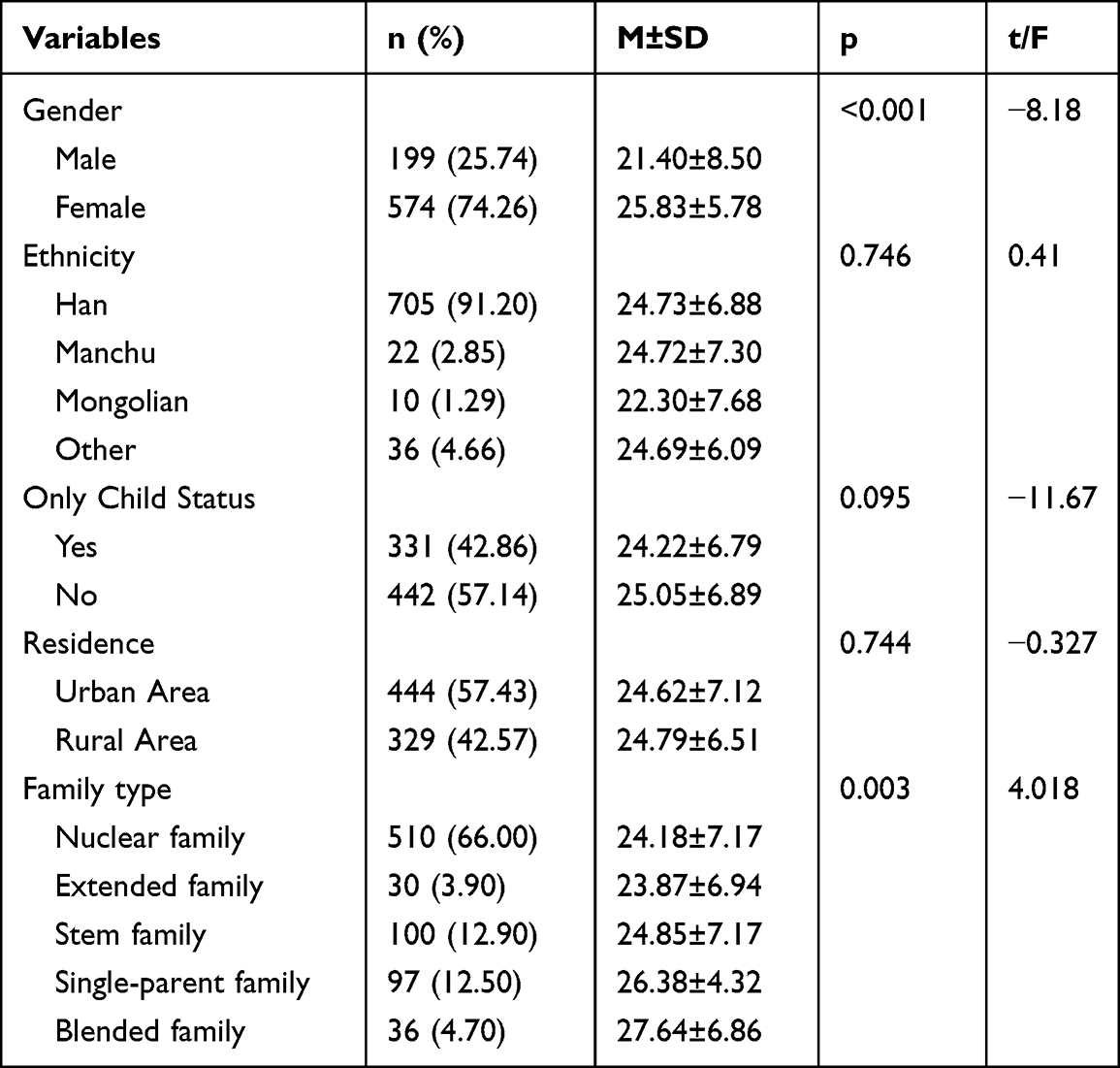 |
Table 1 Sociodemographic Characteristics of the Participants |
Measures
General Demographic Information
The general demographic information collected in this study included gender, ethnicity (han, manchu, mongolian, others), only child status (yes, no), residence (rural area, urban area), and family type (nuclear family, extended family, stem family, single-parent family and blended family).
Depression
The study utilized the Self-Rating Depression Scale (SDS) to measure depression levels among college students. The scale was developed by William W.K. Zung and later adapted into Chinese by Wang Zhengyu.31 It consists of 20 items assessing participants’ depressive symptoms over the past week. Participants are instructed to assess the frequency of symptom occurrence for each item using a four-point scale, with 1 representing “none or very little of the time” and 4 representing “most of the time”. The raw score of this scale is converted into a standard score by multiplying it by 1.25. A standard score above 53 is considered indicative of a depressive state, and a higher standard score signifies a more severe depression.32 In this study, the scale demonstrated high internal consistency, with a Cronbach’s α of 0.870. This scale demonstrates good validity: χ2/df=2.58, CFI=0.945, RMSEA=0.067, TLI=0.903, SRMR=0.049.
Cognitive Reappraisal
This study utilized the Chinese version of the Emotion Regulation Questionnaire (ERQ) developed by Wang et al,33 with a specific focus on the cognitive reappraisal subscale to assess college students’ propensity for cognitive reappraisal. The original ERQ comprises 10 items across two theoretically distinct dimensions: cognitive reappraisal (eg, “When I want to feel positive emotions, I change the way I think about things”) and expressive suppression (eg, “When I feel positive emotions, I am careful not to express them outwardly”). The cognitive reappraisal subscale, which was the key assessment tool in this study, consists of 6 items. Participants rated their agreement with each item on a 7-point Likert scale (1 = “strongly disagree”, 7 = “strongly agree”), where higher scores indicate more frequent use of cognitive reappraisal strategies.34 In the present study, the cognitive reappraisal subscale demonstrated high internal consistency (Cronbach’s α = 0.810). This scale demonstrates good validity: χ2/df =2.34, CFI=0.924, RMSEA=0.072, TLI=0.926, SRMR=0.047.
Social Pain
Social pain is measured using the revised Chinese version of the social pain questionnaire (SPQ) by Jiang et al.35 The questionnaire consists of a total of 10 items, scored on a likert 7-point scale, where 1 represents “strongly disagree” and 7 represents “strongly agree”. Higher scores indicate a higher level of social pain. In this study, the internal consistency of the questionnaire, as indicated by the Cronbach’s α coefficient was 0.927. This scale demonstrates good validity: χ2/df =2.63, CFI=0.927, RMSEA=0.069, TLI=0.907, SRMR=0.041.
Statistical Analysis
Descriptive statistics were performed using SPSS 29.0. Measurement data were described using M±SD, and count data were described using frequency and percentage. T-tests and one-way analysis of variance were used to explore the differences in social pain based on general demographic information. Correlation analysis was conducted to explore the associations among depression, cognitive reappraisal, and social pain. Linear regression was used to examine their independent effects. A four-way decomposition analysis was performed to investigate the mediation and interaction effects of cognitive reappraisal in the relationship between depression and social pain. In the four-way decomposition analysis, we simultaneously fitted the mediation model and the outcome model using a nonlinear mixed model. Consistent with previous studies, the means of the independent variable and the mediator variable were set as references.29 Among the covariates, males and single-parent families were used as reference groups. The four-way decomposition analysis was performed using SAS 9.4, with the significance level set at p < 0.05.
Results
Common Method Variance Test
In this study, Harman’s single-factor test was employed to examine common method bias. The results indicated that the first unrotated factor accounted for 28.56% of the variance explained (< 40%),36 that is, there was no serious common method bias in this study.
Descriptive Analysis
As shown in Table 1, significant differences in social pain were observed across gender and family type. Specifically, female college students and those from single-parent and blended family reported higher levels of social pain (P < 0.05). Therefore, gender and family type were adjusted as covariates in the four-way decomposition analysis.
Correlation Analysis
Pearson correlation analysis revealed significant pairwise correlations among depression, cognitive reappraisal, and social pain. Specifically, depression and cognitive reappraisal exhibited a significant negative correlation (r = −0.465, P < 0.01), depression and social pain showed a significant positive correlation (r = 0.500, P < 0.01), and cognitive reappraisal and social pain demonstrated a significant negative correlation (r = −0.421, P < 0.01), as shown in Table 2.
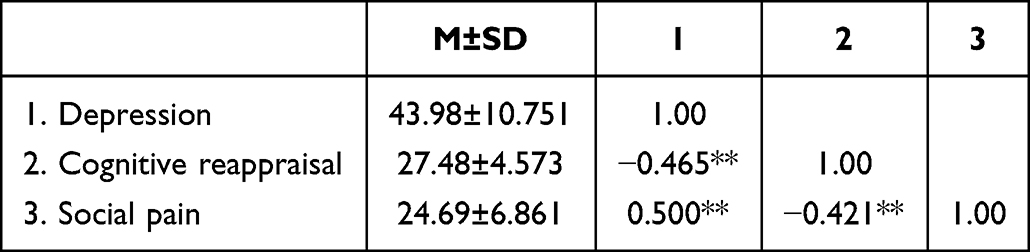 |
Table 2 Descriptive Statistics and Correlation Analysis of Each Variable |
The Independent Associations of Depression, Cognitive Reappraisal, and Social Pain
Table 3 indicates that cognitive reappraisal is associated with depression and social pain. After adjusting for gender and family type, the increase in depression level led to a significant decrease in the usage frequency of cognitive reappraisal strategies (β = −0.20, p < 0.001); Meanwhile, social pain showed a significant upward trend (β =0.30, p < 0.001). An increase in the frequency of cognitive reappraisal usage would lead to a decrease in the level of social pain (β = −0.63, p < 0.001).
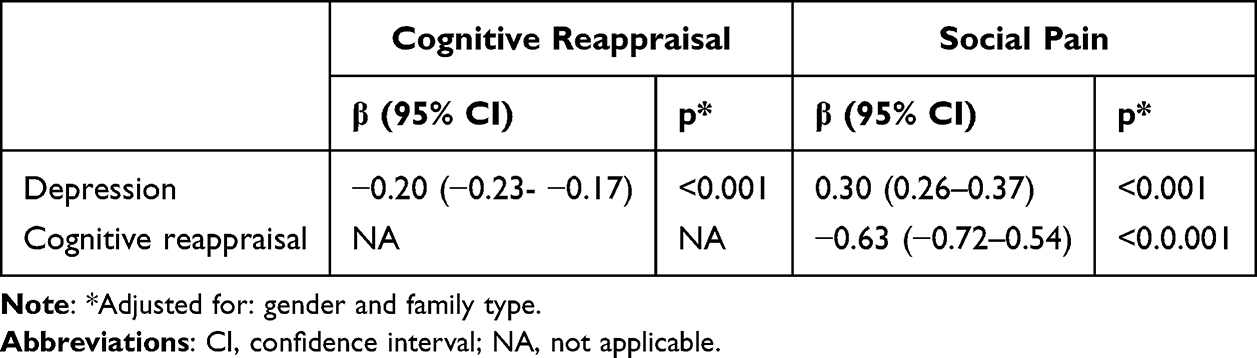 |
Table 3 The Association Between Depression, Cognitive Reappraisal and Social Pain |
Four-Way Decomposition Analysis
Table 4 and Figure 3 are the results of the four-way decomposition analysis. After adjusting for gender and family type, the total effect and the four decomposition effects were all significant (P < 0.05). The estimated values reflect the direction and intensity of the influence of the independent variable on the dependent variable under this effect. Specifically, an estimated value > 0 indicates a positive effect of the independent variable on the dependent variable under this effect, whereas an estimated value < 0 indicates a negative effect. In the study, the total effect was 0.182, indicating a positive correlation between depression and social pain. The CDE accounted for the largest proportion at 316.68% (estimate=0.585, 95% CI: 0.32–0.83), more than three times the total effect (3.17-fold); this finding indicates that depression exerts a positive impact on social pain even when cognitive reappraisal is not involved. The PIE yielded an estimate of 0.076 with a 95% CI that does not include 0, indicating that depression significantly influences social pain through cognitive reappraisal—confirming the mediating role of cognitive reappraisal in the relationship between depression and social pain. The proportion of the INTref was −265.36% (estimate=−0.482, 95% CI:-0.83–0.13), which suggests that the interaction between depression and cognitive reappraisal mitigates social pain among college students. Given that the estimate of the CDE is positive (> 0), these findings collectively demonstrate an antagonistic effect between depression and cognitive reappraisal. Furthermore, the Overall Mediation Proportion accounted for 54.20% (Overall Mediation Proportion = (INTmed + PIE) / total effect). The Proportion of the total interaction effect between depression and cognitive reevaluation was −263.92% (Interaction Effect Proportion = (INTref + INTmed) / total effect). The elimination proportion is as high as −221.43% (Eliminable Proportion = (INTref + INTmed + PIE) / total effect), which also reflects the important role of cognitive reappraisal in depression and social pain.
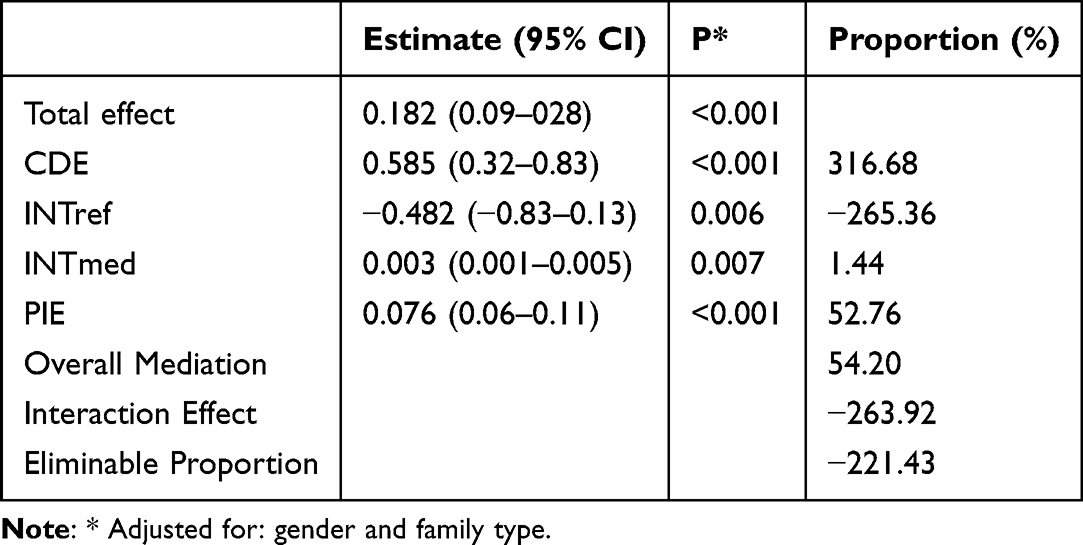 |
Table 4 Four-Way Decomposition Analysis of Depression, Cognitive Reappraisal, and Social Pain |
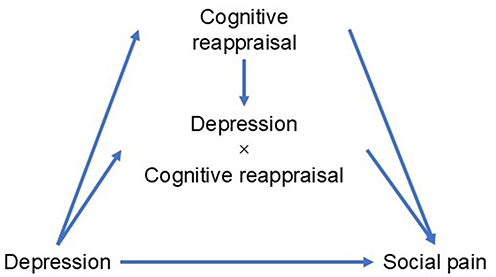 |
Figure 3 Four-way decomposition diagram of depression, cognitive reappraisal, and social pain. Note: solid lines represent the paths that actually exist in this model. |
Sensitivity Analysis
To verify the robustness of the results, this study conducted a sensitivity analysis by converting depression from a continuous variable to a dichotomous variable. As shown in Table 5, Linear regression analysis demonstrated that after adjusting for gender and family type, depression was positively associated with social pain (β = 5.92, p < 0.001). Cognitive reappraisal exhibited significant negative associations with both depression (β = −3.82, p < 0.001) and social pain (β = −0.63, p < 0.001), which is consistent with the results presented in Table 3. As shown in Table 6, The four-way decomposition analysis demonstrated that the total effect and all four decomposition effects were significant. Notably, the CDE (estimate = 6.68, 95% CI: 2.52–10.83) accounted for the largest proportion (252.21%), followed by the INTref (estimate = −5.14, 95% CI: −9.85--0.44). The overall mediation effect accounted for 42.13% of the total effect, while the interaction effect accounted for −181.34%, with an eliminable proportion of −152.22%. This result indicates that cognitive reappraisal exerts both a mediation effect and an interaction effect between depression and social pain. The above findings indicate that the research conclusions remain consistent even when the depression-related data type is altered, which confirms the good robustness of the study.
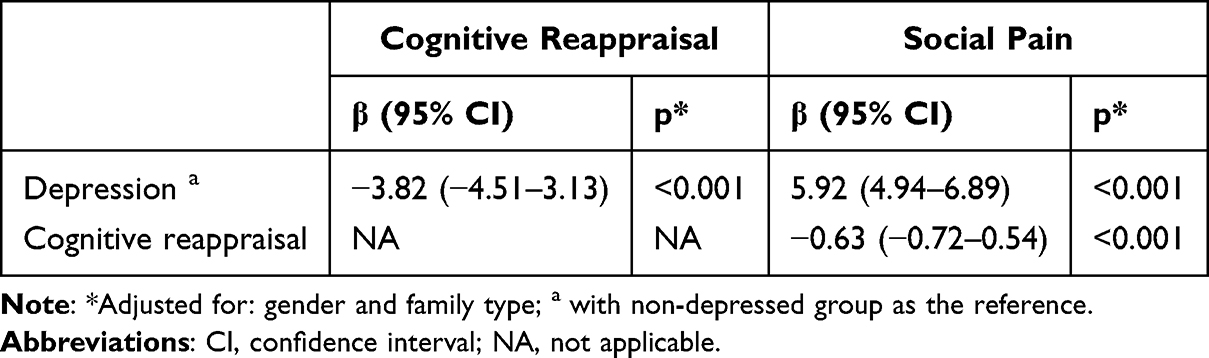 |
Table 5 Sensitivity Analysis of the Association Between Depression, Cognitive Reappraisal and Social Pain |
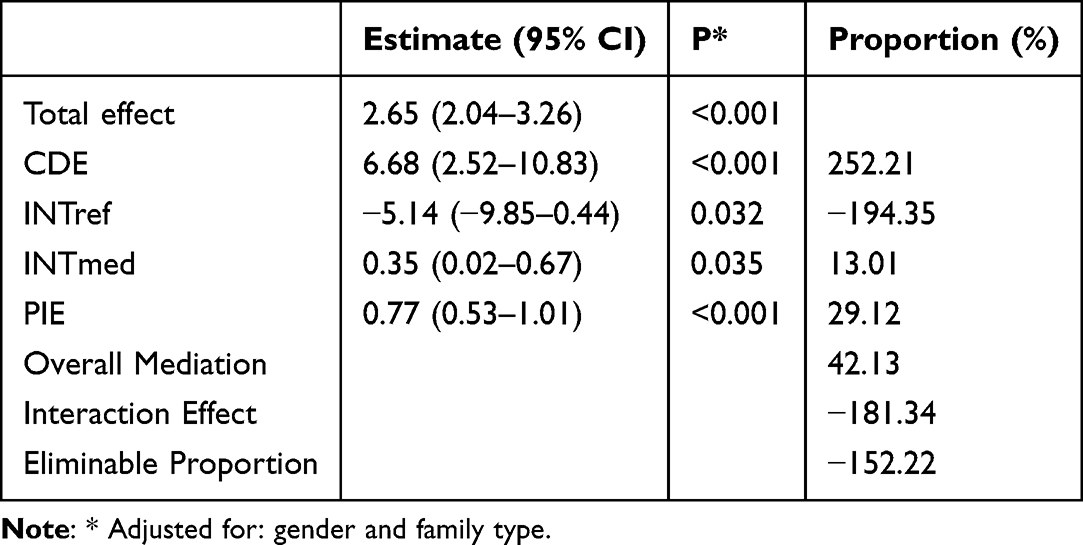 |
Table 6 Sensitivity Analysis of the Four-Way Decomposition Analysis of Depression, Cognitive Reappraisal, and Social Pain |
Discussion
This study is the first to investigate the psychological mechanisms underlying the association between depression and social pain among college students. Using linear regression, we revealed the independent influences among variables, and through four-way decomposition analysis, identified both mediation and interaction effects of cognitive reappraisal in the relationship between depression and social pain. These findings not only deepen our understanding of the mechanisms underlying social pain but also provide a novel entry point for targeted interventions.
In this study, linear regression analysis revealed that depression exerts a significant positive predictive effect on social pain. Additionally, the results of the four-way decomposition indicated that there are significant positive total effect and controlled direct effect between depression and social pain. Collectively, the aforementioned results demonstrate that as the level of depression among college students increases, their experience of social pain shows a significant upward trend. These findings are consistent with results from previous research. Hurtado found through qualitative research that patients with mental illnesses often exhibit social skills and social functional impairments, such as social withdrawal, communication difficulties, and life breakdowns.37 Such functional impairments can directly lead to individuals being more prone to setbacks in social interactions, thereby increasing the frequency and intensity of social pain. Beck’s Cognitive Theory of Depression posits that individuals with depression exhibit a characteristic cognitive processing bias, whereby they tend to interpret neutral social information as negative.38 This cognitive pattern contributes to heightened rejection sensitivity, leading individuals to develop stronger expectations of and reactions to potential rejection cues in social contexts, ultimately amplifying the experience of social pain.39 In addition, physiological research has indicated that individuals with mental disorders such as depression exhibit key physiological alterations, including reduced secretion of monoamine neurotransmitters like serotonin.40 Decreased serotonin secretion disrupts the endogenous inhibitory balance of the central nervous system in regulating pain, directly leading to a decline in individuals’ pain tolerance.41,42 Collectively, the aforementioned theoretical and empirical studies provide robust support for the findings of our research.
Meanwhile, this study found that the total mediation effect of cognitive reappraisal accounted for 54.20% in the relationship between depression and social pain, indicating that cognitive reappraisal plays a mediating role in the context of depression and social pain. On the one hand, depression has a significantly negative predictive effect on cognitive reappraisal among college students, which is consistent with previous research findings.43 The underlying reason may be that, due to the presence of a negative mood state in individuals with depression, their available cognitive resources are diminished. This leads to the formation of an automatic processing bias, making it difficult for them to disengage their attention from negative information, which in turn triggers impairments in the use of cognitive reappraisal.44 In addition, reduced connectivity strength and insufficient activation of the prefrontal cortex in patients with depression are also among the factors contributing to impaired implementation of cognitive reappraisal.45 This view has been supported by previous research. Using a controlled trial, Peña-Arteaga V. found that patients with major depressive disorder exhibited decreased activation of the ventrolateral prefrontal cortex during cognitive reappraisal,46 and the VLPFC plays a core role in this emotional regulation strategy.47 On the other hand, cognitive reappraisal has a significant negative predictive effect on social pain among college students. According to the Emotional ABC Theory, cognition exerts a crucial influence on subsequent emotional experiences and behavioral manifestations.48 This mechanism is specifically manifested in interpersonal contexts as follows: when an individual encounters interpersonal setbacks, by actively adjusting their cognitive schemas regarding the setback-inducing event (that is, interpreting the beliefs about the eliciting event as proposed in the Emotional ABC Theory), they can directly alter the emotional experience and the direction of behavioral responses triggered by the event. This theoretical proposition has also been supported by empirical research. Mo et al employed social exclusion images to induce social pain in individuals and required participants to use cognitive reappraisal to downregulate their emotions. They found that cognitive reappraisal significantly reduced the intensity of social pain.49 Similarly, Xie et al obtained consistent findings. In their study, social pain was induced in participants through negative evaluations, and participants were instructed to use cognitive reappraisal and distraction to downregulate their emotions. The results revealed that cognitive reappraisal not only effectively reduced the experience of social pain but also led to significantly lower valence ratings and vocabulary recognition accuracy in the delayed post-test compared to the passive viewing condition. These findings indicate that cognitive reappraisal can not only downregulate social pain but also facilitate the forgetting of negative social feedback.50
Furthermore, the study results also revealed that the interaction effect between cognitive reappraisal and depression accounts for −265.36% of the total effect, which indicates that the interaction effect between the two exerts a significant alleviating effect on social pain. Meanwhile, we also found that both the total effect and the controlled direct effect of depression on social pain are significantly positive, whereas the interaction effect between cognitive reappraisal and depression significantly alleviates social pain. This result further illustrates that cognitive reappraisal and depression exhibit an antagonistic effect in their impacts on social pain. This aligns with previous research findings. Zhang et al induced negative emotions in individuals using negative images and required participants to employ cognitive reappraisal for emotion regulation. They discovered that the effect size of down-regulating negative emotions in children with high depression levels was significantly smaller than that in the low-depression group.51 This may be related to depression causing abnormal activation patterns during emotion regulation, which reduces the efficiency of recruiting the dorsolateral prefrontal cortex for cognitive control, thereby impairing cognitive processes such as cognitive reappraisal.52
Implications
The study found that cognitive reappraisal exhibits both a mediation effect and a moderating effect in the relationship between depression and social pain, and it can alleviate the negative impact of depression on social pain. These findings provide empirically-supported implications for mental health management and intervention practices in higher education, which can be elaborated from the following two aspects: First, universities need to establish a standardized mechanism that links depression screening with tiered interventions. Specifically, a comprehensive screening system covering the entire student lifecycle should be implemented. This involves a three-tiered model—comprising baseline screening at enrollment, dynamic screening during semesters, and supplemental screening for at-risk groups—to facilitate the early identification and precise targeting of high-risk individuals, thereby blocking the pathological pathway from depression to worsened social pain at its source. Furthermore, intervention resources must be allocated based on screening results. Subclinical populations should receive routine psychological counseling, while a tripartite referral support system—integrating the university counseling center, designated medical institutions, and the family—should be established for those at high risk of clinical depression, ensuring a seamless transition from identification to support. Second, universities should systematically promote the development of a cognitive reappraisal training framework. Based on common scenarios that trigger social pain among university students, ecologically valid intervention cases should be designed to create a structured training framework involving “situation identification, cognitive restructuring, and emotional feedback”. University-wide required mental health courses and group cognitive-behavioral training can serve as diverse delivery channels to ensure comprehensive coverage. Concurrently, digital self-help tools—such as cognitive reappraisal check-in systems and emotion regulation guidebooks—should be developed to foster the transition of cognitive reappraisal strategies from “acquired skills” to “daily emotional management habits”. This will maximize their buffering role between depression and social pain, ultimately providing a sustainable intervention pathway for enhancing the mental health literacy of university students.
Although this study uses four-way decomposition analysis to explore the impact of depression on social pain and the mediation and interaction effects of cognitive reappraisal—thereby addressing limitations inherent in traditional mediation models—there remain certain limitations: (1) All the surveys in this study were conducted using scales, which may have a social approval effect. Physiological indicators can be used for verification in the future; (2) The majority of the samples were female. Although gender was controlled in this study, stratified analysis of gender can be conducted in the future. (3) Cross-sectional surveys cannot reveal the potential causal relationships among variables. Longitudinal studies can be conducted in the future. (4) The collection of general demographic information was insufficient. In future research, variables such as grade, place of origin, and family economic status could be incorporated into the analysis. (5) Although confounding factors were adjusted in this study, the possibility of residual confounding factors still cannot be ruled out. (6) All samples in this study were exclusively recruited from Daqing, which may limit the generalizability of the results. Therefore, multicenter research should be conducted in future studies to further validate the findings.
Conclusion
In linear regression analysis, we identified depression as a significant risk factor for social pain, while cognitive reappraisal emerged as a protective factor against social pain. Furthermore, a negative correlation was observed between depression and cognitive reappraisal. Four-way decomposition analysis revealed that cognitive reappraisal not only plays a mediating role in the relationship between depression and social pain but also exhibits a negative interaction effect with depression, jointly influencing social pain outcomes. Consequently, families and educational institutions must address depressive emotions while enhancing college students’ tendency to use cognitive reappraisal, thereby alleviating social pain levels.
Abbreviations
SAS, Self-Rating Anxiety Scale; ERQ, Emotion regulation questionnaire; SPQ, Social pain questionnaire; CDE, Controlled direct effect; INTref, Reference interaction effect; INTmed, Mediated interaction effect; PIE, Pure indirect effect.
Data Sharing Statement
The data that support the findings of this study are available from the corresponding author, upon reasonable request.
Ethics Approval Consent to Participate
This study was conducted in accordance with the Declaration of Helsinki. All experimental procedures were reviewed and approved by the Ethics Committee of Harbin Medical University (HMUDQ20240711001). Throughout the data collection process, we strictly adhered to the principle of voluntariness and obtained informed consent from all participants.
Acknowledgments
The authors are grateful to the participants for contributing to this research.
Author Contributions
Wei Li and Haizhen Zu are co–first authors. All authors made a significant contribution to the work reported, whether that is in the conception, study design, execution, acquisition of data, analysis and interpretation, or in all these areas; took part in drafting, revising or critically reviewing the article; gave final approval of the version to be published; have agreed on the journal to which the article has been submitted; and agree to be accountable for all aspects of the work.
Funding
The present study is supported by the Humanities and Social Sciences Project, Ministry of Education (24YJAZH005), China; the Natural Science Foundation of Heilongjiang Province (LH2024H031), China; the Fundamental Research Funds for the Provincial Universities (JFQN202103), China; the National Natural Science Foundation of China (72204068).
Disclosure
The authors declare no competing interests.
References
1. Levi MK, Schreuer N, Granovsky Y, et al. “Feeling unwanted, when nobody wants you around”: perceptions of social pain among people with autism. Am J Occup Ther. 2023;77(2):7702185050. doi:10.5014/ajot.2023.050061
2. Macdonald G, Leary MR. Why does social exclusion hurt? The relationship between social and physical pain. Psychol Bull. 2005;131(2):202–223. doi:10.1037/0033-2909.131.2.202
3. Zhang X, Qing P, Liu Q, et al. Neural patterns of social pain in the brain-wide representations across social contexts. Adv Sci. 2025;12(18):e2413795. doi:10.1002/advs.202413795
4. Yang X, Li H, Feng F, Zhang Y. The influence of different developmental trajectory types of social exclusion on internet gaming addiction among college freshmen: the parallel multiple mediating effects of sense of control and face consciousness. Chin J Clin Psychol. 2025;(3):535–540. doi:10.16128/j.cnki.1005-3611.2025.03.016
5. Modecki KL, Minchin J, Harbaugh AG, Guerra NG, Runions KC. Bullying prevalence across contexts: a meta-analysis measuring cyber and traditional bullying. J Adolesc Health. 2014;55(5):602–611. doi:10.1016/j.jadohealth.2014.06.007
6. Ferguson HJ, De Lillo M, Woodrow-Hill C, Foley R, Bradford EEF. Neural empathy mechanisms are shared for physical and social pain, and increase from adolescence to older adulthood. Soc Cogn Affect Neurosci. 2024;19(1):nsae080. doi:10.1093/scan/nsae080
7. Wang D, Zhou M, Hu Y. The relationship between harsh parenting and smartphone addiction among adolescents: serial mediating role of depression and social pain. Psychol Res Behav Manag. 2024;17:735–752. doi:10.2147/PRBM.S438014
8. Ihme H, Courtet P, Risch N, Dubois J, Belzeaux R, Olié E. Mediation effect of anxious attachment on relationship between childhood trauma and suicidal ideation sensitive to psychological pain levels. Eur Psychiatry. 2023;66(1):e79. doi:10.1192/j.eurpsy.2023.2452
9. Twenge JM, Baumeister RF, DeWall CN, Ciarocco NJ, Bartels JM. Social exclusion decreases prosocial behavior. J Pers Soc Psychol. 2007;92(1):56–66. doi:10.1037/0022-3514.92.1.56
10. Kunstman JW, Kinkel-Ram SS, Benbow KL, et al. Social pain minimization mediates discrimination’s effect on sleep health. Behav Sleep Med. 2025;23(1):118–132. doi:10.1080/15402002.2024.2423296
11. Beevers C. Cognitive vulnerability to depression: a dual process model. Clinic Psychol Rev. 2005;25(7):975–1002. doi:10.1016/j.cpr.2005.03.003
12. Bordes J, Miranda L, Reinhardt M, et al. Automatically annotated motion tracking identifies a distinct social behavioral profile following chronic social defeat stress. Nat Commun. 2023;14(1):4319. doi:10.1038/s41467-023-40040-3
13. Christensen MC, Adair M, Loft H, McIntyre RS. The motivation and energy inventory (MEI): analysis of the clinically relevant response threshold in patients with major depressive disorder and emotional blunting using data from the COMPLETE study. J Affect Disord. 2023;323:547–553. doi:10.1016/j.jad.2022.11.033
14. Rum R, Birg JA, Silva G, Rottenberg J, Clayson PE, Goodman FR. Social motivation differentiates social anxiety and depression: a daily diary study. Behav Ther. 2024;55(4):698–711. doi:10.1016/j.beth.2023.11.004
15. Hsu DT, Sanford BJ, Meyers KK, et al. It still hurts: altered endogenous opioid activity in the brain during social rejection and acceptance in major depressive disorder. Mol Psychiatry. 2015;20(2):193–200. doi:10.1038/mp.2014.185
16. Reichler AG, Preece DA, Gross JJ. Emotion regulation profiles and symptoms of depression and anxiety. J Affect Disord. 2025;387:119548. doi:10.1016/j.jad.2025.119548
17. Handelzalts JE, Tevet M, Padoa A, Shlomi I. Urinary symptoms in sexual abuse survivors with severe post-traumatic morbidity: the impact of emotion regulation strategies. Eur J Psychotraumatol. 2025;16(1):2510726. doi:10.1080/20008066.2025.2510726
18. Gross JJ. Emotion regulation: current status and future prospects. Psychol Inq. 2015;26(1):1–26. doi:10.1080/1047840X.2014.940781
19. Herber CLM, Breuninger C, Tuschen-Caffier B. Psychophysiological stress response, emotion dysregulation and sleep parameters as predictors of psychopathology in adolescents and young adults. J Affect Disord. 2025;375:331–341. doi:10.1016/j.jad.2025.01.110
20. Bylsma LM. Emotional reactivity and regulation in current and remitted depression: an event related potential study. USF Tampa Graduate Thesesand Dissertations; 2011. Available from: https://digitalcommons.usf.edu/etd/4000.
21. Baumeister RF, André N, Southwick DA, Tice DM. Self-control and limited willpower: current status of ego depletion theory and research. Curr Opin Psychol. 2024;60:101882. doi:10.1016/j.copsyc.2024.101882
22. Zhang Q, Chen T, Liu S, et al. Effects of high-definition transcranial direct current stimulation on implicit emotion regulation of social pain in healthy individuals. J Affective Disorders. 2023;338:74–82. doi:10.1016/j.jad.2023.05.075
23. Mo L, Li S, Cheng S, Li Y, Xu F, Zhang D. Emotion regulation of social pain: double dissociation of lateral prefrontal cortices supporting reappraisal and distraction. Soc Cogn Affect Neurosci. 2023;18(1):nsad043. doi:10.1093/scan/nsad043
24. Zaid SM, Hutagalung FD, Abd Hamid HSB, Taresh SM. The power of emotion regulation: how managing sadness influences depression and anxiety? BMC Psychol. 2025;13(1):38. doi:10.1186/s40359-025-02354-3
25. Lu T, Liu K, Feng X, Zhang X, She Z. The impact of cognitive reappraisal intervention on depressive tendencies in chinese college students: the mediating role of regulatory emotional self-efficacy. Behav Sci. 2025;15(5):562. doi:10.3390/bs15050562
26. Tayebi B, Ghoreishi A, Kazemi M, Amiri Sararoodi PS, Mardani P, Mousavi SE. Effects of an emotion regulation training programme combined with medication therapy on mania severity, depression and emotion regulation strategies of adults with bipolar disorder type 1: a randomized clinical trial. Clin Psychol Psychother. 2025;32(3):e70078. doi:10.1002/cpp.70078
27. Yuan J, Zhang Y, Zhao Y, Gao K, Tan S, Zhang D. The emotion-regulation benefits of implicit reappraisal in clinical depression: behavioral and electrophysiological evidence. Neurosci Bull. 2023;39(6):973–983. doi:10.1007/s12264-022-00973-z
28. Liu P, Cheng X, Fan M, Huang Z, Zhang C. Emotion regulation modulates affective responses without altering memory traces: a study of negative social feedback from acquaintances. Behav Sci. 2025;15(9):1294. doi:10.3390/bs15091294
29. VanderWeele TJ. A unification of mediation and interaction: a 4-way decomposition. Epidemiology. 2014;25(5):749–761. doi:10.1097/EDE.0000000000000121
30. Tang Q, Zou X, Gui J, et al. Effects of childhood trauma on the symptom-level relation between depression, anxiety, stress, and problematic smartphone use: a network analysis. J Affective Disorders. 2024;358:1–11. doi:10.1016/j.jad.2024.05.018
31. Li L, Wang P, Li S, et al. Canonical correlation analysis of depression and anxiety symptoms among college students and their relationship with physical activity. Sci Rep. 2023;13(1):11516. doi:10.1038/s41598-023-38682-w
32. Zhu Z, Cui Y, Gong Q, et al. Frequency of breakfast consumption is inversely associated with the risk of depressive symptoms among Chinese university students: a cross-sectional study. PLoS One. 2019;14(8):e0222014. doi:10.1371/journal.pone.0222014
33. Ma W, Motevalli S, Kuang X, Song R. The mediating role of emotion regulation and cognitive flexibility in the relationship between cooperative learning and social skills of students: a cross-sectional study. BMC Psychol. 2025;13(1):1302. doi:10.1186/s40359-025-03649-1
34. Zhang N, Liu W, Che H, Fan X. Effortful control and depression in school-age children: the chain mediating role of emotion regulation ability and cognitive reappraisal strategy. J Affective Disorders. 2023;327:111–119. doi:10.1016/j.jad.2023.01.129
35. Jiang X. Is the Smartphone a Digital Security Blanket? The Effects of Smartphone Presence and Usage on Pain [Master]. Central China Normal University; 2022.
36. Haoran S, Tianci L, Hanwen C, Baole T, Yiran C, Yan J. The impact of basketball on the social adjustment of Chinese middle school students: the chain mediating role of interpersonal relationships and self-identity. Front Psychol. 2023;14:1205760. doi:10.3389/fpsyg.2023.1205760
37. Hurtado MM, Villena A, Quemada C, Morales-Asencio JM. Personal relationships during and after an initial psychotic episode. First-person experiences. J Ment Health. 2025;34(3):280–286. doi:10.1080/09638237.2024.2408245
38. Joiner TE. Dysfunctional attitudes and Beck’s cognitive theory of depression. Br J Psychiatry. 1993;162(6):850–851. doi:10.1192/bjp.162.6.850b
39. Giovazolias T. The relationship of rejection sensitivity to depressive symptoms in adolescence: the indirect effect of perceived social acceptance by peers. Behav Sci. 2023;14(1):10. doi:10.3390/bs14010010
40. Coppen A. The biochemistry of affective disorders. Br J Psychiatry. 1967;113(504):1237–1264. doi:10.1192/bjp.113.504.1237
41. Huang C, van Wijnen AJ, Im HJ. Serotonin transporter (5-Hydroxytryptamine Transporter, SERT, SLC6A4) and sodium-dependent reuptake inhibitors as modulators of pain behaviors and analgesic responses. J Pain. 2024;25(3):618–631. doi:10.1016/j.jpain.2023.10.008
42. Sasaki M, Obata H, Saito S, Goto F. Antinociception with intrathecal alpha-methyl-5-hydroxytryptamine, a 5-hydroxytryptamine 2A/2C receptor agonist, in two rat models of sustained pain. Anesth Analg. 2003;96(4):1072–1078. doi:10.1213/01.ANE.0000050560.15341.A8
43. Shetty T, Kashyap H, Mehta UM, Binu VS. Executive function and emotion regulation in depressive and anxiety disorders: a cross-sectional study. Indian J Psychol Med. 2025;02537176251340586. doi:10.1177/02537176251340586
44. Koster EHW, De Lissnyder E, Derakshan N, De Raedt R. Understanding depressive rumination from a cognitive science perspective: the impaired disengagement hypothesis. Clin Psychol Rev. 2011;31(1):138–145. doi:10.1016/j.cpr.2010.08.005
45. Steinmann S, Tiedemann KJ, Kellner S, et al. Reduced frontocingulate theta connectivity during emotion regulation in major depressive disorder. J Psychiatr Res. 2024;173:245–253. doi:10.1016/j.jpsychires.2024.03.022
46. De la Peña-Arteaga V, Berruga-Sánchez M, Steward T, et al. An fMRI study of cognitive reappraisal in major depressive disorder and borderline personality disorder. Eur Psychiatry. 2021;64(1):e56. doi:10.1192/j.eurpsy.2021.2231
47. Keller M, Zweerings J, Klasen M, et al. fMRI neurofeedback-enhanced cognitive reappraisal training in depression: a double-blind comparison of left and right vlPFC regulation. Front Psychiatry. 2021;12:715898. doi:10.3389/fpsyt.2021.715898
48. Liu Q, Su L, Pan X, Jin X. A study on the professional identity intervention of Chinese new nurses by Balint groups from the perspective of ABC theory of emotion-hong. BMC Nurs. 2025;24(1):6. doi:10.1186/s12912-024-02678-2
49. Mo L, Guo T, Zhang Y, Xu F, Zhang D. Activating the right ventrolateral prefrontal cortex enhances emotional regulation of social pain in patients with depression: a TMS study. Acta Psychologica Sinica. 2021;53(5):494–504. doi:10.3724/SP.J.1041.2021.00494
50. Xie H, Lin X, Hu W, Hu X. Emotion regulation facilitates forgetting of negative social feedback: evidence from behavioral and electroencephalographic (EEG) data. Acta Psychologica Sinica. 2023;55(6):905–921. doi:10.3724/SP.J.1041.2023.00905
51. Zhang N, Liu W, Liu F, Guo X. The relationship between depression and cognitive reappraisal in children aged 8–12 years: the mediating role of attentional bias towards sad faces. Acta Psychologica Sinica. 2022;54(1):25–39. doi:10.3724/SP.J.1041.2022.00025
52. Yu W, Wang S, Chou X, Gao K, Chen W, Zhang D. The effect of transcranial magnetic stimulation (TMS) over the ventrolateral prefrontal cortex on social pain: the moderating roles of rejection sensitivity and depression. Chin J Clin Psychol. 2022;30(4):985–990+972. doi:10.16128/j.cnki.1005-3611.2022.04.045
 © 2025 The Author(s). This work is published and licensed by Dove Medical Press Limited. The
full terms of this license are available at https://www.dovepress.com/terms
and incorporate the Creative Commons Attribution
- Non Commercial (unported, 4.0) License.
By accessing the work you hereby accept the Terms. Non-commercial uses of the work are permitted
without any further permission from Dove Medical Press Limited, provided the work is properly
attributed. For permission for commercial use of this work, please see paragraphs 4.2 and 5 of our Terms.
© 2025 The Author(s). This work is published and licensed by Dove Medical Press Limited. The
full terms of this license are available at https://www.dovepress.com/terms
and incorporate the Creative Commons Attribution
- Non Commercial (unported, 4.0) License.
By accessing the work you hereby accept the Terms. Non-commercial uses of the work are permitted
without any further permission from Dove Medical Press Limited, provided the work is properly
attributed. For permission for commercial use of this work, please see paragraphs 4.2 and 5 of our Terms.