
Back to Journals » Journal of Multidisciplinary Healthcare » Volume 19
Meaning in Life and Professional Identity Among Nursing Students: The Parallel Mediating Role of Death Attitudes and the Moderating Role of Peer Support
Authors Gu Y, Zhao Y, Yang X, Lu Z, Wu D, Xie J 
Received 2 April 2026
Accepted for publication 2 June 2026
Published 8 June 2026 Volume 2026:19 614116
DOI https://doi.org/10.2147/JMDH.S614116
Checked for plagiarism Yes
Review by Single anonymous peer review
Peer reviewer comments 2
Editor who approved publication: Dr David C. Mohr
Yujing Gu,1,* Yun Zhao,1,2,* Xiaoxian Yang,3 Zhouzhou Lu,1,2 Danni Wu,4 Jun Xie1
1Department of Scientific Research, Affiliated Children’s Hospital of Jiangnan University (Wuxi Children’s Hospital), Wuxi, Jiangsu, People’s Republic of China; 2Wuxi School of Medicine, Jiangnan University, Wuxi, Jiangsu, People’s Republic of China; 3School of Health and Nursing, Wuxi Taihu University, Wuxi, Jiangsu, People’s Republic of China; 4Nursing Department, The First Affiliated Hospital of Soochow University, Suzhou, Jiangsu, People’s Republic of China
*These authors contributed equally to this work
Correspondence: Jun Xie, Department of Scientific Research, Affiliated Children’s Hospital of Jiangnan University (Wuxi Children’s Hospital), Wuxi, Jiangsu, People’s Republic of China, Email [email protected]
Aim: Professional identity is considered important for nursing students’ professional commitment and future career development. Meaning in life, attitudes toward death, and peer support may be related to professional identity formation. This study aimed to examine the association between meaning in life and professional identity among nursing students, test the parallel mediating roles of positive and negative death attitudes, and explore whether peer support moderated these associations.
Design: A cross-sectional observational study was conducted.
Methods: A total of 361 nursing interns from mainland China were recruited using convenience sampling and completed structured questionnaires, including a demographic questionnaire, the Death Attitude Profile-Revised, the Professional Identity Questionnaire, the Chinese version of the Meaning in Life Questionnaire, and the Friends Support Scale. Data were analyzed using correlation analysis, hierarchical regression analysis, and moderated parallel mediation analysis.
Results: Professional identity was positively associated with meaning in life, positive death attitudes, and peer support, and was negatively associated with negative death attitudes. Positive and negative death attitudes showed partial parallel mediating roles in the association between meaning in life and professional identity. Peer support significantly moderated the direct association between meaning in life and professional identity, but did not significantly moderate the associations between death attitudes and professional identity.
Conclusion: The findings suggest that nursing students’ professional identity is associated with both internal meaning-making and external peer support, and that death attitudes may represent potential psychological mechanisms linking meaning in life and professional identity. Nursing education may benefit from strategies that address students’ sense of meaning, incorporate reflective death education, and support peer networks. Given the cross-sectional design, these findings should be interpreted as associations rather than causal relationships.
Keywords: nursing students, professional identity, meaning in life, death attitudes, peer support
Introduction
The State of the World’s Nursing 2025 report indicates that, in 2023, the global nursing workforce remained highly unevenly distributed, with an estimated shortage of approximately 5.8 million nurses worldwide. Nearly 46% of nurses were employed in high-income countries that accounted for only 17% of the world’s population, where nurse density was almost ten times higher than in low-income countries.1 A multicenter study in China reported that 69.4% of nurses had strong turnover intentions.2 Newly graduated nurses are no exception: among 1313 respondents, 6.7% reported high turnover intention, with negative clinical or life events identified as major driving factors.3 Alongside nurse shortages and turnover risks, challenges in the development of professional identity among nursing students have also been reported. Some nursing students continue to experience insufficient perceived professional value, an unstable sense of professional belonging, and low evaluations of the social status of nursing during professional education and clinical internship.4–6 Importantly, a stronger professional identity at the emotional and moral levels may serve as a psychological resource that helps individuals maintain professional commitment under clinical stress and occupational adversity and may be associated with a lower tendency to withdraw from the nursing profession.4,5
Professional identity can be understood as a continuously evolving self-narrative concerning what it means to be a nurse and how one should act in the professional role. It may develop through the systematic acquisition of professional knowledge and skills during nursing education, role modeling, and ongoing clinical practice.5,7 A well-developed professional identity has been associated with higher self-efficacy and greater internalization of nursing values into one’s professional self.4,5 Recent identity theories further emphasize that nursing students do not passively absorb professional values; rather, their professional identity may be continuously constructed through professional learning, clinical practice, interpersonal interaction, and personal experience.8,9
Professional identity in nursing may be related to multiple levels of factors, including personal characteristics, psychological resources, relational interactions, educational and clinical systems, and sociocultural evaluations. At the individual level, relevant factors include age, gender, years of study or work, and other basic characteristics.9 For example, male nursing students may face distinctive identity negotiation pressures, including tendencies to conceal their professional identity, concerns about occupational prestige, and the need to reconcile traditional masculinity with the caring role of nursing.8,9 At the sociocultural level, public perceptions, social stigma, and gender stereotypes may be associated with students’ sense of professional value and belonging, whereas social recognition—particularly public affirmation of nursing during public health events—may be related to stronger professional commitment.8 From a psychological perspective, individuals’ understanding of meaning in life and the cognitive and emotional orientations they develop toward death may prompt reflection on the value of healthcare and caregiving.5,6 In addition, educational and clinical system factors, such as curriculum design, death education, the clinical learning environment, and preceptorship quality, as well as relational factors, such as peer support, teacher guidance, and professional role modeling, may also be associated with the development of professional identity.8,9
Among these factors, meaning in life, death attitudes, and peer support may be particularly important for nursing students during clinical internship. First, meaning in life is a core construct in positive psychology and comprises two dimensions: the presence of meaning and the search for meaning. It refers to individuals’ subjective experience of existential purpose, coherence, and value.10 The meaning of nursing practice does not arise solely from work tasks themselves, but depends more fundamentally on how students interpret and engage with caregiving experiences. Conceptually, meaning in life may provide an existential and value-based foundation for professional identity formation, because meaning-making helps individuals interpret stressful or existentially challenging experiences through their broader beliefs and values.11 Professional identity formation similarly involves self-understanding, value internalization, and the development of a coherent professional self-concept.7 When nursing students connect caregiving experiences with personal purpose and social value, they may be more likely to internalize nursing values and develop a stronger professional self-concept.6,7 In this sense, meaning in life and professional identity are conceptually aligned: when nursing students approach clinical tasks with positivity, creativity, and responsibility, even routine or challenging caregiving practices may become sites of meaning-making, thereby supporting the formation of professional identity.6,7
Second, death is an unavoidable theme in nursing work. One study found that 71.8% of newly recruited Chinese nurses had considered leaving their job during the first year, which may be related to the persistent psychological stress associated with death-related situations.12 Death attitudes may be differentially associated with professional identity and professional commitment, particularly when fear of death and avoidance responses are pronounced.13 When nursing students witness the end of life, they may reflect on the meaning of life and develop empathy and communication skills, which may be related to their professional self-understanding. However, without adequate preparation and support, death-related experiences may also be accompanied by fear, grief, and helplessness, and may be associated with lower psychological resources and weaker professional commitment.13
In addition, during clinical internship, peer support may contribute to a psychologically safe environment through reduced fear of judgment, shared experiences, and emotional connection, and may be related to trust, coping with internship stress, emotional regulation, and the development of soft skills.14–16
However, although previous studies5,6,15 have separately examined the relationships of meaning in life, death attitudes, or peer support with professional identity among nursing students, two important gaps remain. First, most studies have focused primarily on the direct association between a single factor and professional identity, with limited integration of meaning in life, death attitudes, and peer support into a unified theoretical model. Second, the psychological pathways linking meaning in life and professional identity remain insufficiently explained, particularly regarding whether death attitudes play a mediating role and whether peer support modifies these associations.
Based on Park’s meaning-making model,11 meaning in life can be regarded as an essential component of an individual’s meaning system, providing a framework of beliefs and values through which stressful or existentially challenging events may be interpreted. Death-related experiences encountered by nursing students during clinical internship may constitute salient existential challenges. Through cognitive and emotional processing, individuals may make meaning of death-related situations and develop differentiated death attitudes: positive dimensions may reflect acceptance-oriented understanding and meaning integration, whereas negative dimensions may reflect fear and avoidance. These two parallel psychological pathways may be related to the extent to which nursing students integrate the nursing role into their self-concept, that is, their professional identity. Meanwhile, according to Conservation of Resources theory,17 peer support, as a key external social resource during clinical internship, may alter the strength of the association between internal psychological resources and professional identity. Specifically, meaning in life was conceptualized as an internal psychological resource, whereas peer support was conceptualized as an external interpersonal resource. From this perspective, peer support may condition the associations between meaning-related and death-related psychological processes and professional identity. These theoretical considerations informed the moderated parallel mediation model examined in this study.
Therefore, the following hypotheses were proposed (Figure 1):
H1: Meaning in life is positively associated with professional identity among nursing students. H2: Positive death attitudes mediate the association between meaning in life and professional identity. H3: Negative death attitudes mediate the association between meaning in life and professional identity. H4: Peer support moderates the direct association between meaning in life and professional identity. H5: Peer support moderates the indirect associations between meaning in life and professional identity through positive and negative death attitudes.
 |
Figure 1 Conceptual Framework Illustrating the Hypothesized Relationships in This Study. Notes: X denotes the independent variable, Y denotes the dependent variable, M1 and M2 denote the two parallel mediators, and W denotes the moderator. |
Method
Research Design and Sample Characteristics
This research adopted a cross-sectional observational approach and followed the STROBE reporting standards for studies of this type.18 Between April and August 2025, nursing interns from three universities in Jiangsu Province, China, were recruited using convenience sampling. Inclusion criteria were: (1) currently engaged in clinical internship, and (2) enrolled in an undergraduate program or above. Exclusion criteria were early termination of internship due to suspension of study, illness, or other reasons.
Following Kendall’s rule-of-thumb, the required sample size was estimated to be between 5 and 10 times the number of independent variables.19 With 25 predictors and accounting for a potential 20% dropout, the minimum sample needed was determined to be 157 participants.
Measures
Social Demographic Information
Sociodemographic information was obtained via a self-developed questionnaire, encompassing basic characteristics including gender, age, education level, residential area, religious affiliation, and only-child status. It also covered training experience related to death education and hospice care.
Death Attitude Profile-Revised, DAP-R
Nursing students’ attitudes toward death were measured using the Chinese version of the Death Attitude Profile-Revised (DAP-R).20 The scale includes five dimensions: Fear of Death, Death Avoidance, Neutral Acceptance, Approach Acceptance, and Escape Acceptance. In this study, Neutral Acceptance, Approach Acceptance, and Escape Acceptance were classified as positive death attitudes, whereas Fear of Death and Death Avoidance were classified as negative death attitudes.5 Sample items include “Death is a terrible experience” and “Death is simply a part of the process of life.” Responses were recorded using a five-point Likert scale, with higher scores indicating stronger agreement with each item. In this study, internal consistency was high, with Cronbach’s α values of 0.831 for positive death attitudes and 0.864 for negative death attitudes.
Professional Identity Questionnaire, PIQ
Nursing students’ professional identity was measured using the Chinese version of the Professional Identity Questionnaire for Nursing Students (PIQ).21 The questionnaire comprises 17 items across five dimensions: Professional Self-Concept, Benefits of Retention and Risks of Turnover, Social Comparison and Self-Reflection, Autonomy in Career Choice, and Social Persuasion. A sample item is “I am willing to become a nurse.” Each item is rated on a five-point Likert scale, ranging from 1 (“strongly inconsistent”) to 5 (“strongly consistent”), with a total score ranging from 17 to 85. Higher scores indicate a higher level of professional identity. In the present study, the Cronbach’s α for the PIQ was 0.935.
Chinese Version of the Meaning in Life Questionnaire, MLQ-C
The Chinese Version of the Meaning in Life Questionnaire (MLQ-C)22 was used to assess nursing students’ sense of meaning in life. The questionnaire includes 10 items, each rated on a seven-point Likert scale from 1 (“absolutely untrue”) to 7 (“absolutely true”). A sample item is “I am seeking a purpose or mission in my life.” Higher total scores indicate a stronger perception of meaning in life. In this study, Cronbach’s α was 0.830, indicating good internal consistency.
Friends Support Scale, FSS
Peer support was assessed using the Friends Support Scale (FSS), the friends support subscale of the Chinese version of the Perceived Social Support Scale (PSSS).23 The scale includes four items, each rated on a seven-point Likert scale from 1 (“strongly disagree”) to 7 (“strongly agree”). A sample item is “I can rely on my friends when I encounter difficulties.” Higher scores reflect greater perceived peer support. In this study, Cronbach’s α was 0.707, indicating acceptable reliability.
Data Collection
Prior to data collection, all investigators underwent standardized training covering questionnaire content and procedures. The survey was conducted online using a structured questionnaire platform. Before responding, participants were required to read and sign an electronic informed consent form. Data were collected anonymously and treated with strict confidentiality. Participants accessed the questionnaire via a voluntary link and could withdraw at any time. Each item was mandatory. Two independent investigators conducted quality control after data collection, excluding invalid responses such as patterned answering.
Statistical Analysis
Data analyses were conducted in SPSS 26.0 following a structured procedure. First, descriptive statistics were performed: the Kolmogorov–Smirnov test indicated non-normal distribution, so continuous variables were reported as medians with interquartile ranges, and categorical variables as frequencies and percentages. Second, subgroup differences in professional identity were examined using the Mann–Whitney U and Kruskal–Wallis H-tests. Third, Spearman’s rank correlation assessed associations between professional identity and other variables. Fourth, hierarchical multiple regression was applied to examine the associations of meaning in life, positive and negative death attitudes, and peer support with professional identity, adjusting for sociodemographic factors with significant group differences. Finally, a moderated parallel mediation model was tested using PROCESS macro 4.2 with 5000 bootstrap resamples to calculate 95% bias-corrected confidence intervals (CIs); indirect and interaction effects were deemed significant if CIs excluded zero. Statistical significance was set at p < 0.05.
Ethical Considerations
This study adheres to the ethical principles outlined in the Declaration of Helsinki and has been approved by the Ethics Committee of the Affiliated Children’s Hospital of Jiangnan University (Approval No. WXCH2025-04-089). Participation was entirely voluntary. Before completing the online survey, nursing students were provided with a clear description of the study’s objectives, procedures, and confidentiality measures. They were also informed that refusal or withdrawal would not result in any negative consequences. Only those who confirmed their willingness and submitted electronic informed consent proceeded to participate.
Results
Participants’ Characteristics
Among the 366 nursing interns who participated in the survey, five were excluded due to patterned responses, resulting in 361 valid questionnaires. The majority of participants were female (n = 290, 80.3%), with ages ranging from 21 to 28 years. The majority (n = 246, 68.1%) were postgraduate students. Within the sample, 82.3% had received education or training related to death, and 59.6% had undergone hospice care training. Table 1 presents a comprehensive overview of the participants’ characteristics.
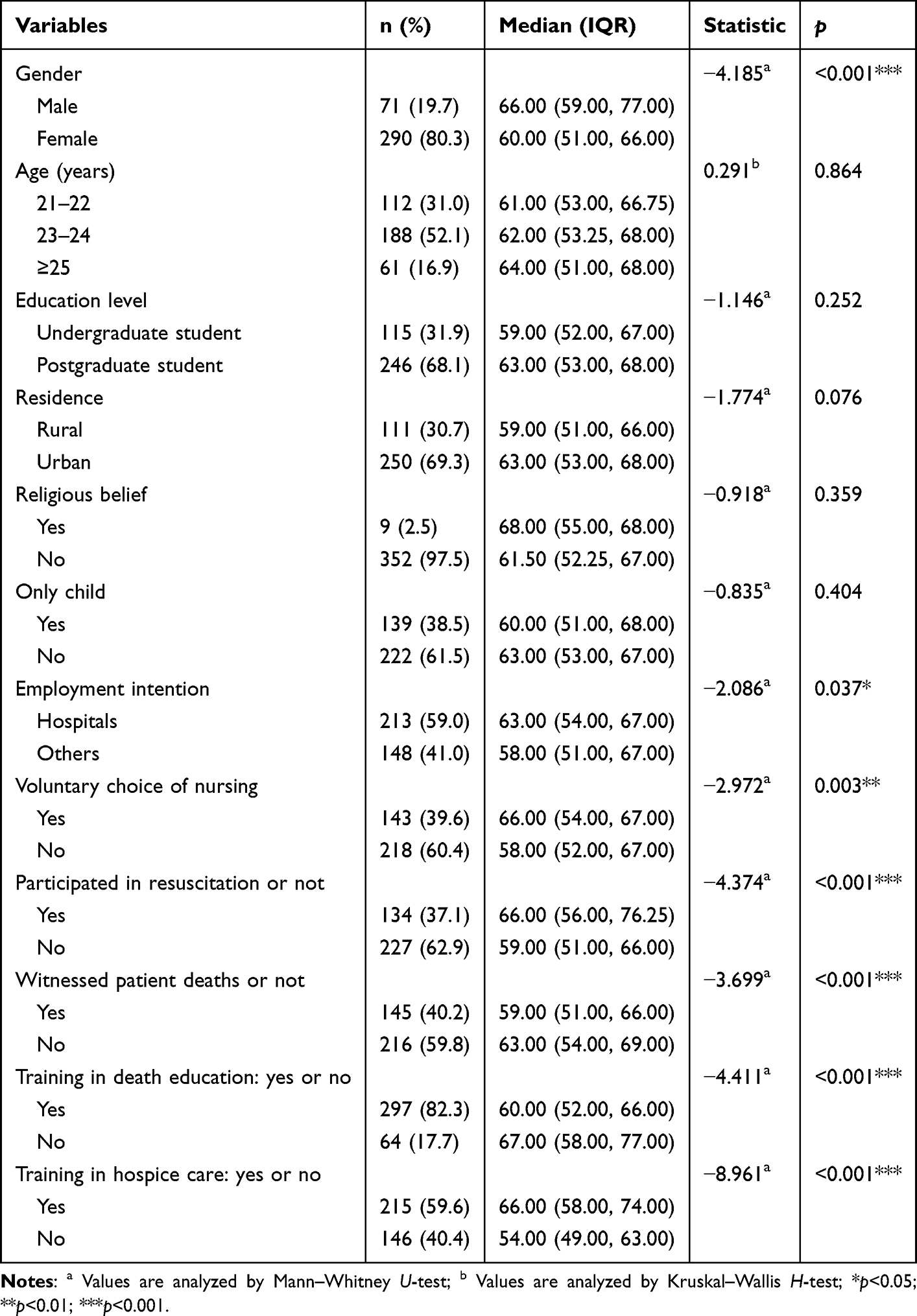 |
Table 1 Differences in Professional Identity by Demographic Variables. (n=361) |
Correlation and Hierarchical Regression Analysis
Table 2 shows the correlations between nursing students’ meaning in life, attitudes toward death, perceived peer support, and professional identity. Professional identity exhibited a positive relationship with meaning in life (r = 0.592, p < 0.01), positive death attitudes (r = 0.372, p < 0.01), and peer support (r = 0.358, p < 0.01), and a negative relationship with negative death attitudes (r = −0.434, p < 0.01).
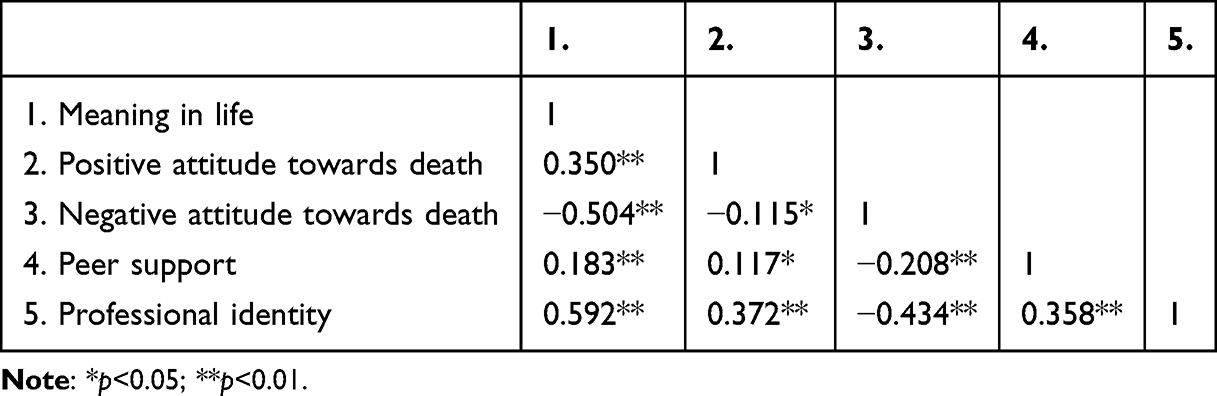 |
Table 2 The Correlations Among Nursing Students’ Meaning in Life, Death Attitudes, Peer Support, and Professional Identity |
Hierarchical multiple linear regression analysis was conducted with professional identity as the dependent variable (Table 3). Model 1 included sociodemographic characteristics and yielded an adjusted R2 of 0.439. In Model 2, meaning in life, positive death attitudes, and negative death attitudes were added, increasing the adjusted R2 to 0.594 and explaining an additional 15.5% of variance. All three variables were significantly associated with professional identity (p < 0.001). Model 3 further incorporated peer support, raising the adjusted R2 to 0.602 and accounting for an additional 0.8% of variance. Peer support was significantly and positively associated with professional identity (p = 0.006). All three models were statistically significant (p < 0.001).
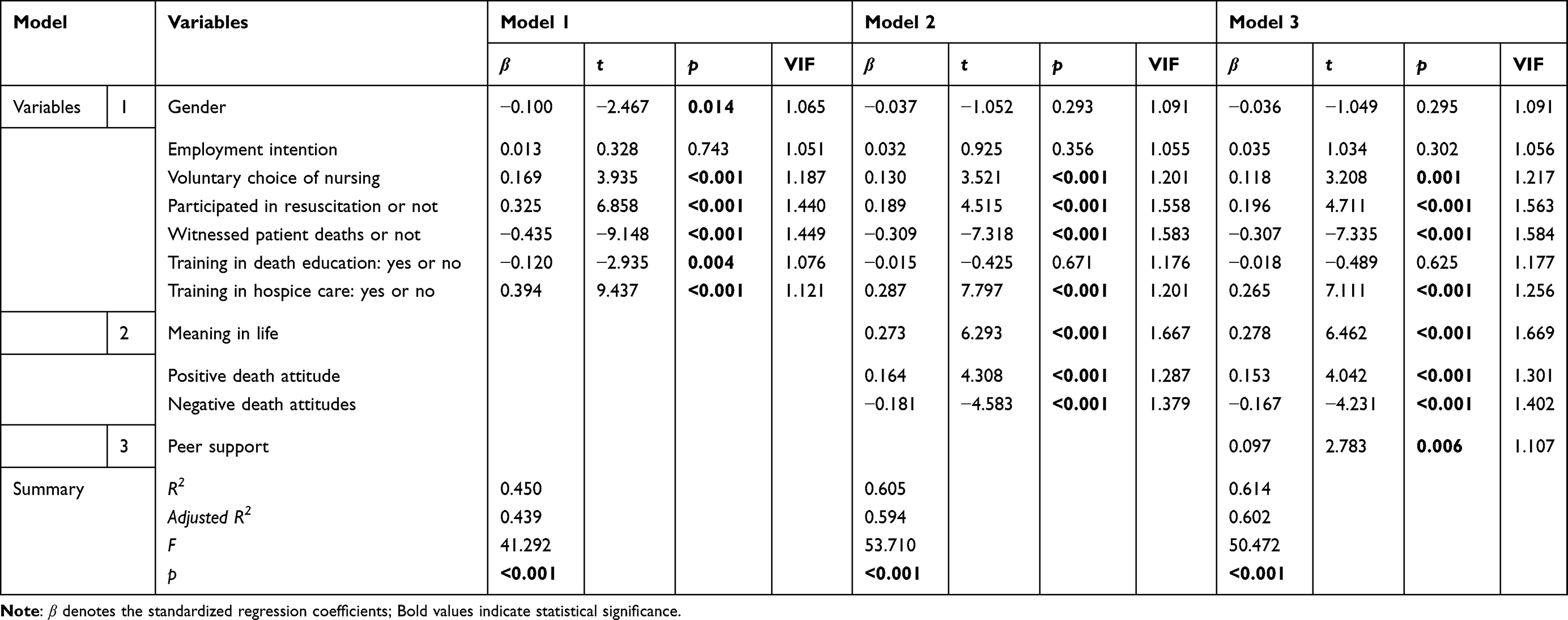 |
Table 3 Hierarchical Linear Regression Analysis of Factors Associated with Professional Identity |
Path Analysis
Parallel Mediation Model
Using nursing students’ meaning in life as the independent variable (X), positive death attitudes (M1) and negative death attitudes (M2) as mediators, and professional identity (Y) as the dependent variable, a parallel mediation analysis was conducted with PROCESS macro 4.2 (Model 4). Covariates included gender, employment intention, voluntary choice of nursing, participation in resuscitation, witnessing patient deaths, and prior training in death education or hospice care.
As shown in Table 4, the total effect of meaning in life on professional identity was significant (Effect = 0.348, 95% CI: 0.277–0.418). The total indirect effect was also significant (Effect = 0.105, 95% CI: 0.068–0.143), comprising two distinct pathways. First, positive death attitudes mediated the relationship between meaning in life and professional identity (Effect = 0.041, 95% CI: 0.020–0.064). Second, negative death attitudes also showed a significant mediating role in the association between meaning in life and professional identity (Effect = 0.064, 95% CI: 0.036–0.094). In addition, the direct effect of meaning in life on professional identity remained significant (Effect = 0.243, 95% CI: 0.167–0.319), indicating partial parallel mediation by positive and negative death attitudes in the association between meaning in life and professional identity (Table 4 and Figure 2).
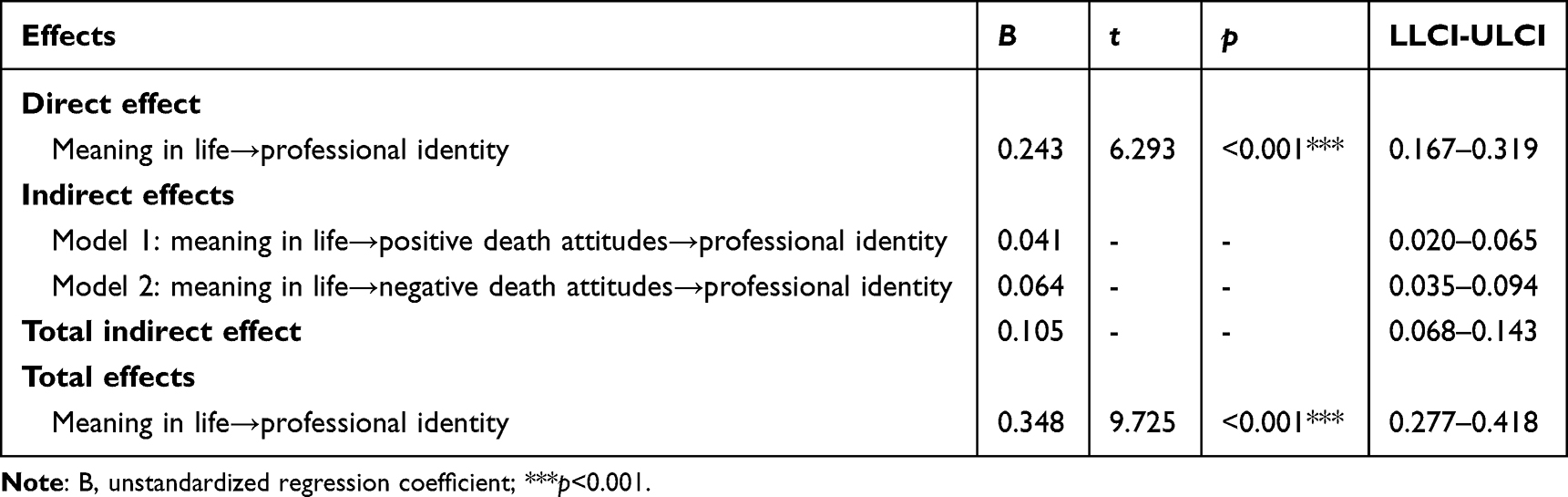 |
Table 4 Parallel Mediation |
 |
Figure 2 Path Diagram of the Parallel Mediation Model. Notes: X denotes the independent variable, Y denotes the dependent variable, and M1 and M2 denote the two parallel mediators. The numbers shown in the figure are unstandardized regression coefficients. a1 denotes the path from X to M1; a2 denotes the path from X to M2; b1 denotes the path from M1 to Y; b2 denotes the path from M2 to Y; c1 denotes the total effect of X on Y; and c2 denotes the direct effect of X on Y after including the mediators. ***p < 0.001. |
Moderated Parallel Mediation Model
Building on the parallel mediation model, a moderated parallel mediation model was first tested using the PROCESS macro Model 15, in which peer support was specified as a moderator of the paths from M1 to Y, M2 to Y, and X to Y. The results showed that peer support did not significantly moderate the paths from M1 to Y or from M2 to Y (p > 0.05), whereas the interaction between meaning in life and peer support on professional identity was statistically significant (p = 0.012).
Given the non-significant moderation of the M1→Y and M2→Y paths in Model 15, PROCESS Model 5 was further used to examine the moderating role of peer support in the direct association between meaning in life and professional identity, while retaining the parallel mediating paths through positive and negative death attitudes. The total indirect effect through positive and negative death attitudes remained statistically significant (B = 0.098, 95% CI: 0.061–0.136) (Table 5 and Figure 3). Peer support significantly moderated the direct association between meaning in life and professional identity. Specifically, the positive association between meaning in life and professional identity was strongest at low levels of peer support (−1 SD; B = 0.331, p < 0.001), weaker at the mean level of peer support (B = 0.248, p < 0.001), and weakest at high levels of peer support (+1 SD; B = 0.164, p = 0.001) (Table 5 and Figure 4).
 |
Table 5 The Moderated Parallel Mediation |
 |
Figure 3 The Moderated Parallel Mediation Model. Notes: X denotes the independent variable, Y denotes the dependent variable, M1 and M2 denote the two parallel mediators, and W denotes the moderator. The numbers shown in the figure are unstandardized regression coefficients. a1 denotes the path from X to M1; a2 denotes the path from X to M2; b1 denotes the path from M1 to Y; b2 denotes the path from M2 to Y; c2′ denotes the direct effect of X on Y after including the mediators; d1 denotes the effect of W on Y; and d2 denotes the interaction effect between X and W on Y. **p < 0.01, ***p < 0.001. |
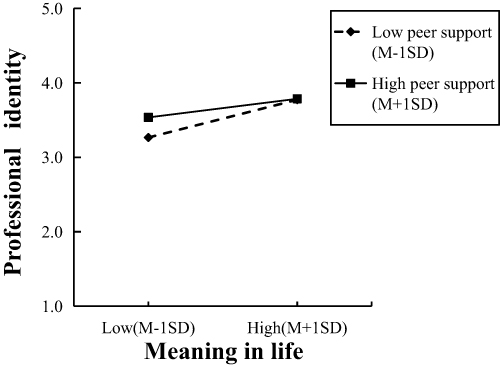 |
Figure 4 Simple Slopes Plot Under the Moderation of Peer Support. Notes: M denotes the mean level of peer support. Low peer support refers to one standard deviation below the mean (M − 1 SD), and high peer support refers to one standard deviation above the mean (M + 1 SD). |
Discussion
The median professional identity score among nursing students in our study was 62.00 (IQR 52.50–67.00), suggesting a moderate level, which aligns with the results reported by Qiu et al.6 This study examined multiple factors associated with professional identity. First, although previous studies have characterized nursing as a predominantly female domain, equating caregiving and empathy with feminine traits, gender stereotypes and occupational stigmas may be associated with challenges in male nursing students’ professional identity.5,24,25 Interestingly, in our sample, male students exhibited significantly higher professional identity than females, which may reflect the “glass escalator” phenomenon, where men working in predominantly female professions frequently experience accelerated career advancement and increased leadership prospects.26 Additionally, a higher educational background (bachelor’s degree or above) may be related to more positive career expectations. Voluntary choice of nursing was also associated with higher professional identity, likely due to increased intrinsic motivation, professional commitment, and anticipatory development.27 Clinical experience was also significantly associated with professional identity. Students involved in patient resuscitation exhibited higher professional identity than those who had not; such experiences may be associated with greater perceived competence, professional confidence, and a sense of nursing mission, which may support identity internalization. Conversely, students who had experienced patient death demonstrated lower professional identity, which may be related to fear, grief, helplessness, psychological strain, occupational stress, and more negative perceptions of nursing values after exposure to patient death.13 Collectively, these individual characteristics offer valuable insights for identifying students who may require targeted professional guidance or support.
Consistent with previous studies, nursing students’ meaning in life was positively associated with their professional identity.6 This finding further supports the conceptual connection between meaning in life and professional identity. Meaning in life reflects individuals’ perception of purpose, coherence, and value in self-existence,10 whereas professional identity involves the internalization of professional values and the development of a professional self-concept.7 Therefore, the two constructs may be linked through value internalization and professional self-construction. During clinical internship, nursing students encounter not only technical learning tasks but also emotionally demanding experiences, such as patient suffering, death-related situations, ethical tension, and intensive caregiving responsibilities. Students with a stronger sense of meaning in life may be more able to interpret these experiences as meaningful contributions to patients’ well-being and social value, thereby integrating the nursing role into their professional self-concept.6,7 In contrast, students with a weaker sense of meaning may find it more difficult to connect clinical work with personal goals and values, which may be associated with weaker professional belonging and lower professional identity.6
However, our findings suggest that the association between meaning in life and professional identity is complex and may be partly explained by individual attitudes toward death. Specifically, students with a stronger sense of meaning in life may be more likely to accept death’s inevitability rationally and recognize its significance, which may be associated with higher professional identity. They may also report lower levels of death anxiety, avoidance, and denial, which may be associated with more stable professional engagement. According to the DAP-R, positive death attitudes include Neutral Acceptance, Approach Acceptance, and Escape Acceptance, while negative death attitudes encompass Fear of Death and Death Avoidance.20 In our sample, Neutral Acceptance scored highest, with a median of 3.80 (IQR 3.20–4.20), aligning with Yu et al.28 Neutral Acceptance, which is strongly linked to a heightened sense of life meaning, represents a rational comprehension of life’s finite nature, viewing death as an inherent part of existence rather than as an external danger.28 Recognizing death as an unavoidable reality may be related to greater engagement in professional roles and a more constructive perspective on life and death. Notably, our findings diverge from Xie et al,5 in which nursing students predominantly exhibited Approach Acceptance (viewing death as a transition to a better state) and Escape Acceptance (viewing death as the cessation of suffering), with Neutral Acceptance scoring lowest. They attributed this difference to cultural emphases on death’s symbolic and social significance in China, where death is more closely tied to achieving a meaningful social life than to the natural cessation of life.5 While cultural factors provide a broad explanation, they cannot fully account for inter-study differences. Variations in educational background, sample characteristics, and social context are likely influential. In our study, over half of the students had received systematic hospice and death education, which may be related to their capacity to understand death more rationally and to exhibit higher Neutral Acceptance.29 In sum, understanding professional identity formation requires attention not only to meaning in life but also to the role of differing death attitudes.
Peer support constitutes an important social factor related to professional identity.14,15 According to Hobfoll’s (2001) Conservation of Resources Theory (COR), individuals mobilize available resources to maintain psychological functioning when faced with scarcity or stress.30 In the development of professional identity, an individual’s sense of meaning in life functions as an internal resource, while support from peers constitutes a key external social resource. When peer support is lacking, the association between meaning in life and professional identity may become stronger, suggesting that students with lower peer support may rely more on internal meaning-related resources. Conversely, higher peer support may be associated with lower psychological demands, which may reduce the relative strength of the association between meaning in life and professional identity while maintaining its significance. Contrary to our initial expectations, peer support showed no moderating effect on the association of death attitudes with professional identity (paths b1 and b2). Two potential explanations are proposed. First, death attitudes may be closely related to worldview, values, and personal experiences, and may reflect relatively stable core beliefs.31 Therefore, their associations with career choice and professional identity may be less likely to vary according to daily peer interactions. Second, peer support among students may primarily involve academic collaboration, clinical challenges, interpersonal issues, or emotional venting, and may be more closely related to general stress relief than to profound reflections on death.
These findings may have practical implications for nursing education and clinical training. Beyond their psychological relevance, meaning in life, death attitudes, and peer support may also be linked to nursing students’ professional behaviours in clinical practice. A stronger sense of meaning in life may help students approach routine and emotionally demanding care with greater responsibility, persistence, and patient-centred commitment. More adaptive death attitudes may support students in communicating with patients and families in end-of-life situations, managing death-related distress, and maintaining professional engagement after exposure to patient suffering or death. In addition, peer support may facilitate collaborative learning, emotional regulation, help-seeking, and mutual reflection during clinical placement. At the individual level, nursing educators may consider supporting students’ sense of life purpose as part of efforts to promote professional identity development and provide psychological support for professional development. Strategies may include death education courses, reflective groups on life meaning, and narrative nursing interventions that address students’ understanding of life and death and support psychological resilience. At the group level, peer support networks could be developed through team-based training, peer mentoring, and support groups to create a supportive learning environment and help students cope with clinical stress and professional challenges. It should be emphasized that peer support by itself may not be sufficient to change students’ understanding of death. Integrating peer support with systematic death education may be a useful approach to supporting professional identity development by addressing both internal resources, such as meaning in life, and external resources, such as peer support.
Beyond these individual and interpersonal factors, professional identity formation may also be related to system-level processes, including how nursing work is structured, documented, and made visible within educational and clinical settings. Standardized documentation practices and standardized nursing language may help represent the scope, complexity, and professional contribution of nursing activities in routine care.32 For nursing students, exposure to structured educational or clinical documentation systems may support their understanding of nursing as a knowledge-based and value-generating profession, whereas poorly structured or fragmented documentation may obscure the distinct contribution of nursing work. Future research could further examine how documentation practices, standardized representations of nursing activities, and students’ psychological resources jointly contribute to the development of professional identity.
Limitations
First, the cross-sectional nature of the design prevents establishing causal relationships; subsequent studies could adopt longitudinal or experimental approaches to further examine causal directions. Second, as participants were recruited from a single geographic area, the findings may have limited generalizability due to regional and cultural influences. Given significant cultural differences in perceptions of death, cross-cultural comparisons are warranted in future studies. Third, potential confounding factors, such as participants’ family educational backgrounds, were not considered in this study, yet they may be associated with both death attitudes and professional identity.
Conclusion
Meaning in life was associated with nursing students’ professional identity both directly and indirectly through positive and negative death attitudes, while peer support moderated the direct pathway between meaning in life and professional identity. These findings suggest that professional identity formation may be related to both internal meaning-making and external interpersonal support. Nursing education may benefit from addressing factors operating at both the individual and group levels to support nursing students’ professional identity development.
Data Sharing Statement
The datasets used and/or analyzed during the current study are available from the corresponding author upon reasonable request.
Ethics and Consent Statements
This study was conducted in accordance with the Declaration of Helsinki and was approved by the Affiliated Children’s Hospital of Jiangnan University (Approval No. WXCH2025-04-089). Electronic informed consent was obtained from all participants prior to their participation in the study.
Acknowledgments
We would like to sincerely thank all participants for their valuable contribution to this research. We are also grateful to the research team members who contributed to questionnaire data collection.
Funding
This study was supported by the Top Talent Support Program for young and middle-aged people of Wuxi Health Committee (No. BJ2023091) and the Wuxi Science and Technology Development Fund (No. K20253007).
Disclosure
The authors report no conflicts of interest in this work.
References
1. World Health Organization. State of the world’s nursing report. Available from: https://www.who.int/publications/i/item/9789240110236.
2. Liu Y, Duan Y, Guo M. Turnover intention and its associated factors among nurses: a multi-center cross-sectional study. Front Public Health. 2023;11:1141441. doi:10.3389/fpubh.2023.1141441
3. Li Z, Cao J, Wu X, Li F, Zhu C. Intention to leave among newly graduated nurses: a descriptive, multicenter study. J Adv Nurs. 2020;76(12):3429–14. doi:10.1111/jan.14545
4. Liu J, Zhang H, Tao S, He J, Li S. Centrality and bridge connections between cognitive emotion regulation strategies and professional identity among Chinese undergraduate nursing students: a network analysis. Nurse Educ Pract. 2024;80:104151. doi:10.1016/j.nepr.2024.104151
5. Xie L, Li Y, Ge W, Lin Z, Xing B, Miao Q. The relationship between death attitude and professional identity in nursing students from mainland China. Nurse Educ Today. 2021;107:105150. doi:10.1016/j.nedt.2021.105150
6. Qiu L, Miao Q, Zhao Y, Zhu L, Wang Y. A study on the impact of life meaning on occupational identity of nursing students in China:a cross-sectional study. BMC Nurs. 2023;22(1):480. doi:10.1186/s12912-023-01667-1
7. Fagermoen MS. Professional identity: values embedded in meaningful nursing practice. J Adv Nurs. 1997;25(3):434–441. doi:10.1046/j.1365-2648.1997.1997025434.x
8. Bai X, Wu S, Zhang M, et al. Facilitators and barriers to professional identity formation among nursing students: a qualitative systematic review. Nurse Educ Pract. 2026;93:104819. doi:10.1016/j.nepr.2026.104819
9. Mao A, Lu SE, Lin Y, He M. A scoping review on the influencing factors and development process of professional identity among nursing students and nurses. J Prof Nurs. 2021;37(2):391–398. doi:10.1016/j.profnurs.2020.04.018
10. Chen X, Wang T, Hou S, Zhang L, Zhao F, Chen J. Categories of characteristics of nurses’ meaning in life and its relationship with gratitude: a Cross-section Study. Asian Nurs Res. 2025. doi:10.1016/j.anr.2025.03.011
11. Park CL. Making sense of the meaning literature: an integrative review of meaning making and its effects on adjustment to stressful life events. Psychol Bull. 2010;136(2):257–301. doi:10.1037/a0018301
12. Chen X, Cheng L, Guo X, Xie Y, Cheng Y. How can I face death? Exploring the role of resilience in shaping nursing students’ meaning in life, professional identity and coping skills. J Health Psychol. 2026;13591053261438038. doi:10.1177/13591053261438038
13. Majidipour P, Janatolmakan M, Andayeshgar B, Khatony A. Exploring patient death experiences among Iranian nursing students. Sci Rep. 2024;14(1):21345. doi:10.1038/s41598-024-72631-5
14. Cuesta-Martínez R, González-Sanz P, Raventós-Torner RD, et al. Experiences of nursing students in A peer mentoring program during their clinical practices. A qualitative study. Nurse Educ Today. 2024;139:106234. doi:10.1016/j.nedt.2024.106234
15. Lim S, Lim GYT, Chong CYL, Eky H, Dong Y. Navigating the peer mentoring journey: experiences of peer mentors in an undergraduate nursing programme. Nurse Educ Today. 2025;154:106829. doi:10.1016/j.nedt.2025.106829
16. Luo J, Liu XB, Yao Q, et al. The relationship between social support and professional identity of health professional students from a two-way social support theory perspective: chain mediating effects of achievement motivation and meaning in life. BMC Med Educ. 2024;24(1):473. doi:10.1186/s12909-024-05391-5
17. Hobfoll SE, Freedy J, Lane C, Geller P. Conservation of social resources: social support resource theory. J Soc Pers Relat. 1990;7(4):465–478. doi:10.1177/0265407590074004
18. von Elm E, Altman DG, Egger M, Pocock SJ, Gøtzsche PC, Vandenbroucke JP. The Strengthening the Reporting of Observational Studies in Epidemiology (STROBE) statement: guidelines for reporting observational studies. Ann Intern Med. 2007;147(8):573–577. doi:10.7326/0003-4819-147-8-200710160-00010
19. Wolf EJ, Harrington KM, Clark SL, Miller MW. Sample size requirements for structural equation models: an evaluation of power, bias, and solution propriety. Educ Psychol Meas. 2013;76(6):913–934. doi:10.1177/0013164413495237
20. Tang L, Zhang L, Li Y, et al. Reliability and validity analysis of the Chinese version of death attitude profile among nurses. J Nurs. 2014;29(14):64–66.
21. Hao YF. Study on self-education model to enhance nursing students’ professional identity and self-efficacy [PhD thesis]. Second Military Medical University; 2011.
22. Wang X, You Y, Zhang D. Reliability and validity of the Chinese version of the meaning in life questionnaire in university students and its relationship with psychological quality. J Southwest Univ. 2016;38(10):161–167.
23. Zhao Q, Lu S, Wang X, Du J, Peng X. Evaluation of the Perceived Social Support Scale (PSSS) among frontline staff. Adv Psychol Sci. 2022;12(3):10.
24. Prosen M, Čekada T. Nursing students’ views on men in nursing: a gender diversity challenge in the healthcare workforce. BMC Nurs. 2025;24(1):820. doi:10.1186/s12912-025-03521-y
25. Amin SM, Demerdash DE, Othman AA, et al. The mediating role of professional identity in the relationship between gender misconceptions and occupational stigma among male nursing students. BMC Nurs. 2025;24(1):930. doi:10.1186/s12912-025-03552-5
26. Ghimire A, Qiu Y. Navigating masculinity in nursing: unpacking the ‘critical care only’ career aspirations of male undergraduate nursing students. Nurse Educ Pract. 2025;84:104332. doi:10.1016/j.nepr.2025.104332
27. Zhang J, Wang L, Yang X, et al. The mediating effect of clinical belongingness on the relationship between anxiety and professional identity in nursing interns: a cross-sectional study. Front Med. 2024;11:1489383. doi:10.3389/fmed.2024.1489383
28. Yu H, Sun C, Xie L, et al. Using a mediating model of death attitude and meaning in life to understand nursing students attitude about hospice care. Nurse Educ Today. 2022;116:105448. doi:10.1016/j.nedt.2022.105448
29. Liu H, Tao H, Huang H, et al. The relationship between death and hospice care attitudes among nursing interns: a cross-sectional survey. BMC Nurs. 2025;24(1):1014. doi:10.1186/s12912-025-03684-8
30. Hobfoll SE. The influence of culture, community, and the nested-self in the stress process: advancing Conservation of Resources theory. Applied Psychology. 2001;50(3):337–370. doi:10.1111/1464-0597.00062
31. Lan X, Wang Y. The essence, objectives, and functions of death education. Med Philos. 2024;45(23):49–54.
32. Vanalli M, Cesare M, Cocchieri A, D’Agostino F. Natural language processing and string metric-assisted assessment of semantic heterogeneity method for capturing and standardizing unstructured nursing activities in a hospital setting: a retrospective study. Ann Ig. 2023;35(1):3–20. doi:10.7416/ai.2022.2517
 © 2026 The Author(s). This work is published and licensed by Dove Medical Press Limited. The
full terms of this license are available at https://www.dovepress.com/terms
and incorporate the Creative Commons Attribution
- Non Commercial (unported, 4.0) License.
By accessing the work you hereby accept the Terms. Non-commercial uses of the work are permitted
without any further permission from Dove Medical Press Limited, provided the work is properly
attributed. For permission for commercial use of this work, please see paragraphs 4.2 and 5 of our Terms.
© 2026 The Author(s). This work is published and licensed by Dove Medical Press Limited. The
full terms of this license are available at https://www.dovepress.com/terms
and incorporate the Creative Commons Attribution
- Non Commercial (unported, 4.0) License.
By accessing the work you hereby accept the Terms. Non-commercial uses of the work are permitted
without any further permission from Dove Medical Press Limited, provided the work is properly
attributed. For permission for commercial use of this work, please see paragraphs 4.2 and 5 of our Terms.