
Back to Journals » Psychology Research and Behavior Management » Volume 18
“Let’s Try to Stay on Track”: Exploring Therapists’ Responses to Digressive Utterances of Children with ASD
Authors Wen H, Zeng X  , Liu X, Chen Z, Ma B
Received 11 May 2025
Accepted for publication 21 August 2025
Published 12 September 2025 Volume 2025:18 Pages 1969—1992
DOI https://doi.org/10.2147/PRBM.S530238
Checked for plagiarism Yes
Review by Single anonymous peer review
Peer reviewer comments 2
Editor who approved publication: Prof. Dr. Bao-Liang Zhong
Huazhen Wen,1,2 Xiaorong Zeng,1 Xia Liu,1 Zeyuan Chen,1 Bosen Ma3
1School of Foreign Languages, Jiangxi Agricultural University, Nanchang, Jiangxi, People’s Republic of China; 2School of Humanities, Nanchang University, Nanchang, Jiangxi, People’s Republic of China; 3School of International Studies, Zhejiang University, Hangzhou, Zhejiang, People’s Republic of China
Correspondence: Bosen Ma, School of International Studies, Zhejiang University, Hangzhou, Zhejiang, People’s Republic of China, Tel +8613777486910, Email [email protected]
Purpose: Autistic children’s digressive utterances can disrupt therapeutic progress, yet remain understudied in China. This study investigates how Chinese therapists respond to such digressions during Naturalistic Intervention (NI) sessions, specifically exploring how they navigate the tension between structured therapeutic goals and spontaneous interactions while adapting evidence-based practices (EBPs) to individual child profiles and sociocultural contexts.
Participants and Methods: Applying discourse analysis (DA), we analyzed 19 NI sessions involving five Board Certified Behavior Analysts (BCBAs; ≥ 2 years of experience; trained in NI) and ten Chinese autistic boys (aged 29– 78 months; Level 1 ASD). Therapists delivered tailored NI sessions (4– 30 hours/week), embedding communication goals within play-based routines. Sessions were video-recorded in therapeutic settings.
Results: Therapists employed seven distinct response practices spanning a directive-to-elicitory continuum. Immediate refocusing practices (restatement with nonverbal cues, digression-termination before refocusing, and integration) prioritized task adherence but risked further disengagement. Delayed refocusing practices (minimal acknowledgment before refocusing, accommodation before refocusing, and following the child’s lead before refocusing) validated children’s agency and elicited higher rates of goal-aligned responses. Digression-following practices fostered spontaneity but risked further divergence. Notably, accommodation and following the child’s lead before refocusing elicited the most contingent responses, while abrupt termination often provoked resistance. Senior therapists employed more diverse practices while favoring delayed refocusing practices, whereas juniors favored immediate refocusing practices. Practice selection was influenced by digression sub-focus, therapist experience, child characteristics, and sociocultural contexts.
Conclusion: Findings reframe digressions as agentic bids necessitating mutual adaptation, aligning with “the double empathy problem”. As the first DA study of therapist responses to digressions in China, this study underscores the clinical importance of culturally attuned flexibility for validating autistic agency while maintaining therapeutic progress. Based on the research findings, therapist training should emphasize reflective, context-responsive practices to enhance engagement across cultures.
Keywords: therapists, Chinese children with ASD, digressive utterances, response practices, discourse analysis
Introduction
Effective therapeutic interactions hinge on healthcare practitioners’ ability to build rapport, foster mutual understanding, and guide client progress through therapeutic communication.1,2 Clients’ improvements occur within sequential turn-by-turn interactions where each speaker’s contribution shapes subsequent responses.3 These interactional dynamics become particularly complex when working with atypical children, whose communicative profiles often challenge neurotypical expectations. For children with autism spectrum disorder (ASD), a neurodevelopmental condition characterized by atypical social communication,4 therapeutic progress depends on how therapists manage digressive utterances, speech that deviates from an ongoing topic.
While digressions occur across populations, autistic children produce them more frequently than their non-autistic peers.5–7 Quantitative studies often attribute this pattern to inherent deficits in theory of mind, executive dysfunction, or linguistic impairments,8,9 reinforcing a medical-deficit model that frames digressions as pathological symptoms. This deficit perspective drives compliance-focused interventions that prioritize symptom reduction over autistic agency.10,11 However, such compliance-centric interventions risk exacerbating stress and depression in autistic individuals.11,12
These limitations are challenged by the double empathy problem,13–15 which posits that communication breakdowns between autistic and non-autistic individuals stem from bidirectional differences in social cognition, interaction styles, and emotional expression, not unilateral deficits in autistic individuals. This paradigm reframes misunderstandings as mutual mismatches in neurotypical and neurodivergent communicative norms,14,16 which shifts therapeutic goals from behavior modification towards fostering mutual understanding and autistic agency.16,17 Consequently, therapists may face a tension: strict adherence to therapeutic agendas supports skill development,18,19 while accommodating spontaneous digressions honors communicative initiation, which itself is a key therapy goal for autistic children.20,21 To be more specific, overly rigid responses risk dismissing the child’s communicative framework, while excessive accommodation may compromise progress.19
This tension is further complicated in cultural contexts like China, where therapeutic priorities are shaped by both evidence-based practices (EBPs)—practices shown by research to have meaningful effects on outcomes22 and Confucian values emphasizing hé (relational harmony), lǐ(ritualized order), and xué (lifelong learning). Hé may prioritize therapeutic alliance over topic adherence, lǐ could reinforce hierarchical rigidity, and xué might valorize structural skill acquisition,23,24 creating therapeutic negotiations. Compounding this tension, evidence on managing digressions derives almost exclusively from Western contexts, overlooking cultural variations in how digressions are interpreted or managed. Furthermore, existing studies on digressions in the Chinese context predominantly rely on frequency comparisons between autistic children and control groups,25–28 overlooking the co-constructed nature of interactions. Although Chen29 utilized qualitative conversation analysis (CA) to examine topic management challenges, including digressions, the analysis lacked the micro-analytic rigor needed to trace the real-time sequential development of digressive utterances and partners’ responses. Besides, extant data derived primarily from child-peer or child-mother dyads,25–27,29 leaving therapist-child therapeutic interactions almost unexamined. While Ma and Ma30 analyzed therapists’ multimodal efforts to re-establish joint attention following autistic children’s digressions, their work did not investigate digressions per se. These studies overlooked the co-constructed nature of digressions and therapists’ role in managing digressive utterances, leaving a pivotal dimension of therapeutic interactions in China unexplored. Academic attention is thus needed to dissect how therapist responsiveness to digressions shapes therapeutic interactional progress within China’s unique sociocultural and therapeutic contexts.
These gaps are especially salient in Naturalistic Intervention (NI), an established EBP for ASD. NI prioritizes child-led, play-based activities to foster communication within daily routines.31 Its inherent flexibility also allows autistic children more freedom to diverge from therapists’ preferred conversational trajectories, thereby testing therapists’ “strategic flexibility”32—the ability to bridge the child’s autonomy while maintaining therapeutic goals. Additionally, NI’s child-led ethos may align with xué’s experiential learning but potentially conflict with lǐ’s emphasis on structured hierarchies in Confucian-informed therapy. Yet no study globally, let alone in China, has microscopically analyzed how therapists navigate digressions within NI sessions, and what factors influence their practice selection.
Our study addresses these gaps by applying discourse analysis (DA), particularly CA, to examining how therapists respond to digressive utterances during NI sessions in China. Specifically, we investigate the following questions:
- What response practices do Chinese therapists employ to manage digressive utterances from autistic children during NI sessions?
- How do these response practices distribute across interactions and what factors influence their selection?
- How do these response practices shape therapeutic trajectories within the context of Confucian values?
By dissecting the bidirectional co-construction of digressions through DA, we aim to resolve extant methodological limitations while revealing culture-specific therapeutic negotiations. Our findings promise to enrich cross-cultural understandings of ASD interventions and provide actionable practices to align EBPs like NI with autistic agency.
Data and Methods
Ethics
The study received approval from the Research Ethics Committee of Nanchang University (No. NCUREC202310002) and adhered to the Declaration of Helsinki and local guidelines. Written informed consent was obtained from legal guardians. For the children, verbal assent was obtained using age-appropriate explanations tailored to their developmental level. To ensure comprehension, simplified language, visual aids, and interactive demonstrations of the recording process were employed. Both therapists and children were offered opportunities to ask questions before consent and assent were finalized. Both guardians and therapists were also provided with a written summary outlining key details and their right to withdraw consent at any time without penalty. All consent materials were reviewed by the ethics committee prior to implementation for accessibility.
All identifying information, including names and addresses, was anonymized with non-traceable codes. Data were collected and stored on password-protected servers and encrypted hard drives accessible only to the authors. All data will be permanently deleted five years post-publication. These protocols ensured confidentiality and privacy alignment with institutional ethical standards throughout the study and beyond.
Research Method
This study employed discourse analysis (DA), particularly CA, to examine how therapists respond to autistic children’s digressive utterances within therapeutic interactions in China. CA, a micro-analytic approach within DA focusing on the study of talk in interaction,31 served as the primary lens to scrutinize the micro-level dynamics of therapist-child interactions. Through a turn-by-turn scrutiny of audio-visual recordings, CA identifies recurring interactional patterns often overlooked by other research methods,32,33 and captures the observable linguistic and paralinguistic nuances underpinning therapists’ management of interactional challenges like topic digressions.31,34 This granular approach is particularly helpful for understanding therapists’ “professional stocks of interactional knowledge” (SIKs)—the organized knowledge shared by professionals about how to interact effectively within their fields.35 By detailing the practices encapsulated in SIKs, CA reveals the intersection of therapeutic goals with autistic communication rhythms and the co-construction of meaning.36,37 We selected CA for its capacity to uncover locally contingent practices, such as how therapists deploy design responses to repair interactional ruptures or align with children’s communicative pacing.
Building on CA’s micro-analytic insights, DA interpreted therapists’ response practices within the broader Chinese sociocultural contexts. DA considers language as an interactional accomplishment shaped by context, emphasizing examining the contributions of both participants for a holistic picture of interaction.38 DA can be useful to uncover therapists’ practices of which they might have been unaware, thereby enabling more deliberate future use of these practices.39,40
This dual-layered approach bridged the micro-macro divide. While CA explicated how therapists respond sequentially to children’s digressions, DA investigated why certain practices become culturally sanctioned. Specifically, DA traced how these practices reflected tensions between global EBPs like NI and the Chinese sociocultural context, particularly Confucian values. This synergistic framework demonstrated how therapists’ moment-to-moment decisions recursively shaped and were shaped by sociocultural values, offering insights into the dynamic interplay between interactional micro-dynamics and macro-level sociocultural contexts.
Participants
The participating therapists and autistic children were recruited from a children’s hospital affiliated with the National Clinical Research Centers for Child Health in Mainland China, our collaborating institution. We first contacted the head of the hospital’s autism intervention center, who recruited five volunteering therapists. As male therapists for autistic children are rare in China, all therapists were female Board Certified Behavior Analysts (BCBAs) with ≥2 years of specialized experience in autism interventions, as well as training in speech-language pathology, psychotherapy, and NI. Therapists were familiar with the double empathy problem as it aligns with NI’s principles of child-led engagement, validating spontaneous communication, and mutual adaptation. These therapists served as invaluable clinical consultants during data transcription and analysis, but were neither involved in coding the interaction data for this study nor were they authors.
These therapists recommended 12 potential child participants (aged 29–78 months) initially identified as high-functioning autism cases. From this pool, we applied explicit inclusion criteria requiring a confirmed Level 1 ASD diagnosis (requiring mild support) and average/above-average cognitive functioning (Full-Scale IQ ≥70). Two children scoring below the FSIQ threshold were excluded, yielding a final cohort of ten autistic boys (aged 29–78 months; M = 56.5 ±15.8 months). This gender homogeneity reflects ASD’s male-to-female prevalence bias (4:1) and challenges in recruiting female autistic children.41 Each therapist worked with 1–3 children (Table 1), reflecting typical clinical caseloads in China. While sessions led by the same therapist may share interactional tendencies resulting in clustering effects, we mitigated this risk by (a) diversifying therapist-child dyads and (b) cross-validating response patterns across therapists to ensure no single therapist’s response pattern disproportionately influenced aggregated results.
 |
Table 1 Demographic Characteristics of Participants |
Nine of the children underwent the Psychoeducational Profile Third Edition (PEP-3), a standardized tool for designing individualized educational programs for autistic children.33 The PEP-3 Communication Composite score, reflecting cognitive and language development levels, showed mild-to-moderate delays for seven children and age-appropriate levels for two. One child, Lele, did not participate in the PEP-3 assessment due to relocation. Demographic details of the participants are provided in Table 1.
Data Collection
The dataset consisted of 19 routine NI sessions recorded in July-August 2021. Sessions occurred in individualized training rooms equipped with a table, three chairs, and standardized therapeutic materials. Data were collected using a Sony camera (Sony a9 II) placed unobtrusively in room corners to ensure clear audiovisual capture of paralinguistic and nonverbal cues essential for CA. Only the therapist, child, and a non-participatory caregiver were present. Therapists received structured hands-on training before data collection, including an illustrated guide, two supervised practice sessions with researcher feedback, and a written protocol emphasizing non-intervention. This standardization protocol ensured consistent high-quality recordings suitable for microanalysis of interactional sequences. Recordings commenced five minutes after session initiation to minimize observer effects.
Therapists delivered routine NI sessions (4–30 hours/week, M=20.6) for each child. NI prioritizes spontaneous verbal interactions embedded within the child’s daily routines, such as playing games, reading, drawing, and telling stories.42 Each session comprised multiple phases targeting specific communicative or behavioral skills, tailored to individual child needs based on their PEP-3 results. Therapists were attentive to children’s subtle communicative attempts and shared conversational control.43 Recorded sessions lasted 20–60 minutes (M =43.8 ±20.3), totaling 7 hours 17 minutes.
Data Analysis
The analysis proceeded in two integrated phases: (1) Conversation analysis (CA) for micro-interactional patterns, and (2) discourse analysis (DA) of these patterns through practice coding and distributional quantification.
CA was used to scrutinize the sequential organization of interactions. Two co-authors transcribed video recordings using Jeffersonian transcription conventions.44 This detailed transcription system, developed by Gail Jefferson, was adopted as the methodologically standard for CA, ensuring our data aligns with disciplinary norms for granularity, reproducibility, and scholarly dialogue. By precisely capturing temporal features, prosody, and nonverbal resources, Jeffersonian conventions provide the empirical precision required to analyze how therapists and autistic children co-deploy multimodal interactional resources. The transcription yielded a dataset of 62,467 Chinese characters. Transcriptions underwent iterative cross-review, with discrepancies resolved through team discussions. Inter-rater reliability was assessed on a 15% random sample, yielding a 92% agreement rate.
Transcripts and recordings were carefully examined during research meetings to identify the target sequences. A typical sequence included the therapist’s turn, the child’s digression, the therapist’s response, and the child’s subsequent reaction. An example of the target sequence is illustrated in Figure 1.
 |
Figure 1 Example of digressive-utterance and response sequences. In all the following extracts, children’s digressions are italicized, and therapists’ responses are in bold and indicated by rightward arrows (see Appendix for more transcription conventions). |
In this extract, the digressive-utterance and response sequence starts with Qiangqiang’s posture shift (line 4) and off-topic request (line 5), and Ziqi responds with a dual practice of emotional accommodation and task reframing (line 6), which elicits Qiangqiang’s subsequent compliance (line 7). Such a sequence was typical of the interactions analyzed in this study. 87 sequences were identified for analysis.
Through iterative review, these response practices were inductively categorized into seven types based on temporal design, interactional practices, and multimodal resources. Similarly, children’s subsequent responses were coded as either contingent responses (task-aligned replies or re-engagement) or further digressions (topic shifts or resistance). The categories were refined iteratively through multiple group discussions. Representative examples were selected for granular conversation analysis to illustrate how response timing and practices shaped interactional trajectories. Mandarin Chinese extracts were transliterated into Chinese phonetic Pinyin and translated into English. All the translations were reviewed by two native speakers of American English for linguistic accuracy and cultural appropriateness.
Then all the CA-derived categories underwent systematic coding and statistical validation, preparing for DA interpretation. Initial response practice categories from CA were refined into a coding manual with operational definitions. Two authors independently coded all 87 sequences for therapist response practice, child subsequent response, and digression sub-focus. Inter-rater reliability was calculated on 20% of random sample sequences, achieving 92% agreement (Cohen’s κ= 0.89). Discrepancies were resolved through discussions. Frequencies and percentages of response practices and child responses were computed. Based on these data, DA interpreted patterns through a broader sociocultural lens, linking practice selection to sociocultural negotiations and child characteristics.
Results
Therapists’ Response Practices
Of the 87 instances analyzed, the therapists refocused the child’s digressive trajectory in 83 cases, either immediately or after a delay. In the remaining four cases, they followed the child’s lead without trying to refocus the conversation. These varying practices elicited different reactions from the children, including contingent responses or further digressive utterances which often led to additional response sequences.
Refocusing Practices
We identified six distinct practices used by the therapists to refocus therapeutic interactions. These practices were classified into two categories based on the immediacy of the response: immediate and delayed. The following section details each practice with a conversation analysis extract.
Immediate Refocusing Practices
Restatement with Nonverbal Cues
When a child produces a digressive utterance, therapists typically avoid directly confronting or terminating the digression, as this could disrupt the child’s engagement or hinder the development of trust. Instead, therapists may restate their prior therapeutic objective, often using nonverbal cues to subtly redirect the child’s focus.
In Extract 2 (Figure 2), Chengqi teaches Lele to identify directions and locations using toy animals. A toy truck is placed at one end of the table between them. After Lele correctly identifies their positions, Chengqi rearranges the animals. The interaction has been going smoothly, with Lele answering all questions correctly up to this point.
 |
Figure 2 Transcription of Extract 2. |
Chengqi acknowledges Lele’s previous answer with a positive evaluation, “↓Excellent!” (line 1), closing the prior sequence. Then she proceeds with a new question, “Who is on the ↑top?” (line 1). The rising pitch on “↑shangmian” (top) marks the turn as a first pair part (FPP), which creates a conditional relevance for Lele’s response. However, Lele shows his non-alignment by reaching for a toy truck (line 2) and articulates with a verbal request (“[>I–I wanna play< with the truck for a while.]”, line 3), thereby disattending the projected sequence. Chengqi responds to this disalignment with multimodal resources. Rather than engaging in explicit verbal repair, she physically removes the truck, an embodied action that eliminates the distractor, and then moves the task-relevant puppy and tiger closer to Lele (line 4). This spatial reconfiguration serves as a nonverbal remedial intervention, recalibrating the interactional framework to prioritize the therapeutic activity.
Lele withdraws his hand and shifts his focus back to the animals (line 5), which displays his orientation to Chengqi’s intervention and re-establishes joint attention. Chengqi then reissues the original question (“Who: is on the ↑top?”, line 6), employing prosodic emphasis (elongation of “Who:” and rising pitch on “↑top”) to foreground its urgency. This repetition is timed to coincide with the spatial reorganization, creating a multimodal gestalt that reinforces the question’s salience. The multimodal pairing of prosodic emphasis and spatial restructuring reinforces the task’s salience, capitalizing on the child’s heightened sensitivity to visual and tactile cues.45,46 Lele’s compliance is evidenced by his gaze fixation on the animals and his eventual answer (“<The puppy>.”, line 7), which satisfies the conditional relevance of Chengqi’s question. Chengqi immediately reinforces this alignment by granting access to the truck (line 8), thereby contingently linking task participation to a preferred activity.
The sequence demonstrates how therapists deploy multimodal resources to manage children’s disalignment without verbal confrontation. Chengqi’s avoidance of explicit rejection preserves the interactional flow, while her strategic use of nonverbal redirection and prosodic emphasis prioritizes the activity’s structure. The success of this approach is observable in Lele’s rapid re-engagement and compliant response, underscoring the efficacy of temporally coordinated verbal and nonverbal practices in sustaining task-oriented interactions.
Digression-Termination Before Refocusing
During task-oriented phases, therapists tend to respond in a more directive manner and may close down unrelated contributions, as illustrated in Extract 3 (Figure 3).
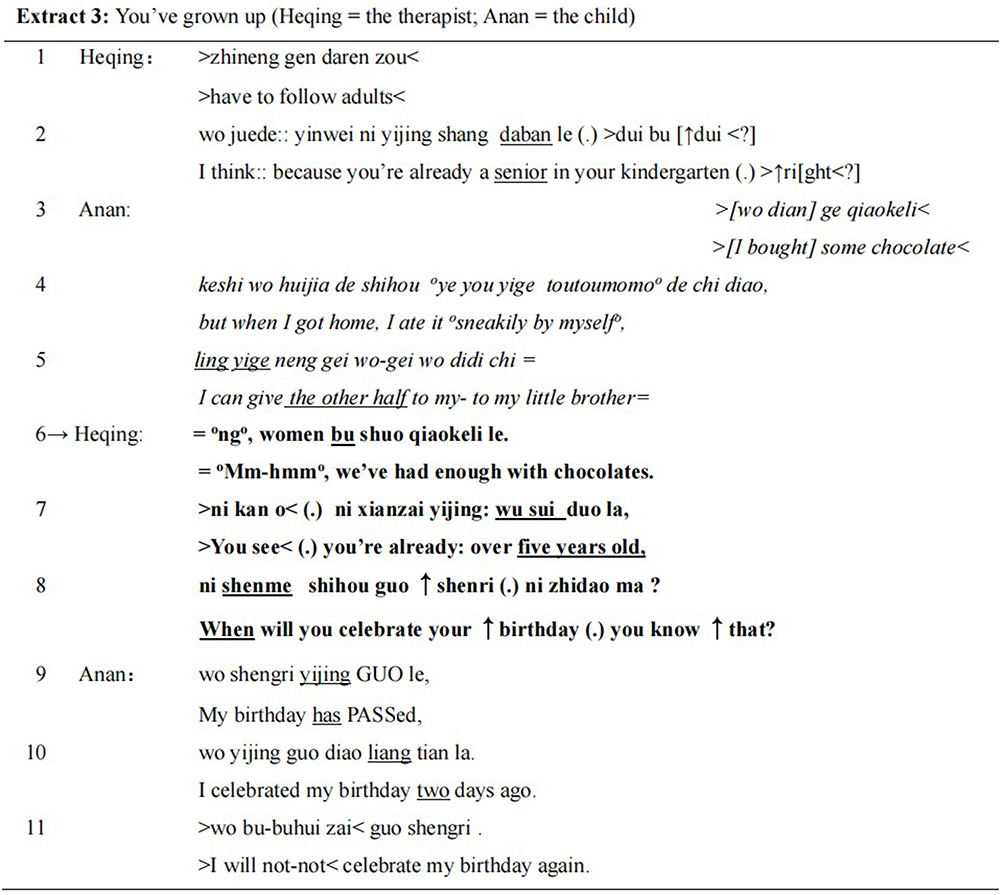 |
Figure 3 Transcription of Extract 3. |
Heqing has been guiding Anan in planning a birthday party. However, Anan has made multiple topic shifts before this exchange. Prior to this extract, Heqing suggested that Anan could make independent purchases of cold drinks, but Anan rejected the idea, claiming that young children should always be accompanied by an adult when outdoors.
The exchange begins with Heqing recycling Anan’s prior utterance (“>have to follow adults<”, line 1) and then attempts to refocus the boy by asking, “because you’re already a senior in your kindergarten (.) >↑right<?” (line 2). This question frames Anan’s kindergarten senior status as a rationale for independent decision-making. Before Heqing finishes her question, Anan produces a disjunctive next action, overlapping the prior turn to introduce an unrelated narrative, “>[I bought] some chocolate <” (line 3), followed by an extended account of consuming it covertly (lines 4–5). This narrative typically elicits the listener’s explicit news receipts.47 However, this topic shift also disrupts the adjacency pair, creating sequential misalignment.
Heqing responds with a minimal acknowledgment token (“°Mm-hmm°”, line 6), withholding further encouraging feedback. Her subsequent declarative closure (“We’ve had enough with chocolates”, line 6) functions as a sequence-closing third,48 terminating the digressive talk while avoiding explicit rejection. Heqing then reintroduces the therapeutic agenda by reasserting Anan’s age (“you’re already: over five years old”, line 7), using prosodic emphasis (“already:”) to foreground its relevance, and poses a question about his birthday (“ When will you celebrate your ↑birthday (.) you know ↑that?” line 8). The rising pitch on “↑birthday” and the tag-like “you know ↑that?” frame the turn as a high-constraint prompt, narrowing response options and prioritizing realignment.49
Anan’s reply (“My birthday has PASSed”, line 9) resists the presupposition embedded in Heqing’s question but remains topically adjacent, displaying partial compliance. His elaboration (“celebrated two days ago”, line 10) and subsequent negation (“not celebrate again”, line 11) sustain engagement with the birthday topic, albeit oppositionally. This illustrates how Heqing’s redirection successfully reintegrates Anan into the therapeutic frame despite resistance. By embedding the birthday inquiry within a statement about Anan’s maturity, Heqing links task compliance to his self-identity as a “grown-up” and leverages social reinforcement to motivate participation—a practice consistent with NI’s emphasis on integrating personal relevance into therapeutic tasks.43,50
The interaction demonstrates Heqing’s calibrated management of disalignment through minimal repair and topic refocusing. Her avoidance of overt correction preserves interactional flow, while her strategic deployment of prosodic cues and lexical framing ensures structural predictability, which is an essential affordance for autistic children navigating reciprocal interaction.51 The sequence underscores how therapists balance respecting the child’s contributions with maintaining institutional goals, achieving progress through temporally coordinated verbal practices rather than explicit directives.
Integration
In Extract 4 (Figure 4), Lijun uses paper-cut fish to teach Kuaikuai about marine animals. When Kuaikuai, growing impatient, throws the paper fish on the floor and crawls under the table, the session’s progress is disrupted.
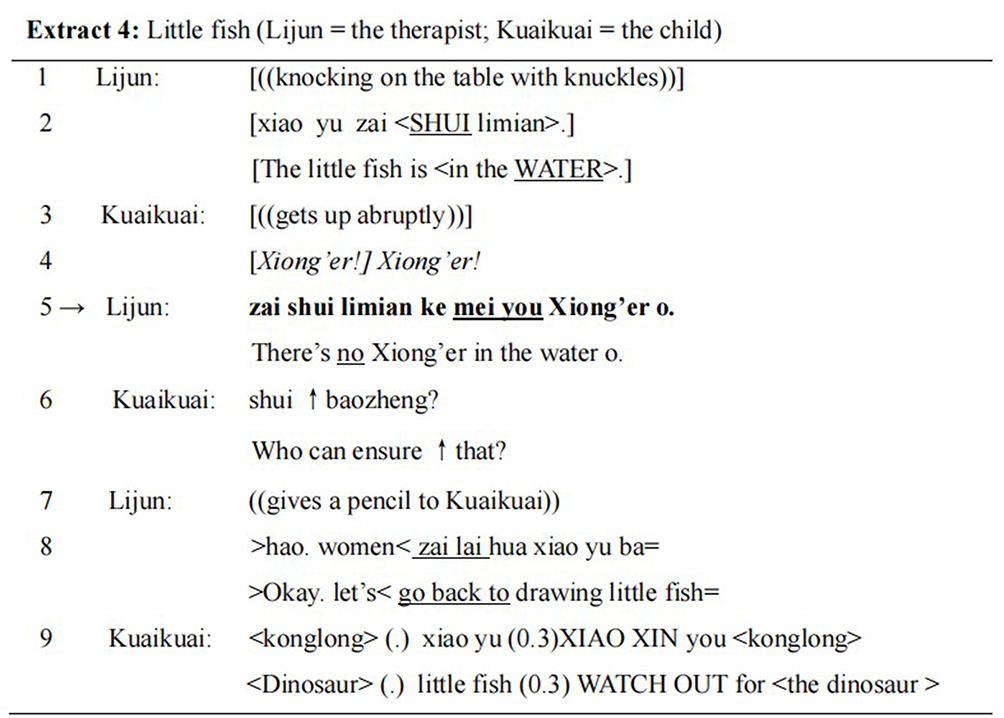 |
Figure 4 Transcription of Extract 4. |
Lijun produces a multimodal prompt, combining a nonverbal knock on the table (line 1) and a verbal formulation (“The little fish is <in the WATER>”, line 2), marked by prosodic emphasis on “WATER.” Kuaikuai responds with an embodied display of “incipient compliance”52 by abruptly standing up, while simultaneously producing a disjunctive verbal contribution through the repeated invocation of “Xiong’er” (line 4), a non-contextual cartoon character.
Lijun’s subsequent turn (line 5) exhibits contingent responsiveness. She topicalizes Kuaikuai’s reference (“Xiong’er”) within the ongoing activity frame through the negated declarative (There’s no Xiong’er in the water o.”, line 5). The softened prosody (“o”) and declarative structure soften epistemic assertiveness and mitigate disaffiliation, reducing potential resistance.53 This turn accomplishes dual interactional work of acknowledging the child’s topic while reinforcing the aquatic theme through lexical repetition (“water”), thus preserving the therapeutic agenda without overtly rejecting the digression.
Kuaikuai’s follow-up query (“Who can ensure ↑that?”, line 6) challenges, testing the boundaries of the activity frame. Rather than engaging in debate, Lijun avoids direct epistemic contestation by deploying a pivot (lines 7–8). She offers a pencil as a material resource (line 7) and reintroduces the task through a compressed directive (“let’s go back to drawing little fish”, line 8), framed collaboratively through the inclusive pronoun “we” and accelerated speech tempo (“>hao. women<”). This turn design prioritizes progressivity over repair, scaffolding re-engagement through task reorientation.
Kuaikuai’s subsequent utterance (“Dinosaur (.) little fish (0.3) WATCH OUT for the dinosaur”, line 9) demonstrates partial alignment. While persisting with an unrelated referent (“dinosaur”), Kuaikuai reintroduces “little fish”, suggesting a negotiated return to the task. The sequential trajectory from disjunctive insertion to fitted partial compliance illustrates the negotiated recalibration of intersubjective focus, achieved through Lijun’s systematic integration of the child’s contributions into the activity’s epistemic and material framework.
Delayed Refocusing Practices
Alternatively, therapists may delay redirecting the child’s digression, either by briefly acknowledging it or by exploring the new topic with the child before returning to the original discussion.
Minimal Acknowledgment Before Refocusing
Balancing the need to acknowledge children’s initiations with maintaining the session’s objectives requires the therapist to briefly validate autistic children’s contributions before redirecting the conversation back, as illustrated in Extract 5 (Figure 5).
 |
Figure 5 Transcription of Extract 5. |
In this extract, Yuanli discusses picnic preparations with Hanghang, a talkative autistic child with high language proficiency. Yuanli initiates the sequence by proposing bringing “an electric fan” (line 1), establishing a task-oriented trajectory. Hanghang maintains the topic by referencing a comparable item (“small fan at home”, line 2). Yuanli briefly acknowledges this with a minimal response token (“Mm-hmm::”, line 3) followed by an incomplete polar question (“Is ↑[it]…”, line 3), projecting expansion. However, Hanghang interrupts, with accelerated speech (“[>I am at a <]) and a marked shift to “toughened glass”. This turn deploys detailed descriptions (lines 4–5) punctuated by pauses, and self-repairs (eg, repetition of “TOUGHENED GLASS”), reflecting difficulties in formulating the new topic. This digression creates a sequential misalignment, diverging from the interactional trajectory established earlier.
Upon Hanghang finishes his turn, Yuanli employs a latched minimal acknowledgment token (“Mm-hmm:.”, line 6) and a positive evaluation (“That’s nice”, line 6), which serve as a passing turn54 that briefly validates Hanghang’s contribution withholding further topical engagement. She then reintroduces the therapeutic agenda through a bodily-state account (“And I think I will definitely go out->will sweat<”, line 7) and task-relevant proposal (“so I’ll bring: tissues.”, line 8), using a mitigated, collaborative frame (“I think I will…”) to model appropriate task engagement.
Hanghang orients to this redirection in line 9 with a quiet agreement token (“oRighto”, line 9) and a claim of “GOOD IDEA” (line 9), signaling receptivity to Yuanli’s redirection. However, he persists momentarily with the glass theme (line 11) before reintegrating the institutional agenda through topic shading, which is an advanced topic management skill that introduces a new topic while relating it to the prior one.55 His final turn (“We can ALL: go in for a picnic”, line 12) artfully links the prior glass-door narrative to the picnic frame, demonstrating advanced topic management by introducing a new focus (“picnic”) while preserving coherence with the preceding talk.
The interaction exemplifies how minimal acknowledgment tokens paired with associative redirection can guide autistic children back to therapeutic tasks without escalating resistance. By avoiding expansion of off-topic talk and deploying mitigated, task-relevant turns, the therapist balances affiliation with institutional goals, while the child’s topic shading reveals interactional competence in navigating topic transitions.
Accommodation Before Refocusing
In Extract 6 (Figure 6), Pengpeng (the child) is engaged in a role-playing game with Ziqi (the therapist). During the interaction, Pengpeng pretends to be a doctor treating a doll as a sick baby but is also particularly interested in a toy truck on a shelf near Ziqi.
 |
Figure 6 Transcription of Extract 6. |
As Pengpeng pretends to administer an injection to the doll, Ziqi proposes a medical narrative, asserting, “the injection on the baby doesn’t work:.” (line 1). She then follows up with a polar question (“Do you need to give him some ↑medicine?”, line 2) designed to elicit a type-conforming response.56 Her placement of the pill box next to the doll (line 3) serves as a multimodal prompt, reinforcing the projected next action. Pengpeng, however, produces a dispreferred response,57 interjecting with a directive to reposition the truck (“Put the truck next to me”, line 4), thereby initiating a side sequence.
Ziqi accommodates this deviation by placing the truck as requested (line 5). She then deploys elongated prosody (“↓Okay::!”) and a modified repetition (“Put it next to you:”, line 6), which validate Pengpeng’s agency while reframing the spatial reference (“next to you”) to align with the child’s perspective. Her immediate return to the medical agenda (“Do you need to give him some medicine?”, line 6) constitutes a pursuit of response, reasserting the institutional goal. Pengpeng again resists through an embodied directive, pointing to his right hand (line 7) and emphatically reiterating, “[Put it] HERE!” (line 8), specifying placement through gesture and prosodic stress. Ziqi’s compliance (line 9) and softened acknowledgment (“[oMm-hmm, okayo].”, line 10), function as a minimal continuer58 and acknowledge the request without expanding the digression, thereby limiting digressive momentum.
Ziqi’s subsequent directive (“Give the baby some medicine”, line 10), produced after a 0.3-second pause, continues to pursue the therapeutic agenda, leveraging sequential positioning to re-anchor the activity. Pengpeng then seizes the truck, briefly engages in solitary play, and administers the pill (line 11), reflecting a negotiated return to the medical frame. This final compliance is achieved through Ziqi’s calibrated balance of accommodation and redirection. His final utterances (“I <ate it all>.”, line 13; “>Recovered<.”, line 15), delivered with accelerated speech and falling prosody, perform a terminal exchange, ratifying the closure of the medical narrative. Throughout, Ziqi employs multimodal resources, including verbal prompts, object placement, and prosodic modulation, to navigate Pengpeng’s competing orientations, illustrating the interplay between child-led negotiation and therapeutic scaffolding in sustaining joint focus.
Following the Child’s Lead Before Refocusing
In the above response practices, the therapist refrains from encouraging the child to diverge from the current topic. However, in Extract 7 (Figure 7), the therapist follows the child’s lead before refocusing the conversation back to the therapeutic task.
 |
Figure 7 Transcription of Extract 7. The address provided in this extract is pseudonymous to protect privacy and confidentiality. |
Before this extract, Heqing and Anan have been discussing household roles. Heqing initiates a topic shift to upcoming birthdays, marked by her elongated pre-shift token,48 “↓Oh::” (line 1) and a pre-announcement (“I hear that in your family <some [one is going to]>”, line 1). Anan initially overlaps with a tangential response (“>At home< I don’t cook”, line 2), reflecting his preoccupation with the previous topic. Heqing persists by completing her turn (“=celebrate his birthday.”, line 3), prompting Anan’s engagement. His subsequent self-repair (“but> I give you-tell< (.) your (.) address.”, line 4), introduces a digression, marked by rushed speech and syntactic truncation, refocusing the talk on disclosing his home address.
Heqing affiliates with this digression with a go-ahead response48 (“↓Great!”, line 6) that legitimizes Anan’s shift while maintaining sequential progressivity. Anan discloses his address (“We live in Dashan [Community], Hangzhou”, line 7; “Room 501, Unit 4, Building 14”, line 9) while Heqing produces an overlapping minimal continuer (“[↑Ah::]”, line 8),58 signaling her active listening.59
After Anan completes his address disclosure (line 9), Heqing initiates repair (“Why are you telling me your ↑address?”, line 10), implicitly questioning the digression’s relevance. Anan’s explanation (“ My home is also- just the address (.) is there.” line 11) displays a literal interpretation of the inquiry, foregrounding his orientation to factual accuracy over pragmatic intent.
Heqing then formulates Anan’s action as an unstated invitation (“ So you [want to] invite us to your home, do you?=”, line 14 and line 16), recontextualizing the digression within a therapeutic frame. However, Anan interrupts (line 15) and vehemently rejects this formulation (“≤NO, I don’t! < I want to tell you.”, line 17), creating a brief competitive overlap. Heqing persists with a playful hypothesis (“I thought:: it was your little brother’s birthday”, line 19), using prosodic elongation (“thought::”) to soften the disjunction and retroactively frame the digression as a potential birthday-related invitation. Her follow-up pre-closing query (“You just want to tell me ↑this?”, line 18) signals readiness to conclude the digression while affirming Anan’s communicative intent. Anan’s final response (line 20) demonstrates partial reorientation to the birthday topic, though his emphasis on temporal distance (“has long passed”) and numerical detail (“FIVE birthday cakes”) sustains a degree of topic divergence, underscoring the negotiated nature of topical alignment in autism interaction. This interaction illustrates how therapists may temporarily accommodate child-initiated trajectories while employing formulations and repairs to reintegrate therapeutic agendas.
Digression-Following Practice
During NI sessions, therapists may pursue a child’s digressions rather than always returning to the previous topic to boost their communicative motivation, as illustrated in Extract 8 (Figure 8).
 |
Figure 8 Transcription of Extract 8. |
At the start of the session, Beibei and Ziqi (the therapist) are playing a beach-themed game, in which Beibei is not initially interested. Ziqi initiates a counting activity involving buggies, marked by prosodic emphasis (“THREE buggies”) and affect-laden interjections (“↑Yikes!” and “↓Ah!”, line 1). Beibei, however, produces no verbal or embodied alignment to this activity, instead humming until his sudden exclamation “CRAB!” (line 2), which is topically incongruent with the ongoing task. This turn, delivered with heightened volume and prosodic prominence, constitutes a marked topic shift. Ziqi orients to this as a legitimate interactional move rather than a disruption, evidenced by her immediate pursuit of a new sequence. Her accelerated “>Where’s< the crab?” (line 3) deploys a compressed turn-initial particle (“>nali you<”) and embodied pretense of searching (“Let me ofind: ito.”, line 3), reframing the interactional agenda around Beibei’s initiated topic.
When Beibei minimally reaffirms “oCrabo.” (line 5), Ziqi further expands Beibei’s minimal digression by crafting a paper crab (line 6) and animating it with playful vocalizations (“[oCrawling, crawling and crawlingo]”, line 10) and kinetic actions (line 9), transforming Beibei’s isolated utterance into a shared narrative. Her exaggerated prosody (“WHERE’s the crab ↑gone?”, line 4) and embodied orientation (line 4) further amplify the topic’s salience. This multimodal scaffolding invites Beibei’s continued engagement, as seen in his next humming turn and interjection (“Sandcastle”, line 11), introducing another abrupt topic shift. Ziqi seamlessly incorporates this through a latched response (“Right, ca:stle”, line 12), where the elongated vowel (“ca:stle”) and lexical specification (“<a squa:re> castle”, line 13) mirror Beibei’s prosodic style while adding structural complexity.
The sequence illustrates how digressions are interactionally organized into collaborative activity through contingent responsiveness. Ziqi’s response practices treat Beibei’s utterances as sequentially consequential rather than deviant. By prioritizing locally emergent topics over predefined agendas, the therapist sustains participation through co-orientation to the child’s interactional footing, thereby transforming isolated contributions into progressively elaborated joint activities.
Summary of Therapists’ Response Practices
Therapists’ responses to digressive utterances span a continuum from directive to elicitory practices, reflecting the balance between maintaining therapeutic focus and fostering spontaneous communication (Figure 9). At the directive end, therapists prioritize control and therapeutic objectives through structured, goal-oriented interactions. Thus therapists often employ immediate refocusing practices to redirect the interaction. At the elicitory end, therapists expand on the child’s digressive utterances without refocusing, fostering spontaneous communication and validating the child’s autonomy. These practices prioritize the child’s initiative, promoting natural interaction over strict adherence to therapeutic objectives. Delayed refocusing practices, positioned in the middle of the continuum, balance the need to maintain therapeutic focus with responsiveness to the child’s communicative agency. Through accommodation or the child’s lead before gently refocusing, therapists validate the child’s contributions while adhering to the overall therapeutic strategy. The entire continuum represents therapists’ flexibility in adapting their approaches, balancing structured intervention with the need to enhance developmental outcomes and encourage communicative spontaneity.
 |
Figure 9 Continuum of therapists’ response practices. |
Distribution of Therapists’ Response Practices and Their Influences on the Interactional Trajectories
To understand the prevalence of different response practices, we analyzed the frequency distribution of the seven response practices identified across all 87 digression sequences, as detailed in Table 2.
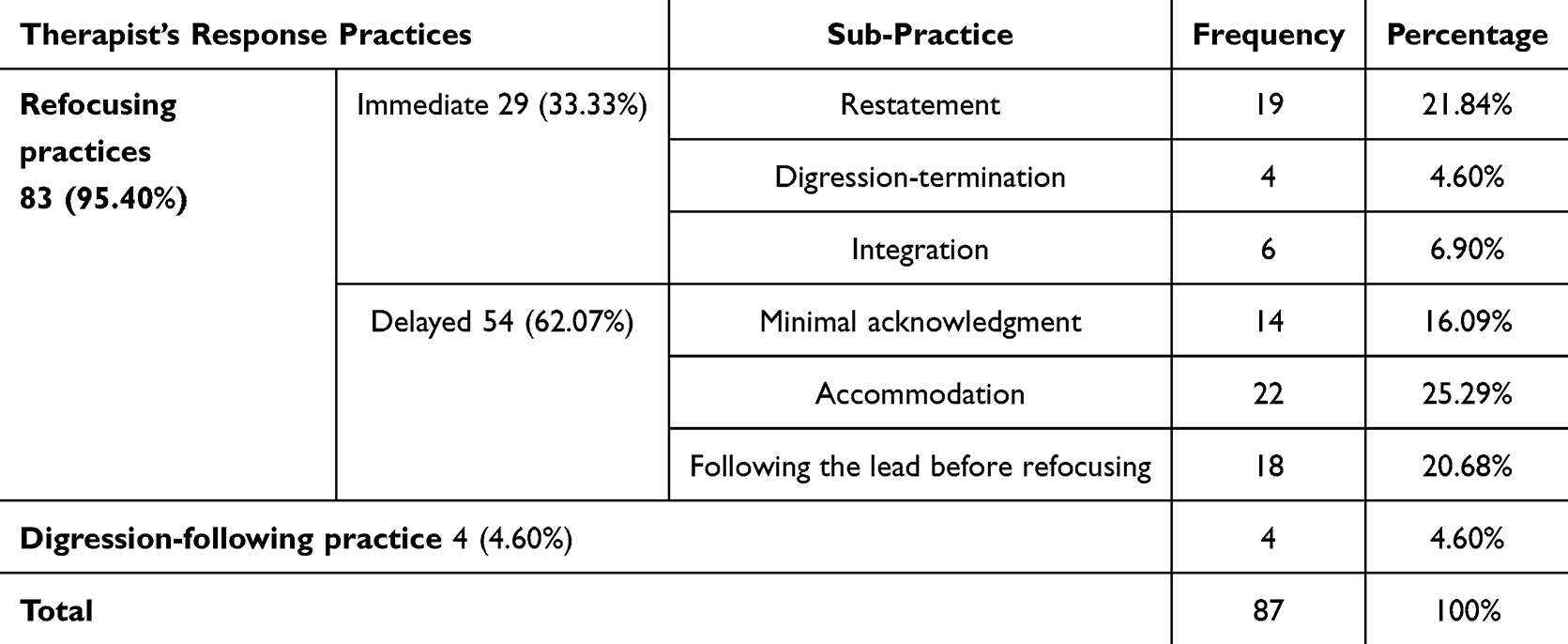 |
Table 2 Distribution of Therapists’ Response Practices |
Overall, therapists prioritized refocusing practices (95.40%), demonstrating a strong emphasis on task adherence. Within this category, delayed refocusing practices were most common (62.07% of all responses), with accommodation before refocusing (25.29%) and following the child’s lead before refocusing (20.69%) together accounting for nearly half of all responses. Immediate refocusing practices were less frequent (33.33%), with restatement with nonverbal cues being the predominant subtype (21.84% of all responses, or 65.52% of immediate practices). Digression-termination (4.60%) was rare, and integration (6.9%) was relatively uncommon. Digression-following practice were the least frequent (4.60%), reflecting therapists’ preference for structured redirection over expanding digressions.
The distribution of response practices demonstrated variation based on therapist experience, child characteristics, and digression type, as shown in Table 3.
 |
Table 3 Patterns in Response Practice Selection: The Role of Experience and Context |
First, our findings indicate that therapists’ years of experience influenced their selection of response practices. Junior therapists (Chengqi,3yrs; Lijun,2yrs) predominantly employed immediate refocusing practices. RN constituted a significant portion of their total responses: 60% (3/5) for Chengqi’s responses to Lele and 50% (3/6) for Lijun’s responses to Kuaikuai. In contrast, senior therapists employed a wider variety of practices (5–6 types per child) and favored delayed refocusing practices. The distribution of different types adopted by a senior therapist’s responses for a single child was relatively even, without overconcentration on specific types. Senior therapists also varied their practices based on the child’s communicative profile and emotional states. For instance, Ziqi used DF for 25% (3/12) of her responses to low-verbal Beibei but shifted to 30% (3/10) of RN to sensory overloaded Pengpeng (see Extract 6). Yuanli showed a clear preference for MA (30%, 3/10) and AC (30%, 3/10) in her responses to Hanghang’s perseverative narrative but deployed AC (27%, 3/11) and FL (27%, 3/11) in response to Hengheng’s topic perseveration.
Non-immediate refocusing practices, including delayed refocusing practices and DF, dominated senior therapists’ responses (74.6%, 50/67 cases) compared to 40% (8/20 cases) among the two junior therapists. This peaked at 83.3% (10/12 delayed) for Ziqi-Beibei and 81.8% (9/11 delayed +DF) for Yuanli-Hengheng. DF remained exceptionally rare across all dyads (≤25%), with its highest occurrence (25%, 3/12) observed for Beibei’s language inadequacy.
Second, digression sub-focus directly influenced therapists’ practice selection. Sensory-driven digressions, including object fixation and sensory demand, consistently elicited RN (100% for Lele’s sensory seeking) or AC (40% for Pengpeng’s competing focus), whereas language-linked digressions, including topic perseveration and literal associations, prompted more frequent use of MA (50% for Haohao’s associative shift) or IN.
Third, PEP-3 communication levels also modulated therapists’ response practice selection. Children with mild-moderate delays (“M”) received more AC and FL. For instance, Yuanli used 55% (6/11) AC and FL combined for Hengheng’s perseverative interest. Age-appropriate communicators (“A”) elicited predominantly RN (50%, 3/6 for Kuaikuai) or MA (30%, 3/10 for Hanghang).
Among all the seven response practices, AC emerged as the most versatile and frequently deployed practice overall, utilized across all therapist experience levels and in 7/9 of the digression sub-types. Conversely, DT was the least employed practice, with only 4 total occurrences across all dyads and less than 10% in any single dyad. These aggregated trends demonstrate systematic alignment between response practices and contextual variables, with AC serving as the central pivot balancing immediacy and validation.
Therapists’ response practices significantly shaped children’s subsequent reactions, categorized as either contingent responses (task-aligned replies or re-engagement) or further digressions (topic shifts or resistance), as presented in Table 4.
 |
Table 4 Autistic Children’s Subsequent Responses to Therapists’ Response Practices |
Overall, 81.61% of responses were contingent, indicating that therapists’ general success in redirecting digressions. Delayed refocusing practices elicited significantly higher rates of contingent responses (85.19%) compared to immediate practices (75.86%), underscoring the efficacy of validating children’s perspectives before reintroducing tasks.
Among immediate refocusing practices, RN elicited the highest proportion of contingent responses (78.95%), likely due to its multimodal scaffolding. DT yielded the least contingent responses (50%), likely due to its abrupt dismissal of the child’s focus. IN yielded more contingent responses (83.33%), as it linked digressions to therapeutic goals.
Delayed refocusing practices elicited the most contingent responses overall. Among these, FL (88.89%) and AC (86.36%) produced the highest percentages of contingent responses, reflecting their emphasis on rapport-building and validation before redirection. MA remained moderately elicitory (78.6%), validating the child’s agency without prolonging digressions. DF yielded 75% contingent responses but carried a higher risk of further digressions (25%). It is important to note that these micro-interactional contingencies do not presume long-term developmental outcomes but reveal how culturally attuned responsiveness can create conditions for mutual understanding, a necessary precursor to therapeutic progress.
Discussion
This study reveals how Chinese therapists navigate autistic children’s digressive utterances during NI. Through a continuum of seven response practices, therapists balance therapeutic structure with responsiveness to spontaneous communication. Delayed refocusing practices were most frequently used and elicited the highest rates of contingent child responses, underscoring a clinical preference for validating autistic agency before reintroducing therapeutic goals. Immediate refocusing practices were less frequent and DF was rare. Therapists’ response practices showed that they reframed digressions not as pathological disruptions but as interactional pivots that required mutual adaptation. This adaptation process was aligned with the double empathy problem and modulated within China’s Confucian sociocultural context and NI ethos. Below, we discuss these core findings and their implications.
Balancing Structure and Spontaneity Through Strategic Flexibility
Therapists’ deployment of seven distinct response practices illustrated their nuanced negotiation between structured therapeutic goals and spontaneous communication. This included adaptation to contextual factors like therapist experience, digression type, and child communication profile. This mirrors broader debates in ASD intervention between skill acquisition-focused EBPs60,61 and neurodiversity-affirming approaches.14,17 In this study, therapists dynamically modulated their responses based on real-time interactional cues, such as emotional states (Extract 3), sensory preferences (Extract 8), and task complexity (Extract 6). In Extract 6, Ziqi balanced structure and spontaneity by first accommodating Pengpeng’s digressive request for the toy truck and then seamlessly reintegrating the therapeutic agenda through a directive. By temporarily honoring child-led interests before scaffolding task realignment, this contingent flexibility elicited Pengpeng’s subsequent contingent response. This demonstrated how delayed refocusing practices reconciled NI goals with autistic agency through bidirectional adaptation within structured frameworks. This interactional modulation aligns with Antaki and Jahoda’s19 conceptualization of “on-track” management in therapy while extending it to incorporate cultural and neurodiversity-informed sensitivity to autistic communication styles.
In this study, immediate refocusing practices (eg, RN in Extract 2) affirmed the importance of structure in guiding therapeutic interactions. However, overreliance on immediacy risked disengagement, as seen in Anan’s partial resistance following abrupt topic termination (Extract 3) and DT’s low contingent response rate (50%, Table 4). These findings echo critiques of rigid interventions that suppress autistic communication styles,11,62,63 underscoring the need to balance structure with flexibility. Conversely, the predominant delayed refocusing practices prioritized spontaneity as a catalyst for engagement and temporarily validated digressions to bridge child-led interests with therapeutic objectives. For example, Ziqi’s playful expansion of Beibei’s “crab” digression (Extract 8) transformed disengagement into a collaborative play, exemplifying NI’s child-centered ethos43,64 and neurodiversity principles. This fluidity mirrors research emphasizing sequence organization as a scaffolding for mutual understanding in linguistically asymmetric interactions.65,66 The higher rates of contingent responses observed in delayed practices (Table 4) confirm that strategic spontaneity enhances engagement when framed collaboratively.
Therapists alternated their response practices based on contextual cues. For instance, Heqing curtailed Anan’s dysregulatory digressions in Extract 3 while accommodating exploratory ones in Extract 7. This dynamic responsiveness aligned with the double empathy problem,13,14 as therapists navigated mismatched interactional norms through adaptive reciprocity, demonstrating how EBPs like NI can integrate neurodiversity principles without compromising therapeutic integrity.
Validating Autistic Agency Through Neurodiversity-Aligned Reciprocity
Autistic children’s digressions during therapy emerged as agentic pivots that renegotiated interactional dynamics and challenged deficit-oriented assumptions. Therapists reframed these digressions as purposeful adaptations to neurotypical norms, prioritizing flexible responsiveness over behavioral conformity. Therapists tailored their responses to the communicative intent and profile underlying the digressions (Table 3). Sensory-driven digressions, such as object fixation, sensory demand, elicited hig v her frequency of RN or AC, while language-linked digressions, including topic perseveration and literal associations, prompted more MA or IN. This neurodiversity-aligned approach fostered autonomy while maintaining therapeutic progress.
Central to these interactions was therapists’ preference for delayed refocusing practices, which elicited the highest contingent responses from children (Table 4). These practices underscore the clinical value of reconceptualizing digressions as teachable moments rather than disruptions. By temporarily validating digressions before gently reintroducing therapeutic goals, therapists reduced power asymmetries and modeled mutual adaptation, which is key to mitigating empathy gaps.67 For instance, in Extract 5, Hanghang’s return to discussing picnic preparations occurred only after the therapist acknowledged his tangential interests, illustrating how structured flexibility enables children to integrate personal motivations with task demands.68 Similarly, Pengpeng’s insistence on repositioning the toy truck (Extract 6) was not interpreted as noncompliance but as a bid to renegotiate sensory and spatial boundaries, which ultimately facilitated his gradual reintegration into the activity. These practices also mirror self-management frameworks,69 where autonomy-supportive scaffolding enhances cooperation and task adherence. These findings affirm the assertion that autistic communication, when met with reciprocity, is often purposeful and adaptive.63
Therapists further reinforced engagement through multimodal reciprocity, adapting interactional rhythms to children’s sensory and cognitive profiles. In Extract 8, Ziqi’s exaggerated prosody and collaborative crafting activity leveraged Beibei’s interests to sustain joint attention. This commitment to spontaneity was particularly elicitory for children with language delays (“M” PEP-3 level), who received more AC and FL (Table 3). This mirrors Ochs et al’s51 concept of “structured improvisation”, where nonverbal scaffolding compensates for limited verbal reciprocity. Treating digressions as valid interactional pivots fostered trust and participation, which aligned with NI’s child-centered ethos43,64 and non-directive play therapy principles that validate agency to foster collaboration.37 The integration of the child’s “crab” digression into a joint play narrative embodied the emphasis of the double empathy problem on co-constructed meaning, contrasting sharply with compliance-focused models. This neurodiversity-aligned recipient design reframes off-task moments as opportunities for shared meaning-making, demonstrating how therapeutic integrity can coexist with autistic agency.
Strategic Flexibility Within the Chinese Cultural Context
Therapists’ strategic flexibility70 manifested as cultural adaptation, embedding NI within Confucian principles, particularly hé (relational harmony), lǐ (ritualized order and hierarchical respect), and xué (lifelong learning).
The predominance of delayed refocusing practices (62.07%, Table 2) exemplifies hé which prioritizes relational harmony over direct conflict. Unlike Western NI’s emphasis on egalitarian, child-led play,43,64 this method allows therapists to subtly redirect interactions while maintaining rapport. For example, in Extract 5, the therapist acknowledged the child’s off-topic remarks before guiding the focus back, balancing autonomy with hierarchical respect (lǐ). Such adaptations reflect Confucian relational ethics, where hierarchical respect coexists with individualized responsiveness,23,71,72 and challenge universalist assumptions in EBPs, highlighting the need for context-responsive frameworks.73,74
Immediate refocusing practices, such as restatement with nonverbal cues (Extract 2), reflect lǐ’s emphasis on ritualized structure and therapist authority. This was notably prevalent among junior therapists, with RN constituting as much as 60% of their responses (Table 3) and for sensory-driven digressions. Despite children’s digressions driven by personal interests (Extract 2), eagerness to share (Extract 3), or impatience (Extract 4), therapists consistently reasserted task goals before accommodating needs, ensuring structured progression. Notably, therapists seldom completely followed children’s digressions. This aligns with societal prioritization of measurable skill acquisition (xué), where unstructured exploration is often deemed incongruent with achievement-oriented values.75,76
Therapists’ indirect, nonverbal practices, such as exaggerated prosody (Extract 8) and spatial reorientation (Extract 2), exemplify a culturally hybrid approach. These techniques reduce cognitive demands while upholding hé, resonating with East Asian indirect communication norms77 and Zhong Yong (the Doctrine of the Mean), where therapists avoid extremes of control or permissiveness. For example, in Extract 6, the therapist blended spontaneity with structure by nonverbally acknowledging Pengpeng’s request for truck repositioning before reintegrating the activity into a skill-building task. Even playful interactions (Extract 8) culminated in goal-oriented outcomes, reconciling child agency with xué’s educational focus.
These adaptations reveal how Chinese therapists reframe NI into Confucian-mediated practices and guide autonomy within communal expectations, a model harmonizing neurodiversity principles with cultural pragmatism. Such culturally embedded practices highlight the imperative for globally inclusive, context-sensitive intervention frameworks.
Limitations and Future Directions
This study has limitations that warrant further investigation. First, findings from 19 sessions at a single Chinese hospital may reduce generalizability. Multi-site, longitudinal studies with larger, geographically diverse cohorts are needed to validate patterns across contexts and assess the long-term impacts of therapists’ response practices on children’s developmental outcomes. Second, the focus on male autistic children with Level 1 ASD and female therapists limits insights into how gender, symptom severity, and neurodivergent profiles influence interactional dynamics. Future research should include females across ASD levels and male therapists to examine adaptations to varying communication needs, sensory profiles, and co-occurring conditions. Finally, this study’s exclusive reliance on qualitative DA to analyze therapist response practices limits insights into the supportiveness of therapists’ response practices. Collaborations with autistic communities to co-design interventions may further harmonize cultural pragmatism with autistic agency.
Implications
The results of the study have important implications for autism research and intervention. Theoretically, the study enriches CA literature by detailing how therapists’ moment-to-moment responses shape therapeutic trajectories. It demonstrates that digressive utterances are not mere disruptions but interactional pivots requiring nuanced negotiation, aligning with the double empathy problem framework. Furthermore, by illustrating how Confucian values mediate the implementation of NI through context-sensitive practices, the study bridges cultural psychology and autism intervention research. It offers a theoretical model for reconciling global EBPs with local sociocultural norms, emphasizing that therapeutic “best practices” are not culturally neutral but require contextual adaptation.
Practically, the experience-based patterns observed in this study suggest that training should differentiate strategies for junior and senior therapists. Institutions should also promote reflective practices such as Reflective Interventionist Conversation Analysis,78 where therapists regularly review session interactions through micro-level analysis. This method helps identify effective response practices, refine SIKs, and optimize flexibility in supporting spontaneous communication. Training should also integrate the double empathy problem to help therapists match practices to child profiles. Moreover, autism intervention programs should bridge global EBPs with local sociocultural values, enabling therapists to tailor practices to cultural priorities. This requires systemic support for therapist training in cultural humility and bidirectional communication strategies. In addition, the study underscores the need for child-state responsiveness, which empowers therapists to modulate immediacy or delay in refocusing based on real-time engagement cues and child-specific factors. Moving beyond prescriptive “best practices”, this adaptive framework prioritizes the child’s immediate communicative state, harmonizing structure with spontaneity.
Conclusion
This study illuminates the nuanced interplay between therapeutic structure and autistic children’s spontaneous communication in China, revealing how therapists navigate digressive utterances through a continuum of immediate and delayed response practices. Therapists’ prioritization of delayed response practices fostered higher rates of engagement and contingent responses, embodying the double empathy problem’s core principle of resolving bidirectional communicative mismatches through validating autistic agency. By temporarily honoring children’s digressions as legitimate interactional bids, therapists transformed potential breakdowns into co-constructed meaning-making, bridging neurotypical and neurodivergent interaction norms through mutual adaptation rather than unilateral compliance. Child-specific adaptations of NI, mediated by Confucian principles (hé, lǐ, xué), showed how global EBPs can be localized without undermining therapeutic integrity. As the first DA examination of therapist responses to digressions in Chinese autism interventions, it addresses a gap in a domain dominated by Western-centric studies. It uncovers a cultural model of strategic flexibility for balancing child autonomy with therapeutic progress. Future work should extend this lens to diverse cultural contexts and neurodivergent profiles to develop adaptive intervention frameworks that honor agency while advancing therapeutic progress through reflective responsiveness.
Funding
This study was funded by Jiangxi Planning Project of Philosophy and Social Sciences (Grant No. 23YY14), the Humanities and Social Sciences Research Project of the Ministry of Education of the People’s Republic of China (Grant No. 22YJA740002), and the Humanities and Social Sciences Research Project of Jiangxi Provincial Department of Education (Grant No. YY22102).
Disclosure
The authors report no conflicts of interest in this work.
References
1. Liu X, Zeng J, Li L, Wang Q, Chen J, Ding L. The influence of doctor-patient communication on patients’ trust: the role of patient-physician consistency and perceived threat of disease. Psychol Res Behav Manag. 2024;17:2727–2737. doi:10.2147/PRBM.S460689
2. Hesse C, Rauscher EA. The relationships between doctor-patient affectionate communication and patient perceptions and outcomes. Health Commun. 2019;34(8):881–891. doi:10.1080/10410236.2018.1439269
3. Maynard DW. Why social psychology needs autism and why autism needs social psychology: forensic and clinical considerations. Soc Psychol Q. 2019;82(1):5–30. doi:10.1177/0190272519828304
4. American Psychiatric Association, ed. Diagnostic and Statistical Manual of Mental Disorders: DSM-5. American Psychiatric Association; 2013.
5. Tager-Flusberg H, Anderson M. The development of contingent discourse ability in autistic children. J Child Psychol Psychiatr. 1991;32(7):1123–1134. doi:10.1111/j.1469-7610.1991.tb00353.x
6. Abbot-Smith K, Matthews D, Bannard C, et al. Conversational topic maintenance and related cognitive abilities in autistic versus neurotypical children. Autism. 2024;29(3):684–697. doi:10.1177/13623613241286610
7. Bauminger-Zviely N, Karin E, Kimhi Y, Agam-Ben-Artzi G. Spontaneous peer conversation in preschoolers with high-functioning autism spectrum disorder versus typical development. J Child Psychol Psychiatr. 2014;55(4):363–373. doi:10.1111/jcpp.12158
8. Abbot-Smith K, Dockrell J, Sturrock A, Matthews D, Wilson C. Topic maintenance in social conversation: what children need to learn and evidence this can be taught. First Lang. 2023:014272372311726. doi:10.1177/01427237231172652
9. Paul R, Orlovski SM, Marcinko HC, Volkmar F. Conversational behaviors in youth with high-functioning ASD and Asperger syndrome. J Autism Dev Disord. 2009;39(1):115–125. doi:10.1007/s10803-008-0607-1
10. Monahan J, Freedman B, Pini K, Lloyd R. Autistic input in social skills interventions for young adults: a systematic review of the literature. Rev J Autism Dev Disord. 2023;10(1):1–21. doi:10.1007/s40489-021-00280-9
11. Albin M, Chawrun I, Tint A. Rethinking social communication support: exploring communication partner training for autistic adults and their neurotypical communication partners. Autism Adulthood. 2024:1–8. doi:10.1089/aut.2023.0181
12. Cassidy SA, Gould K, Townsend E, Pelton M, Robertson AE, Rodgers J. Is camouflaging autistic traits associated with suicidal thoughts and behaviors? Expanding the Interpersonal psychological theory of suicide in an undergraduate student sample. J Autism Dev Disord. 2020;50(10):3638–3648. doi:10.1007/s10803-019-04323-3
13. Milton DEM. On the ontological status of autism: the “double empathy problem. Disabil Soc. 2012;27(6):883–887. doi:10.1080/09687599.2012.710008
14. Milton D, Gurbuz E, López B. The “double empathy problem”: ten years on. Autism. 2022;26(8):1901–1903. doi:10.1177/13623613221129123
15. Cheang RT, Skjevling M, Blakemore AI, Kumari V, Puzzo I. Do you feel me? Autism, empathic accuracy and the double empathy problem. Autism. 2024:13623613241252320. doi:10.1177/13623613241252320
16. Mitchell P, Sheppard E, Cassidy S. Autism and the double empathy problem: implications for development and mental health. Br J Dev Psychol. 2021;39(1):1–18. doi:10.1111/bjdp.12350
17. López B. Commentary on autism and the double‐empathy problem: implications for development and mental health. Br J Dev Psychol. 2022;40(2):368–370. doi:10.1111/bjdp.12410
18. Spaniol MM, Shalev L, Kossyvaki L, Mevorach C. Attention training in autism as a potential approach to improving academic performance: a school-based pilot study. J Autism Dev Disord. 2018;48(2):592–610. doi:10.1007/s10803-017-3371-2
19. Antaki C, Jahoda A. Psychotherapists’ practices in keeping a session “on-track” in the face of clients’ ‘off-track’ talk. Commun Med. 2010;7(1):11–21. doi:10.1558/cam.v7i1.11
20. Sowden H, Perkins M, Clegg J. Context and communication strategies in naturalistic behavioural intervention: a framework for understanding how practitioners facilitate communication in children with ASD. Child Lang Teach Ther. 2011;27(1):21–38. doi:10.1177/0265659010369990
21. Paul R. Interventions to improve communication in autism. Child Adolesc Psychiatr Clin N Am. 2008;17(4):835–856. doi:10.1016/j.chc.2008.06.011
22. Cook BG, Odom SL. Evidence-based practices and implementation science in special education. Except Child. 2013;79(2):135–144. doi:10.1177/001440291307900201
23. Tsai DFC. How should doctors approach patients? A Confucian reflection on personhood. J Med Ethics. 2001;27(1):44–50. doi:10.1136/jme.27.1.44
24. Bell DA, Chaibong H, eds. Confucianism for the Modern World. Cambridge University Press; 2003. doi:10.1017/CBO9780511509964
25. Zhang W. A Study on Conversation Maintenance Ability and Intervention for Children with ASD: Taking an Autism Intervention Institution in Shandong as an Example. Master’s Thesis. Wenzhou University; 2014.
26. Feng C. A Study on Conversational Ability of Children with Mild Autism in Mother-Child Conversation Situations. Master’s Thesis. Nanjing Normal University; 2017.
27. Yang X. A Study on Peer Interaction Language in Role-Playing Games Among 4-6-Year-Old Children. Doctoral Dissertation. East China Normal University; 2018.
28. Li X. Conversation Development and Rehabilitation in Children with High-Functioning Autism: Trait-Centered Therapy Model. China Social Sciences Press; 2019.
29. Chen G. A Study on Conversation Topics of Students with Asperger Syndrome Across Settings. Doctoral Dissertation. National Taiwan Normal University; 2007.
30. Ma W. Clinical conversation analysis of rehabilitation interactions for children with ASD: a multimodal analysis framework and application. Foreign Lang Their Teach. 2024;(4):60–71.
31. Sterponi L, De Kirby K. A multidimensional reappraisal of language in autism: insights from a discourse analytic study. J Autism Dev Disord. 2016;46(2):394–405. doi:10.1007/s10803-015-2679-z
32. Stiegler LN. Discovering communicative competencies in a nonspeaking child with autism. Lang Speech Hear Serv Sch. 2007;38(4):400–413. doi:10.1044/0161-1461(2007/041)
33. Maciejewska E. Autistic resources from a discourse-analytic perspective. Qual Psychol. 2020;7(3):348–366. doi:10.1037/qup0000167
34. Hoey EM. How speakers continue with talk after a lapse in conversation. Res Lang Soc Interact. 2018;51(3):329–346. doi:10.1080/08351813.2018.1485234
35. Peräkylä A, Vehviläinen S. Conversation analysis and the professional stocks of interactional knowledge. Discourse Soc. 2003;14(6):727–750. doi:10.1177/09579265030146003
36. O’Reilly M, Lester J. Applied conversation analysis for counselling and psychotherapy researchers. Couns Psychother Res. 2019;19(2):97–101. doi:10.1002/capr.12216
37. Maciejewska E. Non-directive play therapy with autistic adolescents: a qualitative study of therapists’ interactional practices. Text Talk. 2022;42(3):369–390. doi:10.1515/text-2020-0063
38. Maciejewska E. Discourse analysis as a tool for uncovering strengths in communicative practices of autistic individuals. Discourse Stud. 2019;21(3):300–316. doi:10.1177/1461445619829237
39. Antaki C, Wilkinson R. Conversation analysis and the study of atypical populations. In: Sidnell J, Stivers T, editors. The Handbook of Conversation Analysis.
40. Roberts C, Sarangi S. Theme-oriented discourse analysis of medical encounters. Med Educ. 2005;39(6):632–640. doi:10.1111/j.1365-2929.2005.02171.x
41. Delobel-Ayoub M, Saemundsen E, Gissler M, et al. Prevalence of autism spectrum disorder in 7–9-Year-Old children in Denmark, Finland, France and Iceland: a population-based registries approach within the ASDEU Project. J Autism Dev Disord. 2020;50(3):949–959. doi:10.1007/s10803-019-04328-y
42. Tiede G, Walton KM. Meta-analysis of naturalistic developmental behavioral interventions for young children with autism spectrum disorder. Autism. 2019;23(8):2080–2095. doi:10.1177/1362361319836371
43. Schreibman L, Dawson G, Stahmer AC, et al. Naturalistic developmental behavioral interventions: empirically validated treatments for autism spectrum disorder. J Autism Dev Disord. 2015;45(8):2411–2428. doi:10.1007/s10803-015-2407-8
44. Jefferson G. Glossary of transcript symbols with an introduction. In: Conversation Analysis: Studies From the First Generation. John Benjamins Publishing Company; 2004:13–31.
45. Grandin T. How People with autism think. In: Schopler E, Mesibov GB editors. Learning and Cognition in Autism. Springer US; 1995:137–156. doi:10.1007/978-1-4899-1286-2_8.
46. Stevenson JL, Gernsbacher MA. Abstract spatial reasoning as an autistic strength. PLoS One. 2013;8(3):e59329. doi:10.1371/journal.pone.0059329
47. Heritage J. A change-of-state token and aspects of its sequential placement. In: Atkinson JM editor. Structures of Social Action. Cambridge University Press; 1984:299–345. doi:10.1017/CBO9780511665868.020.
48. Schegloff EA. Sequence Organization in Interaction: A Primer in Conversation Analysis (Volume 1). Cambridge University Press; 2007.
49. Local J, Walker G. Abrupt-joins as a resource for the production of multi-unit, multi-action turns. J Pragmat. 2004;36(8):1375–1403. doi:10.1016/j.pragma.2004.04.006
50. Frost KM, Brian J, Gengoux GW, et al. Identifying and measuring the common elements of naturalistic developmental behavioral interventions for autism spectrum disorder: development of the NDBI-Fi. Autism. 2020;24(8):2285–2297. doi:10.1177/1362361320944011
51. Ochs E, Kremer-Sadlik T, Sirota KG, Solomon O. Autism and the social world: an anthropological perspective. Discourse Stud. 2004;6(2):147–183. doi:10.1177/1461445604041766
52. Kent A. Compliance, resistance and incipient compliance when responding to directives. Discourse Stud. 2012;14(6):711–730. doi:10.1177/1461445612457485
53. Humă B, Joyce JB, Raymond G. What does “resistance” actually look like? The respecification of resistance as an interactional accomplishment. J Lang Soc Psychol. 2023;42(5–6):497–522. doi:10.1177/0261927X231185525
54. Beeke S, Beckley F, Best W, Johnson F, Edwards S, Maxim J. Extended turn construction and test question sequences in the conversations of three speakers with agrammatic aphasia. Clin Linguist Phon. 2013;27(10–11):784–804. doi:10.3109/02699206.2013.808267
55. Brinton B, Fujiki M. Development of topic manipulation skills in discourse. J Speech Lang Hear Res. 1984;27(3):350–358. doi:10.1044/jshr.2703.350
56. Raymond G. Grammar and social organization: yes/No interrogatives and the structure of responding. Am Sociol Rev. 2003;68(6):939–967. doi:10.2307/1519752
57. Pomerantz A. Agreeing and disagreeing with assessments: some features of preferred/dispreferred turn shapes. In: Atkinson JM editor. Structures of Social Action. Cambridge University Press; 1984:57–101. doi:10.1017/CBO9780511665868.008.
58. Schegloff EA. Discourse as an interactional achievement: some uses of “uh huh” and other things that come between sentences. Georgetown University Roundtable on Languages Linguistics. 1982;71–93.
59. Hutchby I. “Active listening”: formulations and the elicitation of feelings-talk in child counselling. Res Lang Soc Interact. 2005;38(3):303–329. doi:10.1207/s15327973rlsi3803_4
60. Reichow B, Volkmar FR. Social skills interventions for individuals with autism: evaluation for evidence-based practices within a best evidence synthesis framework. J Autism Dev Disord. 2010;40(2):149–166. doi:10.1007/s10803-009-0842-0
61. Hume K, Steinbrenner JR, Odom SL, et al. Evidence-based practices for children, youth, and young adults with autism: third generation review. J Autism Dev Disord. 2021;51(11):4013–4032. doi:10.1007/s10803-020-04844-2
62. Schuck RK, Tagavi DM, Baiden KMP, et al. Neurodiversity and autism intervention: reconciling perspectives through a naturalistic developmental behavioral intervention framework. J Autism Dev Disord. 2022;52(10):4625–4645. doi:10.1007/s10803-021-05316-x
63. Sterponi L, de Kirby K, Shankey J. Rethinking language in autism. Autism. 2015;19(5):517–526. doi:10.1177/1362361314537125
64. Dubin AH, Lieberman-Betz RG. Naturalistic interventions to improve prelinguistic communication for children with autism spectrum disorder: a systematic review. Rev J Autism Dev Disord. 2020;7(2):151–167. doi:10.1007/s40489-019-00184-9
65. Rae J. Interactional analysis of scaffolding in a mathematical tasks in ASD. In: Analysing Interactions in Childhood. John Wiley & Sons, Inc.; 2010:185–208.
66. Maynard DW, Turowetz J. Autistic Intelligence: Interaction, Individuality, and the Challenges of Diagnosis. University of Chicago Press; 2022; doi:10.7208/chicago/9780226815992.001.0001
67. Jones DR, Botha M, Ackerman RA, King K, Sasson NJ. Non-autistic observers both detect and demonstrate the double empathy problem when evaluating interactions between autistic and non-autistic adults. Autism. 2024;28(8):2053–2065. doi:10.1177/13623613231219743
68. Holmqvist ME. Structured flexibility: six case studies of how children with diagnosed autism develop independency in daily living activities. Scand J Disabil Res. 2009;11(3):175–193. doi:10.1080/15017410902753862
69. Koegel RL, Bradshaw JL, Ashbaugh K, Koegel LK. Improving question-asking initiations in young children with autism using pivotal response treatment. J Autism Dev Disord. 2014;44(4):816–827. doi:10.1007/s10803-013-1932-6
70. Georgiadis C, Peris TS, Comer JS. Implementing strategic flexibility in the delivery of youth mental health care: a tailoring framework for thoughtful clinical practice. Evid-Based Pract Child Adolesc Ment Health. 2020;5(3):215–232. doi:10.1080/23794925.2020.1796550
71. Xia LLL, Jlc M. Sitting in: the experience of learning and practicing family therapy through being a co‐therapist in Hong Kong. Fam Process. 2020;59(4):1914–1927. doi:10.1111/famp.12531
72. Duan C, Hill C, Jiang G, et al. Therapist directives: use and outcomes in China. Psychother Res. 2012;22(4):442–457. doi:10.1080/10503307.2012.664292
73. Quek KMT, Chen HM. Family therapy in Chinese culture and context: lessons from supervising therapists-in-training in China. Contemp Fam Ther. 2017;39(1):12–20. doi:10.1007/s10591-016-9401-y
74. Sands MM, Meadan H, Ramos-Torres S, Fanta A. The cultural and linguistic adaptation of a caregiver-implemented naturalistic communication intervention. Early Child Educ J. 2023;51(1):43–53. doi:10.1007/s10643-021-01280-4
75. Mcbride-Chang C, Chow BWY, Zhong Y, Burgess S, Hayward WG. Chinese character acquisition and visual skills in two Chinese scripts. Read Writ. 2005;18(2):99–128. doi:10.1007/s11145-004-7343-5
76. Wu Z, Hu BY, Fan X, Zhang X, Zhang J. The associations between social skills and teacher-child relationships: a longitudinal study among Chinese preschool children. Child Youth Serv Rev. 2018;88:582–590. doi:10.1016/j.childyouth.2018.03.052
77. Hall GCN, Kim-Mozeleski JE, Zane NW, et al. Cultural adaptations of psychotherapy: therapists’ applications of conceptual models with Asians and Asian Americans. Asian Am J Psychol. 2019;10(1):68–78. doi:10.1037/aap0000122
78. O’Reilly M, Kiyimba N, Nina Lester J, Muskett T. Reflective interventionist conversation analysis. Discourse Commun. 2020;14(6):619–634. doi:10.1177/1750481320939710
 © 2025 The Author(s). This work is published and licensed by Dove Medical Press Limited. The
full terms of this license are available at https://www.dovepress.com/terms
and incorporate the Creative Commons Attribution
- Non Commercial (unported, 4.0) License.
By accessing the work you hereby accept the Terms. Non-commercial uses of the work are permitted
without any further permission from Dove Medical Press Limited, provided the work is properly
attributed. For permission for commercial use of this work, please see paragraphs 4.2 and 5 of our Terms.
© 2025 The Author(s). This work is published and licensed by Dove Medical Press Limited. The
full terms of this license are available at https://www.dovepress.com/terms
and incorporate the Creative Commons Attribution
- Non Commercial (unported, 4.0) License.
By accessing the work you hereby accept the Terms. Non-commercial uses of the work are permitted
without any further permission from Dove Medical Press Limited, provided the work is properly
attributed. For permission for commercial use of this work, please see paragraphs 4.2 and 5 of our Terms.