
Back to Journals » Diabetes, Metabolic Syndrome and Obesity » Volume 18
Lean Mass Index, Not Body Mass Index, is Essentially Associated with Arterial Stiffness in Chinese Adults: A Cross-Sectional Study
Authors Wang X  , Yi M, Zhang Y, Xiao K, Si J, Sun L, Zhang H, Sun J, Liu Z, Lin J, Xie Y, Zhang B, Zhao J, Chu X, Li J
Received 1 August 2025
Accepted for publication 17 October 2025
Published 11 November 2025 Volume 2025:18 Pages 4141—4151
DOI https://doi.org/10.2147/DMSO.S556617
Checked for plagiarism Yes
Review by Single anonymous peer review
Peer reviewer comments 3
Editor who approved publication: Dr Donald McClain
Xinyi Wang,1,* Ming Yi,1,* Yinghua Zhang,2 Keling Xiao,1 Jin Si,1 Lijie Sun,1 Haoyu Zhang,1 Jinghao Sun,1 Zhaoli Liu,1 Jiaying Lin,1 Yuxin Xie,1 Bingyan Zhang,1 Jing Zhao,3 Xi Chu,3 Jing Li1
1Department of Geriatrics, Xuanwu Hospital, Capital Medical University, National Clinical Research Center for Geriatric Diseases, Beijing, 100053, People’s Republic of China; 2Department of Cardiology, Chui Yang Liu Hospital Affiliated to Tsinghua University, Beijing, 100021, People’s Republic of China; 3Health Management Center, Xuanwu Hospital, Capital Medical University, Beijing, 100053, People’s Republic of China
*These authors contributed equally to this work
Correspondence: Jing Li, Department of Geriatrics, Xuanwu Hospital, Capital Medical University, National Clinical Research Center for Geriatric Diseases, Beijing, 100053, People’s Republic of China, Tel +86-13611092728, Email [email protected] Xi Chu, Health Management Center, Xuanwu Hospital, Capital Medical University, Beijing, 100053, People’s Republic of China, Tel +86-15699959668, Email [email protected]
Purpose: Although body mass index (BMI) is an established risk factor for cardiovascular diseases (CVD), many studies found that obese patients with established CVD had better prognosis than their lean counterparts. The study aimed to investigate whether this inverse association between BMI and arterial stiffness can be explained by body composition analysis.
Patients and Methods: Participants, aged from 26 to 86 years, were included in the cross-sectional study from October 2016 to January 2020. The brachial-ankle PWV (baPWV) was measured to assess arterial stiffness. Body composition was measured using bioelectrical impedance analysis (BIA). Lean Mass Index (LMI) and Fat Mass Index (FMI), calculated as lean mass and fat mass divided by squared height (kg/m²) respectively, are complementary indices that quantitatively assess individual’s non-fat and fat compartments. Multiple linear regression analysis was conducted to investigate the associations between BMI, LMI and arterial stiffness. Mediation analysis was performed to examine the effect of bone mineral density (BMD) on the association between LMI and baPWV.
Results: A total of 744 participants were included. The median age was 61.00 (55.00, 67.00) years, and 502 (67.47%) of them were men. The median BMI, FMI and LMI were 25.56 (23.35, 28.01) kg/m2, 7.18 (5.81, 8.68) kg/m2 and 18.45 (17.10, 19.73) kg/m2 respectively. The median baPWV was 1514.50 (1358.00, 1689.00) cm/s. Among all the anthropometric parameters, only BMI (r=− 0.150, p< 0.001) and LMI (r=− 0.206, p< 0.001) were significantly correlated with baPWV. Although BMI was inversely associated with baPWV [β=− 5.99, 95% CI (− 11.10, − 0.89), p=0.022], the association became insignificant after LMI [β=− 25.85, 95% CI (− 44.73, − 6.96), p=0.007] was included in the model. Furthermore, 19.68% of the association between LMI and baPWV was mediated by BMD.
Conclusion: Lean mass is the essential body component that determines the inverse association between BMI and arterial stiffness. Body composition analysis may provide important information for subclinical atherosclerosis beyond BMI.
Keywords: arterial stiffness, bioelectrical impedance analysis, body composition, body mass index
Introduction
The global obesity epidemic is well-established,1 as the prevalence of obesity has tripled over the past four decades.2 Body mass index (BMI) is widely accepted as a measurement of general adiposity for its convenience and feasibility.3 Well-documented epidemiologic studies have established BMI as an independent risk factor for diabetes mellitus (DM), cardiovascular diseases (CVD), cancer and mortality.4–7 Atherosclerotic cardiovascular disease (ASCVD) is the leading cause of global morbidity and mortality. Atherosclerosis may initiate during early life and progress silently for many years, culminating in severe complications such as myocardial infarction or ischemic stroke.8 Arterial stiffness is an early stage of atherosclerosis that can be detected before clinical symptoms, served as important surrogate for cardiovascular risk.9,10 Brachial–ankle pulse wave velocity (baPWV) is widely used as a non-invasive measurement to assess arterial stiffness for its simplicity and repeatability.11 A previous meta-analysis based on data from 14 cohort studies including 14,673 participants showed that one standard deviation unit elevation in baPWV was related to 1.2 times increased cardiovascular risk.12
Although BMI is a well-known risk factor for CVD, many studies have reported its paradoxical association with better prognosis in patients with CVD, which has been termed “obesity paradox”.13 Accumulating studies have also reported the “obesity paradox” in the inverse association between BMI and arterial stiffness.14–20 For example, a cross-sectional study including 578 healthy participants found reduced arterial stiffness with increasing BMI.19 Hu et al found BMI was inversely correlated with baPWV in 4322 Chinese adults with hypertension. The underlying mechanism for the inverse association remains to be elucidated.20
A potential explanation is that BMI cannot distinguish between lean mass and fat mass, which may have disparate effects on the development of arterial stiffness.21,22 In particular, higher lean mass is generally associated with improved metabolic health and enhanced insulin sensitivity, which may attenuate arterial stiffening.23,24 In contrast, excess fat mass, especially visceral fat, promotes inflammation, insulin resistance, and endothelial dysfunction, thereby accelerating arterial stiffness.25–27 However, limited data are available on the correlation between body composition and arterial stiffness. Bioelectrical impedance analysis (BIA) is a non-invasive, low-cost, quick, and simple method to estimate body composition.28 Lean Mass Index (LMI) and Fat Mass Index (FMI) are complementary indices defined as lean mass and fat mass (kg) divided by height squared. Therefore, the current study used BIA to measure participants’ body composition and hypothesized that the inverse correlation between BMI and PWV could be explained by body composition analysis.
Materials and Methods
Study Population
Participants in the present study include: 1) participants who had regular physical examinations at the Health Management Department of Xuanwu Hospital, Capital Medical University; 2) patients who had a history of CVD and took regular visits at the Cardiology Outpatient Department of Xuanwu Hospital. A total of 744 participants who have examined baPWV and body composition from October 2016 to January 2020 were included. Participants with incomplete primary data, end-stage liver or renal disease, acute infection, malignancy, hematologic disease, autoimmune diseases were excluded.
Data Collection
Demographic characteristics, lifestyle factors, and medical history were extracted from electronic medical records of participants at Xuanwu Hospital, Capital Medical University. Hypertension and diabetes mellitus (DM) cases were defined based on either self-reported medical history or current use of disease-specific medications. Hypercholesterolemia was defined as either low density lipoprotein-cholesterol (LDL-C) ≥ 3.4mmol/l, self-reported physician diagnosis, or use of lipid-lowering medication.
Anthropometric Measurements
The standing height was measured using a fixed stadiometer, and weight was measured using a calibrated digital scale. BMI was calculated as body weight (kg) divided by square of body height (m2). Anthropometric indices (waist, abdominal and hip circumferences) were measured with a soft non-stretchable tape while participants were barefoot and wearing light indoor clothing. Waist circumference (WC) was measured at the midpoint between the lowest costal margin and the iliac crest. Abdominal circumference (AC) was measured at the level of the umbilicus in the standing position at the end of expiration while breathing normally. Hip circumference (HC) was measured at the level of the maximal protrusion of the gluteal muscles, with the tape parallel to the floor. Each circumference was measured twice non-consecutively, and the mean of both measurements was used for the analysis. The waist–hip ratio (WHR) was calculated as waist circumference (cm) divided by hip circumference (cm).
Body Composition and BMD Measurement
Body Composition Analyzer (ACCUNIQ, SELVAS Healthcare Co, Korea) was used to estimate participants‘body composition. Participants were fully informed of the purpose, procedure, and precautions of the test, rested for more than 30 minutes in a comfortable position, removed any metal accessories, and put on light clothing before measurement. The participants were required to step on the plate electrodes barefoot, grip the handle electrodes and stretch both arms. Participants were not allowed to talk or move during the measurement if not necessary. Lean mass, fat mass, visceral fat area (VFA), and body fat percent (BFP) were collected for analysis. Lean mass index (LMI) and fat mass index (FMI) were calculated as dividing the subjects’ lean mass or fat mass in kg by the square of the subject’s height in meters. Dual-energy X-ray absorptiometry (DEXA) scan (EXA3000, OsteoSys Co, Korea) was used to determine the BMD (g/cm2) at the non-dominant arm, following the standard protocol. All subjects were required to remove from the participants before measurement. Participants’ forearm was positioned laterally between the X-ray source and detector of the DEXA machine.
BaPWV Measurement
The present study measured baPWV using an automatic waveform analyzer with appropriate-sized cuffs (BP-203RPE III, Omron-Colin Co, Japan). After maintaining a supine position for at least 10 minutes, occlusion cuffs were applied to both upper arms and ankles for baPWV measurement. BaPWV was determined as the distance between brachial and posterior tibial arterial recording sites divided by pulse wave transmission time.25 The mean value of the left and right baPWV value was used in the statistical analyses.
Statistical Analysis
Baseline characteristics of participants were reported as means ± standard deviations (SD) for normally distributed data or medians (inter-quartile ranges) for skewed data. Categorical variables were described as number (percentage). Correlations between BMI and body components as well as the correlations between baPWV and anthropometric parameters were assessed using Spearman correlation analyses. Multiple linear regression analysis was conducted to explore the relationship between BMI and baPWV. Model 1 was adjusted for age, sex, smoking history, low-density lipoprotein-cholesterol (LDL-C) level, and history of coronary heart disease (CHD), hypertension and DM. Model 2 was further adjusted for LMI based on Model 1. Mediation analysis was conducted to investigate the role of BMD in the association between LMI and baPWV. Variance inflation factors (VIF) were calculated to diagnose collinearity among multiple variables. P-value < 0.05 was considered as statistically significant. Statistical analyses were performed using SPSS version 26.0 and PROCESS 4.2.
Results
Seven hundred and forty-four participants were included in the cross-sectional study from October 2016 to January 2020. The demographic and clinical characteristics of participants are shown in Table 1. The median age of the study participants was 61.00 (55.00, 67.00) years, and 502 (67.74%) of them were male. About 50.81% of participants had a history of smoking. The proportions of participants with CHD, hypertension, DM and hypercholesterolemia was 60.22%, 61.89%, 28.09%, and 55.24%, respectively. The median value of BMI, FMI and LMI were 25.56 (23.35, 28.01) kg/m2, 7.18 (5.81, 8.68) kg/m2 and 18.45 (17.10, 19.73) kg/m2. The median baPWV was 1514.50 (1358.00, 1689.00) cm/s.
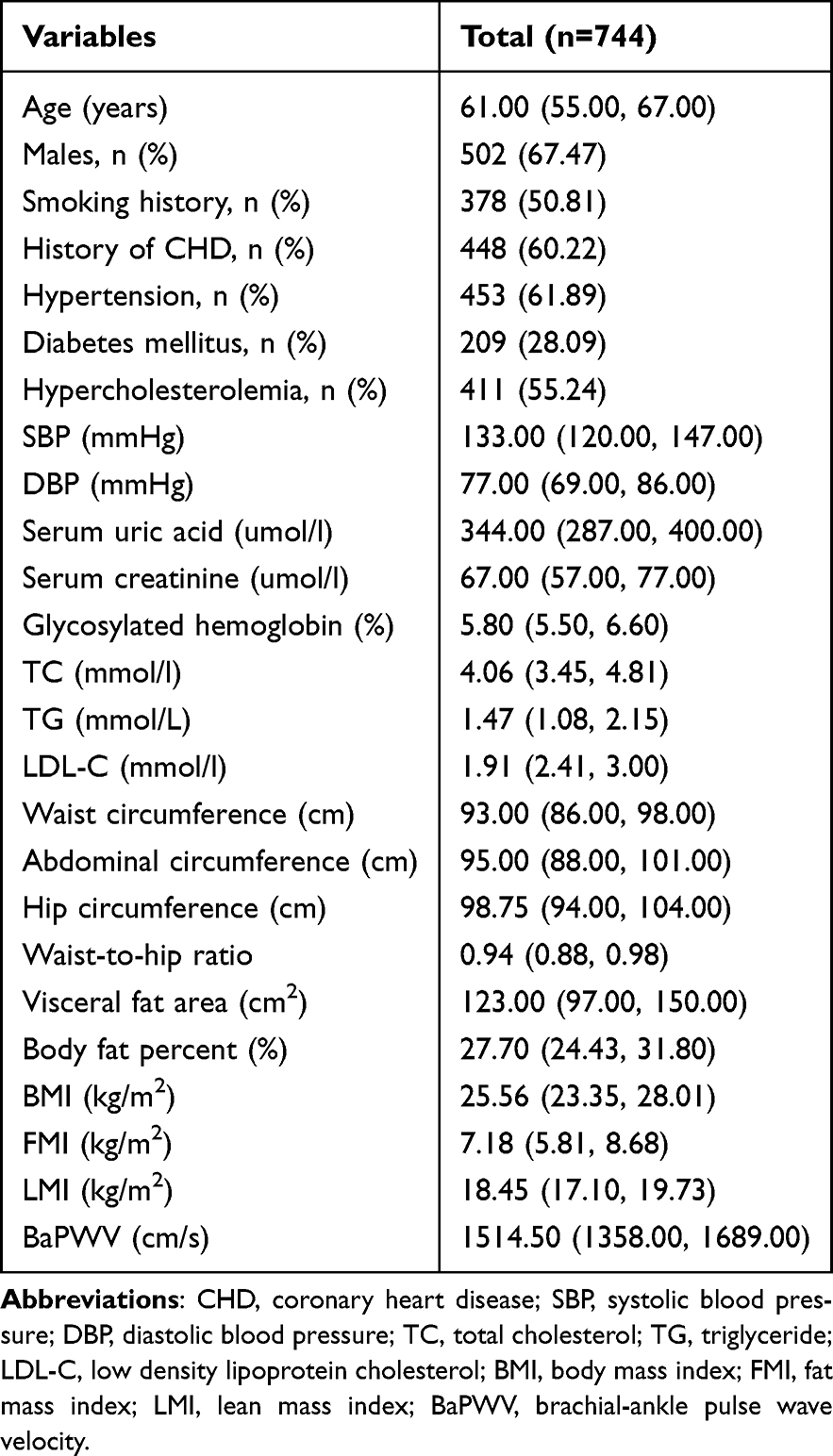 |
Table 1 Demographic and Clinical Characteristics of Participants |
As shown in Figure 1, BMI was both positively correlated with FMI (r=0.782, p<0.001) and LMI (r=0.744, p<0.001). Table 2 showed the results of Spearman correlation analyses between baPWV and multiple anthropometric parameters. Only BMI (r=−0.150, p<0.001) and LMI (r=−0.206, p<0.001) were significantly correlated with baPWV among all the parameters. As shown in Table 3, the univariate analysis showed BMI [β=−9.76, 95% CI (−15.47, −4.04), p<0.001] and LMI [β=−25.98, 95% CI (−35.15, −16.81), p<0.001] were negatively associated with baPWV. Model 1 showed that the association between BMI [β=−5.99, 95% CI (−11.10, −0.89), p=0.022] and baPWV remained significant after adjustment of age, sex, smoking history, LDL-C, history of CHD, hypertension, and DM. However, BMI [β=5.61, 95% CI (−4.28, 15.49), p=0.266] became insignificant after LMI [β=−25.85, 95% CI (−44.73, −6.96), p=0.007] was included in the model 2. The variance inflation factors for all variables were less than 10.
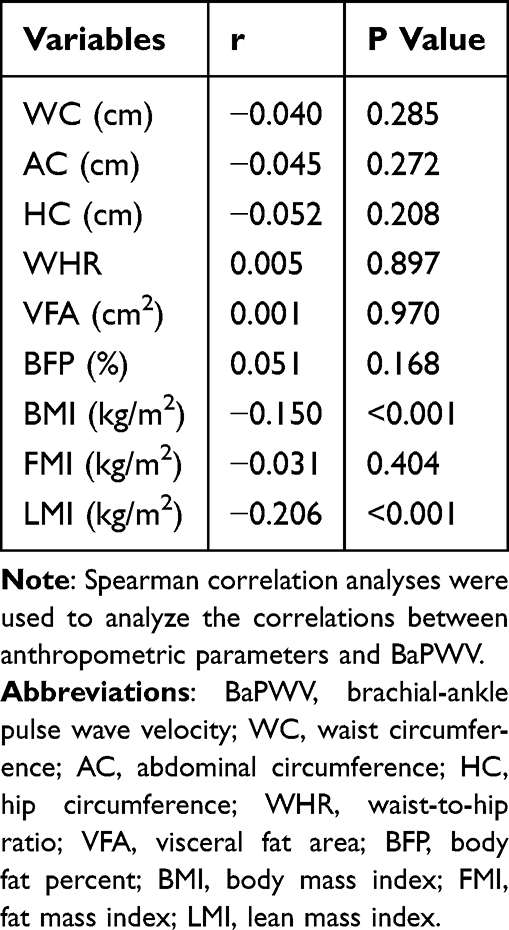 |
Table 2 Correlations Between Anthropometric Parameters and baPWV |
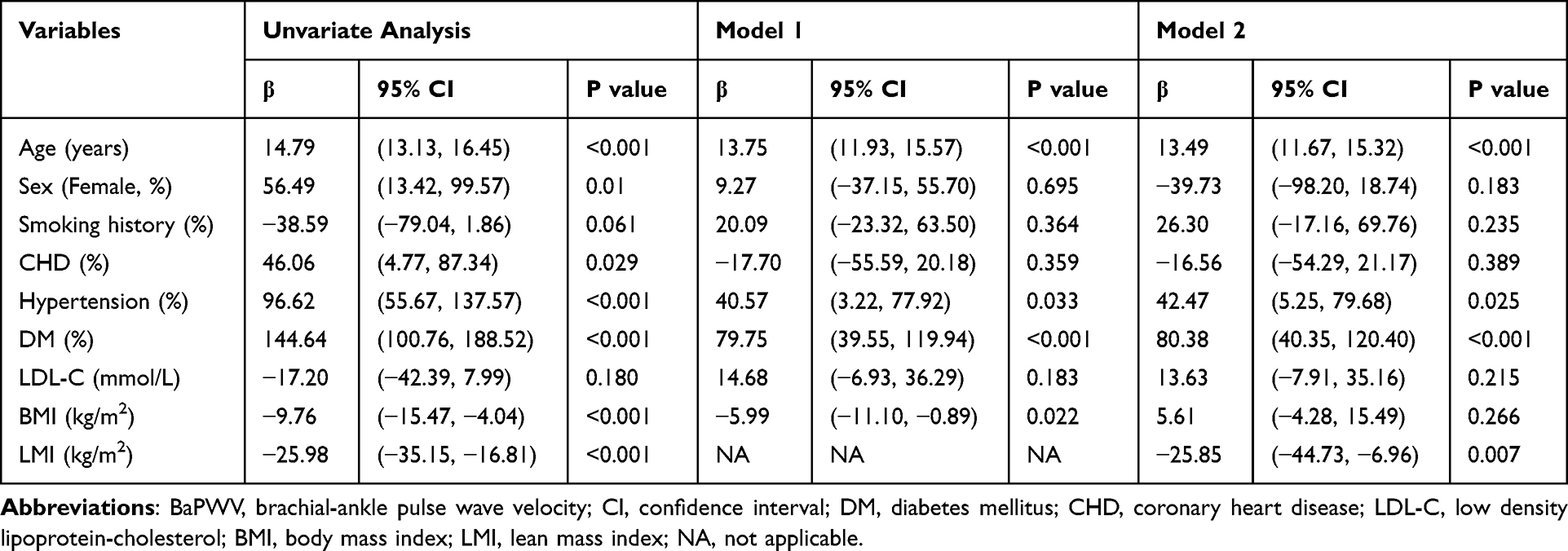 |
Table 3 Univariate and Multivariate Linear Regression Model for baPWV |
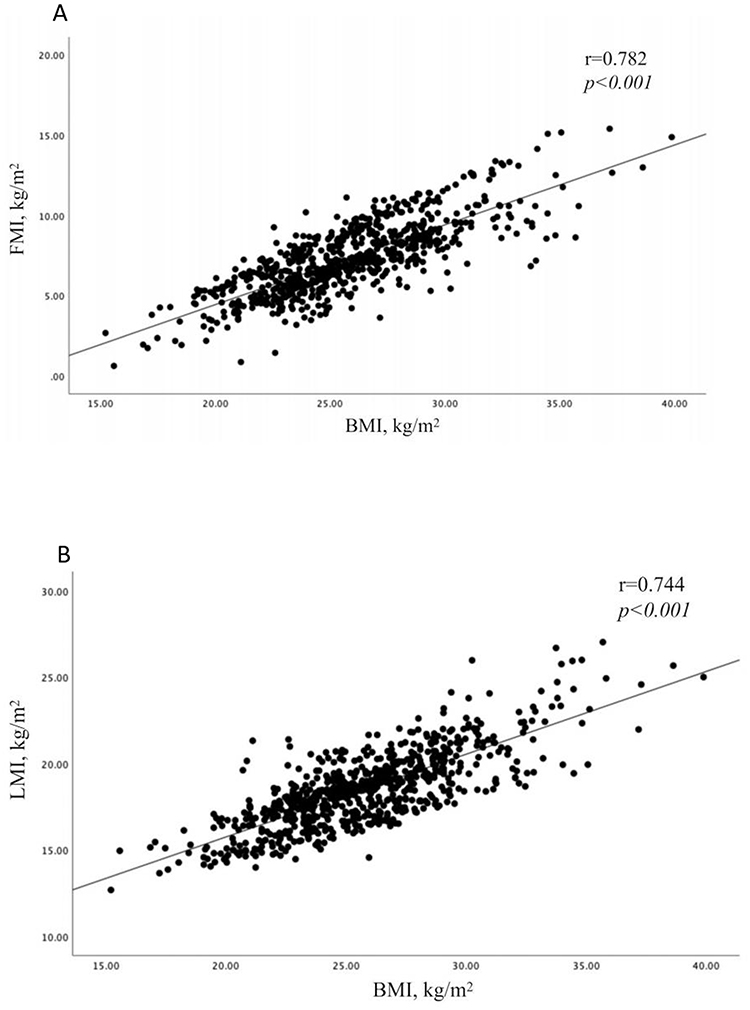 |
Figure 1 Correlations between BMI and FMI, LMI. (A) Correlation between BMI and FMI. (B) Correlation between BMI and LMI. Abbreviations: BMI, body mass index; FMI, fat mass index; LMI, lean mass index. |
Table 4 shows the results of mediation analysis performed to identify the mediating effect of BMD on the association between LMI and baPWV. LMI had a significant direct effect on baPWV [direct effect=−24.53, 95% CI (−35.95, −13.11), p<0.001], whereas BMD partially mediated the effect of LMI on baPWV [indirect effect=-6.01, 95% CI (−11.61, −0.96), p<0.001]. BMD elucidates 19.68% of the association between connecting LMI and baPWV, visually depicted in Figure 2.
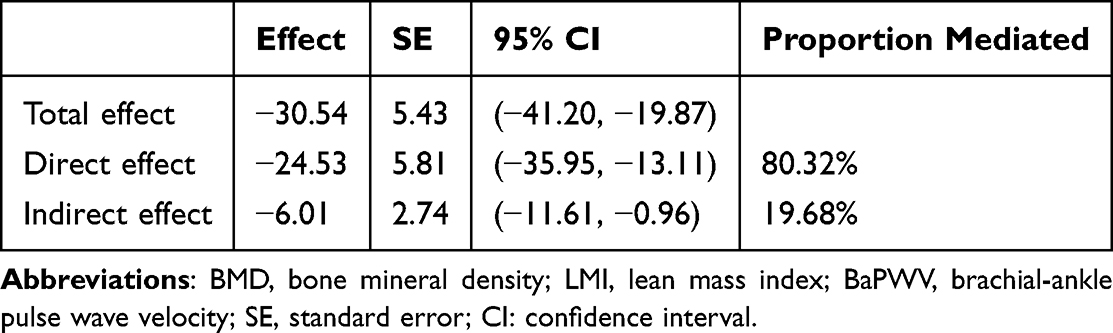 |
Table 4 Mediation Analysis of BMD on LMI and baPWV |
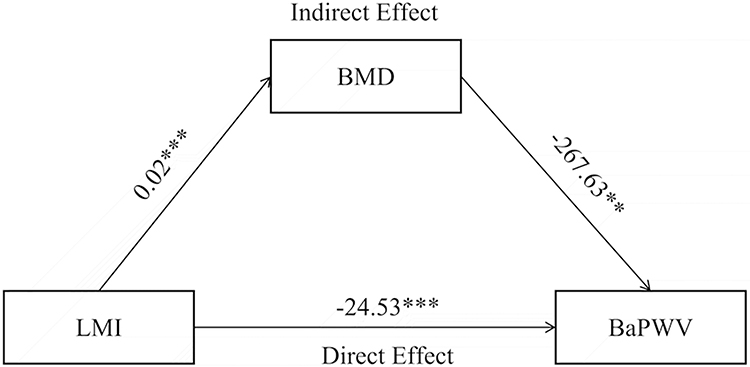 |
Figure 2 The mediating effect model of BMD on LMI and baPWV. ***p<0.001, **p<0.01. Abbreviations: BMD, bone mineral density; LMI, lean mass index; BaPWV, brachial-ankle pulse wave velocity. |
Discussion
This cross-sectional study included 744 participants from October 2016 to January 2020. BIA was further performed to examine lean mass and fat mass, which were expressed as LMI and FMI by dividing the squared height. LMI and BMI were significantly correlated with baPWV among all the anthropometric parameters. Although BMI was inversely associated with baPWV, the association became insignificant when LMI was included in the model. To the best of our knowledge, this study was the first to identify lean mass as the predominant body component that determines the relationship between BMI and arterial stiffness.
Arterial stiffness, commonly assessed using baPWV, is a feature of vascular aging and an independent predictor of cardiovascular events beyond conventional risk factors.29 BMI, a simple anthropometric measurement for obesity, was an established risk factor for CVD.7,8 However, a great number of studies found an inverse association between BMI and arterial stiffness.14–20 For example, a cross-sectional study including 7750 healthy participants found BMI was negatively correlated with arterial stiffness.30 Misako et al found arterial stiffness reduced with elevating BMI in 724 patients with diabetes mellitus.31 Huang et al found an inverse relationship between BMI and baPWV in 14866 hypertensive participants.32 The inverse relationship was also observed in several cross-sectional studies based on the general population.16,33 Our finding was in line with previous studies, as we consistently observed an inverse association between BMI and baPWV even after adjusting for multiple risk factors. Previous studies have proposed several possible explanations. Some studies hypothesized that residual confounding factors such as hypertension, smoking history and cardiorespiratory fitness were not adjusted in the model.16,19 Several studies have applied other anthropometric indices including a body shape index (ABSI), WC, WHR and VFA to assess obesity but have shown inconsistent results.15,20,34,35 So far, no study has analyzed participants’ body composition to explain the inverse association.
BMI is a crude measurement of general adiposity that cannot discriminate between lean mass and fat mass, which have distinct associations with arterial stiffness. Bioelectrical impedance analysis (BIA) is a non-invasive and simple method that estimates body composition by measuring the resistance to a low-intensity electrical current, providing valuable data on fat mass and lean mass.36 Previous studies showed that lean mass was negatively correlated with baPWV. A cross-sectional study including 186 middle-aged participants showed that arterial stiffness increased with decreasing lean mass.37 Another study showed that reduced lean mass was an independent predictor for arterial stiffness in the elderly.38 The inverse association remained significant in healthy participants as well as in patients with chronic kidney disease and peripheral artery disease.39–41 In contrast, the correlation between fat mass and arterial stiffness was inconsistent in previous studies. Several studies showed that fat mass was not significantly associated with baPWV.37,42,43 The observed inconsistencies may be attributed to the limited capacity of fat mass to reflect fat distribution.34 Consistent with previous studies, we found that lean mass instead of fat mass was significantly correlated with baPWV. Furthermore, the association between BMI and baPWV became insignificant when LMI was included in the model. BMI represents a composite measure of both lean and fat mass, whereas our findings identify lean mass as the component strongly associated with arterial stiffness, indicating the superior predictive value of the LMI over BMI.
Although the underlying mechanism for the association between LMI and baPWV remains unknown, previous studies have suggested several potential explanations. Skeletal muscle, the primary component of lean mass could secret myokines including irisin that reduce inflammation and improve insulin sensitivity to protect against arterial stiffness.44 Additionally, higher lean mass could enhance glucose metabolism, reducing oxidative stress and endothelial dysfunction.44–46 The current study was the first to report that BMD partially mediate this association. Lean mass reflects the non-fat constituents of body weight such as muscles, bones, and blood. A great number of studies showed that lean mass was positively correlated with BMD. A Mendelian randomization study confirmed lean mass as a risk factor for osteoporosis.47 Besides, recent studies found that BMD was an independent predictor for arterial stiffness.48 We found 19.68% of the association between LMI and baPWV was mediated by BMD. The possible mechanisms include abnormal calcium homeostasis and vitamin D insufficiency, which may induce bone-turnover disturbances and enhance vascular calcification.49,50
Interestingly, a large amount of studies found BMI was inversely associated with mortality in individuals with heart failure (HF), atrial fibrillation and coronary heart disease (CHD) which has been termed as “obesity paradox”.51–53 Furthermore, accumulating studies showed lean mass was an independent predictor for CVD prognosis.54–56 Our study provided a novel insight into the obesity paradox that the decreased mortality risk at higher BMI range may be attributed to increased lean mass. Compared with body weight management, interventions aimed at preserving or increasing muscle mass through resistance and aerobic exercise may yield superior prognostic outcomes.57,58 Further research is needed to vary our findings.
There are some limitations in the present study. First, due to the cross-sectional design of our study, we could not make inferences about the causality between lean mass and arterial stiffness. Prospective cohort studies are warranted to verify the conclusions. Second, the participants were recruited from a single Chinese ethnic group with established cardiovascular risk factors, which limit the generalizability of our findings to other ethnic populations and healthier population. Third, we used BIA instead of DEXA to measure body composition. However, evidence have shown that body composition measured by BIA was strongly correlated with that measured by DEXA and have been widely used in epidemiological and clinical studies.59 Finally, carotid-femoral pulse wave velocity (cfPWV) was accepted as the “gold standard” for arterial stiffness assessment, but the present study used baPWV to evaluate arterial stiffness since it is more simple, acceptable and reproducible.
Conclusions
LMI, rather than BMI, is significantly and inversely associated with arterial stiffness. BMD partially mediate the association between LMI and baPWV. Our findings provide a novel explanation for the widely observed “obesity paradox” by highlighting the protective role of lean mass in vascular health. The results underscore the clinical importance of assessing body composition to better evaluate cardiovascular risk beyond conventional anthropometric measures. Future longitudinal studies are warranted to establish causality and explore underlying mechanisms.
Data Sharing Statement
The datasets used and analyzed during the current study are available from the corresponding author on reasonable request.
Ethics Approval and Informed Consent
Informed written consent was obtained from all subjects. The study protocol complied with the Declaration of Helsinki and was approved by the Ethics Committee of the Xuanwu Hospital, Capital Medical University (Protocol No [2023] 047). Participants consented to the publishing of all clinical data included in the manuscript.
Author Contributions
Xinyi Wang: Conceptualization, Data curation, Formal analysis, Methodology, Visualization, Writing – original draft, Writing – review & editing. Ming Yi: Data curation, Formal analysis, Methodology, Visualization, Writing – original draft, Writing – review & editing. Yinghua Zhang: Formal analysis, Software, Writing – original draft, Writing – review & editing. Keling Xiao: Formal analysis, Software, Writing – original draft, Writing – review & editing. Jin Si: Formal analysis, Software, Writing – original draft, Writing – review & editing. Lijie Sun: Formal analysis, Software, Writing – original draft, Writing – review & editing. Haoyu Zhang: Software, Writing – review & editing. Jinghao Sun: Formal analysis, Visualization, Writing – review & editing. Zhaoli Liu: Formal analysis, Visualization, Writing – review & editing. Jiaying Lin: Formal analysis, Visualization, Writing – review & editing. Yuxin Xie: Formal analysis, Visualization, Writing – review & editing. Bingyan Zhang: Formal analysis, Visualization, Writing – review & editing. Jing Zhao: Formal analysis, Visualization, Writing – review & editing. Xi Chu: Conceptualization, Resources, Supervision; Validation, Writing – original draft; and Writing – review & editing. Jing Li: Conceptualization, Formal analysis, Funding acquisition, Methodology, Project administration, Resources, Supervision; Validation, Writing – original draft; and Writing – review & editing. All gave final approval of the version to be published; have agreed on the journal to which the article has been submitted; and agree to be accountable for all aspects of the work.
Funding
This work was supported by the National Natural Science Foundation of China [grant number: 82170347] and Beijing Municipal Public Welfare Development and Reform Pilot Project for Medical Research Institutes [grant number: JYY2023-13].
Disclosure
The authors declare no competing interests.
References
1. Lavie CJ, McAuley PA, Church TS, Milani RV, Blair SN. Obesity and cardiovascular diseases: implications regarding fitness, fatness, and severity in the obesity paradox. J Am Coll Cardiol. 2014;63(14):1345–1354. doi:10.1016/j.jacc.2014.01.022
2. Boutari C, Mantzoros CS. A 2022 update on the epidemiology of obesity and a call to action: as its twin COVID-19 pandemic appears to be receding, the obesity and dysmetabolism pandemic continues to rage on. Metabolism. 2022;133:155217. doi:10.1016/j.metabol.2022.155217
3. Romero-Corral A, Somers VK, Sierra-Johnson J, et al. Accuracy of body mass index in diagnosing obesity in the adult general population. Int J Obes. 2008;32(6):959–966. doi:10.1038/ijo.2008.11
4. Verma S, Hussain ME. Obesity and diabetes: an update. Diabetes Metab Syndr. 2017;11(1):73–79. doi:10.1016/j.dsx.2016.06.017
5. Bianchini F, Kaaks R, Vainio H. Overweight, obesity, and cancer risk. Lancet Oncol. 2002;3(9):565–574. doi:10.1016/S1470-2045(02)00849-5
6. Flegal KM, Graubard BI, Williamson DF, Gail MH. Cause-specific excess deaths associated with underweight, overweight, and obesity. JAMA. 2007;298(17):2028–2037. doi:10.1001/jama.298.17.2028
7. Romero-Corral A, Montori VM, Somers VK, et al. Association of bodyweight with total mortality and with cardiovascular events in coronary artery disease: a systematic review of cohort studies. The Lancet. 2006;368(9536):666–678. doi:10.1016/S0140-6736(06)69251-9
8. Jacobs DR, Sinaiko AR, Woo JG. Childhood risk factors and adult cardiovascular events. Reply. N Engl J Med. 2022;387(5):473–474. doi:10.1056/NEJMc2208135
9. Jae SY, Heffernan KS, Park JB, et al. Association between estimated pulse wave velocity and the risk of cardiovascular outcomes in men. Eur J Prev Cardiol. 2021;28(7):e25–e27. doi:10.1177/2047487320920767
10. Kim HL, Lim WH, Seo JB, Kim SH, Zo ZH, Kim MA. Prediction of cardiovascular events using brachial-ankle pulse wave velocity in hypertensive patients. J Clin Hypertens. 2020;22(9):1659–1665. doi:10.1111/jch.13992
11. Asmar R, Benetos A, Topouchian J, et al. Assessment of arterial distensibility by automatic pulse wave velocity measurement. Validation and clinical application studies. Hypertension. 1995;26(3):485–490. doi:10.1161/01.HYP.26.3.485
12. Ben-Shlomo Y, Spears M, Boustred C, et al. Aortic pulse wave velocity improves cardiovascular event prediction: an individual participant meta-analysis of prospective observational data from 17,635 subjects. J Am Coll Cardiol. 2014;63(7):636–646. doi:10.1016/j.jacc.2013.09.063
13. Tutor AW, Lavie CJ, Kachur S, Milani RV, Ventura HO. Updates on obesity and the obesity paradox in cardiovascular diseases. Prog Cardiovasc Dis. 2023;78:2–10. doi:10.1016/j.pcad.2022.11.013
14. Vallée A, Olié V, Kretz S, Safar ME, Blacher J, Blacher J. Relationship between BMI and aortic stiffness: influence of anthropometric indices in hypertensive men and women. J Hypertens. 2020;38(2):249–256. doi:10.1097/HJH.0000000000002228
15. Zhao L, Zhou X, Chen Y, et al. Association of visceral fat area or BMI with arterial stiffness in ideal cardiovascular health metrics among T2DM patients. J Diabetes. 2023;16(1):e13463. doi:10.1111/1753-0407.13463
16. Ishida A, Taira H, Shinzato T, Ohya Y. Association between visceral fat mass and arterial stiffness among community-based screening participants. Hypertens Res. 2023;46(11):2488–2496. doi:10.1038/s41440-023-01350-7
17. Zuo J, Tang B, O’Rourke MF, Avolio AP, Adji A. Association between brachial-ankle pulse wave velocity as a marker of arterial stiffness and body mass index in a Chinese population. J Cardiovasc Dev Dis. 2022;9(3):75. doi:10.3390/jcdd9030075
18. Hu F, Yu R, Han F, et al. Does body mass index or waist-hip ratio correlate with arterial stiffness based on brachial-ankle pulse wave velocity in Chinese rural adults with hypertension? BMC Cardiovasc Disord. 2021;21(1):573. doi:10.1186/s12872-021-02390-y
19. Tang B, Luo F, Zhao J, et al. Relationship between body mass index and arterial stiffness in a health assessment Chinese population. Medicine. 2020;99(3):e18793. doi:10.1097/MD.0000000000018793
20. Hu F, Zhou W, Wang T, et al. Association between six different types of anthropometric indices and arterial stiffness measured by brachial-ankle pulse wave velocity in hypertensive Chinese adults. Heliyon. 2024;10(7):e28523. doi:10.1016/j.heliyon.2024.e28523
21. Corden B, Keenan NG, de Marvao ASM, et al. Body fat is associated with reduced aortic stiffness until middle age. Hypertension. 2013;61(6):1322–1327. doi:10.1161/HYPERTENSIONAHA.113.01177
22. Rodríguez AJ, Karim MN, Srikanth V, Ebeling PR, Scott D. Lower muscle tissue is associated with higher pulse wave velocity: a systematic review and meta-analysis of observational study data. Clin Exp Pharmacol Physiol. 2017;44(10):980–992. doi:10.1111/1440-1681.12805
23. Agbaje AO, Barker AR, Tuomainen TP. Cardiorespiratory fitness, fat mass, and cardiometabolic health with endothelial function, arterial elasticity, and stiffness. Med Sci Sports Exerc. 2022;54(1):141–152. doi:10.1249/MSS.0000000000002757
24. Bartholomew CL, Martins C, Gower B. Association between insulin sensitivity and lean mass loss during weight loss. Obesity. 2024;32(6):1156–1162. doi:10.1002/oby.24022
25. Kolb H. Obese visceral fat tissue inflammation: from protective to detrimental? BMC Med. 2022;20(1):494. doi:10.1186/s12916-022-02672-y
26. Janochova K, Haluzik M, Buzga M. Visceral fat and insulin resistance - what we know? Biomed Pap Med Fac Univ Palacky Olomouc. 2019;163(1):19–27. doi:10.5507/bp.2018.062
27. Hoffman RP, Copenhaver MM, Zhou D, Yu CY. Increased body fat and reduced insulin sensitivity are associated with impaired endothelial function and subendocardial viability in healthy, non-Hispanic white adolescents. Pediatr Diabetes. 2019;20(7):842–848. doi:10.1111/pedi.12896
28. Ward LC. Bioelectrical impedance analysis for body composition assessment: reflections on accuracy, clinical utility, and standardisation. Eur J Clin Nutr. 2019;73(2):194–199. doi:10.1038/s41430-018-0335-3
29. Boutouyrie P, Chowienczyk P, Humphrey JD, Mitchell GF. Arterial stiffness and cardiovascular risk in hypertension. Circ Res. 2021;128(7):864–886. doi:10.1161/CIRCRESAHA.121.318061
30. Sugiura T, Dohi Y, Takagi Y, et al. Relationships of obesity-related indices and metabolic syndrome with subclinical atherosclerosis in middle-aged untreated Japanese workers. J Atheroscler Thromb. 2020;27(4):342–352. doi:10.5551/jat.50633
31. Hamamura M, Mita T, Osonoi Y, et al. Relationships among conventional cardiovascular risk factors and lifestyle habits with arterial stiffness in type 2 diabetic patients. J Clin Med Res. 2017;9(4):297–302. doi:10.14740/jocmr2870w
32. Huang J, Chen Z, Yuan J, et al. Association Between Body Mass Index (BMI) and Brachial-Ankle Pulse Wave Velocity (baPWV) in males with hypertension: a community-based cross-section study in North China. Med Sci Monit. 2019;25:5241–5257. doi:10.12659/MSM.914881
33. Zhang Y, Fujiyoshi A, Higashiyama A, et al. Appendicular muscle mass index was stronger than body mass index in association with atherosclerosis in the community-dwelling elderly. J Atheroscler Thromb. 2023;30(12):1882–1892. doi:10.5551/jat.64165
34. Kim HL, Ahn DW, Kim SH, et al. Association between body fat parameters and arterial stiffness. Sci Rep. 2021;11(1):20536. doi:10.1038/s41598-021-00175-z
35. Li G, Yao T, Wu XW, et al. Novel and traditional anthropometric indices for identifying arterial stiffness in overweight and obese adults. Clin Nutr. 2020;39(3):893–900. doi:10.1016/j.clnu.2019.03.029
36. Sergi G, De Rui M, Stubbs B, Veronese N, Manzato E. Measurement of lean body mass using bioelectrical impedance analysis: a consideration of the pros and cons. Aging Clin Exp Res. 2017;29(4):591–597. doi:10.1007/s40520-016-0622-6
37. Hernandez-Martinez A, Martinez-Rosales E, Alcaraz-Ibañez M, Soriano-Maldonado A, Artero EG. Influence of body composition on arterial stiffness in middle-aged adults: healthy UAL cross-sectional study. Medicina. 2019;55(7):334. doi:10.3390/medicina55070334
38. Snijder MB, Henry RMA, Visser M, et al. Regional body composition as a determinant of arterial stiffness in the elderly: the Hoorn Study. J Hypertens. 2004;22(12):2339–2347. doi:10.1097/00004872-200412000-00016
39. Karava V, Printza N, Dotis J, et al. Body composition and arterial stiffness in pediatric patients with chronic kidney disease. Pediatr Nephrol. 2019;34(7):1253–1260. doi:10.1007/s00467-019-04224-8
40. Muster V, Gütl K, Pregartner G, et al. Lower lean mass is associated with greater arterial stiffness in patients with lower extremity artery disease. JPM. 2021;11(9):911. doi:10.3390/jpm11090911
41. Guo M, Diaz-Canestro C, Pugliese NR, Paneni F, Montero D. Lean body mass and the cardiorespiratory phenotype: an ethnic-specific relationship in Hans Chinese women and men. J Cachexia Sarcopenia Muscle. 2024;15(3):963–974. doi:10.1002/jcsm.13464
42. Yang M, Zhang X, Ding Z, et al. Low skeletal muscle mass is associated with arterial stiffness in community-dwelling Chinese aged 45 years and older. BMC Public Health. 2020;20(1):226. doi:10.1186/s12889-020-8323-7
43. Czernichow S, Bertrais S, Oppert JM, et al. Body composition and fat repartition in relation to structure and function of large arteries in middle-aged adults (the SU.VI.MAX study). Int J Obes. 2005;29(7):826–832. doi:10.1038/sj.ijo.0802986
44. Tap L, Kirkham FA, Mattace-Raso F, Joly L, Rajkumar C, Benetos A. Unraveling the links underlying arterial stiffness, bone demineralization, and muscle loss. Hypertension. 2020;76(3):629–639. doi:10.1161/HYPERTENSIONAHA.120.15184
45. Fulle S, Protasi F, Di Tano G, et al. The contribution of reactive oxygen species to sarcopenia and muscle ageing. Exp Gerontol. 2004;39(1):17–24. doi:10.1016/j.exger.2003.09.012
46. Cleasby ME, Jamieson PM, Atherton PJ. Insulin resistance and sarcopenia: mechanistic links between common co-morbidities. J Endocrinol. 2016;229(2):R67–81. doi:10.1530/JOE-15-0533
47. Liu C, Liu N, Xia Y, Zhao Z, Xiao T, Li H. Osteoporosis and sarcopenia-related traits: a bi-directional mendelian randomization study. Front Endocrinol. 2022;13:975647. doi:10.3389/fendo.2022.975647
48. Jannasz I, Brzeziński J, Mańczak M, et al. Is the association between pulse wave velocity and bone mineral density the same for men and women? - A systematic review and meta-analysis. Arch Gerontol Geriatr. 2024;119:105309. doi:10.1016/j.archger.2023.105309
49. Lu HK, Zhang Z, Ke YH, et al. High prevalence of vitamin D insufficiency in China: relationship with the levels of parathyroid hormone and markers of bone turnover. PLoS One. 2012;7(11):e47264. doi:10.1371/journal.pone.0047264
50. Fujihara Y, Nawata H, Honda M, et al. Comparative study of the correlation between atherosclerosis and osteoporosis in women in Japan and Mongolia. J Gen Fam Med. 2017;18(5):237–243. doi:10.1002/jgf2.56
51. Lavie CJ, De Schutter A, Patel DA, Romero-Corral A, Artham SM, Milani RV. Body composition and survival in stable coronary heart disease: impact of lean mass index and body fat in the “obesity paradox. J Am Coll Cardiol. 2012;60(15):1374–1380. doi:10.1016/j.jacc.2012.05.037
52. Powell-Wiley TM, Poirier P, Burke LE, et al. Obesity and cardiovascular disease: a scientific statement from the American Heart Association. Circulation. 2021;143(21). doi:10.1161/CIR.0000000000000973
53. Sandhu RK, Ezekowitz J, Andersson U, et al. The ‘obesity paradox’ in atrial fibrillation: observations from the ARISTOTLE (Apixaban for Reduction in Stroke and Other Thromboembolic Events in Atrial Fibrillation) trial. Eur Heart J. 2016;37(38):2869–2878. doi:10.1093/eurheartj/ehw124
54. Liu M, Zhang Z, Zhou C, et al. Predicted fat mass and lean mass in relation to all-cause and cause-specific mortality. J Cachexia Sarcopenia Muscle. 2022;13(2):1064–1075. doi:10.1002/jcsm.12921
55. Huang BT, Peng Y, Liu W, et al. Lean mass index, body fat and survival in Chinese patients with coronary artery disease. QJM. 2015;108(8):641–647. doi:10.1093/qjmed/hcv013
56. Batsis JA, Mackenzie TA, Emeny RT, Lopez-Jimenez F, Bartels SJ. Low lean mass with and without obesity, and mortality: results from the 1999–2004 national health and nutrition examination survey. J Gerontol a Biol Sci Med Sci. 2017;72(10):1445–1451. doi:10.1093/gerona/glx002
57. Sharma A, Sharma N, Vats S, et al. Effect of resistance training on body composition, hemodynamic parameters and exercise tolerance among patients with coronary artery disease: a systematic review. Healthcare. 2022;11(1):131. doi:10.3390/healthcare11010131
58. Strength training and aerobic exercise training for muscle disease - PubMed. 2025.
59. Sun G, French CR, Martin GR, et al. Comparison of multifrequency bioelectrical impedance analysis with dual-energy X-ray absorptiometry for assessment of percentage body fat in a large, healthy population. Am J Clin Nutr. 2005;81(1):74–78. doi:10.1093/ajcn/81.1.74
 © 2025 The Author(s). This work is published and licensed by Dove Medical Press Limited. The
full terms of this license are available at https://www.dovepress.com/terms
and incorporate the Creative Commons Attribution
- Non Commercial (unported, 4.0) License.
By accessing the work you hereby accept the Terms. Non-commercial uses of the work are permitted
without any further permission from Dove Medical Press Limited, provided the work is properly
attributed. For permission for commercial use of this work, please see paragraphs 4.2 and 5 of our Terms.
© 2025 The Author(s). This work is published and licensed by Dove Medical Press Limited. The
full terms of this license are available at https://www.dovepress.com/terms
and incorporate the Creative Commons Attribution
- Non Commercial (unported, 4.0) License.
By accessing the work you hereby accept the Terms. Non-commercial uses of the work are permitted
without any further permission from Dove Medical Press Limited, provided the work is properly
attributed. For permission for commercial use of this work, please see paragraphs 4.2 and 5 of our Terms.
Recommended articles
Association of Aldosterone, Renin, and Aldosterone to Renin Ratio with Metabolic Profile in Primary Aldosteronism
Han M, Cao X, Zhang J, Yang X, Zhang Y, Liu Y
Diabetes, Metabolic Syndrome and Obesity 2024, 17:2065-2074
Published Date: 18 May 2024
Association of Type 2 Diabetes and Body Mass Index with Arterial Stiffness: A Carotid Ultrasound Study
Su J, Liu J, Liu XC, Chen Y, Xiao X, Zhang Y, Lin XP, Du YG, Guo YX, Zhu CF, Luo XX
Diabetes, Metabolic Syndrome and Obesity 2026, 19:540353
Published Date: 16 February 2026