
Back to Journals » Infection and Drug Resistance » Volume 19
Integrative Traditional Chinese Medicine Strategies for Refractory Mycoplasma Pneumonia in Children: Clinical Challenges, Mechanisms, and Evidence-Based Insights
Received 6 December 2025
Accepted for publication 9 March 2026
Published 27 March 2026 Volume 2026:19 587094
DOI https://doi.org/10.2147/IDR.S587094
Checked for plagiarism Yes
Review by Single anonymous peer review
Peer reviewer comments 2
Editor who approved publication: Dr Sandip Patil
Meiqi Li,1 Zhenqi Wu2
1The First Clinical College, Liaoning University of Traditional Chinese Medicine, Shenyang, 110847, People’s Republic of China; 2Shenyang Key Laboratory of Traditional Chinese Medicine Exogenous Diseases, The Affiliated Hospital of Liaoning University of Traditional Chinese Medicine, Shenyang, 110034, People’s Republic of China
Correspondence: Zhenqi Wu, Shenyang Key Laboratory of Traditional Chinese Medicine Exogenous Diseases, The Affiliated Hospital of Liaoning University of Traditional Chinese Medicine, No. 33 Beiling Street, Huanggu District, Shenyang, Liaoning, 110034, People’s Republic of China, Tel +86 024-82961300, Email [email protected]; [email protected]
Abstract: Respiratory Mycoplasma Pneumonia (RMPP) in pediatric populations presents a significant therapeutic challenge, particularly due to the rising prevalence of macrolide-resistant strains and dysregulated immune responses. Traditional Chinese Medicine (TCM) offers a complementary therapeutic approach, focusing on restoring balance by addressing both underlying deficiencies, such as Qi and Yin deficiency, and excessive pathogenic factors, including inflammatory mediators (“heat toxin” in TCM theory) and mucus hypersecretion (“phlegm accumulation”). Key TCM herbs, including Scutellaria baicalensis and Isatis indigotica, demonstrate direct antimicrobial activity against Mycoplasma pneumoniae and exert immunomodulatory effects by reducing pro-inflammatory cytokines (e.g, TNF-α, IL-1, IL-6) and promoting the resolution of phlegm and mucus. These actions not only target infection but also alleviate airway obstruction and support lung function. Formulas such as Ma Xing Shi Gan Tang and Lianhua Qingwen have shown clinical efficacy when used in conjunction with antibiotics, resulting in accelerated fever resolution, reduced inflammatory markers, and enhanced radiographic improvement. Integrated treatment strategies combining TCM with conventional therapies have been shown to shorten symptom duration, decrease inflammatory biomarkers, and potentially reduce the need for corticosteroids. However, while the clinical evidence supporting TCM in RMPP management is promising, further research is needed to standardize treatment protocols, clarify the mechanistic underpinnings of TCM, and establish its role in integrated pediatric care. TCM offers a valuable adjunct to conventional treatments, enhancing therapeutic outcomes and reducing the risk of complications associated with prolonged antibiotic or corticosteroid use.
Keywords: refractory mycoplasma pneumoniae pneumonia, pediatric pneumonia, macrolide resistance, traditional Chinese medicine, integrative medicine
Introduction
Mycoplasma pneumoniae (MP) is a leading cause of respiratory tract infections in children, accounting for approximately 10–40% of community-acquired pneumonia (CAP) cases in pediatric populations.1 Unlike bacteria with cell walls, MP lacks a peptidoglycan structure, rendering it inherently resistant to β-lactam antibiotics, such as penicillins and cephalosporins.2 The pathogen is primarily transmitted through respiratory droplets, with seasonal variations in different geographical regions.3 In northern China, MP infections are more prevalent during winter and spring, whereas in southern China, cases peak in summer and autumn.4 Macrolide antibiotics, including azithromycin and erythromycin, are the first-line treatment for MP pneumonia (MPP) in children, given their efficacy and safety profile.5 However, widespread macrolide resistance (MRMP) has emerged as a significant challenge, particularly in Asia, where resistance rates have exceeded 80% in some regions.6 The increasing prevalence of macrolide-resistant strains has led to a rise in severe and refractory cases, complicating the clinical management of the disease.
Refractory Mycoplasma pneumoniae pneumonia (RMPP) represents a severe and persistent form of MPP, characterized by prolonged fever lasting ≥7 days despite macrolide therapy, progressive lung involvement, and potential extrapulmonary complications.7 The diagnostic criteria for RMPP were first proposed by Japanese researchers in 2008 and have since been widely adopted in clinical practice.7 Especially, RMPP is diagnosed based on three primary criteria: persistent fever despite appropriate macrolide therapy for at least 7 days, progressive radiographic deterioration, including lung consolidation and pleural effusion, and extrapulmonary complications such as encephalitis, myocarditis, hemolytic anemia, or thrombosis.8 The condition is more frequently observed in older children (≥5 years old), who tend to exhibit a stronger immune response, often leading to excessive inflammatory activation and more severe lung injury.9
The clinical management of RMPP poses significant challenges due to its complex pathophysiology and limited effective treatment options. Antibiotic resistance remains a major concern, as the increasing prevalence of MRMP strains significantly reduces the efficacy of macrolide therapy.6 Furthermore, excessive immune activation, characterized by Th1/Th2 imbalance and cytokine overproduction, exacerbates lung damage and contributes to systemic complications.10 Mucus hypersecretion and airway obstruction are common in severe cases, leading to atelectasis and impaired pulmonary function.11 Additionally, hypercoagulability and vascular endothelial dysfunction have been observed in RMPP, increasing the risk of thromboembolic events.12 While alternative antibiotics such as tetracyclines and fluoroquinolones have been considered for treatment, their use in young children is limited due to concerns regarding their effects on bone and cartilage development.13 Immunomodulatory therapies, including corticosteroids and intravenous immunoglobulin (IVIG), are commonly used in severe cases, but their optimal dosing strategies and long-term safety remain subjects of ongoing debate.14
Given these challenges, there has been growing interest in complementary and alternative therapeutic approaches, particularly Traditional Chinese Medicine (TCM). In recent years, TCM has been explored for its potential to inhibit MP proliferation, modulate immune responses, reduce inflammation, improve microcirculation, and alleviate adverse effects associated with conventional therapies.15 Several studies suggest that integrating TCM with standard antibiotic and immunomodulatory therapies may offer a more individualized and comprehensive approach to managing RMPP, improving clinical outcomes in affected children.15,16 Therefore, this review summarizes the mechanisms underlying RMPP and critically evaluates the potential role of traditional Chinese medicine as an adjunctive therapeutic strategy in pediatric management.
Pathogenesis of RMPP
The exact pathogenesis of RMPP remains incompletely understood, but it is believed to involve a combination of macrolide resistance, abnormal immune responses, excessive mucus production, hypercoagulability, and co-infections (Table 1). These factors contribute to the disease’s severity and treatment challenges.
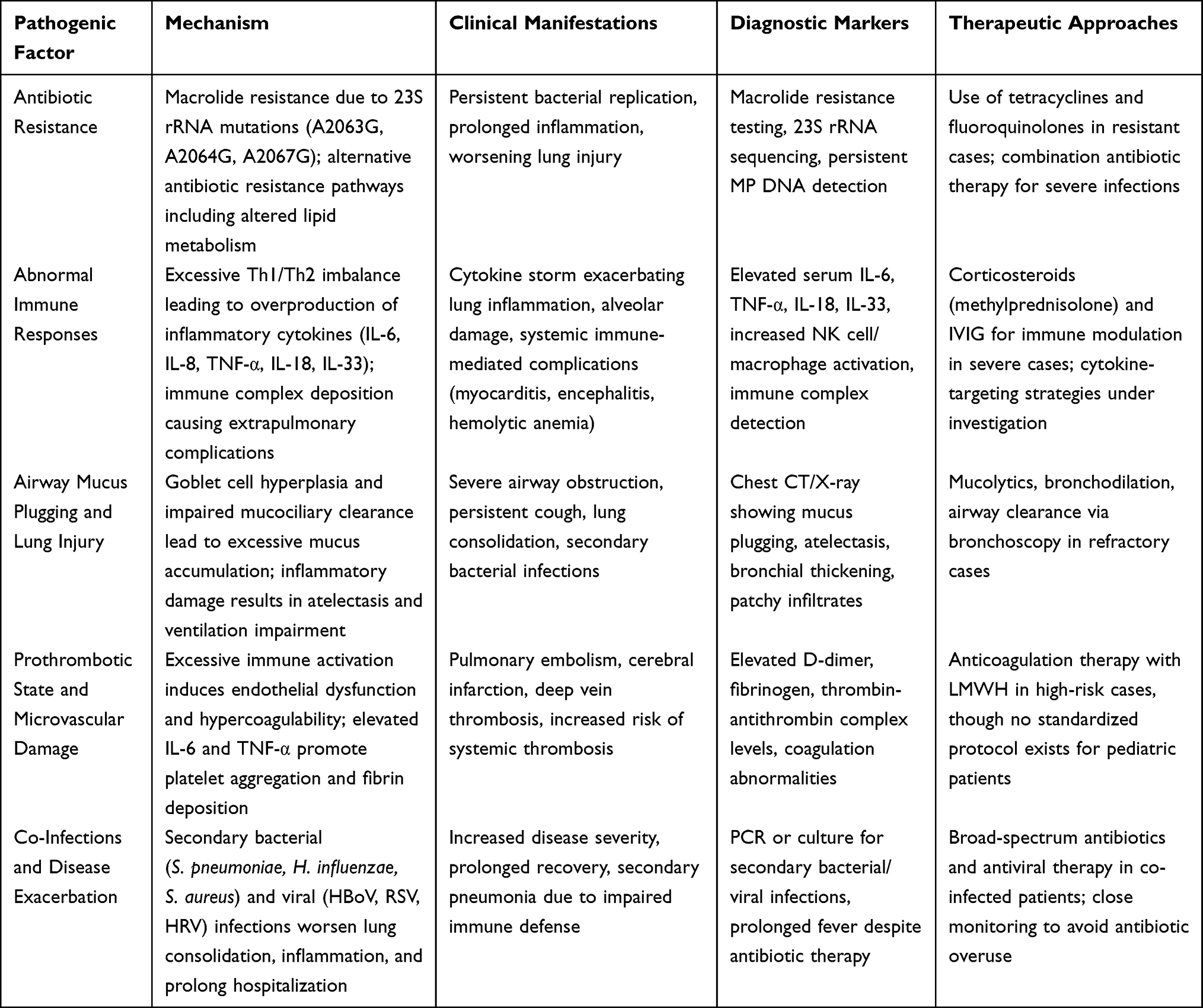 |
Table 1 Comprehensive Summary of the Pathogenesis, Clinical Manifestations, and Treatment Strategies of Refractory Mycoplasma Pneumoniae Pneumonia (RMPP) |
Antibiotic Resistance Mechanisms
MP lacks a cell wall, making it naturally resistant to β-lactam antibiotics.17 Macrolides target the bacterial 50S ribosomal subunit, inhibiting protein synthesis.18 However, point mutations in the 23S rRNA gene at positions A2063G, A2064G, and A2067G significantly reduce the binding affinity of macrolides, leading to resistance.19 Long-term and widespread use of macrolides has driven the selection of resistant MP strains, with resistance rates in Asia exceeding 80%.20 In macrolide-resistant cases, persistent bacterial replication and colonization prolong the inflammatory process, contributing to disease progression and refractory symptoms.21 Additionally, studies have suggested that alterations in MP membrane lipid metabolism and transporter proteins may play a role in antibiotic resistance.22 Dysregulation in these pathways enhances the bacterium’s ability to evade host immune responses and therapeutic interventions.22
Abnormal Immune Responses
In addition to antibiotic resistance, excessive immune activation and dysregulated inflammatory responses play a crucial role in the pathogenesis of RMPP.23 Unlike typical MPP cases, where inflammation is primarily controlled by the host immune system, RMPP exhibits aberrant immune responses that contribute to lung injury and systemic complications.24
T-helper cell imbalance is a hallmark of RMPP.25 Studies have shown that RMPP patients exhibit an excessive Th1/Th2 imbalance, with increased Th1-related cytokines (eg, IFN-γ, TNF-α) and Th2-related cytokines (eg, IL-4, IL-6, IL-18, IL-33).26 The overproduction of IL-6 and TNF-α leads to a cytokine storm, which exacerbates lung inflammation and damages alveolar structures.27 Additionally, IL-18 activation stimulates macrophages and natural killer (NK) cells, further promoting the release of pro-inflammatory cytokines.28 IL-33, a key mediator of Th2-driven immunity, enhances eosinophilic inflammation and mucus secretion, contributing to airway obstruction.29
Extrapulmonary complications in RMPP are partly attributed to immune complex deposition in multiple organs, including the heart, kidneys, and central nervous system.30 MP shares structural antigens with host tissues, leading to autoimmune reactions that can trigger myocarditis, encephalitis, and hemolytic anemia.31 These immune mechanisms justify the clinical use of corticosteroids and intravenous immunoglobulin (IVIG) for severe pediatric RMPP.
Airway Mucus Plugging and Lung Injury
A distinctive feature of RMPP is excessive airway mucus production, which contributes to persistent cough, airway obstruction, and worsening respiratory distress.32 The accumulation of thick mucus plugs in the bronchi leads to atelectasis and ventilation impairment, further complicating treatment.33
The overproduction of mucus is driven by elevated levels of IL-6 and IL-8, which stimulate goblet cell hyperplasia and excessive mucus secretion.34 Inflammatory damage to ciliary epithelial cells impairs mucociliary clearance, allowing mucus to accumulate and form airway plugs.32 Chest imaging in RMPP often reveals lung consolidation, atelectasis, and patchy infiltrates, indicative of mucus-related airway obstruction.35
Severe mucus plugging also increases the risk of secondary bacterial infections, further complicating disease management.36 The presence of thick, tenacious mucus creates an ideal environment for bacterial colonization, particularly with Streptococcus pneumoniae and Haemophilus influenzae.37 Consequently, bronchoscopic mucus removal is sometimes required in severe cases to restore airway patency.38 Clinically, early anti-inflammatory and airway-clearance strategies are critical to prevent mucus-associated complications.
Prothrombotic State and Microvascular Damage
Emerging evidence suggests that MP infection induces a hypercoagulable state, increasing the risk of thrombosis and vascular endothelial damage.39 RMPP patients frequently exhibit elevated D-dimer levels, indicative of systemic hypercoagulability.40 The exact mechanism remains unclear, but several factors contribute to this prothrombotic state.
First, MP infection triggers excessive immune activation, leading to vascular inflammation and endothelial dysfunction. The activation of complement pathways and neutrophil recruitment results in the release of pro-inflammatory cytokines, proteases, and reactive oxygen species (ROS), which disrupt vascular integrity.23 Additionally, IL-6 and TNF-α promote platelet activation and fibrin deposition, further exacerbating coagulation abnormalities.41
Clinically, hypercoagulability in RMPP can manifest as pulmonary embolism, cerebral infarction, and deep vein thrombosis.39 Anticoagulation therapy with low-molecular-weight heparin (LMWH) has been used in severe cases, but there is no standardized protocol for its use in pediatric patients.42
Co-Infections and Disease Exacerbation
MP infection compromises airway defenses, predisposing patients to bacterial and viral co-infections that can worsen disease severity.21 Bacterial co-infections, particularly with Streptococcus pneumoniae, Haemophilus influenzae, and Staphylococcus aureus, are commonly observed in severe RMPP cases.43 These secondary infections contribute to persistent fever, worsening lung consolidation, and prolonged hospitalization.35
Viral co-infections are also common in children with RMPP, with human bocavirus (HBoV), respiratory syncytial virus (RSV), and rhinovirus (HRV) being frequently detected.43 Viral infections exacerbate airway inflammation and immune dysregulation, leading to greater disease severity and prolonged recovery times.32
Given the multifactorial nature of RMPP pathogenesis, a comprehensive treatment strategy targeting both infection control and immune modulation is essential. The following sections will discuss conventional treatment approaches, their limitations, and the potential role of Traditional Chinese Medicine (TCM) in addressing these challenges.
Conventional Treatment Approaches and Challenges
Antibiotic Therapy
Macrolides, including azithromycin, clarithromycin, and erythromycin, are the first-line treatment for MPP.13 These antibiotics exert their antibacterial effects by binding to the 50S ribosomal subunit, inhibiting bacterial protein synthesis.17 However, the increasing prevalence of macrolide-resistant Mycoplasma pneumoniae (MRMP) has significantly reduced their efficacy, particularly in Asia, where resistance rates exceed 80%.44 The emergence of macrolide resistance is largely attributed to point mutations in the 23S rRNA gene, which alter ribosomal structure and decrease macrolide binding affinity.45 Consequently, persistent bacterial replication and prolonged immune activation contribute to the development of RMPP.
For macrolide-resistant cases, alternative antibiotics such as tetracyclines (doxycycline, minocycline) and fluoroquinolones (moxifloxacin, levofloxacin) have been considered.13 These antibiotics target the 30S ribosomal subunit and DNA gyrase/topoisomerase IV, respectively, effectively inhibiting bacterial growth.18 However, their use in children is restricted due to safety concerns. Tetracyclines are generally contraindicated in children under eight years of age because they can lead to permanent tooth discoloration and impair bone growth.46 Fluoroquinolones, although effective against resistant strains, are not recommended for children under eighteen years due to their association with cartilage damage and tendon rupture.47
Given the limitations of monotherapy, some studies have explored the use of combination antibiotic therapy to improve treatment outcomes in RMPP. The combination of macrolides with tetracyclines or fluoroquinolones has been proposed as a strategy to enhance bacterial clearance.48,49 However, there is no consensus on the optimal regimen, and concerns remain regarding potential antibiotic overuse, adverse effects, and further resistance development.
Immunomodulatory Therapy
Corticosteroids are frequently used in RMPP to reduce excessive inflammation, inhibit cytokine release, and prevent lung injury.50 The optimal timing, dosage, and duration of corticosteroid therapy remain subjects of debate, but methylprednisolone pulse therapy is commonly adopted in severe cases. In moderate cases, low-dose regimens of 1–2 mg/kg/day for three to five days are typically administered. In severe cases with significant lung involvement, high-dose regimens of 10–30 mg/kg/day for three days, followed by gradual tapering, are often recommended.51
Corticosteroids have been shown to be effective in reducing fever duration, improving lung inflammation, and enhancing oxygenation.52 However, their use is associated with several potential adverse effects, including immune suppression, hyperglycemia, hypertension, and growth retardation in children.53,54 Prolonged corticosteroid use may also lead to osteoporosis, gastrointestinal bleeding, and increased susceptibility to secondary infections.55 Additionally, the timing of corticosteroid administration appears to influence treatment outcomes, with early intervention demonstrating greater effectiveness compared to delayed administration.56
IVIG is occasionally used as an adjunct therapy in severe or steroid-resistant RMPP cases, particularly when autoimmune-mediated complications such as encephalitis, myocarditis, or hemolytic anemia are present.57 IVIG functions by neutralizing pro-inflammatory cytokines, modulating immune responses, and preventing immune complex deposition in target organs.58
Despite its potential benefits, IVIG therapy presents several limitations. The high cost of IVIG makes it less accessible in resource-limited settings, posing a financial barrier to widespread use.59 There is currently a lack of standardized dosing guidelines, leading to variations in clinical practice.60 Additionally, evidence supporting its efficacy remains limited, with some studies reporting no significant improvement in clinical outcomes.57 Due to these concerns, IVIG is generally reserved for patients with severe systemic inflammation who do not respond to corticosteroid therapy.61
Antithrombotic Therapy
Emerging evidence suggests that MP infection induces a hypercoagulable state, leading to an increased risk of thrombosis and vascular endothelial injury.39 Elevated D-dimer levels, fibrinogen concentration, and thrombin-antithrombin complex formation have been observed in RMPP patients, suggesting an abnormal coagulation profile.62 The underlying mechanisms remain unclear but are thought to involve excessive immune activation, endothelial dysfunction, and increased platelet aggregation.8
The most commonly reported thrombotic complications in RMPP include pulmonary embolism, cerebral infarction, and deep vein thrombosis.63 These conditions can lead to significant morbidity, necessitating early recognition and intervention.64 Anticoagulation therapy with low-molecular-weight heparin (LMWH) or vitamin K antagonists has been used in severe cases to prevent clot formation and reduce the risk of embolic events.65 However, the use of anticoagulation in pediatric RMPP patients remains controversial due to the absence of standardized guidelines and the risk of bleeding complications.
Although early identification of thrombotic complications is crucial, routine anticoagulation therapy is not recommended for all RMPP patients.66 Instead, D-dimer monitoring and coagulation assessments should be performed in high-risk patients to guide individualized treatment strategies.67
Limitations of Conventional Therapies
Despite advancements in antibiotic therapy, immunomodulation, and anticoagulation, significant challenges remain in the management of RMPP. The increasing prevalence of macrolide-resistant strains has reduced the effectiveness of first-line antibiotics, limiting treatment options. Alternative antibiotics such as tetracyclines and fluoroquinolones are effective but have age-related safety concerns that restrict their use in children. Immunomodulatory therapies, including corticosteroids and IVIG, can ameliorate excessive inflammation, but their optimal dosing strategies and long-term safety profiles remain unclear. Additionally, the lack of standardized anticoagulation guidelines complicates the management of RMPP-related thrombotic complications.
Given these challenges, there is growing interest in complementary and integrative approaches, particularly TCM. TCM has been explored for its potential to inhibit MP replication, regulate immune responses, reduce inflammatory damage, and improve microcirculation.41 The following section will discuss TCM approaches and their role in addressing the limitations of conventional treatments.
Traditional Chinese Medicine (TCM) in the Management of RMPP
TCM Perspective on RMPP
In TCM, RMPP in children is classified under “pneumonia with dyspneic cough”, characterized by labored breathing, persistent cough, and fever.15 TCM interprets this condition as one of “root deficiency and branch excess”.68 The “root” refers to internal deficiencies—particularly Qi deficiency (a weakness of vital energy, commonly in the lungs and spleen) and Yin deficiency (depletion of fluids due to prolonged fever)—that reduce the body’s resistance. The “branch”, by contrast, represents excessive pathogenic factors such as phlegm-heat, toxic heat, and blood stasis, which accumulate during infection. Persistent high fever and inflammation correspond to “heat toxin”, excessive mucus congestion indicates “phlegm obstruction”, and vascular injury or microthrombosis corresponds to “blood stasis”. This conceptual framework mirrors the biomedical view of RMPP as a condition involving persistent infection, immune overactivation, mucus plugging, and vascular injury in a host with reduced immunologic resilience.
Based on these principles, TCM treatment aims to both eliminate the pathogenic excess and reinforce the body’s deficiency. The key therapeutic principles included clearing heat and resolving toxin to suppress excessive inflammation, transforming phlegm and opening the lung to improve ventilation and sputum clearance, invigorating blood circulation and removing stasis to enhance microcirculation and reduce consolidation, and tonifying Qi and nourishing Yin to strengthen recovery and prevent relapse.69 This stage-based approach adapts dynamically to disease progression: in the acute febrile phase, “heat-clearing and toxin-resolving” formulas predominate, while in the recovery phase, Qi- and Yin-tonifying herbs are introduced to restore physiological balance.
Mechanisms of TCM in Treating RMPP
Multi-Target and Multi-Pathway Mechanisms
Modern research increasingly reveals that TCM exerts its therapeutic effects on RMPP through a multi-component, multi-target, and multi-pathway approach.70 Unlike single-compound pharmaceuticals, TCM formulas consist of numerous bioactive constituents—flavonoids, alkaloids, terpenoids, and saponins—that act synergistically to modulate inflammation, immunity, microbial proliferation, and tissue repair.71 Network pharmacology and metabolomic analyses have shown that many TCM formulations target critical molecular pathways such as NF-κB, NLRP3 inflammasome, AMPK/mTOR, and MAPK, thereby reducing hyperinflammation, oxidative stress, and immune overactivation associated with RMPP pathogenesis.72
Anti-Mycoplasma and Antimicrobial Activity
Several TCM herbs have demonstrated direct anti-Mycoplasma effects or synergy with antibiotics. Scutellaria baicalensis (Huangqin) contains baicalin and baicalein, which suppress M. pneumoniae growth and inhibit bacterial adherence.73 Isatis indigotica (Banlangen) and Houttuynia cordata (Yuxingcao) exhibit broad-spectrum antimicrobial and antiviral effects by disrupting microbial nucleic acid synthesis and enhancing macrophage phagocytosis.74 These actions not only reduce microbial load but also enhance the effectiveness of macrolide antibiotics—critical in RMPP cases that are often resistant to conventional therapy.
Anti-Inflammatory and Immunomodulatory Effects
One hallmark of RMPP is excessive immune activation leading to lung tissue damage.75 TCM formulas rich in polyphenols and saponins modulate both innate and adaptive immune responses. For instance, Forsythia suspensa (Lianqiao) and Scutellaria baicalensis (Huangqin) downregulate pro-inflammatory cytokines (TNF-α, IL-6, IL-8) by suppressing the NF-κB and MAPK pathways.76 Glycyrrhiza uralensis (Gancao) reduces HMGB1-mediated inflammation,77 while Astragalus membranaceus (Huangqi) and Cordyceps sinensis promote immune homeostasis by enhancing CD4⁺ T-cell function and balancing Th1/Th2 responses.78,79 Clinical trials in recent years have shown that integrating TCM formulas with standard antibiotic therapy significantly lowers serum CRP, IL-6, and TNF-α, shortening fever duration and accelerating radiographic resolution.80
Bronchodilation and Mucus Clearance
Airway obstruction caused by mucus hypersecretion is a major contributor to respiratory distress in RMPP.81 Herbs such as Ephedra sinica (Mahuang) and Armeniacae Semen (Xingren) —components of the classical Ma Xing Shi Gan Tang (Maxing Shigan Decoction)—exert bronchodilatory and antitussive effects.82 Ephedrine relaxes bronchial smooth muscle via β2-adrenergic stimulation, while amygdalin from Xingren suppresses cough reflex and aids expectoration.83 Platycodon grandiflorus (Jiegeng) promotes mucus clearance by increasing ciliary motility and reducing sputum viscosity.84 These properties collectively alleviate wheezing and dyspnea, improving pulmonary ventilation and oxygenation in pediatric patients.
Protection and Repair of Lung Tissue
Beyond antimicrobial and anti-inflammatory actions, TCM herbs also protect alveolar epithelium and promote tissue repair.85 Salvia miltiorrhiza (Danshen) and Panax notoginseng (Sanqi) enhance microcirculatory perfusion, inhibit platelet aggregation, and mitigate endothelial injury—mechanistically preventing microthrombosis often observed in RMPP.86 Danshen’s tanshinones exhibit potent antioxidative activity, reducing lipid peroxidation and improving alveolar-capillary integrity.87 Experimental models confirm that these herbs downregulate TGF-β1 and α-SMA expression, mitigating pulmonary fibrosis and aiding recovery.88
Regulation of Cell Death and Autophagy
Recent molecular studies have uncovered that certain TCM formulations modulate inflammatory cell death pathways. For instance, Maxing Shigan Decoction inhibits NLRP3 inflammasome activation and pyroptosis in alveolar macrophages by promoting autophagy via the AMPK/mTOR/ULK1 signaling axis.89 This not only reduces IL-1β secretion but also prevents excessive cell death and lung injury.90 Such mechanistic discoveries bridge traditional TCM theory—“clearing heat and toxin”—with modern immunopathological understanding.
Reduction of Therapy-Related Side Effects
Another notable advantage of TCM integration is its ability to mitigate the adverse effects of antibiotics and corticosteroids. Glycyrrhiza uralensis protects gastric mucosa and supports adrenal function, while Qi-tonifying herbs like Astragalus and Codonopsis pilosula (Dangshen) improve appetite, enhance vitality, and restore gut microbiota balance after prolonged drug therapy.91 This holistic support helps maintain immune resilience and promotes full convalescence.
Integrative Clinical Evidence
Recent clinical and experimental studies provide tangible evidence supporting these mechanisms. For instance, Ling et al15 reported that children receiving “heat-phlegm and toxin-clearing” TCM therapy experienced faster fever resolution and improved chest imaging outcomes compared with controls. Formulas incorporating Forsythia, Scutellaria, and Houttuynia significantly decreased inflammatory cytokines and sputum production,92 while “blood-activating” herbs like Salvia accelerated the absorption of pulmonary infiltrates.93 Collectively, these findings confirm that TCM not only alleviates symptoms but also modulates the immune–inflammatory cascade and promotes tissue repair.
Commonly Used Formulas, Clinical Applications, and Evidence for Efficacy and Safety
Recently, a growing body of clinical evidence from China has evaluated TCM herbal formulas as adjunctive therapies in pediatric RMPP.15 These studies consistently report that the combination of TCM and conventional Western therapy accelerates symptom resolution, improves radiological recovery, and reduces inflammatory biomarkers without increasing adverse events. The main outcome indicators assessed include time to fever clearance, cough duration, lung auscultation findings, chest imaging absorption, and length of hospitalization. Below, major formulas used in RMPP are summarized, highlighting their composition, TCM indications, mechanisms, and supporting evidence (Table 2).
 |
Table 2 Summary of Commonly Used TCM Formulas for Refractory Mycoplasma Pneumoniae Pneumonia (RMPP) |
Ma Xing Shi Gan Tang (Maxingshigan Decoction)
This classical prescription—comprising Ephedra sinica (Ma Huang), Armeniacae Semen (Xing Ren), Gypsum fibrosum (Shi Gao), and Glycyrrhiza uralensis (Gan Cao)—is traditionally used for “lung heat with wheezing”, typified by high fever, cough, and labored breathing.94 In the context of RMPP, it corresponds to “heat obstructing the lungs”, where excessive inflammation and thick phlegm hinder normal respiration.95
Numerous RCTs and meta-analyses support its effectiveness. A meta-analysis of 13 RCTs (657 patients) reported that adding Maxing Shigan-based prescriptions to antibiotics increased clinical efficacy (pooled OR ≈ 2.3) compared with antibiotics alone.96 A larger 2025 systematic review involving 6682 patients with community-acquired pneumonia found that combined therapy shortened fever, cough, sputum, and dyspnea durations by 1.6–2.4 days.97 In pediatric RMPP specifically, integrated therapy achieved faster resolution of fever and rales (~2–3 days earlier) and enhanced chest X-ray absorption by ~2.7 days on average.98,99
Pharmacological studies confirm that Maxing Shigan Decoction suppresses excessive lung inflammation by inhibiting NLRP3 inflammasome activation and promoting autophagy through the AMPK/mTOR/ULK1 pathway.89 Clinically, it reduces IL-6 and TNF-α levels, consistent with its heat-clearing, antipyretic effects.90 Safety data are reassuring: pooled analyses show no significant difference in adverse event rates between herbal and control groups (3.6% vs. 5.4%), with only mild gastrointestinal discomfort occasionally reported.97 When properly dosed, the formula is well-tolerated in children.97
Qingfei Paidu Decoction (QFPD)
Qingfei Paidu Decoction, formulated during the COVID-19 pandemic, is a composite of classical recipes such as Ma Xing Shi Gan Tang, Shegan Mahuang Tang, Xiao Chaihu Tang, and Wuling San.100 It contains over 20 herbs, including Ephedra, Gypsum, Apricot kernel, Licorice, Bupleurum, Scutellaria, Pinellia, and Atractylodes.101 It “clears heat and detoxifies the lung”, “resolves dampness”, and “supports the spleen.102“ Clinically, it is used in severe RMPP with persistent high fever, radiographic consolidation, and respiratory distress.
Although pediatric RMPP-specific RCTs remain limited, QFPD’s efficacy is inferred from its success in severe viral pneumonias. Studies during COVID-19 demonstrated that QFPD reduced disease severity, inflammation, and hospital stay without major adverse effects.103 Experimental research revealed that QFPD suppresses hyperinflammation by downregulating TNF-α, IL-6, and complement C3 activation while modulating the HIF-1α/NF-κB axis.104 These actions reduce pulmonary edema, inhibit cytokine storms, and improve tissue oxygenation.105 Its “broad-spectrum” mechanism—combining antiviral, anti-inflammatory, and organ-protective effects—makes it a rational choice for integrative RMPP therapy.
Clinical use in both adults and children during the COVID-19 pandemic showed excellent tolerability. Mild gastrointestinal reactions and transient rashes were occasionally observed but self-resolved.101 Given the inclusion of Ephedra, caution is warranted in young children; however, its stimulating effects are balanced by Gypsum and dampness-clearing herbs.106 Physicians generally restrict QFPD to short-term use during acute illness, switching to milder tonics during recovery.107
Lianhua Qingwen (LHQW) Capsules/Granules
LHQW is a patented modern TCM formula combining Forsythia suspensa, Lonicera japonica, Ephedra, Gypsum, Isatis root, Houttuynia cordata, Rheum palmatum, and others.108 It “clears heat and detoxifies, disperses lung obstruction, and releases the exterior”, addressing wind-heat toxin syndromes with fever, sore throat, and productive cough.108
A 2024 meta-analysis (Li et al) encompassing 15 RCTs and 1909 pediatric Mycoplasma pneumoniae cases found that LHQW plus azithromycin significantly improved outcomes versus azithromycin alone—higher response rate (RR = 1.17), faster fever relief (by ~1.3 days), cough resolution (by ~1.7 days), and earlier rales disappearance (by ~1.5 days).109 Inflammatory biomarkers (CRP, PCT, IL-6, TNF-α) were markedly reduced, and pulmonary function (FEV1, FVC) improved.109,110
Pharmacological studies confirm that LHQW inhibits NF-κB and NLRP3 inflammasome activation, suppressing IL-1β, IL-6, and TNF-α release.111 It also enhances mucosal barrier function, reduces oxidative stress via Forsythia and Rhodiola constituents, and impedes pathogen adhesion.112 These multifaceted mechanisms explain its broad efficacy in respiratory infections including RMPP.
Across trials, LHQW showed a favorable safety profile—adverse event incidence was lower in the herbal combination group (RR = 0.65).109 Mild digestive disturbances or transient rash were rare and self-limiting. Given its standardized granule form and wide pediatric use, LHQW is considered a safe and practical adjunct for RMPP management.
Other Formulas and Interventions
The shuanghuanglian (SHL) preparations were composed of Lonicera, Forsythia, and Scutellaria, SHL syrups and injections are classic “heat-toxin clearing” remedies.113 A 2021 meta-analysis of 27 RCTs (2884 children) reported improved cure rates (RR ≈ 1.14) and shortened fever (by 1.7 days), cough (by 3 days), and rales (by 2.1 days) durations in Mycoplasma pneumonia.114 SHL also improved T-cell subset balance and reduced IL-6 and TNF-α levels, with no severe adverse effects noted.115
The second one is Yin-Nourishing and Lung-Tonifying Formulas. During the convalescent phase of RMPP, when children exhibit lung Yin or Qi deficiency (dry cough, fatigue), formulas such as Sha Shen Mai Dong Tang and Bu Fei Tang are employed.116 These prescriptions, containing Glehnia, Ophiopogon, Astragalus, and Codonopsis, restore lung moisture, strengthen immunity, and prevent relapse.117 They are mild, well-tolerated, and often used as follow-up therapy after heat-clearing formulas.
In addition, intravenous herbal preparations. In severe or ICU cases, injectable formulations like Xiyanping (andrographolide), Tanreqing, and Reduning are used alongside antibiotics.118–120 These agents exert rapid anti-inflammatory and antiviral actions and have shown improved symptom resolution without increased toxicity in pediatric MPP. Although vigilance for allergic reactions is necessary, large-scale reviews report low adverse event rates.121,122
Collectively, clinical data in recent years demonstrate that integrating TCM formulas with Western medicine improves the therapeutic response in RMPP. Children treated with herbal adjuncts experience faster symptom relief, quicker radiographic recovery, and improved inflammatory profiles without elevated risk of adverse events. Meta-analyses indicate comparable or lower side effect rates relative to standard therapy. No major herb-drug interactions have been documented. Thus, when prescribed based on syndrome differentiation and under appropriate supervision, TCM represents a safe and effective complementary approach for pediatric RMPP management.
Integration of TCM with Western Medicine
Combination with Antibiotics
TCM does not replace antibiotics but complements them through anti-mycoplasmal, anti-inflammatory, and immunoregulatory actions. Meta-analytic evidence shows that adding TCM to azithromycin more than doubles the cure rate (OR≈2.34) and markedly increases overall effectiveness (OR≈5.21), while shortening fever and cough durations by ~1.6 days each and accelerating resolution of lung rales by ~1.1 days.123 These clinical gains are paralleled by larger reductions in CRP, IL-6, and TNF-α, indicating better inflammatory control. Notably, adverse reactions are fewer with the combination (OR≈0.37), suggesting that certain herbs may protect the gut–liver axis and attenuate drug-related discomfort.123 Mechanistically, herbs such as Houttuynia and Scutellaria may suppress M. pneumoniae growth or virulence and target host pathways (eg, NF-κB, NLRP3), yielding a more comprehensive therapeutic profile than antibiotics alone and decreasing the need for second-line agents or ventilatory support.124,125
Steroid-Sparing Effects
Because corticosteroids are often required to quell hyperinflammation in RMPP, strategies that reduce steroid dose or duration are clinically valuable.126 TCM formulas provide overlapping anti-cytokine effects (eg, lowering IL-6 and TNF-α) and promote airway mucus clearance, which together can stabilize clinical status earlier and lower the threshold for steroid initiation or allow faster tapering once started.123 Evidence from other severe respiratory conditions (eg, SARS) suggests integrated regimens can lower daily steroid dose without compromising recovery, supporting the biological plausibility of a steroid-sparing effect in RMPP pending direct confirmation.127 By decreasing steroid dependence, integrative protocols may help avoid hyperglycemia, mood changes, infections, and growth suppression associated with prolonged corticosteroid use in children.54,128
Use Alongside IVIG and Other Immunomodulators
IVIG remains reserved for severe, immune-mediated RMPP (eg, encephalitis, myocarditis, severe hemolysis).129 Although pediatric RMPP-specific trials of “TCM+IVIG” are limited, clinical experience indicates that TCM can be safely co-administered to support microcirculation, reduce vascular inflammation, and enhance recovery after IVIG.130,131 While direct trials in children with RMPP treated with IVIG plus blood-activating herbs (such as Salvia miltiorrhiza) or nutritive-level formulations (such as Rehmannia-based combinations) are limited, pharmacological data and adult/animal studies suggest a theoretical benefit in improving microcirculation and reducing vascular inflammation. This provides a rationale for their adjunctive use alongside IVIG, particularly in complex cases involving neurologic or vascular complications.132,133
Safety, Interactions, and Practical Protocol
When prescribed by weight and stage, pediatric safety of integrative therapy is favorable, with overall adverse-event rates comparable to—or lower than—antibiotics alone. Potential herb–drug interactions are manageable with routine monitoring: Glycyrrhiza (licorice) can potentiate corticosteroid effects (via 11β-HSD2 inhibition) and warrants awareness;134 Ephedra may add adrenergic effects with β-agonists but is typically used at low pediatric doses;135 and minor pharmacokinetic shifts (eg, with Scutellaria) have not translated into clinical harm.136 A pragmatic protocol is to (i) initiate azithromycin plus a heat-clearing TCM formula (eg, Maxing Shigan Tang or Lianhua Qingwen) at diagnosis; (ii) if RMPP criteria persist at day 5–7, add corticosteroids and broaden TCM to formulas such as Qingfei Paidu Decoction, consider bronchoscopy for mucus plugs, and adjust antibiotics if MRMP is suspected; (iii) in complications, use IVIG and targeted Western measures with TCM support; and (iv) during recovery, transition to Qi-/Yin-tonifying formulas (eg, Bu Fei Tang, Sha Shen Mai Dong Tang) to consolidate gains and reduce relapse. This time-sequenced, mechanism-informed integration leverages complementary strengths—pathogen eradication, immune recalibration, mucus and microvascular management, and host reconditioning—to shorten disease course, improve radiographic and laboratory endpoints, and maintain a strong safety profile in children with RMPP.
Future Directions
The management of RMPP remains a significant challenge due to the increasing prevalence of MRMP and the complexity of immune-mediated lung injury.6,137 While conventional therapies, including antibiotics, corticosteroids, and immunomodulatory agents, are essential for treatment, their limitations highlight the need for complementary approaches. TCM has shown promise in modulating immune responses, reducing inflammation, improving microcirculation, and alleviating disease severity. Moving forward, a comprehensive approach integrating TCM with modern medical therapies may optimize patient outcomes and reduce complications associated with RMPP.
Given the multi-factorial pathogenesis of RMPP, the integration of TCM with conventional treatments has the potential to enhance therapeutic efficacy. TCM formulations, when combined with antibiotics, may reduce disease duration, enhance bacterial clearance, and mitigate excessive inflammatory responses.71 Furthermore, TCM’s immune-regulating and anti-inflammatory properties could decrease reliance on corticosteroids, thereby minimizing the risk of steroid-related complications.138
Personalized TCM treatment based on syndrome differentiation is a key advantage, as it allows for individualized therapeutic approaches that address different disease phases and patient-specific pathophysiology.139 This precision-based strategy aligns with modern medical principles of personalized medicine. Additionally, multi-target therapy using bioactive TCM compounds provides a unique advantage over single-target drugs by concurrently addressing infection control, immune modulation, and microvascular protection.15 Future studies should explore the synergy between TCM and conventional treatments to establish evidence-based integrated protocols for RMPP management.
Despite the growing recognition of TCM in RMPP treatment, several research gaps need to be addressed. Standardization of TCM treatment protocols remains a critical challenge, as variations in herbal formulations, dosages, and administration methods can impact clinical outcomes.140 Establishing consensus guidelines based on rigorous clinical evidence is essential to promote the widespread adoption of TCM in RMPP treatment.
Furthermore, well-designed, large-scale randomized controlled trials (RCTs) are needed to validate the efficacy, safety, and long-term benefits of TCM in RMPP management. These trials should focus on evaluating the therapeutic effects of TCM alone and in combination with standard treatments, comparing clinical endpoints such as symptom resolution, lung function recovery, and recurrence rates.
On a mechanistic level, exploring the molecular and immunological pathways influenced by TCM could enhance our understanding of its therapeutic potential. Investigating how TCM modulates cytokine networks, regulates immune homeostasis, and impacts the pulmonary microbiome may provide insights into novel treatment targets for RMPP. Integrating systems pharmacology, network analysis, and multi-omics technologies could further elucidate the bioactive components and pharmacokinetics of key herbal medicines used in RMPP treatment.
Conclusion
RMPP remains a complex and challenging condition due to antibiotic resistance, dysregulated immune responses, and persistent inflammation. Conventional therapies, while effective, have notable limitations, necessitating complementary treatment strategies. TCM offers a promising adjunctive approach by targeting infection control, immune modulation, inflammation resolution, and coagulation balance, which are critical aspects of RMPP pathogenesis.
Moving forward, a multidisciplinary approach integrating TCM with modern medicine may improve clinical outcomes in pediatric RMPP patients. Future research should focus on optimizing integrated treatment protocols, conducting high-quality clinical trials, and elucidating the mechanistic basis of TCM therapies. With further advancements in evidence-based research and standardization, TCM has the potential to become an integral part of comprehensive RMPP management, contributing to more effective and personalized therapeutic strategies.
Author Contributions
All authors made a significant contribution to the work reported, whether that is in the conception, study design, execution, acquisition of data, analysis and interpretation, or in all these areas; took part in drafting, revising or critically reviewing the article; gave final approval of the version to be published; have agreed on the journal to which the article has been submitted; and agree to be accountable for all aspects of the work.
Funding
There is no funding to report.
Disclosure
The authors declare no conflicts of interest.
References
1. Garcia T, Florin TA, Leonard J, et al. Clinical features and management strategies in children with Mycoplasma pneumoniae. Pediatr Emerg Care. 2025;41(4):305–16. doi:10.1097/PEC.0000000000003338
2. Riu F, Ruda A, Ibba R, et al. Antibiotics and carbohydrate-containing drugs targeting bacterial cell envelopes: an overview. Pharmaceuticals. 2022;15(8):942. doi:10.3390/ph15080942
3. Moriyama M, Hugentobler WJ, Iwasaki A. Seasonality of respiratory viral infections. Annu Rev Virol. 2020;7(1):83–101. doi:10.1146/annurev-virology-012420-022445
4. Gao LW, Yin J, Hu YH, et al. The epidemiology of paediatric Mycoplasma pneumoniae pneumonia in North China: 2006 to 2016. Epidemiol Infect. 2019;147(e192):e192. doi:10.1017/S0950268819000839
5. Wang YS, Zhou YL, Bai GN, et al. Expert consensus on the diagnosis and treatment of macrolide-resistant Mycoplasma pneumoniae pneumonia in children. World J Pediatr. 2024;20(9):901–914. doi:10.1007/s12519-024-00831-0
6. Li P, Wang W, Zhang X, Pan J, Gong L. Observational retrospective clinical study on clinical features of macrolide-resistant Mycoplasma pneumoniae pneumonia in Chinese pediatric cases. Sci Rep. 2024;14(1):5632. doi:10.1038/s41598-024-55311-2
7. Tong L, Huang S, Zheng C, Zhang Y, Chen Z. Refractory Mycoplasma pneumoniae Pneumonia in children: early recognition and management. J Clin Med. 2022;11(10):2824. doi:10.3390/jcm11102824
8. Li M, Wei X, Zhang SS, et al. Recognition of refractory Mycoplasma pneumoniae pneumonia among Myocoplasma pneumoniae pneumonia in hospitalized children: development and validation of a predictive nomogram model. BMC Pulm Med. 2023;23(1):383. doi:10.1186/s12890-023-02684-1
9. Song Z, Jia G, Luo G, Han C, Zhang B, Wang X. Global research trends of Mycoplasma pneumoniae pneumonia in children: a bibliometric analysis. Front Pediatr. 2023;11:1306234. doi:10.3389/fped.2023.1306234
10. Weaver LK. Myeloid cells in the immunopathogenesis of cytokine storm syndromes. In: Cytokine Storm Syndrome. Springer International Publishing; 2019:183–195.
11. Johnson DC. Airway mucus function and dysfunction. N Engl J Med. 2011;364(10):
12. Wang C, Li L, Xiao G, et al. Characteristics and outcomes of Mycoplasma pneumoniae pneumonia associated with pulmonary embolism and necrotizing pneumonia in children. Infect Drug Resist. 2024;17:1961–1969. doi:10.2147/IDR.S459626
13. Tsai TA, Tsai CK, Kuo KC, Yu HR. Rational stepwise approach for Mycoplasma pneumoniae pneumonia in children. J Microbiol Immunol Infect. 2021;54(4):557–565. doi:10.1016/j.jmii.2020.10.002
14. Shan LS, Liu X, Kang XY, Wang F, Han XH, Shang YX. Effects of methylprednisolone or immunoglobulin when added to standard treatment with intravenous azithromycin for refractory Mycoplasma pneumoniae pneumonia in children. World J Pediatr. 2017;13(4):321–327. doi:10.1007/s12519-017-0014-9
15. Ling X, Sun X, Kong H, et al. Chinese herbal medicine for the treatment of children and adolescents with Refractory Mycoplasma Pneumoniae Pneumonia: a systematic review and a meta-analysis. Front Pharmacol. 2021;12:678631. doi:10.3389/fphar.2021.678631
16. Chen Z, Shi Q, Peng Y, et al. Traditional Chinese medicine oral liquids combined with azithromycin for Mycoplasma pneumoniae pneumonia in children: a Bayesian network meta-analysis. Front Pharmacol. 2021;12:652412. doi:10.3389/fphar.2021.652412
17. Cho HK. Consideration in treatment decisions for refractory Mycoplasma pneumoniae pneumonia. Clin Exp Pediatr. 2021;64(9):459–467. doi:10.3345/cep.2020.01305
18. Yang HJ, Song DJ, Shim JY. Mechanism of resistance acquisition and treatment of macrolide-resistant Mycoplasma pneumoniae pneumonia in children. Korean J Pediatr. 2017;60(6):167–174. doi:10.3345/kjp.2017.60.6.167
19. Nguyen DD, Ho NT, Dover LG, et al. Novel variant and known mutation in 23S rRNA gene of Mycoplasma pneumoniae, northern Vietnam, 2023. Emerg Infect Dis. 2024;30(5):1034–1036. doi:10.3201/eid3005.231632
20. Molecular characteristics of macrolide-resistant Mycoplasma pneumoniae in children with community-acquired pneumonia in Urumqi, Xinjiang, China in autumn. 2023-2024.
21. Zhou Y, Wang J, Chen W, et al. Impact of viral coinfection and macrolide-resistant mycoplasma infection in children with refractory Mycoplasma pneumoniae pneumonia. BMC Infect Dis. 2020;20(1):633. doi:10.1186/s12879-020-05356-1
22. Li J, Luu LDW, Wang X, et al. Metabolomic analysis reveals potential biomarkers and the underlying pathogenesis involved in Mycoplasma pneumoniae pneumonia. Emerg Microbes Infect. 2022;11(1):593–605. doi:10.1080/22221751.2022.2036582
23. Fan L, Xu N, Guo Y, Li L. Enhanced insights into the neutrophil-driven immune mechanisms during Mycoplasma pneumoniae infection. Heliyon. 2024;10(21):e38950. doi:10.1016/j.heliyon.2024.e38950
24. Wang Z, Peng Y, Yang S, et al. Risk factors for complications of Mycoplasma pneumoniae pneumonia in hospitalized children in China: a systematic review and meta-analysis. BMC Pediatr. 2024;24(1):810. doi:10.1186/s12887-024-05279-9
25. Yu M, Zhang Q, Yan H. Cytokines and refractory Mycoplasma pneumoniae pneumonia in children: a systematic review. Minerva Pediatr. 2024;76(2):259–267. doi:10.23736/S2724-5276.23.07158-6
26. Lee YC, Chang CH, Lee WJ, et al. Altered chemokine profile in Refractory Mycoplasma pneumoniae pneumonia infected children. J Microbiol Immunol Infect. 2021;54(4):673–679. doi:10.1016/j.jmii.2020.03.030
27. Riyaz Tramboo S, Elkhalifa AME, Quibtiya S, et al. The critical impacts of cytokine storms in respiratory disorders. Heliyon. 2024;10(9):e29769. doi:10.1016/j.heliyon.2024.e29769
28. Shen X, Jin Z, Chen X, et al. Single-cell transcriptome atlas revealed bronchoalveolar immune features related to disease severity in pediatric Mycoplasma pneumoniae pneumonia. MedComm. 2024;5(10):e748. doi:10.1002/mco2.748
29. Russell RJ, Boulet LP, Brightling CE, et al. The airway epithelium: an orchestrator of inflammation, a key structural barrier and a therapeutic target in severe asthma. Eur Respir J. 2024;63(4):2301397. doi:10.1183/13993003.01397-2023
30. Hu J, Ye Y, Chen X, Xiong L, Xie W, Liu P. Insight into the pathogenic mechanism of Mycoplasma pneumoniae. Curr Microbiol. 2022;80(1):14. doi:10.1007/s00284-022-03103-0
31. Widén J, Jönsson G, Karlsson U. Mycoplasma pneumonia with severe cold agglutinin hemolysis, thrombocytosis, leukemoid reaction and acute renal failure. IDCases. 2023;31(e01689):e01689. doi:10.1016/j.idcr.2023.e01689
32. Guo ZQ, Gu SY, Tian ZH, Du BY. A comprehensive review of Mycoplasma pneumoniae infection in chronic lung diseases: recent advances in understanding asthma, COPD, and bronchiectasis. Front Med Lausanne. 2024;11:1437731. doi:10.3389/fmed.2024.1437731
33. Zhang J, Wang T, Li R, et al. Prediction of risk factors of bronchial mucus plugs in children with Mycoplasma pneumoniae pneumonia. BMC Infect Dis. 2021;21(1):67. doi:10.1186/s12879-021-05765-w
34. Hao Y, Kuang Z, Jing J, et al. Mycoplasma pneumoniae modulates STAT3-STAT6/EGFR-FOXA2 signaling to induce overexpression of airway mucins. Infect Immun. 2014;82(12):5246–5255. doi:10.1128/IAI.01989-14
35. Liu J, Zhao F, Lu J, et al. High Mycoplasma pneumoniae loads and persistent long-term Mycoplasma pneumoniae infection in lower airway associated with severity of pediatric Mycoplasma pneumoniae pneumonia. Res Square. 2019. doi:10.21203/rs.2.10258/v1
36. Kant R, Kumar N, Malik YS, et al. Critical insights from recent outbreaks of Mycoplasma pneumoniae: decoding the challenges and effective interventions strategies. Int J Infect Dis. 2024;147(107200):107200. doi:10.1016/j.ijid.2024.107200
37. Thevaranjan N, Whelan FJ, Puchta A, et al. Streptococcus pneumoniae colonization disrupts the microbial community within the upper respiratory tract of aging mice. Infect Immun. 2016;84(4):906–916. doi:10.1128/IAI.01275-15
38. Zhang H, Yang J, Zhao W, et al. Clinical features and risk factors of plastic bronchitis caused by refractory Mycoplasma pneumoniae pneumonia in children: a practical nomogram prediction model. Eur J Pediatr. 2023;182(3):1239–1249. doi:10.1007/s00431-022-04761-9
39. Liu J, Li Y. Thrombosis associated with Mycoplasma pneumoniae infection (Review). Exp Ther Med. 2021;22(3):967. doi:10.3892/etm.2021.10399
40. Zheng Y, Hua L, Zhao Q, et al. The level of D-dimer is positively correlated with the severity of Mycoplasma pneumoniae pneumonia in children. Front Cell Infect Microbiol. 2021;11:687391. doi:10.3389/fcimb.2021.687391
41. Li W, Liu T, Yao M, et al. Effect of interesting respiratory rehabilitation training for the treatment of refractory Mycoplasma pneumoniae pneumonia in children. BMC Infect Dis. 2023;23(1):561. doi:10.1186/s12879-023-08513-4
42. Cheng R, Wang Q, Jiang L, Liu LM. Pulmonary thromboembolism due to Mycoplasma pneumoniae in children: a case report and literature review. BMC Pediatr. 2024;24(1):816. doi:10.1186/s12887-024-05283-z
43. Zhang X, Chen Z, Gu W, et al. Viral and bacterial co-infection in hospitalised children with refractory Mycoplasma pneumoniae pneumonia. Epidemiol Infect. 2018;146(11):1384–1388. doi:10.1017/S0950268818000778
44. Kim K, Jung S, Kim M, Park S, Yang HJ, Lee E. Global trends in the proportion of macrolide-resistant Mycoplasma pneumoniae infections: a systematic review and meta-analysis. JAMA Network Open. 2022;5(7):e2220949. doi:10.1001/jamanetworkopen.2022.20949
45. Yin YD, Wang R, Zhuo C, et al. Macrolide-resistant Mycoplasma pneumoniae prevalence and clinical aspects in adult patients with community-acquired pneumonia in China: a prospective multicenter surveillance study. J Thorac Dis. 2017;9(10):3774–3781. doi:10.21037/jtd.2017.09.75
46. Pearson JC, Gillett E, Gadri ND, Dionne B. Tetracyclines, the old and the new: a narrative review. CMI Commun. 2025;2(1):105059. doi:10.1016/j.cmicom.2025.105059
47. Patel K, Goldman JL. Safety concerns surrounding quinolone use in children. J Clin Pharmacol. 2016;56(9):1060–1075. doi:10.1002/jcph.715
48. Vardakas KZ, Trigkidis KK, Falagas ME. Fluoroquinolones or macrolides in combination with β-lactams in adult patients hospitalized with community acquired pneumonia: a systematic review and meta-analysis. Clin Microbiol Infect. 2017;23(4):234–241. doi:10.1016/j.cmi.2016.12.002
49. Zahari NIN, Engku Abd Rahman ENS, Irekeola AA, et al. A review of the resistance mechanisms for β-lactams, macrolides and fluoroquinolones among Streptococcus pneumoniae. Medicina. 2023;59(11):1927. doi:10.3390/medicina59111927
50. Yang JW, Mao B, Tao RJ, et al. Corticosteroids alleviate lipopolysaccharide-induced inflammation and lung injury via inhibiting NLRP3-inflammasome activation. J Cell Mol Med. 2020;24(21):12716–12725. doi:10.1111/jcmm.15849
51. You SY, Jwa HJ, Yang EA, Kil HR, Lee JH. Effects of methylprednisolone pulse therapy on refractory Mycoplasma pneumoniae pneumonia in children. Allergy Asthma Immunol Res. 2014;6(1):22–26. doi:10.4168/aair.2014.6.1.22
52. Khilnani GC, Hadda V. Corticosteroids and ARDS: a review of treatment and prevention evidence. Lung India. 2011;28(2):114–119. doi:10.4103/0970-2113.80324
53. Ciriaco M, Ventrice P, Russo G, et al. Corticosteroid-related central nervous system side effects. J Pharmacol Pharmacother. 2013;4(Suppl 1):S94–8. doi:10.4103/0976-500X.120975
54. Aljebab F, Choonara I, Conroy S. Systematic review of the toxicity of long-course oral corticosteroids in children. PLoS One. 2017;12(1):e0170259. doi:10.1371/journal.pone.0170259
55. Tavares LCP, Caetano L de VN, Ianhez M. Side effects of chronic systemic glucocorticoid therapy: what dermatologists should know. An Bras Dermatol. 2024;99(2):259–268. doi:10.1016/j.abd.2023.05.005
56. Zwank MD. Early administration of systemic corticosteroids reduces hospital admission rates for children with moderate and severe asthma exacerbation. Year B Crit Care Med. 2013;2013:7–8.
57. Shen YY, Feng ZQ, Wang ZP, Wang XQ, Luo C, Liu QZ. Efficacy of azithromycin combined with intravenous immunoglobulin in the treatment of refractory Mycoplasma pneumoniae pneumonia in children: a meta-analysis. BMC Pediatr. 2024;24(1):678. doi:10.1186/s12887-024-05150-x
58. Danieli MG, Antonelli E, Auria S, Buti E, Shoenfeld Y. Low-dose intravenous immunoglobulin (IVIg) in different immune-mediated conditions. Autoimmun Rev. 2023;22(11):103451. doi:10.1016/j.autrev.2023.103451
59. Sun D, Heimall JR, Greenhawt MJ, Bunin NJ, Shaker MS, Romberg N. Cost utility of lifelong immunoglobulin replacement therapy vs hematopoietic stem cell transplant to treat agammaglobulinemia. JAMA Pediatr. 2022;176(2):176–184. doi:10.1001/jamapediatrics.2021.4583
60. Lee JL, Mohd Saffian S, Makmor-Bakry M, et al. Prescribing practices of intravenous immunoglobulin in tertiary care hospitals in Malaysia: a need for a national guideline for immunoglobulin use. Front Pharmacol. 2022;13:879287. doi:10.3389/fphar.2022.879287
61. Liu J, He R, Zhang X, et al. Clinical features and “early” corticosteroid treatment outcome of pediatric Mycoplasma pneumoniae pneumonia. Front Cell Infect Microbiol. 2023;13:1135228. doi:10.3389/fcimb.2023.1135228
62. Huang X, Li D, Liu F, Zhao D, Zhu Y, Tang H. Clinical significance of D-dimer levels in refractory Mycoplasma pneumoniae pneumonia. BMC Infect Dis. 2021;21(1):14. doi:10.1186/s12879-020-05700-5
63. Fujino Y, Kawasaki T, Kawamata H, Tamura A, Shiga K, Oyamada H. Cerebral infarction with pulmonary thromboembolism due to immobilization. Intern Med. 2020;59(22):2955–2959. doi:10.2169/internalmedicine.3285-19
64. Massicotte P, Julian JA, Gent M, et al. An open-label randomized controlled trial of low molecular weight heparin for the prevention of central venous line-related thrombotic complications in children: the PROTEKT trial. Thromb Res. 2003;109(2–3):101–108. doi:10.1016/S0049-3848(03)00099-9
65. Chan KH, Slim J, Shaaban HS. Pulmonary embolism and increased levels of D-dimer in patients with Coronavirus disease. Emerg Infect Dis. 2020;26(10):2522–2533. doi:10.3201/eid2610.202127
66. Gao L, Sun Y. Laboratory diagnosis and treatment of Mycoplasma pneumoniae infection in children: a review. Ann Med. 2024;56(1):2386636. doi:10.1080/07853890.2024.2386636
67. Fu Y, Zhang TQ, Dong CJ, Xu YS, Dong HQ, Ning J. Clinical characteristics of 14 pediatric Mycoplasma pneumoniae pneumonia associated thrombosis: a retrospective study. BMC Cardiovasc Disord. 2023;23(1):1. doi:10.1186/s12872-022-03030-9
68. Sun Q, Yu H, Shang Y, Cao Y. Correlation analysis of Chaige Qinlian decoction and acupuncture combined intervention on prognosis of children with pneumonia. J Healthc Eng. 2021;2021:8229251. doi:10.1155/2021/8229251
69. Zi S, Huang H, Yang P, et al. Evaluating the effects of heat-clearing Traditional Chinese Medicine in stable bronchiectasis by a series of N-of-1 trials. Evid Based Complement Alternat Med. 2022;2022:6690638. doi:10.1155/2022/6690638
70. Wu Y, Huang J, Guo J, Lian W, Suo M. Drug repurposing in traditional Chinese medicine: from empirical wisdom to modern therapeutic strategies. Front Pharmacol. 2025;16(1631727):1631727. doi:10.3389/fphar.2025.1631727
71. Bhunia S, Mallick S, Mondal AI, et al. Exploring the scope of traditional Chinese medicinal plants in battle of antibiotic resistance – a comprehensive review. Pharmacolog Res Mod Chin Med. 2025;14(100574):100574. doi:10.1016/j.prmcm.2025.100574
72. Gu ZX, Wang ZH, Zhang XQ, et al. Research advances in the study of traditional Chinese medicine formula granules on signaling pathway-mediated disease mechanisms. Front Pharmacol. 2025;16:1609211. doi:10.3389/fphar.2025.1609211
73. Zhang H, Li X, Wang J, Cheng Q, Shang Y, Wang G. Baicalin relieves Mycoplasma pneumoniae infection‑induced lung injury through regulating microRNA‑221 to inhibit the TLR4/NF‑κB signaling pathway. Mol Med Rep. 2021;24(2). doi:10.3892/mmr.2021.12210
74. Lin JG, Huang GJ, Su YC. Efficacy analysis and research progress of complementary and alternative medicines in the adjuvant treatment of COVID-19. J Biomed Sci. 2023;30(1):30. doi:10.1186/s12929-023-00923-5
75. Zhu Y, Luo Y, Li L, et al. Immune response plays a role in Mycoplasma pneumoniae pneumonia. Front Immunol. 2023;14:1189647. doi:10.3389/fimmu.2023.1189647
76. Ming X, Yin M, Liyan W. Antibacterial and anti-inflammatory potential of chinese medicinal herbs: lonicerae Flos, Lonicerae Japonicae Flos, Scutellaria Baicalensis Georgi, and Forsythia Suspensa. Nat Prod Commun. 2022;17(11):1934578X221136673
77. Hong D, Xiao Y. Shaoyao Gancao Decoction: a comprehensive review of modern clinical applications and underlying pharmacological mechanisms. Front Pharmacol. 2025;16(1656217). doi:10.3389/fphar.2025.1656217
78. Liao Z, Yang X, He L, et al. Cordyceps protein alleviates renal injury by inhibiting T cell infiltration and Th1 cell differentiation in lupus nephritis mice. Int Immunopharmacol. 2024;138(112566):112566. doi:10.1016/j.intimp.2024.112566
79. Chen Y, Fan W, Zhao Y, Liu M, Hu L, Zhang W. Progress in the regulation of immune cells in the tumor microenvironment by bioactive compounds of traditional Chinese medicine. Molecules. 2024;29(10):2374. doi:10.3390/molecules29102374
80. Wen Y, Feng C, Chen W, et al. Effect of traditional Chinese medicine on serum inflammation and efficacy in patients with sepsis: a systematic review and meta-analysis. Ann Palliat Med. 2021;10(12):12456–12466. doi:10.21037/apm-21-3179
81. Li L, Song C, Yi X, Li P, Li Y. Risk factors analysis of airway mucus plugs in community-acquired refractory Mycoplasma pneumoniae pneumonia: a case-control study. Ital J Pediatr. 2025;51(1):216. doi:10.1186/s13052-025-02071-y
82. Zhao B, Shu X, Zhang H. Pulmonary Diseases and Traditional Chinese Medicine. In: Lung Biology and Pathophysiology. 2024.
83. Deeney BT, Cao G, Orfanos S, et al. Epinephrine evokes shortening of human airway smooth muscle cells following β2 adrenergic receptor desensitization. Am J Physiol Lung Cell Mol Physiol. 2022;323(2):L142–L151. doi:10.1152/ajplung.00444.2021
84. Zhang L, Wang X, Zhang J, Liu D, Bai G. Ethnopharmacology, phytochemistry, pharmacology and product application of Platycodon grandiflorum: a review. Chin Herb Med. 2024;16(3):327–343. doi:10.1016/j.chmed.2024.01.005
85. Wang C, Ling S, Xu JW. Effect of active ingredients of Chinese herbal medicine on the rejuvenation of healthy aging: focus on stem cells. Evid Based Complement Alternat Med. 2020;2020(1):7307026. doi:10.1155/2020/7307026
86. Yin SJ, Luo YQ, Zhao CP, et al. Antithrombotic effect and action mechanism of Salvia miltiorrhiza and Panax notoginseng herbal pair on the zebrafish. Chin Med. 2020;15(1):35. doi:10.1186/s13020-020-00316-y
87. Zhong C, Lin Z, Ke L, et al. Recent research progress (2015-2021) and perspectives on the pharmacological effects and mechanisms of tanshinone IIA. Front Pharmacol. 2021;12:778847. doi:10.3389/fphar.2021.778847
88. Hasan M, Paul NC, Paul SK, et al. Natural product-based potential therapeutic interventions of pulmonary fibrosis. Molecules. 2022;27(5):1481. doi:10.3390/molecules27051481
89. Su C, Liu H, Liu L, et al. Ma Xing Shi Gan Decoction alleviates lipopolysaccharide-induced pneumonia by inhibiting NLRP3 inflammasome activation via AMPK/mTOR/ULK1-mediated autophagy. J Ethnopharmacol. 2025;353(Pt B):120418. doi:10.1016/j.jep.2025.120418
90. Xu Y, Bao L, Cao S, et al. Pharmacological effects and mechanism of Maxing Shigan decoction in the treatment of Pseudomonas aeruginosa pneumonia. J Ethnopharmacol. 2024;320(117424):117424. doi:10.1016/j.jep.2023.117424
91. Song W, Zhang T, Wang Y, Xue S, Zhang Y, Zhang G. Glycyrrhiza uralensis polysaccharide modulates characteristic bacteria and metabolites, improving the immune function of healthy mice. Nutrients. 2025;17(2):225. doi:10.3390/nu17020225
92. Muluye RA, Bian Y, Alemu PN. Anti-inflammatory and antimicrobial effects of heat-clearing Chinese herbs: a current review. J Tradit Complement Med. 2014;4(2):93–98. doi:10.4103/2225-4110.126635
93. Qin L, Tan HL, Wang YG, et al. Astragalus membranaceus and Salvia miltiorrhiza ameliorate lipopolysaccharide-induced acute lung injury in rats by regulating the toll-like receptor 4/nuclear factor-kappa B signaling pathway. Evid Based Complement Alternat Med. 2018;2018:3017571. doi:10.1155/2018/3017571
94. An X, Shi C, Han Y, et al. The rational dose for MaXingShiGan decoction is crucial for its clinical effectiveness in treating bronchial pneumonia: three randomized, double-blind, dose-parallel controlled clinical studies. Front Pharmacol. 2023;14:1279519. doi:10.3389/fphar.2023.1279519
95. Fangfang ZH, Lili SH, Jiejie WA. Analysis of therapeutic effect of added flavor of Maxing Shigan decoction combined with acupoint application in the treatment of Mycoplasma pneumoniae pneumonia in children. Chin J Gen Pract. 2025; 23(2):253–256.
96. A meta-analysis of the clinical efficacy of the treatment for infantile pneumonia with modified Maxing Shigan decoction.
97. Ling Y, Liu X, Zhang B, et al. Effectiveness and safety of Maxing Shigan Decoction for community-acquired pneumonia: a systematic review and meta-analysis of randomized controlled trials. Front Med Lausanne. 2025;12(1639027):1639027. doi:10.3389/fmed.2025.1639027
98. Randomized controlled trial and meta-analysis of the therapeutic effect of Maxing Shigan Decoction combined with azithromycin on Mycoplasma pneumoniae pneumonia in children.
99. Huang Q, Zhang Q, Li S. Efficacy and safety of integrated Maxing Shigan decoction and azithromycin for Mycoplasma pneumoniae pneumonia in children: a systematic review and meta-analysis. J Clin Pharm Ther. 2023;2023:1–17. doi:10.1155/2023/2596562
100. Zhang Y, Xie H, Li Y, et al. Qingfei Paidu decoction for treating COVID-19: a protocol for a meta-analysis and systematic review of randomized controlled trials. Medicine. 2020;99(36):e22040. doi:10.1097/MD.0000000000022040
101. Zong X, Liang N, Wang J, et al. Treatment effect of qingfei Paidu decoction combined with conventional treatment on COVID-19 patients and other respiratory diseases: a multi-center retrospective case series. Front Pharmacol. 2022;13:849598. doi:10.3389/fphar.2022.849598
102. Ren W, Ma Y, Wang R, et al. Research advance on qingfei Paidu decoction in prescription principle, mechanism analysis and clinical application. Front Pharmacol. 2020;11:589714. doi:10.3389/fphar.2020.589714
103. Wang Q, Zhu H, Li M, et al. Efficacy and safety of qingfei Paidu decoction for treating COVID-19: a systematic review and meta-analysis. Front Pharmacol. 2021;12:688857. doi:10.3389/fphar.2021.688857
104. Li Y, Li B, Wang P, Wang Q. Traditional Chinese medicine, qingfei Paidu decoction and Xuanfei Baidu decoction, inhibited cytokine production via NF-κB signaling pathway in macrophages: implications for Coronavirus disease 2019 (COVID-19) therapy. Front Pharmacol. 2021;12:722126. doi:10.3389/fphar.2021.722126
105. Ye XL, Tian SS, Tang CC, et al. Cytokine storm in acute viral respiratory injury: role of Qing-Fei-Pai-Du decoction in inhibiting the infiltration of neutrophils and macrophages through TAK1/IKK/NF-[formula: see text]B pathway. Am J Chin Med. 2023;51(5):1153–1188. doi:10.1142/S0192415X23500532
106. Mei F, Xing XF, Tang QF, et al. Antipyretic and anti-asthmatic activities of traditional Chinese herb-pairs, Ephedra and Gypsum. Chin J Integr Med. 2016;22(6):445–450. doi:10.1007/s11655-014-1952-x
107. Fan R, He H, Tang T, Cui H. Long-Term Effects of Qingfei Paidu Decoction (清肺排毒汤) in Patients with Coronavirus Disease 2019 Acute Pneumonia after Treatment: a Protocol for Systematic Review and Meta-Analysis. J Trad Chin Med. 2023;43(6):1068–1071.
108. Fang L, Zhan Y, Qu L, Sheng H. The clinical efficacy and safety research of Lianhuaqingwen (LHQW) in treatment of COVID-19: a systematic review and meta-analysis. Pharmacolog Res Mod Chin Med. 2022;3(100092):100092. doi:10.1016/j.prmcm.2022.100092
109. Li J, Ma Y, Qi J, Hao Y, Wang Y, Wu Y. Efficacy and safety of Lianhua Qingwen granule combined with azithromycin for Mycoplasma pneumoniae pneumonia in children: a systematic review with meta-analysis and trial sequential analysis. Front Pharmacol. 2024;15:1374607. doi:10.3389/fphar.2024.1374607
110. Zhou Y, Niu M, Zhang D, et al. Screening for anti-inflammation quality markers of Lianhua Qingwen capsule based on network pharmacology, UPLC, and biological activity. Front Pharmacol. 2021;12:648439. doi:10.3389/fphar.2021.648439
111. Runfeng L, Yunlong H, Jicheng H, et al. Lianhuaqingwen exerts anti-viral and anti-inflammatory activity against novel coronavirus (SARS-CoV-2). Pharmacol Res. 2020;156(104761):104761. doi:10.1016/j.phrs.2020.104761
112. Shi M, Peng B, Li A, et al. Broad anti-viral capacities of Lian-Hua-Qing-Wen Capsule and Jin-Hua-Qing-Gan Granule and rational use against COVID-19 based on literature mining. Front Pharmacol. 2021;12:640782. doi:10.3389/fphar.2021.640782
113. Zhang FX, Li ZT, Yang X, et al. Discovery of anti-flu substances and mechanism of Shuang-Huang-Lian water extract based on serum pharmaco-chemistry and network pharmacology. J Ethnopharmacol. 2021;268(113660):113660. doi:10.1016/j.jep.2020.113660
114. Peng Y, Chen Z, Li Y, et al. Shuanghuanglian oral preparations combined with azithromycin for treatment of Mycoplasma pneumoniae pneumonia in Asian children: a systematic review and meta-analysis of randomized controlled trials. PLoS One. 2021;16(7):e0254405. doi:10.1371/journal.pone.0254405
115. Li BH, Li ZY, Liu MM, Tian JZ, Cui QH. Progress in traditional Chinese medicine against respiratory viruses: a review. Front Pharmacol. 2021;12:743623. doi:10.3389/fphar.2021.743623
116. Xie YQ, Yan FN, Yu LH, Yan HW, Kong YX, Yang ZY. Mechanism of Shashen-Maidong herb pair in treating hepatocellular carcinoma using network pharmacology and experimental validation. J Ethnopharmacol. 2025;337(Pt 3):118954. doi:10.1016/j.jep.2024.118954
117. Li H. Traditional Chinese Medicine treatment for pulmonary nodules: a systematic review. Nat Prod Commun. 2025;20(8). doi:10.1177/1934578x251367330
118. Zhang XY, Lv L, Zhou YL, et al. Efficacy and safety of Xiyanping injection in the treatment of COVID-19: a multicenter, prospective, open-label and randomized controlled trial. Phytother Res. 2021;35(8):4401–4410. doi:10.1002/ptr.7141
119. Wang W, Xu J, Lai Q, et al. Effect of Tanreqing injection on multidrug resistance organisms: a test-negative case-control study and network pharmacology analysis. Phytomedicine. 2025;136(156358):156358. doi:10.1016/j.phymed.2024.156358
120. Wang Y, Xu B, Zhang P, Li S, Xie Y. Efficacy and safety of reduning injection for severe pneumonia: a systematic review and meta-analysis. Front Pharmacol. 2025;16:1591136. doi:10.3389/fphar.2025.1591136
121. Ding B, Fang B, Li J, et al. Expert consensus guidelines on clinical use of Xiyanping injection for acute infectious diseases. Asian Pac J Trop Med. 2020;13(4):152. doi:10.4103/1995-7645.280222
122. Duan X, Wang K, Wu J, et al. Comparative efficacy of Chinese herbal injections combined with azithromycin for mycoplasma pneumonia in children: a Bayesian network meta-analysis of randomized controlled trials. J Clin Pharm Ther. 2019;44(5):675–684. doi:10.1111/jcpt.12855
123. Lyu J, Fan F, Li J, et al. Efficacy and safety of traditional Chinese medicine combined with azithromycin sequential therapy for mycoplasma pneumonia among children: a meta-analysis of randomized controlled trials. Front Pharmacol. 2024;15:1431706. doi:10.3389/fphar.2024.1431706
124. Zhang F, Ke C, Zhou Z, et al. Scutellaria baicalensis pith-decayed root inhibits macrophage-related inflammation through the NF-κB/NLRP3 pathway to alleviate LPS-induced acute lung injury. Planta Med. 2023;89(5):493–507. doi:10.1055/a-1878-5704
125. Wu Z, Deng X, Hu Q, et al. Houttuynia cordata Thunb: an Ethnopharmacological Review. Front Pharmacol. 2021;12:714694. doi:10.3389/fphar.2021.714694
126. Meng L, Xu X, Ning J, et al. High-dose versus low-dose methylprednisolone in the treatment of pediatric refractory Mycoplasma Pneumoniae pneumonia: a real-world study.
127. Chen Y, Guo JJ, Healy DP, Zhan S. Effect of integrated traditional Chinese medicine and western medicine on the treatment of severe acute respiratory syndrome: a meta-analysis. Pharm Pract. 2007;5(1):1–9. doi:10.4321/S1886-36552007000100001
128. Lima JP, Chowdhury SR, Tangamornsuksan W, et al. Adverse events following short-course systemic corticosteroids among children and adolescents: a systematic review and meta-analysis. JAMA Network Open. 2025;8(9):e2534953. doi:10.1001/jamanetworkopen.2025.34953
129. Karaaslan S, Oran B, Çalışkan Ü, Baysal T, Başpınar O, Taş A. Hemolysis after administration of high-dose immunoglobulin in a patient with myocarditis. Turk J Hematol. 2003;20(4):237–240.
130. Clinical effect of immunoglobulin in the treatment of refractory Mycoplasma Pneumoniae pneumonia in children.
131. Wang M, Li H, Yang J, Wang M, Liu J. Clinical efficacy enhancement of a Chinese herbal injection in the treatment of mycoplasma pneumonia in children: a protocol of randomized controlled trial. Medicine. 2021;100(12):e25135. doi:10.1097/MD.0000000000025135
132. Li ZM, Xu SW, Liu PQ. Salvia miltiorrhizaBurge (Danshen): a golden herbal medicine in cardiovascular therapeutics. Acta Pharmacol Sin. 2018;39(5):802–824. doi:10.1038/aps.2017.193
133. Li Y, Huang W, Sun J, Li W. Traditional Chinese medicinal herbs for treating post-ischemic stroke cognitive impairment insights from frequency and association analysis. Brain Behav. 2025;15(9):e70829. doi:10.1002/brb3.70829
134. Ceccuzzi G, Rapino A, Perna B, et al. Liquorice toxicity: a comprehensive narrative review. Nutrients. 2023;15(18):3866. doi:10.3390/nu15183866
135. Ma G, Bavadekar SA, Davis YM, et al. Pharmacological effects of ephedrine alkaloids on human α- and β-adrenergic receptor subtypes. J Pharmacol Exp Therapeut. 2007;322(1):214–221.
136. Xie Y, Sun G, Tao Y, et al. Current advances on the therapeutic potential of scutellarin: an updated review. Nat Products Bioprospect. 2024;14(1):20. doi:10.1007/s13659-024-00441-3
137. Zhou Y, Zhang Y, Sheng Y, Zhang L, Shen Z, Chen Z. More complications occur in macrolide-resistant than in macrolide-sensitive Mycoplasma pneumoniae pneumonia. Antimicrob Agents Chemother. 2014;58(2):1034–1038. doi:10.1128/AAC.01806-13
138. Coutinho AE, Chapman KE. The anti-inflammatory and immunosuppressive effects of glucocorticoids, recent developments and mechanistic insights. Mol Cell Endocrinol. 2011;335(1):2–13. doi:10.1016/j.mce.2010.04.005
139. Yue W, Ji W, Wang X, Ma X, Wang P, Wang X. SDPR: prescription recommendation with syndrome differentiation in Traditional Chinese Medicine. IEEE J Biomed Health Inform. 2025;29(5):3736–3749. doi:10.1109/JBHI.2025.3525507
140. Wang H, Chen Y, Wang L, Liu Q, Yang S, Wang C. Advancing herbal medicine: enhancing product quality and safety through robust quality control practices. Front Pharmacol. 2023;14:1265178. doi:10.3389/fphar.2023.1265178
 © 2026 The Author(s). This work is published and licensed by Dove Medical Press Limited. The
full terms of this license are available at https://www.dovepress.com/terms
and incorporate the Creative Commons Attribution
- Non Commercial (unported, 4.0) License.
By accessing the work you hereby accept the Terms. Non-commercial uses of the work are permitted
without any further permission from Dove Medical Press Limited, provided the work is properly
attributed. For permission for commercial use of this work, please see paragraphs 4.2 and 5 of our Terms.
© 2026 The Author(s). This work is published and licensed by Dove Medical Press Limited. The
full terms of this license are available at https://www.dovepress.com/terms
and incorporate the Creative Commons Attribution
- Non Commercial (unported, 4.0) License.
By accessing the work you hereby accept the Terms. Non-commercial uses of the work are permitted
without any further permission from Dove Medical Press Limited, provided the work is properly
attributed. For permission for commercial use of this work, please see paragraphs 4.2 and 5 of our Terms.
Recommended articles
Integrated Western and Traditional Chinese Medicine Approaches for Herpes Zoster and Post-Herpetic Neuralgia: A Narrative Review
Li L, Xu J, Al-Danakh A, Xing Q
Drug Design, Development and Therapy 2026, 20:570847
Published Date: 13 January 2026