
Back to Journals » International Journal of Chronic Obstructive Pulmonary Disease » Volume 21
Integrated Care for COPD in the Elderly: Impact on Healthcare Utilization Across Healthcare Settings
Authors Lin PC, Cheng YY  , Chen CH, Shih YM, Huang KY, Hung CT, Lin CH
Received 19 November 2025
Accepted for publication 21 February 2026
Published 27 February 2026 Volume 2026:21 578345
DOI https://doi.org/10.2147/COPD.S578345
Checked for plagiarism Yes
Review by Single anonymous peer review
Peer reviewer comments 3
Editor who approved publication: Dr Jill Ohar
Pei-Ching Lin,1,* Yun-Yue Cheng,1,* Cheng-Hsiung Chen,1 Ying-Ming Shih,1 Kuo-Yang Huang,1 Chin-Tun Hung,2,* Ching-Hsiung Lin1,3– 5,*
1Division of Chest Medicine, Department of Internal Medicine, Changhua Christian Hospital, Changhua, Taiwan; 2Department of Healthcare Administration, Central Taiwan University of Science and Technology, Taichung, Taiwan; 3Institute of Genomics and Bioinformatics, National Chung Hsing University, Taichung, Taiwan; 4PhD Program in Translational Medicine, National Chung Hsing University, Taichung, Taiwan; 5Department of Post-Baccalaureate Medicine, College of Medicine, National Chung Hsing University, Taichung, Taiwan
*These authors contributed equally to this work
Correspondence: Ching-Hsiung Lin, Division of Chest Medicine, Department of Internal Medicine, Changhua Christian Hospital, Changhua, Taiwan, Tel +886-4-7238595, Fax +886-4-7232942, Email [email protected] Chin-Tun Hung, Department of Healthcare Administration, Central Taiwan University of Science and Technology, Taichung, Taiwan, Tel +886 4 22391647ext7308, Fax +886 2239-8540, Email [email protected]
Background: Elderly COPD patients present unique challenges due to multimorbidity and diminished self-management capacity. Taiwan’s COPD integrated disease management (IDM) program—comprising multidisciplinary care, patient education, and routine follow-up—has exerted a positive net effect on reducing COPD exacerbations. Whether similar benefits extend to elderly patients across different healthcare settings remain unclear. This study evaluated pre-post changes in ED visits and hospitalizations across four healthcare setting.
Methods: A retrospective cohort study was conducted using data from the Taiwan COPD Pay-for-Performance registry and National Health Insurance claims database. Elderly COPD patients (≥ 65 years) enrolled in the IDM program were included. COPD severity was classified according to GOLD grade based on FEV1% predicted. Patients were stratified by healthcare level (medical centers, regional hospitals, district hospitals, and primary care clinics). Primary outcomes were pre-post changes in ED visits and hospitalizations within one year. Generalized estimating equations (GEE) were used to assess changes in healthcare utilization. Multivariable logistic regression was performed to identify factors associated with improvement.
Results: A total of 1454 elderly COPD patients were analyzed (mean age 74.8± 6.3 years; 90.7% male, mean Post-BD FEV1/FVC 56.95± 11.00). District hospitals demonstrated the most significant reduction in both COPD-related ED visits (from 35.2% to 25.1%; p = 0.011) and hospitalizations (from 28.6% to 22.5%; p = 0.002) compared with primary care clinics. In contrast, medical centers showed increased hospitalizations rates (from 18.1% to 18.9%; p = 0.008). Factors independently associated with significantly greater reductions in the rate of both ED visits and hospitalizations included advanced age and greater COPD severity.
Conclusion: Integrated COPD care reduced ED visits and hospitalizations most significantly at district hospitals. Patients with GOLD 3 and GOLD 4 grades, disproportionately represented at district hospitals, showed significantly greater reductions. These findings demonstrate that benefit magnitude varies across healthcare settings based on patient severity profiles.
Keywords: integrated care, COPD, elderly patient, healthcare settings
Introduction
Chronic obstructive pulmonary disease (COPD) is characterized by persistent airflow limitation resulting from airway inflammation, small airway remodeling, and parenchymal destruction.1 Normal pulmonary aging involves progressive changes including reduced lung elastic recoil, increased chest wall stiffness, and diminished respiratory muscle strength, resulting in gradual FEV1 decline.2–4 When COPD is superimposed on these age-related changes, the disease manifests accelerated lung aging—characterized by cellular senescence, elevated inflammation and oxidative stress—which may enhance disease activity and increase susceptibility to acute exacerbations.5,6
The prevalence of COPD is two to three times higher in people over 60 years of age than in younger populations,5 with rates of approximately 10% among those aged 75 years and older.7 As global life expectancy rises, the burden of COPD in elderly populations continues to intensify.8,9 Elderly patients with COPD often present complex clinical phenotypes, including frailty, sarcopenia, multimorbidity, and cognitive impairment, which contribute to poor treatment adherence, limited self-management capacity, and increased healthcare utilization.10 These challenges are inadequately addressed by traditional disease-centered care models. Integrated disease management (IDM)—comprising multidisciplinary care, patient education, self-management support, pulmonary rehabilitation, and routine follow-up—has demonstrated beneficial effects on reducing COPD exacerbations, improving quality of life, and lowering healthcare utilization.11 Although randomized controlled trials have shown that IDM can improve treatment adherence and reduce readmission rates among COPD patients,12 existing evidence derives predominantly from single-center trials with small samples, limiting generalizability to real-world elderly populations.12,13 Large-scale real-world evidence examining temporal changes in healthcare utilization following IDM implementation in elderly COPD populations remains scarce, particularly in Asian contexts.
Taiwan has rapidly transitioned into an aged society and is projected to become a super-aged society by 2025.14 Given that COPD prevalence increases with age, the disease burden among elderly Taiwanese is expected to rise correspondingly, necessitating effective chronic disease management strategies. In 2017, Taiwan’s National Health Insurance Administration implemented a COPD integrated care program, which has demonstrated beneficial effects in reducing COPD exacerbations.15 Yet, the program’s impact specifically on elderly patients has not been thoroughly examined. Furthermore, Taiwan’s four-tiered healthcare system—medical centers, regional hospitals, district hospitals, and primary clinics—serves distinct patient populations within different organizational contexts. Elderly COPD patients may differentially access these institutional levels based on disease severity, functional status, and geographic proximity, potentially leading to variations in care outcomes. In addition, institutional factors—including staffing ratios, specialist availability, technological resources, and care coordination capacity—vary across healthcare tiers, further contributing to outcome heterogeneity. Despite these recognized disparities, whether integrated care benefits for elderly COPD patients differ across healthcare tiers remains unclear.
Therefore, this study aims to evaluate changes in healthcare utilization one year before and after IDM enrollment among elderly COPD patients, to compare utilization patterns across healthcare settings, and to identify factors associated with utilization reductions. The findings may provide insights for optimizing integrated care delivery in aging societies with tiered healthcare systems, particularly among elderly Asian populations.
Materials and Methods
Data Sources
Data used in this study were extracted from the Taiwan COPD Pay-for-Performance (P4P) registry dataset and Taiwan National Health Insurance (NHI) claim datasets. Permission to access these data was granted by the National Health Insurance Administration (NHIA), Ministry of Health and Welfare, Taiwan, through the Applied Health Research Data Integration Service. The Taiwan COPD P4P registry dataset provided clinical variables including body mass index (BMI) and post-bronchodilator spirometry data. The NHI claim dataset was utilized to collect demographic information, outpatient and inpatient claims, and diagnostic codes based on the International Classification of Diseases, Tenth Revision, Clinical Modification (ICD-10-CM). The study was conducted according to the guidelines of the Declaration of Helsinki. Changhua Christian Hospital’s Institutional Review Board approved the present study (Approval Number: 211034). Informed consent was waived since the research was retrospective in nature. All methods were carried out in accordance with relevant guidelines and regulations established by the ethics committee. Data from the database were de-identified, and researchers followed Taiwan’s Computer-Processed Personal Data Protection Law and privacy regulations.
The Protocol of COPD Integrated Care (IDM) Program
The COPD integrated disease management (IDM) program, known as Taiwan COPD P4P, was investigated in this study. This comprehensive care program provides multidisciplinary interventions including pharmacologic and non-pharmacologic treatments based on Taiwan’s COPD clinical guidelines. The program encompasses personalized patient education, smoking cessation counseling, pulmonary rehabilitation, disease-specific information provision, and healthcare resource integration. Patients diagnosed with COPD (ICD-10 codes: J41-J44) had their diagnosis confirmed using spirometry with post-bronchodilator forced expiratory volume in one second to forced vital capacity ratio (FEV1/FVC) less than 70% within 90 days before program enrollment. Enrolled patients received comprehensive care following Taiwan’s COPD guidelines, combining pharmacologic management with non-pharmacologic interventions including pulmonary rehabilitation, smoking cessation, and patient education. Physicians managed treatment adjustments while case managers provided personalized education programs. The structured protocol required quarterly visits at baseline, 3, 6, and 9 months, with annual evaluations and continued participation based on clinical need and adherence.
Taiwan’s healthcare system operates through a four-tier institutional framework comprising medical centers, regional hospitals, district hospitals, and primary care clinics, each characterized by population density, geographic location, and transportation facilities.9 Detailed characteristics of each healthcare tier are provided in the Appendix Table 1. Within this healthcare framework, COPD IDM participating institutions were categorized into two operational groups based on care delivery capacity, comprising institutions providing specialist-led comprehensive care coordinated by pulmonary specialists and COPD case managers with multidisciplinary support, and institutions delivering physician-led standardized care protocols focused on essential COPD education and medication management. Both groups utilize standardized educational materials and follow structured referral protocols, with patients transferable between groups based on clinical needs and disease complexity.
To evaluate healthcare utilization across different institutional levels, participants were stratified according to this four-tier healthcare framework based on their enrolling institution. This classification was justified by the fundamental organizational differences across institutional tiers, including variations in specialist availability, diagnostic capabilities, and referral pathways, which create systematic differences in healthcare utilization patterns. Care tier assignment remained fixed throughout follow-up, as patients continued to receive IDM services from their original healthcare team. Although some patients visited non-enrolling facilities during acute exacerbations requiring emergency care or hospitalization, these episodes represented temporary acute care utilization rather than transfers of care, as patients returned to their original IDM team for ongoing disease management.
Study Design and Study Population
This study employed a retrospective cohort design with participants recruited during the study period from January 1, 2018, to December 31, 2018. A total of 17,025 patients enrolled in the Taiwan COPD Pay-for-Performance (P4P) program between January and December 2018 were initially screened for eligibility. The study design incorporated a six-month run-in period following P4P enrollment to ensure patient stabilization within the program, followed by a one-year observation period for outcome assessment. Inclusion criteria were: (1) age ≥65 years at enrollment, and (2) completion of at least four clinical visits during the one-year observation period. Patients were excluded if they: (1) did not complete the six-month run-in period, (2) were aged <65 years, or (3) had incomplete data during the one-year observation period. Eligible patients were categorized by institution across Taiwan’s four-tier healthcare framework: medical centers, regional hospitals, district hospitals, and primary care clinics. The study flowchart was shown in Appendix Figure 1.
Outcome Measures
Primary outcomes associated with COPD exacerbation were assessed: COPD-related emergency department (ED) visits and COPD-related hospitalizations. These outcomes were evaluated during two distinct periods: one year before and one year after initiation of follow-up. COPD-related healthcare utilization events were identified through primary contact diagnoses (ICD-10 codes J41-J44) in medical records. The analysis captured all COPD-related healthcare utilizations system-wide, beyond the enrolling healthcare setting, ensuring comprehensive tracking of each participant’s complete medical encounters during the study period. Secondary outcomes examined factors associated with COPD exacerbation among elderly patients across different healthcare settings.
Relevant Variables
Demographic variables included age, sex, and geographic region based on Taiwan’s National Health Insurance (NHI) branch (Taipei, Northern, Central, Southern, Kaohsiung-Pingtung, and Eastern regions). Clinical variables included body mass index (BMI), smoking status, history of acute exacerbations requiring emergency department visits or hospitalizations in the previous year, and COPD severity classified according to Global Initiative for Chronic Obstructive Lung Disease (GOLD) criteria based on post-bronchodilator percent predicted FEV1: mild (≥80%), moderate (50–79%), severe (30–49%), and very severe (<30%). Severity of comorbidities was assessed using the Charlson Comorbidity Index (CCI) and classified as 0, 1–2, and ≥3.
Statistical Analysis
Baseline demographic and clinical characteristics were compared across Taiwan’s four-tier healthcare system. Continuous variables were expressed as mean (SD) and compared using Kruskal–Wallis tests. Categorical variables were presented as frequencies and percentages and compared using chi-square tests. For the primary objective, changes in healthcare utilization patterns, including emergency department (ED) visits and hospitalizations, between the one-year periods before and after enrollment were evaluated using generalized estimating equations (GEE) models, adjusted for sex, age, body mass index (BMI), COPD severity, smoking history, Charlson Comorbidity Index (CCI), and NHI branch. Primary care clinics served as the reference category for healthcare tier comparisons. For the secondary objective, factors associated with reduction in healthcare utilization among elderly COPD patients were examined using multivariable logistic regression analysis. The binary dependent variable was defined as any reduction in combined COPD-related ED visits and hospitalizations between the pre- and post-enrollment periods (coded as 1 = reduction; 0 = no change or increase). Independent variables were selected using stepwise regression. All statistical analyses were conducted using SAS version 9.4 (SAS Institute Inc., Cary, NC, USA). All hypothesis testing utilized two-tailed tests with statistical significance set at α=0.05.
Results
Demographic and Clinical Characteristics
A total of 1454 elderly patients with COPD were included in this study. The demographic characteristics are presented in Appendix Table 2. The majority of participants were male (90.7%), with showing the largest proportion in the 75–79 years age group (24.6%). 45.6% of participants had normal weight (BMI: 18.5–23.9 kg/m2), while 18.6% of participants were classified as obese (BMI >27 kg/m2). Pulmonary function assessment revealed that 49.5% of patients had moderate COPD (50% ≤ FEV1 <80% predicted), followed by 26.8% with severe COPD (30% ≤ FEV1 <50% predicted). The Charlson Comorbidity Index (CCI) distribution demonstrated that the majority of participants (57.3%) exhibited a relatively low comorbidity burden (CCI score 0–2), whereas 42.7% of participants presented with multiple comorbidities representing a higher disease burden (CCI score ≥3). 84.6% of participants were ever smokers, while 24.2% were current smokers, and 15.4% were never smokers. Geographic distribution revealed the highest proportion of participants in the Taipei region (27.4%), followed by the central region (22.6%) and northern region (17.5%). Across healthcare settings, participants were predominantly managed at regional hospitals, which accounted for the largest proportion (47.2%), followed by medical centers (32.7%), district hospitals (15.6%), and primary care clinics (4.5%).
Comparison of Characteristics Across Healthcare Settings
Table 1 presents significant differences in patient characteristics across healthcare settings. Gender distribution varied significantly (p <0.001), with primary care clinics showing a notably higher proportion of female patients (26.2%) compared to other healthcare settings. Age distribution also differed significantly across settings (p = 0.013), with medical centers having a higher proportion of patients aged 70–74 years (24.6%). COPD severity showed significant variation among healthcare settings (p = 0.004), with district hospitals treating a higher proportion of patients with severe COPD (37.4% with 30% ≤ FEV1 <50% predicted). Geographic distribution patterns were significantly different across healthcare settings (p = 0.008), reflecting regional healthcare accessibility patterns. The frequency of acute exacerbations in the previous year showed statistically significant differences among healthcare settings (p <0.001), with primary care clinics reporting the highest mean exacerbation rate (1.98 ± 7.58 times per year).
 |
Table 1 Demographic and Clinical Characteristics Across Healthcare Setting |
Changes in Healthcare Utilization Across Healthcare Setting
Figure 1 presents the healthcare utilization for elderly COPD patients, assessed through changes in acute exacerbation-related healthcare encounters as surrogate indicators of disease management effectiveness during the one-year periods before and after follow-up initiation across different healthcare settings.
 |
Figure 1 COPD Acute Exacerbation Events during One-Year Periods Before and After Follow-up Initiation. (A) COPD-related ED visit; (B) COPD-related hospitalizations. |
COPD-related emergency visits rate, serving as indicators of acute exacerbation management, showed varying patterns across healthcare settings. Medical centers demonstrated ED rate decrease from 28.6% to 26.1%, regional hospitals showed similar trends with rates declining from 32.5% to 29.7%, and District hospitals showed the most substantial reduction, with rates declining from 35.2% to 25.1%. Primary care clinics experienced an increase from 15.4% to 24.6%. Generalized estimating equation (GEE) analysis revealed that district hospitals achieved a statistically significant reduction compared to primary care clinics (p = 0.011), while medical centers (p = 0.083) and regional hospitals (p = 0.075) showed trends toward reduction that did not reach statistical significance. (Figure 1A and Table 2).
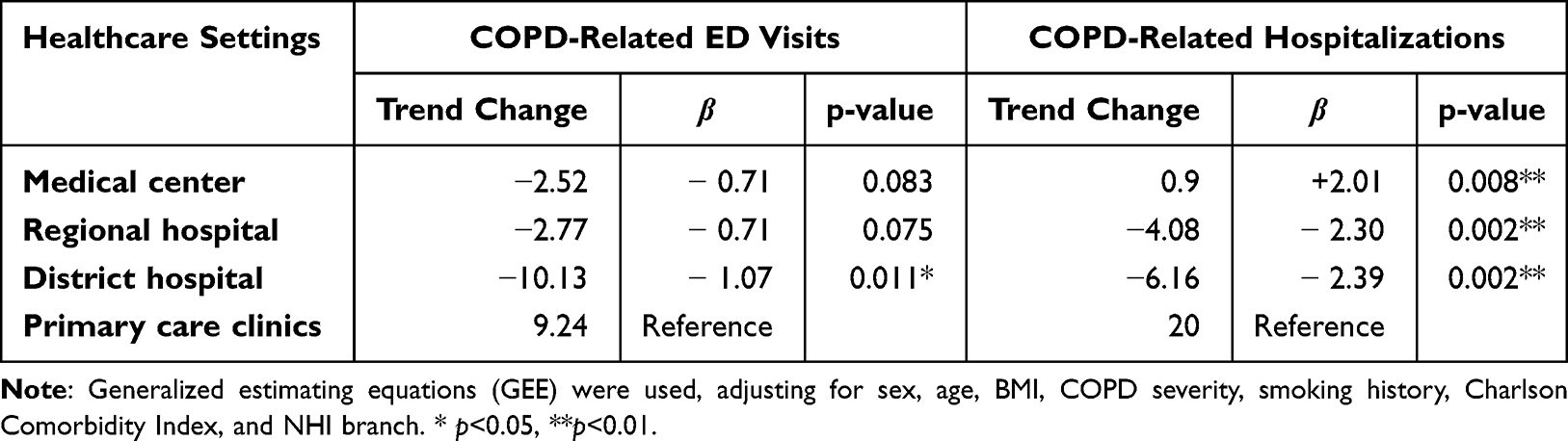 |
Table 2 Trend Changes in COPD-Related Healthcare Utilization by Healthcare Setting |
COPD-related hospitalizations rates, reflecting management of severe exacerbations, demonstrated heterogeneous outcomes across healthcare settings. Medical centers showed a modest increase from 18.1% to 18.9%. Regional hospitals showed a reduction in rates, from 24.8% to 20.7%. And district hospitals exhibited the largest reduction from 28.6% to 22.5%. Primary care clinics showed an increase from 0% to 20.0%. GEE analysis revealed statistically significant changes across multiple healthcare settings. Medical centers demonstrated a significant increase in hospitalizations rates (p = 0.008). Regional hospitals (p = 0.002) and district hospitals (p = 0.002) both achieved significant reductions compared to primary care clinics, with district hospitals demonstrating the most pronounced reduction in hospitalization rates (Figure 1B and Table 2).
Factors Associated with Reduction in COPD-Related ED Visits
Advanced age demonstrated a positive association, with patients aged ≥85 years showing significantly higher likelihood of decline in COPD-related ED visits rate (OR = 1.72, 95% CI: 1.12–2.63, p = 0.013) compared to the reference group (65–69 years). BMI exhibited a protective effect, with obese patients (BMI >27 kg/m2) showing significantly higher likelihood of decline in COPD-related ED visits rate (OR = 0.59, 95% CI: 0.36–0.97, p = 0.039) compared to underweight patients. COPD severity was strongly associated with a reduction in ED visits. Patients with very severe COPD (FEV1 <30% predicted) demonstrated the highest likelihood of decline in COPD-related ED visits (OR = 2.94, 95% CI: 1.61–5.37, p = 0.001), followed by those with severe COPD severity (30% ≤ FEV1 <50% predicted: OR = 1.72, 95% CI: 1.14–2.59, p = 0.010) and moderate COPD (50% ≤ FEV1 <80% predicted: OR = 1.52, 95% CI: 1.04–2.22, p = 0.032), all compared to patients with mild impairment (FEV1 ≥80% predicted). Former smokers demonstrated marginally significant reduction (OR = 1.47, 95% CI: 1.00–2.17, p = 0.050) compared to never-smokers (Figure 2A).
 |
Figure 2 Factors Associated with Reduction in Healthcare Utilization Among Elderly COPD Patient. (A) COPD-related ED visit; (B) COPD-related hospitalizations. |
Factors Associated with Reduction in COPD-Related Hospitalizations Rates
Decline in hospitalizations frequency showed similar but distinct patterns. Advanced age groups demonstrated significant associations, with patients aged 80–84 years (OR = 1.79, 95% CI: 1.12–2.84, p = 0.014) and ≥85 years (OR = 1.75, 95% CI: 1.06–2.87, p = 0.027) showing higher likelihood of decline in COPD-related hospitalizations rates. BMI categories of 18.5–23.9 kg/m2 (OR = 0.56, 95% CI: 0.35–0.90, p = 0.016) and 24.0–26.9 kg/m2 (OR = 0.60, 95% CI: 0.36–0.99, p = 0.044) showed significantly better outcomes compared to underweight patients. Patients with moderate COPD severity had substantially higher likelihood of decline in COPD-related hospitalizations rates (OR = 6.37, 95% CI: 3.24–12.54, p = 0.012), followed by severe COPD (OR = 3.51, 95% CI: 2.10–5.88, p <0.001) and very severe COPD (OR = 1.91, 95% CI: 1.15–3.16, p <0.001). Geographic variation was observed, with patients in the southern region showing significantly reduced hospitalizations.(OR = 0.34, 95% CI: 0.15–0.76, p = 0.008) compared to the eastern region reference group (Figure 2B).
Discussion
To our knowledge, this represents the first head-to-head comparative study examining the impact of integrated COPD care across different healthcare settings in elderly Asian patients. Our findings reveal differential outcome patterns across healthcare levels, with district hospitals demonstrating particular advantages in reducing COPD exacerbation events, including COPD-related ED visits and COPD-related hospitalizations, while medical centers did not show comparable benefits. Notably, we observed a paradoxical association whereby advanced age (≥85 years) and severe COPD were associated with significantly more reduction in the frequency of COPD-related emergency department visits and hospitalizations. These findings indicate that integrated care effectiveness varies substantially across healthcare settings among elderly patients, likely reflecting the complex interplay between institutional characteristics, patient case-mix complexity, and care coordination capabilities.
Examining the specific outcomes across healthcare levels, this study revealed significantly declining trends in COPD-related emergency department (ED) visits among elderly patients in district hospitals, as well as significantly declining trends in COPD-related hospitalizations in both regional and district hospitals. However, at medical centers, more modest effects were observed for COPD-related ED visits, and COPD-related hospitalizations actually increased. These nuanced findings partially align with our previous studies, reinforcing that while integrated care models can effectively reduce COPD-related healthcare utilization, their effectiveness may vary across healthcare settings among elderly patients. Previous research has reported inconsistent findings regarding the relationship between hospital level and healthcare utilization for COPD patients. A Thailand study demonstrated comparable ED re-attendance rates among elderly COPD patients across different hospital levels, with community hospitals at 62.2%, general hospitals at 61.5%, and advanced hospitals at 61.0%, showing no significant differences despite variations in available resources.10 This contrasts with a Korean study conducted by Kim et al, which found that elderly COPD patients treated at resource-rich hospitals had lower COPD readmission rates compared to those at resource-limited facilities.16
The observed differences in study results can be attributed to several key factors: (1) Taiwan’s Unique Healthcare System Architecture. Taiwan’s healthcare system demonstrates distinctive characteristics that differentiate it from both Thailand and Korea models, with particular advantages for managing elderly patients with chronic conditions. The integrated care program employs a standardized clinical guideline-based care approach that may systematically improve care quality in lower-tier medical institutions with fewer specialized resources. (2) Functional Differentiation Across Hospital Levels. Taiwan’s healthcare system exhibits clear functional differentiation across hospital levels, with each tier naturally specializing in distinct care domains. A comprehensive nationwide analysis of pharmaceutical expenditure patterns revealed that medical centers and regional hospitals predominantly prescribed anti-tumor and immunologic agents, reflecting their primary role in managing acute and severe illnesses, whereas district hospitals and clinics primarily prescribed antidiabetic and cardiovascular medications, indicating their emphasis on chronic disease management.17 This institutional specialization pattern suggests that district hospitals have developed particular expertise and established care pathways specifically tailored for chronic disease management, which is particularly relevant for elderly COPD patients who typically present with multiple chronic comorbidities requiring integrated long-term care rather than episodic acute interventions. (3) Geographic Accessibility and Community-Based Care. District hospitals in Taiwan, being geographically distributed closer to communities, may offer critical advantages for elderly COPD patients who often face mobility limitations and transportation barriers when accessing distant medical centers. The closer proximity of district hospitals to communities may facilitate more frequent specialist coordination and timely outpatient management, preventing disease exacerbations that would otherwise lead to emergency visits or hospitalizations. Previous research has demonstrated that the availability of pulmonary care specialists is a key factor in reducing hospital utilizations among COPD patients, as pulmonary specialists provide more guideline-concordant care and better disease management compared to generalists.18 For elderly patients, the reduced travel burden associated with community-based district hospitals may facilitate more frequent follow-up visits and better medication adherence, which are essential for preventing acute exacerbations in this vulnerable population. (4) The Paradox of Medical Center Density. In contrast, higher hospital availability has been paradoxically associated with increased hospitalization rates, as greater accessibility to hospital facilities may lower barriers to admission rather than improving outpatient disease management.18 This phenomenon may be particularly relevant in regions with high medical center density. Notably, in our study, 45.6% of elderly COPD patients receiving care at medical centers were concentrated in the Taipei metropolitan area, where medical centers are most densely distributed. This geographic concentration may create exceptionally high accessibility to tertiary hospital facilities for elderly patients in urban areas, potentially contributing to the observed increase in hospitalization rates.
Regarding the potential influence of patient case mix, our baseline characteristic analysis (Table 1) revealed that patients at medical centers were characterized by advanced age (35.5% aged ≥80 years vs 24.7% at district hospitals), numerically higher comorbidity burden (CCI ≥3: 44.3% vs 39.6% at district hospitals), and greater prior exacerbation frequency (0.68±1.12 vs 0.56±0.73 at district hospitals). These characteristics represent well-established risk factors for COPD-related hospitalization. Previous systematic reviews have consistently identified advanced age, comorbidity burden, and prior exacerbation history as the most important predictors of hospitalization and readmission in COPD patients.19,20 Specifically, the ECLIPSE cohort study demonstrated that prior hospitalization for COPD exacerbation was strongly predictive of future hospitalization, independent of lung function severity.20 Furthermore, a meta-analysis examining predictors of mortality in hospitalized COPD patients identified age and cardiac comorbidities as consistently significant prognostic factors across multiple studies.21 The accumulation of these high-risk characteristics among medical center patients may contribute to an elevated baseline propensity for hospitalization that persists despite integrated care interventions. Notably, patients with more severe airflow limitation (GOLD 3–4) showed significantly greater reductions in healthcare utilization. Given that district hospitals served a higher proportion of this patient population, this finding may partially explain the substantial improvements observed in this setting.
Importantly, the age-related increase in hospitalization risk among elderly COPD patients extends beyond simple disease severity. Advanced age is associated with increased prevalence of cardiovascular comorbidities—particularly heart failure, which affects 30.9% of COPD patients aged 70–79 years and 58.7% of those over 80 years of age, and can simulate or aggravate exacerbations.22 The complex interplay between respiratory and cardiovascular dysfunction in elderly patients may lower the threshold for clinical deterioration requiring hospitalization, regardless of baseline COPD severity as measured by FEV1. This phenomenon may explain why medical center patients, despite demonstrating milder airflow limitation (FEV1 ≥80% predicted: 20% vs 13.2% at district hospitals), nonetheless experienced increased hospitalization rates.
To address these case-mix differences, our analyses adjusted for age, sex, BMI, COPD severity, smoking history, Charlson Comorbidity Index, and prior acute exacerbation history. After adjustment, the differential outcomes across healthcare levels remained significant, suggesting that factors beyond measured patient characteristics contribute to the observed patterns. Nevertheless, unmeasured medical complexity—such as frequency of cardiovascular decompensation, frailty syndrome, or disease phenotypic heterogeneity—could not be fully captured and may represent residual confounding. Taken together, these findings suggest that the increased hospitalization rates at medical centers likely reflect a combination of patient case-mix characteristics and institutional factors, rather than representing a failure of the integrated care program.
We further analyzed the factors associated with clinical improvement among elderly patients and observed an intriguing pattern: greater reductions in COPD-related emergency visits and hospitalizations were found in those with worse baseline characteristics, such as advanced age and poorer lung function. Although this result may initially appear paradoxical, it can be reasonably interpreted through complementary measurement and physiological mechanisms. From a measurement standpoint, this pattern reflects inherent psychometric properties of outcome evaluation rather than a true contradiction in clinical behavior. Ward et al demonstrated that the dependence of minimal clinically important improvement (MCII) on baseline values primarily arises from the floor and ceiling effects of clinical outcome measures.23 Patients with poorer baseline function have greater measurable room for improvement because they are farther from the upper limit of the scale, whereas those with better baseline performance are closer to measurement ceilings that constrain detectable change. From a physiological perspective, patients with more severe airflow limitation may retain greater therapeutic responsiveness. Chen et al reported that COPD patients with lung hyperinflation—despite having worse baseline pulmonary function—exhibited superior bronchodilator responsiveness.24 This finding suggests that individuals with advanced functional impairment may possess greater physiological “reserve capacity”, allowing more substantial benefit from comprehensive, multidimensional interventions such as integrated disease management. Further evidence supporting this interpretation is provided by Ferrone et al, whose randomized controlled trial demonstrated that comprehensive disease-management interventions led to significant improvements in quality of life, exacerbation rates, and healthcare utilization among high-risk COPD patients (frequent exacerbators).25 Such standardized, evidence-based, and multidisciplinary approaches ensure consistent delivery and maximize treatment fidelity across multiple domains of care.
The enhanced treatment response observed in patients with poorer baseline function likely reflects larger and previously unaddressed “care gaps” that can be systematically mitigated through integrated interventions. These patients often accumulate multiple deficiencies in disease management—such as suboptimal pharmacologic regimens, improper inhaler technique, and insufficient self-management ability—which collectively hinder optimal outcomes. Comprehensive disease-management programs simultaneously target these interrelated deficiencies, producing synergistic clinical improvements. This “care gap hypothesis” is conceptually consistent with the principle of diminishing marginal returns in healthcare, wherein patients with the greatest unmet needs derive the largest absolute gains from structured and multidisciplinary care interventions. By closing multiple care gaps at once, integrated programs provide a coordinated framework that addresses the inherently multifaceted demands of COPD management—spanning pharmacologic, behavioral, and educational domains. Future research should focus on identifying specific mediating mechanisms—such as medication adherence, inhaler technique competency, and disease knowledge—to clarify how integrated care generates heterogeneous benefits across different patient subgroups and to inform more precisely targeted intervention strategies.
This study has several limitations. First, due to temporal constraints in data retrieval from the National Health Insurance integrated database, only patients who participated in the COPD pay-for-performance (P4P) program for at least six months with one-year follow-up could be included. This relatively short observation period limits our assessment to short-term outcomes, and the long-term effects of the integrated care program warrant further investigation. Second, variations in patient adherence to medical advice during the disease course may have influenced care intervention effectiveness. Third, given Taiwan’s unique healthcare system and the specific design of its COPD P4P model, the generalizability of these findings to other healthcare settings may be limited. Fourth, although our analyses adjusted for measured confounders including demographic characteristics, COPD severity, comorbidity burden, and prior exacerbation history, unmeasured clinical complexity—such as frequency of cardiovascular decompensation, frailty syndrome, or disease phenotypic heterogeneity—could not be fully accounted for. Additionally, structural and system-level factors that may differ across healthcare levels—including differences in admission thresholds, availability of specialized diagnostic services, institutional practice patterns, or reimbursement policies—were not directly measured in this study. These unmeasured patient-level and system-level factors may partially influence the differential outcomes observed across healthcare levels and represent potential residual confounding. Fifth, our study population was predominantly male (approximately 90% across all healthcare levels), which may limit the generalizability of findings to female COPD patients. However, this sex distribution is consistent with the epidemiological profile of COPD in Taiwan, where the prevalence is substantially higher in males,26 possibly related to the high male-to-female smoking ratio (approximately 10.9:1) among Taiwanese adults.27 Future studies examining sex-based differences in integrated care effectiveness are warranted.
Conclusion
This study demonstrates that integrated COPD care effectively reduces healthcare utilization (ED visits and hospitalizations) among elderly patients, with district hospitals showing the most significant reductions. The study included patients across all GOLD severity grades (GOLD 1–4), with the majority classified as GOLD 2 (50% ≤ FEV1 < 80% predicted). Patients with GOLD 3 and GOLD 4 grades (FEV1 <50% predicted), disproportionately represented in district hospitals, showed significantly greater reductions compared to those with milder disease. These findings demonstrate that the magnitude of benefit from integrated care varies across healthcare settings based on patient severity profiles, suggesting that healthcare settings serving higher proportions of severe COPD patients may experience more substantial reductions in preventable care utilization through systematic management.
Data Sharing Statement
The datasets analyzed during the current study are not publicly available due to privacy and ethical restrictions. The data were obtained from the Taiwan COPD Pay-for-Performance registry and National Health Insurance claims database, with permission granted by the National Health Insurance Administration (NHIA), Ministry of Health and Welfare, Taiwan. Data access requests may be submitted to the NHIA subject to approval and compliance with applicable data protection regulations.
Ethics Approval and Informed Consent
This study adhered to the principles of the Declaration of Helsinki, approved by the Institutional Review Board of Changhua Christian Hospital, with a waiver of informed consent requirements (IRB No:211034).
Consent for Publication
Not applicable. This study used publicly available, de-identified data from the National Health Insurance Research Database (NHIRD) and did not include any individual person’s identifiable information.
Acknowledgments
Pei-Ching Lin and Yun-Yue Cheng are co-first authors for this study. Chin-Tun Hung and Ching-Hsiung Lin are co-correspondence authors for this study. The authors would like to thank the Applied Health Research Data Integration Service of the National Health Insurance Administration.
Funding
This research was funded by Changhua Christian Hospital, grant number 114-CCH-IRP-093. This funding source had no ultimate authority over the design of this study, its execution, analyses, data interpretation or decision to submission.
Disclosure
The authors report no conflicts of interest in this work.
References
1. Global Strategy for the Diagnosis, Management and Prevention of COPD, Global Initiative for Chronic Obstructive Lung Disease (GOLD). Global initiative for chronic lung disease (2023 Report). Fontana, Wisconsin, USA: Global Initiative for Chronic Lung Disease; 2023. Available from: https://goldcopd.org/2023-gold-report-2/.
2. Sangani R, Lee MM, Xu H, Dupuis J, O’Connor GT. The upper limit of normal rate of lung function decline in healthy adults in the framingham heart study. Chest Pulm. 2024;2(3):100058. doi:10.1016/j.chpulm.2024.100058
3. Kerstjens HA, Rijcken B, Schouten JP, Postma DS. Decline of FEV1 by age and smoking status: facts, figures, and fallacies. Thorax. 1997;52(9):820–12. doi:10.1136/thx.52.9.820
4. Morris JF, Koski A, Johnson LC. Spirometric standards for healthy nonsmoking adults. Am Rev Respir Dis. 1971;103(1):57–67. doi:10.1164/arrd.1971.103.1.57
5. MacNee W. Is chronic obstructive pulmonary disease an accelerated aging disease? Ann Am Thorac Soc. 2016;13(Suppl 5):S429–S437. doi:10.1513/AnnalsATS.201602-124AW
6. Janssens JP, Pache JC, Nicod LP, Barbera JA, Marrades RM, Wagner PD. Physiological changes in respiratory function associated with ageing. Eur Respir J. 1999;13(1):197–205. doi:10.1183/09031936.99.14614549
7. Akinbami LJ, Liu X. Chronic obstructive pulmonary disease among adults aged 18 and over in the United States, 1998–2009. NCHS Data Brief. 2011;63:1–8.
8. Meng K, Chen X, Chen Z, Xu J. Burden of chronic obstructive pulmonary disease in adults aged 70 years and older, 1990–2021: findings from the global burden of disease study 2021. PLoS One. 2025;20(1):e0316135. doi:10.1371/journal.pone.0316135
9. Wang Y, Jin L, Dong Y, et al. Global burden of disease study on COPD in the older adult: comprehensive analysis of environmental factors and interaction effects. Front Public Health. 2025;13:1597793. doi:10.3389/fpubh.2025.1597793
10. Iyer AS, Wells RD, Bechthold AC, et al. Identifying priority challenges of older adults with COPD: a multiphase intervention refinement study. J Am Geriatr Soc. 2024;72(11):3346–3359. doi:10.1111/jgs.19158
11. Poot CC, Meijer E, Kruis AL, Smidt N, Chavannes NH, Honkoop PJ. Integrated disease management interventions for patients with chronic obstructive pulmonary disease. Cochrane Database Syst Rev. 2021;9(9):CD009437. doi:10.1002/14651858.CD009437.pub3
12. Khosravi A, Ravari A, Mirzaei T, Gholamrezapour M. Effects of a comprehensive care program on the readmission rate and adherence to treatment in elderly patients with chronic obstructive pulmonary disease. Tanaffos. 2020;19(4):401–412.
13. Jia S, Fan P. Analysis of the effect of continuous nursing care in patients with COPD. J Clin Nurs Res. 2024;8:233–237. doi:10.26689/jcnr.v8i1.5874
14. Chang MWS. Population ageing and societal inequalities: the case of Taiwan. In: Dhakal S, Nankervis A, Burgess J, editors. Ageing Asia and the Pacific in Changing Times. Singapore: Springer; 2022:195–211. doi:10.1007/978-981-16-6663-6_12
15. Cheng SL, Li YR, Huang N, et al. Effectiveness of nationwide COPD pay-for-performance program on COPD exacerbations in Taiwan. Int J Chron Obstruct Pulmon Dis. 2021;16:2869–2881. doi:10.2147/COPD.S329454
16. Kim TW, Choi ES, Kim WJ, Jo HS. The association with COPD readmission rate and access to medical institutions in elderly patients. Int J Chron Obstruct Pulmon Dis. 2021;16:1599–1606. doi:10.2147/COPD.S302631
17. Chung CH. Trends in pharmaceutical expenditure in the Taiwan national health insurance database at different hospital levels. J Comp Eff Res. 2023;12(2):e220162. doi:10.2217/cer-2022-0162
18. Kim M, Ren J, Tillis W, Asche CV, Kim IK, Kirkness CS. Explaining the link between access-to-care factors and health care resource utilization among individuals with COPD. Int J Chron Obstruct Pulmon Dis. 2016;11:357–367. doi:10.2147/COPD.S95717
19. Bahadori K, FitzGerald JM. Risk factors of hospitalization and readmission of patients with COPD exacerbation--systematic review. Int J Chron Obstruct Pulmon Dis. 2007;2(3):241–251.
20. Müllerova H, Maselli DJ, Locantore N, et al. Hospitalized exacerbations of COPD: risk factors and outcomes in the ECLIPSE cohort. Chest. 2015;147(4):999–1007. doi:10.1378/chest.14-0655
21. Singanayagam A, Schembri S, Chalmers JD. Predictors of mortality in hospitalized adults with acute exacerbation of chronic obstructive pulmonary disease. Ann Am Thorac Soc. 2013;10(2):81–89. doi:10.1513/AnnalsATS.201208-043OC
22. Morena D, Izquierdo JL, Rodríguez J, et al. The clinical profile of patients with COPD is conditioned by age. J Clin Med. 2023;12(24):7595. doi:10.3390/jcm12247595
23. Ward MM, Guthrie LC, Alba M. Dependence of the minimal clinically important improvement on the baseline value is a consequence of floor and ceiling effects and not different expectations by patients. J Clin Epidemiol. 2014;67(6):689–696. doi:10.1016/j.jclinepi.2013.10.025
24. Chen C, Jian W, Gao Y, Xie Y, Song Y, Zheng J. Early COPD patients with lung hyperinflation associated with poorer lung function but better bronchodilator responsiveness. Int J Chron Obstruct Pulmon Dis. 2016;11:2519–2526. doi:10.2147/COPD.S110021
25. Ferrone M, Masciantonio MG, Malus N, et al; Primary Care Innovation Collaborative. The impact of integrated disease management in high-risk COPD patients in primary care. NPJ Prim Care Respir Med. 2019;29(1):8. doi:10.1038/s41533-019-0119-9
26. Cheng SL, Chan MC, Wang CC, et al. COPD in Taiwan: a national epidemiology survey. Int J Chron Obstruct Pulmon Dis. 2015;10:2459–2467. doi:10.2147/COPD.S89672
27. Wen CP, Levy DT, Cheng TY, Hsu CC, Tsai SP. Smoking behaviour in Taiwan, 2001. Tob Control. 2005;14(Suppl 1):i51–5. doi:10.1136/tc.2004.008011
 © 2026 The Author(s). This work is published and licensed by Dove Medical Press Limited. The
full terms of this license are available at https://www.dovepress.com/terms
and incorporate the Creative Commons Attribution
- Non Commercial (unported, 4.0) License.
By accessing the work you hereby accept the Terms. Non-commercial uses of the work are permitted
without any further permission from Dove Medical Press Limited, provided the work is properly
attributed. For permission for commercial use of this work, please see paragraphs 4.2 and 5 of our Terms.
© 2026 The Author(s). This work is published and licensed by Dove Medical Press Limited. The
full terms of this license are available at https://www.dovepress.com/terms
and incorporate the Creative Commons Attribution
- Non Commercial (unported, 4.0) License.
By accessing the work you hereby accept the Terms. Non-commercial uses of the work are permitted
without any further permission from Dove Medical Press Limited, provided the work is properly
attributed. For permission for commercial use of this work, please see paragraphs 4.2 and 5 of our Terms.