
Back to Journals » Advances in Medical Education and Practice » Volume 16
Institutional Determinants of Academic Achievement in Biomedical Sciences: A Cross-Sectional Study of Nursing Students in Uganda
Authors Munguiko C  , Ngeno ACK, Atukwatse J , Museene SK
Received 29 July 2025
Accepted for publication 14 December 2025
Published 30 December 2025 Volume 2025:16 Pages 2439—2462
DOI https://doi.org/10.2147/AMEP.S556809
Checked for plagiarism Yes
Review by Single anonymous peer review
Peer reviewer comments 2
Editor who approved publication: Dr Md Anwarul Azim Majumder
Clement Munguiko,1,2 Anne Chepngetich Koske Ngeno,2 Joseph Atukwatse,1 Safinnah Kisu Museene3
1Department of Nursing, Soroti University, Soroti City, Uganda; 2Department of Medical Education, Moi University, Eldoret City, Kenya; 3Department of Health Education and Training, Ministry of Education and Sports, Kampala, Uganda
Correspondence: Clement Munguiko, Email [email protected]
Background: Mastery of foundational sciences namely, anatomy, physiology and biochemistry is essential for nursing competence, yet many undergraduate nursing students struggle with these courses.
Objective: To investigate institutional factors influencing academic achievement in biomedical sciences among undergraduate nursing students in Uganda.
Methods: A cross-sectional study, guided by the philosophy of critical realism, Input-Transformation-Output framework, and constructivist learning theory, was conducted at four purposively selected public universities in Uganda between April and June 2024. A total of 208 undergraduate nursing students were enrolled using the census approach. This study examined the influence of institutional factors on academic achievement in biomedical sciences, measured by the Grade Point Average (GPA). Data were collected using a self-administered questionnaire with excellent internal consistency (α = 0.9366) and analysed using Welch’s analysis of variance and linear mixed-effects model.
Results: Lower ratings of lecturer’s teaching quality (β = − 0.25, 95% CI: − 0.46, − 0.03, p = 0.03), online only teaching (β = − 0.41, 95% CI: − 0.75 − − 0.07, p = 0.02) and lack of constructive feedback (β = − 0.47, 95% CI: − 0.90, − 0.03, p = 0.046) were associated with lower GPA scores, while Problem Based Learning (β = 0.48, 95% CI: − 0.05– 1.91, p = 0.04) and good lecturer-student relationship (β = 0.34, 95% CI: − 0.06 to 0.62, p = 0.03) predicted higher GPA scores.
Conclusion and Recommendations: Lower teaching quality, lack of feedback, and online only instruction were linked to lower GPA scores, while problem-based learning and good lecturer-student relationships predicted higher achievement. Therefore, nursing programs should prioritize strengthening lecturer’s teaching skills, providing constructive feedback, fostering positive lecturer-student relationship, and integrating Problem Based and blended teaching approaches to improve students’ academic outcomes.
Keywords: sociodemographic factors, academic achievement, biomedical sciences, nursing education
Introduction
According to the International Council of Nurses (1987), nursing care encompasses the independent, interdependent, and collaborative care of individuals of all ages, families, groups, and communities, whether sick or well, in all settings.1 This care includes the promotion of health; prevention of disease; and care of the sick, disabled, and dying, as well as advocacy, promotion of a safe environment, research, participation in shaping health policy, health systems management, and nursing education. Given their wide scope, nurses constitute about 50% of the global health workforce and play a critical role in caring for millions of people worldwide.2 They work across almost all points of care and contribute significantly to the realization of universal health coverage and Sustainable Development Goals.3 With the right knowledge, skills, and attitudes, coupled with adequate numbers and a high level of motivation, nurses can significantly transform the healthcare system.4
Accordingly, many countries now recognize a degree in nursing, herein referred to as the Bachelor of Nursing Science (BNS), as the minimum level of education for entry into the nursing profession.5 The BNS program hinges strongly on the biomedical sciences. Therefore, science has been described as the foundation of nursing because its scope of knowledge is based on scientific principles, facts, concepts, and theories.6 In addition, it has been found that better educated nurse workforce adds value to hospitals and therefore upgrading nurse education level can immensely improve patient care.7,8
As many countries work towards realizing universal health coverage, there is equally growing evidence showing that BNS graduates bring unique skills to their work as nurse clinicians and contribute greatly towards high-quality nursing care. For instance, Wieczorek-Wójcik, Gaworska-Krzemińska9 conducted a study to determine the influence of nurse education level on hospital admissions and found that an increasing number of nurses with BNS qualifications was associated with significant reductions in patient readmissions and economic benefits. Johua Porat-Dahlerbursh, Linda H.Aiku10 also revealed that higher proportion of BNS nurses in the hospital was associated with lower odds of congestive heart failure and inpatient surgical mortality.
Biomedical sciences are the foundational courses that students in the BNS program undertake during their first two years of study. These courses include anatomy, physiology, genetics, pathophysiology, microbiology, and biochemistry.11–13These courses are usually referred to as preclinical or gatekeeper courses because they form a strong foundation for the clinical courses and other non clinical courses that are taught later in the program.14 For instance, anatomy, physiology, and biochemistry provide a strong foundation for courses like microbiology, pharmacology, and pathology which in turn underpin all clinical nursing and midwifery courses, including surgical nursing, medical nursing, and antepartum care. Anatomy course focuses on the structure of the human body, including systems, organs, and tissues, hence enabling students to understand spatial relationships and normal anatomy essential for patient assessment and nursing procedures.15 By the end of the anatomy course, students should be able to accurately identify and describe the structures and spatial relationships of human body systems, organs and tissues, and apply this knowledge to conduct precise patient assessments and perform nursing procedures safely.
Physiology course explores the functional processes of the human body, explaining how organs and body systems work individually and in coordination. This knowledge is important for the nurses to understand health, disease mechanisms, and the rationale behind nursing interventions.16 By the end of the course, students should be able to explain the functional processes of body systems, analyse how these systems work individually and in coordination and apply this understanding to interpret health and disease states and guide nursing interventions.
Similarly, biochemistry examines the chemical and molecular basis of life, including structures of biomolecules of medical importance, metabolism, and enzymatic reactions which forms understanding of the disease processes and treatment molecules.17 By the end of this course, students should be able to describe the chemical and molecular basis of life, including biomolecule structure, metabolism, and enzymatic reactions among others and use this knowledge to understand disease mechanisms and rationalize treatment strategies in clinical practice.
Since biomedical sciences form the foundation for the clinical practice for BNS students, and the ultimate goal of the BNS nurse is to provide high quality patient care, all BNS graduates are expected to demonstrate competence in biomedical sciences during and after the study program.18 Nonetheless, this is not surprising since understanding biomedical sciences has been found to help BNS students comprehend clinical constructs and subsequently transition smoothly from biomedical to clinical courses. One study found that students’ academic success in biomedical science courses such as anatomy and physiology was a strong predictor of their success in the clinical courses such as midwifery and medical nursing.19 This is because BNS nurses use their knowledge of biomedical sciences to assess patients, make accurate diagnoses, and provide high-quality clinical care.20 Similarly, knowledge of biomedical sciences assists BNS nurses make sound clinical decisions regarding patients’ next course of action and provides a solid foundation for further studies.21,22
Bakon23 stated in one of their articles that increasing knowledge of biomedical sciences among BNS students was associated with improved patient care and consequently contributed towards improved healthcare outcomes. Accordingly, Vincent24 stated that inadequate knowledge of biomedical sciences among nursing students raises patient safety concerns. This has been evidenced by a study in which BNS students in Australia declared that inadequate knowledge and skills in biomedical sciences had a negative impact on their ability to understand patients’ clinical conditions and nursing practice.25
Despite their relevance, biomedical sciences, particularly anatomy, physiology, and biochemistry, are widely regarded as the most challenging course units for many BNS students.26 Academic achievement in these courses has remained persistently poor among BNS students in many countries for many years and continues to be a significant concern despite various efforts to improve it.27 According to York, Gibson, and Rankin (2015), academic achievement refers to students’ ability to meet performance criteria, attain learning objectives, acquire desired competencies, express satisfaction with their performance, and persist in their study programs. Specifically, academic achievement reflects the extent to which BNS students meet their predetermined educational goals.28 Academic achievement in biomedical sciences is a foundation component of nursing education, shaping students competence and readiness for clinical practice. Low achievement in these courses can seriously undermine the quality of nursing care, reduce workforce density, and negatively affect the career prospects of undergraduate nurses.29
Some studies indicate that due to inadequate knowledge in biomedical sciences, a significant proportion of BNS students and qualified nurses continue to experience deficiencies in the cognitive, psychomotor, and affective abilities required for clinical roles. For instance, due to challenges in biomedical science knowledge, another study revealed that approximately 20% of newly graduated BNS nurses in the United States left their jobs within the first year.30
Just like in many other courses, academic achievement in biomedical sciences among undergraduate nursing students is shaped by multiple, interrelated factors. These factors may operate at the input level, where inputs such as students’ sociodemographic and educational factors are acted upon and converted into desirable educational outcomes.29 The transformation process, according to Input-Transformation- Output (ITO) framework, plays a critical role in shaping the learning outcomes. This process is primarily related to institutional factors and highlights the influence of contextual elements that explain variations in academic achievement across institutions.31
According to Gultice, Witham,32 poor academic achievement in biomedical sciences among BNS students may not be a context-specific phenomenon, since the literature indicates that globally, a large proportion of BNS students register fail or marginal pass scores in these courses. However, various studies have also shown variations in the extent of academic achievement in biomedical sciences among BNS students and the factors that predict it, implying that there could be context-specific factors as well. For instance, studies conducted in Norway, Italy, and England reported that approximately 30% of BNS students registered at least one failure in anatomy, physiology or biochemistry.33–37 In contrary, a related study conducted at a community college in the United States between 2014 and 2015 reported that 50% of nursing students experienced academic failure in anatomy and physiology, making a sharp departure from the earlier study finding.38 Therefore, this implies that academic achievement in the biomedical sciences among BNS students is a phenomenon that has various modifiable and non-modifiable factors, some of which are contextual in nature operating at the educational institutions.39
Institutional determinants such as teaching effectiveness resulting from application of engaging teaching methods and approaches have been reported in many studies.40,41 However, the reported findings primarily come from studies conducted in high income countries or from systematic reviews, leaving the contextual situation in many low- and middle-income countries poorly understood.27 A study conducted in Tanzania, one of Uganda’s neighboring countries revealed that low tutor quality was one of the institutional factors influencing acquisition of competences. However, this study focused only on diploma-awarding institutions, thereby excluding degree awarding institutions such as universities.42 A study in Uganda explored the institutional factors influencing academic achievement. However, it focused primarily on those factors that predict acquisition of clinical skills, leaving out those that affect the mastery of biomedical sciences, the prerequisites for clinical courses.43 Another study focused on the student educational factors influencing academic achievement in biomedical sciences among undergraduate nursing students, hence leaving out the understanding of the institutional determinants.44 Similarly, a study in Uganda explored the lecturers’ views on academic achievement in biomedical sciences and found that institutional factors, such as high student-lecturer ratio influenced academic achievement. However, this was a qualitative study, the determinants from the quantitative perspective remain poorly understood, yet such understanding would complement the insights already gained from qualitative findings.45 Owing to this research gap, the issue of biomedical sciences among BNS students has been described as an area where more research studies are needed.26,46
Therefore, a clear understanding of the institutional determinants of academic achievement in anatomy, physiology, and biochemistry, among BNS students from the quantitative perspective, can provide credible evidence to guide the design and implementation of effective and efficient interventions to address poor academic performance in these courses in Uganda and beyond.32
Critical Realism (CR) philosophy enriches the understanding of the institutional determinants of academic achievement in biomedical sciences among BNS students by recognizing the layered nature of reality, distinguishing between observable events, the mechanisms that produce them, and the deeper structures that underpin those mechanisms.47 The Critical Realist philosophical stance supported the use of multiple approaches to uncover factors influencing academic achievement, as well as potential explanations for these factors from the available literature. CR enables a nuanced understanding of institutional influences, accounting for both visible outputs and less-tangible contextual and structural enablers or constraints.48 Taken together, the ITO framework and CR philosophy provide a robust justification for the study’s design and focus on uncovering the institutional factors that shape academic achievement. Therefore, by revealing both surface-level patterns and deeper predictive mechanisms, this study aimed to identify institutional determinants of academic achievement among Bachelor of Nursing Science students and to recommend strategies for improving and sustaining academic achievement in Uganda and similar contexts.
Methods
Study Design and Site
A cross-sectional design was used to guide this study. A cross-sectional study design was used to examine the associations between institutional factors and academic achievement in biomedical sciences at a single point in time. This design is particularly advantageous for exploring complex, multifactorial relationships within a defined population without the resource-intensive demands of longitudinal follow-up. By capturing data simultaneously on both predictor and outcome variables, the cross-sectional approach enabled efficient assessment of existing patterns and correlations within the academic environment of Ugandan nursing students. Furthermore, this design allowed for the identification of potential areas for educational intervention and policy development, serving as a foundational step for future longitudinal or experimental research. Given the study’s objective of mapping out institutional influences on academic achievement and recommending strategies to improve and sustain it in Uganda and similar settings, the cross-sectional design provides a pragmatic yet robust framework for generating timely, contextually relevant insights.49
The study was conducted between April and June 2024 at four public universities in Uganda offering Bachelor of Nursing Science (BNS) program. Private universities were excluded because of their notable differences from public institutions in areas such as student academic preparedness, funding structures, administrative systems, institutional philosophies, and core values. These structural and operational disparities may have introduced significant variability, potentially confounding the analysis. Public universities were purposively selected to ensure contextual and institutional homogeneity, which was essential for maintaining internal validity. Additionally, the study did not aim to compare academic achievement between public and private universities; rather, it sought to explore the factors influencing academic success in a relatively uniform institutional environment. This focus allowed for a more controlled examination of the predictors of academic achievement among nursing students in public higher education settings in Uganda.
At all four public universities that participated in the study, the three biomedical science courses of interest, namely, anatomy, physiology, and biochemistry were taught by different lecturers. Each course was assigned to specific lecturers, the majority of whom at least held a master’s degree relevant to the course. For example, a master of Anatomy or Surgery for anatomy course, a master of Physiology or Internal Medicine for physiology course, and master of Biochemistry or Molecular genetics for biochemistry course.
At all four public universities, each biomedical science course comprised four to five sub courses, each carrying four to five Credit Units (CUs). For instance, at one university, anatomy course included anatomy I (5CUs), anatomy II (4CUs), anatomy III (4CUs), and anatomy IV (5CUs). A similar structure was used for physiology and biochemistry. The number of sub courses and corresponding CUs varied only slightly across universities, consistent with the flexibility allowed under National Council of Higher Education (NCHE) minimum standards. The structure, content, delivery, and assessment of these courses were largely uniform as guided by the NCHE minimum standards for degree nursing program. These guidelines specify the essential content, expected learning outcomes, and assessment methods. However, individual universities retain discretion to exceed the minimum requirements through supplementary materials or instructional innovations. Consequently, while minor variations may exist, the overall structure, content coverage, mode of delivery, and assessment of these courses were highly comparable across the four universities. These minor structural differences likely contributed to the observed violation of homogeneity of variance in the data, which was appropriately addressed during data analysis. This research work was undertaken as part of the authors’ doctoral studies in medical education and therefore forms a component of the thesis.
Study Participants and Sampling Method
The target population comprised all undergraduate nursing students in Uganda who had completed biomedical sciences and were enrolled in a four-year nursing program at public universities. Owing to the small size of the study population, a census sampling approach was employed, including all nursing students who met the criteria of being in the target population and had all examination results available on their online portals. However, students who declined to participate in the study, or were absent during the time of data collection, did not participate in the study. As a result, a total of 218 students met the inclusion criteria and were expected to participate in the study. However, 208 students participated in the study, giving an excellent response rate of 95.4%. Among the students who did not participate in the study, eight (8) were absent during the time of data collection due to various illnesses and two (2) declined to participate in the study possibly due to other overarching academic or personal engagements.
The census sampling approach has numerous strengths in terms of the quality of the study findings. Including all students who met the inclusion criteria enhanced the study’s internal validity by eliminating sampling bias.50 This approach increased the statistical power and precision, thus allowing for a more reliable analysis of the complex factors influencing academic achievement. It also ensured inclusivity, captured diverse student experiences, and aligned with the study’s non-comparative focus on a homogeneous institutional context.51 Overall, census sampling strengthened methodological rigor and provided a solid foundation for future research.
Data Collection Instrument
A structured questionnaire was used to collect data. The questionnaire was developed by the principal investigator based on the existing literature and validated by two co-authors and two peer researchers, all of whom were experts in nursing education. This single questionnaire was used to collect data across the three biomedical science courses. The questionnaire consisted four sections, labeled A, B, C, and D. Section A gathered data on the students’ sociodemographic characteristics and consisted 20 items. Section B assessed the level of academic achievement, comprising 4 broad items, each with at least four sub items. Section C focused on the student-related educational factors that predicted academic achievement and contained 28 items. Data from this section formed the basis for the previously published article. Section D examined institutional determinants of academic achievement and included 29 items. Data from this section form the basis for this article.
The questionnaire was pre-tested with 30 nursing students from a non-participating university to ensure its clarity and reliability. The scale’s internal consistency was assessed, yielding a Cronbach’s alpha value of 0.9366, indicating excellent reliability. A structured questionnaire was used to ensure standardized and reliable data collection, minimize bias, and enhancing consistency.52 Its high Cronbach’s alpha (≥ 0.80) reflected strong internal consistency, indicating that the instrument reliably measured key constructs such as institutional support and academic preparedness.53 This reliability reduced measurement errors, strengthened internal and construct validity, and ensured that the findings were both accurate and meaningful.54 By using a psychometrically sound instrument, the study improved methodological rigor and credibility, enabling trustworthy conclusions that can inform nursing education policies and practice.55
Study Variables and Their Measurement
Academic achievement (the outcome variable) was measured and analyzed in relation to institutional factors (predictor variables) to explore the relationship between the two. Academic achievement was defined as the extent to which undergraduate nursing students met the learning objectives and outcomes in biomedical sciences. Academic achievement was measured objectively and subjectively using the Grade Point Average (GPA) and Subjective Academic Achievement Scale (SAAS) respectively. The SAAS had five modified parameters: the level of student satisfaction with their academic achievement in biomedical sciences, whether their achievement reflected their effort, their perceived knowledge in biomedical sciences, their self-efficacy to improve, and the extent to which they applied biomedical knowledge in patient care. Each of these parameters was measured using a five-point Likert scale and the findings were interpreted as percentages.
Institutional factors, in this context, referred to the degree to which the universities were equipped and prepared to deliver biomedical science education to nursing students. The comparison aimed to determine whether universities’ level of preparedness and the instructional approaches employed by lecturers influenced students’ academic achievement in the biomedical sciences. Institutional factors included, but were not limited to, the biomedical sciences curriculum content, the instructional approaches and methods used by lecturers, and the quality of student–lecturer interactions.
Data Collection Process
After obtaining ethical approval and administrative clearance from the vice chancellors of the participating universities, the Principal Investigator (PI) scheduled visits to each university on different days. The PI recruited and trained a research assistant who held a postgraduate qualification in health research. The PI and one research assistant engaged with the participants through their heads of departments and class representatives. They were informed about the study, and those who consented provided their mobile numbers that were used to share a link to the online questionnaire. Students completed and submitted the questionnaire immediately using Kobo Collect software. Upon submission, the research assistant asked each participant to access the online academic result portal. The submitted data, including grades in anatomy, physiology, and biochemistry, were verified before the students’ departure. These grades were further analyzed to arrive at the Grade Point Averages (GPAs) for each biomedical science course.
Data Analysis
Academic achievement was analyzed by considering data variability and clustering within institutions. To address potential biases due to institutional differences, analyses were conducted separately for each biomedical science course: anatomy, physiology, and biochemistry. Descriptive statistics were used to summarize the sample and academic performance. Welch’s analysis of variance was applied to accommodate unequal variances among groups. For multivariate analyses, a Linear Mixed-Effects (LME) Model was employed, treating the university as a random effect to account for institutional clustering. Therefore, the model was preferred to ensure robust inference despite data variability.
LME model fit was assessed using Akaike Information Criterion (AIC), which compares relative quality of competing models by balancing model likelihood and complexity. A lower AIC value indicates a more parsimonious model with better relative fit. Therefore, the null model had an AIC of 457.57, while model 1, which included all potential predictors, had a higher AIC of 579.67. Predictors were then refined using stepwise regression which sequentially added or removed variables based on statistical significance, resulting in the exclusion of non-contributory factors. The final model achieved an AIC of 444.62, indicating improved model fit relative to the null and full model.
Before using LME model, key assumptions namely linearity, normality of residuals, homoscedasticity, and independence of random effects were evaluated to confirm adequacy of the final model. Linearity between random predictors and outcome was examined by plotting residuals against fitted values, which showed no evidence of systematic patterns, thus supporting the assumption of linearity. Normality of residuals was checked using Q-Q plots and histograms, both of which indicated an approximately normal distribution. Independence of random effects was assessed by examining the variance-covariance structure and plotting best linear unbiased predictors against fitted values. No evidence of dependance was observed. Thus, findings supported the adequacy of the LME model for the data. Homogeneity of variance was assessed using Levene’s test. The results indicated a significant violation of the homogeneity assumption (p˂0.005). Therefore, in order to account for unequal variances and correlated errors, data were analyzed using LME model, which provides valid estimates under such conditions.
To control for potential confounding factors such as students’ sociodemographic factors (age, home address, gender, religion, financial status, marital status) and individual educational factors (previous school attended, prior academic performance, choice of nursing profession, learning styles), these variables were included in the LME as covariates.
All analyses were conducted in R (version 4.4.1), with statistical significance set at p < 0.05.
Ethical Considerations
This study was approved by the Research and Ethics Committee of Moi University in Kenya (FAN: 0004463), The AIDS Support Organization-Research Ethics Committee in Uganda (TASO: 2023–261), and by the Uganda National Council of Science and Technology (HS3522ES). The principal investigator (PI) also obtained clearance from the Uganda National Council for Science and Technology. Written informed consent was obtained from all participants.
Results
Sociodemographic Characteristics of Study Participants
A total of 208 nursing students participated in the study between April and June 2025. The majority were male (58.7%, n = 122) and aged 20–24 years (71.6%, n = 149). Most participants were single (79.3%, n = 165), hailed from Eastern Uganda (37.5%, n = 78), and from rural settings (35.6%, n = 74). More than half (54.3%, n = 113) were under government sponsorship, whereas 75.5% (n = 157) had both parents alive. The study also revealed that significant proportion of study participants (63.5%, n = 132) resided in privately rented hostels typically located 1–3 km from the university. See Table 1.
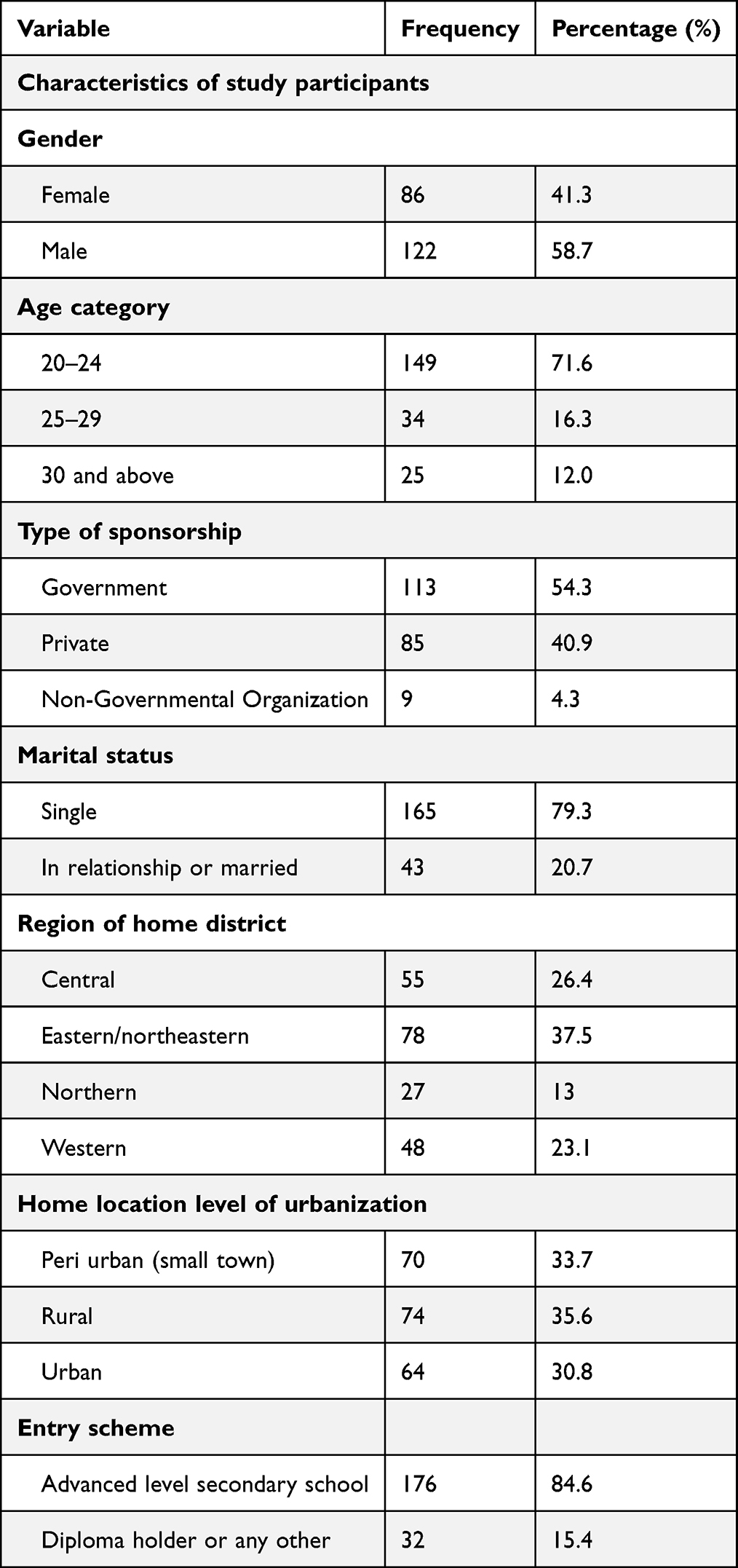 |
Table 1 Sociodemographic Characteristics of Study Participants |
Level of Academic Achievement in Biomedical Sciences
Grade Point Average (GPA)
Students scored highest mean GPA in physiology (2.92), followed by biochemistry (2.91) and the least GPA score was in anatomy (2.65). The overall mean GPA score across the three biomedical science courses was 2.83.
Analysis of variance demonstrated a significant difference in academic achievement across the three biomedical science courses (F= 7.9, P˂0.001). Students scored significantly lower in anatomy (mean GPA 2.65±0.81), compared with physiology (mean GPA 2.92±0.77, p˂0.01) and biochemistry (mean GPA 2.91±0.77, p˂0.01). No difference in academic achievement was observed between physiology and biochemistry (p˃0.05). The proportion of variance explained by course differences was small (η2 = 0.025), corresponding to-small-to moderate effect size (Cohen’s f = 0.16). When variation in academic achievement across the four universities was examined, an intraclass correlation coefficient (ICC) of 0.37 was found, indicating that 37% of the variance in academic achievement was explained by the differences between universities.
Subjective Academic Achievement
Students who strongly agreed or agreed that they were satisfied with their academic achievement in anatomy, physiology and biochemistry had significantly higher GPAs compared to those who disagreed or strongly disagreed (p˂0.01). The strongest differences were observed in anatomy and physiology (p˂0.001). Similarly, students who strongly believed that their academic achievement was appropriate for their efforts had the highest GPAs with significant differences across categories (p˂0.01). Perception of being knowledgeable and applying knowledge in these courses in the care of patients did not show statistically significant associations with GPA (p˂0.316 and p˂0.222 respectively). Belief in the potential to do better was marginally associated with academic achievement (p˂0.051). See Table 2.
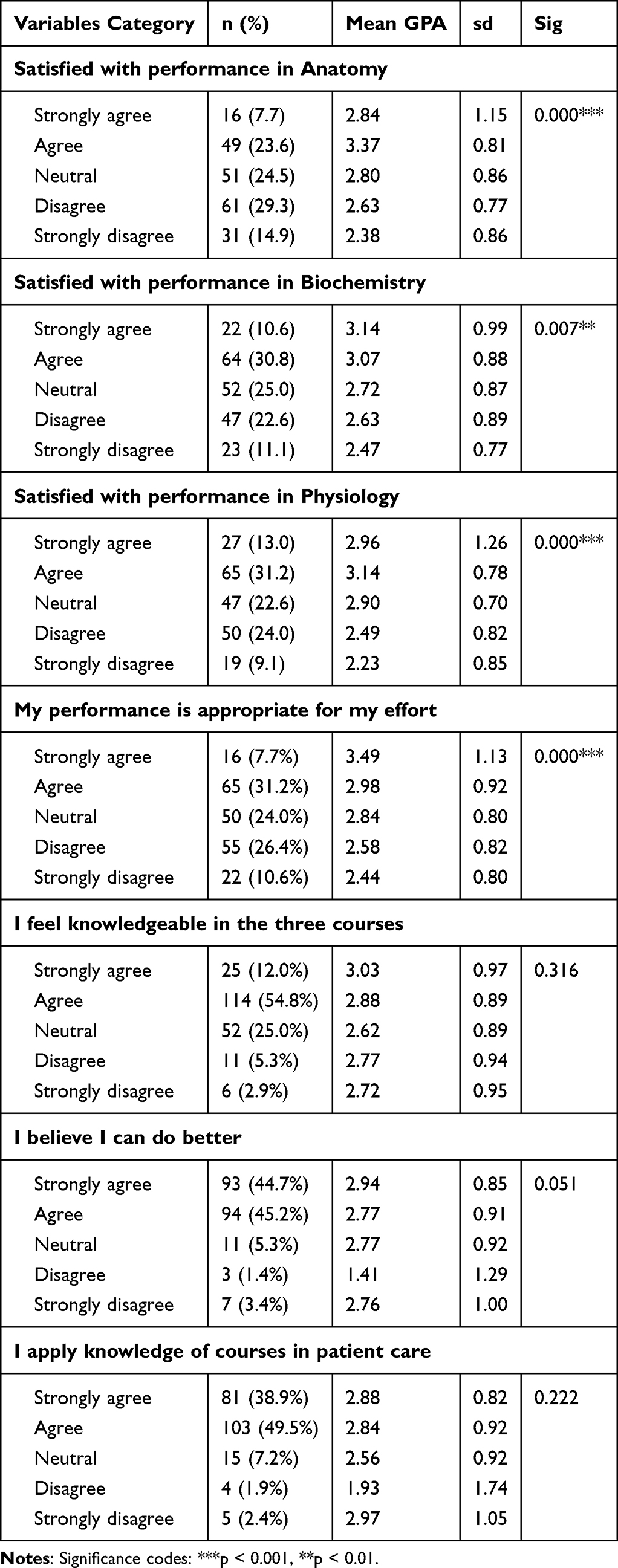 |
Table 2 Findings on Subjective Academic Achievement Using Subjective Academic Achievement Scale (SAAS) |
Institutional Factors Influencing Academic Achievement in Biomedical Sciences
Anatomy
Multivariate analysis revealed that students who were unsure if their lecturers missed teaching scheduled anatomy lessons scored a GPA less by 0.59 points compared to those who knew that lecturers missed scheduled anatomy lessons (β = −0.59, 95% CI: −1.11 - −0.09, p = 0.03). Students who were taught anatomy using practical sessions, such as cadaver dissection in addition to theory lessons, scored a GPA less than 0.36 points compared to those who were not (β = −0.36, 95% CI: −0.62 - −0.10, p = 0.006). The study also found that students who were taught anatomy using Problem Based learning approach scored higher in GPA by 0.48 points compared to those who were taught using the lecture method (β = 0.48, 95% CI: 0.01–0.96, p = 0.04). Similarly, students who were taught using tutorials scored higher in GPA by 0.33 points compared to those who were taught using the lecture method (β = 0.33, 95% CI: 0.03–0.63, p = 0.03). The study also found that students who were taught anatomy using an online approach scored a GPA of less than 0.32 points compared to those who were taught using the blended approach (β = −0.32, 95% CI: −0.61 - −0.02, p = 0.04). See Table 3.
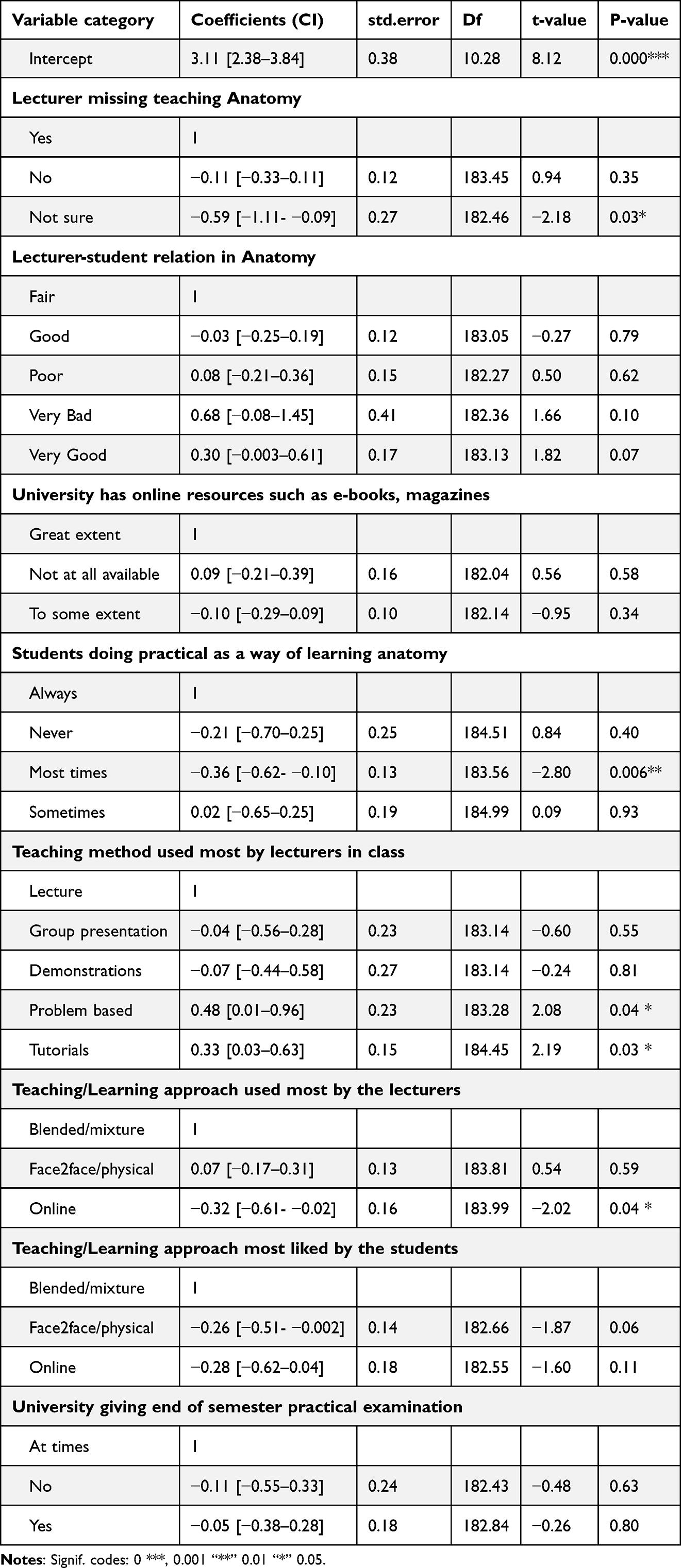 |
Table 3 Multivariate Analysis of Institutional Factors Influencing Academic Achievement (GPA) in Anatomy Among Students of Bachelor of Nursing Science |
Physiology
Multivariate analysis of institutional factors influencing academic achievement in physiology among BNS students revealed that those who perceived their physiology lecturers as having good teaching skills to some extent scored, on average, 0.25 GPA points lower than those who perceived their lecturers as having good teaching skills to a greater extent (β = −0.25, 95% CI: −0.46 - −0.03, p = 0.03). Students who reported having very good relationship with their lecturers of physiology scored 0.37 GPA points higher than those who described their relationship with their lecturers as simply a fair one (β = 0.37, 95% CI: 0.07–0.67, p = 0.02). Similarly, students who preferred to be taught physiology using an online approach scored, on average, 0.41 GPA points lower than those who preferred a blended teaching approach (β = −0.41, 95% CI: −0.75 - −0.07, p = 0.02). See Table 4.
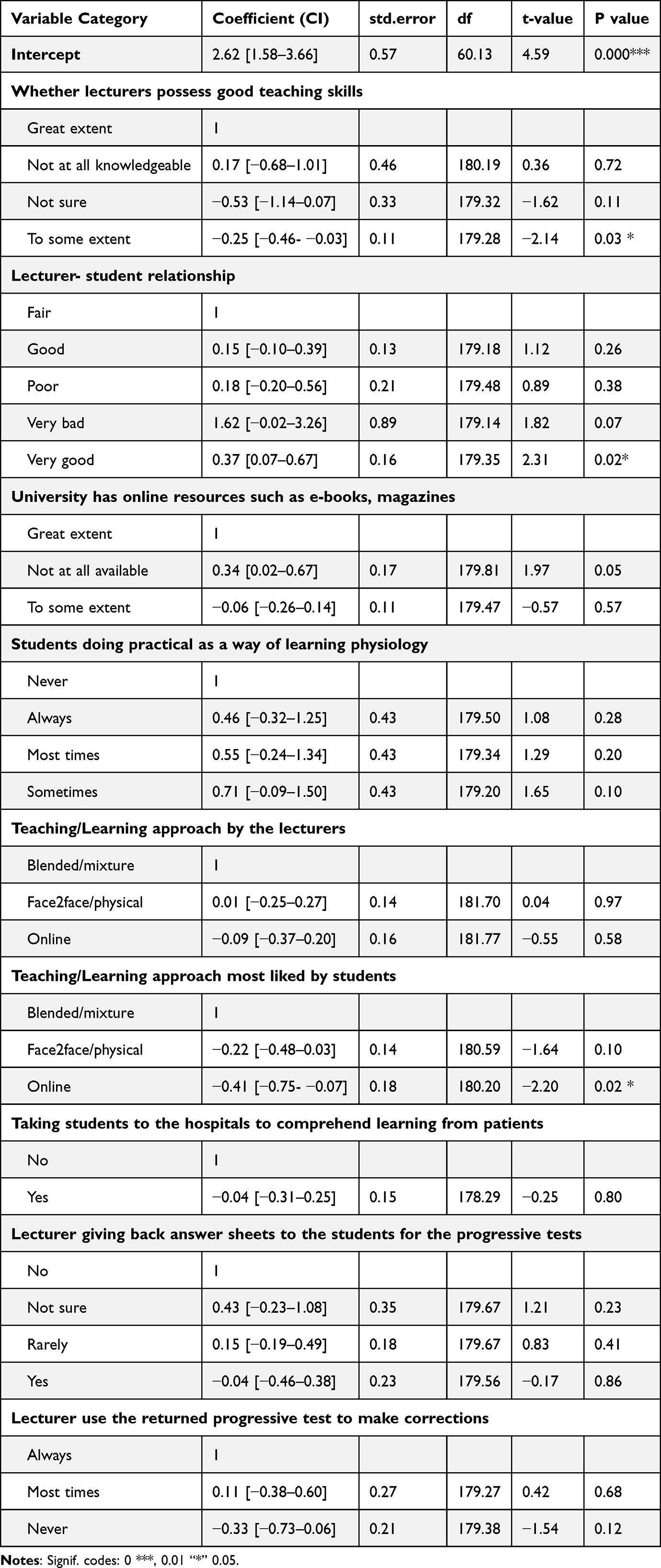 |
Table 4 Multivariate Analysis of Institutional Factors Influencing Academic Achievement in Physiology Among Students of Bachelor of Nursing Science |
Biochemistry
A multivariate analysis of institutional factors influencing academic achievement revealed that students who described their relationship with biochemistry lecturers as “very good” had a GPA of 0.34 points higher than those who described their relationship as “fair” (β = 0.34, 95% CI: 0.06–0.62, p = 0.03). Similarly, students whose lecturers never returned marked scripts for progressive tests scored a GPA that was 0.44 points lower than those whose lecturers always returned scripts for feedback and revision (β = −0.44, 95% CI: −0.84 - −0.04, p = 0.04). Additionally, students whose lecturers rarely returned marked scripts for progressive tests had a GPA that was 0.47 points lower than those whose lecturers consistently provided constructive feedback (β = −0.47, 95% CI: −0.90 - −0.03, p = 0.046). Although the association was only marginally significant (p = 0.05), the findings indicate that students taught exclusively through an online platform scored, on average, 0.26 GPA points lower than those taught using a blended approach (β = −0.26, 95% CI: −0.52 - −0.20, p = 0.05). See Table 5.
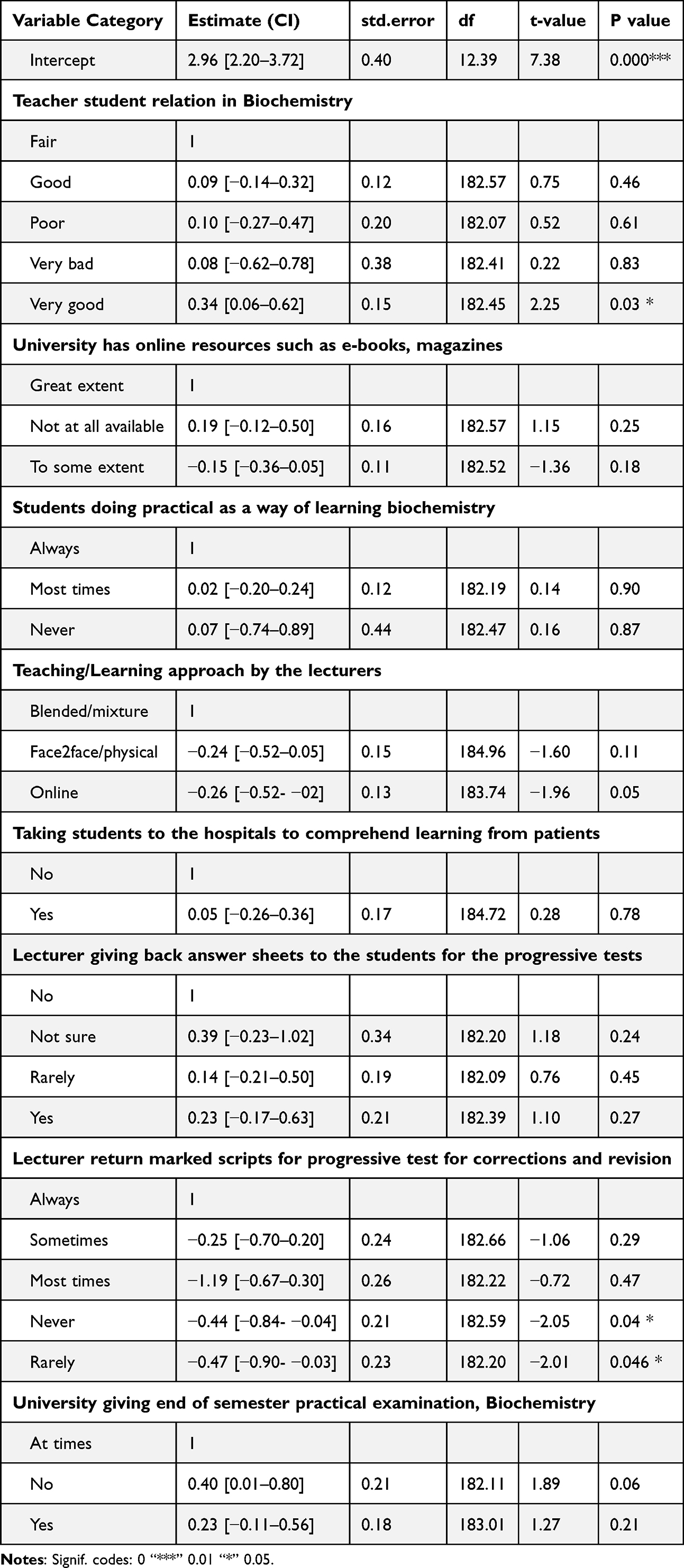 |
Table 5 Multivariate Analysis of Institutional Factors Influencing Academic Achievement in Biochemistry Among Students of Bachelor of Nursing Science |
Discussion
The study reveals that nursing students experience varying levels of academic success across foundational biomedical sciences, with anatomy emerging as the most demanding course compared to physiology and biochemistry. Students who felt satisfied with their academic achievement or believed their effort matched their academic outcomes tended to achieve higher examination results, highlighting the influence of motivation and self-perception on learning. These findings suggest that interventions to strengthen both academic support and students’ confidence could improve academic achievement in biomedical sciences. Notably, the variations in performance between universities contributed more substantially to the gaps in achievement than variations between courses alone.
This means that institutional factors such as teaching effectiveness, availability of resources, and student-lecturer ratio played a significant role in influencing the learning outcomes.
These patterns in academic achievement are consistent with findings from previous studies indicating that academic outcomes in biomedical sciences among nursing students is shaped by various factors including the type of the course and the institution where a student studies from. For instance, previous studies have similarly reported lower academic achievement in anatomy compared to other biomedical sciences, often attributing this to the heavy content load, high difficulty level and abstract nature of the course.56,57 Similarly, differences in academic achievement across universities observed in this study resonate with research studies emphasizing the influence of teaching quality, teaching and learning resources, and learning environments on academic achievement.58,59
Institutional Factors Influencing Academic Achievement in Anatomy, Physiology and Biochemistry
Institutional factors influencing academic achievement were determined for each specific biomedical science course. Accordingly, the discussion of findings is presented by course to enhance clarity and facilitate clear connection between results and their implications. Results and the discussion sections show that some factors were found to influence academic achievement across more than one course. Such cross-cutting factors could be considered as the most prevalent institutional determinants of academic achievement among students as they reflect broader systemic or environmental conditions that influence learning in multiple courses.
Anatomy
The study revealed that students who were uncertain about the consistency of their lecturers in conducting scheduled anatomy lectures tended to achieve lower GPA than those who were aware that some lessons had been missed. This finding implies that students were possibly not actively engaged in the teaching-learning process, reflecting the influence of lecturer-student instructional approaches. The finding points to the quality of teaching where learning is predominantly directed by the lecturer rather than facilitated through active student participation. It is most likely that a student will always remember the lecture sessions in which he or she was active and also keep track of those sessions ahead that require his or her active engagement. Similar findings have been reported in previous studies. For instance, a study conducted in Nigeria revealed that students who were taught using conventional, teacher-centred methods such as lectures tended to be passive during the learning process and consequently achieved lower academic performance.60 A similar study in the United States compared academic achievement among medical students exposed to passive and active learning approaches. The study found that students exposed to large group discussions, an active teaching method, demonstrated a strong feeling of having learned and achieved higher grade points than those taught using traditional lecture method, which represents a passive learning approach.61 The choice of the type of teaching method largely depends on the lecturer. Consequently, the lecturer’s pedagogical skills, in combination with institutional academic policies as well as the type of the curriculum, play a critical role in determining whether teaching methods that promote passive or active learning engagement are implemented. The findings from this study, therefore, also reflect the influence of lecturer’s pedagogical skills at the institutions where the study was conducted. Lecturers who possess or have had training in effective teaching methods are more likely to apply teaching methods that actively engage and motivate learners hence fostering more meaningful learning and academic achievement. For instance, findings from the systematic review study on the effectiveness of faculty development programs for training university professors in the health area revealed that pedagogical skills led to positive behavioral changes among professors, enabling them to better stimulate and encourage students, and resulting in improved quality of teaching.62 This suggests that strengthening pedagogical capacity among lecturers of biomedical sciences, particularly in anatomy, could foster more active learning environments characterized by learners’ awareness of their lecturers’ consistence in conducting scheduled lectures, thereby promoting self-regulated learning and higher academic achievement. When students are in institutional environments where they are confident that their lecturers will reliably conduct lectures as scheduled and thus they are engaged and trust in the whole instructional process, they are likely to set educational goals, monitor their learning, choose appropriate strategies, reflect on what they have learned, and regulate their motivation. This aligns with Self-Regulated Learning (SRL) theory by Barry Zimmerman (1980–1990) which emphasizes metacognitive, motivational and behavioral processes in learning.63
While it is generally expected that exposing students to practical sessions in anatomy, such as cadaveric dissections, alongside theoretical teaching enhances understanding and contributes to higher academic achievement, this study revealed counterintuitive findings. The study revealed that students who participated in both practical and theoretical sessions recorded lower academic achievement than those who received theory-based instruction only. This is very surprising counterintuitive finding given that many previous studies link practical sessions in anatomy, such as cadaveric dissections to higher academic achievement, cultivation of empathy and respect for patients after death, a deeper appreciation of existence after death, acceptance that death is not frightening, an understanding of the afterlife, a better understanding of interprofessional roles, and development of professional identity.64,65 However, there are some previous studies that reveal contrary findings and consequently support findings of this study. For instance, a study in South Carolina investigated the effects of cadaveric dissection in gross anatomy on academic performance in examinations and found that participating in cadaveric dissection did not translate into higher academic performance.66 This unexpected study finding may be attributed to factors such as less effective practical sessions due to high lecturer-student ratio and inadequate institutional resources to facilitate effective practical sessions. It could be due to cognitive overload from managing complex hands-on tasks alongside theory or inadequate integration between theoretical concepts and practical exercises, which may have hindered effective learning. Limited effect of practical sessions on learning outcomes aligns with Cognitive Load Theory (CLT). CLT is a psychological framework that explains how the human brain receives, processes, and retains new information. It posits that learning is most effective when instructional design aligns with the brain’s limited working memory capacity.67 CLT operates on three principles: intrinsic, extraneous, and germane loads.67 Intrinsic load refers to the level of difficulty of the content being taught; extraneous load refers to how the content is organized and presented to the students; and germane denotes the mental effort directed at understanding and integrating new information into existing knowledge. Practical sessions like cadaveric dissections present high intrinsic and extraneous cognitive load. Therefore, students may struggle to process all this information, leading to lower academic achievement in examinations that primarily test theoretical knowledge. This finding that subjecting students to practical learning sessions in anatomy did not appear to contribute to enhanced academic achievement than theory-based learning among undergraduate nursing students calls for thoughtful reflection on its educational policy implications. While this finding contrasts with traditional expectations and raises important questions for educators and curriculum developers, it should be interpreted with caution.
The findings may have been influenced by the small sample size, the cross-sectional study design, or the differences in how practical sessions were implemented across institutions where the study was conducted. Nonetheless, the findings highlight the need for more rigorous, multisite and longitudinal studies to generate stronger evidence on the educational and competence outcomes of practical sessions such as cadaveric dissections in anatomy course among undergraduate nursing students especially in low resource settings.
Similarly, this study revealed that students who were taught anatomy using Problem-Based Learning (PBL) approach significantly scored higher GPA scores, as did those who were taught using tutorials. PBL and tutorials are student-centred teaching methods that promote active learning, critical thinking, effective communication, intrinsic motivation to learn, teamwork, problem solving, and time management among students.68 Many previous studies indeed show that PBL teaching method has been used to teach anatomy. Most of the studies report findings that are consistent with what was also found in this study. For instance, a study in the United Kingdom reported that tutorial PBL exercises, when incorporated into curriculum design, can improve student experience in biomedical sciences.69 A similar study on the effectiveness of problem-based- learning on academic performance in genetics found that students who were taught genetics through PBL approach had higher academic achievement and performance skills scores than those who were taught using traditional classes.70 Another study among medical and dental students in Karachi on the effectiveness of problem-based learning strategies compared to conventional anatomy teaching approaches, concluded that students perceived PBL as more inducive in enhancing learning compared to conventional teaching.71 The influence of PBL on academic achievement in biomedical sciences aligns with Constructivist learning theory attributes. According to constructivist learning theory, learning becomes more effective if it is student-centered in which learners build knowledge through experience, reflection, and interaction.72
Therefore, these findings underscore the growing evidence of student-centred pedagogies such as PBL and tutorials in contemporary anatomy education. Their association with higher academic achievement suggests that active-collaborative learning approaches can effectively complement or outperform traditional teaching approaches such as lecture method by fostering deeper understanding, critical thinking, and transferable skills that are effectual for professional practice. The finding also carry vital policy and curriculum development implications that may need to be considered. Curriculum development and reviews may need to consider competence-based curriculum that embrace student-centered teaching methods and approaches such as PBL and tutorials.
Physiology
The study revealed that perceptions of students about quality of teaching significantly influenced their academic achievement in physiology. Students who viewed their lecturers as demonstrating good teaching skills tended to register higher grades than those who perceived their lecturers’ teaching skills less positively. This finding is supported by several previous studies. For instance, a study conducted in Indonesia revealed that students’ perception about teachers’ basic teaching skills had a significant effect on students’ learning achievement. According to students, about 40% of the academic achievement was attributed to the teacher’s effective teaching skills. The same study further explained that specific teaching skills such as the use of stimulus variation, reinforcement, and effective questioning, keep students engaged, promote critical thinking, and motivate students to learn.73 Although this study was conducted among students undertaking basic accounting course, rather than biomedical sciences, it is reasonable to believe that the influence of teaching quality is a cross-cutting phenomenon that extends across disciplines, including medical, humanities, and business courses. Similarly, another study in New Zealand on the academic achievement in English language found that students who believed they were given high quality teaching by their teachers, had greater self-efficacy and academic achievement in the same subject.74 However, a similar study in Ethiopia on the effect of teaching quality on academic achievement concluded that teachers’ teaching skills were not easily measurable.75
Findings from this study are also supported by the Pygmalion effect, also known as self-fulfilling prophecy.76 In education, the Pygmalion effect refers to the phenomenon where students tend to perform in the ways that reflect the expectations of their teachers. The four-stage cycle of the Pygmalion effect states that the beliefs of the teachers about their students shape the conduct of students, the conduct of lecturers towards students influences the beliefs of students themselves, the beliefs of students then impact their actions toward their lecturers, and actions of students towards their lecturers influence the beliefs of lecturers about students in turn, hence perpetuating the cycle. Therefore, students who perceived their lecturers as having good teaching skills, likely experienced higher expectations, encouragement, and more supportive learning environment. This perception could have boosted their motivation, engagement and confidence, resulting in higher academic achievement compared to students who rated their lecturers’ teaching skills lower. Fundamentally, the students’ perception of teaching quality acted as a trigger for the Pygmalion effect, influencing their achievement outcomes.
In addition, finding from this study suggests that effective teaching practices of the lecturer play a vital role in enhancing students’ understanding of concepts in physiology hence better academic achievement.
It emphasizes the importance of lecturer’s competence and instructional quality in fostering academic success. Consistent with this, one study reported that teachers contribute about 20–30% of the students’ academic success, compared to 50% attributed to the student, and only 5–10% to the influence of the school and peers, highlighting the significant impact of teaching quality on learning outcomes.77 This implies that continuous professional development and pedagogical training of lecturers could substantially improve student outcomes, as better teaching quality promotes deeper learning and sustained academic achievement.
Anatomy and Physiology
Students who were taught anatomy and physiology exclusively via online methods scored significantly lower in GPAs than those who were taught using blended learning approach. Further understanding of the findings of this study is shaped by the findings of previous studies. For instance, a quasi-experimental study in the United Arab Emirates compared both online and blended learning strategies and found that, although both approaches were effective, the blended approach was superior to the online-only approach.78 A study in India revealed that the majority of anatomy students who were taught using a blended learning strategy, compared to those taught through face-to-face instruction alone, reported greater satisfaction with their learning experiences. They also indicated an increased ability to develop independent learning skills, which the face-to-face approach alone did not adequately support. Therefore, this study recommended blended learning as a suitable approach for teaching anatomy to medical and nursing students.79 In Australia and China, two studies concluded that a blended strategy can be effective in teaching anatomy and biochemistry as long as face-to-face sessions are maintained for practical sessions to complement theory taught online.80,81 Similarly, a post-test-only randomized study in Ireland that compared online, face-to-face, and blended learning strategies concluded that face-to-face and blended strategies were effective at leading to skill acquisition and were preferred by the students when compared to the online-only strategy.82 Findings from the systematic review and meta-analysis study compared blended teaching and learning approach with other approaches among nursing students and revealed that students who were taught using blended approach had improved critical thinking and positive impact on nursing students compared to other approaches.83 A similar study in South India compared online, offline and blended teaching approaches in physiology and revealed that nursing students preferred offline or well organized blended approach due to network challenges associated with online only approach.84 Relatedly, another study on the effectiveness of blended teaching and learning in biomedical sciences concluded that blended teaching approach remained effective in improving learning outcomes.85 In contrast, a study in the United States and Hong Kong, which compared online, face-to-face, and blended learning strategies, concluded that there was no statistically significant difference between blended online teaching approaches.86,87
This finding is further explained by the Community of Inquiry (CoI) framework. CoI framework emphasizes three essential elements for effective learning in online and blended environments: cognitive presence, social, and teaching presence.88 Cognitive presence refers to the extent to which learners can construct and confirm meaning through sustained reflection and discourse. It involves a critical thinking process that helps students to understand, apply, and integrate new knowledge. In blended or online learning, cognitive presence is demonstrated when students engage with content, ask questions, solve problems, and connect topics and real-world contexts. Social presence refers to learners’ ability to project themselves socially and emotionally in a learning community. This includes building trust and creating a sense of belonging among the learners. In online and blended settings, social presence is essential for fostering collaboration, engagement, and mutual support, which are key factors in enhancing motivation and reducing feelings of isolation. Teaching presence involves the design, facilitation, and direction of the cognitive and social processes that support meaningful learning. This includes instructional design (such as structuring content and activities), facilitating discussion, and providing timely feedback. In blended learning, teaching presence is often stronger because of in-person opportunities for guidance, whereas in fully online environments, its effectiveness depends heavily on the instructor’s ability to engage students through digital platforms.89 Therefore, blended learning tends to support all three approaches more effectively than an online-only approach. Online-only environments may suffer from reduced social and teaching presence, leading to lower student motivation, engagement, and ultimately, achievement.90 For instance, as explained by constructivist learning theory, a blended learning approach that combines face-to-face interaction with online aspects provides richer opportunities for active student engagement such as dialogue, collaborative learning, peer-assisted learning, and immediate feedback, which are vital to academic achievement. In contrast, online teaching and learning limits students to various learning opportunities, thus reducing the depth of knowledge construction.91
The implications of this finding are both educational and policy related. The lower GPAs observed among students who were exclusively taught using online suggest that the absence of in person interaction, immediate feedback, reliable internet connectivity, and hands on engagement may limit the depth of understanding and acquisition of desired skills in these foundational biomedical courses. Given than anatomy and physiology need spatial understanding, practical demonstration, and contextual application of knowledge, purely online teaching and learning approach may not adequately support the mastery of these competences. Consistent with previous studies, this suggests that integrating online sessions with face-to-face components enhances learning outcomes.
Biochemistry
This study revealed that students who did not receive regular feedback from their lecturers performed noticeably lower grades in biochemistry compared to those who consistently received marked scripts and other opportunities for revision. This underscores the critical role of timely and constructive feedback in supporting student’s learning and academic achievement. The constructive feedback to students by lecturers revealed in this study is a practice that has been recommended by many previous studies to improve learning outcomes. For example, a study in Australia by Colthorpe and Zimbardi92 revealed that feedback from teachers to students improved their learning experiences and contributed to academic achievement. However, the same study emphasized that to produce a positive impact, it should be timely, detailed, directed, and specific. A study at Queensland University in Australia found that feedback to students from their lecturers was positively associated with academic performance.93 A similar study on the effect of constructive feedback on academic performance in Pakistan revealed that students with low academic achievement registered better academic achievement in chemistry, a closely related biochemistry course, after receiving constructive feedback from their teachers.94 From these previous studies and in reference to what this study also found, it can be concluded that constructive, timely, and specific feedback to students indeed correlates positively with academic achievement in the biomedical sciences. This is possible because feedback enables students to bridge the gap between what they know and desire. Feedback promotes responsive learning because when students receive feedback, they learn that their lecturers want them to learn and are therefore most likely to trust the advice of their lecturers and use it to progress towards improvement. It also promotes teachers’ teaching capabilities, as it helps lecturers modify their teaching by reflecting on feedback.95 Constructive feedback improves understanding, enhances student motivation, and enables students to engage in self-reflection and evaluation.96 Feedback encourages critical thinking, problem-solving skills, motivation to learn, self-regulated learning capabilities, self-efficacy, and confidence in students.97 The findings from one of the studies concluded that students who did not receive feedback scored lower on GPAs, possibly because of a gap in the scaffolding intended to support learners’ progress.98
This finding highlights the importance of the universities and other institutions to institutionalize regular, structured, and timely feedback mechanisms in biomedical science courses especially biochemistry. It points to the need to support lecturers to provide timely and constructive feedback as a way to enhance academic achievement. At the institutional level, the findings point to the need to integrate feedback practices into teaching and assessment policies.
Biochemistry and Physiology
This study also found that the cordial and supportive relationship between students and their lecturers positively influenced academic achievement in physiology and biochemistry. This finding concurs with those of previous studies. For instance, a study in India reported that teachers who demonstrated strong professional character and treated their students with dignity and respect positively influenced students’ concentration and fostered positive feelings toward the subject being taught, resulting in higher academic achievement than teachers with poor character.99 Two studies in Karachi and Finland also assessed the teacher-student relationship and academic achievement and found that students who had cordial academic relationships with their teachers performed better on examinations than those who did not.100,101 In Africa, a cross-sectional study in Nigeria concluded that a significant correlation exists between the student and lecturer relationship and academic achievement.102 However, all these studies examined the influence of the student–teacher relationship on academic achievement among students in non-medical disciplines. Therefore, findings from this study underscore the importance of this relationship in education by adding a new dimension that the student–teacher relationship is crucial in nursing education just like it has also been found with other professional disciplines.
Positive and supportive relationships between students and their lecturers relate to the comparison between teacher-centered and student-centered approaches to teaching and learning. The teacher-centered teaching approach is usually characterized by an authoritative teacher who controls all the activities of teaching and learning and considers the student as a passive participant who has little or nothing to contribute in terms of planning and decision making. In contrast, the student-centered approach to teaching and learning recognizes the learner as an adult who is able to plan, drive himself or herself, and make appropriate decisions regarding his or her learning, and the teacher respects and supports the student to exhibit his or capabilities.103 Similarly, students who have good academic relationships with their teachers usually find the learning environment very supportive and motivating to learn, find it easy to approach their teachers for consultation, and build a sense of confidence and self-efficacy among themselves.104
Previous studies have added another dimension to the importance of the relationship between teachers and students, which also needs to be considered. These studies found that, although this relationship is indeed important, students who embrace self-regulated learning, particularly those in higher education, tend to rely less on direct teacher intervention. When students are empowered to learn independently, they typically require less teacher intervention. Instead, they benefit more from access to enabling resources and minimal guidance, especially when scaffolding is needed to narrow Vygotsky’s Zone of Proximal Development (ZPD), the gap between what a student can do independently and what they can accomplish with the teacher’s help.105 A study in Hong Kong found that as students develop self-regulated learning abilities, they increasingly take initiative in their learning processes, seek help from peers, and utilize online resources before approaching instructors. This shift reflects a move towards greater independence in learning, with students requiring less direct intervention from teachers.105 Despite the independent role of students, the teachers’ impact on academic achievement remains solid.
Taken together, this study finding that cordial and supportive lecturer-student relationships enhance academic achievement in physiology and biochemistry highlights the critical role of interpersonal engagement in nursing education. A positive academic engagement fosters trust, motivation, and open communication, creating a supportive environment that promotes confidence, active participation, and deeper learning. This underscores the need for nursing educators to adopt student-centred teaching and learning approaches that emphasize respect, mentorship and responsiveness to students’ academic needs.
Conclusion and Recommendations
This study concludes that academic achievement in biomedical science courses namely anatomy, physiology and biochemistry among undergraduate nursing students is influenced by various individual and institutional factors. Anatomy emerged as the most challenging course, most likely due to its abstract content and cognitive load, while physiology and biochemistry showed relatively comparable better outcomes. Students’ self-perception, motivation, and satisfaction with their learning progress were positively linked to academic achievement, emphasizing the role of self-regulated learning and intrinsic motivation. Institutional factors such as teaching quality, pedagogical approach, lecturer consistency, availability of feedback, and the nature of student-lecturer relationship were found to be critical institutional determinants of academic achievement. Findings indicate that student-centred and interactive pedagogies such as problem-based learning (PBL) and tutorials yield higher academic achievement than conventional lecturer-centered instruction. In addition, blended teaching and learning approach proved superior to online only methods in enhancing understanding and skill acquisition. Regular, constructive feedback and cordial lecturer-student relationship also emerged as strong predictors of academic success, highlighting the importance of supportive, reflective, and communicative learning environments. Overall, the study emphasizes that both institutional quality and learner engagement jointly shape achievement in biomedical sciences among nursing students.
Based on the findings of this study, several recommendations are proposed to enhance academic achievement in biomedical sciences among nursing students. Educational institutions should prioritize continuous professional development programs aimed at strengthening lecturer’s pedagogical competencies. Such programs should emphasize student-centred and interactive teaching approaches including problem-based learning, tutorials and other active learning strategies that promote critical thinking, self-regulation and deeper understanding. By equipping lecturers with contemporary teaching skills, institutions can ensure that students are actively engaged in their learning process, leading to improved outcomes in foundational biomedical science courses.
Educational institutions should adopt blended teaching and learning approaches that effectively combine online and face-to-face instructional methods. Blended approaches have been found to enhance understanding and skill acquisition, particularly in biomedical sciences such as anatomy and physiology that require hands-on experience and visual-spatial comprehension. Therefore, institutions should invest in digital infrastructure such as reliable internet connectivity to optimize the benefits of both online and physical interactions.
In addition, institutions should put in place structured and timely feedback systems within their teaching frameworks. Lecturers should be encouraged and supported to provide constructive, specific, timely, and actionable feedback that guides students toward improvement. The feedback should be aligned with the course learning objectives and intended learning outcomes. Students should be appraised for what they did well, be told what they did not do well, then be guided on what they should do so as to do better. Regular feedback helps to bridge learning gaps, strengthens motivation, and encourages self-reflection, which are all critical for sustained meaningful academic achievement.
Furthermore, the establishment of positive lecturer-student relationships should be deliberately promoted within nursing education programs. Lecturers should cultivate the culture of being approachable, promote mutual respect, and mentorship to create a supportive learning environment that builds students’ confidence, motivation, and academic self-efficacy. Strengthening this relational dimension enhances students’ engagement and trust in the learning process, ultimately contributing to improved performance.
Finally, curriculum developers and educational policymakers should review existing nursing curricula to integrate competence-based and student-centred instructional strategies that align teaching methods with desired learning outcomes. Alongside this, educational institutions must improve institutional resources, including teaching materials, laboratory facilities, and lecturer-student ratios, to support effective teaching and learning in biomedical sciences. Further research is also recommended to explore the long-term effects of pedagogical innovations, feedback models, and institutional factors on both academic achievement and professional competence in nursing education.
Study Limitations
This study has limitations that should be considered when interpreting findings. As a cross-sectional study design was employed to guide the study, causal relationships could not be established between the observed variables. The findings therefore indicate associations rather than direct cause-and-effect relationship among factors such as effective feedback, student-centred and problem-based learning strategies, positive student-lecturer relationships and academic achievement in biomedical sciences among undergraduate nursing students. Additionally, although the study involved four public universities, these institutions were purposively selected and therefore may not fully represent all nursing students across Ugandan universities. Furthermore, while academic scores in biomedical sciences were objectively verified, other measures related to students’ learning characteristics relied on self-reported data, which may be influenced by response bias.
Data Sharing Statement
The data set used during data analysis is available from the corresponding author on request.
Ethical Approval
Ethical approval was obtained from Moi University REC (FAN: 0004463), TASO-REC (TASO-2023-261), and Uganda National Council of Science and Technology (HS3522ES). Informed consent to participate in the study was obtained from all participants. The study adhered to the principles of the Declaration of Helsinki.
Funding
No external funding was received for the study. The funds involved were generated internally by the corresponding author.
Disclosure
We declare no competing interests.
References
1. ICN. Current Nursing Definitions. 2002.
2. Boniol M, Kunjumen T, Nair TS, et al. The global health workforce stock and distribution in 2020 and 2030: a threat to equity and ‘universal’ health coverage? BMJ Glob Health. 2022;7(6):e009316. doi:10.1136/bmjgh-2022-009316
3. Crisp N, Brownie S, Refsum C. Nursing & Midwifery: The Key to the Rapid and Cost Effective Expansion of High Quality Universal Healthcare. School of Nursing and Midwifery, East Africa; 2018:1–39.
4. Alshammari MH, Alenezi A. Nursing workforce competencies and job satisfaction: the role of technology integration, self-efficacy, social support, and prior experience. BMC Nurs. 2023;22(1):308. doi:10.1186/s12912-023-01474-8
5. Nursing ACO. The baccalaureate degree in nursing as minimum preparation for professional practice. J Prof Nurs. 2001;17(5):267–9.
6. WHO. Global Strategic Directions for Strengthening Nursing and Midwifery 2016-2020. France: World Health Organization; 2016.
7. Lasater K, Sloane DM, McHugh MD, et al. Changes in proportion of bachelor’s nurses associated with improvements in patient outcomes. Res Nurs Health. 2021;44(5):787–95.
8. Liu X, Zheng J, Liu K, et al. Associations of nurse education level and nurse staffing with patient experiences of hospital care: a cross sectional study in China. Res Nurs Health. 2019;43.
9. Wieczorek-Wójcik B, Gaworska-Krzemińska A, Owczarek A, et al. The influence of nurse education level on hospital readmissions—a cost-effectiveness analysis. Int J Environ Res Public Health. 2022;19(7):4177. doi:10.3390/ijerph19074177
10. Porat-Dahlerbursh J, Aiken LH, Lasater KB, et al. Variation in nursing baccalaureate education and 30 day inpatient surgical mortality. Elsevier. 2022;70(2):300–308.
11. Abdullahi A, Gannon M. Improving college students’ success in gateway science courses: lessons learned from an anatomy and physiology workshop. Ame J Health Sci. 2012;3.
12. McVicar A, Andrew S, Kemble R. The ‘biosciences problem’ for nursing students: an integrative review of published evaluations of year 1 bioscience and proposed directions for curriculum development. Elsevier. 2015;25(3):500–509.
13. Craft J, Christensen M, Bakon S, et al. Advanced student nurse knowledge of biomedical sciences: a mixed methods study. Nurse Educ Today. 2017;48:114–119. doi:10.1016/j.nedt.2016.10.003
14. Syed Abd Halim SA, Yusoff MSB, Yaman MN, et al. Clinical students’ reflections on the preclinical anatomy learning experience. J Taibah Univ Sci. 2023;18(4):757–770. doi:10.1016/j.jtumed.2022.12.007
15. Yao Q, Cheng Y, Wang W, et al. Human anatomy curriculum reform for undergraduate nursing students: an exploratory study. Clin Anat. 2024;37(5):522–533. doi:10.1002/ca.24142
16. Nuuyoma V, Mukerenge NF, Kuugongelwa S. Fostering understanding of anatomy and physiology among undergraduate nursing students for integration into clinical practice: an integrative literature review. Nurs Educ Prac. 2025;88:104575. doi:10.1016/j.nepr.2025.104575
17. Aliouche H. Using biochemistry in the treatment of disease. 2022.
18. Connolly SA, Gillingwater TH, Chandler C, et al. The anatomical society’s core anatomy syllabus for undergraduate nursing. J Anatomy. 2018;232(5):721–728. doi:10.1111/joa.12782
19. Langtree EM. Factors contributing to success in anatomy and physiology in first year students in the KZNCN nursing programme. DUT Open Scholar. 2015.
20. Singh R, Jones DG, Kumar R, et al. Will development of human anatomy revolutionize medical education? Basic Sci Med. 2021;10:10–18.
21. Bingen H, Tveit B, Krumsvik RJ, et al. Nursing students’ experiences with the use of a student response system when learning physiology. Nordic J Digital Literacy. 2019;14(1–2):37–53. doi:10.18261/issn.1891-943x-2019-01-02-04
22. Sulosaari V, Suhonen R, Leino-Kilpi H. An integrative review of the literature on registered nurses’ medication competence. J Clin Nurs. 2011;20(3–4):464–478. doi:10.1111/j.1365-2702.2010.03228.x
23. Bakon CM, Wirihana L, Christensen M, Wirihana L. Can active learning principles be applied to the bioscience assessments of nursing students? A review of the literature. Nurse Educ Today. 2016;37:123–127. doi:10.1016/j.nedt.2015.11.030
24. Vincent C. Science and Patient Safety. National Library of Medicine; 2013.
25. Gordon C, Hudson PB, Plenderleith MB, et al. Final year Australian nursing students’ experiences with bioscience: a cross sectional survey. Nurs Health Sci. 2017;19(1):22–8.
26. Jensen KT, Knutstad U, Fawcett TN. The challenge of the biosciences in Nurse education: a literature review. J Clin Nurs. 2018;27(9–10):1793–1802. doi:10.1111/jocn.14358
27. McVicar A, Andrew S, Kemble R. The ‘bioscience problem’ for nursing students: an integrative review of published evaluations of Year 1 bioscience, and proposed directions for curriculum development. Nurse Educ Today. 2015;35(3):500–509. doi:10.1016/j.nedt.2014.11.003
28. Al Hmaimat N, Melhem O, Rosita A, et al. Curriculum evaluation: assessing the students’ achievement of a program level learning outcomes in the baccalaureate degree of nursing. Inter J Nurs Health Care Res. 2021;4:1267.
29. Munguiko C, Ngeno A, Museene S. Educational factors influencing academic achievement in biomedical sciences among undergraduate nursing students in Uganda: analytical cross-sectional study. Discover Education. 2025;4(1):208. doi:10.1007/s44217-025-00601-8
30. Song Y, L.McCreary L. New graduate nurses’ self assessed competencies: an integrative review. Nurs Educ Prac. 2020;45.
31. Fomba BK, Talla DNDF, Ningaye P. Institutional quality and education quality in developing countries: effects and transmission channels. J Knowledge Economy. 2023;14(1):86–115. doi:10.1007/s13132-021-00869-9
32. Gultice A, Witham A, Kallmeyer R. Are your students ready for anatomy and physiology? Developing tools to identify students at risk for failure. Adv Physiol Educ. 2015;39:108–115. doi:10.1152/advan.00112.2014
33. Bergen UO. Norwegian Agency for Quality Assurance in Education. Bergen: University of Bergen; 2010.
34. Dante A, Fabris S, Palese A. Time-to-event analysis of individual variables associated with nursing students’ academic failure: a longitudinal study. Adv Health Sci2013;18.
35. Knutstad U, Småstuen M, Jensen K. Teaching bioscience to nursing students—What works? Nurs Open. 2020;8.
36. Lancia L, Petrucci C, Giorgi F, et al. Academic success or failure in nursing students: results of a retrospective observational study. Nurs Educ Today. 2013;33.
37. Ryan Blackwell G. Enhancing nursing student success: a critical realist framework of modifiable factors. Arch Nurs Prac Care. 2016;2(1):057–070. doi:10.17352/2581-4265.000015
38. Forgey SB, Williams MR, Pribesh S. Pathways to success in anatomy and physiology at the community college: the role of prerequisite courses. Commun College Enterprise. 2020;26(1):9–12.
39. Bakon S, Christensen CJ, Wirihana ML, Wirihana L. Can active learning principles be applied to the bioscience assessments of nursing students? A review of the literature. Nurse Educ Today. 2016;37:123–127.
40. Manchester KR, Roberts D. Bioscience teaching and learning in undergraduate nursing education: a systematic review with narrative synthesis. Nurs Educ Prac. 2025;82:104226. doi:10.1016/j.nepr.2024.104226
41. Speer J, Conley Q, Thurber D, et al. A mixed-methods study of the effectiveness and perceptions of a course design institute for health science educators. BMC Med Educ. 2022;22(1):873. doi:10.1186/s12909-022-03910-w
42. Nyamtema A, Karuguru GM, Mwangomale AS, et al. Factors affecting production of competent health workforce in Tanzanian health training institutions: a cross sectional study. BMC Med Educ. 2022;22(1):662. doi:10.1186/s12909-022-03719-7
43. Kempango J, Boibanda F, Lugulu J, et al. Institutional factors influencing acquisition of clinical competencies among nursing undergraduates in government and private universities in Uganda. J Front Human Soc Sci. 2025;3(1):14–26.
44. Munguiko C, Ngeno A, Museene S. Educational factors influencing academic achievement in biomedical sciences among undergraduate nursing students in Uganda: analytical cross-sectional study. Discover Educ. 2025;4(1):1–13.
45. Munguiko C, Ngeno A, Museene S. Lecturers’ perspectives on the level and factors that contribute to academic success in biomedical sciences among Ugandan nursing students: a descriptive qualitative study. BMC Med Educ. 2025;25(1):925. doi:10.1186/s12909-025-07514-y
46. Jensen K, Knutstad U, Fawcett T. The challenge of the biosciences in nurse education: a literature review. J Clin Nurs. 2018;27.
47. Dissanayake DMAP, Warnakulasuriya SSP. A critical realist analysis of nursing educators’ willingness to learn and teach patient safety in Sri Lanka: study protocol. PLoS One. 2025;20(5):e0323561. doi:10.1371/journal.pone.0323561
48. Stutchbury K. Critical realism: an explanatory framework for small-scale qualitative studies or an ‘unhelpful edifice’? Int J Res Method Educ. 2022;45(2):113–128. doi:10.1080/1743727X.2021.1966623
49. Vega A, Maguiña JL, Soto A, et al. Cross-sectional studies. Cross-Sectional Stud. 2021;21(1):164–170. doi:10.25176/RFMH.v21i1.3069
50. Etikan I, Bala K. Sampling and sampling methods. Biometrics Biostatist Inter J. 2017;5(6):00149. doi:10.15406/bbij.2017.05.00149
51. Chen JH, Gardner AK. Promoting inclusive environments through best practices in demographic survey design. Global Surg Educ J Assoc Surg Educ. 2022;1(1):47. doi:10.1007/s44186-022-00045-w
52. Bryman A. Social Research Methods. Oxford university press; 2016.
53. Tavakol M, Dennick R. Making sense of Cronbach’s alpha. Int Jo Med Educ. 2011;2:53. doi:10.5116/ijme.4dfb.8dfd
54. DeVellis RF, Thorpe CT. Scale Development: Theory and Applications. Sage publications; 2021.
55. Field A. Discovering Statistics Using IBM SPSS Statistics. Sage publications limited; 2024.
56. Qamar K, Bashir S, Khalid R, et al. Reasons for difficult topics in anatomy and their solutions as per undergraduate medical students. Khyber Med Univ J. 2021;13(3):161–165. doi:10.35845/kmuj.2021.21177
57. Cheung CC, Bridges SM, Tipoe GL. Why is anatomy difficult to learn? The implications for undergraduate medical curricula. Anat Sci Educ. 2021;14(6):752–763. doi:10.1002/ase.2071
58. Lu B, Chen F, See BH, et al. How institutional resources affect university students’ learning outcomes: evidence from the 2023 university student learning experience survey in China. Stud Higher Educ. 2024;1–19.
59. Kassab SE, Rathan R, Taylor DCM, et al. The impact of the educational environment on student engagement and academic performance in health professions education. BMC Med Educ. 2024;24(1):1278. doi:10.1186/s12909-024-06270-9
60. Agwu UD, Nmadu J. Students’ interactive engagement, academic achievement and self concept in chemistry: an evaluation of cooperative learning pedagogy. Chem Educ Res Prac. 2023;24(2):688–705. doi:10.1039/D2RP00148A
61. Boedeker P, Schlingmann T, Kailin J, et al. Active versus passive learning in large-group sessions in medical school: a randomized cross-over trial investigating effects on learning and the feeling of learning. Med Sci Educator. 2025;35(1):459–467. doi:10.1007/s40670-024-02219-1
62. Cotta RMM, de Souza Ferreira E, de Aguiar Franco F, et al. The effectiveness of faculty development programs for training university professors in the health area: a systematic review and meta-analysis. BMC Med Educ. 2024;24(1):768. doi:10.1186/s12909-024-05735-1
63. Shah DK, Modna Y. The impact of medical students’ metacognitive awareness level on their academic performance. Int J Res Med Sci. 2022;10(11):2363–2370. doi:10.18203/2320-6012.ijrms20222830
64. Horiuchi-Hirose M, Fukuoka T, Saito S. Learning outcomes of nursing students’ experience with cadaveric dissection: a scoping review. Sage Open Nurs. 2024;10:23779608241274543. doi:10.1177/23779608241274543
65. Shell K, Holt E, Kington A, et al. Motivation to learn neuroanatomy by cadaveric dissection is correlated with academic performance. Clin Anat. 2020;33(1):128–135. doi:10.1002/ca.23500
66. Sargent Jones L, Paulman LE, Thadani R, et al. Medical student dissection of cadavers improves performance on practical exams but not on the NBME anatomy subject exam. Med Educ Online. 2001;6(1):4522. doi:10.3402/meo.v6i.4522
67. Kennedy MJ, Romig JE. Cognitive load theory: an applied reintroduction for special and general educators. Teaching Except Children. 2024;56(6):440–451. doi:10.1177/00400599211048214
68. Trullàs JC, Blay C, Sarri E, et al. Effectiveness of problem-based learning methodology in undergraduate medical education: a scoping review. BMC Med Educ. 2022;22(1):104. doi:10.1186/s12909-022-03154-8
69. Posner MG, Dempsey NC, Unsworth AJ. The benefits of using case study focussed, problem based learning approaches to unit design for biomedical science students. British J Biomed Sci. 2023;Volume80–2023.
70. Araz G, Sungur S. Effectiveness of problem‐based learning on academic performance in genetics. Biochem Mol Biol Educ. 2007;35(6):448–451. doi:10.1002/bmb.97
71. Javaid Q, Usmani A. Effectiveness of problem-based learning strategies compared to conventional anatomy teaching approaches. J Pak Med Assoc. 2024;74(2).
72. Lima VV. Constructivist Spiral: An Active Learning Methodology. Vol. 21. Saúde, Educação: Interface-Comunicação; 2016:421–434.
73. Setyoningrum NE, Handayati P. The influence of student’s perception about teacher’s basic teaching skills and students characteristic to student learning achievement. in
74. Hong M, Brown GTL. Secondary students’ perceptions of teaching quality and teacher-family interaction: a structural equation model. New Zealand J Educ Stud. 2024;59(2):533–550. doi:10.1007/s40841-024-00342-6
75. Engida MA, Iyasu AS, Fentie YM. Impact of teaching quality on student achievement: student evidence. In: Encabo-Fernandez E, editor. Frontiers in Education. Frontiers Media SA; 2024.
76. Rosenthal R, Jacobson L. Pygmalion in the classroom. Urban Rev. 1968;3(1):16–20.
77. Hattie J. Teachers Make a Difference, What is the research evidence? In: Australian council for educational research. ACEReSearch; 2003.
78. Ali A, Khan RMI, Alouraini A. A comparative study on the impact of online and blended learning. Sage Open. 2023;13(1):21582440231154417. doi:10.1177/21582440231154417
79. Khalil MK, Meguid EMA, Elkhider IA. Teaching of anatomical sciences: a blended learning approach. Clin Anat. 2018;31(3):323–329. doi:10.1002/ca.23052
80. Green RA, Whitburn LY. Impact of introduction of blended learning in gross anatomy on student outcomes. Anatomic Sci Educ. 2016;9(5):422–430. doi:10.1002/ase.1602
81. Yang L, Yang Y, Zhu Y, et al. Integration of online and offline teaching mode in biochemistry and molecular biology courses. Biochem Mol Biol Educ. 2025;53(2):171–180. doi:10.1002/bmb.21877
82. Forde C, O’Brien A, Croitoru O, et al. Comparing face-to-face, blended and online teaching approaches for practical skill acquisition: a randomised controlled trial. Med Sci Educator. 2024;34(3):627–637. doi:10.1007/s40670-024-02026-8
83. Niu Y, Xi H, Liu J, et al. Effects of blended learning on undergraduate nursing students’ knowledge, skills, critical thinking ability and mental health: a systematic review and meta-analysis. Nurse Educ Pract. 2023;72:103786. doi:10.1016/j.nepr.2023.103786
84. Savitha D, Kumar S, Anto T. Online physiology teaching for nursing students during the COVID-19 pandemic–strengths, challenges and reinforcement measures. Indian J Physiology Pharmacol. 2024;68(1):86–99. doi:10.25259/IJPP_304_2023
85. Grønlien HK, Christoffersen TE, Ringstad Ø, et al. A blended learning teaching strategy strengthens the nursing students’ performance and self-reported learning outcome achievement in an anatomy, physiology and biochemistry course - A quasi-experimental study. Nurse Educ Pract. 2021;52:103046. doi:10.1016/j.nepr.2021.103046
86. Ngan OMY, Tang TLH, Chan AKY, et al. Blended learning in anatomy teaching for non-medical students: an innovative approach to the health professions education. Health Professions Educ. 2018;4(2):149–158. doi:10.1016/j.hpe.2017.11.001
87. Yen S-C, Lo Y, Lee A, et al. Learning online, offline, and in-between: comparing student academic outcomes and course satisfaction in face-to-face, online, and blended teaching modalities. Educat Inform Technol. 2018;23(5):2141–2153. doi:10.1007/s10639-018-9707-5
88. Sevnarayan K, Vaughan N. Collaborative learning in a large enrollment online course: application of the community of inquiry framework. Int J E-Learning Distance Educ. 2024;39(2).
89. Lim H. Community of Inquiry in an online undergraduate information technology course. JITE. 2007;6:153–168.
90. Garrison DR, Akyol Z. The community of inquiry th eoretical framework. In: Moore MG, editor. Handbook of Distance Education. Routledge; 2013:104–120.
91. Efgivia MG, Rinanda RA, Hidayat A, et al. Analysis of constructivism learning theory. In: Prof. Dr. Ir. Setyo Budi, M.S, editor.1st UMGESHIC International Seminar on Health, Social Science and Humanities (UMGESHIC-ISHSSH 2020). Atlantis Press; 2021.
92. Colthorpe K, Zimbardi K. Facilitating timely feedback in the biomedical sciences. Int J Innovation Sci Mathematics Educ. 2013;21:60–74.
93. Zimbardi K, Colthorpe K, Dekker A, et al. Are they using my feedback? The extent of students’ feedback use has a large impact subsequent academic performance. Assess Eval Higher Educ. 2016;42.
94. Aslam R, Khan N, Ahmed U. Title: constructive feedback intervention for students’ academic achievement in chemistry: a case of public secondary schools of Pakistan affiliation(s). Instit Business Manage History. 2023;6:81–105.
95. McFadzien N. Why is effective feedback so critical in teaching and learning? 2015.
96. Obilor EI. Feedback and students’. Learning Int J Innovative Res Educ. 2019;7:40–47.
97. Aslam R, Khan N. conStructive feedback and students’academic acHievement: a tHeoreticaL frameWork. New Horizons. 2020;14(2):175–198.
98. Frank B, Simper N, Kaupp J. Formative feedback and scaffolding for developing complex problem solving and modelling outcomes. Euro J Engine Educ. 2018;43(4):552–568. doi:10.1080/03043797.2017.1299692
99. Dharmarajan B, Shaji H, Cecily DHSJ. Nursing teachers’ behavior and their influence on academic performance among students. J Nurs Sci Prac. 2022;12(2):31–6.
100. Imran M, Sultana Z, Ahmed S. The influence of student-teacher interactions on secondary school students’academic performance. Benazir Res J Human Soc Sci. 2023;2(1).
101. Sointu ET, Savolainen H, Lappalainen K, et al. Longitudinal associations of student–teacher relationships and behavioural and emotional strengths on academic achievement. Educ Psychol. 2017;37(4):457–467. doi:10.1080/01443410.2016.1165796
102. Leonard S, Omotoyosi OF, Olumide AB, et al. Impact of lecturer-student relationship on student academic performance in federal university. Oye-Ekiti Innovare J Educ. 2024;12(1):10–16. doi:10.22159/ijoe.2024v12i1.49924
103. Muganga L, Ssenkusu P. Teacher-Centered vs. Stud Centered Cultural Pedagogic Inquiry. 2019;11(2):16–40. doi:10.18733/cpi29481
104. Nyadanu SD, Garglo MY, Adampah T, et al. The impact of lecturer-student relationship on self-esteem and academic performance at higher education. J Soc Sci Stud. 2015;2(1):264–281. doi:10.5296/jsss.v2i1.6772
105. Margolis A. Zone of proximal development, scaffolding and teaching practice. Cultural Historic Psycholog. 2020;16(3):15–26. doi:10.17759/chp.2020160303
 © 2025 The Author(s). This work is published and licensed by Dove Medical Press Limited. The
full terms of this license are available at https://www.dovepress.com/terms
and incorporate the Creative Commons Attribution
- Non Commercial (unported, 4.0) License.
By accessing the work you hereby accept the Terms. Non-commercial uses of the work are permitted
without any further permission from Dove Medical Press Limited, provided the work is properly
attributed. For permission for commercial use of this work, please see paragraphs 4.2 and 5 of our Terms.
© 2025 The Author(s). This work is published and licensed by Dove Medical Press Limited. The
full terms of this license are available at https://www.dovepress.com/terms
and incorporate the Creative Commons Attribution
- Non Commercial (unported, 4.0) License.
By accessing the work you hereby accept the Terms. Non-commercial uses of the work are permitted
without any further permission from Dove Medical Press Limited, provided the work is properly
attributed. For permission for commercial use of this work, please see paragraphs 4.2 and 5 of our Terms.