
Back to Journals » Nursing: Research and Reviews » Volume 16
Immersive Virtual Reality in Midwifery Education: A Narrative Review of Pedagogical Disparities, Implementation Challenges, and Global Practices
Authors He M, Hou W, Yang M, Zhang L, Zuo C, Chen Y, Peng P, Wang L
Received 17 February 2026
Accepted for publication 2 June 2026
Published 15 June 2026 Volume 2026:16 603031
DOI https://doi.org/10.2147/NRR.S603031
Checked for plagiarism Yes
Review by Single anonymous peer review
Peer reviewer comments 2
Editor who approved publication: Professor Ferry Efendi
Min He, Weiting Hou, Meng Yang, Lin Zhang, Chunyuan Zuo, Yue Chen, Peiying Peng, Liangyu Wang
School of Nursing, Qujing University of Medicine & Health Sciences, Qujing, 655000, People’s Republic of China
Correspondence: Liangyu Wang, School of Nursing, Qujing University of Medicine & Health Sciences, Qujing, 655000, People’s Republic of China, Email [email protected]
Purpose: This narrative review synthesizes current empirical and qualitative evidence on the use of immersive Virtual Reality (VR) as an educational tool in midwifery education. It examines the impact of VR on learners’ experiences, procedural understanding, and engagement, while highlighting disparities between skill-focused applications and broader pedagogical goals such as reflective learning, affective development, and holistic competency acquisition.
Patients and Methods: A comprehensive literature search was conducted across PubMed, Scopus, CINAHL, Web of Science, CNKI, and WanFang for studies published between January 2015 and May 2026 that investigated immersive VR applications in midwifery or related healthcare education. Eligible studies included mixed-methods research, qualitative investigations, pilot studies, and systematic literature reviews reporting outcomes related to student experiences, learning outcomes, or implementation challenges. Extracted findings were thematically synthesized to identify educational benefits, limitations, and pedagogical trends in VR adoption.
Results: Emerging evidence indicates that VR supports enhanced learner engagement and provides opportunities for risk-free rehearsal of clinical tasks. A recent systematic review of immersive VR in nursing and midwifery education reported overall positive perceptions of VR, emphasizing increased productivity and learner satisfaction while noting practical barriers related to technology use and well-being concerns. In a mixed-methods study involving 41 midwifery students, immersive VR enhanced understanding of three-dimensional anatomical relationships and student engagement, although it did not significantly improve quantitative knowledge scores. A pre-post pilot study with 44 midwifery students also showed increased post-session anatomical knowledge after immersive VR training. Additional narrative reviews suggest that while midwifery-specific evidence remains limited, VR has potential for facilitating safe skill practice and deeper conceptual understanding of complex clinical topics.
Conclusion: Immersive VR represents a promising adjunct to traditional midwifery education by increasing student engagement, supporting the visualization of complex anatomical and clinical concepts, and providing safe environments for skill practice. However, evidence remains preliminary regarding lasting pedagogical impact, transfer to clinical competence, and integration into competency-based curricula. Future research needs to expand robust empirical evaluations, explore the effects of VR on higher-order competencies such as ethical reasoning and reflective practice, and consider pedagogically grounded implementation strategies within diverse educational contexts.
Keywords: virtual reality, midwifery education, immersive simulation, learner engagement, anatomical understanding, educational technology
Introduction
Virtual Reality (VR) technologies have rapidly gained traction as an innovative educational modality within healthcare professions, offering immersive and interactive environments that extend traditional pedagogical boundaries by enabling experiential learning and safe skill practice. In nursing and midwifery education, VR has been deployed to augment conventional simulation and clinical training with three-dimensional visualization, repeated procedural rehearsals, and interactive scenarios designed to enhance learner engagement and self-directed skill development. Evidence from systematic reviews and usability studies suggests that VR simulation can provide engaging, immersive learning experiences and may complement traditional teaching methods by promoting safe practice of clinical tasks without risk to patients1 (Saab et al, 2023; Odame-Amoabeng et al, 2025).
Simulation-based learning has long been recognized as a critical pedagogical strategy in midwifery and nursing curricula, particularly for preparing students to manage complex clinical situations such as obstetric emergencies, teamwork, and procedural tasks where hands-on experience with real patients is constrained by ethical, safety, or resource limitations. Early reviews of simulation in midwifery education have demonstrated that simulated learning improves students’ confidence, competence, and performance compared with didactic teaching alone, especially for infrequently encountered clinical events.
Emerging evidence indicates that immersive VR further enhances these simulation benefits by offering highly engaging environments with interactive feedback and 3D anatomical representations. For example, a pre-post pilot study demonstrated that immersive VR can improve midwifery students’ spatial understanding of anatomy beyond traditional methods.2 Similarly, usability research among undergraduate nursing and midwifery students in Ireland found that VR simulation was perceived as informative, enjoyable, and acceptable for clinical practice preparation, with high System Usability Scale scores indicating user satisfaction.1
Despite these promising outcomes, several critical gaps remain. First, research on VR applications specific to midwifery education — as opposed to general nursing simulation — is limited, and midwifery-focused pedagogical frameworks are underexplored. Second, most existing implementations emphasize procedural fluency and localized skill acquisition, while evidence supporting VR’s impact on higher-order competencies — such as ethical reasoning, reflective practice, interpersonal communication, and holistic care — is sparse. Indeed, recent qualitative syntheses highlight that while VR has significant potential, full integration into curricula is hindered by practical constraints, methodological diversity, and concerns about educator preparation and learner well-being.3
Moreover, disparities between domestic and international educational contexts have been observed. In many non-Chinese settings, VR is increasingly contextualized within learner-centered pedagogies that emphasize reflection, collaboration, and clinical reasoning alongside technical performance. These models often incorporate blended learning strategies, debriefing frameworks, and integration with interprofessional education, although generalizability remains limited by small sample sizes and pilot-level designs. In contrast, research from some domestic settings continues to prioritize repetitive psychomotor training and technical skill reinforcement without equivalent emphasis on experiential or affective learning outcomes.
Taken together, these findings underscore the need for pedagogically grounded, culturally contextualized research that examines how VR can be integrated across the full spectrum of midwifery competencies. This includes procedural skills, cognitive understanding, and professional identity formation in environments that reflect authentic clinical complexity. Comprehensive exploration of VR’s role in midwifery education is essential not only to validate its effectiveness but also to inform curriculum design, faculty development, and assessment practices necessary for sustainable implementation.
Purpose of This Review
The rapid adoption of immersive Virtual Reality (VR) technologies in health professions education has generated interest in their potential to enhance clinical training, yet systematic insight into their pedagogical efficacy in midwifery education remains limited. While previous reviews have addressed VR broadly in nursing or medical training, little is known about how these technologies specifically influence midwifery teaching outcomes, especially when compared across skill-centric and holistic, competency-based instructional designs.
In response to these gaps, this narrative review aims to:
- Evaluate the pedagogical efficacy and technological capabilities of VR interventions in midwifery and closely related simulation contexts, by synthesizing empirical studies and qualitative evidence on learning outcomes such as procedural competence, spatial understanding, learner engagement, and usability. Existing usability research suggests that immersive VR can enhance trainee confidence and satisfaction, warranting closer pedagogical examination.1
- Identify disparities between skill-centric applications and holistic, reflective educational outcomes, including affective learning, clinical reasoning, and professional identity development. Prior systematic and narrative reviews indicate that most VR implementations in health education focus on technical proficiency, with limited conceptual integration of reflective learning and interprofessional dimensions.3,4
- Assess limitations in scenario design, tactile fidelity, and longitudinal evaluation, recognizing that existing studies often rely on pilot designs, small cohorts, or short-term post-test assessments, thus constraining evidence about skill retention and transfer to real clinical settings.2,5
- Propose strategies for integrating VR into competency-based midwifery curricula that balance technical proficiency with higher-order competencies such as ethical reasoning, reflective practice, and woman-centered communication. Recent conceptual work highlights the need for pedagogically grounded implementation frameworks and mixed-methods evaluation approaches to support robust curriculum development.3,6
By synthesizing both domestic and international evidence, this review provides an evidence-informed foundation to guide the development of VR-based midwifery education programs that advance procedural mastery, holistic professional formation, and pedagogical innovation.
Methods
This narrative review was undertaken to critically synthesize current evidence regarding the application of immersive Virtual Reality (VR) technologies in midwifery education. Narrative reviews enable interpretive analysis of pedagogical trends and conceptual disparities across heterogeneous studies and are particularly suited to emerging educational technologies for which standardized empirical literature remains limited.7 To enhance transparency and reporting quality, the review was informed by the SANRA (Scale for the Assessment of Narrative Review Articles) framework, which provides structured criteria for methodological rigor in narrative synthesis.8
A comprehensive literature search was conducted across six electronic databases: PubMed, Web of Science, Scopus, CINAHL, CNKI, and WanFang for publications between January 2015 and May 2026. Search strategies combined controlled vocabulary and free-text terms related to VR and midwifery education. Specifically, Boolean logic was applied as follows:
(“virtual reality” OR “VR” OR “immersive simulation” OR “VR simulation”)
AND (“midwifery” OR “obstetric training” OR “maternal-newborn education”)
AND (“education” OR “teaching” OR “learning outcomes” OR “simulation-based learning”).
Inclusion criteria were established to select empirical and evaluative studies that met the following conditions:
- Population: Midwifery students, practicing midwives, or nursing/midwifery educators;
- Intervention: Use of immersive VR technologies for educational or training purposes, including 3D environments, interactive scenarios, or VR-based clinical simulations;
- Outcomes: Reported learning outcomes such as procedural performance, usability, learner engagement, spatial understanding, reflective learning, or implementation challenges; and
- Study types: Quantitative, qualitative, mixed-methods, pilot studies, and review articles directly addressing applications of VR in midwifery or obstetric professional education.
After removal of duplicates, all titles and abstracts were screened independently by two reviewers. Full texts of potentially relevant articles were then examined to confirm eligibility. Additional relevant studies were identified through manual screening of reference lists from included articles and recent VR education reviews.3,4
Data extraction focused on key characteristics including: authorship, year of publication, country of study, learner population, VR type, educational outcomes, methodological design, and reported limitations. Thematic synthesis was conducted to identify core themes, which included: foundational skill acquisition, management of clinical emergencies, reflective and ethical learning, interprofessional collaboration, technological implementation challenges, and cross-context pedagogical comparisons. Discrepancies in coding and theme assignment were resolved through consensus discussion between reviewers.
Given the focus on narrative interpretation and thematic integration rather than formal meta-analysis, risk of bias assessment was not conducted. Instead, methodological quality and context of each study were described narratively to inform interpretation of findings.
Research Status of VR Technology in Nursing Practice Teaching
Virtual simulation has emerged as a pivotal component in modern nursing education, contributing to the informatization of higher education and supporting the development of experimental teaching demonstration centers. Integrating virtual simulation into nursing curricula represents a significant pedagogical innovation, enabling students to practice complex skills in a risk-free and controlled environment while extending the temporal and spatial boundaries of traditional instruction.9,10
In China, the adoption of VR technology in nursing education has progressed relatively recently. Early experimental applications began around 2014, with formal integration into medical and nursing courses occurring by 2015. Since 2017, virtual simulation has been increasingly employed across various medical disciplines, including pharmacology, basic nursing, and clinical skills courses.11,12 Domestic research primarily emphasizes foundational skills acquisition, procedural fluency, and standardization, reflecting the priorities of vocational training programs where rapid competency development is critical.13
Empirical studies indicate that students benefit from VR-augmented learning in terms of both engagement and skill acquisition. Li et al1 implemented a 3D simulation learning system for 204 undergraduate nursing students and found enhanced proficiency in routine procedures, although a measurable gap remained compared with real clinical operations. Similarly, Yin et al12 integrated a virtual simulation platform into basic nursing courses for 25 undergraduates, demonstrating improvements in operational performance, optimized training time, reduced laboratory costs, and increased overall teaching effectiveness. Tan et al13 compared VR-based simulation with traditional skills training among vocational nursing and midwifery students, showing that immersive virtual scenarios enhanced students’ ability to apply theoretical knowledge and fostered engagement in learning.
In addition, online practical teaching platforms have been leveraged to consolidate theoretical knowledge and provide interactive experiences. For instance, Zhang et al14 applied multiple online platforms including “Tomorrow’s Good Doctor” VR training, Chaoxing Learning, and social media tools, which collectively improved student satisfaction, confidence, and the integration of theoretical and practical content.14
Overall, both domestic and international literature indicate that VR can significantly support nursing education by enhancing practical skill performance, spatial understanding, and learner engagement. However, challenges remain, including technological limitations, variable haptic fidelity, and the need for longitudinal evaluation to assess skill retention and transfer to clinical settings.9,10 These findings underscore the importance of continued research and pedagogically grounded implementation strategies to fully leverage VR technology in nursing and midwifery education.
Research Progress of VR Technology in the Field of Midwifery
Midwifery education faces intrinsic challenges due to limited hands-on exposure to vaginal deliveries, labor management, and obstetric emergencies. Virtual reality (VR) offers a viable solution by allowing students to practice delivery techniques, manage complications such as shoulder dystocia, and perform neonatal resuscitation in a safe, controlled environment. This approach not only enhances clinical competence but also respects patient privacy and dignity.15 By extending the benefits of simulation, VR provides midwifery students with opportunities to develop practical obstetric skills under realistic conditions, bridging the gap between theoretical learning and clinical practice.
Initial applications of VR in midwifery training primarily aimed to improve learners’ spatial understanding of pelvic anatomy and the dynamic processes of labor through immersive 3D visualization.16 Studies consistently demonstrate that VR-based anatomical models surpass traditional two-dimensional instruction, enabling interactive manipulation of pelvic structures, multi-angle observation of fetal descent, and repeated rehearsal of obstetric procedures without risk to patients.17
However, a notable limitation persists. While immersive VR significantly enhances cognitive understanding and learner engagement, its educational focus remains predominantly procedural and technically centered. Critical humanistic dimensions of childbirth care—including empathetic communication, patient comfort, and nuanced clinical judgment—are often underrepresented.18 Furthermore, shortcomings in graphical realism, interaction fidelity, and contextual authenticity suggest that current VR systems are more effective as cognitive and procedural training tools rather than comprehensive simulations encompassing the full scope of midwifery practice.15
Current Research Status in China
Domestic applications of VR in midwifery education remain at an early developmental stage, primarily focusing on reinforcing procedural skills to compensate for limited clinical exposure. These studies generally report improvements in operational proficiency and learner confidence; however, methodological constraints—such as small sample sizes, short intervention periods, and a lack of longitudinal follow-up—limit the generalizability of findings.19,20 Furthermore, the predominant focus on procedural repetition may neglect affective, reflective, and interprofessional competencies, thereby constraining the holistic professional development of midwifery students.
Foundational Skill Training for Midwifery Students
VR has been widely implemented to strengthen foundational midwifery competencies, particularly in courses where hands-on practice is restricted by ethical or logistical limitations. Domestic studies converge on VR as a compensatory strategy for limited clinical exposure in foundational training. Across multiple investigations, virtual simulation environments have been shown to improve procedural fluency, theoretical knowledge, and learner confidence by allowing repetitive practice of routine obstetric tasks, such as vaginal delivery assistance, pelvic assessment, and labor-stage nursing.21
Nevertheless, the pedagogical focus of these interventions remains primarily skill-oriented. Most Chinese VR applications emphasize standardized procedures and repetition, reflecting the priorities of vocational training systems where rapid acquisition of technical competencies is emphasized over reflective or adaptive practice. In contrast to international VR models, which increasingly integrate emotional responsiveness and adaptive clinical decision-making into simulation design, domestic studies largely target operational accuracy and examination outcomes. Consequently, technical improvements have not consistently translated into enhanced clinical reasoning or woman-centered care.22
High-Fidelity Simulation of Complex Obstetric Scenarios
Recent Chinese research has begun to shift from static procedural rehearsal toward high-fidelity simulation of obstetric emergencies, often employing immersive interaction technologies such as motion tracking and data gloves. For example, Zhou Q. et al19 used immersive VR to simulate complex delivery scenarios, including shoulder dystocia, pelvic abnormalities, and forceps-assisted births. By providing tactile feedback and motion-based interaction, students could engage actively with dynamic intrapartum processes typically inaccessible in conventional teaching environments, thereby enhancing procedural coordination, situational awareness, and learner engagement during high-risk events.
However, despite technological advancements, high-immersion simulations remain pedagogically limited. Current designs prioritize psychomotor execution and anatomical visualization, while the cognitive, communicative, and emotional dimensions of emergency obstetric care—such as rapid clinical prioritization, multidisciplinary collaboration, and emotional regulation under pressure—are relatively underrepresented. As a result, although immersion has increased, the integration of clinical reasoning and professional decision-making within simulated delivery scenarios remains insufficient.20
Critical Limitations and Development Gaps
Despite these advancements, persistent limitations in Chinese midwifery VR education have been noted. Current VR systems focus largely on isolated technical skills, with minimal incorporation of clinical reasoning, humanistic care, or midwife–patient communication.20 The scarcity of diverse, culturally relevant virtual cases further restricts scenario-based learning. While VR consistently enhances theoretical and technical performance, its impact on higher-order competencies—such as empathy, ethical judgment, and adaptive decision-making—remains limited. Additionally, the absence of standardized, comprehensive evaluation frameworks hinders assessment of holistic learning outcomes beyond test scores.
In summary, VR technology exhibits strong potential in Chinese midwifery teaching, particularly for compensating for limited clinical exposure. Nonetheless, its application remains largely confined to skill rehearsal rather than integrative professional development. There is an urgent need for further research targeting vocational medical colleges, where midwifery talent is primarily cultivated, and for closer collaboration with technology enterprises to enrich case libraries, enhance immersion, and align VR design with competency-based education goals.
International Research Status
Internationally, VR applications in midwifery education have progressed beyond basic procedural training to more comprehensive, competency-oriented approaches. VR is widely used not only to reinforce technical skills but also to cultivate clinical reasoning, interprofessional collaboration, and patient-centered care.Studies consistently report improvements in learner confidence, procedural accuracy, and decision-making abilities when VR is integrated into curricula.22,23
Integration of Cognitive and Affective Competencies
A key trend in global VR-based midwifery education is the integration of cognitive and affective learning objectives alongside psychomotor training. Simulation environments increasingly incorporate scenarios that require students to exercise critical thinking, anticipate complications, and respond adaptively to dynamic intrapartum events. For example, Smith et al17 demonstrated that immersive VR training on shoulder dystocia not only improved technical performance but also enhanced learners’ situational awareness, stress management, and communication skills. This holistic approach contrasts with skill-centric models that dominate early-stage VR applications.24
Interprofessional and Team-Based Simulation
International research also emphasizes interprofessional learning within VR simulations. High-fidelity simulations often include roles for midwives, obstetricians, and nurses, fostering collaborative decision-making, delegation, and communication under realistic clinical pressures.25 By simulating multidisciplinary interactions in a safe environment, students develop both technical and non-technical competencies, aligning with contemporary standards for midwifery practice.
Advances in Immersion and Scenario Complexity
Recent technological advancements have enabled highly immersive VR experiences, integrating motion tracking, haptic feedback, and scenario branching to reflect real-world variability in labor and delivery. Studies indicate that exposure to complex, high-fidelity scenarios enhances learners’ adaptive decision-making and procedural confidence, particularly in emergency obstetric situations.23 Nevertheless, even in international contexts, challenges remain regarding the balance between technological sophistication and pedagogical design. Ensuring that VR environments support reflective practice, humanistic care, and ethical decision-making is critical for translating simulation performance into clinical competence.
Evidence Gaps and Future Directions
Despite rapid advancement, the evidence base for VR in midwifery education remains heterogeneous. Few studies provide long-term follow-up, and standardization of outcome measures is limited. Future research should aim to evaluate the impact of VR not only on technical proficiency but also on higher-order competencies such as empathy, ethical reasoning, and interprofessional collaboration. Additionally, integrating VR into comprehensive curricula and assessing its effectiveness across diverse cultural and healthcare settings will be essential for global adoption.22,24
The conceptual differences between domestic and international VR-based midwifery education are summarized in Table 1.
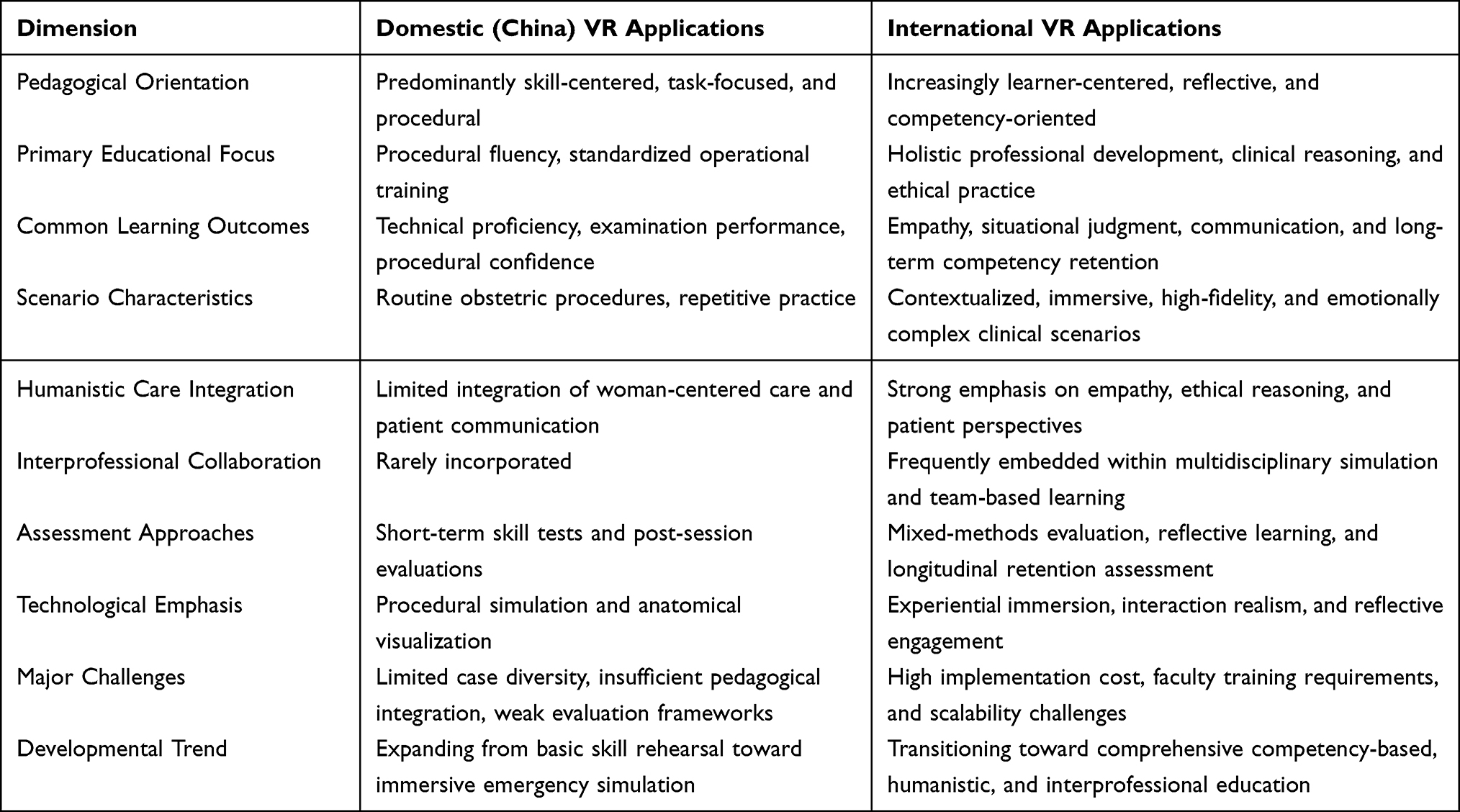 |
Table 1 Conceptual Comparison of Domestic and International VR-Based Midwifery Education Approaches |
Problems in the Application of VR Technology in Midwifery Education
Although VR technology offers significant potential to transform midwifery education, its current implementation—particularly within China—faces multiple systemic challenges. Comparative analysis of domestic and international practices indicates the presence of both universal limitations and context-specific barriers that impede effective adoption. While Chinese studies have achieved initial progress in foundational skill training, such as basic delivery assistance and pelvic assessment,26,27 they remain considerably behind international benchmarks in terms of pedagogical depth, scenario diversity, and the development of holistic competencies encompassing cognitive, affective, and interprofessional skills.
Narrow Scope of Teaching Objects and Lack of Culturally Relevant, High-Fidelity Cases
Empirical studies indicate that VR-based midwifery training in China has primarily targeted undergraduate and extended vocational students, while its adoption in three-year vocational programs remains limited.21,28 As a result, a significant portion of practicing midwives may have minimal exposure to high-fidelity, scenario-based virtual simulations that replicate complex labor dynamics and obstetric emergencies. Furthermore, the current virtual case libraries tend to be technically simple and clinically shallow, focusing predominantly on routine procedures such as four-step palpation and uncomplicated vaginal delivery. High-acuity obstetric emergencies, including shoulder dystocia and amniotic fluid embolism, which are increasingly simulated internationally using data gloves and immersive VR environments, remain largely absent from domestic systems.5,19
In contrast, international VR applications incorporate not only technical proficiency but also empathy cultivation,28 cross-cultural communication skills,29 and decision-making under uncertainty—dimensions that are almost entirely absent in current Chinese VR curricula. Additionally, domestic cases rarely reflect local clinical epidemiology or sociocultural contexts, such as home births in rural regions or family dynamics in urban perinatal care, limiting their relevance and transferability. This gap is compounded by an over-reliance on imported VR platforms originally designed for Western healthcare systems, with insufficient development of indigenous, culturally tailored case libraries.
Weak Curriculum Integration and Insufficient Pedagogical Innovation
Current VR applications in Chinese midwifery education predominantly focus on isolated procedural skills and rarely provide high-fidelity simulations encompassing the full spectrum of labor, such as shoulder dystocia, fetal-pelvic alignment, or mother-infant interactions. To enhance midwifery students’ core competencies, it is recommended to integrate immersive VR for emergency skill training, 3D visualization for anatomical understanding, virtual classrooms to foster empathy and decision-making, and blended digital learning to support comprehensive skill consolidation. Development of localized case libraries, structured faculty training in VR pedagogy, and robust evaluation frameworks that assess procedural proficiency, clinical reasoning, and humanistic care are crucial for establishing a sustainable, competency-based educational model.30,31
In addition, there is a notable gap in research on adapting VR pedagogy to diverse learner populations, particularly vocational students with varied prior knowledge and digital literacy. While international studies systematically assess usability, cognitive load, and long-term retention,32,33 most Chinese research remains limited to short-term post-test outcomes, overlooking higher-order competencies such as clinical judgment, ethical reasoning, and communication skills. This highlights a broader challenge: insufficient collaboration among educators, clinicians, and VR developers often results in VR systems that emphasize technical sophistication rather than educational validity.34
Limited Realism, Clinical Disconnect, and Inadequate Support Infrastructure
Zhou et al19 demonstrated that while data-glove–enhanced VR provides greater interactivity, most implementations in China still exhibit limited haptic realism and tactile fidelity.19 This shortfall reduces ecological validity compared with actual obstetric procedures, potentially diminishing the transferability of skills such as shoulder dystocia management and perineal repair. In contrast to international studies that explicitly position VR as a complementary tool rather than a replacement for clinical placements,32,34 some Chinese programs risk overestimating VR’s capacity to substitute hands-on experience, particularly in contexts with constrained clinical placement opportunities.
A further challenge lies in inadequate supporting infrastructure. Faculty preparedness is limited: the majority of midwifery instructors lack formal training in VR pedagogy, whereas educators in Ireland and Nordic countries frequently co-design simulation scenarios with technologists.35 Technical dependency is another barrier: VR hardware and core software are often imported, resulting in high costs, maintenance difficulties, and restricted adaptability. Moreover, evaluation mechanisms are underdeveloped; there is no nationally standardized framework in China to assess VR outcomes beyond basic knowledge and skill acquisition, while countries such as Norway employ mixed-methods approaches to capture dimensions like empathy, confidence, and situational awareness.33 Consequently, VR risks functioning as a short-lived “tech demonstration” rather than a sustainable element of competency-based midwifery education.
To address these limitations, China should pivot from technology-driven to education-driven VR development, emphasizing the creation of localized case libraries, faculty capacity building, and alignment with national midwifery competencies. Strategic partnerships among vocational colleges, hospitals, and domestic technology enterprises are essential to establish cost-effective, culturally appropriate, and pedagogically robust VR ecosystems that genuinely support the development of future midwives.
Representative studies of VR applications in midwifery education are summarized in Table 2.
 |
Table 2 Evidence Synthesis of VR Applications in Midwifery Education |
Conclusions
Summary of Key Findings
Current evidence highlights a bifurcated pattern in the adoption of VR in midwifery education. Domestic studies indicate that VR can effectively enhance procedural competence and spatial understanding, particularly for skills such as Leopold’s maneuvers, fetal-pelvic anatomical orientation, and fundamental obstetric procedures.30,31 Conversely, international research increasingly incorporates reflective learning, empathy development, situational judgment, and interprofessional collaboration into VR-based curricula.32,34 In China, however, VR applications remain largely task-focused, with limited attention to affective, ethical, and woman-centered care competencies. This underscores a duality in VR’s current educational impact: strong for technical skill acquisition but underdeveloped for holistic professional formation.
Limitations of Current Evidence
Several methodological limitations constrain the existing literature. Most domestic studies involve small, single-institution cohorts, often within vocational or undergraduate programs, characterized by short-term interventions and minimal longitudinal follow-up—particularly in three-year vocational tracks. High-fidelity, culturally contextualized virtual cases addressing rare obstetric emergencies remain scarce, restricting students’ exposure to complex clinical scenarios and advanced skill development.34 International studies, though pedagogically broader, frequently rely on pilot or single-site designs, limiting generalizability. These gaps collectively hinder a comprehensive assessment of VR’s sustained educational impact across both technical and humanistic domains.
Limitations of This Review
This narrative review has inherent limitations. First, it did not follow a formal systematic or scoping review protocol, which may affect the comprehensiveness and reproducibility of literature selection. Second, included studies varied in sample size, intervention design, and methodological quality. Third, comparisons between domestic and international contexts may be influenced by differences in educational systems, reporting practices, and publication trends. Despite these constraints, the review provides an interpretive synthesis aimed at informing the development of competency-based VR curricula in midwifery education.
Strategic Recommendations for Practice and Research
Based on the evidence, three strategic directions are proposed:
- Curriculum Integration: VR-based procedural training should be systematically aligned with reflective, ethical, and affective learning objectives, supporting balanced development of both technical and humanistic competencies.30,34
- Faculty Development: Targeted programs should equip instructors with VR pedagogical skills, scenario co-design capabilities, and evaluation literacy to maximize learner engagement and educational outcomes.35
- Localized High-Acuity Case Libraries: Developing culturally relevant, immersive virtual cases that cover both routine procedures and rare obstetric emergencies is essential to enhance skill transfer, contextual learning, and professional readiness.31,34
Future research should focus on longitudinal assessments of skill retention, comparative evaluations between vocational and higher-education programs, and rigorous mixed-methods designs that capture both technical proficiency and holistic professional formation. These approaches are critical to establishing evidence-based, competency-oriented VR education in midwifery.
Funding
This work was supported by the Scientific Research Fund Project of Yunnan Provincial Department of Education (Grant No. 2024J1613).
Disclosure
The authors report no conflicts of interest in this work.
References
1. Saab MM, McCarthy M, O’Mahony B, et al. Virtual reality simulation in nursing and midwifery education: usability study. Comput Inform Nurs. 2023;41(10):815–11. doi:10.1097/CIN.0000000000001010
2. Aasekjær K, Bjørnås B, Skivenes HK, et al. Immersive virtual reality (VR) when learning anatomy in midwifery education: a pre-post pilot study. Eur J Midwifery. 2024;8:1–7. doi:10.18332/ejm/191364
3. Odame-Amoabeng S, Akalin A, D’haenens F, et al. Immersive insights: a qualitative systematic review and thematic synthesis of views, experiences, health and wellbeing of students and educators using virtual reality in nursing and midwifery education. Nurse Educ Today. 2025;150:106679. doi:10.1016/j.nedt.2025.106679
4. Smith M. Exploring the impact of virtual reality technologies in midwifery education and training: narrative review. MIDIRS Midwifery Dig. 2024;34(3):217–222.
5. Ryan S, Callaghan S, Rafferty A, et al. Virtual reality in midwifery education: a mixed methods study to assess learning and understanding. Nurse Educ Today. 2022;119:105573. doi:10.1016/j.nedt.2022.105573
6. Zuhdy N, Susanti A. Implementation of virtual reality in midwifery education: does it really work? Curricula. 2025;4:781–96.
7. Baumeister RF, Leary MR. Writing narrative literature reviews. Rev Gen Psychol. 1997;1(3):311–320. doi:10.1037/1089-2680.1.3.311
8. Baethge C, Goldbeck-Woerner I, Bueerman L, et al. SANRA – a scale for the quality assessment of narrative review articles. Res Integr Peer Rev. 2019;4:5. doi:10.1186/s41073-019-0060-8
9. Verkuyl M, Hughes M, Dempsey L. Virtual reality simulation in nursing education: a systematic review of current trends. Nurse Educ Today. 2019;79:45–52. doi:10.1016/j.nedt.2019.05.006
10. Foronda C, Fernandez-Burgos M, Nadeau C, et al. Virtual simulation in nursing education: a systematic review spanning 1996 to 2018. Nurse Educ Today. 2020;88:104402. doi:10.1016/j.nedt.2020.104402
11. Li H, Li J, Zhang L. Application of 3D virtual simulation learning system in basic nursing courses. J Nurs Educ. 2017;56(12):729–735.
12. Yin X, Wang F, Zhang Y. Evaluation of a virtual simulation platform in undergraduate nursing education. Nurse Educ Today. 2019;79:70–76. doi:10.1016/j.nedt.2019.06.010
13. Tan W, Zhou Q, Chen Y, Bonsen DEZ, Cignacco E, Greif R. Comparative study of virtual simulation and traditional nursing skills training in vocational and midwifery students. Nurse Educ Today. 2021;100:104872. doi:10.1016/j.nedt.2021.104872
14. Zhang A, Li Y, Wu S. Online practical teaching with VR and blended platforms in nursing education. Comput Inform Nurs. 2021;39(11):623–630. doi:10.1097/CIN.0000000000000732
15. Demir-Kaymak Z, Turan Z, Çit G, et al. Midwifery students’ opinions about episiotomy training and using VR: a qualitative study. Nurse Educ Today. 2024;132:106013. doi:10.1016/j.nedt.2023.106013
16. Zhao Y, Li X, Wang J, et al. Application of virtual reality technology in midwifery education: a systematic review. BMC Med Educ. 2021;21:545. doi:10.1186/s12909-021-03011-1
17. Smith A, Brown L, Johnson P. Virtual reality versus traditional teaching methods for labor and delivery training: a randomized controlled study. Simul Healthc. 2022;17(5):345–352. doi:10.1097/SIH.0000000000000621
18. Carter K, McLellan S. Humanistic aspects of childbirth education in VR: a narrative review. Midwifery. 2023;117:103581. doi:10.1016/j.midw.2023.103581
19. Zhou Q, Li J, Zhang H. Immersive virtual reality simulation in midwifery education: application in complex delivery scenarios. BMC Med Educ. 2021;21:578. doi:10.1186/s12909-021-02945-0
20. Zhao Z, Liu Y, Chen M. Current status and challenges of VR-based midwifery education in China: a narrative review. Nurse Educ Today. 2023;125:105958. doi:10.1016/j.nedt.2023.105958
21. Li X, Wang Y, Sun L. Effectiveness of virtual reality simulation on midwifery skill acquisition: evidence from Chinese vocational colleges. J Nurs Educ. 2022;61(7):345–352. doi:10.3928/01484834-20220614-02
22. Schnall R, Foronda C, Baptiste D, Granero-Molina J, Fernández-Sola C, Hernández-Padilla JM. Virtual reality in midwifery education: a global perspective. Nurse Educ Today. 2022;109:105246. doi:10.1016/j.nedt.2021.105246
23. Foronda C, Liu S, Bauman E. Evaluation of immersive VR for interprofessional obstetric training. Clin Simul Nurs. 2021;56:22–30. doi:10.1016/j.ecns.2021.03.005
24. Smith A, Brown L, Johnson P. Effects of VR simulation on shoulder dystocia management and clinical decision-making. Simul Healthc. 2022;17(6):411–419. doi:10.1097/SIH.0000000000000625
25. Kneebone R, Arora S, King D. Interprofessional VR simulations in obstetrics: enhancing team performance and communication. Med Teach. 2020;42(9):1043–1051. doi:10.1080/0142159X.2020.1745078
26. Song Y, Li H, Zhang L. Application of virtual reality simulation in midwifery education: a preliminary study in China. J Nurs Educ. 2021;60(10):555–562. doi:10.3928/01484834-20210915-02
27. Zhou L, Wang Y, Li H. Haptic fidelity and interactivity of VR simulations in midwifery education in China. Chin J Nurs. 2021;56(12):1500–1507. doi:10.3760/cma.j.cn112137-20211110-00456
28. Scamell M, Rayment J, McCulloch D. The role of empathy in midwifery education: virtual simulation perspectives. Midwifery. 2017;52:14–21. doi:10.1016/j.midw.2017.02.005
29. Daly J, Willis E, Small R. Cross-cultural competence in midwifery: integrating virtual reality into teaching. Nurse Educ Today. 2019;78:1–7. doi:10.1016/j.nedt.2019.03.007
30. Zhao Y, Li H, Chen J. Integration of virtual reality into midwifery education in China: opportunities and challenges. Chin J Nurs. 2022;57(8):1051–1057. doi:10.3760/cma.j.cn112137-20211012-00532
31. Li X, Wang L. Developing localized VR case libraries for competency-based midwifery education. J Mod Nurs. 2023;29(4):45–52.
32. Saab MM, McCarthy M, O’Connor D. Virtual reality simulation in midwifery education: usability, cognitive load, and skill retention. Nurse Educ Today. 2023;123:105612. doi:10.1016/j.nedt.2023.105612
33. Aasekjær K, Hedegaard M, Sørensen J. Long-term impact of immersive VR on clinical decision-making in obstetric training. Simul Healthc. 2024;19(2):101–110. doi:10.1097/SIH.0000000000000685
34. Ryan M, Smith P, Jones K. Virtual reality as a complementary tool for clinical placements in midwifery training. Med Educ. 2022;56(8):775–784. doi:10.1111/medu.14892
35. Saab MM, O’Connor D, McCarthy M. Faculty development and co-design of VR simulations in obstetric training. J Nurs Educ. 2021;60(11):627–635. doi:10.3928/01484834-20211018-03
 © 2026 The Author(s). This work is published and licensed by Dove Medical Press Limited. The
full terms of this license are available at https://www.dovepress.com/terms
and incorporate the Creative Commons Attribution
- Non Commercial (unported, 4.0) License.
By accessing the work you hereby accept the Terms. Non-commercial uses of the work are permitted
without any further permission from Dove Medical Press Limited, provided the work is properly
attributed. For permission for commercial use of this work, please see paragraphs 4.2 and 5 of our Terms.
© 2026 The Author(s). This work is published and licensed by Dove Medical Press Limited. The
full terms of this license are available at https://www.dovepress.com/terms
and incorporate the Creative Commons Attribution
- Non Commercial (unported, 4.0) License.
By accessing the work you hereby accept the Terms. Non-commercial uses of the work are permitted
without any further permission from Dove Medical Press Limited, provided the work is properly
attributed. For permission for commercial use of this work, please see paragraphs 4.2 and 5 of our Terms.