
Back to Journals » International Journal of Women's Health » Volume 17
Identification of Novel Disease-Modifying Agents for Pelvic Organ Prolapse by Systematic Druggable Genome-Wide Mendelian Randomization
Authors Liu X  , Zhao Z, Wang L
Received 2 March 2025
Accepted for publication 20 September 2025
Published 9 October 2025 Volume 2025:17 Pages 3591—3605
DOI https://doi.org/10.2147/IJWH.S525908
Checked for plagiarism Yes
Review by Single anonymous peer review
Peer reviewer comments 2
Editor who approved publication: Dr Vinay Kumar
Xiaochun Liu,1,* Zongyu Zhao,2,* Lin Wang2
1Shanxi Bethune Hospital, Shanxi Academy of Medical Sciences, Third Hospital of Shanxi Medical University, Tongji Shanxi Hospital, Taiyuan, 030032, People’s Republic of China; 2Third Hospital of Shanxi Medical University, Shanxi Bethune Hospital, Shanxi Academy of Medical Sciences, Tongji Shanxi Hospital, Taiyuan, 030032, People’s Republic of China
*These authors contributed equally to this work
Correspondence: Xiaochun Liu, Department of Gynaecology and Obstetrics, Shanxi Bethune Hospital, Shanxi Academy of Medical Sciences, Third Hospital of Shanxi Medical University, Tongji Shanxi Hospital, Taiyuan, Shanxi, People’s Republic of China, Email [email protected]
Objective: Pelvic organ prolapse (POP) present a significant global health burden, yet effective therapeutic targets remain limited. This study aims to identify potential disease-modifying agents for POP and provide insights to guide the development of targeted therapeutics.
Methods: We integrated data from the druggable genome and expression quantitative trait loci (eQTL) with genome-wide association studies (GWAS) and employed Mendelian randomisation (MR) alongside colocalization analysis to identify potential therapeutic targets. To further elucidate the biological relevance of the identified targets, we performed functional enrichment analyses, including the construction of protein-protein interaction (PPI) networks, Gene Ontology (GO) annotations, and KEGG pathway analysis. Key candidate genes were subsequently evaluated using phenome-wide MR (Phe-MR) to investigate potential adverse effects of these druggable genes on POP treatment.
Results: From two druggable gene sets, two QTLs datasets, four different tissues, and two large-scale POP GWAS datasets, we identified 23 positive targets and 5 druggable genes, including ESR1, DES, and SLC12A2 for whole blood and two tissue-specific genes (ADAMTS5 and PCOLCE2). Enrichment analysis highlighted biological processes involving vagina development, glycosaminoglycan binding, and sulfur compound binding. Phe-MR analysis indicated no significant adverse effects for most genes, except for ESR1 and DES.
Conclusion: This study investigates the biological roles of potential drug targets for POP, identifying promising candidates for future research and drug development in POP treatment.
Keywords: pelvic organ prolapse, druggable genome, Mendelian randomization, enrichment analysis, drug safety evaluation, phenome-wide association study
Introduction
Pelvic organ prolapse (POP) is characterized by the descent of one or more pelvic structures, including the anterior or posterior vaginal walls, the uterus (cervix), or the vaginal apex (vaginal vault or cuff scar post-hysterectomy).1 Clinically, POP manifests as a vaginal bulge, alongside symptoms such as pelvic pressure, voiding, defecatory, and sexual dysfunction, all of which can significantly impair quality of life. The condition is prevalent,2 with approximately 13% of women requiring surgical intervention for prolapse over the course of their lifetime. While POP can affect younger women, its prevalence increases with advancing age, peaking between the ages of 70 and 79.3 As an age-related disorder, POP presents a growing public health concern in the context of global population ageing,4 with a projected rise in demand for pelvic floor treatments as the older demographic expands.5
Treatment strategies for pelvic organ prolapse (POP) include conservative management through observation, pelvic floor physical therapy, pessary placement, and surgical intervention. Observation is typically reserved for asymptomatic individuals, while pessaries offer an effective nonsurgical alternative for patients either not desiring or deemed medically unfit for surgery.6 Surgical options, when indicated, can be performed via transvaginal, laparoscopic/robotic, or open approaches, utilizing either native tissue or mesh augmentation. Nonetheless, recurrent prolapse remains a significant concern, with recurrence rates believed to increase over time.7
In recent years, large-scale genome-wide association studies (GWAS) have uncovered numerous single-nucleotide polymorphisms (SNPs) associated with increased risk of POP. While these studies have yielded important insights, their capacity to directly identify causal genes and therapeutic targets remains constrained, as many of the associated SNPs are located in non-coding or intergenic regions. The concept of the “druggable genome” pertains to genes or gene products that are known or predicted to interact with therapeutics, ideally conferring clinical benefits to the patient. Druggable genes, which encode proteins or regulate gene expression, are of particular interest as they offer critical insights into potential drug targets.8 Gene expression levels can be considered a form of lifelong exposure, reflecting the sustained influence of genetic and environmental factors on cellular and physiological processes throughout an individual’s lifespan, with expression quantitative trait loci (eQTLs) located near druggable genes frequently acting as proxies for these exposures.9,10 As a result, by integrating summary-level statistics from GWAS and the eQTLs datasets of druggable genes, mendelian randomisation (MR)11 is a robust analytical approach that gained widespread application in drug repurposing efforts12 and the discovery of novel therapeutic targets.13,14
The validation of eQTLs across different tissues—such as whole blood, ovary, uterus, and vagina—and the application of “druggable genomes” in the investigation of disease-modifying agents for POP remain notably underexplored. This study sought to address this gap by identifying effective disease-modifying agents for POP through the integration of druggable genomes, MR analysis, and transcriptomics. First, to assess causal relationships between eQTLs of druggable genes in blood and pelvic organ tissues (ovary, uterus, and vagina) in association with POP, MR analysis was conducted, utilizing both discovery and validation outcome datasets. To further substantiate the findings, colocalization analyses were conducted on the identified positive targets, ensuring that the genetic variants influencing gene expression were also causal for POP. For genes that showed significant associations, enrichment analyses were conducted, and protein-protein interaction (PPI) networks were constructed to gain mechanistic insights into the biological pathways involved, thereby informing the development of more targeted therapeutic interventions. Finally, phenome-wide MR was applied to evaluate potential off-target effects associated with the identified druggable genes on POP treatment, ensuring the safety and efficacy of the proposed therapeutic targets.
Method
Study Design
Our study followed the framework guidelines of the STROBE-MR statement.15 All summary statistics used were obtained with informed consent and ethical approval from the original research studies. The study design is illustrated in Figure 1.
 |
Figure 1 Research Design Overview. First, we identified 5883 druggable genes. Next, we conducted two-sample MR on eQTL from five tissue-specific druggable genes, using IV screening to assess their causal association with POP-related phenotypes. We then performed sensitivity and colocalization analyses to validate the robustness of the results. Subsequently, GO analysis, KEGG analysis, and PPI network construction were conducted to investigate the potential mechanisms by which the identified genes affect angina, as well as their interactions. Finally, we utilized Phe-MR analysis to explore possible additional indications and potential side effects of the identified genes. Abbreviations: DGIdb, Drug–Gene Interaction Database; eQTL, expression quantitative trait locus; IV, instrumental variable; MR, Mendelian randomization; GO, Gene Ontology; KEGG, Kyoto Encyclopedia of Genes and Genomes; PPI, protein-protein interaction. |
Data Source
Identification of Druggable Genes
Druggable genes utilized in our study were sourced from the Drug-Gene Interaction Database (DGIdb v4.2.0, available at https://www.dgidb.org/downloads)16 and the comprehensive analysis conducted by Finan C et al.8 The DGIdb is an online resource that provides connections between genes and their known or potential drug interactions, aggregating information from literature, databases, and various web sources. We accessed the “Categories Data” from DGIdb, released in February 2022, which includes all genes within the druggable categories mapped to Entrez genes.16 Additionally, Finan et al’s review presented an additional gene set, connecting disease-associated loci identified through GWAS with druggable genes, thereby facilitating the identification and validation of therapeutic targets. By integrating findings from both studies, we compiled a comprehensive catalog of druggable genes for further analysis.8
eQTL Datasets
Given that cis-eQTLs located in proximity to the encoding gene, as opposed to trans-eQTLs which are located elsewhere in the genome, cis-eQTLs are more effective in detecting and regulating gene expression and are less susceptible to violations of the horizontal pleiotropy assumption.9 Therefore, we utilized cis-eQTL data from human blood as well as from pelvic organ tissues, including the ovary, uterus, and vagina. This encompassed genetic variants within a 1 Mb range on either side of the coding sequence in druggable genes.
Cis-eQTL data for blood were obtained from the eQTLGen consortium (https://eqtlgen.org/),17 encompassing cis-eQTLs for 16,989 genes derived from 31,684 blood samples from European populations. Furthermore, we utilized cis-eQTL data from the Genotype-Tissue Expression (GTEx) Project V.8 (https://gtexportal.org/home/datasets)18 for three distinct pelvic organ tissue types: ovary, uterus, and vagina. The sample sizes for cis-eQTLs from the GTEx database were 167 for ovary, 129 for uterus, and 141 for vagina, as detailed in Table 1.
 |
Table 1 Details of eQTL and GWAS Used in the Study |
POP GWAS Datasets
In the discovery phase, we utilized GWAS summary statistics for POP from the FinnGen study (version R11) as the outcome. The GWAS summary statistics for POP contained 20,634 cases and 119,468 controls (Table 1). Launched in 2017, the FinnGen study is one of the pioneering global studies to examine the integration of human genomic information with public healthcare data and contains genomic information from approximately 500,000 participants.
For external validation, we utilized summary statistics from the comprehensive analysis conducted by Natàlia P et al, which encompassed a cohort of 28,086 women diagnosed with POP and 546,291 control subjects of European descent, drawn from three distinct sources. These included summary-level data from a GWAS meta-analysis of Icelandic and UK Biobank (UKBB) populations (IceUK), as well as from the FinnGen R3 dataset. Additionally, they incorporated data from the Estonian Biobank (EstBB). Control subjects were defined as those lacking these specific ICD codes.
Instrumental Variables Selection
We utilized cis-eQTLs of druggable genes as exposures in our analysis. To ensure the robustness and reliability of our findings, the instrumental variables (IVs) employed in the MR analysis were required to meet three key assumptions:20 (i) the IVs must be strongly associated with the druggable genes; (ii) the IVs must be independent of any confounders; (iii) the IVs must be independent of POP, except through their effect on the druggable genes. In accordance with these assumptions, we obtained comprehensive cis-eQTL results (characterized by a SNP-gene distance of < 1 Mb and a false discovery rate [FDR] < 0.05) and allele frequency data from the eQTLGen and GTEx v8 consortia. To further mitigate the potential impact of pleiotropy and weak instruments on our results, we used a genome-wide significance threshold (P < 5×10⁻⁸) and excluded IVs with an F-statistic < 10.21 To identify independent IVs, we applied linkage disequilibrium (LD) clumping using the TwoSampleMR R package, referencing the 1000 Genomes European reference panel.22 Finally, to minimize confounding effects, we conducted a search using PhenoScanner V2 to exclude SNPs related to risk factors for POP.23
MR Analysis
Upon identifying the effective IVs for druggable genes, we extracted the corresponding SNPs from the GWAS data for POP, ensuring the exclusion of all palindromic sequences. In the MR analysis, the wald ratio method was applied to assess the causal relationship between cis-eQTLs and POP in cases where a single IV was available. For cases involving two or more IVs, we applied the inverse variance weighted (IVW)24 approach to assess the causal association. To minimize the potential impact of reverse causation, steiger filtering was applied to exclude variants likely influenced by the outcome.25 For instrument sets comprising multiple variants, heterogeneity was evaluated using Cochrane’s Q test.26 MR results exhibiting a significant MR-Egger intercept (P < 0.05) were considered potentially biased and unreliable due to pleiotropy.27 FDR correction was applied to positive results to control for false positives in multiple hypothesis testing, with adjust P < 0.05 considered statistically significant.28
Bayesian Colocalization Analysis
Within a ±1 Mb genomic region, we performed a Bayesian colocalization analysis to evaluate the probability that potentially druggable genes and POP-related phenotypes share the same causal genetic variants. This analysis was performed using the “coloc” R package.29 The analysis generated posterior probabilities for five hypotheses regarding the potential shared genetic variant between the eQTL and POP (p1=p2=1e-4; p12=1e-5): PPH0, indicating no association with either trait; PPH1, associated with the expression of druggable genes but not with POP risk; PPH2, associated with POP risk but not with gene expression; PPH3, where both traits are linked to genetic variants but by different causal variants; and PPH4, where both traits are associated with and driven by the same genetic variant. We concentrated on the posterior probabilities PPH3 and PPH4. Under PPH3, the eQTL and POP are influenced by distinct variants within the locus, whereas PPH4 suggests they are affected by a shared genetic variant. We employed the coloc.abf algorithms to assess evidence of colocalization, considering a gene to exhibit colocalization if its gene-based PPH4 ratio exceeded 80%.30
Construct Protein Interaction Network and Enrichment Analysis of Identified Genes
To investigate the interactions among the identified druggable genes and their roles in the pathogenesis of POP, we conducted functional enrichment and PPI network analyses on genes that satisfied both MR and colocalization criteria. Functional enrichment analyses, including Gene Ontology (GO)31 and Kyoto Encyclopedia of Genes and Genomes (KEGG) pathway analyses,32 were conducted.33 The GO analysis encompassed assessments of enrichment in biological processes (BP), cellular components (CC), and molecular functions (MF), applying a significance threshold of q < 0.05. KEGG pathway analysis provided insights into relevant metabolic pathways. The PPI network was constructed using the Search Tool for the Retrieval of Interacting Genes (STRING) database (available at https://string-db.org/),34 employing a minimum interaction score threshold of 0.4.
Phenome-Wide MR
To explore potential side effects associated with five identified druggable genes, we leveraged summary statistics from disease outcomes in both the UK Biobank cohort (n ≤ 408,961) and the FinnGen R11 cohort to perform phe-MR analyses. Due to considerations of statistical power, we selected 2514 traits from the UK Biobank, each with over 1000 cases, and 2440 traits from the FinnGen cohort for our phe-MR evaluations, with a default parameter of FDR <0.05 indicating significance.
Result
Druggable Genome
Utilizing data from DGIdb v4.2.0, we identified 3953 genes classified as potentially druggable (Table S1). Additionally, we obtained 4463 genes with druggable properties from the research by Finan et al (Table S2). Through the integration of these datasets, we identified 5883 unique druggable genes for subsequent analysis (Table S3).
Screening the Causal Genes for POP and Identifying Candidate Blood-Specific Druggable Genes
First, we screened the causal genes for POP in the discovery MR analysis using blood cis-eQTLs data of druggable genes as exposure and POP summary statistics from the FinnGen version R11 as the outcome. We identified twelve potential blood drug targets (FDR pval<0.05) (EHMT2, ESR1, DES, SLC12A2, EGFL8, SMAD3, PRIM1, PLA2G6, PRRC2A, TGFB2, SCGB3A1, and DDX5) (Figures 2A, 3 and Tables S4, S5). EHMT2, SLC12A2, EGFL8, PRIM1, PLA2G6, and TGFB2 showed a positive estimate effect in the MR result, indicating an association between increased EHMT2 (OR =2.248, 95% CI: 1.722–2.933, P=2.41e-09, FDR pval=8.14e-06), SLC12A2 (OR =1.559, 95% CI: 1.316–1.848, P=2.87e-07, FDR pval=2.42e-04), EGFL8 (OR =1.609, 95% CI: 1.331–1.945, P=8.80e-07 FDR pval=5.94e-04), PRIM1(OR =1.242, 95% CI: 1.128–1.367, P=9.27e-06, FDR pval=4.47e-03), PLA2G6 (OR =1.348, 95% CI: 1.178–1.542, P=1.48e-05, FDR pval=6.25e-03), and TGFB2 (OR =2.225, 95% CI: 1.518–3.260, P=4.10e-05, FDR pval=0.015) expression and increased POP risk (Tables S4, S5 and Figure 3). Also, the genetic predicted increased expression of ESR1, DES, SMAD3, PRRC2A, SCGB3A1, and DDX5 (ESR1: OR =0.598, 95% CI: 0.500–0.717, P=2.60e-08, FDR pval=4.38e-05; DES: OR =0.594, 95% CI: 0.489–0.721, P=1.38e-07, FDR pval=1.55e-04; SMAD3: OR =0.723, 95% CI: 0.630–0.830, P=4.31e-06, FDR pval=2.43e-03; PRRC2A: OR =0.734, 95% CI: 0.633–0.852, P=4.32e-05, FDR pval=0.015; SCGB3A1: OR =0.878, 95% CI: 0.822–0.939, P=1.26e-04, FDR pval=0.035; DDX5: OR =0.921, 95% CI: 0.883–0.961, P=1.24e-04, FDR pval=0.038) decreased POP risk (Tables S4, S5 and Figure 3). The detailed summary of genetic variants of the above twelve genes is shown in Table S6.
 |
Figure 2 Associations of blood (A), ovary (B), uterus (C), and vagina (D) druggable genes with POP. The associations that survived after multiple testing were labelled in the volcano plot. |
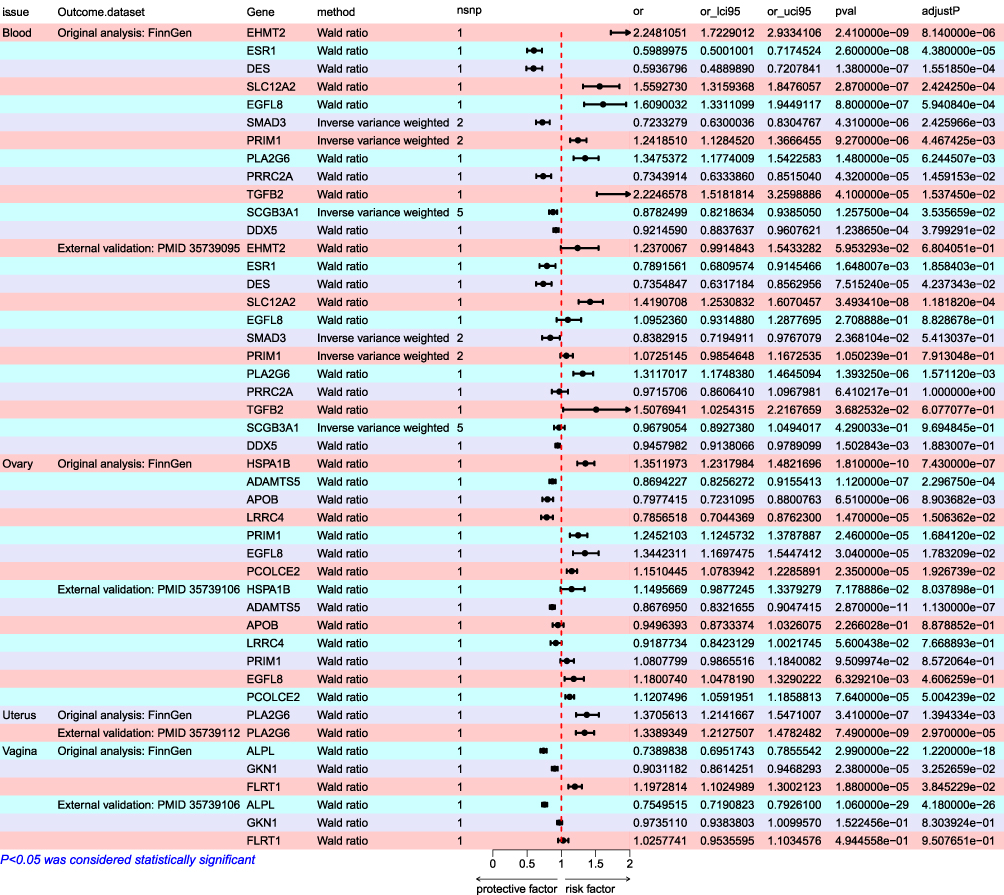 |
Figure 3 Associations of twelve genes (EHMT2, ESR1, DES, SLC12A2, EGFL8, SMAD3, PRIM1, PLA2G6, PRRC2A, TGFB2, SCGB3A1, and DDX5) with POP in original analysis and external validation using Mendelian analysis. |
Secondly, we performed external validation using blood cis-eQTLs data of druggable genes as exposure and POP GWAS from the comprehensive analysis conducted by Natàlia P. et al as the outcome and identified seven drug targets (P < 0.05): ESR1, DES, SLC12A2, SMAD3, PLA2G6, TGFB2, and DDX5. The genetic expressions of SLC12A2, PLA2G6, and TGFB2 were associated with increased risk of ALD (SLC12A2: OR =1.419, 95% CI: 1.253–1.607, P=3.49e-08; PLA2G6: OR =1.311, 95% CI: 1.174–1.465, P=1.39e-06; TGFB2: OR =1.507, 95% CI: 1.025–2.217, P=0.037) by MR (Tables S4, S7 and Figure 3). Also, the genetic predicted increased expression of ESR1, DES, SMAD3, and DDX5 (ESR1: OR =0.789, 95% CI: 0.681–0.915, P=0.002; DES: OR =0.735, 95% CI: 0.632–0.856, P=7.52e-05; SMAD3: OR =0.838, 95% CI: 0.719–0.977, P=0.023; DDX5: OR =0.945, 95% CI: 0.914–0.979, P=0.002) decreased POP risk (Tables S4, S7 and Figure 3). A detailed summary of genetic variants of the above seven genes is shown in Table S8.
Thirdly, to determine further the probability that SNPs associated with blood eQTL and POP shared a causal genetic variant, we conducted Bayesian colocalization analysis using blood cis-eQTL data of the above seven potential druggable genes and identified three drug targets. The expression of ESR1 (PP.H4 = 0.897), DES (PP.H4 = 0.887), and SLC12A2 (PP.H4 = 0.969) showed a significant colocalized association with POP (Table S9 and Figure 4). Therefore, three potentially druggable gene with evidence of a shared genetic effect between the blood eQTL and ALD risk was identified using MR and Bayesian colocalization analysis.
 |
Figure 4 LocusCompare plot depicting colocalization of the eQTL surrounding ESR1 (A), DES (B) and SLC12A2 (C) and POP GWAS. The top right plots show the association results in the POP GWAS; the bottom right plots represent the corresponding eQTL results; the left plot shows the colocalization of genetic association and eQTL signals. |
Candidate Tissue-Specific Druggable Genes for POP
Utilizing proposed ovary, uterus, and vagina cis-eQTL instruments, MR analyses identified significant associations between the expression levels of five genes—ADAMTS5, EGFL8, PCOLCE2, PLA2G6, and ALPL—are susceptibility to POP based on the discovery findings and external validation results (discovery analysis phase-FDR pval < 0.05 combined with external validation phase- P <0.05) (Figures 2B–D, 3 and Tables S10–S14). To further evaluate the likelihood of shared single causal variants between POP loci and tissue eQTLs, subsequent genetic colocalization analyses were performed. Notably, the ADAMTS5 (PP.H4 = 0.987) and PCOLCE2 (PP.H4 = 0.839) locus exhibited profiles suggestive of causal relationships in ovary tissue (Figures S1 and S2).
PPI Network Construction and Enrichment Analysis
We conducted functional enrichment analysis and PPI network construction on five identified genes--ESR1, DES, SLC12A2, ADAMTS5, and PCOLCE2--that are significantly linked with POP. The results of the GO enrichment analysis revealed that the significant biological process (BP) terms include intracellular monoatomic anion homeostasis, intracellular chloride ion homeostasis, and vagina development. The cellular component (CC) terms are primarily associated with cell body membrane, intercalated disc, and euchromatin. The molecular function (MF) terms include heparin binding, glycosaminoglycan binding, and sulfur compound binding (Figure 5A and B). Furthermore, KEGG pathway analysis indicated that these interacting genes are primarily involved in vibrio cholerae infection, endocrine and other factor−regulated calcium reabsorption, prolactin signaling pathway, and endocrine resistance (Figure 5C). The STRING database was utilized to construct a PPI network, with interaction pathways depicted in Figure 5D.
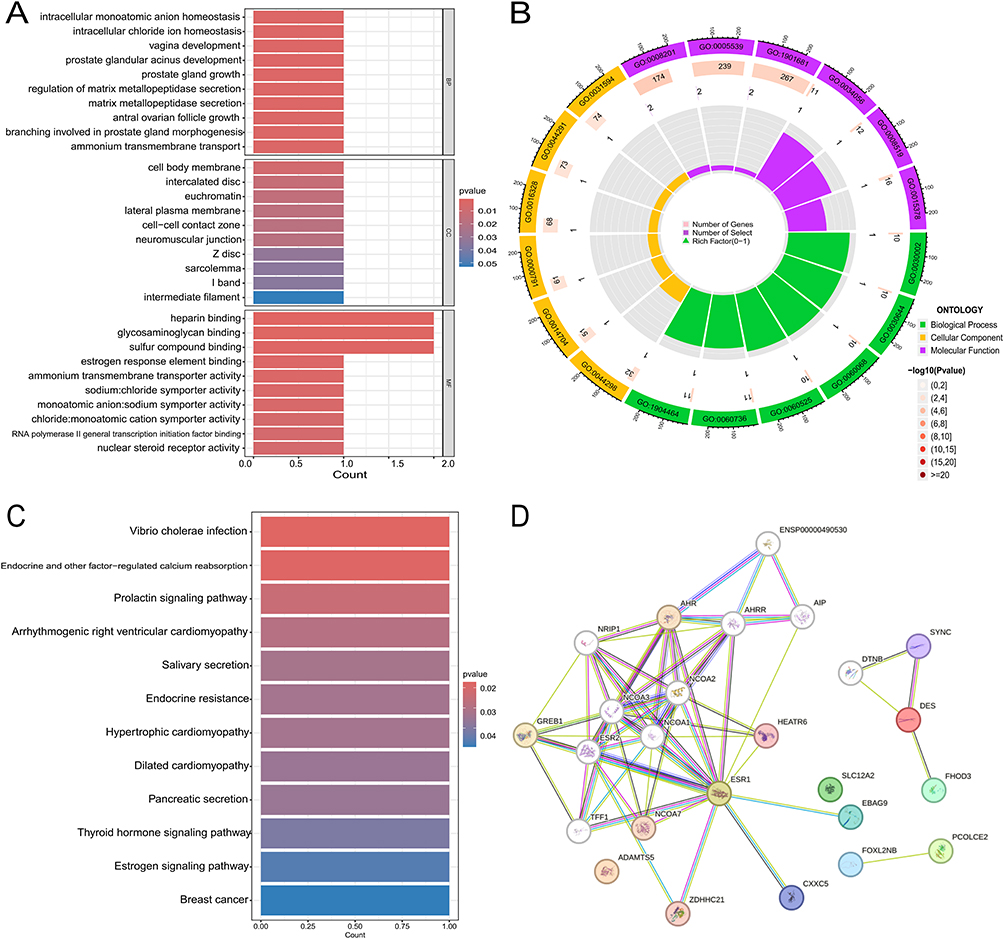 |
Figure 5 Function and biological pathways were predicted by positive gene enrichment analysis. (A and B) Presents the functional enrichment results; (C) Show the KEGG enrichment results and the key participating genes; (D) Displays the PPI Network built by STRING. Abbreviations: BP, biological process; CC, cellular component; MF, molecular function. |
Phe-MR Analysis of Drug Candidate Genes for POP-Related Phenotypes
To clarify the association between primary evidence genes and specific phenotypes, we conducted a phe-MR analysis. We found that ESR1 showed a significant negative correlation with endometriosis, while DES had a weak positive correlation with colonic or urogenital fistula and a weak negative correlation with pulse rate, suggesting potential side effects for these druggable targets (Table S15). The results of all Phe-MR are shown in Manhattan plots (Figures S3–S12).
Discussion
Main Findings
Leveraging these datasets, our study presents genetic evidence linking three blood druggable genes (ESR1, DES, and SLC12A2) and two tissue-specific genes (ADAMTS5 and PCOLCE2) to POP. Additionally, enrichment analysis and PPI network construction were performed to elucidate the biological relevance and interaction mechanisms of these drug targets. Phe-MR further identified additional therapeutic benefits of targeting the five POP-associated genes, while also indicating potential safety concerns.
Interpretation
Estrogen receptor 1 (ESR1), commonly referred to as estrogen receptor alpha, is a key mediator of estrogenic signaling in cells.35 As a nuclear protein, estrogen receptor alpha plays a central role among the estrogen receptors by binding to DNA and acting as a transcription factor, thereby regulating cellular responses to estrogen.36 Previous studies, such as those by Lang et al, have reported reduced expression of estrogen receptor alpha in premenopausal women diagnosed with POP.37 Additionally, Moon et al identified 59 genes associated with signal transduction and transcription through microarray gene expression profiling, with four genes linked to estrogen signaling.38 In patients with POP, downregulation of estrogen-related receptor alpha was observed, alongside upregulation of death-associated protein kinase 2, signal-transducing adapter protein-2, and interleukin 15. These findings suggest that alterations in estrogen signaling may contribute to the histological changes in pelvic floor support structures, which are implicated in the pathogenesis of POP. The integrity and function of pelvic floor connective tissue are influenced by extracellular matrix (ECM) proteases, which are regulated by estrogen. Collectively, our results highlight ESR1 as a promising therapeutic target for treating POP by influencing the connective tissue dynamics in the pelvic floor.
Desmin (DES) has been known to encode muscle-specific type III intermediate filament essential for proper muscular structure and function.39 The pelvic floor muscles are important structures that support pelvic organs, and desmin helps maintain their structure and function in these muscles.40 Desmin is essential for the repair and regeneration of muscle tissue following injury. The pelvic floor muscles may be damaged during childbirth or other stress, and the effective expression and function of desmin are crucial for tissue repair after injury.41 Overall, our findings suggest that DES is a promising therapeutic target for POP due to its role in muscle formation and maintenance.
Solute Carrier Family 12 Member 2 (SLC12A2), also referred to as Na-K-Cl Cotransporter 1 (NKCC1), encodes the human protein S12A2.42 SLC12A2 functions as a cation-chloride cotransporter, mediating the electroneutral transport of chloride,43 potassium, and sodium ions across cellular membranes, and plays a pivotal role in maintaining ionic homeostasis and regulating cell volume.44 NKCC1, specifically, is a well-established regulator of cell volume. Depletion of NKCC1 has been shown to reduce intracellular sodium concentrations, leading to a decrease in cell size and mass, while concurrently promoting cell proliferation.45 Although direct evidence is currently lacking, future investigations into the role of SLC12A2 in pelvic floor cell types, including muscle cells and fibroblasts, have the potential to elucidate its specific contributions to POP.
A disintegrin and metalloproteinase with thrombospondin motifs 5 (ADAMTS5) encodes the ATS5 protein, a metalloproteinase that plays a critical role in the organization of connective tissue, as well as in processes such as development, inflammation, and cell migration.46 ADAMTS5 functions as an ECM-degrading enzyme, exhibiting proteolytic activity toward the hyalectan group of chondroitin sulfate proteoglycans (CSPGs), including aggrecan (ACAN), versican (VCAN), brevican (BCAN), and neurocan (NCAN).47 Notably, it can cleave VCAN in the pericellular matrix surrounding myoblasts, facilitating cell contact and fusion—processes essential for muscle development and regeneration.48 Furthermore, Tola et al reported that females with POP exhibited lower levels of ADAMTS5 in the uterosacral ligament (USL) compared to non-POP individuals.49 In summary, elucidating the specific role of ADAMTS5 in POP and exploring its potential therapeutic applications warrants further investigation.
Procollagen C-Endopeptidase Enhancer 2 (PCOLCE2) encodes the PCOC2 protein, which is involved in the regulation of collagen synthesis and enhances the activity of procollagen C-terminal peptidase.50 Collagen, a critical component of the ECM in connective tissue, plays an essential role in maintaining the structural integrity and support of the pelvic floor.51 POP is characterized by a weakening of pelvic supportive tissues, and alterations in collagen strength and metabolism have been implicated in the pathophysiology of the condition.52 These changes are believed to originate at the molecular level, affecting collagen structure and function. The identification of drug targets related to collagen regulation, as presented in our study, is supported by multiple lines of evidence, further underscoring the therapeutic potential of targeting collagen synthesis and metabolism in POP.
Strengths and Limitations
This study represents the first to potential therapeutic targets for POP through the integration of multi-omics data. Compared with other studies, our study has the following advantages. Firstly, we conducted MR analyses of cis-eQTLs within druggable genomic regions, providing new insights into angina-related drug development from a genetic perspective and potentially reducing future development costs. Secondly, our results were tested by multiple corrections and colocalization analysis, which made the results more convincing. Thirdly, the present study further supports the MR results through biofunctional enrichment and gene interaction analyses. Finally, we verified the safety of potential therapeutic targets for angina pectoris by Phe-MR analysis, offering valuable guidance for future drug development.
Our study has several limitations. First, in our MR analyses, the limited number of IVs used for each gene in the analysis may affect the robustness of the results, and we were also unable to perform sensitivity, heterogeneity, and pleiotropy analyses. Second, although MR studies provide valuable insights into causality, our study was based on MR analyses of linear models, which may not be consistent with what is possible in real-world clinical trials (drug dose and disease often have a non-linear relationship). Third, the GWAS statistics used in our analysis were exclusively derived from European populations, which may constrain the generalizability of our findings to other ethnic groups.
Conclusion
The results of our study highlight several potential disease-modifying agents for the future treatment of pelvic organ prolapse. The five identified druggable genes—ESR1, DES, SLC12A2, ADAMTS5, and PCOLCE2—warrant further investigation to evaluate their viability as therapeutic targets for pelvic organ prolapse. The findings delineate potential pathways for the development of more effective POP therapeutics, which could significantly reduce the financial burden of drug development. However, we emphasize that while Mendelian randomization (MR) analyses provide valuable insights, these findings must be cautiously extrapolated to clinical practice. Validation through well-designed clinical trials is essential to confirm the therapeutic potential of these targets.
Data Sharing Statement
The data that support the findings of this study are available in DGIdb v4.2.0 at https://www.dgidb.org/downloadsat; eQTLGen consortium at https://eqtlgen.org/; Genotype-Tissue Expression (GTEx) Project V.8 at https://gtexportal.org/home/datasets; FinnGen study (version R11) at https://www.finngen.fi/en. These data were derived from the following resources available in the public domain: DGIdb v4.2.0 at https://www.dgidb.org/downloadsat; eQTLGen consortium at https://eqtlgen.org/; Genotype-Tissue Expression (GTEx) Project V.8 at https://gtexportal.org/home/datasets; FinnGen study (version R11) at https://www.finngen.fi/en.
Ethics Statement
The data used in this study were obtained from anonymized public databases and were fully compliant with the exemption criteria specified in Article 32, item 1 and 2 of the Measures for Ethical Review of Life Science and Medical Research Involving Human Subjects (issued by the National Health Commission of China, effective February 18, 2023). Consequently, our study does not require additional informed consent or ethical review.
Acknowledgments
Xiaochun Liu and Zongyu Zhao are co-first authors for this study. We are grateful to Singleron team for their continuous support. We are grateful to the financial support from The National Natural Science Foundation of China (Grant number 81971365), the special fund for Science and Technology Innovation Teams of Shanxi Province (Grant number 202204051002031), Fund Program for the Scientific Activities of Selected Returned Overseas Professionals in Shanxi Province (Grant number 20200007) and Research Project Supported by Shanxi Scholarship Council of China (Grant number HGKY2019095).
Author Contributions
All authors made a significant contribution to the work reported, whether that is in the conception, study design, execution, acquisition of data, analysis and interpretation, or in all these areas; took part in drafting, revising or critically reviewing the article; gave final approval of the version to be published; have agreed on the journal to which the article has been submitted; and agree to be accountable for all aspects of the work.
Disclosure of Interests
The authors declare no competing interests in this work.
Funding
We are grateful to the financial support from The National Natural Science Foundation of China (Grant number 81971365), the special fund for Science and Technology Innovation Teams of Shanxi Province (Grant number 202204051002031), Fund Program for the Scientific Activities of Selected Returned Overseas Professionals in Shanxi Province (Grant number 20200007), Research Project Supported by Shanxi Scholarship Council of China (Grant number HGKY2019095), the 2025 Central Guidance Fund for Local Science and Technology Development Projects (Project No. YDZJSX2025D076), and Shanxi Province Selective Funding Program for Scientific and Technological Activities of Returned Scholars (Grant No. 2025058).
References
1. Collins S, Lewicky-Gaupp C. Pelvic organ prolapse. Gastroenterol Clin North Am. 2022;51(1):177–193. doi:10.1016/j.gtc.2021.10.011
2. Iglesia CB, Smithling KR. Pelvic organ prolapse. Am Fam Physician. 2017;96(3):179–185.
3. Weintraub AY, Glinter H, Marcus-Braun N. Narrative review of the epidemiology, diagnosis and pathophysiology of pelvic organ prolapse. Int Braz J Urol. 2020;46(1):5–14. doi:10.1590/S1677-5538.IBJU.2018.0581
4. Raju R, Linder BJ. Evaluation and management of pelvic organ prolapse. Mayo Clin Proc. 2021;96(12):3122–3129. doi:10.1016/j.mayocp.2021.09.005
5. Chow D, Rodríguez LV. Epidemiology and prevalence of pelvic organ prolapse. Curr Opin Urol. 2013;23(4):293–298. doi:10.1097/MOU.0b013e3283619ed0
6. Maher C, Feiner B, Baessler K, Schmid C. Surgical management of pelvic organ prolapse in women. Cochrane Database Syst Rev. 2013;(4):CD004014. doi:10.1002/14651858.CD004014.pub5
7. Hickman LC, Tran MC, Davidson ERW, Walters MD, Ferrando CA. Pelvic organ prolapse recurrence in young women undergoing vaginal and abdominal colpopexy. Int Urogynecol J. 2020;31(12):2661–2667. doi:10.1007/s00192-019-04139-w
8. Finan C, Gaulton A, Kruger FA, et al. The druggable genome and support for target identification and validation in drug development. Sci Transl Med. 2017;9(383):eaag1166. doi:10.1126/scitranslmed.aag1166
9. Schmidt AF, Finan C, Gordillo-Marañón M, et al. Genetic drug target validation using Mendelian randomisation. Nat Commun. 2020;11(1):3255. doi:10.1038/s41467-020-16969-0
10. Zhu Z, Zhang F, Hu H, et al. Integration of summary data from GWAS and eQTL studies predicts complex trait gene targets. Nature Genet. 2016;48(5):481–487. doi:10.1038/ng.3538
11. Sekula P, Fabiola Del Greco M, Pattaro C, Köttgen A. Mendelian randomization as an approach to assess causality using observational data. J Am Soc Nephrol. 2016;27(11):3253–3265. doi:10.1681/ASN.2016010098
12. Interleukin-6 Receptor Mendelian Randomisation Analysis (IL6R MR) Consortium. The interleukin-6 receptor as a target for prevention of coronary heart disease: a mendelian randomisation analysis. Lancet. 2012;379(9822):1214–1224. doi:10.1016/S0140-6736(12)60110-X
13. Gaziano L, Giambartolomei C, Pereira AC, et al. Actionable druggable genome-wide Mendelian randomization identifies repurposing opportunities for COVID-19. Nat Med. 2021;27(4):668–676. doi:10.1038/s41591-021-01310-z
14. Storm CS, Kia DA, Almramhi MM, et al. Finding genetically-supported drug targets for Parkinson’s disease using Mendelian randomization of the druggable genome. Nat Commun. 2021;12(1):7342. doi:10.1038/s41467-021-26280-1
15. Skrivankova VW, Richmond RC, Woolf BAR, et al. Strengthening the reporting of observational studies in epidemiology using mendelian randomisation (STROBE-MR): explanation and elaboration. BMJ. 2021;375:n2233. doi:10.1136/bmj.n2233
16. Freshour SL, Kiwala S, Cotto KC, et al. Integration of the Drug-Gene Interaction Database (DGIdb 4.0) with open crowdsource efforts. Nucleic Acids Res. 2021;49(D1):D1144–D1151. doi:10.1093/nar/gkaa1084
17. Võsa U, Claringbould A, Westra HJ, et al. Large-scale cis- and trans-eQTL analyses identify thousands of genetic loci and polygenic scores that regulate blood gene expression. Nat Genet. 2021;53(9):1300–1310. doi:10.1038/s41588-021-00913-z
18. GTEx Consortium, Laboratory, Data Analysis & Coordinating Center (LDACC)—Analysis Working Group, Statistical Methods groups—Analysis Working Group, et al. Genetic effects on gene expression across human tissues. Nature. 2017;550(7675):204–213. doi:10.1038/nature24277
19. Pujol-Gualdo N, Läll K, Lepamets M, et al. Advancing our understanding of genetic risk factors and potential personalized strategies for pelvic organ prolapse. Nat Commun. 2022;13(1):3584. doi:10.1038/s41467-022-31188-5
20. Didelez V, Sheehan N. Mendelian randomization as an instrumental variable approach to causal inference. Stat Methods Med Res. 2007;16(4):309–330. doi:10.1177/0962280206077743
21. Burgess S, Thompson SG; CRP CHD Genetics Collaboration. Avoiding bias from weak instruments in Mendelian randomization studies. Int J Epidemiol. 2011;40(3):755–764. doi:10.1093/ije/dyr036
22. Byrska-Bishop M, Evani US, Zhao X, et al. High-coverage whole-genome sequencing of the expanded 1000 Genomes Project cohort including 602 trios. Cell. 2022;185(18):3426–3440.e19. doi:10.1016/j.cell.2022.08.004
23. Kamat MA, Blackshaw JA, Young R, et al. PhenoScanner V2: an expanded tool for searching human genotype-phenotype associations. Bioinformatics. 2019;35(22):4851–4853. doi:10.1093/bioinformatics/btz469
24. Slob EAW, Burgess S. A comparison of robust Mendelian randomization methods using summary data. Genet Epidemiol. 2020;44(4):313–329. doi:10.1002/gepi.22295
25. Hemani G, Tilling K, Davey Smith G. Orienting the causal relationship between imprecisely measured traits using GWAS summary data. PLoS Genet. 2017;13(11):e1007081. doi:10.1371/journal.pgen.1007081
26. Greco M FD, Minelli C, Sheehan NA, Thompson JR. Detecting pleiotropy in Mendelian randomisation studies with summary data and a continuous outcome. Stat Med. 2015;34(21):2926–2940. doi:10.1002/sim.6522
27. Burgess S, Thompson SG. Interpreting findings from Mendelian randomization using the MR-Egger method. Eur J Epidemiol. 2017;32(5):377–389. doi:10.1007/s10654-017-0255-x
28. Schnell PM. Controlling the false-discovery rate when identifying the subgroup benefiting from treatment. Clin Trials. 2023;20(4):394–404. doi:10.1177/17407745231169300
29. Giambartolomei C, Zhenli Liu J, Zhang W, et al. A Bayesian framework for multiple trait colocalization from summary association statistics. Bioinformatics. 2018;34(15):2538–2545. doi:10.1093/bioinformatics/bty147
30. Zhao SS, Yiu ZZN, Barton A, Bowes J. Association of lipid-lowering drugs with risk of psoriasis: a Mendelian randomization study. JAMA Dermatol. 2023;159(3):275–280. doi:10.1001/jamadermatol.2022.6051
31. Gene Ontology Consortium. Gene Ontology Consortium: going forward. Nucleic Acids Res. 2015;43(Database issue):D1049–1056. doi:10.1093/nar/gku1179
32. Kanehisa M, Goto S. KEGG: kyoto encyclopedia of genes and genomes. Nucleic Acids Res. 2000;28(1):27–30. doi:10.1093/nar/28.1.27
33. Yu G, Wang LG, Han Y, He QY. clusterProfiler: an R package for comparing biological themes among gene clusters. OMICS. 2012;16(5):284–287. doi:10.1089/omi.2011.0118
34. Szklarczyk D, Kirsch R, Koutrouli M, et al. The STRING database in 2023: protein-protein association networks and functional enrichment analyses for any sequenced genome of interest. Nucleic Acids Res. 2023;51(D1):D638–D646. doi:10.1093/nar/gkac1000
35. Nakad B, Fares F, Azzam N, Feiner B, Zilberlicht A, Abramov Y. Estrogen receptor and laminin genetic polymorphism among women with pelvic organ prolapse. Taiwan J Obstet Gynecol. 2017;56(6):750–754. doi:10.1016/j.tjog.2017.10.008
36. Jackson S, James M, Abrams P. The effect of oestradiol on vaginal collagen metabolism in postmenopausal women with genuine stress incontinence. BJOG. 2002;109(3):339–344. doi:10.1111/j.1471-0528.2002.01052.x
37. Lang JH, Zhu L, Sun ZJ, Chen J. Estrogen levels and estrogen receptors in patients with stress urinary incontinence and pelvic organ prolapse. Int J Gynaecol Obstet. 2003;80(1):35–39. doi:10.1016/s0020-7292(02)00232-1
38. Moon YJ, Bai SW, Jung CY, Kim CH. Estrogen-related genome-based expression profiling study of uterosacral ligaments in women with pelvic organ prolapse. Int Urogynecol J. 2013;24(11):1961–1967. doi:10.1007/s00192-013-2124-9
39. Zhang H, Bryson VG, Wang C, et al. Desmin interacts with STIM1 and coordinates Ca2+ signaling in skeletal muscle. JCI Insight. 2021;6(17):e143472. doi:10.1172/jci.insight.143472
40. Paulin D, Li Z. Desmin: a major intermediate filament protein essential for the structural integrity and function of muscle. Exp Cell Res. 2004;301(1):1–7. doi:10.1016/j.yexcr.2004.08.004
41. López‐García K, Cuevas E, Sánchez‐García O, Pacheco P, Martínez‐Gómez M, Castelán F. Differential damage and repair responses of pubococcygeus and bulbospongiosus muscles in multiparous rabbits. Neurourol Urodynamics. 2016;35(2):180–185. doi:10.1002/nau.22702
42. Yang X, Wang Q, Cao E. Structure of the human cation-chloride cotransporter NKCC1 determined by single-particle electron cryo-microscopy. Nat Commun. 2020;11(1):1016. doi:10.1038/s41467-020-14790-3
43. Mutai H, Wasano K, Momozawa Y, et al. Variants encoding a restricted carboxy-terminal domain of SLC12A2 cause hereditary hearing loss in humans. PLoS Genet. 2020;16(4):e1008643. doi:10.1371/journal.pgen.1008643
44. Vitari AC, Thastrup J, Rafiqi FH, et al. Functional interactions of the SPAK/OSR1 kinases with their upstream activator WNK1 and downstream substrate NKCC1. Biochem J. 2006;397(1):223–231. doi:10.1042/BJ20060220
45. Demian WL, Persaud A, Jiang C, et al. The ion transporter NKCC1 links cell volume to cell mass regulation by suppressing mTORC1. Cell Rep. 2019;27(6):1886–1896.e6. doi:10.1016/j.celrep.2019.04.034
46. Nakada M, Miyamori H, Kita D, et al. Human glioblastomas overexpress ADAMTS-5 that degrades brevican. Acta Neuropathol. 2005;110(3):239–246. doi:10.1007/s00401-005-1032-6
47. Longpré JM, McCulloch DR, Koo BH, Alexander JP, Apte SS, Leduc R. Characterization of proADAMTS5 processing by proprotein convertases. Int J Biochem Cell Biol. 2009;41(5):1116–1126. doi:10.1016/j.biocel.2008.10.008
48. Kelwick R, Desanlis I, Wheeler GN, Edwards DR. The ADAMTS (A Disintegrin and Metalloproteinase with Thrombospondin motifs) family. Genome Biol. 2015;16(1):113. doi:10.1186/s13059-015-0676-3
49. Tola EN, Koroglu N, Yıldırım GY, Koca HB. The role of ADAMTS-2, collagen type-1, TIMP-3 and papilin levels of uterosacral and cardinal ligaments in the etiopathogenesis of pelvic organ prolapse among women without stress urinary incontinence. Eur J Obstet Gynecol Reprod Biol. 2018;231:158–163. doi:10.1016/j.ejogrb.2018.10.043
50. Steiglitz BM, Keene DR, Greenspan DS. PCOLCE2 encodes a functional procollagen C-proteinase enhancer (PCPE2) that is a collagen-binding protein differing in distribution of expression and post-translational modification from the previously described PCPE1. J Biol Chem. 2002;277(51):49820–49830. doi:10.1074/jbc.M209891200
51. Gong R, Xia Z. Collagen changes in pelvic support tissues in women with pelvic organ prolapse. Eur J Obstet Gynecol Reprod Biol. 2019;234:185–189. doi:10.1016/j.ejogrb.2019.01.012
52. Lammers K, Lince SL, Spath MA, et al. Pelvic organ prolapse and collagen-associated disorders. Int Urogynecol J. 2012;23(3):313–319. doi:10.1007/s00192-011-1532-y
 © 2025 The Author(s). This work is published and licensed by Dove Medical Press Limited. The
full terms of this license are available at https://www.dovepress.com/terms
and incorporate the Creative Commons Attribution
- Non Commercial (unported, 4.0) License.
By accessing the work you hereby accept the Terms. Non-commercial uses of the work are permitted
without any further permission from Dove Medical Press Limited, provided the work is properly
attributed. For permission for commercial use of this work, please see paragraphs 4.2 and 5 of our Terms.
© 2025 The Author(s). This work is published and licensed by Dove Medical Press Limited. The
full terms of this license are available at https://www.dovepress.com/terms
and incorporate the Creative Commons Attribution
- Non Commercial (unported, 4.0) License.
By accessing the work you hereby accept the Terms. Non-commercial uses of the work are permitted
without any further permission from Dove Medical Press Limited, provided the work is properly
attributed. For permission for commercial use of this work, please see paragraphs 4.2 and 5 of our Terms.
Recommended articles
Impact of Milk Consumption and Dietary Patterns on Pelvic Organ Prolapse: A Mendelian Randomization Study
Xia X, Hu Y, Xu J, Fan S, Zhang Y
International Journal of Women's Health 2025, 17:1837-1847
Published Date: 19 June 2025
Genetically Predicted Associations of CX3CL1 and UMOD with Acute Kidney Injury Risk: Evidence from Mendelian Randomization and Clinical Validation
Yang L, Xu Y, Liang Y, Lan C, Zhang J
Journal of Inflammation Research 2026, 19:595754
Published Date: 10 July 2026