
Back to Journals » Clinical Ophthalmology » Volume 20
Hyphema Associated with Water Bead Projectile Toys: A Retrospective Comparative Study
Authors Aggarwal AI, Singh PK, Arias DE, Netland PA 
Received 16 May 2026
Accepted for publication 2 July 2026
Published 10 July 2026 Volume 2026:20 624067
DOI https://doi.org/10.2147/OPTH.S624067
Checked for plagiarism Yes
Review by Single anonymous peer review
Peer reviewer comments 3
Editor who approved publication: Dr Sotiria Palioura
Aashri I Aggarwal, Priya K Singh, Diego E Arias, Peter A Netland
Department of Ophthalmology, Eastern Virginia Medical School, Norfolk, Virginia, USA
Correspondence: Peter A Netland, Department of Ophthalmology, Eastern Virginia Medical School, 600 Gresham Drive, Norfolk, Virginia, 23507, USA, Tel +1 757-388-2473, Email [email protected]; [email protected]
Purpose: Superabsorbent water beads can be used in projectile toy guns. We aimed to characterize water bead-related hyphema and compare the prevalence with other causes of traumatic hyphema.
Methods: In this 10-month retrospective review, we identified 35 consecutive patients with traumatic hyphema presenting to the emergency department. Cases were grouped by injury mechanism, water bead-related compared with all other causes. Clinical data on initial presentation and subsequent visits were compared.
Results: In the patients with traumatic hyphema, 8 (23%) cases were due to water bead trauma. Bead-related cases involved significantly younger patients (16 ± 9 years) compared with other cases (32 ± 21 years; p = 0.004). No statistically significant differences were found in peak intraocular pressure (p = 0.14) or need for surgical intervention (p = 0.3). The proportion of hyphema related to water bead injuries was higher in pediatric (42%) compared with adult patients (10%). The odds ratio of water-bead hyphema in pediatric compared with adult patients was 6.44 (95% CI:1.15– 57.1; p = 0.021).
Conclusion: In this study, approximately a quarter of patients with traumatic hyphema during the study period were water bead–related, with approximately six-fold increased risk in younger patients. These findings suggest a need for public health awareness about water bead projectile injuries.
Keywords: ocular injury, ophthalmic trauma, intraocular pressure, toy guns, water beads
Introduction
Water beads such as Orbeez (Spin Master Corp., Toronto, Ontario, Canada) are superabsorbent sodium polyacrylate polymer spheres that expand when exposed to water. Originally designed as children’s toys and sensory tools, their increasing prevalence has been accompanied by a rise in associated injuries, particularly among pediatric populations.1 Reports of water bead-related trauma have included bowel obstructions when ingested, as these beads continue to expand within the gastrointestinal tract, leading to potentially life-threatening complications.2
In ophthalmic trauma, water bead projectiles launched from toy guns have been implicated in corneal abrasion, traumatic iritis, and hyphema.3–5 Hyphema can result from blunt or penetrating trauma and may lead to elevated intraocular pressure (IOP), corneal blood staining, and long-term visual impairment.6 While hyphema can also arise from non-traumatic causes, such as sickle cell disease, clotting disorders, and neovascularization; trauma remains a primary etiology.7
Social media trends have amplified the misuse of these toys, increasing risk of serious ocular injury. The objective of this study was to examine the characteristics and outcomes of water bead-related traumatic hyphema compared with other causes of hyphema, with particular attention to the pediatric population.
Methods
This retrospective comparative cohort study compared ocular findings between water bead-related and other traumatic hyphema in consecutive patients presenting to Sentara Norfolk General Hospital, Eastern Virginia Medical School, and Children’s Hospital of the King’s Daughters in Norfolk, Virginia (1/1/2024–10/15/2024). The study was approved by the Eastern Virginia Medical School Institutional Review Board (IRB # 25–01-WC-0016) and adhered to the Declaration of Helsinki and Health Insurance Portability and Accountability Act (HIPAA) regulations. Informed consent was waived for this retrospective study, which conformed to standards for minimal risk research and did not affect patient safety, clinical care, or the rights and welfare of subjects. To protect patient confidentiality, personal identifiers were removed from spreadsheets used for data analyses and all reports.
Patients were identified by ICD-10 code H21.0x. Exclusion criteria included spontaneous hyphema without trauma history, and one patient with a bleach-soaked water bead chemical injury without hyphema was not included in the analysis. Pediatric patients were defined as under 18 years of age.
Collected data from all patients included date of birth, date of first presentation, date of injury, hospital where they were seen, race, ethnicity, height (cm), weight (kg), legal sex, sickle cell status, anticoagulant use, best corrected visual acuity (BCVA), laterality, mechanism (bead-related, other), IOP, hyphema type (microhyphema, layered hyphema, total hyphema) and other reported injuries. Use of IOP lowering drops, cycloplegia, and surgical procedures were also recorded. Calculated fields included age at presentation, body mass index (BMI), peak-to-final IOP difference, and days to hyphema resolution.
Hyphema classification was based on standard classification grading. Grade 0: no visible layering, but there are red blood cells within the anterior chamber (microhyphema). Grades I–III: layered blood occupying less than one-third to less than total of the anterior chamber (layered hyphema). Grade IV: total filling of the anterior chamber with blood (total hyphema). Sickle cell status was determined based on sickle cell testing documented in the medical record.
The primary outcome was the frequency and characteristics of water bead-related hyphema. The secondary outcome compared water bead-related hyphema to other mechanisms in the pediatric population. Statistical analysis was performed using RStudio version 12.0 (Posit PBC, Boston, MA). Data findings were presented as mean with standard deviation. Continuous variables were compared using a two-sample t-test, categorical variables with Fisher’s exact test, and proportions with the z-test. Odds ratio with 95% confidence interval (CI) was used to compare bead-related hyphema between pediatric and adult patients. A p-value <0.05 was considered statistically significant.
Results
A total of 35 eyes from 35 patients with traumatic hyphema were identified during the study period (Table 1). Eight (23%) sustained injuries due to water bead projectiles and 27 (77%) from other mechanisms. Water bead-injured patients were significantly younger than patients with other causes of hyphema (16 ± 9 years and 32 ± 21; p = 0.004), more likely to identify as Black or African American (7/8 [88%] and 10/27 [37%]; p = 0.033), and had a higher proportion of sickle cell trait or disease (p = 0.004). All patients with water-bead injuries were male (8/8, 100%) compared with 20/27 (74%) in the non–water-bead group. This difference did not reach statistical significance (p = 0.27), likely due to the small sample size. There were no significant differences in ethnicity (p = 0.6), height (p = 0.5), or weight (p = 0.13) between the water-bead and non-water-bead groups.
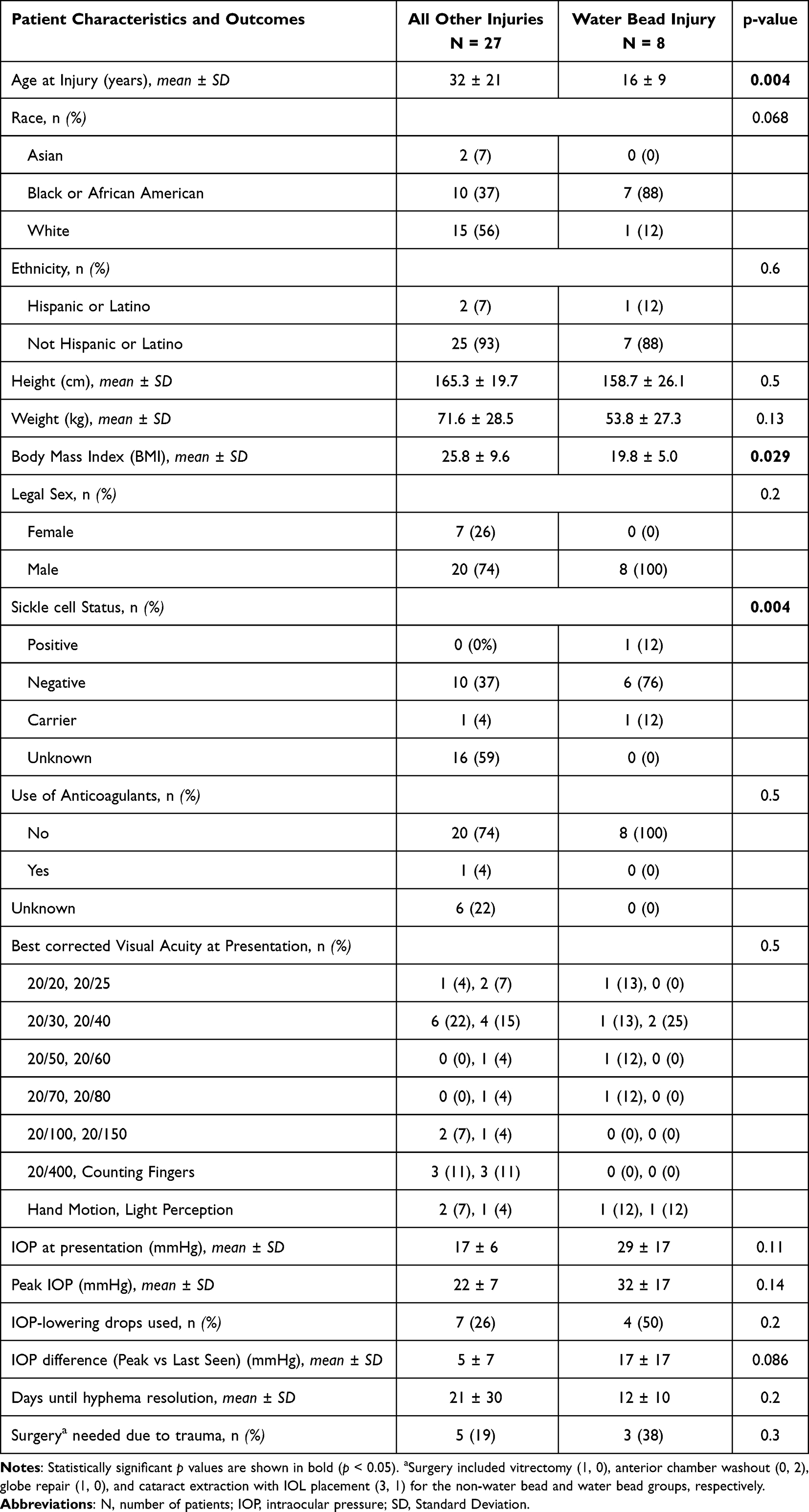 |
Table 1 Characteristics of Patients and Outcomes of Traumatic Hyphema |
There were no significant differences in anticoagulant use (p = 0.5), BCVA at presentation (p = 0.5), time to hyphema resolution (12±10 and 21±30 days; p = 0.2), initial IOP (29±17 and 17±6mmHg; p = 0.11), peak IOP (32±17 and 22±7mmHg; p = 0.14), or use of IOP-lowering drops ([50%] vs [26%]; p = 0.2) for water bead and non-water bead groups, respectively (Table 1). The water bead group showed a trend toward greater IOP change from peak to final visit (17±17mmHg and 5±7 mmHg; p = 0.086), with the highest recorded peak IOP of 48 mmHg occurring in this group. Surgical intervention was required more frequently in the water bead-injured group (3/8 [38%]) than in the non-water bead group (5/27 [18%]); however, this difference did not reach statistical significance (p = 0.3). Two water bead-injured patients required anterior chamber washout for elevated intraocular pressure (IOP).
The proportion hyphema related to water bead injuries was higher in pediatric (6/14 [42%]) compared with adult patients (2/21 [10%]). Table 2 shows a comparison of age groups (pediatric and adult) and mechanism of injury (bead-related and other). The odds of water-bead injuries being the etiology of the hyphema in pediatric patients was 6.44 times the odds in adult patients (95% CI:1.15–57.1; p = 0.021).
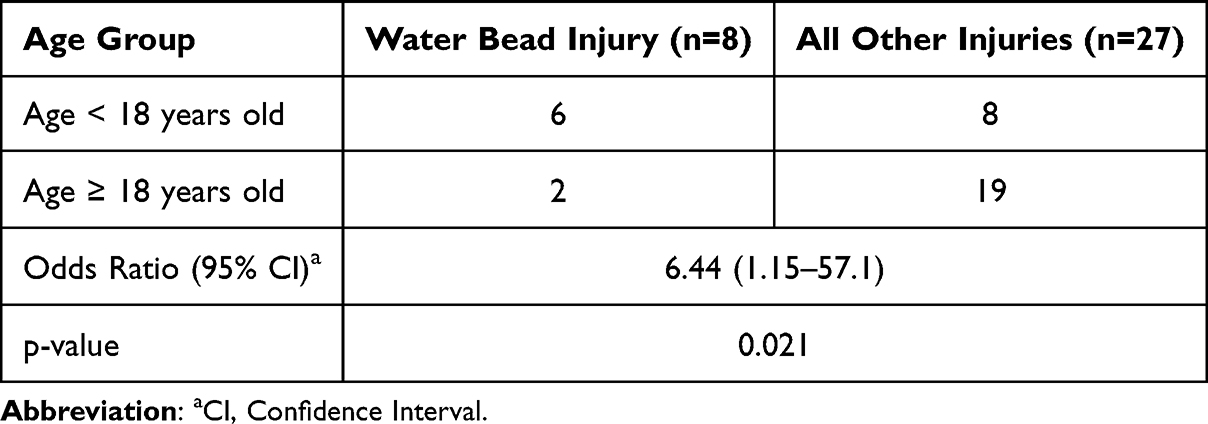 |
Table 2 Analysis of Water Bead Injury Comparing Pediatric to Adult Population |
Discussion
In this study, water bead injuries accounted for nearly a quarter of all hyphema cases (23%) and were significantly more common in pediatric patients, comprising 42% of pediatric trauma-related hyphema. The observed differences in BMI between groups likely reflect the younger age distribution of water bead-injured patients rather than true biological susceptibility. Despite similar visual acuity and IOP at presentation, only the water bead group required anterior chamber washout for elevated IOP. While differences in BCVA, time to resolution, IOP at presentation, surgical intervention rates, and use of IOP-lowering drops did not reach statistical significance, likely due to small sample size, some differences may be clinically relevant and warrant further studies for confirmation.
Ocular trauma from toy guns in the pediatric population has been documented, with 6,617 cases reported between 2010–2019.8 In 2022, the “Orbeez challenge” went viral on TikTok, encouraging users to shoot water beads with gel blaster guns. Video of this trend amassed over 255 million views, with 87.2% showing no eye protection.9 The resulting “Orbeez attacks” have been reported nationwide, and while this was a single-center study, these social trends suggest increased prevalence of water-bead ocular injuries across the country.5
One patient with a bleach-soaked bead was excluded from analysis because of lack of hyphema. Other fluids besides water may be used to hydrate the beads, suggesting that we likely underestimated the total injuries due to water beads in our study of hyphema. Use of water bead projectiles soaked in caustic chemicals such as bleach before being fired may pose a public health risk for other injuries besides hyphema. Limitations of this study include a short study period, small sample size, and single-institution design, precluding geographic trend analysis. Larger multicenter studies are needed to clarify the full injury spectrum of water-bead injuries and reach statistical significance in subgroup comparisons.
Conclusion
In this retrospective comparative cohort study, water bead projectiles caused approximately one quarter of all traumatic hyphema cases during the study period. Bead-related hyphema cases involved significantly younger patients compared with other hyphema cases, 42% of pediatric trauma-related hyphema cases were related to water bead injuries, and pediatric compared with adult patients had approximately 6-fold increased risk of hyphema associated with water bead projectiles. These findings highlight a public health concern related to superabsorbent water beads.
Funding
This study was not funded by grant support.
Disclosure
The authors report no conflicts of interest in this work.
References
1. Joynes HJ, Kistamgari S, Casavant MJ, Smith GA. Pediatric water bead-related visits to United States emergency departments. Am J Emerg Med. 2024;84:81–5. doi:10.1016/j.ajem.2024.07.048
2. Caré W, Dufayet L, Paret N, et al. Bowel obstruction following ingestion of superabsorbent polymers beads: literature review. Clin Toxicol. 2022;60(2):159–167. doi:10.1080/15563650.2021.1987452
3. Misused “Orbeez” guns on the rise in York County, sheriff says. McIntosh B and 13NewsNow, 2024. Available from: https://www.13newsnow.com/article/news/local/york-county/misused-orbeez-guns-rise-york-county-virginia-sheriff-says/291-030d03c3-b251-49c6-b5c2-d8588c309323.
4. East Beach neighbors hit by what they believe to be a pellet gun. Payne R and WAVY, 2023. Available from: https://www.wavy.com/news/local-news/norfolk/east-beach-neighbors-hit-by-what-they-believe-to-be-a-pellet-gun/.
5. Krisch M, Ueberroth J, Gupta N, et al. Characterization of ocular injuries caused by Orbeez hydrated gel pellet projectiles: clinical insights and implications. Am J Ophthalmol. 2024;257:212–217. doi:10.1016/j.ajo.2023.10.003
6. Walton W, Von Hagen S, Grigorian R, Zarbin M. Management of traumatic hyphema. Surv Ophthalmol. 2002;47(4):297–334. doi:10.1016/S0039-6257(02)00317-X
7. Mir T, Iftikhar M, Seidel N, et al. Clinical characteristics and outcomes of hyphema in patients with sickle cell trait: 10-year experience at the Wilmer Eye Institute. Clin Ophthalmol. 2020;14:4165–4172. doi:10.2147/OPTH.S281875
8. Oydanich M, Uppuluri A, Zarbin MA, Bhagat N. Epidemiology of ocular injuries related to toy guns in pediatric patients from 2000 to 2019. J Pediatr Ophthalmol Strabismus. 2022;59(3):e29–e31. doi:10.3928/01913913-20220314-01
9. Schneider HP, Reedy JM, McAdams RJ, et al. A content analysis of the Orbeez® Gel Blaster injury challenge on TikTok. Inj Epidemiol. 2025;12(1):9. doi:10.1186/s40621-024-00557-7
 © 2026 The Author(s). This work is published and licensed by Dove Medical Press Limited. The
full terms of this license are available at https://www.dovepress.com/terms
and incorporate the Creative Commons Attribution
- Non Commercial (unported, 4.0) License.
By accessing the work you hereby accept the Terms. Non-commercial uses of the work are permitted
without any further permission from Dove Medical Press Limited, provided the work is properly
attributed. For permission for commercial use of this work, please see paragraphs 4.2 and 5 of our Terms.
© 2026 The Author(s). This work is published and licensed by Dove Medical Press Limited. The
full terms of this license are available at https://www.dovepress.com/terms
and incorporate the Creative Commons Attribution
- Non Commercial (unported, 4.0) License.
By accessing the work you hereby accept the Terms. Non-commercial uses of the work are permitted
without any further permission from Dove Medical Press Limited, provided the work is properly
attributed. For permission for commercial use of this work, please see paragraphs 4.2 and 5 of our Terms.