
Back to Journals » International Journal of Nanomedicine » Volume 21
Hydrogel-Based Immunomodulatory Strategies for Infected Bone Defects Regeneration: Remodeling the Osteoimmune Microenvironment and Future Perspectives
Authors Jin S, Liu C, Zhu Y, Zhou S
Received 22 April 2026
Accepted for publication 15 June 2026
Published 9 July 2026 Volume 2026:21 619077
DOI https://doi.org/10.2147/IJN.S619077
Checked for plagiarism Yes
Review by Single anonymous peer review
Peer reviewer comments 5
Editor who approved publication: Professor Dong Wang
Shengyu Jin,1 Chang Liu,2 Ye Zhu,3 Shicheng Zhou1
1Orthopaedic Medical Center, The Second Hospital of Jilin University, Changchun, Jilin, People’s Republic of China; 2Department of Obstetrics and Gynecology, The Second Hospital of Jilin University, Changchun, Jilin, People’s Republic of China; 3Department of Emergency and Critical Care Medicine, The Second Hospital of Jilin University, Changchun, Jilin, People’s Republic of China
Correspondence: Shicheng Zhou, Orthopaedic Medical Center, The Second Hospital of Jilin University, 218 Ziqiang Street, Nanguan District, Changchun, Jilin, 130000, People’s Republic of China, Email [email protected]
Abstract: Infected bone defects remain a major challenge in orthopaedic and reconstructive medicine. Conventional strategies often fail to achieve reliable long-term outcomes lack of adequately addressing the hostile osteoimmune microenvironment. In recent years, hydrogel-based biomaterials have emerged as highly promising platforms for infected bone defect regeneration due to their injectability, defect conformity, extracellular matrix-like architecture, and tunable physicochemical properties. Importantly, hydrogels are evolving from passive drug carriers into dynamic immunomodulatory systems capable of releasing bioactive agents in a controlled manner, reprogramming immune metabolism, and coordinating angiogenic and osteogenic repair. This review summarizes recent progress in hydrogel-based immunomodulatory strategies for infected bone defects from the perspective of osteoimmune microenvironment remodeling. Four major design paradigms include programmed transformation of the osteogenic microenvironment, metabolic reprogramming of the infectious niche, spatiotemporally staged immune–osteogenic regulation, and photothermal-immunomodulatory therapy. However, the translation of these systems faces challenges including biosafety concerns, batch-to-batch variability, manufacturing complexity, and regulatory intricacies. Despite these hurdles, hydrogel-based immunomodulatory platforms represent a clinically relevant strategy for integrated infection control and functional bone regeneration. Future perspectives are proposed, emphasizing multicellular osteoimmune network engineering, disease-specific precision hydrogels, and artificial intelligence (AI)-assisted biomaterial design. Overall, hydrogel-based immunomodulatory systems represent a promising direction for achieving integrated infection control and functional bone regeneration in infected bone defects.
Keywords: hydrogel biomaterials, osteoimmune microenvironment, immunometabolic regulation, stage-specific bone regeneration, multifunctional nanocomposite hydrogels
Introduction
Infected bone defects remain one of the most formidable challenges in orthopaedic and reconstructive medicine because they combine two biologically antagonistic conditions including persistent infection and impaired tissue regeneration.1,2 Unlike aseptic bone injuries, these defects are characterized not only by loss of structural integrity, but also by bacterial colonization, biofilm formation, prolonged inflammation, oxidative stress, vascular disruption, and dysregulated bone remodeling.3 Under such conditions, conventional clinical strategies, including systemic antibiotics, repeated debridement, bone grafting, and implant-based reconstruction, often fail to achieve predictable long-term healing.4–6 The difficulty lies in the fact that infected bone repair is not simply a matter of filling a defect or eliminating bacteria.7 It requires coordinated control of infection, resolution of pathological inflammation, restoration of vascular supply, and reactivation of osteogenesis within a hostile local niche.8 This clinical reality has driven a conceptual shift in the field from osteogenesis-centered repair toward osteoimmunology-guided regeneration.
Bone healing is now understood as a tightly regulated process governed by reciprocal interactions among immune cells, skeletal cells, stromal cells, cytokines, metabolites, and extracellular matrix cues.9 In infected defects, this osteoimmune crosstalk becomes profoundly disturbed.10 Excessive or unresolved inflammatory activation can suppress osteoblast function, promote osteoclast-mediated bone resorption, impair angiogenesis, and prevent the establishment of a regenerative microenvironment.11 At the same time, premature or indiscriminate immunosuppression may weaken host defense and allow persistent bacterial survival.12 Therefore, the key therapeutic challenge is no longer merely to promote bone formation, but to reshape the osteoimmune microenvironment.13 This perspective has elevated immunomodulation from an auxiliary consideration to a central design principle in biomaterials for infected bone defect treatment.14
Among candidate biomaterial platforms, hydrogels are uniquely suited for this purpose.15,16 Their high water content, tunable physicochemical properties, injectability, biocompatibility, and structural similarity to native extracellular matrix make them highly adaptable to irregular bone defects and local pathological niches.17,18 More importantly, modern hydrogels are no longer viewed as passive carriers for antibiotics or growth factors.19,20 Instead, they are increasingly engineered as dynamic and instructive systems capable of sensing local cues, releasing therapeutics in a programmed manner, interacting with immune cells, scavenging reactive oxygen species, modulating inflammatory signaling, and supporting angiogenic and osteogenic processes.21,22 Because infected bone healing unfolds across multiple stages, hydrogels offer a particularly attractive platform for integrating responsiveness, spatial adaptability, and temporal control into a single material system.23,24 In this sense, the therapeutic value of hydrogels lies not only in what they deliver, but in how they actively participate in microenvironmental reprogramming.25,26 Several recent studies have mentioned the immune microenvironment of bone healing and immunomodulatory hydrogel strategies. Zhao et al focuses on the impacts of various immune cells and cytokines on the immune microenvironment in infected bone defects and summarizes hydrogel strategies targeting infection and regeneration.27 Fu et al summarizes general advances in immunomodulatory hydrogels for bone tissue regeneration, emphasizing macrophage regulation and hydrogel design principles for enhancing bone repair.28 Zhang et al summarized macrophage polarization mechanisms and hydrogel strategies broadly from basic immunology to translational challenges.11 Hydrogel could achieve temporal immunomodulation of early M1 and later M2 macrophage phenotypes to promote infected bone repair.29 Hydrogel-based immunomodulatory systems promote bone regeneration by actively reshaping the osteoimmune microenvironment rather than merely serving as osteogenic delivery matrices.30 The novelty of this review lies in its disease-specific and mechanism-integrated framework. Rather than summarizing hydrogels simply according to material type or delivered bioactive molecules, this review reorganizes recent advances according to four functional design paradigms: programmed transformation of the osteogenic microenvironment, immunometabolic reprogramming of the infectious niche, spatiotemporally staged immune–osteogenic regulation, and photothermal-immunomodulatory therapy (Figure 1). This structure highlights how advanced hydrogels are evolving from passive delivery matrices into dynamic microenvironment-regulating platforms that coordinate antibacterial defense, immune remodeling, angiogenesis, and osteogenesis in a stage-adapted manner. The related studies have been summarized in Table 1.
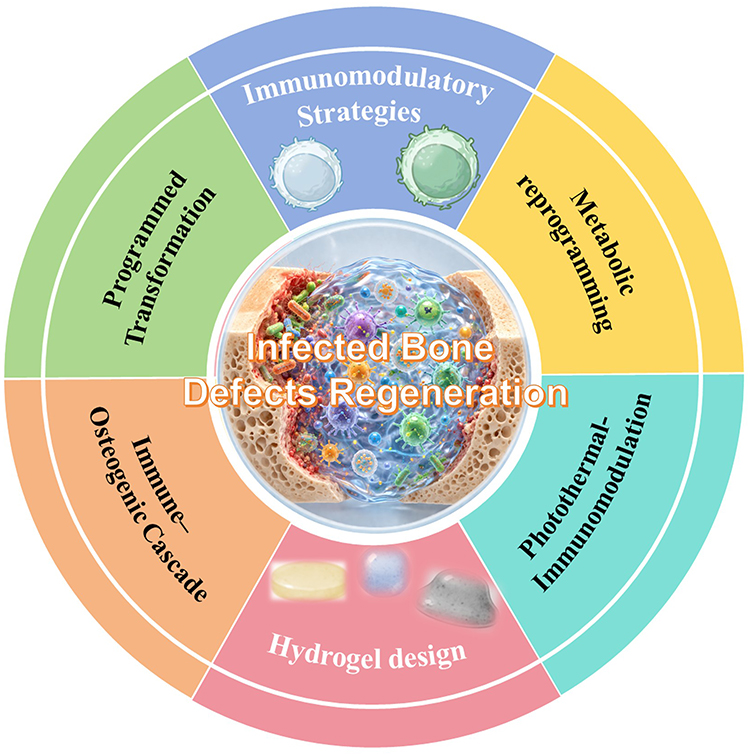 |
Figure 1 Scheme for hydrogel-based immunomodulatory strategies for infected bone defects regeneration. |
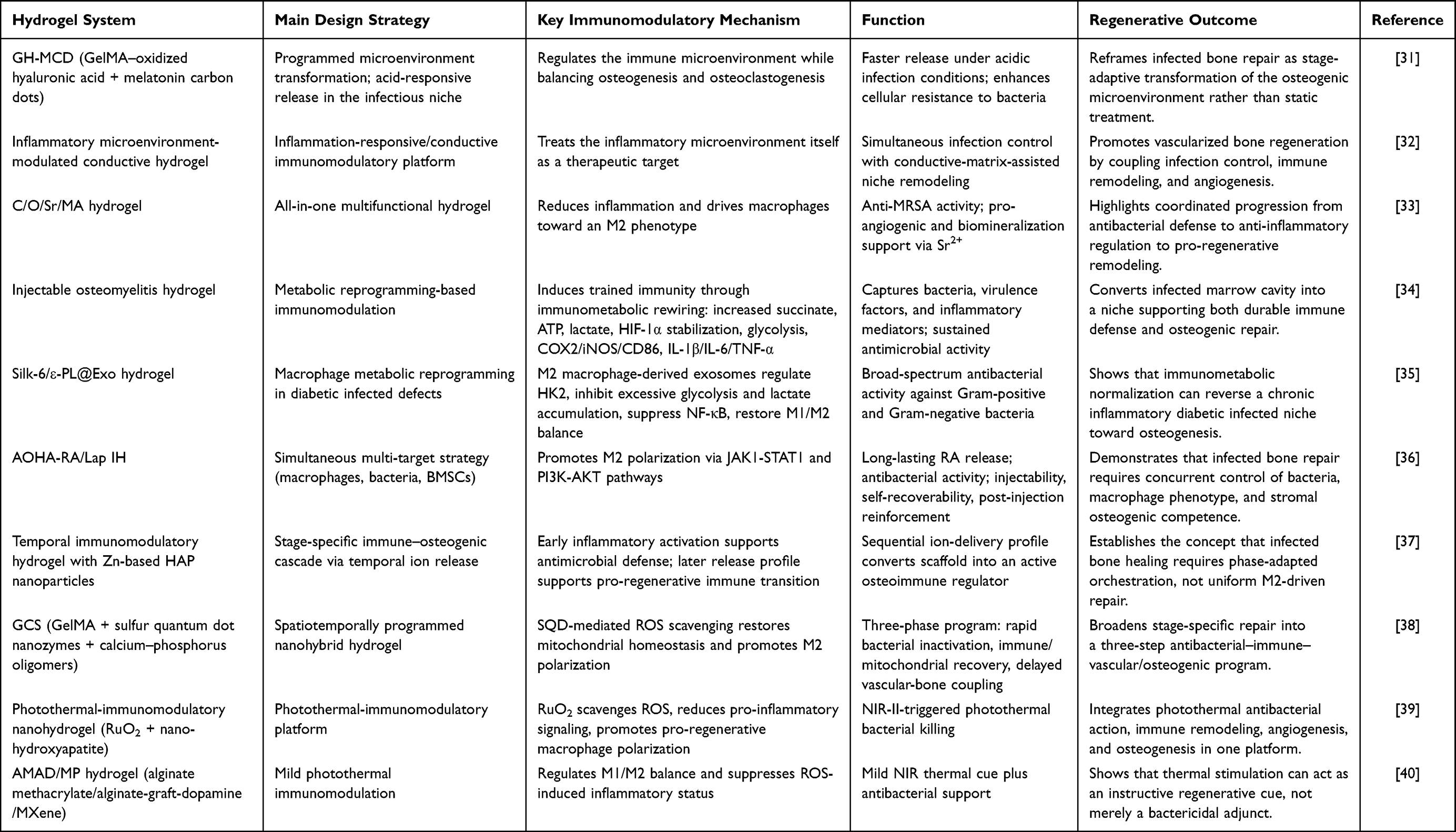 |
Table 1 Hydrogel-Based Immunomodulatory Strategies for Infected Bone Defects Regeneration |
Design Strategies of Hydrogel-Based Immunomodulatory Systems
Hydrogel-based immunomodulatory systems for infected bone defects have rapidly evolved from passive space-filling materials or local antibiotic depots into active platforms for osteoimmune engineering.41 Rather than merely suppressing inflammation or delivering antibacterial agents, current hydrogels are increasingly designed to dynamically reconfigure the pathological niche in a way that integrates infection control, immune regulation, vascularization, and osteogenesis.42 Based on the representative studies discussed above, their design strategies can be understood as four highly interconnected directions (Table 2). Microenvironment-responsive and transformation-oriented hydrogels are engineered to sense pathological features such as acidity, oxidative stress, and persistent inflammation, and then adapt their behavior accordingly.43 In this design logic, the hydrogel is not a static carrier but a responsive therapeutic platform whose function evolves with the healing stage.44 Acid-responsive systems, conductive hydrogels, and all-in-one multifunctional networks exemplify this principle by coupling antibacterial activity with immune remodeling, angiogenesis, and osteogenic support, thereby enabling the gradual conversion of an infection-dominated hostile niche into one permissive for bone regeneration.45 Metabolic reprogramming-based hydrogels target the immunometabolic abnormalities that sustain chronic inflammation and impaired repair.31 In osteomyelitis and diabetic infected bone defects, advanced hydrogels have been developed to self-assemble in situ, capture bacteria and inflammatory mediators, induce trained immunity, regulate glycolytic pathways such as hexokinase 2 (HK2), reduce lactate accumulation, suppress nuclear factor kappa-B (NF-κB)-related inflammation, and restore macrophage homeostasis. These studies suggest that reconstruction of the infectious osteogenic microenvironment may require not only antimicrobial action, but also active correction of the dysregulated metabolic circuitry that underlies persistent immune dysfunction.
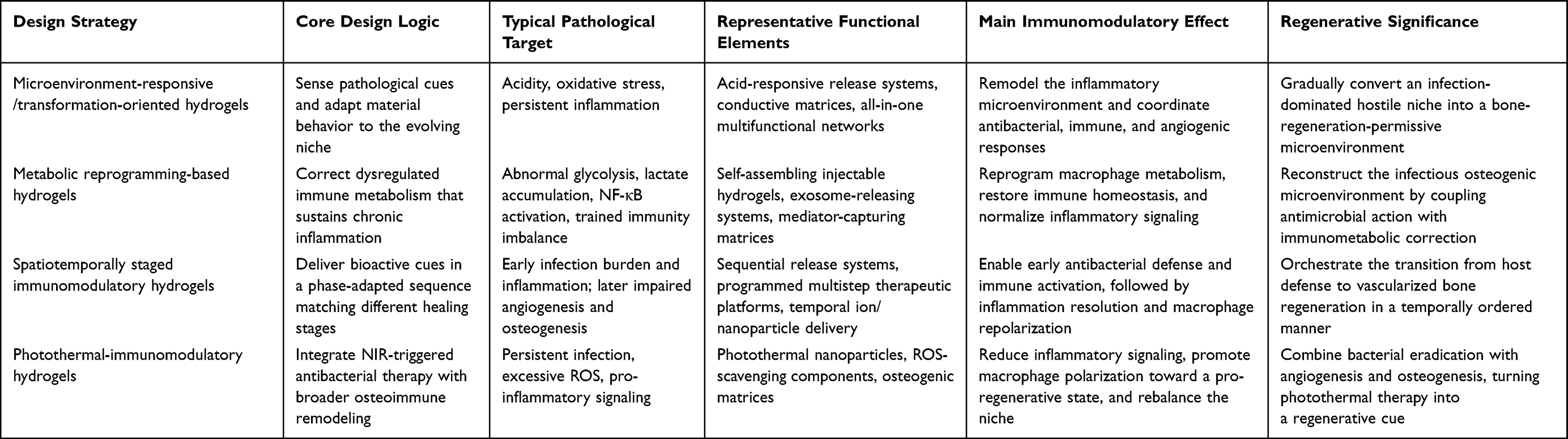 |
Table 2 Major Design Strategies of Hydrogel-Based Immunomodulatory Systems for Infected Bone Defects |
Spatiotemporally staged immunomodulatory hydrogels are built on the recognition that infected bone healing has fundamentally different requirements in the early and late phases. Early antibacterial defense depends on sufficiently activated innate immunity, whereas later repair requires inflammation resolution, vascular coupling, and osteogenesis. Accordingly, recent systems have been designed with sequential release profiles or programmed multistep therapeutic behavior, allowing rapid bacterial inactivation and early immune activation to be followed by reactive oxygen species (ROS) scavenging, macrophage repolarization, angiogenesis, and bone regeneration.46 Compared with uniform immunosuppression, this strategy is more physiologically aligned because it orchestrates the transition from host defense to tissue repair in a temporally ordered manner.47 Photothermal-immunomodulatory hydrogels represent a rapidly emerging strategy in which near infrared (NIR)-responsive antibacterial therapy is integrated with broader microenvironment remodeling.32 In these systems, photothermal treatment is no longer viewed simply as a local bactericidal tool, but as part of a multifunctional platform that also scavenges ROS, modulates inflammatory signaling, promotes macrophage polarization toward a pro-regenerative state, and enhances angiogenesis and osteogenesis.33 Earlier work on mild photothermal stimulation further indicates that thermal cues themselves can serve as instructive regulators of the regenerative niche, even without exogenous cytokines or cells, highlighting that photothermal responsiveness can be harnessed to coordinate antibacterial action with immune and osteogenic regulation.48
These functional strategies share common structural design principles. Most systems are injectable and in situ forming, enabling them to conform to irregular defects and localize treatment within the infected niche.49,50 Many incorporate reversible or dual cross-linking networks, which provide self-healing, self-recoverability, spatial adaptability, and post-implantation mechanical reinforcement. In addition, multifunctionality is often achieved through incorporation of bioactive ions, nanoparticles, nanozymes, exosomes, conductive agents, or photothermal components, which allow the hydrogel matrix to directly influence antibacterial defense, redox balance, immune phenotype, angiogenesis, and osteogenesis.51 Importantly, these advances show that high-performance immunomodulatory hydrogels are not created simply by adding more therapeutic ingredients, but by rationally integrating matrix architecture, responsive behavior, immune targeting, and regenerative signaling into a unified design.52 Taken together, these studies indicate that the field is moving from static delivery to microenvironment-responsive transformation, from simple macrophage phenotype regulation to immunometabolic reprogramming, from uniform intervention to stage-adapted orchestration, and from single-function anti-infective materials to multifunctional osteoimmune engineering systems capable of supporting durable regeneration of infected bone defects.
Programmed Transformation of Osteogenesis Microenvironment
Infectious bone defects are characterized by a highly dynamic pathological niche, in which the dominant barriers to regeneration vary over time.34,53 During the early stage, bacterial colonization and excessive ROS accumulation severely impair cell survival and tissue integration, whereas in the later stage, residual intracellular bacteria, persistent inflammation, and delayed osseointegration continue to compromise defect healing.35,36 Xie et al proposed the concept of programmed transformation of the osteogenesis microenvironment, arguing that successful repair of infectious bone defects requires biomaterials capable of adapting to the evolving biological demands of different healing phases rather than providing a single static function throughout treatment (Figure 2).54 They developed a multifunctional hydrogel termed GH-MCD, in which melatonin carbon dots (MCDs) were incorporated into a GelMA–oxidized hyaluronic acid hydrogel through a Schiff-base-associated network. Importantly, the hydrogel was engineered to respond to the acidic microenvironment of infectious bone defects, enabling faster release of MCDs under infection-relevant conditions and transforming the material into a microenvironment-responsive therapeutic platform rather than a passive scaffold. Mechanistically, this study emphasized that the hydrogel promotes bone repair not through a single pathway, but through programmed, stage-adaptive modulation of the regenerative microenvironment. The GH-500 MCD hydrogels killed ≈90% of the bacteria within 24 h, suggesting enhanced cellular resistance to bacteria. After 4 weeks, the bone volume fraction (BV/TV) in the GH-MCD group reached ≈25%, in contribution to the balanced osteogenesis and osteoclastogenesis. RNA-seq analysis revealed that GH-MCD regulated the immune microenvironment by downregulating genes involved in hematopoietic cell lineage, complement and coagulation cascades, platelet activation, natural killer cell-mediated cytotoxicity, B-cell receptor signaling, and osteoclast differentiation, thereby reducing immunogenicity while supporting antibacterial defense and bone regeneration. Taken together, this study exemplifies how hydrogel-based systems are evolving from static anti-infective scaffolds into dynamic platforms that program the transformation of the osteogenic microenvironment, thereby enabling more effective regeneration of infectious bone defects.37,55
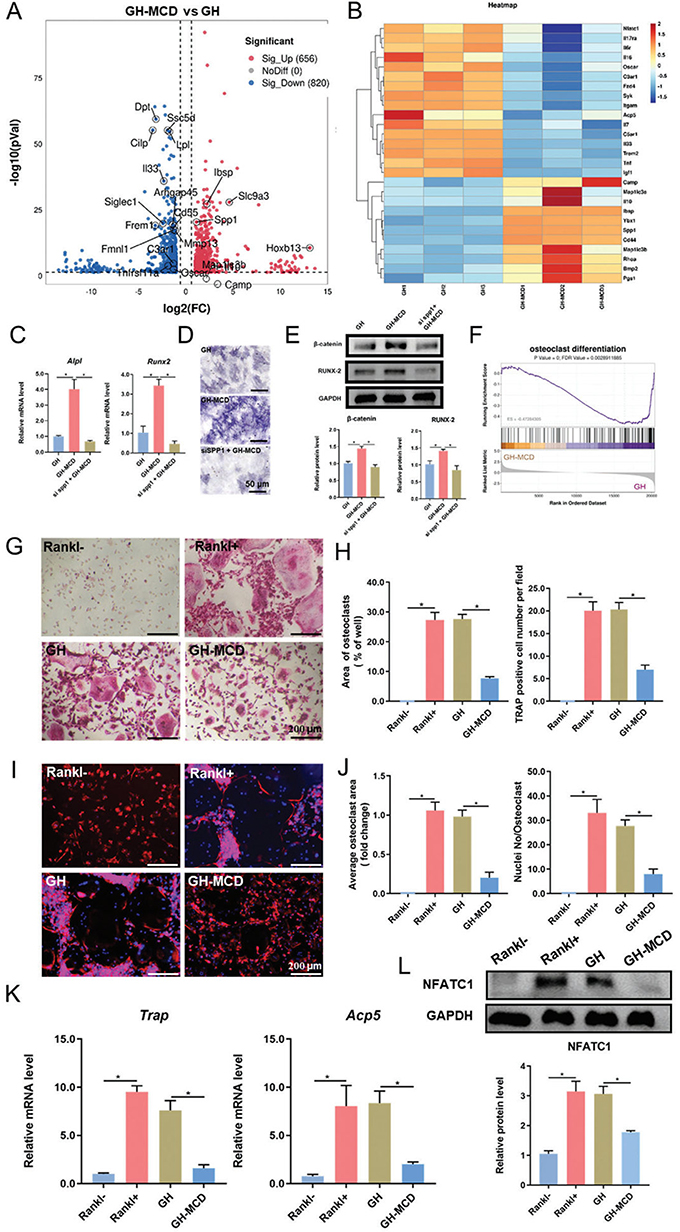 |
Figure 2 Programmed Transformation of Osteogenesis Microenvironment (adapted from Adv Sci (Weinh). 2025 Mar;12 (10):e2409683).54 (A) Volcano plot showing differentially expressed genes between GHMCD and GH groups. (B) Heat map of some genes. (C) Gene expression of Alpl and Runx2 of the BMSCs at 5 days. (D) ALP staining of BMSCs at 5 days. (E) Protein expression of RUNX-2 and β-catenin at 5 days before and after Spp1 being knocked down and quantitative analysis. (F) Gene set enrichment analysis. (G) TRAP staining. (H) Quantitative analysis of TRAP staining. (I) Podosome belt formation assay. (J) Quantitative analysis of Podosome belt formation assay. (K) Genes and (L) protein expression during osteoclastogenesis of the BMMs at 7 days. *p < 0.05. |
In contrast to approaches focused primarily on bacterial killing, Yang et al highlighted the importance of simultaneously controlling infection, remodeling the immune microenvironment, and restoring vascularized bone regeneration.14 They developed an inflammatory microenvironment-modulated conductive hydrogel for infected bone defects. In this system, the hydrogel matrix served as a defect-adaptable semi-solid scaffold, while copper nanoparticles provided multiple functions, including antibacterial activity, electrical conductivity, and immune microenvironment regulation. The rationale for introducing conductivity was to provide bioelectrical cues that may support cell communication, angiogenic activity, and osteogenic repair, whereas the copper-containing component contributed to bacterial inhibition and inflammatory niche remodeling. CuNPs-GelMA conductive hydrogel combined with electrical stimulation, significantly reduced the expression levels of M1 macrophage markers (IL-1β, CD86, IL-6) while markedly increasing the expression levels of M2 macrophage markers (IL-10, CD206, TGF-β). The significance of this work lies in its emphasis that the inflammatory microenvironment itself should be regarded as a therapeutic target rather than a passive background condition. By integrating anti-infective and immunomodulatory functions with a conductive matrix, the hydrogel broadened the concept of osteogenic microenvironment transformation from simple inflammation attenuation to a more coordinated regulation of infection control, immune remodeling, and vascularized osteogenesis. A further extension of this concept was provided by Duan et al, who described an all-in-one multifunctional injectable hydrogel (C/O/Sr/MA hydrogel) for MRSA-infected bone defects.38 Their design explicitly framed infected bone repair as a multistep regenerative process involving antibacterial activity, immune regulation, angiogenesis, osteogenic differentiation, and biomineralization, and sought to integrate these functions within a single hydrogel system. There was no significant variation observed in CD206 expression between the HP-PVA and HP-PVA@MH hydrogels compared with the IL-4 group. However, a substantial increase was observed in CD206 expression within the HP-PVA@Fe-Que and HP-PVA@MH/Fe-Que groups. Mechanistically, the hydrogel inhibited MRSA growth and coordinated with Sr2⁺, which was associated with reduced inflammation, a shift of macrophages toward the M2 phenotype, and enhanced vascularization and bone regeneration. In a rat MRSA-infected bone defect model, the hydrogel promoted angiogenesis, collagen deposition, and bone healing while suppressing inflammatory responses. This study therefore reinforces the idea that effective transformation of the osteogenic microenvironment requires not one dominant biofunction, but the coordinated progression from antibacterial defense to anti-inflammatory regulation and pro-regenerative remodeling.56
Metabolic Reprogramming Reconfigure the Infectious Osteogenic Microenvironment
In infected bone defects, successful healing depends not only on pathogen eradication, but also on reconstruction of a regeneration-permissive osteoimmune microenvironment within the bone marrow cavity.57,58 This is especially important because the bone marrow is not merely an anatomic site of infection, but also a key niche for innate immune activation and immune memory formation.59,60 From this perspective, Chen et al proposed that injectable hydrogels for osteomyelitis treatment should move beyond conventional local antibiotic delivery and instead reconfigure the infectious osteogenic niche through metabolic reprogramming of innate immunity (Figure 3).61 They developed an injectable hydrogel that self-assembles in situ within the bone marrow cavity and captures bacteria, virulence factors, and inflammatory mediators through multivalent interactions, while simultaneously providing sustained antimicrobial and immunomodulatory activity.61 By targeting the marrow cavity, the system was designed not only to control infection at its core location, but also to engage the local immune microenvironment where trained immunity is initiated.61 Mechanistically, the significance of this work lies in demonstrating that hydrogel-mediated treatment can be coupled to immunometabolic rewiring. Pathogen-associated signals adsorbed by the hydrogel activated pattern-recognition pathways and induced metabolic changes characterized by elevated succinate, ATP, and lactate, stabilization of HIF-1α, enhanced glycolysis, and increased expression of inflammatory markers such as COX2, iNOS, and CD86, together with upregulated IL-1β, IL-6, and TNF-α.61 Rather than representing uncontrolled inflammation, this response was interpreted as the establishment of trained immunity, enabling stronger antibacterial defense and protection against reinfection.61 Importantly, this hydrogel did not function as a purely immune-activating system, it also promoted bone regeneration, with improved expression of osteogenic factors such as Runx-2, Osterix, OPG, COL1A1, and ALP, as well as better bone structural outcomes including increased BMD, BV/TV, and Tb.N and reduced Tb.Sp.61 Thus, the therapeutic logic of this study lies in converting the infected marrow cavity from a site of persistent pathogen burden into a microenvironment capable of both durable immune defense and osteogenic repair.
 |
Figure 3 Metabolic reprogramming reconfigure the infectious osteogenic microenvironment (adapted from Nat Commun. 2026 Jan 13;17 (1):1613).61 (A) Schematic illustration of GaCuVan self-assembly. (B) Schematic diagram illustrating the preparation of HACHO-BSA. (C) In vitro simulation of in situ gel formation of GaCuVan&HACHO-BSA hydrogel. (D) Mechanism of in situ gel formation. (E) In situ administration with GaCuVan&HACHO-BSA hydrogel. (F) (a) Recognition and capture of bacteria by the hydrogel via binding to specific terminal peptides on the bacterial cell wall. (b) Schematic illustrating the adsorption of bacterial antigens, serum albumin, and inflammatory factors by the hydrogel through Schiff base reactions, hydrogen bonding, and ionic coordination. (G) Mechanisms of induced trained immunity by the hydrogel. (H) Bacterial capture and bactericidal properties of the hydrogel. (I) Osteogenic effects of the hydrogel. (J) Induction of trained immunity and prevention of relapse by the hydrogel. |
Abnormal immune metabolism further aggravates persistent inflammation, bacterial infection, and delayed bone regeneration.62 To solve this, Jin et al developed a multifunctional Silk-6/ε-PL@Exo hydrogel composed of modified silk fibroin, ε-polylysine, and M2 macrophage-derived exosomes, and explicitly framed the system as a strategy for macrophage metabolic reprogramming rather than simple anti-inflammatory delivery.39 This degradable hydrogel exhibited broad-spectrum antibacterial activity against both Gram-positive and Gram-negative bacteria, while the released M2-Exo targeted M1 macrophages and modulated the key glycolytic enzyme hexokinase II (HK2). This in turn regulated the inflammation-related NF-κB pathway, alleviated lactate accumulation, inhibited excessive glycolysis, and helped restore the M1-to-M2 balance. In a rat model, the hydrogel improved infection control, rebalanced immune responses, and accelerated bone defect healing, indicating that immunometabolic normalization can be used to convert a diabetic infected niche from a state of chronic inflammatory persistence toward one permissive for osteogenesis. Thus, this study reinforces the idea that reconstruction of the infectious osteogenic microenvironment may require not only antimicrobial activity, but also direct intervention in the metabolic circuitry of macrophages that sustains pathological inflammation. A further complementary example was provided by Du et al, who developed a multifunctional self-reinforced injectable hydrogel (AOHA-RA/Lap IH) designed to simultaneously target macrophages, bacteria, and bone marrow stromal cells (BMSCs) in infected bone defects (Figure 4).63 The hydrogel was formed through two reversible cross-linking mechanisms, namely laponite-mediated electrostatic interactions and phenylboronic acid ester bonds between 4-aminobenzeneboronic acid-grafted oxidized hyaluronic acid and rosmarinic acid (RA), which endowed the material with injectability, self-recoverability, spatial adaptability, and post-injection mechanical reinforcement. Importantly, the hydrogel induced M2 macrophage polarization and osteogenic differentiation of bone marrow derived mesenchymal stem cells (BMSCs). Mechanistically, the macrophage-regulatory effect was linked to the JAK1-STAT1 and PI3K-AKT pathways, whereas the osteogenic effect involved calcium signaling, extracellular matrix (ECM) receptor interaction, and TGF-β signaling. Although this study did not focus explicitly on immunometabolic memory, it strongly supports the broader principle that successful reconfiguration of the infectious osteogenic microenvironment requires simultaneous control of bacteria, macrophage phenotype, and stromal osteogenic competence, rather than treatment of these pathological axes in isolation.
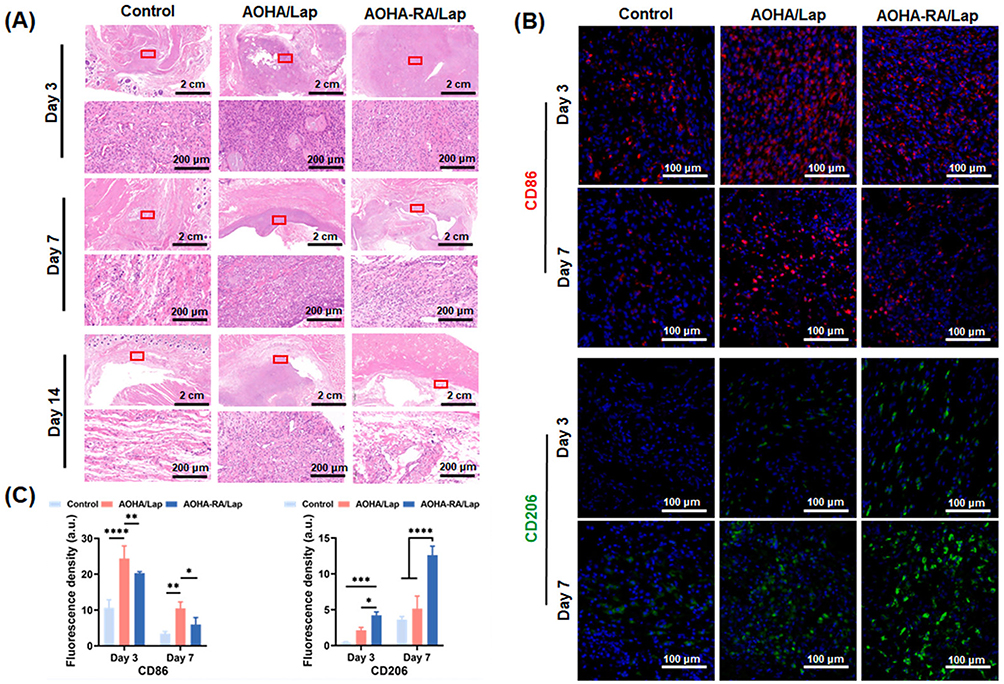 |
Figure 4 Subcutaneous immunoregulatory effects of the hydrogel in rats (adapted from Acta Biomater, 189 (2024) 232–253).63 (A) Representative H&E staining images of subcutaneous implantation at 3, 7, and 21 d post-implantation. The image below is a high-magnification image corresponding to the red area above. (B) Representative immunofluorescence staining images of CD86 and CD206 within the subcutaneous tissues at 3 and 7 d post-implantation. (C) Corresponding statistical analysis of the fluorescence intensities of CD86 and CD206 in (B). *p < 0.05, **p < 0.01, ***p < 0.001, ****p < 0.0001. |
Spatiotemporally Stage-Specific Immune–Osteogenic Cascade
A central challenge in the treatment of infected bone defects is that the immune requirements of the early and late healing phases are fundamentally different.40 Early after implantation, efficient pathogen clearance depends on a sufficiently activated inflammatory response, whereas later-stage repair requires resolution of inflammation and the establishment of a pro-regenerative microenvironment.64 In this context, Jin et al reported a temporal immunomodulatory hydrogel for infected bone defect regeneration, arguing that conventional osteoimmunomodulatory strategies place excessive emphasis on M2-driven repair while underestimating the indispensable contribution of early M1-associated antimicrobial immunity (Figure 5).29 Their work therefore reframed infected bone healing as a stage-specific immune–osteogenic cascade rather than a simple anti-inflammatory process. The hydrogel was constructed by crosslinking acrylate-modified engineered protein with oxidized sodium alginate, yielding a rapidly formed matrix intended to mimic extracellular matrix architecture and support cell adhesion, angiogenesis, and osteogenesis. To enable temporal regulation, they incorporated zinc-based nanoparticles mineralized with hydroxyapatite into the hydrogel network. This design is particularly important because it links hydrogel composition to a programmed ion-delivery profile, thereby converting the material from a passive scaffold into an active regulator of the osteoimmune microenvironment. Mechanistically, the key innovation of this study lies in its sequential ion release behavior, which promoted M1-associated antibacterial immunity to improve early infection control, and then supported a later pro-regenerative transition that enhanced inflammation resolution, osteogenic differentiation, and new bone formation. The hydrogel regulated infected bone healing through a temporally ordered immune–osteogenic cascade rather than uniform immunosuppression or continuous M2 polarization.
 |
Figure 5 Stage-specific Immune–Osteogenic Cascade by Temporal Ion Release (adapted from Adv Mater. 2026 Jan;38 (2):e14419).29 |
Another representative example of stage-specific regulation in infected bone defect repair was reported by Liu et al, who developed a GelMA-based nanocomposite hydrogel (GCS) co-embedded with sulfur quantum dot nanozymes (SQDs) and calcium–phosphorus oligomers (CPOs) to achieve temporally controlled therapy of infectious bone defects (Figure 6).65 Unlike strategies that rely on uniform immunosuppression throughout healing, this system was designed to coordinate the sequential needs of the defect microenvironment. The hydrogel executed a three-phase therapeutic program. First, SQDs that were only weakly associated with the matrix were released rapidly to inactivate bacteria during the early phase. Second, SQD-mediated reactive oxygen species scavenging restored mitochondrial homeostasis and ATP synthesis, suppressed inflammation-associated protein expression, and promoted macrophage M2 polarization. Third, the more sustained delivery of calcium–phosphorus oligomers promoted vascular coupling and osteogenic differentiation during tissue regeneration. In this way, the material functioned not merely as an antibacterial depot, but as a dynamically instructive platform that linked infection control, immune remodeling, and bone repair in a temporally ordered sequence. This study therefore broadens the concept of the immune–osteogenic cascade from simple phenotype switching to a more integrated model in which programmed material dynamics orchestrate the transition from innate defense to regenerative healing in infectious bone defects.66 Taken together, these studies highlight a paradigm shift from static immunomodulation to phase-adapted orchestration of antibacterial defense, immune remodeling, vascularization, and osteogenesis, thereby enabling more precise regeneration of infected bone defects.
 |
Figure 6 Preparation of CSG Nanocomposite Hydrogels (a) and Temporal-Controlled Therapy through Mitochondrial Homeostatic Balance Modulation of Immunity and Vascularization (b) (adapted from ACS Appl Mater Interfaces, 17 (2025) 51,904–51,918).65 (a) Preparation of CSG Nanocomposite Hydrogels and (b) Temporal-Controlled Therapy of IBDs through Antimicrobial Maintenance of Mitochondrial Homeostatic Balance Modulation of Immunity and Vascularization. |
Photothermal-Immunomodulation Accelerates Bone Regeneration
Photothermal therapy has emerged as a promising strategy for infected bone defects because it enables localized bacterial eradication without relying exclusively on conventional antibiotics, which is particularly valuable in the context of persistent infection and impaired tissue repair.67–69 However, photothermal antibacterial treatment alone is often insufficient for defect healing, since excessive inflammation and oxidative stress may continue to compromise osteogenesis even after bacterial burden is reduced.70–72 To solve this, Zhan et al developed a photothermal-immunomodulatory nanohydrogel and proposed that effective treatment of infected bone defects should integrate targeted antibacterial therapy, immune microenvironment modulation, and osteogenic support within a single platform (Figure 7).73 The system was constructed by combining photothermal/antioxidant-responsive polymer nanoparticles containing ruthenium oxide with bioactive nano-hydroxyapatite in a hydrogel matrix. Under NIR-II laser irradiation, the hydrogel generated a potent photothermal effect that damaged bacterial membranes and disrupted bacterial metabolic activity, thereby achieving strong local antibacterial action. At the same time, the RuO2 component scavenged excessive reactive oxygen species, reduced pro-inflammatory signaling, and helped remodel the immune microenvironment, while the hydrogel scaffold and embedded hydroxyapatite provided a favorable matrix for osteoblast adhesion, growth, and osteogenic differentiation. Particularly, the PNPs@RuO2@HAP@Gel/laser group exhibited significantly greater CD206 expression and a concomitant reduction in CD80-positive cells, suggesting a clear shift toward M2 macrophage polarization. The Gel/laser and PNPs@RuO2@HAP@Gel groups showed moderate levels of CD31-positive microvessels within the defect areas. This multifunctional hydrogel not only eradicated infection in a rat infected bone defect model, but also lowered pro-inflammatory cytokine levels, promoted macrophage polarization toward a pro-regenerative state, and enhanced both angiogenesis and new bone formation.
 |
Figure 7 Photothermal-Immunomodulation Accelerates Bone Regeneration (adapted from Adv Healthc Mater, 15 (2026) e04317).73 (A) Schematic diagram of the treatment of infectious bone defects with PNPs@RuO2@HAP@Gel. (B) Diagram explaining the mechanism of PNPs@RuO2@HAP@Gel in repairing infectious bone defects. |
The rationale of photothermal-immunomodulation is further supported by earlier work showing that mild, rather than ablative, photothermal stimulation can actively orchestrate the regenerative microenvironment.74 Wu et al developed an injectable and photocurable AMAD/MP hydrogel based on alginate methacrylate, alginate-graft-dopamine, and polydopamine-functionalized MXene nanosheets, and demonstrated that NIR-mediated mild thermal stimulation could synergize immunomodulation, osteogenesis, and bacterial elimination within a single hydrogel platform.75 The optimized hydrogel exhibited favorable biocompatibility and osteogenic activity, while also establishing a more appropriate immune microenvironment by regulating the M1/M2 macrophage balance and suppressing ROS-induced inflammatory status. Notably, this mild photothermal cue was sufficient to attenuate local immune reactions and promote new bone formation without the addition of exogenous cells, cytokines, or growth factors, underscoring that thermal stimulation itself can serve as an instructive signal rather than merely a bactericidal adjunct. Although this study was not specifically designed for infected bone defects, it provides important mechanistic support for the infected-defect strategy. Thus, photothermal-immunomodulatory hydrogels are evolving from simple heat-generating antibacterial systems into microenvironment-orchestrating platforms that coordinate infection control, immune remodeling, and bone regeneration.
Current Challenges and Future Perspectives
While macrophage-centered approaches have significantly advanced infected bone defect regeneration, focusing solely on M1/M2 polarization may overlook the nuanced spectrum of immune cell states present in vivo.76 The immune microenvironment involves dynamic interactions among neutrophils, dendritic cells, T cells, and stromal cells, each with distinct temporal and spatial contributions to both infection control and tissue repair.77 Current hydrogel systems that target only macrophage phenotypes may insufficiently capture these complex regulatory networks, limiting translational efficacy.78 Over-suppression of early inflammatory responses can impede bacterial clearance, whereas insufficient control of later-stage inflammation may compromise osteogenesis.79 Stage-specific hydrogels with spatiotemporal release profiles and programmable immunomodulatory cues have shown promise in addressing this challenge, yet fine-tuning remains difficult due to inter-individual variability and the dynamic evolution of infectious niches.80 Hydrogel systems are increasingly multifunctional, integrating antimicrobial agents, immunoregulatory molecules, metabolic modulators, photothermal components, and osteogenic factors.81,82 While these designs enhance therapeutic efficacy, they introduce manufacturing complexity, batch-to-batch variability, and regulatory hurdles.83 Simplifying design without compromising performance remains an ongoing challenge for clinical translation.84 There is a notable absence of standardized metrics for evaluating immunomodulatory hydrogels, including immune readouts, mechanical properties, degradation kinetics, and in vivo performance in infected bone models.28,85,86 This heterogeneity complicates cross-study comparisons, hampers reproducibility, and slows regulatory approval processes. Development of consensus frameworks for hydrogel characterization and preclinical testing is urgently needed.87 The incorporation of bioactive ions, nanoparticles, exosomes, and photothermal agents raises safety concerns, including immunogenicity, cytotoxicity, and long-term persistence in tissue.88 Regulatory pathways for combination products involving biologics, devices, and drugs are complex.89 Early engagement with regulatory authorities and rigorous preclinical safety assessments are essential to ensure clinical viability. In addition to biochemical immunomodulation, the physical properties of hydrogels should be considered as important regulators of the osteoimmune microenvironment.90 Hydrogels are semi-solid, water-rich three-dimensional polymer networks whose stiffness, viscoelasticity, porosity, swelling behavior, and degradation kinetics can be adjusted through polymer composition and crosslinking density.91 An ideal immunomodulatory hydrogel for infected bone defects should provide a mechanically permissive but sufficiently supportive microenvironment.
Future hydrogel designs will increasingly adopt a systems-level approach, modulating not just macrophages but orchestrating interactions among multiple immune and stromal cell types, such as neutrophils, dendritic cells and T lymphocytes, to provide a more comprehensive overview of the osteoimmune network. By targeting the broader osteoimmune network, these platforms aim to synchronize infection clearance, inflammation resolution, angiogenesis, and bone regeneration for more robust and resilient repair outcomes. Advances in responsive and programmable hydrogels enable customization to disease-specific pathological microenvironments.92,93 Tailoring hydrogel composition, release kinetics, and mechanical properties to match conditions such as diabetic osteomyelitis or MRSA-infected defects can enhance regeneration while minimizing off-target effects.94,95 Integration of metabolic reprogramming and photothermal cues further supports niche-adapted, stage-specific therapy.96 Artificial intelligence and machine learning offer opportunities to accelerate hydrogel development.97 By integrating large-scale omics data, imaging, and outcomes, predictive models can inform the selection of bioactive components, crosslinking strategies, and spatiotemporal release profiles. Data-driven approaches can optimize multifunctional hydrogel architectures, reduce experimental burden, and enhance the precision of immunomodulatory interventions. Although hydrogel-based immunomodulatory strategies have shown promising therapeutic effects in preclinical models of infected bone defects, their clinical translation remains limited. Therefore, future work should prioritize standardized preclinical assessment, long-term biosafety evaluation, scalable manufacturing, regulatory pathway clarification, and well-designed clinical trials to validate their safety and efficacy in patients.
Conclusion
Infected bone defects represent a uniquely challenging regenerative concern. As highlighted throughout this review, effective treatment therefore requires more than antibacterial eradication or structural defect filling alone. It demands active remodeling of the osteoimmune microenvironment so that host defense, inflammation resolution, angiogenesis, and bone regeneration can proceed in a coordinated manner. In this context, hydrogel-based immunomodulatory systems have emerged as especially promising platforms because they combine injectability, defect adaptability, extracellular matrix-mimicking properties, and the capacity for dynamic therapeutic programming. Rather than functioning as passive carriers, these hydrogels are increasingly designed as instructive biomaterials that sense pathological cues, regulate immune responses, modulate redox and metabolic states, and guide stage-specific tissue repair. Hydrogel design is evolving along programmed microenvironment transformation, immunometabolic reprogramming, spatiotemporal orchestration of immune–osteogenic cascades, and photothermal-assisted osteoimmune regulation. Importantly, the next generation of hydrogels will likely move beyond simplified macrophage-centered models toward multicellular osteoimmune network engineering, with greater emphasis on disease-specific precision design, long-term biosafety, regulatory complexity, manufacturing reproducibility, and clinical scalability. With continued progress in biomaterials science, osteoimmunology, and data-driven design, hydrogel-based immunomodulatory strategies are poised to become powerful therapeutic tools for achieving durable and clinically translatable regeneration of infected bone defects.
Funding
This study was funded by Scientific Development Program of Jilin Province (Grant No. YDZJ202401688ZYTS).
Disclosure
The authors report no conflicts of interest in this work.
References
1. Lin X, Deng S, Fu T, et al. Hyaluronic acid-based hydrogel microspheres with multi-responsive properties for antibacterial therapy and bone regeneration in Staphylococcus aureus-infected skull defects. Mater Today Bio. 2025;32:101676.
2. Tian Y, Wu D, Wu D, et al. Chitosan-based biomaterial scaffolds for the repair of infected bone defects. Front Bioeng Biotechnol. 2022;10:899760. doi:10.3389/fbioe.2022.899760
3. Lindfors SC, Arts CJ, Lindfors NC. Clinical use of S53P4 bioactive glass in the treatment of bone defects and infected bone: a systematic review of the quality of clinical outcomes and A grade assessment. Adv Healthc Mater. 2026;15(5):e03013. doi:10.1002/adhm.202503013
4. Jiamin, Jiaying, Chen T, Luo L, Wenhua. Engineering smart 3D -printed antibacterial bone scaffolds: stimuli-responsive release and personalized therapy for infected bone defects. J Biomed Mater Res B Appl Biomater. 2026;114(4):e70057. doi:10.1002/jbm.b.70057
5. Li J, Li M, Wang W, Li B, Liu L. Evolution and development of ilizarov technique in the treatment of infected long bone nonunion with or without bone defects. Orthop Surg. 2022;14(5):824–19. doi:10.1111/os.13218
6. Ren C, Li M, Ma T, et al. A meta-analysis of the Masquelet technique and the Ilizarov bone transport method for the treatment of infected bone defects in the lower extremities. J Orthop Surg. 2022;30(2):10225536221102685. doi:10.1177/10225536221102685
7. Xu Y, Xu C, Xie M, et al. Ultrasound activated piezoelectric catalysis and neurogenic activity for effective therapy of MRSA infected bone defects by phase/defect-engineered barium strontium titanate. Small Meth. 2025;9(8):e2402174. doi:10.1002/smtd.202402174
8. Zhang R, Stehle Y, Chen L, et al. Multifunctional, enzyme/pH-responsive gelatin microspheres with aptamer-targeted antibacterial and ionic-mediated dual therapy for infected bone defects. Biomaterials. 2026;326:123642. doi:10.1016/j.biomaterials.2025.123642
9. Yang D, Xu Z, Huang D, et al. Immunomodulatory multifunctional janus collagen-based membrane for advanced bone regeneration. Nat Commun. 2025;16(1):4264. doi:10.1038/s41467-025-59651-z
10. Li X, Huang M, Chen T, et al. Biomimetic hydrogel strategy inspired by sea cucumbers: integrating antibacterial, osteoimmune, and osteogenic functions for infected bone repair. Biomaterials. 2026;330:124080. doi:10.1016/j.biomaterials.2026.124080
11. Zhang R, Tan SF, Wang Y, Wu J, Zhang C. From macrophage polarization to clinical translation: immunomodulatory hydrogels for infection-associated bone regeneration. Front Cell Dev Biol. 2025;13:1684357.
12. Qu Y, Ou S, Wen J, et al. Myeloid immune checkpoint blockade overcomes antibiotic resistance in bone infection by enhancing efferocytosis and suppressing MSC PANoptosis. Drug Resist Updat. 2026;85:101348. doi:10.1016/j.drup.2025.101348
13. Chang D, Li L, Lin W, et al. Electrodeposited Janus collagen membrane with tunable barrier protection, controlled degradation, and synergistic immunomodulation for bone regeneration in complex defects. Biomaterials. 2026;331:124137.
14. Yang Q, Wu T, Wu X, Ren M, Liu F, Yang S. Inflammatory microenvironment-modulated conductive hydrogel promotes vascularized bone regeneration in infected bone defects. ACS Biomater Sci Eng. 2025;11(4):2353–2366. doi:10.1021/acsbiomaterials.5c00172
15. Yuan K, Yang Y, Lin Y, et al. Targeting bacteria-induced ferroptosis of bone marrow mesenchymal stem cells to promote the repair of infected bone defects. Adv Sci. 2024;11(39):e2404453. doi:10.1002/advs.202404453
16. Xu D, Gan K, Wang Y, et al. A composite deferoxamine/black phosphorus nanosheet/gelatin hydrogel scaffold for ischemic tibial bone repair. Int J Nanomed. 2022;17:1015–1030. doi:10.2147/IJN.S351814
17. Cao Z, Qin Z, Duns GJ, et al. Repair of infected bone defects with hydrogel materials. Polymers. 2024;16:281.
18. Wang X, Zeng J, Gan D, et al. Recent strategies and advances in hydrogel-based delivery platforms for bone regeneration. Nanomicro Lett. 2024;17(1):73. doi:10.1007/s40820-024-01557-4
19. Guo J, Yao H, Chang L, et al. Magnesium nanocomposite hydrogel reverses the pathologies to enhance mandible regeneration. Adv Mater. 2025;37(2):e2312920. doi:10.1002/adma.202312920
20. Liu J, Tan R, Wang C, Li G, Zheng H, Wan Y. Injectable hydrogels composed of thiolated chitosan, silk fibroin, and gallium-doped bioactive glass nanoparticles for bone regeneration and osteosarcoma suppression. Int J Nanomed. 2026;21:574545. doi:10.2147/IJN.S574545
21. Li W, Wu Y, Zhang X, et al. Self-healing hydrogels for bone defect repair. RSC Adv. 2023;13:16773–16788.
22. Chen Z, Jia M, Liu Y, Zhou H, Wang X, Wu M. Injectable composite hydrogel stents for bone defect management with enhanced osteogenesis and angiogenesis. Int J Nanomed. 2025;20:4589–4606. doi:10.2147/IJN.S509686
23. Zhu Y, Liu H, Wu P, et al. Multifunctional injectable hydrogel system as a mild photothermal-assisted therapeutic platform for programmed regulation of inflammation and osteo-microenvironment for enhanced healing of diabetic bone defects in situ. Theranostics. 2024;14(18):7140–7198. doi:10.7150/thno.102779
24. Wang H, Hu B, Li H, et al. Biomimetic mineralized hydroxyapatite nanofiber-incorporated methacrylated gelatin hydrogel with improved mechanical and osteoinductive performances for bone regeneration. Int J Nanomed. 2022;17:1511–1529. doi:10.2147/IJN.S354127
25. Zhang T, Zhou W, Yang W, et al. Vancomycin-encapsulated hydrogel loaded microarc-oxidized 3D-printed porous Ti6Al4V implant for infected bone defects: reconstruction, anti-infection, and osseointegration. Bioact Mater. 2024;42:18–31. doi:10.1016/j.bioactmat.2024.07.035
26. Yuqiang W, Ziyan Z, Xuedi S, Chengdong P. Recent progress in immunomodulation-based strategies for bone repair. Regener Ther. 2026;31:101054.
27. Zhao P, Li M, Wang J, Li J, Lin Y. Targeting the immune microenvironment: a novel strategy for treating infected bone defects with hydrogels. Chin Chem Lett. 2026;37(5):111319. doi:10.1016/j.cclet.2025.111319
28. Fu M, Yang C, Sun G. Recent advances in immunomodulatory hydrogels biomaterials for bone tissue regeneration. Mol Immunol. 2023;163:48–62.
29. Jin C, Liang J, Wu J, et al. Temporal immunomodulatory hydrogel regulating the immune-osteogenic cascade for infected bone defects regeneration. Adv Mater. 2026;38(2):e14419. doi:10.1002/adma.202514419
30. Wang Y, Zhao Y, Ma S, et al. Injective programmable proanthocyanidin-coordinated zinc-based composite hydrogel for infected bone repair. Adv Healthc Mater. 2024;13(6):e2302690. doi:10.1002/adhm.202302690
31. Zuo G, Zhuang P, Yang X, et al. Regulating chondro-bone metabolism for treatment of osteoarthritis via high-permeability micro/nano hydrogel microspheres. Adv Sci. 2024;11(5):e2305023. doi:10.1002/advs.202305023
32. Wu Y, Xie X, Luo G, et al. Photothermal sensitive nanocomposite hydrogel for infectious bone defects. Bone Res. 2025;13(1):22. doi:10.1038/s41413-024-00377-x
33. Na P, Jiang JL, Lv RP, Yang F, Li SF, Chen XZ. Advances in mild photothermal hydrogel-based therapies for bone and soft tissue injuries. Front Cell Dev Biol. 2025;13:1696209. doi:10.3389/fcell.2025.1696209
34. Ou Z, Wei J, Lei J, et al. Biodegradable Janus sonozyme with continuous reactive oxygen species regulation for treating infected critical-sized bone defects. Nat Commun. 2024;15(1):10525. doi:10.1038/s41467-024-54894-8
35. Sun J, Zhu H, Wang H, et al. A multifunctional composite scaffold responds to microenvironment and guides osteogenesis for the repair of infected bone defects. J Nanobiotechnol. 2024;22(1):577. doi:10.1186/s12951-024-02823-8
36. Zeng D, Wang H, Yu Z, et al. Near-infrared light and magnetic field dual-responsive 3D printed scaffolds for sequential treatment of infected bone defects. Biofabrication. 2025;17(3):035031. doi:10.1088/1758-5090/adebb3
37. Li Q, Zhang H, Pan J, et al. Tripeptide-based macroporous hydrogel improves the osteogenic microenvironment of stem cells. J Mater Chem B. 2021;9(30):6056–6067. doi:10.1039/D1TB01175H
38. Duan Y, Li Y, Wang Y, et al. An all-in-one “multifunctional hydrogel”: through antibacterial, anti-inflammatory, and angiogenic to promoting MRSA-infected bone defect repair. Chem Eng J. 2025;503:158132. doi:10.1016/j.cej.2024.158132
39. Jin J, Yang Y, Yang J, et al. Macrophage metabolic reprogramming-based diabetic infected bone defect/bone reconstruction though multi-function silk hydrogel with exosome release. Int J Biol Macromol. 2024;278:134830.
40. Wu H, Chen C, Li J, et al. Engineered magneto-piezoelectric nanoparticles-enhanced scaffolds disrupt biofilms and activate oxidative phosphorylation in icam1+ macrophages for infectious bone defect regeneration. ACS Nano. 2024;18(52):35575–35594. doi:10.1021/acsnano.4c13562
41. Jian G, Li D, Ying Q, et al. Dual photo-enhanced interpenetrating network hydrogel with biophysical and biochemical signals for infected bone defect healing. Adv Healthc Mater. 2023;12(25):e2300469. doi:10.1002/adhm.202300469
42. Zhang S, Ge G, Li W, et al. Sr-MOF-based hydrogel promotes diabetic tissue regeneration through simultaneous antimicrobial and antiinflammatory properties. Mater Today Bio. 2025;32:101906. doi:10.1016/j.mtbio.2025.101906
43. Wang Y, Ma S, Zhao Y, et al. Dynamically crosslinked carbon dot/alginate hydrogels for on-demand osteomyelitis therapy. Adv Mater. 2026;38(28):e73080. doi:10.1002/adma.73080
44. Wang W, Chen H, Xiao J, et al. Microenvironment-responsive injectable hydrogel for neuro-vascularized bone regeneration. Mater Today Bio. 2024;29:101369. doi:10.1016/j.mtbio.2024.101369
45. Fu X, Luo Z, Guo Y, et al. Microenvironment-responsive multifunctional enzyme-linked hydrogel for diabetic bone defect regeneration. Nat Commun. 2025;16(1):10275. doi:10.1038/s41467-025-65165-5
46. Li X, Sun Z, Shang X, et al. Sequential delivery of IL-10 and icariin using nanoparticle/hydrogel hybrid system for prompting bone defect repair. Mater Today Bio. 2024;29:101374. doi:10.1016/j.mtbio.2024.101374
47. Li Y, Liu Y, Lou C, et al. Sono-controllable janus hydrogel platform for sequential tumor eradication and bone regeneration in metastatic breast cancer. Adv Sci. 2025;12(43):e06386. doi:10.1002/advs.202506386
48. Wu M, Liu H, Li D, et al. Smart-responsive multifunctional therapeutic system for improved regenerative microenvironment and accelerated bone regeneration via mild photothermal therapy. Adv Sci. 2024;11(2):e2304641. doi:10.1002/advs.202304641
49. Zhou H, He Z, Cao Y, et al. An injectable magnesium-loaded hydrogel releases hydrogen to promote osteoporotic bone repair via ROS scavenging and immunomodulation. Theranostics. 2024;14(9):3739–3759. doi:10.7150/thno.97412
50. Zhou S, Xiao C, Fan L, et al. Injectable ultrasound-powered bone-adhesive nanocomposite hydrogel for electrically accelerated irregular bone defect healing. J Nanobiotechnol. 2024;22(1):54. doi:10.1186/s12951-024-02320-y
51. Li G, Liu S, Chen Y, et al. An injectable liposome-anchored teriparatide incorporated gallic acid-grafted gelatin hydrogel for osteoarthritis treatment. Nat Commun. 2023;14(1):3159. doi:10.1038/s41467-023-38597-0
52. Zhu H, Cai C, Yu Y, et al. Quercetin-loaded bioglass injectable hydrogel promotes m6A alteration of per1 to alleviate oxidative stress for periodontal bone defects. Adv Sci. 2024;11(29):e2403412. doi:10.1002/advs.202403412
53. Ying D, Zhang T, Qi M, Han B, Dong B. Artificial bone materials for infected bone defects: advances in antimicrobial functions. ACS Biomater Sci Eng. 2025;11(4):2008–2036. doi:10.1021/acsbiomaterials.4c01940
54. Xie E, Yuan Z, Chen Q, et al. Programmed transformation of osteogenesis microenvironment by a multifunctional hydrogel to enhance repair of infectious bone defects. Adv Sci. 2025;12(10):e2409683. doi:10.1002/advs.202409683
55. Wei FL, Zhai Y, Wang TF, et al. Stem cell-homing biomimetic hydrogel promotes the repair of osteoporotic bone defects through osteogenic and angiogenic coupling. Sci Adv. 2024;10(44):eadq6700. doi:10.1126/sciadv.adq6700
56. Zhu Y, Xiu Z, Jiang X, et al. Injectable hydrogels with ROS-triggered drug release enable the co-delivery of antibacterial agent and anti-inflammatory nanoparticle for periodontitis treatment. J Nanobiotechnol. 2025;23:205.
57. Ma L, Cheng Y, Feng X, et al. A Janus-ROS healing system promoting infectious bone regeneration via sono-epigenetic modulation. Adv Mater. 2024;36(2):e2307846. doi:10.1002/adma.202307846
58. Zhang Y, Yang F, Sun D, et al. rFSAV promotes Staphylococcus aureus-infected bone defect healing via IL-13- mediated M2 macrophage polarization. Clin Immunol. 2023;255:109747. doi:10.1016/j.clim.2023.109747
59. Lin Q, Lin X. Cyclic mechanical stretch pre-stimulated bone marrow mesenchymal stem cells promote the healing of infected bone defect in a mouse model. Biotechnol J. 2023;18(10):e2300070. doi:10.1002/biot.202300070
60. Zhang Y, Zhou J, Wu JL, et al. Intrinsic antibacterial and osteoinductive sterosomes promote infected bone healing. J Control Release. 2023;354:713–725. doi:10.1016/j.jconrel.2023.01.058
61. Chen H, Wei L, Yu Q, et al. Injectable hydrogels for osteomyelitis treatment induce metabolic reprogramming for protection against reinfection. Nat Commun. 2026;17:1613.
62. Zhang W, Gao R, Rong X, et al. Immunoporosis: role of immune system in the pathophysiology of different types of osteoporosis. Front Endocrinol. 2022;13:965258. doi:10.3389/fendo.2022.965258
63. Du J, Chu Y, Hu Y, et al. A multifunctional self-reinforced injectable hydrogel for enhancing repair of infected bone defects by simultaneously targeting macrophages, bacteria, and bone marrow stromal cells. Acta Biomater. 2024;189:232–253. doi:10.1016/j.actbio.2024.10.014
64. Qiao Z, Zhang W, Jiang H, Li X, An W, Yang H. 3D-printed composite scaffold with anti-infection and osteogenesis potential against infected bone defects. RSC Adv. 2022;12(18):11008–11020. doi:10.1039/D2RA00214K
65. Liu J, Wei J, Xiao S, Zuo Y, Li Y, Li J. Nanohybrid hydrogels spatiotemporally restore infectious bone defects via mitochondrial homeostasis-driven immunomodulation and vascular-bone coupling synergy. ACS Appl Mater Interfaces. 2025;17(37):51904–51918. doi:10.1021/acsami.5c14131
66. Yang Q, Wang S, Chen A, et al. A poly(ether-ketone-ketone) composite scaffold simulating the immune-osteogenic cascade for in situ bone regeneration. J Mater Chem B. 2025;13(15):4641–4656. doi:10.1039/D5TB00070J
67. Zhao Y, Peng X, Wang D, et al. Chloroplast-inspired scaffold for infected bone defect therapy: towards stable photothermal properties and self-defensive functionality. Adv Sci. 2022;9(31):e2204535. doi:10.1002/advs.202204535
68. Yang F, Shi Z, Hu Y, et al. Nanohybrid hydrogel with dual functions: controlled low-temperature photothermal antibacterial activity and promoted regeneration for treating MRSA-infected bone defects. Adv Healthc Mater. 2025;14(11):e2500092. doi:10.1002/adhm.202500092
69. Li X, Yang Y, Chen M, et al. Diatom-inspired scaffold for infected bone defect therapy: achieving stable photothermal properties and coordinated antibacterial-osteogenic functions. Adv Mater. 2026;38(1):e09997. doi:10.1002/adma.202509997
70. Zhao Y, Kang H, Xia Y, Sun L, Li F, Dai H. 3D printed photothermal scaffold sandwiching bacteria inside and outside improves the infected microenvironment and repairs bone defects. Adv Healthc Mater. 2024;13(6):e2302879. doi:10.1002/adhm.202302879
71. Han M, Li X, Shi S, et al. Thermal control of photothermal implants inspired by polar bear skin for the treatment of infected bone defects. Mater Horiz. 2024;11(19):4651–4664. doi:10.1039/D4MH00453A
72. Yang Q, Lou S, Zhang Y, et al. NIR-II responsive multifunctional scaffold enabling “kill-modulation-build” synergistic therapy for infectious bone defects. Adv Sci. 2025;12(47):e08948. doi:10.1002/advs.202508948
73. Zhan T, Fang Z, Xu J, et al. Photothermal-immunomodulatory nanohydrogel eradicates infection and accelerates bone regeneration in infected defects. Adv Healthc Mater. 2026;15(8):e04317. doi:10.1002/adhm.202504317
74. Liu Y, Shan J, Zhang C, et al. Self-reinforced photothermal-immunomodulation potentiating ISR-ICD cascade against postoperative relapse. Biomaterials. 2026;329:123995. doi:10.1016/j.biomaterials.2026.123995
75. Wu M, Liu H, Zhu Y, et al. Mild photothermal-stimulation based on injectable and photocurable hydrogels orchestrates immunomodulation and osteogenesis for high-performance bone regeneration. Small. 2023;19(28):e2300111. doi:10.1002/smll.202300111
76. Wu X, Jin S, Wang Q, et al. Calcium phosphate nanoparticle-immobilized macrophage-derived extracellular vesicle nanohybrid facilitates diabetic bone regeneration. Adv Mater. 2026;38(3):e09410. doi:10.1002/adma.202509410
77. Chen H, Liu Z, Yue K, Ding J, He Y. Immune microenvironment: novel perspectives on bone regeneration disorder in osteoradionecrosis of the jaws. Cell Tissue Res. 2023;392(2):413–430. doi:10.1007/s00441-023-03743-z
78. Xiao Y, Xu M, Shi Y, et al. ZnCe-LDO nanozyme-based multifunctional hydrogel promotes bone regeneration by inflammatory macrophage reprogramming and Piezo1 activation. ACS Nano. 2025;19(36):32606–32628. doi:10.1021/acsnano.5c10123
79. Qiu P, Ouyang Y, Liu S, et al. Environmental response temporal release injectable hydrogel for controlled growth factor release to enhance inflammatory periodontal bone defect regeneration. Adv Mater. 2026;38(3):e12531. doi:10.1002/adma.202512531
80. Lyu Z, Wu Y, Hu F, et al. Controlled release of ionic carrier hydrogels for sequential immunomodulation to facilitate stage-specific treatment of infectious wound. Biomaterials. 2025;322:123376. doi:10.1016/j.biomaterials.2025.123376
81. Song W, Liu W, Li SY, et al. Remodeling the senescent microenvironment for promoting osteoporotic tendon-to-bone healing via synergizing senolytic quercetin and aligned nanowire-structured hydrogels. ACS Nano. 2025;19(19):18364–18385. doi:10.1021/acsnano.5c01332
82. Yang H, Lv D, Qu S, et al. A ROS-responsive lipid nanoparticles release multifunctional hydrogel based on microenvironment regulation promotes infected diabetic wound healing. Adv Sci. 2024;11(43):e2403219. doi:10.1002/advs.202403219
83. Liang Y, He J, Guo B. Functional hydrogels as wound dressing to enhance wound healing. ACS Nano. 2021;15:12687–12722.
84. Tan SH, Chua DAC, Tang JRJ, Bonnard C, Leavesley D, Liang K. Design of hydrogel-based scaffolds for in vitro three-dimensional human skin model reconstruction. Acta Biomater. 2022;153:13–37. doi:10.1016/j.actbio.2022.09.068
85. Qian Y, Ding J, Zhao R, et al. Intrinsic immunomodulatory hydrogels for chronic inflammation. Chem Soc Rev. 2025;54(1):33–61. doi:10.1039/D4CS00450G
86. Nadine S, Correia CR, Mano JF. Engineering immunomodulatory hydrogels and cell-laden systems towards bone regeneration. Biomater Adv. 2022;140:213058. doi:10.1016/j.bioadv.2022.213058
87. Bu W, Wu Y, Ghaemmaghami AM, Sun H, Mata A. Rational design of hydrogels for immunomodulation. Regen Biomater. 2022;9:rbac009. doi:10.1093/rb/rbac009
88. Kharaziha M, Baidya A, Annabi N. Rational design of immunomodulatory hydrogels for chronic wound healing. Adv Mater. 2021;33(39):e2100176. doi:10.1002/adma.202100176
89. Peng Y, Liang S, Meng QF, et al. Engineered bio-based hydrogels for cancer immunotherapy. Adv Mater. 2024;36(21):e2313188. doi:10.1002/adma.202313188
90. Zhang YS, Khademhosseini A. Advances in engineering hydrogels. Science. 2017;356(6337). doi:10.1126/science.aaf3627
91. Wu H, Su Q, Zhou R, et al. Synergistic borate crosslinking and chain entanglement for mechanically robust and water-rich hydrogels. J Colloid Interface Sci. 2026;702:138972. doi:10.1016/j.jcis.2025.138972
92. Wang Y. Programmable hydrogels. Biomaterials. 2018;178:663–680. doi:10.1016/j.biomaterials.2018.03.008
93. Chen H, Zhang X, Shang L, Su Z. Programmable anisotropic hydrogels with localized photothermal/magnetic responsive properties. Adv Sci. 2022;9(26):e2202173. doi:10.1002/advs.202202173
94. Liu H, Wei X, Peng H, et al. LysSYL-loaded pH-switchable self-assembling peptide hydrogels promote methicillin-resistant staphylococcus aureus elimination and wound healing. Adv Mater. 2024;36(52):e2412154. doi:10.1002/adma.202412154
95. Xu J, Lin Y, Wang Y, et al. Multifunctional regeneration silicon-loaded chitosan hydrogels for MRSA-infected diabetic wound healing. Adv Healthc Mater. 2024;13(10):e2303501. doi:10.1002/adhm.202303501
96. Huang Y, Li J, Yu Z, Li J, Liang K, Deng Y. Elaborated bio-heterojunction with robust sterilization effect for infected tissue regeneration via activating competent cell-like antibacterial tactic. Adv Mater. 2024;36(48):e2414111. doi:10.1002/adma.202414111
97. Jiang Z, Feng J, Wang F, et al. AI-guided design of antimicrobial peptide hydrogels for precise treatment of drug-resistant bacterial infections. Adv Mater. 2025;37(20):e2500043. doi:10.1002/adma.202500043
 © 2026 The Author(s). This work is published and licensed by Dove Medical Press Limited. The
full terms of this license are available at https://www.dovepress.com/terms
and incorporate the Creative Commons Attribution
- Non Commercial (unported, 4.0) License.
By accessing the work you hereby accept the Terms. Non-commercial uses of the work are permitted
without any further permission from Dove Medical Press Limited, provided the work is properly
attributed. For permission for commercial use of this work, please see paragraphs 4.2 and 5 of our Terms.
© 2026 The Author(s). This work is published and licensed by Dove Medical Press Limited. The
full terms of this license are available at https://www.dovepress.com/terms
and incorporate the Creative Commons Attribution
- Non Commercial (unported, 4.0) License.
By accessing the work you hereby accept the Terms. Non-commercial uses of the work are permitted
without any further permission from Dove Medical Press Limited, provided the work is properly
attributed. For permission for commercial use of this work, please see paragraphs 4.2 and 5 of our Terms.