
Back to Journals » Journal of Multidisciplinary Healthcare » Volume 18
Hydrogel-Based Biomaterials in Spinal Repair: Evaluating Mechanisms for IVDD, SCI, and Dural Regeneration
Authors Wang Y  , Guo Y, Zhang D
Received 6 August 2025
Accepted for publication 23 November 2025
Published 10 December 2025 Volume 2025:18 Pages 7961—7978
DOI https://doi.org/10.2147/JMDH.S558679
Checked for plagiarism Yes
Review by Single anonymous peer review
Peer reviewer comments 2
Editor who approved publication: Dr Pavani Rangachari
Yibo Wang,1 Ya Guo,1 Dianyu Zhang2
1Orthopedic Third Ward, Heze Hospital of Traditional Chinese Medicine, Heze, 274300, People’s Republic of China; 2Acupuncture and Moxibustion Department, Heze Hospital of Traditional Chinese Medicine, Heze, People’s Republic of China
Correspondence: Dianyu Zhang, Email [email protected]
Abstract: Spinal disorders, such as intervertebral disc degeneration (IVDD) and spinal cord injury (SCI), pose substantial challenges in modern healthcare, exacerbated by an aging population and the limited effectiveness of current treatments. IVDD, characterized by extracellular matrix (ECM) degradation, dehydration of the nucleus pulposus, and inflammation, is a leading cause of chronic low back pain, affecting approximately 266 million people worldwide each year. Likewise, SCI, frequently resulting from traumatic incidents, can induce irreversible neurological impairment due to both primary mechanical injury and secondary inflammatory responses, encompassing glial scar formation and axonal disruption. Despite advancements in pain management, surgery, and cell therapies, these conditions remain difficult to treat effectively. This review examines recent developments in hydrogel materials for spinal surgery, with a focus on their applications in the treatment of IVDD and SCI. Hydrogels, due to their biocompatibility, tunable mechanical properties, and ability to mimic the native ECM, have shown enormous promise in spinal repair. Their high water content and porous structure enable the efficient delivery of drugs and cells, and their injectability makes them useful for minimally invasive procedures. Hydrogels offer potential in regenerating the nucleus pulposus, modulating inflammation, supporting axonal regrowth, and preventing fibrosis. Furthermore, their injectable and self-healing properties enable less invasive surgical interventions. While showing clear advantages, they continue to struggle with mechanical strength, controlled therapeutic delivery, and precise structural outcomes in 3D printing. Ongoing research is needed to optimize these properties for clinical applications. This review provides an overview of the biological mechanisms, material design, and fabrication techniques of hydrogels, aiming to support the future development of hydrogel-based therapies in spinal disorder treatment.
Keywords: hydrogel, intervertebral disc degeneration, spinal cord injury, spinal repair, spinal regeneration
Introduction
Spinal disorders, including intervertebral disc degeneration and spinal cord injury, represent a growing healthcare burden as populations age and existing treatments offer only limited effectiveness. Intervertebral disc (IVD) degeneration (IVDD), characterized by extracellular matrix (ECM) degradation, nucleus pulposus dehydration, and inflammation, is a leading cause of chronic low back pain, affecting an estimated 266 million individuals globally each year.1–3 Spinal cord injury (SCI) refers to permanent damage to the spinal cord that disrupts neuronal function, primarily caused by traumatic mechanical injury. It involves both primary injury, which results in direct tissue destruction, and secondary injury, characterized by inflammation, cell dysfunction, and tissue changes, which further impair neuronal function and hinder recovery.4,5 Despite various treatment approaches, including pain management, surgery, and cell therapies, these conditions remain difficult to effectively treat or reverse.1,6,7
One of the key obstacles in spinal repair is the ongoing degradation of tissue. In IVDD, surgical or cell-based interventions fail to halt the catabolic processes driving ECM loss, including oxidative stress-induced matrix metalloproteinase (MMP) overproduction and collagen II degradation.8,9 In SCI, the injury creates a hostile microenvironment marked by mitochondrial dysfunction, neuroinflammation, and inhibitory ECM deposition, which prevents axonal regrowth.10,11 Furthermore, during dural repair after spinal surgery, current sealants primarily focus on achieving watertight closure but lack sufficient anti-fibrotic properties, leading to epidural fibrosis and scar formation that compromise neural function.12,13 These challenges highlight the urgent need for advanced biomaterials that can not only replenish the ECM but also modulate inflammation, support axon regeneration, and prevent fibrosis.
Hydrogels, characterized by excellent biocompatibility, adjustable mechanical properties, and an ability to recapitulate the native ECM, have become an attractive scaffold strategy for spinal surgery.1,3,14 Their high water content and porous structure make them ideal for delivering cells, drugs, and growth factors, and their injectability allows for minimally invasive applications. In IVDD, hydrogels can restore proteoglycans, provide mechanical support, and modulate inflammation.1,3 In SCI repair, hydrogels serve as scaffolds to bridge gaps, guide axonal regrowth, and create a favorable microenvironment for recovery.15–17 Recent advancements, including bioresponsive and 3D bioprinting, have further expanded the potential of hydrogels, with composite hydrogels offering enhanced durability and bioactivity.3,18
Over the past five years, numerous preclinical studies have demonstrated that hydrogels can regenerate the nucleus pulposus and reduce inflammation in animal models of IVDD. Additionally, hydrogel scaffolds have been utilized in SCI to modulate inflammation, inhibit glial scar formation, and promote axonal regrowth.7,19,20 For dural repair, low-swelling adhesive hydrogel sealants offer efficient sealing that shortens operations and mitigates postoperative complications.7,21 This review examines the most recent progress in the design and production of hydrogel materials, as well as their biological mechanisms and uses in spinal repair, especially for IVDD and SCI. By analyzing recent innovations and preclinical outcomes, we aim to highlight both the opportunities and challenges in advancing hydrogel-based therapies for spinal disorders.
Advancements and Key Features of Hydrogel
Definition and Development of Hydrogels
Hydrogels are three-dimensional (3D) hydrophilic polymer networks that swell in aqueous environments, forming crosslinked structures capable of absorbing and retaining substantial amounts of fluid while preserving their mechanical integrity.22 Their inherent biocompatibility, biodegradability, and tunable viscoelastic properties allow hydrogels to mimic the native ECM, match soft tissue mechanics, and minimize immune responses.22,23 In surgical applications, hydrogels are employed as tissue adhesives, sealants, and hemostatic agents, as well as scaffolds for tissue regeneration, facilitating wound closure, preventing fluid leakage, promoting blood clotting, and supporting cellular growth for tissue repair and regeneration.24–26 In addition, they can be engineered for the controlled release of therapeutic agents or growth factors, providing targeted support for postoperative tissue repair.27,28
World War II sparked a surge in innovations in plastic surgeries, many of which were later adapted for both experimental and clinical surgical applications. One notable example is the formalin-fixed polyvinyl alcohol (Ivalon) sponge, first described by Grindlay and Clagett29 in 1949 for experimental post-pneumonectomy plombage. In 1960, a transformative milestone occurred when Wichterle and Lim30 synthesized poly(2-hydroxyethyl methacrylate) (PHEMA) hydrogels for soft contact lens applications. This was the first demonstration that high-water-content polymer networks could serve as biocompatible medical devices, establishing the foundation for subsequent tissue-engineering applications. In the 1970s, transparent crosslinked poly(vinyl alcohol) (PVA) hydrogels were developed using electron beam irradiation. However, they exhibited weak mechanical properties, characterized by low modulus, tensile strength, and extensibility. A study31 at the time emphasized correlating the molecular weight between crosslinks obtained from swelling and tensile experiments, establishing a near-linear relationship that advanced understanding of hydrogel network structure. These early networks paved the way for the development of the inaugural biomedical hydrogel scaffolds, which were applied in bone tissue engineering and demonstrated osteoconductivity, supporting cell proliferation in critical-sized defects.32
Hydrogels, as polymer scaffolds, offer excellent mechanical strength and closely resemble the ECM of bone, providing a suitable nutrient environment for endogenous cell growth. They absorb water, swell, and maintain the activity of bioactive factors.33 With tunable mechanical properties and excellent biocompatibility, injectable hydrogel formulations can conformably fill irregular bone defects and support osteoblast adhesion, proliferation, and differentiation in situ.34,35 Functionalization of these hydrogels with bioactive molecules or nanoparticles enables sustained release of osteoinductive growth factors such as BMP-2, thereby enhancing mesenchymal stem cell differentiation and accelerating new bone formation.36
Mineralized materials, such as calcium phosphate, can be incorporated into these hydrogels. These hydrogels combine organic and inorganic phases to mimic the structure of bone tissue, thereby improving osteointegration and facilitating the healing of bone defects.37 Furthermore, nanostructured calcium phosphate materials integrated with hydrogels support stem cell attachment and differentiation, which accelerates bone regeneration.38 Hydrogels can also regenerate and restore their structure after damage through dynamic covalent or non-covalent interactions. This characteristic promotes in situ tissue regeneration, offering effective solutions for bone repair.39
Injectable hydrogels provide a promising minimally invasive approach for orthopedic procedures, facilitating in situ gelation within irregularly shaped bone defects and minimizing surgical trauma. One such hydrogel combines gelatin methacryloyl (GelMA), κ-carrageenan, and calcium phosphate cements (CPC), offering rapid gelation, excellent biocompatibility, and enhanced mechanical strength. The incorporation of κ-carrageenan enhances the injectability of the hydrogel, while CPC contributes to its osteogenic activity, creating a robust system for bone regeneration.40 Another innovative hydrogel integrates puerarin, chitosan, and mesoporous silica nanoparticles, designed to promote immunomodulation and accelerate bone healing. This hydrogel not only facilitates tissue regeneration and reduces inflammation but also encourages the migration and differentiation of bone marrow mesenchymal stem cells (MSCs) (BM-MSCs), further supporting bone repair.41 Preclinical studies in animal models consistently demonstrate that hydrogel-based strategies accelerate bone healing, modulate the inflammatory response, and enhance functional recovery, highlighting their promising translational potential in modern orthopedic treatments.42,43
Beyond structural support, hydrogels are being engineered as multifunctional drug-delivery platforms to regulate osteogenesis and angiogenesis while controlling local inflammation. A novel hydrogel composed of carboxymethyl chitosan (CMCS) and GelMA was developed to deliver CGRP and ZIF-8, promoting bone healing through sustained bioactive release and immune modulation.44 Stimuli-responsive hydrogels are advanced biomaterials that dynamically react to specific stimuli, such as pH, temperature, light, and enzyme activity, enabling controlled drug release, antimicrobial action, and tissue regeneration for enhanced wound healing.45 In parallel, the smart chitosan-carrageenan composite hydrogels demonstrated excellent mechanical properties and induced chondrogenic differentiation of ATDC-5 cells, showing great potential for cartilage repair and skeletal regeneration.46
Antibacterial coatings of hydrogels have become a focal point in research for orthopedic implants due to their effectiveness in reducing post-surgical infections.47 For instance, in the case of the Defensive Antibacterial Coating (DAC®) hydrogel, active molecules such as gentamicin and vancomycin are incorporated into the hydrogel. DAC® hydrogel in orthopedics primarily functions as a hydrophilic barrier to prevent bacterial adhesion and biofilm formation on implant surfaces, particularly after surgery.48 It is loaded with antibiotics, providing controlled local release to inhibit bacterial growth. The gel is biocompatible, undergoes complete hydrolytic degradation within 72 hours, and shows synergistic effects with antibiotics. This feature makes it an effective tool in preventing postoperative infections in procedures like arthroplasty, trauma, and spinal surgery.
Types of Hydrogels for Bone Repair and Regeneration
Hydrogels are versatile materials widely used in tissue engineering and regenerative medicine, particularly for bone and spinal cord repair. They mimic the properties of natural ECMs, provide a hydrated environment for cell growth, and can deliver bioactive molecules such as growth factors. Various types of hydrogels have been developed to meet specific therapeutic needs, each offering unique properties for bone and spinal tissue regeneration.
Natural Polymer Hydrogels
Natural polymer-based hydrogels, such as those derived from HA, chitosan, and alginate, are increasingly utilized in regenerative medicine due to their biocompatibility and biodegradability.49 HA hydrogels closely mimic the ECM of the nucleus pulposus, and they can promote chondrogenic differentiation and restore disc height in IVDD models. Their high biocompatibility and degradability make them ideal carriers for cells and bioactive factors in disc repair.2,49 Chitosan-based hydrogels are biodegradable and biocompatible, providing mechanical support to injured spinal cord tissue. In animal models, chitosan scaffolds reduce glial scarring, enhance axonal growth, and modulate inflammation, aiding in functional recovery following spinal cord injury.5,15 Alginate hydrogels provide a mild, aqueous environment for cell encapsulation and sustained release of therapeutics. When combined with HA in interpenetrating networks, they support cartilage-like matrix deposition and maintain mechanical integrity for disc repair.50,51
Synthetic Polymer Hydrogels
Synthetic polymers such as polyethylene glycol (PEG) offer enhanced control over material properties, such as degradation rates and mechanical strength, making them particularly useful for clinical applications like dural repair and spinal cord injury treatment. PEG hydrogels form the basis of commercial dural sealants such as DuraSeal®, achieving watertight dural closure and significantly reducing postoperative cerebrospinal fluid leaks in cranial and spinal surgeries. Their rapid in situ crosslinking and biocompatibility make them indispensable adjuncts to traditional suture techniques.52,53
Composite Hydrogels
Composite hydrogels, which combine different materials, have enhanced mechanical properties and biological functions, making them ideal candidates for a wide range of bone and spinal regeneration applications. To support bone regeneration, a thermo-responsive Poloxamer 407 (P407) hydrogel matrix was developed for dual growth factor delivery.54 The system provided a biomimetic release of SDF-1α and IGF-1, supporting early and continuous stages of bone healing. In vitro tests showed enhanced migration, osteogenic marker expression, and mineralization of BM-MSCs. In vivo, the system significantly promoted bone regeneration in a critical-sized calvarial defect model in rats, highlighting its potential for bone regeneration therapies. When processed using a two-stage temperature-control system to stabilize its temperature-sensitive viscosity and reinforced with silanated silica particles, GelMA hydrogels exhibit improved 3D printability, enhanced mechanical integrity, increased initial cell attachment and proliferation, and accelerated osteogenic differentiation, supporting their use for hard tissue regeneration.55
Functionalized Hydrogels
Functionalized hydrogels are modified with specific chemical groups to enhance their properties, such as the sustained release of growth factors or improved mechanical performance, which are crucial for successful tissue regeneration. Heparin-functionalized poloxamer hydrogels sustain NTF-3 release over 28 days, preserving growth factor bioactivity and enabling intrathecal injection for spinal cord injury treatment.56,57 Chitosan-based hydrogels functionalized with citric acid and dopamine enhance mechanical strength and bioactivity, improving cell adhesion and survival in the post-injury environment of spinal cord injury.58,59
Major Characteristics of Hydrogels
Compared to traditional implant materials, hydrogels offer numerous advantages. Figure 1 illustrates the key advantages of hydrogels over traditional implant materials, along with some disadvantages.
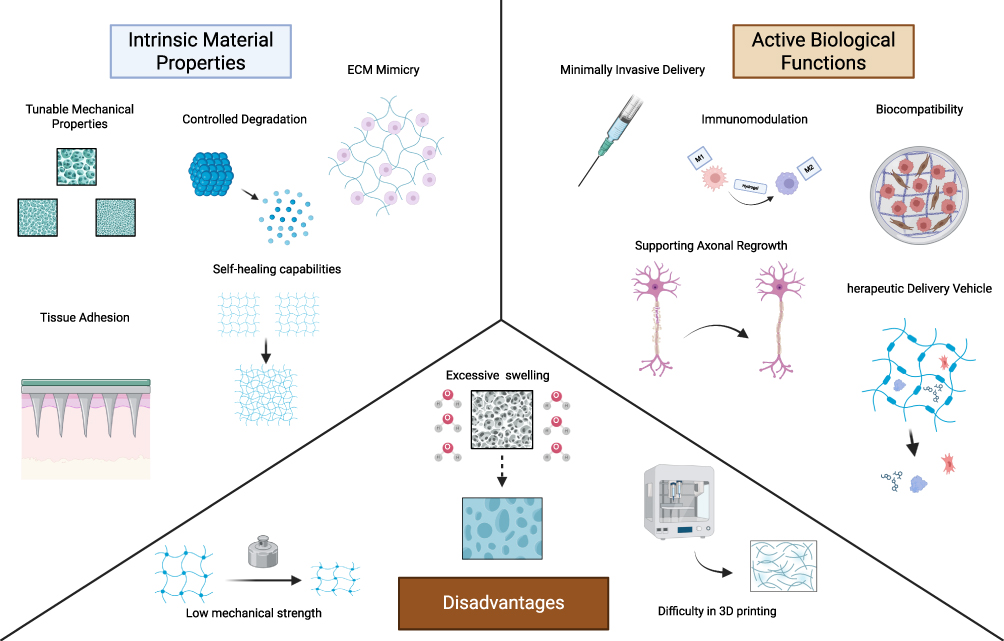 |
Figure 1 Key Characteristics, Advantages, and Disadvantages of Hydrogel Biomaterials. The figure provides a comprehensive summary of hydrogel properties, dividing them into three categories: Advantages: Intrinsic Properties: ECM Mimicry, Biocompatibility, Controlled Degradation. Tunable Mechanics: Self-healing, Tissue Adhesion, and Minimally Invasive Delivery. Active Functions: Therapeutic Delivery Vehicle, Immunomodulation (M1/M2 Polarization), and Supporting Axonal Regrowth. Disadvantages: Includes common challenges such as Low Mechanical Strength, Excessive Swelling, and Difficulties in 3D Printing, highlighting areas for future research. |
Biodegradability and Biocompatibility
In recent years, significant advancements have been made in the development of degradable hydrogels with improved biocompatibility, adjustable mechanical properties, and controlled degradation kinetics. The unique capacity of hydrogels to absorb and retain substantial amounts of water, owing to their crosslinked polymer networks, renders them highly attractive for these applications.60 The degradation rate of hydrogels can be precisely controlled by adjusting their composition and crosslinking, allowing them to synchronize with tissue repair processes when used as scaffolds in tissue engineering. Additionally, their high hydration properties mimic the natural ECM, promoting cell adhesion, proliferation, and differentiation, thus supporting tissue regeneration. Additionally, hydrogels can be designed to degrade when exposed to particular triggers, including variations in pH, temperature, or the presence of enzymes. These features make hydrogels ideal for creating scaffolds that support cell growth and tissue repair, providing a temporary structure that is eventually metabolized or excreted by the body.60
The application of hydrogels in tissue adhesives offers several potential benefits, such as better mechanical compatibility with the target tissue, ease of handling, the ability to alleviate interfacial stress, provision of biochemical signals, control over adhesion strength, and the ability to design adhesives that can be removed as needed.61 Gelatin, a natural protein-based material, is widely utilized in the creation of medical hydrogels due to its excellent biocompatibility, non-immunogenic properties, and ability to promote cell adhesion.62 Likewise, short peptide‐based hydrogels leverage their high water content and tailored peptide sequences to minimize immunogenicity and support sustained cell viability and proliferation, effectively modulating macrophage responses to enhance tissue repair.63
Delivery Vehicle and Regulation of Immune Responses
Hydrogels are increasingly recognized for their potential to modulate immune responses and promote tissue healing, particularly in the context of SCI. The secondary inflammatory response following SCI plays a crucial role in either facilitating recovery or exacerbating tissue damage, depending on the activation and polarization of immune cells.64,65 Macrophage polarization toward the anti-inflammatory M2 phenotype is essential for tissue repair and regeneration. As a result, immunomodulatory therapies aimed at enhancing the M2 macrophage response are being actively explored in preclinical models.66,67
Hydrogels, with their ability to retain a porous structure in aqueous environments, serve as ideal controlled delivery vehicles for various therapeutic agents such as drugs, growth factors, or cells.68 For instance, a recent study69 indicated that hydrogel-based drug delivery systems—specifically chitosan-based thermosensitive hydrogels loaded with celecoxib—demonstrate significant potential in alleviating IVDD and mitigating local inflammation. These hydrogels undergo rapid crosslinking at body temperature, providing mechanical stability and sustained drug release, thereby controlling inflammation and preventing postoperative disc herniation recurrence.
In the realm of stem cell therapy for SCI, human MSCs (hMSCs) show promise, but challenges such as limited cell viability and difficulties in localizing cells to the injury site persist.70 The novel agarose/carbomer-based hydrogel, evaluated by Caron et al, significantly improved hMSC viability, density, and the delivery of paracrine factors. By optimizing the loading procedure and incorporating RGD peptides and 3D ECM deposition, this hydrogel facilitated better hMSC attachment and supported the maintenance of healthy cell populations. Additionally, the hydrogel demonstrated its ability to modulate the immune environment, as evidenced by an increase in M2 macrophage populations, which created a more favorable regenerative environment at the injury site.
Furthermore, hydrogels are being integrated into 3D bioprinted IVD scaffolds, incorporating BM-MSCs and growth factors such as CTGF and TGF-β3. These hydrogels facilitate the controlled release of these factors, promoting the differentiation of BM-MSCs into nucleus pulposus-like and annulus fibrosus-like cells. The results showed that the 3D printed scaffolds successfully mimicked the structure and function of natural IVD tissue, exhibiting good mechanical strength and facilitating tissue-specific matrix formation.71
Mechanical Adaptation and Tissue Adhesion
The ongoing development of hydrogels with adjustable mechanical properties, strong tissue adhesion, and self-healing capabilities is expanding their potential in a range of medical and biomedical applications. These hydrogels can provide advanced solutions for wound healing, tissue repair, and surgical procedures, demonstrating their significant promise as multifunctional materials for future healthcare innovations.72,73 A notable feature of hydrogels is their ability to exhibit superior mechanical properties, such as high stretchability, toughness, and resistance to swelling. Recent progress has facilitated the development of hydrogels tailored for specific applications. For instance, hydrogels composed of poly(vinyl alcohol) and poly(acrylic acid) with tannic acid inclusion exhibit excellent toughness, self-healing properties, and water resistance, preventing swelling under physiological conditions.74
Hydrogels composed of polymers with ionic and covalent crosslinks exhibit exceptional mechanical properties, including the ability to stretch over 20 times their original length and a fracture energy of approximately 9000 J/m2, making them highly suitable for advanced biomedical applications.75
Another key aspect of hydrogels is their ability to adhere strongly and reliably to tissues, even in wet environments. Many hydrogels can form dynamic and reversible adhesion bonds that enhance their tissue-adhesive properties. For example, hydrogel tapes that use catechol chemistry enable rapid and strong adhesion to tissues, with a fault-tolerant mechanism that allows for repositioning during surgical procedures.76 The poly(acryloyl phenylalanine salt) (PAAS) hydrogel adhesive, featuring a unique structure combining carboxylic and phenyl groups, offers superior wet adhesion, swelling resistance, and tissue sealing capabilities.77 It efficiently promotes hemostasis, tissue repair, and in vivo monitoring of physiological activities, making it highly promising for clinical applications in hemostasis, injury repair, and bioelectronics. A hydrogel sealant composed of gelatin and o-phthalaldehyde (OPA)-terminated 4-armed poly(ethylene glycol) (4aPEG-OPA) offers strong adhesive properties and low-swelling, effectively sealing dural defects in spinal and neurosurgery while preventing cerebrospinal fluid leakage and reducing postoperative complications like inflammation and fibrosis.21
The design of hydrogels with tunable mechanical properties and strong tissue adhesion is also pivotal for enhancing their performance in specialized applications. For instance, the introduction of cellulose-based, wrinkle-patterned hydrogels enables the controlled alignment of cells, which is essential for tissue engineering and regenerative medicine.78
Minimally Invasive Delivery
Unlike preformed PEEK cages or PMMA implants, which require extensive surgical exposure and precise shaping, hydrogel precursors can be delivered via fine-gauge needles into defect sites (eg, the nucleus pulposus or epidural space) and polymerized in situ to conform exactly to irregular geometries. This reduces operative time, soft-tissue disruption, and postoperative morbidity.7,79 Injectable hydrogels with asymmetric adhesion properties can prevent postoperative adhesions by selectively interacting with tissues, representing an effective strategy for minimally invasive surgery.80 This injectability and in situ gelation afford true minimally invasive procedures and patient-specific customization without sacrificing mechanical support.
Shortcomings
Although widely applied in orthopedic surgery, hydrogels have several important limitations. Their relatively low mechanical strength and limited durability render them inadequate for long‑term load‑bearing roles, particularly in joints. Excessive water uptake can cause volumetric swelling, further undermining stability and function.81 Additionally, hydrogels can suffer from burst release of loaded therapeutic agents, such as growth factors or antibiotics, which reduces their effectiveness in sustained drug delivery for bone and joint repair.82 Another challenge is the difficulty in achieving precise structural control during 3D printing, as hydrogels may deform or collapse before cross-linking is complete, limiting their ability to replicate complex bone or cartilage architectures.28,83 Furthermore, some hydrogel materials may trigger immune responses or exhibit suboptimal biocompatibility, particularly when synthetic polymers are used, potentially leading to inflammation or delayed tissue integration.84,85
Biological Mechanisms of Hydrogels in Spinal Repair
Crosstalk Between Immune Microenvironment and Hydrogel in Spinal Repair
In IVDD, the IVD is an immune-privileged structure due to its avascular nature, limiting immune cell infiltration under normal conditions. However, during degeneration, this immune tolerance is disrupted, leading to immune cell infiltration and an inflammatory response. Notably, macrophages play a critical role in the inflammation and degeneration of the disc. Macrophages can polarize into two functional states: the pro-inflammatory M1 macrophages, which secrete cytokines such as TNF-α and IL-1β that promote ECM degradation and inflammation, and the anti-inflammatory M2 macrophages, which secrete IL-10 and TGF-β to resolve inflammation and facilitate tissue repair. Thus, macrophage polarization is central to the pathogenesis of IVDD and presents a potential therapeutic target. Manipulating such polarization could offer promising potential for promoting disc regeneration.86 The regenerative capacity of hydrogels targets key pathological features of spinal disorders. Figure 2 outlines the strategic approaches and key regenerative pathways in IVDD and SCI repair.
 |
Figure 2 Hydrogel Strategies for IVDD and SCI Repair. IVDD Repair: Injectable carriers halt NP cell loss, restore Mitochondrial Function, and promote disc regeneration. SCI Repair: Scaffolds bridge the lesion, control Neuroinflammation, and promote axonal growth for functional recovery. |
In addition to macrophages, regulatory T cells (Tregs) have emerged as crucial players in the immune regulation of IVDD. Treg cells suppress the activation of effector T cells and limit the inflammatory response by secreting anti-inflammatory cytokines such as IL-10 and TGF-β. By enhancing the function of Tregs, it may be possible to attenuate the inflammatory environment in the degenerated disc and promote healing.87
Adoungotchodo et al88 prepared chitosan hydrogels by mixing chitosan and porcine gelatin at a ratio of 3:2, which were then used for encapsulating nucleus pulposus cells. To further enhance their function, the peptide Link N (an IVD-derived peptide normally located outside the disc) was incorporated into the hydrogels. The inclusion of Link N increased both the nucleus pulposus cell encapsulation efficiency and nucleus pulposus matrix deposition under degenerative conditions. Compared with the control group, chitosan hydrogels significantly promoted glycosaminoglycan (GAG) release from nucleus pulposus cells after 14 days in vitro, reflecting enhanced nucleus pulposus cell activity. Interestingly, the increase in GAG production was comparable to that induced by TGF-β, suggesting that stimulation of both the annulus fibrosus and nucleus pulposus may contribute to IVD repair. However, such effects appear to be limited to the early stages of IVDD.89
In the healthy state, the IVD is devoid of nerve tissue; neuropathic pain arises only when neurotrophic factors drive aberrant nerve ingrowth into the disc. To address this, Isa et al90 developed a cross-linked hyaluronic acid (HA) hydrogel system by combining high molecular weight HA with 1-ethyl-3-(3-dimethylaminopropyl)-carbodiimide (EDC). This cross-linked HA hydrogel could interact with the CD44 receptor on nucleus pulposus cells, thereby competing with IL-1β for binding to CD44. By blocking IL-1β–CD44 interactions, the hydrogel downregulated the expression of NGF and BDNF mRNA, providing a protective mechanism against inflammation-associated pain. However, while effective in alleviating neuropathic pain, the cross-linked HA hydrogel system did not address the underlying degenerative changes or restore native IVD function. This limitation may stem from the comparatively weak competitive binding of HA, which was insufficient to completely obstruct IL-1β signaling. To prolong the inhibitory effect on IL-1β, Isa et al90 further incorporated polylactic-co-glycolic acid (PLGA) microparticles loaded with an IL-1 receptor antagonist (IL-1Ra).
Microglia, the resident macrophages of the central nervous system, are among the first responders to SCI. After SCI, activated microglia and infiltrating macrophages, primarily derived from circulating monocytes, together contribute to the inflammation. Despite their shared origin from bone marrow mononuclear cells, these cells exhibit similar molecular markers and functional traits, making it challenging to distinguish them. The polarization of macrophages/microglia into distinct phenotypes, M1 and M2, significantly impacts the outcome of SCI. M1 macrophages/microglia, activated by T helper 1 cells (Th1) cytokines like TNF-α and IFN-γ, produce pro-inflammatory cytokines that promote neurotoxicity and axonal degeneration and exacerbate inflammation. Conversely, M2 macrophages/microglia, induced by Th2 cytokines such as IL-4 and IL-13, play a protective role by secreting anti-inflammatory factors like TGF-β and IL-10, which aid in tissue repair and angiogenesis.91 The balance between these phenotypes is crucial; while M1 macrophages exacerbate inflammation and tissue damage, M2 macrophages facilitate tissue remodeling and repair.92 Strategies that promote polarization toward M2, such as the use of certain biomaterials, have shown promise in enhancing functional recovery after SCI.93
Hydrogels are an effective approach for filling voids in SCI. They exhibit excellent biocompatibility and can act as scaffolds to support axon regeneration.94,95 Furthermore, their natural properties allow them to mimic the biological characteristics of the ECM. Li et al96 developed a nanofiber-hydrogel composite (NHC) material that combines a fiber surface with a hydrogel network interface. This material, consisting of polycaprolactone (PCL) nanofibers and HA hydrogel, demonstrated favorable biological compatibility, capacitance, degradability, and mechanical properties. When injected into an adult rat SCI model, the ratio of M2 to M1 macrophages in the treatment group was twice that of the control group, indicating that NHC can regulate macrophage polarization.97
In addition, Cornelison et al98 created an injectable hydrogel by optimizing acellular nerves through enzymatic hydrolysis. Immunofluorescence staining was performed on animals treated with phosphate-buffered saline and injectable optimized acellular materials for one week. Quantitative analysis demonstrated a threefold decrease in the M1/M2 macrophage ratio, corresponding to a reduction to one‑third of the baseline level and indicating a shift from pro‑inflammatory toward anti‑inflammatory phenotypes. This transformation plays a crucial role in altering the immune microenvironment to support and enhance spinal cord repair and regeneration.
Interplay Between Mitochondrial Function and Hydrogels in Spinal Repair
The critical role of mitochondria in spinal repair has attracted considerable interest, particularly in the contexts of cellular energy metabolism, oxidative stress, and apoptosis. Restoring mitochondrial function is considered a promising approach for improving these conditions, with hydrogels emerging as a novel delivery material that shows substantial potential in promoting mitochondrial function, regulating redox balance, and alleviating apoptosis.
One study99 highlighted that HA promotes mitochondrial autophagy (mitophagy) in nucleus pulposus cells (NPCs), which may protect mitochondrial function and alleviate IVDD. Oxidative stress-induced mitochondrial dysfunction, apoptosis, senescence, and ECM degradation are central pathological changes in IVDD. The research found that HA activated mitophagy, which promoted mitochondrial clearance, improved mitochondrial function, slowed apoptosis and senescence, and reduced ECM degradation. Furthermore, HA interacted with C1QBP, thereby enhancing its protective effect against oxidative stress. The findings provide robust evidence supporting the clinical application of HA for the prevention and treatment of IVDD.
A spinal cord injury treatment research focused on the poly(glycerol succinate) hydrogel (PPGS) and its ability to regulate mitochondrial function.100 In this study, an innovative bioenergetically active hydrogel, acrylated PPGS (APPGS), was developed to protect mitochondrial function following traumatic SCI. The hydrogel has demonstrated significant therapeutic potential in both in vitro and in vivo assays, presenting a potential new approach for SCI treatment.100
In response to mitochondrial dysfunction associated with IVDD, an innovative ROS-responsive hydrogel was developed and loaded with berberine liposomes (HP-Lipo@BBR), aiming to scavenge excess reactive oxygen species (ROS) and restore mitochondrial function.101 This hydrogel exhibited excellent self-healing properties, degradability, and biocompatibility, with intelligent drug release in the high ROS microenvironment of degenerated discs. Berberine effectively scavenged ROS, inhibited the abnormal phosphorylation of DRP1, and reduced mitochondrial fission, thus blocking the CASP-3-mediated apoptosis pathway. In animal models, the hydrogel significantly improved disc height and hydration, proving its therapeutic potential in IVDD and related degenerative diseases.
Emerging Technologies for Hydrogels Used in Spinal Repair
Photo-Crosslinkable Composite Hydrogels
Recently, multifunctional hydrogel systems have been engineered to address these multifaceted pathologies by combining physical guidance cues, controlled drug or cell-derived factor delivery, and immune modulatory properties. Among the most notable advances are photo-crosslinkable GelMA networks and nanoparticle-reinforced self-healing hydrogels, such as photo-crosslinkable nanocomposite hydrogel (PXNT).
GelMA hydrogels, synthesized by methacrylating natural gelatin, preserve native collagen motifs that facilitate cell adhesion and matrix remodeling. They also enable rapid ultraviolet (UV)- or visible light-initiated crosslinking in the presence of a photoinitiator.102 By adjusting the degree of methacrylation and polymer concentration, GelMA networks can be precisely tuned to achieve a stiffness range of 1–50 kPa. This range covers both the softer environment that supports neural cell survival and the stiffer scaffolds necessary to resist deformation in vivo.103,104 Critically, GelMA’s inherent biodegradability, facilitated by MMP cleavage sites, allows for gradual scaffold resorption in concert with tissue regeneration.
Complementing GelMA’s cell-supportive features, nanoparticle-reinforced hydrogels such as the PXNT system developed by Wang et al integrate thermosensitive Poloxamer 407 matrices with tannic acid-stabilized tempol and phenylboronic acid pinacol ester functionalized-β-CD (TPCD) nanoparticles to yield injectable, self-healing hydrogels with built-in anti-oxidative and anti-inflammatory functions.105 Poloxamer 407 imparts sol-to-gel transition behavior at body temperature, facilitating minimally invasive delivery into the epidural or intrathecal space, where the formulation rapidly solidifies and conforms to the injury cavity. The embedded TPCD nanoparticles actively scavenge reactive oxygen species, while tannic acid contributes further antioxidant capacity and promotes tissue adhesiveness—critical for maintaining scaffold localization in the dynamic spinal environment. Rheological studies confirm PXNT’s suitable viscoelastic properties for spinal mobilization, and in vitro assays demonstrate efficient ROS elimination and inhibition of fibroblast proliferation, mitigating the risk of peridural fibrosis. In vivo, PXNT treatment following lumbar laminectomy in rodent models resulted in reduced epidural adhesion formation, preserved hindlimb motor function, and diminished expression of inflammatory cytokines at the injury site, evidencing the hydrogel’s capacity to modulate the SCI microenvironment and support functional regeneration.
Janus Membrane Architectures and Anti-Adhesive Coatings
Postoperative dural defects in spinal surgery carry significant risks of cerebrospinal fluid (CSF) leakage and epidural fibrosis, with reported incidence rates ranging from 4% to 32% depending on surgical approach and repair materials.106,107 Conventional dural substitutes, such as animal-derived collagen matrices (eg, type I collagen purified from bovine Achilles tendon), decellularized small intestinal submucosa (SIS), and synthetic polyglycolic acid (PGA) patches, suffer from a mechanical anisotropy mismatch relative to the native dura mater,108,109 undergo uncontrolled degradation via rapid hydrolytic breakdown (particularly of polymers like PGA) that can compromise scaffold integrity and tissue repair,110,111 and provoke inflammatory foreign-body responses that undermine long-term efficacy.112 Janus membrane architectures that combine anisotropic microtopographies for directed cell alignment with anti-adhesion surface chemistries to prevent fibrotic scarring, thereby creating a closed-loop pipeline that connects material design to measurable therapeutic outcomes.
The outer HA-silk fibroin glycidyl methacrylate (HAMA-SilMA) coating takes advantage of the well-documented anti-fibrotic and anti-adhesion functions of HA. HA derivatives have been shown to suppress fibroblast proliferation and limit ECM protein deposition, thereby mitigating fibrotic responses. For instance, sulfated HA analogs inhibit hyaluronidase activity and modulate fibroblast metabolism, resulting in reduced cell growth and ECM accumulation.113 Crosslinking HA with polyisocyanide scaffolds produces hydrogels that significantly curb fibroblast proliferation and downregulate fibrotic markers in vitro.114 Photo-crosslinked HA/carboxymethylcellulose composites act as effective anti-adhesion barriers by decreasing fibroblast attachment and penetration.13 Finally, HA combined with platelet-rich plasma in core–shell nanofibrous membranes not only hinders fibroblast adhesion but also provides enhanced lubrication, effectively preventing postoperative tendon adhesions.115 Adding SilMA addresses HA’s inherent instability by reducing swelling and enhancing structural robustness without sacrificing hydrophilicity or anti-adhesion effectiveness.116,117
Anisotropic surfaces, such as those created with micropatterned hydrogel coatings, have demonstrated significant potential in modulating macrophage immune responses.118,119 A recent study120 involving subcutaneous implantation in animal models confirmed that microgrooved hydrogel surfaces effectively enhance host cell infiltration and integration with surrounding tissues. Immunofluorescence analyses further indicated that appropriately sized microgrooves, around 20 μm, significantly elevate the proportion of M2 macrophages, characterized by increased expression of Arg-1 proteins. The M2 macrophage–enriched microenvironment promotes tissue regeneration and attenuates fibrotic responses, underscoring the therapeutic potential of anisotropic micropatterned hydrogel coatings for clinical applications such as spinal dura mater repair. Additionally, certain hydrogel compositions, such as those containing HA derivatives, have been shown to suppress myofibroblast adhesion and proliferation, thereby mitigating adverse fibrotic outcomes and enhancing functional tissue regeneration.80,121,122
Injectable Hydrogel Delivery Systems
Hydrogels exhibit excellent biocompatibility, can conform to and fill cystic cavities, and actively support axonal regeneration and cell differentiation. Importantly, hydrogels can be implanted or injected directly into a lesion site without provoking additional immune reactions.17 These attributes make them ideal local drug-delivery systems for administering therapeutic agents or growth factors in a minimally invasive, site-specific manner, thereby reducing the need for high systemic doses and minimizing adverse side effects. Recent advances in hydrogel engineering have significantly broadened the toolkit available for IVDD repair by combining biomaterial innovation with cell-free therapeutic strategies. Among these, injectable photo-crosslinkable hydrogels based on silk fibroin methacrylate (SilkMA) have emerged as promising platforms for sustained exosome delivery, effectively addressing two critical challenges in IVDD: the rapid clearance of therapeutic vesicles and the need for precise modulation of the degenerated microenvironment. SilkMA hydrogels can be formulated to gel in situ upon visible-light irradiation, forming networks that match the native stiffness of nucleus pulposus tissue and resist premature degradation under physiological loading conditions.123–125 Silk fibroin hydrogel (SM@ME) is an exosome-loaded methacrylated silk fibroin hydrogel that incorporates Cavin-2-engineered exosomes derived from hypoxia-treated BM-MSCs. This hydrogel activates the mitochondrial unfolded protein response (UPRmt) by upregulating DKK2, inhibiting the Wnt/β-catenin pathway, and reducing apoptosis and senescence, thereby delaying the progression of IVDD and offering a new therapeutic approach for disc regeneration.19
Mechanistically, SM@ME hydrogels exert their regenerative effects through multi-modal modulation of nucleus pulposus cell biology. Cavin-2 decoration greatly enhances exosome uptake by degenerated nucleus pulposus cells, thereby boosting the delivery of miRNAs and proteins that effectively suppress the secretion of pro-inflammatory cytokines (eg, IL-6 and IL-1β) and the expression of MMPs (eg, MMP-13).105 Concurrently, exosomal cargo restores DKK2 expression, which acts as an endogenous antagonist of Wnt/β-catenin signaling. By inhibiting the overactivation of the Wnt pathway—a key feature of senescent nucleus pulposus cells—SM\@ME helps maintain mitochondrial homeostasis. This effect is supported by the upregulation of markers associated with the UPRmt, such as ATF4, CHOP, HSP60, HSP70, CLPP, and LONP1. These effects stabilize mitochondrial membrane potential and prevent pathological opening of the mitochondrial permeability transition pore (mPTP). Activation of Wnt signaling with LiCl abrogated SM@ME’s protective benefits, indicating that SM@ME may alleviate TBHP‐induced senescence, inflammation, and apoptosis primarily through modulation of the DKK2/Wnt/β‐catenin pathway and enhancement of mitochondrial protein quality control.19
From a materials design perspective, the versatility of SilkMA chemistry allows for the independent tuning of gel stiffness, degradation rate, and network porosity. By adjusting the degree of methacrylation and polymer concentration, hydrogels can be engineered to match the mechanical modulus of healthy nucleus pulposus tissue (~10–20 kPa) while retaining an interconnected pore network conducive to nutrient diffusion and cell migration.126,127 This tunability is critical for accommodating patient-specific variations in disc biomechanical properties and for minimizing implant extrusion under cyclic loading. Moreover, the inherent biodegradability of silk fibroin ensures gradual hydrogel resorption concomitant with tissue regeneration, avoiding the need for secondary removal procedures.
In vivo, injectable SM@ME hydrogels have demonstrated robust efficacy in rodent models of IVDD. Behavioral assays further indicate alleviation of pain-related behaviors and restoration of locomotive function, correlating with preserved nucleus pulposus architecture on magnetic resonance imaging. These preclinical successes position SilkMA-based exosome delivery systems as front-running candidates for translational development. They offer a minimally invasive, cell-free therapeutic modality that overcomes the limitations of direct cell transplantation, including immune rejection and tumorigenicity risks associated with stem cell therapies.128–131
Wang et al132 explored the fabrication of injectable hydrogels using 4-arm star PEG, which addresses the mechanical limitations commonly observed in traditional hydrogels. By optimizing the gelation conditions and using a combination of vinyl sulfone-functionalized PEG and a short dithiol crosslinker, these materials could achieve a hydrogel with a local maximum compressive strength of approximately 20 MPa, a value deemed suitable for cartilage tissue engineering. This enhanced mechanical performance did not come at the expense of the hydrogel’s biocompatibility, as demonstrated by the successful transplantation of chondrocyte-laden hydrogels in vivo, which promoted cell proliferation and ECM production.
A study by Zhang et al133 reports the design of a dual-functional hydrogel scaffold for SCI repair, in which wogonin-loaded carbon nanotubes are embedded in a photo-cross-linkable gelatin matrix. Carbon nanotubes possess excellent mechanical and conductive properties due to their special molecular structure, as well as high aspect ratios, making them ideal for use in electroconductive scaffolds and drug delivery applications.134 This composite hydrogel exhibits enhanced electrical conductivity and mechanical strength, along with a controlled and sustained release of wogonin. In vitro, it promotes neural stem cell migration and neurogenic differentiation and supports angiogenesis. In the SCI mouse model, it dampens inflammation and fibrosis in both the injured cord and the bladder’s detrusor–sphincter complex, leading to accelerated recovery of both motor function and neurogenic lower urinary tract control.
Combination of iPSCs with Hydrogels
Recent progress in regenerative medicine has shown that induced pluripotent stem cells (iPSCs) could be a useful tool for repairing SCI. iPSCs are generated from adult somatic cells, providing an alternative to traditional stem cell sources while avoiding ethical concerns and limitations related to supply. These pluripotent cells, first introduced by Yamanaka’s lab in 2006, can be reprogrammed into various differentiated cell types, providing a unique opportunity to treat neurological disorders like SCI.135
The incorporation of hydrogels in SCI treatment also helps address key challenges, such as low cell viability and uncontrolled differentiation in the ischemic spinal cord environment. One study136 has indicated that using GelMA hydrogels with iPSC-derived neural stem cells (iNSCs) in a mouse spinal cord transection model led to amazing functional recovery. This finding was further validated by histological analysis, which revealed reduced cavity areas and decreased collagen deposition in the treated group. Moreover, the hydrogel-based system significantly reduced inflammation by minimizing the activation of macrophages and microglia, which are key contributors to secondary tissue damage in SCI. Notably, the GelMA/iNSC implants helped reduce glial scar formation, a major obstacle in spinal cord regeneration, while promoting axonal regeneration and tissue repair.136 These results support the use of 3D hydrogel scaffolds delivering iPSCs or iNSCs as a cutting-edge strategy to facilitate tissue regeneration and mitigate deficits following spinal cord injury.
Further research should investigate combining exosome-based therapies with hydrogels to improve tissue repair after spinal cord injury. Exosomes derived from cortical neurons generated from iPSCs have shown potential in modulating immune responses and promoting neuroregeneration. By incorporating these exosome-loaded hydrogels, significant improvements in tissue repair and functional recovery were observed in animal models. Specifically, an injectable decellularized ECM (dECM) hydrogel infused with exosomes facilitated the polarization toward M2 macrophages, reduced neuronal apoptosis, and fostered a regenerative environment that promoted axon regeneration and remyelination. This combined approach also enhanced motor function recovery and preserved tissue integrity in SCI-afflicted rats.137 These results underscore the growing potential of combining iPSC-derived exosomes and hydrogels for a comprehensive therapeutic strategy aimed at SCI repair.
Conclusions and Future Prospects
The development of 3D printing technology, particularly in the context of hydrogel-based scaffolds, has shown promising potential for advancing spinal repair and tissue engineering applications. Hydrogels, with their ability to mimic the ECM, create an ideal environment for cell growth and proliferation, making them well-suited for tissue regeneration. Recent advancements in 3D printing have enabled the fabrication of complex tissue structures, allowing for more personalized and precise therapeutic interventions, which could significantly benefit spinal repair efforts.138 These innovations enable the creation of customized scaffolds that support cellular function and promote tissue regeneration at the site of spinal injuries. However, compared to natural tissues, hydrogels lack sufficient mechanical strength, making it difficult for them to withstand stress or maintain structural stability, thus limiting their application in tissue engineering.139 The combination of natural and synthetic polymers, along with the incorporation of nanomaterials, can enhance the strength and functionality of hydrogel scaffolds, improving their suitability for spinal tissue engineering applications.138 Continuous innovation in material composition and printing techniques is crucial to overcoming these challenges and unlocking the full potential of hydrogel-based 3D printing for spinal repair. Ultimately, hydrogel-based scaffolds could play a central role in regenerating damaged tissues and improving patient outcomes in spinal repair, provided that challenges related to mechanical properties and regulatory hurdles are effectively addressed.
The Janus decellularized small intestine submucosa membrane with ECM-mimetic anisotropic microgrooves and anti-adhesion silk-based coatings has demonstrated clear prevention of epidural fibrosis and promotion of dura regeneration in rodent models.20 However, the study does not assess the membrane’s suturability or its ability to conform and adhere under surgical handling and lacks systematic large-animal data on these practical aspects. The PXNT supramolecular hydrogel, designed to prevent post-laminectomy epidural adhesion, offers viscoelastic properties that facilitate spinal mobility without compressing neural structures and shows strong anti-adhesion performance in preclinical rat and rabbit models.105 However, very few long-term in vivo studies have assessed its effects on spinal flexibility, and limited discussion on its immunogenicity raises concerns about potential immune recognition and foreign body reactions with chronic implantation.
Looking ahead, the integration of artificial intelligence (AI) with hydrogel design could substantially accelerate the development of personalized therapies. Data-driven models and machine-learning algorithms can analyze high-throughput experimental datasets to predict composition–property relationships, enabling rapid optimization of mechanical strength, degradation kinetics, and bioactivity.140,141 Early demonstrations of Bayesian optimization in microarray-based hydrogel screening have reduced the experimental burden by identifying high-performance formulations from hundreds of candidates in a fraction of the time required by traditional approaches.138 As AI-assisted platforms evolve toward closed-loop workflows, which integrate robotic synthesis, real-time characterization, and algorithmic feedback, researchers will be able to dynamically adjust hydrogel parameters. This will allow them to meet the unique needs of individual patients and the specific demands of surgical procedures.142
In addition to AI’s potential to optimize hydrogel composition and predict patient-specific outcomes, several key considerations are essential for advancing the clinical translation of hydrogels in spinal repair. Standardization of material properties is essential to ensure uniformity in hydrogel formulations.143 The lack of consistent protocols and outcome measures currently hinders comparative evaluations and delays regulatory approval, particularly given the variability in hydrogel composition and the need to tailor properties for individual patient needs. Additionally, long-term biocompatibility studies should be prioritized. While hydrogels have shown outstanding potential for nerve repair, issues related to immune response, material degradation, and integration with host tissue remain significant barriers to their clinical use. Therefore, robust, long-term animal and preclinical studies are essential to assess the full scope of their biocompatibility and functional outcomes.144
The scalability of hydrogel production and compliance with Good Manufacturing Practice (GMP) standards are also significant obstacles to clinical translation. Current multifunctional hydrogel design tends to deliver excellent preclinical results but presents challenges in terms of reproducibility and large-scale manufacturing. Automated production methods and 3D bioprinting could potentially address these issues by ensuring consistent quality and facilitating personalized fabrication.143 Furthermore, regulatory pathways must be carefully navigated, as hydrogels may fall under classifications as biologics, devices, or combination products, each requiring distinct approval processes.145
Ultimately, the next generation of hydrogel therapies for spinal disorders will rely on a synergistic framework that unites personalized biomaterials with intelligent design tools. By leveraging patient imaging data for geometry and tissue property mapping, customizing hydrogel chemistry with autologous biological cues, and harnessing AI to navigate the vast formulation landscape, clinicians and engineers can co-develop “smart” implants that adapt to the evolving microenvironment of the injured spine. Such integrated strategies are poised to transform spinal surgery from a predominantly palliative endeavor into a truly restorative discipline, delivering tailored, high-efficacy treatments with predictable outcomes. As these technologies converge in the coming years, rigorous preclinical validation and regulatory harmonization will be critical to ensure their safe and effective deployment in the operating room.
Acknowledgments
We would like to express our sincere gratitude to Ms. Chen Ruixin for her constructive guidance and assistance regarding the schematic diagrams during the article revision process.
Funding
There is no funding being granted for this research.
Disclosure
The authors report no conflicts of interest in this work.
References
1. Liu Y, Zhao Z, Guo C, et al. Application and development of hydrogel biomaterials for the treatment of intervertebral disc degeneration: a literature review. Front Cell Dev Biol. 2023;11:1286223. doi:10.3389/fcell.2023.1286223
2. Desai SU, Srinivasan SS, Kumbar SG, Moss IL. Hydrogel-based strategies for intervertebral disc regeneration: advances, challenges and clinical prospects. Gels. 2024;10(1):62. doi:10.3390/gels10010062
3. Kmail M, Razak R, Mohd Isa IL. Engineering extracellular matrix-based hydrogels for intervertebral disc regeneration. Front Bioeng Biotechnol. 2025;13:1601154. doi:10.3389/fbioe.2025.1601154
4. Orr MB, Gensel JC. Spinal cord injury scarring and inflammation: therapies targeting glial and inflammatory responses. Neurotherapeutics. 2018;15(3):541–553. doi:10.1007/s13311-018-0631-6
5. Pang Q-M, Chen S-Y, Xu Q-J, et al. Neuroinflammation and scarring after spinal cord injury: therapeutic roles of MSCs on inflammation and glial scar. Front Immunol. 2021;12:751021. doi:10.3389/fimmu.2021.751021
6. Chen X, Jing S, Xue C, Guan X. Progress in the application of hydrogels in intervertebral disc repair: a comprehensive review. Curr Pain Headache Rep. 2024;28(12):1333–1348. doi:10.1007/s11916-024-01296-6
7. Dong R, Zheng S, Cheng X. Designing hydrogel for application in spinal surgery. Mater Today Bio. 2025;31:101536. doi:10.1016/j.mtbio.2025.101536
8. Mai Y, Wu S, Zhang P, Chen N, Wu J, Wei F. The anti-oxidation related bioactive materials for intervertebral disc degeneration regeneration and repair. Bioact Mater. 2025;45:19–40. doi:10.1016/j.bioactmat.2024.10.012
9. Zhang S, Liu W, Chen S, et al. Extracellular matrix in intervertebral disc: basic and translational implications. Cell Tissue Res. 2022;390(1):1–22. doi:10.1007/s00441-022-03662-5
10. Tian T, Zhang S, Yang M. Recent progress and challenges in the treatment of spinal cord injury. Protein Cell. 2023;14(9):635–652. doi:10.1093/procel/pwad003
11. Chen X, Huang R, Yang Z, et al. Biological engineering approaches for modulating the pathological microenvironment and promoting axonal regeneration after spinal cord injury. Front Neurosci. 2025;19:1574763. doi:10.3389/fnins.2025.1574763
12. Wu D, Zou Y, Zhang W, et al. PDA-Au-nanocluster-loaded polyacrylamide alginate hydrogels for dural repair and functional recovery. Chem Eng J. 2025;517:164274. doi:10.1016/j.cej.2025.164274
13. Huang Y-C, Liu Z-H, Kuo C-Y, Chen J-P. Photo-crosslinked hyaluronic acid/carboxymethyl cellulose composite hydrogel as a dural substitute to prevent post-surgical adhesion. Int J Mol Sci. 2022;23(11):6177. doi:10.3390/ijms23116177
14. Zhang X, Gao X, Zhang X, Yao X, Kang X. Revolutionizing intervertebral disc regeneration: advances and future directions in three-dimensional bioprinting of hydrogel scaffolds. Int J Nanomed. 2024;19:10661–10684. doi:10.2147/ijn.s469302
15. Lv Z, Dong C, Zhang T, Zhang S. Hydrogels in spinal cord injury repair: a review. Front Bioeng Biotechnol. 2022;10:931800. doi:10.3389/fbioe.2022.931800
16. Cai M, Chen L, Wang T, et al. Hydrogel scaffolds in the treatment of spinal cord injury: a review. Front Neurosci. 2023;17:1211066. doi:10.3389/fnins.2023.1211066
17. Silva D, Sousa RA, Salgado AJ. Hydrogels as delivery systems for spinal cord injury regeneration. Mater Today Bio. 2021;9:100093. doi:10.1016/j.mtbio.2021.100093
18. Chen K, Yu W, Zheng G, et al. Biomaterial-based regenerative therapeutic strategies for spinal cord injury. NPG Asia Mater. 2024;16(1):5. doi:10.1038/s41427-023-00526-4
19. Lu X, Lin Z, Li L, et al. Exosome-loaded methacrylated silk fibroin hydrogel delays intervertebral disc degeneration by DKK2-mediated mitochondrial unfolded protein response. Chem Eng J. 2025;511:162191. doi:10.1016/j.cej.2025.162191
20. Bi X, Mao Z, Li L, et al. Janus decellularized membrane with anisotropic cell guidance and anti-adhesion silk-based coatings for spinal dural repair. Nat Commun. 2025;16(1):1674. doi:10.1038/s41467-025-56872-0
21. Cheng X, Zhang Z, Ren H, et al. A low-swelling hydrogel as a multirole sealant for efficient dural defect sealing and prevention of postoperative adhesion. Natl Sci Rev. 2024;11(6):nwae160. doi:10.1093/nsr/nwae160
22. Omidian H, Akhzarmehr A, Dey Chowdhury S. Hydrogel composites for multifunctional biomedical applications. J Compos Sci. 2024;8(4):154. doi:10.3390/jcs8040154
23. Naahidi S, Jafari M, Logan M, et al. Biocompatibility of hydrogel-based scaffolds for tissue engineering applications. Biotechnol Adv. 2017;35(5):530–544. doi:10.1016/j.biotechadv.2017.05.006
24. Ren H, Zhang Z, Cheng X, Zou Z, Chen X, He C. Injectable, self-healing hydrogel adhesives with firm tissue adhesion and on-demand biodegradation for sutureless wound closure. Sci Adv. 2023;9(33):eadh4327. doi:10.1126/sciadv.adh4327
25. Jeon J, Subramani SV, Lee KZ, Elizondo-Benedetto S, Zayed MA, Zhang F. Engineering adhesive hydrogels for hemostasis and vascular repair. Polymers. 2025;17(7):959. doi:10.3390/polym17070959
26. Ding Q, Zhang S, Liu X, et al. Hydrogel tissue bioengineered scaffolds in bone repair: a review. Molecules. 2023;28(20):7039. doi:10.3390/molecules28207039
27. Yang J, Yu H, Wang L, et al. Advances in adhesive hydrogels for tissue engineering. Eur Polym J. 2022;172:111241. doi:10.1016/j.eurpolymj.2022.111241
28. Choi H, Choi W-S, Jeong J-O. A review of advanced hydrogel applications for tissue engineering and drug delivery systems as biomaterials. Gels. 2024;10(11):693. doi:10.3390/gels10110693
29. Grindlay JH, Clagett OT. A plastic sponge prosthesis for use after pneumonectomy; preliminary report of an experimental study. Proc Staff Meet Mayo Clin. 1949;24(21):538.
30. Wichterle O, Lím D. Hydrophilic gels for biological use. Nature. 1960;185(4706):117–118. doi:10.1038/185117a0
31. Peppas NA, Merrill EW. Crosslinked poly(vinyl alcohol) hydrogels as swollen elastic networks. J Appl Polym Sci. 1977;21(7):1763–1770. doi:10.1002/app.1977.070210704
32. Yue S, He H, Li B, Hou T. Hydrogel as a biomaterial for bone tissue engineering: a review. Nanomaterials. 2020;10(8):E1511. doi:10.3390/nano10081511
33. Bai X, Gao M, Syed S, Zhuang J, Xu X, Zhang X-Q. Bioactive hydrogels for bone regeneration. Bioact Mater. 2018;3(4):401–417. doi:10.1016/j.bioactmat.2018.05.006
34. A Alamir HT, Ismaeel GL, Jalil AT, et al. Advanced injectable hydrogels for bone tissue regeneration. Biophys Rev. 2023;15(2):223–237. doi:10.1007/s12551-023-01053-w
35. Olov N, Bagheri-Khoulenjani S, Mirzadeh H. Injectable hydrogels for bone and cartilage tissue engineering: a review. Prog Biomater. 2022;11(2):113–135. doi:10.1007/s40204-022-00185-8
36. Zheng Y, Ke Z, Hu G, Tong S. Hydrogel promotes bone regeneration through various mechanisms: a review. Biomed Tech. 2025;70(2):103–114. doi:10.1515/bmt-2024-0391
37. Estevez AT, Abdallah YK. Biomimetic approach for enhanced mechanical properties and stability of self-mineralized calcium phosphate dibasic–sodium alginate–gelatine hydrogel as bone replacement and structural building material. Processes. 2024;12(5):944. doi:10.3390/pr12050944
38. Wang P, Zhao L, Liu J, Weir MD, Zhou X, Xu HHK. Bone tissue engineering via nanostructured calcium phosphate biomaterials and stem cells. Bone Res. 2014;2:14017. doi:10.1038/boneres.2014.17
39. Li B, Li C, Yan Z, et al. A review of self-healing hydrogels for bone repair and regeneration: materials, mechanisms, and applications. Int J Biol Macromol. 2025;287:138323. doi:10.1016/j.ijbiomac.2024.138323
40. Zhang H, Ding S, Xue H, et al. Injectable organic-inorganic hybrid hydrogels for bone defect repair. Front Bioeng Biotechnol. 2025;13:1563546. doi:10.3389/fbioe.2025.1563546
41. He Y, Luo Z, Nie X, et al. An injectable multi-functional composite bioactive hydrogel for bone regeneration via immunoregulatory and osteogenesis effects. Adv Compos Hybrid Mater. 2025;8(1):128. doi:10.1007/s42114-025-01213-4
42. Liu J, Yang L, Liu K, Gao F. Hydrogel scaffolds in bone regeneration: their promising roles in angiogenesis. Front Pharmacol. 2023;14:1050954. doi:10.3389/fphar.2023.1050954
43. Zhang S, Li X, Li C, Cong H, Yu B. Research progress of injectable hydrogels in the treatment of bone tissue diseases. Chem Eng J. 2024;498:155139. doi:10.1016/j.cej.2024.155139
44. Luo R, Chen Z, Zhe M, et al. Angiogenesis–osteogenesis coupling and immunomodulatory CGRP@nano MOF-loaded CMCS/GelMA hydrogel for bone regeneration. J Mater Chem B. 2025;13(21):6199–6218. doi:10.1039/d5tb00113g
45. Ding K, Liao M, Wang Y, Lu JR. Advances in composite stimuli-responsive hydrogels for wound healing: mechanisms and applications. Gels. 2025;11(6):420. doi:10.3390/gels11060420
46. Liang X, Wang X, Xu Q, et al. Rubbery chitosan/carrageenan hydrogels constructed through an electroneutrality system and their potential application as cartilage scaffolds. Biomacromolecules. 2018;19(2):340–352. doi:10.1021/acs.biomac.7b01456
47. Roberts RHR, Gamble C, Malek I. Defensive antibacterial coating in orthopaedic surgery: current evidence and future direction. World J Orthop. 2025;16(7):107575. doi:10.5312/wjo.v16.i7.107575
48. Pressato D, Battista A, Govoni M, Vivarelli L, Dallari D, Pellegrini A. The intraoperative use of defensive antibacterial coating (DAC®) in the form of a gel to prevent peri-implant infections in orthopaedic surgery: a clinical narrative review. Materials. 2023;16(15):5304. doi:10.3390/ma16155304
49. Wang X, Huang Y, Yang Y, et al. Polysaccharide-based biomaterials for regenerative therapy in intervertebral disc degeneration. Mater Today Bio. 2025;30:101395. doi:10.1016/j.mtbio.2024.101395
50. Gorroñogoitia I, Olza S, Alonso-Varona A, Zaldua AM. The effect of alginate/hyaluronic acid proportion on semi-interpenetrating hydrogel properties for articular cartilage tissue engineering. Polymers. 2025;17(4):528. doi:10.3390/polym17040528
51. Thanh TN, Laowattanatham N, Ratanavaraporn J, Sereemaspun A, Yodmuang S. Hyaluronic acid crosslinked with alginate hydrogel: a versatile and biocompatible bioink platform for tissue engineering. Eur Polym J. 2022;166:111027. doi:10.1016/j.eurpolymj.2022.111027
52. Osbun JW, Ellenbogen RG, Chesnut RM, et al. A multicenter, single-blind, prospective randomized trial to evaluate the safety of a polyethylene glycol hydrogel (Duraseal Dural Sealant System) as a dural sealant in cranial surgery. World Neurosurg. 2012;78(5):498–504. doi:10.1016/j.wneu.2011.12.011
53. Pereira EAC, Grandidge CA, Nowak VA, Cudlip SA. Cerebrospinal fluid leaks after transsphenoidal surgery – effect of a polyethylene glycol hydrogel dural sealant. J Clin Neurosci. 2017;44:6–10. doi:10.1016/j.jocn.2017.06.016
54. Zhong Q, Wang D, Mai H, et al. Injectable thermo-responsive Poloxamer hydrogel/methacrylate gelatin microgels stimulates bone regeneration through biomimetic programmed release of SDF-1a and IGF-1. Int J Biol Macromol. 2024;271(Pt 2):132742. doi:10.1016/j.ijbiomac.2024.132742
55. Choi E, Kim D, Kang D, et al. 3D-printed gelatin methacrylate (GelMA)/silanated silica scaffold assisted by two-stage cooling system for hard tissue regeneration. Regen Biomater. 2021;8(2):rbab001. doi:10.1093/rb/rbab001
56. Meissner S, Rees S, Nguyen L, et al. Encapsulation of the growth factor neurotrophin-3 in heparinised poloxamer hydrogel stabilises bioactivity and provides sustained release. Biomater Adv. 2024;159:213837. doi:10.1016/j.bioadv.2024.213837
57. Mantry S, Das PK, Sankaraiah J, et al. Advancement on heparin-based hydrogel/scaffolds in biomedical and tissue engineering applications: delivery carrier and pre-clinical implications. Int J Pharm. 2025:125733. doi:10.1016/j.ijpharm.2025.125733
58. Liu K, Dong X, Wang Y, Wu X, Dai H. Dopamine-modified chitosan hydrogel for spinal cord injury. Carbohydr Polym. 2022;298:120047. doi:10.1016/j.carbpol.2022.120047
59. Ma Y, Chen Q, Li W, et al. Spinal cord conduits for spinal cord injury regeneration. Eng Regen. 2023;4(1):68–80. doi:10.1016/j.engreg.2022.12.003
60. Garcia-Garcia A, Muñana-González S, Lanceros-Mendez S, Ruiz-Rubio L, Alvarez LP, Vilas-Vilela JL. Biodegradable natural hydrogels for tissue engineering, controlled release, and soil remediation. Polymers. 2024;16(18):2599. doi:10.3390/polym16182599
61. Ho MH, van Hilst Q, Cui X, et al. From adhesion to detachment: strategies to design tissue-adhesive hydrogels. Adv NanoBiomed Res. 2024;4(2):2300090. doi:10.1002/anbr.202300090
62. Han K, Bai Q, Wu W, Sun N, Cui N, Lu T. Gelatin-based adhesive hydrogel with self-healing, hemostasis, and electrical conductivity. Int J Biol Macromol. 2021;183:2142–2151. doi:10.1016/j.ijbiomac.2021.05.147
63. Nie R, Zhang Q-Y, Feng Z-Y, et al. Hydrogel-based immunoregulation of macrophages for tissue repair and regeneration. Int J Biol Macromol. 2024;268(Pt 1):131643. doi:10.1016/j.ijbiomac.2024.131643
64. Vidal PM, Lemmens E, Dooley D, Hendrix S. The role of “anti-inflammatory” cytokines in axon regeneration. Cytokine Growth Factor Rev. 2013;24(1):1–12. doi:10.1016/j.cytogfr.2012.08.008
65. Rust R, Kaiser J. Insights into the dual role of inflammation after spinal cord injury. J Neurosci. 2017;37(18):4658–4660. doi:10.1523/jneurosci.0498-17.2017
66. Al Mamun A, Monalisa I, Tul Kubra K, et al. Advances in immunotherapy for the treatment of spinal cord injury. Immunobiology. 2021;226(1):152033. doi:10.1016/j.imbio.2020.152033
67. Monteiro S, Salgado AJ, Silva NA. Immunomodulation as a neuroprotective strategy after spinal cord injury. Neural Regen Res. 2018;13(3):423–424. doi:10.4103/1673-5374.228722
68. Walsh CM, Wychowaniec JK, Brougham DF, Dooley D. Functional hydrogels as therapeutic tools for spinal cord injury: new perspectives on immunopharmacological interventions. Pharmacol Ther. 2022;234:108043. doi:10.1016/j.pharmthera.2021.108043
69. Du Y, Li J, Tang X, et al. The thermosensitive injectable celecoxib-loaded chitosan hydrogel for repairing postoperative intervertebral disc defect. Front Bioeng Biotechnol. 2022;10:876157. doi:10.3389/fbioe.2022.876157
70. Caron I, Rossi F, Papa S, et al. A new three dimensional biomimetic hydrogel to deliver factors secreted by human mesenchymal stem cells in spinal cord injury. Biomaterials. 2016;75:135–147. doi:10.1016/j.biomaterials.2015.10.024
71. Sun B, Lian M, Han Y, et al. A 3D-Bioprinted dual growth factor-releasing intervertebral disc scaffold induces nucleus pulposus and annulus fibrosus reconstruction. Bioact Mater. 2021;6(1):179–190. doi:10.1016/j.bioactmat.2020.06.022
72. Li S, Li X, Xu Y, et al. Collagen fibril-like injectable hydrogels from self-assembled nanoparticles for promoting wound healing. Bioact Mater. 2024;32:149–163. doi:10.1016/j.bioactmat.2023.09.012
73. Wu J, Pan Z, Zhao Z-Y, et al. Anti-swelling, robust, and adhesive extracellular matrix-mimicking hydrogel used as intraoral dressing. Adv Mater. 2022;34(20):e2200115. doi:10.1002/adma.202200115
74. Park J, Kim TY, Kim Y, et al. A mechanically resilient and tissue-conformable hydrogel with hemostatic and antibacterial capabilities for wound care. Adv Sci. 2023;10(30):e2303651. doi:10.1002/advs.202303651
75. Sun J-Y, Zhao X, Illeperuma WRK, et al. Highly stretchable and tough hydrogels. Nature. 2012;489(7414):133–136. doi:10.1038/nature11409
76. Xue B, Gu J, Li L, et al. Hydrogel tapes for fault-tolerant strong wet adhesion. Nat Commun. 2021;12(1):7156. doi:10.1038/s41467-021-27529-5
77. Shen K, Lv Z, Yang Y, et al. A wet-adhesion and swelling-resistant hydrogel for fast hemostasis, accelerated tissue injury healing and bioelectronics. Adv Mater. 2025;37(6):e2414092. doi:10.1002/adma.202414092
78. Zou J, Wu S, Chen J, et al. Highly efficient and environmentally friendly fabrication of robust, programmable, and biocompatible anisotropic, all-cellulose, wrinkle-patterned hydrogels for cell alignment. Adv Mater. 2019;31(46):e1904762. doi:10.1002/adma.201904762
79. Lin PH, Dong Q, Chew SY. Injectable hydrogels in stroke and spinal cord injury treatment: a review on hydrogel materials, cell–matrix interactions and glial involvement. Mater Adv. 2021;2(8):2561–2583. doi:10.1039/d0ma00732c
80. Wu X, Guo W, Wang L, et al. An injectable asymmetric-adhesive hydrogel as a GATA6+ cavity macrophage trap to prevent the formation of postoperative adhesions after minimally invasive surgery. Adv Funct Mater. 2022;32(9):2110066. doi:10.1002/adfm.202110066
81. Gan X, Wang X, Huang Y, Li G, Kang H. Applications of hydrogels in osteoarthritis treatment. Biomedicines. 2024;12(4):923. doi:10.3390/biomedicines12040923
82. Liu Z, Xin W, Ji J, et al. 3D-printed hydrogels in orthopedics: developments, limitations, and perspectives. Front Bioeng Biotechnol. 2022;10:845342. doi:10.3389/fbioe.2022.845342
83. Billiet T, Vandenhaute M, Schelfhout J, Van Vlierberghe S, Dubruel P. A review of trends and limitations in hydrogel-rapid prototyping for tissue engineering. Biomaterials. 2012;33(26):6020–6041. doi:10.1016/j.biomaterials.2012.04.050
84. Cao H, Duan L, Zhang Y, Cao J, Zhang K. Current hydrogel advances in physicochemical and biological response-driven biomedical application diversity. Signal Transduct Target Ther. 2021;6(1):426. doi:10.1038/s41392-021-00830-x
85. Chelu M, Popa M, Calderón Moreno JM. Applications of hydrogels in emergency therapy. Gels. 2025;11(4):234. doi:10.3390/gels11040234
86. Dou Y, Zhang Y, Liu Y, et al. Role of macrophage in intervertebral disc degeneration. Bone Res. 2025;13(1):15. doi:10.1038/s41413-024-00397-7
87. Chen H, Peng H, Wang P-C, Zou T, Feng X-M, Wan B-W. Role of regulatory T cells in spinal cord injury. Eur J Med Res. 2023;28(1):163. doi:10.1186/s40001-023-01122-6
88. Adoungotchodo A, Epure LM, Mwale F, Lerouge S. Chitosan-based hydrogels supplemented with gelatine and Link N enhance extracellular matrix deposition by encapsulated cells in a degenerative intervertebral disc environment. Eur Cell Mater. 2021;41:471–484. doi:10.22203/ecm.v041a30
89. Hegewald AA, Cluzel J, Krüger JP, Endres M, Kaps C, Thomé C. Effects of initial boost with TGF-beta 1 and grade of intervertebral disc degeneration on 3D culture of human annulus fibrosus cells. J Orthop Surg Res. 2014;9:73. doi:10.1186/s13018-014-0073-8
90. Isa ILM, Srivastava A, Tiernan D, et al. Hyaluronic acid based hydrogels attenuate inflammatory receptors and neurotrophins in interleukin-1β induced inflammation model of nucleus pulposus cells. Biomacromolecules. 2015;16(6):1714–1725. doi:10.1021/acs.biomac.5b00168
91. Fu S-P, Chen S-Y, Pang Q-M, et al. Advances in the research of the role of macrophage/microglia polarization-mediated inflammatory response in spinal cord injury. Front Immunol. 2022;13:1014013. doi:10.3389/fimmu.2022.1014013
92. Wang J, Tian F, Cao L, et al. Macrophage polarization in spinal cord injury repair and the possible role of microRNAs: a review. Heliyon. 2023;9(12):e22914. doi:10.1016/j.heliyon.2023.e22914
93. Wang H, Xia Y, Li B, Li Y, Fu C. Reverse adverse immune microenvironments by biomaterials enhance the repair of spinal cord injury. Front Bioeng Biotechnol. 2022;10:812340. doi:10.3389/fbioe.2022.812340
94. Papa S, Vismara I, Mariani A, et al. Mesenchymal stem cells encapsulated into biomimetic hydrogel scaffold gradually release CCL2 chemokine in situ preserving cytoarchitecture and promoting functional recovery in spinal cord injury. J Control Release. 2018;278:49–56. doi:10.1016/j.jconrel.2018.03.034
95. Xu Y, Zhou J, Liu C, et al. Understanding the role of tissue-specific decellularized spinal cord matrix hydrogel for neural stem/progenitor cell microenvironment reconstruction and spinal cord injury. Biomaterials. 2021;268:120596. doi:10.1016/j.biomaterials.2020.120596
96. Li X, Katsanevakis E, Liu X, Zhang N, Wen X. Engineering neural stem cell fates with hydrogel design for central nervous system regeneration. Prog Polym Sci. 2012;37(8):1105–1129. doi:10.1016/j.progpolymsci.2012.02.004
97. Li X, Zhang C, Haggerty AE, et al. The effect of a nanofiber-hydrogel composite on neural tissue repair and regeneration in the contused spinal cord. Biomaterials. 2020;245:119978. doi:10.1016/j.biomaterials.2020.119978
98. Cornelison RC, Gonzalez-Rothi EJ, Porvasnik SL, et al. Injectable hydrogels of optimized acellular nerve for injection in the injured spinal cord. Biomed Mater. 2018;13(3):034110. doi:10.1088/1748-605x/aaab82
99. Zhang F, Wang S, Gao M, et al. Hyaluronic acid ameliorates intervertebral disc degeneration via promoting mitophagy activation. Front Bioeng Biotechnol. 2022;10:1057429. doi:10.3389/fbioe.2022.1057429
100. Li A, Miao X, Han Z, Lin J, Huang J, Zheng X. Poly(glycerol succinate) hydrogel promotes spinal cord repair by regulating bio-energetic activity in severe injury. Mater Today Bio. 2025;31:101624. doi:10.1016/j.mtbio.2025.101624
101. Guo C, Du L, Du X, et al. ROS-responsive hydrogel loaded with berberine liposome protects against intervertebral disc degeneration by inhibiting mitochondrial fission and apoptosis. Chem Eng J. 2025;522:167108. doi:10.1016/j.cej.2025.167108
102. Yue K, Trujillo-de Santiago G, Alvarez MM, Tamayol A, Annabi N, Khademhosseini A. Synthesis, properties, and biomedical applications of gelatin methacryloyl (GelMA) hydrogels. Biomaterials. 2015;73:254–271. doi:10.1016/j.biomaterials.2015.08.045
103. Bupphathong S, Quiroz C, Huang W, Chung P-F, Tao H-Y, Lin C-H. Gelatin methacrylate hydrogel for tissue engineering applications—a review on material modifications. Pharmaceuticals. 2022;15(2):171. doi:10.3390/ph15020171
104. Zhang Y, Chen H, Li J. Recent advances on gelatin methacrylate hydrogels with controlled microstructures for tissue engineering. Int J Biol Macromol. 2022;221:91–107. doi:10.1016/j.ijbiomac.2022.08.171
105. Wang Y, Li L, Ma Y, et al. Multifunctional supramolecular hydrogel for prevention of epidural adhesion after laminectomy. ACS Nano. 2020;14(7):8202–8219. doi:10.1021/acsnano.0c01658
106. Guerin P, El Fegoun AB, Obeid I, et al. Incidental durotomy during spine surgery: incidence, management and complications. A retrospective review. Injury. 2012;43(4):397–401. doi:10.1016/j.injury.2010.12.014
107. Kinaci A, Moayeri N, van der Zwan A, van Doormaal TPC. Effectiveness of sealants in prevention of cerebrospinal fluid leakage after spine surgery: a systematic review. World Neurosurg. 2019;127:567–575.e1. doi:10.1016/j.wneu.2019.02.236
108. Muniz NO, Baudequin T. Biomimetic and nonbiomimetic approaches in dura substitutes: the influence of mechanical properties. Tissue Eng Part B Rev. 2025;31(2):174–189. doi:10.1089/ten.TEB.2024.0079
109. Niestrawska JA, Rodewald M, Schultz C, et al. Morpho-mechanical mapping of human dura mater microstructure. Acta Biomater. 2023;170:86–96. doi:10.1016/j.actbio.2023.08.024
110. Chen Z, Zhang X, Fu Y, et al. Degradation behaviors of polylactic acid, polyglycolic acid, and their copolymer films in simulated marine environments. Polymers. 2024;16(13):1765. doi:10.3390/polym16131765
111. Cui H, Zhang Z, Huang Q. Enhancing degradation resistance of polyglycolic acid through stereocomplex polylactic acid integration: a novel “stereo-lock” approach. Polymer. 2025;321:128088. doi:10.1016/j.polymer.2025.128088
112. Mohammed K, Iqbal J, Arshad M, et al. Extensive foreign body reaction to synthetic dural replacement after decompressive craniectomy with radiological and histopathology evidence: observational case series. World Neurosurg. 2023;172:e585–e592. doi:10.1016/j.wneu.2023.01.089
113. Schmaus A, Rothley M, Schreiber C, et al. Sulfated hyaluronic acid inhibits the hyaluronidase CEMIP and regulates the HA metabolism, proliferation and differentiation of fibroblasts. Matrix Biol. 2022;109:173–191. doi:10.1016/j.matbio.2022.04.001
114. Kumari J, Hammink R, Baaij J, Wagener FADTG, Kouwer PHJ. Antifibrotic properties of hyaluronic acid crosslinked polyisocyanide hydrogels. Biomater Adv. 2024;156:213705. doi:10.1016/j.bioadv.2023.213705
115. Chen CH, Chen SH, Chen SH, Chuang AD, TG D, Chen JP. Hyaluronic acid/platelet rich plasma-infused core-shell nanofiber membrane to prevent postoperative tendon adhesion and promote tendon healing. Int J Biol Macromol. 2023;231:123312. doi:10.1016/j.ijbiomac.2023.123312
116. Knopf-Marques H, Pravda M, Wolfova L, et al. Hyaluronic acid and its derivatives in coating and delivery systems: applications in tissue engineering, regenerative medicine and immunomodulation. Adv Healthc Mater. 2016;5(22):2841–2855. doi:10.1002/adhm.201600316
117. Liao J, Li X, Fan Y. Prevention strategies of postoperative adhesion in soft tissues by applying biomaterials: based on the mechanisms of occurrence and development of adhesions. Bioact Mater. 2023;26:387–412. doi:10.1016/j.bioactmat.2023.02.026
118. Fan Z, Liu H, Ding Z, Xiao L, Lu Q, Kaplan DL. Simulation of cortical and cancellous bone to accelerate tissue regeneration. Adv Funct Mater. 2023;33(33):2301839. doi:10.1002/adfm.202301839
119. Sun J, Ding Q, Chen Y, et al. Effects and underlying mechanism of micro-nano-structured zirconia surfaces on biological behaviors of human gingival fibroblasts under inflammatory conditions. Acta Biomater. 2024;183:356–370. doi:10.1016/j.actbio.2024.05.031
120. McWhorter FY, Wang T, Nguyen P, Chung T, Liu WF. Modulation of macrophage phenotype by cell shape. Proc Natl Acad Sci U S A. 2013;110(43):17253–17258. doi:10.1073/pnas.1308887110
121. Wu W, Cheng R, Das Neves J, et al. Advances in biomaterials for preventing tissue adhesion. J Control Release. 2017;261:318–336. doi:10.1016/j.jconrel.2017.06.020
122. Li J, Feng X, Liu B, et al. Polymer materials for prevention of postoperative adhesion. Acta Biomater. 2017;61:21–40. doi:10.1016/j.actbio.2017.08.002
123. Pan X, Li R, Li W, et al. Silk fibroin hydrogel adhesive enables sealed-tight reconstruction of meniscus tears. Nat Commun. 2024;15(1):2651. doi:10.1038/s41467-024-47029-6
124. Jian G, Li D, Ying Q, et al. Dual photo-enhanced interpenetrating network hydrogel with biophysical and biochemical signals for infected bone defect healing. Adv Healthc Mater. 2023;12(25):e2300469. doi:10.1002/adhm.202300469
125. Rajput M, Mondal P, Yadav P, Chatterjee K. Light-based 3D bioprinting of bone tissue scaffolds with tunable mechanical properties and architecture from photocurable silk fibroin. Int J Biol Macromol. 2022;202:644–656. doi:10.1016/j.ijbiomac.2022.01.081
126. Gutierrez AM, Frazar EM, Mv XK, Paul P, Hilt JZ. Hydrogels and hydrogel nanocomposites: enhancing healthcare through human and environmental treatment. Adv Healthc Mater. 2022;11(7):e2101820. doi:10.1002/adhm.202101820
127. Li P, Zhang M, Chen Z, Tian B, Kang X. Tissue-engineered injectable gelatin-methacryloyl hydrogel-based adjunctive therapy for intervertebral disc degeneration. ACS Omega. 2023;8(15):13509–13518. doi:10.1021/acsomega.3c00211
128. Lu X, Xu G, Lin Z, et al. Engineered exosomes enriched in netrin-1 modRNA promote axonal growth in spinal cord injury by attenuating inflammation and pyroptosis. Biomater Res. 2023;27(1):3. doi:10.1186/s40824-023-00339-0
129. Ma T, Xu G, Gao T, et al. Engineered exosomes with ATF5-modified mRNA loaded in injectable thermogels alleviate osteoarthritis by targeting the mitochondrial unfolded protein response. ACS Appl Mater Interfaces. 2024;16(17):21383–21399. doi:10.1021/acsami.3c17209
130. Fu H, Chen Y, Fu Q, et al. From conventional to cutting-edge: exosomes revolutionizing nano-drug delivery systems. Chem Eng J. 2024;500:156685. doi:10.1016/j.cej.2024.156685
131. Jin Y, Wu O, Chen Q, et al. Hypoxia-preconditioned BMSC-derived exosomes induce mitophagy via the BNIP3–ANAX2 axis to alleviate intervertebral disc degeneration. Adv Sci. 2024;11(34):e2404275. doi:10.1002/advs.202404275
132. Wang J, Zhang F, Tsang WP, Wan C, Wu C. Fabrication of injectable high strength hydrogel based on 4-arm star PEG for cartilage tissue engineering. Biomaterials. 2017;120:11–21. doi:10.1016/j.biomaterials.2016.12.015
133. Zhang Q, Zhang L, Weng W, et al. Restoration of motor and bladder functions after spinal cord injury via sustained wogonin release from carbon nanotube incorporated hydrogels. ACS Mater Lett. 2024;6(8):3443–3452. doi:10.1021/acsmaterialslett.4c00081
134. Peng H, Sun X, Cai F, et al. Electrochromatic carbon nanotube/polydiacetylene nanocomposite fibres. Nat Nanotechnol. 2009;4(11):738–741. doi:10.1038/nnano.2009.264
135. Takahashi K, Yamanaka S. Induction of pluripotent stem cells from mouse embryonic and adult fibroblast cultures by defined factors. Cell. 2006;126(4):663–676. doi:10.1016/j.cell.2006.07.024
136. Fan L, Liu C, Chen X, et al. Directing induced pluripotent stem cell derived neural stem cell fate with a three-dimensional biomimetic hydrogel for spinal cord injury repair. ACS Appl Mater Interfaces. 2018;10(21):17742–17755. doi:10.1021/acsami.8b05293
137. Wang G, Li Q, Liu S, et al. An injectable decellularized extracellular matrix hydrogel with cortical neuron-derived exosomes enhances tissue repair following traumatic spinal cord injury. Mater Today Bio. 2024;28:101250. doi:10.1016/j.mtbio.2024.101250
138. Porwal S, Sridhar SB, Talath S, Wali AF, Warsi MH, Malviya R. 3D printable sustainable hydrogel formulations for tissue engineering applications. J Drug Deliv Sci Technol. 2024;101:106308. doi:10.1016/j.jddst.2024.106308
139. Tajik S, Garcia CN, Gillooley S, Tayebi L. 3D printing of hybrid-hydrogel materials for tissue engineering: a critical review. Regen Eng Transl Med. 2023;9(1):29–41. doi:10.1007/s40883-022-00267-w
140. Li Z, Song P, Li G, et al. AI energized hydrogel design, optimization and application in biomedicine. Mater Today Bio. 2024;25:101014. doi:10.1016/j.mtbio.2024.101014
141. Negut I, Bita B. Exploring the potential of artificial intelligence for hydrogel development—a short review. Gels. 2023;9(11):845. doi:10.3390/gels9110845
142. Finster R, Sankaran P, Bihar E. Computational and ai-driven design of hydrogels for bioelectronic applications. Adv Electron Mater. 2025;2025:2400763. doi:10.1002/aelm.202400763
143. Sarhane KA, Qiu C, Harris TGW, Hanwright PJ, Mao H-Q, Tuffaha SH. Translational bioengineering strategies for peripheral nerve regeneration: opportunities, challenges, and novel concepts. Neural Regen Res. 2023;18(6):1229–1234. doi:10.4103/1673-5374.358616
144. Mozhdehbakhsh Mofrad Y, Asiaei S, Shaygani H, et al. Advances in smart hydrogels for nerve repair: a review focusing on criteria and applications. J Sci Adv Mater Dev. 2025;10(4):100996. doi:10.1016/j.jsamd.2025.100996
145. Belsky K, Smiell J. Navigating the regulatory pathways and requirements for tissue-engineered products in the treatment of burns in the United States. J Burn Care Res. 2021;42(4):774–784. doi:10.1093/jbcr/iraa210
 © 2025 The Author(s). This work is published and licensed by Dove Medical Press Limited. The
full terms of this license are available at https://www.dovepress.com/terms
and incorporate the Creative Commons Attribution
- Non Commercial (unported, 4.0) License.
By accessing the work you hereby accept the Terms. Non-commercial uses of the work are permitted
without any further permission from Dove Medical Press Limited, provided the work is properly
attributed. For permission for commercial use of this work, please see paragraphs 4.2 and 5 of our Terms.
© 2025 The Author(s). This work is published and licensed by Dove Medical Press Limited. The
full terms of this license are available at https://www.dovepress.com/terms
and incorporate the Creative Commons Attribution
- Non Commercial (unported, 4.0) License.
By accessing the work you hereby accept the Terms. Non-commercial uses of the work are permitted
without any further permission from Dove Medical Press Limited, provided the work is properly
attributed. For permission for commercial use of this work, please see paragraphs 4.2 and 5 of our Terms.