
Back to Journals » Journal of Pain Research » Volume 18

Herpes Zoster in Pregnancy: Clinical Outcomes and Treatment Patterns from a Multicenter Retrospective Cohort
Authors Xu H, Qin X, Feng Z, You S
Received 20 January 2025
Accepted for publication 1 April 2025
Published 4 April 2025 Volume 2025:18 Pages 1817—1826
DOI https://doi.org/10.2147/JPR.S518448
Checked for plagiarism Yes
Review by Single anonymous peer review
Peer reviewer comments 2
Editor who approved publication: Professor King Hei Stanley Lam
Hongli Xu,1,* Xiaoyan Qin,2,* Zeguo Feng,3 Shaohua You3
1Medical Big Data Research Center, Medical Innovation Research Department of PLA General Hospital, Beijing, 100853, People’s Republic of China; 2Department of Clinical Laboratory, Shijingshan Teaching Hospital of Capital Medical University, Beijing Shijingshan Hospital, Beijing, 100049, People’s Republic of China; 3Department of Pain Medicine, The First Medical Center of Chinese PLA General Hospital, Beijing, 100853, People’s Republic of China
*These authors contributed equally to this work
Correspondence: Shaohua You, Department of Pain Medicine, The First Medical Center of Chinese PLA General Hospital, Beijing, 100853, People’s Republic of China, Tel +86 13051718025, Email [email protected]
Background: Herpes zoster is a global health issue that can lead to complications like neuropathic pain and is particularly risky for those with weakened immune systems. Pregnant women, who experience natural immunosuppression, may face more severe symptoms or longer recovery. However, there is limited data on how herpes zoster affects pregnant women and their babies, especially in Asian populations.
Aim: This multicenter study evaluates herpes zoster outcomes and treatment patterns in Chinese pregnant women.
Methods: This retrospective multicenter study analyzed real-world data from the Big Data Center at PLA General Hospital, examining medical records of pregnant women with herpes zoster from January 1, 2010, to June 30, 2024, across four hospitals. We gathered patient demographics, herpes zoster details, and pregnancy and delivery information, followed by descriptive statistical analysis.
Results: In this study, 72 pregnant women with herpes zoster were identified, all of whom completed delivery. The average age of the participants was 31.4 ± 4.7 years. Nearly all (98.6%) experienced neuropathic pain. Seven women took oral acyclovir, two used Radix isatidis, and 37 did not receive medication. Ultimately, 38 women had vaginal deliveries, and 34 underwent cesarean sections. No adverse outcomes related to herpes zoster itself or its treatment were observed in either the mothers or their infants.
Conclusion: Herpes zoster during pregnancy showed benign maternal-fetal outcomes regardless of antiviral use, supporting cautious management in this population.
Keywords: acyclovir, fetuses, herpes zoster, neuropathic pain, pregnancy
Introduction
Herpes zoster is a worldwide health concern, with an incidence rate of 3 to 5 cases per 1000 person-years in the United States. Over the past several decades, the incidence has been rising, although the underlying causes of this increase remain unidentified. The etiological agent responsible for herpes zoster is the varicella-zoster virus (VZV).1 VZV, a member of the Alphaherpesvirinae subfamily, is classified under the Herpesviridae family and is formally designated as Human Herpesvirus Type 3 (HHV-3).2 VZV has only one serotype in nature, and humans are its sole reservoir. The virus can manifest as two distinct clinical conditions: varicella (chickenpox) and herpes zoster (shingles). Primary infection with VZV results in varicella, after which the virus becomes latent in the cerebral and dorsal root ganglia. Upon a decline in cell-mediated immunity, VZV can reactivate within T lymphocytes residing in the ganglia, resulting in extensive viral replication and the manifestation of herpes zoster.3,4 Two to three days prior to the onset of the rash, patients typically exhibit prodromal symptoms, including fatigue, headache, low-grade fever, and abnormal skin sensations such as itching, burning, and prickling. During the active phase, herpes zoster manifests at the affected dermatome with the appearance of a rash accompanied by pain.5,6 This condition frequently results in a deterioration of the patient’s quality of life. Approximately 20% of patients continue to experience pain during the chronic phase after the rash has resolved, a condition known as postherpetic neuralgia. In contrast to primary infection, herpes zoster can cause prolonged discomfort and chronic pain.7
Currently, research on varicella in pregnant women has attracted global attention, with comprehensive studies conducted on both the treatment of varicella and the prognosis of pregnancy complications.8 It is estimated that herpes zoster occurs in one out of every 20,000 pregnancies.9 However, there is a relative paucity of research and reports regarding the treatment and prognosis of herpes zoster in pregnant women. Women in pregnancy experience a state of immunological adaptation that results in lower overall immunity, making them more susceptible to infections. This immunosuppressed state is necessary to tolerate the semi-allogeneic fetus,10 but it also creates an environment where latent viruses can become reactivated. For instance, viruses such as VZV can remain dormant in the body and may reactivate during pregnancy due to the altered immune response.
Similar to typical cases of herpes zoster reactivation, herpes zoster in pregnant women usually presents as unilateral erythematous papules and vesicles along a dermatomal distribution, accompanied by neuropathic pain. A study conducted in 1989 involving 25 peripartum women with herpes zoster found that the VZV does not cross the placenta and does not cause intrauterine infection in the fetus, indicating a benign prognosis for peripartum herpes zoster.11 In another joint prospective study conducted five years later in Germany and the UK, 366 pregnant women with herpes zoster had no infants born with clinical evidence of intrauterine infection.12
The treatment of herpes zoster during pregnancy primarily involves antiviral therapy. The US Acyclovir, famciclovir, and valacyclovir have received approval from the Food and Drug Administration for the treatment of herpes zoster. All three antiviral medications function by inhibiting viral replication. A large national cohort study found that early pregnancy exposure to acyclovir or valacyclovir was not associated with an increased risk of severe birth defects.13
The aforementioned studies are largely constrained to the white populations of Europe and America from the last century. However, research on herpes zoster in women of Asian descent, particularly in Northeast Asia, predominantly consists of case reports.14 Consequently, there is a significant paucity of evidence-based medical data regarding the treatment and prognosis of herpes zoster in this population.
This study aims to conduct a retrospective analysis of the treatment and outcomes of pregnant women diagnosed with herpes zoster across multiple centers in Beijing over the past 14 years. Our objective is to provide more comprehensive evidence and guidance for the clinical management of herpes zoster during pregnancy through the collection and analysis of real-world data, particularly regarding the use of antiviral medications and their effects on both mothers and fetuses.
Methods
Study Design
This is a retrospective multicenter study involving several participating centers, including the First Medical Center of the Chinese People’s Liberation Army General Hospital, the Fourth Medical Center, the Fifth Medical Center, and the Seventh Medical Center. The study population consists of all pregnant women diagnosed with herpes zoster from January 1, 2010, to June 30, 2024. The Chinese People’s Liberation Army General Hospital is a large comprehensive hospital in Beijing, characterized by a diverse patient population reflecting the socioeconomic and ethnic variety of China. A large database administrator retrieved medical records from the aforementioned four centers of the Chinese People’s Liberation Army General Hospital. In this study, the obstetric history during pregnancy was documented in the medical records written by obstetricians. The diagnosis of herpes zoster was obtained when pregnant women visited the pain or dermatology departments, and this diagnosis was recorded in their medical files. The risks associated with this study are minimal, and all personal information has been anonymized. The ethical committee of the Chinese People’s Liberation Army General Hospital approved the study design and protocol (Ethical Code: S2024-497-01). For this study, informed consent was not required. The data acquired is unique to this research and has not been published or used in any previous studies. This investigation complied with the principles stipulated in the Declaration of Helsinki (WMA Declaration of Helsinki, 2013).
Inclusion & Exclusion Criteria
Inclusion Criteria
a. Pregnant women aged 18 years or older. b. Women diagnosed with herpes zoster during pregnancy.
Exclusion Criteria
a. Medical records that have been previously included in these studies. b. Pregnant women with incomplete clinical data. c. Pregnant women who had herpes zoster prior to pregnancy, wherein the condition should be diagnosed as postherpetic neuralgia during pregnancy. d. medical records identified by the quality control group as misdiagnosed cases, such as those with concurrent herpes simplex or varicella during pregnancy, rather than herpes zoster.
Quality Assurance
To ensure the quality of the study, researchers participating in this study must possess expertise in their respective fields. All participating physicians received training on the predefined study protocol. The quality control team comprises one expert each from obstetrics and gynecology, pain management, dermatology, and the big data center. This team evaluates the diagnostic quality based on medical record reviews in accordance with the diagnostic criteria for herpes zoster outlined in the “Expert Consensus on the Comprehensive Management of Herpes Zoster-Related Pain Throughout the Course” published in China in 2022.15
Data Collection
Researchers collected data from pregnant women who met the inclusion and exclusion criteria, encompassing demographic characteristics, information related to herpes zoster, and data pertaining to the entire pregnancy and delivery. The relevant information on herpes zoster included the timing of onset, affected areas, pain status, treatment details, and presence or absence of postherpetic neuralgia. Pregnancy and delivery data comprised the number of pregnancies, complications during gestation, gestational age at delivery, mode of delivery, pregnancy outcomes, Apgar scores, and birth weights of the newborns.
Statistical Analysis
This is a descriptive, retrospective study examining the symptoms and treatment patterns of pregnant women with herpes zoster, as well as their delivery outcomes. A dedicated registry database was established specifically for this study to record and manage patient data. To mitigate bias, two researchers independently recorded and cross-checked the data under the supervision of the quality control team. Data processing and statistical assessments were performed using SPSS software (SPSS version 26.0, SPSS Inc). Quantitative variables conforming to a normal distribution were depicted as mean ± standard deviation (SD), while continuous data that were not normally distributed were illustrated as median (interquartile range). Qualitative variables were documented as absolute frequencies and percentages (%).
Result
Screening, Inclusion, and Exclusion Process
The Big Data Center conducted a comprehensive search of medical records from the aforementioned four centers within the PLA General Hospital, covering the period from January 1, 2010, to June 30, 2024. After excluding duplicate records, a total of 92 patients diagnosed with herpes zoster during pregnancy were identified. Among these, one patient had herpes primarily located on the bilateral labia majora, which was confirmed as genital herpes by the quality control team. Another patient presented with herpes 35 days prior to her last menstrual period and was subsequently excluded from the study by the quality control team. Additionally, 12 medical records were found to be incomplete. Consequently, in this study, a total of 72 cases of herpes zoster during pregnancy were analyzed. Of these, 19 cases (26.4%) were from rural areas, while 53 cases (73.6%) were from urban areas. The ethnic distribution included 69 cases (95.8%) identifying as Han, 1 case (1.4%) as Mongolian, and 2 cases (2.8%) as Manchu. Regarding educational attainment, 4 individuals (5.6%) had completed high school or less, 47 individuals (65.3%) had attained a university education, and 21 individuals (29.2%) had pursued graduate-level education. The screening and selection process for the study is illustrated in the flowchart (Figure 1).
 |
Figure 1 Study Flow Chart. |
Miscarriage
A pregnant woman experienced a miscarriage due to trauma 2 weeks after developing herpes zoster. Five pregnant women developed herpes zoster at gestational weeks 3, 4, 5, 5, and 10, respectively. It is hypothesized that the concern among the pregnant women and their families regarding potential adverse fetal outcomes may have led to the decision of undergoing induced abortions. Among them, a 41-year-old advanced-age pregnant woman, who experienced severe pain and extensive herpetic lesions, ultimately opted for an induced abortion and antiviral treatment. However, she subsequently developed postherpetic neuralgia, possibly related to the extensive herpetic lesions and the development of severe keloids in the affected area. To date, she continues to take pregabalin for long-term pain management.
Baseline Characteristics of Pregnant Women
A total of 72 pregnant women completed delivery. The mean age of these 72 women was 31.4±4.7 years, with 43 being primiparous and 29 being multiparous. Some of the pregnant women had comorbidities such as anemia, threatened abortion, hypertension, hypothyroidism, obesity, and asthma. Basic attributes of the pregnant participants are detailed in Table 1.
 |
Table 1 The General Characteristics of the Pregnant Women |
Herpes Zoster During Pregnancy
Pregnant women were diagnosed with herpes zoster throughout all seasons of the year. During the first trimester (≤12 weeks of gestation), nineteen women developed herpes zoster. In the second trimester (12–28 weeks of gestation), this condition was observed in twenty-six women, while twenty-seven women were affected after 28 weeks of gestation. The condition affected areas distributed across the trigeminal, cervical, thoracic, lumbar, and sacral nerves. Nearly all the affected women reported neuropathic pain, though pain scores were largely unrecorded in the majority of cases. Thirty-seven of the pregnant women did not receive any pharmacological treatment, while the remaining 35 opted for a combination of up to three interventions, including oral acyclovir tablets, oral Radix isatidis (Chinese name Banlangen), topical penciclovir cream, and topical calamine. Specifically, seven women, at gestational weeks 8, 11, 13, 19, 24, 27, and 35, chose to take acyclovir tablets for antiviral therapy, and two women at weeks 33 and 35 opted for oral Radix isatidis treatment. The occurrence and treatment of herpes zoster are listed in Table 2.
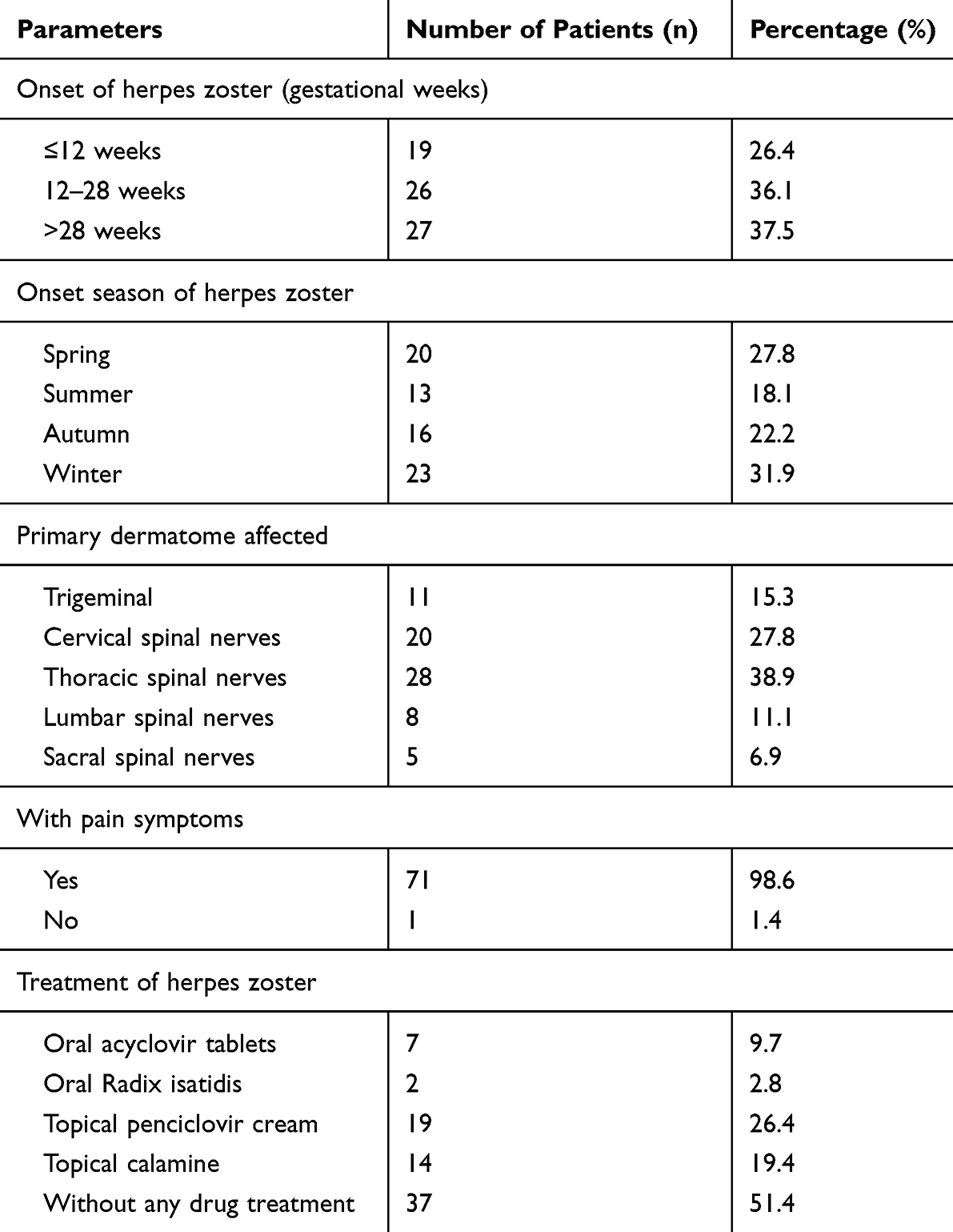 |
Table 2 The Occurrence and Treatment of Herpes Zoster |
Delivery Data and Fetal Outcomes
Among the 72 pregnant women who completed delivery, 69 had singleton pregnancies and 3 had twin pregnancies, with one of the twin pregnancies achieved through in vitro fertilization (IVF). There were three cases of preterm births and 69 cases of term deliveries (see Figure 2). Naturally occurring vaginal births accounted for 38 cases, while cesarean sections accounted for 34 cases.
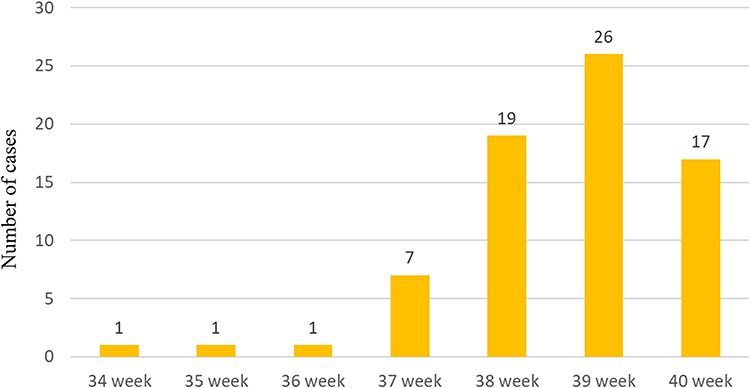 |
Figure 2 Number of Women Delivered at Various Gestational Ages. |
Among the 69 singleton pregnancies, there was one case of low birth weight, 66 cases of normal birth weight, and two cases of macrosomia. Among the three pairs of twins, one pair was conceived via IVF and both had normal birth weights. One patient experienced a twin pregnancy (dichorionic diamniotic). One fetus had a birth weight of 2390g, while the corresponding fetus associated with the accessory placenta had a birth weight of 2315g. The lower-weight fetus was diagnosed with a neonatal anomaly (duodenal atresia) after birth. The 36-year-old pregnant woman developed herpes zoster at 26 weeks of gestation and delivered at 35 weeks. Another pregnant woman, aged 29, had a routine ultrasound at 28 weeks gestation, which indicated absent diastolic flow in the umbilical artery of the right-side fetus, decreased cerebral artery resistance, and multifocal calcifications within the fetal abdomen, diagnosing meconium peritonitis. She underwent a cesarean section at 34 weeks of gestation, delivering a stillborn fetus weighing 700g and a liveborn fetus weighing 2360g. This pregnant woman developed herpes zoster at 34 weeks of gestation. Detailed fetal birth weights and outcomes are depicted in Figure 3. Among the 74 surviving infants, two had Apgar scores of 9 at birth, and 72 had scores of 10.
 |
Figure 3 Birth Weight and Outcomes of singleton newborns and twin newborns. Abbreviations: NBW, normal birth weight; LBW, Low birth weight; DO, duodenal atresia; IVF, In vitro fertilization. |
Discussion
Herpes zoster during pregnancy is relatively uncommon. Between January 1, 2010, and June 30, 2024, a total of 72 pregnant women diagnosed with herpes zoster were identified from four central hospitals of the People’s Liberation Army General Hospital, all of whom had complete medical records. Herpes zoster can occur during any season of pregnancy, and 98.6% of the pregnant women reported experiencing neuropathic pain. In this study, 9.7% of the women chose to receive oral acyclovir treatment, while 2.8% opted for oral Radix isatidis for antiviral therapy. Notably, no adverse delivery outcomes were reported as a result of herpes zoster occurrence or its treatment among all the pregnant women.
For a long time, it has been believed that viral infections during pregnancy can cause harm to the fetus and lead to severe consequences for the child’s organ development.16 Infections such as Zika virus, human cytomegalovirus, and rubella virus can cross the placenta and directly infect the fetus, leading to malformations of the fetal nervous system or other organs.17 This is because viral replication may induce abnormal cell growth and/or apoptosis.
In a study involving 25 peripartum women with herpes zoster, none of the infants were found to have IgM antibodies at birth, and IgG antibodies were also not detected at 1–2 years of age.11 This indicates that the VZV cannot cross the placenta to infect the fetus. In another joint prospective study conducted in Germany and the UK involving 366 pregnant women with herpes zoster, both IgM and IgG antibodies in the infants were negative at birth,12 indicating that the VZV activated during pregnancy infects along the sensory nerves and develops into herpes zoster. However, the VZV is controlled by the maternal immune system and does not cause viraemia, making it rare for the virus to cross the placenta and infect the infant through the bloodstream. Mourad et al research has revealed that silent reactivation of VZV during pregnancy is quite common.18 Their studies conducted in two independent laboratories using PCR (Polymerase Chain Reaction) technology demonstrated that the reactivation rates of VZV in women during late pregnancy were 92% and 70%, respectively. They posited that mothers in their reproductive years, as compared to the elderly,19 generally possess more robust and functional immune systems, which allow them to maintain sufficient cellular immunity to prevent the reactivated VZV from reaching the threshold required for clinical herpes zoster. In the majority of cases, their immune competence is also adequate to safeguard the fetus. Seventeen pregnant women diagnosed with herpes zoster were evaluated in the Infectious Diseases Department of the National Perinatal Institute of Mexico between 1994 and 2002. The findings from this study suggest that herpes zoster during pregnancy typically follows a benign course, does not lead to complications during pregnancy, and does not result in phenotypic changes at birth.20 In our study involving the outcomes of 72 pregnant women who experienced herpes zoster during pregnancy, no adverse outcomes related to the condition were observed for either the mothers or the fetuses. Our findings align with those reported in prior research.
In this study, five pregnant women chose to undergo induced abortion shortly after contracting herpes zoster during the first trimester. This decision may be related to concerns from the pregnant women or their families regarding the potential adverse effects of the VZV on fetal development. As a retrospective study, this research cannot definitively determine whether herpes zoster was a direct cause or an indirect factor in the decision to terminate the pregnancy. The decision to terminate a pregnancy depends on multiple factors, including the mother’s ideology, psychological makeup, personal beliefs, and concerns or doubts regarding the diagnosis.21,22
In our study although 98.6% of the pregnant women exhibited neuropathic pain, only 12.5% opted for oral acyclovir or Radix isatidis under medical guidance. Additionally, 45.8% of the patients chose topical medication for treatment. 51.4% of the pregnant women chose not to undergo any treatment. This may reflect concerns among pregnant women in China regarding the use of medications during pregnancy. Although there are limited reports on the safety and efficacy of these antiviral treatments during pregnancy,9 some studies have shown that early exposure to acyclovir, penciclovir, and valacyclovir does not increase the risk of major birth defects compared to pregnant women who were not exposed to these antiviral medications.13,23 Our study found no adverse outcomes related to the use of either oral acyclovir or Radix isatidis for the pregnant women or their fetuses. Furthermore, in a case report,14 an Asian-ethnicity pregnant woman who developed thoracic herpes zoster was treated not only with antiviral medications but also with lidocaine for thoracic paravertebral and intercostal nerve blocks, and acetaminophen for analgesia. Both the mother and the fetus achieved favorable outcomes. This case illustrates that during pregnancy, in addition to oral antiviral therapy, the use of local anesthetics for nerve blocks or acetaminophen for pain relief is safe and effective for managing herpes zoster in pregnant women.
This study has several strengths. Firstly, it is a multicenter study conducted in multiple Grade III Level A hospitals in Beijing, which renders the study population highly representative. Secondly, the incidence of herpes zoster may be associated with race; studies have indicated that the likelihood of developing herpes zoster is lower among individuals of African descent.24 To our knowledge, this study is the largest to date focusing on the prognosis of herpes zoster during pregnancy in individuals of Asian descent. Furthermore, the population in this study is clearly defined. We established a quality control team to review the medical records of each pregnant woman to ensure the accuracy of the included population. Lastly, there is minimal missing data. To safeguard the health of both pregnant women and their fetuses, China has implemented a pregnancy registration system, resulting in comprehensive medical records for all pregnant women.
This study also has several limitations. Firstly, it is a retrospective study. We had 12 incomplete medical records, possibly due to these pregnant women delivering at other hospitals, which may have introduced some bias to our findings. Secondly, the results of this study may not be generalizable to broader populations, as the data primarily come from pregnant women in Beijing and Hebei Province, China. Additionally, we did not obtain pain scores for women with herpes zoster and data on postherpetic neuralgia. Lastly, our study design did not include a control group. This decision was based on our statistical analysis, which revealed that all pregnant women did not experience adverse outcomes due to herpes zoster.
Conclusions
The management of herpes zoster during pregnancy can be effectively achieved through the administration of oral antiviral medications, including both oral and topical formulations, encompassing nucleoside antiviral agents and traditional Chinese medicine antivirals such as Radix isatidis. These treatments are effective irrespective of the patient’s age and contribute to mitigating the symptoms and progression of the disease. Current evidence indicates that neither herpes zoster nor the use of antiviral medications adversely impacts pregnancy outcomes or fetal development. Consequently, there is no justification for patients to endure severe neuropathic pain, nor is there a rationale for opting for elective termination of pregnancy due to undue concern.
Data Sharing Statement
The data that support the findings of this study are available from the corresponding author, SH Y, upon reasonable request.
Ethics Approval and Consent to Participate
This study was approved by the ethical committee of the Chinese People’s Liberation Army General Hospital with the Ethical Code: S2024-497-01. Informed consent was waived by the IRB for this study. The waiver was granted based on the following reasons: The study utilizes completely de-identified data, which precludes the possibility of identifying individual participants. As a result, obtaining informed consent is not feasible.
Acknowledgments
We would like to express our gratitude to the other staff members of the First Medical Center of the PLA General Hospital.
Author Contributions
All authors made a significant contribution to the work reported, whether that is in the conception, study design, execution, acquisition of data, analysis and interpretation, or in all these areas; took part in drafting, revising or critically reviewing the article; gave final approval of the version to be published; have agreed on the journal to which the article has been submitted; and agree to be accountable for all aspects of the work.
Funding
This research did not receive any specific grant from funding agencies in the public, commercial, or not-for-profit sectors.
Disclosure
The authors declare no competing interests.
References
1. van Oorschot D, Vroling H, Bunge E. et al. A systematic literature review of herpes zoster incidence worldwide. Hum Vaccines Immunother. 2021;17(6):1714–1732. doi:10.1080/21645515.2020.1847582
2. Sun J, Liu C, Peng R, et al. Cryo-EM structure of the varicella-zoster virus A-capsid. Nat Commun. 2020;11(1):4795. doi:10.1038/s41467-020-18537-y
3. Ouwendijk WJD, Depledge P, Rajbhandari L, et al. Varicella-zoster virus VLT-ORF63 fusion transcript induces broad viral gene expression during reactivation from neuronal latency. Nat Commun. 2020;11(1):6324. doi:10.1038/s41467-020-20031-4
4. McKay SL, Guo A, Pergam SA, et al. Herpes Zoster Risk in Immunocompromised Adults in the United States: a Systematic Review. Clin Infect Dis. 2020;71(7):e125–e134. doi:10.1093/cid/ciz1090
5. Hasan S, Ishrat Khan N, Nakeb AA, et al. Herpes zoster with oro-facial involvement – report of a case and detailed review of literature. Ind J Dent. 2012;3(2):94–101.
6. Jayasinghe S, Sheridan S, Macartney K. Herpes zoster vaccination in Australia: what’s available and who benefits? Aust Prescr. 2020;43(1):2–6. doi:10.18773/austprescr.2020.001
7. Van Oorschot D, McGirr A, Goulet P, et al. A Cross-Sectional Concept Elicitation Study to Understand the Impact of Herpes Zoster on Patients’ Health-Related Quality of Life. Infect Dis Ther. 2022;11(1):501–516. doi:10.1007/s40121-021-00581-w
8. Bertelli A, Carta V, Mangeri L, et al. Varicella-Zoster Virus Prevalence among Pregnant Women: a European Epidemiological Review. Life. 2023;13(2). doi:10.3390/life13020593.
9. Singal A, Schwartz RA, Bhate C. Herpes zoster infection in pregnancy: features and consequences. Arch Dermatol Res. 2024;316(4):107.
10. Zandvakili A, Kobayashi T, Kaewpoowat Q, et al. Pelvic and central nervous system tuberculosis complicated by a paradoxical response manifesting as a spinal tuberculoma: a case report. BMC Infect Dis. 2022;22(1):750. doi:10.1186/s12879-022-07731-6
11. Miller E, Cradock-Watson JE, Ridehalgh MK. Outcome in newborn babies given anti-varicella-zoster immunoglobulin after perinatal maternal infection with varicella-zoster virus. Lancet. 1989;2(8659):371–373. doi:10.1016/S0140-6736(89)90547-3
12. Enders G, Miller E, Cradock-Watson J, et al. Consequences of varicella and herpes zoster in pregnancy: prospective study of 1739 cases. Lancet. 1994;343(8912):1548–1551. doi:10.1016/S0140-6736(94)92943-2
13. Pasternak B, Hviid A. Use of Acyclovir, valacyclovir, and famciclovir in the first trimester of pregnancy and the risk of birth defects. JAMA. 2010;304(8):859–866. doi:10.1001/jama.2010.1206
14. Kim JY, Ko YR, Sim SE, et al. Safe drug treatment and procedure for herpes zoster in pregnancy: a case report. Chin Med J. 2020;133(16):1999–2000. doi:10.1097/CM9.0000000000000927
15. Liu BT, Xue K, Fan BF, et al. Interpretation of the expert consensus on the whole-process management of herpes zoster-associated pain. Zhonghua Yi Xue Za Zhi. 2022;102(40):3156–3159. doi:10.3760/cma.j.cn112137-20220415-00814
16. Megli CJ, Coyne CB. Infections at the maternal-fetal interface: an overview of pathogenesis and defence. Nat Rev Microbiol. 2022;20(2):67–82.
17. Van Campen H, Bishop JV, Abrahams VM, et al. Maternal Influenza A Virus Infection Restricts Fetal and Placental Growth and Adversely Affects the Fetal Thymic Transcriptome. Viruses. 2020;12(9):1003. doi:10.3390/v12091003
18. Mourad M, Gershon M, Mehta SK, et al. Silent Reactivation of Varicella Zoster Virus in Pregnancy: implications for Maintenance of Immunity to Varicella. Viruses. 2022;14(7):1438. doi:10.3390/v14071438
19. Gershon AA, Gershon MD, Breuer J, et al. Advances in the understanding of the pathogenesis and epidemiology of herpes zoster. J Clin Virol. 2010;48(Suppl 1):S2–7. doi:10.1016/S1386-6532(10)70002-0
20. Casanova Román G, Reyna Figueroa J, Figueroa Damián R, et al. Herpes zoster in immunocompetent pregnant women and their perinatal outcome. Ginecol Obstet Mex. 2004;72:63–67.
21. Zaręba K, Makara-Studzińska M, Ciebiera M, et al. Role of Social and Informational Support while Deciding on Pregnancy Termination for Medical Reasons. Int J Environ Res Public Health. 2018;15(12):2854. doi:10.3390/ijerph15122854
22. Tang L, Wu S, Liu D, et al. Repeat Induced Abortion among Chinese Women Seeking Abortion: two Cross Sectional Studies. Int J Environ Res Public Health. 2021;18(9):4446.
23. Shahar-Nissan K, Pardo J, Peled O, et al. Valaciclovir to prevent vertical transmission of cytomegalovirus after maternal primary infection during pregnancy: a randomised, double-blind, placebo-controlled trial. Lancet. 2020;396(10253):779–785. doi:10.1016/S0140-6736(20)31868-7
24. Marra F, Parhar K, Huang B, et al. Risk Factors for Herpes Zoster Infection: a Meta-Analysis. Open Forum Infect Dis. 2020;7(1):ofaa005. doi:10.1093/ofid/ofaa005
 © 2025 The Author(s). This work is published and licensed by Dove Medical Press Limited. The
full terms of this license are available at https://www.dovepress.com/terms
and incorporate the Creative Commons Attribution
- Non Commercial (unported, 4.0) License.
By accessing the work you hereby accept the Terms. Non-commercial uses of the work are permitted
without any further permission from Dove Medical Press Limited, provided the work is properly
attributed. For permission for commercial use of this work, please see paragraphs 4.2 and 5 of our Terms.
© 2025 The Author(s). This work is published and licensed by Dove Medical Press Limited. The
full terms of this license are available at https://www.dovepress.com/terms
and incorporate the Creative Commons Attribution
- Non Commercial (unported, 4.0) License.
By accessing the work you hereby accept the Terms. Non-commercial uses of the work are permitted
without any further permission from Dove Medical Press Limited, provided the work is properly
attributed. For permission for commercial use of this work, please see paragraphs 4.2 and 5 of our Terms.
Recommended articles
Efficacy and Safety of Pulsed Radiofrequency in Herpes Zoster Related Trigeminal Neuralgia: A Systematic Review and Meta-Analysis
Wang C, Dou Z, Yan M, Wang B
Journal of Pain Research 2023, 16:341-355
Published Date: 2 February 2023
Herpes Zoster of the Sacral Region without Motor Dysfunction in a 55-year-Old Female: A Case Report and Literature Review
Alsulaiman OA, Alsaati AA, Alsulaiman F, Aljaafari D, Alabdali M
International Medical Case Reports Journal 2025, 18:677-682
Published Date: 3 June 2025
Effect of Erector Spinae Plane Block Applied to Painful Herpes Zoster Patients Who Failed to Respond to Pregabalin Treatment on Immunological Marker Levels and Postherpetic Neuralgia Incidence Rate
Büyükbezirci G, Demiralp N, Keles S, Yılmaz R, Arıcan Ş, Tuncer Uzun S, Reisli R, Reisli İ
Journal of Pain Research 2026, 19:611477
Published Date: 6 June 2026