
Back to Journals » Journal of Asthma and Allergy » Volume 19
Glucagon-Like Peptide-1 Receptor Agonists vs Dipeptidyl Peptidase-4 Inhibitor Use on Risk of Asthma Exacerbation Among Diabetic Patients with Co-Morbid Asthma in Hong Kong
Authors Kwok WC  , Zhou L , Ma TF , Leung RYH , Tam TCC , Ho JC
Received 7 May 2026
Accepted for publication 14 July 2026
Published 21 July 2026 Volume 2026:19 622748
DOI https://doi.org/10.2147/JAA.S622748
Checked for plagiarism Yes
Review by Single anonymous peer review
Peer reviewer comments 2
Editor who approved publication: Dr Amrita Dosanjh
Wang Chun Kwok,1,* Lu Zhou,2,* Ting Fung Ma,2 Raymond Yau Hang Leung,1 Terence Chi Chun Tam,1 James CM Ho1
1Department of Medicine, The University of Hong Kong, Hong Kong SAR, People’s Republic of China; 2Department of Statistics, University of South Carolina, Columbia, SC, USA
*These authors contributed equally to this work
Correspondence: James CM Ho, Department of Medicine, The University of Hong Kong, 4/F, Professorial Block, Queen Mary Hospital, 102 Pokfulam Road, Hong Kong SAR, People’s Republic of China, Tel +852 2255 4999, Email [email protected]
Background: Co-existing asthma and diabetes mellitus (DM) are common, and there has been a debate on whether glucagon-like peptide-1 (GLP-1)-based therapies, such as GLP-1 receptor agonists (GLP-1RA) and inhibitors of dipeptidyl peptidase-4 (DPP-4i), confer benefits in these patients due to their anti-inflammatory effects in chronic inflammatory diseases.
Methods: A territory-wide retrospective cohort study was conducted in Hong Kong among adult patients with co-existing asthma and DM to examine the impact of add-on GLP-1RA or DPP-4i on asthma exacerbations, ranging from mild exacerbations managed in outpatient settings to severe exacerbations requiring hospitalization. Adult patients were prescribed DPP-4i or GLP-1RA in year 2018 and for at least 6 months in Hospital Authority of Hong Kong were included. These patients were followed till 31st December 31, 2023. Propensity score matching was performed using optimal full matching, which is a sub-classification-based approach in which treated and control subjects are assigned to matched subclasses.
Results: A total of 3295 patients with both asthma and DM, 3193 treated with DPP-4i and 102 treated with GLP-1RA, were included in the study. There were 1191 (36.1%) male patients with a mean age of 68.0 ± 14.2 years. There were 2531 (76.8%) patients with moderate-to-severe asthma according to Global Initiative for Asthma (GINA) Steps 3 to 5. GLP-1RA-treated patients had significantly lower risks of hospitalized asthma exacerbation (Average Treatment Effect on the Treated (ATT) Mean Ratio of 0.513, p < 0.001), ad hoc outpatient visits with OCS (ATT Mean Ratio of 0.343, p = 0.005), emergency visits (ATT Mean Ratio of 0.378, p = 0.009), and all asthma exacerbations (ATT Mean Ratio of 0.419, p < 0.001) compared with the DPP-4i group.
Conclusion: GLP-1RA, compared with DPP-4i, as an add-on treatment for patients with co-existing DM and asthma was associated with a lower risk of asthma exacerbation. The use of GLP-1RA among diabetic patients with comorbid asthma may be considered though validation in clinical trials is needed.
Keywords: acute exacerbation, asthma, GLP-1 receptor antagonist, DPP-4 inhibitor
Introduction
Asthma and diabetes mellitus (DM) are both common chronic medical diseases. For diabetes, it is a common among adults in Hong Kong, with prevalence of about 10%.1 Asthma is also another common medical condition in Hong Kong with more than 330000 patients suffering from asthma.2 For asthma, environmental factors such as air pollution has been well recognized to be an important trigger.3 Chronic airway inflammation was also a hallmark feature in asthma, involving various pro-inflammatory cytokines.4 The co-existence of asthma and DM was also reported with increasing prevalence.5 The co-existence of asthma and DM was also reported to be linked to worse asthma control.
Glucagon-like peptide-1 (GLP-1)-based therapies, such as GLP-1 receptor agonists (GLP-1RA)6,7 and inhibitors of dipeptidyl peptidase-4 (DPP-4i)8–10 which are GLP-1 inactivating enzymes, have been developed for the treatment of diabetes mellitus. GLP-1-based therapies are useful in diabetic control. GLP-1RA also can promote weight loss and reduce cardiovascular disease outcomes in patients with existing atherosclerotic cardiovascular disease. There are also data suggesting that GLP-1-based therapies also demonstrate anti-inflammatory effects in chronic inflammatory diseases, including asthma.11 The common adverse effects of GLP-1RA include nausea, vomiting, and diarrhea. GLP-1 has demonstrated anti-inflammatory effects on pancreatic islets and adipose tissue, contributing to lowering glucose levels in DM.12,13 The anti-inflammatory effects were also observed in other organs such as the lungs.11,14 GLP-1 receptor was also found to be found expressed abundantly in human lung, especially in vascular and smooth muscle tissues.15,16 The GLP-1 receptor was also shown to be expressed in human eosinophils and neutrophils.17 Studies suggested the possible role of GLP-1 receptor in asthma include smooth muscle relaxation and structural medication.16 GLP-1 was also proposed to exert regulatory functions in innate immune cells, especially macrophages.18 As GLP-based therapy, DPP-4i also raise endogenous GLP-1 but its pulmonary effects are weaker.19
Based on the knowledge of the anti-inflammatory effects of GLP-1-based therapies, these agents have been assessed for use among patients with respiratory diseases such as asthma.20–22 Both DPP-4i and GLP-1RA were studied in asthma patients. The use of DPP-4i has been shown to reduce the risk of asthma and also asthma exacerbations.23
For GLP-1RA, a study demonstrated a beneficial effect on reducing asthma exacerbation relative to sulfonylureas, particularly among asthma patients with two or more emergency department visits.24 In a retrospective study, patients starting on GLP-1RA were also reported to have fewer asthma exacerbations and improved asthma symptoms than those initiating the alternative agents (SGLT-2 inhibitors, DPP-4i, sulfonylurea, and basal insulin) within 6 months of drug initiation.25 A meta-analysis also suggested a modest reduction in the incidence of asthma in patients with type 2 diabetes or obesity using GLP-1 receptor-based agonist treatments.26
However, the observed benefits of DPP-4i and GLP-1RA have also been challenged by other studies. One study suggested that there were no differences in asthma control between patients treated with or without DPP-4i.27 The use of DPP-4i and GLP-1RA was also suggested to be associated with poorer asthma control than metformin.28 The results from the above recently published studies indicate that controversies remain regarding GLP-1-based therapies among patients with asthma. Also, there is a lack of dedicated study that directly compares DPP-4i and GLP-1RA in diabetic patients with co-morbid asthma, whether there is a difference in asthma exacerbation rate among patients prescribed with DPP-4i or GLP-1RA. To further complicate this situation, there has been a lack of data on the beneficial effects of DPP-4i and GLP-1RA on asthma control, in particular real-world Asian data with long term follow up. As such, we propose the current study to compare the efficacy of DPP-4i versus GLP-RA in preventing asthma exacerbations among DM patients with co-morbid asthma in Hong Kong.
Materials and Methods
This is a territory-wide study conducted in Hong Kong to study the clinical efficacy of DPP-4i versus GLP-1RA in DM patients with asthma. Adult patients with DM and asthma, managed by the Hong Kong Hospital Authority (HKHA) in 2018, were included. They were prescribed DPP-4i or GLP-1RA for at least 6 months within the study period. These patients were followed from 1st January 2018 (or the start date of DPP-4i or GLP-1RA, whichever is later) to 31st December, 2023 (or the date of discontinuation of DPP-4i or GLP-1RA or death, whichever is earlier) (Figure 1). This study utilized electronic health records from the Clinical Data Analysis and Reporting System (CDARS) managed by the HKHA. HKHA is a public healthcare service provider that manages 43 hospitals and institutions and 123 outpatient clinics, covering more than 90% of the Hong Kong population since 1993.29 The CDARS captures medical information including diagnosis, drug prescription details, demographics, admissions, medical procedures, and laboratory results. The asthma diagnostic code in CDARS was validated with a positive predictive value (PPV) of 85.0% (95% confidence interval = 80.1–89.9%).30
 |
Figure 1 Study design. |
The inclusion criteria were adult patients (age ≥ 18 years) with a diagnosis of asthma identified by the International Classification of Diseases, 9th Revision (ICD-9) code of 493 and DM with ICD-9 code of 250 in 2018. Patients with a co-existing ICD-9 code of 496, indicating a co-existing diagnosis of COPD, and patients who received both DPP-4is and GLP-1RA during the inclusion period were excluded. Demographic (age and sex) and clinical characteristics (Charlson comorbidity index (CCI), presence of comorbidities and medications for asthma and DM, and baseline creatinine level) were retrieved from the CDARS. The medication the patients prescribed for asthma at the time of study initiation was used to define asthma severity as GINA steps. This study was approved by the Institutional Review Board of the University of Hong Kong and the Hospital Authority Hong Kong West Cluster (UW 23-510). Patient informed consent was waived as this was a retrospective study without active patient recruitment, and all retrieved clinical data were de-identified.
Asthma exacerbations of different severities, ranging from ad hoc outpatient visits with oral corticosteroid prescriptions to emergency department visits without hospitalization and hospitalization, were retrieved from the CDARS.
The primary outcome was the number of hospitalized asthma exacerbations. The secondary outcomes included the number of ad hoc outpatient visits with oral corticosteroid prescriptions (at least oral prednisolone 20 mg daily for 5 days), emergency department visits without hospitalization, and the number of asthma exacerbations of any severity.
Statistical Analysis
Categorical variables were expressed as the actual numbers (percentages). Continuous variables were expressed as mean ± standard deviation (SD) or median with interquartile range (IQR). Between-group comparisons of continuous variables were performed using the independent t-test or Mann–Whitney U-test, and categorical variables were compared using the chi-square test or Fisher’s exact test. Measures, including regular and conditional mean, SD, and IQRs (25th to 75th percentiles), were introduced to compare medical outcome event counts before and after matching. Here, conditional refers to calculations based on nonzero event counts. Causal effect estimation in observational studies requires comparison of medical outcomes between treated and control groups with similar covariate distributions to mitigate confounding bias.
Propensity score matching was performed using optimal full matching in R with the MatchIt package (version 4.7.2), which calls functions from the optmatch package for optimal full matching.31–33 The covariates that were significantly different at baseline or clinically associated with asthma exacerbation risk were matched. Unlike fixed-ratio nearest-neighbor matching, optimal full matching is a subclassification-based approach in which treated and control subjects are assigned to matched subclasses, each containing at least one treated and one control subject. Full matching does not necessarily discard subjects; instead, it generates matching weights for all included individuals. Consequently, the nominal numbers of treated and control subjects can remain unchanged before and after matching, whereas post-matching covariate balance statistics can be computed using these weights. Accordingly, the adjusted means, absolute standardized differences, variance ratios, and Kolmogorov–Smirnov statistics reflect the weighted matched pseudo-population rather than the original unweighted sample. Weighted Kolmogorov–Smirnov statistics were computed based on the standard empirical distribution function approach and extended to incorporate matching weights.34–36 The analysis estimated the average treatment effect in the treated (ATT) using a weighted regression model with marginal standardization, in which predicted outcomes under treatment and control were averaged over the treated population while incorporating the full-matching weights.33,37 Standard errors were estimated using subclass-clustered variance estimation to account for the matched structure.33,38 Thus, the analysis reflects the effect of treatment among treated individuals, with covariate balance improved through weighting rather than by reducing the cohort size. Therefore, the effective sample size, a precision-equivalent number of independent observations in the weighted sample, is more informative than the nominal sample size for interpreting the matched analysis.36
Statistical significance was determined at a level of p = 0.05.
Results
In 2018, there were 14379 patients with asthma (without COPD) and DM were followed up in the HKHA. Among these patients, there were 3193 treated with DPP-4i, 102 treated with GLP-1RA and 204 with both DPP-4i and GLP-1RA. Thus, only 3293 patients treated with DPP-4i or GLP-1RA were included in the final analysis. The patient selection flow diagram is shown in Figure 2. The baseline clinical characteristics of the patients are summarized in Table 1. The matching results are shown in Supplementary Figure 1.
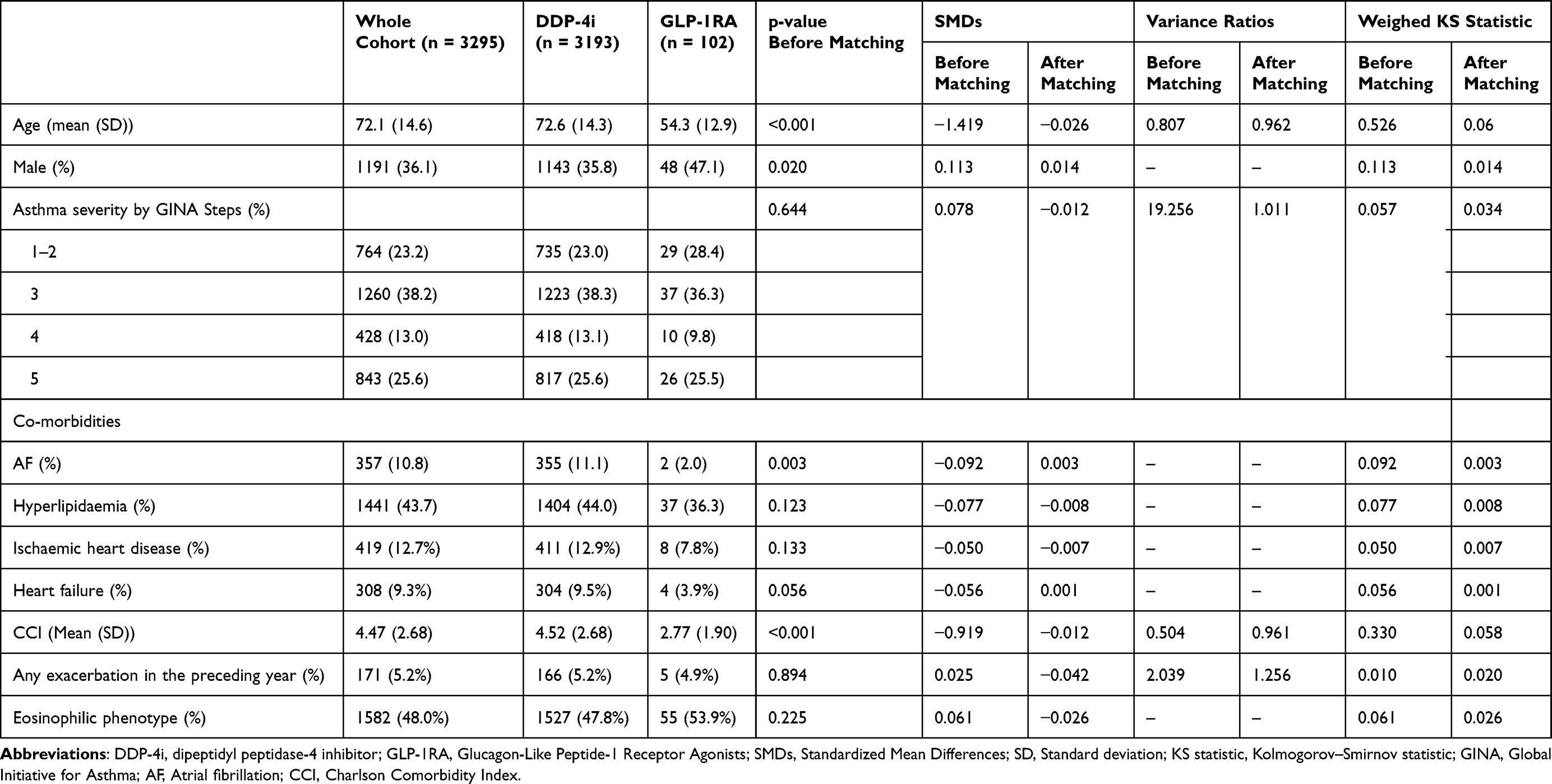 |
Table 1 Baseline Clinical Characteristics of the Included Patients |
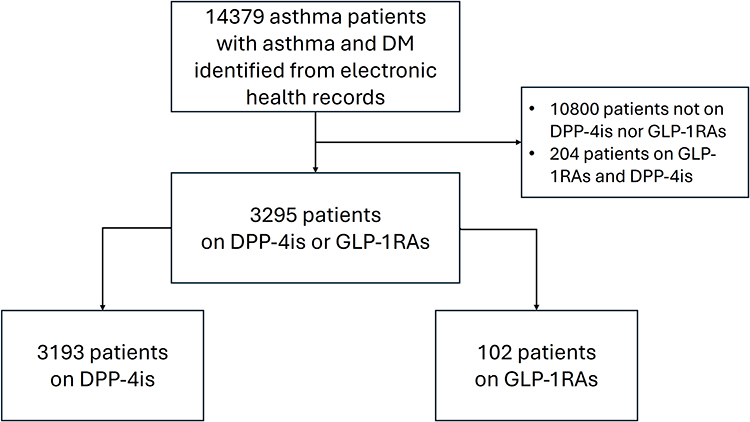 |
Figure 2 Patient selection flow diagram. |
There were 1191 (36.1%) male patients with a mean age of 72.1 ± 14.6 years. There were 2531 (76.8%) patients with moderate-to-severe asthma according to Global Initiative for Asthma (GINA) Steps 3 to 5. The matched cohorts were constructed through PSM on observed covariates including age, sex, GINA treatment steps, the presence of asthma exacerbation in the previous 12 months, CCI, phenotype as determined by blood eosinophil count (cutoff at 150 cells/μL), and the presence of underlying cardiovascular risk factors and diseases. After optimal full matching, the effective sample size was 421.65 in the DPP-4i group and 102 in the GLP-1RA group. This provided approximately four effective controls per treated patient, supporting adequate ATT analysis while reflecting the weighting required to achieve covariate balance. In addition, the absolute Standardized Mean Differences (SMDs) between the treated and control groups of all covariates were within 0.05, the adjusted variance ratios were close to 1.0, and the weighted Kolmogorov–Smirnov statistics were smaller than 0.1, indicating a good distributional balance.
For count outcomes, weighted Poisson regression models with a log link were fitted in the propensity-score-matched cohort using the full-matching weights. Models included treatment group and prespecified covariates used for matching. Treatment effects were estimated as ATT mean ratios through g-computation using marginal standardization, calculated as the ratio of predicted mean outcomes under treatment and predicted mean outcomes under control among the treated population. Since overdispersion was observed, we also fitted quasi-Poisson model as a less sensitivity remedy, which retains the Poisson log-link mean structure while estimating a dispersion parameter. The quasi-Poisson yielded the same ATT mean ratios as the Poisson models and remained significant after using overdispersion-adjusted standard errors.
Hospitalized Asthma Exacerbations
Eleven patients (10.8%) in the GLP-1RA group and 516 (16.2%) in the DPP-4i group developed hospitalized asthma exacerbations. The conditional mean number of hospitalized asthma exacerbation was 0.50 ± 3.02 in GLP-1RA group and 0.83 ± 5.20 in DPP-4i group. The GLP-1RA (treatment) group was associated with a 48.7% lower expected number of events than the DPP-4i (control) group in the treated population (ATT mean ratio = 0.513 with a standard error (SE) of 0.087, p < 0.001) (Table 2).
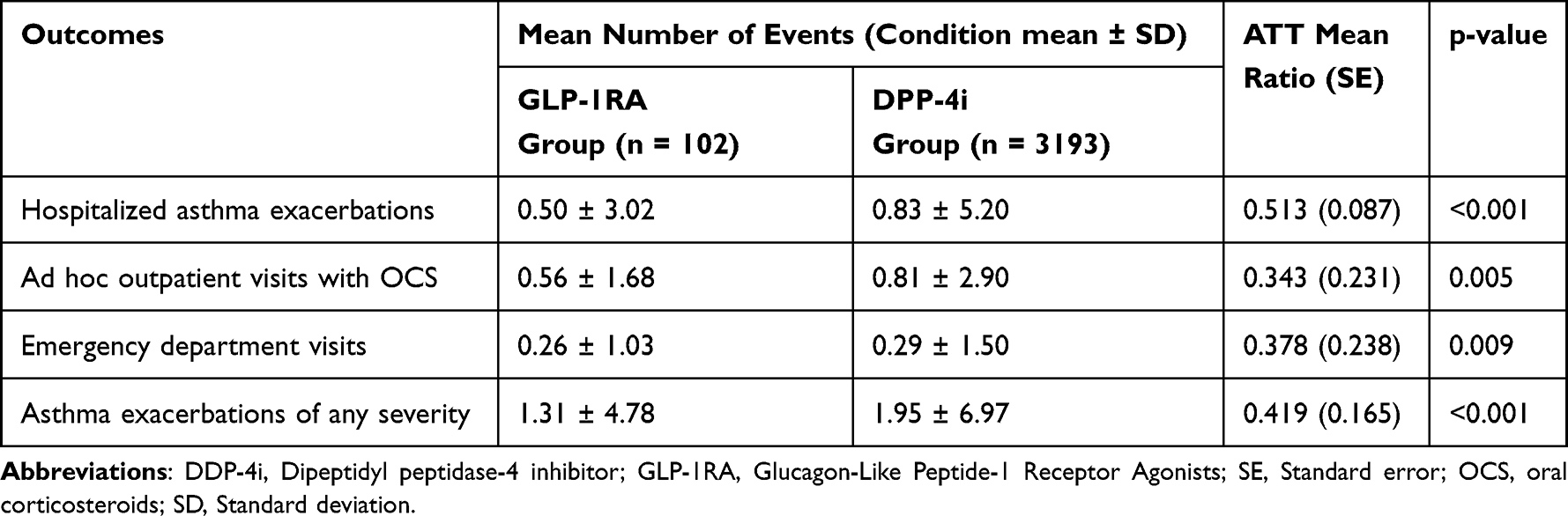 |
Table 2 Outcomes for Treatment and Control Groups |
Ad hoc Outpatient Visits with Oral Corticosteroid Prescriptions
Sixteen patients (15.8%) in the GLP-1RA group and 556 (17.4%) in the DPP-4i group had ad hoc outpatient visits with oral corticosteroid prescriptions. The conditional mean number of ad hoc outpatient visits with oral corticosteroid prescriptions episodes were 0.56 ± 1.68 in the GLP-1RA group and 0.81 ± 2.90 in the DPP-4i group. The GLP-1RA (treatment) group had a 65.7% lower expected number of events than the DPP-4i (control) group in the treated population (ATT Mean Ratio of 0.343, SE = 0.231, p = 0.005) (Table 2).
Emergency Department Visits Without Hospitalization
Eleven patients (10.8%) in the GLP-1RA group and 252 (7.9%) in the DPP-4i group had emergency department visits without hospitalization. The mean number of emergency department visits without hospitalization episodes were 0.26 ± 1.03 in the GLP-1RA group and 0.29 ± 1.50 in the DPP-4i group. The GLP-1RA (treatment) group was associated with a 62.2% lower expected number of events than the DPP-4i (control) group in the treated population (ATT Mean Ratio 0.378, SE = 0.238, p = 0.009) (Table 2).
Asthma Exacerbations of Any Severity
There were 27 patients (26.7%) in the GLP-1RA group and 875 (27.4%) in the DPP-4i group developed asthma exacerbations. The mean number of any asthma exacerbation episodes were 1.31 ± 4.78 in the GLP-1RA group and 1.95 ± 6.97 in the DPP-4i group. The GLP-1RA (treatment) group was associated with a 58.1% lower expected number of events than the DPP-4i (control) group in the treated population (ATT Mean Ratio = 0.419, SE = 0.165, p < 0.001) (Table 2).
Discussion
Our study suggested the potential clinical benefits of GLP-1RA among patients with co-existing asthma and DM. In the current cohort, patients treated with GLP-1RA had significantly fewer asthma exacerbations of all severities, ranging from those managed in the outpatient setting to those requiring hospitalization. These findings may suggest the potential benefit of using GLP-1RA as an add-on therapy for DM patients with co-existing asthma, with benefits beyond DM and body weight control, but also fewer asthma exacerbations. The findings in this study provided insights into dedicated clinical trials to demonstrate the clinical value of GLP-1RA among patients with co-existing asthma and DM.
The potential benefits of GLP-1RA have been extensively studied in recent years. The benefits range from regulating neuroinflammatory pathways that contribute to asthma pathogenesis,39 reducing asthma development in diabetic patients,40 improving asthma control,41 better lung function42 and reducing asthma exacerbation risks.43,44 The benefits may be driven by the effects on mechanistic effects of GLP-1 on pulmonary function and disease. In murine models of lung injury, the administration of exogenous GLP-1RAs has been shown to confer significant protection against pulmonary inflammation and airway hyperresponsiveness.45 The benefits observed warrants proper assessment by measuring asthma outcomes in different dimensions, such as exacerbation of different severities, and by including a comparator arm.
Our study has an advantage over other published studies regarding the role of GLP-1-based therapies in patients with DM and asthma. First, we chose DPP-4i as the comparator arm instead of other diabetic medications. As both GLP-1RA and DPP-4i work along the same pathway, they are not recommended for concomitant use.46 When compared with other studies, this strength is more prominent. Kimura et al28 compared GLP-1RA and DPP-4i with metformin, which is the first-line treatment for DM,46 while GLP-1RA and DPP-4i were mainly used as an add-on treatment to metformin. Wang et al24 compared GLP-1RA with sulfonylureas, which are one of the most commonly used antihyperglycemic agents, given their low cost and availability. A head-to-head comparison of GLP-1RA and DPP-4i is ideal, as they are not recommended for concomitant use. Our study also had a prolonged follow-up period to assess the various outcomes. In this study, we demonstrated the potential clinical benefits of GLP-1RA over DPP-4i as an add-on therapy for reducing asthma exacerbations of different severities among patients with asthma and DM. This highlights the importance of personalized therapy among patients with different comorbidities, with the combination of DM and asthma being an example.
In the current study, the number of patients prescribed with GLP-1RA and DPP-4i differs, which can be explained by the differences in indications of the two drugs. In view of this, we performed propensity score matching with optimal full matching implemented. By doing this, we matched the baseline characteristics of the patients prescribed with GLP-1RA and DPP-4i without changing the nominal numbers of subjects in each group. This can handle the issues of possible confounders from the difference in baseline characteristics.
Although DM and asthma are both common medical conditions worldwide, the co-existence of both conditions is also well reported, with different proposed mechanisms linking these two conditions together.47–49 As such, it is important to consider this combination as a specific condition in which personalized therapy can be offered. The results of this study indicate that a diabetic drug might have potential benefits beyond diabetic care but also in improving asthma control with fewer exacerbations. The possible mechanism could be related to the inhibitory effect on airway inflammation, as demonstrated in animal models.50 The benefits could also be related to the weight reduction effect of GLP-1RA.51 These two properties of GLP-1RA could potentially explain the superiority of GLP-1RA over DPP-4i among patients with DM and asthma. As such, among patients with DM and asthma, GLP-1RA could be considered as the add-on diabetic medication of choice.
Our study had several limitations. First, the majority of the patients included in this study were Chinese, which may have affected generalizability. However, we also reported similar findings, as mentioned in studies conducted in other countries. Also, the effect of GLP-1RA is unlikely to be affected by ethnicity. Second, the lung function parameters and symptom burden were not assessed. We assessed asthma severity using the pharmacotherapy they received, that is, GINA Steps, which is a well-recognized way to assess asthma severity. For GINA Steps, it was defined by the asthma medication at the study start. But the treatment and severity of asthma may vary over time, which is another limitation that we need to acknowledge. While the patients prescribed with GLP-1RA and DPP-4i were matched in the study, potential residual confounding from BMI, diabetes severity, smoking statis and concurrent diabetes medications were possible. Some of these factors might affect asthma exacerbation risks, while some do not. Afterall, the factors that have critical importance were being matched and the impact from the factors not matched may not be a major one. For the outcomes in this study, all exacerbations necessitating the attendance of public hospitals and clinics were captured, while those attending private clinics were not. This may underestimate the number of mild asthma exacerbations, but the impact on more severe ones, such as those requiring hospitalization, is less likely to be affected. Third, only asthma exacerbations, but not asthma control, as measured by changes in the asthma control test score or lung function changes, were measured as the outcomes. However, asthma exacerbation carries a higher burden to patients as well as the healthcare system, and it is also one of the most important criteria to decide on add-on asthma therapy, such as biologics. Lastly, the number of patients treated with GLP-1RA was relatively small as the choices of GLP-1RA were limited at the time of this study. Future prospective studies including clinical trials are valuable to validate the observation.
Conclusion
Among adults with co-existing asthma and diabetes in Hong Kong, GLP-1RA use was associated with fewer asthma exacerbation events compared with DPP-4i use. The potential mechanism can be linked to the anti-inflammatory property of GLP-1RA, while validating the results from a large-scale study involving more subjects is warranted.
Abbreviations
GLP-1, Glucagon-like peptide-1; GLP-1RA, GLP-1 receptor agonists; DPP-4i, Inhibitors of dipeptidyl peptidase-4; DM, Diabetes mellitus; HKHA, Hong Kong Hospital Authority; CDARS, Clinical Data Analysis and Reporting System; PPV, Positive predictive value; ICD-9, International Classification of Diseases, 9th Revision; CCI, Charlson comorbidity index; ICU, Intensive care unit; SD, Standard deviation; IQR, Interquartile range; PSM, Propensity score matching; SMDs, standardized mean difference; ATT, average treatment effect on the treated; BMI, Body mass index; GINA, Global Initiative for Asthma.
Data Sharing Statement
All available data are presented in the manuscript and no additional data are provided.
Ethics Approval and Informed Consent
This study was approved by the Institutional Review Board of the University of Hong Kong and the Hospital Authority Hong Kong West Cluster (UW 23-510). Patient informed consent was waived as this was a retrospective study without active patient recruitment, and all retrieved clinical data were de-identified. This study was conducted in compliance with the principles of the Declaration of Helsinki.
Author Contributions
All authors made a significant contribution to the work reported, whether that is in the conception, study design, execution, acquisition of data, analysis and interpretation, or in all these areas; took part in drafting, revising or critically reviewing the article; gave final approval of the version to be published; have agreed on the journal to which the article has been submitted; and agree to be accountable for all aspects of the work.
Funding
There is no funding to report.
Disclosure
The author reports no conflicts of interest in this work.
References
1. Quan J, Li T, Pang H, et al. Diabetes incidence and prevalence in Hong Kong, China during 2006–2014. Diabetic Med. 2017;34(7):902–10. doi:10.1111/dme.13284
2. Chiu WK. Diagnosis and management of childhood asthma. Hong Kong Pract. 2018;40(4):125–134.
3. Mak HWL, Ng DCY. Spatial and socio-classification of traffic pollutant emissions and associated mortality rates in high-density Hong Kong via improved data analytic approaches. Int J Environ Res Public Health. 2021;18(12):6532. doi:10.3390/ijerph18126532
4. Hammad H, Lambrecht BN. The basic immunology of asthma. Cell. 2021;184(6):1469–1485. doi:10.1016/j.cell.2021.02.016
5. Torres RM, Souza MDS, Coelho ACC, de Mello LM, Souza-Machado C. Association between asthma and type 2 diabetes mellitus: mechanisms and impact on asthma control—a literature review. Can Respir J. 2021;2021(1):8830439. doi:10.1155/2021/8830439
6. Meier JJ, Rosenstock J, Hincelin-Mery A, et al. Contrasting effects of lixisenatide and liraglutide on postprandial glycemic control, gastric emptying, and safety parameters in patients with type 2 diabetes on optimized insulin glargine with or without metformin: a randomized, open-label trial. Diabetes Care. 2015;38(7):1263–1273. doi:10.2337/dc14-1984
7. Kapitza C, Forst T, Coester HV, Poitiers F, Ruus P, Hincelin-Mery A. Pharmacodynamic characteristics of lixisenatide once daily versus liraglutide once daily in patients with type 2 diabetes insufficiently controlled on metformin. Diabetes Obes Metab. 2013;15(7):642–649. doi:10.1111/dom.12076
8. Craddy P, Palin HJ, Johnson KI. Comparative effectiveness of dipeptidylpeptidase-4 inhibitors in type 2 diabetes: a systematic review and mixed treatment comparison. Diabetes Ther. 2014;5(1):1–41. doi:10.1007/s13300-014-0061-3
9. Aschner P, Kipnes MS, Lunceford JK, et al. Effect of the dipeptidyl peptidase-4 inhibitor sitagliptin as monotherapy on glycemic control in patients with type 2 diabetes. Diabetes Care. 2006;29(12):2632–2637. doi:10.2337/dc06-0703
10. Raz I, Hanefeld M, Xu L, et al. Efficacy and safety of the dipeptidyl peptidase-4 inhibitor sitagliptin as monotherapy in patients with type 2 diabetes mellitus. Diabetologia. 2006;49(11):2564–2571. doi:10.1007/s00125-006-0416-z
11. Lee YS, Jun HS. Anti-Inflammatory Effects of GLP-1-Based Therapies beyond Glucose Control. Mediators Inflamm. 2016;2016:3094642. doi:10.1155/2016/3094642
12. Cabou C, Burcelin R. GLP-1, the gut-brain, and brain-periphery axes. Rev Diabet Stud. 2011;8(3):418–431. doi:10.1900/RDS.2011.8.418
13. Lee YS, Park MS, Choung JS, et al. Glucagon-like peptide-1 inhibits adipose tissue macrophage infiltration and inflammation in an obese mouse model of diabetes. Diabetologia. 2012;55(9):2456–2468. doi:10.1007/s00125-012-2592-3
14. Zhang MQ, Lin C, Cai XL, et al. The association between GLP-1 receptor-based agonists and the incidence of asthma in patients with type 2 diabetes and/or obesity: a meta-analysis. Biomed Environ Sci. 2024;37(6):607–616. doi:10.3967/bes2024.067
15. Pyke C, Heller RS, Kirk RK, et al. GLP-1 receptor localization in monkey and human tissue: novel distribution revealed with extensively validated monoclonal antibody. Endocrinology. 2014;155(4):1280–1290. doi:10.1210/en.2013-1934
16. Wu AY, Peebles RS. The GLP-1 receptor in airway inflammation in asthma: a promising novel target? Expert Rev Clin Immunol. 2021;17(10):1053–1057. doi:10.1080/1744666X.2021.1971973
17. Mitchell PD, Salter BM, Oliveria JP, et al. Glucagon-like peptide-1 receptor expression on human eosinophils and its regulation of eosinophil activation. Clin Exp Allergy. 2017;47(3):331–338. doi:10.1111/cea.12860
18. Chen J, Mei A, Wei Y, et al. GLP-1 receptor agonist as a modulator of innate immunity. Front Immunol. 2022;13:997578. doi:10.3389/fimmu.2022.997578
19. Singh AK. Dipeptidyl peptidase-4 inhibitors: novel mechanism of actions. Indian J Endocrinol Metab. 2014;18(6):753–759. doi:10.4103/2230-8210.141319
20. Janic M, Skrgat S, Harlander M, et al. Potential use of GLP-1 and GIP/GLP-1 receptor agonists for respiratory disorders: where are we at? Medicina. 2024;60(12):2030. doi:10.3390/medicina60122030
21. Kanwar MK, Sunku R, Alruwaili F, Mufti MA, Raji M. Beneficial effects of glucagon-like peptide-1 receptor agonists in patients with asthma: a literature review. Cureus. 2022;14(10):e30812. doi:10.7759/cureus.30812
22. Kaplan AG, Kim JW. Asthma exacerbations and glucagon-like peptide-1 receptor agonists: a review of the current evidence. Pulm Ther. 2022;8(4):343–358. doi:10.1007/s41030-022-00203-x
23. Li PF, Chung CH, Liu JS, et al. Association of dipeptidyl peptidase-4 inhibitor use and the risk of asthma development among type 2 diabetes patients. Ther Adv Respir Dis. 2022;16:17534666221135320. doi:10.1177/17534666221135320
24. Wang T, Keil AP, Buse JB, et al. Glucagon-like peptide 1 receptor agonists and asthma exacerbations: which patients benefit most? Ann Am Thorac Soc. 2024;21(11):1496–1506. doi:10.1513/AnnalsATS.202309-836OC
25. Foer D, Beeler PE, Cui J, Karlson EW, Bates DW, Cahill KN. Asthma exacerbations in patients with type 2 diabetes and asthma on glucagon-like peptide-1 receptor agonists. Am J Respir Crit Care Med. 2021;203(7):831–840. doi:10.1164/rccm.202004-0993OC
26. Wu AY, Cahill KN, Toki S, Peebles RS. Evaluating the glucagon-like peptide-1 receptor in managing asthma. Curr Opin Allergy Clin Immunol. 2022;22(1):36–41. doi:10.1097/ACI.0000000000000797
27. Colice G, Price D, Gerhardsson de Verdier M, et al. The effect of DPP-4 inhibitors on asthma control: an administrative database study to evaluate a potential pathophysiological relationship. Pragmat Obs Res. 2017;8:231–240. doi:10.2147/POR.S144018
28. Kimura Y, Jo T, Inoue N, et al. Association of novel antihyperglycemic drugs versus metformin with a decrease in asthma exacerbations. J Allergy Clin Immunol Pract. 2024;12(8):2035–2044. doi:10.1016/j.jaip.2024.05.002
29. Cheung NT, Fung V, Kong JH. The Hong Kong Hospital Authority’s information architecture. Stud Health Technol Inform. 2004;107(Pt 2):1183–1186.
30. Kwok WC, Tam TCC, Sing CW, Chan EWY, Cheung CL. Validation of diagnostic coding for asthma in an electronic health record system in Hong Kong. J Asthma Allergy. 2023;16:315–321. doi:10.2147/JAA.S405297
31. Massey FJ. The Kolmogorov-Smirnov test for goodness of fit. J Am Stat Assoc. 1951;46(253):68–78. doi:10.1080/01621459.1951.10500769
32. Hansen BB, Klopfer SO. Optimal full matching and related designs via network flows. J Comput Graph Stat. 2006;15(3):609–627. doi:10.1198/106186006X137047
33. Ho D, Imai K, King G, Stuart EA. MatchIt: nonparametric preprocessing for parametric causal inference. J Stat Softw. 2011;42:1–28. doi:10.18637/jss.v042.i08
34. Franklin JM, Rassen JA, Ackermann D, Bartels DB, Schneeweiss S. Metrics for covariate balance in cohort studies of causal effects. Stat Med. 2014;33(10):1685–1699. doi:10.1002/sim.6058
35. Stuart EA. Matching methods for causal inference: a review and a look forward. Stat Sci. 2010;25(1):1. doi:10.1214/09-STS313
36. cobalt: Covariate Balance Tables and Plots [computer program]. 2026.
37. Arel-Bundock V, Greifer N, Heiss A. How to interpret statistical models using marginaleffects for R and Python. J Stat Softw. 2024;111:1–32. doi:10.18637/jss.v111.i09
38. Abadie A, Spiess J. Robust post-matching inference. J Am Stat Assoc. 2022;117(538):983–995. doi:10.1080/01621459.2020.1840383
39. Lehman C, Peebles RS. The therapeutic potential of glucagon-like peptide-1 receptor analogs for neuroinflammation in the setting of asthma. Explor Asthma Allergy. 2025;3. doi:10.37349/eaa.2025.100967
40. Cheng YS, Chung CH, Kuo SM, et al. Glucagon-like peptide-1 receptor agonists linked to a reduced risk of developing asthma among patients with type 2 diabetes. Ther Adv Endocrinol Metab. 2025;16:20420188251400536. doi:10.1177/20420188251400536
41. Kaplan A, Heatley H, Townend J, et al. The real-world impact of glucagon-like peptide 1 receptor agonists on asthma control in people with high-risk asthma and obesity. Adv Ther. 2025;42(6):2950–2956. doi:10.1007/s12325-025-03175-x
42. Gomez DR, Swartzman I, Linderholm A, et al. State of the art review: glucagon-like peptide-1 in obesity-related asthma. Lung. 2025;203(1):108. doi:10.1007/s00408-025-00861-z
43. Wang T, Wang JH, Kinlaw AC, et al. Glucagon-like peptide-1 receptor agonists in asthma exacerbations: an application of high-dimensional iterative causal forest to identify subgroups. Pharmacoepidemiol Drug Saf. 2025;34(8):e70192. doi:10.1002/pds.70192
44. Cooper DH, Akbarian N, Aaron SD, Luks V, Kendzerska T. Glucagon-like peptide 1 (GLP-1) receptor agonists and asthma and COPD exacerbations in adults with diabetes: a systematic review. Respir Med. 2025;245:108197. doi:10.1016/j.rmed.2025.108197
45. Sato T, Shimizu T, Fujita H, et al. GLP-1 receptor signaling differentially modifies the outcomes of sterile vs viral pulmonary inflammation in male mice. Endocrinology. 2020;161(12). doi:10.1210/endocr/bqaa201
46. Maruthur NM, Tseng E, Hutfless S, et al. Diabetes medications as monotherapy or metformin-based combination therapy for type 2 diabetes: a systematic review and meta-analysis. Ann Intern Med. 2016;164(11):740–751. doi:10.7326/M15-2650
47. Song Y, Klevak A, Manson JE, Buring JE, Liu S. Asthma, chronic obstructive pulmonary disease, and type 2 diabetes in the Women’s Health Study. Diabet Res Clin Pract. 2010;90(3):365–371. doi:10.1016/j.diabres.2010.09.010
48. Mueller NT, Koh WP, Odegaard AO, Gross MD, Yuan JM, Pereira MA. Asthma and the risk of type 2 diabetes in the Singapore Chinese Health Study. Diabet Res Clin Pract. 2013;99(2):192–199. doi:10.1016/j.diabres.2012.11.019
49. Perez MK, Piedimonte G. Metabolic asthma: is there a link between obesity, diabetes, and asthma? Immunol Allergy Clin North Am. 2014;34(4):777–784. doi:10.1016/j.iac.2014.07.002
50. Toki S, Zhang J, Printz RL, et al. Dual GIPR and GLP-1R agonist tirzepatide inhibits aeroallergen-induced allergic airway inflammation in mouse model of obese asthma. Clin Exp Allergy. 2023;53(2):216–221. doi:10.1111/cea.14252
51. Farhangi MA, Doumat G, Baroni IF, Camargo CA. Weight loss and asthma control: a systematic review of randomized controlled trials. Obes Rev. 2025;26:e13907. doi:10.1111/obr.13907
 © 2026 The Author(s). This work is published and licensed by Dove Medical Press Limited. The
full terms of this license are available at https://www.dovepress.com/terms
and incorporate the Creative Commons Attribution
- Non Commercial (unported, 4.0) License.
By accessing the work you hereby accept the Terms. Non-commercial uses of the work are permitted
without any further permission from Dove Medical Press Limited, provided the work is properly
attributed. For permission for commercial use of this work, please see paragraphs 4.2 and 5 of our Terms.
© 2026 The Author(s). This work is published and licensed by Dove Medical Press Limited. The
full terms of this license are available at https://www.dovepress.com/terms
and incorporate the Creative Commons Attribution
- Non Commercial (unported, 4.0) License.
By accessing the work you hereby accept the Terms. Non-commercial uses of the work are permitted
without any further permission from Dove Medical Press Limited, provided the work is properly
attributed. For permission for commercial use of this work, please see paragraphs 4.2 and 5 of our Terms.